Santa Maria in Aquiro
In short. Santa Maria in Aquiro opens onto Piazza Capranica, an irregular widening 100 meters from the Chamber of Deputies and 200 from the Pantheon.
Santa Maria in Aquiro opens onto Piazza Capranica, an irregular widening 100 meters from the Chamber of Deputies and 200 from the Pantheon. The two-order facade, with the two low bell towers and the large central window, looks onto a lot of official cars and a continuous flow of people crossing the square without lifting their eyes. Inside is one of the darkest churches in the center, with six side chapels, a 14th-century fresco on the high altar and three Caravaggesque canvases that for two centuries were attributed to the wrong painter. The door stays open almost every day, admission costs nothing, there is no ticket office and no line. Yet very few people go in, and this page tries to explain why, also telling the things you don't read in the guides: the name nobody can explain with certainty, the building site that lasted 170 years, the orphanage that gave its name to a palace now occupied by the Senate, and the remains of an imperial temple that lie under the floor of the complex and are not part of the visit.
Where Santa Maria in Aquiro is and how to get there
The address of the church is Piazza Capranica 72, rione Colonna. The parish offices, on the other hand, are listed on Via della Guglia, the narrow street that goes down the left side toward Piazza Colonna and takes its name from the obelisk that for centuries stayed buried in this area. The two indications are not in contradiction: the square is the facade, Via della Guglia is the administrative access. Whoever sets the navigator to the offices' address arrives at the side and then has to go around the block.
Piazza Capranica occupies the exact point where the fabric of the medieval Campus Martius fits into the modern institutional machine. On one side the square of Montecitorio with the Chamber of Deputies, on the other the lane that leads to the Pantheon. In between, a parish church that neither of the two worlds frequents much.
By subway
The most convenient stop is Barberini on line A, followed by a walk of 12 or 13 minutes that goes down Via del Tritone and then cuts toward Piazza Colonna. Alternatively there is Spagna, also line A, with a slightly longer route along Via del Corso. No subway stop directly serves the Pantheon quadrant: whoever expects to come out of the tunnel and find the church in front of them is disappointed, because the whole heart of the Campus Martius has no metro and will not for a long time. To understand how Roman transit really works we have a dedicated page on getting around Rome.
On foot, which is the right way
Santa Maria in Aquiro yields much more as a stop on a route than as a destination in itself. Whoever goes down from the Trevi Fountain toward the Pantheon necessarily passes 50 meters from the facade. Whoever arrives from Piazza Navona crosses the Campus Martius and comes out in Piazza Capranica from the opposite side. The walk from Largo Argentina to the Pantheon to Piazza Capranica to Montecitorio takes barely 20 minutes and lines up five things that are usually visited on three different days.
By car and by bike
Arriving by car makes no sense. The area falls within the limited-traffic zone of the historic center, the gates are active for much of the day and the few places available in Piazza Capranica are reserved for the service cars of Parliament and the administrations. By bike the stretch is doable but the sanpietrini paving and the traffic on Via del Corso make the route less comfortable than it looks on the map: an honest assessment of Roman bike lanes is on our page about Rome by bike.
Why almost nobody goes in, even though they walk right past
The question has three practical answers and one cultural one. The first is that the facade doesn't ask for attention: it is composed, regular, without projections or statues, of the same dirty ochre color as half the houses around. Whoever walks looking at the phone or chasing the dome of the Pantheon doesn't register it as a monumental church. The second is that the square works as a parking and transit area for institutional vehicles, and the passerby's gaze is caught by the cars and barriers more than by the building.
The third answer concerns the competition. Within a radius of 300 meters there are the Pantheon, the column of Marcus Aurelius, Sant'Ignazio di Loyola with the fake dome, the Minerva with Michelangelo's Christ and the tomb of Fra Angelico, and five minutes away San Luigi dei Francesi with the three Caravaggios of the Contarelli chapel. In a context like this, a church without a famous name to spend simply gets skipped.
The cultural reason is that Santa Maria in Aquiro never had a built tourist identity. It doesn't appear in the standard itineraries, it has no masterpiece recognized by the general public, it is not tied to an order with a strong communications machine. It has remained what it was: a neighborhood parish in a neighborhood that has very few residents, wedged between ministries, parliamentary offices and hotels.
The name Aquiro: four hypotheses, none proven
Nobody knows what Aquiro means. This is the honest premise, and it must be said before the explanations, because pages circulate online that present a single etymology as settled. The sources available list at least four, and present them all as conjectures. Below we report them in the order in which they appear most often, without choosing one.
The Cyrus trail
The most recurrent reading derives Aquiro from a Latin form of the type a Cyro, present in a redaction of the Liber Pontificalis that speaks of a basilica indicated with that formula. Cyrus would be a person, perhaps the founder or benefactor of the original diaconia, perhaps a local owner. The hypothesis holds up on the linguistic level and on the fact that Roman titles very often take the name of the donor. It doesn't hold up on the documentary level, because nothing is known about this Cyrus.
The circus trail
A second explanation sees in Aquiro a corruption of the Latin circus, passing through intermediate forms like Acyro. The reference would be to the Circus Flaminius, which stood in the southern Campus Martius, or generically to the entertainment structures of the area. The objection is geographic: the Circus Flaminius was quite a bit further south, toward the area of Largo Argentina and the Theater of Marcellus, and the pairing works only if you accept a very broad notion of proximity.
The Equirria trail
A third hypothesis connects the name to the Equirria, the horse races in honor of Mars that took place in the Campus Martius in February and March. It is the most seductive explanation on the narrative level and the most fragile on the philological one, because it requires a substantial phonetic leap and because between the end of the pagan festivals and the first attestation of the church's name centuries of documentary silence pass.
The water trail
The fourth reading starts simply from the Latin aqua and invokes the Aqua Virgo aqueduct, whose terminal branch runs under this part of the Campus Martius and still feeds the fountains of the center today. The conduit passes nearby, and the presence of water is a verifiable material fact. Here too, though, the intermediate step is missing: no document shows the transformation from a water-related term to the form Aquiro.
The ancient origins of the title
The first sure attestation of the church comes from the Liber Pontificalis, which records a restoration promoted by Pope Gregory III, whose pontificate falls between 731 and 741. A restoration implies a building already existing, so the origins must be placed earlier, but how much earlier depends on the source you consult. Some entries speak of a 5th-century foundation, others of a 7th-century diaconia, still others relaunch a tradition that attributes the foundation to Pope Anastasius I, straddling the 4th and 5th centuries.
Diaconia or title
The fact the sources share is the original nature of the institution: a diaconia, that is a center of assistance and food distribution run by the Church, not a parish in the modern sense. The Roman diaconiae arise between the 6th and 8th centuries in transit and market zones, often readapting ancient public buildings. This explains the location in a quadrant of the Campus Martius that at the time was still full of reused imperial ruins.
The cardinal title
Santa Maria in Aquiro is the seat of a cardinal title of very ancient institution, which several sources trace back to the 7th century and to Pope Agatho. The title was held for 14 years by Cardinal Angelo Amato, who died at the end of 2024, and after that date it appears vacant in the lists consulted. The assignments change at every consistory, so the fact should be rechecked against official sources before taking it as current.
The 16th-century building site and the contested facade
The church seen today comes from a building site begun at the end of the 16th century and closed well into the 18th. The overall duration is the most interesting thing about the story, because it tells of a way of building that had nothing of the planned building campaign: they worked as long as there was money, then stopped for decades.
Salviati and Francesco Capriani da Volterra
The promoter was Cardinal Antonio Maria Salviati, who started the reconstruction around 1588. The sources agree in indicating as first architect Francesco Capriani da Volterra, active on the site in the immediately following years and dead in 1594. To him is owed the general three-nave layout with side chapels. After his death the work stopped for several years.
Maderno, Breccioli and the problem of attribution
The resumption of the building site is placed by the sources around 1601 or 1602 under the direction of Carlo Maderno, assisted by a collaborator whose name is precisely the controversial point. Several Italian entries, including those of ecclesiastical encyclopedic type and the more analytical reconstructions, indicate Filippo Breccioli as author of the facade design. The English Wikipedia entry instead reports the form Giovanni Francesco Braccioli. It is in all probability the same person with the surname deformed, but until the archive documentation is consulted the correct form remains uncertain, and it is worth knowing that both names circulate.
The date of completion
The building site stopped again around 1605 with only the lower part of the facade built, and the upper part remained unfinished for over a century and a half. The completion is attributed to Pietro Camporese the Elder. On the date the sources diverge: most indicate 1774, while the entry on the City of Rome's tourist portal reports 1744. The 30-year difference is not trivial for whoever reconstructs Camporese's career, and in the absence of a direct document we flag both readings, indicating the first as the majority one.
What you see in the facade
The front is of two orders with three portals, surmounted by two small bell towers with little-dome roofs. At the center of the second order opens a rectangular large window crowned by a triangular pediment with angels and a coat of arms. The coat of arms is not identified with certainty in the reconstructions available, which put forward the name of Cardinal Andrea Negroni as a possibility without closing it. The join between the 16th-century part and the 18th-century one can be read by looking at the facade at a slant from Via della Guglia side, where the change in moldings becomes evident.
The orphanage, the most interesting part of the whole story
The story that truly justifies a stop here concerns not architecture but welfare. In 1540 a group of priests linked to the circle of Ignatius of Loyola gave life to a company dedicated to the care of orphans, and Pope Paul III entrusted the church to it. The context is precise and must be kept in mind: Rome was emerging from the sack of 1527 with a halved population, a broken social fabric and a number of children without families that the existing structures couldn't cover.
How it really worked
The institution began as a confraternity and then as an archconfraternity, based in the houses of Piazza Capranica adjacent to the church. The orphan boys stayed here, the orphan girls were transferred in 1645 to the complex of the Santi Quattro Coronati. The separation by sex and the different educational destiny of the two groups are the most eloquent fact about the mentality of the era: boys were taught a trade or given access to courses of study, girls were prepared a dowry and a marriage or religious life.
The Salviati college
In 1591 Cardinal Antonio Maria Salviati, the same who financed the rebuilding of the church, allocated 10,000 gold scudi to the foundation of a college bearing his name, meant to give higher education to the most capable orphan boys. It is an important and rarely cited passage: it means that inside the institution there was a channel that allowed a child without a family to reach studies that in the Rome of the time were reserved for the sons of well-off families. How many really got there is another matter, and the available sources give no numbers.
The Somascans and the passage to the State
In 1826 Pope Leo XII reorganized the Roman welfare institutes and entrusted the management to the Clerics Regular of Somasca, the order founded by Girolamo Emiliani in the 16th century precisely for the care of orphans. The Somascans still serve the church today. After the unification of Italy, a royal decree of December 1871 turned the body into a legal entity subject to public control, and in the following decades the real estate holdings ended up largely at the State's disposal.
What remains
The Istituti di Santa Maria in Aquiro still exist as a body, but the mission has shifted: since the 1990s the activity has been oriented toward care of the elderly, in agreement with municipal and regional social services. The orphanage in the strict sense has been gone for a long time, and the word itself has left the vocabulary of Italian social services. The name remains, attached to a palace that now has an entirely different function.
The orphanage palace and the Senate
The building that housed the orphans, facing the same square, is today the Palazzo di Santa Maria in Aquiro and is in use by the Senate of the Republic, which has offices there and a conference room indicated in official acts with the address Piazza Capranica 72. It is a passage that closes a circle of five centuries: the house built for children without families has become a parliamentary annex, 200 meters from Palazzo Madama, seat of the assembly.
This transformation also explains why the quadrant around the church is occupied by service cars and by personnel in jackets. Rione Colonna has very few residents and very many offices: among the Chamber, the Senate, the Prime Minister's Office at Palazzo Chigi and scattered ministries, the area by day is extremely dense and at 8 in the evening it empties. The church lives inside this rhythm and its Masses are set for those who work here, not for those who live here.
The interior and the works, checked one by one
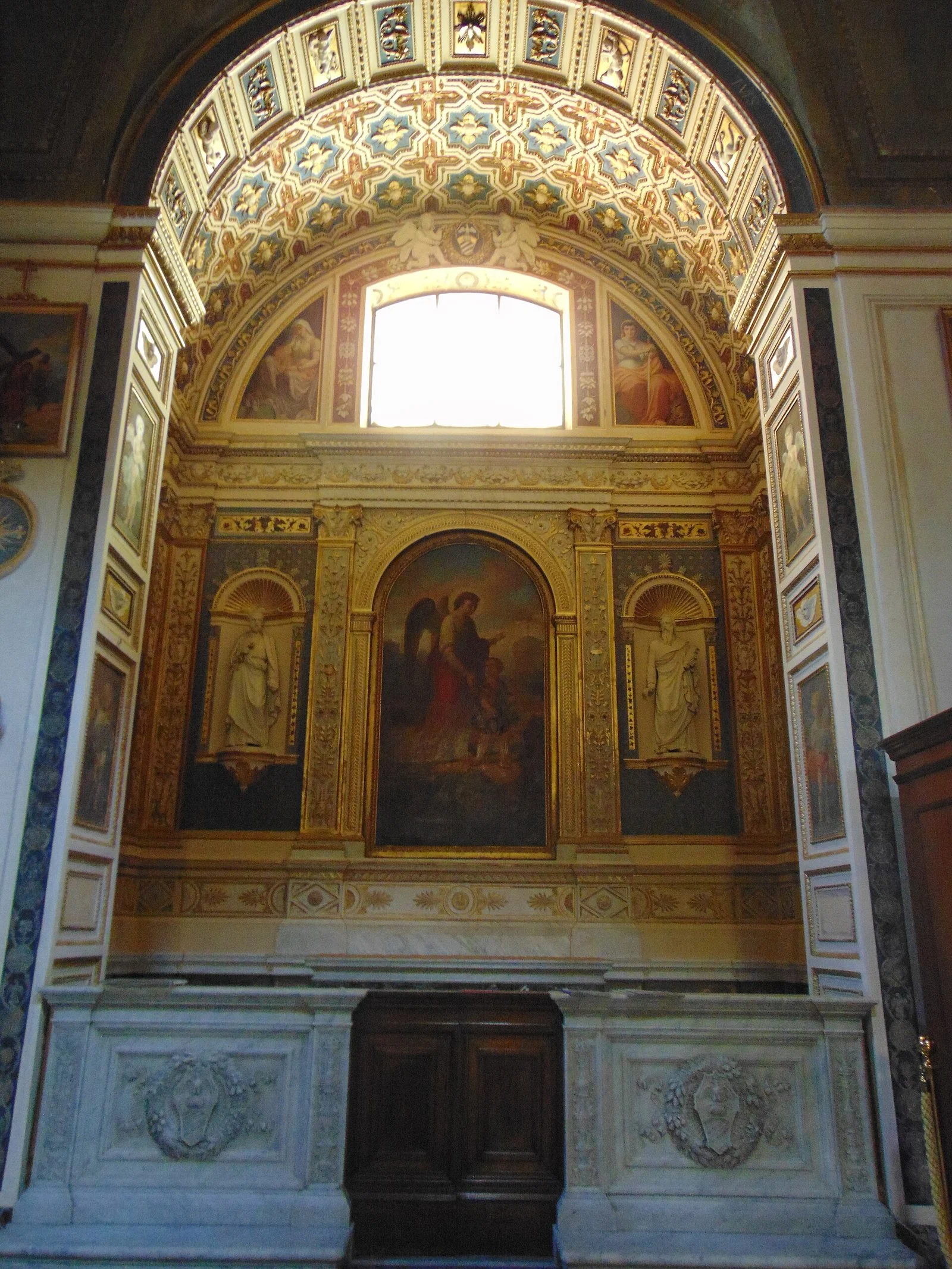
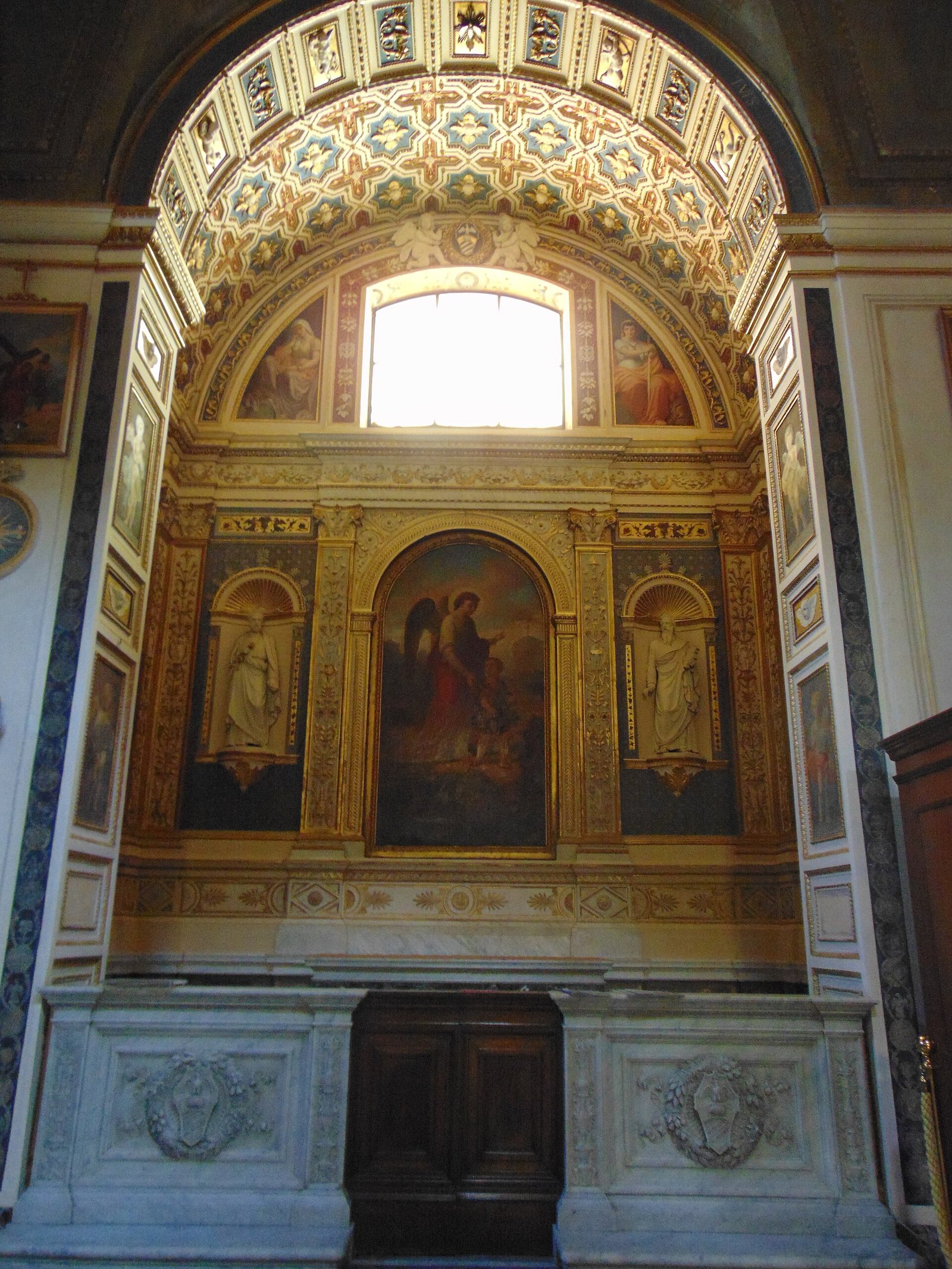
The interior is three naves with six side chapels, decorated with stuccoes and frescoes. The first thing that strikes is the darkness. The church receives little natural light and the artificial lighting is kept low: visitors' descriptions agree in noting that the custodians turn on the lights of the main chapels on request. Whoever enters and stays three minutes without asking for anything sees practically nothing.
The fresco of the high altar
On the high altar is the oldest work in the church: a Madonna and Child with Saint Stephen, referred to the school of Pietro Cavallini and dated to the 14th century, with some sources leaning toward the late 13th. The painting was not born here: it comes from the church of Santo Stefano del Trullo, demolished, and was transferred together with some funerary monuments. In the iconography the saint kisses the feet of the Child, a detail the descriptions flag as unusual. The altar that receives it is referred to Mattia de Rossi and dated 1681.
The chapel of the Annunciation and Carlo Saraceni
The presence of Carlo Saraceni is the best-documented fact of the whole church. The Dizionario Biografico degli Italiani, in the entry dedicated to the painter, lists among his works an oil-on-wall cycle with Stories of the Virgin, placed in Santa Maria in Aquiro in the Ferrari chapel and dated to before 1617. The technique deserves attention: oil spread directly on the wall, not fresco, a solution that Saraceni practices and that over the centuries has created conservation problems. Other entries speak of activity between 1611 and 1617 and of a single canvas with the Birth of the Virgin dated 1617.
Francesco Nappi, probable attribution
The altarpiece of the same chapel is assigned by some reconstructions to Francesco Nappi, a Milanese painter active in Rome in the early 17th century. The attribution appears with cautious formulas of the type plausibly or probably, and we have not found a source that presents it as documented. We therefore report it as a proposal of the literature, not as an established fact.
The chapel of the Passion and the Honthorst case
In the left nave is the chapel of the Passion of Christ with three Caravaggesque canvases: a Deposition from the Cross, a Crowning with Thorns and a Flagellation, datable to around the 1630s. For a long time they were attributed to Gerrit van Honthorst, the Dutch painter whom they called Gherardo delle Notti in Rome. The most recent criticism has shifted the attribution toward Trophime Bigot, a French painter from Arles active in Rome in the second quarter of the century, long known only as the Master of the Candlelight.
The case is worth more than the single church. Bigot is one of those painters that art history reconstructed backward, starting from a group of anonymous works united by candlelight and arriving only in the 20th century at giving him a name and a catalog. The canvases of Santa Maria in Aquiro fall within that reordering, and not all with the same certainty: the more analytical reconstructions accept the attribution to Bigot for part of the group and leave it open for the rest, with an alternative hypothesis circulating for the Deposition. Whoever wants to understand the context of that painting finds a general guide on our page about Caravaggio in Rome.
The 19th century of Cesare Mariani
What is seen today as the general decorative cladding, however, is 19th-century. A fire in 1845 badly damaged the interior, the presbytery was rearranged in 1856 and between 1864 and 1868 a decoration campaign of the nave and transept took place under the direction of the architect Gaetano Morichini, with the painting work of Cesare Mariani and Pietro Gagliardi. To Mariani is assigned the canvas with Saint Girolamo Emiliani presenting the orphans to the Madonna, dated 1867: a painting that says explicitly what this church was for.
The works we left out
Some pieces of information that circulate we did not write into the body of the page because they rest on a single unverifiable source. Among them, the attribution of a Guardian Angel to Ippolito Zapponi with the date 1867, that of an Apparition of the Trinity and the Madonna to Vincenzo Pasqualoni dated 1877, and the description of a painting of 1873 as the first Roman depiction of the Madonna of Lourdes, a primacy that no independent source confirms. They probably exist, but we are not able to guarantee them.
A curiosity about Santa Maria in Aquiro
The facade of this church took about 170 years to be finished, and for much of that time Rome simply lived with it. The lower register was raised within the first decade of the 17th century, then the funds ran out and the building site stopped. From around 1605 until the 18th-century completion, generations of Romans crossed Piazza Capranica seeing a church cut off at half height, with rough masonry above the cornice.
The interesting detail is that nobody found it urgent. In Baroque Rome an unfinished facade was not a scandal but an ordinary condition, and the same happened to much more famous churches. San Lorenzo in Florence never had its own, and in Rome several parishes waited a century for their front. The modern idea that a building must be delivered finished belongs to another economy and another idea of time.
Something nobody tells you about Santa Maria in Aquiro
Under the Santa Maria in Aquiro complex lie the remains of an imperial temple, and almost no guide to the area tells it. In 2005, during consolidation works on the foundations of the old orphans' hospice, there emerged large column bases, a stepped flight, part of a peristyle and a stretch of paving that preserved traces of ancient color. Deeper still, a platform of foundation piles referred to the 1st century was identified.
Which temple it is
The structures are traced back to the complex of the temple of Matidia, built by Hadrian after AD 119 to deify his mother-in-law Salonina Matidia. The temple stood in the Campus Martius between the area of the present Piazza Capranica and that of the Temple of Hadrian in Piazza di Pietra, and its location was confirmed by an inscription on a water conduit that carries the formula relating to the temple of Matidia. Antoninus Pius completed the complex with two basilicas dedicated to Matidia and Marciana, whose exact position remains disputed.
What you see on the surface
Of the temple, traces remain in view without going underground, and it is a three-minute walk. Two columns of cipollino marble are incorporated in the facade of the house at number 76 of the same Piazza Capranica, and the base of a third is visible in Vicolo della Spada d'Orlando, where the diameter lets you estimate original columns of about 17 meters. The lane takes its name from a groove on the shaft that legend attributes to a sword blow from Orlando.
The clarification that matters
The remains are not under the church but under the annexed palace, the one of the former orphanage now in use by the Senate, and are not part of an ordinary visiting route. There is no staircase going down from the nave, no ticket, no hours. Access happens on special openings or visits organized with the body that has the use of the spaces. Whoever wants to understand what can really be seen underground in the city finds an overall picture on our page about underground Rome.
The advice I give you for visiting Santa Maria in Aquiro
Walk in and ask for the light. It is the most concrete advice that can be given about this church, and it is worth more than any indication of hours. The interior is kept in half-light for reasons of consumption and conservation, the side chapels stay dark, and Caravaggesque canvases in an unlit church are black surfaces. The custodian or the sacristan, when present, turn on the spotlights of the main chapels if someone asks. Without that request the visit doesn't exist.
When to go
The best window is late morning on weekdays, between 10:00 and noon, when the church is open, no service is under way and someone from the staff is around. Late afternoon before the evening Mass works, but you risk walking in while the celebration is being prepared and the tour of the chapels becomes awkward. On Sunday morning the church belongs to those who pray in it: you go in, stop at the back, don't go around the chapels.
How much time it takes
With the lights on, 25 minutes are enough for the high altar, the chapel of the Passion, the chapel with the Stories of the Virgin and a tour of the naves. Without lights you leave in five minutes convinced there was nothing, and that is exactly what happens to most people who walk in by chance. Whoever has a whole afternoon should pair it with two or three nearby stops instead of treating it as a stand-alone destination.
With whom it doesn't work
With small children this church gives little: there are no educational routes, the interior is dark, there is nothing to touch and the level of attention required is high. With those who have little time in Rome and want to see the things that are remembered, it must be said honestly that the priorities are elsewhere: the full picture of what to sacrifice we give in the pages on Rome in a day and on a weekend in Rome.
Another well-known fact, yet rarely cited
This church was born as a welfare structure, not as a place of representation, and it is the fact everyone knows as a generic sentence and that almost nobody keeps in mind while looking at the building. The Roman diaconiae were warehouses and distribution centers before they were churches, and the archconfraternity that in the 16th century took over the place did so to gather children left alone.
Keeping this origin in mind changes the reading of the architecture. The very slow building site doesn't come from laziness but from the priorities of a body that had to maintain an orphanage: when money arrived, it went first to the food and education of the boys and then to the facade. Salviati's funding in 1591 in fact goes to a college, not to the second order of the front. The result is a church of serious size and restrained decor, in an area where the neighboring churches show far more expensive marbles and frescoes.
The most useful comparison is made 200 meters away, inside Sant'Ignazio, where an order with enormous resources can afford the painted fake dome and one of the most imposing Baroque apparatuses in Rome, or inside the church of the Gesù, where the financial means can be read in every centimeter. Santa Maria in Aquiro occupies the other end of the scale, and that is why telling it together with the others is useful.
The right photo to take at Santa Maria in Aquiro
The photograph worth setting up here is not the frontal facade, which comes out flat and lacking depth at almost every hour of the day. The cut that works is taken from the south corner of the square, where the facade goes into perspective and the two bell towers stagger: the oblique framing conveys the double nature of the building, the 16th-century lower register and the 18th-century upper one.
The light
The square is narrow and surrounded by tall buildings, so the facade stays in shadow for much of the day and receives direct sun for a limited window in the middle of the afternoon, with noticeable seasonal differences. In summer the light arrives later and higher, in winter it almost never gets there. Whoever wants the contrast between the ochre of the facade and the sky must accept waiting, or work on an overcast day, which on this plaster works better than you would think.
The detail that tells the most
The most tellable photograph is not the church but the two cipollino columns incorporated in the house at number 76 of the same square. They are ancient shafts that ended up inside a residential wall, with the veined marble surfacing from the plaster. In a single frame fit a temple of Hadrian, a modern building and the facade of the church in the background: it is the most direct way to show how Rome is made.
Inside
Inside, photography is allowed outside the hours of the celebrations, but the darkness makes almost everything shot handheld useless. Flash doesn't help and disturbs, tripods in a parish church are not set up without asking. The best result is obtained by resting the camera or phone on a pew and accepting long exposure times, after getting the chapel lights turned on.
Some important events that happened here in history
8th century: the restoration of Gregory III
The first documentary foothold is the restoration promoted by Pope Gregory III between 731 and 741, recorded in the Liber Pontificalis. It is the date from which one starts to state that the building already existed, while everything earlier remains in the field of hypotheses. Whoever reads older dates presented as certain should also read the note at the bottom of the entry, because usually there isn't one.
1389: the attempt to change the name
With the institution of the feast of the Visitation by Urban VI, the church is also indicated as Santa Maria della Visitazione. The new name doesn't catch on, and Aquiro survives. It is the kind of event that leaves no architectural traces and that nonetheless says much about the resistance of popular usage to official names.
1540 and 1541: the welfare turn
The company born for the care of orphans receives the church from Paul III and then obtains papal confirmation. It is the moment when Santa Maria in Aquiro stops being a church among many and becomes the center of a system of care that will last four centuries. The exact dates waver between 1540 and 1541 in the different reconstructions, depending on whether one considers the foundation of the company or the pontifical act.
1588 and following: the building site
The start of the reconstruction wanted by Cardinal Salviati opens a season of discontinuous works that reaches the 18th century. In between are the death of Capriani da Volterra in 1594, the resumption of the building site with Maderno at the start of the 17th century, the halt around 1605 and the completion of the facade in the following century.
1826: the Somascans arrive
Leo XII reorganizes the Roman welfare institutes and entrusts the management to the Clerics Regular of Somasca. The passage also marks a change in educational approach, with greater attention to schooling. The Somascans are still here, and this makes Santa Maria in Aquiro one of the few Roman places in which the original function and the community that carries it out have such a long continuity.
1845: the fire
A fire badly damages the interior and opens the season of 19th-century restorations. The presbytery is rearranged in 1856, the decoration of nave and transept takes place between 1864 and 1868 under Gaetano Morichini, with Cesare Mariani and Pietro Gagliardi on the painting. What is seen today as the general atmosphere of the interior comes from this intervention, not from the 17th century.
1871 and after: the Italian State
A royal decree of December 1871 places the body in the system of pious works under public control, and in the following decades the holdings pass largely to the State. The church itself today falls among the places of worship administered by the competent state fund, while the former orphanage is in use by the Senate.
2005: the excavation
The foundation consolidation works bring to light the remains of the Matidia complex. It is the last relevant event in the history of the place, and concerns a level that in 731 was already buried for centuries.
Who passed through Santa Maria in Aquiro
The names tied to this church divide into three categories: those who wanted it, those who built and painted it, those who lived in it. The third category is the largest and the least documented, because it is made of people whose names were not preserved.
The patrons
Gregory III in the 8th century, Urban VI at the end of the 14th, Paul III in the 16th, Leo XII in the 19th: they are the popes who appear in the chronology. The real patron of the modern church, however, is Cardinal Antonio Maria Salviati, who financed the reconstruction and the college. The Salviati family was Florentine and related to the Medici, and its presence in Rome can be read in several points of the city.
The architects
Francesco Capriani da Volterra lays out the building and dies in 1594. Carlo Maderno, who a few years later will be the author of the facade of Saint Peter's, resumes the building site at the start of the 17th century. Pietro Camporese the Elder closes it in the 18th. Gaetano Morichini directs the 19th-century restoration. A church crossed by four generations of professionals, each with a different idea of what it should be.
The painters
Carlo Saraceni is the name of greatest weight, a Venetian transplanted to Rome and among the protagonists of the generation that absorbs Caravaggio's lesson without limiting itself to copying it. Trophime Bigot, or whoever stands for him, in fact signs the canvases of the Passion. Giovanni Battista Speranza works on the vault. In the 19th century Cesare Mariani and Pietro Gagliardi intervene. Whoever wants to follow the Caravaggesque thread in the city can continue toward Sant'Agostino, where the Madonna dei Pellegrini is found, and toward Santa Maria del Popolo.
The saints and the religious
The circle of Ignatius of Loyola stands behind the foundation of the orphans' company, and Girolamo Emiliani, founder of the Somascans, is the spiritual reference of those who have run the place since 1826. Mariani's painting that depicts him presenting the orphans to the Madonna is the point where the history of the institution and the decoration of the church coincide.
The kids
For four centuries this was the address of hundreds of children left without families in Rome. No names of theirs remain in the guides, but the archives of the institution remain, preserved and described in the public archival systems. Whoever looks for the meaning of this church will find it there more than in the painterly attributions.
Hours and opening regime
Santa Maria in Aquiro is a working parish, not a museum, and this is the key to understanding the hours. There is no tourist visiting schedule: the church opens for worship and whoever enters does so within that calendar. The community that serves it is the Clerics Regular of Somasca, and the opening windows follow their organization, which can change with changes of parish priest, with summer and with holidays.
The Masses
The listings of celebration times indicate for weekdays, Saturday included, two Masses, early in the morning around 07:45 and in the evening around 18:30. On Sunday the Masses rise to three, late in the morning and in the evening. They are typical hours of a center parish set for those who work in the area: the morning Mass before the office, the evening one on leaving.
When the church is actually open
Between the morning Mass and the evening one the church generally stays accessible, but with a closure in the central hours of the early afternoon that is common practice in Roman parishes. It is not an hour published with precision, and it changes. Whoever arrives between 13:00 and 16:00 risks a closed door. Whoever wants to be sure phones the parish the day before: the number is published by the diocese and by the hours listings.
The closures that surprise
There are two variables that nobody in Rome allows for and that weigh more here than elsewhere. The first is non-ordinary celebrations: funerals, weddings, confirmations, which in a center parish are frequent and make a tour of the chapels unthinkable. The second is security: Piazza Capranica borders the Chamber's area, and during demonstrations, state visits or summits it can happen to find barriers and filtered access on the surrounding streets. It doesn't close the church, but it lengthens the route.
Admission and costs
Admission is free and there are no tickets, reservations or audio guides. There is no bookshop. Offerings go toward the upkeep of the building and the parish's activities. Whoever looks for other Roman things to visit without spending finds our roundup on free Rome, where churches weigh more than any other category.
Accessibility
Access from the square has some steps and no equipped route is declared for those who use a wheelchair. As there is no visits office, the check must be made by contacting the parish. The interior floor is level once past the threshold.
What is around, within five minutes on foot
The value of Santa Maria in Aquiro grows a lot if it is placed in a loop, because it sits at the geometric center of one of the densest concentrations of monuments in Europe. What follows is a walking order that works, not a list.
Toward Parliament
Leaving the church and turning right you reach in one minute the square of Montecitorio, with the palace that Bernini designed for the Ludovisi and that now houses the Chamber of Deputies. At the center of the square is the obelisk of Montecitorio, brought from Heliopolis by Augustus and used in antiquity as the gnomon of a great sundial in the Campus Martius. The link with the Ara Pacis and with the Mausoleum of Augustus is no accident: they were pieces of the same monumental program.
Toward Piazza Colonna
On the other side, two minutes away, opens Piazza Colonna with the column of Marcus Aurelius, the historiated shaft almost 30 meters high that tells of the Danubian wars. The column is visible at any hour and without a ticket, and from Via della Guglia side you catch the relation of scale with the houses around. Palazzo Chigi, seat of the government, occupies the northern side of the square.
Toward the Pantheon
Taking Via delle Coppelle or Via degli Uffici del Vicario you reach in four minutes the Pantheon, with the Macuteo obelisk on the fountain in front. From there, another two minutes and you are at the Minerva with Bernini's little elephant holding up the obelisk of the Minerva, one of six ancient obelisks set upright again within a radius of a few blocks.
The other churches of the quadrant
Within walking distance are San Lorenzo in Lucina, a very ancient parish with Poussin's tomb, Santa Maria Maddalena with one of the few Rococo facades in Rome, Sant'Antonio dei Portoghesi, the Portuguese national church, and Santa Maria in Via Lata on the Corso, with the ancient underground rooms under the nave. None of these is crowded, all have free entry, and together they make up an alternative route to the one of the big names.
If time remains
10 minutes of walking lead to the Trevi Fountain or to Piazza Navona, 20 to the Quirinale or to Santa Maria in Campitelli. Whoever wants to build the loop over several days finds an already ordered layout on the page about three days in Rome, and whoever still has to choose the area to stay in, in the guide on where to stay in Rome. For the Bernini thread, which in this quadrant is very dense, we have a dedicated itinerary on Bernini in Rome, and for those who go around in the evening the page on Rome at night.
Eating in the area: Piazza Capranica, Montecitorio, Pantheon
The quadrant between Piazza Capranica, Montecitorio and the Pantheon is among the hardest in Rome for someone who wants to eat well without getting fleeced, and the reason is twofold. There is the positional rent of the square meters in front of the monuments, which exists everywhere in the historic center, and there is also the institutional customer: parliamentary aides, lobbyists, officials, journalists, delegations. A customer who lunches on an expense account and doesn't look at the bill generates prices that then fall on everyone else. It is an economic mechanism, not a moral judgment, but whoever doesn't know it pays for two.
The signals that save the bill
The first signal to read is the menu with photographs of the dishes, displayed on the street and translated into five or six languages. A kitchen that has something to say doesn't need to show the image of the carbonara: that panel is there to be understood by people passing once who will never come back. It also holds for laminated menus with little flags, and for chalkboards with the tourist wording in English given more prominence than the Italian.
The second signal is the person at the entrance inviting you in. Where Romans book, nobody stays on the sidewalk stopping passersby: that role exists only where the flow is random and the customer is served once. The polite version, the one that hands you the menu smiling, works exactly like the insistent one.
The third signal is the staging of handmade pasta in the window or on the sidewalk, with the lady rolling out the sheet behind the glass. It is a communication operation, not a clue to the cooking: in many cases that pasta is not what arrives on the plate, and in others it is real but serves to justify a doubled price. Good fresh pasta in Rome is made in the kitchen, where you can't see it.
The fourth signal is continuous hours. A place that serves from 10 in the morning to midnight with no kitchen closure has no shifts, no crew that rests and no service designed: it has a line that reheats. The trattorias that work close between 15:00 and 19:00, and this is perhaps the most reliable filter of all.
The price trick in front of monuments
In places facing the famous squares there is a precise practice to know about: menu items without a price, indicated as the day's quotation or with the wording subject to availability, and different price lists between inside and outside tables. The surcharge for the table with a view, when there is one, must be written. The practical rule is simple: if an item doesn't have the price printed, you ask before ordering, and if the answer is vague you get up. Asking for the itemized bill is a right, not a discourtesy, and in Lazio the cover charge as a fixed item follows precise rules, which it is worth knowing before arguing.
The chains of the center
Within five minutes of Piazza Capranica there are several places with a repeated sign, the same ones found identical in other Italian and European cities. They work as tourist attractions, with their line, their photographed entrance and their standardized product: they are predictable, clean, and give exactly what they promise. No snobbery, but it must be said clearly that Romans don't go there, and that going in means having made a different choice from eating Roman.
The criterion that always works
Look at who is sitting and in what language they order. It is the only method that doesn't fail in any area of Rome, and in this one it counts double. A place full of people speaking Italian at 13:30 on a Tuesday is a place that lives on return business, not on passing trade. A place full only of foreigners at 19:30 in the evening, when no Roman has had dinner yet, lives on passing trade. In this area a third indicator is added: the presence of tables occupied by people with a badge around the neck indicates a place that lives on the offices, with steep prices but generally honest cooking, because that customer comes back every day.
Where to move
Whoever has 20 minutes should spend them leaving the quadrant. Toward the Ghetto, toward the stretch of rione Monti beyond Via Nazionale, toward the part of the Campus Martius to the north that the flows don't touch, prices drop and average quality rises. In the same logic, for coffee and pastry it is worth looking for the historic shops instead of the bars on monumental squares: we made a reasoned selection on the page about historic cafes and shops of Rome. The full picture of the criteria, area by area, is on our page about where to eat in Rome without falling into the tourist trap.
For addresses verified one by one, Daniele keeps a public list on Google Maps that he updates when something changes: the list of places to eat in Rome. It is not a ranking and it is not sponsored, they are the places where one really goes.
Frequently asked questions about Santa Maria in Aquiro
What does Aquiro mean?
The meaning of Aquiro is not known with certainty and the sources propose at least four explanations: a derivation from a personal name in the form a Cyro present in redactions of the Liber Pontificalis, a corruption of the Latin circus, a connection with the Equirria celebrated in the Campus Martius, and a reference to the Latin aqua because of the proximity of the Aqua Virgo aqueduct. None of these is proven by documents.
How much does it cost to enter Santa Maria in Aquiro?
Admission to Santa Maria in Aquiro is free, as in almost all Roman parish churches. There are no tickets, mandatory reservations or official guided visits organized by the church. The offerings left at the entrance go toward the upkeep of the building and the parish's activities, which is run by the Somascan fathers.
When is the church open?
The hours of Santa Maria in Aquiro follow the liturgical calendar of the parish, with weekday Masses early in the morning and in the late afternoon and three Masses on Sunday. The church generally stays accessible between the two celebrations, with a closure in the central hours of the early afternoon. The hours change with the seasons and with changes of parish priest: it is best to phone the day before.
Can you visit the Roman remains under the church?
The remains of the temple of Matidia complex identified in 2005 are under the annexed palace, not under the church, and are not part of an ordinary visiting route. The building is in use by the Senate of the Republic. Access happens only on special openings or organized visits, and there is no public schedule.
Who painted the canvases of the chapel of the Passion?
The three canvases of the chapel of the Passion, a Deposition, a Crowning with Thorns and a Flagellation, were for a long time attributed to Gerrit van Honthorst, called Gherardo delle Notti in Rome. The most recent criticism refers them wholly or in part to the Frenchman Trophime Bigot, for years identified only as the Master of the Candlelight. For some of them the attribution remains disputed.
Who serves the church today?
The church is run by the Clerics Regular of Somasca, the order founded by Girolamo Emiliani to care for orphans, who have been here since 1826 by decision of Pope Leo XII. It's a rare continuity: the charitable function that gave the place its purpose in the 16th century is still represented by the community that looks after it.
Why does the church get so few visitors?
Santa Maria in Aquiro suffers from the competition of famous monuments within 300 meters, a plain facade that doesn't catch the eye, a square used as an institutional service area, and the absence of any tourist promotion. On top of that the interior is very dark, which discourages people who walk in by chance and don't ask for the chapel lights to be turned on.
Who wrote this page
This page comes from the editorial team of Tour Leader Pro, the Rome-based company that designs visits, itineraries and cultural events in Rome and Lazio. The hours, access conditions and attributions given here were checked on the date of publication against the sources named in the text, and where the sources disagree we said so instead of picking one. It's worth checking again before you go: in parish churches the hours change without notice. If you find a wrong detail, let us know.
If you have to build a day in Rome that combines churches run by religious communities and not by tourist bodies, openings that depend on the liturgical calendar, areas where institutional security shifts the routes, and walking distances that look like nothing on the map, whether for yourself or for a group, you'll find working tools on Tour Leader Pro, designed both for those who guide and for those who organize on their own.
For the wider picture, trains and connections, rentals, airports and destinations in Lazio outside central Rome, from the Castelli to the lakes and the coast, a useful resource is Italy Planner.