Church of Santa Maria Maddalena
In short. The Church of Santa Maria Maddalena faces the small square of the same name in the Colonna district, less than two minutes' walk from the Pantheon, and keeps what is commonly considered the only fully rococo front in Rome: a concave…
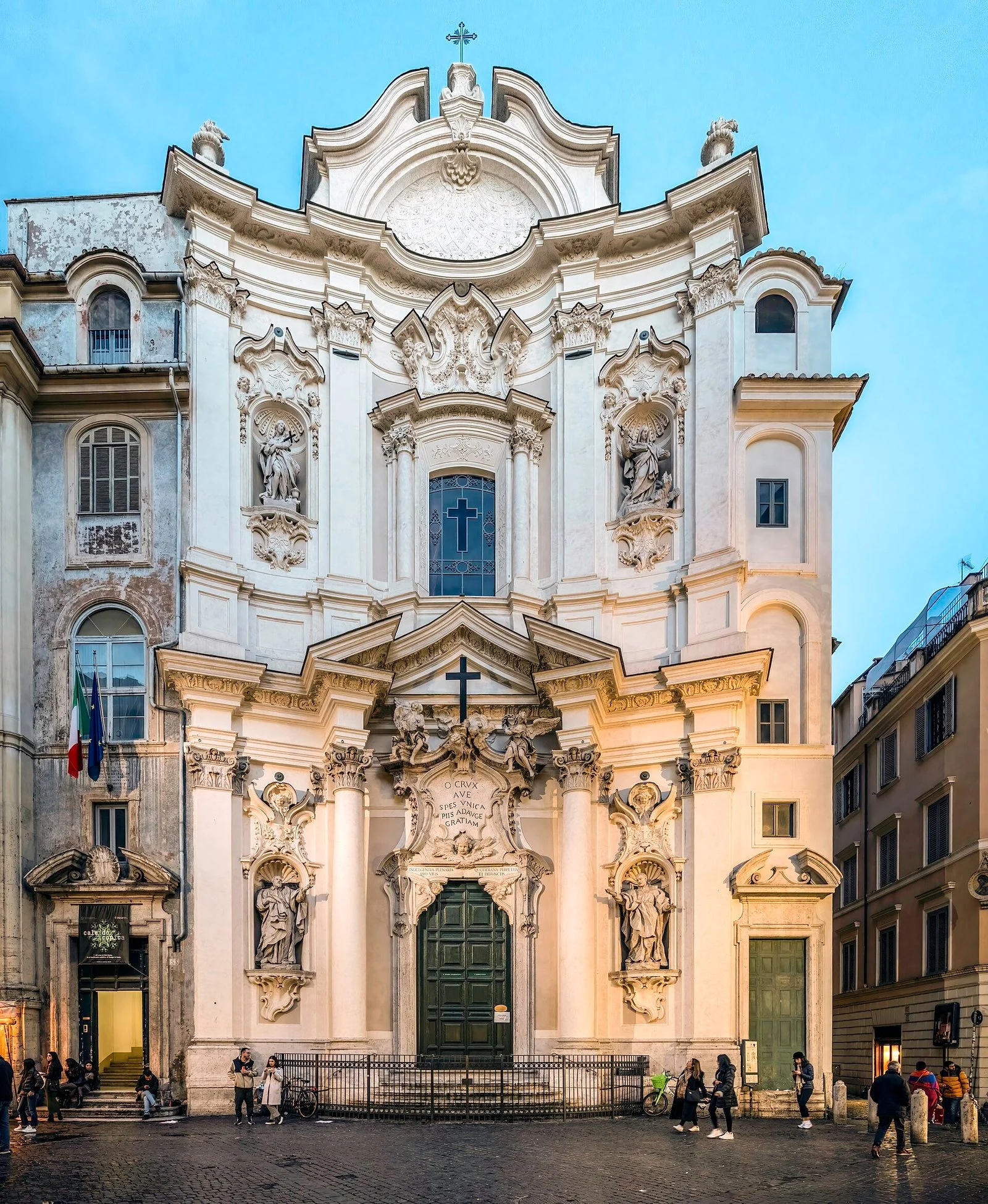
The Church of Santa Maria Maddalena faces the small square of the same name in the Colonna district, less than two minutes' walk from the Pantheon, and keeps what is commonly considered the only fully rococo front in Rome: a concave facade, modeled entirely in stucco, finished in 1735 and traditionally attributed to Giuseppe Sardi. It is a true rarity, not a convenient formula. Rococo, the light and curving style that between the 1720s and the 1760s swept over half of Europe, hardly took root in Rome, above all in sacred architecture, and this little church wedged among the alleys of Campo Marzio remains the most striking case to the contrary. The church is also the mother house of the Camillians, the Clerics Regular Ministers of the Sick founded by Camillus de Lellis, who died here on July 14, 1614 and rests here. The lines that follow tell how the facade is made and why it is an isolated case, what you see inside (an elliptical nave, a gilded choir loft, a sacristy that is a masterpiece in itself), who Saint Camillus was, what the real relationship is between the Camillian red cross and the Red Cross we know today, and how to organize a visit without wasting time.
Where the Church of Santa Maria Maddalena is and how to get there
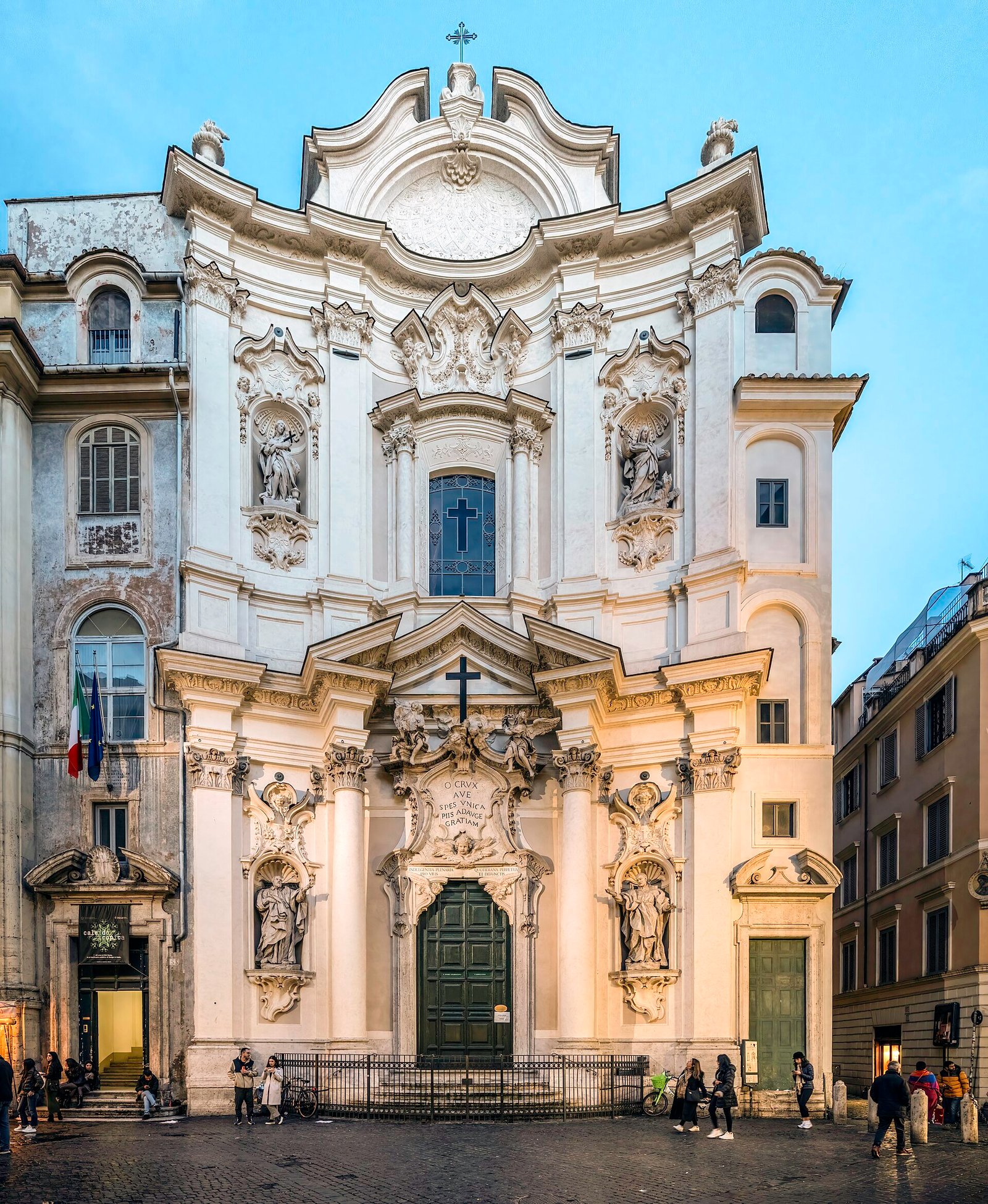
The church is at Piazza della Maddalena 53, in the Colonna district, about 150 meters from the Pantheon. You leave Piazza della Rotonda on the side opposite the portico, take Via della Maddalena, and in a few dozen steps the little square opens on the right. The entrance of the Camillian Generalate, attached to the church, opens at number 53, next to the main portal, with a portal topped by a broken pediment at the center of which appears the radiant cross of the Order.
On foot from the Pantheon and the historic center
The most natural route starts from the Pantheon: from Piazza della Rotonda, where the Macuteo Obelisk rises above the 16th-century fountain, you take Via della Maddalena and arrive in under two minutes. From Piazza Navona it takes about seven minutes, crossing Corso del Rinascimento and passing by the Basilica of Sant'Agostino in Campo Marzio. From Piazza Colonna and from Montecitorio, five or six minutes are enough going down Via degli Uffici del Vicario. From the Trevi Fountain the route is a little over 10 minutes at an easy pace, cutting through Via delle Muratte, Via del Corso and Via delle Colonnelle.
By public transport
There is no subway stop in the immediate vicinity: the whole Pantheon area is one of the zones of Rome's historic center farthest from the subway network. The usable stations are Barberini and Spagna on line A, both about a dozen minutes' walk away, and alternatively you arrive with the surface buses that serve Largo di Torre Argentina and Corso Vittorio Emanuele II, a few minutes on foot from the square. Those arriving from Termini can take subway line A to Barberini and walk down toward the center, or use one of the surface lines that cross the historic center toward Largo di Torre Argentina, which remains the most convenient interchange hub of the whole area.
By car the area is essentially off limits: the Pantheon area falls within the restricted traffic zone of the historic center and the surrounding streets are largely pedestrian or reserved for residents. Those arriving from outside Rome do well to leave the car in a park-and-ride connected to the subway and complete the trip by public transport: stopping to look for a space in this part of Campo Marzio almost always means losing more time than the whole walk on foot would take.
Opening hours and Masses
According to what the Camillians, who run the church, indicate, Santa Maria Maddalena is open Monday to Saturday from 8:00 to 12:00 and from 18:00 to 19:45, with Holy Mass at 19:00, while on Sunday it is open from 8:00 to 12:30 and from 18:00 to 19:45, with Masses at 9:30, at 11:30 and at 19:00. Since it is a church in use for worship, the hours can change for celebrations, concerts, restorations or holidays: before a planned visit it is worth phoning the Generalate, whose telephone number is given by the Order and by the tourism portal of the City of Rome. Entrance to the church is open and free.
The rococo facade: why it is a Roman one-off
The facade of Santa Maria Maddalena was completed in 1735, almost 40 years after the completion of the body of the church, and it is the element for which the building appears in every manual of architectural history. It is concave, on two orders, entirely covered in stucco decoration, and presents a repertoire of scrolls, shells, festoons and mobile frames that has no direct parallel in 18th-century Rome.
What rococo concretely means
Rococo is not simply a more loaded baroque: it is a different sensibility. The Roman baroque of the 17th century works by masses, by contrasts of light and shadow, by broad and theatrical architectural gestures. Rococo works instead by surfaces, by continuous undulating lines, by a fine ornament that tends to cover the whole wall without strong hierarchies. The preferred forms are the shell (the rocaille from which the style takes its name), the asymmetrical scroll, the frayed cartouche, the frame that never fully closes. It is a style born in Regency France and then spread above all in central Europe, in Bavaria, Bohemia and Austria, and in northern Italy, from Piedmont to Lombardy to the Veneto.
In Rome this language almost never took hold in architecture, and least of all in that of churches. The reasons most often given are two, and both should be taken with the caution that general explanations deserve. On one side the weight of ecclesiastical patronage, generally conservative and tied to an idea of sacred decorum matured in the 17th century. On the other the gravitational pull of the Roman baroque model itself, that of Bernini, Borromini and Pietro da Cortona, so authoritative as to make any radical turn difficult. The result is that the Roman 18th century produces the barocchetto, that is, a lighter and softened version of the previous language, but not a full rococo.
A concave facade, all modeled in stucco
The first thing that strikes you is the curvature. The front is not flat but recessed, and this produces two immediate effects: it optically widens the little square, which is small, and it creates a play of shadows that changes continuously through the day. The second is the material. The decoration is in stucco, not in marble or carved travertine, and stucco allows a soft, almost plastic modeling that cutting stone would not allow except at enormous cost. The surface is treated like a paste worked in relief, and from exactly this comes the nickname the Romans stuck on it.
Whoever looks at the facade carefully also recognizes motifs that recall the repertoire of Francesco Borromini, in particular in the way the frames bend and in the treatment of the crownings. It is a debt that is not surprising, since Borromini is the Roman architect who more than any other worked on the curved surface and on ornamental detail as an integral part of the structure. Anyone who wants to make the comparison on site has two points of reference a few minutes away by bus, the Church of Sant'Ivo alla Sapienza and the Church of San Carlo alle Quattro Fontane, both by Borromini and both built around the idea of a curved wall.
Who really designed the facade
The authorship of the facade is a matter of discussion among scholars, and it is worth saying so clearly instead of repeating the brochure formula. The most widespread guides and reference works assign the work to Giuseppe Sardi, an architect born in Sant'Angelo in Vado in 1688 and died in Rome in 1770, trained as a master mason and also active as a picture dealer, to whom are due, among other things, the 18th-century facade of Santa Maria in Cosmedin, later dismantled at the end of the 19th century in the Romanesque restoration, and the church of the Santi Quaranta Martiri e San Pasquale Baylon in Trastevere.
A part of the critics, however, has cast doubt on this attribution. Between 1732 and 1734 the Portuguese architect Manuel Rodrigues dos Santos directed, as architect of the Order, the completion of the works on the church, and the scholar Alessandra Marino, in an essay published in the Quaderni dell'Istituto di Storia dell'Architettura in 1990, proposed assigning to him the conception of the facade decoration, noting among other things how dos Santos's training in the art of cabinetmaking explains well an ornament superimposed on a preexisting structure, similar to that of the carved wooden furnishings of the period. The architectural historian Nina Mallory, too, in a work on Roman rococo architecture published in 1977, argued that Sardi can hardly be its author. Whoever visits the church today will still find the name of Sardi everywhere. It is the traditional version, but it is not a closed matter.
A curiosity about the Church of Santa Maria Maddalena
The Romans of the 18th century called it the sugar church. It was not a compliment. The nickname comes from the fact that the stucco decoration, fine and undulating, recalled icing whipped on top of a cake, and therefore something sugary, ephemeral, decidedly out of place on a sacred building. Alongside this nickname the criticism of the time also produced an even fiercer formula, handed down by local sources, which branded the facade the non plus ultra of twisted taste, that is, the lowest point that taste could reach.
A necessary clarification on demolitions that never happened
The story often circulates that in the 19th century a real project was drawn up to demolish the facade and replace it with something more sober, judging it in bad taste. It is a piece of news that the sources available do not confirm in a documented way. What is certain is the existence of a long tradition of very harsh criticism of the style of the facade, from the nickname of sugar church to the formula about twisted taste, and the fact that in 1855 refurbishment work was carried out inside, in the Chapel of the Relics. Whoever wants to tell this church well will therefore do better to speak of a facade long detested, which is true and documented, rather than of a planned demolition, for which an archive confirmation would be needed.
Something nobody tells you about the Church of Santa Maria Maddalena
The church you see today was not born the way we see it, and it is the result of a construction site that lasted almost a century, with at least six architects passing the project from hand to hand. It is a detail that no plaque tells and that explains many of the building's oddities.
A construction site 70 years long
The rebuilding of the church began in the first decades of the 17th century, after the Camillians had obtained from Pope Urban VIII, in 1628, the authorization to open a new square in front of the building, as the inscription still legible on the convent states, for greater ornament of the City and service and convenience of the said church. The works proceeded in lots, chapel by chapel, and dragged on for a long time. As late as 1695 houses built against the right side of the building were still being demolished. The construction could be called complete in 1699, but the consecration took place only on May 4, 1727, and the facade arrived eight years later.
In the list of architects who succeeded one another appear Francesco Grimaldi, Carlo Fontana, to whom the dome and the vault built around 1673 are attributed, Giovanni Antonio De Rossi, who worked mainly on the interior layout, Giulio Carlo Quadri and Francesco Felice Pozzoni, who finished the body of the church in 1699. The adjacent convent, on the left side, was begun around 1678 on a design by the Palermo architect Paolo Amato and completed in the early 1680s by Carlo Francesco Bizzaccheri, with very sober forms on three orders. The contrast between the severity of the convent and the exuberance of the church's facade is one of the most instructive aspects of the whole complex.
The church was moved within the block
The urban detail that almost nobody notices is that the church does not occupy the footprint of the medieval building that preceded it. When the Camillians obtained permission to widen the square in front, demolishing at their own expense the houses that cluttered it, the church was moved toward the end of the block to make use of the space gained, while the convent went to occupy the left side. Put differently, Piazza della Maddalena is not the void left by chance. It is an operation of urban staging worked out on paper, in which the scenography of the concave facade finally finds its reason for being. Looking at the facade without knowing that the square was built expressly to look at it means missing half the project.
The interior: the elliptical nave and the chapels
The interior of Santa Maria Maddalena has a single nave of elliptical shape, with chapels on the sides, a transept under the dome and a deep apse, and it represents one of the most successful examples of integration between a late baroque layout of the late 17th century and a rococo decoration added in the following decades. Whoever enters from the sun-dazzled square takes a few seconds to get used to the half-light, and then realizes that the space is much more articulated than the facade let one expect.
The chapels on the right
The first chapel on the right is dedicated to Saint Francis of Paola, and keeps on the altar a canvas of Saint Francis of Paola Raising a Child, painted by Biagio Puccini in 1720. Next comes the Chapel of the Madonna della Salute, from 1718, designed by the Roman architect Francesco Ferruzzi and built by Giuseppe and Giovan Battista Luraghi. The Marian image venerated here, once placed on the high altar, is the Madonna and Child known as Salus Infirmorum, donated to the church by Settimia de' Nobili in 1614. The decorative inserts in the lunette above the painting, with flying angels holding the crown and festoons with the dove of the Holy Spirit, are attributed to Giuseppe Ghezzi and dated 1759. The coat of arms recalls that the chapel is under the patronage of the Simonetti marquises.
The third chapel on the right, originally dedicated to the Assumption, is today the Chapel of Saint Camillus de Lellis and holds the remains of the saint, translated here in 1742. The initial design was by Francesco Rosa and was completed by Francesco Nicoletti. The historical sources give 1749 as the year of completion, a few years after the canonization of June 29, 1746. On the vault you admire the fresco of Saint Camillus in Glory by Sebastiano Conca, dated 1744, while on the altar is placed the altarpiece of Saint Camillus de Lellis to Whom the Crucifix Appears, by Placido Costanzi, made around 1749. Four alabaster columns hold up an undulating pediment and give the chapel an air of solemnity that stands out sharply from the lightness of the rest of the church.
The chapels on the left
On the left side, the second chapel is dedicated to Saint Lawrence Giustiniani, erected in 1694 at the wish of Francesco Giovanni Farsetti, with on the altar the painting Saint Lawrence Giustiniani Adores the Child made by Luca Giordano in 1704. It is probably the painting of greatest appeal in the whole church for those who arrive with a specific interest in Neapolitan painting of the 17th and early 18th centuries. Next comes the Chapel of Saint Nicholas of Bari, built between 1694 and 1696 for the Genoese banker Paolo Girolamo della Torre, covered in fine marbles and with on the altar the canvas Saint Nicholas of Bari before Jesus and the Virgin by Giovan Battista Gaulli, called il Baciccio. The dedication is not by chance: the life of Saint Nicholas was the examination subject of Camillus de Lellis for admission to the priesthood, and the saint of Bari remained for him a reference of charity throughout his life. The last chapel is that of the Madonna Assunta, built by Francesco Nicoletti, with on the altar a Madonna Assunta by Gerolamo Pesce from the first half of the 18th century.
The high altar and the apse
The high altar is the fulcrum toward which all the lines of the nave and the crossing converge in perspective. The back wall holds the painting of Saint Mary Magdalene in Prayer and the Camillian cross carried in glory by angels, a work of 1698 by Michele Rocca of Parma. Originally the canvas was rectangular and received its arched top only later, when Felice Fardichini carved its rich gilded frame, finished at the top with floral motifs, doves and a shell. Above the painting, a group of angels sculpted by Pietro Pacilli carries the cross in flight, set in a concave pediment that follows the line of the frame at the base of the apse semi-dome.
On the two concave walls of the apse are two large marble bas-reliefs, The Marys at the Sepulchre on the left and Noli me tangere on the right, by Francesco Gesuelli, begun in 1756 and put in place the following year. In the apse semi-dome the fresco The Preaching of Christ to the Crowds by Aureliano Milani of Bologna dominates. The whole is a good example of how the Roman 18th century still knows how to build a unified backdrop, mixing painting, marble sculpture and gilded carving without any of the three languages prevailing over the others.
The organ and the choir loft: the piece almost nobody looks at
On the inner facade wall of Santa Maria Maddalena is a double choir loft topped by a pipe organ inside a carved and gilded wooden case. It is a complex that the Camillians themselves call a unique model of its kind and that most visitors never look at, because you enter with your back to exactly that wall.
Who built the organ
On the organ itself the sources tell an articulated story, and it is worth giving in full because imprecise versions circulate. The Camillians name as author of the instrument the German Hans Conrad Werle, an organ builder of considerable fame who signed several instruments in Rome and Lazio, and place the first official trial of the organ on July 21, 1726. The most detailed encyclopedia entry available reconstructs instead a many-handed story: an instrument built in 1706 by Giuseppe Testa, case and decorative apparatus of the same year designed by Giulio Carlo Quadri and made by Giovan Domenico Barbiani, then a deep modification by the Tyrolean Johann Conrad Werle in 1735, a further intervention by Giacomo Pinacci in 1790 and work by the Paoli firm in the early 20th century, with the consequent loss of the original tonal character.
The two reconstructions are not irreconcilable, because the Werle named by the Camillians and the Johann Conrad Werle of the encyclopedia entry are evidently the same person, and the difference concerns the weight attributed to his intervention: author of the instrument for one source, radical reworker of a preexisting organ for the other. As for the sound side, the organ was entirely rebuilt in a contemporary neo-baroque style by the Ruffatti Brothers in 1977, keeping Werle's tonal material. Today it has mechanical action and 21 stops on two manuals and pedal.
A clarification on an attribution that circulates online
It must be said clearly that in the sources available no 16th-century organ appears in this church, nor any organ builder named Hans Donati linked to the Maddalena. The confusion arises in all likelihood from the similarity of sound with the name of Hans Conrad Werle, who is instead perfectly documented. Whoever looks for ancient instruments and the history of Roman musical liturgy finds a much more complete overall picture at the National Museum of Musical Instruments, which keeps one of the most important organological collections in Italy.
The sacristy: the Roman barocchetto was born here
The sacristy of Santa Maria Maddalena, built between 1738 and 1741, is considered a unique example of the Roman barocchetto, the style of transition between baroque and rococo, and according to the Camillians it was right here that Gerolamo Pesce inaugurated it. For many visitors it is the strongest surprise of the whole visit, because the room has been preserved almost intact in its 18th-century configuration.
From refectory to sacristy
Originally this hall was the refectory of the Camillian seminary. During the canonization process of Saint Camillus, between 1743 and 1746, it was transformed into a sacristy, and with this function it has come down to today. It is a change of use that says a lot about the Order's priorities in those years: the canonization of the founder meant an influx of pilgrims and an increase in celebrations, and a service space suited to the new status of the church was needed.
The vault by Gerolamo Pesce
The vault was painted in fresco and tempera by Gerolamo Pesce in 1739 and depicts Saint Camillus in Glory with Saint Philip Neri. The composition, enclosed at the sides by a sinuous balustrade that frames it, has an upward thrust toward the background of sky. There is an iconographic detail worth looking for: of the two saints in the foreground, one has a halo and the other does not, and it is not a lapse of the painter. Philip Neri had already been canonized, Camillus de Lellis had not, and the difference in treatment records precisely the canonical situation at the moment the fresco was painted, that is, a few years before the beatification of 1742.
My advice for visiting the Church of Santa Maria Maddalena
The most useful advice is not to treat this church as a three-minute stop between the Pantheon and Piazza Navona, but to arrive with at least half an hour and, above all, to arrive at the right times. The church closes in the middle of the day, and whoever passes through Piazza della Maddalena at two in the afternoon finds the door barred: the morning opening stops at 12:00 on weekdays and at 12:30 on Sunday, and reopens only at 18:00.
The best moment of the day
For the facade the ideal moment is the late afternoon, when the raking light carves out the stuccoes and the curvature of the front becomes readable even in a photograph. At noon, with the sun high, the decoration flattens and the facade loses a good part of its effect. For the interior the opposite reasoning holds: the church is lit from the big windows of the nave, and the morning time slot shows the whole of the gilding and marbles better. Whoever has time for only one visit and wants both things chooses late morning, around 11:00, which is a good compromise.
Asking to see the sacristy and the museum
The sacristy and the Order's museum are not openly accessible like the church. The museum, which is in the attached Generalate and keeps relics and everyday objects that belonged to Saint Camillus, is visited on request: the Order indicates as the way to send an email to the communications office or to phone the number of the Generalate. Whoever arrives without notice risks seeing only the church, which by itself is worth the detour, but misses the most singular part of the complex. A contact a few days beforehand changes the visit completely, especially for those traveling in a group.
How to fit it into an itinerary
The location is so central that the Maddalena fits into any tour of the historic center at no cost in walking. An itinerary that works well starts from the Pantheon, continues to the Maddalena, touches the Basilica of Santa Maria sopra Minerva with its Obelisk of the Minerva, and ends with the Church of Sant'Ignazio: four stops within a radius of 300 meters, all with free entry, covering 2,000 years of Roman architecture from the temple of Hadrian to the 18th century. Those with more time add Piazza Navona and the Church of San Luigi dei Francesi with the Caravaggios, five minutes away.
Saint Camillus de Lellis, the giant of charity
Camillus de Lellis was born in Bucchianico, in Abruzzo, on May 25, 1550 and died in Rome on July 14, 1614, in the convent of the Maddalena. The church we are describing is therefore the place of his death as well as of his burial, and it is the reason the whole building is constructed around his memory.
A biography that starts badly
His is not the story of a precocious saint. Son of an officer in the service of Spain and of a mother who bore him at almost 60, Camillus was a restless boy, set on a military career and then removed from arms in 1570 by an ulcer on his foot that would stay with him all his life. To get treated he came to Rome, to the Hospital of San Giacomo degli Incurabili, on March 7, 1571. He was hired as an attendant and dismissed soon after for little inclination to work, after just 131 days. He went back to being a soldier of fortune, first for Venice and then for Spain, and ruined himself at dice.
The turning point came on February 2, 1575, while he was working for the Capuchins of Manfredonia: the conversion, which took place according to the traditional account on the road back from San Giovanni Rotondo, pushed him toward religious life. The sore on his foot kept him from staying with the Capuchins, however, and brought him back to Rome and to San Giacomo, where this time he stayed four years as a servant, from October 23, 1575 to June 20, 1579, and then again from October 1579 to September 1, 1584 as steward and Master of the House, for a total of nine years. It was there that the idea of professional, organized care for the sick matured.
The birth of the Ministers of the Sick
In August 1582, together with his first five companions, Camillus founded the Company of the Ministers of the Sick. The first statutes were approved by Pope Sixtus V on March 18, 1586. On September 21, 1591, with the bull Illius qui pro gregis, Pope Gregory XIV raised the Company to an Order of solemn vows, struck by the heroism with which Camillus and his companions had cared for the sick. The element that still distinguishes the Camillians from other religious orders is the fourth vow, added to the three usual ones of poverty, chastity and obedience: assistance to the sick, as the formula puts it, even the plague-stricken, even at the risk of life.
Camillus had been ordained a priest on May 26, 1583, under the spiritual guidance of Philip Neri, and then moved into the convent attached to the Maddalena to serve above all at the hospital of Santo Spirito in Sassia, the largest facility in Rome, without ever fully leaving San Giacomo. From 1571 to 1614, that is, for almost 44 years, he lived and carried out his ministry in the city of Rome, so much so that historians consider him for all intents and purposes a Roman saint by adoption.
Beatification, canonization and patronages
Camillus de Lellis was beatified on April 7, 1742 and canonized on June 29, 1746, both times by Pope Benedict XIV. In 1886 Leo XIII declared him, together with Saint John of God, patron of hospitals and of the sick. On August 28, 1930 Pius XI proclaimed him, again together with John of God, patron of nurses. Paul VI proclaimed him patron of the region of Abruzzo in 1964 and special protector of the Italian military health service in 1974. The liturgical memorial falls on July 14, the anniversary of his death. A large statue of him stands in the central nave of St. Peter's Basilica, sculpted by Pietro Pacilli, the same author as the angels above the high altar of the Maddalena.
The Cubiculum and the saint's heart
Inside the Generalate is kept the Cubiculum, the old infirmary of the house, that is, the room in which Camillus died on July 14, 1614, today used as an internal chapel. There the relic of the saint's heart is kept, initially translated to Bucchianico and then brought back to Rome. In 2012, on the occasion of the expansion works of the museum for the fourth centenary, the heart received a new display setting. The body, instead, rests in the church, in the chapel dedicated to him. Between June 16 and July 27, 2012, for the first time after four centuries, the remains returned temporarily to Bucchianico.
The Camillians' red cross and the modern Red Cross
The red cross that the Camillians have worn sewn on their habit since 1586 predates by almost three centuries the international Red Cross born from the Geneva Convention of 1864, but the relationship between the two is told around with a casualness that deserves correcting, because on this point you read claims much stronger than the sources allow.
What the document says
The certain and documentable fact is one. With the brief Cum nos nuper of June 26, 1586, Pope Sixtus V granted Camillus and his companions the faculty to wear in perpetuity, on the right side of their garments, a cross of coarse cloth of a reddish color, called in the vernacular tané. The brief was the direct consequence of the approval of the Company on March 18 of the same year: the religious asked that, as their institute was distinguished from others, so their habit should be distinguished too. The original color, therefore, was not full red but tané, a reddish brown. True red came only later.
What the Order says, and with what caution
On the relationship with the modern Red Cross, the Camillians themselves, in a text edited by the Order's historical archive, use a cautious language that is worth reporting. The reconstruction starts from the established fact that on June 24, 1859, during the battle of Solferino and San Martino, in nearby Castiglione delle Stiviere there were Camillian religious working who spared no effort in assisting the wounded, and that the young Swiss Jean Henry Dunant also witnessed that battle, from whose experience came the idea that led to the Red Cross. From here the Order observes that it would have been easy for Dunant to draw inspiration from a symbol that had stood out on the chests of the Camillians for over three centuries, but it puts the claim in the conditional and concludes that the importance lies not so much in the symbol as in the shared purpose of the two realities.
Where the line falls between fact and story
To sum up plainly: it is documented that the Camillians have worn a red cross on their habit since 1586 by concession of Sixtus V. It is documented that Camillian religious gave aid to the wounded in the days of Solferino. It is documented that Dunant was at Solferino and that from that experience came his book A Memory of Solferino. What is not documented, and the Order itself does not claim, is that Dunant chose the emblem of the Red Cross by copying it from the Camillian one. The official explanation of the Geneva emblem is another, namely the inversion of the colors of the Swiss flag. Whoever tells this place by saying that the Red Cross was born here is skipping a step. What can be said honestly is that the idea of a visible sign identifying those who aid the wounded was already in circulation in Europe for almost three centuries, and that the Camillians were its first institutional bearers.
Another well-known fact, yet rarely mentioned
Santa Maria Maddalena is the regional church of the Abruzzese living in Rome, and it has been since before the Camillians received it. The tie with Abruzzo runs through the whole history of the building and explains choices that would otherwise seem arbitrary.
What the regional and national churches of Rome are
Rome has a fabric of churches tied to an Italian region or to a foreign nation, born as a reference point for the communities of outsiders who lived in the city: places where one's own dialect was spoken, the saints of home were celebrated, assistance was found and, in case of need, burial. The Church of San Luigi dei Francesi is the most famous example on the national side. The Maddalena is the Abruzzese equivalent, and its identity is today certified by the diocese of Rome.
The right photo to take at the Church of Santa Maria Maddalena
The photograph to take home from Santa Maria Maddalena is the frontal facade, shot from the opposite side of the square in the late afternoon, when the raking light makes the curvature of the front and the relief of the stuccoes readable. It is a less obvious shot than it seems, because the square is narrow and the temptation to open the wide angle too far ruins the proportions.
Where to shoot from
The best spot is the corner of the square toward Via delle Colonnelle, which lets you frame the facade almost frontally while leaving a little air at the sides. Whoever has a slow lens does well to lean on a wall or a small table: in the hours of fading light the exposure times get longer, and the stucco decoration, played entirely on small details, forgives camera shake very little. Whoever instead wants to tell the surprise of arrival can shoot from Via della Maddalena, with the facade appearing at an angle at the end of the alley, between the walls of the houses.
Some important events that took place here in history
The chronology of Santa Maria Maddalena concentrates in three seasons: the arrival of the Camillians in 1586, the long construction between the 17th and 18th centuries, and the season of mid-18th-century canonizations that gave the church its present appearance.
1586: the church passes to Camillus de Lellis
In 1586 the church, risen on a 14th-century chapel formerly owned by the Archconfraternity of the Gonfalone, is entrusted with the attached hospital to Camillus de Lellis as the seat of the Company of the Ministers of the Sick, founded four years earlier. To the Order and its convent was assigned the whole surrounding block, between Piazza della Maddalena, Via del Collegio Capranica and Via delle Colonnelle. It is the birth certificate of the complex as we see it today.
December 24, 1598: the Tiber flood
On December 24, 1598 one of the most ruinous floods in the history of the Tiber invaded this part of Campo Marzio. Tied to the church is the story that the 15th-century wooden statue of the Magdalene was seen floating upright on the waters rushing into the building and moving from a side chapel to the high altar, where it came to rest safely. This is a devotional tradition, not an established historical fact. The flood, that yes, is extremely well documented and is recalled by plaques scattered throughout the center of Rome. The statue exists, you can still see it, and it is the point where history and story touch.
1742 and 1746: beatification, translation, canonization
In 1742 the remains of Saint Camillus are translated to the third chapel on the right, coinciding with the beatification of April 7 of that year. In 1744 Sebastiano Conca frescoes the vault of the chapel. On June 29, 1746 Benedict XIV proclaims Camillus de Lellis a saint, and the works in the chapel continue until about 1749, the year of Placido Costanzi's altarpiece. Between 1738 and 1741, in the middle of this season, the sacristy is decorated, and between 1743 and 1746, during the canonization process, the old refectory of the seminary takes on the function it still has today.
Who passed through the Church of Santa Maria Maddalena
For such a small church, the list of people who left a mark here is surprisingly long, and includes saints, architects, painters and at least a couple of unknown people whose story was preserved by chance.
The architects
On the Maddalena construction site there followed one another Francesco Grimaldi, Carlo Fontana, Giovanni Antonio De Rossi, Giulio Carlo Quadri, Francesco Felice Pozzoni, Mattia de Rossi, Carlo Francesco Bizzaccheri, Paolo Amato, Francesco Ferruzzi, Francesco Rosa, Francesco Nicoletti, Manuel Rodrigues dos Santos and Giuseppe Sardi. It is a list that by itself tells the passage from full baroque to barocchetto and finally to rococo, and that makes this church a kind of one-to-one-scale manual of Roman architecture between the 17th and 18th centuries.
The painters and sculptors
Among the painters appear Giovan Battista Gaulli, called il Baciccio, author of the altarpiece of Saint Nicholas of Bari and of the decoration of the nearby Church of the Gesù, Luca Giordano, Sebastiano Conca, Placido Costanzi, Michele Rocca, Aureliano Milani, Biagio Puccini, Giuseppe Ghezzi and Gerolamo Pesce. Among the sculptors and carvers, Pietro Pacilli, Francesco Gesuelli, Felice Fardichini and Alessandro Richenbach. It is a concentration of names that in a bigger and more central church would generate lines at the entrance, and that here you visit in silence and alone.
The Romans who came to get the water
Until the end of the 19th century, on the anniversary of the death of Saint Camillus, Romans came to the Maddalena to receive a special blessed water in which was mixed a small quantity of dust taken from the saint's tomb, considered a remedy against every kind of ill. It is a devotional practice that no longer exists today, but that helps to understand the role this church played in the daily life of the city, in an age when the boundary between medicine and devotion was much thinner than today.
What is around the Maddalena
The Maddalena stands at the point of greatest monumental density in the historic center of Rome: within a radius of 500 meters you count around 10 places that elsewhere would be enough by themselves to justify a trip.
The Pantheon and its square
A couple of steps away is the Pantheon, the best-preserved building of ancient Rome by far, and in front of it the 16th-century fountain topped by the Macuteo Obelisk, the Egyptian monolith that comes from the nearby sanctuary of Isis and Serapis in the Campus Martius. The contrast between the solemnity of the Pantheon and the lightness of the Maddalena's facade, 150 meters away, is one of the most instructive pairings the center of Rome can offer.
Sant'Ignazio, the Minerva and the Gesù
In the opposite direction you reach in a few minutes the Church of Sant'Ignazio di Loyola, with the vault by Andrea Pozzo and the celebrated painted fake dome, and the Basilica of Santa Maria sopra Minerva, the only Gothic church in the center of Rome, in front of which rises the Obelisk of the Minerva on Bernini's little elephant. Continuing further you reach the Church of the Gesù, the mother church of the Jesuits, where Baciccio's vault offers a direct yardstick against the altarpiece that the same painter left at the Maddalena.
Frequently asked questions about the Church of Santa Maria Maddalena
How much does it cost to enter the Church of Santa Maria Maddalena?
Entrance to the Church of Santa Maria Maddalena in Rome is open and free, as in almost all churches in use for worship in the historic center. There is no ticket office or compulsory booking for the church alone. The museum of the Order, housed in the attached Generalate, is instead visited on request, by contacting the Camillians' communications office in advance to agree on day and time.
What are the hours of the Church of Santa Maria Maddalena?
According to what the Camillians indicate, the Church of Santa Maria Maddalena is open Monday to Saturday from 8:00 to 12:00 and from 18:00 to 19:45, with Mass at 19:00, and on Sunday from 8:00 to 12:30 and from 18:00 to 19:45, with Masses at 9:30, at 11:30 and at 19:00. Since it is a working church, the hours can vary for celebrations or works: it is worth checking them with the Generalate.
How do you get to the Church of Santa Maria Maddalena by public transport?
The Church of Santa Maria Maddalena is most conveniently reached on foot from the Pantheon, from which it is about 150 meters along Via della Maddalena. There are no subway stops nearby: the usable stations are Barberini and Spagna on line A, about 10 minutes' walk away, or you use the surface buses that serve Largo di Torre Argentina and Corso Vittorio Emanuele II.
How much time does it take to visit the Church of Santa Maria Maddalena?
To visit the Church of Santa Maria Maddalena, 20 or 30 minutes are enough, sufficient to look at the facade from the square, walk the nave, stop at the chapel of Saint Camillus and raise your eyes to the choir loft on the inner facade wall. Whoever has arranged in advance the visit to the Order's museum and the sacristy must count on at least an hour in total.
Why is the Church of Santa Maria Maddalena called the sugar church?
The Church of Santa Maria Maddalena was nicknamed the sugar church by the Romans of the 18th century because the stucco decoration of its facade recalled the icing of a cake. It was a criticism, not a compliment: the rococo style was judged worldly and ill-suited to a sacred building, so much so that the facade was also called the non plus ultra of twisted taste.
Where is Saint Camillus de Lellis buried?
Saint Camillus de Lellis is buried in the Church of Santa Maria Maddalena in Rome, in the third chapel on the right, originally dedicated to the Assumption and then named for him, where the remains were translated in 1742. The relic of the heart is instead in the Cubiculum of the attached Generalate, that is, in the room in which the saint died on July 14, 1614.
Was the Red Cross born from the Camillians of the Maddalena?
No, the international Red Cross is not born from the Camillians, even though the religious of the Maddalena have worn a red cross on their habit since 1586 by concession of Pope Sixtus V. It is documented that Camillians aided the wounded in the days of the battle of Solferino in 1859, the same one from which Henry Dunant drew the idea of the Red Cross, but no source documents that the Geneva emblem derives from the Camillian one.
Can you take photographs in the Church of Santa Maria Maddalena?
In the Church of Santa Maria Maddalena no general ban on photography appears to be posted, but the rules common to Roman churches in use for worship apply: no flash, no tripods, no shots during Masses. For shooting that goes beyond personal photography, including for professional purposes, you need to ask permission of the Camillian religious who run the church.
Is the Church of Santa Maria Maddalena suitable for children and is it accessible?
The Church of Santa Maria Maddalena is a short and simple visit, suitable also for families with children precisely because of its brief duration and its very recognizable facade. The entrance is preceded by a short flight of steps, so for those with mobility problems it is best to ask the Generalate in advance about the access arrangements available.
One last piece of advice for anyone organizing the itinerary
The Maddalena works better as a stop within a walk than as a destination on its own: it is two minutes from the Pantheon, costs nothing, takes half an hour and offers something you don't find anywhere else in Rome, namely an authentic rococo facade. Whoever organizes a day in the historic center does well to slot it between the Pantheon and Sant'Ignazio, and to schedule it in the time slot when the church is actually open, which is the easiest part of the whole visit to get wrong.
Whoever puts together a wider itinerary in the center of Rome, crossing this stop with the other stops of Campo Marzio and the Colonna district, can find useful planning tools on Tour Leader Pro, while for a broader picture of transport and destinations in Lazio Italy Planner is a good resource.