Santa Maria in Campitelli
In short. Santa Maria in Campitelli is in Piazza Campitelli, a small and almost always empty square that opens between the Jewish Ghetto of Rome and the climb to the Capitoline Hill, less than 300 meters from the Portico of Octavia and the Theater of Marcellus.
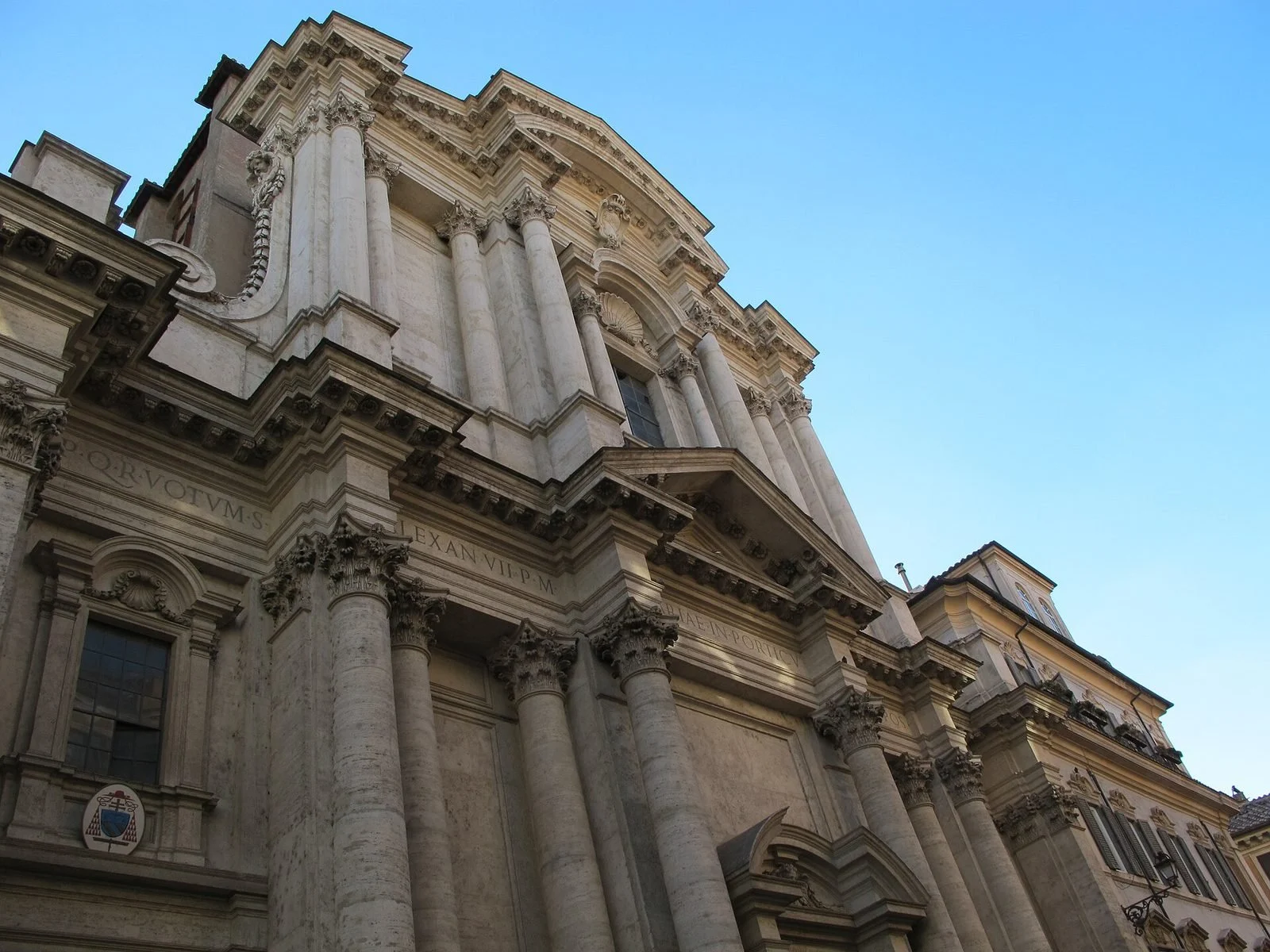
Santa Maria in Campitelli is in Piazza Campitelli, a small and almost always empty square that opens between the Jewish Ghetto of Rome and the climb to the Capitoline Hill, less than 300 meters from the Portico of Octavia and the Theater of Marcellus. The church was built by Carlo Rainaldi between 1662 and 1667 for a precise reason: to house permanently a very small Marian icon, the Madonna di Santa Maria in Portico, which the Romans held responsible for the end of the plague of 1656. So it was not born as a neighborhood parish church, nor as a noble family chapel. It was born as a civic ex-voto, decided and paid for by the Senate and People of Rome, and this explains the one thing that strikes anyone who comes here for the first time: the front of the church is enormously bigger than the square that hosts it, and the columns of the facade seem to elbow their way into the space. Inside, the reason to go in is something else again. Rainaldi lined up two different spaces, one in front and one behind, and hid the windows that light the second: as you enter through the portal you see the back of the church brighter than the area where you are standing, and the eye goes there on its own. This page explains how that effect works, what the icon really is, how much of what is told about its origin is history and how much is popular tradition, and how to organize a visit to a church whose hours change often and are not published in a stable way.
Where Santa Maria in Campitelli is and how to get there
Santa Maria in Campitelli looks onto Piazza di Campitelli, in the Campitelli district, a few steps from Via del Teatro di Marcello and the area of the Forum Holitorium. On the map it seems like a very central address, because it is, and yet almost nobody crosses it by chance: the square is not a thoroughfare, it leads nowhere except to itself, and whoever gets here usually gets here on purpose. The simplest way to place it is to think of it as the triangle of streets between the Ghetto, the ramp that climbs to the Capitoline Hill and the bulk of the Altar of the Fatherland, which from here you glimpse only sideways.
On foot from the Ghetto and the Portico of Octavia
From the Portico of Octavia it takes three or four minutes: you take Via della Tribuna di Campitelli or climb back up Via dei Funari, and the square opens suddenly, without warning, with the church facade taking up almost the whole far side. It is one of the best-constructed arrivals in the historic center, and the credit goes not to Rainaldi but to the very shape of the streets that lead there: narrow, crooked, shaded, and then the open space. If you come from the Synagogue of Rome or the Jewish Museum of Rome, add just under five minutes.
From the Capitoline Hill and Piazza Venezia
Coming down from the Capitoline Hill toward Via del Teatro di Marcello, and so from the Capitoline Museums, the church is less than five minutes on foot. From Piazza Venezia the time is the same, but the route is less pleasant because it runs alongside a high-traffic roadway. We recommend the second route only to those who are already leaving Palazzo Venezia. If instead you are coming down from Santa Maria in Aracoeli, you can take the descent toward Via di Sant'Omobono and slip into Piazza Campitelli from the more discreet side.
By public transportation
The useful surface stops are those on Via del Teatro di Marcello and at Piazza Venezia, served by the lines that connect Termini and the Lungotevere to the historic center. We don't list the line numbers because in Rome they change so often that any printed list is unreliable: it's best to check the updated route on the transit company's app or website on the same day. The nearest subway station is Colosseo, on Line B, from which you walk about 15 minutes along Via dei Fori Imperiali and then toward Via del Teatro di Marcello. Alternatively you get off at Circo Massimo, also on Line B, and climb back up the Lungotevere. In both cases the walk is flat until the last 50 meters.
Landmarks so you don't pick the wrong square
The risk, for those who don't know the area, is confusing Piazza Campitelli with Piazza Margana or Piazza Mattei, which are close by and resemble it in their silence. Three reference points settle the doubt. The first is the fountain in the middle of the square, an elongated basin on steps, attributed to Giacomo della Porta and placed here at the end of the 16th century. The second is the facade of the church, two orders high, entirely in travertine, with columns that come out of the wall instead of staying flattened like pilasters. The third is the presence of two noble palaces on the sides, Palazzo Capizucchi and Palazzo Albertoni Spinola, which close the square without crushing it. If the fountain is missing, you have ended up in the wrong square.
Why this church exists: the plague of 1656 and the city's vow
Santa Maria in Campitelli was born from an epidemic. In 1656 the plague that had struck Naples came up to Rome, and the city, though with a less catastrophic toll than Naples, stayed closed for months under a regime of quarantine, lazarettos and sanitary cordons run by the Congregation of Health established by Pope Alexander VII. When the contagion ran out, the reaction was the usual one of Baroque Rome: they looked for a supernatural party responsible for the deliverance, identified it in a Marian image already venerated in the district, and decided to build a new church for it.
What the vow was, in practice
The vow was not a private gesture of a cardinal or a family, and here lies the difference that explains everything else. It was a public decision, taken by the Senate and People of Rome, that is, by the civic administration that sat on the Capitoline Hill, with the endorsement and support of the pope. A church built with municipal public money as a thank-you from the whole city had to be visible, monumental, recognizable from afar. And it had to be built quickly. This double constraint, size and speed, shapes the project much more than any choice of personal taste on the architect's part.
The problem of the site
The point is that the available land was small. On the spot there was already a church of Santa Maria in Campitelli, of medieval origin, facing a square of modest size in a very dense urban fabric, made of houses pressed together, courtyards and alleys. Building a monumental-scale structure there meant accepting that the facade would be out of proportion with the space in front of it. Rainaldi accepted it, and even made it an argument: the facade of Santa Maria in Campitelli is designed to be seen up close and from below, with the eye forced to rise, and the columns detached from the wall serve to give depth to a front that cannot be seen in perspective from afar.
The dates, and where the sources don't agree
On the chronology the sources agree on the essentials and diverge on the details. The start of construction is placed in 1662, with the completion of the main body by 1667, the year in which the icon was moved into the new church. Some reconstructions bring the laying of the first stone forward by a few months or move it to 1663, and others distinguish between the completion of the structure and the completion of the facade, finished later. The formal consecration of the building is given by several sources as 1728, that is, over 60 years after the end of the main works: a normal gap for the time, which depends on legal questions and not on the state of the construction site. We report both versions because someone who reads a plaque in the church and then a history of architecture textbook may find different numbers in front of them without either being wrong.
Carlo Rainaldi, the architect who comes after the two greats
Carlo Rainaldi was born in Rome in 1611 and died there in 1691, and his professional problem can be summed up in one sentence: he worked in the same years as Gian Lorenzo Bernini and Francesco Borromini, in a city that had eyes only for those two. The history of architecture long treated him as a second-rank figure, and only in the 20th century did critics recognize an independent profile for him. Santa Maria in Campitelli is the work on which that recognition was built.
Why Campitelli is his masterpiece
The difference is that at Campitelli Rainaldi is not working on a facade to be applied to an existing building, but designs everything together, exterior and interior, with a constraint of space that forces him to invent. The result is a church that resembles none of the other Roman Baroque churches of its time, and that has to be understood the way you understand a theatrical apparatus: by looking at where the light comes from and where the gaze ends up. 20th-century criticism, starting from Rudolf Wittkower's studies of Italian architecture between the 17th and 18th centuries, has placed Santa Maria in Campitelli among the most original achievements of Roman Baroque after Bernini and Borromini, recognizing in it a spatial logic of its own and not a derived one.
The facade: a front bigger than the square that contains it
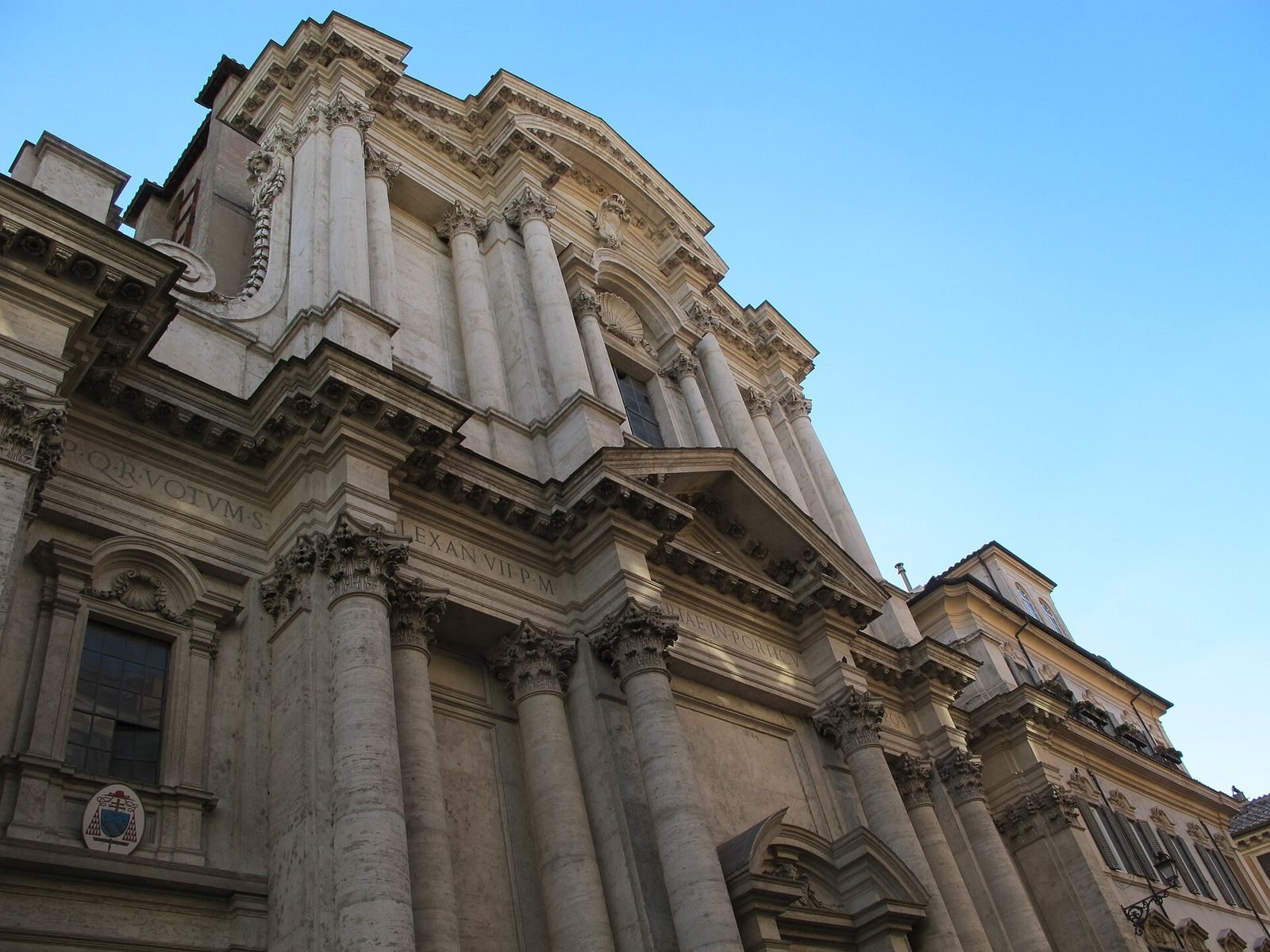
The facade of Santa Maria in Campitelli is in travertine, articulated in two superimposed orders, and its recognizable feature is that the columns are not set into the wall but come out of it, arranged on different planes and grouped in pairs. The result, looking at it from the square, is a front that seems to advance toward whoever is looking at it. Those who arrive from the Ghetto see it appear suddenly, and almost everyone's first reaction is to take a step back to frame it. The step back is never enough, because the square is too short.
The two orders and how to read them
The lower order organizes the central portal and the two side doors with a system of columns that multiply as they approach the axis: the more you move toward the center, the more the supports crowd together and project. The upper order repeats the scheme on a reduced scale and ends with a pediment. Between the two orders runs an entablature that is not a continuous line but a moving profile, which projects where the columns project and recedes where they recede. This is the technical reason for the effect: the facade does not have a surface, it has a thickness.
Why free-standing columns change everything
A pilaster casts a flat shadow, a few centimeters wide. A column detached from the wall casts a deep shadow, which moves during the day and which in the evening, with the artificial lighting from below, stretches upward. Look at the facade at noon in July and you find it flat and white. Look at it in the late afternoon and you find it full of relief. It is the same building, and it is a difference that depends only on the angle of the light.
The scale in relation to the square: a flaw or a choice?
The disproportion between the front of the church and the space of the square is evident and is often pointed out as a limit of the design. We read it differently, and we say so as a judgment and not as a fact: that disproportion is the visible form of the vow. A church built by the city as thanks for the end of an epidemic had to be bigger than its surroundings, because the surroundings were the neighborhood and the patron was Rome. If the facade had been scaled to the square, it would have been the church of a district. As it is, it is the church of a city. The price of this choice is paid by the photographer, who can't fit everything in the frame.
How the play of light toward the presbytery works
This is the thing to know before going in, and no photograph conveys it. The interior of Santa Maria in Campitelli is not a single space, but two spaces lined up along the same axis, of different shape and height, separated by a narrow passage marked by columns. The first, the one you enter, is wider and relatively low. The second, the presbytery, is more compact in plan and taller in elevation, and is covered by a dome. The light that illuminates the second space comes from openings that cannot be seen from the entrance door. The eye therefore registers an area at the back that is brighter than the area where the body of the church is, without seeing the source that lights it.
The mechanism, step by step
Whoever enters through the central portal has in front of them a first space in half-light, lit obliquely by the side windows and by the chapels. Looking straight ahead, beyond the screen of columns, they see the presbytery: narrower, framed, and visibly brighter. The light in the presbytery comes from the drum of the dome and from high openings, which stay outside the visual cone of someone looking from below at the back of the church. The brain, not seeing where the light enters from, attributes it to what it illuminates, that is, the high altar and the icon kept there. It is exactly the same principle as a stage where the spotlights are hidden in the wings.
The role of the screen of columns
The passage between the two spaces is not a simple empty arch. It is a succession of columns arranged on several planes, which work like theatrical wings: they frame the image at the back and narrow it, and at the same time prevent you from seeing sideways into the presbytery. This narrowing produces an effect of apparent depth greater than the real one: the church seems longer than it is. Architectural historians use the term telescopic vision or perspective spyglass for this device, and it is the reason Santa Maria in Campitelli is cited in textbooks together with the great stage machines of the 17th century.
Where to stand to see it work
The right observation point is on the central axis, just inside the portal, before the first chapels. All it takes is moving two meters to the side and the effect comes undone: you start to see the presbytery wall directly lit, the trick explains itself and the apparent depth shrinks. We recommend trying it: looking at the device first from inside and then from outside is the quickest way to understand it.
When the effect works best
The contrast between the two spaces works best when the outside light is not so strong that it floods the first bay too. On clear spring and summer mornings, with the sun high, the first space brightens and the difference fades. On overcast days, and in the late hours of the afternoon, the half-light of the first space deepens and the back stands out more. If you can choose the time, go in when the light outside is fading. It is not a measurable fact but an optical effect, and so we give it for what it is: a rule of thumb, which you can check in half an hour on the spot.
The icon of Santa Maria in Portico: tiny inside an enormous altar
The image for which Santa Maria in Campitelli was built is the icon known as Santa Maria in Portico, a Marian depiction of very small size, of Byzantine tradition, kept in the aedicule of the high altar. The contrast between the scale of the architectural apparatus and the scale of the venerated object is the second thing that strikes whoever enters, after the light, and in a certain sense explains both: all that apparatus exists to bring the eye to something that, on its own, would be lost in a drawer.
The measurements: what we can say and what we can't
On the exact dimensions of the icon the available indications don't coincide. The descriptions agree in calling it a small-format image, on the order of a few decimeters or less, such that it could be held in one hand, while the precise measurements reported vary depending on the source and it is not always clear if they include the frame. For this reason we don't give a number: anyone who needs the exact figure should ask the religious community that has custody of the church or look for it in a catalog entry. What can be stated without risk is the ratio of scale, which is visible to the naked eye: the altar aedicule is several meters tall, and the image it contains is smaller than a sheet of writing paper.
The legend of St. Galla, which is popular tradition
About the origin of the icon, a story has circulated for centuries that has to be treated for what it is, namely popular tradition and not a historical document. According to that story the image appeared miraculously in the portico of the house of a Roman noblewoman of the 6th century, St. Galla, daughter of Symmachus, while she was distributing food to the poor. From that portico the title Santa Maria in Portico would derive. Historiography has no evidence to confirm the episode, and the dating of the icon itself is a matter of discussion among specialists. The title, however, is real and documented: the earlier church that kept the image was called precisely Santa Maria in Portico, and the name passed to the new building.
Why it was held to be a protector against the plague
The link between the icon and the epidemic of 1656 doesn't come from nowhere. In 17th-century Rome the Marian images considered miraculous were dozens, and at a time of collective crisis the city chose which one to entrust itself to, often through public processions that served as ritual and statistic at once: when the epidemic ceased after the procession, the connection was established. In the case of the image of Santa Maria in Portico the devotion was already rooted in the district, and this was enough for the city to identify it as responsible for the end of the contagion and dedicate a new church to it. What interests us here is the cultural mechanism, which is documented, more than the question of the miracle, which is not a matter for historical verification.
A curiosity about Santa Maria in Campitelli
The curiosity is that the church's official title contains the name of another church. The full name is Santa Maria in Portico in Campitelli, and it preserves the memory of the earlier building, that of Santa Maria in Portico, which kept the icon before the move. It is an overlap that often happens in Rome, because ecclesiastical titles are legal entities that outlive buildings, and it produces a curious effect: the church built by Rainaldi bears the name of the place that made it necessary.
The cardinal title
The same name identifies a cardinal title, that is, one of the Roman churches symbolically assigned to cardinals at the time of their appointment. Anyone who goes in and finds a heraldic coat of arms displayed in the church is looking, in all likelihood, at that of the cardinal currently holding the title. The titleholder changes over time, and this is a fact that goes out of date quickly: anyone who wants to know who it is today should consult the updated list and not trust what they read on a web page a few years old, this one included if we don't update it.
One thing nobody tells you about Santa Maria in Campitelli
The thing almost no guide says is that the neighborhood around Santa Maria in Campitelli, as you see it today, is in large part the result of what was demolished and not of what was built. Between the end of the 1920s and the early 1930s, the demolitions to open Via del Mare, today Via del Teatro di Marcello, and to isolate the Theater of Marcellus wiped out entire blocks between the Capitoline Hill and the Tiber. Piazza Campitelli came out of it almost intact, but lost the web of alleys that connected it to the river.
The relationship with the Ghetto
The second element little told is the immediate proximity to the Jewish Ghetto of Rome, which begins less than 200 meters away. For over three centuries, from 1555 to the breach of Porta Pia, that perimeter was an area of compulsory confinement, and the new church was built in exactly the years when the system was fully in force. The two stories run in parallel and are almost never told together, but they are separated by little more than 200 paces. Anyone who visits the church and then goes down toward the Portico of Octavia crosses in three minutes two stories that for centuries did not speak to each other.
A frequent misunderstanding to clear up
Many visitors come to Campitelli looking for Gian Lorenzo Bernini's Blessed Ludovica Albertoni, because the Albertoni name appears on one of the palaces of the square. The sculpture is not here: it is in the Church of San Francesco a Ripa, in Trastevere, on the other side of the river. The confusion comes from the family, not the work. Pointing it out saves someone half an hour of searching inside a church that doesn't have what they are looking for.
The advice I give you for visiting Santa Maria in Campitelli
The practical advice is only one and is worth more than all the others: arrive in the afternoon, and before going in stop for five minutes in the square. The facade, with its detached columns, needs raking light to be read, and raking light arrives when the sun gets low. Then you go in, and inside you need the opposite condition: less outside light means more contrast between the first space and the presbytery, that is, the effect for which this church exists.
On the orientation, said honestly
As far as we can tell the facade faces roughly west relative to the square, and in that case direct sun reaches it in the second half of the day. We prefer, though, to put it as reasoning about light and not as certified geographic fact: if you want certainty, check the orientation on a satellite map before leaving home, it takes 30 seconds. In any case, the practical rule holds even without the compass, because in the afternoon the square is in partial shade and the contrast on the facade increases anyway.
The conditions that ruin the visit
Three situations make the trip useless, and it's best to know them beforehand. The first is arriving during a service: the church is in use, and during services walking around the nave is inappropriate as well as forbidden in practice. The second is arriving when the church is closed, which happens more often than you'd think because the hours don't follow a fixed calendar. The third is arriving when the presbytery is cordoned off for works, a condition that in Rome can come up at any moment and without published notice. In all three cases the solution is the same: call or write beforehand, and have a plan B five minutes away on foot.
Plan B, already ready
If the church is closed, within a 10-minute walk there remain the Portico of Octavia, the church of San Nicola in Carcere with its three Republican temples built into the masonry, the Turtle Fountain in Piazza Mattei and, going a little farther, Largo Argentina and the Crypta Balbi, which tells the urban layering of this quadrant better than any panel. None of these alternatives requires advance booking, except where indicated by the respective bodies.
Another well-known fact, yet rarely mentioned
The fact is that Santa Maria in Campitelli is a church built in a hurry, and the hurry shows. Between the start of construction in 1662 and the completion of the main body in 1667 five years pass, a very short time for a building of this size in 17th-century Rome, where the great church projects were measured in decades. The reason lies in the nature of the vow: a church of thanksgiving loses its meaning if it is delivered when the epidemic is a distant memory.
What building in five years entails
It entails precise construction choices. Materials available on site, travertine instead of fine marbles for the exterior, a floor plan that does not require complex structures needing centering, and an interior decoration concentrated where it matters, that is, on the high altar, leaving the rest more sober. Whoever enters expecting a Roman church overrun with stucco, frescoes and marble on every surface is thrown off balance: here the decoration is selective and the architectural structure stays readable. This is the reason the church seems more modern than many of its contemporaries.
The square in front: one of the few quiet squares in the center
Piazza Campitelli is, together with Piazza Margana and a few others, one of the rare squares in the historic center of Rome where you hear the sound of your own footsteps. It doesn't have outdoor seating spread over the whole surface, it isn't crossed by tourist flows headed elsewhere, it doesn't have a monument that acts as a magnet for groups. Whoever arrives from Piazza Navona or from Campo de' Fiori perceives the contrast within a few seconds, and it is not a matter of beauty but of density: here there is almost nobody.
The fountain, and who made it
In the middle of the square there is a travertine fountain with an elongated basin, raised on steps, attributed to Giacomo della Porta and made toward the end of the 16th century, as part of the program of public fountains fed by the Acqua Vergine that equipped the Roman districts with water points. The sources give 1589 as the year of construction, while on the actual execution and the stonecutters involved the attributions vary: della Porta signed the design, the execution passed through different workshops. Anyone who has already seen the Turtle Fountain, two minutes from here, recognizes the same hand and an opposite tone: there the bronze and the figures, here the travertine and nothing more.
Why the silence here is a practical fact
For anyone organizing itineraries, the silence of a square is not an aesthetic matter but a logistical resource. Piazza Campitelli is the most convenient spot in this quadrant for a stop with a group, for giving instructions without shouting, for waiting for someone who is late, or for collecting your thoughts halfway between the Capitoline Hill and the Ghetto. It has shade in the hot hours on at least one side, it has steps to sit on, and it doesn't have the through traffic of the neighboring squares. In a congested historic center, this combination is worth more than one more monument on the list.
The right photo to take at Santa Maria in Campitelli
The right photo at Santa Maria in Campitelli is not the frontal facade, which is the photograph everyone takes and which almost always turns out badly. The square is short, and to fit the whole front in the frame you have to back up to the opposite wall and use a very wide-angle lens: the result is columns that fall inward, a white sky and a flattened facade that loses exactly what makes it interesting, that is, the relief.
The framing that really works
The photograph that conveys the character of this facade is taken at an angle, from one of the corners of the square, with the low sun coming from the side. From that corner the columns overlap one another and the shadow each casts on the next makes the thickness of the front visible. You need a normal lens or a slight telephoto, not a wide-angle. It is the only way to get across in one image why this facade is different from all the pilaster facades you see around Rome.
The interior photo, and why it's hard
Inside, the image to look for is the one on the central axis, just beyond the portal, with the bright presbytery framed by the screen of columns. It is a photograph with very high contrast between the half-light of the foreground and the light at the back, and any automatic setting on the camera or phone gets it wrong: if it exposes for the foreground, it blows out the back. If it exposes for the back, the foreground goes black. The solution, for those who can, is a sequence at different exposures to combine, or a manual exposure fixed on the lit area, accepting that the nave stays dark, which is what the eye actually sees anyway.
Some important events that took place here in history
The events that matter for understanding Santa Maria in Campitelli are few and all connected: an epidemic, a public vow, a fast construction project, a transfer of an image, and then three centuries of continuity interrupted only by the urban transformations of the 20th century. We put them in sequence, flagging where the sources don't agree.
1656: the plague arrives in Rome
The plague epidemic that in 1656 struck southern Italy and Naples in particular reached Rome the same year. The city reacted with severe health measures, isolation of districts, lazarettos on the Tiber Island and control of access. The Roman toll was heavy but lower in proportion to the Neapolitan one, and this fact was read at the time as a form of protection. Anyone who wants to see the material places of that episode can start from the Tiber Island, which has a continuous health history from antiquity to today and is reached on foot by crossing Ponte Fabricio.
1662 and 1667: the construction and the transfer of the icon
Construction opens in 1662 and the main body is finished in 1667, the year the icon is moved into the new church. Some reconstructions move the laying of the first stone to 1663 and others distinguish the end of the building work from the completion of the facade, finished at a later time. On this point the sources diverge and we say so openly: the time span 1662 to 1667 is the one reported most often and the one we adopt, but it is not the only one in circulation.
The 1920s and 1930s: the demolitions
The most radical transformation of the context does not concern the church but the neighborhood. Between 1926 and the early 1930s the demolitions to open Via del Mare and to isolate the Theater of Marcellus wiped out the building fabric between the Capitoline Hill and the river, displacing thousands of residents and changing forever the relationship between this area and the Tiber. If you want an idea of what that means, look at the front of the Altar of the Fatherland and try to imagine how much built-up space was removed to free it.
October 16, 1943: what happened 200 meters away
On October 16, 1943 the German occupation troops carried out the roundup of the Ghetto of Rome, deporting over a thousand people from the district that begins a few hundred meters from Piazza Campitelli. The episode is told in detail at the Jewish Museum of Rome and in the memory routes of the Jewish Ghetto of Rome. We mention it here because the geography of this quadrant can't be understood without it, and because whoever strolls between the church and the Portico of Octavia is walking, without knowing it, on the same streets.
Who passed through Santa Maria in Campitelli
The people tied to Santa Maria in Campitelli are of three kinds: those who wanted it, those who built it and those who studied it. None of these categories includes celebrities of anecdote, and this is consistent with the nature of the building, which was never a court church.
Alexander VII, the pope who rewrites Rome
Fabio Chigi, Pope Alexander VII from 1655 to 1667, is the institutional figure who accompanies the undertaking. His pontificate coincides with the season in which Rome is redesigned as an urban stage set: the colonnade of St. Peter's Square, the arrangement of squares and road axes, the promotion of an idea of the city as a continuous visual apparatus. Santa Maria in Campitelli belongs to that season and shares its logic, even though it is a civic initiative.
Carlo Rainaldi
Rainaldi is the technical protagonist. His career is played out in comparison with Bernini and with Borromini, and his critical reappraisal is relatively recent. In Rome his signature is recognized at Piazza del Popolo, on the facade of the Basilica of Sant'Andrea della Valle and in the apse area of the Basilica of Santa Maria Maggiore. Anyone who wants a direct comparison among three ways of understanding Baroque space can line up, in a single day, Campitelli, Borromini's Church of Sant'Ivo alla Sapienza and the Church of Sant'Ignazio di Loyola with its false dome.
Giovanni Leonardi and the Clerics Regular of the Mother of God
Giovanni Leonardi, founder of the Clerics Regular of the Mother of God, died in Rome in 1609 and was canonized in 1938. The church, run by his order, keeps and venerates his relics. If you are visiting near his liturgical memorial, which falls in October, you may find the church livelier than usual and with a dense calendar of services: it is useful information for those looking for silence and for those who, on the contrary, are looking for the living church.
The scholars who put it back at the center
The modern critical fortune of Santa Maria in Campitelli is due in large part to 20th-century historiography on Baroque architecture, and in particular to the studies of Rudolf Wittkower, who analyzed its spatial device and placed it among the most original achievements of the period. Since then the church has appeared steadily in textbooks and in the study visits of architecture schools, while remaining almost absent from the mass tourist circuits. This asymmetry, much studied and little visited, is one of the reasons the square stays empty.
Hours, admission and accessibility: what we know and what needs checking
Admission to Santa Maria in Campitelli is free, as in all Roman churches open for worship: there is no ticket office and you pay nothing to go in. The opening hours, on the other hand, are variable and don't follow a stable calendar published in a reliable way. For this reason we don't give them: any number written here would risk being wrong within a few weeks, and sending someone to a closed door is worse than saying nothing.
How to check before going
The right way is to contact directly the religious community that has custody of the church, or to consult the official channels of the Diocese of Rome for churches open for worship. Review platforms report hours entered by users and for a church in active use they are the least reliable source, because they don't record closures for services, works or internal needs. A phone call the same morning is worth more than three web pages.
Accessibility, children, clothing
The church is preceded by a flight of steps, and this is the main obstacle for anyone using a wheelchair or a stroller: it's best to ask in advance if a usable side entrance exists, because the situation may change over time. Inside, the nave is level and wide. For children the visit is short and doesn't require absolute silence as in a museum, but it remains a church in use and the rule of respecting services in progress applies. Clothing follows the standard of Roman churches: shoulders and knees covered, especially in summer, to avoid being turned away at the threshold.

Eating in the area without falling into traps
The area between Piazza Campitelli, the Ghetto and the Theater of Marcellus is one of the areas of Rome with the highest concentration of places aimed at passing tourist traffic, and this calls for some caution. On estateromana.com we don't name businesses, for a reason of method: a list of names goes out of date in a few months, changes management, changes cuisine, and whoever publishes it ends up recommending something that no longer exists. We prefer to teach how to choose, because the criterion stays valid even when the place closes.
The five signs of a trap
There are five, you can recognize them from the street and they almost never fail. The first: the lady rolling out fresh pasta in the window or at a table on the street. It is an advertising lure built for passersby, not a kitchen. The second: the menu with photographs of the dishes, which is there for people who can't read the language and signals that the target clientele never comes back twice. The third: the tout at the door inviting you to sit down, because a place that has to stop people in the street has a problem filling its tables. The fourth: the continuous hours from morning to night with no kitchen break, which is incompatible with preparation made to order. The fifth: the location directly in front of a famous monument, where the price tends to follow the tourist in front of them, with items not priced on the menu and different price lists inside and outside.
Places with a repeated sign
In the center of Rome in recent years a model of restaurant has spread with the same sign replicated at several points in the city, an identical menu and a queue organized with a ticket number. We don't name them and we don't recommend them. The thing to observe, simply, is that Romans don't go there: they are built for the fast consumption of someone passing through once, and their price reflects the location more than the raw ingredients. Those short on time find better alternatives two streets away, where table turnover is slower and the clientele is mixed.
The simplest criterion there is
The criterion we always give, and which works in any Italian city, is this: look at who is sitting there and in what language they order. If the tables are occupied by locals who order in Italian, who know one another and the people serving, and who at that hour are there to eat and not to photograph the dish, the place holds up. If instead every table speaks a different language and nobody seems to have come back a second time, the signal is clear. All it takes is to stop for 30 seconds at the door and look inside.
Daniele Dezi's list
For those who want a personal reference anyway and not an algorithm, there is Daniele Dezi's personal list on Google Maps: a hand-curated collection, not sponsored and not paid for, updated on the basis of direct experience. It should be used the way you use the advice of a person who knows the city, that is, with the awareness that it is a point of view and not a ranking.
Frequently asked questions about Santa Maria in Campitelli
How much does it cost to enter Santa Maria in Campitelli?
Admission to Santa Maria in Campitelli is free, because it is a church open for worship and not a museum site with a ticket office. There are no fees, reductions or paid reservations for the ordinary visit. Any offerings are voluntary and go to the upkeep of the building. For guided group visits or professional filming, the religious community that keeps the church may set specific conditions, which must be agreed in advance.
What are the opening hours of Santa Maria in Campitelli?
The hours of Santa Maria in Campitelli are variable and not published in a stable form, so they need to be checked case by case before setting out. We don't give them for exactly this reason. The practical advice is to contact the religious community that has custody of the church or the official channels of the Diocese of Rome on the day of the visit, and to keep in mind that in the middle hours of the day many Roman churches in use stay closed.
Who built Santa Maria in Campitelli and in what years?
Santa Maria in Campitelli was built to a design by the Roman architect Carlo Rainaldi, with a construction period placed by most sources between 1662 and 1667. Some reconstructions move the laying of the first stone to 1663 or distinguish the conclusion of the building from the completion of the facade. The formal consecration of the church is given by several sources as 1728, long after the end of the main works.
Why was Santa Maria in Campitelli built?
Santa Maria in Campitelli was built as an ex-voto of the city of Rome after the plague epidemic of 1656, to house the Marian icon of Santa Maria in Portico, held to be a protector against the contagion. The decision was taken by the civic administration of the Capitoline Hill, that is, the Senate and People of Rome, with the support of Pope Alexander VII. It is this civic origin that explains the monumental scale of the facade relative to the small square that hosts it.
How do you get to Santa Maria in Campitelli by public transportation?
You reach Santa Maria in Campitelli by getting off at the Colosseo subway station on Line B and walking about 15 minutes toward Via del Teatro di Marcello, or by the buses that serve Piazza Venezia and Via del Teatro di Marcello itself. We don't give the line numbers because in Rome they change often: it's best to check the updated route on the public transit app on the same day.
How much time do you need to visit Santa Maria in Campitelli?
To visit Santa Maria in Campitelli, 20 to 30 minutes inside is enough, plus about 10 minutes in the square for the facade. Anyone interested in Baroque architecture who wants to understand the light device between nave and presbytery can comfortably take an hour. Included in an itinerary between the Capitoline Hill and the Ghetto, the church works well as a half-hour stop.
Can you take photographs inside Santa Maria in Campitelli?
Inside Santa Maria in Campitelli you can photograph for personal use, with the precautions that apply in any church in use: no shooting during services, no flash, no tripod without authorization. The contrast between the half-light of the nave and the light of the presbytery is very strong and automatic settings almost always get it wrong. For professional or commercial filming, a prior agreement with the religious community that keeps the church is required.
Is Santa Maria in Campitelli accessible to people with mobility disabilities?
Santa Maria in Campitelli is preceded by an external flight of steps, which is the main obstacle for anyone using a wheelchair or a stroller. Inside, the nave is level and easy to move around in. Since alternative access solutions may change over time, we advise asking the religious community in advance if a side entrance or a temporary ramp is available on the day of the visit.
What is the difference between Santa Maria in Campitelli and Santa Maria in Portico?
Santa Maria in Campitelli and Santa Maria in Portico are the same ecclesiastical title at two different moments: the full name of the present church is Santa Maria in Portico in Campitelli, and it preserves the memory of the earlier building that kept the icon before 1667. The church you visit today in Piazza Campitelli is the one built by Carlo Rainaldi. The ancient Santa Maria in Portico no longer exists in its original form.
Who wrote this page
This page is edited by the team of Tour Leader Pro, the Rome-based project office that designs and coordinates visits, itineraries and cultural events in Rome and Lazio. Hours, fares and access conditions given here are verified as of the publication date against the official sources indicated in the text. Before setting out it's best to check them again, because they change often. If you find outdated information, let us know.
Anyone building an itinerary in this quadrant of the historic center will find in Santa Maria in Campitelli a stop that fits well with the other nearby stops, from the Portico of Octavia to the Capitoline Hill, from the Theater of Marcellus to Santa Maria in Cosmedin, the Circus Maximus and the Arch of Janus, and anyone organizing themed half-days on Roman Baroque or on the city's health history can find useful planning tools on Tour Leader Pro, which works on this type of route in Rome and Lazio.
For a broader picture, one that holds together transportation, the real distances between one stop and the next and destinations in the rest of Italy, a good planning resource is Italy Planner, especially useful for those who fit Rome into a longer trip and have to decide how many days to give the historic center before moving on.