San Marco Evangelista al Campidoglio
In short. San Marco Evangelista al Campidoglio is one of the oldest churches in Rome and, at the same time, one of the least visited in the Historic Center.
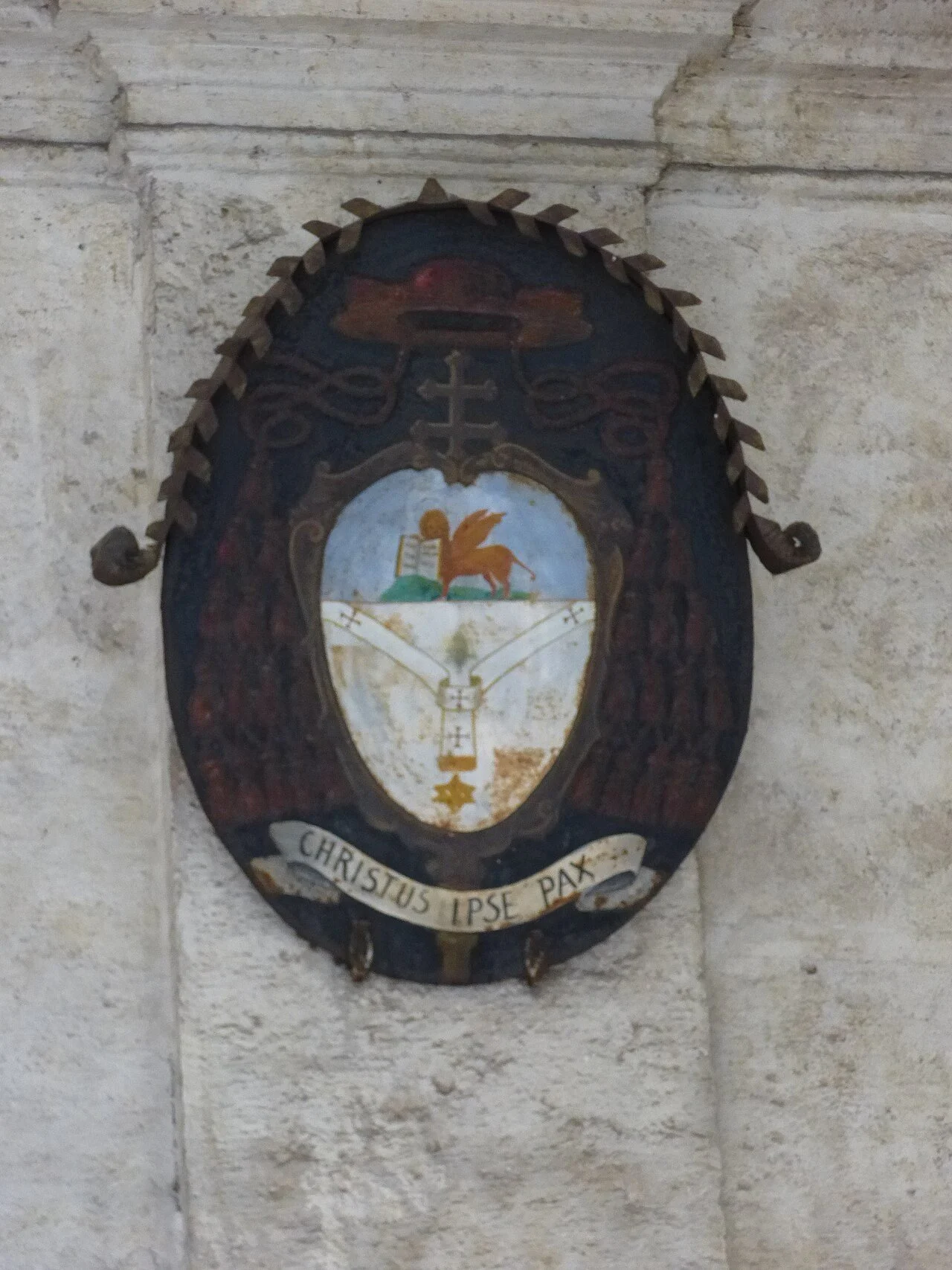
San Marco Evangelista al Campidoglio is one of the oldest churches in Rome and, at the same time, one of the least visited in the Historic Center. The traditional founding goes back to 336, under Pope Mark, a pontificate that lasted less than nine months. The building you see today is the result of three overlapping building campaigns: the Carolingian one of Gregory IV in the 9th century, the 15th-century one of Paul II Barbo, and the 18th-century one that redesigned the interior. The reason almost nobody goes in is pure topography: the entrance doesn't open onto Piazza Venezia, but onto Piazza San Marco, on the flank of Palazzo Venezia, in a recess that the traffic and the bulk of the palace hide from anyone crossing the most photographed intersection in Rome.
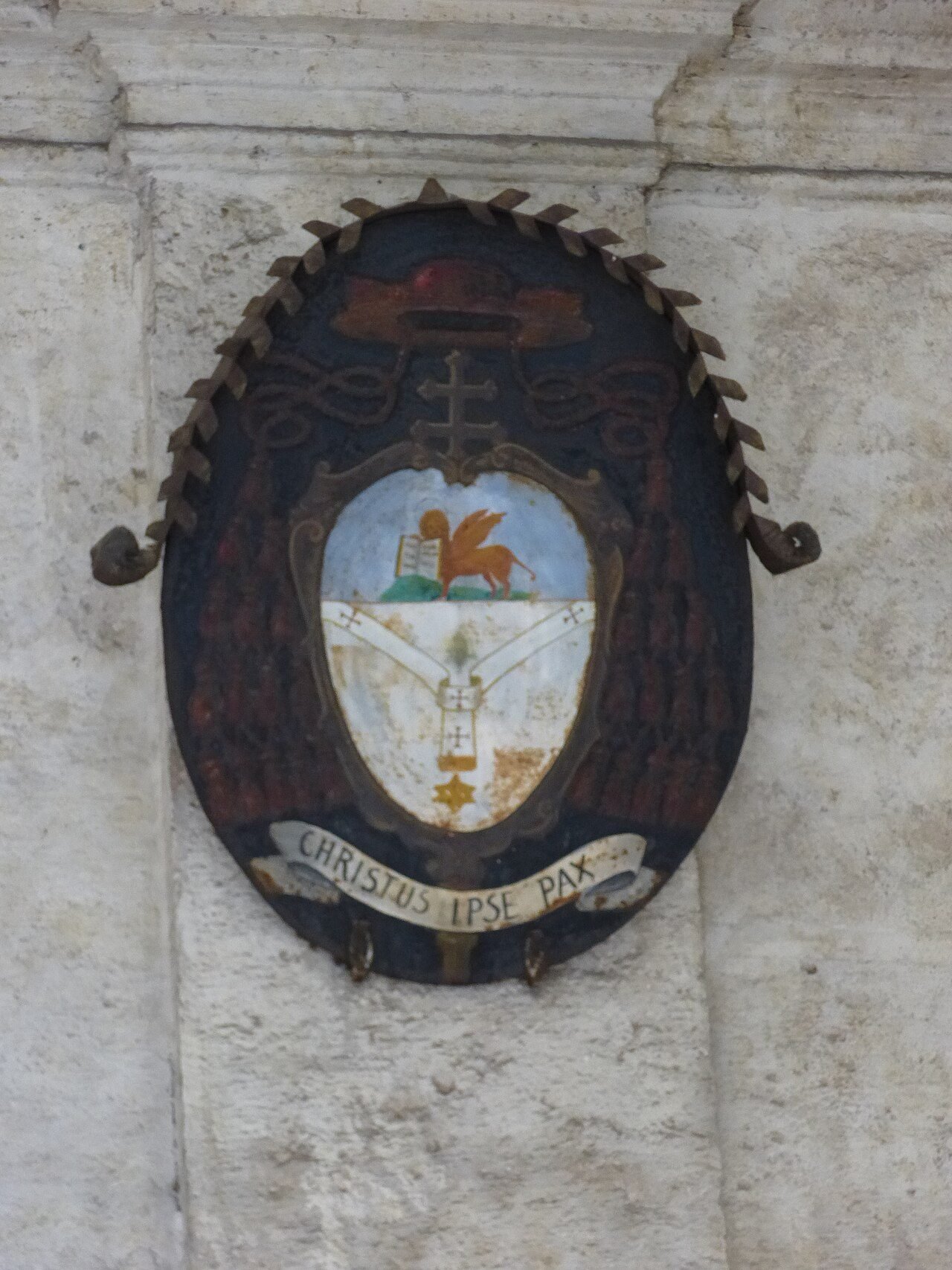
The result is a paradox: tens of thousands of people a day pass within 20 meters of a 9th-century apse mosaic and don't know it exists.
Where San Marco Evangelista al Campidoglio is and how to get there
The basilica faces Piazza San Marco, the small square tucked between the flank of Palazzo Venezia and the Palazzetto Venezia, a few steps from the climb to the Capitoline Hill. If you arrive from Piazza Venezia, you have to go around the south corner of the palace, toward Via del Plebiscito and then toward the climb of San Marco. The entrance is under the Renaissance portico, and the portico is set back from the street line just enough to make it invisible from a distance.
Bus and metro
Piazza Venezia is one of the best-served surface hubs in the city: among others, lines 40, 60, 62, 64, 70, 81, 83, 85, 87, 160, 170 and H stop here, plus tram 8, which comes from Trastevere and ends a short distance away. There is no metro here, though. The closest station is still Colosseo on Line B, about a kilometer away, or Cavour, also on Line B. The future Line C station at Piazza Venezia has been an archaeological construction site for years and is not in service. If you arrive from Termini, you get here faster with the 40 or the 64 than on foot, and if you arrive from the Vatican, you'll find the 40 runs direct.
Getting there on foot, which is almost always the best choice
From the Pantheon it's about 10 minutes, from the Colosseum 15, from Piazza Navona a good 15. The route we suggest to anyone who wants to arrive with some sense of it goes down from Largo di Torre Argentina along Via del Plebiscito, passes in front of the Church of the Gesù and reaches the basilica from the side where the portico is seen at an angle, not head-on. It's the only approach from which the building reads as a church in its own right and not as an appendage of the palace.
What San Marco Evangelista al Campidoglio is: a basilica inside a palace
San Marco Evangelista al Campidoglio is an early Christian basilica refounded in the 9th century and absorbed in the 15th century into the Palazzo Venezia complex, with which it shares walls, courtyards and administrative history. The words "al Campidoglio" in the title don't mean the church stands on the hill. They indicate proximity to the Campidoglio, which in medieval place names served to distinguish it from San Marcello al Corso, a different church with a different dedication, which pilgrims confused back then exactly as people confuse them today.
A church that reads in layers
Whoever enters sees the 18th century first: white and gold stuccoes, side altars, remade chapels. Looking up, you find the 15th century in the coffered ceiling. Looking toward the back, beyond the high altar, you find the 9th century in the apse semidome. Under your feet, invisible, is the 4th century. This stratigraphy is the real reason to go in, and it is also why a hurried visit gives you nothing back: the three eras don't announce themselves, you have to look for them.
The relationship with Palazzo Venezia, and why they are two different pages
On the site you already have a page dedicated to Palazzo Venezia and one to the National Museum of Palazzo Venezia. Those cover the 15th-century palace and the museum route with its rooms, collections and ticket, while this page covers only the basilica, which has its own entrance from Piazza San Marco, is not part of the museum route and can be visited for free as a place of worship.
The founding in 336 and Pope Mark
Tradition assigns the founding of the basilica to the year 336 and to Pope Mark, whose pontificate ran from January 18 to October 7 of that year, less than nine months. It is one of the earliest dates among Rome's churches, comparable to those of the oldest tituli, and the building's ancient title, titulus Marci, appears in the acts of the Roman synod of 499 among the churches of Rome with their own clergy.
What "titulus" means
In late antique Rome the titulus was the house or building where a Christian community met, named after its owner or founder. The titulus Marci takes its name from Mark, and later tradition has overlapped two figures: Pope Mark the founder and Mark the Evangelist, to whom the church is dedicated today. The overlap is old and cannot be untangled: in the 9th-century apse mosaic both appear, distinct.
The archaeological phases under the floor
Excavations carried out under the basilica during the 20th century intercepted structures from the Roman period and the masonry of at least two phases earlier than the Carolingian one, with the ancient walking surface several meters below the present one. The thing to keep in mind is that ground level in this part of Rome has risen a lot: the 4th-century church was a low building in an area of warehouses and insulae, not an isolated monumental building. The underground rooms are not part of the ordinary visit.
Why the date should be taken as tradition, not as chronicle
336 is the date handed down by the liturgical sources and the Liber Pontificalis, and it is widely accepted. It has to be said clearly, though, that a founding in 336 doesn't mean the wall you touch today dates from 336. Of that phase there are archaeological traces, not visible walls. When a guide says "this is a 4th-century church," he is saying something true about the continuity of the place of worship, not about the material of the building.
The 9th-century apse mosaic and the square nimbus of Gregory IV
The mosaic in the apse semidome of San Marco was made under Pope Gregory IV, whose pontificate runs from 827 to 844, and it is one of the five or six early medieval mosaic cycles preserved in Rome, together with those of Santa Prassede, Santa Maria in Domnica and Santa Cecilia. At the center stands Christ giving a blessing. At the sides is a row of standing figures, saints and a pope, on a gold background, following the apse scheme of the early Christian tradition, taken up and stiffened by the so-called Roman Carolingian renaissance.
The square nimbus: what it means
The figure of Gregory IV, who holds the model of the church and offers it to Christ, wears around his head not the circular halo of the saints but a square nimbus. It is not a mistake or a decorative variant. In early medieval Roman iconography the square nimbus indicates that the person portrayed was still alive when the image was made. The circle belongs to the blessed and the saints, that is, to those already in glory. The square, the earthly figure par excellence, belongs to the living. It's a convention that works like a date: if you see a square nimbus, the mosaic or fresco was made during that person's lifetime.
In practice, that square places the San Marco mosaic between 827 and 844 without needing any other proof.
Where to look for the square nimbus elsewhere in Rome
The same sign appears in other building projects of the same period, and recognizing it changes how you look at an apse. If you want to train your eye, compare San Marco with the mosaics of Santa Prassede, where the patron Paschal I appears with the same attribute, and with the early medieval paintings of San Clemente in the lower church. It's the kind of detail that almost never appears on the information panels and that makes readable a wall that otherwise seems merely golden.
What you actually see, and in what light
The semidome is high and far from where the faithful stand, and the basilica has discreet interior lighting. In the middle hours of the day, with light coming in from the high windows, the gold tesserae look their best. In the late afternoon in winter you see much less. If there is a coin-operated or switch-operated lighting system, you have to ask the staff: we have no stable information to report, because the management changes.
State of conservation and restorations
The mosaic has undergone restoration work, integrations and cleanings at different times, and some parts are remakings. For individual figures the identification varies from author to author. The presence of Mark the Evangelist, Pope Mark and Gregory IV is agreed on throughout the literature, while descriptions diverge on the order and identity of the saints at the sides. We say so explicitly instead of choosing one version and passing it off as certain.
The Renaissance portico of Paul II: a disputed attribution
The two-tier portico that opens onto Piazza San Marco is the most notable part of the exterior and dates from the 15th-century building campaign ordered by Paul II Barbo, pope from 1464 to 1471, the same man who had Palazzo Venezia built. It is a travertine front with arcades on the ground floor and an upper loggia, designed as a blessing loggia, that is, as a place from which the pontiff showed himself to the crowd: the same function as the loggias of St. Peter's and the Lateran, applied to a family church.
Who designed it: the three hypotheses
The attribution is disputed and must be stated as such. The proposals the literature puts on the table are essentially three. The first points to the circle of Leon Battista Alberti, on the basis of the classical vocabulary of arches on piers with attached half-columns, which recalls the Albertian logic of rewriting the Roman order. The second names Giuliano da Maiano, with the argument of the Tuscan presence in Paul II's Roman building projects. The third, which the most recent historiography tends to favor, identifies Francesco del Borgo, architect and official of Paul II's court, as the person actually in charge of the project.
None of the three is proven by a document that assigns the design by name. Anyone who tells you "this portico is by Alberti" is simplifying an open question.
Why the question is not idle
The portico of San Marco is one of the first Roman fronts where the arch on a pier with a superimposed order is applied to a building of worship with this clarity. If the design is Albertian, the date anticipates the Roman spread of that language. If it comes from the papal court's building yard, it tells instead how thoroughly the ancient model had already been absorbed among the technicians in the pope's service. In both cases the direct reference is the Colosseum and the Theater of Marcellus, that is, the Roman buildings with superimposed arcades a few minutes' walk away.
The travertine and where it came from
A well-established tradition holds that the travertine of the portico and of Palazzo Venezia comes from the stripping of the Colosseum and the Theater of Marcellus. The practice of quarrying ancient monuments in 15th-century Rome is documented in general, and it is certain that the papal building yards of those years drew on those reserves. On the precise origin of this specific travertine, however, the link you read everywhere should be treated as historiographical tradition and not as a fact of the building site verified block by block.
The 15th-century coffered ceiling
The wooden coffered ceiling of the central nave dates from the pontificate of Paul II and is one of the very few 15th-century wooden ceilings preserved in Rome in their original position. It bears the coats of arms and emblems of the Barbo pope, gilding and deep divisions, and it is the reason it's worth looking up as soon as you walk in, even before looking at the apse.
Why so few are left
Wooden ceilings are the most fragile part of a church: they burn, they rot, they are taken apart when taste changes. In Rome the Baroque period replaced the 15th-century roofs almost everywhere with vaults and stuccoes, and the few surviving ceilings can be counted. The one at Santa Maria Maggiore is the most famous. The one at San Marco is less known and in a much smaller building, and for exactly that reason it reads better, because it is closer to the eye.
What to look for when you look up
There are three elements to pick out: the heraldic emblems of the Barbo family, the molding of the coffers, which is deep and produces sharp shadows, and the points where the original gilding can be told apart from later integrations by tone and brightness. If you have opera glasses, use them here: from the floor the heraldic details are at the limit of what the naked eye can read.
The relationship with the rest of the interior
The interior you see today is largely the result of the 18th-century remodeling promoted by the Venetian cardinal Angelo Maria Quirini, with work entrusted to Filippo Barigioni around the middle of the century. That building campaign redesigned altars, chapels and decoration, but left two things standing: the 15th-century ceiling and the Carolingian mosaic. It's a choice we consider fortunate today and that was not a given at the time.
The national church of the Venetians in Rome
San Marco Evangelista al Campidoglio is the national church of the Venetians in Rome, that is, the reference place of worship for the Veneto community in the Urbe, as San Luigi is for the French and Sant'Antonio for the Portuguese. The dedication to Mark the Evangelist, patron of Venice, makes the link immediate, but the story is less linear than the name suggests, and it all runs through Pietro Barbo.
From titular cardinal to pope: the chain of facts
Pietro Barbo, born in Venice in 1417, nephew of Pope Eugene IV, received the cardinal's title of San Marco in 1451. As titular cardinal he began building next to his church the residence we now call Palazzo Venezia, a project started around the middle of the 1450s. Elected pope in 1464 with the name Paul II, he did not abandon that palace. He enlarged it and made it his papal residence, effectively moving the center of gravity of the court from the Vatican to this area. The basilica, which was the starting point of the whole story, was redesigned accordingly.
The palace passes to Venice
In 1564, under Pius IV, the palace was ceded to the Republic of Venice, which installed its embassy to the Holy See there. From that moment the name "Palazzo Venezia" became official and the basilica's link with the Veneto community was consolidated in a stable form. After the fall of the Republic in 1797, the complex passed to Austria, which kept its embassy there until the First World War. In 1916 the Italian State took possession of it.
What is Venetian inside the church
The most evident sign is the set of funerary memorials and inscriptions tied to Veneto families and prelates who succeeded one another in the title and in the care of the church. The best known is the monument to Leonardo Pesaro, a young Venetian patrician, by Antonio Canova, from the last years of the 18th century. It's a presence that alone justifies a stop for anyone interested in neoclassical sculpture and that rarely appears in general-audience guides.
A curiosity about San Marco Evangelista al Campidoglio
The most solid curiosity concerns the square nimbus of the mosaic, and it's one of those pieces of information that, once learned, you use for life in front of any medieval apse. In the semidome of San Marco, Pope Gregory IV doesn't wear a round halo. He wears a square. That square is a statement of civil status. It means "alive at the time of execution," and it works as a chronological signature put there by the artist.
The model in the pope's hand
Gregory IV holds a model of the church, following the scheme of the patron offering the building to Christ or to the titular saint. That little model is a source: it shows how the Carolingian basilica looked in the 9th century, with the roof and the front summarized in a few volumes. It has to be read as a pictogram, not as a survey drawing, but it remains one of the very few visual testimonies of the building's appearance before the 15th century.
Something nobody tells you about San Marco Evangelista al Campidoglio
What almost nobody says is that the basilica is not part of the Palazzo Venezia visit route and you don't pay: entry is free, from Piazza San Marco, and doesn't require the museum ticket. Many visitors leave the museum convinced they have seen the whole complex, without knowing that the oldest part of the block has a different door, 20 meters farther on, open for free at certain times of day.
The orientation mistake that keeps happening
The second recurring misunderstanding concerns the name. People looking for "San Marco" in Rome often end up at San Marcello al Corso, which is another church, with another dedication and another history, 500 meters away. The confusion is old and has produced errors even in the literature. The way not to get it wrong is to remember the complement: San Marco is "al Campidoglio," San Marcello is "al Corso."
The basilica as a survival shortcut
There is also a practical function that people who work in the area know well: in an area where sitting down for free in the shade is almost impossible and the few bars charge Piazza Venezia prices, the basilica offers 20 minutes of silence, coolness and a seat without having to buy anything. We don't write this as a frivolous suggestion: on July days, with the sun beating on the white of the Vittoriano, it's a real resource.
My advice for visiting San Marco Evangelista al Campidoglio
The practical advice is just one and it counts for more than all the others: don't come without checking that it's open. The basilica's hours are variable, tied to services, staff availability and the works under way on the Palazzo Venezia complex, and they change more often than any page can keep up with. We don't give an hours table here because it would be wrong within a few weeks. It's better to ask the basilica's official channels or the staff, or to call before crossing half the city.
The time slot that statistically works best
From scheduling experience, the titular churches of the center with reduced clergy tend to open in early morning and late afternoon, with a midday closure. Anyone planning an informed tour puts San Marco at the start or the end of the day and not at noon. It remains a probabilistic criterion, not a schedule: it has to be confirmed.
How much time you need
A careful visit takes between 20 and 30 minutes: five for the portico, five for the ceiling, 10 for the apse and the rest for the side chapels and the Pesaro monument. If you only want to see the mosaic, you get by in 10 minutes. Fitting it into a Piazza Venezia itinerary costs very little in time and changes the quality of the morning quite a bit.
How to behave inside
It's an active place of worship. You enter with your shoulders covered, you speak in a low voice, you don't visit during services and you don't use flash. If a Mass is under way, the rule is to postpone: a mosaic visit with 20 people standing during a celebration is disrespectful and, on top of that, you can't see anything.
The verdict we feel entitled to give
Among the things to do at Piazza Venezia, the Basilica of San Marco is worth more than the climb to the panoramic terrace if your interest is art history, and worth less if you're after the view over the city. Put in terms of cost: the Vittoriano terrace is paid, San Marco is free, and it contains a 9th-century mosaic. For anyone with an hour who wants to spend it well, there's no doubt about where to go.
Another well-known fact, yet rarely cited
The fact is this: the balcony from which Mussolini spoke to the crowd is on the facade of Palazzo Venezia facing Piazza Venezia, that is, on the other side of the same block that holds the basilica. The Sala del Mappamondo and the 9th-century apse semidome are a few tens of meters apart as the crow flies, inside the same perimeter wall. It's a juxtaposition nobody talks about and one that explains better than many pages how Roman stratification works: not by separate sectors, but by overlap inside the same building.
The Palazzetto Venezia moved wholesale
A second little-cited fact concerns urban planning. Between 1910 and 1913, to free the view onto the construction site of the monument to Victor Emmanuel II, the Palazzetto Venezia was taken apart and rebuilt in a different position, shifting toward the present Piazza San Marco. The square onto which the basilica's portico faces, then, is not medieval or Renaissance in its present form. It is the result of an operation of urban surgery at the start of the 20th century, the same one that changed the face of the whole area between the Campidoglio and Via del Corso.
Why this changes how you read the portico
Anyone looking at the 15th-century front today sees it in a scene built in the 20th century. The proportions between portico and the space in front of it are not those intended by whoever designed it: the space has changed around it. It's the same thing that happened to the churches of Trajan's Forum and to dozens of buildings gutted by the works for Via dell'Impero. Keeping this distortion in mind is the right way to look at any facade in the center of Rome.
The right photo to take at San Marco Evangelista al Campidoglio
The right photo at San Marco is the portico at an angle, three-quarter view, taken from Piazza San Marco in the mid-morning, when the light comes in raking across the travertine and separates the shadows of the arcades without blowing out the white. Head-on, the front flattens and the image becomes a land registry card. From three-quarters you can read the depth of the arcades and the relationship with the bulk of the palace behind.
Lens and settings
You need a moderate wide angle, between 24 and 35 millimeters equivalent: wider than that and the verticals distort, and the square is too narrow to correct by stepping back. Medium aperture, low ISO, and watch the vertical lines, which here have to be kept straight because the subject is orderly architecture and every cadence shows. If you can straighten in post, do it: the raw file from this position always converges a little.
The interior photo, which is harder
Inside, the challenge is the apse: scarce light, reflective gold, strong contrast between the lit area and the dark nave. Without a tripod, which as a rule you can't use in a church without permission, you need to raise the ISO and lean against a column or a seat back. Flash is useless as well as forbidden: at that distance it doesn't reach, and it flattens the tesserae, which live on angled reflection.
The detail nobody photographs
The subject we really recommend is the square nimbus: a telephoto lens on the semidome, a tight frame on Gregory IV's head, and in a single shot you have the historical content of the whole visit. It's a photograph that explains something, which an overall view of a church interior almost never does.
Some important events that took place here in history
The chronology of San Marco Evangelista al Campidoglio covers about 1,690 years, from the traditional founding in 336 to contemporary conservation work, and runs through three different political systems: late antique Rome, papal Rome and Rome under the Italian State. Here are the dates that really matter, with the warning that for the early Middle Ages the sources are liturgical and hagiographic before they are documentary.
336: the founding
Pope Mark founds the titulus that bears his name. The pontificate lasts from January to October of the same year, which makes the founding an act almost contemporaneous with the pope's election and death. It's the same period in which Rome is passing from a city of temples to a city of basilicas.
499: the title in the synodal acts
The Roman synod of 499 lists the presbyters of the tituli of Rome, and the titulus Marci appears among them with its own clergy. It's the first solid documentary attestation of the community's existence and functioning.
827 and 844: the building campaign of Gregory IV
During the pontificate of Gregory IV the basilica is rebuilt and receives the apse mosaic that can still be seen. It's the moment when the building takes on the three-aisle basilical form that, though reworked, still holds up the present layout.
1154: the bell tower
The construction of the Romanesque bell tower is dated to 1154, consistent with the great season of Roman brick bell towers of the 12th century. It's one of the surviving medieval elements of the complex.
1451 and 1464: Pietro Barbo
Barbo obtains the cardinal's title of San Marco in 1451 and is elected pope in 1464 with the name Paul II. Between the two dates he starts the palace. After the second, he turns the complex into a papal residence and remakes the basilica with the portico and the ceiling.
1564: the passage to the Republic of Venice
Pius IV cedes the palace to the Serenissima as the seat of its embassy to the Holy See. The name "Venezia" is fixed then, and with it the Veneto character of the basilica next to it.
Mid-18th century: Quirini's remodeling
The Venetian cardinal Angelo Maria Quirini finances the remodeling of the interior, entrusted to Filippo Barigioni. The 18th-century look of the nave and the chapels is born here, with the choice to keep the mosaic and the ceiling.
1797: the end of the Republic
With the fall of Venice the palace passes to Austria, which keeps its embassy there until 1916, when the Italian State takes possession of it in the context of the First World War.
1929 and the years of the regime
Palazzo Venezia becomes the seat of the head of government and the balcony over the square enters the political imagination of the 20th century. The basilica, on the opposite side of the block, continues its ordinary liturgical life.
Who has passed through San Marco Evangelista al Campidoglio
Through San Marco Evangelista al Campidoglio, in 17 centuries, have passed figures who appear in the manuals for different reasons: two popes who decided its form, an Enlightenment cardinal who remade its interior, a sculptor who left a monument here, and a series of architects whose involvement is a matter of debate.
Pope Mark
The founder according to tradition, pope for less than nine months in 336. His figure appears in the apse mosaic five centuries later, a sign that the memory of the founding was alive and structured.
Gregory IV
Pope from 827 to 844, he is the man who gave the basilica its early medieval form and the mosaic. His portrait with the square nimbus is the most direct testimony of his presence, and it is also one of the few portraits of a Carolingian pope preserved in Rome.
Pietro Barbo, then Paul II
Venetian, titular cardinal from 1451, pope from 1464 to 1471. He built the palace around his own church, wanted the portico and the coffered ceiling, and tied the building's fate forever to that of the Veneto community of Rome. He was also a great collector of antiquities and gems, and his palace worked as a private museum.
Angelo Maria Quirini
Venetian cardinal, scholar and librarian, promoter of the 18th-century remodeling. The present look of the nave is due to him, along with the decision to respect the ancient parts instead of erasing them.
Antonio Canova
The sculptor made the funerary monument to Leonardo Pesaro, a young Venetian patrician who died at a very young age, in the last years of the 18th century. It's one of the least visited Canova works in Rome, and its presence here is explained, once again, by the basilica's Venetian connection.
The Romanesque bell tower and the little Middle Ages that remains
The bell tower of San Marco is dated by tradition to 1154 and belongs to the family of Roman brick bell towers of the 12th century, with tiers of mullioned windows and dentil cornices, the same type you recognize at Santa Maria in Cosmedin and in about 20 other churches in the city. It is visible only from certain points, because the palace absorbs it and hides it almost everywhere.
Where you can see it from
The best view comes from going up toward the Campidoglio and turning back at the bend. From Piazza San Marco, under the portico, the bell tower can't be seen at all: that's the measure of how much the 15th-century palace absorbed the church that had preceded it by 11 centuries. The times of services remain the main constraint on a visit, and during a service you don't walk around the aisles.
Hours, entry and visiting rules
Entry to the Basilica of San Marco Evangelista al Campidoglio is open and free, because it is a place of worship and not a museum site with a ticket. The opening hours, on the other hand, are variable: they depend on services, on the availability of clergy and volunteers and on the state of the works on the adjacent complex, and for this reason we don't publish a time slot here that would risk being wrong.
How to check before you go
The recommended method is twofold: direct contact with the basilica in the days immediately before, and a cross-check with the notices posted on the main door, which remain the most up-to-date source by far. If you're organizing on your own, do the same: a phone call saves a wasted trip. Be wary of hours tables published on generic aggregators, which in our experience are wrong in most cases for the titular churches of the center.
Guided visits and groups
For an organized group the rule is to ask the rector or the staff for prior authorization, stating the number of people and the time. In the titular churches of the center, unannounced visits with a guide and a microphone are frowned upon and sometimes get interrupted. A group of more than 15 people is already large here: the space is intimate and the voice booms.
Accessibility, honestly
Access is under the portico, with steps. We have no confirmed information on ramps or alternative routes in operation, and in a building of this kind the situation can vary even from month to month. If you have specific mobility needs, check directly with the basilica: we prefer to say we don't know rather than publish reassuring and false information.
Eating around Piazza Venezia: how to choose
Piazza Venezia is among the most exposed areas of Rome as far as restaurants go, together with the Colosseum area and the Trevi Fountain area: maximum density of tourist foot traffic, customers who don't come back, sky-high rents. From us you won't find names of venues, and it's not reticence: a list of signs gets old in a few months and ends up being free advertising or an injustice to someone. Much more useful is learning to recognize the signals, which at Piazza Venezia are all present in the same block.
The trap signals, one by one
The woman rolling out fresh pasta in the window or right on the sidewalk is a stage lure, not a sign of cooking: it's there to stop the passerby, and in places where the kitchen really works, that work is done in back, not on the street. The menu with photographs of the dishes says the place is aimed at people who don't read Italian and will never come back: the price is set accordingly. The barker on the threshold inviting you to sit is the most reliable signal of all, because a place that's doing business doesn't need to stop people. The place open from morning to late at night without a break has no real kitchen shifts: it's a continuous flow of reheated dishes. And the places set in front of famous monuments often raise prices according to the tourist in front of them, with items not priced on the menu and different price lists inside and outside.
The chains in the center
In recent years the center has filled up with signs repeated in several points of the city, with identical menus, a queue with a number ticket and a standardized product. We don't name them. The fact that matters for the reader is another: Romans don't go there. They are formats built for the passing tourist, and the fact that there's a line in front says nothing about quality, it only says that the marketing works.
The simplest criterion, the one we really use
Look at who is seated and in what language they order. If Italian is spoken at the tables and there are people who work in the area, the place holds up. If the tables hold only suitcases and backpacks, the place lives off passing trade. It's a rough criterion and it works almost always, much better than the little stars on review platforms, which at Piazza Venezia are polluted by the number of customers who give their opinion once in their lives.
Moving a little changes everything
The radius to cover is ridiculous: five or six minutes on foot toward the Ghetto, toward the alleys above Largo di Torre Argentina or toward Monti take you into settings where a local clientele still exists. Whoever stays on the square pays for the view and nothing else. On the subject of historic signs and how to tell them from those that merely claim to be, we have collected criteria on the page about historic cafés and shops of Rome.
The personal list
Anyone who prefers a ready-made selection can consult Daniele Dezi's personal list on Google Maps: it is a curated collection, not sponsored, and it reflects personal choices formed by working in the city, not commercial agreements.
What to see nearby: the block between the Campidoglio, the Forums and Via del Corso
San Marco sits at the point of greatest monumental concentration in Rome: within 500 meters of the portico are the Campidoglio, the Imperial Forums, the Vittoriano and the start of Via del Corso. The practical consequence is that the basilica doesn't hold up as the only destination of a day and works very well instead as the first or last stop of a well-built route.
Going up to the Campidoglio
From the basilica the Cordonata is two minutes away, and at the top is the Michelangelo square with the Capitoline Museums and the Palazzo dei Conservatori. Next to the Cordonata rises the very steep staircase of the Aracoeli, 124 steps that nobody tackles twice in the same day. Behind the hill, the overlook onto the Roman Forum and the Palatine is free and reached by turning right of the Palazzo Senatorio.
The front of the Forums
On the other side of the square the Imperial Forums begin, with Trajan's Forum, Trajan's Column, the two churches of Trajan's Forum and the Trajan's Markets. Beneath the church of San Giuseppe dei Falegnami is the Mamertine Prison, and continuing on you reach the Colosseum.
Toward the Corso and the Campo Marzio
Taking Via del Corso you immediately meet Santa Maria in Via Lata, Palazzo Doria Pamphilj with its gallery, San Marcello al Corso and, a little farther on, the Column of Marcus Aurelius. On the opposite side of Piazza Venezia is Palazzo Bonaparte, a venue for exhibitions, and a little farther on the Santi XII Apostoli with the square of the same name.
The underground and the nearby museums
To understand how the stratigraphy of this part of the city works, there are two places worth more than any explanation: the Domus Romane di Palazzo Valentini, a stone's throw away, and the Crypta Balbi, which tells precisely the passage from antiquity to the Middle Ages on a single block. If you want to stay on the theme of churches, you can continue toward Santa Maria sopra Minerva, the Pantheon and the Gesù, and for an overall picture of the city's 17th-century churches there is the page on Baroque Rome.
A note on the Vittoriano
The Vittoriano complex with the Ala Brasini occupies the flank of the square and is free in the lower part, paid for the panoramic elevator. For anyone short on time, the choice between terrace and basilica is the one discussed above. For anyone with a whole day, you do both and you do the basilica first, because it opens and closes at less predictable times.
Frequently asked questions about San Marco Evangelista al Campidoglio
How much does it cost to enter San Marco Evangelista al Campidoglio?
Entry to the Basilica of San Marco Evangelista al Campidoglio is open and free, because it is a place of worship where services are held and not a museum site with a ticket. No reservation is needed and there is no ticket office. The ticket for the Museo Nazionale del Palazzo Venezia covers the palace's museum route, which is another thing and has another entrance: whoever pays for that is not paying for the church.
What are the opening hours of San Marco Evangelista al Campidoglio?
The hours of San Marco Evangelista al Campidoglio are variable and tied to religious services, staff availability and the works on the Palazzo Venezia complex, so it's best to check them with the basilica before going. We don't publish an hours table because the time slots change frequently and a wrong piece of information costs you a trip. The notices posted on the main door remain the most reliable source by far.
How do you get to San Marco Evangelista al Campidoglio by public transport?
You reach San Marco Evangelista al Campidoglio by getting off at Piazza Venezia, served among others by bus lines 40, 60, 62, 64, 70, 81, 83, 85, 87, 160, 170 and H, as well as by tram 8 from Trastevere. The metro doesn't reach Piazza Venezia: the closest useful stop is Colosseo on Line B, about a kilometer on foot. The basilica's entrance is on Piazza San Marco, on the flank of Palazzo Venezia.
How much time do you need to visit San Marco Evangelista al Campidoglio?
To visit San Marco Evangelista al Campidoglio, 20 or 30 minutes are enough if you look carefully at the 15th-century portico, the coffered ceiling, the 9th-century apse mosaic and the funerary monument sculpted by Canova. If you go in only for the mosaic, you get by in 10 minutes. The basilica works well as a stop within an itinerary of Piazza Venezia and the Campidoglio, not as a half-day destination.
What is the square nimbus in the mosaic of San Marco Evangelista al Campidoglio?
In the apse mosaic of San Marco Evangelista al Campidoglio, Pope Gregory IV wears a square nimbus, that is, a square in place of the circular halo, and in early medieval Roman iconography that sign indicates that the person portrayed was still alive when the image was made. The round halo belonged to saints and to the dead in glory. The square nimbus therefore places the mosaic during the pontificate of Gregory IV, between 827 and 844.
Can you take photographs inside San Marco Evangelista al Campidoglio?
Inside San Marco Evangelista al Campidoglio, amateur photography without flash and without a tripod is as a rule tolerated, while professional filming, video and bulky equipment require an authorization to be requested from the rector. You don't take photos during services. The conditions can change at the discretion of whoever manages the basilica, so the practical rule is to look at the notices at the entrance and, if in doubt, to ask the staff present.
Is San Marco Evangelista al Campidoglio the same thing as Palazzo Venezia?
San Marco Evangelista al Campidoglio is an autonomous basilica absorbed into the Palazzo Venezia complex, with its own entrance on Piazza San Marco and a free visit, distinct from the palace's museum route, which you pay for and enter elsewhere. The link between the two buildings comes from Pietro Barbo, titular cardinal of San Marco from 1451 and then Pope Paul II, who built the palace next to his own titular church.
Is San Marco Evangelista al Campidoglio suitable for a visit with children?
San Marco Evangelista al Campidoglio is a short, quiet visit, suitable for children too as long as you don't expect dedicated activities: there are no educational routes, workshops, illustrated panels or restrooms. The hook that works best with the little ones is the hunt for details, the pope with the square in place of the circle and the coats of arms in the ceiling. 20 minutes is the realistic maximum.
Why is San Marco Evangelista al Campidoglio the church of the Venetians?
San Marco Evangelista al Campidoglio is the national church of the Venetians in Rome because it is dedicated to Mark the Evangelist, patron of Venice, and because its titular cardinal Pietro Barbo, a Venetian, became Pope Paul II and built next to it the palace that in 1564 passed to the Republic of Venice as the seat of its embassy. Since then the link between the basilica and the Veneto community of Rome has remained stable.
Who wrote this page
This page is curated by the editorial team of Tour Leader Pro, the Roman project office that designs and coordinates visits, itineraries and cultural events in Rome and Lazio. Hours, fares and access conditions given here are verified as of the publication date against the official sources indicated in the text. Before leaving, it's best to recheck them, because they change often. If you find outdated information, let us know.
If you're building an itinerary in the center of Rome and want to combine this stop with the Campidoglio, the Imperial Forums and the churches of the Campo Marzio, you'll find tools for planning, group management and visit coordination on Tour Leader Pro, which works in the Rome and Lazio area with this kind of route.
For a broader picture, covering the links between Rome and the rest of the country, transport, real distances and building a multi-day trip in Italy, a good reference resource is Italy Planner, especially useful to those arriving from abroad who have to fit Rome into a national itinerary.