The Two Churches of Trajan’s Forum
In short. At the foot of Trajan's Column two domed churches face each other like a pair built in a single go.
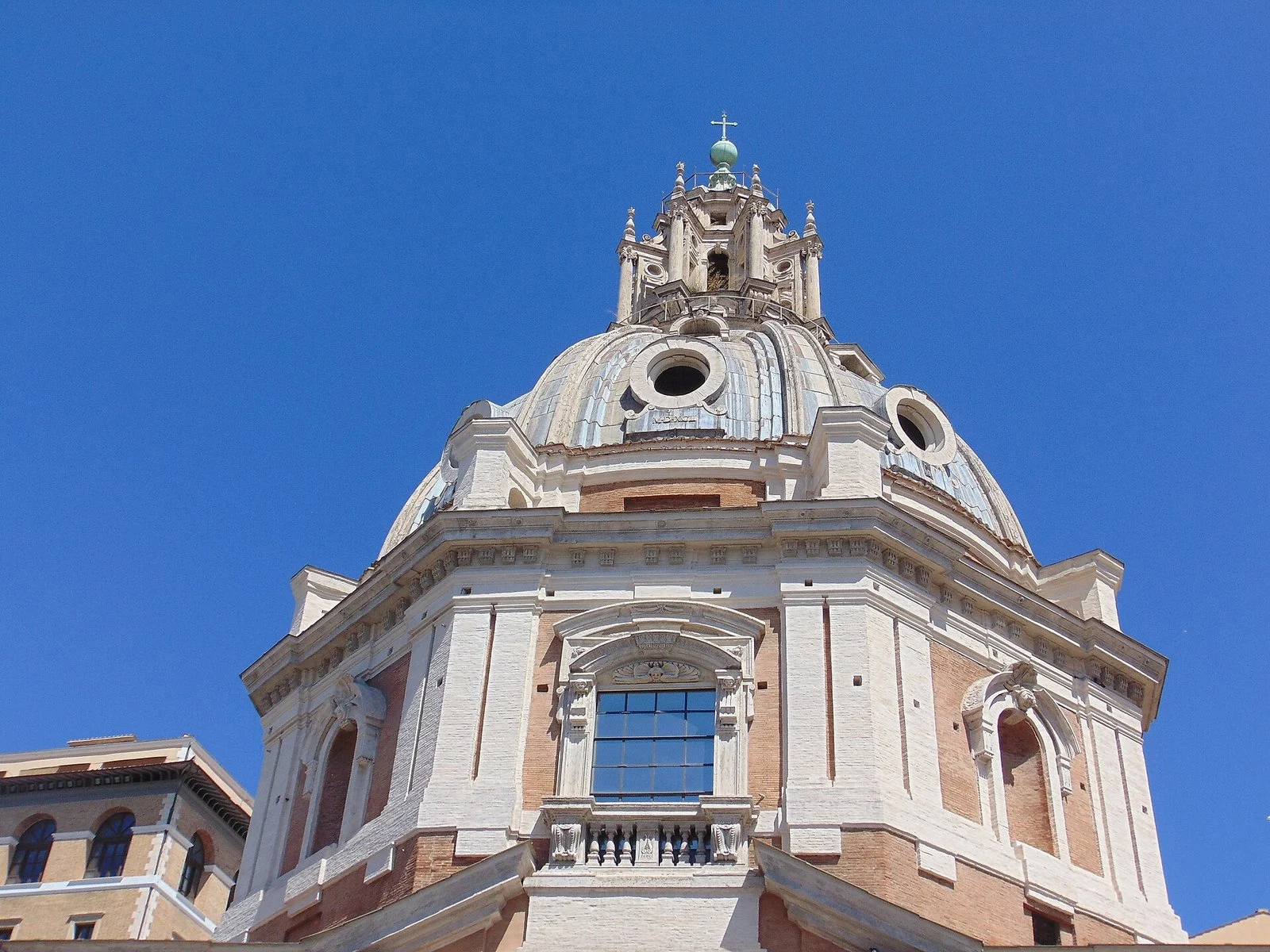
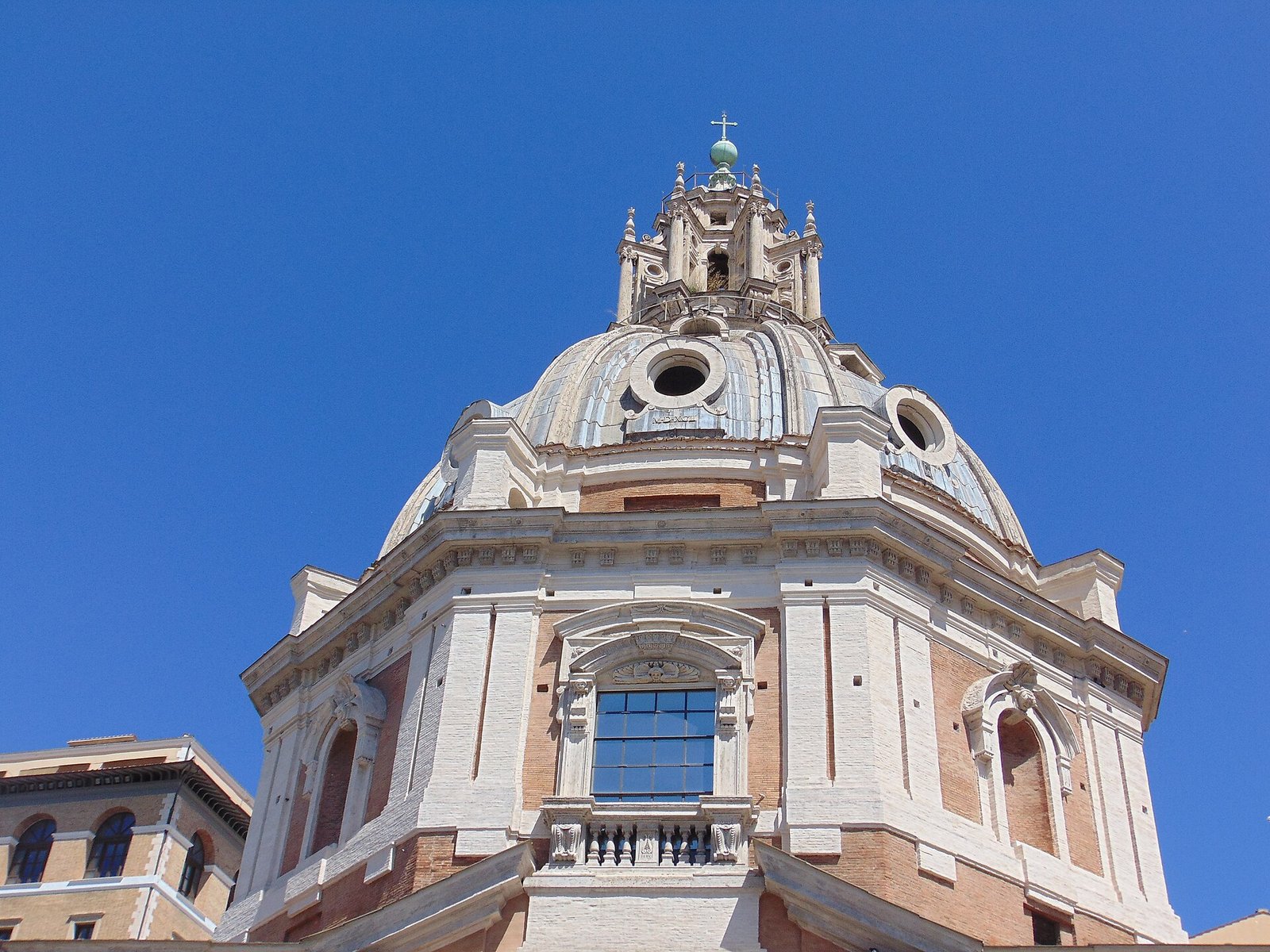
At the foot of Trajan's Column two domed churches face each other like a pair built in a single go. They are not. Santa Maria di Loreto and the Santissimo Nome di Maria al Foro Traiano are separated by more than two centuries of construction: the first begins in 1507, the second opens its work site in 1735. The resemblance you see from the street is an intended effect, but a late one, obtained by the 18th-century architects by copying the outline of the one that was already there. Anyone who learns to look at the two lanterns can tell them apart in three seconds. The lines that follow explain what they are, how to recognize them, what you see inside, why they seem perched above an archaeological ditch and why the context in which they were born no longer exists.
Where the two churches of Trajan's Forum are and how to get there
The two churches of Trajan's Forum are less than 200 meters from Piazza Venezia, on the eastern edge of the archaeological area of Trajan's Forum, with Trajan's Column in front and the front of the Markets of Trajan behind, on the other side of the excavation. Santa Maria di Loreto has its entrance on Piazza della Madonna di Loreto, at number 26. The Santissimo Nome di Maria is the church next to it, which the official lists give now as Foro Traiano 89, now on the same Piazza della Madonna di Loreto, now on Piazza della Colonna Traiana.
On foot, from the landmarks of the center
From Piazza Venezia it takes barely three minutes: you pass along the Palazzo delle Assicurazioni Generali, go past the tree-lined flower bed at the corner and the two domes appear on the right. From the Colosseum you walk along Via dei Fori Imperiali for about a kilometer, a good 15 minutes, keeping the excavation on your right. From the Pantheon it takes 12 minutes to Largo di Torre Argentina and Via delle Botteghe Oscure. From the Trevi Fountain the shortest route goes through Via delle Muratte and Piazza Venezia, and takes a little more than a quarter of an hour. From the Capitoline Hill you go down the Capitoline Cordonata and cross over: four minutes.
By public transport
There is no metro station in the immediate vicinity. The closest is Colosseo on line B, about a kilometer along Via dei Fori Imperiali. Cavour, also on B, is slightly farther and comes from the opposite side, via Via degli Annibaldi. The buses serving the hub around Piazza Venezia are many, but since the autumn of 2025 the metro C work site has moved several lines onto Via delle Botteghe Oscure and diverted other routes. Before leaving, it is worth checking the updated route on the Atac app, because in this phase the changes are frequent and not always posted at the stops. Tram 8 has its terminus right by Piazza Venezia, on Via dell'Ara Coeli, five minutes on foot. Anyone arriving from the Quirinale can get off at Largo Magnanapoli and take the Salita del Grillo or Via dei Fori Imperiali downhill.
By car, by taxi and with the ZTL
Arriving here by private car is not worthwhile. The whole area is inside the ZTL Centro Storico and there is no useful surface parking within a radius of a few hundred meters. Traffic around Piazza Venezia is squeezed by the metro works. For the access rules we refer you to our page on ZTL and cars in Rome, and for the alternatives to the guide how to get around Rome.
Accessibility
The sidewalk in front of the two churches is flat and wide, but both entrances have steps: Santa Maria di Loreto has an access staircase, the Santissimo Nome di Maria a raised churchyard with risers. Wheelchair users get a full view of the exteriors from the balustrade of the archaeological area, with no barriers. For the interior it is best to call first and ask if a side entrance is available. The general information on the city is in the guide Accessible Rome.
Two centuries apart: why they are not twins
Between the start of work on Santa Maria di Loreto, in 1507, and that on the Santissimo Nome di Maria, set by the sources between 1735 and 1736, 228 years go by. That is the fact that explains everything else. The pair you see today does not come from a unified design as happens with the twin churches of Piazza del Popolo, where the two work sites run in parallel in the same 20 years of the 17th century. Here there is a Renaissance church, finished in the late 16th century, and next to it a late Baroque church built more than a century and a half later that deliberately copies it.
Who copied whom
The direction of the imitation is documented and not in question: the 18th century looks at the 16th. The architect of the Santissimo Nome di Maria has before his eyes the outline of Santa Maria di Loreto, a compact body with an octagonal drum and a segmented dome crowned by a lantern, and he takes it up while changing proportions, language and details. The official entries of the City of Rome speak openly of a church that takes up the forms of its neighbor and that is in some way a rewriting of it. Architectural literature defines it as an intentional transcription in a late Baroque key. The result is a symmetry built after the fact, with the means of a different era.
Where the sources disagree
On this work site the bibliography is less compact than it seems, and we prefer to say so before going into detail. On the start of Santa Maria di Loreto three different attributions circulate, and on the date of completion of the dome at least two. For the Santissimo Nome di Maria the start dates range between 1735 and 1736, and the handover between the two architects is placed now in 1741, now in 1743. Below, chapter by chapter, we give both versions when they exist, instead of choosing one and presenting it as certain.
Santa Maria di Loreto, the bakers' church
Santa Maria di Loreto is the older of the two and has belonged for more than five centuries to the guild of the bakers of Rome, today the Pio Sodalizio dei Fornai, which still has its seat in the building attached to the church. It is not a parish church or a church of a religious order: it is the church of a trade guild, and this explains both its modest size and its stop-and-start construction history, tied to the finances of a confraternity and not to a single patron.
From chapel to church: 1500, 1507, 1534
At the origin is a small chapel that the congregation of the bakers obtains around 1500, under the pontificate of Alexander VI. In 1507 the confraternity tears it down and opens the work site of a larger church. The consecration comes in 1534, with the building still incomplete in the upper part. Above the main entrance an inscription recalls the Lauretan sodality and the Jubilee year 1550, which is roughly the moment when the facade is closed: the sources place that phase between 1550 and 1552.
The conflicting attributions of the design
The name that recurs most often is that of Antonio da Sangallo the Younger, indicated as the author of the design actually carried out. Other sources, including the English Wikipedia entry and part of the 19th-century literature, backdate the idea to Donato Bramante and assign an execution phase to Andrea Sansovino. The Italian Catholic entries also cite Giuliano da Sangallo among the initial designers. These are attributions that have layered up over time and should be taken for what they are: the Sangallo authorship of the lower body is the best supported, the rest is debated.
Giacomo del Duca and the upper part
The part that makes the church recognizable from afar is not 16th century in the full sense: it is late 16th century, and bears the signature of Giacomo del Duca, a Sicilian, a pupil of Michelangelo. The sources place his intervention between 1573 and 1576 for the sides, the bell tower and the giant interior order, and date the start of the double shell of the dome to 1582. A cartouche on the drum bears the date 1593, which marks the end of the works. Some sources instead move the lantern up to about 1575. Between the laying of the first stone and the finished lantern, then, between 80 and 90 years go by.
The cricket cage
Del Duca's lantern is the most debated element of the whole building. It is empty, openwork, with small columns and openings that make it look more like an open-frame structure than a massive crowning, and in the 18th century the critic Francesco Milizia dismissed it by calling it a cricket cage. The nickname stuck, and today it is repeated fondly by those who consider that lantern one of the freest outcomes of Roman Mannerism. Milizia's judgment says more about the Neoclassicism of the man who wrote it than about the object: two and a half centuries later, that lantern is the reason the church can be recognized even in a grainy photograph.
The two-cell bell tower
On the side of the church rises a bell tower conceived with the same logic: two superimposed cells, the first square in plan, the second circular. It is a detail that almost nobody looks at and that is instead the quickest way to tell the two churches apart even from an unfavorable angle, because the Santissimo Nome di Maria has nothing similar.
What it is like inside
The interior is an octagon inscribed in a square, with four semicircular chapels on alternate sides. The other sides hold the three entrances and the presbytery, which is deep and on axis with the main door. The space is compact and vertical: the eye goes straight up to the drum and the dome.
The works to look for
The best-known sculpture is the Saint Susanna by François Duquesnoy, called il Fiammingo, which the sources date now to 1630 and 1633, now to around 1640. It is considered one of the peaks of 17th-century Roman sculpture and on its own justifies going in. In the presbytery there are other marble statues, including a Saint Cecilia by Giuliano Finelli and a Saint Agnes by Pompeo Ferrucci, and angels attributed to Stefano Maderno. In the chapels there are decorations by Niccolò Circignani, dated 1585, and mosaics by Paolo Rossetti, for which the sources range between 1554 and 1592. On the high altar there is a panel with a disputed attribution: part of the literature assigns it to Marco Palmezzano, of the late 15th century, other entries speak of an altarpiece by Pietro Vannucci called il Perugino. These are attributions that do not coincide, and we have no elements to choose.
The Santissimo Nome di Maria, the church born from Vienna 1683
The church of the Santissimo Nome di Maria al Foro Traiano comes from a military event that took place 1,200 kilometers from Rome: the siege of Vienna in July 1683 and the victory of the army of the Holy League on September 11 and 12 of that year. Pope Innocent XI, who during the siege had called an extraordinary jubilee and penitential processions, extended the feast of the Holy Name of Mary to the whole Church in thanksgiving. From that devotion comes the confraternity that obtains papal approval in 1688, and from the confraternity, half a century later, comes this church.
Antoine Dérizet and the work site of the 1730s
The design is by the French architect Antoine Dérizet, whom the Italian sources also call Antonio Derizet. The start of the works is placed in 1735 by some sources and in 1736 by others. Dérizet's direction covers the first three years, until about 1738. The completion is in 1751. In the intermediate phase Mauro Fontana takes over, whom the entries place now in 1741, now in 1743, and who signs the high altar in 1741. Agostino Masucci coordinates a large part of the decorative apparatus. It is a work site of 15 or 16 years, therefore very fast compared with the decades of Santa Maria di Loreto.
The facade: columns, pilasters and statues on the balustrade
The base is octagonal from the ground up, divided by Composite columns and pilasters, with the portal in the center. Between the first and the second order runs a balustrade carrying statues of evangelists and prophets. It is the detail that lets you recognize this church at a glance: on the crowning of the lower body there are sculpted figures, which are completely absent on the church next door. Above the balustrade rises the drum, marked out in eight bays with arched large windows.
The dome and the lantern
The dome is divided by ribs into eight segments, like that of its neighbor, but the decoration is entirely 18th century: eight stucco medallions with Stories from the Life of Mary, made around 1750, with gilded palms and lilies between one medallion and the next. Among the authors of the stuccoes the sources cite Carlo Tantardini, Michelangelo Slodtz, Bernardino Ludovisi, to whom a medallion with the Assumption of 1740 is owed, and Giovanni Battista Maini, active here in 1746. The lantern is a small closed temple, with a series of small arched windows separated by columns, and at the top a triangle recalling the Trinity. Closed and orderly, where that of Santa Maria di Loreto is open and irregular.
The elliptical interior and the radiating chapels
The plan is central and elliptical, with measurements that the entries give as around 30 meters in length by 25 in width. Around the ellipse open chapels arranged in a radial pattern: the sources differ on the number, six according to the entry of the Diocese of Rome, seven according to Wikipedia and other entries. The difference depends almost certainly on how the space of the presbytery is counted. The cladding is in polychrome marbles and dates in large part to the 19th-century restorations.
The icon of the high altar
On the high altar designed by Mauro Fontana is placed an image of the Virgin and Child painted on panel, of probable 13th-century Roman school, coming from the Lateran treasury. It was brought into the church on September 9, 1741 with a solemn procession, in an era when the transfer of an ancient icon was a public act of weight, negotiated between the chapter and the confraternity. It is the oldest object of the two buildings: it precedes by about two and a half centuries the first stone of the church next door.
How to tell them apart by looking: four tests in 30 seconds
Anyone looking at the two churches of Trajan's Forum from the street sees two similar domes, and nine times out of 10 cannot say which is which. There are four elements that settle the question without needing to read the plaques, and they work even from far away, even against the light, even in a low-quality photograph.
Test one: the lanterns
It is the sharpest difference and the easiest to see. The lantern of Santa Maria di Loreto is openwork and empty: thin small columns, large openings, a mobile profile that lets light and sky through. They called it the cricket cage for exactly this reason. The lantern of the Santissimo Nome di Maria is a closed small temple, with smaller, regular arched windows separated by small columns, and it ends in a geometric apex with the Trinitarian triangle. Sky passing through the lantern: Loreto. Compact lantern against the sky: Nome di Maria.
Test two: the statues on the balustrade
The Santissimo Nome di Maria has a balustrade between the two orders with statues of evangelists and prophets standing out against the drum. Santa Maria di Loreto has nothing of the kind: the passage from the lower body to the drum is sharp, with no figures. If human silhouettes appear on the roofline, that is the 18th-century church.
Test three: the bell tower
Only Santa Maria di Loreto has a bell tower, and it is a particular one: two superimposed cells, the first square and the second circular, built with the same logic of stacking simple volumes that governs the dome. The Santissimo Nome di Maria has nothing comparable. From the side of the Markets of Trajan the bell tower is easy to see and settles the matter in a second.
Test four: material and color
Santa Maria di Loreto shows brick masonry with pilasters, frames and structural members in light travertine: the contrast between the warm brick and the white stone is its signature, and with low sun it becomes obvious. The Santissimo Nome di Maria presents a more uniform front, dominated by the architectural order in stone and light plaster, with less exposed brick. Up close the two buildings have two different skins.
And the two drums
The drums are not the same either, although both are octagonal. That of Santa Maria di Loreto is tall and bare, with the cartouche dated 1593 and a design that stakes everything on the transition from the square of the base to the octagon. That of the Santissimo Nome di Maria is marked by pilasters that delimit eight bays with arched large windows, so it has many more windows and a richer articulation. In practice: sober, dark drum above a square body, Loreto. Light, pierced, articulated drum above an octagonal body, Nome di Maria.
Which of the two is on the left and which on the right
The question has a precise answer only after declaring where you are looking from, and that is why contradictory indications circulate. The fact that does not depend on the observer is geographic: Santa Maria di Loreto is the western church, the Santissimo Nome di Maria the eastern one. The coordinates published by the tourist portal of the City of Rome give Santa Maria di Loreto at 41 degrees 53 minutes 45.70 seconds north and 12 degrees 29 minutes 0.43 seconds east, and the Santissimo Nome di Maria at 41 degrees 53 minutes 46.19 seconds north and 12 degrees 29 minutes 4.40 seconds east. Same latitude within a few meters, four seconds of longitude of difference: a hundred meters or so toward the east. The Santissimo Nome di Maria is therefore the one closer to the climb toward Largo Magnanapoli and the Torre delle Milizie. Santa Maria di Loreto is the one closer to Piazza Venezia.
The observation point we declare
Looking from south to north, that is, from the terraces of the Vittoriano or from the initial stretch of Via dei Fori Imperiali with your back to Piazza Venezia and Trajan's Forum in front of you, Santa Maria di Loreto is the church on the left and the Santissimo Nome di Maria the one on the right. This is the conclusion we draw from the official coordinates, not from repeating a guidebook: from a point located to the south, the westernmost building falls on the left in the field of view and the easternmost on the right.
Why the answer does not work from Piazza Venezia
Here something needs to be said that nobody writes. Staying at street level in Piazza Venezia, the two churches do not appear side by side: they line up almost on the same line of sight. Calculating the directions from the coordinates, from the square the two buildings fall within a few degrees of each other, that is, one in front and one just behind, partially overlapping. From there, talking about right and left is misleading, and whoever does it is reporting the image they have in mind from postcards, almost always taken from a higher elevation or from a point farther back. The truly side-by-side view is obtained by going up to the terraces of the Vittoriano, or by moving to the opposite side of the excavation, toward the Markets of Trajan, from where the order is reversed and Santa Maria di Loreto goes to the right.
The margin of uncertainty, declared
We are sure of the mutual east and west position, because it is confirmed by three independent sources that coincide: the City portal, the Italian and English encyclopedia entries and the addresses themselves, since Santa Maria di Loreto faces Piazza della Madonna di Loreto and the Santissimo Nome di Maria is listed on Foro Traiano. We are not equally sure that anyone, standing at any point of Piazza Venezia, sees exactly the layout described, because 20 meters of movement and a tree are enough to change the scene. Anyone who wants certainty should stand where we said: from the south, up high, with the Forum in front. In that position the reading does not change.
Hours, entry and how the visit works
Entry to both churches of Trajan's Forum is free and without charge: there is no ticket office, no online booking and no paid audio guide. What is missing is the certainty of opening, because the two churches follow different calendars and neither is open continuously for tourists.
Santa Maria di Loreto
Santa Maria di Loreto depends on the Pio Sodalizio dei Fornai, which has its seat in the building next door. The telephone contact published by the tourist portal of the City is 06 6793564. We do not publish an opening time because we did not find an official, stable one: the City's own entry refers to a direct contact for the times of masses and visits. Opening is tied to the celebrations and commitments of the sodality, and on any weekday it can be closed in mid-morning and open in the late afternoon, or the other way around. Anyone who cares about Duquesnoy's Saint Susanna should call the day before.
The Santissimo Nome di Maria
For the Santissimo Nome di Maria the City portal lists a daily mass at 11, but expressly notes that the times may vary and invites contacting the church. The published contact is 06 6798013. In practice the most reliable window for finding it open is around the morning celebration, with the obvious caveat that during mass you do not walk around the church with a camera in hand. We point out a practical matter: the internet domain that until a few years ago hosted the archconfraternity's website is no longer in its hands and has been reused for commercial content unrelated to the church, so no opening time should be sought there.
The street level, or why the churches seem to look out over a ditch
The ancient walking level of Trajan's Forum is about five meters below the current street level, and the two churches are built at the modern level, not the Roman one. That is the reason Trajan's Column, which rests on the ancient level, appears sunk in a depression while the churches seem to look down from above on a pit. Nobody dug around the churches: it is the ground around the column that was brought back to the level of the 2nd century.
How the ground rose
Between late antiquity and the Middle Ages the area of Trajan's Forum filled with debris, collapses, gardens and houses. The level rose by meters, and on top of that material an inhabited neighborhood was built with churches, shops and warehouses. When the bakers opened their work site in 1507, Trajan's Forum as a space had not existed for centuries: what existed was a maze of alleys with Trajan's Column emerging from the built fabric like an anomalous bell tower, surrounded by houses. The two churches were born inside that fabric, backed against other buildings, seen at an angle from narrow streets.
The Napoleonic excavations, 1812 and 1814
The first blow to the medieval context was dealt by the Napoleonic government of Rome, which between 1812 and 1814 had the block south of Trajan's Column demolished with the idea of making a large elliptical square in Neoclassical taste. In that campaign the plan of the Basilica Ulpia re-emerged. The project of the elliptical square was not carried out in the planned form, and the arrangement of the area was completed under Pius VII. Since then the column has been at the bottom of an excavation and the churches look at it from above.
The 20th-century demolitions and the context that is gone
Between 1924 and 1940 the zone between Piazza Venezia and the Colosseum was demolished to open Via dell'Impero, inaugurated on October 28, 1932 and today Via dei Fori Imperiali. The whole Alessandrino neighborhood disappears, a 16th- and 17th-century fabric that had grown over the Forums. The two churches of Trajan's Forum remain standing, but lose everything they had around them: that is why today they appear isolated on a widened square, like two objects set on an empty table.
The churches that are no longer there
In the tally of demolitions of those years there are six churches: San Basilio, San Lorenzo ai Monti, Sant'Eufemia, Sant'Urbano, Santa Maria in Macello and Spirito Santo alla Colonna Traiana, besides four convents, a military hospital and seven palaces. The last of those churches stood a very few meters from here: the place name already says it all, it was the church built up against the monument. Anyone looking at the square today sees two churches and thinks they were always the only ones. They were part of a group.
The gain and the loss
We say what our opinion is, because a page without a judgment is of no use. The demolition gave Trajan's Column back to view and made the plan of the Forum legible, which nobody could have studied under an inhabited neighborhood. But it turned two neighborhood churches, born to be seen at an angle, into two isolated street backdrops, depriving them of the urban scale that justified them. Anyone who finds them out of proportion today to the space around them is right: the space was built after them, and against them.
A curiosity about the two churches of Trajan's Forum
The soundest curiosity concerns the trade: Santa Maria di Loreto has been the church of the bakers of Rome for more than five centuries, and the Pio Sodalizio dei Fornai is still its owner and occupies the adjoining building. It is not a folkloric fact. It means that one of the two domes of Trajan's Forum was paid for, managed and maintained by a guild of bread makers, with the long timelines and interruptions typical of an enterprise financed by membership dues.
Two churches, two patrons, no pope
The second curious element is that neither church comes from a building pope. One belongs to a guild, the other to a devotional confraternity. Within a radius of 300 meters there are imposing papal and cardinal commissions, from the Michelangelo-designed Capitoline Hill to the Church of the Gesù: these two are the work of lay associations, and it shows in their modest scale.
Something nobody tells you about the two churches of Trajan's Forum
What is almost never said is that the pair is an optical fake built at the drawing table in the 18th century, and that the older church was never meant to have a twin. Santa Maria di Loreto was born as a single building inside a dense block. Its dome served to make it findable, not to match anything. The idea of the pair arrives 200 years later, from a French architect who knowingly designs a double.
A symmetry with no axis
The detail that undoes the idea of twinning is that the axis is missing. In the true Roman architectural pairs, starting with the one in Piazza del Popolo, the two churches flank a street or an entrance and the symmetry serves to frame a passage. Here there is no opening to frame: the two churches are simply near each other, with orientations and fronts that do not mirror each other. The pair exists only in the frontal view from the south, and dissolves as soon as you move.
My advice for visiting the two churches of Trajan's Forum
The practical advice is just one: do not come here with the idea of going in, come with the idea of looking, and consider the interior a prize if you find it open. Both churches have irregular openings tied to celebrations, and organizing half a day around the hypothesis of visiting them inside is the surest way to be disappointed. The exteriors, instead, are always visible, free, at any hour, and contain a large part of what there is to understand.
The right time of day
The best light is the late afternoon, when the low sun from the west lights up the travertine of the pilasters of Santa Maria di Loreto and sets the openwork lantern off against the sky. Early in the morning the area is in shadow and the two buildings look flat. At midday the vertical light crushes the ribs of the domes and erases precisely the details needed to tell them apart. Anyone with only one pass through the area should make it in the last hour and a half before sunset.
The route we recommend
Start from the balustrade on Via dei Fori Imperiali, look at Trajan's Column from below and read the difference in level. Go back up toward Piazza della Madonna di Loreto and stand in front of the two facades at close range, for the comparison of materials. Take the wide loop toward Via Magnanapoli or the Salita del Grillo, from where you see the bell tower of Loreto and the group reads in three-quarter view. Finally go down to the Museum of the Imperial Forums inside the Markets, which explains the whole Trajanic complex and, 50 meters from here, is the natural complement to this stop.
What is overrated and what is not
Overrated is the idea that these churches are a stop in themselves: on their own they do not support a dedicated visit, and anyone arriving in the city for two days has stronger priorities. Hugely underrated, instead, is Duquesnoy's Saint Susanna inside Santa Maria di Loreto, which is 17th-century sculpture of the very first rank and which almost no itinerary mentions. If the church is open, going in is worth more than many paid queues elsewhere in the center. Anyone interested in Baroque sculpture will find the context in the guide on Bernini in Rome, which is the yardstick of the era.
Another well-known fact, yet rarely cited
That the Santissimo Nome di Maria was built over a pre-existing church is written in every entry, and almost nobody tells it: the 15th-century church of San Bernardo alla Colonna Traiana was demolished to make room for the present one. The confraternity had settled there in 1694, had tried to restore it and had concluded that it was not worth the expense. The 18th-century work site is therefore a replacement, not an addition.
The right photo to take at the two churches of Trajan's Forum
The photograph that works best is taken from the side of the Markets of Trajan, with the lens pointed toward Piazza Venezia: Trajan's Column stands out in the center and the two domes act as wings on either side. It is the framing that recurs in old prints and 19th-century photographs, and it still works because it gives back together the height of the column, the difference in level and the layering of the square.
The shot that shows the difference
There is then a second photograph, less seen and more useful: a telephoto on the two lanterns, framed together and filling the frame. With a focal length of 150 millimeters or more, from the balustrade of Via dei Fori Imperiali, you get a direct comparison between the openwork of the cricket cage and the closed small temple of Nome di Maria. It is the image that explains in one go the distance of two centuries, and almost nobody takes it.
Some important events that happened here in history
The first event concerning this precise point of the city is the dedication of Trajan's Forum in AD 112 and the erection of the Column in 113, that is, 1,400 years before the bakers opened their work site. Everything that came afterward rested, literally, on that level.
1683, 1688, 1741
On September 12, 1683 the Holy League defeats the Ottoman army at Vienna. Innocent XI extends the feast of the Holy Name of Mary to the universal Church and in 1688 approves the Roman confraternity dedicated to that feast. On September 9, 1741 the Marian icon enters the new church with a solemn procession. In 1751 the work site is concluded.
1812, 1932, 1969
Between 1812 and 1814 the Napoleonic government demolishes the block south of the Column and brings the Basilica Ulpia back to light. On October 28, 1932 Via dell'Impero, today Via dei Fori Imperiali, is inaugurated, at the end of the demolition of the Alessandrino neighborhood. In 1969 Paul VI establishes the cardinal deaconry of the Santissimo Nome di Maria al Foro Traiano. Three dates that sum up the passage from inhabited neighborhood to archaeological scenery.
Who has passed by the two churches of Trajan's Forum
The heaviest name tied to these two buildings is that of Giacomo del Duca, a pupil of Michelangelo Buonarroti and author of the dome, the bell tower and the lantern of Santa Maria di Loreto. Through him the lesson of Michelangelo arrives here in direct form, and not by way of a textbook.
Architects
Antonio da Sangallo the Younger is indicated by the majority of sources as the author of the executed design of the 16th-century church. Part of the literature also brings in Donato Bramante, Giuliano da Sangallo and Andrea Sansovino, with debated attributions. On the 18th-century side the Frenchman Antoine Dérizet and Mauro Fontana work. In the 19th century Luca Carimini intervenes and, for the dome of the 18th-century church, Luigi Gabet. The late completion of Santa Maria di Loreto also passes through Giuseppe Sacconi, who shortly afterward would design the Vittoriano.
Sculptors and painters
François Duquesnoy, called il Fiammingo, signs the Saint Susanna. Giuliano Finelli the Saint Cecilia, Pompeo Ferrucci the Saint Agnes, and the angels are attributed to Stefano Maderno. Niccolò Circignani decorates a chapel in 1585 and Giuseppe Cesari, the Cavalier d'Arpino, leaves two canvases. In the 18th-century church Agostino Masucci, Stefano Pozzi and Nicolò Ricciolini work, and on the stuccoes Bernardino Ludovisi, Giovanni Battista Maini, Michelangelo Slodtz and Carlo Tantardini. It is a list that covers two centuries of Roman sculpture and painting, from Mannerism to the late Baroque, and that crosses with the names in the guides on Caravaggio in Rome and Borromini in Rome.
Who did not pass by, despite the legend
In improvised tours the idea circulates that Michelangelo had a hand in these domes. There are no documents supporting it, and it should be treated for what it is, oral tradition born from the presence of his pupil on the work site and from the nearness of his house at Macel de' Corvi. Michelangelo died a few steps from here in 1564, but the dome of Santa Maria di Loreto is the work of Del Duca.
What is around, within 10 minutes on foot
The two churches of Trajan's Forum are inside the densest radius of monuments in Rome: in 10 minutes on foot you reach some 20 places with a page of their own. The stop here makes sense above all as a link in a chain.
Toward the Forums and the Capitoline Hill
Going down along Via dei Fori Imperiali you meet the Roman Forum with the Curia Iulia, the Temple of Saturn, the Arch of Septimius Severus, the Arch of Titus, the Temple of Antoninus and Faustina and the Basilica of Maxentius. On the flank of the Capitoline Hill are the church of Santi Luca e Martina, the Mamertine Prison with San Pietro in Carcere and the Capitoline Museums, as well as the Basilica of Santa Maria in Aracoeli.
Toward the Corso and the Campus Martius
On the opposite side you take Via del Corso and in a few minutes you reach San Marcello al Corso, Piazza Colonna with the Column of Marcus Aurelius, the church of Sant'Ignazio and the Basilica of the Santi XII Apostoli. Anyone who wants to read these two domes within the general picture of the century will find the route in the guide on Baroque Rome, and anyone with a few hours can fit them into the itineraries of Rome in a day or three days in Rome. Being two churches with free entry, they also fall under Free Rome. A short walk away, the House of the Knights of Rhodes and Palazzo Venezia complete the block.
Eating near Trajan's Forum without getting hurt
The quadrant between Piazza Venezia, the Forums and Via dei Fori Imperiali is among the most exposed in Rome for dining: constant foot traffic, customers who do not come back, prices built on the tourist. On this site we do not recommend places by name. A list of signs gets old in a few months and teaches nothing. The criteria stay valid for years.
The five signs that point to a trap
The first is the lady rolling out fresh pasta in the window or on the sidewalk. It is a lure meant for people walking by, not a sign of the kitchen. In the neighborhoods where you eat well nobody works in the street to be seen.
The second is the menu with photographs of the dishes. It exists to get people who do not read Italian to order, and whoever displays it has already decided that the customer is passing through.
The third is the barker at the door inviting you to sit down. A place that has to stop people in the street has no regular customers.
The fourth is continuous hours from morning to night with no kitchen break. A real kitchen stops between lunch and dinner to clean and prepare. Whoever serves at any hour is reheating.
The fifth, decisive here, is the position in front of the monument. The places facing the Forums or the widening of Piazza Venezia work on a flow that renews itself every day and have no interest in building loyalty with anyone. That is where you find the items with no price on the menu, the cover charge you discover only on the receipt, the different price list between the indoor room and the outside table. Asking the price before ordering and demanding the itemized bill are two gestures that in this area are always worth making.
The criterion that works better than any review
Look at who is sitting and in what language they order. If at the tables there are Romans talking to each other, if the waiter takes orders in Italian and the customers look like people who come back, the place makes sense. If at the tables there are only foreigners and the staff changes language at every turn, the place lives off passing trade. It is worth more than a thousand online reviews, and costs 10 seconds.
The chains of the center
In recent years around Piazza Venezia places have appeared that repeat the same sign in several points of the city, with an identical menu and queues organized with number tickets. We do not name them. The observation that matters is that Romans do not go there: they are formats built for tourist flow, standardized to work anywhere, and therefore with no relation to the cooking of this city.
A curated list, for those who want it
For those who prefer a reference anyway, Daniele Dezi keeps a personal collection of Roman addresses on Google Maps: it is a personal list by Daniele Dezi on Google Maps, curated and not sponsored, with no commercial agreements with the places listed. It should be taken for what it is, a subjective selection based on direct experience. The general criteria are in the guide where to eat in Rome.
Frequently asked questions about the two churches of Trajan's Forum
What are the two churches of Trajan's Forum?
The two churches of Trajan's Forum are Santa Maria di Loreto and the Santissimo Nome di Maria al Foro Traiano, facing the archaeological area at the foot of Trajan's Column, less than 200 meters from Piazza Venezia. The first was started in 1507 for the confraternity of the bakers, the second between 1735 and 1736 for the confraternity born after the victory at Vienna in 1683. They look like twins, but more than two centuries separate them.
Are the churches of Trajan's Forum really twins?
The two churches of Trajan's Forum are not twins: their work sites are more than two centuries apart and there was no unified design. The resemblance is an effect intended by the 18th century, when the French architect Antoine Dérizet designed the Santissimo Nome di Maria taking up the outline of Santa Maria di Loreto, already standing for 150 years. They can be told apart by the lanterns, the statues on the balustrade and the bell tower, which only the 16th-century church has.
How much does it cost to enter the churches of Trajan's Forum?
Entry to the two churches of Trajan's Forum is free and without charge: there is no ticket office or booking. The problem is not the cost but the opening, because both follow calendars tied to celebrations and can be closed at any hour. The exteriors, which contain a large part of what there is to understand, are visible at any time from the square and from the balustrade of the archaeological area.
What are the hours of the churches of Trajan's Forum?
The hours of the two churches of Trajan's Forum are variable and different from each other, and there is no stable tourist schedule published. For the Santissimo Nome di Maria the portal of the City of Rome lists a daily mass at 11, warning that it may change, with the contact 06 6798013. Santa Maria di Loreto depends on the Pio Sodalizio dei Fornai, reachable at 06 6793564. It is best to call the day before.
How do you get to the churches of Trajan's Forum by public transport?
You get to the churches of Trajan's Forum on foot from Piazza Venezia in three minutes, and it is the simplest way. The closest metro is Colosseo on line B, about a kilometer along Via dei Fori Imperiali. Many bus lines serve the hub around Piazza Venezia, but the metro C work site has changed routes and stops: it is best to check the updated route on the Atac app before leaving.
Which of the two churches is on the left when you look at them?
Looking at the two churches of Trajan's Forum from the south, that is, from the terraces of the Vittoriano or from the stretch of Via dei Fori Imperiali with your back to Piazza Venezia, Santa Maria di Loreto is the one on the left and the Santissimo Nome di Maria the one on the right. The observer-independent fact is that Loreto is the westernmost church. Staying in Piazza Venezia at street level the two almost line up, and the distinction between right and left loses meaning.
Can you take photos in the churches of Trajan's Forum?
Outside the churches of Trajan's Forum you can photograph freely and without authorization for personal use, including the view with Trajan's Column between the two domes. Inside, the rules are set by whoever opens the church: you ask first, avoid the flash and do not photograph during celebrations. Drones over the historic center are not allowed, and professional or commercial shooting requires a permit.
How much time do you need to visit the churches of Trajan's Forum?
For the two churches of Trajan's Forum 20 minutes devoted to the exteriors and the comparison between the two lanterns are enough. If you find them open, add 20 minutes for the interiors, where the most notable thing is the Saint Susanna by François Duquesnoy in Santa Maria di Loreto. With Trajan's Column seen from the balustrade and a stop in front of the Markets of Trajan you come to a good hour.
Who wrote this page
This page is edited by the editorial team of Tour Leader Pro, the Roman project office that designs and coordinates visits, itineraries and cultural events in Rome and Lazio. The hours, rates and access conditions given here are verified as of the publication date against the official sources named in the text: before leaving it is worth checking them again, because they change often. If you find outdated information, let us know.
Anyone who has to fit these two churches into a day at the Forums, or is building an itinerary that holds together the Capitoline Hill, Trajan's Forum and the Corso in a tight time, will find the operational side at Tour Leader Pro: guided visits, group accompaniment, management of permits and coordination of entries at sites that require booking. It is the work we do every day in this quadrant of the city, and it is also the reason why on these pages you find verified opening status instead of copied hours.
If instead you are building a longer trip, with Rome as a stop among other Italian cities, the reference project is ItalyPlanner, where you find itineraries, travel times between regions and advice on how to distribute the days. To stay in Rome you can continue with the guides on Trajan's Column and the Markets of Trajan, which complete the picture of this block.