The Twin Churches of Piazza del Popolo
In short. The two churches that close off Piazza del Popolo on the south side, at the mouth of the Tridente, have been known for three and a half centuries as the twin churches.
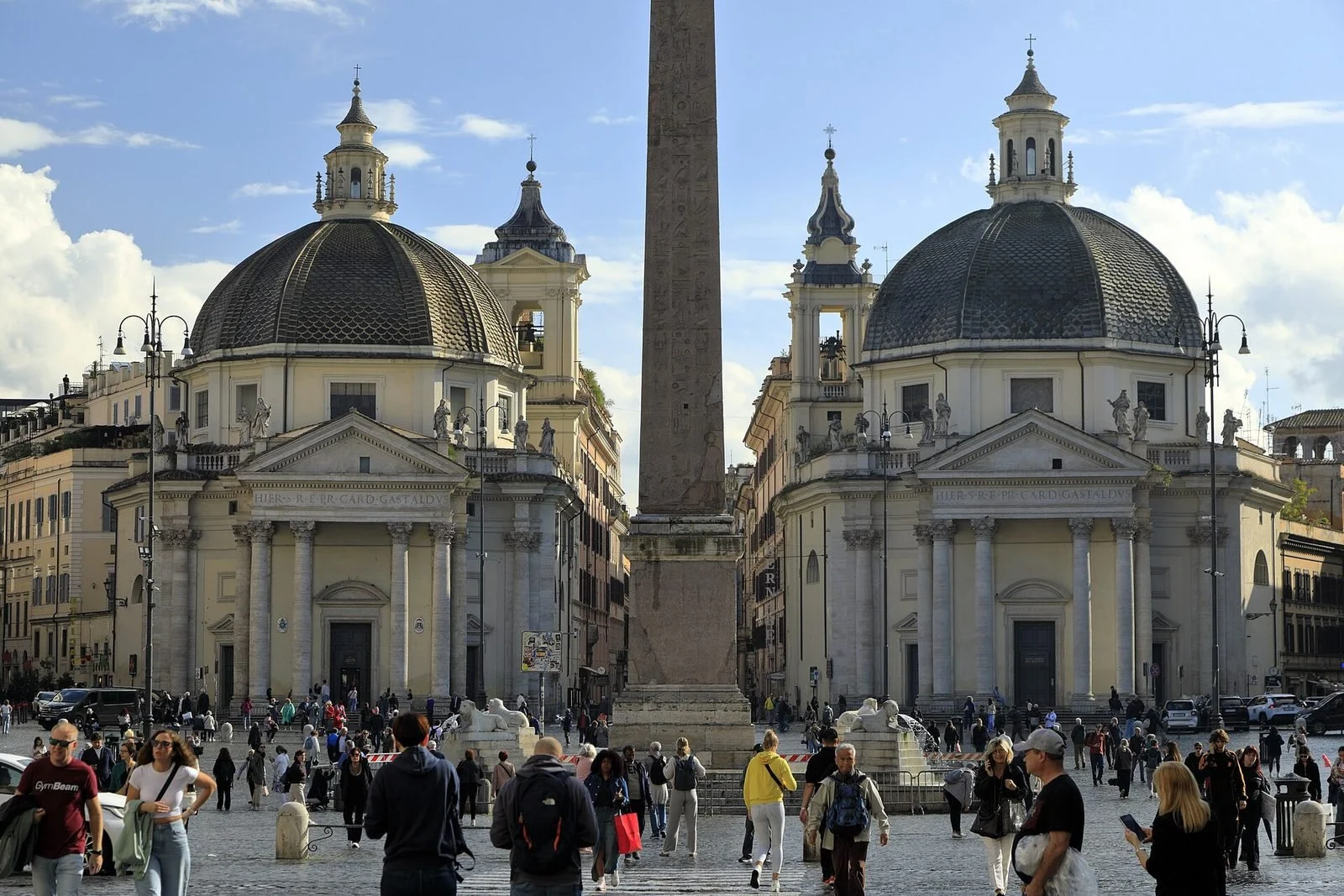
The two churches that close off Piazza del Popolo on the south side, at the mouth of the Tridente, have been known for three and a half centuries as the twin churches. They are called Santa Maria in Montesanto and Santa Maria dei Miracoli, and they have the same portico, the same staircase, the same triangular pediment, the same dome rising behind the facade. Anyone who comes in through the gate and stops in the middle of the square sees two identical buildings framing the obelisk and the mouth of Via del Corso.
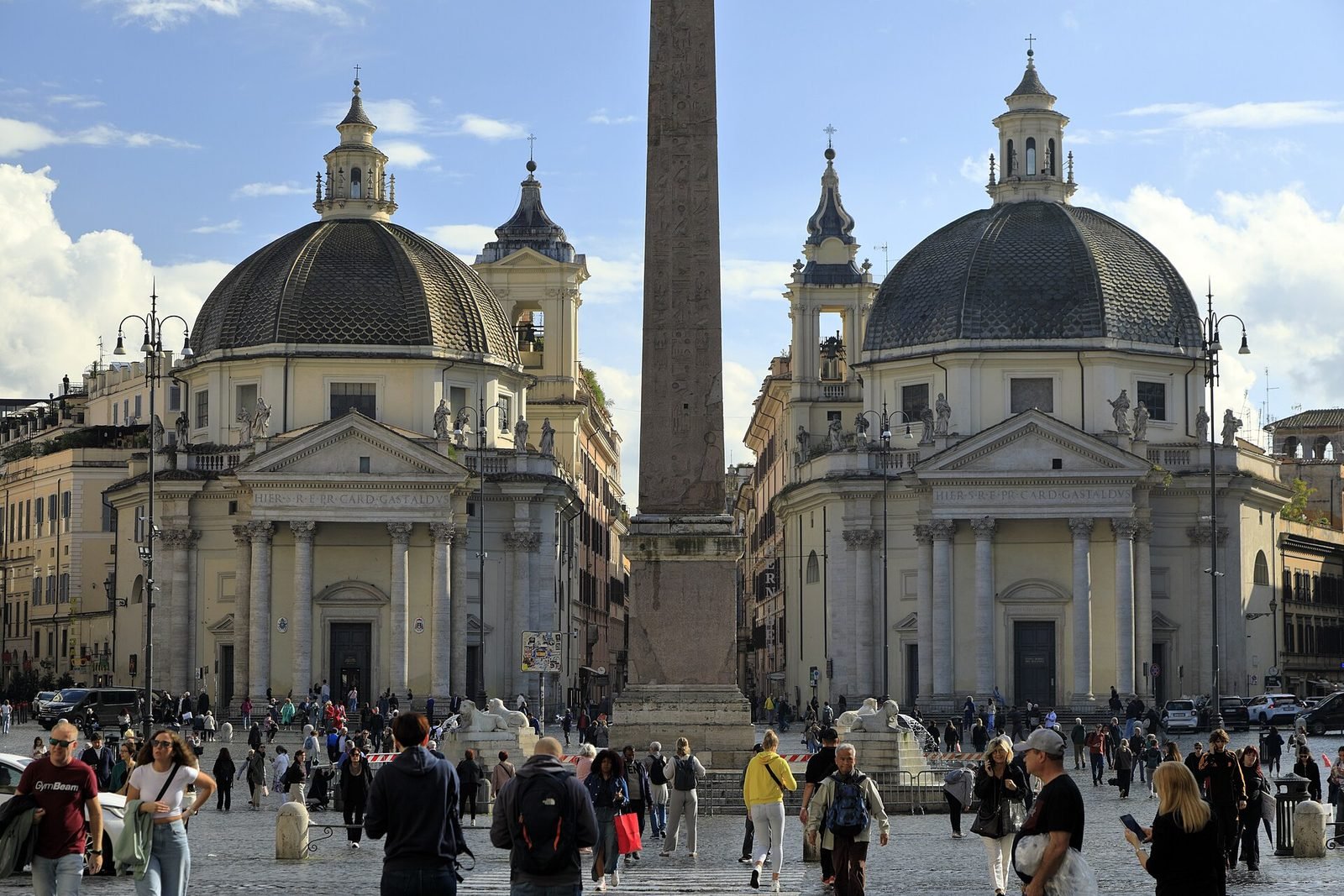
They are not twins. They never were, and not by chance: the two available plots of land had different widths, and the identity you perceive from the square is the result of a deliberate optical calculation, made on the building site between the 1660s and the 1670s. The church on the left looking from the north, Santa Maria in Montesanto, has an elliptical plan and dome. The one on the right, Santa Maria dei Miracoli, has a circular plan and dome. From the center of the square the two domes seem to have the same diameter. From other points the difference is easy to see.
This page explains how that trick works, where to stand to see it and where to stand to take it apart, who built what and in which years, and how things stand today for anyone who wants to go in. The two churches are active places of worship with free entry, they open differently from one another and with hours that change often: here you will not find a made-up table of hours, but pointers on where to check them.
Where the twin churches of Piazza del Popolo are and how to get there
The twin churches of Piazza del Popolo stand on the southern side of the square, at the corners between the three streets of the Tridente: Santa Maria in Montesanto is entered from Via del Babuino 198, Santa Maria dei Miracoli from Via del Corso 528. The nearest metro stop is Flaminio, Line A, about 150 meters from the north gate of the square.
By metro
Line A stops at Flaminio, and the exit opens directly onto Piazzale Flaminio, in front of the Porta del Popolo. You go through the gate, enter the square, and the two churches are in front of you, on the other side of the oval, about 200 meters away. It is the route we recommend to anyone coming for the first time, because it is the only one that gives back the effect the churches were designed for: you enter from the north, as the pilgrims did, and the view arrives all at once.
By tram and bus
Tram 2 starts from Piazzale Flaminio and runs up Viale Tiziano to Piazza Mancini, serving the Auditorium and the Flaminio district. Several urban bus lines also stop at Piazzale Flaminio, linking the area with the center and with the Tiber embankments. The lines change fairly often because of roadworks and detours: before leaving it is a good idea to check the updated route on the transit company's app, because Piazza del Popolo is regularly closed to traffic for events, concerts and demonstrations.
On foot from the center
From Piazza di Spagna it takes about 10 minutes walking the full length of Via del Babuino: it is a straight walk, slightly downhill, and comes out exactly on the side of Santa Maria in Montesanto. From Piazza Venezia it takes a good 20 minutes along Via del Corso, a kilometer and a half in a straight line. From the Pantheon it is 15 minutes, going by Via della Scrofa and Via di Ripetta, or by the Corso.
Why the twin churches of Piazza del Popolo are not twins
The twin churches of Piazza del Popolo have different plans: Santa Maria dei Miracoli is circular, Santa Maria in Montesanto is elliptical, and the difference comes from the fact that the two plots of land between the streets of the Tridente were not the same width. The impression of symmetry you get from the center of the square is an optical correction built on purpose.
The urban planning problem the designers had to solve
The Tridente is the web of three streets that start from Piazza del Popolo and fan out toward the center: Via del Babuino to the east, toward Piazza di Spagna. Via del Corso in the middle, straight to Piazza Venezia. Via di Ripetta to the west, toward the Tiber and the Mausoleum of Augustus. The three streets did not come into being at the same time or by the same criterion, and the angles they form between them are not equal.
The result is that the two triangular blocks between the streets, the one between Babuino and Corso and the one between Corso and Ripetta, have different dimensions. On the front toward the square the second is wider than the first. Anyone who wants to build two buildings that look the same on those two plots has a geometry problem to solve before even drawing a facade.
The solution: same facade, different domes
The answer adopted on the building site was to keep identical all the elements that are read frontally and to modify those that are read in depth. The two porticoes have the same width, the same number of columns, the same pediment. The two staircases have the same rise. The two bell towers, added in the following century, have the same profile.
The dome, instead, is different. On the wider plot, the one between the Corso and Ripetta, a rotunda fit without forcing: Santa Maria dei Miracoli has a circular plan, and its dome rests on a drum that on the outside reads as an octagon. On the narrower plot, between Babuino and the Corso, a rotunda of the same size did not fit: Santa Maria in Montesanto was set on an oval, with the elliptical dome whose major axis runs in depth, toward the back of the church, and on the outside reads as a 12-sided polygon.
The ellipse does one precise thing. Seen frontally, that is, with the minor axis parallel to the facade, it presents to the eye the same apparent width as the circular dome next to it. The extra length it needs to hold the same volume it takes toward the inside, where it cannot be seen from the square. The symmetry the eye registers is therefore true only on one axis.
Where you see the trick, and where you see that it is a trick
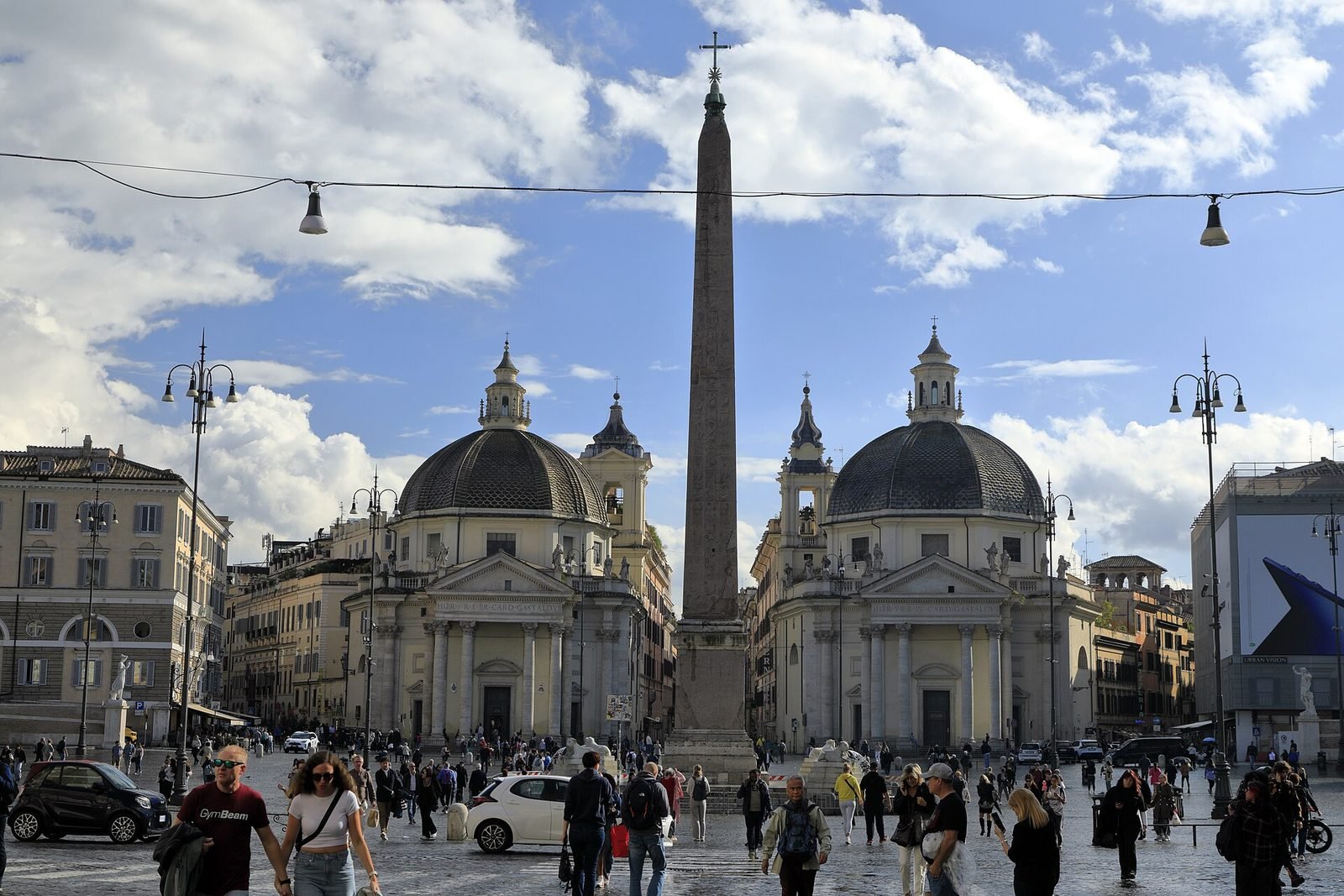
The point from which the effect works is the central axis of the square, near the Flaminian Obelisk, looking south. From there the two domes have the same apparent width, the two porticoes match and the mouth of the Corso opens in the middle like a calculated slit. Even better from the north part of the oval, about 30 meters from the gate: the farther you move along the axis, the more the two silhouettes become equivalent.
The point from which the trick dissolves is the terrace of the Pincio, above the square. From up there you look at the two churches from above and at an angle, and the two domes stop resembling each other: one is round, the other is oval and stretched backward. Even the plan of the roofs tells of two buildings that do not have the same footprint on the ground.
A second useful spot, at street level, is the mouth of Via di Ripetta about 50 meters from the square, looking back toward the north: from there Santa Maria dei Miracoli is seen three-quarters on, and the octagonal drum reads for what it is. The same holds, in mirror image, from Via del Babuino for Montesanto.
Which is which: Montesanto on the left, Miracoli on the right
Looking at the twin churches of Piazza del Popolo from the square, with your back to the Porta del Popolo, Santa Maria in Montesanto is the one on the left, between Via del Babuino and Via del Corso, while Santa Maria dei Miracoli is the one on the right, between Via del Corso and Via di Ripetta. It is the most frequent confusion among visitors, and also among those who write about Rome.
The method that never fails
The practical rule is to tie each church to its street, not to its position, because the position flips depending on where you look from. Montesanto occupies the side of Via del Babuino. Miracoli occupies the side of Via di Ripetta, and therefore the side toward the Tiber. Anyone who remembers that Ripetta was the river port of the city already has a hook: Miracoli is the church on the river side, and it is no accident that the devotion it takes its name from comes from a river story.
Why they are called what they are called
Santa Maria in Montesanto inherits its name from an earlier, smaller church that belonged to the Carmelites of the province of Monte Santo in Sicily. The title passed to the new building together with the religious community.
Santa Maria dei Miracoli takes its name from a Marian image believed to be miraculous. Popular tradition, told this way for centuries and reported here as tradition and not as a documented fact, holds that in 1325 a woman in despair over her son who had fallen into the Tiber prayed before a Madonna painted on a wall near the river, and that the child was saved. The venerated image was later moved because of the floods of the Tiber and ended up in the church of San Giacomo in Augusta. On the high altar of the church in Piazza del Popolo there is a 16th-century copy.
The building site: Rainaldi, Bernini, Fontana and almost 20 years of work
The design of the twin churches of Piazza del Popolo was entrusted to Carlo Rainaldi under the pontificate of Alexander VII, and the first building site opened in 1662 with Santa Maria in Montesanto. The work continued in fits and starts until the end of the 1670s, with interventions by Gian Lorenzo Bernini and the final direction of Carlo Fontana. The sources do not agree on who exactly did what, and here we report the main versions without choosing one.
The dates, and where the sources diverge
On the start there is substantial agreement: the commission to Rainaldi is placed between 1661 and 1662, and the first stone of Santa Maria in Montesanto is laid in 1662. The death of Alexander VII in 1667 stops the building site. Work resumes in 1673 under the direction of Carlo Fontana.
On the conclusion the versions part ways. For Santa Maria in Montesanto some sources give 1675 as the year the building was completed and 1679 as the year the interior decoration was finished. For Santa Maria dei Miracoli the most widespread chronology places the building site between 1675 and 1679, with consecration and opening to the public in 1681. A different reconstruction, which circulates in popular literature, moves the construction of Miracoli earlier, to the two years 1673-1675. The bell towers are additions of the 1700s, attributed to Francesco Navone, and for Montesanto the year 1761 is given.
Who did what
Carlo Rainaldi is the author of the general layout and of the design of both churches. It is to him that we owe the idea of closing the square with two buildings identical in facade, portico and pediment on the ancient model.
Bernini steps in once the building site is under way, and here the sources divide sharply. Several reconstructions, including those of the municipal tourist bodies, attribute to him the revision of the design of Santa Maria in Montesanto, with the shift to the elliptical plan to adapt the building to the shape of the plot. Others, including reference works on Baroque art history, assign him instead the revision of Santa Maria dei Miracoli. The design of the statues of saints placed on the exterior is also traced back to Bernini. We compared the versions and it is not possible to settle them here: whoever writes about these two churches should state the divergence instead of picking one at random.
Carlo Fontana brings both buildings to completion from 1673 onward, and to him are owed weighty interior solutions: the presbytery and the high altar of Santa Maria dei Miracoli, chapels and parts of the decoration in both.
The ancient model behind the two facades
The difference is that the Pantheon is an isolated building seen up close, inside a narrow square, while these two churches were conceived to be read from afar, as a pair, as the scenic backdrop of an urban space. Roman Baroque treats architecture as the direction of the city: the same logic found in the colonnade of Saint Peter's or in the fountains of Piazza Navona, where the Fountain of the Four Rivers was calculated on the axes of movement of the square.
Anyone who wants to follow this thread has two routes on the site that run through it from start to finish: Bernini in Rome and Borromini in Rome. The twin churches stand exactly at the point where that season stops making buildings and starts making a city.
The 10 statues on the balustrade
On the exterior balustrade of Santa Maria dei Miracoli stand 10 statues of saints, made between 1676 and 1677 by a group of sculptors active on the building site, among them Filippo Carcani and Ercole Ferrata. They are figures that from the square read as a profile against the sky, and that almost nobody looks at up close.
A curiosity about the twin churches of Piazza del Popolo
The most solid curiosity about the twin churches of Piazza del Popolo is that the name everyone calls them by is technically wrong, and is so by the designers' choice: the twin effect is a perspective correction built on two buildings that have a different plan, a different dome and a different footprint.
A copy that makes the square work
The value of the two churches is not in the single building. Neither of the two, taken alone, would be among the 10 Roman Baroque churches an enthusiast goes looking for. Together, and in that position, they do something that few architectures in the world manage to do: they turn a city exit into a city gate, and give those who enter the feeling of being expected.
For centuries Piazza del Popolo was the first piece of Rome a traveler saw on arriving from the north along Via Flaminia, after Milvian Bridge. The two churches are the first sentence of the speech.
The detail that disproves the symmetry with the naked eye
There is a detail that takes apart the idea of twinness without needing to climb the Pincio, and that you can see standing in the square: the drum of the two domes has a different number of sides. That of Santa Maria dei Miracoli is octagonal, that of Santa Maria in Montesanto has 12 sides. Counting the corners is possible with a little patience, in the right light, from the north half of the square.
One thing nobody tells you about the twin churches of Piazza del Popolo
The twin churches of Piazza del Popolo do not open at the same hours, and they do not even open by the same logic: they are two distinct bodies, with two communities and two calendars, and the chance of finding one open and the other closed at the same moment is high. Anyone who arrives thinking of visiting them in a row, one after the other, often visits only one.
Two churches, two calendars
Santa Maria in Montesanto has a liturgical life tied to the Artists' Mass, which is celebrated on Sunday and follows a seasonal calendar. Santa Maria dei Miracoli is a rectory with a different rhythm, more tied to weekday Masses and to openings for devotion to the Marian image.
The practical consequence is that the hours to check are double. The phone numbers published by the official tourist portal of the City are 06 3610594 for Santa Maria in Montesanto, which also has a site of its own, and 06 3610250 for Santa Maria dei Miracoli. A phone call the day before solves the problem better than any table found online, including the tables of the big aggregators, which for Roman churches are wrong with a frequency that is surprising.
Entry is free at both. There is no ticket office, no booking, no audioguide. Anyone who asks you for money to enter one of the two churches does not represent the church.
They are active churches, not museums
During services the tourist visit is suspended. It is a rule that holds in all Roman churches open for worship, and here it weighs more than elsewhere because the two churches are small: 20 people standing with their phones raised inside a circular hall of that size are noticed immediately.
The church almost everyone confuses
Many visitors leave Piazza del Popolo convinced they have seen the twin churches, and they have seen Santa Maria del Popolo. It is another church, on the north side of the square, set against the Porta del Popolo, and it contains first-rate works, among them two canvases by Caravaggio in the Cerasi Chapel. It is not part of the Baroque pair on the south side.
Anyone who has time for only one church at Piazza del Popolo and comes for the art should go to Santa Maria del Popolo, not to the twins. We say it bluntly: on the level of the works the comparison does not hold. Anyone who comes to understand how a square is built, instead, has the twins in front of them. They are two visits that answer two different questions, and anyone looking for the Caravaggio paintings in the city can follow the itinerary dedicated to Caravaggio in Rome and the page on the Contarelli Chapel in San Luigi dei Francesi.
The advice I give you for visiting the twin churches of Piazza del Popolo
To visit the twin churches of Piazza del Popolo we recommend setting aside 40 minutes in total, entering through the Porta del Popolo, going up to the Pincio before coming down into the square and leaving the interiors for last: the order matters more than the length, because the sense of the place is understood outside.
The right order of things
The sequence that works is this. First the Pincio, to see the two domes from above and register that they are different. Then the descent into the square along the ramp, which gradually brings the point of view from high to low and lets you see the two silhouettes line up. Then the center of the square, at the obelisk, where the symmetry closes. Then the interiors.
The time of day
The facade of the two churches faces north. This means the front stays in shadow almost all day, while the domes catch raking light in the early morning from the east and in the late afternoon from the west.
The best moment to see the relief of the two domes is the late afternoon, when the raking light from the west sets off the drum of Santa Maria dei Miracoli and leaves that of Montesanto in shadow, making the difference between the two polygons more legible than at noon. At noon, with the sun high, everything flattens and the symmetry looks even more believable: paradoxically it is the hour when the trick works best.
The day of the week
Piazza del Popolo is used for demonstrations, concerts and gatherings with high frequency, and in those cases the square fills with stages, barriers and trucks. The perspective effect disappears. Before planning the visit it is a good idea to check if an event is scheduled in the square, especially on weekends and in the summer months, when the city hosts the program of the cultural season.
On Sunday morning Santa Maria in Montesanto is taken up by the Artists' Mass in the period when it is celebrated. For anyone who wants to go in without overlapping with a service, a weekday in mid-morning or mid-afternoon remains the safest choice.
How to combine the visit
40 minutes at Piazza del Popolo graft well onto a longer walk. Toward the east you take Via del Babuino and in 10 minutes you are at Piazza di Spagna, beneath the Trinità dei Monti, with the Barcaccia Fountain at the foot of the staircase and the Keats Shelley House on the corner. From there you can climb to Villa Medici.
Toward the west you take Via di Ripetta and in eight minutes you reach the Ara Pacis and the Mausoleum of Augustus. Toward the south the Corso leads to San Lorenzo in Lucina, to Montecitorio with its obelisk, to San Marcello al Corso and finally to the Altar of the Fatherland.
Toward the north, beyond the gate, you enter Villa Borghese and can reach the Galleria Borghese, which however requires mandatory booking with timed entry: anyone who wants it on the same day has to build everything else around it, not the other way around.
Another well-known fact, yet rarely cited
The twin churches of Piazza del Popolo are the last act of an urban design begun more than a century earlier: the Tridente already existed, and the two churches were built to give it a unified backdrop on the side of the gate. The fact is known to scholars and almost never told to visitors, who find them there as if they had been born together with the square.
First the streets, then the churches
Via di Ripetta and Via del Babuino date from the 1500s, opening in a fan from the square toward the Tiber and toward the climb of the Pincio. Via del Corso, the central axis, follows the course of the ancient Via Lata. When Rainaldi receives the commission, in the 1660s, the fan has already been drawn for generations.
The square we know is more recent than the churches
The other little-cited fact concerns the shape of the square itself. The oval with the hemicycles, the side fountains and the ramp that climbs to the Pincio is the work of Giuseppe Valadier, carried out in the early 1800s. The twin churches are therefore older than the square they stand in by more than a century.
Valadier works around a pair of already existing buildings and builds the rest to bring out precisely that axis. Anyone looking at the churches from the center of the square is not seeing only a Baroque invention: they are seeing a 17th-century scene restaged by a neoclassical architect who had understood perfectly how it worked. The full context of the square is in the page devoted to Piazza del Popolo, which we do not repeat here.
The obelisk was already in place
The Flaminian Obelisk, the Egyptian monolith at the center of the square, was brought to Rome by Augustus and placed in the Circus Maximus. It was moved to Piazza del Popolo at the end of the 1500s, in the urban rearrangement campaign of Sixtus V. When the churches are built, the obelisk has been there for about 70 years.
This explains why the axis works so well: the designers had a vertical reference already planted at the right spot, and they built around it. On the Pincio there is a second monolith, the Pincio Obelisk, which works on the same axis from above. Rome has the highest concentration of ancient obelisks in the world, and Piazza del Popolo is one of the places where you see two with a single turn of the head.
The right photo to take at the twin churches of Piazza del Popolo
The photo that truly tells the story of the twin churches of Piazza del Popolo is not the frontal one from the center of the square, which everyone takes and which documents the illusion: it is the pair of shots that sets the view from the axis against the view from the Pincio, because only together do they show that the two domes are not the same.
Shot one: the axis, from the center of the square
You stand on the north-south axis of the square, at the height of the obelisk or a few meters farther north, and frame horizontally, including both porticoes and the mouth of the Corso in between. You need a moderate wide angle: with a phone, the standard lens is usually enough, with the ultra-wide the two churches distort at the edges and the effect is lost.
Shot two: from the Pincio, the proof to the contrary
From the terrace of the Pincio you frame the square from above including both domes. From there the oval of Montesanto and the circle of Miracoli can be told apart, and the two roofs have different footprints. A slightly tele focal length, the equivalent of a 50 or 70 millimeter, compresses the scene and makes the comparison more legible than the wide angle.
The two photos placed side by side are the content. Only one of the two proves nothing.
Light, crowds and constraints
Inside the churches the general rule of Roman places of worship applies: no flash, no tripod without authorization, and no filming during services. For professional shooting, video or photo shoots with equipment, permission must be requested in advance from the rectory or the parish, and it is not a formality.
The square is public and photographing it is free. The only practical limit is the crowd: in the summer months and on weekends the axis in front of the churches is occupied by groups, and to have a clear field you have to get up early. At seven in the morning the square is empty.
Some important events that happened here in history
For centuries Piazza del Popolo was the north gate of Rome, the place of solemn entries, of public executions until the 1800s and, in the contemporary era, of the great political rallies and concerts: the twin churches have witnessed all of this from the south side, as a fixed backdrop.
The triumphal entries from the north
Anyone arriving in Rome from Via Flaminia entered through the Porta del Popolo. For the great arrivals the gate was decorated and the route to Saint Peter's or the Quirinal was staged as a procession. The construction of the two churches in the 1600s falls exactly within this logic: giving that entrance an architectural conclusion worthy of it.
The public executions
Until the middle of the 1800s Piazza del Popolo was one of the places where the Papal State carried out capital sentences, with a scaffold set up in the square and a large public. The practice ceased with the end of temporal power.
Valadier's square and the Napoleonic age
The 19th-century rearrangement by Giuseppe Valadier, which gives the square its present oval form with the hemicycles and the link to the Pincio, matures between the Napoleonic age and the Restoration. It is the intervention that transforms an irregular space into a scenic oval and builds the system of ramps toward the hill.
The 1900s: rallies, marches and concerts
In the 1900s Piazza del Popolo was the stage of political rallies of every stripe, of union marches and, from the 1990s on, of high-draw concerts, including the May Day concert in some editions and the gatherings for sports victories. The real capacity of the square is the subject of very different estimates depending on the source and the event: we do not give a figure because the figures that circulate are partisan claims, not technical data.
The Artists' Mass
The Sunday celebration devoted to the world of art and entertainment is the recurring event that gave Santa Maria in Montesanto its contemporary identity. The initiative began in the 1940s and moved to this church in the 1950s, where it has continued since then on a weekly basis during its calendar period.
On the exact dates the sources diverge: the free encyclopedia gives 1953 as the year of the move to Montesanto, with the initiative conceived in 1941, while the municipal tourist portal gives 1951. We report both versions because we have no basis to prefer one.
Who passed through the twin churches of Piazza del Popolo
Through Piazza del Popolo and its two churches has passed everyone who arrived in Rome from the north between the 1600s and the 1800s: it was the obligatory entrance to the city for those coming from continental Europe along Via Flaminia, and the first urban space a traveler crossed.
The travelers of the Grand Tour
For two centuries the Grand Tour brought generations of northern European travelers to Rome, and for almost all of them the entrance was through the Porta del Popolo. The description of the arrival in the square, with the obelisk in the center and the two churches that open the Tridente, is a recurring passage in the travel literature of the period.
The area between Via del Babuino, Via Margutta and Piazza di Spagna becomes in those years the quarter of the foreigners: hotels, cafes, studios of painters and sculptors, antique shops. The housing and commercial system that still characterizes Via del Babuino today was born there.
Artists, architects and scholars
The two churches have been measured, drawn and engraved by generations of architects in training, who on the Roman example learned to compose facades and domes. Villa Medici, seat of the French Academy since the early 1800s, sent its pensionnaires for two centuries to survey the monuments of the city, and Piazza del Popolo was a 10-minute walk from their lodgings.
The world of art and entertainment
Santa Maria in Montesanto is known as the artists' church for the now 70-year attendance of people from the world of art, film, theater and music, who take part in the Sunday Mass and who over the years have seen many funerals of colleagues celebrated here. It is an established fact documented by the church itself, which makes it its distinguishing mark.
On this page we do not name names. The church is an active and well-attended place of worship, the ceremonies celebrated there concern people and families, and turning it into a list of celebrities would be the wrong way to tell its story. Anyone who wants to know more will find the calendar and news on the church's website.
What you see inside the two churches
Inside, the twin churches of Piazza del Popolo have two halls on a central plan with side chapels, white stuccoes and Baroque decoration: the hall of Santa Maria in Montesanto is elliptical and deeper, that of Santa Maria dei Miracoli is circular and more intimate. Entry is free at both.
Santa Maria in Montesanto
You enter under the portico from Piazza del Popolo and find yourself in an oval space, with the long axis running from the entrance toward the altar. The immediate perception is of a space more extensive than the facade would lead you to expect, which is exactly what the ellipse serves to produce.
Santa Maria dei Miracoli
The space is a rotunda, with a circular movement that carries the eye around the hall as far as the presbytery. The presbytery and the high altar are due to Carlo Fontana, and are the part of greatest architectural weight in the interior.
On the high altar is the 16th-century copy of the Marian image from which the church takes its name, with the Madonna and Child crowned. The original, according to the most widespread reconstruction, is kept in the church of San Giacomo in Augusta, a little farther along the Corso, where it had been taken after the floods of the Tiber had made its original location near the river untenable.
What to expect, honestly
A judgment, because it is needed: the interiors of these two churches do not stand comparison with Santa Maria del Popolo 50 meters away, nor with Sant'Andrea al Quirinale, nor with San Carlo alle Quattro Fontane, which are the two Roman masterpieces of the Baroque central plan and which stand 100 meters from each other near the Quattro Fontane.
The two twins are correct, well-kept, well-preserved buildings, and visiting them takes 10 minutes each. The reason you come here remains the relationship between the two buildings and the square. Anyone looking for the emotion of a Baroque interior will find better a few stops away, for example in Sant'Ignazio, in the Church of the Gesù or in Sant'Andrea della Valle.
Accessibility
Both churches have a staircase in front of the portico, which poses an access problem for anyone who uses a wheelchair or has mobility difficulties. There are no permanent ramps on the main fronts. Anyone who needs alternative access should phone ahead to the numbers given by the municipal tourist portal and ask if a usable side entrance exists: the answer changes from church to church and from day to day, and it is not a fact we want to report without having confirmed it with the venue.
The square, by contrast, is flat, paved and completely accessible, and the frontal view of the two churches, which is the thing worth coming for, is obtained from square level without climbing anything. The ramp that leads to the Pincio has a steep gradient and uneven surface in some stretches.
The Tridente around the two churches
The twin churches of Piazza del Popolo are the head of the Tridente, the system of three streets that structures the whole northern sector of the historic center of Rome: Via del Babuino, Via del Corso and Via di Ripetta, which open from the square and cover in a fan the area between the Pincio and the Tiber.
The arm of Via del Babuino
Via del Babuino runs straight from Piazza del Popolo to Piazza di Spagna. It is the street of art galleries, antique dealers and luxury signs, and it keeps the character of a foreigners' quarter that it took on in the age of the Grand Tour. It comes out at the foot of the staircase that climbs to Trinità dei Monti.
The arm of Via di Ripetta
Via di Ripetta descends toward the Tiber and takes its name from the river port that stood at the end of the street, dismantled with the construction of the embankment walls at the end of the 1800s. It is the quietest of the three, less commercial, with a fabric of shops and palaces that still holds up.
Along its course you meet the Mausoleum of Augustus and the Ara Pacis, which together form the Augustan complex of the northern Campus Martius. Continuing south you reach the area of Santa Maria Maddalena and the Pantheon with the Macuteo Obelisk in front of it.
The arm of Via del Corso
Via del Corso is the central axis, a kilometer and a half in a straight line from Piazza del Popolo to Piazza Venezia. It is the street of mass shopping, much trodden, and with the highest pedestrian density of the three.
On its course or a few meters away are San Lorenzo in Lucina, the square of Montecitorio, San Marcello al Corso and, at the far end, the Vittoriano with the Altare della Patria and the Ala Brasini. Turning left halfway along you reach the Trevi Fountain, turning right you enter the system of Piazza Navona and the Pantheon.
The Pincio and Villa Borghese
The most efficient combination for a half day is this: metro to Flaminio, Porta del Popolo, square, twin churches, ramp to the Pincio, terrace, Villa Borghese. It is about two kilometers with a single change in elevation, and it crosses four eras.
Eating near Piazza del Popolo without getting burned
Piazza del Popolo and the Tridente are among the most exposed areas of Rome from the point of view of dining: the density of tourists is very high, the foot traffic is constant and the risk of sitting down in the wrong place is real. On this site we do not recommend venues by name, and the reason is simple: a list of signs ages in a few months and teaches nothing. We prefer to give the criteria.
The five signals that indicate a trap
The first signal is the lady rolling fresh pasta in the window or in front of the door. It is a lure designed for passersby, not a sign of cooking. In the neighborhoods where people eat well nobody works in the street to be seen.
The second is the menu with photographs of the dishes. It is there to make people order who do not read Italian, and whoever displays it has already decided that their customer is passing through and will not come back.
The third is the barker on the threshold inviting you to sit. A place that has to stop people on the street has no regular customers.
The fourth is the non-stop schedule from morning to night with no kitchen break. A real kitchen stops between lunch and dinner because it has to clean, prep and rest. Whoever serves at any hour is reheating.
The fifth, and the most relevant in this area, is the position in front of the monument. The venues facing the square or the mouth of the three streets work on a flow that renews itself every day and have no interest in building loyalty. That is where you meet the items without prices on the menu, the cover charge that appears only on the receipt, the different price list between the indoor room and the outdoor table. Asking the price before ordering and asking for the itemized bill are two gestures worth always making in this area.
The criterion that works better than any review
The most reliable rule is to look at who is seated and in what language they order. If at the tables there are Romans talking to each other, if the waiter takes orders in Italian and if the customers look like people who come back, the place makes sense. If at the tables there are only foreigners and the staff switches from one language to another depending on the shift, the venue lives on passing trade.
The chains in the center
In the Tridente in recent years several venues have appeared that repeat the same sign at multiple points in the city, with an identical menu and queues organized with a ticket number. We do not name them. The observation that matters is that Romans do not go there: they are formats built for the tourist flow, with a standardized offer that works anywhere and that therefore has no connection with the cooking of this city.
A curated list, for those who want it
For those who prefer to have a reference anyway, Daniele Dezi keeps a personal collection of Roman addresses on Google Maps: it is a personal list by Daniele Dezi on Google Maps, curated and not sponsored, with no commercial agreements with the venues listed. It should be taken for what it is, a subjective selection based on direct experience, and not as a ranking.
Frequently asked questions about the twin churches of Piazza del Popolo
How much does it cost to enter the twin churches of Piazza del Popolo?
Entry to the twin churches of Piazza del Popolo, Santa Maria in Montesanto and Santa Maria dei Miracoli, is free of charge. They are two active places of worship, not museums: there is no ticket office, no booking and no mandatory contribution. Anyone who asks for money for access in front of the doors has no connection with the two churches. Any offerings for maintenance remain voluntary.
What are the opening hours of the twin churches of Piazza del Popolo?
The hours of the twin churches of Piazza del Popolo are variable and differ between the two churches, which have distinct calendars and communities. We do not publish a table because it would change within weeks. The contacts given by the official tourist portal of the City are 06 3610594 for Santa Maria in Montesanto, which also has a site of its own, and 06 3610250 for Santa Maria dei Miracoli. A phone call or a check on the site the day before is the most reliable verification.
What is the difference between Santa Maria in Montesanto and Santa Maria dei Miracoli?
The difference between Santa Maria in Montesanto and Santa Maria dei Miracoli is in the plan: Montesanto, between Via del Babuino and Via del Corso, is elliptical with an oval dome and a 12-sided drum, while Miracoli, between Via del Corso and Via di Ripetta, is circular with a round dome and an octagonal drum. The facades and porticoes are the same, because the design aimed to make them look identical from the square.
Why are the twin churches of Piazza del Popolo not really twins?
The twin churches of Piazza del Popolo are not twins because the two plots between the streets of the Tridente had different widths and did not allow two identical buildings. On the wider plot, toward Via di Ripetta, a rotunda with a circular plan was built. On the narrower one, toward Via del Babuino, an elliptical plan was set that develops the volume in depth. From the center of the square the two domes show the same apparent width.
How do you get to the twin churches of Piazza del Popolo by public transport?
You get to the twin churches of Piazza del Popolo by metro Line A, Flaminio stop, about 150 meters from the Porta del Popolo: you go through the gate and the two churches are at the far end of the square, 200 meters away. Tram 2 and several bus lines also stop at Piazzale Flaminio. The square is closed for events with some frequency, so it is best to check detours on the public transport app.
How long does it take to visit the twin churches of Piazza del Popolo?
To visit the twin churches of Piazza del Popolo, 40 minutes are enough, of which about 20 outdoors and 10 for each interior. We recommend going up first to the terrace of the Pincio to see from above that the two domes are different, then going down to the center of the square where the symmetry reassembles, and only at the end going in. Fitted into a walk along the Tridente, the two churches take less than an hour.
Can you photograph the twin churches of Piazza del Popolo?
Photographing the twin churches of Piazza del Popolo from the outside is free, because the square is public space. Inside, the rules common to Roman churches apply: no flash, no tripod without authorization and no filming during services. For photo or video shoots with professional equipment, permission must be requested in advance from the rectory or the parish. The best time for exterior photos is the late afternoon, with raking light on the domes.
Why is Santa Maria in Montesanto called the artists' church?
Santa Maria in Montesanto is called the artists' church because for more than 70 years it has hosted a Sunday Mass devoted to the world of art and entertainment, with steady participation from people in film, theater, music and the visual arts. The initiative began in the 1940s and moved here in the 1950s: the sources diverge between 1951 and 1953. The celebration follows a seasonal calendar, to be checked with the church.
Are the twin churches of Piazza del Popolo wheelchair accessible?
The twin churches of Piazza del Popolo both have a staircase in front of the portico and there are no permanent ramps on the main fronts, so independent access by wheelchair is problematic. Anyone who needs an alternative entrance should phone ahead to the numbers of the two churches and ask. The square, by contrast, is flat and completely accessible, and the frontal view of the two facades is obtained from street level without climbing anything.
Who wrote this page
This page is edited by the editorial team of Tour Leader Pro, the Roman project office that designs and coordinates visits, itineraries and cultural events in Rome and Lazio. The hours, fares and access conditions reported here are verified as of the publication date against the official sources indicated in the text: it is best to recheck them before leaving, because they change often. If you find an outdated figure, let us know.
Anyone building an itinerary in the center of Rome that lines up Piazza del Popolo, the Tridente and the climb to the Pincio, and wants to calculate real times, distances and moments of the day, will find planning tools and operational support at Tour Leader Pro, which works on Rome and Lazio with a project-office approach.
For a broader picture of connections, regional transport and destinations in Lazio outside the historic center, to pair with a Roman day or a longer trip in Italy, a good planning resource is Italy Planner.