Quattro Fontane
In short. The Quattro Fontane are four wall fountains set into the beveled corners of the intersection between Via delle Quattro Fontane and Via del Quirinale, which at that very point changes name and becomes Via XX Settembre.
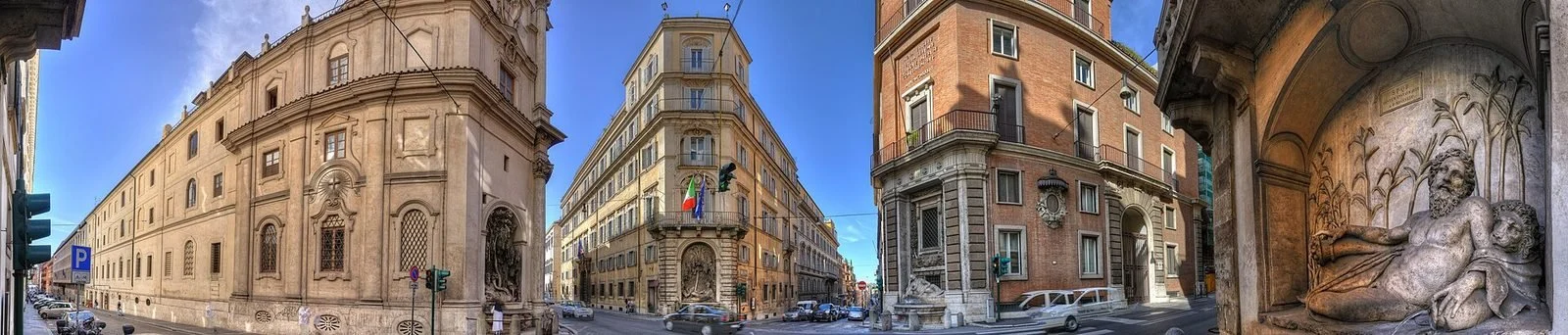
The Quattro Fontane are four wall fountains set into the beveled corners of the intersection between Via delle Quattro Fontane and Via del Quirinale, which at that very point changes name and becomes Via XX Settembre. They were commissioned by Pope Sixtus V as the crowning piece of his urban plan for Rome, designed by the architect Domenico Fontana, and were built between 1588 and 1593, so partly after the death of the pontiff, in August 1590. The water comes from the Acqua Felice, the aqueduct that Sixtus V himself had built a few years earlier to bring running water back to the eastern hills of the city. There is no ticket, no opening hours, no gate: they are four niches on the sidewalk, in the open air, visible 24 hours a day. The difficulty is something else, and it is best to say it right away: the crossing has constant traffic and the sidewalks, at three corners out of four, are narrower than a meter and a half. Looking at the fountains at your leisure takes a choice of time of day, not of ticket. The lines that follow explain who commissioned them, what the four reclining figures represent, why the attributions to the sculptors are still debated, what you actually see from here (three obelisks and a gate by Michelangelo) and how to organize your stop without risking your life among the cars.
Where the Quattro Fontane are and how to get there
The intersection is on the Quirinal Hill, at the top of the climb that leads from Piazza Barberini toward the Viminal, at the highest point of the route. It is where two 16th-century streets cross at a right angle: the first is the Strada Pia, opened by Pius IV in 1561 and today divided between Via del Quirinale to the west and Via XX Settembre to the east. The second is the Strada Felice, commissioned by Sixtus V and today broken up in its names into Via Sistina, Via delle Quattro Fontane and Via Agostino Depretis. The four fountains occupy the four corners of that intersection, one per corner, and since that day the crossing has taken its name from the fountains instead of from the streets.
By metro
The most convenient stop is Barberini, on Line A: from there you walk up Via delle Quattro Fontane for about 500 meters, all uphill, and arrive in a good seven or eight minutes. If you have trouble walking, keep in mind that the slope is real, not symbolic, and that the sidewalk on the right going up is interrupted by driveways and trash bins. The alternative is the Repubblica stop, also Line A, from which you walk down Via delle Quattro Fontane after cutting through Largo Santa Susanna: the distance is similar, the effort much less. We recommend the second option to those arriving from Termini and the first to those coming from the historic center.
By surface bus
Via XX Settembre and Via Nazionale are two axes served by several city lines, and the nearest stops are a few dozen meters from the intersection, in both directions. Line numbers change fairly often because of construction sites and temporary detours, so we do not list them as if they were carved in marble: check them on the transit company's website on the same day. What we can say for sure is that there is no stop at the intersection itself: you get off before or after, and the last stretch is on foot anyway.
On foot, from the center and from nearby museums
From Piazza di Spagna you climb Via Sistina, and in 15 minutes you are in front of the first fountain. It is the same route as the Strada Felice, so you walk exactly along the axis Sixtus V had laid out. From Santa Maria Maggiore you arrive from the other end, going down Via Depretis and back up Via delle Quattro Fontane, in about 20 minutes. From the Trevi Fountain 12 minutes are enough, going by Via del Traforo and Via delle Quattro Fontane. If you are coming out of Palazzo Barberini, you have the shortest climb of all: the palace's main door opens on Via delle Quattro Fontane, and the intersection is 200 meters farther up.
By car: the short answer is no
The intersection is in an area of heavy, regulated traffic, with parking bans almost everywhere and no possibility of stopping even for a minute to take a photo. If you are coming from outside Rome, you are much better off leaving the car in a park-and-ride lot connected to the metro and finishing the trip by metro: between looking for a spot, blue-line parking and the risk of a fine, the car in this area costs time and money and gives nothing back. It is a judgment, and we back it with a fact: between the Barberini stop and the intersection there are 500 meters, which is less than the average walk to reach your car from a free parking spot in the center.
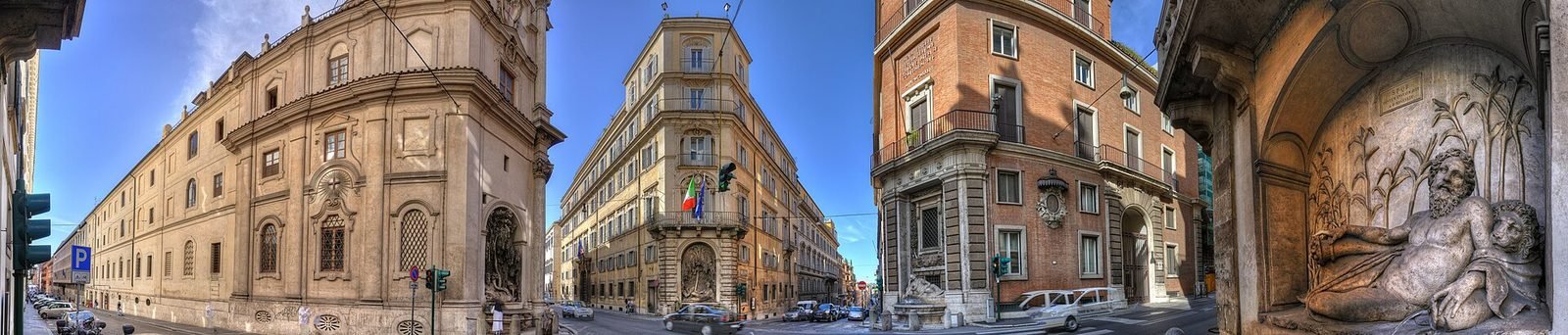
What the Quattro Fontane are: four corners, one project
The Quattro Fontane are four independent wall fountains, each set against the cut corner of a different building, but designed as a single composition that can only be read from the middle of the intersection. Each fountain consists of a rectangular niche with a reclining figure in a river-god pose, leaning on an urn or a ledge of rock from which the water comes out, falling into a low basin at sidewalk level. The dimensions are modest: these are structures a little taller than a person, not monumental square fountains.
Why the corners are beveled
The detail almost no one notices is that the four corners of the buildings are not sharp but cut on the diagonal, to create the flat surface in which the niche is set. It was a change imposed on the owners of the corner buildings, who had to give up a piece of their property and take on, according to the practice of the time, the construction and partly the upkeep of the fountain on their own side. In exchange, Sixtus V granted the use of a share of the aqueduct's water: a perfectly ordinary barter in late 16th-century Rome, where running water was a currency between pope and property owners.
The role of Muzio Mattei
Among the private patrons involved in the operation, the sources most often cite the name of Muzio Mattei, owner of one of the corner buildings, who reportedly took charge of the fountain on his own front. The name also appears in the story of the Turtle Fountain in Piazza Mattei, tied to the same family, and this has helped circulate anecdotes of all kinds about him. We point out that the exact role of each owner in the contracts for the four fountains is not documented with the same precision for all four corners, and anyone who presents the complete list of patrons as an established fact is oversimplifying.
Two fountains on private ground, two on buildings changed over time
The buildings that host the fountains are no longer the 16th-century ones in all four cases. The northeast corner is occupied by the complex of San Carlo alle Quattro Fontane, the church built by Francesco Borromini in the following century, which absorbed the existing fountain into its own side. The other three corners belong to palaces reworked between the 17th and 19th centuries. This means the fountains are older than a good part of the walls that host them, a rare condition in Rome, and it explains some anomalies in the joint between the niche and the facade, clearly visible if you look closely at the masonry above the basins.
The plan of Sixtus V and the Strada Felice
The Quattro Fontane were born as an urban signal inside a larger project: the plan with which Sixtus V, pope from 1585 to 1590, reorganized the connections between the great basilicas of Rome, entrusting the design to Domenico Fontana. The idea was simple and brutal: lay out long straight roads through the countryside that then occupied the eastern hills, linking the pilgrimage sites and making passable by carriage a city that until then had developed almost entirely within the bend of the Tiber.
From Trinità dei Monti to Santa Maria Maggiore
The Strada Felice, named after the pope's given name (Felice Peretti), connected the church of Trinità dei Monti to the basilica of Santa Maria Maggiore and continued toward Santa Croce in Gerusalemme. Today you can still walk that whole route, under three different names, and the Quattro Fontane crossing is its central point: from there you see in one direction the climb toward the Pincio and in the other the descent toward the Esquiline. If you want to understand the Sistine plan with your legs instead of on paper, you can do it by walking that whole axis, in a little over half an hour.
The Strada Pia of Pius IV
The other street, the one that cuts across at a right angle, is a quarter century older: Pius IV had it opened in 1561 between the papal palace of the Quirinal and the Aurelian Walls, where Michelangelo designed the new Porta Pia, completed in 1565. It was a prestigious straight road, meant to be looked at from one end to the other, and its monumental outlet was precisely Michelangelo's gate. When Sixtus V crossed his Strada Felice with the Strada Pia, the point of intersection automatically became the most important visual node of upper Rome.
Why an intersection needs four fountains
Sixtus V and Domenico Fontana understood that an intersection between two long straight roads risks being invisible: people passing through do not realize they are at a notable point. The four fountains serve exactly this purpose, to mark the node, to force the eye to stop, and at the same time to distribute drinking water in a neighborhood that until three years earlier had none. The symbolic function and the practical one coincide, and they are the same thing: here passes the pope's new water, and here his roads cross.
The Acqua Felice: where the fountains' water comes from
The Quattro Fontane are fed by the Acqua Felice, the aqueduct built by Sixtus V and inaugurated in 1587, which brought to Rome the waters of springs in the area between Pantano and Colonna, in the countryside east of the city, partly reusing the course of ancient Roman conduits. Without that aqueduct the fountains could not have existed: the Quirinal, the Viminal and the Esquiline were hills practically without running water since the ancient aqueducts had stopped working, and the repopulation of those areas begins precisely with the arrival of the Acqua Felice.
The water display at Piazza San Bernardo
The monumental end point of the aqueduct is the large fountain in Piazza San Bernardo, a few minutes' walk from the intersection, the one Romans have called the Moses for centuries because of the central statue. From there the network branched out toward the neighborhood's smaller fountains, and the four at the intersection were among the first beneficiaries. If you want to understand the logic of a 16th-century papal aqueduct, do the route in this order: first the water display, then the distribution fountains.
What the difference is with the Acqua Vergine and the Acqua Paola
Modern Rome is hydraulically reborn with three aqueducts restored or built between the 15th and 17th centuries. The Acqua Vergine, whose story we tell in the page on the Aqua Virgo, serves the Campus Martius and feeds the Trevi Fountain and the Barcaccia Fountain. The Acqua Paola, from the 17th century, serves the Janiculum and Trastevere with the water display everyone knows as the Acqua Paola Fountain. The Acqua Felice, in the middle chronologically, serves the eastern hills. Three basins, three neighborhoods, three pontificates.
The water that comes out today
The basins are connected to the city water network and the water runs continuously, as in the Roman drinking fountains. As far as we know it is not marked as non-potable, but the basins of these fountains are flush with the sidewalk, at a point of heavy traffic, and we feel we should advise against drinking from them or filling bottles: the same thing is done much better at any ordinary column drinking fountain on the side streets, where the jet is high and far from the roadway.
The four figures: rivers and goddesses, with some question marks
The four reclining statues represent, according to the current reading, two male river gods and two female figures, and already here begins the part where we have to be honest: the precise identification of the two male figures is debated and the sources do not agree. The most widespread tradition holds that they are the Tiber, recognizable by the she-wolf that accompanies him, and the Aniene, the river that flows into the Tiber north of Rome. An equally widespread reading, repeated by many guides, holds instead that the second male figure is the Arno, that is, Florence, in homage to the Tuscan component of the patronage and of the Roman artistic culture of the time.
Tiber and Aniene, or Tiber and Arno
The two readings have coexisted for centuries and there is no inscription that settles the question. Those who support the Aniene argue from local coherence: two rivers of Lazio that meet, accompanied by two deities, are a complete iconographic program that a Roman could understand. Those who support the Arno argue from the sculpted attributes, in particular the lion that in some descriptions accompanies one of the figures and that is a Florentine symbol, and from the context of relations between Rome and Tuscany in those years. We report both versions because both circulate in the literature, and anyone who tells you the answer is only one is choosing for you.
Diana and Juno, or Fidelity and Strength
On the two female figures the situation is similar. The most frequent reading identifies them with Diana, goddess of the hunt and symbol of chastity, and with Juno, protector goddess of Rome. A second reading, often found in 19th-century descriptions and in part of the later guidebook literature, interprets them instead as personifications of virtues: Fidelity, accompanied by the dog, and Strength, accompanied by the lion. The two readings do not entirely exclude each other, because in late 16th-century iconography the attributes of a goddess and those of a virtue overlap easily, and the animal beside the figure can be read both ways.
How to look at them, in practice
On the spot the quickest way to get your bearings is to look at the animal beside each figure and at the object the figure leans on. The presence of the she-wolf indicates the Tiber in all readings, and there is no discussion on that. For the other three, we recommend observing without insisting on a name: they are four reclining bodies, with heavy drapery and arms resting on urns or rocks, sculpted to be seen from below and at an angle by people passing in carriages. It is sculpture meant for the moving eye, not for close examination, and many roughnesses of execution are explained this way.
A reading tip for those who like the theme of water
If you find the language of river gods in Roman sculpture interesting, you can continue with Bernini's Fountain of the Four Rivers in Piazza Navona, which 50 years later brings the same repertoire to a completely different scale, and with the Triton Fountain in Piazza Barberini, which you meet anyway when climbing up from Barberini metro station. Seeing them on the same day, in chronological order, makes the leap from the Sistine measure to Baroque invention evident.
Who sculpted them: an attribution problem that is still open
None of the four sculptures bears a legible signature, and the construction-site documents that would be decisive have not been found for all four. The result is that the circulating attributions must be treated as proposals, not as data. Among the names that recur in the literature are Domenico Fontana, as designer of the whole, and those of sculptors active in Rome in those years such as Giovanni Antonio Paracca known as il Valsoldo, Flaminio Vacca and Pompeo Ferrucci, with different variants and combinations depending on the author you consult.
The Pietro da Cortona case
One of the most repeated attributions online assigns one of the four figures to Pietro da Cortona. It must be said clearly that this proposal poses a serious chronological problem, because Pietro da Cortona was born in 1596, that is, after the end of the fountains' construction, placed by most studies by 1593. The attribution can be sustained only by assuming a later intervention on one of the fountains, or it must be considered an error handed down. We report it as a circulating claim and point out the date problem, without endorsing it.
Why the attributions remain uncertain
The reason is mundane and holds for many works of this kind: urban distribution fountains were considered workshop labor, commissioned by contract, and the surviving documentation more often concerns the payments for travertine and for pipes than the names of the sculptors. We add that restorations and replacements of parts have altered the surfaces, making stylistic analysis less reliable than it would be on an intact marble. Anyone looking for a certain attribution for these four sculptures is looking for something that at the moment does not exist.
A curiosity about the Quattro Fontane
The curiosity worth telling in full concerns the name of the street. Before 1593 that climb was not called Via delle Quattro Fontane: it was simply a stretch of the Strada Felice, the great papal artery. It was the fountains that gave the street its name, and not vice versa, and the case is less trivial than it seems because in Roman toponymy it almost always happens the other way around, with fountains taking their name from the square or district where they stand. Here four modest-sized structures, a little over two meters tall, gave their name to a street almost a kilometer long, an intersection, a church by Borromini and, by extension, a whole piece of the city.
There is a second aspect tied to the name, and it is the reason why Borromini's church is known to all Romans as San Carlino. The diminutive arose by comparison: San Carlo alle Quattro Fontane occupies such a small surface that, according to an observation handed down for centuries and become almost a commonplace of architectural literature, its plan would fit inside one of the piers of the dome of St. Peter's. The comparison has circulated for so long that it is impossible to trace who first formulated it, and it should be taken for what it is: an effective way of saying that the church is tiny, not a rigorous measurement.
Have the fountains changed position? The answer is no, with a clarification
Every so often you hear that one of the four fountains was moved or rebuilt elsewhere. The fountains have stayed at their four corners from the 16th century to today, and this is documented by the views and engravings that follow one another from the 17th century onward. What has changed, and quite a lot, is the context: the buildings that host them have been rebuilt or raised, the road surface has been altered with asphalt and modern sidewalks, and in some stretches the ground level has risen. The fountains themselves, however, have not moved a meter.
Something nobody tells you about the Quattro Fontane
What almost no guide says, and which is instead the first thing to know in order to organize the visit, is that today you cannot see all four fountains from the same point in decent conditions. The intersection is regulated by traffic lights and the traffic is constant during working hours, including the two directions of Via XX Settembre that lead toward the ministries. To look at the fountain on the fourth corner you have to cross, and to cross you have to wait for the green, and meanwhile behind you buses pass 20 centimeters from the sidewalk. The real visit consists of four short stops separated by three pedestrian crossings.
The protective glass
A second thing you discover only on arrival is that some of the fountains have been protected, during restoration work, with transparent panels and low railings in front of the basin. The reason is practical: preventing damage from vehicle impacts, trash left in the basins and vandalism on marbles within easy reach. The side effect is that the surface reflects, and photographing the niche in full daylight means taking home the reflection of the facades opposite. Those who arrive knowing this allow for an oblique angle and get a different result.
It is not a half-day monument
It must be said honestly: a useful stop at the Quattro Fontane lasts 10 to 20 minutes. Anyone who arrives with the idea of devoting an hour to it will find much less than expected, while those who include it as a connecting node between Palazzo Barberini, San Carlino and Sant'Andrea al Quirinale get a high-level morning with only a few meters of walking. The value of this intersection is being the center of a 300 meter radius that contains three masterpieces of Roman architecture.
My advice for visiting the Quattro Fontane
The operational advice is only one, and it completely changes the visit: come early on a Sunday morning, roughly between 7:00 and 9:00. Via XX Settembre is the axis of the ministries and on weekdays the traffic is constant from 7:00 in the morning until evening. On Sunday morning it drops drastically, and for the first time you can stand still in the middle of the intersection, on the pedestrian island at the traffic light, and turn around seeing the four niches one after the other. It is exactly the way Domenico Fontana had imagined this point being looked at, and it is the only moment of the week when it is possible.
The light: what time to choose
The four niches face the four approximate cardinal points, so they never receive the same light at the same moment. At mid-morning one pair of fountains is in full shade and the other catches raking light. In the afternoon the situation reverses. Anyone who wants to see all four well has to accept that two will always be in worse conditions, or come back a few hours later. The best compromise, in our experience, is late morning on a slightly overcast day, when the contrast drops and the sculpted details in the deep niches become readable again.
The visiting order we recommend
We suggest starting from Repubblica metro station, stopping at the Acqua Felice water display in Piazza San Bernardo to understand where the water comes from, going down Via delle Quattro Fontane to the intersection, spending about 20 minutes on the four niches and the three obelisks, then going into San Carlino, continuing along Via del Quirinale to Sant'Andrea and finishing in front of the Quirinal Palace. That is 900 meters in total, slightly downhill, and the sequence tells two centuries of Roman architecture in chronological order.
Hours of the two churches: the critical point of the itinerary
San Carlino and Sant'Andrea al Quirinale have limited and variable opening hours, with closures that can change for services, holidays and works. We do not give precise hours here because they change and because a wrong figure on this page would send someone to a closed door: check them the day before on the official channels of the two religious communities. This is the real risk of the itinerary, and that is why it has to be planned in reverse, starting from the churches' hours and adapting the rest.
How much time to allow
For the fountains alone 20 minutes are enough. For the complete itinerary with the two churches and a stop in front of the Quirinal you need two and a half hours, three if you add a visit to Palazzo Barberini, which by itself takes at least an hour and a half. If you have half a day you can finish by going down to the Trevi Fountain by way of Via del Traforo, but we warn you that at that point you go from a nearly empty route to one of the most crowded places in Europe, and the contrast is abrupt.
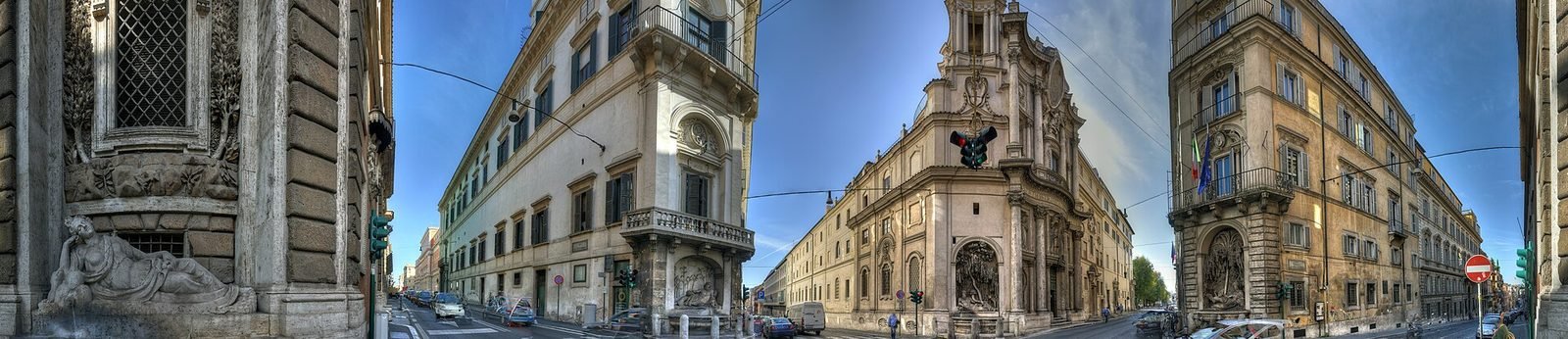
The three obelisks and Porta Pia: what you actually see from here
The Quattro Fontane crossing is famous among those who know Rome for a reason that has nothing to do with the fountains: from this point, looking along the two street axes, you see three obelisks and a monumental gate, each at the end of one of the four directions. Toward the northwest, going up Via Sistina, is the obelisk in front of Trinità dei Monti at the top of the Spanish Steps. Toward the southeast, at the end of Via Depretis, is the obelisk behind the apse of Santa Maria Maggiore. Toward the west, along Via del Quirinale, is the obelisk between the Dioscuri in Piazza del Quirinale. Toward the east, at the end of Via XX Settembre, is Porta Pia.
Where the three obelisks come from
The Esquiline obelisk, the one at Santa Maria Maggiore, and the Quirinal obelisk both come from the Mausoleum of Augustus, where they stood as a pair at the entrance of the imperial tomb. They are obelisks of Roman make, not Egyptian, that is, made in Rome in the imperial age imitating Egyptian models. The Trinità dei Monti obelisk, called the Sallustian because it comes from the area of the Horti Sallustiani, is also a Roman copy, and reproduces the hieroglyphs of the Flaminian obelisk now in Piazza del Popolo.
The chronological point almost everyone skips
This is the part that is rarely told: in 1593, when the four fountains had just been finished, only one of those three obelisks existed. Sixtus V had erected the Esquiline obelisk in 1587, but the other two arrived two centuries later, under Pius VI: the Quirinal one in 1786 and the Trinità dei Monti one in 1789. The view of the three obelisks from this intersection, which today is presented as the outcome of the Sistine plan, was thus completed only at the end of the 18th century, when another pontiff brought to completion an idea of visual end points born two centuries earlier.
What you see in practice, today
Let's say it plainly: the three tips are far away, small and often swallowed by haze, signpost poles, buses and double-parked vans. To the naked eye you do see them, and at some hours they are sharp. In a photograph you need a telephoto lens and a moment when the roadway is clear. Those who expect the postcard view will be a little disappointed, while those who understand they are looking at the workings of an urban system designed 400 years ago take home something more lasting. Our page on the obelisks of Rome explains the complete system of Sistine end points, and it is worth reading before coming here.
Porta Pia, the fourth end point
The east end point is the only one that is not an obelisk: Porta Pia, designed by Michelangelo for Pius IV and completed in 1565, closes Via XX Settembre a little over a kilometer away. It is the most readable of the four end points, because it is a wide architectural mass and not a thin spike, and on clear days it is recognizable without effort. If you want to see the other end of the street, walk the kilometer along the left sidewalk: you pass the ministries, and you understand why it was on this side, in 1870, that the Italian army entered.
Another well-known fact, yet rarely cited
The fact is this: the Quattro Fontane were never conceived as a work of art to contemplate, but as water distribution infrastructure disguised as architecture. In the 16th century a public neighborhood fountain had the function that a network of drinking fountains has today: it gave water to those who did not have it at home, that is, almost everyone. The low basins at sidewalk level served to fill buckets and jugs and to water horses, and the sculpture in the niche was how the patron signed the service rendered to the city.
Why it is forgotten
The reason this evidence is often lost sight of is that the daily use has disappeared. When running water reaches every apartment, a distribution fountain loses its original function and remains only as street decoration, and from that moment it is judged by aesthetic criteria that were not those of the people who built it. The four reclining sculptures are then measured against the yardstick of Bernini's masterpieces, and come out diminished. Judging them as working urban devices gives them back the right scale.
A useful comparison nearby
To understand the difference between a distribution fountain and a monumental fountain, just climb to Piazza Barberini and look at the Triton Fountain, made by Bernini in the 1640s: there the water is material for spectacle, the jet is vertical, the figure is isolated and visible through 360 degrees. 50 years earlier, at the Quattro Fontane, the same water served to fill a bucket. The comparison between the two ways of understanding a fountain is worth the quarter-hour climb by itself, and we also tell it in the page on Bernini in Rome.
The right photo to take at the Quattro Fontane
The photograph worth the trip is not the close-up portrait of a niche, which anyone can take in 10 seconds and which almost always comes out flat because of the reflections on the protective glass. The photograph that tells this place is the alignment: a long telephoto lens, aimed from one of the sidewalks toward the end of one of the two streets, which compresses the perspective and puts in the same frame the blurred niche in the foreground and the distant obelisk in focus. It is a photo that requires patience, because you need a gap in the traffic of at least 15 seconds.
Where to shoot it from
The two points that work are the sidewalks of Via del Quirinale on the San Carlino side, looking west toward the Quirinal, and the high sidewalk of Via Sistina looking toward Trinità dei Monti. In both cases it is best to lean against the wall, not lean out over the roadway, and accept that buses and vans will pass. No photo is worth an accident at an intersection where cars come uphill and do not expect a pedestrian at the edge.
Time of day and equipment
The best light for the alignment toward Trinità dei Monti is late afternoon, when the sun goes down along the axis of Via Sistina. Toward Santa Maria Maggiore, morning is better. For the niches, as already said, an overcast day or full shade works better, eliminating the contrast between lit travertine and dark interior. With a phone you get acceptable results only on the niches, while the alignment with the obelisks requires a real optical zoom: with digital zoom the obelisk becomes a gray smudge.
What is around the intersection
Within 300 meters of the Quattro Fontane there are three buildings that in architectural history textbooks get a chapter each: Borromini's San Carlino on the corner itself, Bernini's Sant'Andrea al Quirinale 200 meters farther west, and Palazzo Barberini 200 meters farther downhill. It is a density that in no other area of Rome is concentrated in so little space.
San Carlo alle Quattro Fontane
The church of San Carlo alle Quattro Fontane is the first independent building designed by Francesco Borromini, built for the Discalced Trinitarians starting in the 1630s, with the facade completed only after the architect's death. The oval plan and the coffered dome are among the most studied things in European architecture. The entrance opens right on the corner of the intersection, next to one of the four fountains, and the church has reduced hours: it is best to check them beforehand. The story of this architect is told in full in the page on Borromini in Rome.
Sant'Andrea al Quirinale
200 meters to the west, along Via del Quirinale, Sant'Andrea al Quirinale is the church that Gian Lorenzo Bernini designed for the Jesuits between the 1650s and the 1670s, with an oval plan and the major axis running across, that is, rotated 90 degrees from what you would expect on entering. Seeing the two churches in the same afternoon, a few minutes apart, is the direct comparison between the two great rivals of Roman Baroque and is one of the most recommended routes.
Palazzo Barberini and the Galleria Nazionale
Going down Via delle Quattro Fontane you reach the gate of Palazzo Barberini, home of the Galleria Nazionale d'Arte Antica, with the two opposing staircases by Bernini and Borromini and the hall frescoed by Pietro da Cortona. The ticket and hours should be checked on the museum's website, which updates rates and closing days fairly often. Under the palace, in a separate room with access by reservation, you also find the Barberini Mithraeum, one of the best-preserved mithraea in Rome.
The rest of the neighborhood
Continuing west you reach the Quirinal Palace and the Scuderie del Quirinale, home of temporary exhibitions, with the small church of San Silvestro al Quirinale next to it. Toward the east you meet the Baths of Diocletian, the Basilica of Santa Maria degli Angeli and the Octagonal Hall. Going down toward Via Nazionale there are the Basilica of San Vitale and, a little farther on, the Galleria Sciarra. Those who climb toward the Esquiline find the Basilica of Santa Prassede and the Basilica of Santa Pudenziana, two mosaic interiors that deserve more visitors than they get. The district downhill, covered in the page on Rione Monti, is the natural extension of the walk.
Some important events that took place here in history
The Quattro Fontane intersection has gone through four centuries of Roman history while remaining the same road junction, and some dates concern it directly.
1561: the Strada Pia opens
Pius IV has the straight road laid out between the Quirinal palace and the Aurelian Walls, where Michelangelo designs Porta Pia, completed in 1565. It is the first of the two axes that will cross here.
1585-1587: the Acqua Felice arrives
Sixtus V has the aqueduct built that brings running water back to the eastern hills, inaugurated in 1587. Without this date the four fountains would not have been possible, and the neighborhood could not have developed.
1587: the Esquiline obelisk
Domenico Fontana erects behind Santa Maria Maggiore the obelisk from the Mausoleum of Augustus, creating the first of the end points visible from the intersection. It is the only one of the three obelisks that already existed when the fountains were finished.
1588-1593: the construction of the four fountains
The fountains are built at the corners of the intersection with the contribution of the owners of the buildings. Sixtus V dies in August 1590, so he does not see the work finished: it is completed under the following pontificates.
17th century: Borromini and Bernini change the corner
The construction of San Carlino, starting in the 1630s, and of Sant'Andrea al Quirinale, between the 1650s and 1670s, turns the crossing into one of the densest places of modern architecture in the city. One of the four fountains ends up absorbed into the side of Borromini's church.
1786 and 1789: the other two obelisks
Pius VI has the obelisk between the Dioscuri in Piazza del Quirinale erected in 1786 and the one in front of Trinità dei Monti in 1789, completing, two centuries later, the system of visual end points imagined by Sixtus V. Only from this moment is the view of the three obelisks from the intersection the one described today.
September 20, 1870: the breach and the new name
The Italian army enters Rome by opening a breach in the walls next to Porta Pia, at the end of the road that passes through this intersection. A few years later the Strada Pia is renamed Via XX Settembre, and the eastern stretch of the crossing takes the name it still bears today.
From 1871 on: the street of the ministries
With Rome as capital, Via XX Settembre fills with ministerial offices and representative buildings built between the 19th and 20th centuries. The traffic that now makes stopping at the intersection uncomfortable comes from here: it is the traffic of a street of public offices, not of a residential neighborhood.
Who has passed by the Quattro Fontane
Almost everyone who made modern Rome has passed through this intersection, for different reasons. Sixtus V and Domenico Fontana designed it. Francesco Borromini built his first independent church here and lived for years in the area, in a neighborhood that was his daily field of work. Gian Lorenzo Bernini worked 200 meters away, at Sant'Andrea al Quirinale, and at Palazzo Barberini farther downhill.
The 18th-century view painters
The intersection appears in the collections of Roman views that circulated throughout Europe in the 18th century, from those of Giuseppe Vasi to the engravings of Giovanni Battista Piranesi, which made this Rome known to those who had never seen it. Those prints are also our main pictorial source on what the corner buildings looked like before the 19th-century rebuilding.
The Grand Tour travelers
The Strada Felice and the Strada Pia were among the obligatory routes for those arriving in Rome in the 18th and 19th centuries, because they connected the major basilicas and crossed the area of villas and gardens on the hills. Those who stayed around Piazza di Spagna, like most foreign travelers, passed through here every time they headed toward Santa Maria Maggiore or toward Porta Pia.
The heads of state, by way of Via del Quirinale
Since 1871 the Quirinal Palace has been a royal residence and since 1946 the seat of the Presidency of the Republic: the institutional traffic that runs along Via del Quirinale and Via XX Settembre passes through this intersection daily. Anyone here on a weekday morning sees escorts, checks and temporary closures of the roadway: an inconvenience for the visitor and at the same time proof that the road of Pius IV still performs the function for which it was opened.
Accessibility, safety and good manners at the crossing
The Quattro Fontane are viewed from the public sidewalk and have no access barriers, but the sidewalks at the intersection are narrow and in some stretches a little over a meter wide, with signpost poles and trash bins reducing the passage further. Someone using a wheelchair or pushing a stroller can reach two of the corners without problems, while for the other two they have to allow for traffic-light crossings and ramps that are not always aligned. We recommend arriving from Via del Quirinale side, where the sidewalk is wider.
With kids
The stop is short and the basins are within reach, so the real risk is the traffic, not the water. If you come with small children, hold them by the hand the whole time and choose Sunday morning, when the intersection is almost empty. The game that works with older ones is the hunt for the three obelisks: you give them the three directions and ask them to find them, and in five minutes they have figured out for themselves what a perspective axis is.
Eating in the area: how to choose, without getting ripped off
We don't name venues, by choice: a list of signs gets old in a few months and helps no one. Here instead are the useful criteria for getting around this area, which is one of the trickiest in Rome because it combines offices, ministries and the tourist flow toward Trevi.
The signs to steer clear of
The menu with photos of the dishes. The person making fresh pasta behind the window or right on the street, which is a commercial lure and not a sign of good cooking. The tout who guards the door and invites you to sit. The place open from morning to night with no kitchen break, which means dishes kept warm or reheated. And the spots directly facing famous monuments, where you may find items with no price on the menu or different price lists between the dining room and the outdoor seating. On the chains that repeat under the same sign at several points in the center the matter is closed in one line: Romans don't go there.
The criterion that always works
Look at who is sitting and in what language they order. In an area of ministries, at noon on a weekday, a place full of employees speaking Italian is a reliable signal. The same place on Sunday may be closed or serve a completely different public. If you want a curated, unsponsored reference, you can consult Daniele Dezi's personal list on Google Maps, which collects addresses chosen in the field.
Frequently asked questions about the Quattro Fontane
Where exactly are the Quattro Fontane in Rome?
The Quattro Fontane are at the four corners of the intersection between Via delle Quattro Fontane and Via del Quirinale, which at that point becomes Via XX Settembre, on the Quirinal Hill. The nearest metro stop is Barberini on Line A, about 500 meters uphill, or Repubblica, also Line A, from which you arrive downhill in about 10 minutes.
How much does it cost to see the Quattro Fontane?
Seeing the Quattro Fontane is free and requires no ticket or reservation: they are four wall fountains on public land, visible at any hour of the day and night. The only possible expense concerns the nearby monuments, such as Palazzo Barberini, which has an admission ticket to be checked on the museum's website because rates and discounts change.
Who had the Quattro Fontane built and when?
The Quattro Fontane were commissioned by Pope Sixtus V as part of the urban plan designed by Domenico Fontana, and were built between 1588 and 1593 with the contribution of the owners of the corner buildings. Sixtus V died in August 1590, so the construction was completed after his death. The water comes from the Acqua Felice aqueduct, inaugurated in 1587.
What do the statues of the Quattro Fontane represent?
The statues of the Quattro Fontane represent two male river gods and two female figures, but the precise identification is debated. The two male figures are read as the Tiber, recognizable by the she-wolf, and the Aniene, or as the Tiber and the Arno. The two female ones are identified as Diana and Juno, or interpreted as Fidelity and Strength. Both readings circulate in the literature.
Is it true that you can see three obelisks from the Quattro Fontane?
From the Quattro Fontane intersection you do indeed see three obelisks, the one at Trinità dei Monti, the one at the Quirinal and the one behind Santa Maria Maggiore, plus Porta Pia at the end of Via XX Settembre. You have to look for them carefully, though: they are far away, small and often hidden by traffic and signs. Two of the three obelisks were erected at the end of the 18th century, two centuries after the fountains.
How much time does it take to visit the Quattro Fontane?
For the Quattro Fontane, 10 to 20 minutes are enough, the time to observe the four niches and look for the three obelisks along the two street axes. Including San Carlo alle Quattro Fontane and Sant'Andrea al Quirinale in the itinerary takes two and a half hours, which become four when adding the visit to the Galleria Nazionale d'Arte Antica at Palazzo Barberini.
Can you photograph the Quattro Fontane?
Photographing the Quattro Fontane is allowed without restrictions, since they are monuments on public land. Some of the fountains are, however, protected by transparent panels installed during restorations, which produce annoying reflections in full daylight: it is best to shoot from an oblique angle, without flash, or under an overcast sky. For the photo of the obelisks at the end of the streets you need an optical zoom.
Are the Quattro Fontane suitable for people with mobility difficulties?
The Quattro Fontane are viewed from the sidewalk and have no steps or ticket offices, but the sidewalks at the intersection are narrow and the traffic is heavy on weekdays. People with mobility difficulties or who use a wheelchair can comfortably reach two of the four corners, and for the other two they have to deal with traffic-light crossings. On early Sunday mornings the situation improves a lot.
Who wrote this page
This page is edited by the team of Tour Leader Pro, the Roman project office that designs and coordinates visits, itineraries and cultural events in Rome and Lazio. Hours, rates and access conditions reported here are verified at the date of publication against the official sources indicated in the text: it is best to recheck them before leaving, because they change often. If you find outdated information, let us know.
If you are building a Roman itinerary that combines the Quirinal, Rione Monti and Piazza Barberini area, and want to fit church hours around museum hours without losing half days, you will find planning tools and already tested routes on Tour Leader Pro, which works on Rome and Lazio with groups and independent travelers.
If instead you are organizing a broader trip in Italy, with moves between cities, trains and stops in several regions, you can start from the guides and tools of Italy Planner, useful above all for working out how many days to devote to each stop and how to connect them without wasting time on badly calculated transfers.