Quirinal Obelisk
In short. The Quirinal Obelisk rises in the middle of the highest square in Rome, wedged between the two colossi of the Dioscuri holding back their horses and resting on the edge of a circular basin of gray granite.
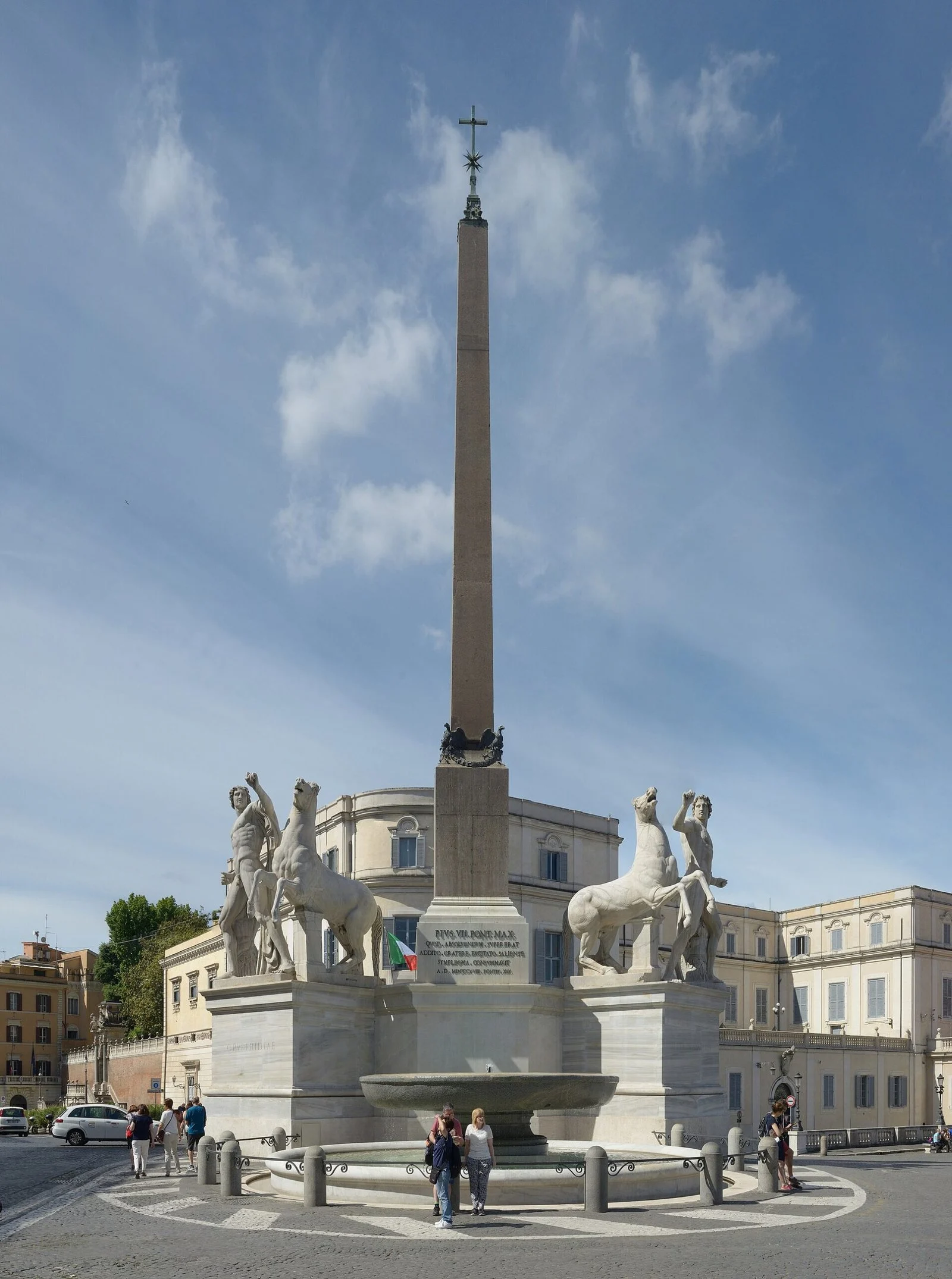
The Quirinal Obelisk rises in the middle of the highest square in Rome, wedged between the two colossi of the Dioscuri holding back their horses and resting on the edge of a circular basin of gray granite. It is the monument that closes the perspective of via del Quirinale and via XX Settembre, the one you see appear from afar when climbing up from the Trevi Fountain, and at the same time it is one of the most misunderstood pieces in the city: almost everyone takes it for an Egyptian obelisk brought to Rome as war booty, and instead it is an obelisk the Romans had made, without a single line of hieroglyphs on it, which for 15 centuries lay stretched out in the ground before being raised in 1786. What makes this square different from all the other monumental squares of Rome is precisely this: what we call the fountain of the Dioscuri or fountain of Monte Cavallo is not a single work, it is an assemblage. Three ancient pieces of different origin, arrived here from three different points of the city, put together over 30 years by different popes and different architects, with a military occupation in between that stopped everything for 20 years. The lines that follow tell what this obelisk really is, where it comes from, who raised it again and how, what two colossal statues and a drinking-trough basin are doing next to it, and how to visit today a square that is at once a belvedere, an open-air museum and the threshold of the residence of the President of the Republic.
Where the Quirinal Obelisk is and how to get there
The Quirinal Obelisk stands in the center of piazza del Quirinale, at the top of the Quirinal hill, in front of the facade of the Quirinal Palace, between the Palazzo della Consulta and the Scuderie del Quirinale. The square is an open-air public area, freely and gratuitously accessible, with no ticket, no turnstiles and no opening hours, except for temporary closures decided for security reasons or for official ceremonies. It is a point worth making right away, because many people confuse a visit to the square, which requires nothing, with a visit to the apartments of the presidential palace, which must be booked and follows a precise calendar.
On foot from the historic center
The most traveled climb starts from the Trevi Fountain: you take via della Dataria, tackle a ramp of steps and in a little over five minutes you come out directly on the panoramic side of the square, exactly at the point where the view is best, with the obelisk and the horses appearing all together in front of the balustrade. It is a theatrical arrival, and not by chance: the difference in level between Trevi and the top of the hill is considerable, and whoever arrives from there goes in a few minutes from the din of the most crowded fountain in Rome to the almost provincial silence of the esplanade. Anyone starting instead from piazza di Spagna can climb via Sistina and cross the upper district toward via del Quirinale, while from the Capitoline Hill you get there along via XXIV Maggio, which climbs steeply from the side of largo Magnanapoli.
By public transport
The nearest metro stop is Barberini, on line A, from which you walk for about 10 minutes passing in front of the Triton Fountain and going up via delle Quattro Fontane to the crossroads of the same name, then turning onto via del Quirinale. An alternative is the Repubblica stop, also on line A, which lets you go down along via Nazionale and then climb via della Consulta. On the surface, the spine of via Nazionale is served by many bus lines linking Termini to the historic center, and from the upper part of via Nazionale the square is a few minutes' walk. Anyone coming from Termini station can choose metro or bus indifferently: the real distance is a little over a kilometer and a half, and on foot the route takes about 20 minutes on a gentle uphill.
What the Quirinal Obelisk really is: Roman, not Egyptian
The Quirinal Obelisk is one of the 13 ancient obelisks of Rome, but it belongs to the least known category among those in the city: it is not a pharaonic monument transported from Egypt after a conquest, but an obelisk made in Roman imperial times, worked in red Aswan granite and brought to Rome in the 1st century AD, probably under Domitian, to be placed in an already Roman funerary setting. The difference is not a specialists' detail: it completely changes the meaning of the object, which is not a spoil of war but a quotation, a piece of Egypt made to measure for an entirely Roman need for dynastic prestige.
The measurements: how tall it is
The shaft of the obelisk measures 14.63 meters, and the whole monument, counting the base and the plinth it rests on, reaches an overall height of 28.94 meters. These are figures the sources give in agreement, with minimal oscillations to the centimeter in different guides, where the shaft sometimes appears rounded to 14.64 meters. To give an immediate comparison, the shaft alone is taller than a four-story building, and the final assemblage is taller than a nine-story one. This explains why the 18th-century raising operation was a real engineering feat, not a simple decorative arrangement.
Anepigraphic: why it has no hieroglyphs
The obelisk is anepigraphic, that is, without inscriptions: on its four faces no hieroglyph appears. It is exactly the opposite of what most visitors expect, and it remains one of the reasons you often hear repeated in front of this monument that the hieroglyphs wore away with time. That is not what happened. The absence of inscriptions is original and is precisely the main clue on which the Roman dating rests: an authentic pharaonic obelisk normally carried the cartouches and celebratory formulas of the sovereign who had it erected, while here the smooth surface indicates that the monolith was cut and finished for a patron who wanted the Egyptian form without the Egyptian content.
The twin: the Esquiline Obelisk and the Mausoleum of Augustus
The Quirinal Obelisk has a twin, the Esquiline Obelisk, which today stands behind the basilica of Santa Maria Maggiore, in piazza dell'Esquilino: the two monoliths were a pair, made together and placed together on either side of the entrance to the Mausoleum of Augustus, the great dynastic tomb of the first imperial family in the northern Campus Martius. Today they are more than two kilometers apart and stand on two different hills, one in front of the residence of the President of the Republic and the other behind one of the four papal basilicas: few visitors know they have seen both on the same trip.
Two obelisks for the tomb of the first emperor
The Mausoleum of Augustus was, in size and ambition, the most imposing funerary monument of 1st-century Rome. The two obelisks marked its entrance like a symbolic gate, framing the access opening and declaring visually, to anyone approaching, that this was a place of pharaonic rank. The reference to Egypt was no accident: Egypt was the emblematic conquest of the Augustan principate, the land wrested from Antony and Cleopatra, and quoting its monumental language in front of the tomb of Augustus meant saying something precise about the power of the person buried there. The most accredited dating places the making of the pair in the imperial age, probably in the time of Domitian, therefore at a moment after the construction of the mausoleum itself: an addition, not an element of the original design.
1527: found together, raised two and a half centuries apart
The two obelisks were identified in 1527, the year of the Sack of Rome, below ground level in the area of the mausoleum, by then reduced to a ruin and absorbed into the urban fabric of Ripetta. From that moment the two stories part in a striking way. The Esquiline one was raised as early as 1587 by Sixtus V, who entrusted the operation to Domenico Fontana as part of his great program of urban redevelopment of Rome: the same pope and the same architect who a few months earlier had accomplished the spectacular feat of moving the Vatican Obelisk in front of St. Peter's Basilica. The Quirinal twin, instead, stayed where it was for a good two centuries more, and was put back on its feet only in 1786. Fully 259 years separate the shared discovery from the second erection.
Some tourist sources tell a story of repeated rediscoveries, with a first sighting around 1520 under Leo X, a later find in the mid-16th century and a definitive uncovering in 1781 during building works. The versions do not coincide in detail and it is best to take them for what they are: signs of a monument that stayed half-buried for a long time, resurfacing now and then whenever someone dug in that corner of the Campus Martius, without anyone having the means or the will to pull it out whole.
A curiosity about the Quirinal Obelisk
The Quirinal Obelisk was not raised where it was found: it had to cross Rome, from the Campus Martius to the top of the hill, and the curious thing is that the one who dug it up was the same architect who would then raise it. Giovanni Antinori, architect to Pius VI, was put in charge of an archaeological dig in the area of the church of San Rocco, next to the Mausoleum of Augustus, and from that dig the huge monolith of red granite came out. The one who found it was also the one who stood it up, and this continuity between discovery and destination is rare in the history of Roman obelisks, where the find and the re-erection are usually separated by decades and by different protagonists.
The Romans' joke about the architect
The 1786 arrangement also involved rotating the two sculptural groups of the Dioscuri, which originally stood side by side and parallel to each other and which were separated and turned so as to sit at a right angle, leaving the space between them for the obelisk. The operation turned out much more complicated than expected, and the Romans, who have always had the last word on the popes' undertakings, came out with a joke that became famous: a donkey could not move a horse. The target was Antinori, and the line remains one of the most effective testimonies of how closely the city followed and commented on the work.
Not Antinori's only obelisk
Giovanni Antinori, born in Camerino in 1734 and died in Rome in 1792, oversaw the erection of three Roman obelisks within a few years: the Quirinal one, the Sallustian Obelisk in piazza Trinità dei Monti between 1787 and 1789, and the Montecitorio Obelisk between 1790 and 1792, a site where death caught him and which was completed by his assistant Pasquale Belli. On this last obelisk an inscription is still carved in his honor recalling his name and city of origin. Anyone walking between piazza del Quirinale, piazza Trinità dei Monti and piazza di Montecitorio therefore crosses, without knowing it, the complete catalog of the undertakings of one man, concentrated in a span of six years under the pontificate of Pius VI.
The raising of 1786: Pius VI, Antinori and a very long building site
The Quirinal Obelisk was erected in 1786 at the wish of Pope Pius VI, within an overall project to rearrange the square begun in 1782 and entrusted to the architect Giovanni Antinori. The fact is important because it makes clear that the obelisk was not an improvised addition but the pivot of a rethinking of the whole urban space in front of the popes' summer residence, at the moment when the Quirinal had become in effect the palace of papal temporal power.
Why here, and why then
At the end of the 18th century piazza del Quirinale already had its protagonists: the Dioscuri with the horses, moved and restored by Domenico Fontana two centuries earlier, and a 16th-century fountain at their feet. What was missing was a vertical element able to give the square an axis and a measure, and to stand up to the bulk of the palace facade. The urban taste of the time, direct heir of the Sistine choices, saw in the obelisk the perfect tool for this task: a tall sign, visible from afar, able to close street perspectives and to work as a landmark for people moving around the city. Pius VI, who knew a thing or two about operations of urban prestige, made it a program.
The San Rocco dig and the recovery of the monolith
The monolith was recovered at the base of the 16th-century church of San Rocco a Ripetta, next to the Mausoleum of Augustus, in the course of an archaeological dig directed by Antinori himself on behalf of the pontiff. The shaft was in poor condition and the base turned out to be damaged: part of the work of the following five years consisted precisely in rebuilding and completing the missing parts, a very delicate operation on a material as hard as granite and on a piece of that size. It is a phase the guides almost always skip, but it explains why four full years passed between the start of the project in 1782 and the erection in 1786.
One thing nobody tells you about the Quirinal Obelisk
The Quirinal Obelisk stayed for 20 years in the middle of a square without a fountain, because the work that was to complete it was interrupted by the arrival of Napoleon's troops in Rome on February 15, 1798, just as the transfer of the great granite basin meant to close the work was under way. Domenico Fontana's 16th-century fountain had already been dismantled and was lost for good. The new basin was still on the road. The result was a mutilated square, with the obelisk and the horses standing and no water at their feet, for a very long time.
20 years of waiting, and the end of Napoleon
The works could resume only after Napoleon's defeat at Waterloo in 1815 and the end of the French occupation, and were concluded in 1818. It means that whoever passed through piazza del Quirinale between 1798 and 1818, in one of the most turbulent 20-year spans in European history, saw an unfinished square. 20 years is a lot: a child born at the arrival of the French was a grown man when the water flowed again. The story of the Quirinal fountain is, in this sense, an exact cast of Roman political history of those years, with the same break and the same resumption.
The 16th-century fountain nobody will see again
There is a second aspect almost nobody tells: the 18th- and 19th-century arrangement involved the destruction of an earlier work. The fountain made by Domenico Fontana at the end of the 16th century, a quatrefoil basin at whose center a pillar held a bowl from which the water fell, resting on three steps and surrounded by a further narrow, sunken basin, was dismantled to make room for the new arrangement and lost. Of that work only engravings and graphic testimonies remain today, among them the views of Giovanni Battista Piranesi, but not a single piece in place. Anyone looking at today's fountain is therefore also looking at the site of another fountain that no longer exists.
The Dioscuri and the horses: the colossi of the Baths of Constantine
The two sculptural groups flanking the Quirinal Obelisk portray the Dioscuri, that is, the twins Castor and Pollux, each holding a horse by the reins, and are colossal sculptures of the imperial age from the nearby Baths of Constantine. They reach a height of 5.6 meters, a size that places them among the largest ancient sculptures visible outdoors in Rome, and are considered Roman copies made from Greek originals of the 5th century BC. Some scholars have proposed different readings of the subject, suggesting that it is actually a 3rd-century group depicting Alexander the Great twice with the horse Bucephalus: the traditional identification with the Dioscuri remains, however, the current one and the one that gave the fountain its name.
The Baths of Constantine, the vanished complex
The Baths of Constantine were the last great bath complex built in ancient Rome, erected on the Quirinal hill around AD 315 by Constantine, perhaps on a building site already started under Maxentius. They occupied the area now lying between piazza del Quirinale, via XXIV Maggio, via della Consulta and via Nazionale, corresponding to the gardens of Palazzo Rospigliosi. They were relatively small baths aimed at an elite public, very different in scale and clientele from the nearby Baths of Diocletian, grandiose and popular. They suffered a fire in 367, the sack by Alaric's Goths in 410 and a restoration in 443, and were then abandoned at the beginning of the Middle Ages and stripped of their materials.
Opus Fidiae and Opus Praxitelis: the wrong signatures
On the bases of the two statues you read the inscriptions Opus Fidiae and Opus Praxitelis, that is, work of Phidias and work of Praxiteles, two of the most celebrated Greek sculptors of antiquity. The inscriptions are ancient, but the attribution is untenable historically: Phidias and Praxiteles worked in different eras and neither can have made these sculptures, which are Roman copies. Philological studies of the 16th century had already settled the question. The two signatures have nonetheless had an extraordinary fortune in the Roman imagination, so much so as to enter permanently into the oral place names of the city and to fuel for centuries a series of tales about the meaning of the two colossi.
Monte Cavallo: how two statues gave their name to a hill
From the Middle Ages and up to the whole 19th century the square was not called piazza del Quirinale but piazza di Monte Cavallo, and Monte Cavallo was the popular name of the hill itself and of its vineyards. The place name comes directly from the two marble horses, which for centuries were the only recognizable thing on top of the hill. The name has not disappeared entirely: it survives in the salita di Montecavallo, the street running down toward via della Dataria, and it is still the official name with which the Capitoline Superintendency refers to the fountain, which in administrative documents is called the fountain of Monte Cavallo. Anyone looking for information on this square will do well to keep both names in mind, because the sources use them interchangeably.
Sixtus V and Domenico Fontana, 1588
The statues were already on the hill, in a more recessed position and turned toward the site of the ancient baths, that is, toward the start of today's via Nazionale. In 1588 Domenico Fontana, on behalf of Sixtus V, had them restored, moved them to a more central position in the square and turned them so they faced the palace, so as to close the perspective of the long via Pia, corresponding to today's via del Quirinale and via XX Settembre. At their feet he then placed the new fountain, and the statues were set on a tall pedestal. It was the first of the three successive assemblages that produced what we see today, and it was also the moment when the square began to become a designed space instead of a simple widening.
The granite basin that arrived from the Roman Forum in 1818
The large circular basin of gray granite that collects the water at the foot of the Quirinal Obelisk is an ancient Roman labrum from the area of the Roman Forum, placed here only in 1818, 32 years after the obelisk and 230 years after the statues. It measures about 24 meters in circumference, and its presence in this square is the result of one of the oddest recoveries in Roman urban history: before becoming the bowl of a monumental fountain in front of the popes' residence, that basin had been for years a drinking trough for livestock.
From Roman fountain to drinking trough
The basin had been found in 1587, probably during the works to build the secondary conduit of the Acqua Felice aqueduct, and it was in all likelihood a fountain of the Roman era. Sixtus V, instead of making it an ornamental fountain, judged it more useful to use it as a drinking trough for animals in the area of the Campo Vaccino, which at the time still hosted the livestock market, and entrusted the work to Giacomo Della Porta, who adorned it with a simple mask from which the water came out. Within a few years the basin filled with refuse and mud, stopped being used and ended up half-buried again.
Campo Vaccino, that is, the Roman Forum
One point that generates confusion in the sources is worth clearing up. Campo Vaccino is the name by which, from the Middle Ages to the 19th century, the Roman Forum was known, reduced to pasture and livestock market, buried under meters of debris and crossed by dirt roads. The Capitoline Superintendency and the official site of the Presidency of the Republic agree in naming the Roman Forum as the basin's place of origin. Some popular entries place the find instead in the area between the Circus Maximus and the Tiber, which is however the Forum Boarium, another livestock market area not far away. The two locations do not coincide and the discrepancy should be pointed out: the most authoritative indication remains that of the Roman Forum.
Raffaele Stern and the present fountain
It was Pius VI who decided to recover the basin and bring it to piazza del Quirinale in place of the 16th-century fountain, but the operation was interrupted by the arrival of the French. Resumed after 1815, it was completed in 1818 under the pontificate of Pius VII by the architect Raffaele Stern, to whom in fact the authorship of the fountain we see is owed: a large circular basin at whose center a baluster supports the granite bowl. Stern is the same architect who in those years worked on some of the most delicate interventions for the conservation of the ancient in Rome, in a season when the protection of monuments was beginning to become a discipline.
The 2016 restoration and recent maintenance
The fountain underwent a complete restoration concluded in 2016 and inaugurated on March 31 of that year by the President of the Republic Sergio Mattarella, in the presence of the extraordinary commissioner of Rome and the Capitoline superintendent for cultural heritage. A further extraordinary maintenance intervention, with biocide treatment and cleaning of the surfaces, was carried out afterward to counter the biological colonization that re-forms quickly on an outdoor, water-fed monument. Anyone visiting the square today therefore sees a complex in good conservation condition, with the granite surfaces legible and the details of the statues' marbles visible again.
A collage of three ancient pieces assembled over 30 years
The fountain of piazza del Quirinale is not a unified work of art but an assemblage of three ancient finds of different origin, put together over 30 years by different popes and different architects: the statues of the Dioscuri with the horses come from the Baths of Constantine and were moved to their present position in 1588, the obelisk comes from the Mausoleum of Augustus and was erected in 1786, the granite basin comes from the Roman Forum and was placed in 1818. It is the most interesting point of the whole square, and curiously it is the one least talked about.
Three origins, three centuries apart
If you take the three pieces separately, the picture becomes clear. The sculptures are Roman copies of the imperial age from Greek originals of the 5th century BC, and stood on a hill a few hundred meters from here. The obelisk is a Roman imperial artifact in Egyptian granite, arrived from the Campus Martius, that is, from another part of the city and from a funerary context. The basin is a Roman labrum recovered from the Forum area. Three ancient objects that in antiquity never saw each other, belonged to three different buildings with different functions, brought together in a single modern monument that makes them look born together.
30 years, four pontificates and a military occupation
The chronology of the assembly is just as instructive. Sixtus V and Domenico Fontana arrange the statues in 1588. Two centuries later Pius VI and Giovanni Antinori slip the obelisk in between in 1786. The site stops in 1798 with the arrival of the Napoleonic troops. It resumes after 1815 and closes in 1818 with Pius VII and Raffaele Stern. Between the first intervention and the last, 230 years pass. Between the arrival of the obelisk and the definitive closing of the site, 32 pass, of which 20 of total suspension. There is no famous monument in Rome composed with this slowness and this many interruptions.
Why the assemblage works anyway
The remarkable thing is that, despite everything, the result holds up very well. The three pieces have very different scales, different materials and different surfaces, but the composition finds a balance thanks to a simple choice: the obelisk supplies the vertical, the two statues the wide, symmetrical base, the basin the horizontal element that keeps everything on the ground. It is a textbook case of intelligent reuse of the ancient, and explains why generations of painters and engravers, from Piranesi to Ippolito Caffi, kept portraying this square as if it were a single work designed by one mind.
The advice I give you for visiting the Quirinal Obelisk
The most useful advice for visiting the Quirinal Obelisk is to arrive in the late afternoon and climb from the Trevi Fountain side, because the square is oriented so that the sunset light hits the palace facade and the flank of the obelisk full on, while the panoramic balustrade opens right toward the west. It is the only moment of the day when the three elements of the monument, red granite, white marble and gray granite, stand out clearly from one another by color.
The right time, season by season
In summer the sun sets late and it is best to show up around half past seven in the evening to catch the last hour of raking light, while in winter the same condition occurs already in mid-afternoon. Early morning has a different advantage: the square is almost empty, foot traffic is minimal and you can walk around the sculptural group at leisure, which in the middle hours becomes harder because of groups and tourist buses parked in the neighboring streets. The middle hours, with the sun high, are instead the worst: the light flattens the volumes and the granite loses its color completely.
From which point to look at it
The best vantage point is not in front of the palace but on the opposite side, at the level of the balustrade: from there the obelisk stands out against the facade and the two groups of the Dioscuri read as two distinct silhouettes instead of overlapping. The second interesting point is the mouth of via del Quirinale, from which you catch the perspective effect intended in the 16th century, with the whole group closing the street at the far end. The third, less visited, is the corner toward the Scuderie, from which you see together the obelisk and the glimpse of the city below.
The belvedere: one of the best panoramas in Rome
The western side of piazza del Quirinale is closed by a balustrade overlooking the panorama of the city, and this makes the square one of the highest and least crowded belvederes in the historic center. It is not an equipped viewpoint or a paid terrace: it is simply the edge of the hill, where the square ends and the void above the roofs of the Trevi rione begins.
What you see from the balustrade
The gaze drops onto the roofs of the center, onto the terraces and bell towers of the area between Trevi and the Campus Martius, and on clear days it reaches the domes that dot the city's profile, with the bulk of St. Peter's dome recognizable on the right beyond the Tiber. It is a different view from that of the Janiculum or the Pincio, closer and more urban: here you do not look at Rome from outside, you look at it from within, with the buildings within reach of your gaze and the physical sensation of standing on the highest point of an inhabited neighborhood.
The changing of the guard in piazza del Quirinale
In piazza del Quirinale the changing of the honor guard at the presidential palace takes place, which on solemn occasions takes the form of a ceremony with the lining up and marching past of the Corazzieri Regiment and the Band of the Fourth Mounted Carabinieri Regiment. It is the only regular event that enlivens the square, and for many visitors it is the very reason for the climb to the Quirinal.
The solemn changing on national occasions
The solemn versions of the ceremony are tied to the great national holidays and are announced from time to time by the Presidency of the Republic: the Festa della Repubblica on June 2 and the anniversary of the proclamation of the Unity of Italy on March 17 are the two recurring occasions. For the Festa della Repubblica of 2026, coinciding with the 80th anniversary, the ceremony was announced in piazza del Quirinale with the participation of the Corazzieri Regiment and the mounted Band, which on these occasions performs a musical program of some 15 pieces among national anthems, regimental anthems and classical compositions. Anyone who wants to attend this version must check the official announcements in the days beforehand, because date and time are confirmed case by case.
The ordinary hours: what appears and what is not confirmed
On the hours of the ordinary changing of the guard the available information is not uniform. Several Roman tourist sources indicate a Sunday appointment, with a winter time of 16:00 and a summer time of 18:00, and place the switch to summer time at the beginning of June. This indication, however, finds no confirmation in a stable official calendar published by the Presidency of the Republic, which announces solemn ceremonies case by case. The advice is therefore not to take the time for granted and to check the official Quirinal site in the days immediately before the visit, especially if the changing of the guard is the main reason you are climbing the hill. Ceremonies can also be canceled or modified for reasons of public order, for weather conditions or for institutional commitments of the Head of State.
Another well-known fact, yet rarely cited
It is well known that the Quirinal Palace was for almost three centuries the residence of the popes, but the most concrete consequence of that fact is rarely cited: four conclaves took place inside this palace, and four popes were elected here instead of in the Vatican. It means that the square where the obelisk stands was, four times in the 19th century, the place where Rome waited for the smoke and heard the announcement of the new pontiff.
The four conclaves of the Quirinal
The conclaves held at the Quirinal led to the election of Leo XII on September 28, 1823, of Pius VIII on March 31, 1829, of Gregory XVI on February 2, 1831 at the end of a conclave lasting some 50 days, and of Pius IX on June 16, 1846, in a vote settled in just two days. The elections were held in the Pauline Chapel, built by Paul V Borghese at the beginning of the 17th century to a design by Carlo Maderno with dimensions almost identical to those of the Sistine Chapel in the Vatican: a space about 42 meters long, 13 wide and 20 high. It was no coincidence: the chapel had been conceived from the start to be able to host the same functions as its Vatican twin.
The right photo to take at the Quirinal Obelisk
The right photo at the Quirinal Obelisk is taken from the side of the panoramic balustrade in the late afternoon, staying low and framing the group vertically: from that point the granite basin fills the foreground, the two Dioscuri with their horses close the sides and the obelisk rises in the center against the sky, with the palace facade serving as a backdrop without stealing the scene. It is the only framing that gives the composite nature of the monument in a single shot.
The classic framing, vertical
To fit everything in you need the vertical format and a fairly wide focal length, because the whole exceeds 28 meters in height and the square, however large, does not let you step back as far as you would like. If you shoot with a phone you can use the wide-angle mode and then correct the convergence of the verticals, which becomes obvious with the lens tilted upward. A useful trick is to keep the horizon low in the frame, giving more room to the sky: the obelisk gains and the composition breathes.
The detail that makes the difference
The most interesting photograph, though, is not the overall one but the one that compares the materials. Moving close to one of the two groups you can frame diagonally the white marble of the statue, the red granite of the obelisk's shaft and the gray granite of the basin's edge in the same frame: three different stones, three centuries of different assemblages, a single shot. It is the most direct way to show visually what this fountain really is, and it is an image almost nobody takes home.
Some important events that happened here in history
For four centuries piazza del Quirinale has been one of the points where the political history of Rome was decided, and some of the events that took place here changed the structure of the State. The obelisk, erected in 1786, has been a direct witness to everything that has happened here from the French Revolution onward.
November 16, 1848: the assault on the Quirinal
On November 15, 1848 the minister Pellegrino Rossi was stabbed to death as he entered the Roman Parliament. The next day a tumultuous crowd, joined by carabinieri and the Civic Guard, marched through the streets of Rome and climbed to the Quirinal to demand a democratic ministry, the Italian constituent assembly and war on Austria. The demonstrators dragged here a cannon taken from the Civic Guard quarters in piazza della Pilotta and aimed it at the palace, without however using it. A gunfight with the papal Swiss Guard nonetheless ensued, at the end of which a prelate attached to the Sacred Palaces, Monsignor Palma, was left dead. On the evening of November 24 Pius IX fled Rome disguised as a simple priest, in a closed carriage, and the following evening he was already safe in the territory of the Kingdom of the Two Sicilies, at Gaeta. From that flight the Roman Republic of 1849 was born.
September 20, 1870: the end of temporal power
With the taking of Rome on September 20, 1870 the city was annexed to the Kingdom of Italy and the palace became the official residence of the king. The passage was not immediate: even after the breach of Porta Pia the palace stayed guarded by the Swiss guards in the service of Pius IX until October 1, 1870, when General Raffaele Cadorna, commander of the Italian expeditionary corps, had them removed by force. The building had meanwhile been emptied of its furnishings, and was refurnished with furniture from other royal palaces of the peninsula, in particular from the Savoy residences in Piedmont and from the Ducal Palace of Colorno.
June 2, 1946: from monarchy to Republic
With the institutional referendum of June 2, 1946 and the proclamation of the Republic the palace became the seat of the President of the Italian Republic. It is worth recalling that in the two years 1945 and 1946 some scholars, among them Emilio Lavagnino together with Aldo De Rinaldis and Federico Zeri, had worked out a proposal to turn the Quirinal into a national museum on the model of the Louvre and the Hermitage. The proposal had no follow-up and the palace kept its institutional function. Had the other hypothesis prevailed, the square with the obelisk would today be the forecourt of one of the largest museums in Europe.
Who passed through the Quirinal Obelisk
Through piazza del Quirinale have passed 30 popes, four kings of Italy and all the Presidents of the Italian Republic, but the list of figures who have had to do with this obelisk and its square is much more varied and includes architects, engravers, painters and foreign sovereigns.
The architects
The list of architects who worked here is a compendium of four centuries of Roman architecture. Ottaviano Mascherino and Martino Longhi the Elder for the original core of the palace, Domenico Fontana for the Sistine enlargement and for the first arrangement of the statues, Flaminio Ponzio and Carlo Maderno for the perimeter and for the representation rooms, Gian Lorenzo Bernini for the 17th-century interventions, Ferdinando Fuga and Alessandro Specchi for the Scuderie and for the Palazzo della Consulta, Giovanni Antinori for the obelisk and Raffaele Stern for the fountain. Anyone who stops in the middle of the square finds themselves surrounded by the work of all of them at once.
The artists who portrayed it
The square has been one of the most engraved and painted subjects in Rome. Giovanni Battista Piranesi left a view of it that documents the 16th-century fountain by Domenico Fontana before its disappearance, and it is today one of the main sources for knowing what it looked like. Ippolito Caffi painted in 1847 a Piazza di Monte Cavallo that shows the 19th-century layout already complete, with the obelisk and Stern's basin in their places. To these are added the prints of Étienne Dupérac, who in 1575 portrayed the remains of the Baths of Constantine still standing, and the 16th-century surveys by Andrea Palladio of the same complex.
Heads of State and illustrious guests
As a residence first royal and then presidential, the palace has received a very long series of State guests who came in and out of this square. The emperor Wilhelm II of Germany stayed there in 1888 and in 1893 in the apartments of the Manica Lunga, and the Bronzino room had its floors and furnishings renewed on the occasion of Adolf Hitler's visit in 1938, an episode remembered today as one of the darkest chapters in the building's history. In 1930 the Pauline Chapel hosted the wedding of Umberto of Savoy and Marie José of Belgium.
What to see around piazza del Quirinale
Piazza del Quirinale lies in the middle of one of the stretches of the city with the greatest density of architecture between the 16th and 18th centuries, and this makes it an excellent starting point for a walk that needs no public transport.
The two churches of via del Quirinale
A few steps from the square, along via del Quirinale, two masterpieces of Roman Baroque face each other a few dozen meters apart: the Church of Sant'Andrea al Quirinale, the work of Gian Lorenzo Bernini, and the Church of San Carlo alle Quattro Fontane, by Francesco Borromini. The close comparison of the two rival architects is one of the most instructive experiences you can have in Rome, and it takes place in a five-minute walk. A little farther on you reach the crossroads of the Quattro Fontane, from which the four perspectives wanted by Sixtus V depart.
The Scuderie and the palace
On the opposite side of the square from the presidential residence stand the Scuderie del Quirinale, an 18th-century building by Alessandro Specchi and Ferdinando Fuga, fully restored between 1997 and 1999 and now home to major temporary exhibitions. They are two distinct visits not to be confused with the visit to the square: on our site the Scuderie del Quirinale have a page devoted to the exhibition program and practical information, while the Quirinal Palace has its own page with the ways to visit the apartments, the gardens and the collections. This page concerns only the obelisk and the open-air monumental complex, which can be seen freely without booking.
Toward the center and toward the Forums
Going down via della Dataria you reach the Trevi Fountain in a few minutes, while taking via XXIV Maggio and then via IV Novembre you arrive at largo Magnanapoli and from there at the Trajan's Markets and the Capitoline Hill. In the opposite direction, via XX Settembre leads toward Porta Pia through the ministries district. Anyone who wants to build a themed itinerary on obelisks can continue to piazza di Montecitorio and then to piazza Navona, where the Agonal Obelisk stands at the center of the Fountain of the Four Rivers.
Frequently asked questions about the Quirinal Obelisk
How much does it cost to see the Quirinal Obelisk?
Seeing the Quirinal Obelisk is completely free, because the monument stands in the middle of an open-air public square, with no ticket office and no fencing. A ticket is needed only for the visit to the interiors of the Quirinal Palace and for the exhibitions at the Scuderie, which are two different things and must be booked separately with their respective managing bodies.
How tall is the Quirinal Obelisk?
The Quirinal Obelisk has a shaft 14.63 meters tall and reaches 28.94 meters counting the base it rests on. Some guides round the shaft measurement to 14.64 meters. The monolith is red Aswan granite and its twin, the Esquiline Obelisk, has a shaft of 14.75 meters, so a few centimeters taller.
Is the Quirinal Obelisk Egyptian or Roman?
The Quirinal Obelisk is a Roman obelisk of the imperial age, not a pharaonic monument: it was made in Egypt with Aswan granite but for a Roman patron, and brought to Rome in the 1st century AD, probably under Domitian. The main proof is the total absence of hieroglyphs on the four faces, a feature that sets it apart from the authentic Egyptian obelisks transported to Rome as booty.
Where does the Quirinal Obelisk come from?
The Quirinal Obelisk comes from the Mausoleum of Augustus, where together with its twin, now in piazza dell'Esquilino, it framed the entrance to the imperial dynastic tomb in the Campus Martius. The two monoliths were found together in 1527, but their paths parted: the Esquiline one was raised in 1587 by Sixtus V, the Quirinal one only in 1786 by Pius VI.
How long does it take to visit the Quirinal Obelisk?
For the Quirinal Obelisk and the square, 20 or 30 minutes are enough, time to walk around the sculptural group, read the inscriptions on the bases and look out from the panoramic balustrade. The visit becomes a half-day one if you add an exhibition at the Scuderie del Quirinale or the booked visit to the apartments of the presidential palace.
Can you photograph the Quirinal Obelisk?
Photographing the Quirinal Obelisk, the fountain and the palace facade from outside is free and requires no authorization, since it is an open-air public space. The instructions of the security staff apply, however, during official ceremonies, and professional shooting with tripods or a crew requires a prior permit. Drones are not allowed, because the area falls within a no-fly zone.
What time is the changing of the guard at the Quirinal?
The changing of the guard in piazza del Quirinale is given by several Roman tourist sources as a Sunday appointment, at 16:00 in winter and at 18:00 in summer, but this time is not confirmed by a permanent official calendar of the Presidency of the Republic, which announces solemn ceremonies case by case. It is therefore best to check the official Quirinal site in the days before the visit.
Is piazza del Quirinale accessible to people with mobility difficulties?
Piazza del Quirinale is flat once you reach it, but the approach routes involve a significant change in level, because the Quirinal is the highest of Rome's historic hills. Anyone with mobility difficulties or pushing a stroller should avoid the staircase of via della Dataria and arrive from via del Quirinale or from via XXIV Maggio, which slope but have no steps. The paving is sanpietrini.
Is a visit to the Quirinal Obelisk suitable for children?
The Quirinal Obelisk lends itself well to a stop with children, because the square is wide, closed to through traffic and offers two colossal marble horses that capture attention more than any explanation. There are no restrooms on the square and the area has no shade, so on hot days it is best to plan the stop in the less sunny hours.
One last tip for those planning the itinerary
Piazza del Quirinale works better as a stop within a route than as a destination in itself: anyone with a few days in Rome will do well to place it on the path linking the Trevi Fountain to the Baroque churches of via del Quirinale, possibly adding an exhibition at the Scuderie if the exhibition calendar allows. It is a place you enjoy in half an hour but that changes completely depending on the hour you arrive, and for this reason it is worth planning the visit instead of stumbling on it by chance.
Anyone building a wider itinerary in central Rome, lining up the obelisks, the Baroque squares and the belvederes of the historic center, can find useful planning tools on Tour Leader Pro, while for a more general picture of transport and destinations in Lazio a good resource is Italy Planner.