Basilica of San Vitale
In short. The Basilica of San Vitale opens onto Via Nazionale, at number 194/B, but to reach it you have to go down: the church lies several meters below street level, at the bottom of a descending staircase built in 1859, and it is one of the…
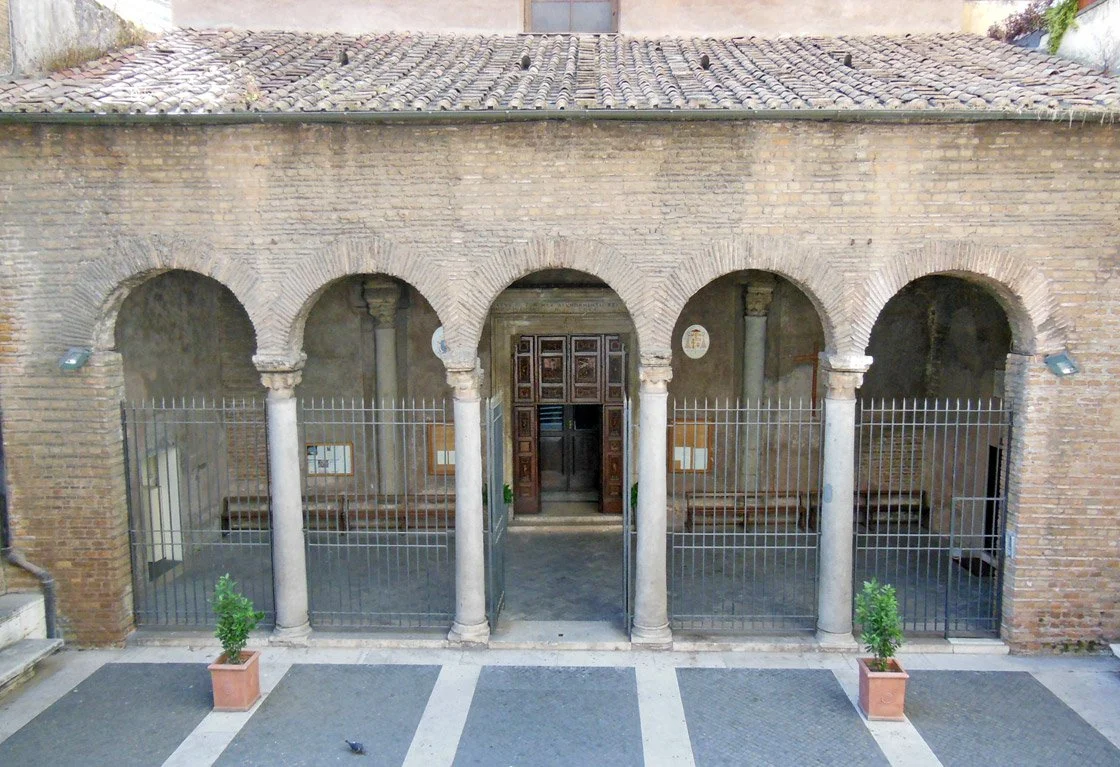
The Basilica of San Vitale opens onto Via Nazionale, at number 194/B, but to reach it you have to go down: the church lies several meters below street level, at the bottom of a descending staircase built in 1859, and it is one of the most evident cases in Rome of an ancient building left at the bottom of a pit after the opening of a great 1800s road. It is a genuine early Christian basilica, not a reworking: its foundation dates to the last years of the 4th century and the consecration by Pope Innocent I is placed by the sources in 402. The name under which it appears in the oldest documents is not that of a saint but that of a woman, a Roman matron called Vestina who left her property so that the church would be built: titulus Vestinae, the title of Vestina. Anyone who goes down that staircase today finds a portico with five arches and late antique capitals, a Renaissance marble portal with the coat of arms of Sixtus IV, and above all a single-nave interior entirely covered with late 1500s frescoes that recount, one after the other, the tortures of the martyrs of the early Church, painted with a realism that still makes more than one visitor uncomfortable. The lines that follow tell how this church was born, who Vestina was, what really happened at street level, why the walls are covered with scenes of martyrdom and how to visit it today, with the hours declared by the parish.
Where the Basilica of San Vitale Is and How to Get There
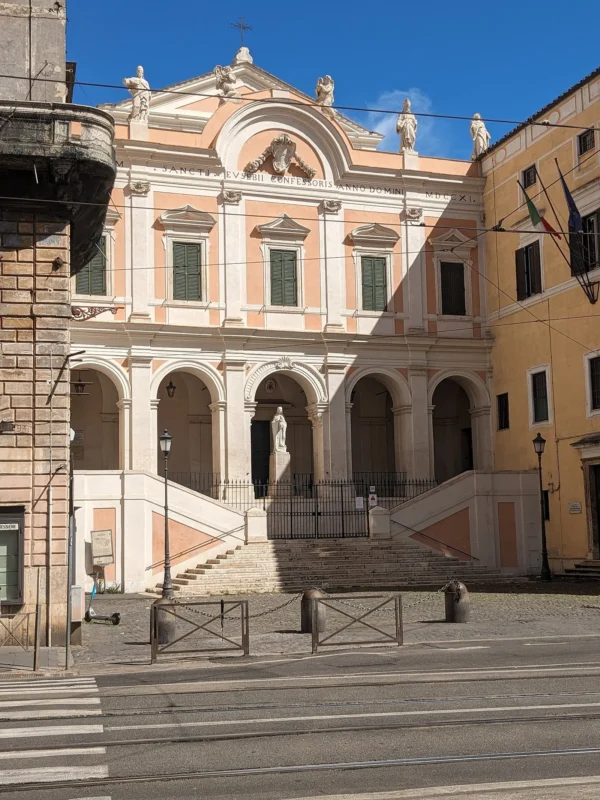
The Basilica of San Vitale is at Via Nazionale 194/B, on the right-hand side going up toward Piazza della Repubblica, in the stretch between Largo Magnanapoli and the intersection with Via Genova. The address is correct but misleading, because there is no facade looking onto the street like those of the neighboring churches: what you see from Via Nazionale is a gate and the mouth of a staircase going down. Many pass in front of it every day without realizing that beyond that parapet, below the level of their feet, is one of the oldest basilicas in Rome still in use for worship.
On Foot from the Center
From Piazza Venezia it takes just under 15 minutes going up Via Quattro Novembre to Largo Magnanapoli and turning onto Via Nazionale: it is a constant climb but never steep, and along the way you skirt the Markets of Trajan and the bulk of the Torre delle Milizie. From the Trevi Fountain the walk is a little over 10 minutes via Via del Tritone and Via delle Quattro Fontane, or going up toward the Quirinal and coming down via Via Ventiquattro Maggio. From Santa Maria Maggiore you go down Via Agostino Depretis in about 10 minutes, arriving at the basilica from Piazza della Repubblica side.
By Public Transport
The most convenient subway stop is Repubblica, on Line A, from which you walk down Via Nazionale for about seven or eight minutes. Alternatively you can use Termini station, served by Lines A and B as well as regional and national trains, from which you reach the start of Via Nazionale in about 10 minutes on foot passing through Piazza della Repubblica. Via Nazionale is also run along its whole length by several urban bus lines connecting Termini to Piazza Venezia: any stop between Piazza della Repubblica and Largo Magnanapoli leaves you a few steps from the basilica. Anyone arriving from Termini station with luggage will do well to consider that Via Nazionale is uphill in the Magnanapoli-Repubblica direction and downhill in the opposite direction, and that the basilica is reached by going down a staircase anyway.
Accessibility: The Staircase and the Alternative
The descending staircase is long and steep, and is a concrete obstacle for people with mobility difficulties or traveling with a stroller. Some sources report the presence of an alternative access with an elevator to reach the level of the basilica without facing the steps. Since this depends on the state of maintenance of the system and the staffing hours, it is best to contact the parish before the visit to have it confirmed that the alternative access is actually available on the day and at the time you intend to go, instead of showing up and discovering on the spot that the only way in is the steps.
Several Meters Below the Street: What Really Happened at the Level of Via Nazionale
The Basilica of San Vitale today lies several meters below the level of Via Nazionale, and this difference in height is not the effect of the church sinking but of the artificial raising of the street that passes in front of it. It is the fact that strikes first-time visitors most, and it is also the one on which the most varied figures circulate: it is best to approach it in order, separating what the sources document from what is repeated out of habit.
How Deep the Drop Is: The Figures in Circulation
The sources available almost always limit themselves to a generic formula: the basilica lies several meters below street level. Whoever ventures to quantify generally speaks of a drop of between four and five meters between the level of Via Nazionale and the level of the church. A figure close to six meters also circulates, often derived by indirect calculation from the number of steps of the staircase, but it does not appear to be supported by a published survey: whoever writes of almost six meters is rounding up an estimate, not citing a certified measurement. The honest figure, the one you can give without risking being wrong, is that it is a drop of the order of a floor and a half of a modern building, enough to make the church disappear completely from the view of someone walking on the sidewalk.
The 1859 Staircase: A Date That Surprises
The descending access staircase was built in 1859 at the wish of Pope Pius IX, as part of a restoration of the basilica. This date deserves attention because it precedes by more than a decade the completion of Via Nazionale and by 11 years the capture of Rome: in 1859 the city was still the capital of the Papal State. Many popular sources write that the staircase was built because of the opening of Via Nazionale, and the summary is incorrect in the strict sense, because in 1859 Via Nazionale did not yet exist. What existed was a process of progressive raising of the street level, begun well before and continued afterward with the urban operation that would give the street its current form.
Via Nazionale: When It Was Really Opened
The layout of Via Nazionale comes from an agreement between the municipality of Rome and Monsignor Francesco Saverio de Merode, who owned land right in the valley of San Vitale, and the work falls between 1867 and 1872, with completions and extensions in the following decades. The street was initially called Via Nuova Pia, in honor of Pius IX, and was renamed Via Nazionale after unification, when Rome became the capital of the Kingdom of Italy. Its function was clear: to connect the new Termini station to the Renaissance center and to Piazza Venezia with a straight, wide, carriage-ready axis, able to bear the traffic of a modern capital. To achieve it, it was necessary to level a valley and regularize its slopes, and the walking surface was raised considerably right in the stretch where the basilica stood.
The urban result is still visible today in an almost didactic way. Via Nazionale runs as a continuous backdrop of Umbertine buildings of five and six floors, built between the 1870s and the 1890s, behind which much older pre-existing features remained enclosed, like the gardens of Villa Aldobrandini, cut by the new route, or indeed the early Christian basilica, which can't be seen at all from the street. Anyone walking along Via Nazionale today walks at a level that in the 1800s was the roof of the valley, not its bottom, and the staircase of San Vitale is the service stair that still allows you to go down to the original level.
The Comparison with San Silvestro al Quirinale: Two Opposite Ways of Ending Up Out of Level
A few hundred meters away, the church of San Silvestro al Quirinale tells the same urban problem with the sign reversed: there the street, Via Ventiquattro Maggio, was lowered by about nine meters to connect it to the new axis of Via Nazionale, and the church remained raised above street level, with the main entrance gone and a side access that almost nobody recognizes. At San Vitale the exact opposite happened: the street was raised and the church ended up below. Two religious buildings a few minutes' walk from each other, hit by the same 1800s building site, one pushed up and one left down: it is the clearest demonstration of how violent, from the point of view of altitude, the grafting of a modern road onto the fabric of a layered city was.
The Foundation: The Titulus Vestinae Between the End of the 4th Century and 402
The Basilica of San Vitale was consecrated by Pope Innocent I in 402, and its original name was dedicated not to a saint but to a woman: in the ancient sources it appears as titulus Vestinae, that is the title of Vestina, from the name of the Roman matron who financed its construction by leaving her property for this purpose. It is a case of foundation documented with a rare precision for the Rome of that era, and it is worth reconstructing step by step, also because it is the point where guidebooks most often oversimplify.
Who Vestina Was
Vestina is described by the sources as a rich Roman matron of senatorial rank, in some reconstructions a widow, who provided in her will that her estate be used to build and endow a church. Her estate included, according to the account handed down, jewels and real estate, sold to finance the work. Practically nothing else is known of her personal biography: we don't know for certain the family she belonged to, we have no portrait, we have no sure date of death. What is preserved is the gesture, and the fact that the Christian community of Rome chose to tie the name of the church to the benefactress instead of to the titular of the cult, at least for the first decades of its existence.
The detail is not minor from the historical point of view. In late antique Rome the tituli, that is the titular churches that formed the parish network of the city, were often named after the owner of the property or the financer of the building, not after the saint to whom they were dedicated: titulus literally indicated the inscription attesting ownership. The following step, the one by which a church ends up known by the name of a martyr instead of that of the donor, is a phenomenon that takes place over the 5th and 6th centuries and that at San Vitale can be followed almost live. That upstream of one of these titles there is a woman, with a personal estate she could freely dispose of by will, also says something concrete about the economic role of Roman aristocratic women in financing the first great Christian building projects of the city.
The Liber Pontificalis and the Date of the Consecration
The news of the foundation arrives through the Liber Pontificalis, the collection of biographies of the popes that is the main source for the history of the Church of Rome in antiquity and the early Middle Ages. In the life of Innocent I, pope from 401 to 417, the erection of the titulus Vestinae with the property left by the matron is recorded. The consecration is placed by most sources in 402, and some reconstructions indicate April 28 as the specific date, presenting it however with caution. The start of the work is placed by several sources already under the pontificate of Siricius, that is after 386, which means that construction would have begun in the last 15 years of the 4th century and concluded under his successor.
On these years the sources do not agree perfectly: some indicate 401, some 402, some prefer the generic formula of the early 5th century, and some others speak of a foundation around 400. The overall range remains however very tight by the standards of late antique archaeology, and it can be said without forcing that the Basilica of San Vitale was born straddling the 4th and 5th centuries, in the same decades in which Rome was ceasing to be an effective imperial capital and the Christian topography of the city was taking the shape it would keep for centuries.
The Dedication to the Martyrs of Milan
The current name arrives at a second moment. The church was dedicated to the saints Vitalis, Valeria, Gervasius and Protasius, a family of martyrs tied to Milan: Gervasius and Protasius are the two brothers whose relics were found by Saint Ambrose in Milan in 386, in an episode that had enormous resonance across the whole Christian West. Vitalis and Valeria are indicated by tradition as their parents. The Ambrosian discovery is considered the main reason for the success of this cult in Rome and elsewhere, and the dedication of the church to the four is placed by some sources in 412, that is a decade after the consecration.
The full title of the basilica, the official one that still appears today in the acts of the diocese, is of the Saints Vitalis, Valeria, Gervasius and Protasius Martyrs in Fovea, and it is one of the longest and least used in Rome: in daily practice the church is simply San Vitale, and by that name it is also known to the Romans who attend it.
A Curiosity About the Basilica of San Vitale
In the official title of the basilica appears the Latin expression in fovea, literally in the pit, and almost everyone who goes down the staircase interprets it the same way: the church is in the pit because it is at the bottom of a hollow, below the level of Via Nazionale. It is a reading that works very well as an image, and indeed it is often repeated, but in all likelihood it is not the original one.
The Meaning That Comes from the Saint's Passion
According to the hagiographic tradition, Saint Vitalis died buried alive in a pit, thrown into a hole and covered with earth and stones: in fovea is therefore first of all a reference to the way in which the titular of the church was martyred, not to the altitude of the building. It is a specification that recurs in many ancient dedications, where to the indication of the saint a reference is added to his passion or to the place of his cult, and which served to distinguish a church from others dedicated to the same saint.
Two Overlapping Readings
The fact that the expression fits the building's current position so well is a coincidence built over time, and rather fascinating. When the dedication was formulated, the basilica was not at all in a pit: it was at ground level, in an inhabited valley between the Quirinal and the Viminal. The current drop is the result of 15 centuries of raising of the walking level, culminating with the 1800s works. The church has in short become literally in fovea long after being called that for completely different reasons, and today the visitor who reads the plaque and looks at the staircase finds a perfect correspondence that nobody had planned. It has to be said clearly that some tourist sources present the topographical interpretation directly as the correct one: it is an understandable simplification, but the hagiographic origin of the term is the explanation that holds up best against the sources.
The Portico, the Portal of Sixtus IV and the Wooden Doors
The facade of the Basilica of San Vitale is preceded by a portico of five round arches, set on four columns and two side pillars, with capitals that the sources date between the 4th and the beginning of the 5th century, that is the time of the foundation. Behind the portico opens the marble portal, considered one of the most remarkable of the early Roman Renaissance, with the coat of arms of Pope Sixtus IV. It is the part of the building that best tells the layering of the whole complex, and also the one on which most misunderstandings pile up.
An Early Christian Narthex, Not a 1400s Portico
The first clarification concerns the dating of the portico itself. It is often described as 1400s, but the sources that examine it in detail identify it as the early Christian narthex of the original building, with 5th-century capitals, that is a structure 400 years older than the 1400s. The 1400s come into play at another point of the facade, the portal, and at another moment in the history of the building, the jubilee restoration of Sixtus IV. Whoever visits and wants to read correctly what they see will do well to keep the two things separate: the arches and their capitals belong to the ancient church, the marble frame of the door belongs to the Renaissance.
The Portal of Sixtus IV and the Jubilee of 1475
Pope Sixtus IV promoted a broad restoration program of Roman churches in view of the jubilee of 1475, and San Vitale was included in the intervention. To that campaign dates the marble portal with the papal coat of arms, described by the sources as one of the noblest works of the early Roman Renaissance. To the same intervention several sources trace the reduction of the basilica from three naves to just one, a radical transformation that erased the early Christian layout of the hall and created the single, elongated space you see today. Some sources instead place the reduction to a single nave in the late 1500s building project: on this specific point the reconstructions do not coincide, and it is best to report both versions instead of choosing one arbitrarily.
The Wooden Doors: A Disputed Date
The entrance door is closed by leaves of carved and cut wood that are one of the most precious pieces of the church. On their dating the sources diverge sharply: some place them at the beginning of the 16th century, others attribute them to an intervention of 1611-1615 referred to Giacomo Taurino, within the decorative campaign promoted by the Jesuits. A century of difference is not small, and whoever visits will do well to know that the fact is not settled. The same sources also point out that some 1600s relief panels of the portal were removed over time, which makes it harder to read the whole as a unified decorative complex.
Image: the five-arched portico of the Basilica of San Vitale seen head-on from the bottom of the staircase, with the marble portal at the center.
Something Nobody Tells You About the Basilica of San Vitale
The five-arched portico you admire today, and which is the first thing you see on reaching the bottom of the staircase, has not come down to us continuously: for more than three centuries it did not exist as a portico. In the late 1500s building project, when the basilica passed to the Jesuits, the ancient portico was closed and turned into a vestibule, that is an interior space with the arches walled up. What visitors of the 1600s, 1700s and 1800s saw on reaching the church was not an open colonnade but a wall.
The Portico Became a Portico Again Only in the 1900s
The reopening of the arches and the restoration of the current look date to an intervention of 1937-1938, which converted the vestibule back into a portico, bringing the columns to light again. It means that the image everyone photographs and everyone considers the oldest face of the building is, as a visible configuration, the result of a restoration of 90 years ago, albeit carried out on authentic elements of late antique date. It is a distinction worth keeping in mind: the materials are ancient, the way we see them arranged is a restoration choice of the 1900s.
The Late 1500s Frescoes: The Walls as a Theater of Martyrdom
The interior of the Basilica of San Vitale is a single nave entirely covered with wall paintings made between 1595 and the first years of the 1600s, with the main part of the cycle datable between 1599 and 1603, devoted almost entirely to the theme of martyrdom. These are not a few isolated scenes: the walls of the nave are marked out by panels showing, one after another, the tortures suffered by the martyrs of the early Church, with a descriptive precision that many visitors find hard to bear.
Tarquinio Ligustri and the Martyrdom Scenes of the Nave
Most of the martyrdom scenes of the nave are the work of Tarquinio Ligustri, a painter from Viterbo, active in the basilica around 1599 and in the immediately following years. The panels depict martyrs identifiable one by one, among them Saint Ignatius the bishop, Saints Marcellinus and Peter, Saint Paphnutius of Thebes and other figures of the ancient martyrology. The particularity of his hand, pointed out by those who have studied the cycle, is that the executions take place within broad, detailed landscapes: not close-ups concentrated on the body of the torture, but panoramic views in which the scene of torment occupies a portion of the picture and around it stretch hills, trees, architecture and skies. The effect is unsettling, because the landscape is painted with the delicacy of a pleasant backdrop while at the center a violence is carried out described without discounts.
Agostino Ciampelli and the Martyrdom of Saint Vitalis
To Agostino Ciampelli, a Florentine painter, are attributed the frescoes that tell the torture and martyrdom of the titular of the church, with the scene of the stoning of Saint Vitalis in Ravenna, dated by the sources to 1595 or in any case to the first moment of the decorative campaign. It is the thematic core around which everything else turns: the church explains to the faithful who the saint it is dedicated to was by showing how he died, according to a logic that post-Tridentine culture considered not only licit but pedagogically necessary.
Andrea Commodi and the Apse
Andrea Commodi, also a Florentine, worked around 1600 on the apse and the niches, with figures of prophets and with a Jesus' climb to Calvary in which Christ falls under the cross. The iconographic choice is consistent with the overall layout: the passion of Christ is presented as the martyrdom par excellence, the model of which all the other tortures painted along the nave are repetitions. Whoever looks at the apse after walking the nave grasps without need of explanation the reasoning that holds the cycle together.
Giovanni Battista Fiammeri and the Altarpieces
To Giovanni Battista Fiammeri, Jesuit and artist, are attributed the altar canvases, among them one devoted to the triumph of virginity and martyrdom, one to the Immaculate Conception and one to the holy confessors. Some sources attribute to him a broader role, that of designer and coordinator of the entire iconographic program of the basilica: he would in short be the mind that established what was to be painted and where, while the other painters would have been left the execution. It is a hypothesis consistent with the fact that Fiammeri had entered the Jesuit novitiate of Sant'Andrea al Quirinale in 1576 and therefore knew from the inside the Ignatian spirituality that the cycle translates into images.
Why So Much Rawness: The Logic of the Counter-Reformation
The question that almost anyone entering asks is the same: why paint all this, and with this level of detail. The answer is to be sought in the cultural climate of the Roman Church of the late 1500s. After the Council of Trent, closed in 1563, the sacred image is rethought as an instrument of instruction and persuasion: it has to be clear, recognizable, able to provoke a strong emotional reaction. Martyrdom, in that context, is the perfect theme, because it shows faith as something paid for with the body. The detailed representation of the tortures is not complacency in violence, at least in the intentions of the patrons, but an exercise in meditation: whoever looks must identify, measure their own readiness and draw a practical conclusion about their own life.
There is then a more concrete reason, tied to the destination of these cycles. Churches of this type were frequented by young men in training destined for the mission, in years when leaving for Protestant Europe, for Asia or for the Americas could truly mean dying for the faith. Looking at those walls every day was not an abstract exercise: it was preparation for a risk that the patrons considered concrete and statistically probable.
The Comparison with Santo Stefano Rotondo and a Necessary Clarification
The San Vitale cycle is often set beside that, even more famous and even more raw, of Santo Stefano Rotondo on the Caelian, painted in the 1580s by Niccolò Circignani known as Pomarancio and by Antonio Tempesta. The two cycles belong to the same season and the same visual culture, but must be kept distinct on a point that is frequently confused: the cycle of Santo Stefano Rotondo was made for the Collegio Germanico Ungarico, the Jesuit institution that trained the clergy destined for the countries of central Europe touched by the Protestant Reformation, and to which that church had been entrusted. San Vitale instead was granted in 1595 by Clement VIII to the Society of Jesus in connection with the novitiate of Sant'Andrea al Quirinale, which stands a short distance away going up toward the hill. Attributing the San Vitale frescoes to the commission of the Collegio Germanico is a recurring mistake, produced by the similarity of the two cycles and by the fact that both were born in the same Jesuit orbit: the institutional link, however, is with the novitiate, not with the Collegio.
My Advice for Visiting the Basilica of San Vitale
The Basilica of San Vitale is open, according to what the parish declares, from September to July from 7:45 to 19:00, while in August opening is limited to the 18:00-19:00 band. It is a wide schedule for a minor Roman church, but the information should be treated as indicative: parish hours change with the seasons, with the services and with the availability of volunteers, and it is always best to check them before setting out, by phoning or consulting the parish website. No hours reported here replace a direct confirmation. It should be added that San Vitale is not a museum but an active parish: there are no tickets, turnstiles or room staff, and a low tone of voice and respect for the presbytery area count here more than elsewhere.
Don't Go During Services, and Know When They Are
The services indicated by the parish are at 11:30 and 18:30 on holidays, with the exclusion of the 11:30 Mass in August, and at 8:00 and 18:30 on weekdays, here too with the exclusion of the morning Mass in August. These are the times to avoid if the goal is to look at the frescoes calmly: during a service wandering through the nave with your eyes on the walls is disrespectful to those taking part, and in any case it can't be done. The best band is mid-morning on weekdays, when the church is open, empty and lit also by the light entering from the facade window.
Pair It with the Right Route
San Vitale works badly as a single destination and very well as a stop on an itinerary on the Quirinal and the Viminal. The most effective combination is with San Silvestro al Quirinale, which tells the exact reverse of the same urban problem, and with Sant'Andrea al Quirinale, the church of the Jesuit novitiate on which this basilica depended. Anyone who wants to widen the loop can continue to Palazzo del Quirinale and the Quirinal obelisk, or go down toward the Markets of Trajan and the Forum of Trajan.
Another Well-Known Fact, Yet Rarely Mentioned
In 1595 Pope Clement VIII granted the Basilica of San Vitale to the Society of Jesus, and that passage determined everything the church became in the following four centuries. It is a fact reported by any record devoted to the building, yet it is almost always cited in passing, as an administrative detail, when it is the key to understanding why an early Christian basilica has an entirely 1500s interior. The sources also indicate in the financing by Isabella Della Rovere, Princess of Bisignano, the material condition that made the great decorative project possible.
The Cardinalate Title Suppressed and Then Reconstituted
The passage to the Jesuits entailed the suppression of the ancient cardinalate title, which the church held as one of the oldest tituli of Rome. The title was reconstituted by Pope Leo XIII, with a measure placed by the sources in 1880, that is after the end of the temporal power of the popes and in coincidence with the urban transformation of the neighborhood. It is an institutional detail that says a lot about the way the Church managed its Roman patrimony: an ancient title can be suspended for three centuries and then taken up again, and formal continuity counts more than continuity of use.
The Novitiate and the Date of 1873
The basilica remained tied to the Jesuit novitiate until 1873, the year in which the suppression laws of the new Italian State abolished the religious corporations and took over their property. It is the same period in which Via Nazionale was being opened a few meters away, and it is a coincidence that sums up well the character of those years: within a decade the neighborhood changes street, changes level, changes owners of the religious properties and changes function, passing from an area of convents and villas to a representative axis of the capital of the Kingdom.
The Right Photo to Take at the Basilica of San Vitale
The photograph that explains the Basilica of San Vitale better than any caption is taken standing on the sidewalk of Via Nazionale, at the mouth of the staircase, framing downward: in the same frame come the parapet of the modern street, the ramp of steps going down and, at the bottom, the five-arched portico of the early Christian basilica. It is the only image that conveys the drop, that is the central historical fact of this place, and no photograph taken from below or from inside manages to do it. Inside the church the rule common to all Roman churches applies: no flash, no shots during services.
How to Set Up the Framing from Above
It is best to lean on the parapet and hold the camera slightly tilted downward, including a portion of sidewalk in the foreground: it serves to give the scale and to make whoever looks understand that the shooting point is street level. A wide-angle lens helps fit everything in the frame, but watch out for the distortion of the verticals, which on a descending staircase becomes evident. If the frame also catches a passerby walking on the sidewalk without looking down, the image takes on exactly the meaning that is needed: the church exists and nobody sees it.
The Other Two Photographs Worth Taking Home
The second image to look for is the marble portal with the coat of arms of Sixtus IV, photographed head-on from under the portico: it is a piece of quality Renaissance sculpture that rarely appears in guidebooks, and the portico itself provides a natural frame. The third is a detail of one of the martyrdom panels of the nave, chosen among those in which the landscape painted by Ligustri occupies a large portion of the picture: framing together the scene of torment and the hills in the background conveys better than any description the strange register of this cycle. Inside, use the available light: flash is forbidden in nearly all Roman churches and in any case would ruin the result by flattening the surface.
Some Important Events That Happened Here in History
The history of the Basilica of San Vitale is concentrated in a few decisive moments, each of which has left a still visible mark on the building: the foundation between 386 and 402, the jubilee restoration of 1475, the grant to the Jesuits of 1595 with the painted cycle that followed, the staircase of 1859, the suppression of the novitiate in 1873 and the 1900s restorations. Going through them in order is the quickest way to understand why the church looks the way it does.
Between 386 and 402: The Building Site and the Consecration
The start of construction is placed by several sources after 386, under the pontificate of Siricius, with financing guaranteed by the bequest of the matron Vestina. The consecration by Innocent I is placed in 402, with a specific date indicated by some sources as April 28 and reported in any case with caution. The original layout had three naves marked by two rows of columns, preceded by a narthex: an early Christian basilica of considerable size, not a chapel.
1595: The Arrival of the Jesuits and the Painted Cycle
Clement VIII granted the church to the Society of Jesus in 1595, tying it to the novitiate of Sant'Andrea al Quirinale. In the following 15 years the basilica was redecorated from top to bottom: the ancient portico was walled up and turned into a vestibule, the walls were covered with the cycle of martyrdoms entrusted to Ligustri, Ciampelli, Commodi and Fiammeri, and the altarpieces were made. The financing is attributed by the sources to Isabella Della Rovere. The building site extends to the years 1611-1615, to which part of the sources also refer the wooden doors of the portal.
1859: The Staircase of Pius IX
The restoration promoted by Pius IX in 1859 gave the basilica its characteristic descending access staircase, made necessary by the progressive raising of the street level in front of the church. It is worth repeating because the confusion is widespread: the intervention precedes by more than a decade the completion of Via Nazionale, opened between 1867 and 1872 and initially christened Via Nuova Pia precisely in honor of the same pope. The modern street then aggravated and consolidated a drop that already existed.
The 1900s: 1937-1938, 1959-1960 and the Recent Restorations
Between 1937 and 1938 an intervention returned the vestibule to the configuration of a portico, reopening the five arches. Between 1959 and 1960 archaeological investigations and conservation works were carried out that made it possible to document the ancient layout better. From 2005 onward there have been successive interventions on the roofs and on the interior wall paintings, with restoration sites set up directly in the church and with the involvement of training institutions in the field.
Who Has Passed by the Basilica of San Vitale
The Basilica of San Vitale is not tied to a single great name but to a chain of figures who founded it, remade it, painted it and saved it, from the matron Vestina at the end of the 4th century to the restorers of the 1900s. Lining them up is the most effective way to see how long the span of time this building crosses is.
Vestina, the Foundress
The Roman matron who with her bequest made construction possible is the first figure in the history of the church, and for centuries she was also the one who gave it its name. Of her life almost nothing remains beyond the testamentary gesture handed down by the Liber Pontificalis, and for this very reason her presence in the ancient title of the basilica is all the more remarkable.
The Popes: Siricius, Innocent I, Sixtus IV, Clement VIII, Pius IX, Leo XIII
Under Siricius, pope from 384 to 399, falls the start of the building site. Innocent I consecrated the basilica in 402 and according to some sources added a baptistery serving the Suburra. Sixtus IV restored it for the jubilee of 1475, leaving his coat of arms on the portal. Clement VIII granted it to the Jesuits in 1595, opening the season of the painted cycle. Pius IX had the staircase built in 1859. Leo XIII reconstituted the cardinalate title in 1880. Six pontificates spread over 15 centuries, each recognizable in a material element still present in the building.
The Painters of the Cycle
Tarquinio Ligustri, from Viterbo, painted most of the martyrdom scenes of the nave between 1599 and the first years of the 1600s. Agostino Ciampelli, a Florentine, made the frescoes on the martyrdom of Saint Vitalis. Andrea Commodi, also a Florentine, worked on the apse with the climb to Calvary and with the figures of prophets. Giovanni Battista Fiammeri, a Jesuit, executed the altarpieces and according to several sources coordinated the entire iconographic program. None of these names belongs to the front rank of Italian art history, and for this very reason the San Vitale cycle is interesting: it shows what the upper-middle level of late 1500s Roman painting knew how to produce when working on a project with a strong intellectual direction.
Monsignor de Merode and the Transformation of the Neighborhood
Francesco Saverio de Merode, who owned land in the valley of San Vitale, was the counterpart in the agreement with the municipality from which the layout of Via Nazionale was born. He did not enter the basilica to leave a work in it, but his intervention determined the way we see it today, that is from the parapet of a raised street. It is an indirect and decisive presence, and explains why the history of this church cannot be told without telling that of post-unification Roman urban planning.
What to See Around the Basilica of San Vitale
The Basilica of San Vitale sits at the central point of an area that concentrates within a few hundred meters the seat of the Presidency of the Republic, two large exhibition spaces, some of the most important Baroque churches in Rome and the front of the Imperial Forums. It is one of the zones where the density of things to see per square meter is highest in the whole city, and paradoxically one of those that visitors cross most quickly.
On Via Nazionale Itself
Practically opposite the basilica is the Palazzo delle Esposizioni, inaugurated in 1883 to a design by Pio Piacentini, one of the city's main exhibition spaces. Going up toward Piazza della Repubblica you reach the Basilica of Santa Maria degli Angeli e dei Martiri, carved by Michelangelo out of the halls of the Baths of Diocletian, which closes the axis of the street scenographically at the upper end.
Going Up Toward the Quirinal
From the basilica side you climb in a few minutes toward the hill, where you meet Bernini's Sant'Andrea al Quirinale and Borromini's San Carlo alle Quattro Fontane, the two Baroque masterpieces that face each other a few dozen meters apart, besides San Silvestro al Quirinale. On the square face the Quirinal Palace, the Scuderie del Quirinale and the Quirinal obelisk with the Dioscuri.
Going Down Toward the Forums
In the opposite direction, toward Largo Magnanapoli and Piazza Venezia, you meet the Markets of Trajan, the Torre delle Milizie and the Forum of Trajan with its column. A little farther opens the Monti district, with the Basilica of Santi Silvestro e Martino ai Monti, which like San Vitale preserves Roman and early Christian structures beneath it, and a short distance away Santa Maria Maggiore.
Frequently Asked Questions About the Basilica of San Vitale
Where Is the Basilica of San Vitale in Rome?
The Basilica of San Vitale is at Via Nazionale 194/B, in Rome, between the Quirinal and the Viminal, almost opposite Palazzo delle Esposizioni. It has no facade on the street: the entrance is a descending staircase that starts from the sidewalk and leads to the level of the church, several meters below the level of Via Nazionale.
How Much Does It Cost to Enter the Basilica of San Vitale?
Entry to the Basilica of San Vitale is free, because it is an active parish church of the Diocese of Rome and not a museum. There is no ticket office or mandatory reservation. As in many Roman churches there may be donation-operated devices for the temporary lighting of the works, and they are useful because several frescoes of the nave are hard to read with natural light alone.
What Are the Hours of the Basilica of San Vitale?
The Basilica of San Vitale is open, as the parish indicates, from September to July from 7:45 to 19:00, while in August opening is reduced to the 18:00-19:00 band. The hours of parish churches change with the seasons and with the services: it is always best to confirm them by phoning the parish or consulting its website before setting out.
Why Is the Basilica of San Vitale Below Street Level?
The Basilica of San Vitale lies below the level of Via Nazionale because the street was raised, not because the church sank. The walking level of the area rose progressively over the centuries and the urban operation that between 1867 and 1872 opened Via Nazionale regularized and raised the level further, leaving the early Christian basilica several meters lower.
When Was the Basilica of San Vitale Built?
The Basilica of San Vitale was built between the end of the 4th century and the beginning of the 5th and was consecrated by Pope Innocent I in 402. The start of the building site is placed after 386, under Siricius, thanks to the bequest of the Roman matron Vestina, from whom the ancient name of the building derives, titulus Vestinae.
What Does in fovea Mean in the Name of the Basilica of San Vitale?
In the full title of the Basilica of San Vitale the Latin expression in fovea means in the pit and in all likelihood recalls the martyrdom of Saint Vitalis, who according to tradition was buried alive in a hole. Many tourist sources instead refer it to the sunken position of the church relative to Via Nazionale: it is an evocative but later reading, because the current drop formed centuries afterward.
Why Is the Basilica of San Vitale Full of Martyrdom Scenes?
The walls of the Basilica of San Vitale are covered with martyrdom scenes because the church was entrusted in 1595 to the Society of Jesus and redecorated according to the sensibility of the Counter-Reformation, which used images of tortures as an instrument of meditation and of training for young men destined for the mission. The cycle, datable above all between 1599 and 1603, is due to Tarquinio Ligustri, Agostino Ciampelli, Andrea Commodi and Giovanni Battista Fiammeri.
Is the Basilica of San Vitale Accessible for People with Mobility Difficulties?
The ordinary access to the Basilica of San Vitale is through a long descending staircase, which is a concrete obstacle for people with mobility difficulties or traveling with a stroller. Some sources report the presence of an alternative access with an elevator: since this depends on the state of the system and the staffing hours, it is best to contact the parish before the visit to have the availability confirmed.
What Is the Difference Between the Basilica of San Vitale and San Silvestro al Quirinale?
The Basilica of San Vitale and San Silvestro al Quirinale tell the same urban problem with the opposite sign: at San Vitale the street was raised and the church ended up several meters below the level of Via Nazionale, while at San Silvestro the street was lowered by about nine meters and the church stayed raised, with the main entrance now unusable.
One Last Piece of Advice for Whoever Organizes the Itinerary
The Basilica of San Vitale pays off most when it is placed in a route that holds together the urban theme and the artistic one: the descent into the pit of Via Nazionale, the climb back up to the Quirinal, the comparison with the churches of the hill and with the Monti district. Approached this way, in an afternoon, it explains more things about the history of Rome than a famous monument visited in a hurry in the middle of a crowd. Anyone arriving in the city for a few days will do well to consider it as the stop that gives meaning to the stretch of road they will walk anyway to go somewhere else.
Anyone building a broader itinerary between the Quirinal, the Viminal and the Forums, crossing opening hours, walking distances and closing days, will find useful planning tools at Tour Leader Pro, while for a broader picture on transport, on destinations in Lazio and on organizing a trip to Italy a good resource is Italy Planner.
Nearby
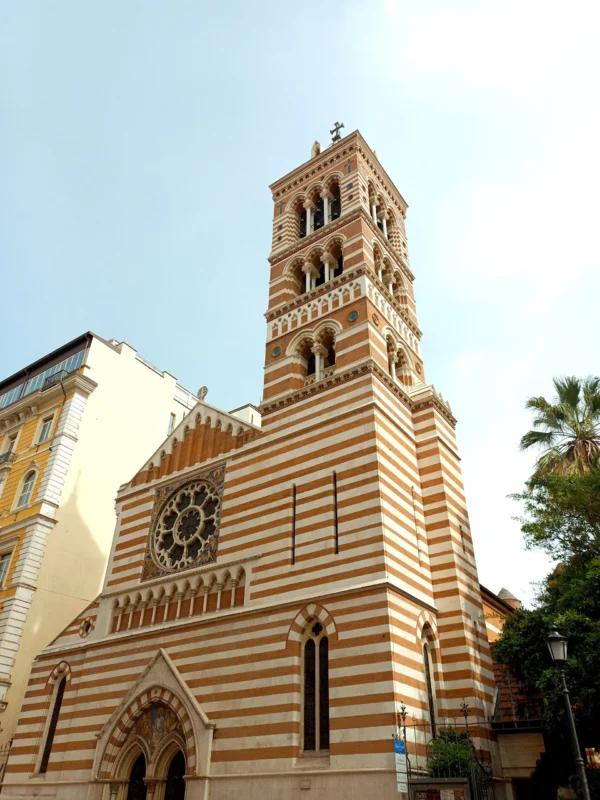
 St. Paul’s Within the Walls100 m
- Rome Opera House100 m
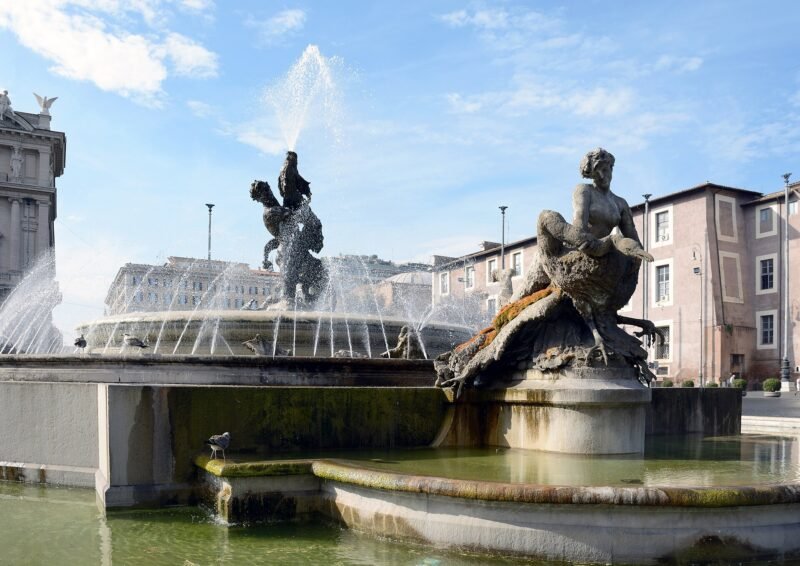
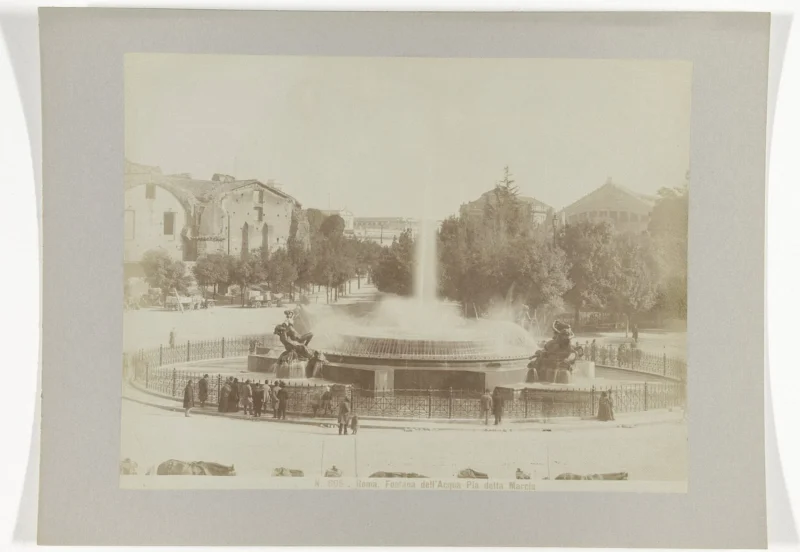
- Fontana delle Naiadi200 m
- Piazza della Repubblica200 m
- Teatro Nazionale200 m
- Enrico Fermi Center – Historical Museum of Physics and Study and Research Center at the Viminale200 m

Upcoming events nearby
- The Three Tenors at the Church of San Paolo entro le Mura, through December 22, 2026100 m
- La Traviata by Giuseppe Verdi at St. Paul’s Within the Walls, through December 19, 2026100 m
- Opera Concerto at St. Paul’s Within the Walls, Every Thursday Through December 9, 2027100 m
- Swan Lake at Teatro dell’Opera di Roma, December 17 to 31, 2026100 m