Church of San Silvestro al Quirinale
In short. The Church of San Silvestro al Quirinale stands in the middle of Via Ventiquattro Maggio, on the Quirinal Hill, in the Trevi district, halfway between the Quirinal Palace and the start of Via Nazionale.
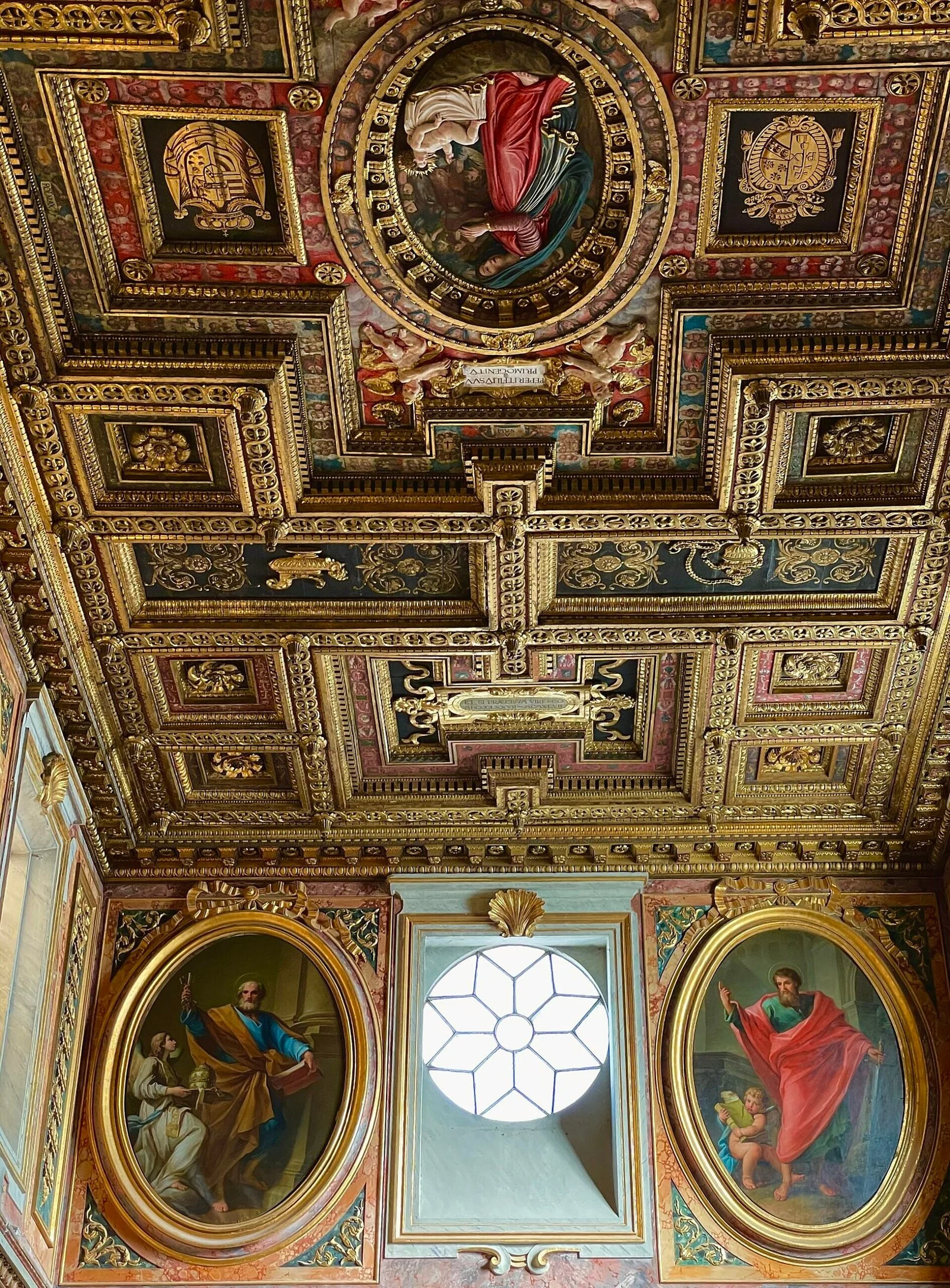
The Church of San Silvestro al Quirinale stands in the middle of Via Ventiquattro Maggio, on the Quirinal Hill, in the Trevi district, halfway between the Quirinal Palace and the start of Via Nazionale. It's one of those Roman churches that almost nobody sees, and that's not just a figure of speech: the urban expansion of the capital, in the late 19th century, took away its facade and its first bay, left it hanging about 10 meters above street level and forced on it a side entrance that passersby don't recognize as one. Yet inside there are two things that are worth the trip on their own: the landscape frescoes by Polidoro da Caravaggio and Maturino da Firenze, among the earliest evidence of independent landscape in Italian painting, and the memory of a place where, in the 16th century, a spiritual and intellectual circle gathered around Vittoria Colonna, attended by Michelangelo. The lines that follow tell what is really in this church, how to get in, what was lost and what remains, carefully separating verified facts from questions still open among scholars.
Where the Church of San Silvestro al Quirinale is and how to get there
The Church of San Silvestro al Quirinale has its address at Via Ventiquattro Maggio 10, in the Trevi district, on the northern flank of the Quirinal Hill. Via Ventiquattro Maggio is the street that runs down from Piazza del Quirinale toward Largo Magnanapoli: a short, sloping stretch, sunk between retaining walls and tall buildings, which most visitors walk absentmindedly on their way from one place to another, without realizing that one of those walls is not a retaining wall but the side of a church.
On foot from the center
From the Trevi Fountain it takes about 10 minutes, going up Via della Dataria or the staircase that leads to Piazza del Quirinale, and from there taking Via Ventiquattro Maggio eastward. From the Colosseum and the Forums the natural route goes along Via dei Fori Imperiali and Via Nazionale, or over the Capitoline Hill and Via Quattro Novembre, past Trajan's Markets and the Torre delle Milizie. From Largo Magnanapoli the church is a few dozen meters farther on, on the right going uphill.
By public transportation
The nearest metro stop is Repubblica, on Line A, from which you walk down Via Nazionale for about a quarter of an hour, downhill. Alternatively you can use the Cavour stop on Line B, climbing toward Largo Magnanapoli, or Termini, which serves both lines and is where the whole of Via Nazionale starts. Several city bus lines run along the full length of Via Nazionale and stop a few dozen meters from the intersection with Via Ventiquattro Maggio, which remains the simplest reference to give to anyone asking for directions.
Landmarks so you don't pick the wrong door
The real risk here is walking past the church without recognizing it, and it happens to a great many people. The 19th-century facade sits very high above the sidewalk, set back and squeezed between newer buildings, and the big central portal you see from the street is not the entrance to the church: it leads to the crypt and is normally closed. The real access is a much smaller, plainer door, on the left, past which a staircase climbs to the left transept. Anyone looking for a monumental entrance doesn't find it and keeps walking, which is why this church is invisible even to people who pass beneath it every day.
A church raised nine meters: what happened with Via Nazionale
The Church of San Silvestro al Quirinale today stands about nine meters above the street level of Via Ventiquattro Maggio, and this difference in height is not a natural feature of the hill but the direct result of the urban works carried out in Rome after 1870. When the city became the capital of the Kingdom of Italy, the administration opened the great axis of Via Nazionale to connect Termini station with the Renaissance center, and lowered and widened the connecting streets that flowed into it, among them Via Ventiquattro Maggio.
The lost facade and bays
To make room for the new road section, the front part of the church was demolished. The sources don't agree on the exact extent of the loss: some descriptions speak of the demolition of the facade and the first bay of the nave, others of the facade and the first two chapels. What is certain is that the church lost its original front and a portion of the longitudinal body, and that the Latin-cross plan was shortened to the point of approaching, in the perception of those who enter today, a more compact plan, almost a Greek cross.
The new facade was designed by Andrea Busiri Vici and built in the 1870s, with dates ranging between 1873 and 1879 depending on the sources consulted. Busiri Vici chose a deliberately historicist language, inspired by the models of late 16th-century Rome, so as not to create too violent a break with the 16th-century interior: a choice of professional good sense that, however, could do nothing against the underlying problem, namely that the church was now much higher than the street and that a facade, to work, has to be at the same level as the person looking at it.
The portal that doesn't open
The most curious result of that work is the main portal. You can see it perfectly well from the street, framed and monumental as you'd expect from a church entrance, but it doesn't lead into the church: it leads to the crypt, that is, the lower level which, after the lowering of the street, ended up at street level while the main hall found itself on the upper floor. That is why the portal normally stays closed and anyone who takes it for the entrance goes the wrong way. The actual access is a minor side door, from which you climb an interior staircase up to the left transept.
The history of the Church of San Silvestro al Quirinale, from the Dominicans to the Lazarists
The origins of the Church of San Silvestro al Quirinale probably go back to the 9th century, but the first certain documentary mention is from the third decade of the 11th century: the sources give the year 1030 or 1039 depending on the tradition followed, and the difference of a year doesn't change the substance, namely that the building already existed in the full Middle Ages under another dedication.
Santo Stefano in Caballo, then San Silvestro in Biberatica
The first documented name is Santo Stefano in Caballo, or de Cavallo, a name that derives from the medieval place name of the hill: the Quirinal was called Monte Cavallo because of the two colossal statues of the Dioscuri with their horses that dominated the summit, today on either side of the Quirinal Obelisk in the square in front of the presidential palace. The church is also recorded as Santo Stefano in Arcioni, from another local place name. From the 12th century the dedication to San Silvestro appears, with the specification in Biberatica, and in this form it is documented toward the end of that century.
The Dominicans and the 16th-century reconstruction
In 1507 Pope Julius II entrusted the church to the Dominican friars, according to the more detailed sources to those of the reformed congregation of the Tuscan area. The Dominicans rebuilt the building and attached a convent to it, with a building project that ended around 1524: hence the double dating found in the guides, some of which directly give 1524 as the year of the reconstruction and of the assignment to the Dominicans, while others distinguish between the grant of 1507 and the completion of the works 15 years later. The two versions are not in contradiction: they describe the same process from its beginning or from its end.
One source reports that around 1540 responsibility for the complex passed temporarily to a cardinal of the Sforza family, but the precise identification of the person is problematic, because the better-known Cardinal Ascanio Sforza had died in 1505 and cannot be the one indicated: it is in all likelihood a namesake or a later member of the same house, and the datum should be taken with the caution deserved by information handed down without an explicit archival reference.
The Theatines and the novice who becomes a church of formation
The next step is the one that gave the church the layout still recognizable today. The church and the convent were entrusted to the Theatine fathers, the order of Clerics Regular founded by Gaetano Thiene and Gian Pietro Carafa, the future Pope Paul IV. On the date the sources diverge sharply: some indicate 1555, the year of Paul IV's election, others 1566. Since the attribution of the transfer to Paul IV recurs and that pontificate falls between 1555 and 1559, the dating to 1555 seems the most consistent with the rest of the story, but the divergence should be pointed out rather than hidden.
From the French occupation to the Lazarists
The French occupation of Rome in 1798 led to the closure of the convent, as happened to dozens of other Roman religious communities in those turbulent years. In 1801 the complex passed to the Society of the Faith of Jesus, the congregation founded by Niccolò Paccanari that in those years was gathering part of the legacy of the suppressed Jesuits. After Napoleon's fall, in 1814, the church was entrusted to the Lazarists, that is, to the fathers of the Congregation of the Mission founded by Saint Vincent de Paul, who have kept care of it ever since.
In 1873 the attached convent was seized by the Italian state under the laws on the confiscation of church property and turned into a barracks, a use that erased most of the original conventual spaces. It is in that context, and a few years later, that the demolitions for the street reorganization described above took place: the church thus lost, within a decade, first the convent and then the facade, remaining as an isolated, raised body in an urban fabric completely redrawn around it.
A curiosity about the Church of San Silvestro al Quirinale
The most immediate curiosity concerns a door that never opens. The large portal at the center of the 19th-century facade of San Silvestro al Quirinale, the one any passerby would identify as the entrance to the church, does not lead to the liturgical hall but to the crypt below, and is habitually closed: a facade perfectly functional from the compositional point of view and completely unusable from the practical one.
A facade that tells of a compromise
Looking at the facade of San Silvestro al Quirinale with this awareness completely changes the way you read it. It is not an ecclesiastical front built to lead the faithful inside, but an element of urban furnishing designed to give a presentable face to an amputated church, at a historical moment when the new capital wanted to present itself as orderly and coherent along its main arteries. The late 16th-century language chosen by the designer served to suggest a stylistic continuity with the historic building, but the real function of that front was to mask a wound.
Something nobody tells you about the Church of San Silvestro al Quirinale
In the first chapel on the left of San Silvestro al Quirinale there are frescoes by Polidoro da Caravaggio and Maturino da Firenze, datable to the mid-1520s, in which the landscape stops being a simple background and becomes the real subject of the scene: art historians consider them among the earliest evidence of independent landscape in Italian painting. It's a distinction that almost never appears in the city's general guidebooks and that places this small, hidden church at a turning point in the history of European painting.
What independent landscape means
To understand why those frescoes matter so much, you have to remember how painting normally worked in the early 16th century. A sacred scene was built around the figures: the saints, the Virgin, the protagonists of the narrated episode occupied the foreground and the central part of the composition, and behind them the painter inserted rocks, trees, watercourses, distant buildings, with the function of giving depth and plausibility. Landscape, in short, existed but served the narrative, it didn't guide it.
In the scenes painted at San Silvestro the relationship is reversed. The figures of the saints become small, almost absorbed by the natural space, while the composition is organized around rocks, tree lines, expanses, scattered architectural presences: the viewer's eye is not guided toward a protagonist but invited to travel through the space. It is exactly the mechanism that, a century later, would found the genre of classical landscape in the Rome of Annibale Carracci, Claude Lorrain and Nicolas Poussin, and which here appears with a remarkable head start.
The subjects of the scenes
The scenes frescoed on the side walls of the chapel concern episodes from the lives of two female saints, traditionally identified as Mary Magdalene and Catherine, while on either side of the altar are painted the figures of the same saints and monochrome putti. The reading of the subjects varies slightly from source to source, and in particular the identification of the second saint oscillates in the descriptions between Catherine of Siena, consistent with the Dominican patronage of the chapel, and other Catherines: whoever visits the church would do well not to get attached to a single version.
A detail on the attribution
Polidoro Caldara da Caravaggio and Maturino da Firenze worked as a pair for years, above all on the monochrome frescoed facades of Roman palaces, a genre of which they were the greatest specialists of their generation and of which very little remains today, because the facades exposed to the weather have almost all been lost and are known to us mainly through engravings. In modern sources the San Silvestro cycle is sometimes attributed to the pair, sometimes to Polidoro alone with the partial intervention of his companion: the question of the exact division of hands remains debated and no guide should present it as settled.
The Fra Mariano chapel, the majolica floor and Polidoro
The first chapel on the left of the nave of San Silvestro al Quirinale, known in the sources also as the Sannesio chapel after the name of a later patron, was originally the chapel of Fra Mariano Fetti, the Dominican friar who in the years of Leo X held in Rome a wholly singular role between the papal court and the convent.
Who Fra Mariano Fetti was
Fra Mariano Fetti is a figure that historiography remembers above all for his role as entertainer and court jester to Leo X, the Medici pope who made his court one of the most brilliant and worldly centers of early 16th-century Europe. He entered the Dominican order and obtained the office of the lead seal, the post that oversaw the affixing of seals to papal documents, a lucrative position that allowed him to finance the decoration of his own chapel. The sources attribute to him a self-mocking nickname that defined him as the prince of fools, consistent with the public persona he had built.
The majolica floor
The chapel preserves a floor of majolica tiles datable to around 1525, described in the sources as made in the style of the Della Robbia workshop. It's an element that is little noticed because one always looks up, toward the frescoes, and that instead deserves a careful look: glazed floor ceramics of this quality and this date have survived in very few cases in Roman churches, because floors are the part of a building most exposed to wear and most frequently redone in later renovations.
The fate of the frescoes in the demolitions
A doubt that arises naturally, knowing that the 19th century took away the facade and at least part of the front body of the church, concerns the survival of these frescoes. Modern descriptions of the interior place the frescoes by Polidoro and Maturino in the first chapel on the left of the present church, which indicates that the cycle has been preserved in situ. The sources that speak of the demolition of two chapels, however, do not clarify precisely which spaces were involved, and the numbering of the chapels in modern guides obviously refers to the layout after the 19th century. Anyone who wants to reconstruct exactly what was lost in that building project must turn to the specialist bibliography, because the popular sources available are not enough.
The advice I give you for visiting the Church of San Silvestro al Quirinale
The decisive advice for visiting the Church of San Silvestro al Quirinale is just one: call or write first, because this church doesn't have continuous, reliable opening hours like a basilica in the center, and the available sources openly contradict each other on the point. Some indicate morning and afternoon opening in a standard time slot, specifying however that on weekdays the church is often closed. Others describe the church as normally not accessible and open only for concerts and guided visits.
What to do before going
Faced with such divergent sources, the only sensible course is to contact the venue directly before setting out. The contacts published by the municipal tourism portal include a landline number, a mobile number and an email address in the church's name: these are the channels to use to ask if the building will be open on the planned date and if it's possible to visit the chapels. It's worth doing it a few days ahead, because the management depends on a religious community and on volunteers, not on an office with staff dedicated to tourist reception.
The concert route
One of the most realistic occasions to get in is a concert. The church is used with some regularity as a venue for musical events, helped by the acoustics of the hall and its central position, and on those evenings the interior is open and lit. Those with a specific interest in the frescoes should bear in mind that the lighting set up for a concert is not ideal for viewing the painting, and that it's best anyway to arrive well ahead of the start to have time to look around.
Combining the visit with the rest of the Quirinal
The practical advice for groups in this area is never to build an outing around this church alone, precisely because of the uncertainty of access, but to include it in an itinerary of the hill that works even if the door stays closed. An effective route starts from Piazza del Quirinale with the view over the city and the Quirinal Obelisk between the Dioscuri, continues along Via del Quirinale with the Church of Sant'Andrea al Quirinale by Bernini and the Church of San Carlo alle Quattro Fontane by Borromini, and goes back along Via Ventiquattro Maggio to San Silvestro and Largo Magnanapoli. In a little over a kilometer you cross the most famous Baroque in Rome and a church that preserves of the 16th century what the Baroque did not erase.
The Bandini chapel: Mascherino, Algardi, Mochi and Domenichino
The Bandini chapel of San Silvestro al Quirinale is an octagonal room covered by a dome and lantern, opening at the end of the left transept, and it was designed by Ottaviano Nonni, known as Mascherino, in the first half of the 1580s, with dates that the sources place between 1580 and 1585. It takes its name from Cardinal Ottavio Bandini, who placed there his own funerary monument and that of his parents. The altarpiece is an Assumption by Scipione Pulzone painted on slate, that is, on a slab of slate rather than on canvas, following a technical fashion of the late 16th century that credited stone with greater durability. The dome of the chapel had to be rebuilt in 1823 after cracks appeared.
The sculptures of Alessandro Algardi
The stucco sculptures of the chapel are attributed to Alessandro Algardi and dated 1628: they depict the Magdalene and Saint John the Evangelist. Algardi, Bolognese by training, is together with Gian Lorenzo Bernini the great sculptor of 17th-century Rome, and compared to his rival he represents an opposite artistic temperament, more restrained, more classically measured, less interested in immediate dramatic effect. The works at San Silvestro belong to a relatively early phase of his Roman career, when stucco was a frequent working material for him, cheaper and quicker than marble and suited to blending with architectural decoration. Two other figures in the same chapel, Saint Joseph and Saint Martha, have been attributed to Francesco Mochi, but for these the attribution is not consolidated and some descriptions speak of works only in the style of Mochi, today by an unidentified author.
Domenichino's roundels
In the pendentives of the dome, Domenichino frescoed in 1628 four roundels with episodes from the Old Testament: David dancing before the Ark, Judith showing the head of Holofernes, Esther fainting before Ahasuerus and Solomon enthroning Bathsheba as queen mother. It's a cycle that specialists consider important in the painter's career, and that belongs to the mature Roman period of Domenico Zampieri, the leader of Bolognese classicism transplanted to Rome.
The coffered ceiling, the part everybody photographs
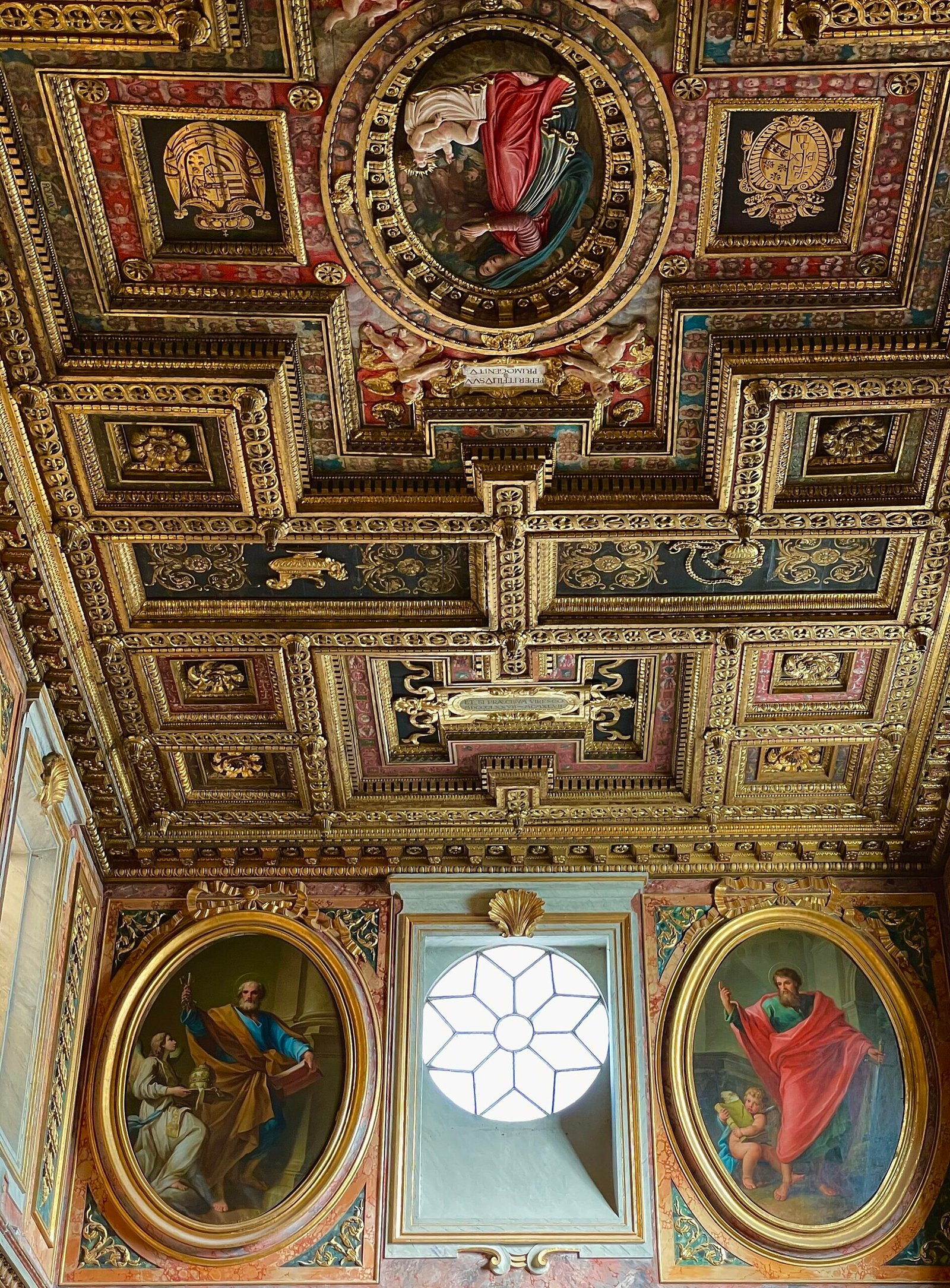
The wooden coffered ceiling of San Silvestro al Quirinale, gilded and decorated with biblical scenes, dates to the second half of the 16th century and is attributed to Flaminio Boulanger. It is the element that strikes those who enter the most, because it covers the whole hall with a continuous surface of carvings and gilding that reflect whatever light is available.
How it's made
The descriptions agree on a structure of carved coffers with a predominance of blue and gold, with a few touches of red, and with some larger oval compartments occupied by reliefs or paintings. Among the subjects recognized in the sources are the handing over of the keys to Saint Peter and a Madonna and Child. A third main compartment was lost in 1877, that is, precisely during the work of rebuilding the front and shortening the nave: when you demolish the first bay of a church, you inevitably take away also the portion of ceiling that covered it.
The other paintings of the hall
Besides the ceiling, the hall preserves a pictorial ensemble that spans more than two centuries. The sources cite works and interventions by Marcello Venusti, the Lombard painter who worked in close contact with Michelangelo and translated some of his inventions into small format, Jacopo Zucchi, Raffaellino da Reggio, the Cavalier d'Arpino, Giacinto Gimignani, Avanzino Nucci, Giovanni and Cherubino Alberti, Lazzaro Baldi and Antonio Barbalonga. To Stefano Pozzi, a mid-18th-century painter, six ovals distributed between the counter-facade and the two sides of the nave are attributed. On the counter-facade there are also the funerary monuments to Cardinal Federico Cornaro and to the jurist Prospero Farinacci. The attribution of the Cornaro monument oscillates in the sources between Giovan Battista Della Porta and Giacomo Della Porta, two sculptors and architects of the same large family of artists, and the point would deserve documentary verification.
Vittoria Colonna, Michelangelo and the dialogues of Francisco de Holanda
In the 16th century San Silvestro al Quirinale was the meeting place of a spiritual and intellectual circle that revolved around the figure of Vittoria Colonna, Marchioness of Pescara, and that according to tradition counted Michelangelo Buonarroti among its regulars. The most famous testimony to those meetings is contained in the Roman dialogues of the Portuguese Francisco de Holanda, and it is precisely on this testimony that scholars have long been debating.
Who Vittoria Colonna was
Vittoria Colonna was born in Marino in 1490 or 1492, depending on the sources, and died in Rome on February 25, 1547. The widow of Ferrante Francesco d'Avalos, Marquis of Pescara, who fell in 1525, she was the most authoritative poet of the Italy of her time and a central figure of the spiritual movement that sought an inner reform of the Church without breaking with Rome, what historians call the milieu of the Spirituals. She was in contact with Juan de Valdés, with Bernardino Ochino and, in the Viterbo years after 1541, with the English cardinal Reginald Pole.
One point must be clarified at once because it generates constant confusion: the Roman convent where Vittoria Colonna withdrew and where she spent long periods until her death was the one attached to the church of San Silvestro in Capite, in Campo Marzio, run by the Poor Clares, and not San Silvestro al Quirinale. They are two different churches, in two different parts of the city, sharing only the dedication to Pope Sylvester. The meetings described by Francisco de Holanda are instead set on the hill, in the church discussed in these lines, then also known as San Silvestro a Monte Cavallo.
The Roman dialogues and the debate about their reliability
Francisco de Holanda, a Portuguese painter and writer born in Lisbon in 1517 and died in the same city in 1585, stayed in Rome toward the end of the 1530s and frequented the circle of Vittoria Colonna. Years later he wrote the treatise Da pintura antiga, the first treatise on painting composed on the Iberian Peninsula, which the sources date to 1548 or 1549. The second part of the work contains four dialogues in which Michelangelo appears as a character and sets out his own ideas on art, in conversations set precisely at San Silvestro, in the presence of Vittoria Colonna and other interlocutors.
Here it must be said clearly what tourist guides usually keep quiet: the documentary value of those dialogues is a matter of discussion among scholars. On one hand, it is beyond dispute that de Holanda really was in Rome in those years, that he had access to the circle of Vittoria Colonna and that the circle did meet in this church: on this the sources converge. On the other, a part of the critics consider the dialogues not a record of conversations that actually took place but a literary construction, following a genre, the philosophical dialogue, that in the 16th century explicitly allowed the staging of real people with speeches composed by the author. Even the reference encyclopedia entries, when they summarize the content of the work, use cautious formulas and speak of alleged dialogues with Michelangelo.
The most balanced position, and the one worth adopting on a visit, is this: the meetings of Vittoria Colonna's circle at San Silvestro belong to the documented history of the place, whereas the individual lines attributed to Michelangelo in de Holanda's dialogues should be treated as indirect testimony, filtered through the writing of an author who had his own theses to defend on ancient painting and on the primacy of drawing. Anyone who tells the story of this church by claiming that Michelangelo said exactly this or that, citing de Holanda as if he were a recording, is skipping a critical step that historiography does not skip.
The so-called cloister of Michelangelo
Attached to the complex is a small terraced space, indicated in descriptions as the cloister of Michelangelo, identified as the place where the 16th-century circle gathered. The name is traditional and commemorative, that is, it links the space to the memory of the meetings, and does not imply that Michelangelo designed it. It must also be kept distinct from the namesake and far more famous Michelangelo's Cloister at the Baths of Diocletian, which is something else entirely in size, history and attribution: the coincidence of the name has generated more than one misunderstanding in popular descriptions.
Another well-known fact, yet rarely mentioned
The high altar of San Silvestro al Quirinale was consecrated in 1584 by Thomas Goldwell, Bishop of St Asaph, who at that time was the last surviving bishop of the English Catholic hierarchy prior to the break with Rome and who resided in this church as superior of the community.
The last bishop of Catholic England
The story deserves to be told at length, because it is one of those cases in which the history of a small Roman church hooks into a central chapter of European history. When Elizabeth I consolidated the break with Rome, the English Catholic bishops who refused the oath were deprived of their sees, and almost all died in prison or under house arrest. Thomas Goldwell, on the other hand, managed to leave England and settled in Italy, where he came into the orbit of the Theatines and ended up residing precisely at San Silvestro al Quirinale.
At his death, in 1585, the English Catholic episcopate appointed before the schism died out with him: as long as he lived, there still existed a bishop consecrated according to the order of the English Church before the break, and with him that continuity was interrupted. That the consecration of the high altar of this church is his work means that an ordinary liturgical act, performed in a building on the periphery of the great Roman basilicas, bears the signature of one of the symbolic figures of the English religious story of the 16th century.
The right photo to take at the Church of San Silvestro al Quirinale
The most effective photograph to take at San Silvestro al Quirinale is not the one of the interior, which requires the church to be open and a light that isn't always there, but the one that documents from outside the difference in height of about nine meters between the street level of Via Ventiquattro Maggio and the raised church: it is the image that explains in a single shot the whole urban history of the place.
The shot from below
It's best to cross the street and look for the farthest-back shooting point possible on the opposite sidewalk, then point upward, including in the frame both the sidewalk in the foreground and the facade at the top. A wide-angle lens helps, provided you accept the converging verticals, which in this case is not a flaw but an expressive element: it's precisely the perspective distortion that gives the feeling of a building pushed upward and detached from the ground that held it up.
The interiors, when you can
If you manage to get in, the most rewarding subject is the coffered ceiling, which should be shot vertically from the center of the hall, resting the camera on a bench or on a stable surface, because the interior light is scarce and exposure times get longer. The Bandini chapel, with the octagonal dome and Domenichino's roundels, requires instead a shot from below toward the cap, and here the main problem is the contrast between the lit parts and the shadowed ones: it's best to expose for the bright areas and recover the shadows in post-processing, rather than the opposite.
Some important events that happened here in history
The history of San Silvestro al Quirinale is arranged around a handful of verifiable dates: the first documentary mention in the third decade of the 11th century, the assignment to the Dominicans in 1507 with the reconstruction concluded around 1524, the passage to the Theatines in the mid-16th century, the consecration of the high altar in 1584, the 17th-century decorative campaign of 1628, the closure of the convent in 1798, the arrival of the Lazarists in 1814 and the demolitions of the 1870s.
The Sack of Rome and the end of a pair of painters
The Sack of Rome in 1527 represents the watershed for the whole artistic milieu of the city and also for the two authors of the frescoes in this church. The collaboration between Polidoro da Caravaggio and Maturino da Firenze was interrupted by that event: Polidoro left Rome and moved to the South, reaching Messina in the end, where he would die in 1543 killed, according to the tradition reported by the sources, by one of his own assistants during an attempted robbery. On Maturino the sources diverge: some say he died during the Sack of 1527 itself, others that he was a victim of the plague that immediately followed the looting. The difference is a matter of months and the substance doesn't change: the pair of monochrome specialists who had frescoed half of Rome dissolved in that two-year period, and with it an entire season of Roman urban decoration.
1628, the year of the 17th century
A second moment of artistic concentration is 1628, the date to which both the roundels frescoed by Domenichino in the pendentives of the Bandini chapel and the stucco sculptures by Alessandro Algardi refer. A decorative campaign that in a single year puts to work in the same space two of the major names of the Rome of the time indicates a high-level commission and a notable financial capacity, consistent with the cardinal rank of the chapel's patron.
1798 and 1814
The French occupation of 1798 and the proclamation of the Roman Republic led to the closure of the convent, as happened throughout the city to religious communities. The brief passage to the Society of the Faith of Jesus in 1801 and the assignment to the Lazarists in 1814, after Napoleon's fall, are chapters of a general reorganization of the Roman religious world that follows the pope's return. Those who also visit the Museo della Repubblica Romana e della Memoria Garibaldina find recounted, for the later period of 1849, the same dynamic of conflict between civil power and ecclesiastical institutions that also hit this church.
Who passed through the Church of San Silvestro al Quirinale
Through San Silvestro al Quirinale have passed, over five centuries, figures belonging to very different stories: painters of the early 16th century such as Polidoro da Caravaggio and Maturino da Firenze, intellectuals and religious figures of the circle of Vittoria Colonna, Michelangelo Buonarroti according to the established tradition, an exiled English bishop like Thomas Goldwell, architects like Ottaviano Mascherino and artists of the mid-17th century such as Domenichino and Alessandro Algardi.
The artists of the 16th-century building site
The first group is that of the painters who worked here in the 1520s and then in the Theatine period. Polidoro Caldara, called da Caravaggio from the Lombard town of his origin, had arrived in Rome very young and trained in the building site of the Vatican Loggias under the direction of Raphael, like many of his generation. Maturino da Firenze shared workshop and commissions with him. After them, Marcello Venusti passed through this church, the painter who translated some compositions of Michelangelo into small-format paintings and who for this reason is today a precious source for reconstructing lost or altered works, and then Jacopo Zucchi, Raffaellino da Reggio, Avanzino Nucci, Scipione Pulzone.
Thomas Goldwell and the exiles
The third group is that of the religious exiles. Thomas Goldwell, Bishop of St Asaph and last survivor of the English Catholic episcopate prior to the schism, lived here as superior of the community and consecrated the high altar in 1584, dying the following year. Around figures like him gravitated, in the Rome of the late 16th century, the colleges and national communities that welcomed those leaving the countries that had passed to the Reformation, and that made the city one of the European hubs of forced religious mobility.
The artists of the 17th century
The fourth group is that of the decorative campaign of 1628. Domenico Zampieri, called Domenichino, was in those years one of the most esteemed painters in Rome and the main heir to the lesson of the Carracci. Alessandro Algardi was building the Roman career that would make him the classicist alternative to Bernini. Having both of them at work in the same chapel places San Silvestro, for a moment, at the center of the Roman artistic scene. Those who want to continue the discussion on that period will find at Palazzo Barberini and in the National Gallery of Ancient Art the complete pictorial context of the Roman 17th century.
The Quirinal around the church: what to see a few steps away
San Silvestro al Quirinale is in the middle of one of the densest concentrations of monuments in Rome, within a radius of 300 meters that includes the seat of the Presidency of the Republic, two absolute masterpieces of the Baroque, an imperial archaeological complex and one of the great 19th-century arteries of the capital.
The two Baroque churches
Along Via del Quirinale, which continues toward the Quattro Fontane, a short distance from each other stand the Church of Sant'Andrea al Quirinale by Gian Lorenzo Bernini and the Church of San Carlo alle Quattro Fontane by Francesco Borromini, that is, the closest and most instructive comparison that exists between the two greatest architects of the Roman Baroque. Visiting them in sequence after San Silvestro builds an impeccable chronological route: the sober, conventual 16th century of San Silvestro, the theatrical and persuasive 17th century of the two churches by Bernini and Borromini.
The Scuderie and the exhibitions
Also on Piazza del Quirinale face the Scuderie del Quirinale, the old building of the papal stables converted into an exhibition space and today home to some of the most important exhibitions held in Rome. It's the stop that lends itself best to being combined with the visit to the hill, because it has regular hours and a proper ticket office, and can therefore serve as an anchor for a day in which the opening of San Silvestro remains uncertain.
At the foot of the hill: the Forums and the Markets
Going down toward Largo Magnanapoli you reach in a few steps Trajan's Markets and the Imperial Forums Museum, which occupy the large brick complex leaning against the flank of the Quirinal, and from there the Trajan's Forum with Trajan's Column. It's the link that gives historical sense to the old name of the church, San Silvestro in Biberatica, because Via Biberatica is precisely the paved street that runs through that complex.
Via Nazionale
On the other side, the intersection with Via Nazionale opens the 19th-century axis that climbs toward Piazza della Repubblica and the Baths of Diocletian, passing in front of the Palazzo delle Esposizioni. It is the street that determined the architectural fate of San Silvestro, and walking its whole length, aware of what it cost the preexisting fabric, is a useful exercise to understand how a modern capital is built inside an ancient city.
Palaces and galleries
A little farther down, toward Piazza Santi Apostoli, is the Galleria Colonna, one of the great private picture galleries of Rome still open to visitors, while climbing toward the Quattro Fontane you reach Palazzo Barberini. They are two stops that complete the picture well, because they show the secular and residential side of the same aristocratic patronage that in the churches of the hill financed chapels and altars.
Frequently asked questions about the Church of San Silvestro al Quirinale
Where is the Church of San Silvestro al Quirinale?
The Church of San Silvestro al Quirinale is at Via Ventiquattro Maggio 10, in the Trevi district, on the Quirinal Hill, between Piazza del Quirinale and the intersection with Via Nazionale. The most convenient metro stop is Repubblica on Line A, about a quarter of an hour's walk downhill along Via Nazionale. Alternatively you can use Cavour on Line B or Termini, or the many bus lines that run along Via Nazionale.
What are the opening hours of the Church of San Silvestro al Quirinale?
The hours of the Church of San Silvestro al Quirinale are not stable and the available sources contradict each other: some report morning and afternoon opening, specifying that on weekdays the church is often closed, others describe it as normally not accessible and open only for concerts and guided visits. Before going it's best to contact the church directly at the telephone and email contacts published by the tourism portal of the City of Rome.
Do you pay a ticket to enter the Church of San Silvestro al Quirinale?
The Church of San Silvestro al Quirinale is a place of worship and not a museum with a ticket office, so no ordinary admission ticket is envisaged. The guided visits organized by cultural associations and the concerts held in the hall, however, may have a cost, and they remain among the most concrete opportunities to get in: the conditions of participation must be checked each time with whoever organizes the event.
Why is the main door of the Church of San Silvestro al Quirinale always closed?
The central portal of the Church of San Silvestro al Quirinale does not lead to the liturgical hall but to the crypt, and that is why it is habitually closed. The reason is the lowering of Via Ventiquattro Maggio carried out in the late 19th century, which left the church raised about nine meters above the street: the real entrance is a minor side door, from which an interior staircase climbs to the left transept.
What is there to see inside the Church of San Silvestro al Quirinale?
Inside the Church of San Silvestro al Quirinale you see the landscape frescoes by Polidoro da Caravaggio and Maturino da Firenze in the first chapel on the left, the gilded wooden coffered ceiling of the second half of the 16th century attributed to Flaminio Boulanger, and the Bandini chapel at the end of the left transept, octagonal, designed by Ottaviano Mascherino, with the stuccoes by Alessandro Algardi and the roundels frescoed by Domenichino in 1628.
Why are the frescoes by Polidoro da Caravaggio at San Silvestro important?
The frescoes by Polidoro da Caravaggio and Maturino da Firenze in the first chapel on the left of San Silvestro al Quirinale are considered among the earliest evidence of independent landscape in Italian painting: they date to the mid-1520s and in them natural space stops serving as a backdrop for the figures and becomes the real subject of the composition, anticipating by almost a century the birth of the genre of classical landscape in Rome.
Did Michelangelo really frequent the Church of San Silvestro al Quirinale?
According to the established tradition, Michelangelo frequented the spiritual circle that in the 16th century gathered at San Silvestro al Quirinale around Vittoria Colonna, and the most cited testimony is that of the Roman dialogues of Francisco de Holanda. The documentary value of that text, however, is debated: a part of scholars consider it a literary construction, following a genre that in the 16th century allowed the staging of real people with speeches composed by the author, and not the faithful account of conversations that really took place.
Is the Church of San Silvestro al Quirinale the same one where Vittoria Colonna lived?
No, the Church of San Silvestro al Quirinale is not the convent where Vittoria Colonna lived: the Marchioness of Pescara withdrew to San Silvestro in Capite, in Campo Marzio, run by the Poor Clares, and stayed there a long time until her death on February 25, 1547. The two churches share only the dedication to Pope Sylvester and are in different parts of the city.
How long does it take to visit the Church of San Silvestro al Quirinale?
20 or 30 minutes are enough to visit the Church of San Silvestro al Quirinale, because the hall is a single one and the main works are concentrated in the first chapel on the left, in the ceiling and in the Bandini chapel. Those who want to devote a morning to the whole hill, adding Piazza del Quirinale, the two Baroque churches of Via del Quirinale and an exhibition at the Scuderie, should instead allow at least three or four hours.
One last piece of advice for those planning the itinerary
San Silvestro al Quirinale works as an additional stop inside an already solid itinerary of the hill, not as the main destination of an outing: the uncertainty of access discourages building a day on it, while the proximity to monuments with reliable hours makes it a low-risk detour. Whoever finds it open takes home one of the least known and most significant chapters of early 16th-century painting. Whoever finds it closed has still walked one of the densest urban stretches of Rome and can read from the outside, in the difference in height between street and facade, the whole history of the neighborhood.
Anyone putting together a broader itinerary between the Quirinal, the Forums and Via Nazionale, cross-checking hours, distances and opening days, will find useful planning tools on Tour Leader Pro, while for a more general picture of transport, connections and destinations in Lazio, Italy Planner remains a good resource.