Sant’Eusebio all’Esquilino
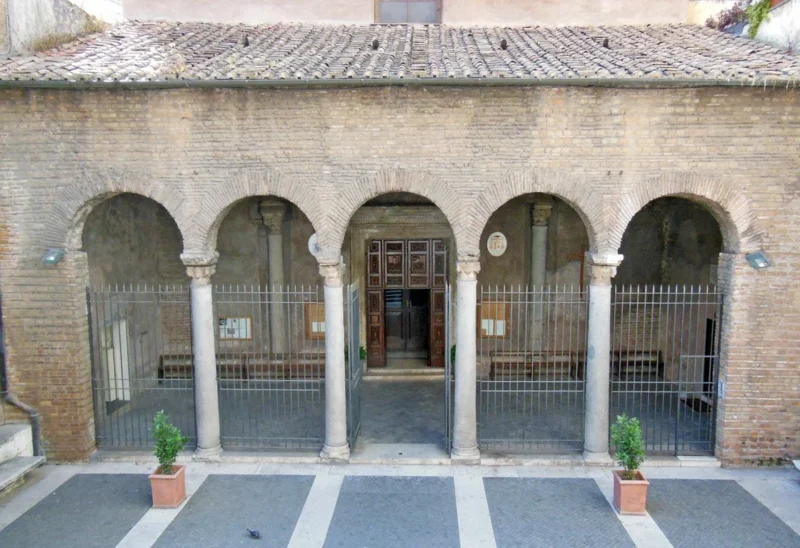
In short. Sant'Eusebio all'Esquilino is the church on the north corner of Piazza Vittorio Emanuele II, at number 12/A, with the double-ramp staircase and the five-arch portico facing the gardens.
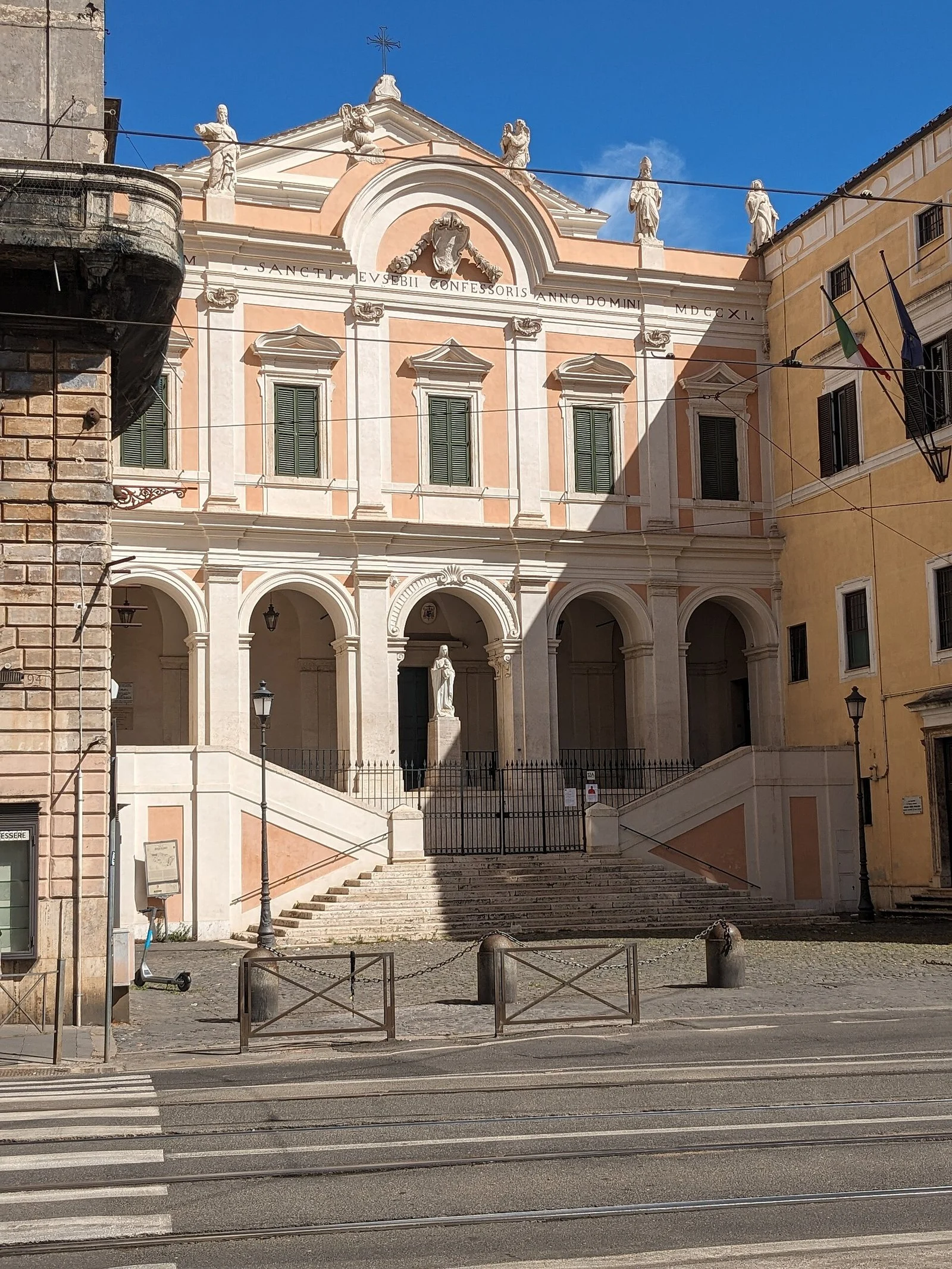
Sant'Eusebio all'Esquilino is the church on the north corner of Piazza Vittorio Emanuele II, at number 12/A, with the double-ramp staircase and the five-arch portico facing the gardens. Thousands of people pass in front of the portico every day and almost nobody goes in. It is one of the oldest titular churches of Rome, documented in the Roman synod of 499, and on the vault of the central nave it has the first great Roman public work by Anton Raphael Mengs, the Glory of Sant'Eusebio. Under the floor are the remains of a building from the 2nd century. Behind the altar is a wooden choir of 42 stalls that has no direct comparison in Rome. This page explains what you really see on entering, what you instead see only with an arranged visit, where the sources disagree with each other, and how to get there without wasting time.
Where Sant'Eusebio is and how to get there
The address is Piazza Vittorio Emanuele II 12/A, in the Esquilino district, and the portico faces the gardens side, not Via Carlo Alberto. The back of the church faces Via Principe Amedeo, and it is the flank that almost nobody looks at even while walking under it. The parish phone number is 06 4466170. Anyone who sets the navigator on Piazza Vittorio alone risks going around the whole perimeter: the right side is the one toward Santa Maria Maggiore.

By metro
The stop is Vittorio Emanuele, line A, opened in 1980 and located right under the square. From the exit to the church staircase it is a three-minute walk. It is one of the few historic Roman churches where the trip from the platform to the door does not exceed five minutes even walking slowly. Those arriving from Termini can choose: one stop of metro A toward Anagnina, or 10 minutes on foot along Via Giolitti or Via Cavour. For the general picture of transport there is our page on getting around Rome.
By tram
Tram lines 5 and 14 pass through Piazza Vittorio, connecting Termini with the east quadrant of the city along Via Giolitti and then Via Prenestina and Via Casilina. They are the two trams commuters really use, and the stop is on the side of the square toward Via Principe Eugenio. Arriving by tram from the Porta Maggiore area is quicker than going down into the metro and coming back up.
By bus
The surface lines that touch Piazza Vittorio and the surrounding streets change often because of construction, detours and network reorganizations. In recent surveys the 70, 105, 360, 590, 649 and 714 appear on the square and the immediately adjacent stops, but not all stop on the same side and some pass on Via Merulana or on Viale Manzoni. The check should be done the same day on the transit company's app, not on a printed guide and not even on this page.
By car, by bike, on foot
Arriving by car is not advisable. Piazza Vittorio is inside the limited traffic zone of the center during the activation hours, the parking spaces around the gardens are few and contested, and the neighborhood is one of the densest in Rome. Anyone who wants to understand what is at risk will find the rules on the page about the Rome ZTL and fines. By bicycle the square can be crossed without problems, even if the traffic on the avenues is lively: the honest assessment of Roman bike routes is on the page about Rome by bike. On foot, from Santa Maria Maggiore it is seven minutes downhill along Via Carlo Alberto, and it is the best way to get there.
What you see on entering, and what you don't
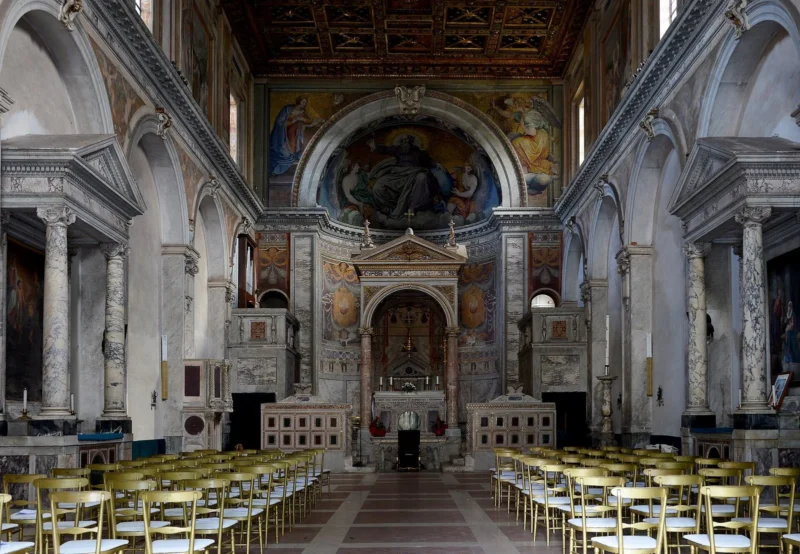
Entering from the portico you find a three-aisle interior, bright, orderly, in that sober Roman 1700s style called barocchetto. There is no decorative explosion of the Jesuit churches of the center and no darkness of reworked early Christian basilicas. There is light, there is measure, and above your head is Mengs's fresco. Anyone who stops at the hall, however, misses the two things that make this church different from 20 other Roman churches of the same period.
The part visible during ordinary hours
The central nave with the frescoed vault, the side aisles with the 1800s and 1900s altars, the presbytery with the double-faced main altar and the stucco angels on the arch, the organ on the left: all of this is seen freely when the church is open for Mass. The main altar dates to Onorio Longhi's arrangement between 1599 and 1600, in view of the Jubilee, and has columns of breccia pavonazza. The stucco angels of the presbytery arch are attributed to Tommaso Righi.
The part seen only on request
The wooden choir behind the altar, the underground levels with the Roman remains, the medieval apse and the bell tower are not part of the free visit. The parish runs two separate guided tours: one with the church, choir and underground levels, the other with the underground levels, medieval apse, bell tower and organ, from which you see Mengs's fresco up close. They have to be requested in advance. The cost is not published consistently by any official source, so ask about it when you get in touch.
The Chapel of Sant'Eusebio
Next to the sacristy there is a room that tradition identifies as the place where the saint was confined. It holds an aedicule with a triangular pediment, a marble relief of Eusebius with the dove of the Holy Spirit and, below it, a fragmentary funerary inscription. It's a small room, not scenic at all, and you have to ask for it: it's not on the route of someone who comes in to pray.
The titulus Eusebii and the Figure of Eusebius: Document and Hagiography
There is only one certain fact, and it's best to isolate it right away. The titulus Eusebii appears among the Roman titles listed in the acts of the synod held in Rome on March 1, 499 under Pope Symmachus, the list that is the most reliable snapshot of the network of Roman churches at the turn of the fifth and sixth centuries. From then on the church is documented continuously. Everything before that belongs to different ground.
What the Hagiographic Tradition Says
According to the account handed down, Eusebius was a Roman presbyter who lived in the first half of the fourth century, a firm opponent of Arianism and of imperial pressure on the Roman clergy. Emperor Constantius II is said to have had him shut up in his own house, where he died of privation after months of confinement. The title that bears his name is then said to have arisen on the site of the house. It's a coherent, widespread and ancient story, and it is exactly the kind of story that arises to explain after the fact a name already in use.
Where Verification Stops
The excavations under the church have not turned up anything that identifies the home of a historical Eusebius, and the local literature says so openly. What the excavations found is a building from the Roman period, and that is a different fact from hagiography. In most Roman titles the name refers to the owner or financer of the property, not necessarily to a martyr, and the transformation of the founder into a saint is a later and recurring step.
The Double Patron
In 1238 Pope Gregory IX rebuilt the church and dedicated it to Saints Eusebius and Vincent. The second name is Vincent of Saragossa, a Spanish deacon and martyr, and the double dedication still appears in the stucco relief under the high altar. In everyday use the second name has dropped away and the church is simply Sant'Eusebio for everyone, but in the oldest documents the pair is there.
The 18th-Century Building Campaign and Its Architects
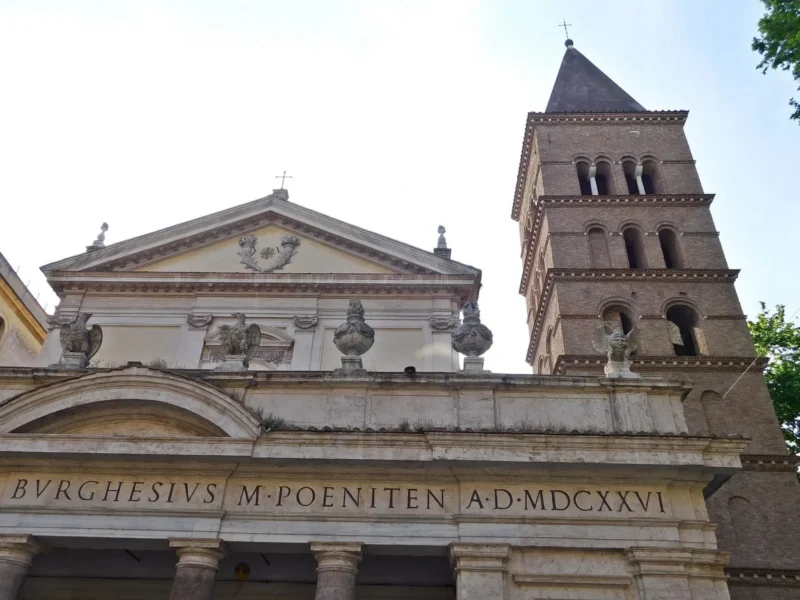
The church you see today is the result of two separate building campaigns, separated by almost 50 years, and confusing them is the most common mistake. The facade with the five-arched portico is dated 1711 and is the work of Carlo Stefano Fontana, nephew of the better-known Carlo Fontana. The three-aisle interior is instead the mid-18th-century remodeling, financed by the cardinal of the title, Enrico Enriquez.
The Problem of the Name
On the author of the interior remodeling the sources diverge, and the divergence is about the name. The parish names Niccolò Lorenzo Piccioni and places the work between 1754 and 1759. Encyclopedia entries and tourist portals instead write Niccolò Picconi, with the date 1759 or a generic mid-18th century. It is most likely the same person with a shifting spelling, but until an archival source settles the question it's better to give both forms than to pick the one that sounds best.
Why the Interior Is the Way It Is
The result of the Enriquez campaign is an interior that scholars rank among the most balanced of the Roman barocchetto, that is, of that mid-century phase in which Rome's taste cools under the pontificate of Benedict XIV and decorum wins out over effect. Little gilding, light walls, slender architectural members, high light. If you arrive here after a church from the height of the 17th century, you'll find it bare. If you arrive after a neoclassical church, you'll find it soft. To understand the contrast with the Rome of the century before, there's the page on Baroque Rome.
The Staircase and the Level of the Square
The double-ramp staircase in front of the portico is not 18th-century in its present form. When Piazza Vittorio Emanuele II was built after Unification, with the excavation needed to lay out the new Umbertine neighborhood, the street level in front of the church dropped and the access had to be rearranged. That double ramp is how the 19th century fixed a difference in level that did not exist before.
The Bell Tower
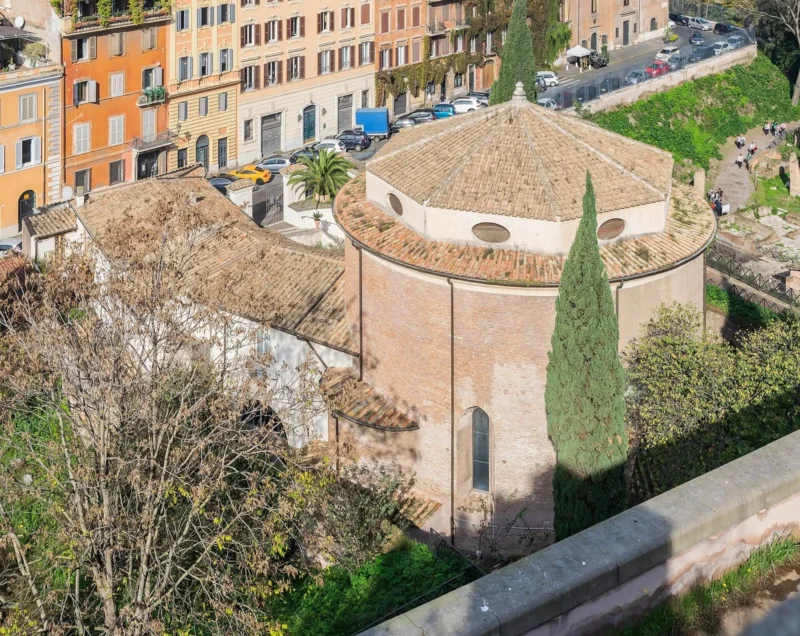
The Romanesque bell tower with its triple-light windows is the only surviving element of Gregory IX's 13th-century church. You can see it well from the gardens side and from the back on Via Principe Amedeo, and the comparison between that brickwork and the 18th-century portico in front tells the whole building history of the structure in two glances. It's visible from outside, without going in and without asking anyone.
The Recent Restorations
Between 2018 and 2021 the Special Superintendency for Archaeology, Fine Arts and Landscape of Rome carried out a series of works that touched almost the whole building. It began with Mengs's fresco, continued with the structural consolidation of the roof at the end of 2019, then the rear facade on Via Principe Amedeo, and closed with the portico, the staircase and the main facade, presented on September 16, 2021. Responsibility for the work on the facade lies with the architect Alessandra Centroni.
The Glory of Sant'Eusebio by Anton Raphael Mengs
The fresco on the vault of the central nave is the work that justifies the detour all by itself, and conflicting data circulate about it that are worth putting in order. The subject is the glory of Eusebius: the saint rises toward the Trinity carried by angels, and a scroll bears the Nicene formula of consubstantiality with the Father, which is a direct reference to the anti-Arian controversy tied to his name. Inside this fresco there is a theological thesis, not a generic celestial apotheosis.
The Author
Anton Raphael Mengs, born in Bohemia in 1728 and died in Rome in 1779, is the painter whom historiography names as the founder of European neoclassicism. When he receives this commission he is a little under 30 and has not yet painted the Parnassus of Villa Albani, the work that will make him famous. The sources that follow the restoration present the Glory as the first public work of the young Bohemian artist in Rome. That's why this time it interests art historians more than tourism realizes.
The Dates, and Why They Don't Match
The General Catalogue of Cultural Heritage records the work with the date 1757. The parish and several entries give it as executed between 1757 and 1759, that is, straddling the campaign to remodel the interior. The two indications don't truly contradict each other: 1757 is the year of the commission and the start, referring to the inscription on the scroll of the triumphal arch that records the intervention of Cardinal Enriquez, while 1759 closes the overall campaign. When you find only one of the two numbers written, you know what is behind it.
The Restoration of 2018 and 2019
The fresco was in bad shape, above all because of damp. A white veil of salt efflorescence had covered the surface to the point of compromising the legibility of the figures. The restoration work lasted about six months, from October 2018 to April 2019, with the scientific supervision of Roberta Porfiri and the work of the restorer Roberta Beltrame. The public presentation of the restored work was on June 7, 2019.
What Came Back Out
The cleaning brought back into view figures that for decades could no longer be made out, in particular the Trinity in the upper part of Paradise, which had become illegible under the salts. If you saw the vault before 2019 and come back today, you're looking at something else. At the end of the work the parish community paid for a new lighting system, and it's a difference you notice: in many Roman churches the most important work stays in the dark for lack of a spotlight.
Our Opinion, Which Not Everyone Will Like
The Glory is important for the history of art and mediocre as a visiting experience for someone who doesn't know what they are looking at. It's high up, light, composed, and to the naked eye from the floor it gives back much less than 100 other, more theatrical Roman vaults. The highlight of this church, for someone who really comes in to look, is the choir behind the altar, not the ceiling. The ceiling is what gets cited. The choir is what gets remembered.
The Wooden Choir and the Stalls
Behind the high altar, in a space that stays closed on most visits, there is a carved walnut choir with 42 seats, 27 in the upper row and 15 in the lower. The backs and the panels bear figures of saints, scenes of martyrdom, the four major prophets and the evangelists. The parish's description calls it unique in all of Rome for style and workmanship, and anyone who has seen it understands why that word is not just a formality.
The Disputed Date
On the date of the choir the sources don't agree and the difference is not a detail. One line of encyclopedia entries gives 1566 and associates with the stalls a lectern from the same set. The visitor's guide published by the parish instead places the work in a phase after 1600 and declares the author unknown. Between the two indications there are at least 40 years and two different cultural seasons. Neither carries at its foot an archival reference that can be checked online, and until a dedicated study appears the question stays open.
The Paintings of the Choir
In the choir room there are three paintings that complete the picture. On the right a Madonna and Child with Saints Eusebius, Vincent, Orosius and Paulinus attributed to Baldassarre Croce. On the left a Crucifixion attributed to Cesare Rossetti. At the back an Assumption described as a copy after Guido Reni. These are names from the Rome of the 16th and 17th centuries, consistent with the Longhi-style arrangement of the presbytery, and this is one of the arguments in favor of the later date for the choir.
How to See It
The choir is the first of the parish's two guided tours, together with the church and the underground levels. You can't go in on your own, there's no fixed published schedule, and the answer depends on the availability of whoever is accompanying. It's best to call 06 4466170 at least a week ahead, say how many of you there are and explain what you're interested in. Anyone who shows up at the door hoping to find the choir door open wastes the trip.
The Underground Levels and the Roman Building
Under the apse and the transept the excavations identified the remains of a building from the 2nd century AD. The main piece is a wall some 20 meters long, oriented parallel to Via Principe Amedeo, and two recognizable rooms remain. The rest of the ancient construction was most likely sacrificed in 1238, when Gregory IX's building campaign rebuilt the church from scratch.
What Was There Even Earlier
The area on which the church stands was part of a sector of the Esquiline that in the Republican era was occupied by pozzolana quarries and a necropolis, and that was only urbanized in the imperial era with insulae and domus. It's the same substratum that resurfaces a little farther on under other churches of the district and that explains why here, whatever you dig, you always find something. The neighborhood of the Gardens of Maecenas and the great imperial residences is all around: the Auditorium of Maecenas, a couple of steps away on Largo Leopardi, is the most visible remnant of that period.
Access to the Underground Levels
The underground levels of Sant'Eusebio are small and not equipped as a museum route. They appear in both of the parish's guided tours and are also opened for initiatives by the city's archaeological associations, which include them in neighborhood walks together with the Porta Alchemica in Piazza Vittorio and the other remains of the area. Anyone looking for organized, signposted Roman underground has to look elsewhere, for example at the underground basilica of Porta Maggiore.
A Curiosity About Sant'Eusebio all'Esquilino
In the monastery attached to the church, at the end of the 16th century, one of the first printing workshops in Rome was operating. It's a detail that almost never appears in descriptions of the church and that says a lot about what these complexes were before they became only places of worship. A monastery with a print shop was a center of cultural production, with skilled workers, presses, paper warehouses and commercial relationships.
Roman printing grew at the end of the 16th century under the push of the Counter-Reformation, which demanded breviaries, missals and correct liturgical texts in large quantities. Religious communities with space and labor entered that market. The monastery of Sant'Eusebio belonged to the Celestines, an order of Benedictine rule active in Rome for centuries.
The detail also helps with the topography. Before the 19th century there was no monumental square here but kitchen gardens, vineyards and large convent enclosures, at the edge of the inhabited city: a print shop could sit there without disturbing anyone. Anyone looking at the solid front of the Umbertine buildings has trouble imagining that emptiness, and the page on Rome Before and After reconstructs the leap.
Something Nobody Tells You About Sant'Eusebio all'Esquilino
The cloister of the complex no longer belongs to the parish. Institutional entries attribute it to Domenico Fontana and note that today the rooms are in use by the police forces. That means a substantial part of the historic monastery is a State service area, not open to visitors, and that a visitor who asks to see the cloister gets a no that doesn't depend on the goodwill of the parish priest.
It happens in Rome more than you'd think. After the suppressions of the orders in the 19th and 20th centuries, dozens of convents became barracks, offices, schools, ministries. The complex was reduced to the church alone and the rest changed use without anyone telling the story. If you look for the cloister in guidebooks, you'll find it mentioned. If you look for it in person, you won't find it.
The attribution to Domenico Fontana, the Ticino architect who redrew half of Rome under Sixtus V and moved the obelisks, should be taken as an attribution and not as an established fact. For this kind of space, attributions harden through repetition, and without a construction document they remain hypotheses of style. I mention it because you find it everywhere, not because I was able to confirm it.
My Advice for Visiting Sant'Eusebio all'Esquilino
Call ahead. It's the least original advice and the most useful I can give about this church, because here the difference between a four-minute visit and a visit worth the whole morning comes down to one phone call to 06 4466170. Without an arrangement you see the nave and the ceiling. With an arrangement you see the choir, the underground levels, the medieval apse and, on the second tour, the bell tower and the organ.
The Right Time of Day
Go around 11 in the morning, with the sun high. The central nave gets its light from the high windows and Mengs's fresco reads much better than in the late afternoon, when the vault goes into shadow and the new lighting system isn't enough to make up for it. On gray days in January and February the ceiling stays dark even at noon: this is not a church to visit in the rain.
What to Pair It With
Sant'Eusebio alone doesn't fill a morning. It works as the first or last piece of a walk around the Esquiline that includes Santa Maria Maggiore, the Basilica of Santa Prassede with its mosaics, the Basilica of Santa Pudenziana and, going down toward Via Cavour, San Pietro in Vincoli. It's a full half-day itinerary, all on foot, with modest changes in elevation.
How Much Time to Allow
For the church alone 20 minutes is enough, and anyone who takes 30 uses them well by looking at the vault calmly from two or three different points in the nave. With the complete guided visit you need an hour and a half, because the underground levels need explanation and the choir has to be looked at stall by stall. If you're traveling on a tight schedule, you'll find a way to fit it in using the page on three days in Rome.
Another Well-Known Fact That Is Rarely Cited
Sant'Eusebio is a church of the Italian State, not of the Holy See. It belongs to the Fondo Edifici di Culto, the Ministry of the Interior body that since 1985 has managed the real estate inherited from the suppression of religious orders between the 19th century and the early 20th. The General Catalogue of Cultural Heritage in fact records Mengs's fresco as State property, with the Special Superintendency of Rome as the protecting body.
The practical consequence is that the restorations here are paid for and directed by the State, not by the parish or the diocese. The cycle of works of 2018 to 2021 was planned and financed within that framework, and it's the reason a neighborhood parish church could afford the restoration of a fresco of that level. In a church of purely ecclesiastical ownership, with a parish of this size, that work would not have been done.
Several leading Roman churches fall under the Fondo Edifici di Culto, and the fact surprises anyone who discovers it. The arrangement doesn't touch liturgical use: the building is open for worship, the parish is alive, the clergy is diocesan. What changes is the chain of responsibility for maintenance.
The Right Photo to Take at Sant'Eusebio all'Esquilino
The photo that works is not the one of the ceiling. The vertical shot of the fresco almost always comes out crooked, with Mengs's perspective not holding up under a framing from below and the high windows blowing out the exposure. Go ahead and take it for the record, but it's not the one to take home.
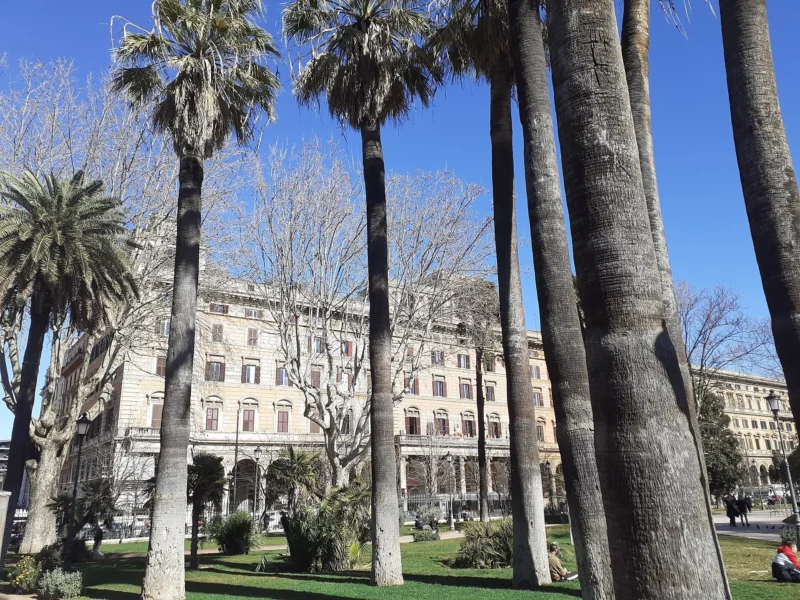
The right photo is taken from outside, from the gardens of Piazza Vittorio, standing on the inner path about 30 meters from the staircase. From there the five-arched portico, the double ramp and, on the right side, the Romanesque brick bell tower all fit in the same frame. That's three eras in a single photo: 13th century, 18th, 19th. With the treetops in the foreground the image gains depth.
The Light
The facade faces southeast, so it gets full light in the first part of the morning. Between 08:00 and 10:00 the travertine of the portico is lit from the side and the brick of the bell tower warms up. In the afternoon the front goes into backlight and the photo turns flat. In summer, with the garden foliage thick, it's better to move toward the center of the square to open up the field.
The Alternative from the Back
If you already have the frontal photo, try Via Principe Amedeo. From the opposite sidewalk you frame the apse and the bell tower rises above the houses, in a setting of Umbertine buildings and shops of the multicultural neighborhood that tells the story of today's Esquiline much better than the postcard from the square. It's a less beautiful and more honest photo, and it interests me more.
Some Important Events That Happened Here in History
The history of this church is a series of changes of hands, and each one left a mark on the building. Putting them in order helps explain why a 13th-century bell tower, a late-16th-century altar, a mid-18th-century interior and 19th-century altars coexist inside.
499: The Title Enters the Records
On March 1, 499 the synod convened by Pope Symmachus is held in Rome, and the records show the titulus Eusebii with the presbyters who serve it. This is the first certain documentary attestation of the church and the point from which every serious reconstruction starts. The earlier dates you read around belong to tradition or to disputed readings of funerary inscriptions.
The Lenten Station
Sant'Eusebio is one of the Roman station churches, that is, one of the stops on the liturgical route that marks Lent with a Mass in a different church each day. The custom is ancient and is traced back at least to the age of Gregory the Great. The station day at Sant'Eusebio falls during Lent and is one of the few moments of the year when the church fills with people who don't live in the neighborhood.
1238: The Reconstruction by Gregory IX
Pope Gregory IX rebuilds the church from scratch and dedicates it to Saints Eusebius and Vincent. What remains of that work is the bell tower with its triple-light windows and, below, the almost complete destruction of the pre-existing Roman structures. It's the moment when the building takes on the medieval layout that will last five centuries.
1289: The Celestines Arrive
Pope Nicholas IV entrusts church and monastery to the Celestine monks, the order born from the hermit experience of Pietro da Morrone, the future Pope Celestine V. The Celestine presence lasts more than 500 years and explains the dedication of one of the side altars to the saint who abdicated. In 1627 the complex is raised to the rank of abbey.
1599 and 1600: The Jubilee and Onorio Longhi
In view of the Holy Year of 1600 the presbytery is rearranged to a design by Onorio Longhi, with the two-sided high altar that you can still see. The layout of the organ goes back to the same rearrangement, traced to the Tyrolean Johann Konrad Wörle. It's the work that opens the way to the decoration of the choir and the paintings kept there.
1711 and 1759: The Two 18th-Century Campaigns
The facade and portico by Carlo Stefano Fontana bear the date 1711. Almost half a century later, the cardinal of the title Enrico Enriquez finances the remodeling of the interior, completed in 1759, and commissions the vault from Mengs. These are the two interventions that give the church its present look.
19th Century: Suppressions and Transfers
In 1810, in the Napoleonic period, the religious orders undergo suppression, and the Celestine presence is interrupted. The sources give the definitive suppression of the order as around 1820. In 1826 Pope Leo XII entrusts the complex to the Jesuits, who keep it until 1873, when the subversive laws of the Kingdom of Italy remove them. From 1889 the parish is run by the diocesan clergy. In between, the construction of Piazza Vittorio Emanuele II completely changes the urban context.
2018 and 2021: The Cycle of Restorations
The restoration of Mengs's Glory opens a cycle that in a little more than three years secures the roof, facades, portico and staircase. It's the most substantial work on the building since the 18th century, and it's the reason that anyone who hasn't been inside in 10 years finds a different church.
Who Passed Through Sant'Eusebio all'Esquilino
The people who left a documented mark here are not cover names, and that's why the list is interesting. Architects, painters, cardinals and religious orders, at different moments.
Anton Raphael Mengs
The Bohemian painter arrives in Rome very young following his father and becomes the theoretical reference point of European neoclassicism, a friend and interlocutor of Johann Joachim Winckelmann. The vault of Sant'Eusebio is cited as his first public Roman commission, that is, the work with which he introduces himself to the city. He will die in Rome in 1779.
Cardinal Enrico Enriquez
Cardinal of the title of the church in the mid-18th century, he is the man who puts up the money and makes the decisions on the remodeling of the interior and the commission to Mengs. His name appears in the inscription on the scroll of the triumphal arch, which is also the source from which the date of the fresco is drawn. Without him this church would have remained a reworked medieval building.
Carlo Stefano Fontana
Nephew of Carlo Fontana, one of the names that dominate Roman architecture between the 17th and 18th centuries, he signs the facade and portico of 1711. The five-arched portico with the staircase is his solution to the problem of giving urban dignity to a church that then faced a peripheral area of kitchen gardens and enclosures.
Onorio Longhi
An architect of late-16th-century Rome, son of Martino Longhi the Elder, he works on the presbytery and the high altar between 1599 and 1600. It's the same professional circle that in those years redraws half the city in the wake of the Counter-Reformation.
Domenico Fontana, with a Reservation
The name of Domenico Fontana, the architect of Sixtus V who moved the Roman obelisks, including the Esquiline Obelisk behind Santa Maria Maggiore, is associated with the monastery cloister. The attribution circulates in institutional entries but does not appear to come with an accessible documentary reference, so it should be held as probable and not as certain.
The Painters of the Choir and the Altars
Baldassarre Croce and Cesare Rossetti for the paintings of the choir, a painter of the Solimena family for the two altarpieces of the side altars with Saint Placidus presented to Saint Benedict and the abdication of Celestine V, Tommaso Righi for the stuccoes of the presbytery arch, Cleto Luzzi for the 19th-century canvas of the Sacred Heart. On some of these attributions the popular literature wavers, and references to Pompeo Batoni also circulate that we were not able to verify in a reliable source.
The Celestines and the Jesuits
For five and a half centuries the Celestine monks lived here, and for almost 50 years of the 19th century the Jesuits. Two opposite ways of being in the city: the Benedictine monastic rule on one side, the order of teaching and mission on the other. The complex bears the marks of both, and the altar dedicated to Celestine V is the most explicit.
The Attached Monastery and What Happened to It
The monastery is the part of the history of Sant'Eusebio that gets told least and explains the most. Until the end of the 18th century the complex was a Celestine abbey with a cloister, kitchen gardens, work spaces and a permanent community. Today nothing remains of the monastic function and the spaces have different uses.
The Celestines, from 1289 to the Early 19th Century
The Celestine monks received church and monastery from Nicholas IV in 1289 and stayed until the Napoleonic suppressions. In 1627 the complex became an abbey, which is a jump in rank and not a formal detail: it means administrative autonomy and an abbot with his own jurisdiction. At the end of the 16th century, as mentioned, a print shop also operated in the monastery.
The Jesuits, from 1826 to 1873
After the Napoleonic interlude and the suppression of the Celestine order, in 1826 Pope Leo XII entrusted the complex to the Society of Jesus. The Jesuit presence lasts 47 years and closes with the subversive laws on ecclesiastical property applied to Rome after 1870. From 1889 the church has been a parish with diocesan clergy, and so it has remained.
The Cloister Today
The rooms of the cloister, attributed to Domenico Fontana, are in use by the Italian police forces and are not open to the public. Anyone looking for a visitable Roman cloister in the quadrant has to look elsewhere. It's the typical outcome of the 19th-century suppressions, the same one that turned other Roman convents into barracks and offices, and knowing it spares you requests destined to go unanswered.
January 17, the Blessing of the Animals
The day this church fills up is January 17, the feast of Saint Anthony the Abbot, when animals are blessed on the churchyard. The rite has its full story, with times, history and practical advice, on our page on Roman festivals lost and found, and we won't repeat it here. Two things remain to be said, both about the building and the parish.
Why Here and Not at Sant'Antonio Abate
The Roman devotion to Saint Anthony had its center in the church of Sant'Antonio Abate all'Esquilino, on Via Carlo Alberto, a few hundred meters from here, with the 13th-century portal you can still see. The pastor of Sant'Eusebio, Massimo Cantelmi, explained to the diocesan press that the move dates to the early 20th century and that the most likely reason was public order and traffic: Via Carlo Alberto is narrow, Piazza Vittorio is not. Parish tradition traces the rite back to 1437, but that date comes from local memory and not from an archival document that can be consulted.
What Actually Happens Today
In recent years the program has spread over several days. On January 17 there are staggered blessings during the morning, generally around 09:30 and 11:30, and a Mass in the late afternoon around 18:30. On the nearest Sunday the solemn morning Mass is celebrated, with the band of the Polizia Locale di Roma Capitale, the procession with the statue of the saint and the general blessing on the churchyard. The times change from year to year and the parish publishes them a few days before: before setting out with your dog, it's best to call. Mostly dogs and cats come, with a few horses and a few farmyard animals.
Hours, Opening Arrangements, Costs
Sant'Eusebio is not a museum and has no declared tourist opening hours. Like almost all Roman parishes, it opens according to the celebrations and closes in the middle hours of the afternoon. The only stable reference published by institutional sources is the Mass schedule.
Mass Times
According to the entry on the city's tourism portal, on weekdays Mass is at 07:30 and 19:00, on Saturdays and the eves of holidays at 19:00, and on Sundays and holidays at 10:30 and 19:00. Around those times the church is open for certain. Outside those windows the door may be closed without notice, especially in August and during the clergy's vacation weeks. The information is current as of September 2026 and should be rechecked before you head out.
What It Costs
Entrance to the church is free, as in all Roman churches open for worship, and there is no ticket office. For the two guided tours with the choir, underground levels, medieval apse, bell tower and organ, no official fee is published: the request is made by phone and any contribution is agreed on. If you find a price online for the visit, it almost always belongs to a third-party operator reselling access within a package. To get your bearings on what you can visit in Rome without spending money, there's the page on Free Rome and the one on free museums.
Accessibility
The double-ramp staircase in front of the portico is the main obstacle for anyone using a wheelchair, and no alternative level access is declared. The underground levels, by their nature, are not accessible. Anyone with mobility difficulties should ask when getting in touch which rooms can be reached, because the answer is not a given and changes depending on who is accompanying. You'll find the general picture of the city on the page on Accessible Rome.
Piazza Vittorio and the Esquiline Around the Church
Piazza Vittorio Emanuele II is the largest arcaded square in Rome and the least Roman in appearance, because it was born in the 1870s as a neighborhood of the new capital, with Turin-style porticoes wanted by the Piedmontese builders who arrived after 1870. Sant'Eusebio is the only ancient building left wedged into that design, and that's why it seems out of place: in reality it was there before everything else.
The Gardens and the Porta Alchemica
Inside the gardens, on the opposite side from the church, is the Porta Alchemica, the only surviving magic gate in Rome, from the villa of the Marquis Palombara and covered in hermetic inscriptions. Next to it are the remains of the so-called Trophies of Marius, which have nothing to do with Marius: it is the front of a monumental nymphaeum of the Severan period, the terminus of an aqueduct, whose sculptural groups now stand on the balustrade of the Capitoline Hill. If you want the esoteric thread of the city, you'll find it on the page on Esoteric Rome.
The Market
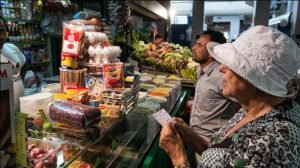
The Nuovo Mercato Esquilino, on Via Filippo Turati, replaced in 2001 the old open-air market that occupied the square. It's the place where you understand the Esquiline in 20 minutes: stalls of Asian and African produce, spices, fish, halal butchers, and a neighborhood clientele doing real shopping. It's not a market set up for visitors, and you can feel the difference. The full picture of Roman markets is on the page on Rome's markets.
What Is Within Short Range
From the staircase of Sant'Eusebio you can reach on foot in less than a quarter of an hour Santa Maria Maggiore, the Auditorium of Maecenas, Santa Bibiana toward the station, and the Palazzo Merulana on Via Merulana. In 20 minutes you reach the Basilica of San Giovanni in Laterano and the Holy Stairs, in 25 Holy Cross in Jerusalem and the Aurelian Walls at Porta Maggiore. Westward you go down into the Monti district, and from there to the Colosseum and the Domus Aurea.
Summer in the Square
In the warm months the gardens host the arena of Notti di Cinema a Piazza Vittorio, one of the longest-running open-air festivals in the city. The church stays there, with the portico lit up behind the spectators, and nobody pays it any attention. If you want the full picture of Roman arenas, you'll find it on the page on Estate Romana.
Eating in the Area: On the Esquiline the Rules Are Reversed
Around Piazza Vittorio the yardstick that works in the historic center has to be recalibrated, and anyone who applies it without thinking discards the best places in the neighborhood. For 30 years the Esquiline has been the most multicultural district of Rome: Chinese, Bangladeshi, Indian, Pakistani, Eritrean, Egyptian, Korean and South American kitchens coexist with surviving neighborhood trattorie and a few historic signs. Restaurants here don't live off occasional passersby, they live off the people who live in the surrounding streets.
The Signs of Traps, and Where They Hold
In the monumental center the signs are well known and work almost every time. The menu with photographs of the dishes, made for people who don't read the language and don't know what they're ordering. The lady rolling out fresh pasta in the window or right on the sidewalk, which is a staged lure built for people walking by and says nothing about what comes out of the kitchen. The person at the entrance inviting you to sit, because they work the flow and not the customer who comes back. The place open nonstop from morning to late at night, with no break between services, that is, without a kitchen crew working defined shifts.
To these you can add the places set up in front of the most photographed monuments, where the price adapts to the customer in front of them: items with no price on the menu, cover charges and surcharges that appear only on the bill, different price lists between the indoor room and the tables outside. They are signs, not verdicts. When three pile up in the same place the picture is clear and you move on.
Why the Photo on the Menu Means Something Different Here
On the Esquiline the photo of the dish can be real communication. In a Bangladeshi trattoria or a northern Chinese kitchen run by a family, with a mixed clientele speaking three different languages at the tables and dishes a Roman has never seen, the image helps people understand what they're ordering. It's not a net for distracted tourists: it's the only practical way to explain a dish to someone who doesn't know its name. The same goes for bilingual signs and translated menus, which in the center are an alarm and here are neighborhood normality.
The criterion to use on the Esquiline is a different one. What counts is the regular clientele, the turnover at the tables during mealtimes, prices in line with the neighborhood and not with the center, and the consistency between what is on the menu and what you see going by. A place with 12 different cuisines on the same menu is suspect anywhere. A place that makes eight dishes and makes them every day holds up, whatever language the sign is in.
Chains with Repeated Signs
In the center of Rome, over the last 15 years, a kind of restaurant with a repeated sign has grown, with the same menu in several points of the city, the same furnishings, the line with a number ticket at the door and staff who speak English before Italian. It works as a tourist attraction in every respect, with its own hours and its own queues, and Romans don't set foot in it. There's no snobbery in saying so: that model sells a product identical to itself at every location, which is the opposite of what you look for close to home. Around Piazza Vittorio those signs are rare, and that's one of the reasons the neighborhood stays interesting.
The Criterion, Just One
Look at who is sitting and in what language they order. In the historic center this criterion rules out nine places out of 10 in two seconds. On the Esquiline it rules out very few, because the tables are almost always filled with people from the neighborhood, and that's the practical difference between the two areas. If at 12:30 in a trattoria around Via Principe Eugenio there are workers, shopkeepers and families ordering without opening the menu, the place stands on its own.
If you want a reference that has already been filtered, you can consult Daniele Dezi's personal list on Google Maps, a curated and unsponsored collection. The full reasoning on how to choose in Rome is on the page on where to eat in Rome, while for places with a long history behind them there's the one on historic cafes and shops of Rome.
Frequently Asked Questions About Sant'Eusebio all'Esquilino
How much does it cost to enter Sant'Eusebio all'Esquilino?
Entrance to Sant'Eusebio all'Esquilino is free, as in all Roman churches open for worship, and there is no ticket office. For the two guided tours that include the choir, underground levels, medieval apse, bell tower and organ, no official fee is published: it is agreed on by phone with the parish. A price found online almost always belongs to a third-party operator.
What are the opening hours of Sant'Eusebio all'Esquilino?
Sant'Eusebio all'Esquilino has no declared tourist hours and opens according to the Masses. The city's tourism portal gives weekday Masses at 07:30 and 19:00, Saturday-evening Masses at 19:00, and holiday Masses at 10:30 and 19:00. The information was checked in September 2026 and should be rechecked before you leave, because in August and during vacation periods the windows change.
Can you see the wooden choir of Sant'Eusebio?
The wooden choir of Sant'Eusebio is behind the high altar and is not part of the free visit. It belongs to the first of the two guided tours organized by the parish, together with the church and the underground levels, and has to be requested in advance by calling 06 4466170. Anyone who shows up at the door without an arrangement sees only the nave.
Who painted the fresco on the ceiling of Sant'Eusebio?
The fresco on the vault of the central nave is the Glory of Sant'Eusebio by Anton Raphael Mengs. The General Catalogue of Cultural Heritage records it with the date 1757, while the parish and other entries give the period between 1757 and 1759, that is, the length of the remodeling campaign. The sources agree, however, in presenting it as the painter's first public work in Rome.
How do you get to Sant'Eusebio by public transport?
To get to Sant'Eusebio the simplest way is Metro Line A to Vittorio Emanuele, with a three-minute walk from the exit to the staircase. Trams 5 and 14 from Termini and from the eastern quadrant also stop at Piazza Vittorio. The bus lines on the square change often because of detours and roadworks: check the same day on the transit company's app.
Why is the blessing of the animals held at Sant'Eusebio?
The blessing of the animals on January 17 was originally held at Sant'Antonio Abate all'Esquilino, on Via Carlo Alberto. The pastor of Sant'Eusebio explained to the diocesan press that the rite moved here in the early 20th century, most likely for reasons of traffic and public order, since Piazza Vittorio offers space and Via Carlo Alberto does not.
Is Sant'Eusebio an ancient church or an 18th-century one?
Sant'Eusebio is a title documented in the Roman synod of 499, rebuilt by Pope Gregory IX in 1238 and remade twice in the 18th century. From the medieval phase the bell tower with its triple-light windows and part of the apse remain, underneath are Roman remains of the 2nd century, and what you see on entering is the mid-18th-century interior. These are four buildings stacked in the same shell.
Can you visit the monastery cloister?
The cloister of the monastery of Sant'Eusebio cannot be visited. Institutional entries attribute it to Domenico Fontana and note that the rooms are now used by the police forces, as a consequence of the suppression of the religious orders in the 19th and 20th centuries. The parish has no authority to open it, so there is no point in asking.
How much time do you need to visit Sant'Eusebio?
For the nave of Sant'Eusebio alone 20 minutes is enough, 30 if you look at Mengs's vault calmly from different points. With the complete guided tour, which includes the choir and underground levels, you need an hour and a half. Included in a walk around the Esquiline with Santa Maria Maggiore and Santa Prassede, it comfortably fills a morning.
Who Wrote This Page
This page comes from the work of the editorial team at Tour Leader Pro, the Roman organization that designs and coordinates visits, itineraries and cultural events in Rome and Lazio. Hours, contacts and access conditions are checked as of the publication date against the official sources cited in the text, and they change more often than you'd imagine: a check before you leave the house avoids wasted trips. Reports of information that is no longer correct are welcome.
Building a Roman itinerary means making things fit together: churches that open only for Masses, guided visits that depend on a volunteer's availability, historic spaces passed to the State and closed to the public, and distances that look like nothing on paper and become something else at 30 degrees. If you organize for yourself or for a group, you'll find planning tools, operating sheets and working materials at Tour Leader Pro, made for those who accompany and for those who travel on their own.
For the wider picture, that is, rail connections, airports, rentals and destinations in Lazio outside the center of Rome, from the lakes to the Castelli to the coast, a useful resource is Italy Planner. If you're arriving by air you'll also find the practical detail on our page on connections from Rome's airports, and if you need to choose where to stay, on the one about where to stay in Rome.
Contact Information
Nearby
 Porta Alchemica of Piazza Vittorio100 m
- Esquiline Hill200 m
- Piazza Vittorio Emanuele II200 m
- Casa dell’Architettura200 m
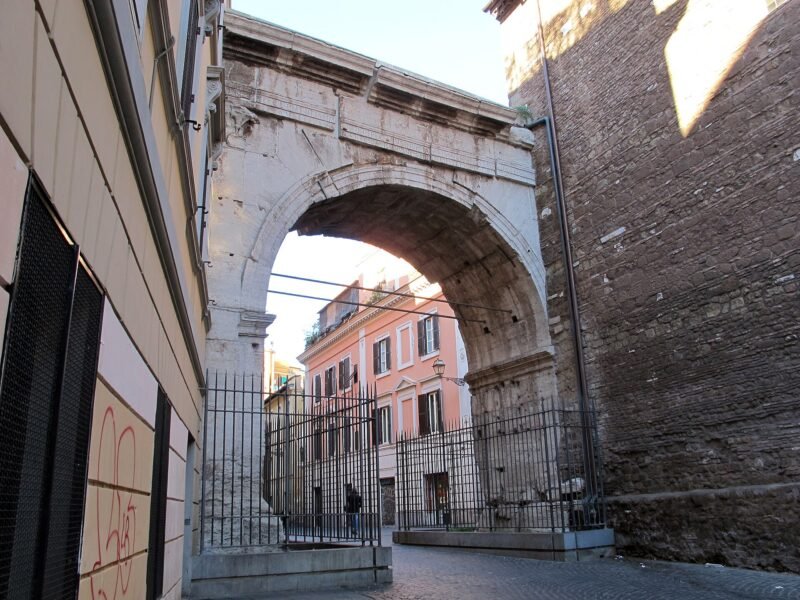
- Arch of Gallienus200 m
- Nuovo Mercato Esquilino300 m

Upcoming events nearby
- Arisa at Teatro Brancaccio in Rome, Live Tour 2026100 m
- Gran Ballo Viennese di Roma (18th edition) at Acquario Romano: Saturday, November 7, 2026200 m
- The Prince of Egypt the Musical at Teatro Brancaccio, October 29 to November 15, 2026400 m
- Mrs Doubtfire the Musical at Teatro Brancaccio, March 31 to April 18, 2027400 m