St. Paul’s Within the Walls
In short. St. Paul's Within the Walls is the first non-Catholic church built inside the Walls of Rome after 1870, and it stands at Via Nazionale 16a, at the corner with Via Napoli.
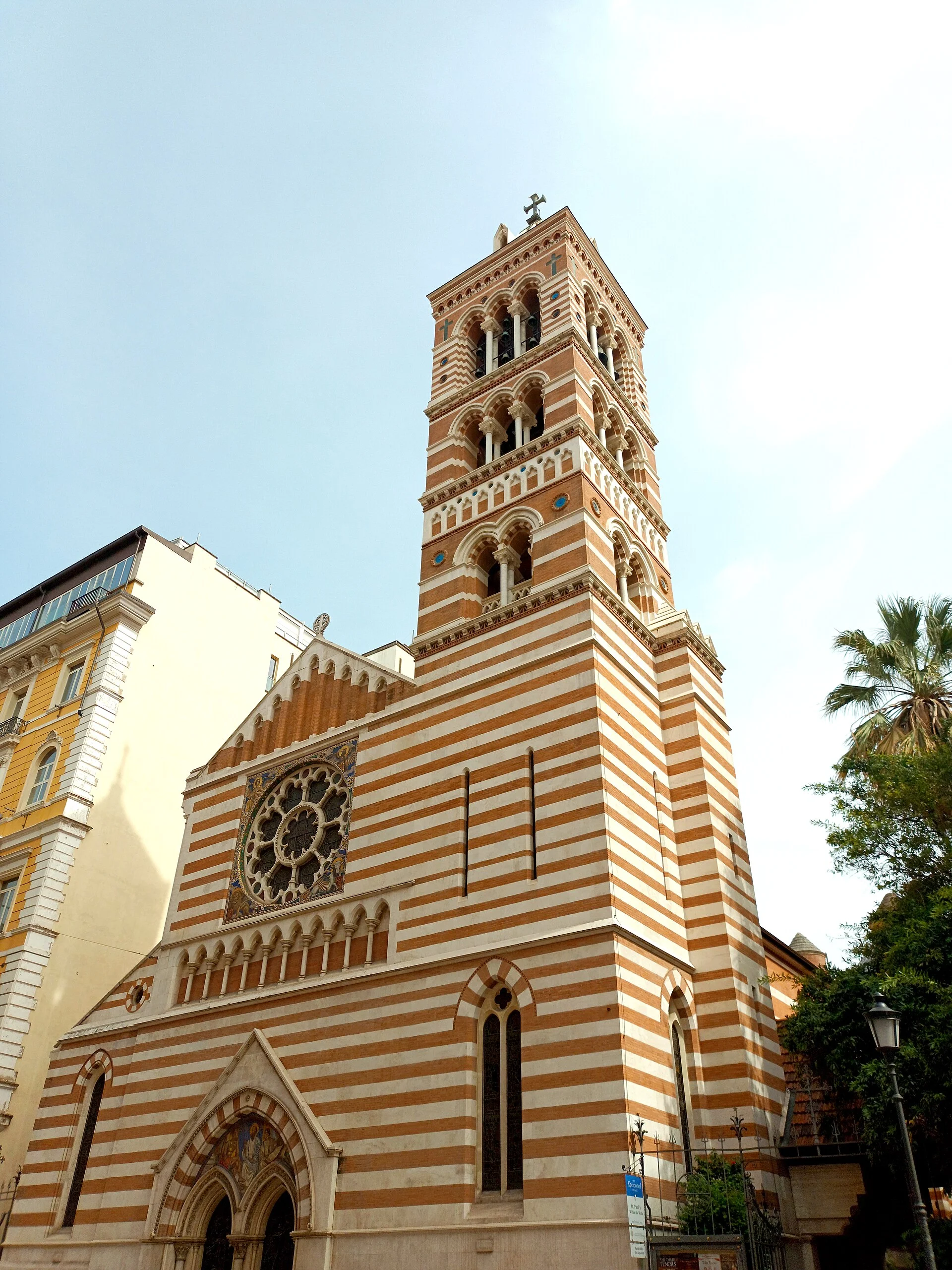
St. Paul's Within the Walls is the first non-Catholic church built inside the Walls of Rome after 1870, and it stands at Via Nazionale 16a, at the corner with Via Napoli. It is the American Episcopal church of Rome, open for worship since 1876, and it keeps in the apse and the chancel the mosaics designed by Edward Burne-Jones. From the outside, among the Umbertine buildings, it looks like a piece of England that fell onto the wrong street.
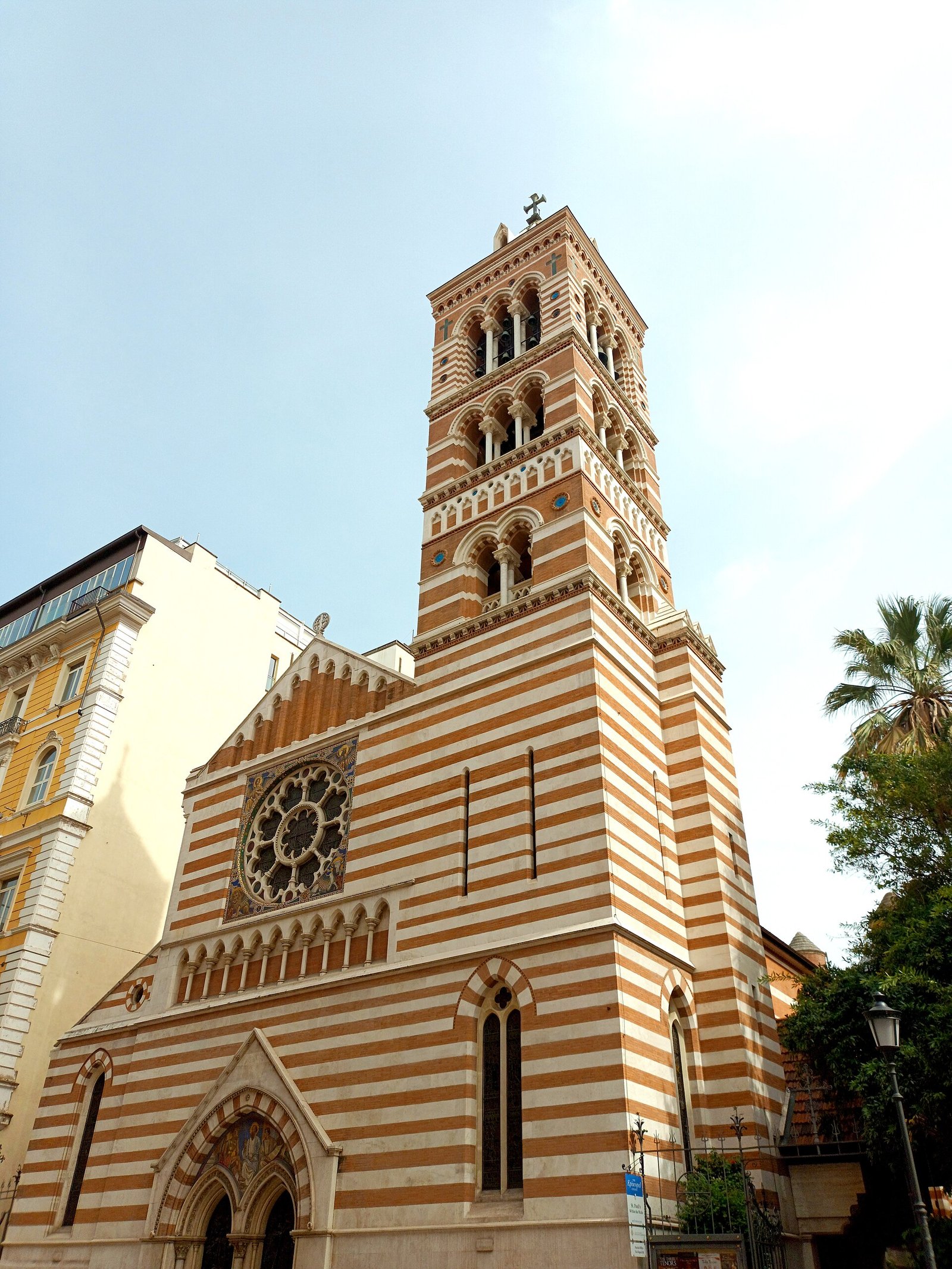
The band of red and white stripes on the facade, brick and travertine, is the first sign that the Roman rule doesn't apply here. The portal faces Via Nazionale, and the door people usually use faces Via Napoli. Inside, as soon as your eyes adjust, the back of the apse lights up with gold. Those mosaics are the reason the 10-minute detour from the station is worth it.
This church works as a hinge: it closes the chapter on papal Rome and opens the one on the Rome of other denominations, the one that appears suddenly in 1870 and that almost no itinerary tells. If you come from Piazza della Repubblica or from the Baths of Diocletian, you walk past it without noticing.
Where St. Paul's Within the Walls is and how to get there
The address of the church is Via Nazionale 16a, 00184 Rome, with the parish office at Via Napoli 58. It stands on the northern side of Via Nazionale, a few dozen meters from where it opens onto Piazza della Repubblica, so in the upper part of the street and not the one toward the Quirinale. The low street number fools anyone who looks at the bottom end, toward Largo Magnanapoli.
The most convenient subway is line A, Repubblica stop, exit onto Piazza della Repubblica: from there you take Via Nazionale and the church comes up on the right after two or three minutes on foot. Termini, the terminus of metro lines A and B, is about 10 minutes' walk via Via Torino. Anyone getting off at Termini crosses the whole Piazza dei Cinquecento anyway, which is not a pleasant walk with suitcases.
The buses that run along Via Nazionale and stop at Nazionale/Torino, the stop closest to the church, are lines 40, 60, 64, 70 and H. Lines 64, 70 and H continue along the street with the stops Nazionale/Quattro Fontane, Nazionale/Palazzo Esposizioni and Nazionale/Quirinale, while 40 and 60 on Via Nazionale stop only at Torino and at Quirinale. Route data checked on September 28, 2026.
The 64 and the 40 are the two most pickpocketed buses in Rome, because they run Termini, Vatican and back. It's better to walk from Repubblica and spare yourself the hassle. If you have luggage or mobility difficulties, the taxi from Termini costs little because the route is short, but with the traffic on Via Nazionale you risk taking longer than on foot.
The street in that stretch slopes slightly uphill toward the Quirinale and the sidewalk in front of the church is narrow. In 2020 and 2021 the cobblestones of Via Nazionale were replaced with asphalt, so at least the surface is no longer a problem for wheels. The raised churchyard has a few steps, and that remains the real obstacle for anyone in a wheelchair.
Hours, entry and reservations: how things really stand
For this church, a tourist visiting schedule published in plain view does not exist. The tourism portal of Roma Capitale refers to the parish contacts without giving any opening bands, and the community runs the building as an active place of worship, not as a museum with a ticket office. Anyone planning a visit must therefore think in terms of sure windows, not guidebook hours.
The sure windows are the services. On Sunday at 10:30 there is a sung Eucharist in English and Italian, with choir and organ. On Sunday at 12:00 the Eucharist in Spanish, accompanied on the piano. On Wednesday at 19:00 an evening prayer liturgy followed by a community dinner. Times recorded on September 28, 2026 from the listings of the Convocation of Episcopal Churches in Europe.
An entrance ticket is not published by any official source. Entering during a service means taking part in a religious function, with the rules that follow: you stay seated, you don't wander the aisles with a camera, you leave when it ends. Anyone who only wants to see the mosaics has to call first.
The parish phone is 06 4883339 and the email address is office@stpaulsrome.it. An institutional booking channel, of the kind that exists for municipal monuments or for the catacombs, is not available here: the church belongs to a foreign religious community and no public body manages access to it. Anyone who promises you an official reservation is selling a service of their own, not a service of the church.
For first-hand information the reference is the community's website, stpaulsrome.it, which publishes the calendar of services and of concerts. The Roma Capitale portal, Turismo Roma, keeps the listing with address and phone. Of the two, the first is more up to date and the second more stable.
Practical rule: for a group, the only serious way is to write two or three weeks ahead, explain how many people you are and ask for a time slot. The community is small and the church hosts a refugee center every day, so the answer depends on what is happening in the building that day. An improvised visit by 20 people doesn't work.
A curiosity about St. Paul's Within the Walls
In the lowest mosaic of the apse, the one with the procession of saints, three faces are portraits of real 19th-century people. Saint Andrew has the face of Abraham Lincoln, Saint James that of Giuseppe Garibaldi, Saint Patrick that of General Ulysses S. Grant. The news is not an anecdote: it is reported by the official listing on the tourism portal of Roma Capitale.
Garibaldi sanctified in mosaic, inside Rome, a few years after the breach of Porta Pia, is a political gesture before it is an artistic one. The American community building its church here was saying, with gold and Murano glass, which side it was on in the Roman question. In 1907, when that register was installed, the message was still readable by everyone.
Some sources extend the list of portraits to Robert Nevin, the rector who commissioned the work, to the financier Junius Spencer Morgan, to Burne-Jones himself and his wife Georgiana. These attributions circulate in a single journalistic source and do not appear in the institutional listings, so I report them as rumors, not facts. The three main ones, however, hold up.
The trick to seeing them is distance. From mid-nave the faces are tiny and the gold of the background dazzles. You have to get closer to the chancel and stand slightly to the side, so that the light doesn't bounce straight into your eyes. With a modest telephoto lens they are perfectly distinguishable, and Garibaldi's beard is unmistakable.
Why it is the first non-Catholic church inside the Walls
Until 1870 the Papal State did not allow non-Catholic worship inside the city wall. The foreign communities celebrated outside the gates, in rented premises, without bell towers and without external signs of a church: the principle was that other people's religion could exist in Rome only if invisible. The Non-Catholic Cemetery in Testaccio comes from the same logic of separation.
With the breach of September 20, 1870 and the arrival of Italy, the ban falls. The American Episcopal community, led by the rector Robert Jenkins Nevin, buys a lot on the new Via Nazionale, the street the Kingdom was opening to connect the station to the center. The first stone is laid on January 25, 1873, the feast of the Conversion of Saint Paul.
The choice of street says it all. Via Nazionale was the symbolic building site of Rome as capital, with the Palazzo delle Esposizioni, the Teatro dell'Opera and the banks that were arriving soon after. Putting a Protestant church there meant claiming a place in the new city, not in a secluded corner.
The church goes into service in 1876 and the complex is completed in 1880. The English Anglican community, which had been in Rome even earlier, builds its church of All Saints on Via del Babuino only later: first stone in 1882, works finished in 1887. The Americans came first, the English second, with the same architect.
The primacy has to be stated precisely, because it is often told badly. It is not the first non-Catholic community in Rome, which had existed for centuries. It is the first non-Catholic place of worship built from scratch inside the Aurelian Walls, with the declared appearance of a church. On this the institutional sources agree.
To grasp the significance, it helps to look at the geography. The Aurelian Walls marked a legal boundary as well as a physical one, and for three centuries had kept other people's temples out. Within 20 years of 1870, inside that perimeter arise this church, the Waldensian church, the Methodist temple and then the Synagogue.
The mosaics of Edward Burne-Jones, register by register
The mosaics are four large fields, executed over 26 years, from cartoons by the Pre-Raphaelite painter Edward Burne-Jones. The physical execution is by the Venice and Murano Glass and Mosaic Company, the firm linked to the name of Salviati, which set the tesserae from cartoons shipped from England. The Roma Capitale portal notes that the Italian government declared the mosaics a national monument.
Christ enthroned in the heavenly Jerusalem
The apse semi-dome is the first piece made, unveiled at Christmas 1885. At the center, Christ enthroned within the heavenly Jerusalem, flanked by five archangels: Michael, Uriel, Gabriel, Chamuel and Zophiel. The names of the last two come from angelological traditions outside the Roman canon, and it is one of the details that betray the Protestant and visionary matrix of the project.
The Annunciation and the Tree of Life
The two arches of the chancel were unveiled in November 1894. The Annunciation is set in a rocky desert, not in the usual Florentine room, and this choice throws anyone who arrives with an eye used to Italian painting. Opposite, the Tree of Life shows Christ in a crucifixion pose on a green tree laden with fruit, with Adam and Eve at the sides.
The earthly Paradise, or Church Militant
The lower band of the apse wall is the last, placed in December 1907. Burne-Jones had died in 1898 and the work was finished by his assistant Thomas Rooke. This is where the faces of contemporaries lent to the saints appear, and the artist's catalogue raisonne confirms it without giving the names, which come instead from the Roman listings.
The commission dates from 1881, the year the architect of the church died. Rector Nevin goes to England to confirm and widen the commission, and the funding comes from the banker Junius Spencer Morgan. The chronology and the steps are reconstructed in the entry of the Burne-Jones catalogue raisonne, which is the driest and most reliable source on this point.
The stained glass, however, is not his. The nave windows were designed by the Clayton and Bell studio and tell episodes from the life of Saint Paul. They are good, they are Victorian, and they have the bad luck of being in the same building as four mosaics that eat them alive in a second.
An honest comparison: anyone arriving here after seeing the mosaics of Santa Prassede or Santa Pudenziana finds a different material. There the mosaic is Byzantine and early Christian liturgy. Here it is 19th-century painting translated into glass, with colors chosen at a table between London and Venice. It is not ancient technique in disguise, it is modern art of its time.
Something nobody tells you about St. Paul's Within the Walls
Edward Burne-Jones never came to follow the work on site. He designed everything in London and sent his assistant Thomas Rooke to Italy to supervise the execution. The artist's catalogue raisonne says so explicitly. The most celebrated 19th-century mosaic cycle in Rome is therefore the work of an author who did not personally oversee its installation.
The consequence is visible to the naked eye, if you know what to look for. The figures are conceived for a flat surface, like a painting, and end up on a curved apse. In some places the proportions stretch and the gestures lose weight. A medieval mosaicist would have corrected the cartoons on the spot, here the correction didn't happen.
The second fact nobody tells concerns the basement floor. Under the church, the Joel Nafuma Refugee Center has worked since 1982, a day center for asylum seekers and refugees that assists 200 or 250 people every day, with meals, language courses, legal assistance and workshops. It is the most intense activity that takes place in this building, and it appears in no tourist guide.
Knowing about the center changes how you ask for a visit. If the reply to an email is lukewarm or slow, it isn't rudeness. It's a small community with a social service running at full capacity in its own house. If you come as a group on a weekday morning, you risk landing in the middle of the activities.
The architecture of George Edmund Street and the striped facade
The design is by the English architect George Edmund Street, 1824-1881, one of the leading figures of Victorian Gothic Revival. Street worked in Rome twice: here and, later, for the Anglican church of All Saints on Via del Babuino. The language is the same, but here the hand is freer and the result more Roman.
The facade plays on the alternation of bands of red brick and bands of white travertine, a layout that the Roma Capitale portal defines as mixed Romanesque-Gothic. It is a motif that doesn't belong to local tradition in Rome and comes from central and northern Italy, filtered through the eye of an Englishman. On Umbertine Via Nazionale, all stucco and cornices, the effect is one of sharp contrast.
The interior plan is a single nave with a raised chancel, conceived for an Anglican liturgy that puts the word and the song at the center. The choir and the organ carry real weight in the Sunday services, and the space is calibrated for that. Anyone who enters looking for side chapels, reliquaries and Baroque altars won't find them.
The bell tower and the parish complex on Via Napoli complete the block. The main front on Via Nazionale, however, is the one that matters for understanding the operation: a foreign church that shows itself, with its form and color, on a brand-new street of the Italian capital. No camouflage.
A detail for those who look at architecture: compare this front with that of San Vitale, a little further along the same street, and with the 17th-century facades of San Carlo alle Quattro Fontane a short step away. Three centuries and three different ideas of what a facade should do on a Roman street. The walk takes under 10 minutes.
My advice for visiting St. Paul's Within the Walls
Go on Sunday morning and stay for the sung Eucharist at 10:30. It is the surest window in which the building is open, lit and in operation, and for an hour you sit in front of the mosaics with the organ playing. You enter as you enter a church during a service: in silence, without wandering, sitting at the back.
If you don't feel like taking part in someone else's liturgy, you have two alternatives. The first is the Mass in Spanish at 12:00, shorter and more intimate. The second is to write to the parish and ask for a weekday time slot, making clear that you are a group and how many people you are.
The worst moment is early afternoon on a summer weekday. The light comes in low from the side windows, the mosaics go into backlight and the gold becomes an indistinct blotch. At those hours, on top of that, the building is often taken up by the refugee center's activities.
Allow a good 40 minutes. 10 for the facade and for understanding the relationship with the street, 20 in front of the apse, 10 for the nave windows. If you want to look for the three famous faces in the lower register, add another 10, because with the naked eye they are not found on the first try.
A tip that doesn't apply only here: bring opera glasses. They cost little, fit in a pocket and in a church with high mosaics they change the visit completely. It's worth packing a couple in the backpack, to pass around in turn in front of the apse.
The contrarian position: go to a tourist concert
Among colleagues people turn up their noses at the concerts held in this church. The program is what it is: Vivaldi's Four Seasons and three-tenors programs, repeated in a barrage from September to December, an audience almost all foreign, tickets sold by the mainstream circuits. The hall declares about 400 seats.
Here the position is the opposite of the usual one. For most visitors that concert is the most realistic way to be inside St. Paul's Within the Walls for an hour and a half, seated, with the lights on the apse, without depending on a visiting schedule that nobody publishes. The musical program is a pretext, the ticket is in effect an entrance ticket.
The reasoning holds on condition that you know what you are buying. You are not buying a memorable evening of music, you are buying time and light inside a building that is otherwise hard to see at leisure. Anyone seeking a serious musical performance goes elsewhere, where the hall is made for that.
The official concert calendar is published on the community's website, stpaulsrome.it, and it's best to check there before buying from a reseller. Dates and prices change, and resale circuits add fees. Checked on September 28, 2026.
A necessary clarification: during the concert you don't walk around the church and you don't photograph at will. You see the apse from your seat, lit, for 90 minutes. For anyone who wants a close-up of the faces in the lower register, a daytime visit remains necessary.
Another well-known fact, yet rarely cited
Via Nazionale is a street born after 1870 to connect the station to the center, and it crosses two different rioni, Castro Pretorio and Monti. The church is on the side that the sources place in Castro Pretorio, not in Monti. It sounds pedantic, but it explains why it often doesn't appear in the guides to the Monti district. The boundary runs down the middle of the roadway.
The street originally reached all the way to Piazza Venezia. In 1916-1918 the final stretches were detached and renamed Via Cesare Battisti and Via IV Novembre, and since then Via Nazionale ends at Largo Magnanapoli, below Santi Domenico e Sisto. Anyone looking for the street number by counting from the piazza gets lost.
From 1880 to 1929 a tram ran down the middle of Via Nazionale. The historic photo with the tracks and the poles often circulates without a caption, and it is sometimes attributed to other Roman streets. If you look at the striped facade in the background of certain period images, that is our church.
The last little-cited fact concerns the bank. Palazzo Koch, seat of the Bank of Italy, dates from 1892 and stands on the same street a few hundred meters away. Within 20 years this street lined up a Protestant church, an exhibition hall, a theater and the central bank: a manifesto of what Italian Rome wanted to be.
The right photo to take at St. Paul's Within the Walls
The photo that works is from the opposite sidewalk of Via Nazionale, shifted slightly toward Piazza della Repubblica. From there you get the facade of red and white bands with a piece of Umbertine building beside it, and the contrast between the two languages reads in a single frame. You need a moderate wide-angle lens, because the street is narrow for the height of the buildings.
The right time is early morning. Via Nazionale runs roughly from northwest to southeast and the facade catches raking light early, when traffic is still light and the delivery vans don't cover the front. From 11 on, double-parked cars ruin every shot.
Inside there is only one serious photo: the front apse, from the central nave, with the upper and lower registers in the same shot. You need to rest the camera on a chair back because the light is low and flash is forbidden as well as useless. A long handheld exposure doesn't hold up here.
The detail to take home is Garibaldi's face in Saint James. With a 200-millimeter telephoto lens it isolates well, and the beard makes it recognizable even to those who don't know the story. Ask first if you can photograph: during services the answer is no.
A photo I always see people take and that never works is the selfie in front of the portal on Via Nazionale. The portal is in shadow almost all day, the sidewalk is narrow and buses go by behind you. If you want a person in the frame, put them on Via Napoli side, where there is more room to breathe.
Some important events that happened here in history
On January 25, 1873 the first stone was laid, on the feast of the Conversion of Saint Paul. The date is not random: the community tied its Roman birth to the saint who had come to Rome from outside and had brought a message from outside. Three years later, in 1876, the building went into service.
In 1880 the works on the complex were considered finished. In 1881 the architect Street died and the community decided to go ahead with the mosaic decoration: Rector Nevin crossed the Channel to confirm and enlarge the commission to Burne-Jones, with the financial support of Junius Spencer Morgan. The mosaic building site would last 26 years.
At Christmas 1885 the apse semi-dome with Christ enthroned was unveiled. In November 1894 the two arches with the Annunciation and the Tree of Life were revealed. In December 1907, nine years after the death of Burne-Jones, the last register, completed by Thomas Rooke, was put in place.
In 1982 the refugee center named after Joel Nafuma was born in the basement. The date places the initiative well before the great migration waves that made news in Italy, and explains why the community has field experience that few others in the center can claim. The service is still active every day.
An event that never happened should be mentioned all the same, because it circulates as if it were true: no institutional source documents papal consecrations, official Vatican visits or Italian state ceremonies in this church. It is a place of worship of a foreign community, and its history is made of ordinary liturgies and social work. The legends about supposed secret ceremonies have no basis.
Who has passed through St. Paul's Within the Walls
Robert Jenkins Nevin is the name that holds the whole story together. Rector of the American Episcopal community, he was the one who wanted the building on Via Nazionale, who managed its construction and then went to England for the mosaic commission. Without him this church would not exist in the form it has.
George Edmund Street passed through as a designer, bringing English Gothic Revival to Rome. Thomas Rooke, assistant to Burne-Jones, instead really worked here and for a long time, because he was the one who followed the installation and completed the last register after the master's death. The big name signs the cartoons, the collaborator does the job.
Junius Spencer Morgan, American banker, put up the money from 1881. His is the kind of patronage that in those years in Rome changes the face of whole blocks and that usually stays without a plaque. In the church his contribution is measured in square meters of gilded glass.
Among those present in mosaic, though not in flesh and blood, are Lincoln, Garibaldi and Grant. The case of Garibaldi is the most curious, because his Roman story is told in detail at the Museo della Repubblica Romana: being portrayed as a saint in a Protestant church a few hundred meters from the Quirinale is an ending nobody would have predicted in 1849.
Also passing through here, every day, is a population that doesn't end up in the guides: the 200-plus people who attend the refugee center on the basement floor. They are the most regular users of the building. Any account of the church that omits them is incomplete.
Non-Catholic Rome: the itinerary that starts here
St. Paul's Within the Walls is the right gateway to the theme, because it is the first built act of freedom of worship in Rome. From here the itinerary opens in three directions: the Protestant churches born after 1870, the Roman Jewish world which is instead very ancient, and the Rome of the communities that arrived in the 20th century. Three different stories that rarely cross.
The Protestant branch is done on foot in half a day. From Via Nazionale you go down toward the center for the Waldensian church and the Methodist temple, continue to All Saints on Via del Babuino, and finish at the Non-Catholic Cemetery in Testaccio, where the Protestants who died in Rome rest from when there was still no church inside the Walls.
The Jewish branch has a completely different chronology. The community of Rome is the oldest in the European diaspora and its path reads between the Ghetto, the Synagogue, the Jewish Museum and, for the archaeological part, the Jewish catacombs of Vigna Randanini on the Appian Way. Here 1870 does not mark a birth but the end of a segregation.
The third branch is 20th-century and peripheral. The Great Mosque, inaugurated in the 1990s in Parioli, is the sign of a Rome that is still changing, and it lies outside any walking route from the center. Anyone who wants to treat the theme seriously must allow for public transport and an hour of travel.
The narrative glue of the whole itinerary is Porta Pia. The breach of 1870 is the event that makes possible this church, the monumental synagogue and everything else. With a full day, it's best to start there, and Via Nazionale becomes the second stop.
What to see nearby in half a day
Going up toward Piazza della Repubblica you reach in five minutes the basilica of Santa Maria degli Angeli, the basilica carved by Michelangelo out of the frigidarium of the imperial baths. Next to it, the Octagonal Hall and the section of the Museo Nazionale Romano complete the picture. This is the densest and closest block.
Going down Via Nazionale toward the Quirinale you meet the Palazzo delle Esposizioni, the basilica of San Vitale with its portico, and then the intersection of the Quattro Fontane. From there you climb to San Carlo alle Quattro Fontane and to Palazzo Barberini in a few minutes' walk.
On the hill next door are the Quirinale Palace, the Quirinale obelisk and the Scuderie, which host the big exhibitions. A little below, the church of Sant'Andrea al Quirinale and that of San Silvestro al Quirinale are worth the stop for anyone who loves the 17th century.
At the end of the street, at Largo Magnanapoli, open the Trajan's Markets and the Forum of Trajan, with the Imperial Forums Museum just beyond. From there you go down toward the Forums and the Galleria Sciarra in about 10 minutes.
Toward the Esquiline, in the opposite direction, you reach Santa Maria Maggiore, Santa Prassede and Santa Pudenziana in a quarter of an hour on foot. If you have time, add San Pietro in Vincoli and the Nuovo Mercato Esquilino, which is the best way to understand how people really eat in that quadrant.
For those staying in the area there are also the Biblioteca Nazionale Centrale, the Teatro Brancaccio and the church of Santa Maria della Vittoria, all reachable on foot. The district is less decorative than the historic center and that makes it more practical: you walk without crowds and the sidewalks are wide.
An extension I recommend to anyone with the full day: from Porta Pia continue to the basilica of Santi Silvestro e Martino ai Monti or go down to Palazzo Massimo alle Terme. They are two opposite directions, and the choice depends on how much the 19th-century Rome interests you compared with the Baroque one.
Eating in the area without getting fleeced
The quadrant between Via Nazionale, Repubblica and Termini is one of the trickiest in Rome for the table. Every day tens of thousands of people pass through who never come back, and a business that lives on one-time customers has no reason to care about its cooking. The average bill here is high for the quality, and that holds along the whole strip beside the street.
The first warning sign is the photographs of the dishes on the displayed menu. A photographed dish is for someone who doesn't read the language, and whoever aims at that audience has already decided the customer is passing through. Same goes for menus translated into six or seven languages with little flags.
The woman rolling out pasta dough behind the glass, or even at a small table on the sidewalk, is theater. It is a staging designed to stop the passerby with a phone in hand, and it says absolutely nothing about what comes out of the kitchen. In Roman homes fresh pasta is made inside, not in a shop window.
The person on the doorstep inviting you in is the clearest signal of all. A place that has to stop people in the street does so because it has no regular customers, and it has none for a reason. Steer clear, even when the invitation is polite and the menu seems honest.
Be wary of non-stop hours from morning to late at night. Roman cooking has two services and stops in between, because the cook rests and prepares: a place that stays open without interruption almost always works with semi-finished products and microwave ovens. The schedule is a technical clue, not an opinion.
In the places in front of the most photographed monuments the price adjusts to the customer. The symptom shows in items with no price on the menu, in different price lists between the indoor room and the outside tables, in cover and service charges that appear only at the end. Ask for the itemized bill and ask for it before ordering, not after.
The chains with repeated signs that you see in the center work as tourist attractions, exactly like a monument with an admission fee. There is nothing wrong with that and I'm not judging them: whoever goes there knows what they are buying and often is buying the experience, not the meal. Romans don't go, though, and that should be enough to guide anyone looking for just any meal of the day.
There is only one criterion and it almost never fails: look at who is sitting and in what language they order. If the tables are occupied by people who speak Italian and look like they work in the neighborhood, the place holds up. If they are all foreigners with backpacks, the place lives off passing trade.
In this quadrant the practical advice is to move away from the main street. Two blocks toward the Esquiline or toward the Viminale are enough to completely change the ratio between price and plate, because there the clientele is made of offices and residents. The distance needed is five minutes on foot, no more.
For anyone who wants to start from an already filtered list, Daniele keeps a public collection of the places where he really eats in Rome and Lazio: the list on Google Maps. It is a personal list, updated over time, with no swaps and no commercial deals.
Frequently asked questions about St. Paul's Within the Walls
Where exactly is St. Paul's Within the Walls?
The church is at Via Nazionale 16a, 00184 Rome, with the parish office at Via Napoli 58. It stands in the upper part of Via Nazionale, on the northern side, two or three minutes on foot from Piazza della Repubblica. The low street number confuses anyone who looks for it toward Largo Magnanapoli, which is the opposite end of the street.
Can you walk into St. Paul's Within the Walls freely?
A tourist visiting schedule is not published by any official source, so free and continuous entry is not guaranteed. The sure windows are the Sunday services at 10:30 and 12:00 and the Wednesday evening liturgy at 19:00. For a visit at other times you need prior contact with the parish, at 06 4883339 or at office@stpaulsrome.it.
How much does a ticket for St. Paul's Within the Walls cost?
An entrance ticket is not published by any official source. The church is an active place of worship of a foreign religious community and has no ticket office or institutional booking channel, unlike municipal monuments or the catacombs. The only sums you spend to get in are the tickets for the evening concerts, sold by the show organizers.
Who made the mosaics of St. Paul's Within the Walls?
The cartoons are by the English Pre-Raphaelite painter Edward Burne-Jones, who died in 1898. The physical execution is by the Venice and Murano Glass and Mosaic Company, the Venetian firm linked to the name of Salviati. The last of the four mosaics was completed in 1907 by Thomas Rooke, Burne-Jones's assistant, after the master's death.
Is it true that the mosaics contain portraits of real people?
Yes, and the news is confirmed by the listing on the tourism portal of Roma Capitale. In the lower register of the apse Saint Andrew has the face of Abraham Lincoln, Saint James that of Giuseppe Garibaldi and Saint Patrick that of General Ulysses S. Grant. Other portraits circulate in single journalistic sources and should be taken with caution.
How do you get there by public transport?
The nearest subway stop is Repubblica, on line A, two or three minutes on foot along Via Nazionale. Buses 40, 60, 64, 70 and H stop at Nazionale/Torino, which is the stop closest to the church. From Termini, the terminus of metro lines A and B, it is about 10 minutes' walk.
Are there concerts at St. Paul's Within the Walls?
Yes, the church regularly hosts classical music concerts and opera programs aimed at tourists, with a declared capacity of about 400 seats. The official calendar is published by the community on its own website, while tickets are also sold by resale circuits that apply fees. It's best to check the dates on the church's source before buying elsewhere.
How much time do you need to visit St. Paul's Within the Walls?
40 minutes are enough for the facade, the apse and the nave windows. If you want to look for the faces of the 19th-century figures in the lower register, and want to understand how each mosaic is built, you comfortably reach an hour. Taking part in the sung Eucharist on Sunday you stay inside for about an hour and a half.
Is it accessible for people with mobility difficulties?
The entrance has a few steps and the sidewalk in front on Via Nazionale is narrow. A declared accessible route and equipped facilities are not published by the community. Anyone in a wheelchair has to ask in advance at the parish number which entrances are usable, because the answer depends on the entrance that is opened that day.
Who wrote this page
The editorial team that looks after this page is that of Tour Leader Pro, the Rome-based project office that designs and organizes visits, itineraries and cultural events in Rome and Lazio. Addresses, service times, transport lines and contacts given here were checked on the date indicated in the text against the official sources cited. The access conditions of a church run by a religious community change without notice: a phone call before leaving remains the most sensible move.
Building a Roman itinerary means making fit together openings that depend on the goodwill of a community, buildings that have no ticket office, distances that look like nothing on paper and are uphill in person, and groups that have to be kept together. Whoever guides for a living, and whoever organizes alone with the same seriousness, will find working tools and preparation materials on Tour Leader Pro.
For the wide picture, trains and connections between cities, rentals, airports and destinations in Lazio outside the center of Rome, from the Castelli to the lakes to the sea, the resource I recommend is Italy Planner.