Jewish Catacombs of Vigna Randanini
In short. The Jewish catacombs of Vigna Randanini can be visited only by reservation, with an arrangement made in advance, because the burial ground lies under private property and has no ticket office open to the public.
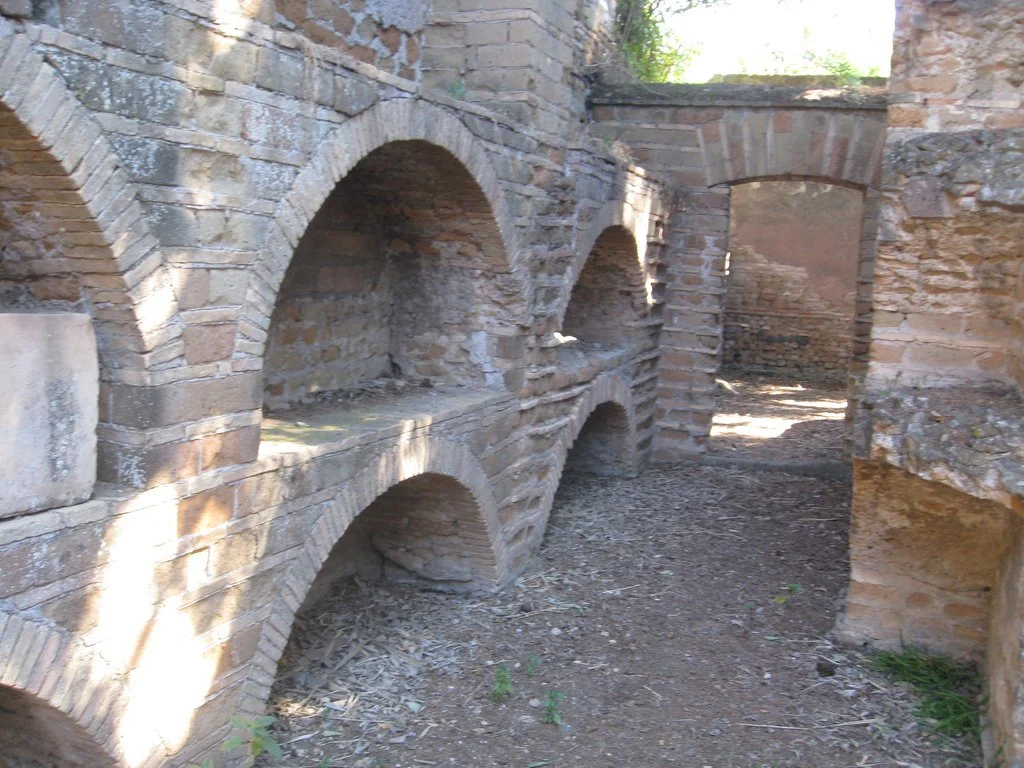
The Jewish catacombs of Vigna Randanini can be visited only by reservation, with an arrangement made in advance, because the burial ground lies under private property and has no ticket office open to the public. The entrance is at Via Appia Pignatelli 2, at the second mile of the Appian Way, a few hundred meters from San Sebastiano. You don't just show up and walk in. If you arrive without a reservation you'll find a closed gate.
This is the point that changes the whole rest of the page. The other Roman catacombs open to the public have a body that manages them, a printed schedule and a ticket. Here the regime is different: the archaeological protection belongs to the State, the land belongs to private owners, and access goes through whoever obtains, case by case, permission to go down. Below you'll find what can be verified and what, instead, nobody publishes clearly.
Where the catacombs of Vigna Randanini are and how to get there
The reference address is Via Appia Pignatelli 2, Rome. The underground complex develops inside the flank of a hill between Via Appia Antica and Via Appia Pignatelli, in an area that also touches Vicolo della Basilica. The Ministry's protection decree, of June 12, 1986, places the burial ground at the second mile of the Appia Antica and indicates the main entrance on Via Appia Pignatelli.
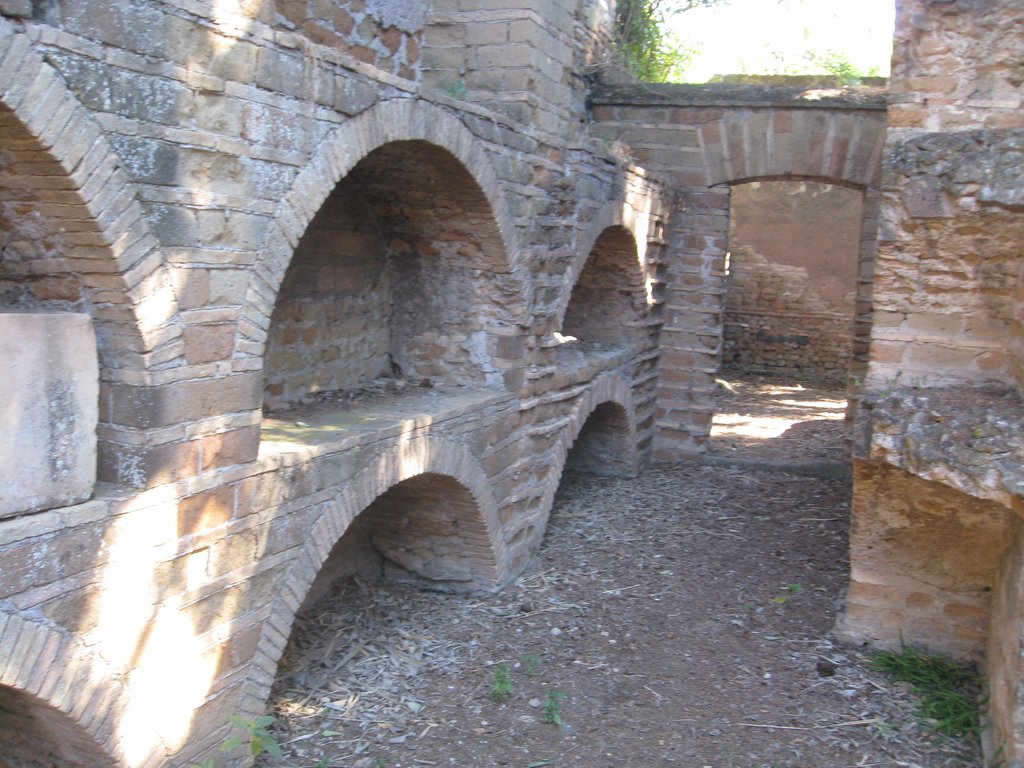
Via Appia Pignatelli is the modern road that cuts diagonally from the Appia Antica toward the Appia Nuova. It starts right at the basilica of San Sebastiano fuori le mura and climbs toward the Fourth Mile. The first part is narrow, with no continuous sidewalk, with cars passing close by. Walking it takes attention, especially in a group and especially at sunset.
The bus line to take is the 118. It runs along Via Appia Pignatelli and has stops along the whole road, including Appia Pignatelli/Appia Antica, Appia Pignatelli/S. Urbano and Appia Pignatelli/Quarto Miglio. The most convenient stop for the entrance is the one at the start, on the Appia Antica side. The route of the 118 has been changed in recent years toward Villa dei Quintili: check the terminus before getting on.
If you come from the center you can take subway Line B to Circo Massimo or to Piramide and continue at street level. The simplest combination remains subway to Circo Massimo and then bus toward the Appia. To find your way among Rome's lines, tickets and apps, the guide on how to get around Rome saves you quite a few planning mistakes.
By car things get complicated. Via Appia Pignatelli has very little legal parking space and the area falls within the protected perimeter of the Appian Way Park, with traffic restrictions that change on weekends. Better not to come by car. Better the bus, better still the bicycle if you're already coming from the Appia Antica, where the basalt paving, however, tests ankles and thin wheels.
How you really visit: private property, permits, reservation
The official site of the Parco Archeologico dell'Appia Antica, in the page devoted to the protection decree, writes that the catacombs are currently private property and are accessible exclusively with private visits. It is the clearest institutional wording that exists online today. It means there is no cash desk, no fixed shift and no calendar published by a body.
Whoever physically opens the gate is the property. Those who lead you down are cultural associations and guides who obtain authorization to bring groups, and who publish the dates on their own channels. There is not, as of the September 2026 check, a single institutional portal where you can book the Jewish catacombs the way you do for San Callisto or Domitilla. Anyone who tells you otherwise is selling a certainty they don't have.
In 2016 there was an attempt at orderly opening. The Roman press reported an agreement between the Ministry, the Soprintendenza and the owners, with visits entrusted to the Soprintendenza's concessionaire and included in a Jubilee program built together with the Jewish Community of Rome, with experimental openings on the first Sundays of the month. That mechanism does not appear to be active today as a stable and continuous channel.
The practical consequence is simple. To go down you have to look for a date already fixed by someone who has the permit, or ask for a dedicated opening for a group. Dates appear and disappear, places are few, groups are capped at around 15 people. Booking two weeks ahead is the reasonable minimum, and in spring you need even more.
A recommendation that counts double here: when you book, ask for written confirmation that the date is confirmed by the property and not just announced. Openings on private land fall through more easily than those on state sites, for reasons that have nothing to do with archaeology. A light flood, work in the garden above, a change of plans by the owner.
How much it costs, how long it lasts, what is not published
Costs have no single price list, because there is no single body that sets them. What you can gather from the published offers is a two-part structure: an entrance contribution to be paid on site to the property, indicated by some operators as €8 in cash, and the guide's fee, which varies. The published total ranges between €20 and €25 per person.
The figures differ from one provider to another. One offer indicates €15 for the guided visit plus €8 for entrance to be paid in cash on site, with no possibility of electronic payment. Another indicates a single fee of €20 full price, €18 reduced, €10 for under 18s and €2 for under 10s, with advance payment at the time of booking. Bring cash in any case.
The stated duration goes from one hour to an hour and a half. It is realistic. The walkable stretch is a fraction of the total, you walk slowly, you stop often and the guide talks a lot because without explanation the galleries say little. Anyone who arrives hoping for two hours of underground walking will be disappointed, and anyone afraid of enclosed spaces will find an hour already long.
Opening hours do not exist in the usual sense of the term. There is no “from 9:00 to 17:00”. There is the set time of the visit, and that's it. The dates that circulate tend to cluster on weekends and in the shoulder seasons, less in January and August. The burial ground stays closed during Jewish holidays and this must be factored in when planning an itinerary.
A curiosity about the Jewish Catacombs of Vigna Randanini
In the catacombs of Vigna Randanini not a single inscription in Hebrew has been found. The epigraphs are in Greek and Latin, and for a Jewish cemetery of ancient Rome this surprises anyone expecting the opposite. Studies that have counted the burial ground's inscriptions show a clear prevalence of Greek, with Latin trailing and a share of bilingual texts.
The fact does not say that those people had forgotten their liturgical language. It says that the everyday language, in imperial Rome, for a community of eastern Mediterranean origin, was Greek. Greek was the language of trade, of the diaspora synagogues, of letters. Latin appears more in the late inscriptions, as happens in all Roman epigraphy of the period.
The percentages that circulate in the literature give about two thirds to Greek, a little under a quarter to Latin and about 10 points to bilingual texts. The figures vary depending on how the fragments are counted and which epigraphs are attributed with certainty to this burial ground and not to others, because many marbles were moved in the 19th century.
What remains constant is the absence of Hebrew and Aramaic. At most short transliterated formulas appear, such as the greeting of peace to the deceased. It is an element scholars use to reason about the linguistic integration of Roman Jews, a topic much more interesting than it seems, and which you'll find also treated in the halls of the Jewish Museum of Rome.
The 1859 discovery and the vineyard that gave the name
The burial ground was found by chance in 1859. The name does not come from a saint, a martyr or an ancient place name: it comes from the surname of the owners of the land, and from the agricultural use of the plot, which was precisely a vineyard. In 19th-century Rome catacombs almost always took the name of the estate in which they opened, and this habit has left a strange set of place names.
The 19th-century excavations were carried out by the standards of the time, which means recovery of the inscribed marbles and little attention to stratigraphy. At the time of discovery there were already signs of ancient tampering. Many epigraphs went different ways, ending up in collections and museums, and this makes it hard today to reconstruct precisely which gallery each single marble came from.
Raffaele Garrucci, who studied the complex in those years, put forward the hypothesis that the rectangular room at the entrance was a synagogue, arguing from the presence of water, the separation of spaces and the distance from the inhabited area. It is a 19th-century reading that later research has scaled down without entirely dismissing. Today that structure tends to be read as a readapted building, with at least two construction phases.
The story of the discovery fits into a specific season. In the 19th century Rome was rediscovering its Christian underground with a very strong apologetic drive, and the Jewish catacombs entered that debate sideways, because they upset the idea that burial in galleries was an invention of the Christians. I come back to this further on, because it's the point on which popular accounts keep getting confused.
Something nobody tells you about the Jewish Catacombs of Vigna Randanini
Inside the Jewish catacombs of Vigna Randanini there are pagan images. Winged Victories, Pegasus, Fortuna with the hippocampus and dolphins, peacocks, roosters, vegetal scrolls. They are not contraband or a misreading: they are there, painted in the decorated cubicula, next to menorahs and arks of the Law. Anyone who goes down expecting a strictly aniconic repertoire finds a different story.
Two explanations have been proposed, and they don't exclude each other. The first is that some rooms were preexisting, of pagan origin, and were readapted to Jewish burial. The second is that the Roman Jewish patrons, perfectly integrated into the figurative culture of the empire, used the current decorative language without feeling it as a religious problem.
The sources differ even on the number of painted cubicula. Some descriptions speak of three frescoed chambers, others of four. The discrepancy depends on how decorated you consider a room in which only minimal traces remain, and the conservation is terrible: humidity and subsidence have eaten much of the surfaces. Much of what you read in books can no longer be seen today.
This is the fact that no promotional presentation puts in the front row. The photographs that circulate are largely old, or taken with professional equipment in conditions granted once. The ordinary visitor, with a flashlight in hand, sees dull colors, patchy plaster and figures that have to be pointed out to be recognized. Knowing this beforehand avoids disappointment.
Inside the galleries: kokhim, loculi, arcosolia
The complex extends over about 18,000 square meters and is arranged on two levels. The overall development of the galleries is given as around 700 meters, of which about 400 or 450 are actually walkable. The rest is off limits because of instability, collapses or flooding. Estimates of the number of identified burials go beyond 1,700.
The type of burial that strikes the most is the kokh, plural kokhim, which in Italian is rendered as tomba a forno. It is a niche dug perpendicular to the wall, deep, into which the body was introduced by the short side. It is a form of Near Eastern origin, widely documented in Judea, and its presence here is one of the clearest signs of the burial ground's identity.
Next to the kokhim there are the loculi, the niches parallel to the wall typical of all Roman catacombs, the arcosolia with their arched niche above the dug sarcophagus, the floor graves and the cubicula, that is the small chambers that held several burials of the same family. The closures were in brick or marble slabs.
The route is not an orderly loop. The plan shows arms that graft onto one another with no unified design, a sign that the burial ground grew by successive additions, probably starting from distinct nuclei. It is the same phenomenon seen in the great Christian catacombs of the Appia and the Ardeatina, with the difference that here the direction of a central authority is missing.
You go down a few steps and find yourself in a space with constant temperature, around 15 degrees, and high humidity. In summer it's a relief, in winter you need to cover up. The floor is uneven, packed earth and fragments, with unmarked level changes. Closed shoes with a sole that grips, not sandals.
Menorah, shofar, lulav: the symbols and how to recognize them
The dominant symbol is the menorah, the seven-branched candelabrum. It appears scratched, painted, carved on the marbles, sometimes drawn in haste on the fresh mortar that sealed a loculus. It is the identity sign par excellence of the burial ground, the one that let the 19th-century discoverers understand right away that they were not inside a Christian catacomb.
Alongside the menorah recur the shofar, the ram's horn sounded at solemnities, and the lulav, the bound bundle of branches used in the feast of Sukkot. They are documented in the burial ground's repertoire together with the ark of the Law, that is the cabinet that keeps the scrolls, sometimes represented with the doors open and the scrolls visible inside.
On the etrog, the citron that accompanies the lulav at Sukkot, it's best to be precise rather than generous. It belongs to the Roman Jewish funerary repertoire in the broad sense and is often cited in a block with the others, but the analytical descriptions of Vigna Randanini insist above all on menorah, shofar, lulav and ark. If a guide points it out to you, ask where.
These signs have no decorative function. They mark the deceased's belonging to a community and his hope. The epigraphic formulas that accompany them are short and repetitive, often a wish of peace for the rest of the deceased, sometimes the indication of the synagogue of belonging. Roman inscriptions recall the existence of several distinct synagogue communities in the city.
The epigraphs, the names and the synagogues of ancient Rome
The epigraphs of Vigna Randanini give back Greek, Latin and Semitic names, trades, ages at death, community offices. Titles such as archisynagogos, gerusiarch, presbyter of the community, father of the synagogue appear. It is prosopographic material that has made it possible to reconstruct the internal organization of Roman Judaism better than any surviving literary source.
The most notable fact is the number of synagogues named. Roman Jewish inscriptions, taken as a whole, refer to about 10 or more distinct congregations, each with its own name, sometimes tied to a neighborhood, sometimes to a person, sometimes to a geographic origin. Rome therefore hosted a network, not a single monolithic community.
Many epigraphs are no longer in place. In the 19th century the inscribed marbles were detached and collected, and today they are kept in museum collections. Anyone who wants to see the epigraphic material has to look for it elsewhere, and this dissociation between container and content is the reason why the visit to the burial ground, by itself, leaves a feeling of incompleteness.
For the overall picture of the Jewish presence in Rome over the long period the reference place remains the complex of the Synagogue of Rome with its museum, and the urban route of the Jewish Ghetto from the Portico d'Ottavia to the Theater of Marcellus as far as the Tiber Island.
My advice for visiting the Jewish Catacombs of Vigna Randanini
Bring a real flashlight, not your phone. The participation notes of those who organize the descents say so too, and there is a technical reason: the phone light is wide, cold and flat, and on the residual painted surfaces it gives back nothing. A flashlight with an adjustable beam, held to the side and not frontal, brings out the graffiti on the mortar that would otherwise vanish.
Dress in layers and put them on before going down. The temperature below is constant and the humidity is high, so what seems excessive above becomes right below. Closed shoes with a treaded sole, because the floor is uneven and in some stretches slippery. A small backpack, held in front in the narrow passages, and no shoulder bags that snag.
Arrive a quarter of an hour early. It's not formality: the entrance is on a road with no continuous sidewalk, finding the right gate the first time takes a few minutes, and the group leaves together. Anyone who arrives late for a capped-number visit agreed with a private property stays outside, and there is no second departure to join.
The advice concerns the order of the day. Vigna Randanini works much better as a second stop than as a first. Go first to the Ghetto or the community museum, pick up the thread of the history of the Jews in Rome, and then come down here. The other way round the visit stays an hour of dark galleries with no context, and the memory fades within a week.
One last thing, and it holds for all Roman underground sites: when you book, ask how many narrow passages there are and how many steps. The answers change depending on the stretch open that day. If you have claustrophobia, an hour underground with no intermediate exits is demanding, and it's best to know while booking and not while going down.
Another well-known fact, yet rarely cited
Catacombs are not a Christian invention. It is something all insiders know and that almost no guided tour says out loud, because it breaks a comfortable narrative. Burial in galleries dug into the tuff was a widespread practice in the Mediterranean basin, and in Rome the Jews adopted it in parallel, not afterward.
The chronology helps in understanding. The Roman Jewish catacombs are dated in a span that the sources place between the second and fourth century, with some proposals that push the start further back and others that extend use to the fifth. The exact dates remain debated and change from burial ground to burial ground, so be wary of anyone who gives you just one.
The substantial point is not the race over who dug first. The point is that the underground gallery was a technical and economic solution to a shared problem: burying many whole bodies, in little space, outside the pomerium, in a city where land cost money and the law forbade intra moenia burials. Roman tuff lent itself to it.
Anyone who wants to check with their own eyes how closely the solutions match can compare the galleries of Vigna Randanini with those of the catacombs of San Sebastiano or the hypogeum of Via Dino Compagni. The digging techniques, the types of loculus, the closures are the same. The symbols change and the formulas change, not the hand that digs.
The other Jewish catacombs of Rome: Villa Torlonia, Monteverde, the lost ones
The Jewish catacombs documented in Rome are more than one, but today only Vigna Randanini appears to be accessible. The others are closed, destroyed or inaccessible. This is the reason why the visit, with all its limits, has a value no other alternative can replace. There is no plan B in the city.
The catacombs of Villa Torlonia, on the Nomentana, were discovered in 1919, with excavations continuing until 1930 and resumed in the 1970s. They extend over more than 13,000 square meters, with over 100 inscriptions and thousands of tombs. They are not open to the public because of stability problems and the presence of gases in the subsoil, including radon and carbon dioxide.
Anyone who visits the park on the Nomentana is therefore walking over an ancient burial ground without being able to see it, while on the surface the Casino Nobile and the other museum buildings are open. Not far away, in the same quadrant, are the Mausoleum of Santa Costanza and the basilica of Sant'Agnese fuori le mura with its galleries.
The case of Monteverde is different and more painful. It was the oldest known Jewish burial ground, on Via Portuense, visited by Antonio Bosio in December 1602. The excavations of the early 20th century recovered at least 151 inscriptions, and a substantial part went in 1907 to the Lateran museum, where a dedicated room was set up.
Then the burial ground disappeared. The pozzolana quarries and the building of the 1920s and 1930s gradually ate away the hill, and a ruinous collapse in October 1928 closed the story. Today of Monteverde there remain the epigraphs in museums and the excavation reports. Under the houses of Circonvallazione Gianicolense there is nothing left to visit.
There remain then minor nuclei and burial grounds known only from reports, such as that of Vigna Cimarra toward Via di San Sebastiano, on private property, and that of the Labicana area, considered destroyed or inaccessible. For those who want the general picture of the city's cemetery underground, the page on the catacombs of Rome lines up the visitable complexes.
The vestibule, the well and the question of the synagogue
At the entrance you come to a rectangular space that doesn't look like a catacomb. The descriptions speak of masonry attributable to two distinct construction phases, of an elongated room that works as an antechamber and of a rectangular vestibule in which a well about six meters deep opens. It is from here that the corridors toward the burial chambers start.
On this building the synagogue hypothesis was built in the 19th century. The presence of water, the division of spaces, the distance from the inhabited area seemed sufficient clues. Later research has largely taken that reasoning apart, observing that none of those elements is decisive and that similar structures are found in suburban funerary contexts of a different nature.
The prevailing reading today reads the entrance complex as a readapted surface building, perhaps originally tied to an agricultural property or to an earlier burial ground, and then absorbed into the access route to the cemetery. The discussion, however, is not closed, and anyone who presents the question as settled one way or the other is simplifying.
Here it is worth stopping longer than in the galleries. A controversial space, over which scholars have been quarreling for 150 years, teaches more than 10 identical loculi. It teaches that archaeology is not a list of certainties and that the same masonry can tell different stories depending on what you look for.
A position that not everyone will like
I'll say it plainly: for most visitors Vigna Randanini is not the first catacomb to see in Rome, nor the second. If you have only one afternoon and no specific interest in ancient Jewish Rome, Priscilla or Domitilla will give you a more readable hour, better lit, with paintings you can really see and without the complication of booking on private property.
This opinion goes against the current rhetoric, which presents Randanini as the secret stop everyone should make. The rarity of access gets mistaken for the value of the experience, and they are two different things. A place that is hard to visit does not automatically become more beautiful to visit. It becomes harder to visit, and that's all.
That said, I change my mind completely for one specific type of visitor. Those who study ancient Judaism, who work on epigraphy, who build a thematic itinerary on the Jewish presence in Rome, who have already seen two or three Christian catacombs and want to understand the comparison: for these people Vigna Randanini is the right place, and the only possible one.
The criterion is brutal but it works. To the question of what you see, the honest answer is: galleries, niches and some trace of color. If at that point the interest remains, the visit is worth it. If you were hoping for a site to photograph, better to go elsewhere and spare yourself a disappointment.
The right photo to take at the Jewish Catacombs of Vigna Randanini
First rule: below, photography is normally forbidden or in any case subject to the authorization of whoever leads you and of the property. Ask first, not after. Flash is ruled out in any case, for the conservation of the painted surfaces, and insisting on this point with the person leading the visit is the quickest way to spoil the atmosphere for the group.
The photograph I recommend is therefore on the surface, and it's not a fallback. The entrance of Via Appia Pignatelli, shot from the Appia Antica side in the early morning, tells exactly the theme of the page: a wall, a gate, a narrow road, and below a cemetery from 2,000 years ago of which nothing is visible on the surface.
The good light is that of the first hours. The Appia runs in a southeast direction and in the early morning the low sun works well on the boundary walls and on the pines. Toward noon the contrast flattens and the road becomes unreadable. In winter the useful moment shifts and stretches, and the landscape without leaves gains depth.
If you want a photograph that holds the context together, walk 200 meters toward the Mausoleum of Cecilia Metella and shoot the basalt paving with the tombs at the sides. It is the image of the road of the dead, which is the reason why all these cemeteries, Jewish and Christian, are found along this axis and not elsewhere.
One thing I would never do, and that I see done often: the smiling portrait in front of a loculus. We are inside a cemetery where someone was buried and where bones were laid. A documentary photograph makes sense, a souvenir pose does not. Whoever leads groups should say so before going down, not after.
Some important events that happened here in history
The first event is the founding of the burial ground itself, between the second and fourth century, in a suburban area that at that time was full of tombs of every faith. The Roman Jewish community obtained or bought the right to dig here, and the choice of the second mile of the Appia says a lot about its social and economic position in the city.
The second moment is the abandonment. Like all Roman catacombs, this one too stops being used when the conditions of the city change, between the fifth century and the early Middle Ages. The galleries stay open and are gradually emptied. The signs of ancient tampering found at the time of discovery show that someone had gone down well before 1859.
The third is the rediscovery of 1859, within the season of 19th-century Christian archaeology. The burial ground enters the European scientific literature and becomes material for international discussion, in particular for the question of the entrance building and for the relationship between pagan iconography and Jewish burial.
The fourth is the ministerial decree of June 12, 1986, which declares the area of important archaeological interest under the law of 1939. It is the act that fixes the current regime: full state protection over a property that remains privately owned, with all the practical consequences for access described here.
The fifth is the attempt in 2016 to open the burial ground on a regular basis, with visits led by the Soprintendenza's concessionaire and included in a program built with the Jewish Community of Rome. It was presented as the result of a long concertation among the Ministry, the Soprintendenza and the owners. It did not turn into a stable and continuous channel in the following years.
Who has passed through the Jewish Catacombs of Vigna Randanini
The people who really passed through here, and who count more than any illustrious name, are the Jews of Rome of the first centuries. Merchants, craftsmen, freedmen, synagogue officials, children who died at two with their name carved in Greek. The epigraphs give back ages, trades and offices, and are the only direct voice that community has left us.
Among scholars, the name tied to the burial ground since the years of the discovery is that of Raffaele Garrucci, author of the first overall reading and of the hypothesis on the entrance building. After him the complex has been crossed by generations of epigraphists and historians of ancient Judaism, and continues to appear in the international bibliography on the Roman diaspora.
Antonio Bosio, the great explorer of the Roman underground of the early 17th century, did not pass through here but through the other Jewish burial ground, that of Monteverde, in December 1602. His name should be remembered all the same, because he was the first to understand that under Rome there was a system of cemeteries and not a series of isolated caves.
In 2016 the burial ground also saw national cultural policy pass through, with the official presentation of the experimental opening by the Ministry and with the direct involvement of the Jewish Community of Rome and of the direction of the Appia Antica. It is a passage that left more journalistic documentation than lasting effects on accessibility.
Today small groups pass through, 15 people at a time, accompanied by guides who have obtained authorization. In a year these are very low numbers compared with those of the Appia catacombs open regularly. This makes every descent a less ordinary thing, and demands a different behavior from the one you keep in a museum.
A cemetery, not an attraction
Vigna Randanini is a Jewish cemetery. In the Jewish tradition the burial place enjoys a protection that does not wear off with the time elapsed: burial is final and the rest of the deceased is not to be disturbed. Even if the galleries were emptied centuries ago, the nature of the place does not change because today you enter it with a flashlight.
From this follows a way of being below. Low voice, no jokes about the dark and ghosts, no hands on the walls, no picking up fragments from the ground. It's not pedantry: it is the difference between visiting a burial ground and using it as a backdrop. Whoever leads groups has the duty to say so beforehand, outdoors, calmly.
It also applies to the way the dead are talked about. The epigraphs speak of real people, many of whom died as children. Turning them into entertainment anecdotes is an elegant way of being disrespectful. Better to read a formula of peace for the deceased and keep quiet for 10 seconds than to fill the silence with a curiosity.
Anyone looking for a Roman route on Jewish memory in the broader sense, including the pages of the 20th century, can line up the Ghetto, the community museum and the Mausoleum of the Fosse Ardeatine, which is a short distance from here, on the Ardeatina, and which closes the circle in a very harsh way.
What to see nearby, in the same half day
The first neighbor is the basilica of San Sebastiano, at the start of Via Appia Pignatelli, with the catacombs below it and the apostolic memory. Across the way and a little farther open the catacombs of San Callisto, the most visited of the quadrant, with their wide routes and languages guaranteed every day.
Going up toward the center along the Appia you meet the church of Domine Quo Vadis, small and always crowded with tour buses, and farther up Porta San Sebastiano with the Museo delle Mura, which remains one of the least frequented and most useful places for understanding how the city's defense worked.
In the opposite direction, toward the southeast, the Appia Antica continues with the Mausoleum of Cecilia Metella, the Villa of Maxentius with its circus, the Capo di Bove complex and, farther on, the Villa of the Quintilii, which with its bath front is the most impressive thing in the whole park.
Anyone who wants to stay on the underground theme can add the catacombs of Domitilla on the Ardeatina, with the semi-underground basilica, or move toward the catacombs of Commodilla and the catacombs of Santa Tecla, less beaten and visitable only by prior arrangement, exactly as here.
Toward the center the natural route passes through the churches of the first stretch of the Appia and the Porta Capena area: San Cesareo de Appia, San Sisto Vecchio, the Santi Nereo e Achilleo, and then the Baths of Caracalla and the Circus Maximus, which close the walk inside the city.
Anyone with a whole day and good legs can extend to the Aqueducts Park, reachable from Via Appia Pignatelli toward the Appia Nuova, or finish on the Aventine Hill. For an overall picture of the city's underground the page on underground Rome remains useful, and for the opposite side of the Tiber the one on the necropolis of Via Portuense.
Eating in the area without getting fleeced
Around Via Appia Pignatelli the offer is thin and this, paradoxically, protects you. The real places concentrate farther up, toward San Giovanni and toward Garbatella, or on the Appia Antica near the most visited sites, where instead the risk rises quite a bit. The traps in this quadrant have recognizable signs and always the same ones.
The first sign is the menu with photographs of the dishes. A dish that needs to be photographed to be sold is a dish that isn't ordered by those who know Roman cooking. It also applies to the menu translated into six languages displayed on the easel: it's not hospitality, it's a funnel built to intercept people who pass only once.
The second is the lady rolling out the pasta sheet in the window or right on the sidewalk. It's theater. A staged lure designed to stop the passerby, not a sign of the quality of what comes out of the kitchen. In places where pasta is really made, it's made in back, in the morning, and nobody pays someone to do it in front of passersby.
The third is the person at the entrance who invites you to sit. Whoever works well has full tables and doesn't need to recruit customers on the street. When they call you, stop you, put the menu in your hand before you've even slowed down, you're in front of a business that lives on foot traffic and not on return customers.
The fourth is the continuous schedule. A kitchen open from 10:00 to midnight, with no break, means things are reheated and served, period. Places where you actually eat have a lunch service and a dinner service, with a gap in the middle in which the staff rests and prepares. It's the most reliable sign of all, and the easiest to check.
The fifth concerns places set in front of the most photographed monuments. There the price adjusts to the customer: unpriced items on the menu, fish or meat by weight with no indication, an inflated cover charge, and sometimes different price lists between the inside room and the tables outside. Asking the price before ordering is not rudeness, it's hygiene.
Then there are the repeated signs of the center, the ones you find identical in five different spots of the city with the same decor and the same menu. They work as a tourist attraction, not as dining: they are predictable, fast, and for people short on time they solve a problem. Simply, Romans don't go there, and there is no snobbery in this observation, only statistics.
The criterion is only one and requires no apps or reviews. Look at who is sitting at the tables and in what language they order. If at two in the afternoon inside there are workers, office employees and neighborhood families speaking Italian, you're in the right place. If there are only foreigners with backpacks, walk another five minutes.
For the Appia area I add a practical rule: eat before going down, not after. Visits often end in mid-afternoon, when kitchens are closed, and you end up choosing among what stayed open, which is almost always the wrong category. A serious breakfast and an early lunch solve the day.
A selection of places is collected in a public list on Google Maps, updated when something changes for better or worse. For the general method, without addresses but with the criteria, there is the guide on where to eat in Rome without falling into the tourist trap.
When to go, what to bring, accessibility
The best season is the shoulder season, for two reasons. The first is that openings on private property concentrate in spring and autumn, when the weather holds and there is demand. The second is that the Appia around is good for walking: in summer the exposed stretch among the pines is very hard, in winter the short days shorten everything.
Below, the temperature stays around 15 degrees all year and the humidity is high. In August the shift from outside is strong and anyone who is sweaty feels it. A light sweatshirt in your backpack is enough. The floor can be wet in the days after rain, and in some stretches puddles form that stay for weeks.
Accessibility for people with mobility difficulties is the sore point. You go down by steps, the floor is uneven, there are narrow passages and level changes without handrails. No accessible route or elevator is declared. Anyone who moves in a wheelchair, and in general anyone with balance problems, must clarify the matter when booking, because the answer is not a given.
With children the assessment depends on age and temperament. Under seven or eight, an hour in the dark in an ancient cemetery, with nothing colorful to see, rarely works. From 10 up, with a guide who tells the story well, it can become the thing they remember of Rome. Prepare them beforehand on what they will see.
To bring: flashlight, sweatshirt, closed shoes, water, cash for the possible entrance fee on site. To leave at home: tripod, flash, bulky bags, documentary expectations. All the data in this section refer to the September 2026 check and should be rechecked at the time of booking, because on a privately accessed site they change without notice.
Frequently asked questions about the Jewish Catacombs of Vigna Randanini
Can you visit the Jewish catacombs of Vigna Randanini without booking?
No. The Jewish catacombs of Vigna Randanini are on private property and the official site of the Parco Archeologico dell'Appia Antica states that they are accessible exclusively with private visits. There is no open ticket office and no continuous schedule. You have to find a date already organized by someone with authorization, or arrange a dedicated opening for a group, weeks in advance.
How much does it cost to enter the catacombs of Vigna Randanini?
The cost has no single price list because there is no single body that publishes it. From the offers in circulation there emerges an entrance fee to be paid on site, indicated as €8 in cash, plus the fee of the person leading you. The published totals run roughly from €20 to €25 per person, with reductions for minors. Bring cash, electronic payment is not guaranteed.
What is the exact address and which bus goes there?
The reference entrance is at Via Appia Pignatelli 2, at the second mile of the Appia Antica, in an area between Via Appia Antica and Via Appia Pignatelli. The bus is line 118, which runs along Via Appia Pignatelli with several stops, including Appia Pignatelli/Appia Antica, the closest to the start. The route of the 118 has been changed in recent years: check the direction before getting on.
What period are the Jewish catacombs of Vigna Randanini from?
The proposed datings do not coincide. The page of the municipal tourist portal places the burials between the second and fourth century AD, other reconstructions extend use to the fifth century. The divergence depends on the criteria for dating the epigraphs and the excavation phases. Anyone who gives you a single precise date is simplifying a debate that specialists have not closed.
Which Jewish symbols can you really see below?
The recurring symbol is the menorah, the seven-branched candelabrum, scratched or painted. In the burial ground's documented repertoire the shofar, the lulav and the ark of the Law with the scrolls also appear. The etrog is often cited together with the others in general presentations of Roman Jewish funerary iconography, but the analytical descriptions of this complex insist above all on the first four elements.
Is it true that there are pagan images in a Jewish catacomb?
Yes, and it is one of the most discussed aspects of the site. In the decorated cubicula figures of classical tradition appear such as the winged Victory, Pegasus, Fortuna with dolphins and hippocampus, together with peacocks and roosters. The proposed readings are the readaptation of preexisting rooms of pagan origin and the casual use of the current figurative language by the Roman Jewish patrons.
What other Jewish catacombs can you visit in Rome?
None other, at the moment. The catacombs of Villa Torlonia on the Nomentana are closed to the public because of stability problems and the presence of gases in the subsoil. The great burial ground of Monteverde, on Via Portuense, was destroyed between the quarries and the building of the early 20th century, with a decisive collapse in 1928. Other minor nuclei are inaccessible or lost.
How long does the visit last and how much of it do you walk?
The duration stated by the organizers goes from one hour to an hour and a half. The overall development of the galleries is estimated at around 700 meters on two levels, but only 400 or 450 meters are comfortably walkable. The rest is closed for instability or flooding. You walk slowly, with frequent stops, so the actual distance covered is less than the number suggests.
Are the Jewish catacombs suitable for people who suffer from claustrophobia?
Not very. The galleries are narrow, the ceiling is low in several stretches, the light is that of flashlights and there are no intermediate exits along the route. Anyone with difficulty in enclosed spaces should declare it when booking and assess with whoever leads the visit, or choose a complex with wider and lit routes among those open regularly on the Appia.
Who wrote this page
This page comes from the editorial team of Tour Leader Pro, the Rome-based outfit that designs, books and coordinates visits, itineraries and cultural events in Rome and Lazio. Costs, hours and access conditions reported here come from the sources cited in the text at the time of publication: on a privately owned site they change faster than elsewhere, so check them again before you set out. If you find a figure that doesn't add up, write to us.
Anyone putting together a Roman itinerary almost always runs into the same variables: openings granted and not guaranteed, sites run by private owners or religious communities instead of tourism bodies, access to be arranged weeks in advance, distances that look short on paper and are not on the basalt paving. On Tour Leader Pro you'll find the planning tools made for those who lead groups and for those who organize on their own.
For the wider picture, meaning trains, rentals, airports and destinations in Lazio outside the center of Rome, from the Castelli to the lakes down to the coast, the resource we point to is Italy Planner, which reasons about transfers and durations instead of single monuments.