Santi Nereo e Achilleo
In short. The church of Santi Nereo e Achilleo stands on Via delle Terme di Caracalla, directly opposite the archaeological enclosure of the Baths of Caracalla, and is passed every day by thousands of people on their way somewhere else.
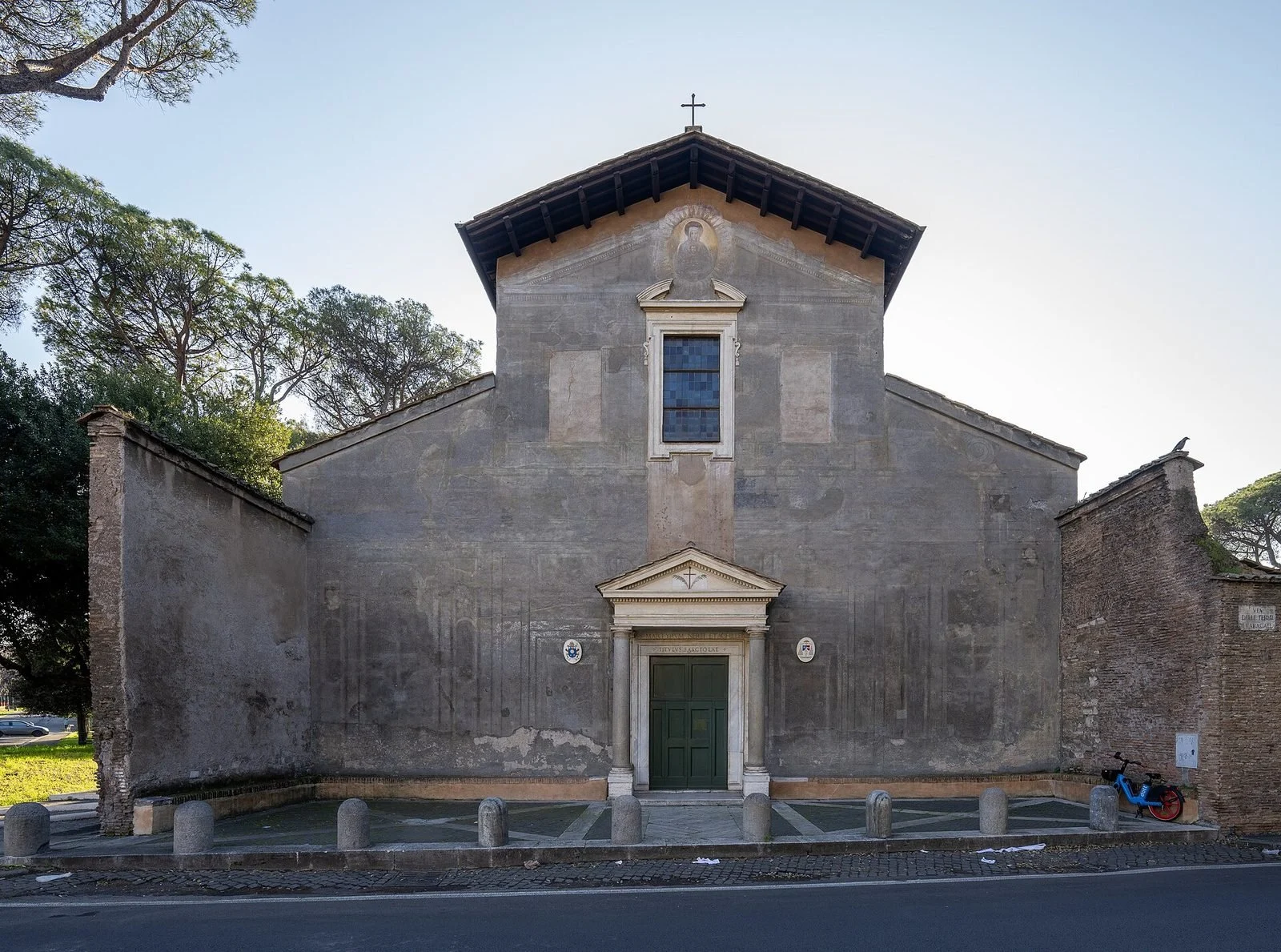
The church of Santi Nereo e Achilleo stands on Via delle Terme di Caracalla, directly opposite the archaeological enclosure of the Baths of Caracalla, and is passed every day by thousands of people on their way somewhere else. It's a low brick building, with a facade that doesn't ask for attention: whoever walks along the avenue looks to the right, toward the massive walls of the Severan bath complex, and the church stays on the other side, at street level, with the door almost always left ajar. Inside, in a space you cross in 20 steps, there are three things that are not easily found together in Rome: the Carolingian mosaic of the triumphal arch, commissioned by Pope Leo III between the end of the 8th and the beginning of the 9th century, a medieval liturgical furnishing in marble and mosaic reassembled at the end of the 1500s, and a painted cycle of the martyrdoms of the apostles that belongs to a precise season in the history of the Church, that of the Counter-Reformation going to look in the catacombs for its own credentials. The director of almost everything you see today has a name: Cesare Baronio, the historian who between 1596 and 1597 took possession of this cardinal title and turned it into his manifesto.
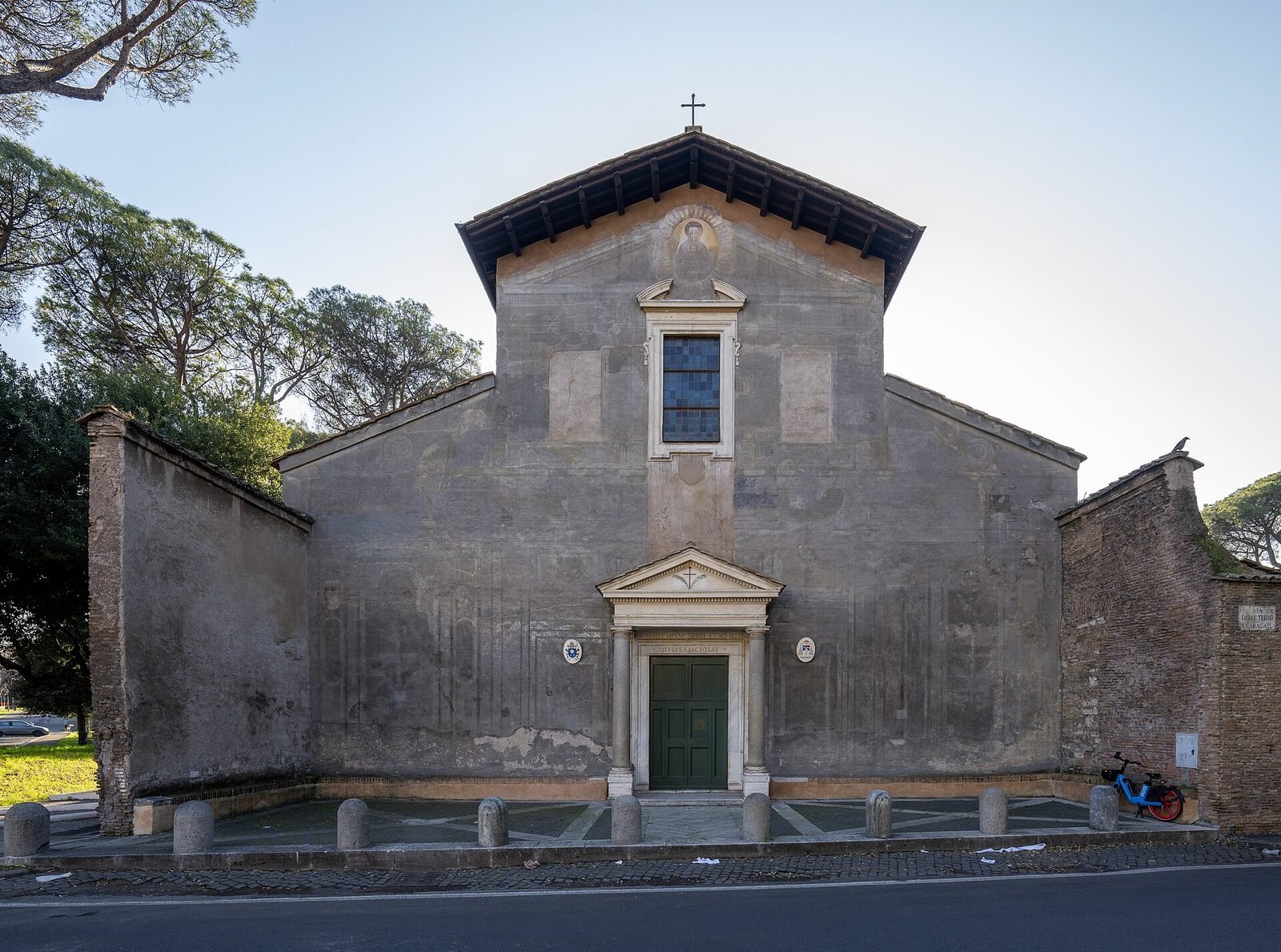
The first thing to say is practical. Opening hours are very limited and not stable over time: whoever arrives here without checking beforehand seriously risks finding the door closed. This is the most important operational fact on the page and it's worth keeping in mind before building an itinerary around it.
Where the church of Santi Nereo e Achilleo is and how to get there
The address is Via delle Terme di Caracalla 28, in the southern sector of the historic center of Rome, in that band of the city that opens between the Circus Maximus, the slopes of the Aventine and the Palatine on one side, and the first spurs of the Celio on the other. The church is on the northeastern side of the avenue, that is, on the sidewalk opposite the entrance to the archaeological site of the baths. Whoever comes out of a visit to the bath area and crosses the street again finds it right in front.
By metro
The nearest station is Circo Massimo, on metro line B. From there you come out onto Viale Aventino and continue southeast, alongside the green area separating the valley of the Circus from Viale delle Terme di Caracalla: it's about 10 minutes of walking, on level ground, on wide sidewalks. It is the most predictable way to arrive, because it doesn't depend on surface traffic. If you're coming from Termini, take line B toward Laurentina and get off at the second stop after Colosseo.
By bus
Via delle Terme di Caracalla is served by surface lines connecting the historic center with the Porta San Sebastiano area and with the start of the Appia Antica. The line historically used by those going toward the Appia Antica Park is the 118, which passes right in front of the baths and continues beyond the walls. Line numbers and routes, however, get reshuffled with some frequency, especially during construction periods: it's better to check the updated route on the app or site of the Roman public transport operator on the same day, instead of trusting a number read in a guidebook.
On foot, and where it's best to arrive from
The walking route that works best doesn't start from the metro but from the Colosseum. You go down toward the Arch of Constantine, take Via di San Gregorio with the Palatine on your right, pass in front of San Gregorio al Celio and reach the head of the Circus Maximus: from there Viale delle Terme di Caracalla starts on a slight uphill and in less than a quarter of an hour you're in front of the church. The route has an advantage that is not only a matter of time: it crosses the whole Passeggiata Archeologica, that is, the system of tree-lined avenues and green areas designed between the end of the 1800s and the early 1900s to give a monumental frame to this sector of the city. The church of Santi Nereo e Achilleo found itself facing a wide avenue that did not exist before, and this explains a good part of its present look as a building isolated at the edge of the road.
Accessibility
The church is at street level and this, in a city where very many basilicas are reached by staircases, is a concrete point in its favor. Entrance is from the front on the avenue. We do not, however, have an official, up-to-date fact on the presence of any interior steps, on the actual width of the door or on the availability of accessible restrooms: whoever travels by wheelchair or accompanies a person with mobility difficulties should ask the rector or the diocese for confirmation before planning the visit, because on this point the public sources are generic.
Hours, admission and the concrete likelihood of finding it closed
Admission to Santi Nereo e Achilleo is free, as in all the churches of Rome that are not part of a ticketed museum circuit: there is no ticket office, no advance sale, no cost. The problem is not the price, it's the opening.
Why we don't publish a schedule
This is a titular church without a daily parish life comparable to that of the great basilicas, and its opening depends on the availability of whoever looks after it. The hours circulating online, reported by third-party tourist sites, are often years old and contradict one another. We have no single, up-to-date official confirmation, and so we publish none: giving a false time slot would be worse than giving none, because it would send someone on a wasted trip with the feeling that they were the one who got it wrong.
How to actually organize
There are three workable ways. The first is to call or write to the church's rectory in the days before, asking for the opening slot of that week. The second is to check the official channels of the Vicariate of Rome, which maintains the list of the diocese's churches with their contact details. The third, the most reliable of all, is to arrive here on the occasion of an announced celebration: May 12, the liturgical memorial of Saints Nereus and Achilleus, is the date on which the church has historically the best chance of being open and in use, and the same goes for the extraordinary openings organized on days dedicated to heritage or for Jubilee routes.
The verdict
Let's say clearly something no guide writes: if you have two days in Rome, don't build half a day around this church. The ratio between the probability of finding it open and the time invested doesn't hold up. The right way to treat it is to pair it with a visit to the Baths of Caracalla, which have certain hours and a ticket office, and consider it a supplement: if it's open, it's 20 minutes worth more than many famous stops, if it's closed, you've lost the time it takes to cross a street. Whoever lives in Rome, or comes back often, should put it in the calendar for May 12 and be done with it.
The titulus Fasciolae: one of the oldest churches in Rome
The church of Santi Nereo e Achilleo was born as the titulus Fasciolae, one of the presbyteral titles of Rome documented in the lists of the Roman synod of 499 convened by Pope Symmachus. The tituli were the reference churches of the city clergy in late antique Rome, each assigned to a priest who bore its name in the council signatures: they are, in essence, the first parish network of the city. Appearing in that list means being already active and recognized at the end of the 5th century, and places this building among the oldest Christian places of worship in Rome still in use.
What Fasciola means
The Latin name fasciola means a bandage, a narrow strip, of the kind used for dressing wounds. Roman popular tradition, collected and handed down by medieval hagiographic literature, ties that name to an episode in the story of Saint Peter's flight from prison: the saint, setting out along Via Appia, supposedly lost here the bandage covering the wounds left by the shackles, and at the spot of the fall a place of worship later arose. It is a tradition, and should be taken for what it is. No document confirms it, its first attestation is much later than the events it recounts, and the soberest explanation of that place name remains the onomastic one: Fasciola could simply have been the name of the person, in all likelihood a woman, who put at disposal the house or the land on which the title was born. It's the same mechanism recognized in dozens of other Roman titles, which bear the name of the donor and not that of a saint.
The tradition of the bandage, however, is not archaeology: it is history of devotion. And as such it has left a concrete mark, because it connected this church to the Petrine route that goes south and that has its best-known episode a little further on, at the church of Domine Quo Vadis, on Via Appia just outside the walls. Whoever wants to understand how medieval Romans imagined the geography of Peter's flight must line up these two points and the line joining them, which passes through Porta San Sebastiano.
When the title changes its name
At some point, between the 5th and 6th centuries, the titulus Fasciolae begins to be called by the name of the martyrs Nereus and Achilleus. The change is documented indirectly by a first-rate source: the homily that Gregory the Great delivered, according to the manuscript tradition of his Homiliae in Evangelia, in the basilica of Saints Nereus and Achilleus. At the end of the 6th century, then, the new name was already the current one. It's a detail that matters more than it seems, because it means that the dedication to the two martyrs precedes by two centuries the arrival of their relics here.
Who Nereus and Achilleus were
Nereus and Achilleus are two Roman martyrs buried in the cemetery of Domitilla, on Via Ardeatina, where a semi-underground basilica was built over their tomb. What is historically certain is the cult, very ancient and continuous. A poem composed by Pope Damasus in the second half of the 4th century and engraved on a marble slab found in the cemetery basilica speaks of them: the Damasian text presents them as soldiers in the service of power who, converted, threw down their arms and faced martyrdom. The later passio, from the early medieval period, turns them into eunuchs in the service of Flavia Domitilla, niece of a Flavian emperor, and interweaves their story with that of the matron. This second version is hagiography, not chronicle, and should be labeled as such: the Damasian account is older and more sober, and it too gives no dates. Whoever wants to see the place where it all starts must go down into the Catacombs of Domitilla, which remain one of the most extensive Christian burial complexes in Rome and which can be visited with regular hours and tickets, unlike the church we are discussing.
The triumphal arch mosaic: a Carolingian rarity
The most precious piece of Santi Nereo e Achilleo is the mosaic decorating the triumphal arch, that is, the great arch separating the nave from the presbytery, made during the pontificate of Leo III, pope from 795 to 816. It is one of the very few Carolingian-era mosaics surviving in Rome, and this is not a figure of speech: the Roman mosaics of the decades around the year 800 can be counted on the fingers of two hands, and some of those that existed were lost in later reconstructions.
What it depicts
At the center of the arch is the Transfiguration: Christ in glory among the prophets, with the apostles as witnesses of the scene in the lower part. At the sides of the arch are the Annunciation, with the angel and the Virgin, and the figure of the Mother with the Child. It is an iconographic program that speaks of manifestation and incarnation, placed exactly at the point where the believer's gaze passes from the space of the assembly to that of the altar.
Why it matters
The value of this mosaic is understood by setting it in series with the other survivors of the same season. In Rome, within a few decades between Leo III and Paschal I, the last great flowering of mosaic in the city was produced before the long medieval silence: you can read it at Santa Prassede, with the apse and above all with the completely covered chapel of San Zeno, at Santa Maria in Domnica on the Celio, with the Virgin enthroned among angels, at Santa Cecilia in Trastevere, with the procession of saints advancing toward the Redeemer. Santi Nereo e Achilleo belong to this narrow group, and are the least visited tessera of the whole. Whoever has already seen Santa Prassede and Santa Maria in Domnica and wants to complete the picture has the missing chapter here.
State of preservation and cautions
On the degree of integrity of the mosaic it's best to be honest. Almost all Roman mosaic surfaces underwent restorations and reintegrations, often heavy, between the 1500s and the 1800s, and telling the original tessera from the remake with the naked eye is a job for specialists with scaffolding up. In this specific case, the late 16th-century intervention we discuss shortly affected the whole building, and it's not reasonable to imagine the arch was left out. What you see is in any case a compositional layout of the Carolingian era, with its logic and its palette, and it should be looked at as such.
Cesare Baronio and the church as manifesto
Everything you see today on entering Santi Nereo e Achilleo passes through the hands of one man: Cesare Baronio, an Oratorian, author of the Annales Ecclesiastici, created cardinal by Clement VIII in 1596 with the title of this church, which he restored and reopened for worship within a few months. To understand why he did it the way he did, you need to know who he was.
A historian, not a patron
Baronio was not a collector cardinal nor a patron interested in his own family's glory. He was the official historian of the Catholic Church at the moment when the Catholic Church needed a history. The Annales, published from 1588, answered year by year the Magdeburg Centuries, the great Lutheran ecclesiastical history that argued the progressive corruption of the Roman Church relative to the apostolic model. Baronio's reply was documentary: go to the texts, the acts, the inscriptions, the monuments, and demonstrate the unbroken continuity between the Church of Rome of the 1500s and that of the martyrs. In those same years the Roman catacombs were being reopened, and Christian archaeology was born exactly from this polemical need.
What he did here, concretely
With a very ancient and dilapidated church in his hands, Baronio made a choice that in his century ran against the current. The dominant late 16th-century taste would have suggested redoing everything in modern forms, erasing the Middle Ages as had been done and would be done in dozens of Roman basilicas. He went in the opposite direction: he recovered, reassembled, put back into service the ancient furnishings, and integrated them with a painted apparatus telling the story of the martyrs. The result is an interior that belongs to no era in a pure sense and that for exactly this reason is a document: it's how a scholar of 1597 thought an early Christian church should look.
Our judgment of this intervention is clear. It is not a restoration in the modern sense of the term, because it doesn't distinguish between conservation and reconstruction and doesn't document what it removes. But it is one of the very first Roman cases in which a patron decides that the value of a building lies in its antiquity and not in its modernity, and for this reason Santi Nereo e Achilleo is a stage in the history of restoration even before being one in the history of art.
The frescoes of the martyrs by Niccolò Circignani, known as il Pomarancio
On the walls of the nave of Santi Nereo e Achilleo runs a painted cycle of the martyrdoms of the apostles, made as part of Baronio's late 16th-century campaign and attributed by the literature to Niccolò Circignani, a painter from Pomarance and for this reason called il Pomarancio. The cycle is the first thing that strikes whoever enters, and not for aesthetic reasons.
What you see
Each panel shows the death of an apostle according to the tradition's account: beheadings, crucifixions, flayings, stonings, pierced bodies. The scenes are built in a didactic way, with the protagonist in the center, the executioners arranged around, and often an inscription identifying the figure and the episode. There is no search for pathos, no psychological rendering, none of the drama of light that a few years later Caravaggio would bring to San Luigi dei Francesi. There is a list, made visible.
Why they are made this way
These paintings are not failed works of art: they are tools that work exactly as they were meant to work. They served to teach, in a city full of foreign seminarians preparing to return home to countries where professing the Catholic faith could cost one's life. The patron wanted a young student to look at the wall and understand that martyrdom is a real possibility and a continuity with the apostles. Clarity counted more than painterly quality, and horror was part of the message.
The obligatory comparison is with the cycle painted by Circignani himself at Santo Stefano Rotondo, on the Celio, where the martyrdom scenes run along the whole ring of the circular church and reach a crudeness that has made that place famous. Whoever wants to understand the logic of this production should see both, on the same afternoon if possible: Santo Stefano Rotondo is about 20 minutes' walk away, going back up toward the Celio.
How to treat them, and how not to
These paintings should be looked at with precision and without relish. Telling them as a gallery of horrors, as some evening tours do, selling them for the thrill, means not understanding them and, on top of that, making a use of them that none of their authors would have recognized. They should be read for what they are: visual catechesis of the Counter-Reformation, consistent with the historiographical project of the cardinal who commissioned them. They are strong images and anyone bringing children should know it before entering, not after: they are not suitable for everyone, and the matter isn't settled by saying it's art.
A note on the attribution
On the name of il Pomarancio a caution must be added, because the nickname has caused confusion for centuries: both Niccolò Circignani and, later, Cristoforo Roncalli were called Pomarancio, two different painters both active in Rome. The current literature assigns the cycle of Santi Nereo e Achilleo to Circignani, but the actual execution of undertakings on this scale is always by workshop, and the master's hand is recognized in the layout more than in the paint handling. Whoever looks for a precise attribution panel by panel won't find it on a popular page, and should be wary of anyone who supplies it without pointing to a study.
The candelabrum, the ambos and the cathedra: the reassembled medieval furnishings
In the presbytery of Santi Nereo e Achilleo is preserved a set of liturgical furnishings in marble with mosaic inlays that belongs to the production of the medieval Roman marble workshops, those conventionally called Cosmatesque after the name of some families of craftsmen active between the 12th and 13th centuries. Baronio put it back in place during his campaign, and this operation is the heart of his project.
The Paschal candlestick
The piece you notice first is the twisted shaft meant to hold the Paschal candle, decorated in bands of colored and gilded tesserae following the twist of the little column. The Paschal candlestick is a typically Roman furnishing: it served to support the great candle lit on Easter night and to mark its position in the space of the choir. The best-known Roman examples are elsewhere, but the type is the same, and here the piece is within eyeshot, without barriers, something that almost never happens in a major basilica.
The ambos
At the sides of the presbytery space are the two marble pulpits, used in the ancient liturgy for the reading of the epistle and the gospel. They are composed of slabs and frames inlaid with mosaic according to the technique of the medieval marble workshops. One point to clarify: pieces of this type, when reassembled centuries later, are almost always the result of an assemblage, that is, they put together elements of different provenance, some original to that church and others recovered elsewhere. In this specific case the popular literature reports discordant versions on the provenance of the individual elements, and we stop at saying what can be verified by eye: it is genuine medieval material, recomposed in the modern age in an arrangement meant to restore the layout of an ancient church.
The cathedra and the inscription of Gregory the Great
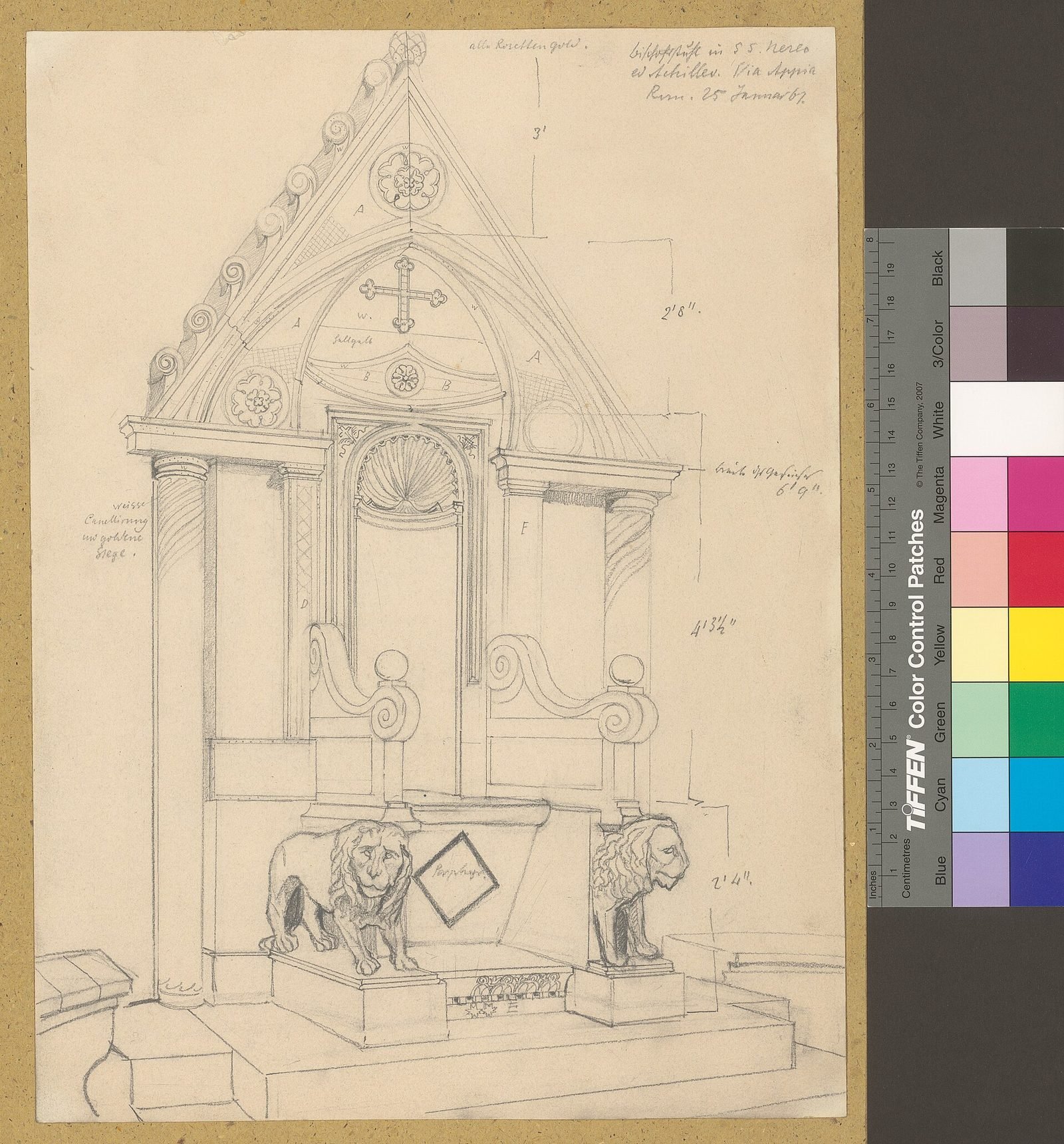
Behind the altar, at the center of the apse, stands the episcopal cathedra in marble, and on its back Baronio had an inscription engraved recalling how from that place Gregory the Great delivered his homily to the faithful gathered in the basilica of Saints Nereus and Achilleus. It is the most Baronian gesture in the whole church: taking a textual fact, that is, the heading of a Gregorian homily handed down by manuscripts, and materializing it in an object that the 16th-century believer could see and touch. Written history becomes furnishing.
It must be said precisely what is certain and what is not. It is documented that one of Gregory the Great's homilies on the gospels was delivered in the basilica of Saints Nereus and Achilleus: the codices say so. That the cathedra visible today is materially the seat on which Gregory sat cannot be demonstrated and no serious scholar claims it: the inscription commemorates an event, it does not certify the object. The distinction is subtle and most tourist accounts skip it, turning a commemoration into a relic.
The altar and the relics
Under the high altar are kept the relics of the titular martyrs, brought here from the cemetery of Domitilla in the context of the early medieval translations that progressively emptied the suburban cemeteries to put the saints' bodies safe inside the walls. It's the same phenomenon that filled the churches of central Rome with relics from the Catacombs of Rome, and that explains why today many underground cemeteries are archaeologically extraordinary and devotionally empty.
A curiosity about Santi Nereo e Achilleo
The curiosity concerns a detail almost nobody notices: this church has changed position. According to a reconstruction accepted by a good part of scholars, the original titulus Fasciolae did not stand exactly where the present building is, and the move would be tied to the reconstruction by Leo III, who chose a slightly different site along the same road axis. The fact is not unanimous and an excavation check that would settle it definitively is lacking, so we report it for what it is, a majority hypothesis. For a place of worship whose identity rests on a topographical episode, the bandage fallen at a precise point, it is a paradox worth pointing out: the memory of the place has proved more resistant than the place itself.
Something nobody tells you about Santi Nereo e Achilleo
What is almost never said is that Santi Nereo e Achilleo is the missing piece of an itinerary that already exists and that almost everyone walks halfway: that of the churches of the valley between the Aventine and the Celio. Within a kilometer and a half from here are some of the oldest places of worship in the city, and almost no visitor lines them up.
The itinerary nobody proposes
Starting from Santa Sabina on the Aventine, with its 5th-century wooden portal and the early Christian nave still legible, you go down toward San Saba, cross the avenue and arrive at Santi Nereo e Achilleo. From here you climb back up a few hundred meters to Santa Balbina, which occupies a late antique hall on a green rise and has a history parallel to this one, and continue toward San Sisto Vecchio, the ancient titulus Crescentianae on the opposite side of the avenue, tied to the first Dominicans in Rome. Neither of these last two churches has a page on this site, and they have to be looked up separately: we mention them because without them the picture of the area stays incomplete. The full route, with all the stops, fits within a morning, but it has to be built knowing that at least half the doors will be closed.
The area is less touristy than it looks
The second little-known fact concerns the flows. The Baths of Caracalla receive a substantial number of visitors, and on summer evenings the area fills up for the performances held in the archaeological enclosure, starting with the opera season the Teatro dell'Opera has organized there for decades and for which a dedicated page on the Caracalla Festival events exists, as well as the series of free concerts by Jazz Image under the baths. Those flows, however, stop at the enclosure: they cross the avenue toward the gate and don't turn around. At 50 meters' distance, the church stays outside any circuit. Whoever finds it open almost always visits it alone.
My advice for visiting Santi Nereo e Achilleo
The practical advice is one and sums up in a line: treat it as an appendix to the visit to the Baths of Caracalla, and go before the baths, not after.
Why before and not after
The Baths of Caracalla are an open-air archaeological site of more than 10 hectares, with changes in level, gravel, little shade and a route that takes at least an hour and a half done at an easy pace. Whoever comes out is tired, overheated in summer and with their attention threshold used up. In those conditions a dark church with a mosaic up high produces nothing. Going in first, with 10 more minutes of clarity, you read the triumphal arch, look at the inlays up close, understand the inscription on the cathedra, and then cross the street with a precise question to take with you into the imperial enclosure: how a Christian community of houses and tituli coexisted with a public complex of that scale.
Light, clothing and small change
The interior depends almost entirely on the natural light from the high windows, because artificial lighting is scarce and not always on: on an overcast January day the mosaic is practically unreadable, so choose a clear morning. Bring compact binoculars for the triumphal arch, clothing that covers shoulders and knees (it's an active church) and a few one-euro coins, because in many Roman churches the apse lighting is coin-operated.
Another well-known fact, yet rarely mentioned
The fact is this: early Christian Rome organized itself on the consular roads and on the cemeteries outside the walls, and the church of Santi Nereo e Achilleo is one of the nodes where you can still see that system at work. Everyone in the trade knows it, and almost nobody tells visitors.
Inside the walls and outside the walls
Until the 4th century the Christians of Rome buried their dead outside the urban perimeter, because Roman law required it, and celebrated in houses inside the city. From that double geography come two families of buildings: the urban tituli, like this one, and the suburban cemetery basilicas, like the one built over the tomb of Nereus and Achilleus in the cemetery of Domitilla. The road connecting the two passes through here: you leave the city by Porta San Sebastiano, the monumental gate of the Aurelian Walls that today houses the Museum of the Walls, and continue on the Appia toward the Catacombs of San Callisto and the Catacombs of San Sebastiano, with the basilica of San Sebastiano fuori le Mura built over them. The parallel branch of the Ardeatina leads to the Catacombs of Domitilla, and the valley in between is that of the Caffarella Park.
The right photo to take at Santi Nereo e Achilleo
The right photo at Santi Nereo e Achilleo is just one and has to be taken from the inside, from the center of the nave, with the triumphal arch closing the frame at the top and the presbytery with the cathedra at the back. It's the only image that conveys the sense of the place: a small space culminating in a mosaic 1,200 years old.
How to set it up
You need a moderate wide-angle focal length, between 24 and 35 millimeters equivalent, and a stable support, because without flash and with natural light the exposure times lengthen immediately. Flash is not used in a church, out of respect and because it flattens the mosaic surfaces, canceling exactly the play of reflections that makes them alive. If you have a small tripod, check first that its use is allowed: in many Roman churches it is forbidden without a permit, and a rector who finds you with the equipment set up has every right to have you take it down.
Some important events that took place here in history
The history of Santi Nereo e Achilleo reads well by episodes, because each of them left a material mark on the building you visit today.
499: the title appears in the records
In the Roman council of 499, convened by Pope Symmachus, the titular priests sign the records indicating their own church. Among those listed appears the titulus Fasciolae. It is the first certain documentary appearance and remains the official birth date of the church, even though the institution was in all likelihood a few decades older.
End of the 6th century: the Gregorian homily
The manuscript tradition of Gregory the Great's Homiliae in Evangelia assigns one of the homilies to the basilica of Saints Nereus and Achilleus. Beyond its devotional value, that fact is proof that at the end of the 6th century the church already had the name of the two martyrs and was important enough to host the bishop of Rome. It is the event Baronio chose to commemorate a thousand years later with the inscription on the cathedra.
Between the 8th and 9th centuries: Leo III rebuilds
The pontificate of Leo III, from 795 to 816, marks the decisive transformation: reconstruction of the building, translation of the relics from the cemetery of Domitilla, creation of the triumphal arch mosaic. He is the same pope who on Christmas night of 800 crowned Charlemagne emperor in St. Peter's, and the figurative culture of this mosaic belongs entirely to that political and cultural climate.
1596 and 1597: Baronio's building project
Cesare Baronio receives the cardinal title of Santi Nereo e Achilleo from Clement VIII in 1596 and immediately begins the restoration, which leads to the reopening for worship the following year. In those months the medieval marble furnishings are reassembled, altar and cathedra put in order, and the painted cycle on the nave walls created. The date remembered as the moment of the reconsecration falls in the month of May, near the liturgical memorial of the two martyrs, set on the 12th of the month.
Between the 1800s and the 1900s: the Passeggiata Archeologica
The last event that changed the church did not happen inside but outside. The arrangement of the Passeggiata Archeologica, the great project of avenues and green areas linking the Circus Maximus to the walls past the baths, redrew the whole surroundings between the end of the 1800s and the first decades of the 1900s. Demolitions and leveling isolated the building, which found itself facing a through avenue where before there were vineyards, kitchen gardens and a fine-grained fabric. A good part of the feeling of estrangement you get on arriving here comes from that urban intervention, not from the Middle Ages.
Who has passed through Santi Nereo e Achilleo
The list of people documented in relation to this church is short but high-level, and concentrates in two moments: late antiquity and the Counter-Reformation.
Gregory the Great
Pope from 590 to 604, Gregory the Great is the most important name tied to this place. His homilies on the gospels were delivered in the churches of Rome according to a stational calendar, and one of them is referred by the manuscripts to the basilica of Saints Nereus and Achilleus. Whoever wants to follow his trail in this part of the city has, a few hundred meters away, San Gregorio al Celio, which arose on the site of the family house he turned into a monastery.
Leo III
The pope who rebuilt the building and brought the relics there is the same protagonist of the coronation of 800. The arch mosaic is his signature here.
Cesare Baronio
An Oratorian, disciple of Philip Neri, author of the Annales Ecclesiastici, Baronio is the figure who determined the present look of the church. His presence in Rome can be read in several places, but this title is the one where his method as a historian becomes architecture and furnishing.
Niccolò Circignani
The painter of the martyrdom cycle, active in Rome in the last quarter of the 1500s, worked for the great commissions of the Counter-Reformation and his name remains tied above all to the martyrdom cycles, starting with that of Santo Stefano Rotondo.
What to see nearby, in order of distance
The church of Santi Nereo e Achilleo is at the center of one of the densest areas of monuments in Rome, and almost everything around it is reached on foot in less than 20 minutes.
Within five minutes
The Baths of Caracalla are literally across the way, with ticketed entry and regular hours. It is the main visit of the area and should be allowed at least an hour and a half.
Within 10 minutes on foot
Toward the northwest you reach the Circus Maximus and from there climb back toward the Aventine, with Santa Sabina and the Orange Garden. Toward the northeast you climb the Celio, where the Case Romane del Celio are, beneath the basilica of Santi Giovanni e Paolo, Villa Celimontana and Santa Maria in Domnica.
Within 20 minutes on foot
Continuing along the avenue toward the south you reach Porta San Sebastiano and the Museum of the Walls, with the chance to walk on a stretch of the walkway of the Aurelian Walls. Just before the gate, on a side street, is San Giovanni a Porta Latina, with its portico and Romanesque bell tower. Toward the west you instead go down to the Forum Boarium, with Santa Maria in Cosmedin, the Mouth of Truth and San Giorgio in Velabro. Toward the southwest you reach the Pyramid of Cestius and Porta San Paolo.
Where to eat near Santi Nereo e Achilleo
Let's start with the honest warning: on Via delle Terme di Caracalla there is practically nothing. It is a monumental avenue flanked by green areas, archaeological boundary walls and a few institutional offices, without the fabric of ground-floor shops that in Rome produces trattorias. Whoever counts on eating here goes hungry or ends up in one of the few places that work exclusively on the passing trade of visitors to the baths, which is the worst condition for anyone looking for a decent meal.
Where to go, then
There are two directions and both are on foot. Going back up toward the northwest you enter the residential Aventine and then go down toward Testaccio, which remains the district with the highest density of everyday Roman cooking and with an active covered market. Toward the northeast you climb the Celio and continue toward the San Giovanni area, where the neighborhood fabric resumes. In both cases we're talking about 15 or 20 minutes of walking, which is exactly the price to pay to get out of the monument price band.
The signs of a trap, which count double here
We don't name places, as an editorial choice: a list of signs gets old in a few months and teaches nothing. We teach instead how to recognize the places to avoid, because the signs are always the same. The lady rolling out fresh pasta behind the window or directly on the sidewalk is an advertising lure, not a sign of a kitchen. The menu with photographs of the dishes, in several languages, means the place doesn't expect to see you again. Whoever stops you in the street inviting you to sit is selling you a table, not a lunch. A kitchen open without a break from morning to night is not flexibility, it's a production line that reheats. And the places set in front of famous monuments are the ones where you most often find items without prices on the menu, or a different price list between the outdoor seating and the dining room.
The chapter on chains should be added: signs repeated identically at several points in the center, with the same menu and a line with ticket numbers, are a phenomenon that concerns tourism exclusively. Romans don't go there. We don't name them and we don't recommend them, and whoever wants to understand where to eat in a city has to start from this fact.
The criterion that always works
The quickest method for judging an unknown place remains the simplest: look at who is sitting at the tables and in what language they order. If at two on a Tuesday afternoon the room is full of people speaking Italian and not consulting a map, you're in the right place. If instead the tables turn over every 40 minutes with customers who photograph the dish before tasting it, you'll pay a bill higher than it's worth.
For those who want a personal, unsponsored reference, there is Daniele Dezi's personal list on Google Maps, curated in the field and updated by hand.
Frequently asked questions about Santi Nereo e Achilleo
How much does it cost to enter Santi Nereo e Achilleo?
Admission to the church of Santi Nereo e Achilleo is free, as in all the churches of Rome that are not part of a paid museum circuit. There is no ticket office or reservation. The only possible cost is an offering for the timed lighting, where present, which in Roman churches is usually activated with a one-euro coin.
What are the opening hours of the church of Santi Nereo e Achilleo?
The opening hours of the church of Santi Nereo e Achilleo are very limited and do not appear stable over time, so much so that we don't publish a time slot in order not to mislead. The information circulating on third-party sites is often old and contradictory. It's best to contact the rectory or consult the official channels of the Vicariate of Rome a few days before, and allow for the concrete possibility of finding the door closed.
How do you get to Santi Nereo e Achilleo by public transport?
You get to Santi Nereo e Achilleo by metro line B, stop Circo Massimo, followed by about 10 minutes of level walking along Viale delle Terme di Caracalla. Alternatively, some surface lines headed toward Porta San Sebastiano and the Appia Antica run along the avenue, including the 118. Routes and numbering change often, so it's best to check them the same day.
How much time do you need to visit Santi Nereo e Achilleo?
To visit Santi Nereo e Achilleo, 20 minutes are enough, which become 40 if you read the painted cycle of the martyrdoms panel by panel and linger over the marble inlays of the presbytery. The building is small and is crossed in a few steps. The real time to budget concerns access, because the opening is irregular and organizing the visit requires a preliminary check.
What can you see inside Santi Nereo e Achilleo?
Inside Santi Nereo e Achilleo you see the Carolingian mosaic of the triumphal arch from the time of Leo III, with the Transfiguration at the center and the Annunciation at the side, the fresco cycle with the martyrdoms of the apostles attributed to Niccolò Circignani known as il Pomarancio, the medieval marble furnishings with Paschal candlestick and inlaid ambos, and the cathedra with the inscription commissioned by Cesare Baronio.
Is the church of Santi Nereo e Achilleo suitable for children?
The church of Santi Nereo e Achilleo is not a suitable stop for younger children, because the cycle painted on the nave walls depicts the martyrdoms of the apostles explicitly and unfiltered. For older kids, accompanied by an explanation of the historical context, it can instead be an effective lesson on the Counter-Reformation. Five minutes away are the lawn of the Circus Maximus and the park of Villa Celimontana.
Why was the church called titulus Fasciolae?
The ancient name of the church of Santi Nereo e Achilleo was titulus Fasciolae, documented in the records of the Roman synod of 499. Popular tradition ties the term to the bandage that fell from the wounds of Saint Peter fleeing along the Appia, but this is a devotional legend with no documentary support. The soberest explanation is onomastic: Fasciola would be the name of the person who donated the house or the land of the title.
Can you take photographs inside Santi Nereo e Achilleo?
Inside Santi Nereo e Achilleo, photographs without flash are generally tolerated, as in most Roman churches, while during services you don't shoot. Flash should always be avoided, both out of respect and because it cancels the reflections of the mosaic tesserae. For a tripod a permit is normally required: it's better to ask whoever looks after the church first instead of setting it up and hoping.
Is it worth the visit if I have little time in Rome?
The church of Santi Nereo e Achilleo should be included in a short trip only as an appendix to the visit to the Baths of Caracalla, which are on the opposite sidewalk and have certain hours. Whoever has two or three days in Rome shouldn't build a dedicated detour, given the irregular opening. Whoever lives in the city or comes back often has here one of the few surviving Carolingian mosaics.
Who wrote this page
This page is curated by the editorial team of Tour Leader Pro, the Rome-based project office that designs and coordinates visits, itineraries and cultural events in Rome and Lazio. Hours, fees and access conditions given here were verified at the publication date against the official sources indicated in the text: it's best to recheck them before leaving, because they change often. If you find outdated information, let us know.
Whoever is building a wider itinerary in this sector of Rome, lining up the Baths of Caracalla, the titular churches between the Aventine and the Celio and the initial stretch of the Appia Antica, will find planning tools and organizational support on Tour Leader Pro, which works on Rome and Lazio with groups, schools and corporate trips.
For the wider picture, from rail and airport connections to destinations in the rest of Italy, a useful reference is Italy Planner, which collects practical information on transport, travel times and seasonality for those planning a trip that doesn't stop at Rome.