Santa Maria in Domnica alla Navicella
In short. Santa Maria in Domnica alla Navicella stands on top of the Celio, in Piazza della Navicella, right in front of the entrance arch of Villa Celimontana.
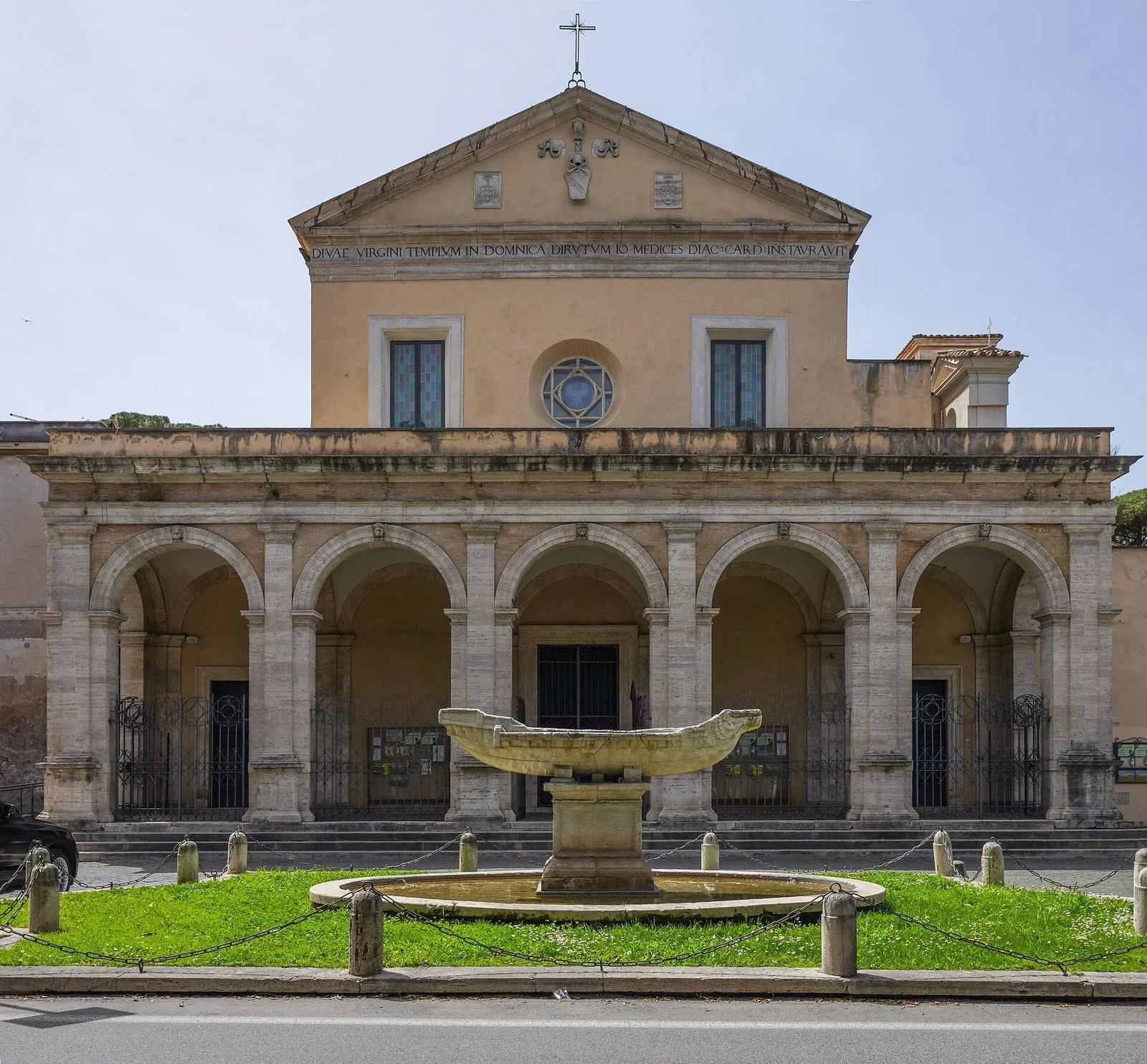
Santa Maria in Domnica alla Navicella stands on top of the Celio, in Piazza della Navicella, right in front of the entrance arch of Villa Celimontana. There is only one reason to climb all the way up here, and it's best to say it right away, without preamble: the Carolingian apse mosaic commissioned by Pope Paschal I between 817 and 824, with the Virgin enthroned and surrounded by a crowd of angels on a flowering meadow and the pope kneeling at her feet, with the square nimbus that in medieval iconography marks a person still alive when the work was made. It's one of the best preserved mosaics in Rome, and also one of the least visited: on weekday mornings you can have the nave to yourself, while 500 meters away the Colosseum deals with 30-minute lines. This page explains what you see, how to look at an apse mosaic without ruining your neck and your eyes, where the nickname "alla Navicella" comes from, and above all what is documented and what remains a hypothesis, because on this church the popular literature takes for certain quite a few things that are not certain.

A practical warning before anything else. Opening hours are limited and variable, admission is free and there is no ticket office: if you walk up without checking, you may find the door closed. Further on we explain how to reduce that risk.
Where Santa Maria in Domnica alla Navicella is and how to get there
The address is Via della Navicella 10, in the Celio district, at the highest point of the hill, where the street climbing from Via Claudia meets the boundary wall of the public villa. The church closes the northern side of the piazza with a portico of five arches. Across from it, on the opposite side, is the gate of Villa Celimontana with the Arch of Dolabella built into later structures. In between, on the traffic island, is the boat-shaped fountain that gave its name to the whole area.
The climb: a practical detail nobody writes down
The Celio is a real hill, not a symbolic rise. From the Colosseum you climb along Via Claudia on a steady slope for about 600 meters, and on a July day at two in the afternoon you feel that slope. If you come from St. John Lateran, the climb is smaller but the route is longer, about a kilometer along Via della Navicella, on narrow sidewalks with constant traffic. The practical difference between the two routes is all here: from the Colosseum it's quicker and harder, from the Lateran you walk more on gentler ground.
By metro
The two useful stops are both on line B: Colosseo and Circo Massimo. From Colosseo it takes about 12 minutes on foot, uphill, and from Circus Maximus about 15 minutes via Via di San Gregorio and the Clivo di Scauro, which is the nicer of the two routes because it runs alongside the apses of the Basilica of Santi Giovanni e Paolo and passes under the medieval buttress arches. Line A doesn't serve it: from San Giovanni, which is on line A, the walk is the one described above.
By surface transport
Via della Navicella is served by the surface lines that connect San Giovanni with the Celio and Piazza Venezia area, and the stop is a few meters from the portico. Roman bus routes change often because of construction and detours, so it's better to check the line number on the transit company's app on the same day than to trust a number you read somewhere months ago. Tram 3 and tram 8 don't come up here: the 3 runs below the hill, along Via Labicana and Viale Aventino, and from there you still have to climb on foot.
Paschal I's apse mosaic, which is the reason for the visit
The mosaic in the apse of Santa Maria in Domnica alla Navicella was made during the pontificate of Paschal I, who reigned from 817 to 824, and it covers the whole apse semi-dome above the high altar. The Virgin sits on a jeweled throne, with the blessing Child on her lap, and behind her stands a host of haloed angels, arranged in several rows, filling the background to the edges of the basin. Beneath the feet of the throne the ground is a flowering meadow, with lilies, roses and poppies rendered in tesserae of just a few colors but with a botanical precision you don't expect from an early medieval mosaic. At the Virgin's feet, kneeling and reduced in scale compared with all the other figures, is the patron: Pope Paschal I, who clasps the Madonna's foot in a gesture of devotion.
The square nimbus, or how to date a mosaic by looking at it
Around Paschal's head there is not the circular halo of the saints but a blue square, the square nimbus. In the early medieval Roman iconographic convention, that square means one precise thing: the person portrayed was still alive when the image was made. The convention is a rule that can be checked across a series of Roman monuments consistent with one another, and it serves to date the mosaic within the years of the pope's pontificate, that is, between 817 and 824. Whoever can read this detail has a dating at a glance, with no need for archive documents.
Paschal I himself appears with the square nimbus in two other Roman building projects of his: in the apse and in the Chapel of San Zeno of the Basilica of Santa Prassede and in the apse of the Basilica of Santa Cecilia in Trastevere. If you visit the three churches on the same day you see the same workshop hand, the same elongated faces, the same color range, and you understand that they are not three isolated episodes but a single program carried out in less than 8 years. It's the most efficient way to study Carolingian mosaic in Rome, and you do it on foot and without tickets.
The crowd of angels: what makes it different
In the oldest Roman apse mosaics the scheme calls for a few large figures, lined up at the sides of the central figure. Here something else happens: the angels number in the dozens, they recede in depth, they crowd behind the throne like a court, and the heads of the back rows peek out between the shoulders of those in front. The effect of a multitude has no close parallels in the Rome of the time, and scholars read it as a deliberate revival of late antique models, in the climate of return to the antique that historians call the Carolingian renaissance. The angels' haloes, overlapping one another, create a rhythm of golden discs that to the naked eye reads as a continuous weave.
The inscription at the base of the basin
Beneath the scene runs an inscription in capital letters on a dark ground, in hexameter verses, which celebrates the rebuilding of the church and names Paschal as the one who rebuilt the previously ruined building. The text is hard to read from the floor, both because of the distance and because of the abbreviations, and the transcriptions published in nineteenth- and twentieth-century editions are not identical to one another in every letter: if you need the exact text, go to a critical edition of the medieval Roman inscriptions and don't trust what you find in online summaries. The content, however, is clear and consistent with the portrait of the pope below it: it is a monumental signature.
How to look at the apse mosaic without wasting your visit
A high, distant apse mosaic is not looked at like a painting, and most visitors find this out the worst way: they come in, look up for 10 seconds, photograph it against the light and leave convinced they've seen it. With the mosaic of Santa Maria in Domnica alla Navicella you need a method, and the method costs five minutes.
Where to stand
The best position is not under the triumphal arch, where the neck bends too much and the curvature of the basin shortens the figures, but halfway down the central nave, roughly at the level of the fourth or fifth column counting from the entrance. From there the line of sight meets the center of the semi-dome at a more natural angle and the perspective distortion intended by the mosaicists works again: the figures straighten up, the meadow spreads out, the row of angels opens up in depth. If you have a little patience, try two or three different positions along the nave and choose: the difference is obvious.
The light, which is the real problem
The apse faces the southern quadrant and the nave windows are few and high. This means the useful natural light arrives in a limited time window, and on overcast days the basin stays dark. The gold of the tesserae needs raking light to come alive: when it gets it, the background goes from brown to warm yellow within a few minutes, and the figures stand out. If the mosaic looks dull when you walk in, wait 10 minutes seated at the back of the nave before giving up. Often everything changes.
Where there is a coin-operated or push-button lighting system, as in many Roman churches, use it: a few tens of cents transform the visit. We don't guarantee that it is permanently active here, because these systems get switched off, moved or replaced without notice, and stating it as certain would be wrong. It's worth looking for it along the right aisle and near the presbytery.
Why you need patience to train your eye
A mosaic of small tesserae, seen from 20 meters, at first reads as a compact surface. The details emerge later, once the eye has learned the scale: first the faces, then the hands, then the wings, then the flowers of the meadow, which are the last thing to appear and the most surprising. The minimum time for this to happen, all told, is around seven or eight minutes of continuous looking. Whoever spends two leaves without having seen the meadow. A lightweight pair of binoculars, even opera glasses, shortens the process and bothers no one.
The triumphal arch, the columns and the ceiling
The mosaic program doesn't end in the basin: it continues on the triumphal arch, where Christ appears at the center inside a mandorla flanked by two angels, and at the sides are the figures of the apostles, with two prophets in the lower area. Reading from below is harder than in the apse because the arch is tilted relative to your line of sight, but the figures are larger and the colors more legible.
The coffered ceiling
The wooden coffered ceiling is sixteenth-century and belongs to the renovation campaign that also affected the facade. In the panels and friezes there are heraldic emblems of the Medici family, consistent with the fact that the church's cardinal title was then held by Giovanni de’ Medici, the future Pope Leo X. There are also nautical references, which point back to the marble boat in front of the church: in the 1500s the nickname was already felt as part of the identity of the place and the decoration went along with it.
The painted frieze
Below the ceiling, along the nave, runs a frieze painted with grotesques and figures. Scholars attribute it to the circle of Perin del Vaga, in some cases on an idea by Giulio Romano, but the attribution is not unanimous and should be taken as an indication of milieu rather than as a signature. We point it out because it's the kind of detail that in quick guides becomes a certainty without anyone checking on what basis.
The facade and the portico: an attribution that remains open
The facade of Santa Maria in Domnica alla Navicella is sixteenth-century and takes the form of a portico of five arches on columns, topped by an upper order with windows. It's a piece of high-level Roman Renaissance architecture, much more refined than its out-of-the-way position would suggest, and for exactly this reason people have argued for centuries about who designed it.
Sansovino or the circle of Raphael
The two recurring proposals are Andrea Sansovino, active in Rome in the early years of the 1500s, and the circle of Raphael, with the name of Giulio Romano appearing in some readings. Neither is supported by a commission document assigning the design to a person with a first and last name, and the specialist literature treats it as a debated attribution. Let's say it plainly, since almost no one does: whoever writes "work of Andrea Sansovino" without adding "attributed" is oversimplifying. The solid datum is another one, the chronology: the campaign falls in the years of Giovanni de’ Medici's cardinalate, so within the second decade of the 1500s.
The Navicella fountain and the origin of the nickname
In front of the church, in the middle of the piazza, there is a marble boat about two meters long set on a base, with water coming out of it: this is the Navicella, and the church, the street and the whole plateau take their name from this boat. What you see today is a sixteenth-century copy, made as part of the same works that produced the portico, and not the original ancient piece.
What is documented
It is documented that in this area there was a marble model ship of the Roman period, and that in the 1500s it was replaced or remade in its present form, with the addition of a fountain function and of a base suited to the new arrangement of the piazza. It is documented that the church's nickname appears in the sources in connection with this object. It is documented, finally, that the ancient piece belonged to the category of votive ship models, which in the Roman world were offered to the gods in fulfillment of a vow, often after a sea voyage or a recovery from illness.
What remains a hypothesis
The most widespread hypothesis links the ex-voto to the presence on the Celio of military men tied to the fleet: the area was home to the urban camp of the peregrini, the soldiers detached from the provinces and stationed in Rome, and nearby there are attested units of sailors from the fleet of Misenum, also employed to operate the equipment for the shows. Hence the hypothesis that the little ship was an ex-voto offered by seamen. It seems reasonable to us, and it is the reconstruction that appears most often in the literature, but it must be said clearly that it is a reconstruction from topographical context, not a deduction from an inscription linking the object to a dedicator. Whoever tells it as an established fact is going beyond the sources.
The confusion with the other Navicella
Many visitors come up here having read somewhere about the "Navicella" and expect a mosaic with a boat: that is something else and is on the other side of the river. The medieval mosaic with the boat of the apostles on a stormy sea, the work of Giotto's workshop for the atrium of the old Vatican basilica, has no relation to the Celio fountain beyond the shared name. Someone planning a tour around the Vatican Museums and someone climbing the Celio are following two different itineraries.
History: from titulus to diaconia, and beyond
Santa Maria in Domnica alla Navicella has its origins in an ancient Christian foundation on the Celio, in an area occupied in the imperial age by barracks and aristocratic residences. The name Domnica is traced back to the Latin dominicum, that is, building of the Lord, one of the terms used in late antiquity to indicate the Christian place of worship, or to a matron named Ciriaca according to a later hagiographic tradition. The first explanation is the linguistically sounder one, the second should be treated as popular tradition.
Paschal I's reconstruction
The decisive moment is the pontificate of Paschal I, between 817 and 824. The apse inscription declares that the previous building was in ruins and that the pope rebuilt it: that is, the basilica structure you walk through today, in its layout, is Paschal's building project, onto which later interventions were then layered. Paschal I was one of the great builders of early medieval Rome, and his three main churches, this one, Santa Prassede and Santa Cecilia, form the most coherent body of Carolingian mosaics in the city.
The diaconia and its welfare role
In the early Middle Ages the church was the seat of a diaconia, that is, an ecclesiastical structure that also had welfare and food distribution functions. Roman diaconiae were often located near transit routes or densely inhabited areas, and this explains why a church in an apparently peripheral position had such a high rank. The cardinal title of Santa Maria in Domnica is still a diaconia today.
The Medici building project
The second decisive moment is the early 1500s, when the title was held by Cardinal Giovanni de’ Medici, elected pope in 1513 as Leo X. The portico, the coffered ceiling and the new arrangement of the piazza with the fountain date from that period. It's the reason a Carolingian basilica today has a Renaissance facade: two layers on top of each other, 700 years apart, both of high quality, something that happens in Rome all the time and that elsewhere would be considered an anomaly.
Hours, admission and accessibility: what we can say and what we can't
Admission to Santa Maria in Domnica alla Navicella is free and there is no ticket: anyone proposing a fee to enter this church is selling something else, for example a guided visit, which is legitimate but is a different service from access. Opening hours, on the other hand, are limited and change over time, and here we deliberately stop.
Why we don't publish a schedule
Roman churches not run by a museum body open depending on the availability of the clergy and volunteer staff, and hours change with the liturgical seasons, with the summer months, with works and with changes of rector. Publishing a time slot that then doesn't match is the quickest way to make a reader climb for nothing. So: before going up, check the official channels of the parish and of the Vicariate of Rome, or call. If you arrive in the city with a tight schedule, do this check the day before, not the same morning.
The likelihood of finding it closed
You have to allow for the door being closed, particularly in the middle of the afternoon and on weekdays out of season. The practical advice is to always pair this stop with two or three others on the Celio, so that the climb doesn't depend on a single door: if this one is closed, 200 meters away there are Santo Stefano Rotondo and the entrance to Villa Celimontana, and a little further down the Roman Houses of the Celian Hill. Nobody has ever lost a day on the Celio over a closed church, provided they climbed up with a plan B.
Accessibility and rules of conduct
Access from the piazza is through the portico and involves a short change in level. The interior floor is continuous and the nave can be walked without steps up to the presbytery, which is raised. For wheelchair users the main difficulty is the approach, that is, the climb up the hill, more than the church itself: for this reason we recommend having a taxi drop you directly in Piazza della Navicella. Inside, the usual rule of all active churches applies: clothing that covers shoulders and knees, silence, no visits during services, no flash. If a Mass is under way, the apse is occupied by the liturgy and you don't look at the mosaic: you come back later.
A curiosity about Santa Maria in Domnica alla Navicella
The curiosity concerns the pope's gesture in the mosaic. Paschal I is not shown standing next to the Virgin, as a donor presenting his work would be, nor kneeling at a respectful distance: he is bent at the foot of the throne and holds the Madonna's foot in his hands. In the repertoire of Roman apse mosaics this kind of physical contact with the sacred figure is rare, and it should be read as a deliberate choice.
Why that gesture matters
The patron who touches the Virgin's foot declares a direct, unmediated relationship. In the same decade Paschal I had himself portrayed with the square nimbus in two other churches, offers models of buildings, signs with verse inscriptions: he is a pontiff who uses the image as a tool of institutional assertion in a historical phase when the Roman papacy was redefining its position relative to the Carolingian empire. The foot clasped in his hands, in that context, is not devotional tenderness. It is a declaration of legitimacy.
A detail almost nobody notices
The scale of the figures. The pope is less than half the height of the angels around him, and this difference in proportion does not come from the mosaicists' lack of skill but from a codified visual hierarchy: the more important a figure, the larger it is. In a mosaic where all the other characters have the same size, the shrunken portrait of the patron is the only element that declares itself as belonging to the world of the living. Whoever looks at the basin knowing this reads the image in two minutes instead of 10.

Something nobody tells you about Santa Maria in Domnica alla Navicella
That it is one of the very few chances, in Rome, to see a first-rate apse mosaic without waiting in line, without paying and without sharing the space with a group talking loudly. This fact appears in no guide because it belongs to the category of crowding and not to that of art history, and nobody measures crowding. It's worth measuring, because it determines how much time you need and how much you understand.
The comparison that gets the idea across
To see the mosaics of Santa Maria Maggiore in the nave you have to live with a continuous flow of visitors and with checks at the entrance. For Santa Maria in Trastevere you have to squeeze in between the tourists in the piazza and the services. Here, on a weekday morning in November, you are alone. The quality of what you look at is not lower: the difference is only one of fame, and fame depends on position along the tourist route, not on the value of the work.
The price to pay
The price is that the church may be closed and that nobody welcomes you, explains things to you, sells you an audio guide. There is no bookshop, no hall staff, no panel telling the story of the mosaic. Whoever wants to understand has to arrive prepared or with someone to explain. It is exactly the flip side of the silence, and it seems honest to us to say so.
A note on the district
The Celio, after six in the evening and outside the months of the summer festival at Villa Celimontana, empties out. The streets are poorly lit and the sidewalks are narrow: which creates a problem of orientation and darkness, not of safety. Whoever comes up in the evening for a concert finds an entirely different context, with the audience of the Village Celimontana filling the villa's paths, and the open-air cinema of Celio Stellato also brings people to the hill on summer evenings. They are two different Celios, and the church belongs only to the first, because in the evening it's closed.
My advice for visiting Santa Maria in Domnica alla Navicella
My advice is not to treat it as a stop on its own, but to build a three-hour Celio route around it, starting from the bottom and going up, and to put this church in the middle and not at the end, when your legs are already gone and so is your concentration.
The order we recommend
You start from Colosseo metro, climb along Via Claudia, look at the Ludus Magnus from above the fence and continue toward Piazza della Navicella. First stop the church, while your mind is fresh and the morning light is the good kind. Then you cross and enter Villa Celimontana for a break in the shade. You leave from the opposite side and go down toward Santi Giovanni e Paolo and the Clivo di Scauro, with the option of the Roman Houses of the Celian Hill beneath the basilica. Whoever still has energy finishes with Santo Stefano Rotondo, which however has its own hours and should be checked with the same care.
The time of day
The morning, between nine and 11, is the window with the best ratio of light to likelihood of finding it open. Early afternoon is the worst slot on both counts. On Sunday morning the church is open for services, so you can enter but not visit at leisure: it's a choice between two different things.
How much time to allow
For the church alone, 25 to 40 minutes, of which at least eight standing in front of the apse. For the complete Celio tour described above, three hours without lunch and four with. If you have two days in Rome and have never been to the Roman Forum or the Palatine, do those first: this is an itinerary for a second or third trip, and we say it without beating around the bush.
The verdict, since one must be given
Among the three churches of Paschal I, the one that pays off most relative to the effort of getting there is Santa Prassede, which is 100 meters from Santa Maria Maggiore and also has the Chapel of San Zeno. Santa Maria in Domnica alla Navicella requires a climb and a check of the hours, so it costs more in organization. But it is the only one of the three where, with good probability, you are left alone in front of the mosaic. For those who come to Rome to look, and not to tick off a list, this is worth the climb.
Where to eat around the Celio, and the honest warning
On the Celio the dining offer is scarce, and whoever climbs up counting on finding a place to sit goes away empty-handed. It's a hill of barracks, hospitals, historic villas and churches: not enough people live there to support a network of trattorias, and the few places that exist mainly serve hospital staff during their breaks. It's better to know this beforehand, not at two in the afternoon with a hungry child.
Where to go down
The two sensible directions are San Giovanni, going down Via della Navicella, and the Monti district, via Via Labicana or past the Colosseum. In both cases you walk 10 to 20 minutes and enter neighborhoods where Romans actually eat, because they work and live there. The area immediately around the Colosseum is the one to cross, not the one to stop in: it is the band where the density of eateries is highest and the average quality lowest in the city.
We don't name names, and we explain why
On these pages we don't name restaurants. A list of signs gets old within a few months, the management changes, the cook changes, and the reader is left holding expired advice. We prefer to teach how to choose, which works always and everywhere. This also applies to the chains with the same sign repeated at several points in the center, identical menu and a line with ticket numbers: we don't name them, and we only observe that Romans don't go there. It's a field observation, repeatable by anyone who stops for 10 minutes to watch who goes in.
The five signs of a trap
The first sign is the lady rolling out fresh pasta in the window or at a table on the street: it's an advertising lure, not a kitchen, and almost always that pasta is not the one that reaches your plate. The second is the menu with photographs of the dishes: where you cook for customers who come back, there's no need to show what a carbonara looks like. The third is the barker at the door who invites you to sit down, sometimes with the price list in hand: a place that has to stop you on the street has a filling problem, and you pay for the problem. The fourth is continuous hours from morning to night with no kitchen break: a real kitchen stops between services, because it has to prepare. The fifth is the places set in front of famous monuments, which often pitch the price to the tourist in front of them, with items not priced on the menu or with different price lists inside and outside.
The criterion that counts most of all
Look at who is sitting and in what language they order. If at two on a Tuesday the tables are occupied by people ordering in Italian without looking at the menu, you're in the right place, even if the room is a bit ugly and the chairs don't match. If instead the room is full of people photographing the plate and nobody speaks Italian at any table, the place lives off passing trade, and whoever lives off passing trade has no reason to make you come back.
The list
Whoever wants concrete, up-to-date directions can consult Daniele Dezi's personal list on Google Maps, a curated, unsponsored collection of places tried over time. It's not a list of bought addresses and it contains no paid collaborations: these are addresses that someone chose to keep going back to, which is the only form of review that means anything.
Another well-known fact, yet rarely mentioned
That the Celio, in the imperial age, was a military hill. Everyone in the trade knows it and almost nobody tells visitors, who climb up imagining a hill of patrician villas and gardens and don't understand why the urban landscape is made of retaining walls, enclosures and service structures.
What was up here
On the Celio were settled the camp of the peregrini, that is, the soldiers detached from the provinces and employed in Rome on liaison and intelligence duties, and units tied to the imperial fleets, as well as barracks structures of which scattered traces remain underground and in reused masonry. Alongside these were high-level aristocratic residences, whose presence is documented by the remains that resurface beneath the churches: the Roman Houses of the Celian Hill under Santi Giovanni e Paolo are the clearest visitable proof. The military use of the hill has never stopped: the Celio military hospital still occupies a substantial portion of the plateau, and the boundary walls you walk beside on the way up belong to that function.
The right photo to take at Santa Maria in Domnica alla Navicella
The photo that works here is not the mosaic. It's the marble boat in the foreground with the Renaissance portico blurred behind it, because it's the only framing that explains in one shot both the name of the place and its architecture.
How to set it up
You stand on the side of the piazza facing the church, lower the shooting point to the height of the boat's side, and keep the portico centered in the background. With a phone you get the effect by moving very close to the bow and tapping the screen on the boat to lock focus: the background loses sharpness by itself. The best time is early morning, when raking sun lights the side of the little ship and leaves the portico in soft shade, or late afternoon, when the light turns and the opposite happens.
The apse photo, and why it almost always comes out badly
Photographing a golden apse basin with a phone almost always produces two flaws: the gold background becomes a brown blotch and the figures at the top get distorted because the wide-angle lens stretches the edges. If you care, do three things. Rest the phone on a column or a chair back to avoid camera shake, because the light is low and the exposure time gets longer. Tap the screen on the Virgin's face to force the exposure on that area rather than on the average of the scene. And give up the wide angle, using the optical zoom if your device has one, moving a few meters closer instead of widening the field. No flash, which on the mosaic is useless beyond three meters and in church is rude.
Common-sense rules
Filming inside active churches is tolerated if discreet and without flash, but it must be suspended during services and not done with tripods or bulky equipment without authorization. For professional or commercial shoots a permit is required, and it's requested in advance from the competent offices. This applies here as at the Basilica of Santi Quattro Coronati or the Basilica of San Clemente, where the rule is applied more strictly because of the underground layers.
Some important events that took place here in history
The history of this church is measured in building projects and patrons' names more than in news episodes, and the passages that count are few but very clear-cut.
Paschal I's building project, between 817 and 824
This is the event that produced everything else. A pope decides to rebuild a ruined church on the Celio and have it decorated with an apse mosaic that competes, in ambition, with the great late antique models of the city. The same pope, in the same years, opens the other two mosaic projects already mentioned: it is a coordinated campaign, not three episodes.
The sixteenth-century renewal under Giovanni de’ Medici
The titular cardinal, the future Leo X, promotes the works that give the church its portico, its ceiling and the arrangement of the piazza with the fountain. This is the moment the place enters the urban imagination with the nickname it still bears: from that project onward, for Romans, this is the church of the Navicella.
Modern restorations and securing the building
Like all Roman churches with ancient mosaic decoration, this one too went through several restoration campaigns between the 1800s and the 1900s, with work on the mosaic surfaces, the roofing and the plaster. The precise dates of the individual interventions are not common knowledge and we don't report them, because a list of years copied from unverified sources helps nobody. Whoever needs the detail will find it in the publications of the superintendencies and in the records of the building sites.
Who has passed through Santa Maria in Domnica alla Navicella
The list of people tied to this church is short and weighty: two pontiffs, a first-rate artistic circle and a long line of scholars who built whole chapters of medieval art history here.
Paschal I
Pope from 817 to 824, he is the patron of the mosaic and the rebuilder of the building. His portrait with the square nimbus at the Virgin's feet is the most direct document of his passage, and together with the two other portraits at Santa Prassede and Santa Cecilia it forms the most coherent series of papal self-representations of early medieval Rome.
Giovanni de’ Medici, later Leo X
Titular cardinal of the church before his election to the papacy in 1513, he is the man who brought the Renaissance up here. The heraldic emblems of his family in the ceiling and the choice to arrange the piazza around the marble boat tell of a precise patronage operation: taking an ancient basilica in an out-of-the-way area and giving it a facade that put it on a par with the churches of the center.
The circle of Sansovino and Raphael
On the name of the portico's designer the question remains open, as we said above, and the two candidacies in play, Andrea Sansovino and the circle of Raphael, are both supported on stylistic and not documentary grounds. Even without a certain name, the relevant fact remains: the building project involved workers of the highest level, the same ones who in those years were working on the great papal building projects.
The scholars of Roman mosaics
From the 1800s onward this apse has entered every repertory of Roman medieval mosaic, and its secure dating, guaranteed by the square nimbus and by the inscription, has made it a fixed point for dating by comparison works that lack references. Many datings of other monuments depend on this basin. Few little-visited churches carry a similar scientific weight.
What to see nearby, on the Celio and just below
Within a kilometer of Piazza della Navicella there is a concentration of monuments that in another city would be enough for three neighborhoods, and almost all of them share the trait of being little visited relative to their value.
On the hill
Across the piazza is Villa Celimontana, with the obelisk and the shaded paths. At 200 meters, Santo Stefano Rotondo, a circular-plan church of the early Christian era, with its own hours that are just as variable. Going down toward the Colosseum, the Basilica of Santi Giovanni e Paolo and beneath it the Roman Houses of the Celian Hill, which are paid and have limited-entry access.
Just below, toward the Lateran
10 minutes on foot separate the church from the Basilica of Santi Quattro Coronati, with its cloister and the Oratory of San Silvestro, and from the Basilica of San Clemente with its underground levels. A little further on you reach St. John Lateran, the Holy Stairs, the Lateran Obelisk and, stretching it a bit, Holy Cross in Jerusalem.
Toward the Circus Maximus and the Aventine
On the opposite side you go down to the Circus Maximus and climb up the other hill, where you find the Basilica of Santa Sabina, the Basilica of San Saba and the route described on our page on what to see on the Aventine. Whoever is headed instead for the Baths of Caracalla reaches them in a quarter of an hour going down Viale delle Terme, and in summer that complex hosts the open-air opera season.
The other mosaic churches
Whoever comes to Rome for the mosaics should build an itinerary linking this church to Santa Prassede, the Basilica of Santa Pudenziana, Santa Maria Maggiore, the Basilica of Santa Maria in Trastevere, the Basilica of Santa Cecilia, Santi Cosma e Damiano, the Mausoleum of Santa Costanza and the Basilica of Sant’Agnese fuori le Mura. That's eight stops and two full days, and it's one of the Roman itineraries with the best ratio between what you see and what you pay, because almost all these churches have free admission.
Frequently asked questions about Santa Maria in Domnica alla Navicella
How much does it cost to enter Santa Maria in Domnica alla Navicella?
Admission to Santa Maria in Domnica alla Navicella is free and there is no ticket office. It is an active church, not a museum site: there are no fees, no reservations and no entry pass is needed. Any offerings are voluntary. Guided visits offered by private operators have a cost that relates to the guide service, not to access to the building.
What are the opening hours of Santa Maria in Domnica alla Navicella?
The hours of Santa Maria in Domnica alla Navicella are limited and variable, and for this reason we don't publish any. Openings depend on the availability of the clergy and change with the liturgical seasons and with works. It's best to check the official channels of the parish and of the Vicariate of Rome the day before the visit, allowing for the possibility of finding the door closed.
How do you get to Santa Maria in Domnica alla Navicella by public transport?
Santa Maria in Domnica alla Navicella is reached from metro line B, stop Colosseo, about 12 minutes on foot uphill along Via Claudia, or Circo Massimo, about 15 minutes via Via di San Gregorio and the Clivo di Scauro. Via della Navicella is also served by surface lines, whose route is best checked the same day because it often changes due to construction.
Why is it called alla Navicella?
Santa Maria in Domnica owes its nickname to the marble boat placed in front of the church, in the piazza, turned into a fountain. The piece visible today is a sixteenth-century copy of a Roman model ship, in all likelihood an ex-voto. The link with the soldiers stationed on the Celio and with the fleet of Misenum is a reconstruction based on topographical context, not on an inscription.
How much time do you need to visit Santa Maria in Domnica alla Navicella?
For Santa Maria in Domnica alla Navicella, 25 to 40 minutes are enough, of which at least eight standing in the nave looking at the apse mosaic, which needs time to reveal the details of the flowering meadow. If you include the church in a Celio tour with Villa Celimontana, Santi Giovanni e Paolo and Santo Stefano Rotondo, you need about three hours.
What period is the mosaic of Santa Maria in Domnica from?
The apse mosaic of Santa Maria in Domnica alla Navicella dates from the pontificate of Paschal I, between 817 and 824, so from the height of the Carolingian age. The dating is guaranteed by the square nimbus around the pope's head, which in the Roman iconographic convention indicates a person alive at the time of execution, and by the verse inscription running beneath the scene.
Can you take photographs inside Santa Maria in Domnica alla Navicella?
Photographing inside Santa Maria in Domnica alla Navicella is tolerated if you shoot discreetly and without flash, as in most of Rome's active churches. Filming must be suspended during services, tripods are not allowed without authorization and professional shoots require a prior permit. Flash on the mosaic is in any case useless beyond three meters of distance.
Is Santa Maria in Domnica alla Navicella accessible to people with mobility difficulties?
Santa Maria in Domnica alla Navicella has an entrance under the portico with a short change in level and a nave that can be walked without steps up to the presbytery, which instead is raised. The real difficulty is the approach, because the Celio is reached uphill from every direction: anyone with walking problems should have a taxi drop them directly in Piazza della Navicella.
Is it worth climbing the Celio just for this church?
Climbing the Celio just for Santa Maria in Domnica alla Navicella makes sense for those who come to Rome to look at medieval mosaics, less so for those on a first visit who haven't yet seen the Roman Forum, the Palatine and the Colosseum. The advice is to always pair the church with two or three other stops on the hill, so that a closed door doesn't send the climb up in smoke.
Who wrote this page
This page is curated by the editorial team of Tour Leader Pro, the Rome-based project office that designs and coordinates visits, itineraries and cultural events in Rome and Lazio. Hours, fees and access conditions given here were verified at the publication date against the official sources indicated in the text: it's best to recheck them before leaving, because they change often. If you find outdated information, let us know.
Whoever is putting together a Roman itinerary that holds together the Celio, the Lateran and the Colosseum area, and has to fit the variable hours of the churches with those of the archaeological sites without burning half days on climbs for nothing, will find planning tools and already tested routes on Tour Leader Pro, which works on Rome and Lazio with groups and independent travelers.
Whoever is instead organizing a wider trip in Italy, with moves between cities, trains and stops in several regions, can start from the guides and tools of Italy Planner, useful above all to work out how many days to give each stop and how to connect them without wasting time on badly calculated transfers.