San Giovanni a Porta Latina
In short. San Giovanni a Porta Latina is an early Christian basilica located at via di Porta Latina 17, inside the Aurelian Walls, a few hundred meters from Porta San Sebastiano.
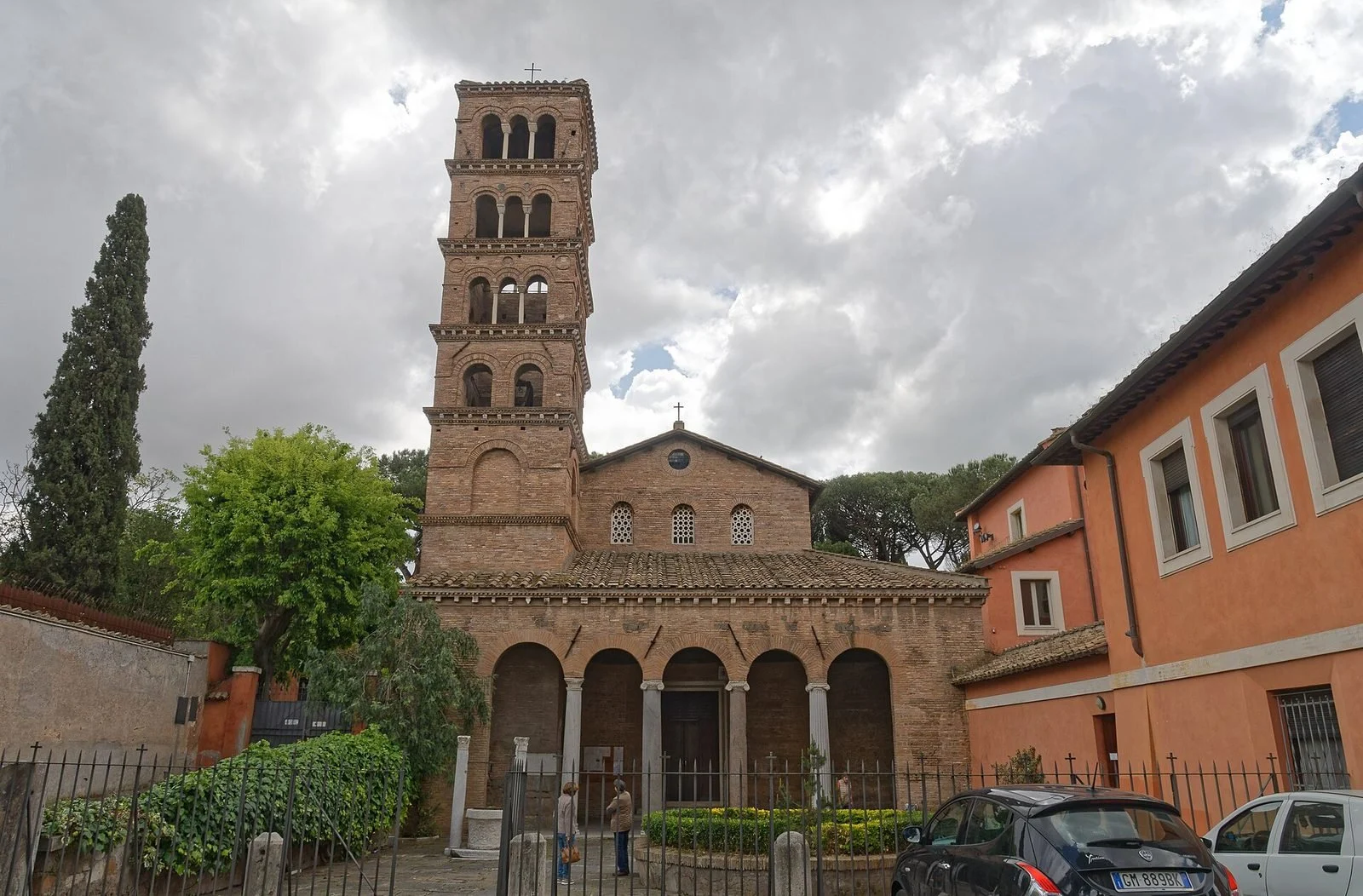
San Giovanni a Porta Latina is an early Christian basilica located at via di Porta Latina 17, inside the Aurelian Walls, a few hundred meters from Porta San Sebastiano. Its foundation is attributed to Pope Gelasius I, in office between 492 and 496, and the element that supports this dating is material: roof tiles with stamps from the Theodoric era, that is, the period between 493 and 526, were found in the roof. Inside, on the walls of the central nave, runs a cycle of 12th-century wall paintings with scenes from the Old and New Testament: Italian sources speak of 46 scenes on overlapping registers, and it is one of the most extensive complexes of medieval painting left in Rome. Admission is free.
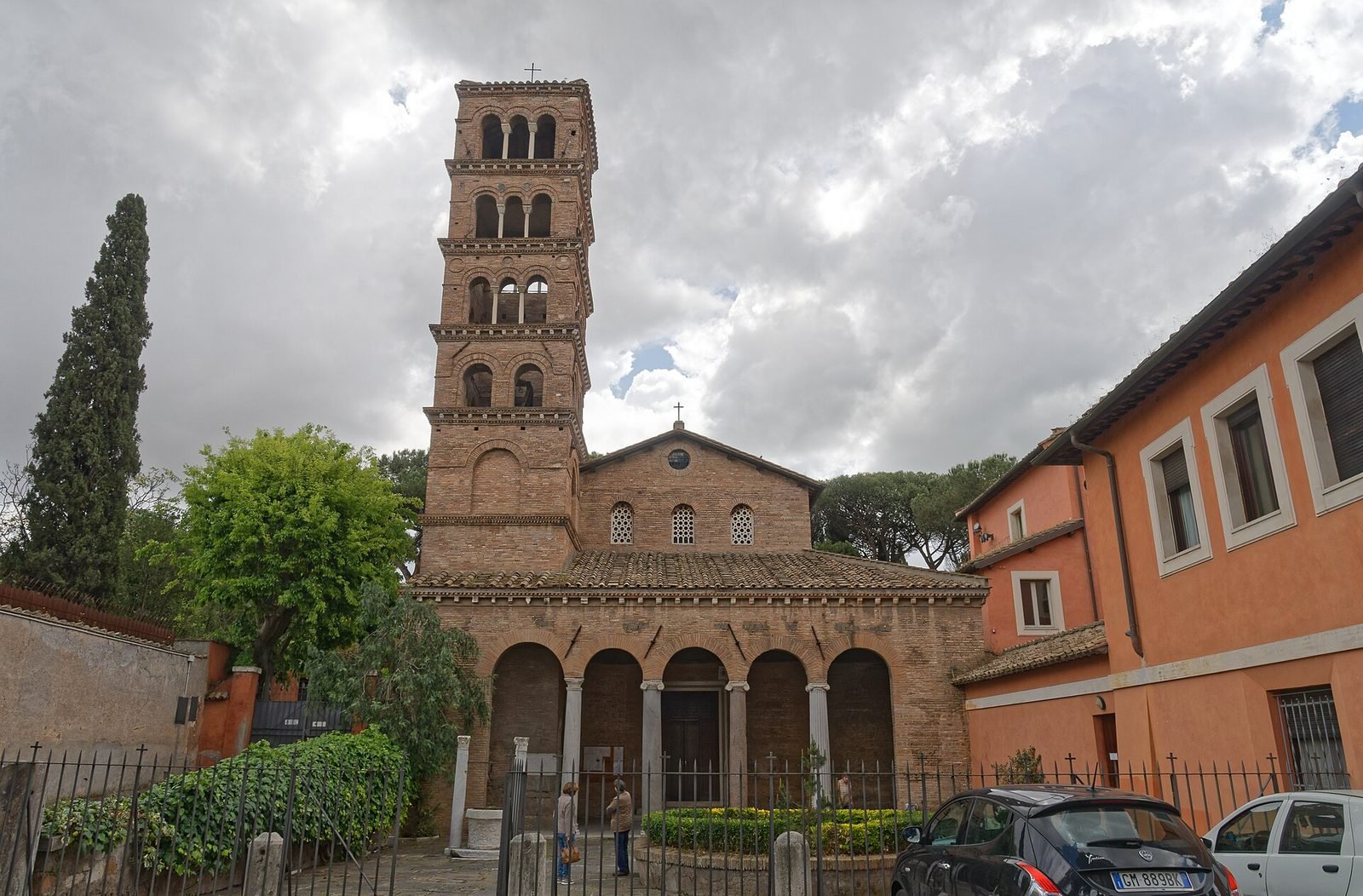
The area is among the quietest in the city that is still inside the walls. No tour buses pass, there are no souvenir stalls, and the street leading to the church is narrow and partly without a sidewalk. The churchyard has a large cedar, a medieval marble well and a portico of five arches supported by ancient columns, all different from one another. That's half the reason people come, and it's best to say it straight: anyone arriving in search of a monumental masterpiece will be left cold.
The other half is the frescoes, and on those the page goes on at length: they are the real content of the visit, and around their dating and attribution there are debates that tourist guides keep quiet about. A few meters away, just inside the city gate, there is also the octagonal shrine of San Giovanni in Oleo, which is normally closed: we cover it in a separate chapter, with all the attributions it carries and which no one has ever settled definitively.
Where San Giovanni a Porta Latina is and how to really get there
The address is via di Porta Latina 17, in the Celio district, in a bend of streets that branches off Piazzale Numa Pompilio and runs parallel to the walls up to the city gate. The Parco Archeologico dell'Appia Antica, which includes the basilica among the sites in its territory, lists as connections bus lines 218, 360 and 714 and metro line A at the San Giovanni stop.
The real problem: the nearest stop isn't near
This is not a church you reach by getting off the vehicle and turning the corner. Specialist guides to the churches of Rome have pointed out for years that San Giovanni a Porta Latina is one of the few Roman cases where no surface stop is truly adjacent: the closest is the one called Latina, served by lines 218 and 360, and from there you still have to go through the city gate and cover the last stretch on foot.
The route we recommend: from Porta San Sebastiano
The most sensible way to arrive is to make it a walk instead of a transfer. Get off at Circo Massimo, walk along the Circus Maximus, continue along Viale delle Terme di Caracalla, reach Piazzale Numa Pompilio and from there take Via di Porta San Sebastiano. This street, flanked by the walls of private properties and by cypresses, is one of the best-preserved urban stretches of Rome off the usual circuits: in just under a kilometer you pass the Tomb of the Scipios and the Park of the Scipios, arrive at Porta San Sebastiano, where the Museum of the Walls is located, and turn left onto Via di Porta Latina.
The total time, walking unhurried and without stopping, is around 35 minutes from Circo Massimo. With a stop at the Museo delle Mura it becomes a sensible half day. Accessibility of the elevated walkway, hours and fares should be checked beforehand at 060608. We do flag one thing that changes the plan: the walkway on the Aurelian Walls accessible from Porta San Sebastiano has been affected by closures for systems work, and it's not guaranteed it will be walkable on the date you go.
Hours: what we know and what we don't know
We have to be honest here, because the sources don't agree and inventing a time would be the fastest way to make a reader lose a morning. The Parco Archeologico dell'Appia Antica indicates daily opening from 7:30 to 12:30 and from 15:00 to 18:00, with free admission. Other sources report afternoon closing at 19:00. The site run by the religious community indicates a wider window, from 6:30 to 18:00. The three indications don't match, and opening also depends on the day's celebrations.
The practical advice we give is this: call. The number published by the official channels is 06 70475938 and the email address is portalatina17@gmail.com. It's the kind of church you find closed if you go at random, especially on Saturday afternoon, because it is a much-requested venue for weddings, and during a celebration the visit can't happen. Anyone organizing a group must arrange it beforehand: showing up with 10 people without notice, in a church of this scale, almost always means staying outside.
What you see at San Giovanni a Porta Latina: a map of the visit
San Giovanni a Porta Latina is a basilica with three naves, a portico of five arches, a Romanesque bell tower on the left side, and an apse that is semicircular inside and polygonal outside. The full visit, frescoes included, takes between 40 minutes and an hour and a quarter, depending on how long you spend deciphering the painted registers.
The churchyard: the cedar, the well, the silence
In front of the façade opens an enclosed churchyard, partly grassy, shaded by a large cedar. It has nothing of an urban square. There is a misunderstanding about this tree that is worth clearing up: many descriptions speak of a cypress, but the sources that describe it precisely, including the catalog entries and the specialist guides to Roman churches, say a cedar. One of them observes that the specimen looks old enough to have been planted when the restoration work of the early 1900s began, which would place it around 1905. We have no planting document: it's an indication, not a certain date.
Next to the portico is the piece almost nobody looks at and which is in fact rare: a wellhead in white marble, sculpted like an overturned trunk, with a very simply made decoration of interlaced wheels and an inscription running along the rim. The text joins the Trinitarian formula and the verse of Isaiah 55:1, the invitation to all the thirsty to come to the water, and ends with the signature of the maker: Ego Stefanus. On the dating the sources waver between the 8th and 9th centuries, and those who assign it to the 8th link it to the works promoted by Pope Hadrian I.
The portico and the façade
The portico has five arches on four ancient columns, each of a different marble: green cipollino, gray granite, red granite, white marble. Three capitals are Ionic, one Doric. They are reused materials, that is, taken from older Roman buildings and reassembled here, and local tradition links them to a temple dedicated to Diana that stood in the area.
Under the portico is kept an object you don't expect: the original finial of San Giovanni in Oleo, the crowning piece that stood on top of the octagonal shrine a short distance away. It was removed during an emergency restoration in 1967 and replaced on site by a copy. The original ended up here, on a plinth, and you can look at it up close. It is the only way a visitor has today to see that piece within arm's reach.
The bell tower
The Romanesque bell tower is attached to the left side, above the roof of the portico. On the number of tiers the sources differ: some count five, others six, and the difference depends on where you start counting, that is, on counting or not counting the stretch that emerges just above the roof of the narthex. The upper tiers open with three-light windows on small marble columns. The intermediate levels have an arched niche and a pair of arches separated by a brick pillar.
There is a discussion about the dating of the bell tower too. The most widespread reading links it to the works of 1191. Part of the specialist literature has proposed a later date, as late as the 14th century. Anyone looking at the tower today should also know that the arches had been walled up almost entirely, except those of the highest tier, and were reopened during the restorations of the 1900s. What you see is therefore a reinstatement, not an intact original.
The interior: columns, light, floor
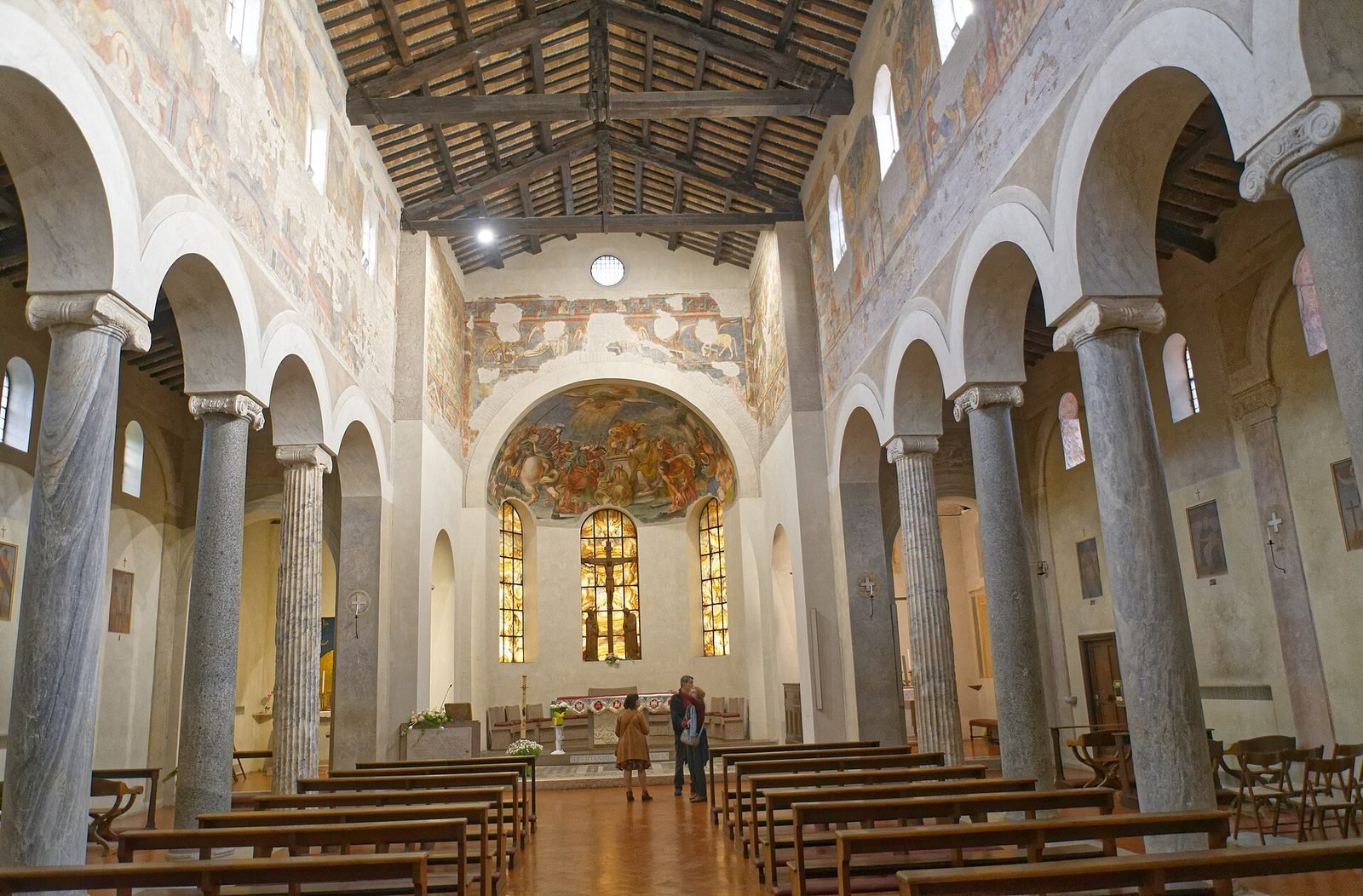
Inside, the basilica is divided into three naves by two rows of five reused columns with round arches. The marbles differ from one another and the variety is the first thing you notice: gray granite, pink granite, cipollino, a gray lumachelle marble, and two fluted shafts in pavonazzetto near the presbytery. The capitals are all Ionic, but the literature considers only two of them ancient and holds that the other eight were made at the time of construction, on the model of the first.
Light is the character of the interior, and it depends on the three large windows of the apse, closed not by glass but by slabs of translucent stone. On which stone it is, the sources split: the specialist guides from the English-speaking world speak of selenite, that is, crystalline gypsum, the same solution adopted at Santa Sabina on the Aventine. The Italian entries speak instead of honey-yellow onyx. The two indications don't match and we haven't been able to check them with an analysis. What is certain, and which neither version hides, is that the current closing of the windows is a 20th-century intervention. None of these slabs is medieval. They are reconstructions made on the basis of what was believed to be the original arrangement.
The floor you walk on is modern. The medieval one lies about 48 centimeters lower down, and of the ancient one there remain Cosmatesque fragments in red and green porphyry framed in white marble in the area of the altar, while the presbytery preserves an opus sectile in polychrome marbles. It is not an intact Cosmatesque floor like that of San Clemente or the Santi Quattro Coronati: these are fragments, and they should be looked at as such.
History of San Giovanni a Porta Latina, from the 5th century to the 20th
The foundation of San Giovanni a Porta Latina is attributed to Pope Gelasius I, whose pontificate ran from 492 to 496, and the material evidence supporting this attribution is the roof tiles, which bear stamps from the Theodoric era, that is, the reign of Theodoric between 493 and 526. This is a chronological convergence, not documentary proof, and should be taken as such: it places the building at the turn between the end of the 5th century and the beginning of the 6th, without fixing a year.
Why a church right here
The church was born next to a city gate and on a consular road, and it was born for a memory. Tradition, reported by Tertullian between the end of the 2nd century and the beginning of the 3rd, holds that John the Evangelist was brought to Rome under Domitian and plunged into a cauldron of boiling oil near Porta Latina, coming out unharmed, and that he was then exiled to Patmos. The expanded version, with the poison drunk without harm, appears in the later hagiographic tradition and spreads widely in the Middle Ages through the Golden Legend. It must be said clearly: this is tradition, not established historical fact, and there is no independent testimony of a Roman stay by the evangelist.
1191: the date that counts
On May 10, 1191 the basilica was reconsecrated and the relics of the saints Gordianus and Epimachus were translated into it. Most sources name Celestine III, elected that year, as the pontiff. Some entries write Celestine II, which in all likelihood is a typo that has propagated from one source to another. The hallmark of this intervention is the decorative campaign: the frescoes of the central nave were made on this occasion or immediately afterward, and the construction or rebuilding of the bell tower and the portico should be read together with them.
The 20th century: rediscovery and reinstatement
The frescoes became visible again between 1913 and 1915, during the works that followed a management begun in the early years of the century. Italian sources more often give 1914 as the year of the discovery. Sources from the English-speaking world speak of a campaign between 1913 and 1915.
In 1938 the basilica was entrusted to the Rosminian fathers, that is, the Institute of Charity, who then set up here the general curia and the Antonio Rosmini missionary college. Between 1940 and 1941 the community carried out the restoration that gave the church its present appearance: removal of the Baroque additions, reinstatement of the medieval arrangement, restoration of the wall paintings, reopening of the windows and of the arches of the bell tower.
This restoration calls for a judgment, and we give it in full because it is the critical knot of the visit. That work site made legible a cycle that without it would have remained invisible, and in this it was decisive. But it also entailed the destruction of medieval fabric: the windows were brought back to the dimensions believed to be original and the operation compromised the integrity of the painted surfaces in the apse area. What you see today is a medieval church rebuilt according to a 20th-century idea of what a medieval church was.
The 12th-century fresco cycle: the real content of the visit
The cycle of wall paintings in the central nave of San Giovanni a Porta Latina counts, according to the most widespread Italian sources, 46 scenes from the Old and New Testament arranged on overlapping registers, and it is considered one of the major complexes of medieval painting in Rome along with the Gothic hall of the monastery of the Santi Quattro Coronati. Chronologically it precedes the season of Pietro Cavallini and the Roman school of the late 13th century, and this is what makes it historically weighty: it documents Roman painting in the moment immediately before the turning point.
How it is organized: the structure in registers
The scenes run along the walls of the central nave and on the inner façade wall, on three overlapping registers that are read clockwise starting from the top right corner. The upper register holds the Old Testament cycle: it begins with the Creation and continues through Genesis to the stories of Joseph, dream included. The lower registers carry the New Testament, from the Annunciation to the Nativity cycle and the Passion, up to the appearance at the Lake of Tiberias.
The criterion is not narrative, it is typological: the Old Testament scenes are chosen and arranged so as to correspond, vertically, to those of the New, following the principle that the ancient episode prefigures the Gospel one. Anyone who looks at the cycle scene by scene the way you look at a comic strip loses half the meaning. The right way to look at it is by vertical columns, not by horizontal rows, asking each time what the pair is.
The apse arch and the 24 Elders
The part that strikes anyone entering most is the one toward the altar. On the apse arch appear the book with seven seals, the symbols of the four evangelists and the figures of the two Johns, the Evangelist and the Baptist, of which however the upper part is lost. On the walls of the presbytery are painted the 24 Elders of the Apocalypse on two registers, in an act of adoration toward the divine throne, with the evangelists in four niches below.
The subject derives from chapters 4 and 5 of the Apocalypse. At the center of the composition, according to the available descriptions, appears the Lamb or a cross as a sign of Christ: an archaic choice for the 12th century, which points to early Christian models more than to contemporary production.
The dating: what is known and what is debated
The fixed point is 1191. The decorative campaign follows the reconsecration and does not precede it: on this the sources converge. What is debated is if the execution was immediate or dragged on. Part of the critics considers the cycle entirely attributable to the 1191 work site and the years immediately after. The catalog entries of the Italian cultural heritage instead place the painted decoration in a range between 1200 and 1249, which shifts everything to the first half of the 13th century. The two positions can't be reconciled, and it's worth knowing that both exist before reading a caption that gives only one.
The attribution: no name, three or four hands
There is no attribution to a master. The most credited readings speak of three or four artists working on a unified project in the work site after 1191, and the recognition of the hands rests on differences in the rendering of faces, drapery and the scale of the figures, not on documents. Anyone looking for a name in this church won't find one, and the entries that propose one should be viewed with suspicion.
On the side of influences the literature is firmer. Per Jonas Nordhagen has insisted on the weight of Byzantine iconographic formulas in the compositions. The manuscript tradition between the 6th and 10th centuries has been indicated as a reservoir of compositional solutions. And Roman painting of the 5th and 6th centuries remains the underlying reference for the apocalyptic layout. The modern monographic work of reference remains Margaret M. Manion's thesis on the wall paintings of this church, defended in 1972 at Bryn Mawr College.
San Giovanni in Oleo, the octagonal shrine in front of the gate
San Giovanni in Oleo is a small shrine on an octagonal plan built in 1509 just inside Porta Latina, about a hundred meters from the basilica, to mark the point where tradition places the failed martyrdom of John the Evangelist in the cauldron of boiling oil. The operational fact must be stated right away, because it is the one that matters to anyone organizing a visit: the shrine is normally closed. It can't be visited inside under ordinary conditions, and those who go see it from outside.
Who had it built
The patron was Benoît Adam, a French prelate tied to the court of Julius II as auditor of the Rota for France. On the door facing the city appears his coat of arms with the motto Au plaisir de Dieu and a dedicatory inscription that mentions him and the pontiff. Above the inner door is walled in a medieval Latin composition that tells of the trials of the evangelist: it is a text older than the building and testifies that the memory was already rooted in the place before the 16th-century work site.
The attributions: all debated, none settled
Here things need to be said as they are, because popular literature always picks a name and presents it as certain, while none of the attributions concerning this building is documented.
The design has traditionally been assigned to Donato Bramante, and this is the version you read in most guides. The most recent criticism proposes instead Antonio da Sangallo the Younger or Baldassarre Peruzzi. The octagonal plan has fed the hypothesis that the 16th-century structure replicates an older shrine, because the octagon is a typical form of early Christian martyria: no excavation has confirmed it. There is no document that settles the question.
Borromini's intervention
On the date of the 17th-century work site too the sources waver between 1657 and 1658. Francesco Borromini rebuilt the roofing on commission from Cardinal Francesco Paolucci, with the authorization of Alexander VII. In place of the hemispherical lead dome that according to the sources covered the shrine, Borromini built a pavilion roof with ribs and added on the drum a decorated terracotta band with festoons of double roses and palm leaves repeated all the way around.
The crowning piece is the most recognizable part: a finial in the form of an inflorescence held up by a bundle of acanthus-leaf volutes, with roses that repeat the heraldic device of the patron. In 1967, during an emergency restoration, the original finial was dismantled and replaced by a copy. The original, as said, is today under the portico of the basilica. What you see at the top of the shrine is not the 17th-century piece.
Can you go in?
Under ordinary conditions, no. Guides from a few decades ago suggested asking for the key at the Rosminian college next door, but that is a practice that no longer works with occasional visitors. Access, when it happens, takes place within guided visits organized together with the basilica, or on the occasion of extraordinary openings. Anyone who cares must write in advance to the basilica's contacts and allow for a negative answer.
Porta Latina and the Aurelian Walls around the basilica
Porta Latina is one of the best-preserved gates of the entire circuit of the Aurelian Walls, the wall circuit begun under Aurelian starting in 271. It takes its name from Via Latina, the consular road heading toward Capua that split from the Appia Antica just outside the city.
How it is built
The gate has a single archway, originally 4.20 meters wide and 6.55 high, flanked by two towers on a semicircular plan equipped with arrow slits. Between 401 and 403 Honorius reduced its opening to 3.73 by 5.65 meters, rebuilt the façade in travertine and opened five arched windows in it: this is the arrangement you see today, and the reduction of the opening answers to defensive reasons at a time when the pressure on the city was growing.
On the arch, on the outer side, the monogram of Christ remains incised. On the inner side you can read an eight-pointed cross of the type called the Cross of St. John or of Malta. These are the signs by which a late antique military structure is placed under Christian protection, and they have to be sought out because they are not signposted.
A curiosity about San Giovanni a Porta Latina
In March 1581 Michel de Montaigne, who was in Rome on the journey later collected in the Journal de voyage, noted that he had heard it said that a few years earlier, in this church, a group of Portuguese men had married each other during mass, with the same ceremonies with which a marriage is celebrated. The matter is connected to a trial that the sources place around 1578 and that ended with capital sentences. San Giovanni a Porta Latina appears for this reason, in the historical literature on sexuality in the early modern period, as the place of what are indicated as among the first documented same-sex unions in Western Europe. Montaigne's text, however, is a diary note gathered secondhand, and historians still debate what really happened: a marriage rite, a pact of brotherhood within a confraternity, or a construction of the prosecution at trial. We report it because it is documented in a source of the first rank, not because it is a reconstructed fact.
Something nobody tells you about San Giovanni a Porta Latina
The medieval church you visit today is in large part a product of 1940. The restoration carried out by the Rosminians between 1940 and 1941 removed the post-Tridentine altars and stuccoes, reopened the walled-up arches of the bell tower, brought the apse windows back to dimensions believed to be original and brought the paintings back to light. No tourist entry says so, and anyone entering is led to believe they are seeing the 12th century.
What was lost to give back what we see
The specialist guides to Roman churches record that the operation on the windows entailed the destruction of medieval fabric and compromised the integrity of the painted surfaces in the apse area. The pierced screens of the upper openings are 20th-century reconstructions. The translucent slabs that close the windows are also a reinstatement. The floor is modern and the medieval one remains buried 48 centimeters lower.
Why we say it
Not to belittle the visit, which remains one of the most instructive you can make in Rome on this period, but because it changes the way you look. Knowing that the arrangement is a 20th-century interpretation of the Middle Ages forces you to distinguish what is ancient from what is restitution, and it's an exercise that then serves in every other Roman church. The useful comparison is with the Basilica of Santa Sabina on the Aventine, subjected in the same decades to a similar reinstatement with the same criteria, or with San Giorgio in Velabro, where the 20th-century work site made choices of the same kind.
My advice for visiting San Giovanni a Porta Latina
The practical advice is just one and counts more than all the others: call 06 70475938 before setting out, because the hours published by the different sources don't match and because the basilica is much requested for weddings, which on weekends take the 11:00, 15:30 and 18:00 slots according to the parish channels. During a celebration the visit can't happen, and anyone who walks from Circo Massimo after half an hour's walk to find the gate closed remembers it for a long time.
The right time
The window we recommend is late morning on a weekday, roughly between 10 and noon. These are the hours when the apse windows work best and the nave receives the warm light that is the character of this interior. Early afternoon, from 15:00, is the second good choice.
What to bring
A small pair of binoculars or a monocular changes the visit, and that's not an exaggeration: the upper registers run at a height that makes the faces unreadable to the naked eye, and without magnification the Old Testament part of the cycle remains a colored band with no content. Anyone without binoculars can use the phone's zoom, but you need a steady hand because the light is low.
The verdict, given in full
San Giovanni a Porta Latina is overrated as an attraction and underrated as a document. Anyone going expecting a monumental thrill will be left cold: the architecture is simple, the dimensions are modest, there isn't a single work that functions as a symbolic image. Anyone going knowing what they're looking at, namely one of the very few Roman wall-painting cycles of the 12th century still standing, takes home a visit worth double many of the famous stops in the center. The difference between the two experiences isn't made by the place: it's made by preparation. That's why we wrote the part on the frescoes long and the one on the atmosphere short.
Another well-known fact, yet rarely cited
The columns of the basilica are all different from one another, and not by aesthetic choice: they are reused materials, taken from older Roman buildings and reassembled here in the 5th century. In the nave you count 10 shafts in two rows, in gray granite, pink granite, cipollino, gray lumachelle marble and fluted pavonazzetto, with the two fluted shafts placed near the presbytery. In the portico there are four others, also of different marbles.
What the reuse tells
The reuse says that in 5th-century Rome worked marble was a resource that was recovered, not one that was produced. The imperial quarries no longer worked at full capacity, transport from Egypt and Asia Minor was irregular, and building a basilica meant dismantling something else. The mismatch of the columns is therefore an economic indicator before an aesthetic one, and it is the same reason the phenomenon is observed throughout ancient Christian Rome, from Santa Sabina to Santa Maria in Cosmedin to San Saba.
The right photo to take at San Giovanni a Porta Latina
The photograph that does justice to this place is the one of the churchyard shot from under the cedar, with the five-arch portico on the right, the bell tower rising behind and the wellhead in the foreground on the left. It is the only framing that holds together the four elements that make up the look of the complex, and it works because the depth of the churchyard gives the composition room to breathe without forcing an extreme wide angle.
The hard photo: the interior
Photographing the frescoes is tricky for three reasons. The light is scarce and warm, so the automatic white balance of phones returns an orange cast that falsifies the colors. The registers are high, so you need zoom and a steady hand isn't enough. And the surfaces have gaps that read as dirt in a photograph. In practice the best result comes from resting the phone or the camera on a stable surface and accepting long exposure times.
Some important events that happened here in history
The chronology of San Giovanni a Porta Latina rests on a few fixed points and on many reconstructed phases. We list them in order, distinguishing each time the documented from the hypothesized, because it is the only form useful to the reader.
772: the reconstruction by Hadrian I
Pope Hadrian I promotes a reconstruction that the sources date to 772. Part of the literature links the wellhead in the churchyard to this season, while other entries date it instead to the 9th century.
May 10, 1191: the reconsecration
The basilica is reconsecrated and the relics of the saints Gordianus and Epimachus are translated into it. The pontiff indicated by most sources is Celestine III. The painted decoration of the nave comes out of this work site, and the Romanesque phase of the bell tower and portico is tied to it.
Around 1578: the trial
The sources place in these years the matter of the unions between men celebrated by a group of Portuguese, reported by Montaigne in 1581 and concluded with capital sentences. As said, the reconstruction of the facts remains debated among historians.
1938 to 1941: the Rosminians and the reinstatement
In 1938 the basilica is entrusted to the Institute of Charity. Between 1940 and 1941 the restoration is carried out that removes the Baroque additions, reopens the arches of the bell tower and the apse windows and restores the paintings. It is the intervention that determines the current appearance, at the cost in ancient fabric that we pointed out above.
Who passed through San Giovanni a Porta Latina
This is not a church of big names, and it's best to say so right away instead of padding a list. The documented presences are few, but those few carry weight.
The popes who had a hand in it
Gelasius I for the foundation, Hadrian I for the rebuilding of the 8th century, Celestine III for the reconsecration of 1191, Leo X for the establishment of the title, Alexander VII for the authorization of the Borromini work site on the nearby shrine. That is five pontiffs spread over 12 centuries, and together they tell of the continuity of a place that was never central and was never abandoned.
Francesco Borromini and the question of attributions
Borromini is the only front-rank architect whose intervention in this corner of Rome is documented with certainty, and it concerns the shrine of San Giovanni in Oleo, not the basilica. Anyone who wants to measure the distance between this minimal job and the same author's major works finds the terms of comparison in Rome: San Carlo alle Quattro Fontane and Sant'Ivo alla Sapienza. The names of Bramante, Antonio da Sangallo the Younger and Baldassarre Peruzzi remain instead attached to the project of 1509 without any of the three being demonstrated. For anyone who wants to see a certain work by Bramante, the Roman reference is the Chiostro del Bramante.
Where to eat around San Giovanni a Porta Latina
We start with the honest warning, because here it is the most useful thing: around Porta Latina the food offering is practically nonexistent. It is not an area with a street of restaurants, there is no café on the corner, and in the stretch between Piazzale Numa Pompilio and the city gate you meet nothing. Anyone planning to spend the morning here must get organized beforehand: bring water and something to eat, or allow for heading down toward the San Giovanni area or back up toward the Aventine for lunch. This is an operational fact, not a judgment on the neighborhood.
We don't name names, and we explain why
On these pages we don't point to specific businesses. A list of restaurants goes out of date in a few months, the management changes, the kitchen changes, and whoever trusted it ends up with an address that no longer matches anything. We prefer to teach how to choose, which is a skill that stays valid everywhere, even in a different city.
The franchises of the center
In the passing-through areas of Rome, chain places have multiplied, with the same sign repeated in several points of the city, the identical menu in every location and the line managed with a ticket number. We don't name them and we don't recommend them. The observation that matters is simple and you make it by looking inside: Romans don't go there. Where the people who live in the area eat, the sign isn't repeated 300 meters away.
The five trap signals
These are the signals you recognize in the field, and they hold across the whole city.
The lady rolling out fresh pasta in the window or directly in the street. It is a lure designed for passersby, not a clue about the cooking: the real pasta shop works in back, not in front.
The menu with photographs of the dishes. It serves people who can't read the language, and a place that needs that tool has built its clientele among people who will never come back.
The barker on the doorstep inviting you to sit. A place that fills its tables by stopping people in the street has a filling problem, and the problem isn't solved in the kitchen.
Continuous hours from morning to night, with no break. A kitchen that serves lunch and dinner needs to close in between. A place that never closes isn't cooking in shifts, it's reheating.
The position in front of the famous monument. These are the places that most often adjust the price to the tourist in front of them: unpriced items on the menu, a different price list at the outdoor table and at the inside counter, cover charges and service fees that appear only on the bill. The monument, in this case, is what pays for the spot.
The criterion, just one
Look at who is sitting and in what language they order. If at the tables there are locals ordering in their own language without looking at the menu, the place works. If there are only passing customers with backpacks, the place lives off passersby. It's a criterion you apply in 30 seconds from the door and that is wrong far less often than any online score.
Where to go, in practice
Heading down toward the San Giovanni area, beyond the city walls, you enter a residential urban fabric where the ratio of price to quality returns to normal and where the criteria above work. Heading instead up toward Testaccio you find a neighborhood with a strong food tradition, with the Nuovo Mercato Testaccio as a reference point for those who prefer to buy and eat something without sitting down.
For anyone who wants an already filtered selection, Daniele Dezi keeps a personal list by Daniele Dezi on Google Maps: it is a curated collection, not sponsored and with no commercial agreements with the places it contains.
What to see around San Giovanni a Porta Latina
San Giovanni a Porta Latina works badly as a single destination and well as a stop on a route, because the walk to get there crosses one of the densest urban bands of ancient Rome. We give three possible itineraries, all on foot except the final stretch.
Toward the northwest: the Baths, the Circus, the Aventine
Going back up toward Piazzale Numa Pompilio you meet the Baths of Caracalla, the most readable imperial bath complex in the city, and from there you reach the Circus Maximus. On the Aventine, within a few hundred meters, are the Orange Garden, Santa Sabina and, on the opposite slope, San Saba. Going down to the river you enter the Forum Boarium, with Santa Maria in Cosmedin and the Mouth of Truth
Toward the south: the gate, the walls, the Appia
In the opposite direction you reach Porta San Sebastiano and the Museum of the Walls in 10 minutes, passing in front of the Tomb of the Scipios. Outside the gate begins the Appia Antica Park, with the Catacombs of St. Callixtus, the Catacombs of St. Sebastian under the basilica of the same name, the Mausoleum of Cecilia Metella and farther on the Villa of the Quintilii. On the flank opens the Caffarella Park. An overview of the underground cemetery system is on our page about the catacombs of Rome
Toward the east: the Celio and the Lateran
Going up the hill you enter the Celio, which concentrates early Christian and medieval buildings similar in age to the one at Porta Latina: the Santi Giovanni e Paolo with the Case Romane del Celio, Santo Stefano Rotondo and Villa Celimontana. A little farther on you reach the Basilica of St. John Lateran, the cathedral of Rome, which shares with our basilica only the patron saint: two buildings different in scale, function and history, to be visited as separate things. On the same axis are San Clemente, the Santi Quattro Coronati, the Colosseum and, climbing toward the Esquiline, Santa Prassede, which offers on mosaics the term of comparison that is missing here
Frequently asked questions about San Giovanni a Porta Latina
How much does it cost to enter San Giovanni a Porta Latina?
Admission to San Giovanni a Porta Latina is free: the basilica is a place of worship run by the Rosminian fathers and has no ticket office. There is no ticket to see the frescoes, which are in the nave and visible to anyone who enters. Any guided tours organized by third parties have their own cost, which has nothing to do with the church. Anyone who wants to leave a contribution can do so with offerings.
What are the hours of San Giovanni a Porta Latina?
The hours of San Giovanni a Porta Latina given by the Parco Archeologico dell'Appia Antica are 7:30 to 12:30 and 15:00 to 18:00 every day, but other sources report different hours, with afternoon closing at 19:00 or continuous opening from 6:30 to 18:00. The indications don't match and opening also depends on celebrations. We recommend calling 06 70475938 before leaving.
How do you get to San Giovanni a Porta Latina by public transport?
You reach San Giovanni a Porta Latina with buses 218, 360 and 714 and with metro line A, San Giovanni stop, but in every case a walk is needed. The nearest surface stop, called Latina, still requires you to cross the city gate on foot. From the metro it's a good 20 minutes' walk. The most pleasant route starts at Circo Massimo on line B and passes through the Baths of Caracalla.
Can you visit San Giovanni in Oleo?
San Giovanni in Oleo, the octagonal shrine just inside Porta Latina, is normally closed and can't be visited inside under ordinary conditions. It is seen from outside, where you can read the inscriptions on the two doors, the terracotta band with roses and palms and the crowning piece, which however is a copy: the original is under the portico of the basilica. Access happens only on the occasion of organized visits or extraordinary openings.
How much time do you need to visit San Giovanni a Porta Latina?
To visit San Giovanni a Porta Latina you need between 40 minutes and an hour and a quarter, depending on how long you stop to read the painted registers of the nave. Add 20 minutes if you want to walk to the shrine of San Giovanni in Oleo and look at it from outside. Anyone who combines the visit with the Museo delle Mura at Porta San Sebastiano should count half a day overall.
What period are the frescoes of San Giovanni a Porta Latina from?
The frescoes of San Giovanni a Porta Latina are referred to the work site following the reconsecration of May 10, 1191, and so to the end of the 12th century. Part of the studies considers them executed immediately after that date, while the catalog entries of the Italian heritage place the decoration between 1200 and 1249. There is no attribution to a master: three or four different hands are recognized.
Can you take photos inside San Giovanni a Porta Latina?
Inside San Giovanni a Porta Latina photography is generally tolerated without flash, as in most Roman churches, but the basilica is a place of worship run by a religious community and the conditions can change without notice. During masses and weddings tourist photography is not done. Flash on the painted surfaces should always be avoided, for conservation reasons.
Is San Giovanni a Porta Latina suitable for children?
San Giovanni a Porta Latina works with children if someone tells them about the painted scenes, because the cycle is narrative and starts from the Creation. You do need binoculars, though, otherwise the high registers remain unreadable. The churchyard with the cedar and the well is an open space where you can be without too many precautions, and the total absence of crowds makes the visit more manageable than in the center.
Is San Giovanni a Porta Latina accessible to people with disabilities?
Access to San Giovanni a Porta Latina is from the churchyard through the portico, on an essentially flat path, but the approach from the transit stops is long and partly without a continuous sidewalk. We have found no official information published on interior accessibility: anyone with specific needs should have the situation checked by calling 06 70475938 before the visit.
Who wrote this page
This page is curated by the editorial team of Tour Leader Pro, the Roman project office that designs and coordinates visits, itineraries and cultural events in Rome and Lazio. Hours, fares and access conditions given here were verified at the date of publication against the official sources indicated in the text: it's worth rechecking them before you leave, because they change often. If you find outdated information, let us know.
Anyone building an itinerary that ties together the walls, the Appian Way and the medieval churches of Rome's southern quadrant has to fit together uneven hours, limited openings and walking distances that are not trivial: for this kind of planning, and for coordinating groups and visits, the tools and services of Tour Leader Pro are the reference we use internally as well.
For anyone instead organizing a broader trip, with travel between Rome and the rest of Lazio or Italy, trains, travel times and choice of bases, a useful resource for general framing is Italy Planner, which thinks on the scale of the trip and not on that of the single visit.