San Gregorio al Celio
In short. San Gregorio al Celio is the church that closes off, at the top of a monumental staircase, the east side of Piazza di San Gregorio, right opposite the slopes of the Palatine Hill and about a hundred meters from the Arch of Constantine.
San Gregorio al Celio is the church that closes off, at the top of a monumental staircase, the east side of Piazza di San Gregorio, right opposite the slopes of the Palatine Hill and about a hundred meters from the Arch of Constantine. The official address is Piazza di San Gregorio al Celio 1, and the thing that matters most can't be seen from the street. Next to the church, inside a garden that opens onto Clivo di Scauro, there are three 17th-century oratories, Sant'Andrea, Santa Silvia and Santa Barbara, and in the first of the three two frescoes from 1608 face each other, one by Domenichino and one by Guido Reni. They are among the most discussed pages of 17th-century Roman painting, they are five minutes on foot from the Colosseum, and on an ordinary day there is almost nobody in front of them. There is, however, a serious practical problem, and we put it right at the top: the oratories have different access and hours from the church, they are often closed, and anyone who arrives without first checking with the monastic community risks climbing the staircase, seeing a decent 18th-century church and leaving without having seen the part that justifies the trip. The lines that follow explain what this complex is, what is documented and what is tradition, how to organize the visit and how to avoid wasting your day.
Where San Gregorio al Celio is and how to get there
The church faces onto Piazza di San Gregorio, the elongated square that separates the slopes of the Palatine from the western side of the Celio hill, along the route that links the Circus Maximus to the Colosseum. It's a confusing position: people pass by all the time, by car or on foot, and look the other way, toward the arches and the ruins. The complex stays behind you, raised about 10 meters above street level, behind a travertine facade that from below looks like the front of any ordinary palazzo.
On foot from the Colosseum, the Palatine and the Circus Maximus
From the Colosseum it takes six or seven minutes. You take Via di San Gregorio, follow the slopes of the Palatine with the Vigna Barberini up on your right, and the staircase appears on the left just before the intersection with Via Claudia. From the Circus Maximus, coming from Piazza di Porta Capena, it's barely five minutes on a slight uphill. If you leave the Roman Forum by Via di San Gregorio exit, you find yourself practically in front of the door, and the same goes for those coming down from the Palatine after visiting the Palatine Museum.
Metro, tram and surface transport
The most convenient metro stop is Circo Massimo, on line B, about seven minutes on foot. The Colosseo stop, also on line B, works well too and adds a couple of minutes of walking. Tram 3 stops at Parco Celio, on the opposite side of the hill, less than 10 minutes from the staircase going by Via Claudia. For buses it's best to check the lines in service on Piazza di Porta Capena and on Piazzale del Colosseo directly on the Atac channels, because routes in the Forums area get changed fairly often and a list printed on a page goes out of date in a few months.
The staircase: how steep it really is
The ramp that climbs from the square to the portal is steep and has no central handrail, with high steps and short treads, the kind of stairs you take without effort at 20 and that at 70, or with a bad knee, calls for a stop halfway. It's the first physical filter of the place, and you need to factor it in before tackling it with a stroller or a suitcase. Anyone with mobility problems should ask the monastic community if there's an alternative access from the Clivo di Scauro side. We understand that the complex has service entrances on that side, but we have no official information on if they are open to the public, so we don't present it as certain.
What you see on arrival: facade, courtyard, church
The facade and portico of San Gregorio al Celio were built between 1629 and 1633 to a design by Giovanni Battista Soria, at the wish of Cardinal Scipione Caffarelli Borghese. When the cardinal died, in 1633, the work site stopped and resumed in 1642. It is a two-order travertine facade, with the heraldic emblems of the Borghese family, the eagle and the dragon, repeated in the decorative elements. From below you can't tell anything about what's behind it, and that is a deliberate choice: 17th-century Rome clad an early medieval complex in new scenery, and clad it well.
The quadriporticus, the real surprise of the facade
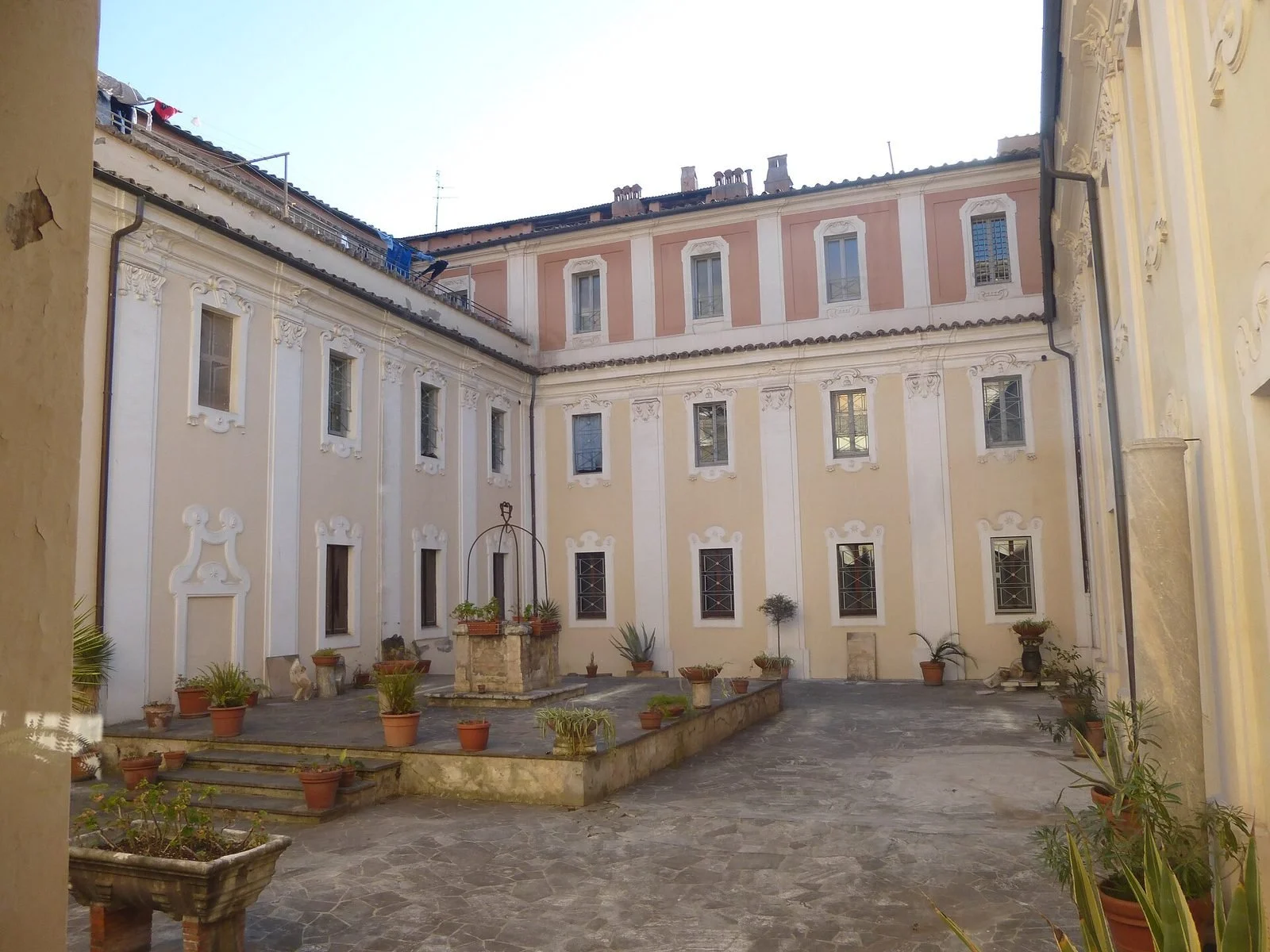
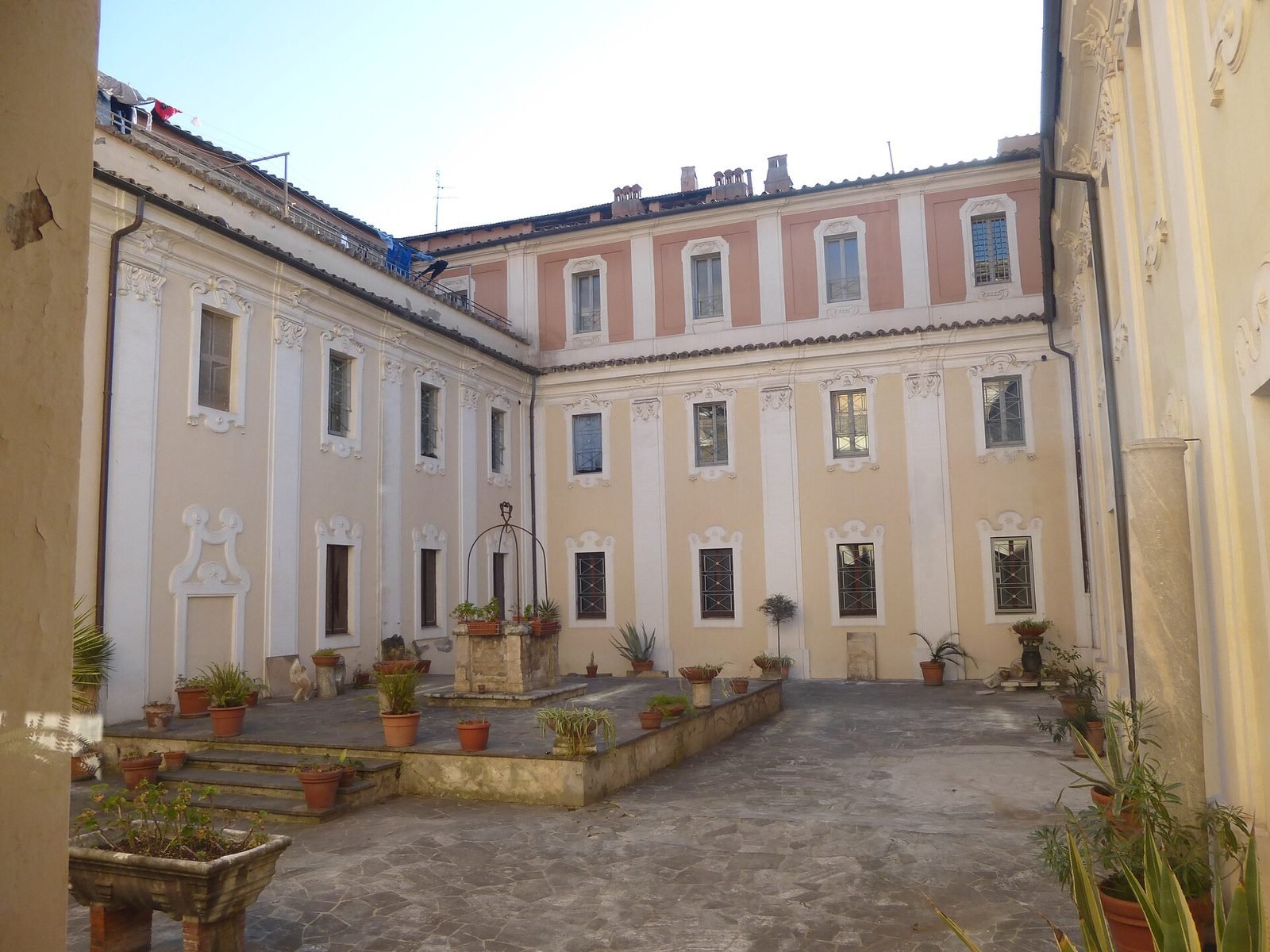
Past the portal you don't enter the church. You enter a porticoed courtyard, a quadriporticus that follows the form of the atrium of ancient basilicas. It's a passage that throws off anyone expecting the nave and is worth a stop of a few minutes. Under the porticoes, plaques and inscriptions from different eras are set into the walls, and among them is the memorial of Sir Edward Carne, the English ambassador to the Holy See at the time of Mary Tudor, who died in Rome in 1561. The complex preserves more than one trace of the long English presence, which descends in a direct line from the mission sent by Gregory the Great to Britain.
The 18th-century interior
The church you see today is the result of the rebuilding begun in 1725 and completed around 1734, attributed by the sources to Francesco Ferrari, with the name of Giuseppe Antonio Soratini appearing in some reconstructions for the initial phase of the work. The plan has three aisles on reused ancient columns, with side chapels and a flat ceiling. In the center of the nave ceiling there is a 1727 fresco by Placido Costanzi with the triumph of Saint Gregory the Great. Anyone who comes looking for the 6th century won't find it: the ancient layout is below and behind, and the church barely acknowledges it.
The Salviati Chapel
At the end of the left aisle opens the Salviati Chapel, designed by Francesco da Volterra and completed by Carlo Maderno in 1600. It holds a marble altar from 1469 attributed to Andrea Bregno and his workshop, that is a piece of 15th-century sculpture that ended up inside a late 16th-century frame. Some sources report that the chapel is now used by the Romanian community of the Byzantine rite. This information circulates on several listings but we couldn't confirm it on an official channel, and we report it as such.
The three oratories in the garden: the part worth the trip
Next to the church, in a garden entered from the side via Clivo di Scauro, three small independent oratories stand in a row: Sant'Andrea in the center, Santa Silvia on the right, Santa Barbara on the left. They were brought back to life by Cardinal Cesare Baronio starting in 1602, on an architectural plan attributed to Flaminio Ponzio and completed by 1606. They are three rooms, not three churches. You go in, look around in 10 minutes and leave. The reason some guides consider them the most important thing on the Celio is entirely inside the central oratory.
The Oratory of Sant'Andrea
The Oratory of Sant'Andrea is a rectangular room with the altar at the far end. Above the altar there is an altarpiece from 1603 by Cristoforo Roncalli, known as Pomarancio, with the Madonna between Saints Andrew and Gregory. On the two long walls, facing each other, are the two frescoes that make the room a stop on the art history route: on the left Guido Reni with Saint Andrew Led to Martyrdom, on the right Domenichino, that is Domenico Zampieri, with the Flagellation of Saint Andrew. Both are dated 1608 and were commissioned by Cardinal Scipione Caffarelli Borghese, the same man who 30 years later would pay for the facade of the church. On the inner wall of the entrance, also from 1608, there are chiaroscuro decorations attributed to Giovanni Lanfranco, who worked under Reni's direction.
Two painters, one wall each
The layout is the key to everything. The patron set two young painters, both out of Annibale Carracci's workshop and already considered the names to bet on, to paint two walls that look at each other. There was no way out without a direct comparison: whoever walks in sees the two works together, at the same glance, in the same light. The critical tradition, going back to the 17th-century biographers, tells this commission as a contest and has built around it one of the most repeated anecdotes in the history of Italian art, that of the old woman explaining to a child the scene painted by Domenichino, cited by Annibale Carracci as proof of his pupil's narrative superiority. The anecdote should be taken for what it is, a workshop tale handed down by the biographies and not a record. The rivalry between the two, on the other hand, is solid historiography: Reni and Domenichino competed for decades for the same Roman commissions.
What to really look at, wall by wall
Reni sets up the walk to martyrdom as a procession that widens into the landscape, with the saint kneeling before the cross in the distance and an orderly crowd in bands of light color. Domenichino chooses the moment of violence and compresses it into the foreground, with twisted bodies, gestures that answer one another and an architecture that closes off the space. The first bets on grace and distance, the second on narrative and impact. Looking at them in the same minute is the reason this room has survived in the memory of art historians far more than on the tourist circuit.
The Oratory of Santa Silvia
The oratory on the right is dedicated to Silvia, the mother of Gregory the Great, and was built between 1602 and 1606. It contains a marble statue of the saint attributed to Nicolas Cordier, the Lorraine sculptor active in Rome in the early 17th century, and a frescoed decoration with a concert of angels attributed to Guido Reni, in which the musical instruments are reproduced with a precision that has made it a source for studies of early 17th-century organology. The sources also assign the figures of David and Isaiah to Sisto Badalocchio. A claim that circulates on some listings, according to which the statue of Santa Silvia was executed under Michelangelo's supervision, is chronologically impossible, since Michelangelo died in 1564. We mention it only to warn anyone who runs across it.
The Oratory of Santa Barbara and the table called Saint Gregory's
The oratory on the left occupies an ancient room, traced by the sources to a Roman house, and tradition identifies it with the triclinium of the poor, the room in which Gregory the Great and his mother Silvia are said to have served lunch every day to 12 poor people of the city. At the center is a large marble table, the so-called table of Saint Gregory, supported by carved supports with winged lion figures. On the walls are frescoes from 1602 by Antonio Viviani with episodes from the saint's life, and the room holds a statue of Saint Gregory attributed to Nicolas Cordier.
The legend of the 12 poor men and the 13th guest
The story tied to the table is popular tradition, and as such we report it. According to the most widespread version, one day a 13th guest joined the 12 poor men, whom nobody had seen come in and who vanished before the end of the meal: it was an angel. The story has the typical structure of hospitality legends, present in similar forms in many religious traditions, and it has done well precisely because there is a concrete object, the table, to hang it on. The historical value of the piece doesn't depend on the anecdote: an ancient marble table reused in a 17th-century oratory is already in itself a document of how Rome recycles its own materials.
How to get into the oratories, and why it's the only thing to check beforehand
The oratories are not visited by entering through the church door and they do not follow the church's hours. They have their own entrance from the garden, on the Clivo di Scauro side, and their opening depends on the availability of the Camaldolese monastic community that officiates the complex and on the organization of guided visits by cultural associations. On many ordinary days they stay closed. We don't publish hours or fees because, as of the date we write, there is no fixed schedule published on an official channel that we can cite with confidence. The monastery's website and the community's switchboard, at 06 7008227, are the references to use, along with the email address given in the institutional listings. Anyone who arrives without having called first has a very good chance of finding the garden gate closed, and the experience is reduced to the 18th-century church.
Guided visits by associations
A substantial part of the entries to the oratories goes through guided visits organized by Roman cultural associations, which agree the opening with the community and sell a limited number of places. It's a legitimate channel and often the most practical, because it solves the opening problem and adds the explanation. We don't give names or prices, because they change from season to season. The method is to look, a few weeks ahead, for the special openings dedicated to the oratories of the Celio and book as soon as they come out, because the places run out.
Gregory the Great and his father's house on the Celio: documented and tradition
The core of the story is this: Gregory, born in Rome around 540 into a family of the senatorial aristocracy, turned the family property on the Celio into a monastery dedicated to the apostle Andrew, withdrew there as a monk, and only afterward, in 590, was elected pope. He died in 604. This sequence, house first, then monastery, papacy after, is agreed on by the sources and explains why the complex carries the name of two saints, Andrew and Gregory.
What is documented
The founding of a monastery on the Celio by Gregory is documented, placed by scholars between 575 and 580. It is documented that Gregory lived there as a monk before his election to the papal throne. It is documented that the monastery was dedicated to Saint Andrew and that only later, around the year 1000, it began to be called San Gregorio in Clivo Scauri after the name of the founder and of the street. A restoration of the complex under Gregory II, pope from 715 to 731, after a period of abandonment, is documented.
What is tradition, and it needs saying
The precise location of the father's house under the present church is established tradition, supported by the continuity of the site and by the ancient structures recognized in the subsoil, but it is not the same thing as an inscription saying here lived Gordianus, father of Gregory. Gregory's membership in the gens Anicia, repeated for centuries, is considered by modern scholars a late genealogical construction. The identification of the Oratory of Santa Barbara with the triclinium of the poor is also tradition: the room is ancient, the rest is story. We keep the two columns separate because it is the right way to treat a place on which 14 centuries of devotion have settled.
Augustine, the prior who left for Britain
From this monastery, in 596, set out the mission destined for the Angles, led by the monk Augustine, who had been prior of the Celio community and who would become the first Archbishop of Canterbury. It is the fact that ties San Gregorio al Celio to English religious history in a direct and verifiable way, and it explains the presence of British memorials in the complex, from the plaque of Sir Edward Carne to the ecumenical meetings of the 20th century and of our own. For those coming from the Anglo-Saxon world this is the real reason for the visit, and many more English pilgrims know it than Romans.
The Camaldolese monastery
The complex passed to the Camaldolese monks in 1573, and the Camaldolese congregation still occupies the monastery. It's a fact that matters in practice too: the church and the oratories depend on a living religious community, with its liturgical day, and not on a ticket office. The hours published on institutional portals are mostly hours of services, not tourist opening hours, and this explains a large part of the misunderstandings you read in online reviews.
A curiosity about San Gregorio al Celio
The curiosity is that the church most tied to the name of Gregory the Great was not called San Gregorio at all for the first four centuries of its existence: the monastery founded by the future pope on the Celio was dedicated to the apostle Andrew, and the founder's name appears in the title only around the year 1000, when the building is referred to as San Gregorio in Clivo Scauri. The current dedication keeps both names, and in fact in official documents the complex is referred to as the Church of Santi Andrea e Gregorio al Celio.
Why the dedication to Andrew is not a detail
The original dedication explains the subject of the 17th-century frescoes of the central oratory. Reni and Domenichino do not paint episodes from the life of Gregory. They paint the martyrdom of Saint Andrew, because he was the patron of the first oratory. A detail of nomenclature 1,000 years old determines the iconographic program of one of the most studied commissions of 17th-century Rome. It often happens, in Rome, that a choice made 14 centuries ago shapes what you see today, and this is a case in which you can follow the mechanism step by step.
A name that confuses two different churches
In Rome there is also a church of San Gregorio della Divina Pietà, which is in the Ghetto, in front of Ponte Fabricio, and has nothing to do with the Celio. It's a small building, famous for the bilingual inscription on its facade tied to the history of the forced sermons imposed on Roman Jews. The two churches are regularly confused in online searches. If you're looking for the contest between Domenichino and Reni you have to climb the Celio. If you're looking for the plaque in Hebrew and Latin, you have to go to the Ghetto.
One thing nobody tells you about San Gregorio al Celio
The thing that is almost never said is that the visit to the complex can come to nothing for a purely organizational reason: the oratories, which hold 90 percent of the artistic interest, are managed separately from the church and stay closed on most days. General guidebooks list Domenichino and Guido Reni as if showing up were enough. It isn't. And the practical consequence is that a great many people have visited San Gregorio al Celio without ever having seen the frescoes whose names they then read about.
The second reason the visit goes wrong
The second reason is the facade. The 17th century covered everything with a travertine stage set, and the visitor who arrives looking for the early Middle Ages finds a building that seems to have been built from scratch in the 18th century. There is no sign in the street saying under this church is the house where Gregory the Great lived and from which the mission that converted England set out. Whoever doesn't know beforehand doesn't find out there.
My advice for visiting San Gregorio al Celio
The practical advice is just one and it comes before all the others: phone or write to the monastic community before fixing your day, asking explicitly if the oratories of Sant'Andrea, Santa Silvia and Santa Barbara will be open and under what conditions. The community's number is 06 7008227 and the monastery has its own website. If the answer is no, it's best to move the visit to another date or fit the complex into a tour of the Celio in which the church is a short stop among surer ones.
How to build the half day around the visit
The setup we recommend is to start early from the Circus Maximus, climb to San Gregorio while the sun is still low, and then continue on the hill toward the Roman Houses of the Celio and the Basilica of Santi Giovanni e Paolo, which are along the same Clivo di Scauro and have their own hours, also to be checked. From there you go down toward Villa Celimontana and finish at Santa Maria in Domnica or at Santo Stefano Rotondo, keeping in mind that the latter too has limited openings. It's an itinerary of a good three hours, all within a radius of 600 meters.
When to go
Early morning, on weekdays. The Celio is one of the few hills of Rome that stay quiet even in high season, but the band between 11:00 and 15:00 is when groups headed for the Colosseum saturate the surrounding streets. In winter the advantage is double: fewer people and a raking light that enters the quadriporticus well. In summer the staircase at noon is exposed and without shade, and that is not a negligible detail with the 40 degrees that Rome now regularly reaches in July.
Another well-known fact, yet rarely cited
The fact is this: on February 14, 1130, in this church, a commission of cardinals led by the chancellor Aimeric elected Pope Innocent II, starting one of the longest schisms of the Middle Ages, because on the same day another part of the college elected Anacletus II. The schism lasted eight years and split Europe, with Bernard of Clairvaux siding with Innocent and the Pierleoni with Anacletus. It is mentioned in one line in the listings for the complex and goes unnoticed, yet it is one of those moments in which a room on the Celio decided the political geography of half a continent.
The right photo to take at San Gregorio al Celio
The photo that works is not the facade seen from the square, which comes out flattened and full of traffic in the foreground. It's the staircase framed from below with the facade at the top, taken from slightly to the side to avoid the frontal view, or the sequence of arches of the quadriporticus from the inside, backlit, with the rectangle of sky in the center. They are two different images and serve two different purposes: the first tells the climb, the second tells the surprise of finding a courtyard where you expected a nave.
The light, hour by hour
The facade faces west, toward the Palatine, so it takes direct light in the afternoon and in the hours before sunset, when the travertine goes from white to warm yellow. In the early morning the front is in shadow, and in those hours it's better to work inside the quadriporticus, where the indirect light is soft and even. The worst moment is summer noon: full light flattens the reliefs and the contrast between steps and sky blows out the highlights.
Where you don't photograph
Inside the oratories the rules are set by whoever opens. If entry is by guided visit, photography may be limited or forbidden, and in any case flash is never used on frescoes. During services in the church the camera stays in the backpack. These are obvious rules, and they need remembering because a monastic community lives in this complex: it isn't a museum with attendants, it's a home.
Some important events that took place here in history
The chronology of San Gregorio al Celio covers 15 centuries and reads better in blocks, because the complex has been in turn an aristocratic house, a monastery, an electoral venue, a Borghese work site and a place of ecumenical meeting. What follows is the backbone, with the dates on which the sources agree.
Between 575 and 580: the founding of the monastery
Gregory turns the family property on the Celio into a monastery dedicated to Saint Andrew and withdraws there as a monk. These are the years immediately after his giving up a civil career, after having been urban prefect. It is the moment in which a private house becomes an institution, and as a result survives.
Between 715 and 731: the restoration by Gregory II
Pope Gregory II has the monastery restored and promotes the construction of the building that will form the medieval backbone of the church. It is the moment in which the complex stops being a memory and goes back to being a working structure.
February 14, 1130: the election of Innocent II
The cardinals' commission gathered in the church elects Innocent II, while another part of the college elects Anacletus II. A schism begins that will last eight years and involve the main European sovereigns.
From 1602: the work site of Cardinal Baronio
Cesare Baronio, Church historian and cardinal, promotes the recovery of the three oratories in the garden, with an architectural project attributed to Flaminio Ponzio and completed by 1606. In 1602 Antonio Viviani frescoes the Oratory of Santa Barbara, and Nicolas Cordier executes the statues of Saint Gregory and Saint Silvia. In 1603 Cristoforo Roncalli paints the altarpiece of the Oratory of Sant'Andrea.
1608: the frescoes of Reni and Domenichino
Cardinal Scipione Caffarelli Borghese commissions the decoration of the Oratory of Sant'Andrea, entrusting the direction to Guido Reni. Reni paints Saint Andrew Led to Martyrdom on the left wall, Domenichino the Flagellation of Saint Andrew on the right, Giovanni Lanfranco the chiaroscuros of the inner entrance wall. It is the date that makes this room a necessary stop for anyone studying the early 17th century, and at the same time one of the least visited in Rome.
1629, 1633, 1642: Soria's facade
The work site of the facade and portico, still financed by Scipione Borghese on a design by Giovanni Battista Soria, runs between 1629 and 1633, stops at the cardinal's death and resumes in 1642. From that moment the complex takes the face it has today toward the square.
1725, 1727, 1734: the rebuilding of the interior
The church is rebuilt inside starting in 1725, on a design attributed to Francesco Ferrari and, for the initial phase, also to Giuseppe Antonio Soratini. The work ends around 1734. In 1727 Placido Costanzi frescoes the ceiling of the nave with the triumph of Saint Gregory. The 13th-century Cosmatesque floor is reworked and restored, according to the sources, around 1745.
March 10, 2012 and October 5, 2016: the two recent meetings
On March 10, 2012 Benedict XVI celebrates Vespers at San Gregorio al Celio for the millennium of the Camaldolese congregation. On October 5, 2016 Pope Francis and the Archbishop of Canterbury Justin Welby celebrate Vespers together in this church, on the 50th anniversary of the meeting between Paul VI and Archbishop Michael Ramsey, and sign a joint declaration. The choice of venue was not symbolic by chance: it is from here that in 596 Augustine's mission had set out for England.
Who has passed through San Gregorio al Celio
The list of people tied to this address is unusually dense for a place that mass tourism ignores, and it holds together saints, collector cardinals, competing painters, English diplomats and two contemporary popes.
Gregory the Great and Augustine of Canterbury
Gregory lived here as a monk for about 10 years before the election of 590, and from here he directed his own spiritual and intellectual formation. Augustine, monk and prior of this community, set out in 596 and died Archbishop of Canterbury. No other place in Rome has an equally direct link with the Christianization of England.
Cesare Baronio
Cardinal Cesare Baronio, author of the Annales Ecclesiastici and one of the builders of modern ecclesiastical historiography, is the mind behind the recovery of the oratories starting in 1602. His interest in this place was not aesthetic: Baronio was looking for material proof of the continuity of the Church of Rome, and a monastery founded by Gregory the Great was exactly the kind of document he needed.
Scipione Borghese, the patron
Cardinal Scipione Caffarelli Borghese, nephew of Paul V and founder of the collection now kept in the Borghese Museum and Gallery, financed both the decoration of the Oratory of Sant'Andrea in 1608 and the facade of the church from 1629. He is the same patron who, in those same years, was putting together the collection of paintings and sculptures that made his name inseparable from 17th-century Rome.
Guido Reni and Domenichino
Both from Bologna, both trained in the school of the Carracci, both at the start of their Roman careers in 1608. In that year they work in the same small oratory, on walls that face each other, for the same cardinal. To understand the rest of their Roman trajectories it helps to keep a map of the churches and palaces of the center at hand, and to look at the Bolognese chapter together with the Caravaggesque one, which is easier to follow on our page on Caravaggio in Rome.
Cristoforo Roncalli, Giovanni Lanfranco, Sisto Badalocchio, Antonio Viviani, Nicolas Cordier
Around the two big names works a team that by itself tells the story of the Roman work site of the early 1600s: Roncalli, known as Pomarancio, for the 1603 altarpiece, Lanfranco for the chiaroscuros, Badalocchio for the figures of David and Isaiah in the Oratory of Santa Silvia, Viviani for the 1602 cycle on Gregory, and the Lorraine sculptor Nicolas Cordier for the two statues. It's a list that in any other city would be the pride of a civic museum.
Accessibility, visit times and practical rules
The monumental staircase is the main barrier: anyone in a wheelchair or with mobility difficulties can't climb it, and we have no official information on an alternative route open to the public from the Clivo di Scauro side. The request has to be made directly to the monastic community, at 06 7008227, explaining the need. It's the only way to get a reliable answer, because the information published online about the accessibility of this complex is incomplete.
Children
The complex works with children only if someone tells the story. There are no multimedia aids, no extensive explanatory panels, and the 18th-century church alone doesn't hold their attention. The marble table of the Oratory of Santa Barbara, with the story of the 12 poor men and the extra guest, is instead a narrative hook that works well from age six up, as long as you say it's a legend. With strollers the staircase is a serious problem.
What's around: the Celio in half a day
The Celio is the hill that more than any other stays off the mass routes despite being attached to the most visited monument in Italy. From San Gregorio you can walk out and in 10 minutes reach a Roman house with 3rd-century paintings, an early Christian basilica, a 5th-century rotunda and a public park.
On Clivo di Scauro
Going up Clivo di Scauro, the ancient street covered by arches that starts right next to the complex, you reach the Roman Houses of the Celio, a set of underground rooms with high-quality paintings, and the Basilica of Santi Giovanni e Paolo, which stands above them. It's the best preserved stretch of ancient road on the hill, and you walk it in five minutes.
Toward Villa Celimontana and the Navicella
A little further on you enter Villa Celimontana, the historic park of the hill, and come out on the side of Santa Maria in Domnica, the church with the Carolingian mosaic, in front of the Navicella fountain. A short distance away are Santo Stefano Rotondo, one of the oldest circular-plan churches in the West, and the Basilica of Santi Quattro Coronati with its cloister and Gothic hall.
Toward the Colosseum, the Palatine and the Forums
Going down toward the north you meet the Arch of Constantine, the Colosseum, the Ludus Magnus and, climbing the Oppian Hill, the Domus Aurea. On the opposite side are the entrance of the Roman Forum with the Arch of Titus and the Rostra, the Palatine and the Palatine Museum. If you have little time and want to understand how to fit it all together, you'll find a possible route on our page on Rome in a day.
Toward Caracalla, the Aventine and the Walls
Going south from Piazza di Porta Capena you reach in 10 minutes the Baths of Caracalla and, continuing, Porta San Sebastiano, the Museum of the Walls and the entrance to the Appian Way Regional Park. To the west you climb the Aventine, with the Orange Garden, the Basilica of Santa Sabina, the Basilica of San Saba, the churches of Sant'Anselmo and of Santi Bonifacio e Alessio and the Rose Garden of Rome, which blooms twice a year. The whole area is described on our page on what to see on the Aventine. At the foot of the hill are Santa Maria in Cosmedin with the Mouth of Truth and, farther south, the Pyramid of Cestius.
If you're interested in the 17th century
Anyone who comes to San Gregorio al Celio for Reni and Domenichino has half a city to reread with the same yardstick: the patron's collection can be visited at the Borghese Museum and Gallery, early 17th-century painting can also be followed at Palazzo Barberini and at Palazzo Doria Pamphilj, and the architecture of the same era can be followed with our page on Bernini in Rome. If you prefer to get around without spending, you'll find alternatives on the page on free Rome, and if you want to stay on the theme of churches in the center you can start with San Pietro in Vincoli and the Basilica of San Clemente, which has three superimposed levels like few other Roman buildings. We tell the story of the district north of the Colosseum in Rione Monti. A stop slightly off the route, but consistent with the story of Gregory and the pilgrims, is the Holy Stairs, next to the Basilica of San Giovanni in Laterano. Anyone who follows the Aurelian Walls toward the south ends the loop on the opposite side of the city.

Eating nearby without falling into traps
Something uncomfortable has to be said here: around Piazza di San Gregorio the offer is scarce and expensive. We are 300 meters from the Colosseum, and that means the few places in the short radius work almost only on passing trade, with price lists calibrated to the visitor who is hungry and short of time. Our practical judgment is simple: it's worth moving. 10 minutes on foot toward the Aventine, toward San Giovanni or toward Via Merulana side completely changes the ratio between what you pay and what you eat. We don't give names, as an editorial choice: a list of signs goes out of date in a few months and teaches nothing. We give the criteria, which last.
The five signs of a trap
You can recognize them from the street, before sitting down. The lady rolling out fresh pasta in the window or on the sidewalk: it's a stage-set lure, not a sign of good cooking. The menu with photographs of the dishes: it serves people who can't read the language, and whoever displays it has chosen that audience. The barker at the door inviting you to sit: a place with customers doesn't need to stop people in the street. The nonstop schedule from morning to late at night with no kitchen break: it means dishes kept ready. And the tables placed in front of a famous monument, where the price tends to follow the tourist in front of you: items with no price on the menu, different price lists inside and outside, cover and service charges that appear only on the bill.
The chains of the center
In the center of Rome a model of venue with a repeated sign has multiplied, with the same menu at several points in the city and the line with a number ticket at the entrance. We don't name them and we don't recommend them. There's only one observation to make, and you can check it in five minutes by looking at the dining rooms: Romans don't go there.
The criterion that always works
Look at who is sitting there and in what language they order. If at the tables there are locals speaking Italian with a Roman accent, the place has regular customers and doesn't live on passing trade. If you hear only English and the room fills up at 18:30, you're in a place calibrated to the tourist. It's a crude criterion, and it's the most reliable one we know.
Daniele Dezi's list
For those who prefer to start from already filtered recommendations, there is Daniele Dezi's personal list on Google Maps, a curated and unsponsored collection, built over time on direct experience. For a general picture of the neighborhoods and price ranges we refer you to our page on where to eat in Rome and to the one on the markets of Rome, which remain the cheapest way to eat in the center at midday.
Frequently asked questions about San Gregorio al Celio
Where is San Gregorio al Celio?
San Gregorio al Celio is at Piazza di San Gregorio al Celio 1, on the western side of the Celio hill, opposite the slopes of the Palatine and along the road that links the Circus Maximus to the Colosseum. The church is reached by climbing a monumental staircase that starts from the square. The nearest metro stop is Circo Massimo on line B, about seven minutes on foot. The Colosseo stop, on the same line, is also convenient.
Can you visit the oratories of Sant'Andrea, Santa Silvia and Santa Barbara?
The oratories of San Gregorio al Celio have their own access and hours, different from the church's, and on many days they stay closed. They are in the garden next to the church, on the Clivo di Scauro side. Opening depends on the Camaldolese monastic community and on guided visits organized in advance. Before going it's best to contact the community at 06 7008227 or through the monastery's website, because arriving without checking almost always means finding the gate closed.
What works can you see in the Oratory of Sant'Andrea al Celio?
In the Oratory of Sant'Andrea at San Gregorio al Celio two frescoes from 1608 face each other: Saint Andrew Led to Martyrdom by Guido Reni on the left wall and the Flagellation of Saint Andrew by Domenichino on the right wall. On the altar is a 1603 altarpiece by Cristoforo Roncalli, known as Pomarancio. The chiaroscuro decorations on the inner entrance wall are attributed to Giovanni Lanfranco. The patron was Cardinal Scipione Caffarelli Borghese.
How much does it cost to enter San Gregorio al Celio?
For San Gregorio al Celio we don't publish fees because there is no stable official price list that we can cite. Entry to churches run by religious communities is normally free. Access to the oratories often goes through special openings or guided visits that involve a contribution set by whoever organizes them. The right thing is to ask in advance the monastic community or the association that opens them.
How much time do you need to visit San Gregorio al Celio?
For the church of San Gregorio al Celio alone, 20 minutes are enough, including the quadriporticus, the Cosmatesque floor and the Salviati Chapel. With the oratories open you need at least 50 minutes, and a guided visit comfortably reaches an hour and a half. Anyone who also wants to see the Roman Houses of the Celio and the Basilica of Santi Giovanni e Paolo should allow half a day for the whole hill.
Is San Gregorio al Celio accessible to people with mobility difficulties?
The main access to San Gregorio al Celio is by a steep monumental staircase, with no ramp and no central handrail, and so it isn't passable in a wheelchair or easy with a stroller. We have no official information on an alternative entrance open to the public from the Clivo di Scauro side. The request has to be made directly to the monastic community, which is the only reliable reference on this point.
What is the table called Saint Gregory's?
The table called Saint Gregory's is a large marble table kept in the Oratory of Santa Barbara at San Gregorio al Celio, supported by carved supports with winged lion figures. Popular tradition ties it to the story according to which Gregory the Great served lunch every day to 12 poor men and one day a 13th guest joined them, later recognized as an angel. It is a legend, not a documented fact.
Is San Gregorio al Celio the same as San Gregorio della Divina Pietà?
No. San Gregorio al Celio and San Gregorio della Divina Pietà are two different churches, far apart. The first is the Camaldolese monastic complex on the Celio hill, tied to Gregory the Great and to the 17th-century oratories. The second is a small church in the Ghetto, in front of Ponte Fabricio, known for the bilingual inscription in Latin and Hebrew on the facade. The similarity of the name creates confusion in online searches.
Can you take photographs inside San Gregorio al Celio?
Inside the church of San Gregorio al Celio, photography without flash is normally tolerated outside services, while in the oratories the rules are set by whoever opens them and may include limits or a ban. Flash on the 1608 frescoes is never used. During liturgies the camera stays in the backpack: the complex is lived in by a monastic community.
Who wrote this page
This page is edited by the editorial team of Tour Leader Pro, the Rome-based project office that designs and coordinates visits, itineraries and cultural events in Rome and Lazio. Hours, fees and access conditions reported here were checked at the date of publication against the official sources indicated in the text. Before leaving it's best to check them again, because they change often. If you find outdated information, let us know.
Anyone building an itinerary on the Celio, lining up San Gregorio with the Roman Houses, Santi Giovanni e Paolo, Villa Celimontana and Santo Stefano Rotondo, and having to fit together openings that depend on religious communities and associations, will find planning and coordination tools on Tour Leader Pro, which works on groups, schools and thematic visits of this kind.
For a broader picture of how to fit Rome into a longer trip, with connections to the rest of Lazio and the other Italian cities, a good planning resource is Italy Planner.