San Gregorio della Divina Pietà
In short. San Gregorio della Divina Pietà is a very small church at the entrance to Ponte Fabricio, on the northern edge of piazza di Monte Savello, in the rione Sant’Angelo, with its facade turned toward the bridge and toward the Tiber Island.
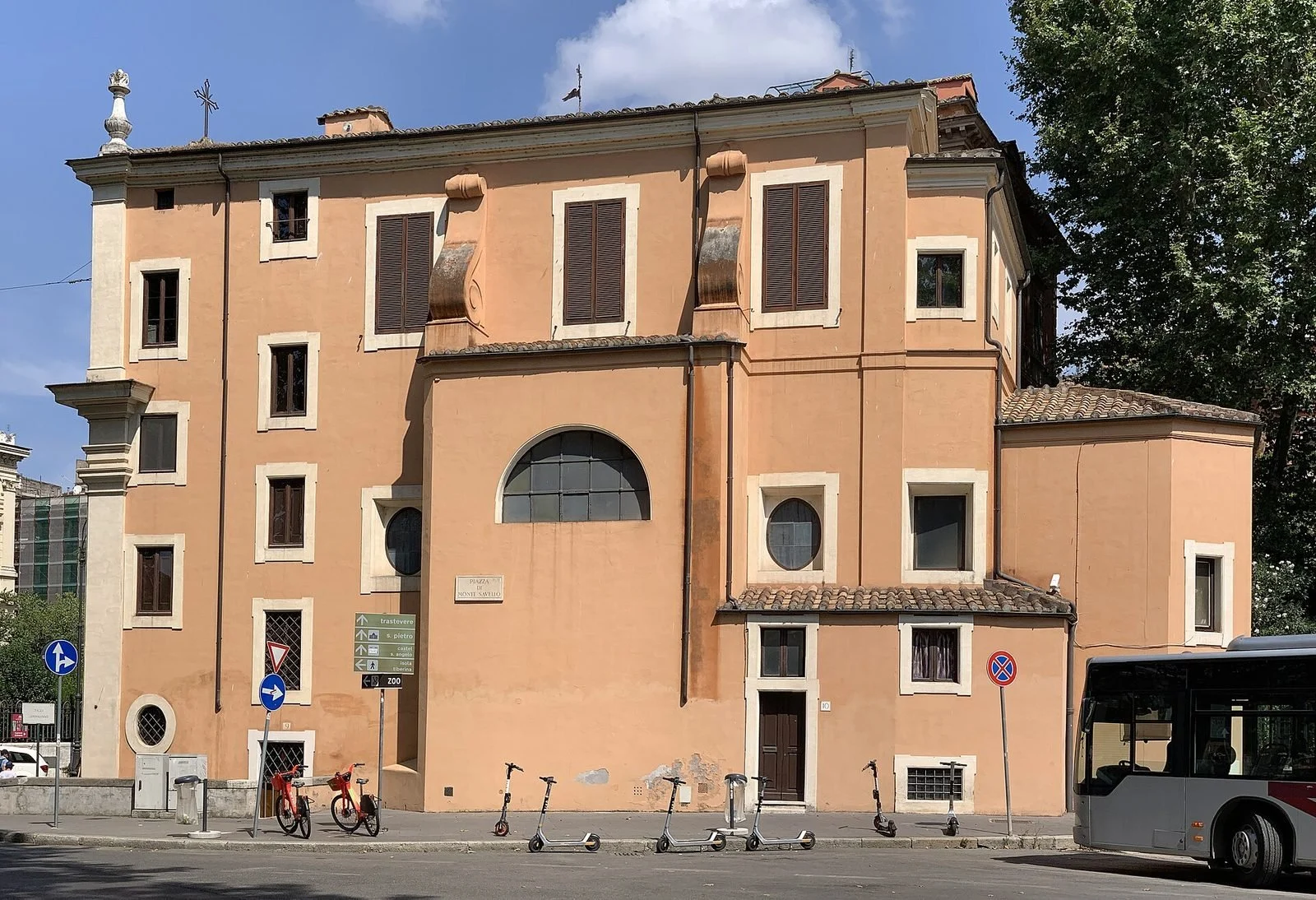
San Gregorio della Divina Pietà is a very small church at the entrance to Ponte Fabricio, on the northern edge of piazza di Monte Savello, in the rione Sant’Angelo, with its facade turned toward the bridge and toward the Tiber Island. Anyone passing by walks past it without noticing: it's squeezed between the traffic of the lungotevere and the abutment of the bridge, it has no churchyard, no dome, no work that appears in the museum guides. The reason this building matters is not architectural. Above the door there is a marble plaque with the same sentence written twice, in Latin and in Hebrew: they are verses 2 and 3 of chapter 65 of the book of Isaiah, and they were put there to be read by the Jews of the Ghetto, who from 1555 lived shut in a few dozen meters from here and who for almost three centuries were obliged to attend conversion sermons. The church was one of the sites of that obligation. The lines that follow explain what is read on that plaque, what the compulsory sermons were as an institution of the Papal State, who was bound to attend and how often, what the documents show and what instead belongs to oral tradition, and how to look today at a building like this without turning it either into a monument to antisemitism or into a curiosity to photograph and nothing more.

A practical warning, because it's the first thing you need to know: the church has no regular opening hours. The plaque, however, can be read from the street at any moment of the day and the year, and it's the only thing you really need to see.
Where San Gregorio della Divina Pietà is and how to get there
The church faces the northern edge of piazza di Monte Savello, exactly where lungotevere dei Cenci and lungotevere dei Pierleoni meet the start of Ponte Fabricio, in the rione Sant’Angelo. On the street number the sources don't agree: the Roma Capitale tourism portal gives piazza di Monte Savello 9, while other sheets report a different address, referring to the portion of the square toward the river. On site the question doesn't arise, because there is only one building and you recognize it right away: narrow front, two pilasters, a painted oval above the door and, below the oval, a marble slab with two blocks of writing, one in Latin characters and one in Hebrew characters.
On foot, from the Ghetto and the center
From the Portico of Octavia you arrive in just under three minutes: you take via del Portico d’Ottavia toward the river, walk along the Synagogue and come out on the lungotevere in front of the bridge. From largo di Torre Argentina it's 10 minutes along via Arenula and via del Progresso. From the Theater of Marcellus it's five minutes downhill, passing in front of San Nicola in Carcere. Anyone coming from Trastevere crosses the Tiber Island, that is Ponte Cestio and then Ponte Fabricio, and finds the church straight ahead at the end, when stepping onto the left bank: it's the best way to arrive, because the facade is seen whole as you walk toward it.
By public transport
The useful surface lines are buses 23, 63, 280 and H and tram 8, the same ones that the Tiber Island hospital gives as the reference for reaching the island. The 23 and the 280 run along the lungotevere, tram 8 stops at Belli, just past Ponte Garibaldi, seven or eight minutes on foot away. The nearest metro stop is Circo Massimo on line B, which however is a quarter of an hour's walk along via del Teatro di Marcello. Anyone arriving from Termini is quicker taking metro B to Circo Massimo and then walking, or a surface bus that goes down toward the Teatro di Marcello. For general connections in the city we refer to our page on getting around Rome.
By car, and why it's best to avoid it
We advise against the car without mincing words. The area falls within the limited traffic zone of the historic center, street parking on the lungotevere is paid during daytime hours Monday to Saturday and the free spots in front of the bridge, when there are any, are almost always reserved or already taken. If you come from outside Rome it's quicker to leave the vehicle in a park-and-ride on line B and finish by metro. The access rules and time bands change over time: our updated notes are on the page dedicated to the ZTL of Rome.
Where to stand to read the plaque
The spot from which the inscription reads best is not in front of the door. Anyone standing right under it, a meter from the wall, sees the marble foreshortened and in the wrong light. It's best to cross and step back about 10 meters, toward the traffic island at the entrance to the bridge, and look at the facade from below but head-on: from there the two blocks of text can be made out in full, you see that the same sentence is repeated twice and you catch the relationship between the plaque and the painted oval above it. The second good position is the first meters of Ponte Fabricio, which is pedestrian: you turn around and have the church on axis, with the bridge abutment on the right. Watch out when crossing the lungotevere, which is fast-moving and on a curve.
What you see from the street: facade, oval and plaque
The facade of San Gregorio della Divina Pietà is barely wider than the door and reads entirely at a glance: the portal, a painted oval above the architrave, the bilingual plaque below the oval, two alms boxes set into the wall at the sides. There's nothing else, and this poverty of means is the first fact to note, because it explains the nature of the building: a church of a charitable congregation, not a showpiece.
The oval of the Crucifixion
Above the door there is an oval painting with a Crucifixion, attributed by the sheets of the city tourism portal to the French painter Étienne Parrocel, active in Rome in the 1700s. The placement is not decorative. The image and the text beneath it form a single discourse, addressed to those who passed over the bridge and to those who came out of the Ghetto enclosure: above, the scene of the Crucifixion, below, the biblical reproach. This is the only reading of the whole that the 19th-century sources and the modern sheets give in agreement.
The bilingual plaque
The slab is marble, rectangular, divided into two fields side by side: on the left as you look, the Hebrew text, on the right the Latin, or the reverse depending on how you read the symmetry of the two blocks. The letters are incised and filled, and the state of preservation is decent but not excellent: some letters are worn and in flat light they are hard to make out. Anyone who really wants to read it should plan to give it a few minutes, not 10 seconds.
The text of the inscription: Isaiah 65, 2-3
The text carved on the plaque of San Gregorio della Divina Pietà is verses 2 and 3 of chapter 65 of the book of Isaiah, given in Latin according to the Vulgate and in Hebrew according to the Masoretic text. It's the passage in which the prophet puts into God's mouth a lament over the people who do not listen. This is the central piece of information of the whole page, and it's also the one that most often circulates online distorted or quoted by half.
The Latin text
In the Clementine Vulgate the two verses read: Expandi manus meas tota die ad populum incredulum, qui graditur in via non bona post cogitationes suas. Populus qui ad iracundiam provocat me ante faciem meam semper. In everyday English: I have stretched out my hands all day to a people who do not believe, who walk on a way that is not good behind their own thoughts. A people who provoke me to anger, continually, before my face. The version carved on the marble reproduces the Latin text of the Vulgate. The English rendering we give here is ours and serves only to convey the sense, because the standard translations in Italian Bibles differ among themselves in the choice of terms.
The Hebrew text
The field in Hebrew characters reproduces the same verses in the Masoretic text. Verse 2 begins with פֵּרַשְׂתִּי יָדַי כָּל־הַיּוֹם, which is transliterated perasti yadai kol ha-yom and means “I have spread out my hands all day”. The choice to carve the Hebrew as well is the decisive element: a Latin plaque would have been a devotional inscription like a thousand others in Rome, and would have been read by priests and educated foreigners. The Hebrew points to the addressee with precision. It was a text aimed at those who knew that text by heart.
What the passage says in its context
In the book of Isaiah chapter 65 belongs to the final section, the one that scholars call Third Isaiah and place in the postexilic age. The lament is internal to the Jewish tradition: it is a Jewish prophet reproaching his own people, in a literary genre, that of the prophetic indictment, which runs through the whole Hebrew Bible. The medieval and modern Christian polemic used these passages in a different key, reading them as proof of the collective guilt of Israel and of its replacement. The plaque of San Gregorio belongs to this second use. Anyone who reads it today should keep both levels in mind, because the difference between the text and its use is exactly the point.
A curiosity about San Gregorio della Divina Pietà
The most concrete curiosity tied to San Gregorio della Divina Pietà does not concern the plaque but the four marble faces that give the bridge opposite its popular name: according to part of the literature the four-faced herms now on the parapet of Ponte Fabricio come from this very church and were brought there in the 1300s. The report is given, among others, by the most widely read English-language entry on the bridge, while other reconstructions consider them an ancient fixture belonging to the bridge itself. The sources differ and there is no document that settles the question: we report it as a hypothesis, not as a fact.
A church dedicated to the pope who defended the Jews
There is a historical irony that no guide underlines and that deserves to be stated precisely. The church is named after Gregory the Great, pope between 590 and 604, and tradition ties the site to the houses of the gens Anicia, the family from which the same tradition has him descend. Gregory the Great is the pontiff to whom we owe the formula sicut Judaeis non, the principle by which the Jews were not to be deprived of the rights that the laws recognized for them, later taken up by a long series of medieval bulls of protection. On the facade of the church named after him, 1,200 years later, a plaque of reproach was placed. The two facts sit together in the same history and neither cancels the other.
The compulsory sermons: what they were, who was obliged to attend, for how long
The compulsory sermons were conversion sermons that the Papal State imposed by law on the Roman Jews, with an obligation to attend and penalties for the absent, and they remained in force from the age of Gregory XIII until the mid-1800s. They were neither an episode nor a local abuse: they were an institution, regulated by normative acts, with a site, a calendar, a salaried appointee and a system for checking attendance.
The framework: the bull of 1555
The premise is the bull Cum nimis absurdum of Paul IV, of July 1555: the sources give July 12 or 14, and the difference is not substantial. The act revoked the rights recognized until then for the Roman Jews and ordered them shut into a walled enclosure in the rione Sant’Angelo, with gates closed from sunset to dawn, along with a series of restrictions on professions, property and clothing. The story of the enclosure, its gates and its later enlargements is told in our page on the Jewish Ghetto of Rome, which is the right place to read it in full: here it matters only as a premise.
The obligation of the sermon
The obligation to attend conversion sermons was imposed on the Roman Jews by Gregory XIII: the sources place it in 1572, the first year of his pontificate, and the rule was then fixed in the apostolic constitution Sancta Mater Ecclesia, of September 1, 1584. The constitution established that the sermons be held wherever a synagogue existed and that a third of the inhabitants of the Jewish quarter attend in turn. The rotation criterion is the detail that explains the whole mechanism: it was not a matter of filling a church once, but of systematically passing the entire population under the pulpit, with a cycle that repeated.
How often
The normative sources speak of a weekly schedule, and the day indicated is Saturday, that is the Jewish day of rest: the choice was deliberate. The 19th-century folkloric sources, however, give a more irregular picture, with a much lower number of sermons per year. The Roman folklorist Giggi Zanazzo, writing at the end of the 1800s and collecting oral memories, speaks of five or six times a year, on Saturday afternoon. The two pieces of information do not exclude each other: the rule sets a theoretical maximum, the practice of three centuries knows phases of rigor and phases of relaxation. Anyone who writes that the sermons were held every Saturday for 300 years is extending the rule to reality without evidence.
Where they were held
In Rome the compulsory sermons did not have a single site. They took place in churches and oratories adjoining the enclosure, among them Sant’Angelo in Pescheria, this church of San Gregorio at Ponte Quattro Capi, the Tempietto del Carmelo, the church of the Santissima Trinità dei Pellegrini and Santa Maria del Pianto. The rotation of sites follows the shifts of the Ghetto's borders and the availability of spaces. San Gregorio was one of the sites, the most remembered because it is the only one that keeps on its facade an explicit sign of that function.
Who preached
The preachers were appointed religious, often belonging to the mendicant orders, and in some periods converted Jews, who had the advantage of knowing Hebrew and rabbinic literature and of being able to discuss it. The appointment was formalized: in the papal yearbook of 1860 the office of appointee for the sermon to the Jews still appears, a sign that the administrative apparatus survived the practical end of the obligation.
How it ended
The obligation was revoked by Pius IX in the early phase of his pontificate: the sources give 1847 or 1848, and we have not found a single, unequivocal act to anchor the date to. The same pope, in 1847, stopped the annual ceremony of homage that the chief rabbi was required to pay on the Capitoline Hill, and in 1848 ordered the demolition of the enclosure wall. The return of papal power after the Roman Republic of 1849 brought back a good part of the restrictions, though without the wall: segregation ended entirely only in 1870, with the end of the Papal State, and the demolition of the block took place in the following years.
One thing nobody tells you about San Gregorio della Divina Pietà
San Gregorio della Divina Pietà is almost always presented as “the church of the compulsory sermons”, in the singular, and that is not exact: the sites were several and alternated over time, and some of them hosted the sermon for much longer than this one. The reason the name of San Gregorio has covered the others is material, not historical: here there is a plaque, and a plaque can be photographed.
The plaque is from the 1800s, the fact is from the 1500s
The second misunderstanding concerns the dates. The marble slab seen today dates to the restoration of 1858, when the church was refitted. Some local sheets maintain that an inscription with the same text had already been put up in 1729, in painted form, and that in 1858 it was translated into marble. The testimony of Ferdinand Gregorovius, who in the essay Il Ghetto e gli Ebrei in Roma of 1853 describes the facade with the painting and the words of Isaiah in Hebrew and Latin, confirms that in 1853 something was already there. The certain fact is therefore this: the text was on the facade before 1853, and the slab we read today is in the form it took around 1858. The compulsory sermons, on the other hand, had begun almost three centuries earlier. The plaque arrives at the end of the story, not at its beginning: it is a monument to the institution placed when the institution was about to be abolished.
Who had it put there
Gregorovius, on the same page, attributes the painting and the inscription to the zeal of a converted Jew. It is a report given by an author who wrote in Rome in those years and who had access to local information, but it is not an archive document, and we report it for what it is: a 19th-century testimony, not proof. Other sheets attribute the transformation into a plaque to the will of Pius IX. The two versions are not necessarily in conflict, because they concern different phases, but neither is accompanied by an archival reference that can be verified in the sources we consulted.
What is documented and what is handed-down story
On the compulsory sermons three or four recurring stories circulate, and they do not all have the same status: some rest on written rules, others on oral memories collected in the 1800s, others still on a film of 1969. Distinguishing between the levels is not pedantry, it is the minimum owed to a history of this kind. The obligation and its normative basis, the rotation of a third of the population, the planned weekly schedule, the fine for the absent and the existence of an official appointee for the sermon are documented: on these points the sources agree.
What belongs to oral memory
The door-to-door checking of attendance, the constable or Swiss guard who watched over the hall and woke with a lash anyone who fell asleep, the roll call by name of those present: these are elements that appear in the Roman folkloric collections of the late 1800s, Zanazzo first among them, and in later popular writing that derives from those collections. They are plausible, because an obligation with a monetary penalty necessarily requires some form of verification, but the precise form that verification took cannot be reconstructed with the popular materials available. We present them as handed-down tradition.
The wax in the ears
The best-known story, that of the Jews who plugged their ears with wax so as not to hear, is popular tradition. It appears as such in the encyclopedia entries too, which introduce it with formulas like “according to an ancient tradition”. The versions collected by Zanazzo speak of cotton balls instead of wax. The image became fixed in the collective imagination above all through cinema: the scene is re-enacted in Nell’anno del Signore by Luigi Magni, from 1969. We know of no contemporary document that attests the practice.
The history of the building, from 1403 to today
The first sure record of the church of San Gregorio at Ponte Quattro Capi dates to 1403, although the site is in all likelihood older and tradition ties it to a preexisting oratory. The building seen today is the result of an 18th-century rebuilding and a 19th-century restoration, and preserves very little visible from the earlier phases.
The origins and the Anicii tradition
The dedication to Gregory the Great descends from the tradition that placed in this area the houses of the gens Anicia, later passed to the Frangipane, and had the pope born nearby. It is a tradition, not an archaeological fact: nothing identifiable of the domus of the Anicii survives under the church, and the topographical reconstruction of the aristocratic properties of the rione in the late antique age remains conjectural. Anyone looking for a verifiable layered Rome a few meters from here finds it under the Crypta Balbi, where the excavation can be visited and is documented, or in the underground spaces described in our page on underground Rome.
The rebuilding of 1729
In 1729 the church was rebuilt to a design by Filippo Barigioni on commission from Benedict XIII Orsini. Barigioni is a Roman architect of the full 1700s, author among other things of work on the layout of squares and fountains of the city, and here he worked on a minimal plan, creating a rectangular hall and a simple front. The present layout is his. Anyone who knows Roman architecture of the 1700s will find nothing here comparable to the great buildings of the period: it was a service church, with a service budget.
The Congregation of the Operai della Divina Pietà
From the 18th-century rebuilding the church was entrusted to the Congregation of the Operai della Divina Pietà, from which the present name derives. The congregation, one of the many Roman charitable confraternities, had as its purpose discreet assistance to families of respectable standing fallen into poverty: the sources differ on the year of papal approval, which is given as both 1679 and 1680 under Innocent XI. The formula of the “poor honorable shamefaced families” carved on the alms box is the exact description of that activity. The congregation still appears to exist in the sheets of the Vicariate and of regional bodies, with the same charitable purpose.
The restoration of 1858 and the plaque
In 1858 the church was restored again and the facade took on its present look, with the bilingual plaque in the form in which we read it. We are a decade after the revocation of the obligation of the sermon and 12 years before the end of the Papal State. The restoration falls in a phase of political restoration: after the Roman Republic of 1849 the papal government had reinstated a good part of the restrictions on the Jews, and in that climate a plaque of reproach on the facade was consistent with the line of the moment.
After 1870
With the end of the Papal State the obligation of the sermon disappears entirely and the Ghetto enclosure is demolished in the following decades, along with much of the neighborhood's historic housing. On the lungotevere the retaining walls and the new roads are built, which isolate the church between two traffic arteries. The Synagogue, inaugurated in 1904, rises 200 meters away, on the area cleared by the demolitions. The plaque remains in its place. It has not been removed, and we return to why further on.
The advice I give you for visiting San Gregorio della Divina Pietà
The operational advice is simple: don't come here to go inside, come to read the facade, and allow 10 minutes, not two. The church has no regular opening hours, the interior is minimal and adds nothing to the reason this building matters. Everything you need to see can be seen from the street, for free, on any day of the year.
Put it in a route, not a stop of its own
A stop here works as a hinge of a tour of the Ghetto, not as a destination of its own. The order we recommend is this: first the Ghetto with via del Portico d’Ottavia and the Portico of Octavia, then the Jewish Museum with the visit to the Great Synagogue, and at the end San Gregorio, when you have already understood what the enclosure was and where the gates stood. Read first, the plaque is an incomprehensible detail. Read last, it is the summary of everything seen in the preceding hour.
When to go
The street has continuous traffic during the day. The two best windows are early morning, before 9:00, when the lungotevere is still flowing and you can stand on the sidewalk without being jostled, and late evening, after 21:00, when the neighborhood empties. In the middle hours of weekends the sidewalk in front of the bridge is occupied by groups waiting to cross toward the island, and stopping to read becomes awkward.
The verdict, because a page without a verdict is useless
If you have three days in Rome, as in the route we propose in three days in Rome, this is not a stop to schedule: it's a 10-minute pause inside a walk you're already taking. Anyone who is interested in modern history, Jewish history or the history of church institutions will find here, in five square meters of facade, more material to think about than in many museum rooms. It's one of the few things in the center that cost nothing and deserve the attention given to a monument you pay for.
Hours, access and accessibility
San Gregorio della Divina Pietà has no regular opening hours and, for the purposes of a planned visit, should be considered a closed church. The Roma Capitale tourism portal lists it as not open to the public, with openings tied to the functions of the congregation that holds it, and gives a telephone number for information. We don't publish hours because there are no verifiable ones: anyone who gives you a precise one is getting it from a source we haven't been able to confirm.
Accessibility
Reading the facade from the street presents no barriers: the sidewalk of the lungotevere is flat, wide in places, and the viewing point we recommend is at ground level. The crossings in the surroundings have traffic lights but the traffic is heavy. On access to the interior we have no verified information about steps or level changes at the entrance, and we prefer not to state anything. For an overview of the routes that can be used in the city we refer to our page on accessible Rome.
How much it costs
Nothing. There's no ticket, no offering requested, no reservation. It's one of the stops we include among those listed on the page dedicated to free Rome, along with other things in the center that you see without paying.
Another well-known fact, yet rarely cited
The plaque of San Gregorio della Divina Pietà has never been removed, and this is the fact that almost nobody comments on despite having it before their eyes. Since 1870 more than 150 years have passed, the neighborhood has been demolished and rebuilt, the Synagogue has been built 200 meters away, the Roman Jewish Community is one of the oldest in Europe and lives here: the inscription has stayed in its place.
Why it stayed
We know of no formal act that decided to keep it, nor a public controversy that asked for its removal. The most reasonable explanation is protection: the historic inscriptions set into Roman facades are protected assets, and removing a 19th-century epigraph would require a Soprintendenza order that would be hard to justify. But there is a second order of reasons, which is the one that matters here.
A document, not a message
A removed plaque erases a piece of evidence. As long as that marble is set there, anyone passing can see for themselves that the Papal State wrote a reproach in Hebrew on the facade of a church in front of the quarter in which it kept a population shut in. There's no need to believe a book. The text is there, two meters above the ground, and whoever wants to verify can verify. Inscriptions of this kind, in the vocabulary of urban historians, are documents, and are read as an archive record is read: for what they attest, not for what they preach.
A parallel a few steps away
The same reasoning applies to the stumbling stones found in the Ghetto and in many other points of the city, which commemorate those deported on October 16, 1943 and which we have gathered in the page on the places of memory in Rome. The two things have opposite signs, because one was placed to humiliate and the others to remember, and for exactly that reason they work the same way: they oblige whoever passes to encounter a fact in the middle of the street, without mediation.
The right photo to take at San Gregorio della Divina Pietà
The photo worth taking away from San Gregorio della Divina Pietà is only one: the legible bilingual plaque, with both blocks of text inside the frame and the characters recognizable. Everything else, the whole facade, the view with the bridge, the night shot, are images you can take anywhere in the center.
Where to shoot from
From the opposite sidewalk, stepping back eight or 10 meters, with a short telephoto lens or the phone's zoom at two or three times. Standing under the plaque you get a trapezoid distorted by perspective, with the lines converging and the text illegible in the upper half. Stepping back and zooming in straightens almost everything. If you have a tripod, leave it at home: on the sidewalk of the lungotevere there is no room and you get in the way of passersby.
The light
The facade faces the square and the entrance to the bridge, so it receives direct light in the middle hours and in the afternoon, while early morning it stays in shadow. To read a worn inscription the best light is not full light: it's a raking light or an overcast day, which gives back the relief of the letters instead of flattening it. Full midday sun in summer is the worst condition. If you happen to be there at that hour and still want a legible result, it's best to underexpose by one stop and recover afterward.
The two complementary framings
The first is vertical and includes the painted oval and the plaque in the same frame: it serves to document the relationship between image and text, which is the sense of the whole. The second is shot from the first meters of Ponte Fabricio, turning back: you take the church on axis with the bridge abutment at the side and, if you crouch, the profile of the plane trees of the lungotevere as well. It's the only image that gives the position of the building in relation to the river and the neighborhood.
Some important events that happened here in history
The documented events tied to San Gregorio della Divina Pietà are few and precisely dated: 1403 of the first mention, 1729 of the rebuilding, 1858 of the restoration and the plaque, and the long repetitive series of compulsory sermons between the late 1500s and the mid-1800s. It's a building without great events, and that should not be surprising: its importance depends on repetition, not on the exception.
1584: the constitution of Gregory XIII
The Sancta Mater Ecclesia of September 1, 1584 fixes the rule of the compulsory sermon and opens the period in which this church, along with the other sites, hosts it. It is the event that determines everything else.
1729: the rebuilding
Benedict XIII entrusts Filippo Barigioni with the rebuilding of the building and the church passes to the Congregation of the Operai della Divina Pietà. Hence the name by which we know it.
1847 and 1848: the end of the obligation
Pius IX revokes the obligation of the sermon, with the date uncertain between the two years we mentioned, stops in 1847 the ceremony of homage on the Capitoline Hill and in 1848 has the wall of the Ghetto torn down. The Roman Republic of 1849 abolishes segregation. Its fall partly reinstates it.
Who has passed by San Gregorio della Divina Pietà
Through San Gregorio della Divina Pietà passed, by legal obligation and in turn, a large part of the Roman Jewish population between the late 1500s and the mid-1800s: they are the human group this place has seen more than any other. We don't know their names, because the attendance lists, if they were compiled, are not material that has been made public. It's worth saying it this way, without rhetoric: the history of this church is made of anonymous people brought here against their will.
Ferdinand Gregorovius
The German historian Ferdinand Gregorovius, author of the monumental history of Rome in the Middle Ages, passed through here in the 1850s and described the facade in the essay Il Ghetto e gli Ebrei in Roma, from 1853. His is the most cited direct testimony on the inscription before the restoration, and remains the source on which most later descriptions depend.
Luigi Magni and cinema
The visual memory of the compulsory sermons, for the Italian public, comes through a film: Nell’anno del Signore by Luigi Magni, from 1969, set in the papal Rome of the Restoration, stages the sermon and the plugged ears. It is cinema, not a document, but it has made the story known to more people than any essay. Rome as a set is a chapter of its own, which we treat in the page on Rome in the movies.
What's around: the short tour
Within 300 meters of San Gregorio della Divina Pietà you find the Ghetto, the Tiber Island, the Theater of Marcellus and the Forum Boarium: it is one of the stretches of Rome with the highest density of different stories per square meter. A full loop, with short stops, takes two and a half hours.
Toward the river
Ponte Fabricio leads to the Tiber Island and the basilica of San Bartolomeo all'Isola. On the other side of the island, Ponte Cestio goes down to Trastevere. Downstream you can see the surviving arch of Ponte Rotto, and above it runs Ponte Palatino. Going up the river you reach Ponte Sisto in a quarter of an hour.
Toward the Ghetto and the center
Behind you, you enter the Ghetto, with the Turtle Fountain in Piazza Mattei, the Portico d'Ottavia and the marbles of the old Pescheria. Continuing west you reach Campo de' Fiori and the ruins of Largo Argentina, which today you visit from below.
Toward the Forum Boarium and the Capitoline Hill
Toward the south, along the river, you meet the Forum Boarium with the Temple of Portunus, the Temple of Hercules Victor, the Arch of Janus and Santa Maria in Cosmedin with the Mouth of Truth. Toward the north you climb to the Capitoline Hill, the Capitoline Museums and Santa Maria in Aracoeli, passing in front of San Nicola in Carcere.

Eating nearby without falling into traps
The area between the Ghetto, the Lungotevere and the start of Ponte Fabricio is one of the most exposed in Rome to passing tourism, and the level of the places varies a lot within a few meters. We don't name names, by editorial choice: a list of signs goes out of date in a few months and teaches nothing. Instead we give the criteria, which stay valid.
The five signs of a trap
There are five and you can spot them from the street, before sitting down. The lady rolling out fresh pasta in the window or on the sidewalk: it's a staged lure, not a sign of good cooking. The menu with photographs of the dishes: it serves people who can't read the language, and whoever displays it has chosen that audience. The barker at the door inviting you to sit: a place with customers doesn't need to stop people on the street. The non-stop opening hours from morning to the middle of the night with no kitchen break: it means dishes kept ready. And the tables placed in front of a famous monument, where the price tends to follow the tourist in front of you: unpriced items on the menu, different price lists inside and outside, cover and service charges that only show up on the bill.
The chains in the center
In the center of Rome a model of place with a repeated sign has multiplied, with the same menu in several spots of the city and a line with a numbered ticket at the entrance. We don't name them and we don't recommend them. There is only one observation to make, and you can check it in five minutes by looking at the dining rooms: Romans don't go there.
The criterion that always works
Look at who is sitting and in what language they order. If the tables hold locals speaking Italian with a Roman accent, the place has regular customers and doesn't live off passing trade. If you only hear English and the room fills up at 18:30, you're in a place calibrated for tourists. It's a crude criterion, and it's the most reliable one we know.
Daniele Dezi's list
For those who prefer to start from already filtered suggestions, there is Daniele Dezi's personal list on Google Maps, a curated, non-sponsored collection built over time on firsthand experience. For a general picture of neighborhoods and price ranges we refer you to our page on where to eat in Rome and to the one on Rome's markets, which remain the cheapest way to eat in the center at midday.
How to read a place like this
San Gregorio della Divina Pietà is an urban document, and the correct reading is the one you apply to a document: you look at what it attests, who produced it, when and for what purpose. The two wrong readings are symmetrical and common. The first turns the church into a monument to antisemitism, that is, it attributes to it a commemorative intention it never had. The second reduces it to a curiosity from a list of Roman oddities, next to the talking statues and the neighborhood legends.
What the marble attests
It attests that a sovereign power wrote a religious reproach in the language of its Jewish subjects, on the facade of a church placed in front of the quarter where it kept them shut in, and that it was still doing so in the second half of the 1800s. There is no need to add adjectives. The fact, told in full and with the dates, is stronger than any comment.
The rest of the city saying the same thing
Similar signs, more or less explicit, are scattered around Rome: the Arch of Titus, with the relief of the spoils of the Temple of Jerusalem, under which the Roman Jewish Community avoided passing for centuries. The inscriptions of the penitential churches. The inscriptions of the confraternities, like the one at Santa Maria dell'Orazione e Morte. Read together they tell of a city that wrote its hierarchies on its walls, and that kept them.
Frequently asked questions about San Gregorio della Divina Pietà
What is written on the facade of San Gregorio della Divina Pietà?
On the facade of San Gregorio della Divina Pietà, above the portal, there is a marble plaque with verses 2 and 3 of chapter 65 of the Book of Isaiah, engraved twice: in Latin according to the Vulgate and in Hebrew according to the Masoretic text. The Latin begins with Expandi manus meas tota die ad populum incredulum, that is, I have stretched out my hands all day to a people who do not believe. The current slab dates from the restoration of 1858.
Can you visit the church of San Gregorio della Divina Pietà?
The church of San Gregorio della Divina Pietà has no regular opening hours and should be considered closed to the public: the Rome city tourism portal reports openings tied only to the services of the congregation that holds it. The bilingual inscription, which is the reason the visit is worth it, can be read from the street at any time, with no ticket and no reservation.
What were the forced sermons imposed on the Jews of Rome?
The forced sermons were conversion sermons that the Papal State imposed by law on the Roman Jews, with mandatory attendance and a fine for absentees. They were introduced by Gregory XIII in 1572 and regulated by the constitution Sancta Mater Ecclesia of September 1, 1584, which provided for the attendance in turn of a third of the inhabitants of the Ghetto, usually on Saturday. The obligation was revoked by Pius IX: the sources give 1847 or 1848.
Was San Gregorio della Divina Pietà the only church of the forced sermons?
San Gregorio della Divina Pietà was one of the venues of the forced sermons, not the only one. The sources list several, among them Sant'Angelo in Pescheria, the Tempietto del Carmelo, the Santissima Trinità dei Pellegrini and Santa Maria del Pianto. San Gregorio is the one most remembered because it is the only one that keeps on its facade a visible sign of that function, that is, the bilingual plaque.
Is it true that the Jews plugged their ears with wax?
The story of the Jews who plugged their ears so as not to hear the sermon is popular tradition, and as such we report it. It appears in the Roman folklore collections of the late 1800s, which however speak of cotton balls, and it became fixed in the imagination through the film Nell'anno del Signore by Luigi Magni, from 1969. We know of no contemporary document that attests the practice.
How do you get to San Gregorio della Divina Pietà by public transport?
San Gregorio della Divina Pietà can be reached by buses 23, 63, 280 and H and by tram 8, which stops at Belli, seven or eight minutes on foot. These are the same lines given as a reference for the Tiber Island. The nearest metro stop is Circo Massimo on line B, about a quarter of an hour's walk along Via del Teatro di Marcello.
How much time does the visit take and is it suitable for children?
For San Gregorio della Divina Pietà 10 minutes are enough, the time to read the plaque and connect it to the Ghetto behind you. With children the place only works if someone explains, because there is nothing to see in the visual sense. From age 10 up, inserted in a route through the Ghetto, it becomes one of the stops people remember longest.
Who wrote this page
This page is edited by the team at Tour Leader Pro, the Roman project office that designs and coordinates visits, itineraries and cultural events in Rome and Lazio. Hours, fares and access conditions given here are checked at the date of publication against the official sources named in the text. Before you leave it's worth checking them again, because they change often. If you find outdated information, let us know.
If you are building an itinerary around the Ghetto and the bend of the Tiber, lining up this stop with the Portico d'Ottavia, the Tiber Island and the Forum Boarium, you will find planning and coordination tools at Tour Leader Pro, which works with groups, schools and thematic visits of this kind.
For a wider picture of how to fit Rome into a longer trip, with connections to the rest of Lazio and the other Italian cities, a good planning resource is Italy Planner.