Pescheria
In short. Pescheria occupies a ground-floor commercial space at Via Galeazzo Alessi, 57/59, in Rome, in the eastern quadrant of the city: where a real neighborhood fish shop used to be, with its marble counter and ice, there is now a listening,…
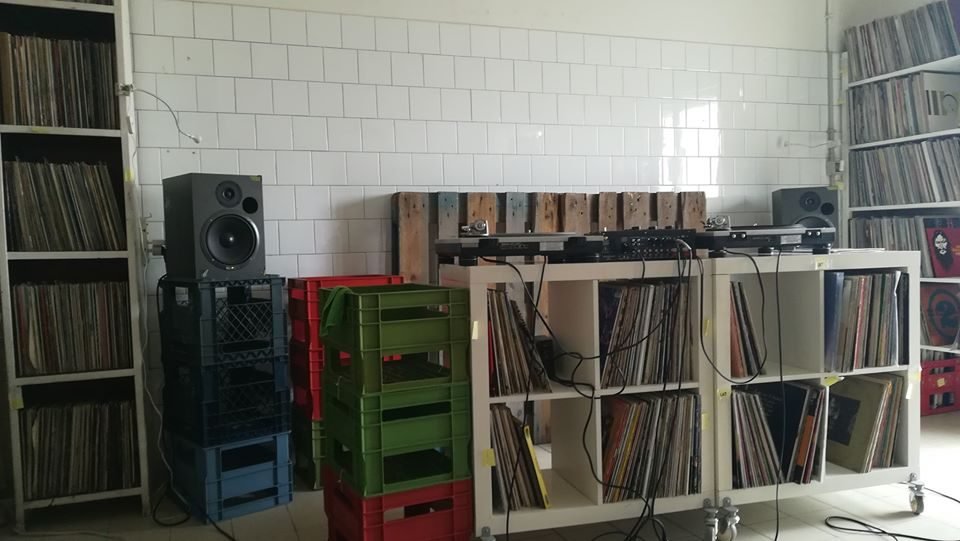
Pescheria occupies a ground-floor commercial space at Via Galeazzo Alessi, 57/59, in Rome, in the eastern quadrant of the city: where a real neighborhood fish shop used to be, with its marble counter and ice, there is now a listening, recording and meeting room dedicated to lateral music.
Via Galeazzo Alessi, 57/59
Rome
It's wise to distrust listings that dismiss a place like this in three lines. A former fish shop turned into a listening room is not a cute anecdote to put at the end of a guide: it's one of the most interesting things happening in the musical geography of east Rome, and to understand it you need to know three things almost nobody ever explains. What a listening room really is, what a recording room is and what is meant by lateral music. If you skip those three steps you're left with the postcard image of a converted fish store, which is the least important part of the story.
Here I try to do the opposite. I start from the address and the piece of city it sits in, which is not a decorative detail but the reason a room like this can exist. Then I get into the technical substance, calmly, explaining what happens inside a room designed for listening and inside a room designed for recording, because they are two different trades and keeping them in the same space is a precise choice. Finally I widen the view to the neighborhood, which has a long and documented history of public housing, borgate, aqueducts, cinemas and resistance, and which explains much better than any press release why certain things in Rome are born here and not inside the walls.
Where Pescheria Is and Which Part of East Rome We're In
The Address and the Quadrant
The address is Via Galeazzo Alessi, 57/59, postal code 00176. The street runs through the zone the street registry calls Villa Certosa, within the territory of Municipio V, in the area commonly identified as Torpignattara, right up against Via Casilina and a short distance from Pigneto and the Mandrione. It's east Rome in the most precise sense of the term: outside the Aurelian Walls, outside the perimeter tourists walk, inside the band of city that formed between the end of the 1800s and the postwar period along the lines of the ancient consular roads.
It's worth being precise on this point, because you often read that the place is in Tuscolano. Tuscolano proper is farther south, beyond the railway and beyond Via Casilina, and has an urban planning history of its own, made of INA-Casa plans and neighborhoods designed by important architects. Here instead we are in the web of streets that descends from Via Casilina toward the Mandrione, a finer fabric, older in its spontaneous formation and more irregular in layout. The two zones touch, they share the aqueduct and the railway as a boundary, and the atmosphere is related. But they are not the same thing, and anyone coming for the first time should know it so as not to look for the address on the wrong side.
How to Get There
Metro line C has the most convenient stops for this part of the city: Pigneto and Malatesta serve the area north and east of Via Casilina, and from both you walk. On Via Casilina run the surface buses connecting Porta Maggiore with Centocelle and the eastern periphery, and along the same axis also runs the old narrow-gauge railway that goes from Termini toward Centocelle, one of the most characteristic railway remnants of the city, with tracks brushing the walls of the houses and level crossings in the middle of traffic. Those arriving by tram from Porta Maggiore get off on Via Prenestina and cross the fabric of Torpignattara on foot: it's a good 20 minutes of walking, but it's the best way to understand where you are.
Why Right Here
Rooms dedicated to listening and recording are born where the square meter costs little, where commercial spaces are large and low, where the neighbors are used to street noise and where the city leaves a margin of tolerance. East Rome meets all four requirements. The spaces of old food shops, workshops, body shops and, precisely, fish shops have high ceilings, roll-down shutters, floor drains, thick walls and, above all, rents that in the historic center would be unthinkable. When a city pushes out of its center everything that doesn't produce immediate income, musical research migrates outward. It happened in Berlin, in London, in Milan, and it has been happening in Rome for at least 30 years, with a trajectory that starts from San Lorenzo and Testaccio and moves progressively toward Pigneto, Torpignattara, Quadraro, Centocelle.
What a Listening Room Really Is
Listening as an Activity, Not as Background
A listening room is a room built around a sound reproduction system, where recorded music is listened to by a group of people as the main activity and not as acoustic wallpaper. The difference from a bar that plays music is total, and it concerns hierarchy: in a bar the sound serves to fill silences and cover conversations, in a listening room conversations drop because the center of attention is the record that's spinning. Put that way it seems obvious, but it's a tiny and radical revolution, because it overturns 100 years of habits in which reproduced music served as a backdrop to something else.
The most cited historical model comes from postwar Japan. In Japanese cities, where apartments were small, walls thin and imported records very expensive, specialized venues were born in which the owner made a high-level sound system and a personal record collection available to the public. The customer paid for a drink and in exchange got the listening: the jazz venues are the best known, but there was an equivalent for classical music and for other repertoires. The unwritten rule was silence, or nearly so. That model has come back into circulation in the last two decades in Europe and the United States under different labels, and has taken root with particular naturalness where independent spaces already existed, used to treating music as a subject of study and not as a service.
What Makes a Room a Listening Room
Three elements, and none of the three concerns the furnishings. The first is the reproduction chain: source, amplification, speakers. The source can be a turntable, a player for digital media, a reel-to-reel recorder, each with different characteristics. In the case of the turntable, what matters is the platter and its rotational stability, the tonearm, the cartridge that reads the groove, and then the phono preamplifier, which does an invisible and decisive job: it applies in reverse the equalization curve with which the record was cut. That curve exists because during cutting the low frequencies are attenuated, otherwise the groove would be so wide as to shorten the side, and the high frequencies are boosted to cover the surface noise. In playback you have to take the opposite path. Without that step a record sounds thin and shrill. It's the kind of thing nobody tells you and which explains why the same record can sound in two completely different ways in two different rooms.
The second element is the speakers and the way they are placed. A speaker doesn't emit sound in all directions in the same way: it has a directivity that changes with frequency, tending to be wide on the lows and narrow on the highs. This means that moving a speaker by 50 centimeters or rotating it by 10 degrees changes the perceived balance far more than swapping a cable does. In the classic layout the two speakers and the listening position form a triangle, and the point where the stereo image recomposes correctly is narrow. In a public listening room that ideal point can't be occupied by everyone, so the challenge becomes distributing good listening over a wide surface: you work on the height of the speakers, on the angling, sometimes on systems that deliberately give up tight stereo in favor of a more even diffusion.
The third element, the most ignored and the most important, is the room. An environment is not a neutral container: it is part of the instrument. Hard surfaces reflect, porous surfaces and fibrous materials absorb, irregular geometries diffuse. If the walls are parallel and smooth, the waves bounce back and forth between two opposite surfaces and generate annoying resonances at certain frequencies, the phenomenon that in jargon is called flutter echo when it concerns the mids and highs, and room modes when it concerns the lows. Low frequencies are the serious problem: their wavelength is comparable to the dimensions of the room, so zones are created where the bass is swollen and zones where it almost completely disappears. You correct them with acoustic traps, with thick panels in the corners, with carefully studied air volumes, not with a rug. A serious listening room devotes more attention and more money to this problem than it devotes to the electronic components.
Why a Former Fish Shop Is an Interesting Case
A neighborhood fish shop is, from the acoustic point of view, the worst room imaginable. It has to be washed, so it's tiled from the floor up to a height of at least two meters. It has to be cold, so it's closed and compact. It has to have hygienic surfaces, so marble, steel, glazed ceramic. All of this reflects sound almost totally. A room like that, left as it is, produces a long, hissing reverberation in which any record becomes unreadable and any conversation turns into a buzz.
Turning it into a listening room therefore means doing the opposite of what the space was built to do. You have to add absorption where there was reflection, break the parallelism of the walls, fill the corners, deal with the ceiling, often work on the windows and the shutter, which are large rigid and vibrating surfaces. The result is never an anechoic chamber, and thankfully so: a room that is too absorbent sounds dead and tires the ear. The goal is a balance in which the reverberation is short but not nil, the lows are controlled and the voice stays intelligible at conversation volume. When you walk into a room like that you notice it before the music even starts: you speak and your voice doesn't come back at you.
What a Recording Room Is, Properly Explained
The Two Rooms and the Glass in Between
A classic recording studio is made of two communicating, acoustically separated spaces. The first is the live room, where the instruments and microphones are. The second is the control room, where the mixing desk, the monitors and the person recording are. Between the two there is a window, usually with double or triple glazing, with the panes not parallel to each other precisely to avoid the reflections mentioned above. The separation serves a practical and indispensable purpose: the listener must hear what goes into the microphones, not what comes out of the instruments in the next room, otherwise they can't judge anything.
Acoustic isolation is a matter of mass, sealing and decoupling. Mass, because a light wall lets sound through and a heavy wall doesn't. Sealing, because a gap of a few millimeters under a door cancels the work of an entire wall: sound behaves like water and finds every opening. Decoupling, because vibrations also travel through structures, and so in serious cases a room is built inside the room, resting on elastic supports, with no rigid contact with the building. In a neighborhood space, with neighbors above and on the sides, this is the most expensive and most delicate part of the whole project, and it's often what decides if a place can host a drum kit or only a string quartet.
Microphones and Pickup
A microphone converts variations in air pressure into an electrical signal. There are two main families. Dynamic microphones work with a coil immersed in a magnetic field attached to the diaphragm: they are sturdy, withstand very high sound pressures, have a less extended response and are excellent for snare drums, guitar amplifiers, brass, powerful voices. Condenser microphones work like a variable capacitor between a moving diaphragm and a fixed plate, require power, are much more sensitive and give superior detail on high frequencies: they are the usual choice for voices, pianos, strings, room sound. Then there is the family of ribbons, with a very thin metal foil suspended in the magnetic field, which has a soft character on the highs and a figure-eight pickup pattern, that is, sensitive in front and behind and deaf to the sides.
The pickup pattern is the second parameter that matters. A cardioid microphone picks up mostly what is in front of it and is the Swiss Army knife of recording. An omnidirectional one picks up from all directions, sounds more natural on the lows and captures a lot of room. The figure-eight, as said, picks up front and back. By combining different patterns you get stereo techniques: two cardioids crossed at the same point, a figure-eight pair and a cardioid for sum and difference techniques, two spaced omnidirectionals to capture an ensemble in a hall. Each gives a different image of the exact same sound event. This is the part of the craft that resembles photography: choosing the point of view.
From Signal to Record
After the microphone the signal passes through a preamplifier, which brings it to a usable level and which, depending on its construction, adds a character. Then it goes into the recording chain. For decades that meant magnetic tape: a film coated with magnetizable particles that runs in front of a head. Tape naturally compresses the peaks, adds a harmonic distortion the ear perceives as warmth, and imposes a precious constraint, namely a limited number of tracks and a material cost for every take. Today recording almost always happens digitally, with the signal converted into a sequence of numbers at a certain sampling rate and a certain bit depth. Digital has no practical limit on tracks, has no background hiss and allows you to undo a mistake, but it removes exactly the constraint that forced you to decide.
The two philosophies coexist, and places like this are where the coexistence shows best: an analog desk, perhaps, with a digital conversion downstream, a reel-to-reel recorder kept alive, electronic instruments that can in turn be analog or digital. After the pickup comes the mix, that is, building the balance among the tracks, with levels, placement in the stereo field, equalization, compression, reverb and delays. At the end comes mastering, the step in which the track is prepared for the medium it will be released on, with attention to the overall level, to the consistency among the tracks of a record and to the physical limits of the medium. If the record is released on vinyl, mastering is anything but a formality: an excess of out-of-phase bass or of energy on the very high frequencies can literally keep the stylus from staying in the groove.
Why a Recording Room and a Listening Room in the Same Place
Because they are the two ends of the same trade. Whoever records needs to listen to a lot of music made by others, and whoever listens with attention ends up wanting to understand how that music was built. Putting the two things in the same commercial space amounts to declaring that the distinction between those who produce and those who consume, in this part of the musical world, doesn't hold. The person who one evening sits down to listen to a whole record from beginning to end is often the same one who the following month brings their own material to record in that room. It's a model that resembles a workshop more than a company, and which in Rome has precedents in self-managed rehearsal rooms, neighborhood workshops and the centri sociali that since the 1980s have served as infrastructure for all the independent music of the city.
Lateral Music: What It Means, Plainly
An Honest Definition
Lateral music is an expression that defines by exclusion: it is everything that doesn't pass through the central channel of distribution, mainstream radio and the sold-out ticketed concert. Put that way it sounds like a poor definition, and indeed it is. I prefer to describe it from the inside, listing the families that usually end up in it, because each has a precise history and none was born yesterday.
The first family is improvisation. Not the solo within a given structure, as in classic jazz, but the collective construction of a music that has no score and that repeats nothing from one night to the next. It's a practice with iron rules, even if invisible: you learn to listen to the others, to be quiet, not to fill, to let something end. Whoever considers it the domain of chance has never tried doing it.
The second family is electroacoustic music, that is, music born from the manipulation of recorded sound and from electronic synthesis. Its conventional birth date is 1948, in Paris, when Pierre Schaeffer produced at French radio the first studies built by editing concrete sounds recorded on disc, hence the name musique concrète. A few years later, in 1955, RAI opened in Milan the Studio di Fonologia Musicale, where Luciano Berio and Bruno Maderna worked among others: it is one of the laboratories that defined the European electronic language, and it remains one of the most relevant Italian contributions to 20th-century music.
The third family is field recording, that is, work on the sounds of the world collected on the spot. Here the microphone stops being a documentation tool and becomes a composition tool: you choose where to put it, how long to wait, what to leave out. A neighborhood like this, with the railway, the level crossings, the courtyards, the markets and the bell towers, is a deposit of material for anyone working in this direction.
The fourth family gathers everything that works on duration and threshold: sounds held for a long time, microvariations, obsessive repetitions, volumes at the edge of silence or at the edge of endurance. These are practices that ask the listener for an investment of time and that, not by chance, work badly in a venue where people talk and very well in a room where people listen.
The Roman Tradition of Musical Research
Rome is not virgin ground for this kind of thing, quite the contrary. In 1960 the Associazione Nuova Consonanza was born in the city, which since then has organized a festival dedicated to contemporary music and research: it is one of the longest-lived institutions of the sector in Italy. From that milieu, in 1964, the Gruppo di Improvvisazione Nuova Consonanza took shape, an ensemble of composers who chose to improvise collectively instead of writing, and which counted among its members Franco Evangelisti, who was its main driving force, and Ennio Morricone, who played trumpet in it. It's a documented fact and systematically left out of popular accounts of Morricone, where the story of the western soundtracks is preferred: and yet that group is one of the most radical European chapters of structured improvisation.
Alongside this learned strand, the city has a parallel tradition made of rehearsal rooms, self-produced festivals, tiny labels, specialized record shops and occupied spaces that for decades hosted music no commercial circuit would have welcomed. The two traditions have crossed many times. A room like this, with a system for listening and a desk for recording, sits exactly at the point where the two lines touch: it's not an auditorium and it's not a centro sociale, it's a sound workshop.
If you're interested in seeing the other end of the same tradition in the city, the circuit of the historic jazz clubs remains the most solid reference: the Alexanderplatz Jazz Club is the best known, the Casa del Jazz holds together concerts, archive and residencies, and on the front of independent live music the Monk and the Largo Venue cover a large part of what moves in Rome outside the big arenas. For the history of instruments, the National Museum of Musical Instruments near Santa Croce in Gerusalemme is a stop almost no Roman has made and which is worth the afternoon.
The Fish Shop That Was Here Before
The Counter, the Ice, the Marble
To understand what that space was you have to remember what a neighborhood fish shop was before big retail. It was a business with high labor intensity and a very low margin for error, because the goods spoil in a few hours. The counter was marble, a material chosen because it stays cold, doesn't absorb and washes clean. Over the marble they spread crushed ice, which was resupplied every morning. The fish was laid out in rows, with the heads toward the customer, and was constantly rewetted. The floor sloped to a central drain, because at the end of the day everything was washed down by the bucketful. The walls were tiled up high for the same reason. In the back there was the cold room, and often a deep sink for cleaning the fish.
The rhythm was set by the wholesale market, where you went in the dead of night, and by the calendar: Friday and the eve of holidays were the peak days, for religious reasons that shaped Italian consumption for centuries. The fish shop was also one of the obligatory social points of the neighborhood, like the bakery and the barber: a place where you stood in line, talked, found things out. Its disappearance from Roman neighborhoods, together with that of the district market stalls in general, is one of the deepest and least told social transformations of the last 40 years.
The Reuse and Its Logic
When a commercial space of that type closes, what remains is a highly equipped shell and a relatively low rent. The drains are there, the electrical hookup is sized for cold rooms and compressors, the display window is wide and the shutter is sturdy. For a music project these are all concrete advantages: the power is needed, the water is needed, the shutter is a first acoustic barrier and the space has no neighbors on the same landing level. It's the same logic by which all over Europe spaces for experimental music end up inside former workshops, former print shops, former warehouses. The difference is that here the previous sign was not erased: the name stays that of the trade that was here before, and it's not a nostalgic affectation. It's a way of saying that the room has a history and that those who use it now are aware of it.
The Neighborhood: Torpignattara, Pigneto, the Mandrione
How This Part of the City Was Formed
The area east of Porta Maggiore was built by aggregation, not by plan. The railway arrives in the mid-1800s, the ancient consular roads, that is, Via Casilina on the old route of Via Labicana and Via Prenestina, carry traffic toward the Castelli and toward the Aniene valley, and along those lines first the kilns, vineyards and farmhouses settle, then the houses. The name Torpignattara comes from a tomb of the late antique age, the one tied to the figure of Helena, mother of Constantine, whose vault was lightened with amphorae set into the masonry: the pignatte from which the place name derives. It's a detail worth keeping in mind, because it tells well how this part of Rome grew literally on top of and inside the ancient, without a break in continuity.
Pigneto, a little farther north, has a similar origin and a different character: its historic part is a tongue of low houses between the railway and Via Prenestina, with villini and small apartment buildings from the first decades of the 1900s, inner courtyards, access balconies. The Mandrione, to the south, runs along the arches of the aqueduct and for decades housed one of the poorest settlements in the city. These three areas border each other, overlap in daily use and are often confused, but they have distinct building histories.
The Public Housing of the 1930s and the 1950s
The public side of eastern Roman housing was built in two waves. The first is that of the 1930s, when the regime gutted the historic center to open the great representative avenues and moved the displaced population into settlements built in a hurry on the margins. This is how the official borgate were born, arranged in a ring around the city, with minimal housing, services reduced to a bare minimum and precarious connections. The Borgata Gordiani, right in this quadrant, and Quarticciolo a little farther east are two textbook examples: they were conceived as containers, not as neighborhoods, and this origin has weighed on them for generations.
The second wave is from the postwar period and is of the opposite sign. In 1949 the law establishing the INA-Casa plan launched a national public housing program financed with contributions from workers and the State, also conceived as a tool against unemployment. In Rome the most famous result of that program is in Tuscolano, where between the 1950s and the early 1960s three large complexes were built. The most studied is the one that includes the courtyard houses designed by Adalberto Libera, a low-rise solution with private patios that is still cited today in architecture textbooks across Europe. They are a few stops from here, and anyone interested in cities would do well to go there on foot.
The comparison between the two waves explains many things about contemporary eastern Rome: the first produces isolation and stigma, the second tries to build neighborhoods with services, green space and urban design. The fabric we are in belongs entirely to neither, because it is in large part the result of small-scale private building, often built before the master plan got here. But the three logics coexist within a few kilometers, and walking you can read them with the naked eye.
The Felice Aqueduct
The arches that accompany Via del Mandrione and cross the whole southeastern quadrant belong to the Acquedotto Felice, built in the 1580s at the will of Pope Sixtus V, born Felice Peretti, hence the name. It was the first great aqueduct built in Rome after the end of the ancient world, and it served to bring water to the eastern hills of the city, then almost uninhabited, making their urbanization possible. The route reuses in several places the structures of the Roman aqueducts, in particular those of the Aqua Marcia and the Aqua Claudia, overlaying modern masonry on the ancient: in some stretches you can tell the two periods apart by eye, because the color and texture of the blocks change.
The same arches, in the 1900s, had a very different fate from the monumental one. Along the Mandrione, between the 1930s and the 1960s, the spans were walled up and turned into makeshift dwellings: shacks leaning against the aqueduct, with the arches serving as the back wall. It is one of the most photographed and filmed scenes of postwar Rome, and one of the hardest. Evictions and transfers to public housing neighborhoods erased the settlement, but the memory remains. Those who want to see the aqueduct in its monumental and free version find it at the Aqueducts Park, a little farther south. Those who instead want to understand the Mandrione can start from the Snodo Mandrione, which deals directly with that piece of the city.
The Quadraro
A little farther south, on the other side of Via Tuscolana, the Quadraro is a neighborhood that deserves a chapter of its own. Born spontaneously as well along the Acquedotto Felice, during the German occupation it became a refuge for partisans, draft evaders, deserters and wanted men, to the point that the German command considered it an out-of-control zone. On April 17, 1944 the occupying forces surrounded the neighborhood at dawn and carried out a mass roundup: hundreds of men were taken, gathered and deported to forced labor in Germany. It is one of the gravest episodes of occupied Rome, and the neighborhood was later awarded a gold medal for civil merit for those events. Walking its streets you come across tablets and plaques that remember it. In recent years the Quadraro has also become a reference point for Roman mural painting, with dozens of works on the facades.
Cinema and This Quadrant
East Rome is one of the most important locations in the history of Italian cinema, and not by chance: this was the real city, not the postcard one. In 1945 Roberto Rossellini shot in this part of the city some of the best-known scenes of Rome, Open City, including the one destined to become the symbol image of neorealism. In 1961 Pier Paolo Pasolini set his first film, Accattone, between Pigneto and the surrounding borgate, and in the following years he returned to these places several times, both with the camera and with writing. The Mandrione, the shacks, the farmhouses, the uncultivated fields between one building and the next are a landscape that today almost no longer exists but which was fixed in dozens of films.
Knowing this changes the walk. The same streets where today you look for a commercial space with the sign of an old fish shop were, 80 years ago, the backdrop of a film that changed the history of world cinema, and 60 years ago the territory of a poet who came looking for a language there. It's not a colorful detail: it's the reason the idea of music circulating in this quadrant has a different relationship with the word periphery than the one circulating elsewhere.
A Curiosity About Pescheria
The curiosity I like best concerns the name of the street. Via Galeazzo Alessi is named after a Perugian architect of the 1500s, born in 1512 and died in 1572, who was one of the protagonists of Italian architecture of his century. Alessi worked for a long time in Genoa, where he designed the basilica of Santa Maria Assunta di Carignano, with its central plan and the dome that dominates the city's profile, and where he contributed to the system of noble palaces of the street that today is a World Heritage site. In Milan he brought Palazzo Marino to completion, today the seat of the city government, with a courtyard that is one of the masterpieces of Lombard Mannerism. In Perugia, his city, he left important works on the complex of San Pietro and on the church of Santa Maria del Popolo.
That a room dedicated to building sound sits on a street named after a man who designed spaces, vaults and courtyards is obviously not someone's design: the street naming of this zone assigns streets the names of architects and engineers, and the coincidence is purely administrative. But it's one of those coincidences that once noticed are never forgotten, because the trade is the same. Alessi calculated how a dome distributed loads and how light entered a nave. Whoever works inside a listening room calculates how a wave reflects on a wall and where the cancellation of a low frequency forms. They are two ways of designing the behavior of a space with respect to something that passes through it.
One Thing Nobody Tells You About Pescheria
That the number one problem of a place like this is not the music, nor the sound system, nor the repertoire. It's the noise that gets out. In a commercial space wedged into a residential building, every decibel that passes through the wall, the floor slab or the window frame is a coexistence problem, and in Italy the limits of noise immission in living spaces are set by a national regulation that shows no mercy. Low frequencies are the most insidious part: they are the ones the ear perceives least in terms of immediate annoyance and the ones that pass best through structures, because their wavelength is large and light materials don't stop them. A speaker booming on the floor above has ruined more music projects than any economic crisis.
A practical consequence follows from this that people arriving from outside often don't understand. A place like this doesn't work like a nightclub, with high volumes and long hours. It works with moderate volumes, with careful management of what happens on the sidewalk and with a discipline shared between those who come in and those who live above. The most delicate part, almost always, is not inside but outside: the people who go out to smoke and talk loudly under other people's windows at 11 at night do more damage than a speaker system left on. It's an unwritten rule of all independent spaces in Roman residential neighborhoods, and it's worth respecting without waiting for someone to ask you.
The second thing nobody says concerns money. A room equipped for listening and recording has high fixed costs and very low revenues by definition, because the model doesn't foresee large numbers. The equipment ages, has to be maintained and repaired. Spare parts for analog components are ever rarer. The acoustic treatment is a heavy initial investment. The rent is paid every month even when the room is empty. Realities of this kind stay afloat with a mix of associations, unpaid work, membership cards, courses, contract productions and a disproportionate amount of stubbornness. Those who frequent these places should know it, because it changes how you behave once inside.
My Advice for Visiting Pescheria
The main advice is trivial only in appearance: find out before you set out. It's not a museum with hours printed on the door, and it's not a bar open every day from six to midnight. Realities of this kind open depending on what's happening inside, and the calendar is the thing that changes most often. The direct channels of whoever runs it are the only reliable source on days and hours, and a message before setting out is worth more than any listing, this one included.
The second piece of advice concerns how to behave inside. If you walk into a listening room while a record is playing, wait for the end of the side before striking up a conversation. It's not snobbery, it's the reason that room exists: if everyone talks over the music, the place becomes a bar with an expensive sound system. Lower your voice, turn off the ringer, avoid crossing the field between the speakers and the seated people, don't film without asking. They are five minimal rules that are learned in a second and that make the difference between a guest and a nuisance.
The third piece of advice is to arrive with an open ear. The music you hear in these places is rarely what you already know, and the first reaction to a listening you don't expect is almost always rejection. Give a piece the time it asks for. Much experimental music works on long durations, and the first three minutes only serve to make you lose your habits: if you leave in the fourth, you've heard the preamble and missed the piece. You don't have to love what you hear, but the judgment after 10 minutes is worth much more than the one after 10 seconds.
The fourth piece of advice concerns the surroundings. Don't come here for just an hour. The quadrant deserves half a day: the market and the streets of Torpignattara, the walk along the Mandrione with the arches of the aqueduct, the murals of the Quadraro, old Pigneto with its low houses. If you build the afternoon around the evening, the place will seem much more sensible to you, because you'll see it as a piece of a fabric and not as an isolated curiosity.
How to Behave in a Listening Room
It's worth devoting a few more lines to etiquette, because it's a recent practice in Italy and many arrive without instructions. The first rule concerns the volume of your voice: you talk, but quietly, and in the pauses. The second concerns movement: an acoustically treated room has a delicate balance, and a person who keeps moving in front of the speakers alters the listening of everyone else. The third concerns requests: in many places of this kind the selection is curated by whoever runs it, and asking for a track on demand is a bit like asking a cook to change the menu halfway through service. If there is a moment open to suggestions, they'll tell you.
The fourth rule concerns the phone. A lit screen in a dimly lit room is as visually intrusive as a loud voice is acoustically intrusive. The fifth concerns respect for the media: records are not touched without permission, they are held by the edge and the label, and never rested on the grooved surface. The sixth, the most important, concerns leaving: when you leave, leave in silence. The sidewalk is someone's home.
Another Well-Known Fact, Yet Rarely Cited
Here is the fact: Rome is a city that invented very little in recorded music and hosted a great deal. It didn't have a record industry comparable to Milan's, it didn't have a public electronic laboratory like RAI's Studio di Fonologia in Milan, and for decades it saw anyone who wanted to make a living from sound leave for the north. But it had something the north didn't have to the same degree: spaces. Huge low-cost premises, warehouses, farmhouses, storerooms, cellars, former workshops, and an urban tolerance that allowed dozens of experiences to be born without permits, without capital and without an initial audience.
From this follows a recognizable feature of the Roman scene: the centrality of the place over the label. In Rome musical stories are told by address, not by brand. You say where something happened, in which rehearsal room, in which basement, in which neighborhood. It's the opposite of what happens in cities with a strong industry, where they tell of record companies and famous studios. Here the heritage is real estate and social before it is commercial, and that is why it is extremely fragile: when a rent doubles, you don't lose a contract, you lose a piece of history.
The second rarely cited fact concerns collective listening. Until the 1950s listening to recorded music together with others was the norm, because the equipment was expensive and sat in a single room of the house, when it existed at all, or in public places. Then came the progressive individualization: the personal system, the headphone, the portable player, wireless earbuds. In two generations listening became a solitary and private activity. The listening rooms that are reopening today are not an aesthetic fashion: they are an attempt to recover a social practice that was normal and that we stopped doing without noticing. Listening to a whole record in a room with 20 strangers is an experience unlike anything you do with headphones, and anyone who has never tried it would do well to try it at least once.
The Right Photo to Take at Pescheria
The right photo is not the one of the sound system. Trust me: photographs of speakers and turntables are all the same and tell nothing, because sound can't be seen. The right photo is the one that holds together the before and the after, that is, the sign and the function. If any trace of the old use remains, a fragment of tile, a lettering, a repurposed marble counter, a hook, that is the subject: an object built for one trade that hosts another. Frame it tight, without people, with the light you have, and don't straighten everything in post-production. The irregularity is the content.
The second photo to take is from the street, in the evening, with the shutter up and the light spilling onto the sidewalk. It's a classic image of the nighttime city and it works for a precise reason: a warm rectangle on a dark street tells you in one stroke that something is happening at that spot. Stand on the opposite sidewalk, wait for someone to pass in front of the window and shoot when the figure is halfway across the opening. If you have a fast lens work wide open. If you only have the phone, rest it on a pole or a parked car to avoid blur, because in light like this the exposure time gets longer.
The third photo, the one I really recommend, is taken 200 meters from here and has nothing to do with the venue. It's the arches of the aqueduct along the Mandrione, with the tracks, the walls and the houses leaning against them: one of the most layered urban landscapes in Europe, where a hydraulic infrastructure of the 1500s built on top of one from the 1st century AD serves as the fence of a private garden of the 2000s. It should be photographed in the raking light of late afternoon, when the bricks light up and the shadows of the arches fall long on the road. If the day is clear, the best moment is in the half hour or so before sunset.
Some Important Events That Happened Here in History
I'm talking about the quadrant, because the long history of this piece of the city is what gives meaning to what happens here today.
In the 1st century AD the aqueducts that cross this zone were built, coming from the Aniene and the Sacco valley, converging toward the city and forming the monumental spine still visible today. The arches of the Aqua Claudia are among the most imposing ever built by Roman engineering, and their route has determined for two millennia the design of the territory east of Rome.
In the 4th century, along Via Labicana, the funerary complex tied to the figure of Helena, mother of Emperor Constantine, was built, with the mausoleum whose masonry lightened by amphorae will give the neighborhood its name, and the nearby catacomb of Saints Marcellinus and Peter, one of the largest Christian cemeteries in the city, with a first-rate early Christian painting heritage.
In the 1580s, under the pontificate of Sixtus V, the Acquedotto Felice was built, bringing water back to the eastern hills by partly reusing the ancient structures and making possible the future expansion of this part of the city.
In the 1930s the regime built the official borgate to house those displaced by the gutting of the center: in the eastern quadrant the Borgata Gordiani and Quarticciolo were born among others, settlements without services and conceived as residential containers.
In 1943 and 1944, under the German occupation, this part of the city was the stage of decisive episodes of the Roman Resistance. On April 17, 1944 the Quadraro was surrounded and subjected to a mass roundup, with hundreds of men taken and deported.
In 1945 Roberto Rossellini shot in this quadrant some of the scenes of Rome, Open City, a film that marks the international beginning of neorealism and fixes the image of popular, occupied Rome.
From 1949 onward the INA-Casa plan launched the great season of public housing: in Tuscolano the complexes were built that include, among others, the courtyard houses designed by Adalberto Libera, one of the reference points of Italian postwar residential architecture.
In 1960 the Associazione Nuova Consonanza was born in Rome and in 1964 the Gruppo di Improvvisazione Nuova Consonanza took shape, with Franco Evangelisti among the promoters and Ennio Morricone among the members: Roman musical research entered the European circuit permanently.
In 1961 Pier Paolo Pasolini shot Accattone between Pigneto and the surrounding borgate, opening a season of cinema that makes this quadrant a landscape recognizable all over the world.
Between the 1960s and the 1970s the shantytown settlements along the Mandrione were progressively cleared and the population transferred to public housing neighborhoods: the face of the area changed, and the long transition that leads to the current fabric began.
From the 1990s onward east Rome became the city's main pool of spaces for independent music, art and theater, through a combination of costs, available volumes and social composition. It is within this trajectory that the conversion of a neighborhood commercial space into a room dedicated to listening and recording should be read.
Who Has Passed Through Pescheria
Here I have to be honest about method, because this is the chapter where it's easiest to write nonsense. A space of this size doesn't publish an honor roll, doesn't have a wall of autographed photographs and has no interest in building a mythology of names. Inventing some would be the worst thing I could do, and I won't. What I can say precisely is who passes through a room like this, because the profile is always the same all over Europe and you recognize it in five minutes.
Those who have been collecting records for 20 years and have no one to listen to them with pass through. Musicians who work on unmarketable material and need a room to try it out in front of someone before deciding if it exists pass through. Sound technicians pass through, who are the quietest and most attentive category of any audience. Conservatory students bored with the repertoire and curious about what's happening outside pass through. People from the neighborhood pass through who walk in because they saw the light on and stay much longer than they expected. Inevitably, musicians passing through town pass through, looking for an evening different from the one on the official circuit.
And then, in a wider sense, much of what counts in 20th-century Italian culture has passed through this piece of Rome. Roberto Rossellini shot here the film that opened neorealism to the world. Pier Paolo Pasolini looked for, found and staged a language and a landscape here, returning for 15 years. Anna Magnani tied her face to a scene shot on these streets that became a world icon. In more recent times, generations of Roman musicians have passed through who learned to play in rehearsal rooms carved out of cellars identical to this one and in basements of public housing built in the two great seasons of public building.
If you look for the thread that holds these presences together, it's always the same: the availability of low-cost space in an area the city considered marginal. This is how neorealism was born, a large part of Italian cinema of the 1960s and almost all the independent Roman music of the last 40 years. Whoever opens a listening room today in a commercial space in east Rome is inside that same history, even if they don't care.
What to See Nearby
Within walking distance there are more things than are needed to fill a day. The arches along the Mandrione are the itinerary I recommend first, with the Snodo Mandrione as a reference point for understanding the context. Farther south, the Aqueducts Park offers the monumental and open version of the same landscape. Toward the center, the Underground Basilica of Porta Maggiore is one of the most mysterious and least visited monuments in Rome, a few minutes from here. In the quadrant, the Casa della Cultura di Villa De Sanctis and the initiatives of the Casilino Urban Fest tell of the grassroots cultural life of the area, while the Rooftop Cinema at Casilino Sky Park is one of the most interesting experiments in public use of neighborhood spaces.
To stay on the theme of sound, RCCB Init works on electronic music and club culture from a research angle, and the MOV festival at Villa Lais brings together music, arts and experimentation in another quadrant of the city. If instead you want to end the day with a dinner in the area, Torpignattara and Pigneto have a density of different cuisines found in few other parts of Rome: it's one of the most international quadrants of the city, and you eat accordingly.
Quick Questions About Pescheria
What Exactly Is Pescheria?
A space on Via Galeazzo Alessi, 57/59, that housed a neighborhood fish shop and today works as a listening room, recording room and meeting place dedicated to experimental music.
In Which Neighborhood Is It?
In the Villa Certosa zone, inside the Torpignattara area, in Municipio V, right up against Via Casilina and the Mandrione. It's east Rome, not Tuscolano, which is farther south beyond the railway.
How Do I Get There by Public Transport?
The most convenient stops on metro line C are Pigneto and Malatesta, from which you walk. On Via Casilina run the surface buses and the old narrow-gauge railway toward Centocelle. From Via Prenestina you get there by tram and then on foot.
What Music Do You Hear?
Lateral music: improvisation, electroacoustic music, field recording, minimalism, sound research. That is, repertoires that rarely pass through commercial circuits and that ask for attentive listening.
Can I Record an Album Here?
A recording room exists for exactly this, but availability, timing and conditions have to be agreed directly with whoever runs the space. It applies to any studio: you start with a phone call, not with an online booking.
Is It Suitable for Children?
It depends on what's on the program. A collective listening session at moderate volume can be an interesting experience even for a curious kid, as long as they can stay quiet for the necessary time. Below that age it's best to skip it.
What Is the Best Time to Come?
The cold season, from October to April, when the indoor programming is denser. In summer Rome moves outdoors and places of this kind reduce their activity or move it elsewhere.
Frequently Asked Questions About Pescheria
Where Is Pescheria and What Was It Before?
Pescheria is at Via Galeazzo Alessi 57/59, postal code 00176, in the Villa Certosa zone, inside Municipio V, in the Torpignattara area, right up against Via Casilina. The space originally housed a real neighborhood fish shop, with a marble counter and crushed ice.
What Is Pescheria Today?
Today Pescheria is a listening room, a recording room and a meeting place dedicated to experimental music and to so-called lateral music, that is, everything that doesn't pass through the central channel of record distribution and mainstream radio.
What Music Do You Hear at Pescheria?
At Pescheria you hear lateral music, an expression that defines by exclusion everything that stays outside the circuit of mainstream radio and the sold-out ticketed concert: niche repertoires and sound research.
Is Pescheria Open Every Day?
No, Pescheria is not a bar with fixed hours: it opens depending on what's happening inside, and the calendar changes often. The direct channels of whoever runs it are the only reliable source on days and hours, so it's best to find out before setting out.
How Do You Behave During a Listening Session at Pescheria?
At Pescheria a precise etiquette applies: you talk quietly and in the pauses, and you don't keep moving in front of the speakers, because an acoustically treated room has a delicate balance that a person in motion can alter for everyone else.
What Is Near Pescheria?
Near Pescheria, in the Torpignattara neighborhood, you find the arches along the Mandrione, with the Snodo Mandrione as a reference point, the Parco degli Acquedotti farther south and, toward the center, the Underground Basilica of Porta Maggiore.
Where Does the Name of the Street Where Pescheria Is Come From?
Via Galeazzo Alessi, where Pescheria is, is named after a Perugian architect of the 1500s, born in 1512 and died in 1572, a protagonist of Italian architecture of his century, active mostly in Genoa.
Why a Place Like This Matters
To close, the most important thing. A city is also judged by how many rooms it has in which it's possible to do something that doesn't produce an immediate profit. Rome has had very many and is losing many, replaced by activities that earn more per square meter and that ask much less of the city. A former fish shop where people listen to records in silence and record music that will sell few copies is, in accounting terms, a folly. In terms of the city it is exactly the opposite: it is the kind of place from which over the decades have come films, records, books and trades, and without which a metropolis becomes just a container of consumption.
So the invitation is direct. Take an afternoon, come down to this quadrant, walk along the aqueduct, look at the low houses and the courtyards, then step into a room where someone has decided that listening to a whole record is an activity worthy of a place of its own. You won't need to know the music on the program. All you'll need is the patience to sit for 40 minutes without looking at your phone, which in 2026 has become a rarer discipline than you imagine.
Article written by the editorial team of TourLeaderPro, contact them for Private/Corporate/V.I.P. Tours and Experiences.
Planning a trip to Rome? The English-language guides to visiting the city are on ItalyPlanner.com.
Contact Information
Via Galeazzo Alessi, 57/59
Roma Roma Città, Roma Città