Monk
In short. Monk is one of those Roman places that are hard to explain in words and easy to understand on foot.
Via Giuseppe Mirri, 35
Rome
Monk is one of those Roman places that are hard to explain in words and easy to understand on foot. The first time you get there, almost always in the evening, almost always following someone who's been before, you feel like you took a wrong turn. You're in the middle of a stretch of the city made of low warehouses, perimeter walls, closed workshops and railway tracks running behind the houses, and it doesn't look like the kind of address where you'd expect to find a stage, a basketball court and 100 people sitting in deck chairs with a drink in hand. Then you turn the corner, see the gate, hear the bass coming from inside and realize it's exactly there. That moment is the best thing about the place: Monk doesn't come to you, you have to go get it.
We're in Portonaccio, on the edge of the Tiburtino quadrant, in that band of Rome that starts after San Lorenzo and ends somewhere toward Cervelletta. For decades this part of the city had only one recognized public identity, the railway and industrial one, and in the last 20 years it has gained a second, nocturnal and musical. Via Giuseppe Mirri is a side street that leads nowhere except to itself. It isn't a through road, it has no shop windows, it doesn't have the constant flow of people you'd expect around a big venue. Whoever gets here gets here on purpose. That changes everything: it filters the crowd, changes the way people behave, removes casual tourism and leaves only those who really wanted to be there.
The reason this address is known in Rome even to people who have never been inside Monk is that in this same space, before, there was La Palma. For generations of Romans who listen to music, La Palma was one of the few venues in the city where jazz, and not only jazz, had a real home: a stage, a sound system, a continuous program, a seasoned audience. It wasn't a downtown club with 50 chairs and a wobbly little table. It was a big space, with a roomy indoor hall and a generous outdoor area, and in Rome that has always been a rare luxury. When La Palma closed, that address stayed in a lot of people's minds as a void: something that was there and is gone, in a city that fills its voids very slowly. The fact that the space has come back to life with another name, another look and another generation of audience is one of the few good structural news items for the quadrant.
The outdoor space is its best card. When Monk is in its right season, it works like a big open-air courtyard: deck chairs, low seating, scattered tables, a bar, a stage for live shows, foosball tables, a basketball court. It isn't a garden designed by a landscaper, it's a civilized yard, and that is precisely why it works in Rome: it looks like a school courtyard that grew up. The indoor space is the other half of the thing, and it matters in the seasons when you can't stay outside: hall, stage, sound system, concerts, DJ sets, aperitifs, parties, long afternoons that turn into long evenings. On the food side, the place has always aimed to sit above the average for venues with a stage, and in the Rome of warm beer and sad sandwiches that detail weighs more than it seems.
Below you'll find everything you need to know about this address, how to get there, how to enjoy it, what was here before and what's around it. One honest premise is needed right away, though: the programming of Roman venues like this changes from season to season and sometimes from month to month, and here you won't find hours, prices or schedules that can't be checked. I'll tell you about the place.
Where Monk is and how to really get there
Via Giuseppe Mirri 35 is an address your navigator finds without problems and your head struggles to place, because it belongs to one of those areas that Romans drive through a thousand times without looking at them. The big landmark is Portonaccio, and more precisely the band between Via Tiburtina, the ring road and the bundle of tracks entering the city from the east. If you picture Rome as a wheel, we're on a spoke that starts from Tiburtina station and heads out: a spoke full of infrastructure, viaducts, depots, things built to work and not to be looked at.
The simplest way to get there without a car is to treat Tiburtina as your starting point. The station is a huge hub: regional and long-distance trains stop there, there's the metro, there's the terminus for a lot of urban and suburban buses, and from there the rest is a matter of a few minutes. I won't give you line numbers or exact times, because Rome's public transport setup changes and I don't want to send you to stops that have changed route in the meantime. Open the app you normally use, set Portonaccio as the destination and trust it, because on this stretch the coverage is good. The important thing to know is something else: the way back. In Rome the problem with a late-night venue is never getting there, it's half past midnight. Before leaving home, check what time the last ride back to where you need to go leaves, or plan for a taxi or a car service. It's the most trivial advice in the world and still the one people forget most often.
By car it's a different story and worth discussing concretely. Portonaccio isn't the historic center: you don't have the limited traffic zone that eats your evening with a fine, and that's already news. But you do have the classic Roman parking problem in an area where the street is narrow and there are many driveways. The rule in these situations is to arrive with 10 minutes to spare and park on the wider main roads instead of insisting on the side street in front of the door. 10 minutes on foot never killed anybody, a towed car ruins the evening. And if you go by motorbike or scooter, which in Rome remains the most sensible vehicle for this kind of evening, you've solved the problem from the start.
There's also something about the perception of distance. People who live in the center, or in Trastevere, or in Prati, tend to consider Portonaccio very far away, and it isn't: from Termini it's a few kilometers, from San Lorenzo it's practically around the corner, from Pigneto it's a short crossing. The real distance is mental, not in kilometers, and it's the same one that keeps many Romans away from Centrale Montemartini or from half of eastern Rome. The Tiburtino quadrant suffers from a geographic prejudice that the numbers don't justify.
What Monk is, in concrete terms
The commercial category doesn't help. If you say venue you think of a bar, if you say club you think of a dance floor, if you say circolo you think of a membership card and a Formica counter. Monk is a hybrid, and like all successful hybrids you only understand it by seeing it. Imagine a closed perimeter inside which, at the same time or in rotation, you find a bar area, a stage area, an eating area, an area for sitting around doing nothing and an area for playing. All without internal walls telling you where one thing ends and another begins.
This model is rare in Rome because it requires square footage. The historic center doesn't have any: the venues downtown are rooms in old buildings, with vaulted ceilings, restrictions, and a capacity counted in dozens of people. To get a real outdoor space you have to leave the circle, and leaving the circle almost always means ending up in a former industrial space. Monk belongs to this family: it's a piece of the city born for another function and converted to leisure. It's the same logic that turned slaughterhouses into museums, workshops into theaters, depots into rehearsal rooms. Rome is full of these transitions, but almost all of them involve institutional culture. Here it involves nightlife, which is a less protected and more fragile form of culture.
On the practical side, which is what matters to people who go, the layout reads like this. The outdoor part is where you stay when the weather allows, and it's the reason the place makes sense mainly from April to October: deck chairs, seating, tables, the bar counter, the stage, the foosball tables, the basketball court. The indoor part is where you stay when you can't stay outside, and it hosts the real concerts, the DJ sets, the parties. The kitchen, when it's active, is part of the offer and not a side dish: we're not talking about the fallback sandwich you eat because it's 1 a.m. and you have no alternative, but about a considered menu. Then there's the part nobody writes in press releases and which is the most important: the space where nothing happens. The deck chairs where you sit down at 19:00 and get up at 21:00 without having done anything in particular. In a city that makes you pay for every square meter of rest, a place where you can simply be is a public service disguised as a venue.
The outdoor space: deck chairs, stage, foosball and basketball court
The deck chairs are the first thing you see and they're also the statement of intent. A deck chair isn't a lounge sofa: it's an object from the beach, from the home garden, from an afternoon with no plans. Putting them in a Roman yard means telling the audience that in there you don't have to do anything in particular, that you can arrive early and stay late, that there's no liturgy to respect. It's a choice of posture, in the literal sense: on a deck chair nobody stays standing to be seen, you lie back. It changes the tone of the whole evening.
The outdoor stage is the other decisive element. An open-air stage in Rome is a privilege you pay for in hours, because noise in a city with homes all around is a serious and regulated problem, and every venue with an outdoor area has to find a balance between the music and the neighbors. This balance determines, much more than the organizers' taste, what kind of music you can play outside and until what time. It's the reason why in many Roman venues the outdoor concert ends early and then the evening moves inside, or turns into a DJ set at low volume. It isn't laziness, it's physics and paperwork.
The foosball tables deserve a paragraph. In Italy foosball is a social object before it's a game: it's the perfect excuse to talk to someone you don't know, to fill the 20 minutes between one set and the next, to form improvised teams. A venue that puts in foosball tables is saying it wants people who interact, not people who stare at their phones in line at the bar. It's a small detail with big consequences for the atmosphere.
The basketball court is the most unexpected thing and, for me, the smartest. A playing court inside a nightlife venue shifts the time axis: it means the place makes sense even at five in the afternoon, that you don't have to wait until 10 at night to have a reason to be there. It's an attempt to build an all-day place, which in a city where venues open late and close early is a remarkable ambition. The basketball court says something else too: that the space is really big. A court, even a reduced one, takes up square footage that no downtown venue could ever afford.
Finally there's the question of light. An open space in Rome in summer lives through three different moments. Late afternoon, when the sun is still high and you look for shade. Sunset, which here isn't the postcard one over the rooftops of the center but a low, orange light cutting across the walls and warehouses, and which is the best moment of the whole day for photos. And the full night, when the space shrinks to cones of artificial light and everything concentrates on the stage and the bar. They are three different venues at the same address, and whoever arrives only at 23:00 knows one out of three.
The indoor space: concerts, DJ sets, aperitifs and parties
The indoor hall is the part inherited most directly from the address's past, because a club with a serious music program needs an enclosed, treated environment, with a permanent sound system and a stage that isn't taken apart every time. The outdoor area is beautiful but seasonal and depends on the weather. The indoor one is what lets a venue exist 12 months a year and build a loyal audience. Anyone who knows how Roman clubs work knows that survival is decided right here: how many days a year you manage to open, and with what sound quality.
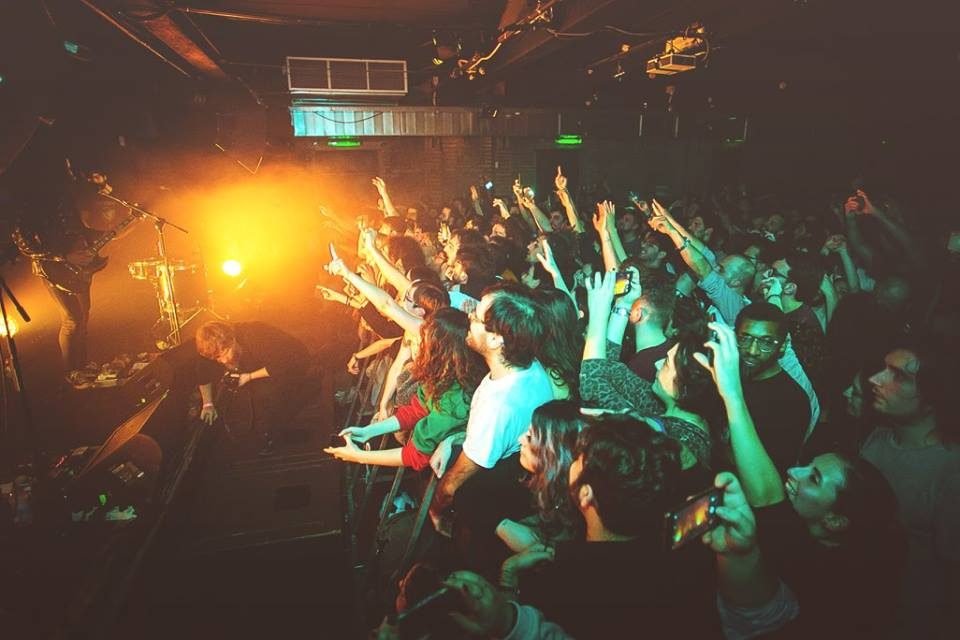
The club concert format is a specific thing and worth explaining to people used only to big events. In a club the stage is low, often a few centimeters off the floor, and the distance between who plays and who listens is measured in meters. There's no barrier, no giant screen, no sound delay arriving out of sync. You see the hands on the neck of the instrument, you hear the breathing in the microphone, you understand when someone makes a mistake and how they recover. It's a completely different experience from a concert in the open-air theater of the Auditorium Parco della Musica, not worse or better: just something else. Rome, historically, has had many big venues and few good clubs, and every time a club holds up it's a fact that concerns the whole city.
DJ sets are the other half of the program and serve to cover the nights when there's no live show. You can feel the difference between a filler DJ set and a curated one within three minutes: in the first case it's background music to get people to drink, in the second there's a path, a selection, an idea. Spaces that come from a musical tradition, like this one, tend toward the second type, because the audience they've built notices and leaves if you treat it badly.
The aperitif, in the Rome of the last 15 years, has become the formula that keeps venues with a program afloat financially. It works like this: the music is the reason people know the place, the aperitif and the kitchen are the reason the place manages to pay salaries. Whoever turns up their nose at this dynamic has never tried to make the books balance for a space with a stage. The difference between a decent aperitif and a badly done one, however, remains enormous, and in serious venues the sad buffet with soggy chips was filed away long ago.
Parties are the most elastic category. Under this word, in a venue like this, goes everything: group birthdays, themed nights, record presentations, festival closings, parties of collectives and associations, recurring events that become habits. It's the hardest part to describe in a listing, because it changes constantly, and it's also the one that defines the identity of a place much more than its architecture.
A couple of words on the kitchen, because a specific promise circulates: a restaurant where you eat very well. It's an ambition that deserves to be taken seriously, because combining a stage and a kitchen is hard. The concert imposes certain hours, the restaurant imposes others. The concert wants darkness and high volume, dinner wants light and the chance to talk. The spaces that manage to hold the two together are few everywhere, not just in Rome, and they almost always manage it by physically separating the functions: you have dinner earlier and somewhere other than where the music is then played. If you go with the idea of having dinner, the sensible thing is to check in advance, because in venues with a program the kitchen is never active every night in the same way.
La Palma, the venue that was here before
To understand why this address matters, we need to talk about what La Palma was. In the musical geography of Rome in the last decades of the 20th century and the early 2000s, jazz had few stable strongholds and many temporary places. There were the downtown clubs, small and historic, with the little table and the compulsory drink. There were the summer festivals, which concentrated in a few weeks what was missing the rest of the year. And then there were the few big spaces with a continuous program, which could afford to host large ensembles, projects that needed volume, and audiences of hundreds of people instead of dozens.
La Palma belonged to this third category, and it was in a peripheral position precisely because the periphery offered the square footage the center didn't have. It was a place where jazz mixed with other things: improvised music, electronic, experimental work, things that don't fit into labels. This mixture is a precisely Roman trait: in Rome the border between genres has always been porous, and whoever has programmed in the city has almost always worked on hybrid lineups, out of economic necessity before aesthetic choice. A club that played only pure jazz, in Rome, wouldn't have lasted a year.
The end of La Palma left a hole that was felt. In cities where live music venues are few, every closing is not an arithmetic loss but a geometric one: a stage disappears, and with it disappears the chance for dozens of projects to have a date in the city, an audience that had formed there disappears, the technical staff who worked there disappear. Rome, in this, has historically been fragile. It has an enormous offer in summer, when the city fills with festivals and temporary stages in parks and courtyards, and a much thinner one from November to March, when only the permanent venues remain. The relationship between these two seasons is the real structural problem of Roman music.
The fact that the space on Via Mirri is working again, with a new name and a different project, is therefore news that goes beyond the single venue. It means that a building with those characteristics, with that capacity and that sound system, has returned to the circuit. And it also means that someone decided to bet on a quadrant that the Roman real estate market doesn't consider glamorous. The two things together, in a city that loses spaces regularly, deserve to be said.
Something less romantic has to be said too: spaces like this have a life that depends on fragile variables. Contracts, permits, neighbors, licenses for live music, energy costs, the ability to fill the place on Wednesday and not just on Saturday. In the Rome of recent years quite a few places that seemed solid have changed management, formula or name. For this reason, if Monk is on your list, the most useful thing you can do is check the venue's channels before leaving home, instead of trusting a page, whichever it is, written months earlier.
A curiosity about Monk
The best curiosity concerns the name, and its relationship with what was here before. Calling a venue Monk when it was born inside the walls of a historic Roman jazz club is a gesture that works on two levels at once. The first is musical and transparent: Monk is one of the founding surnames of modern jazz, and anyone who has even brushed against that music recognizes it without needing an explanation. The second is subtler and almost architectural: in English a monk is a member of a monastic order, and a monk evokes a cloister, an inner courtyard, enclosure, a closed perimeter inside which exists a world you can't see from the outside. Which is, literally, the physical description of this place: an anonymous wall on an anonymous street, and inside a courtyard with a stage.
The play of meanings, accidental or intended, tells the logic of converted Roman spaces well. In Rome beautiful places almost never announce themselves from the street. The real cloisters, those of the convents, have worked exactly like this for a thousand years: closed door, no signs, and beyond the threshold a silent garden that nobody would suspect. Rome is a city that hides, not a city that displays, and its nightlife spaces have inherited this grammar without knowing it. People who come from elsewhere and expect the lit sign visible from 200 meters always end up thrown off.
There's a second curiosity, minor but nice, and it concerns street names. Via Giuseppe Mirri belongs to a grid of streets in the Tiburtino quadrant named after people whom almost none of the residents could identify. It's a perfectly normal condition of 20th-century Roman suburbs: entire neighborhoods have street names that nobody decodes anymore, names that have become pure geographic identifiers emptied of content. For the vast majority of Romans today, Via Mirri doesn't mean a man: it means a venue. Affectionate place names have beaten official ones, and it almost always goes that way when something people love opens on a street.
Portonaccio, the San Lorenzo freight yard and the Tiburtino quadrant
To appreciate the place it helps to understand the territory, because here the context is not a decorative detail: it's half the story. Portonaccio is one of those Roman names that indicate an area without matching a sharp administrative boundary. It lies east of Tiburtina station, in a piece of the city that grew around infrastructure: the railway, the depots, the warehouses, the fast-flowing roads. It's the kind of urban landscape that no tourist guide describes and that nonetheless tells you more about the real Rome than three Baroque churches put together.
The keyword for the whole quadrant is scalo, the freight yard. The San Lorenzo freight yard is one of the city's great railway facilities, the place where goods arrived, were sorted and loaded. Around freight yards, in all European cities, the same kind of fabric has grown: workshops, depots, crafts, workers' housing, and a quantity of sheds built to hold things and not people. When rail freight shrank and production moved elsewhere, those sheds stayed, empty and available. That's where nightlife districts are born all over Europe: Berlin, Hamburg, Barcelona, Milan, Rome. It was never an aesthetic choice, it was a real estate consequence. Big, noisy spaces end up where the noise already was.
The Tiburtino quadrant is also the territory of Rome's wartime memory. The area between the freight yard and the San Lorenzo neighborhood bears the marks of the bombing of July 1943, the event that most deeply marked the emotional geography of this part of the city: the military targets were precisely the railway yards, and the residential fabric around them paid a very high price. Whoever walks today between San Lorenzo fuori le Mura and the Verano Cemetery crosses a piece of the city that still wears that wound, in the rebuilt facades and the gaps never filled. This heavy past lives side by side, a few hundred meters away, with the most carefree nightlife in the city, and the coexistence of the two layers is one of the most Roman things there is.
Then there's the university dimension. San Lorenzo, a few minutes from here, is the neighborhood of Sapienza, and from the 1970s on it has had a density of students that completely redrew its character. Students bring three things: little money, a lot of time and a hunger for places to hang out without spending much. This combination has generated in eastern Rome an ecosystem of clubs, self-managed spaces, beer halls and rehearsal rooms, including places like Container San Lorenzo or Palestra Popolare San Lorenzo, which have shaped generations of audiences. Monk benefits from this catchment area even without being inside San Lorenzo: the audience is the same, it just moves a few stops.
Finally the green, which exists in this quadrant and is underrated. Heading east you reach Cervelletta Park, one of the surviving pieces of the Roman countryside inside the city, with the farmhouse, the fields and a quiet that seems impossible 10 minutes from the ring road. To the northwest, across the river, there is Parco del Pineto. Eastern Rome is not just concrete and tracks: it's a mosaic where the industrial and the agricultural touch without mediation, and this lack of transition is its landscape signature.
Something nobody tells you about Monk
What you won't read anywhere is that this place changes nature three times over the course of the same day, and that 90 percent of people know only one version of it. Those who go just for the concert arrive at 22:00, go in, look at the stage, leave at 01:00 and have seen a club. Those who go in the afternoon find a courtyard with deck chairs, low sun, few people, the noise of foosball tables and no urgency, and have seen a public garden with a bar. Those who go for dinner find a restaurant with the music in the other room. They are three experiences that exclude each other, and most regulars stay loyal to just one without knowing the others exist.
The contrarian suggestion is to try the version you've never done, and in particular the late afternoon one. In a venue with an evening program, the afternoon is the moment when you see the bare structure: the space without people, the empty stage, the natural light on the walls, the technicians doing their tests. The soundcheck, for those lucky enough to catch it, is often more interesting than the concert: you hear the same pieces played without an audience, with interruptions, requests to the sound engineer, jokes between the musicians. It's the backstage you'll never see in the big venues, because they keep you outside until the gates open.
The second thing nobody tells you concerns the relationship with the neighborhood, which in a space like this is the invisible variable that decides everything. A venue with an open-air stage in a fabric that also includes lived-in homes is in permanent balance. If the balance breaks, restrictions arrive, hours get shorter, outdoor live music becomes impossible. This is why, in places like this, the request to leave quietly at the end of the night is not a bureaucratic formality posted to pass the buck: it is literally the condition for the space's survival. The 100 people talking loudly on the sidewalk at 2 a.m. do more damage than the whole concert. Anyone who has gone out in Rome at night over the last 20 years has seen enough places close to know this isn't rhetoric.
The third, and perhaps the most useful, concerns Wednesdays and Thursdays. In venues with a program, Saturday is the worst night to really get to know the place: it's crowded, the audience is general, the lines at the bar are long, the music is whatever works with everyone. Weeknights are the opposite: fewer people, bolder programming, staff willing to talk, room to sit down. If you want to understand what a place really is, go on a Wednesday. This is true for Monk as it is for any club in any city in the world.
The advice I give you for visiting Monk
The main advice is one and I'll sum it up in one sentence: arrive early and don't plan your exit. Early means in daylight, at least an hour before you were thinking of going, and it serves three purposes. First, you find a place to sit where you want, and in a space with deck chairs and tables the position makes an enormous difference between a comfortable evening and an evening standing against a wall. Second, you see the transformation of the space as the light fades, which is the most beautiful part and the one everyone misses. Third, if the kitchen is open you eat calmly instead of fighting the peak-hour line.
Not planning your exit means the opposite of what most people do, who arrive at 23:00 for the band they care about and leave at the end of the set. What comes after, the DJ set, the tail end of the night, the people who stay and talk, is often the part where the place gives its best. If you decided from the start that at half past midnight you're in the car, you've bought half a ticket.
Second piece of advice, very practical: check the weather with maniacal attention, because in a space with a double soul the rain doesn't cancel the evening but moves it inside, and inside the capacity is different and so is the atmosphere. A summer evening planned outside and ended inside is another evening. It's not worse, it's different, but if you go with the idea of deck chairs under the stars and find yourself in the hall, the betrayed expectation spoils your judgment.
Third piece of advice: dress to stay outside. Rome has a reputation as a hot city and in July it is, but an open space at night, in a quadrant near the river and the tracks, gets much colder than people imagine. From mid-September on, the difference between 21:00 and 01:00 is several degrees. A sweatshirt in your backpack is what most often saves your evening. And comfortable shoes, because between the yard, the gravel, the court and the walk from the parking spot you walk more than it seems.
Fourth piece of advice, about money: don't take anything for granted regarding payment methods, any membership cards and how you get into events. In Roman venues with a music program the formulas change and may include free entry on certain nights and tickets on others. Finding out 30 seconds before leaving solves everything. Showing up at the door with the wrong idea only generates pointless arguments.
Fifth piece of advice, the one worth more than all the others: if you don't know the band that's playing, go anyway. Discovering an unknown musical project in a small hall, with no expectations, with 200 people around and the stage three meters away, is one of the experiences that stadium concerts can never give back to you. That's exactly what a club is for. And if you don't like it, you've lost an evening and gained a story.
What to wear, who to go with, how long to stay
The dress code here is that of nighttime Rome on the east side, which is, and I say this as a compliment, the least codified in the city. It isn't the center where people dress to be seen, it isn't the coast where you go in flip-flops. It's an intermediate, informal register: comfortable pants, shoes that can handle gravel, a shirt or a T-shirt, something on top for the night. Nobody will look at you badly for how you're dressed, which is an enormous relief compared to certain Roman venues where entry depends on an aesthetic judgment at the door.
As for company, the place works especially well in two configurations. The first is the medium-sized group, four to six people, because the space lets you sit together without squeezing, and the foosball tables and the court automatically give you something to do when conversation runs out. The second, less obvious, is the couple or the solo visitor who comes for the music: in a small hall you can stand alone in front of the stage without feeling strange, which isn't possible in a nightclub. The case where it works less well is the very large group that arrives late, because by then the space is already taken and you'll end up scattered.
As for duration, the ideal average is four hours. Under two hours it makes no sense to make the trip, because the travel time eats the evening. Over five, in a space where you stay on your feet or sit in low deck chairs, tiredness wins. Four hours, typically from 19:00 to 23:00 in the long-afternoon version, or from 22:00 to 02:00 in the concert version, is the right measure.
One last note on children, because I'm asked about it more often than you'd think. A space with a basketball court, a courtyard and foosball tables, during the day, is theoretically perfect for a family. In practice it depends entirely on the formula of the day and the venue's rules, which can change between afternoon and evening. If the idea is to bring kids, checking in advance is not optional.
Another well-known fact, yet rarely cited
The well-known fact is that Rome has a good musical nightlife. Everyone says it, guides write it, Romans repeat it with pride. What almost nobody adds is the uncomfortable part: this nightlife exists almost entirely in the suburbs, and it exists there for negative reasons, not positive ones. Not because the suburbs are more creative, but because the historic center has expelled it.
The mechanism is simple and concerns all European cities with a monumental historic center. Downtown, properties cost a lot, restrictions are heavy, housing is dense, permits for amplified music are hard to get, and in the last 15 years the pressure from short-term tourist rentals has done the rest. The result is that inside the Aurelian Walls a venue with a real stage is almost impossible to keep going, and the few survivors are historic, small clubs, with capacities that don't allow hosting large ensembles. Whoever wants a stage, a serious sound system and 200 places has to go where square footage costs less and the neighbors are fewer: that is, toward Tiburtina, toward Ostiense, toward Pigneto, toward Quadraro.
The cultural consequence is that the map of Rome's live music is exactly the inverse of the tourist map. A visitor staying near Piazza Navona who asks at the hotel where to hear good music will receive, at best, the address of a venue with a pianist, at worst that of a pub. The halls where interesting things happen are all 20 minutes away by metro or bus, in neighborhoods no guide has ever named to them. This asymmetry is the real secret of Rome's nightlife, and Monk is a textbook example: an address that every music-loving Roman knows and that no tourist itinerary contains.
There is a second part to the fact, even less cited, and it concerns seasonality. Rome has one of the richest summer offerings in Europe: from June to September the city fills with festivals, arenas, temporary stages in parks, courtyards, along the river, inside archaeological areas. It's an authentic heritage, with a collective name and a long tradition. The flip side is that this summer abundance coexists with a notable winter thinness, because the festivals take down their stages in September and from October only the permanent venues remain, which in the city are few. Venues with a real indoor hall, like this one, are therefore much more important than their public profile suggests: they are the infrastructure that keeps live music going in the months when the city has nothing else. It's true of Monk, it's true of Casa del Jazz in its covered part, it's true of historic clubs like Alexanderplatz Jazz Club, Gregory's Jazz Club and Elegance Cafe Jazz Club. Few names for a capital of almost 3 million inhabitants.
The right photo to take at Monk
The wrong photograph, the one everybody takes, is the stage shot from the back of the hall with the phone held above your head: you get a dark rectangle with three colored lights on top and a forest of arms in front. It tells nothing, you can't tell who's playing, you can't tell where you are, and in six months you won't even be able to recognize it. If there's a photographic genre the phone handles worst, it's the concert in the dark with moving point lights.
The right photo here is another one and has to be taken before night falls. It's the outdoor space in the hour before sunset, when the light comes in low and from the side and turns the walls and warehouses around into orange surfaces. In that hour you have three elements that compose beautifully: the yard with the deck chairs, the stage still empty or in rehearsal, and in the background the industrial architecture of the quadrant. It's a photograph that explains exactly what this place is, that is, a leisure courtyard inside a working landscape. Put a human figure somewhere in the frame, even small and from behind, because it gives the scale and keeps the photo from looking like a rendering.
The second shot I recommend is the simplest and most underrated: the detail. The foosball handles worn by use, the hoop against the sky, an empty deck chair with a glass next to it, the cables climbing toward the stage, the monitor speaker resting on the edge. These are images that work because they need no context and because they convey the texture of the place better than any panorama. The hoop against the sky, in particular, is the signature photograph of this address: a sports object out of its natural context, isolated against the blue or the purple of the evening.
Third possibility, for those who feel like walking: the photo isn't taken inside but outside. The surrounding quadrant, with its perimeter walls, tracks, overpasses, workshop shutters, is one of the most photogenic and least photographed urban landscapes in Rome. It has harsh light, long geometries, saturated colors and no possible postcard. If you go in afternoon light and walk for 20 minutes around the block before going in, you go home with a reportage that nobody has already seen a thousand times. It's the exact opposite of standard Roman photography, the one of rooftops, domes and sunsets from the Janiculum, and it's far more interesting.
Two common-sense rules, which apply here as everywhere. The first: during concerts, a phone held up in front of the face of the person behind you is a hostile gesture, even if you don't realize it. In a small hall, where the distance from the stage is a few meters, the annoyance is multiplied. Take your photo, put the phone away, watch the concert with your eyes. The second: in private venues, photographing people is not automatically allowed just because you have a phone in your hand, and in places with a specific policy on the subject it's posted or they tell you. Asking before filming someone you don't know is, even before being a legal matter, a matter of manners.
Some important events that happened here in history
The history weighing on this address is not made of precise dates but of two big passages, and it's honest to tell it that way instead of inventing a calendar.
The first passage is the birth of the quadrant as a railway and productive territory. Between the end of the 1800s and the first decades of the 1900s, Rome, having become the capital, built the infrastructure apparatus it lacked: stations, freight yards, depots, workshops, general warehouses. The band east of the city, crossed by the lines arriving from the Adriatic and from the north, was the natural place for this development. Around the facilities grew the homes of those who worked there, and a fabric of small businesses living off that economy grew too. Via Mirri belongs to that design: it's a service street in a service neighborhood. Everything that makes this place interesting today, that is the square footage, the height of the ceilings, the absence of grand buildings around, descends directly from that origin.
The second passage is the war. In July 1943 the Allied bombing of Rome targeted precisely the railway facilities of this sector of the city, and hit the San Lorenzo neighborhood and the surrounding areas devastatingly, with a very high number of civilian victims and damage to the heritage, starting with the basilica, that permanently marked Rome's collective memory. It isn't an event that happened inside these walls, but it happened a few hundred meters away, and it shaped the physical face of the whole quadrant: the reconstructions, the gaps, the houses rebuilt in a hurry with poor materials. Whoever looks carefully at the facades in the area, even today, reads that fracture.
The third passage is the long season in which this address hosted one of the city's reference music clubs. Reconstructing a program year by year is not possible, and attributing undocumented concerts to this stage would make no sense. What can be said with certainty is that for years live music was made here continuously, with a jazz and improvisational vocation open to other things, and that the Roman audience used this place as a stable reference point. In the history of a city's music, memorable evenings matter as much as the banal, priceless continuity: the fact that there was a place to go every week, with the certainty that the stage would be lit.
The fourth passage is the reopening with the current formula, that is the transformation of the space into a place with a broader vocation, with the big outdoor area, the deck chairs, the court, the foosball tables, the kitchen and a program that holds together concerts, DJ sets and parties. It's the passage that brought the address back into Romans' conversation, after a period in which it had become a nostalgia. This too, in its way, is a historic event: in urban life the reopening of a closed space is as rare as an inauguration, and much harder.
Finally there is a diffuse event, which appears in no chronology and which concerns thousands of people: the ordinary evenings. The first times, the groups of friends who formed around a table, the musicians who played their first Roman date here, the people who met in line at the bar. The history of a venue, in the end, is made 99 percent of this invisible material, and only 1 percent of the dates that end up in archives.
Who has been through Monk
Here I'm forced to make a choice that I consider the only correct one: not to list names. Many Italian and foreign musicians have passed through Roman stages of this type, but I can write a list only if I can document it, and lining up plausible surnames would be exactly the kind of operation that makes listings on the internet useless. So it's better to say who passes through here in another sense, which is also more useful.
The audience of the eastern quadrant passes through, which is perhaps the most knowledgeable in the city when it comes to live music. People who grew up between San Lorenzo, Pigneto, Tiburtino and Casilino, who have frequented clubs and self-managed spaces, who have seen concerts in improbable courtyards, who can tell a good sound system from a bad one and who don't applaud out of politeness. It's a demanding audience, little inclined to nostalgia. In a club, the quality of the audience is a technical ingredient: it determines how much silence there is during delicate passages, how much people listen, what the musicians feel authorized to try.
Roman musicians who are building something pass through. Rome has a remarkable and chronically underrated instrumental scene, made of people who play on other people's records, who teach, who tour in different lineups, and who need intermediate stages to bring their own projects forward. The 200-seat club is the link between the rehearsal room and the festival: without that link, careers don't start. Every time a city loses spaces of this size, it silently loses a generation of musicians, and notices 10 years later.
Touring groups pass through, that is foreign bands doing European tours who need a Roman date with a sustainable contract. A mid-sized club is the only facility that can host them: the auditorium is too big and too expensive, the little venue is too small. This is why the presence or absence of mid-sized clubs determines, much more than the prestige of the big venues, how plugged in a city is to international circuits.
Finally the Romans who know nothing about music pass through and come for the rest: for the deck chair, for the foosball, for dinner, for company. They are the silent majority of any venue with a program, they are the ones who allow its economic survival, and every now and then one of them turns toward the stage and discovers music they would never have looked for. That moment, for those who organize concerts, is worth all the effort.
What to do nearby, before or after
One of the advantages of this address is that it lends itself to an evening built in two parts, because the surrounding quadrant has enough material to fill the afternoon. Here are a few combinations.
The historical and austere combination: afternoon in San Lorenzo, with a visit to the basilica of San Lorenzo fuori le Mura, one of the most layered and least crowded churches in Rome, and then a walk inside the Verano Cemetery, an open-air museum of funerary sculpture and one of the quietest places in the city. After an afternoon like that, arriving in a courtyard with music is a contrast that works beautifully.
The industrial combination: afternoon at Centrale Montemartini, on the other side of the city but on the same conceptual axis, where ancient statues share space with diesel engines and turbines. It's the most successful model of Roman industrial reuse and helps you understand what it means, here, to put a stage inside a former workspace. Then you head back up east and end the day where the deck chairs are.
The contemporary combination: afternoon at MAXXI, which is in the opposite part of the city but remains the obligatory stop for anyone who wants to understand how Rome tried to give itself a 21st-century architecture, and evening at Monk. It's a long but coherent day: two different ways of handling the relationship between container and content.
The rural combination, for those who have a whole day and want an hour of real greenery: Cervelletta Park in the afternoon, with the farmhouse and the fields, and back toward Portonaccio for the evening. It's the best way to understand that eastern Rome is not a single block of concrete but a mosaic where the rural survives inside the built-up.
If instead you want the evening to stay short and concentrated, the neighborhood immediately to the west, San Lorenzo, offers everything you need for a before or an after: beer halls, pizza by the slice, places where you sit down and talk. Places like Container San Lorenzo are part of that fabric. The advice, if anything, is not to multiply your moves: a space like this gives its best if you live it for a long time, not if you touch it for 40 minutes between two stops.
For those who want to look for jazz systematically, the Roman map is made of a few coordinates and it's worth having them in mind: Casa del Jazz with its park, Alexanderplatz Jazz Club, Gregory's Jazz Club, Elegance Cafe Jazz Club. They are very different places in size and formula, and put together they tell the Roman way of keeping alive a music that in this city has always had many musicians and few halls.
Frequently asked questions
Is Monk open all year
The structure has a double soul, outdoor and indoor, and this allows, in principle, activity spread over all seasons, with an evident peak when the outside is usable. The actual program, however, depends on the season and the management, and it changes. Before leaving home it's always worth checking the venue's official channels.
Can you have dinner
The food offering is part of the place's identity and the kitchen is meant to be a real offer, not a fallback. The nights and hours when it's active depend on the calendar, so booking or at least a check in advance is the sensible move.
Do you need a membership card
In the world of Roman venues with a music program, membership formulas exist and change over time, as do the ways of getting into individual events. I don't take any formula for granted: it's the first thing to ask when you check the night.
Can you go without knowing who's playing
Absolutely yes, and in fact it's the way I prefer. A space with a big outdoor area, seating, the court and the foosball tables makes sense regardless of the lineup. The concert, in that case, becomes a bonus.
Is it suitable for people who don't drink alcohol
A venue that bets on a serious food offering almost always also has a decent non-alcoholic menu. And in a place where the center of the evening is the music, not drinking doesn't put you in an awkward minority as in other nightlife settings.
Can you get there by public transport
Yes, and the reference is Tiburtina station, which is an important interchange between metro, trains and buses. The real issue is not getting there but the late-night return, which has to be planned before leaving.
What is the best season
The way it's built, the period from late spring to early autumn is when the place gives its best, because it's the time when the outdoor space is fully enjoyable. In winter the experience concentrates in the hall and becomes more like that of a classic club.
Is it a place for very young people
No, and that's one of the things that make it pleasant. The audience of music venues in eastern Rome cuts across ages, because live music mixes generations far more than the nightclub does. You find 25-year-olds and 60-year-olds in the same hall, and it's normal.
Final advice
If I have to sum up why it's worth making the trip to Via Mirri, the reason is not the program, which changes, and it's not the formula, which can change too. The reason is that this address represents a rare thing in Rome: a big, informal space, with a real stage, inside a piece of the city that was not designed for having fun. Every time a place like this works, the city becomes a little less predictable and a little more livable. And every time one of these places closes, the center fills up with identical outdoor seating areas and the suburbs go back to being just a place where you sleep.
The best way to use it is to stop thinking of it as a venue and start thinking of it as a piazza. Get there early, sit down, take your time, talk to someone, play foosball, watch the band's rehearsal, eat if there's food, and then stay for the concert as if it were something that happens and not the goal of the evening. Rome is a city that has built its identity in its piazzas for 20 centuries, and this one, with its deck chairs, its hoop and the warehouses around, is simply the contemporary, suburban version of the same idea. It's worth the detour, it's worth the gas and it's worth the effort of the return in the dead of night.
One last recommendation, which applies to all places of this kind: before hitting the road, a quick check of the venue's official channels solves 90 percent of misunderstandings, because season, hours and formulas change faster than any written page.
Frequently asked questions about Monk
What is Monk, in Rome?
Monk is a hybrid space in Rome that brings together, at the same time or in rotation, a bar area, a stage area for concerts and DJ sets, an eating area and an outdoor space with deck chairs, foosball tables and a basketball court. It can't be reduced to a single category: not a simple bar, not a dance club, not a circolo with a membership card and a Formica counter.
Where is Monk and how do you get there?
Monk is at Via Giuseppe Mirri 35, in the Portonaccio area, between Via Tiburtina, the ring road and the bundle of tracks entering the city from the east. It's an area that Romans often drive through without noticing it, so it's best to locate the address in advance.
Is Monk open all year?
The space has a double soul, outdoor and indoor, which in principle allows activity spread over all seasons, with an evident peak when the outdoor area is usable. The actual program, however, depends on the season and the management and changes over time. Before going out it's always worth checking the venue's official channels.
Can you eat at Monk?
Yes, Monk has a food offering alongside the music program and the bar spaces, designed for people who arrive early and stay late. The specific menu details change and should be checked on the venue's official channels before your visit.
What was here before Monk?
Before Monk, at the same address, there was La Palma, a historic Roman jazz club. In the musical geography of the city, between the late 20th century and the early 2000s, jazz had few stable strongholds, and La Palma was one of them, before making room for the new project.
Where does the name Monk come from?
The name Monk works on two levels: it is one of the founding surnames of modern jazz, recognizable to anyone who has even brushed against that music, and at the same time an implicit tribute to the address's jazz past, when the same place hosted the club La Palma.
How should you dress to go to Monk?
The dress code at Monk is informal and intermediate: it isn't the historic-center register where people dress to be seen, nor the coastal one in flip-flops. Comfortable pants, shoes suited to the courtyard gravel, a shirt or a T-shirt with something on top for the night are a suitable choice.
Article written by the editorial team of TourLeaderPro, contact them for Private/Corporate/V.I.P. Tours and Experiences.
Planning a trip to Rome? The English guides for visiting the city are on ItalyPlanner.com.
Contact Information
Via Giuseppe Mirri, 35
Roma Roma Città, Roma Città