Palestra Popolare San Lorenzo
In short. Palestra Popolare San Lorenzo is a self-managed sports space that occupies a municipal building at Via dei Volsci 94, in the heart of the San Lorenzo neighborhood in Rome, a short walk from the Sapienza University campus and the Verano Cemetery.
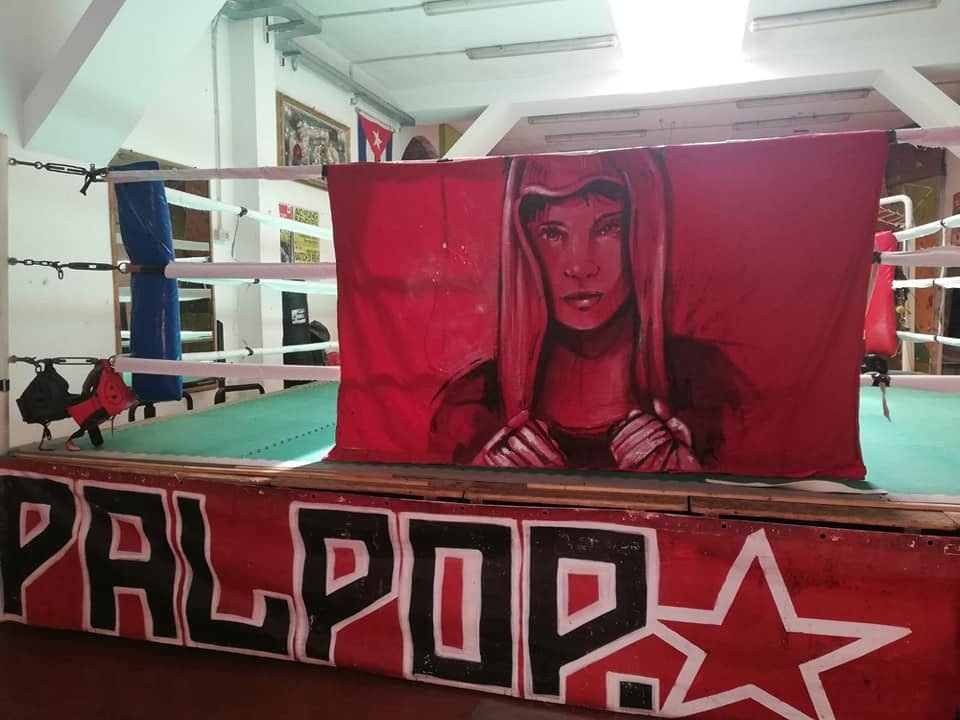
Palestra Popolare San Lorenzo is a self-managed sports space that occupies a municipal building at Via dei Volsci 94, in the heart of the San Lorenzo neighborhood in Rome, a short walk from the Sapienza University campus and the Verano Cemetery. Born in 1998 from the occupation of an abandoned building, it is now an amateur sports association, the ASD Popolare, which runs courses in martial arts, combat sports, climbing and wellness at fees designed to be accessible to residents and students of the neighborhood. The motto found in its communications, "sport as a form of resistance and neighborhood community," sums up the spirit of the place well: a space born from below, kept going by the people who use it, in one of the most layered and most written-about neighborhoods of Rome. If you are planning a stay in the capital and want to get your bearings among San Lorenzo's social spaces, markets, churches and necropolises, the pages on the Basilica of San Lorenzo fuori le mura and the Verano Cemetery are also useful, both a few minutes' walk from the gym.
Palestra Popolare San Lorenzo: What to Know Before You Go
First of all, a distinction worth having clear: Palestra Popolare San Lorenzo is not a commercial fitness center, and you shouldn't look for it with the expectations you'd bring to a gym chain. It is an association space. To train you have to sign up as a member of the ASD Popolare, pay the membership fee and follow the courses organized by discipline and level, on a calendar that follows the Italian sports year, from September to June, and not a monthly open-access subscription like at a chain. If you come for the first time, you do well to show up with this frame in mind: the welcome here is direct, the relationship with the instructors is personal, and the facility reflects decades of do-it-yourself building work more than the polished look of a chain gym.
Address and what the space looks like
The location is at Via dei Volsci 94, on the stretch of street that in the 1970s was at the center of Roman political news and that today is a residential street like many others, among old doorways and murals. The gym's entrance is recognizable by the colors and writing that mark it as a community space: not a corporate sign, but painted panels, flyers from past initiatives, stickers from collectives and friendly teams. Inside, the rooms are divided between a combat sports room with heavy bags and tatami, a climbing wall or structure, spaces for yoga and pilates, and the locker rooms. They are functional rooms, kept up with volunteer work, not a spa. If you want the luxury of a designer gym, you'll be thrown off. If you want a real place to train without spending much, you'll find exactly what it promises.
A place run by its members, not by a company
What most sets Palestra Popolare San Lorenzo apart from any fitness chain is its management model. There is no owner, no franchise, no board of directors with profit logic: the facility is run by the members themselves through the amateur sports association, with an elected president and a group of instructors that often coincides with the historic founders or with those who, over the years, chose to stay and train the younger ones. Decisions on fees, on which courses to open or close, and on investments in the facility go through internal assemblies, not through a business plan handed down from above. It is a slow model, at times tiring, but it is also the reason a place like this has managed to stay on its feet for more than 25 years in a neighborhood where commercial rents have risen dramatically.
What you can practice
The range of disciplines is wide for a place of this size: self-defense, climbing, karate, kickboxing, boxing, Thai boxing, taekwondo, yoga and pilates have appeared for years in the course program, with twice-weekly or three-times-weekly frequency depending on the discipline, while more recent sources add capoeira to the catalog. It is a mix typical of Roman community gyms, designed to cover both those looking for athletic and competitive training and those who simply want regular physical activity that is cheap and close to home. The classes share the same space at different times, and it is not unusual to see, on the same afternoon, a group of kids training in boxing and a yoga class in the next room.
Combat sports and martial arts
The historic core of the offering remains tied to combat sports: boxing and Thai boxing have always attracted a substantial share of members, followed by kickboxing, karate and taekwondo, practiced both competitively and as simple physical activity and self-defense. Having several ring and tatami disciplines under one roof is a trait common to many Roman community gyms, where the line between Eastern and Western combat sports is less marked than in commercial facilities specialized in a single discipline. The same spaces, and sometimes the same equipment, such as heavy bags or mirrors for technique work, are shared among different courses in separate time slots.
Climbing, yoga and pilates
Alongside the combat sports, the gym has offered a climbing course for years, designed for people who want to approach this sport without facing the costs of the best-equipped private indoor facilities in the city, and yoga and pilates courses aimed at a wider audience, often made up of adults and older people from the neighborhood looking for a gentle activity to maintain mobility and manage stress. It is the component least visible from outside, but probably the one that best represents the territorial vocation of the space: not only competitive sport for a few, but everyday wellbeing for anyone living around Via dei Volsci.
From Occupation to Community Stronghold: The History of Palestra Popolare San Lorenzo
The gym's history begins in June 1998, when a group of neighborhood residents occupied an abandoned municipal building on Via dei Volsci with a precise goal: to give San Lorenzo an accessible sports space that, despite the housing density and the presence of thousands of university students, simply did not exist in the neighborhood at affordable prices. It is not an isolated case. These are the same years in which dozens of similar spaces, social centers, gyms and clubs, were born in Rome, often starting from exactly the same act, the occupation of a public building left empty.
Resolution 26 of 1995 and the path to recognition
The turning point came when the occupiers began a dialogue with the city administration on the basis of Resolution 26 of 1995, the instrument by which the Municipality of Rome provided for assigning unused public spaces to associations for social purposes. It is the same mechanism that in the following years regularized many Roman social centers and community spaces, turning spontaneously born occupations into proper administrative concessions. It is well known among those who frequent these circles, but rarely explained to those who read about these spaces from the outside.
Why it had to be a gym
The choice to use the occupied building for a sports space, and not for a general social center or a cultural club as happened in other Roman cases of the same period, was not accidental. At the end of the 1990s San Lorenzo was a densely populated neighborhood, with a very high share of elderly residents alongside a steadily growing student population, but with very few public or affordable sports facilities. The existing gyms were tied to schools, with limited hours and access, or were private clubs out of reach for the neighborhood's average income. Those who promoted the 1998 occupation identified in this gap a concrete need, not an ideological one in the strict sense: the chance for a boy or girl of the neighborhood to play sports regularly without bearing the costs of a commercial gym. That reasoning explains why, more than 25 years later, the gym has survived deep political and administrative changes while other experiences born in the same period have run out of steam: it answered, and continues to answer, a material need that anyone can recognize, regardless of political orientation.
The 2008 regularization
The decisive step for Palestra Popolare San Lorenzo came in 2008, when the position of the space was formalized with an administrative concession. The regularization, however, had a heavy cost: the association had to take on about 70,000 euros in arrears on top of the current monthly fee, an enormous sum for a self-funded organization that lives on modest membership fees. According to those who led the association in those years, the amount was paid in full, a detail that in the gym's internal narrative weighs as much as the 1998 occupation: not just occupying a space, but keeping it going by paying its price to the end.
The self-built renovations
Between 2018 and 2023 the space went through two major renovation phases, carried out largely with the volunteer work of the members and with funds raised through extraordinary fees and self-financing initiatives. It is a method typical of Roman community gyms, where ordinary and extraordinary maintenance does not go through an outside contractor but through days of collective work, often organized on weekends, in which those who train become for a day a bricklayer, an electrician or a house painter. The result is never a polished space, but it is a space that every member, one way or another, has helped build with their own hands, an element that comes up often in the gym's internal narrative, almost more than the sport practiced.
A Curiosity About Palestra Popolare San Lorenzo
If you look for the gym's official name in the sports registers, you won't find "Palestra Popolare San Lorenzo" but the acronym ASD Popolare: the name under which the amateur sports association is registered and under which it appears in the databases of the federations and sports promotion bodies. The name that the neighborhood and the regulars have always used, the popular one, became over the years the recognizable brand, but from a bureaucratic point of view two identities coexist: the administrative one, needed to sign the concession with the Municipality and to insure those who train, and the communication one, the one the gym uses on social media and on neighborhood posters. It is not a minor detail for anyone searching online: results with slightly different names all point to the same space on Via dei Volsci.
How to Get to Palestra Popolare San Lorenzo
San Lorenzo is one of the most central neighborhoods of Rome, wedged between Termini station, the Verano and the Pigneto, and reaching it does not require complicated transport. The gym, on Via dei Volsci, is in the heart of the grid of streets named after peoples of ancient Italy that structures the neighborhood between Via Tiburtina and Viale dello Scalo San Lorenzo.
By bus and tram
Several Roman public transport lines cross San Lorenzo or run along its edges. The lines along Via Tiburtina connect the neighborhood to Termini in a few minutes, while the tram running on Via dei Reti and Viale delle Province quickly takes you toward Porta Maggiore and the center. If you come from more outlying areas, you can count on the lines converging on Piazzale del Verano, a step from the cemetery of the same name and two blocks from the gym. As with any road trip in Rome, it's best to check updated routes and frequencies on the ATAC app or website the same day, because surface lines are the most subject to seasonal changes and detours for roadworks.
On foot from Termini and from Sapienza
One of the strengths of San Lorenzo is its location: from Termini station you reach Via dei Volsci with a 15 to 20 minute walk across the rail yard and the first blocks of the neighborhood. If you are coming from the Sapienza University campus, with its monumental entrance on Piazzale Aldo Moro, it takes even less: San Lorenzo is literally next door to the university, and that is why generations of out-of-town students have made this neighborhood their second home, community gym included.
By metro
San Lorenzo is not crossed directly by a metro line, a limit the neighborhood shares with much of Rome's extended historic center. The nearest stop is Policlinico, on line B, at the western edge of the neighborhood toward Viale Regina Elena, from which Via dei Volsci is a 10 to 15 minute walk through the inner streets. Alternatively there are the stations of line A and line B that converge on Termini, from which you continue as described above. If you are traveling with heavy luggage or have difficulty walking, you'd do better to consider a taxi or a private transfer from the airport or the station to Via dei Volsci, rather than relying on the last stretch on foot.
By train and by car
Termini station, the capital's main rail hub, is a few minutes from San Lorenzo, as is Roma Tiburtina, also served by regional and high-speed connections. If you arrive by car, you have to allow for the typical difficulties of a late nineteenth-century neighborhood built on a tight grid, without large parking lots: parking is found mostly on the blue-striped spaces in side streets, and in the evening, with the neighborhood's nightlife in full swing, finding a spot near Via dei Volsci takes patience.
Something Nobody Tells You About Palestra Popolare San Lorenzo
What rarely emerges from the more celebratory accounts of these spaces is how much their survival depends on a very fragile financial balance, suspended between membership fees kept low by political choice and fixed costs that never stop. In 2023 Palestra Popolare San Lorenzo had to launch a public fundraiser, called "Passione Popolare," to cover a debt of about 10,000 euros accumulated with the Municipality of Rome for the 2021 concession charges, the year in which Italian gyms stayed closed for much of the time because of the health measures but the concession fees did not stop. The campaign, run with a margin of about a month before the debt went into compulsory collection, raised more than 12,000 euros thanks to more than 225 supporters, a figure that covered and exceeded the minimum goal. It is concrete proof of how much these spaces hang by a thread the public rarely sees: behind courses costing a few euros per lesson there are utility bills, insurance, extraordinary maintenance and a municipal fee that, when enrollments drop even for a single pandemic year, can put 20 years of collective work at risk.
When to Go to Palestra Popolare San Lorenzo
The courses follow the typical calendar of Italian amateur sports associations, with enrollments concentrated between late August and September and lessons continuing, with a break at Christmas and one at Easter, until June. In the summer months, as with most Roman community gyms, regular activity is reduced or stops altogether, sometimes replaced by special initiatives, tournaments or neighborhood events. Some sources indicate typical opening hours Monday to Friday from late morning to late evening, with Saturday on shorter hours and Sunday closed. This is, however, information gathered from outside portals and not updated with a certain date, so take it as a rough indication and verify it directly by contacting the association or checking its social channels before planning a visit, especially if you are coming from outside the neighborhood just for a trial lesson.
The Advice I Give You for Visiting Palestra Popolare San Lorenzo
The most useful practical advice for first-timers is simple: don't show up without writing or calling first. Community gyms, unlike commercial chains, have no reception open continuous hours and no staff dedicated to welcoming the curious. The instructors are often the same members who keep the space open, and contacting them beforehand through the association's social page or the phone number of the venue lets you find out which course is open to new members, if a free or reduced-price trial lesson is offered, and what paperwork to bring, generally a medical certificate for non-competitive sports activity. If you come to San Lorenzo as a tourist and only want to see the space from the outside, you can do it with a walk through the grid of streets named after Italic peoples, but to go in and train the right channel is always direct contact with the association, never an attempt to walk in unannounced during class hours.
How Much Palestra Popolare San Lorenzo Costs
Consistent with its nature as a community space, Palestra Popolare San Lorenzo applies membership fees designed to stay accessible to residents, out-of-town students and families of the neighborhood, far from the price lists of the capital's fitness chains. The typical mechanism in these places is an annual membership card, which gives access to member status and insurance coverage, plus a fee for the courses chosen, often discounted for those who sign up for multiple disciplines or for families. We don't give exact figures here: prices change from season to season and the information found online is not always reliably dated, so publishing it as current rates would risk misinforming readers. The right way to learn the real cost of a course remains direct contact with the association, which communicates the updated price list to members and to newly interested people at the start of each sports season.
Another Well-Known Fact, Yet Rarely Mentioned
Among those who frequent the world of Roman social spaces it is well known, but rarely explained to those reading from outside, that Palestra Popolare San Lorenzo is not an isolated case but a node in a wider network. In Rome there are several community gyms born with the same logic, spaces like the one in the Tor Pignattara neighborhood or the Ostiense area, which share method, language and often mutual solidarity at tournaments and events. Over time an explicit collaboration has also consolidated among some of these groups, brought together in joint initiatives meant to put the outskirts back at the center through community sport: meetings, workshops and tournaments in which athletes from the different gyms face each other on the same tatami or the same ring, in a circuit that stays off the radar of official competitive sport but that over the years has trained hundreds of practitioners.
Palestra Popolare San Lorenzo with Kids
Among the disciplines offered, several are designed for a very young audience too: karate, taekwondo and climbing courses for children and teens have appeared for years in the gym's program, in line with the territorial vocation of the space, which aims to offer neighborhood families an affordable alternative to private sports schools. The approach is the typical one of educational martial arts, with attention to discipline, respect for the rules and teamwork before competition. Those who bring a child for the first time will find a less formal environment than a traditional sports school, but for that very reason one able to convey a sense of belonging to the neighborhood that is rarely found in a commercial sports center: kids training a step from where their parents or older siblings train, in a space the neighborhood has felt as its own for more than 25 years. Here too the general rule applies: before bringing a minor to a trial lesson, contact the association to learn the schedule of the junior courses, the health requirements and how to enroll.
The Right Photo to Take at Palestra Popolare San Lorenzo
If you want an image that tells in a single shot what this space is, aim for the entrance at Via dei Volsci 94: the facade, with its hand-painted lettering, the posters layered over the years and the bright colors mixing with the gray of the surrounding public housing, is more eloquent than any description. It is an aesthetic found in many occupied and regularized spaces of San Lorenzo, a neighborhood where muralism and street art have coexisted for decades with late nineteenth-century working-class architecture, and which makes every glimpse of the street a small open-air archive of the neighborhood's social struggles. For those who instead want to document the actual sporting activity, the best moment remains a workshop or a tournament open to the public, occasions when the association itself encourages sharing images on its own channels, far more informative than a snapshot stolen during an ordinary lesson, when the priority is always the concentration of those training.
San Lorenzo: From Working-Class Neighborhood to the Bombing of July 19, 1943
To really understand what a community gym means at this address, you have to know the neighborhood that hosts it. San Lorenzo was born in the late nineteenth century, after 1870, as the first working-class neighborhood of Rome as capital, built outside the Aurelian Walls to house the workers employed in the construction sites of the new capital, in the rail yard and in the factories that stood along Via Tiburtina. It is a dense grid layout, designed for the working class more than for show, with narrow blocks and very little green space. The streets still bear the names of the peoples of pre-Roman Italy, from the Sabines to the Aequi, from the Volsci to the Marsi, a street naming that symbolically evokes the idea of an Italic people united around the new capital.
The birth of a neighborhood outside the walls
Until the Unification of Italy, the area where San Lorenzo stands today was countryside, little more than vegetable gardens and vineyards just outside the line of the Aurelian Walls, near the early Christian basilica dedicated to the deacon Lawrence and the cemetery that even then held the burials of Romans. With the choice of Rome as capital in 1871 the city entered a phase of unprecedented building expansion, and the Municipality identified this very area as the natural site of a working-class neighborhood to be built from scratch, suited to housing the labor needed to build the new capital and to run the nearby freight yard of Termini station. The 1883 master plan drew the orthogonal grid that still characterizes the neighborhood today, with narrow blocks, very little green space and very high housing density, designed to keep construction costs as low as possible at the expense of the inhabitants' quality of life: a compromise that would mark the neighborhood's social identity for more than a century.
The roots of the neighborhood's political awareness
Precisely because of its social makeup, made largely of railway workers, bricklayers and laborers, San Lorenzo developed from the first decades of the twentieth century a strong popular identity and a tradition of union and political activism, which runs through Fascism, the Resistance and the postwar period up to the movements of the 1960s and 1970s, when the neighborhood became one of the symbols of Roman protest. It is in this historical groove, made of public housing, shared courtyards and a collective memory of struggle for social rights, that in the 1990s experiences like that of the gym on Via dei Volsci took root: a direct inheritance of that culture, more than an isolated or improvised phenomenon.
Reconstruction and the postwar years
In the months and years after the bombing, San Lorenzo faced a slow and partial reconstruction, driven more by the spontaneous initiative of its residents than by an organic plan from the administration, in an Italy that had come out of the war with very scarce public resources. Whole blocks stayed marked by rubble for a long time, and the memory of those days settled deeply into the neighborhood's collective identity, handed down from one generation to the next along with the story of San Lorenzo's working-class and anti-Fascist makeup in the years of the regime. It is in this context of a neighborhood that paid a very high price to the war, but never stopped rebuilding itself from below, that the tradition of popular self-organization took root which decades later would lead to the occupation of the building on Via dei Volsci.
July 19, 1943
The date that more than any other marks San Lorenzo's collective memory is July 19, 1943, when the neighborhood was hit by the first major Allied bombing of Rome. The declared target was the rail yard, but the bombs fell on a densely inhabited urban fabric, causing thousands of civilian deaths and destroying whole blocks, as well as severely damaging the Basilica of San Lorenzo fuori le mura, which stands not far from the community gym and still preserves evidence of that reconstruction. It was on that occasion that Pope Pius XII went among the rubble of the neighborhood, an episode that entered the collective imagination of Rome. Walking today along the same streets where Palestra Popolare San Lorenzo stands therefore means crossing a neighborhood that still carries in its public memory the weight of that day, along with the more recent marks of its social history.
San Lorenzo and Its Literary and Political Memory
San Lorenzo is not only the neighborhood of the 1943 bombing. It is also one of the places that most marked Italian fiction and cinema of the second half of the twentieth century. Pier Paolo Pasolini, who lived in Rome for a long time in neighboring and outlying districts, described many times in writings and interviews the humanity of borgate and working-class neighborhoods like San Lorenzo, the same humanity of railway workers, artisans and urban subproletariat that in the following decades would give rise to self-managed experiences like that of the gym on Via dei Volsci. In the 1970s the neighborhood was also one of the epicenters of the Roman student movement, with occupations, assemblies and clashes involving the same streets now frequented by those who train at the gym or eat dinner at a neighborhood trattoria. It is a political tension that in San Lorenzo has never entirely subsided, and that can still be read today in the murals, in the social spaces and in the very street names of the neighborhood.
Public housing and the social fabric that endures
Another element that explains the longevity of places like Palestra Popolare San Lorenzo is the persistence, inside the neighborhood, of a substantial core of public housing and of families who have lived there for several generations, despite the pressure of real estate rents tied to the closeness to the historic center and the university. It is often these very family units that guarantee continuity to the neighborhood associations, enrolling their children and then their grandchildren in the same courses they attended decades earlier, in an intergenerational transmission that market logic alone can hardly reproduce. It is a phenomenon that makes San Lorenzo a special case in the Roman landscape: a neighborhood heavily touristified in its evening life, but which in its daytime life, made of local markets, schools and sports associations like this gym, still keeps strong traits of a working-class neighborhood in the most literal sense of the term.
The Nuovo Cinema Palazzo and the vocation for shared spaces
San Lorenzo shares with Palestra Popolare San Lorenzo a broader characteristic: that of being a neighborhood where underused public buildings have repeatedly been transformed from below into collective spaces. This is the case, among others, of the former cinema in Piazza dei Sanniti, occupied in the 2010s by citizens' collectives and converted into a self-managed cultural space with screenings, assemblies and public initiatives. It is not an identical path to the gym's, but it belongs to the same urban grammar: San Lorenzo as a permanent laboratory of popular reuse of empty spaces, a phenomenon that has crossed different fields, from sport to cinema, from music to pure social work, while keeping the same underlying principle, that of giving back to the community what would otherwise have been left abandoned.
Some Important Events That Happened Here in History
Narrowing the focus to the history of the sports space itself, a few milestones remain carved in the memory of those who have passed through it. June 1998, the occupation of the abandoned building on Via dei Volsci, remains the starting point. 2008 marks the administrative turning point, with the concession obtained against full payment of about 70,000 euros in arrears, a step that made legitimate in the eyes of the Municipality an experience born outside any formal framework. 2021, the year of the closures linked to the health emergency, was instead the most fragile moment in the gym's recent history, when the impossibility of charging members fees collided with the obligation to keep paying the concession charges to the Municipality. 2023, finally, with the "Passione Popolare" campaign and the mobilization of more than 200 supporters, showed that the social network built over 25 years of activity was still able to spring into action within a few weeks to save the space from a debt that threatened to overwhelm it.
Where to Eat Near Palestra Popolare San Lorenzo
San Lorenzo is, together with Trastevere and the Pigneto, one of the Roman neighborhoods with the highest concentration of trattorias, pizzerias and evening venues per square meter, helped by the constant presence of thousands of university students. A short walk from Via dei Volsci you'll find historic addresses of Roman cooking and neighborhood trattorias frequented for generations, as well as late-opening pizza-by-the-slice places, artisan pasta shops that have become reference points for a quick first course at lunch, and newer venues born in the wake of the neighborhood's transformation into a hub of Roman nightlife. If you're looking for the most traditional Roman cooking, made of amatriciana, carbonara and tripe, you'll find it without difficulty along Via dei Sabelli and Via dei Marsi. If you're looking for an aperitivo or a craft beer before dinner, head instead for Via degli Equi and the side streets that open onto Piazzale Verano, the heart of the neighborhood's evening nightlife. The general rule for those who train at the gym and then want to eat dinner nearby is the same as in every Roman university neighborhood: the cheapest and most honest places, often without a flashy sign, are almost always the ones most frequented by the students themselves, a more reliable indicator than any online ranking.
A neighborhood that reinvented its food offering
It should also be said that in the last two decades San Lorenzo has gone through a deep transformation of its food offering, from a neighborhood of popular trattorias tied to the working-class and railway presence to one of the liveliest districts of young Roman dining, with artisan pasta shops, historic bakeries converted into gathering places, gelaterie and venues that mix Roman cooking with international influences. It is a transformation parallel, in some ways, to the one lived by Palestra Popolare San Lorenzo itself: both were born in a working-class neighborhood and have had to reinvent themselves to stay relevant in an urban context that has changed radically around them, without entirely losing the link with the original popular identity. If you train in the evening and are hungry, you can count on evening opening hours that are rather long compared with the Roman average, precisely because of the constant presence of a student crowd that eats dinner late.
The Neighborhood as Seen by Those Who Train Every Day
People who attend Palestra Popolare San Lorenzo regularly often describe a relationship with the space that goes beyond the single weekly lesson. For many longtime members the gym has become over the years a social reference point even before a sports one: a place where people know each other by name, where the instructors follow the growth of the young ones both on and off the tatami, where the families who bring their kids to the courses end up forming relationships that last well beyond the years of enrollment. It is a trait shared by many experiences of community sport in Italy, but in San Lorenzo it takes on a particular meaning, because it sits in a neighborhood where housing turnover, tied to the constant presence of out-of-town students, continually risks eroding the sense of community of the stable residents. In this sense the gym also works as an identity anchor for those who were born in San Lorenzo or have lived there for decades, a stronghold that resists the continuous turnover of a passing university population.
Of course there is no shortage of the daily difficulties typical of any self-managed organization: opening shifts to cover with volunteers alone, maintenance that takes time away from other things, a relationship with municipal bureaucracy that, as the 2021 episode shows, can quickly turn into a financial emergency. But it is precisely the ability to face these difficulties collectively, without closing and without giving up its popular nature, that has made Palestra Popolare San Lorenzo a reference case among the city's self-managed sports organizations, cited not by chance in initiatives that network the different Roman community gyms.
Who Has Passed Through Palestra Popolare San Lorenzo
By the very nature of a self-managed community space, Palestra Popolare San Lorenzo does not keep a roll of honor of international champions in the sense an Olympic federation would mean: its history is made above all of generations of boys and girls from the neighborhood who took their first steps here in boxing, karate or climbing, and of instructors who stayed tied to the space for decades, often going from founding members to trainers of the new recruits. Over the years the gym has also built sporting ties with the other groups in the circuit of Roman community gyms, sharing tournaments, joint workshops and away trips, in a web of relationships that has allowed several athletes raised within these walls to compete at the national level too, in combat sports competitions organized by the sports promotion bodies. It is a less showy story than the tale of a single champion, but more faithful to what this kind of space really is: a collective forge more than an individual showcase.
San Lorenzo at Night: University, Nightlife and the Neighborhood's Memory
As the sun goes down, San Lorenzo changes skin. The same streets that by day host shops, local markets and the stroll of people leaving the Sapienza classrooms fill up, from late afternoon on, with students, young Romans and visitors drawn to one of the densest concentrations of bars, pubs and evening venues in the city. It is a phenomenon that has its roots precisely in the closeness to the University campus, whose monumental entrance on Piazzale Aldo Moro is a few minutes' walk from Via dei Volsci, and that over the last 20 years has turned San Lorenzo from a working-class neighborhood on the edge of the historic center into one of the hubs of Roman nightlife, with all the tensions that this brings among longtime residents, new inhabitants and occasional visitors.
In this context Palestra Popolare San Lorenzo keeps a particular function: it is one of the few spaces in the neighborhood that continues to address residents explicitly rather than passing visitors, with a course calendar that structures the weekday evenings in a way alternative to the nightlife of the venues. It is not unusual for the youngest members, after a boxing or kickboxing lesson, to move on to the neighborhood's bars for the same sociability that, by day, is built on the tatami. It is a fragile balance, between a neighborhood that lives at night and a neighborhood that still recognizes itself in its working-class and sporting roots, but it is precisely in this balance that spaces like Palestra Popolare San Lorenzo continue to play a role as a social stronghold.
A Curiosity About Palestra Popolare San Lorenzo
A detail that tells the spirit of this place well is the slogan with which the association accompanied the 2023 fundraising campaign: "da questa realtà non usciremo mai" (we will never leave this place). It is not a simple appeal to support a fundraiser, but a declaration of continuity that ideally closes the circle opened in 1998: the same determination with which a group of residents occupied an abandoned building to turn it into a gym is the one with which, 25 years later, the community that uses that space answered a debt that could have closed it forever. Among the lesser-known curiosities is also the fact that the gym, though born from an occupation, is today in every respect a regularly recognized amateur sports association affiliated with the sports promotion bodies, complete with membership cards, insurance and the medical certification required of its members: the road from an occupied building to a structured sports organization passes, in this case, through more than two decades of collective work.
What's Around Palestra Popolare San Lorenzo
The neighborhood that hosts the gym is full of places worth a stop, both for those who train and for those visiting San Lorenzo for the first time. A few minutes' walk away is the Basilica of San Lorenzo fuori le mura, one of the seven jubilee churches of Rome, damaged by the very bombing of July 19, 1943 and then rebuilt, dedicated to the martyr deacon from whom the neighborhood takes its name. Next to it stands the monumental Verano Cemetery, the largest monumental cemetery in Rome, where generations of Romans rest and where funerary art tells two centuries of the city's history. If you like university museums little visited by mass tourism, within a few minutes, inside the Sapienza grounds, you can reach places like the Gipsoteca, Museum of Classical Art, the G. Sergi Museum of Anthropology and the Contemporary Art Museum Laboratory, MLAC, as well as the splendid Church of Sant'Ivo alla Sapienza with its famous spiral dome. For another cultural and social space in the neighborhood, one that marks San Lorenzo's recent transformation, Container San Lorenzo is also worth a visit, another place that testifies to the rail yard's vocation for hosting independent cultural initiatives.
Practical Questions About Palestra Popolare San Lorenzo
What is Palestra Popolare San Lorenzo? It is a self-managed sports space born in 1998 from the occupation of a municipal building at Via dei Volsci 94, now active as an amateur sports association, the ASD Popolare, with courses in martial arts, combat sports, climbing and wellness.
Do you have to sign up to train? Yes, as in every Italian amateur sports association you need to join as a member and follow a specific course. It is not an open-access fitness center.
How do you get there? On foot from Termini in about 15 minutes, in a little less from the Sapienza University campus, or with the public transport lines that cross Via Tiburtina and converge on Piazzale del Verano.
How much do the courses cost? The fees are designed to be accessible, on the model of Roman community gyms, but they change from season to season. The most reliable source remains direct contact with the association, not a number read online and undated.
Is it suitable for children? Yes, several disciplines, in particular karate, taekwondo and climbing, have courses dedicated to children and teens, with an educational approach before a competitive one.
Is it still active today? The most recent public sources available, including the updated listing on some local portals and the association's social page, describe it as an operating space. For precise confirmation of courses, hours and availability in the current season, however, it's best to contact the association directly, because the information is not confirmed on official sources with a certain date.
Do you need a medical certificate to train? As in all Italian amateur sports associations, a medical fitness certificate is generally required for non-competitive practice, to be checked with the association itself at enrollment.
Is there dedicated parking? No, the gym has no parking of its own. Parking is found in the blue-striped spaces on nearby streets, with more availability in daytime hours than in the evening, when the neighborhood fills up for its nightlife.
Are there tournaments or exhibitions open to the public? Over the years the gym has taken part in workshops, tournaments and joint initiatives with the other Roman community gyms, some of them open to outside public participation. Dates, when planned, are announced on the association's social channels.
Is the gym connected to a social center? No, it is an autonomous space with its own administrative concession specific to sports activity, distinct from the neighborhood's social centers though sharing part of their history and language.
Frequently Asked Questions About Palestra Popolare San Lorenzo
Where is Palestra Popolare San Lorenzo?
Palestra Popolare San Lorenzo is at Via dei Volsci 94, in the heart of the San Lorenzo neighborhood, wedged between Termini station, the Verano and the Pigneto, inside the grid of streets named after peoples of ancient Italy that structures the area between Via Tiburtina and Viale dello Scalo San Lorenzo.
What is Palestra Popolare San Lorenzo?
It is a self-managed sports space born in June 1998 from the occupation of an abandoned municipal building on Via dei Volsci, now active as an amateur sports association under the name ASD Popolare, with courses in martial arts, combat sports, climbing and wellness.
Do you have to sign up to train at Palestra Popolare San Lorenzo?
Yes, as in every Italian amateur sports association, to train you need to join as a member of the ASD Popolare, pay the membership fee and follow the courses organized by discipline and level, on a calendar that follows the sports year.
How much does it cost to join Palestra Popolare San Lorenzo?
Palestra Popolare San Lorenzo applies membership fees designed to stay accessible to residents, out-of-town students and families of the neighborhood, far from the price lists of the capital's fitness chains. The typical mechanism includes an annual membership card, which gives access to member status and insurance coverage, plus a fee for the courses.
Does Palestra Popolare San Lorenzo have courses for children?
Yes, among the disciplines offered there have been karate, taekwondo and climbing courses for children and teens for years, designed as an affordable alternative to private sports schools for neighborhood families, in line with the territorial vocation of the space.
How do you get to Palestra Popolare San Lorenzo by public transport?
San Lorenzo is one of the most central neighborhoods of Rome and several Roman public transport lines cross it, bringing you a short walk from Via dei Volsci, where the gym is located, in the grid of streets between Via Tiburtina and Viale dello Scalo San Lorenzo.
Should you show up at Palestra Popolare San Lorenzo without notice?
No, the advice for first-timers is to write or call first. Community gyms have no reception open continuous hours, and the instructors are often the same members who keep the space open, so contacting them beforehand through the social page is the most reliable way to plan the visit.
Practical Information and Tools for Planning Your Visit
If you are planning a stay in Rome that includes a stop in an authentic neighborhood like San Lorenzo, away from the more touristy circuits of the historic center, you may find useful the professional resources designed for those who visit Italy more attentively. The network of professional escorts of TourLeaderPro is a reference for those looking for qualified guides and escorts able to tell the story of neighborhoods like San Lorenzo with the historical and social depth they deserve, beyond a simple list of addresses. For broader trip planning in Italy, including practical information on getting around, neighborhoods and less-visited attractions of the big cities, the guide of ItalyPlanner remains a solid starting point, especially for those arriving from abroad who want to build an itinerary that goes beyond the usual monuments.
A few common-sense practical notes remain, valid for anyone who wants to approach Palestra Popolare San Lorenzo: since it is an association space and not a commercial one, punctuality and respect for course hours matter more than in a traditional gym, because every lesson is taught by instructors who often give the space hours of volunteer work on top of their own jobs. Bringing an ID and, if requested, a medical certificate for non-competitive sports activity avoids delays at the first entry. And for those who simply stroll through the neighborhood without training, it is still a good reason to stop in front of the facade at Via dei Volsci 94 and read, among murals and posters, a piece of San Lorenzo's social history that keeps being written every evening, a few dozen meters from the boxing bags and the tatami.
Contact Information
Via del Volsci, 94
Roma Roma Città, Roma Città