Catacombs of Commodilla
In short. The Catacombs of Commodilla are in Rome at Via delle Sette Chiese 42, 00145, in the Ostiense district, a step from the border with Garbatella.
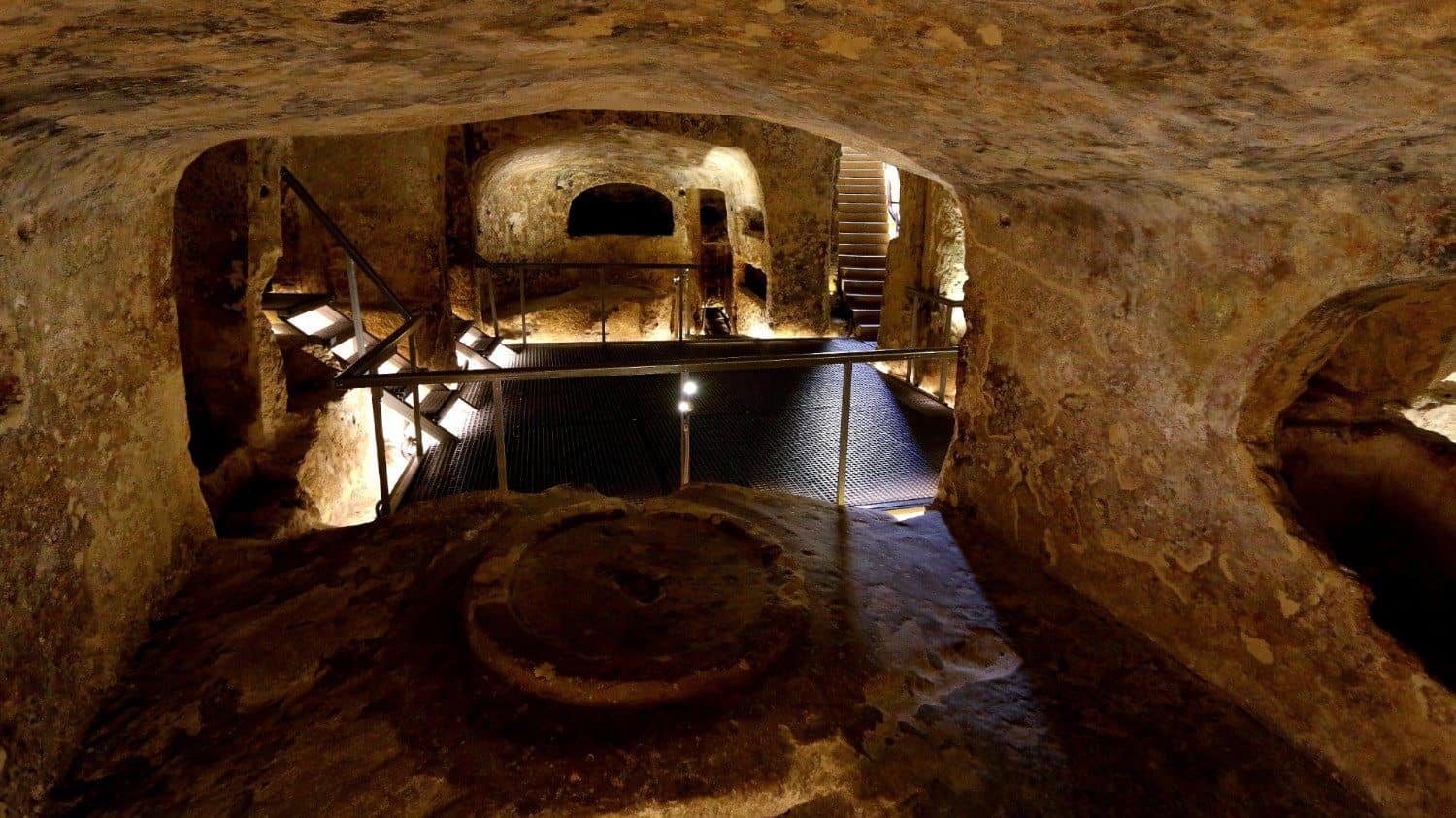

The Catacombs of Commodilla are in Rome at Via delle Sette Chiese 42, 00145, in the Ostiense district, a step from the border with Garbatella. The entrance opens inside the green area of Villa Serafini, whose pedestrian access is on Via Giovannipoli, and anyone looking for a monumental portal on the sidewalk of the street won't find it, because it doesn't exist. The complex is not open to the public with a ticket office and hours: it can only be visited on written request to the Pontifical Commission for Sacred Archaeology, at the address protocollo@arcsacra.va, stating the requester's personal details or the institution's letterhead, the reason for the visit, date, time, number of participants and any need for a guide in a foreign language. The Commission's phone numbers are +39 06 4465610 and +39 06 4467601. The regulations for catacombs open on request set groups at no more than 15 people and a fee of €250.00 per group, which includes the presence of a fossore for custody and assistance and an archaeologist who illustrates the monument. It is a lump sum, not per head, and it's worth remembering because divided by 15 it comes to just under €17 per person. There are no online tickets, no published reduced rates, no free first Sunday of the month. Outside this procedure there remain only occasional extraordinary openings, organized together with Municipio VIII or the Commission, which are announced from time to time and have their own conditions and prices: anyone chasing them must check the official channels in the preceding days, because places sell out within a few hours. You get there by metro B, Garbatella stop, a 10-minute walk slightly downhill. The surface lines running along Via delle Sette Chiese, including the 670 and the 716, leave you a few tens of meters away. From the Basilica of St. Paul Outside the Walls you walk up in barely a quarter of an hour. Underground the temperature stays low and constant in every season, the humidity is high and the ground is uneven: closed shoes with a lugged sole, a sweatshirt even in July.
If you want to place this hypogeum within the wider system of the city's Christian cemeteries, you'll find the complete picture on the Catacombs of Rome page, while the general list of places you can visit is in the tourist attractions section.

Why they are called the Catacombs of Commodilla
The name doesn't belong to a saint, nor to a martyr. Commodilla was a landowner, a Roman matron about whom we know practically nothing: she appears in the sources as the holder of the estate under which the cemetery opened, and from her modern archaeology took the label under which the complex is cataloged today. It is a very common case in the Christian topography of Rome, where underground cemeteries almost always bear the name of the land before that of the faith: Priscilla, Domitilla, Balbina, Generosa. Private property precedes worship, and the land register precedes the liturgical calendar.
In antiquity, however, this place was called something else. The early medieval itineraries for pilgrims, the lists of tombs that travelers from the North copied before going down to Rome, and above all an inscription found on site identify it as the cemetery of Felix and Adauctus: the two martyrs buried here gave their name to the whole complex, and for centuries nobody would have understood what you were talking about by saying Commodilla. The epigraph of the cubiculum of Leo preserves the ancient formula in Latin, with the patron declaring that he had the burial chamber built for himself while alive, in the cemetery of Adauctus and Felix. It is an internal source, written on site by the person who paid: the kind of document that is worth more than 10 treatises.
The passage from one name to the other is recent and troubled. Antonio Bosio, who in 1595 was the first to set foot in it again in the modern age, baptized it the catacomb of Lucina, confusing it with another funerary complex. The correct identification came in the nineteenth century with Giovanni Battista de Rossi, the founder of Christian archaeology as a scientific discipline, and the name was then fixed by Enrico Stevenson in 1897. Three centuries to attribute the right name to a cemetery the size of a city block: anyone who thinks Roman archaeology proceeds by sudden illuminations should keep this chronology on the nightstand.
Many expect a Saint Commodilla with a legend and all, but in our judgment the wrong name is more interesting than the right one. It reminds us that beneath Rome there is no zoning plan of devotion, but a mosaic of private lots that someone, at some point, opened to the dead of their own community. The faith settled on other people's land registers.
Where the Catacombs of Commodilla are and what the surrounding neighborhood is like
We are in the central stretch of Via delle Sette Chiese, the road that the pilgrimage of the seven basilicas followed to connect St. Paul Outside the Walls to San Sebastiano: an ancient axis, today an urban neighborhood street, with the apartment buildings of the 1920s and 1930s on one side and the public housing blocks of Garbatella on the other. The same street, a couple of kilometers further on at number 282, leads to the entrance of the Catacombs of Domitilla: two Christian cemeteries on the same street, one open every day except Tuesday and the other accessible only by appointment. It's worth knowing before you leave, because confusion between the two is the most common mistake I see visitors make.
The urban context matters more than it seems. This is the Rome that grows between the two wars around the industrial plants of Ostiense, the Mercati Generali, the Gasometer. It is the Rome of public housing blocks and row villas, not that of cardinal palaces. The Christian cemetery, when it was excavated in the 4th century, was in open suburban countryside, a few hundred meters from Via Ostiense and from the tomb of the Apostle. The two things today coexist within a radius of one kilometer: the 4th-century level underfoot, the 20th-century buildings overhead, and in between a neighborhood park where kids play soccer without knowing what lies beneath.
On the practical side: parking in the area is possible but hard in the middle hours, and the stretch of Via delle Sette Chiese in front of Villa Serafini has no convenient spaces. Metro B is the honest solution. From Termini it takes a little over a quarter of an hour to Garbatella, and the walk down toward Via delle Sette Chiese is a pleasant route between the public housing of Via Giovannipoli and the courtyards of the historic blocks. If instead you come from San Paolo, you can combine the visit with the Basilica of St. Paul Outside the Walls and the nearby Museo della Via Ostiense, inside Porta San Paolo.
How you actually visit the Catacombs of Commodilla
The difference between this hypogeum and the five or six postcard catacombs of the city is all in the procedure. At San Callisto or San Sebastiano you arrive, wait in line, buy the ticket and go in with the next group. Not here. Here you write an email, wait for an answer, agree on a date, and on the set day you find an open gate in a neighborhood park with a fossore who opens up and an archaeologist who accompanies you. The fossore, incidentally, is the oldest professional figure of the trade: the term now designates the Pontifical Commission staff in charge of the custody and maintenance of the hypogea, and descends in a direct line from the late antique fossores who dug burial niches on piecework.
The visit requires a certain attitude. The galleries have beaten-earth floors, with uneven levels and steps. The lighting is basic and in many stretches you need to follow the person who opens. The painted rooms are narrow and allow only a few people to stop at a time. The group of 15, the maximum in the regulations, should be understood as a limit, not as the ideal format: with eight or 10 people you see twice as much and hear everything. It is the reason why, when I organize an access, I never fill the group to the last available place.
On duration, don't expect the pace of the tourist circuits. A visit done well, with the reading of Leo's epigraph, the stop in front of the Madonna of Turtura and the time to understand where the vulgar graffito is, comes close to an hour and a half. It is long by the standards of a catacomb open to the public, where the standard tour is 25 or 30 minutes, and it is the real added value of this formula: here the archaeologist has no other group pressing from behind.
The operational advice: write well in advance, indicate two or three alternative dates and specify whether there are people with mobility difficulties in the group, because the answer changes. And allow for the possibility that a request may not be accepted for the period you ask: hypogea closed to the public have conservation needs that come before the visitors' calendar, and the microclimate of the frescoed rooms is monitored precisely to limit the number of entries.

A pozzolana quarry that became a cemetery
The structural fact from which everything else follows is this: the Catacombs of Commodilla did not begin as a cemetery. They began as a quarry. The bank of pozzolana, the volcanic sand the Romans mixed with lime to make concrete, was extracted here in the imperial age through wide, irregular spaces, dug with industrial rather than funerary criteria. When the working ceased, the mouth of the quarry was closed and replaced by a staircase descending from above: the traces of that intervention remain legible on the east wall, and they are the physical hinge between two completely different uses.
The reuse explains the form. Whoever enters a catacomb dug from scratch, like a large part of San Callisto, walks in narrow, very tall corridors, with the loculi arranged in regular rows and a geometry that follows the logic of the burial worksite. Here, instead, you pass through wide rooms, with squared sections and walls that follow no module: they are the voids left by the quarrymen, adapted to house the dead. Christian archaeology calls these complexes reused arenaria, and Commodilla is one of the most instructive examples in Rome.
The three levels of the Catacombs of Commodilla
The complex is arranged on three superimposed levels. The intermediate level is the oldest and the most important: it coincides with the adapted quarry, holds the burials of the martyrs and the underground basilica, and the rest of the cemetery radiated out from there. Above and below, at a later stage, clusters of galleries developed with modest burials, without decoration and largely anonymous. The fact that the middle level is the original one, and not the upper one as in most cemeteries, is the direct consequence of the quarry: they started from the void that was already there, not from the surface.
The oldest burials of the middle level were made in the floor, with the technique of the formae, the earth-cut graves covered by slabs. When space began to run out, they moved to the walls, then added row upon row up to the ceiling. The internal chronology is anchored to a solid epigraphic datum: a burial dated to 367, which places the phase of full activity in the second half of the fourth century. Burial use proper ended by the end of that century, and from then on the cemetery stopped receiving the dead and began receiving pilgrims.
Shaft burials, the signature of the Catacombs of Commodilla
There is one technical solution that reaches an unusual spread here: shaft burials. They are deep vertical pits dug in the floor of the galleries, with loculi opening one above another in their walls: in some cases up to 20 are counted in a single shaft. It is a brutal and highly effective way of multiplying capacity on terrain that did not allow the corridors to be lengthened, and it gives the image of a large burial community with little space at its disposal.
The interesting point is the geography of this technique. Shaft burials are rare in Rome and are concentrated in just two complexes, both in the Ostiense sector: Commodilla and the nearby Catacombs of Santa Tecla. Two neighboring cemeteries, the same engineering solution, the same period: it is reasonable to think of shared workers, of teams of fossores who worked on both sites carrying their own technical repertoire with them. It is not documented proof, but it is the hypothesis that the material evidence makes most economical.
Why the Catacombs of Commodilla are poor and why it matters
Scholars describe this complex with a formula that sounds like a negative judgment and is instead a social diagnosis: extreme architectural, epigraphic and iconographic poverty. Cubicula are rare, arcosolia very few, the inscribed marbles scarce and often full of spelling mistakes, with inverted letters and wrong formulas. In an aristocratic cemetery this does not happen: whoever pays the marble cutter also pays someone who can write.
Those errors, however, are a source. They say that the patrons were people of modest condition, artisans and small traders of the Ostiense suburb, half-literate, who bought the slab and had it carved by whoever cost the least. In a city where Christian archaeology has often told the story of converted senators, Commodilla tells the story of everyone else. And it is the reason I consider it one of the most instructive catacombs in Rome: there is no luxury to distract you. Then, in the midst of this widespread modesty, comes the cubiculum of a high imperial official and a series of frescoes of the very highest quality, and the contrast becomes the real subject of the visit.
Felix and Adauctus, the martyrs of the Catacombs of Commodilla
The cemetery owes its fortune to two burials. Felix and Adauctus appear for the first time in the epigraphic poetry of Pope Damasus, the pontiff who between 366 and 384 reorganized the memory of the Roman martyrs by having celebratory poems carved on their tombs: the Damasian poem dedicated to these two is lost, but the manuscript tradition preserves its content, and it described them as brothers and presbyters buried together. Damasus is a fourth-century source speaking of events of the previous century: close, not contemporary.
The passio, the hagiographic account that stages the martyrdom, is instead much later, early medieval, and must be read for what it is: devotional literature, not a trial record. It says that Felix was condemned in the last years of Diocletian, between 284 and 305, and that as he was being led to execution a stranger came out of the crowd declaring himself a Christian and asking to die with him. Nobody knew his name. He went down in history as Adauctus, from the Latin adauctus, the added one: a martyr whose proper name is literally the fact of having added himself to another. Part of the scholarship prefers to place the two under the persecution of Valerian, in the years around 258, and the question remains open.
On reliability it is best to distinguish: that two martyrs named Felix and Adauctus were buried here and venerated already in the 4th century is documented by epigraphy and archaeology. That one of the two denounced himself during the execution of the other is hagiographic tradition, beautiful and probably built after the fact precisely to explain a name that was no longer understood. The name, in short, may have generated the story rather than the reverse. It is a very widespread mechanism in the formation of the legends of the saints, and recognizing it takes nothing away from the value of the place.
Archaeologists have identified the point of the burial: two superimposed niches, under the fresco that depicts them. Not a sarcophagus, not a monument: two niches in the wall, like anyone else's. The Roman Christian community of the 4th century did not separate its martyrs from the rest of the dead, it made them recognizable with painting and inscription. The hierarchy was visual, not architectural.
Merita, Digna, Gaudentia, Nemesius: the other names
Around the two titular saints revolves a small group of venerated figures, known to very different degrees. Merita is the best documented because her name appears painted next to her image in one of the frescoes of the small basilica, and she is considered the only female martyr figure fully preserved in this complex. Tradition links her to Digna as a pair of sisters killed under Valerian, between 253 and 260. Gaudentia is remembered by the Hieronymian Martyrology on the date of August 29. Nemesius appears in the early medieval itineraries for pilgrims.
For Digna, Gaudentia and Nemesius the archaeological traces on site are scarce or absent: we know they were named, not where they were. It is a typical situation of Roman cemeteries, where pilgrimage lists name more saints than archaeology manages to locate, and where some names migrate from one complex to another over the centuries. Visitors would do well to keep the two planes separate: what the written sources assert and what the wall confirms.
There is a chronological detail worth lining up, because it has important consequences for another question. Merita appears to have been translated elsewhere under Pope Paul I, so between 757 and 767. Felix and Adauctus, according to the traditional reconstruction, left the cemetery a century later, under Leo IV, between 847 and 855, when relics of the two martyrs were donated to Ermengarde, wife of Emperor Lothair. That the minor martyr leaves 100 years before the titular saints is an anomaly that some scholars have flagged as a sign of a chronology to be revised. We'll come back to it, because it touches the dating of the most famous piece of this place.
The underground basilica of Saints Felix and Adauctus
In the first quarter of the 6th century the cemetery changes nature. Under Pope John I, whose pontificate covers the years 523-526, a portion of the old quarry on the middle level is reworked and turned into a small underground basilica dedicated to the two martyrs. The walls are reinforced, the rooms enlarged and regularized, the area around the tombs organized to host the liturgy and the flow of devotees. It is the moment when a burial place becomes a place of worship: a transformation that repeats in Rome in dozens of hypogea between the 5th and 6th centuries, and that here is readable with particular clarity because the structure of the quarry, under the papal intervention, can still be seen.
The small basilica has an apsidal area with the presbytery, and in front of it stood the altar. The side walls are the ones that carry the frescoes. Anyone entering today struggles to perceive the whole as a church, because all the furnishings are missing and because the light is the artificial light of a basic system. But the plan can be read, and the sequence of frescoes along the walls gives the idea of a space that was walked through, looked at, touched.
From the 6th to the 9th century the pontiffs intervene repeatedly on the underground basilica, with documented restorations. It is the most reliable index of the sanctuary's fortune: money is spent only where people arrive. Among the popes involved in the history of the place appears also Gregory IV, whose pontificate covers the years 827-844, and the events of this cemetery intertwine with those of Leo IV. Then, when the relics leave, the place goes dark. It is not destroyed: it is forgotten, which in the Roman subsoil is the most effective way of preserving oneself.
The pilgrims' graffiti in the small basilica
On the walls of the small basilica, from the beginning of the 7th century onward, the devotional graffiti of visitors accumulate. They are names, invocations, crosses, marks of passage engraved with the point of a knife or a stylus. Among them appear Anglo-Saxon inscriptions and runic characters, left by pilgrims who came from the British Isles and Northern Europe between the 8th and 9th centuries. Those signs are worth as much as an attendance register: they say that this was not a local neighborhood devotion, but a stop included in the international circuits of Roman pilgrimage.
A datum from the excavation, gathered by Christian epigraphy, allows an even more precise reading: about three quarters of the graffiti in the small basilica of Felix and Adauctus turn out to be the work of laypeople, not clerics. It was not a space reserved for the clergy. It was a place where ordinary people wrote on the walls, and where what we would today call vandalism was instead a legitimate and expected form of prayer. Keep this datum in mind: it is the key to understanding the most famous graffito of the complex.

The frescoes of the Catacombs of Commodilla, one by one
The painting is the reason why this poor cemetery counts as much as the great complexes of the Appian Way. In a few square meters of wall you can read the evolution of the Christian image in Rome from the 4th to the 7th century, with dated works and in some cases dated on documentary grounds. I describe them in the order in which it's best to look at them.
The Madonna of Turtura, the masterpiece of the Catacombs of Commodilla
It is the work for which the entire bureaucratic procedure of the request is worth it. Datable to the middle of the 6th century, the fresco was commissioned by the son of a woman named Turtura for his mother's tomb. The composition is frontal and solemn: the Virgin sits enthroned with the Child on her knees, on a golden seat. At the sides are the two titular martyrs, Felix and Adauctus, in an attitude of presentation. And between them, smaller in size, the deceased is led into the presence of the Mother of God.
The iconographic type is that of the Virgin in majesty that is establishing itself in Byzantine Rome of the 6th century, with elongated faces, large fixed eyes, gold replacing the landscape. If you know the icon of the Madonna della Clemenza in Santa Maria in Trastevere, or the panels of Santa Maria Antiqua in the Forum, you are in the same figurative horizon and in the same half century. With one difference: the one at Commodilla is a private funerary painting, paid for by a son for his mother, and it keeps a domestic tone that the great commissions don't have.
The epigraph that accompanies the image is a little literary jewel. It plays on the name of the deceased, which in Latin means turtledove, and tells her she bore that name rightly, because she was truly a turtledove: faithful, gentle, and, in ancient symbolism, a widow who does not remarry. It is a few lines of family funerary poetry, of the kind that in 6th-century Rome were commissioned together with the fresco. In front of this wall, usually, I stop talking for a minute and let people look.
Saint Luke with the surgeon's bag
On the wall of the small basilica is painted a Saint Luke the Evangelist that art historians consider the oldest certain depiction of the saint. He has no book, no ox: he has a small leather bag with surgeon's instruments inside. Tradition, based on a passage in the Pauline letters, made Luke a physician, and the 7th-century Roman painter chooses to characterize him with his trade instead of his gospel.
The dating is unusually precise because it is anchored to an internal chronological reference that points to the reign of Emperor Constantine IV, between 668 and 685. We are therefore in the second half of the 7th century, in the full Roman Byzantine age, when the city is formally part of the Eastern empire and the popes are confirmed by Constantinople. That bag of surgical instruments, for those who deal with the history of medicine, is an iconographic document regularly cited: you'll find it reproduced in manuals that have nothing to do with Christian archaeology.
The Traditio clavium and the group of saints
A third fresco shows Christ seated on the globe handing the keys to Peter. Around the central scene is arranged a group of saints with their names painted next to them: Adauctus, Merita, the apostle Paul, Felix and the protomartyr Stephen, in an attitude of prayer. The chronology oscillates, in the different readings, between the 6th century and the end of the 7th, with one proposal placing it around 684.
The handing over of the keys is a political theme even before a devotional one: it asserts the Petrine primacy, and in Rome it is painted when that primacy needs to be reaffirmed. The detail that deserves attention is another, however, and it is the presence of the written names. In an environment frequented by pilgrims who were largely illiterate or semi-literate, the tituli served those who could read to explain to those who couldn't: they were functional captions, not ornaments. The painting spoke, and someone translated it aloud.
Merita and the figures at the entrance
The martyr Merita keeps her own image here with her name painted: a not frequent case, because in most Roman cemeteries the minor female saints are names without faces. Above the entrance of the cubiculum of Leo, instead, Felix and Adauctus are depicted offering to a dove the crowns of their martyrdom: the image, from the 4th century, takes up a symbolic language still late antique, with the crown as the prize and the dove as the figure of the Spirit. Another painting from the 4th century showed the two martyrs in the act of acclaiming the Christogram, the monogram of Christ made of the Greek letters chi and rho.
Anyone who looks at these fragments in sequence sees something you almost never see in museums: the same pair of saints represented three centuries apart, first as symbolic figures beside a monogram, then as solemn, frontal characters in liturgical dress. Three centuries of Christian image history on the walls of a single hypogeum, without ever leaving the room.
The cubiculum of Leo, the artistic summit of the Catacombs of Commodilla
The region that contains this room was discovered in 1953, and the discovery changed the rank of the complex. The cubiculum belonged to a man named Leo, an imperial official with the office of prefect of the annona, that is, responsible for Rome's food supply: one of the most delicate posts of the late antique administration, because the bread of the plebs was a matter of public order before it was one of logistics. We are in the second half of the 4th century.
Leo left an inscription declaring that he had the cubiculum built for himself while still alive, in the cemetery of Adauctus and Felix. The Latin formula, with its imperfect spelling, is one of the most precious internal sources of the complex: it attests the ancient name of the cemetery, documents the practice of building the tomb in advance, and hands us the patron with his title. At the entrance of the room another painted inscription identified him as owner and prefect of the annona.
The painted scenes of the cubiculum of Leo
The room is entirely painted with biblical scenes, and the quality of execution is far superior to everything else in the cemetery. At the center of the vault stands a bearded, nimbed Christ the Savior, flanked by the apocalyptic letters alpha and omega: the beginning and the end, according to the formula of the Apocalypse. The bearded Christ is already at this stage the official image of divine majesty, and replaces the beardless young man of the early centuries.
On the right arcosolium is painted the denial of Peter, the episode in the courtyard in which the apostle denies three times that he knows the master. On the left arcosolium, Peter makes water gush from the rock: it is a theme that transfers to the apostle a miracle of Moses, and that in Roman funerary painting alludes to baptism and salvation. The two scenes look at each other from wall to wall, and together they tell the parable of a man who betrays and then becomes a foundation. For an imperial official preparing his tomb, the choice is not random: the fall and the redemption are an iconographic program, not a decoration.
The dating of the paintings oscillates between the end of the 4th and the early years of the 5th century. The structural consolidation of the cubiculum was one of the most delicate chapters of the latest restoration, and the condition of the room remains the reason why access is limited. This is the room that alone justifies the whole procedure of the request, and whoever is lucky enough to enter should devote at least a quarter of an hour to it, in silence, without flash and without hurry.

Non dicere ille secrita a bboce: Italian begins here
On the left frame of one of the frescoes in the crypt of Saints Felix and Adauctus, at the height of Adauctus's elbow, someone engraved seven words with a metal point. They are these: non dicere ille secrita a bboce. Translated: don't say the secrets out loud. It is not an official inscription, not a commissioned epigraph, not the work of a stonecutter. It is a graffito, drawn by an unskilled hand over the painted frame of a 6th- or 7th-century picture, and it is worth an entire museum.
The reason is that those seven words are not in Latin. They are in Roman vernacular, that is, in the language people spoke in Rome when written Latin had already become a school subject. And they are, in all probability, the oldest written attestation of Italian vernacular that we possess, earlier than the notarial documents with which the history of our language usually opens. Whoever has studied the history of Italian has met this graffito on page one of the textbook, often without knowing that the wall on which it is engraved is half an hour by metro from the Colosseum.
What it says, word by word
It is worth taking the sentence apart piece by piece, because every word contains a linguistic phenomenon that classical Latin did not know.
Non dicere: in classical Latin the negative imperative was built with noli dicere, that is, with the verb nolo followed by the infinitive. Here the construction is already the Italian one, negation plus infinitive, exactly as we say non dire today.
Ille: in the Latin of Cicero it is a demonstrative, that. Here it works as an article, and governs a feminine plural derived from the forms illae or illas. That is to say, we are at the moment when the Latin demonstrative is turning into the definite article of the Romance languages: the same process that gives French le, Spanish el, Italian il and le. Catching that transition in action, on a wall, is an extremely rare piece of luck.
Secrita: from the Latin secreta, the neuter plural used as a noun. The i in place of the e reflects a pre-Carolingian spelling that renders with the i the closed quality of the vowel: it is a writing trait typical of the early medieval Roman area, and for paleographers it is a good chronological clue.
A bboce: from the Latin ad vocem. Three things happen here together. The final consonant of the preposition and of the noun drops, following the rule that leads Italian to avoid consonants at the end of words. The initial v becomes b, a phenomenon that linguists call betacism and that in Lazio is still alive. And above all the b doubles: bboce, not boce. It is syntactic doubling, the phenomenon by which in central-southern Italian certain words lengthen the initial consonant of the word that follows. We say a ccasa, a Rroma, and we don't notice because the spelling doesn't record it. Here, instead, someone recorded it.
The detail I find most moving concerns precisely that double b. Scholars' observation is that the second b is a correction: the writer had drawn boce and then added the consonant, as if he had realized that the real sound of his language did not coincide with the spelling he got from school. It is the gesture of someone who senses the distance between how one writes and how one speaks, and chooses to write as one speaks. In that doubling added by hand there is, in miniature, the whole birth of a language.
When the graffito of the Catacombs of Commodilla was written
The dating is a range, and it is best to declare it as such. The point after which the graffito was certainly engraved is given by the fresco it rests on, from the 6th or 7th century: you cannot scratch the frame of a picture that doesn't exist yet. The point by which it must have been engraved is given by the abandonment of the crypt, traditionally placed around the middle of the 9th century. Within this range, the most authoritative and most cited proposal is that of Francesco Sabatini, who in 1966 assigned it to the first half of the 9th century on the basis of paleographic, linguistic and historical arguments.
The arguments are three. The first is the script, an uncial that comparison places between the 8th and 10th centuries. The second is from liturgical history and concerns the interpretation of the text. The third is from the history of the site and rests on the date of abandonment of the small basilica. The overall range that research considers acceptable runs from the 8th to the first half of the 9th century.
The weak point of the third argument has emerged recently. If the abandonment depends on the translation of the martyrs' bodies under Leo IV, between 847 and 855, then that is the latest date. But the primary sources, re-examined, speak of relics and not of whole bodies, and do not guarantee that the remains were still in the small basilica at the time of the donation. Moreover, the martyr Merita appears to have been translated almost a century earlier, under Paul I. If Felix and Adauctus also had left the cemetery in the second half of the 8th century, the dating of the graffito would have to be raised accordingly. On the page I say it as research says it: the graffito can be dated between the 8th century and the first half of the 9th, and Sabatini's proposal remains the reference.
Who wrote it, and what they meant
Here the matter becomes gripping, because the sentence is clear and its meaning is not.
The classic reading, Sabatini's, is liturgical. The secreta, in the Roman Mass, are the prayers over the offerings that the celebrant recites in a low voice, the mysteria meant for God and not for the assembly. The graffito would then be a reminder among priests, engraved on the wall next to the altar by a cleric to remind whoever was celebrating not to pronounce aloud the prayers that are to be said softly. A service note, in short, written in the language in use because it was the one everyone understood. It is the interpretation you read in all the textbooks.
In recent years this reading has been challenged with serious arguments. The first is topographical: the altar of the small basilica was in the apsidal area, in front of the presbytery, while the graffito is on a side wall, low down, in a poorly lit room crowded with standing worshippers. The celebrant could not have read it. The second is historical and liturgical: the practice of reciting those prayers in silence comes from the Frankish world, not the Roman one, and the Church of Rome in the 9th century was attached to its own customs. The third is linguistic: secrita is a plural, while the prayer in question is normally attested in the singular. The fourth is sociolinguistic: the hand that engraved it is judged by paleographers to be unskilled, typical of a semi-literate person, and not of an educated cleric.
The alternative interpretation proposed is narrative and devotional, and it has the merit of explaining the position of the graffito. Adauctus, according to his legend, was a Christian hidden from men and known only to God, until he revealed aloud what he kept in his heart, and for this he died. The graffito is engraved right next to his figure, at the height of the elbow. Read this way, it is not a liturgical reminder but an apostrophe: someone who, listening to or remembering the passio, addresses the painted saint and tells him not to say them, those secrets, not to pronounce them. A burst of affection toward a painted figure, like someone at the movies whispering to the protagonist not to open that door. That 74 percent of the graffiti in this small basilica are the work of laypeople makes the hypothesis more than plausible.
A popularizing position, not a philological one: the devotional reading better explains the physical position of the writing, the liturgical one better explains the technical vocabulary. The debate is alive and not closed. What neither reading changes is the linguistic value of the document, which remains identical in both cases. And the fact remains, for me the most impressive of the whole visit, that the first sentence written in our language is not a notarial deed, not a verse, not a prayer, but an invitation to be quiet.
The primacy and its right measure
We need to agree on what first document of the Italian vernacular means, because it is a formula that generates misunderstandings. The Commodilla graffito is the oldest sentence in the vernacular that has come down to us in writing, but it is not a text with legal value nor a literary work: it is a private note. The documents that open the official history of written Italian, the Placiti Campani of the second half of the 10th century, are trial records with formulas repeated before a judge, and they have a completely different nature. The Veronese riddle too, often cited alongside this one, poses classification problems, because many scholars still consider it late Latin rather than vernacular.
The correct formula is this: at Commodilla is preserved the oldest written testimony of Roman vernacular, a fragment of speech caught in the act, while the placiti are the first vernacular in an official document. The two things do not compete, they measure different phenomena. And visitors would do well not to look on the wall for a monumental inscription: the letters are small, lightly engraved, and without someone pointing them out nobody finds them.
The restoration presented in 2025
The complex has emerged from a conservation project whose terms are worth knowing, because it also explains why the visit is regulated the way it is. The agreement between the Pontifical Commission for Sacred Archaeology and the Heydar Aliyev Foundation of the Republic of Azerbaijan dates to 2021, and continues a collaboration that had already involved other underground monuments of Rome, including the catacombs of Saints Marcellinus and Peter on Via Casilina. The worksite concluded with the public presentation of October 16, 2025, in the presence, among others, of Mehriban Aliyeva for the Foundation, of Monsignor Pasquale Iacobone, president of the Commission, of Cardinal Gianfranco Ravasi, of Ambassador Ilgar Mukhtarov and of the president of Municipio VIII Amedeo Ciaccheri.
The interventions concerned the underground basilica of Saints Felix and Adauctus and the cubiculum of Leo. The method deserves two lines because it is the state of the art in the restoration of painted hypogea: diagnostic surveys and multispectral analyses of the painted surfaces before touching anything. Cleaning with low-power lasers, calibrated to remove limescale incrustations without attacking the pigments. Consolidants based on low environmental impact resins and nanostructured products. Structural consolidation of the cubiculum of Leo with carbon fiber reinforced materials. Minimal, reversible pictorial integrations, only where they served to make the image legible. And a permanent microclimate monitoring system to keep humidity and temperature under control.
This last point is the one the visitor feels on the skin. The enemy of hypogeal frescoes is not time, it is the public: every human body releases heat and water vapor into a saturated environment, and the condensation on the painted surfaces triggers cycles of salt solubilization that in a few years erase what 15 centuries had preserved. It is the physical, not bureaucratic, reason why groups are limited to 15 people and why a request may receive a different date from the one requested.
The official statements released at the presentation indicate as the goal the protection and enhancement of the site with a view to its stable opening to the public, with the hypothesis of putting it back into the circuit of archaeological visits. It would be important news for the neighborhood and for those who study. For now, the door opens on request: anyone planning a trip should deal with the procedure in force and check on the Commission's website whether anything has changed.
How the Catacombs of Commodilla were rediscovered
The history of the discoveries, in this case, is almost more eventful than the ancient one. Antonio Bosio, the Maltese gentleman who between the late 16th and early 17th centuries systematically explored the Christian subsoil of Rome, earning the title of Columbus of the catacombs, descended here in 1595 and identified the complex wrongly, calling it the catacomb of Lucina. Bosio worked with a lantern, a rope and the texts of the medieval itineraries: getting it wrong was the norm, and his Roma sotterranea remains nonetheless the book that founds the discipline.
In the 18th century the cemetery suffered the worst fate that could befall it: relic hunters. The hunt for holy bodies devastated the rooms, opened niches, scattered materials. Whoever today finds bare walls and detached fragments must imagine two centuries of clandestine digging with the pickax.
The scientific rediscovery comes at the turn of the 19th and 20th centuries. Giovanni Battista de Rossi, in the 19th century, recognizes the complex and restores its correct identity. Enrico Stevenson fixes the name in 1897. Between 1903 and 1905 the campaigns of the Pontifical Commission for Sacred Archaeology, with Orazio Marucchi among the protagonists, lead to the complete excavation of the second cemetery level and bring to light an intact gallery. It is from those campaigns that the small basilica, the frescoes and the epigraphs emerge. The vernacular graffito receives its first interpretation in 1906, by Gervasio Celi. 60 years later, in 1966, Francesco Sabatini devotes to it the study that makes it famous outside the circle of specialists.
The final chapter is from 1953, when the region containing the cubiculum of Leo is identified: the most important painted room of the complex emerges in the mid-20th century, three and a half centuries after Bosio's first descent. Whoever visits the subsoil of Rome should take away above all this lesson: beneath this city the completion of knowledge has never been reached, and discoveries arrive at the rate of one per generation.

A curiosity about the Catacombs of Commodilla
The curiosity lies in a doubled consonant. In the vernacular graffito, the word bboce has a second b that according to scholars was not written together with the first: it is a retouch, a later intervention by someone who had already drawn the word and then went back to add that letter. The gesture seems tiny and is instead enormous, because it records a moment of linguistic awareness. The writer had learned at school a spelling, the Latin one, that required him to write vocem, or at most boce. But in his own mouth he heard a long sound, the one a Roman still produces today saying a bbocca aperta. He decided to side with the ear and against the school.
This, technically, is called syntactic doubling: in central and southern Italian certain words, for reasons that go back to lost Latin final consonants, lengthen the initial consonant of the following word. We all do it every day without knowing. We say a Rroma, a ccasa, è vvero, tre ppani, and our spelling systematically hides it because the written Italian norm chose to ignore it. The Commodilla graffito is one of the very first cases in which someone writes it down.
There is a second layer of curiosity, and it concerns the one who held the point. Paleography judges that hand to be unskilled: irregular letters, uncertain stroke, the writing of a semi-literate person. Not a notary, not a scribe, not a highly trained cleric. A person who knew how to write just enough, in a cemetery where three graffiti out of four are the work of laypeople. The first sentence of our language was not written by a man of letters: it was written by someone who was passing by and had something to say.
An observation that makes you think: in the history of almost all European languages, the first surviving text is a text of power. An oath between sovereigns, a deed of property, a law, a sacred translation. Not in Italian. In Italian the first piece of a sentence that has reached us is a rebuke whispered inside a cemetery, engraved on a painted frame, telling someone to lower their voice. I know of no better opening for a language that would later make opera its export product.
One thing nobody tells you about the Catacombs of Commodilla
That this is not a catacomb you visit: it is a catacomb you obtain. And the difference completely changes how you organize a trip to Rome. No booking site sells an entrance to Commodilla, no serious tour operator can guarantee you a date, no combination of cumulative tickets includes it. There is only one channel, the email to the Pontifical Commission for Sacred Archaeology, and the answer depends on staff availability, conservation needs and the work calendar. Anyone who arrives in Rome hoping to improvise goes home without having seen anything.
The second element that almost nobody explains is the structure of the fee. The €250 set by the regulations is per group, not per person, and covers two professionals: the fossore who opens and assists, and the archaeologist who illustrates the monument. In a group of 15 the individual share falls below €17, that is, less than the price of admission to many museums in the city, and in exchange you get a private visit with a specialist. With two people, that same sum is prohibitive. The practical consequence is that here it pays to get organized, to team up with others, to involve a cultural association or a class: it is one of the few Roman cases in which group logic truly pays off, and it is not a commercial recommendation, it is arithmetic.
Third thing, and it counts as a warning: the address you find on the documents is Via delle Sette Chiese 42, but other street numbers are also in circulation for the same complex, and the actual access goes through the green area of Villa Serafini, from Via Giovannipoli side. Anyone looking for a facade on the sidewalk ends up standing there staring at a wall. When you agree on the date, it's best to ask explicitly where you will meet the staff, because the meeting point is inside the park and is not marked the way a museum entrance would be.
Fourth and last: that park is a neighborhood park, with benches, play equipment and people walking their dogs. Above the small 6th-century basilica and above the cubiculum of a prefect of the annona there are families strolling. This overlap, which in Rome is the rule, is particularly stark here because there is no monumental fence to signal it. The city lives above its own subsoil with a casualness that continues to amaze me after 20 years.
My advice for visiting the Catacombs of Commodilla
Write at least a month and a half in advance, and in the email be as precise as if you were filling out a form: name and details of the requester or letterhead of the organization, reason for the visit, three alternative dates with time slot, exact number of participants, language requested. A vague request gets a slow answer. A complete request gets a date.
Second piece of advice, and for me it is the one that makes the difference between a nice visit and a memorable one: prepare the group before going down. This is not a place that explains itself. It doesn't have the scenery of the Appian Way, it doesn't have the kilometers of galleries of San Callisto, it doesn't have a basilica over your head. It has a handful of rooms and five or six decisive images. If the people you bring already know who Turtura was, what Saint Luke's surgeon's bag means and why seven scratched words count as much as an illuminated codex, the visit becomes a close reading. If they don't know, they will see damp walls.
Third: ask the archaeologist explicitly to show you the exact spot of the graffito and to leave you time to look at it. The letters are small and shallow, engraved on a painted frame, with no dedicated lighting. Anyone who doesn't know where to look passes 30 centimeters from the first sentence in Italian and doesn't notice.
On equipment, three concrete things. Closed shoes with a lugged sole, because the ground is uneven and slippery in places. A sweatshirt or light jacket even in August, because underground the temperature is low and constant and the contrast with the summer outdoors is felt after 10 minutes. A small personal flashlight, not to light your own way, but to look at details when the archaeologist allows it. Leave bulky backpacks and tripods at home: the spaces are tight and a tripod in a catacomb gallery is a hazard for the frescoes and for others.
The last recommendation is about method. Don't try to pair this visit with a packed schedule in the same morning. Between the time to arrive, the hour and a half underground and the minutes needed to pick up the rhythm of the world above, you have used up half a day. The rest of the afternoon, if anything, devote on foot to the neighborhood: St. Paul Outside the Walls, Garbatella, Via Ostiense. They are within walking distance and tell the same piece of city in three different eras.
Another well-known fact, yet rarely cited
That the Roman catacombs were never clandestine refuges from persecution. It is written in every manual of Christian archaeology for more than a century, all the serious guides repeat it, and yet the legend of Christians hidden underground celebrating secret masses while imperial soldiers searched for them survives with a vitality that is almost admirable. Commodilla is the right place to dismantle it, because here the material evidence is particularly evident.
First: the underground cemeteries were perfectly well known to the authorities. Roman legislation protected tombs, funerary law applied to Christians too, and funerary associations were recognized. A cemetery like this one, with its quarry mouth, its staircase, its patrons who sign their own tombs with name and title, has nothing clandestine about it. A prefect of the annona who has his cubiculum painted and writes his own name and office on it is not hiding from anyone: he is displaying his status, as he would on the surface.
Second: living in them was impossible. The galleries are narrow, without ventilation, saturated with humidity. Oil lamps burn oxygen and deposit soot. And in the 4th century thousands of decomposing bodies filled niches closed with slabs and mortar. Nobody could have lived in such an environment for longer than the hours needed to bury someone. Persecutions, when they happened, struck people in their homes and in public places, and in some cases confiscated the cemeteries themselves, because they were perfectly identifiable community property.
Third, and this is the part that usually surprises: mass attendance at the catacombs begins when the persecutions have been over for quite a while. The burials here run out by the end of the 4th century, and from then on the complex becomes a sanctuary, with Pope John I building a basilica there in the 6th century, with northern pilgrims leaving their names there in runic characters between the 8th and 9th centuries, with pontiffs funding restorations up to the Carolingian age. The catacombs are not the place of Christian fear, they are the place of Christian triumph: they were born as legal cemeteries and became international devotional destinations. The romantic version, with the fugitives and the lamps, is a literary invention of the 19th century, and it has done far more damage to the understanding of these monuments than the relic hunters of the 18th century ever did.
The right photo to take at the Catacombs of Commodilla
A premise that is worth more than any technical advice: in painted hypogea photography is regulated, and flash is forbidden without exception. It is not pedantry. High-intensity light, repeated thousands of times a year on a 6th-century pigment, accelerates its degradation, and the heat contributes to the swings that the microclimate monitoring tries to contain. Before raising your camera, ask the staff what is allowed on the specific day: the answer may change from one room to another, and it must be respected to the letter.
That said, if permission is granted, the photograph I always take home from here is not that of the fresco. It is that of the shaft burial. You stand at the edge, point downward and frame the vertical row of niches descending into the dark, with the wall cut into the pozzolana serving as a guide for the eye. You need a moderate wide-angle lens, a stable support on the edge, long exposure times and high sensitivity. No tripod, which in tight spaces is bulky and risky. The result tells the decisive archaeological fact of this cemetery, the density of the burials, better than any caption.
The second shot I recommend is a close-up detail of the frame of the crypt fresco, the one along which the vernacular graffito runs. Don't try to photograph the writing thinking it will be legible: it won't be, it is too faint and the surface is irregular. Photograph the context, the corner of the frame next to the figure of Adauctus, and use that image as a placeholder to tell those who weren't there what they showed you. The photos that count, in the catacombs, are those that document a point, not those that claim to replace the eye.
The third shot, the one nobody takes, is on the surface. Go out, climb a few meters into the park, and frame the lawn with the neighborhood buildings in the background, knowing that under that lawn there are three levels of galleries and a painted 4th-century cubiculum. It is not a spectacular photograph. It is a true photograph, and it is the one that says what Rome really is: a city that walks over itself without looking down. If I had to save just one, I would save this one.
Some important events that happened here in history
The first event is geological and industrial before it is religious: the end of quarrying of the pozzolana quarry, in the imperial age, with the closing of the extraction mouth and the opening of a staircase from above. From that moment a void dug to make concrete becomes available for another function. The traces of the intervention can still be seen on the east wall, and it is the zero moment of all the history that follows.
The second is the martyrdom of Felix and Adauctus, which the passio places in the last years of Diocletian, between 284 and 305, and which part of the scholarship instead brings back to the persecution of Valerian around 258. On this, caution is required: the fact of the veneration is certain, the date and circumstances belong to hagiographic tradition.
The third is the Damasian arrangement. Between 366 and 384 Pope Damasus has his own poems in hexameters engraved on the tombs of the Roman martyrs, entrusting them to the very elegant chiseling of the calligrapher Furius Dionysius Filocalus. The poem dedicated to Felix and Adauctus is lost, but its existence places this cemetery inside the great operation of building martyrial memory with which Damasus transforms the Christian topography of Rome into an organized system of sanctuaries.
The fourth event is dated precisely by an epigraph: a burial of 367, which fixes the phase of full funerary activity in the second half of the 4th century. In the same season a high official, the prefect of the annona Leo, has his own cubiculum dug and painted, declaring in writing that he did it while alive.
The fifth is the worksite of Pope John I, between 523 and 526: the transformation of a stretch of quarry into the underground basilica of Saints Felix and Adauctus. From then on the place stops being a cemetery and becomes a destination.
The sixth is the season of the great paintings: the Madonna of Turtura in the middle of the 6th century, the Saint Luke with the surgical instruments under Constantine IV between 668 and 685, the handing over of the keys to Peter with the group of saints toward the end of the 7th century. Three generations of Roman painters leave their stylistic signature here.
The seventh is the writing of the vernacular graffito, between the 8th and the first half of the 9th century. Nobody recorded it, nobody noticed, and for 11 centuries those seven words stayed one meter from the floor without anyone understanding that they were a document.
The eighth is the translation of the relics. Merita leaves the cemetery under Pope Paul I, between 757 and 767. Relics of Felix and Adauctus are donated under Leo IV, between 847 and 855, to Ermengarde, wife of Emperor Lothair. When the bodies leave, the pilgrims stop coming, and the complex closes in on itself.
The ninth is the 18th-century devastation by the hunters of holy bodies, who opened niches and scattered materials in search of relics to place on the altars of European churches.
The 10th and the 11th are modern: the excavation campaigns of the Pontifical Commission between 1903 and 1905, with Orazio Marucchi, which bring to light the entire second level and an intact gallery. And the discovery of the region of the cubiculum of Leo in 1953. The 12th is the presentation of the restoration, on October 16, 2025, with the announcement of the goal of bringing the complex back into the circuit of visits.
Who has passed through the Catacombs of Commodilla
The first name, in order of rank, is that of Pope Damasus, pontiff from 366 to 384, the great organizer of the memory of the Roman martyrs: his lost poem for Felix and Adauctus ties him directly to this cemetery, and his epigraphic policy is the reason why today we know who was buried where.
The second is Leo, prefect of the annona in the second half of the 4th century. He was not a saint and not a martyr: he was an imperial official with a very heavy responsibility, the food supply of the capital, and he chose to be buried in a cemetery of modest people by commissioning the most refined painted room of the complex. He left us his own name, his own title and his own iconographic program. Of almost no Roman of the 4th century do we know as much.
The third name is that of a woman, Turtura, and of the son who paid for her fresco in the middle of the 6th century. We don't know what they did, we don't know their rank. We know that someone loved his mother enough to hire a capable painter and have him write an epigraph that plays on her name. It is the kind of presence that never appears in guidebooks and that interests me more than many crowned heads.
Then come the popes. John I, pontiff from 523 to 526, who builds the underground basilica here and who will die a prisoner of Theodoric in Ravenna. Paul I, between 757 and 767, under whom the martyr Merita is translated. Gregory IV, between 827 and 844, within the season of papal interventions on the suburban sanctuaries. Leo IV, between 847 and 855, with whom relics of the two martyrs leave the cemetery to reach Ermengarde, wife of Emperor Lothair: a diplomatic gift that marks the end of the place's fortune.
Passing through here, and leaving a signature, were the pilgrims from Northern Europe. Between the 8th and 9th centuries someone who came from the British Isles and Scandinavia engraved on the walls of the small basilica Anglo-Saxon inscriptions and runic characters. We don't know their names in full, but we know they had crossed Europe on foot to get here, and that writing on the wall was their way of saying they had made it.
In the modern age the decisive passage is that of Antonio Bosio, in 1595, with rope and lantern, who gets the name wrong but opens the way. Then Giovanni Battista de Rossi in the 19th century, who restores the correct identity of the complex. Enrico Stevenson, who in 1897 fixes the name. Orazio Marucchi, who between 1903 and 1905 directs the decisive excavations. In 1906 Gervasio Celi proposes the first interpretation of the vernacular graffito. In 1966 Francesco Sabatini devotes to it the study that delivers it to the history of the Italian language and to half a century of school textbooks.
The last chapter is very recent. On October 16, 2025 the restored complex was presented in the presence of Mehriban Aliyeva for the Heydar Aliyev Foundation, of Monsignor Pasquale Iacobone, president of the Pontifical Commission for Sacred Archaeology, of Cardinal Gianfranco Ravasi, of Ambassador Ilgar Mukhtarov and of the president of Municipio VIII Amedeo Ciaccheri. 16 centuries separate the prefect of the annona who has his tomb painted from the vice president of a Caucasian republic who funds its restoration. Few Roman rooms have an equally mismatched list of visitors.
The Catacombs of Commodilla and the other catacombs of Rome
Anyone with few days who wants to understand where to place this visit within an itinerary must know that the Roman catacombs open to the public with a ticket office are seven: San Callisto and San Sebastiano on the Appian Way, Domitilla on Via delle Sette Chiese, Priscilla on Via Salaria, Sant'Agnese on Via Nomentana, San Pancrazio on the Janiculum, Saints Marcellinus and Peter on Via Casilina. All the others, Commodilla included, are visited on request or are closed. It is a distinction that no brochure clarifies and that determines the entire planning.
Commodilla or the Catacombs of San Callisto
They are two different experiences and not alternatives. The Catacombs of San Callisto, on Via Appia Antica at number 110, are the official burial complex of the Church of Rome of the 3rd century, with the crypt of the popes and kilometers of galleries on several levels. You enter every day except Wednesday, with short guided shifts and large groups, and the rates should be checked on the official website before you leave. Commodilla is the opposite: small, poor, closed, and with an exceptional density of documents in a few square meters.
A clear opinion: if you have only one afternoon and have never been down into a catacomb, go to San Callisto, because the scale of the phenomenon can only be understood by walking in those galleries. If instead you have already seen the catacombs and want to understand them, Commodilla is worth triple. It is the difference between visiting a cathedral and reading a manuscript.
Commodilla, Santa Tecla and the others of the Ostiense sector
Within a radius of a couple of kilometers there is a concentration of Christian cemeteries tied to Via Ostiense and to the memory of Saint Paul. The Catacombs of Santa Tecla share with Commodilla the technique of shaft burials and have yielded the oldest known portraits of the apostles. The Museo delle Catacombe di Generosa preserves the material of another suburban complex. On the same Via delle Sette Chiese, further along, opens the entrance of the Catacombs of Domitilla, at number 282, open to the public with weekly closure on Tuesday.
For those who want to push toward the Appian Way, the picture widens with the Catacombs of San Sebastiano, the Church of Domine Quo Vadis, the Ipogeo di via Dino Compagni with its pagan and Christian frescoes, and the Appian Way Park. On the north side, the Catacombs of Priscilla on Via Salaria complete the picture with the so-called Greek chapel.
The Catacombs of Commodilla with children and with schools
A frequent question, and the answer is less obvious than it seems. On the physical level, the route is demanding: uneven steps, dirt floor, tight spaces, partial darkness, humidity. A child under six or seven will hardly feel at ease there, and a stroller makes no sense here. On the level of content, however, this catacomb works with kids better than many others, on one condition: that someone tells it to them as a story and not as a list of dates.
The hook exists and it is formidable. A middle school class studying the origins of Italian has its document zero here, and seeing it with their own eyes changes the relationship with the subject. Even kids bored by three pages of textbook light up at the explanation of the double b added by hand. The sequence that works is this: first you explain that Latin, as spoken, was crumbling. Then you read the sentence aloud, in Romanesco, and everyone understands without translation. Then you show where it is. At that point they have done the lesson themselves.
For schools, the request formula with the institution's letterhead is provided for in the regulations, and the per-group fee becomes advantageous: a class fits under the cap of 15 participants only if it is small, so in many cases it needs to be split into two shifts, and it is worth asking about this at the booking stage. I advise preceding the descent with a preparatory lesson in the classroom: down here there is neither space nor time for an introduction, and the archaeologist who accompanies you takes a minimum of context for granted.
A sincere warning for families: if the child is afraid of the dark or of closed spaces, don't insist. It is not an environment that forgives second thoughts halfway through, because going back alone is not possible and the group cannot stop. Anyone with doubts should find an alternative on the surface and postpone for a few years.
Accessibility and visit conditions
The truth must be told plainly: a late antique hypogeum dug in the pozzolana is not wheelchair accessible. You go down by stairs, the floor is uneven, the passages are narrow, there are no elevators or ramps, and it is not technically possible to build them without destroying the monument. Anyone with serious mobility difficulties cannot take on this route, and it is right to know it before booking instead of finding out in front of the gate.
For those with partial limitations, the assessment must be made case by case with the Commission staff at the time of the request: state the situation in the email, precisely, and you will be told what is feasible. The same goes for those who suffer from claustrophobia or breathing problems: the air is saturated with humidity and the rooms are closed.
On the practical side, there are no restrooms dedicated to visitors inside the complex, no coat check, no bookshop, no cafe. It is not a museum. It is a monument open by appointment, with a fossore and an archaeologist. Get organized beforehand: restroom and coffee are to be had in the neighborhood, and Garbatella is generous on this front. Bring a small bottle of water, but don't eat underground.
When to go to the Catacombs of Commodilla
The season matters less than elsewhere, because underground the climate is always the same. It matters instead for what surrounds it: between November and March the neighborhood is quieter, requests to the Commission face less competition and the day is easier to organize. Between June and September the temperature contrast between the outside and the hypogeum is strong, and coming out after an hour and a half at barely 15°C onto a Via delle Sette Chiese at 38°C is an experience I advise preparing for with a bottle of water and a hat.
The ideal time is the morning, for two reasons. The first is that the staff is more available and the timing stretches out. The second is that coming out around noon leaves you the afternoon free for the neighborhood, which is the best part of the program. Avoid end-of-day slots, which don't exist here in the form of lines but turn into compressed visits.
A period worth keeping an eye on is that of the extraordinary opening initiatives, which in recent years have also involved this complex in collaboration with Municipio VIII and with the Giornata delle Catacombe. They are occasions announced with little notice, with limited numbers, which allow you to enter without the group procedure. Anyone who lives in Rome or plans a long stay should check the channels of the Pontifical Commission for Sacred Archaeology periodically: it is the least expensive way in.
What to see around the Catacombs of Commodilla
The neighborhood pays back the trip. 10 minutes' walk downhill is the Basilica of St. Paul Outside the Walls, the second largest in Rome after St. Peter's, rebuilt after the fire of 1823 and equipped with a Cosmatesque cloister that alone is worth the detour. The link with Commodilla is not only geographic, because Via delle Sette Chiese was born as a devotional connection between the great basilicas of the pilgrimage.
Heading back toward the city you meet the industrial Via Ostiense, with the Centrale Montemartini, the old thermoelectric plant where the ancient sculptures of the Capitoline Museums coexist with diesel engines. It is the most surprising museum in Rome and no passing tourist gets there. A little further on, at Porta San Paolo, the Museo della Via Ostiense explains the road and the river port, and next to it rise the Pyramid of Cestius and the Non-Catholic Cemetery with the tombs of Keats and Shelley.
On the opposite side, toward the interior, is Garbatella, a neighborhood founded in 1920 and designed on the garden city model, with its numbered lots, staircases, shared courtyards and urban gardens. Walking through it after coming out of a 4th-century cemetery produces a short circuit that I recommend: two housing utopias 1,700 years apart, one underground and one above.
Anyone with time left can push on to EUR, three metro stops away, or cross the Tiber toward the Basilica of Santa Cecilia in Trastevere, where the hypogeum under the church and the Last Judgment by Pietro Cavallini close the discussion on underground and painted Christian Rome. To organize the timing of a full day, the page my trip helps fit the stops together.
Quick questions about the Catacombs of Commodilla
Can you visit the Catacombs of Commodilla?
Yes, but only on request. There is no ticket office and there are no public opening hours: you write to the Pontifical Commission for Sacred Archaeology at protocollo@arcsacra.va stating the requester's details, reason, desired date and time, number of participants and any foreign language.
How much does it cost to visit the Catacombs of Commodilla?
The regulations for catacombs open on request indicate €250.00 per group, not per person, with the presence of a fossore and an archaeologist. The figure should be confirmed at the time of the request, because rates may be updated.
How many people can enter together?
Groups of no more than 15 people. The limit depends on the conservation condition of the painted rooms and on the microclimate monitoring installed after the restoration.
What is the exact address of the Catacombs of Commodilla?
Via delle Sette Chiese 42, 00145 Rome. The actual access is from the green area of Villa Serafini, on Via Giovannipoli side: it is best to have the meeting point indicated to you when you agree on the date.
How do you get to the Catacombs of Commodilla by public transport?
Metro B, Garbatella stop, then a 10-minute walk. Surface lines run along Via delle Sette Chiese, including the 670 and the 716. From St. Paul Outside the Walls you walk up in a quarter of an hour.
How long does the visit to the Catacombs of Commodilla last?
A complete visit, with the stop in front of the frescoes and the reading of the vernacular graffito, comes to about an hour and a half. It is longer than the standard shifts of catacombs open to the public, which generally last between 25 and 40 minutes.
Can you take photos in the Catacombs of Commodilla?
Photography is regulated and flash is forbidden: intense light damages the ancient pigments. Ask the staff what is allowed on the specific day and follow what you are told.
Are the Catacombs of Commodilla wheelchair accessible?
No. You go down by stairs, the floor is uneven and the passages are narrow. There are no ramps or elevators. For partial mobility limitations it is best to describe the situation in the request email and agree with the staff.
What is the most important thing to see at the Catacombs of Commodilla?
Three things: the vernacular graffito non dicere ille secrita a bboce, the fresco of the Madonna of Turtura from the middle of the 6th century and the painted cubiculum of the prefect of the annona Leo, discovered in 1953.
Why is the Commodilla graffito so famous?
Because it is considered the oldest written testimony of the Italian vernacular: seven words in spoken language, with an article derived from the Latin demonstrative, betacism and syntactic doubling, engraved between the 8th and the first half of the 9th century.
What does non dicere ille secrita a bboce mean?
Literally, don't say the secrets out loud. The traditional interpretation reads it as a liturgical reminder about the secret prayers of the Mass. A more recent reading considers it a devotional apostrophe addressed to the martyr Adauctus, next to whose figure it is engraved.
Who were Felix and Adauctus?
Two martyrs venerated here since the 4th century, remembered by Pope Damasus as brothers and presbyters. According to the passio, Adauctus was a stranger who declared himself a Christian during the execution of Felix: his name means the added one.
Who was Turtura?
A woman buried here in the middle of the 6th century, for whose tomb her son commissioned the fresco with the Virgin enthroned between the two martyrs. The epigraph plays on her name, which in Latin means turtledove.
Why are they called the Catacombs of Commodilla?
From the name of the landowner, a Roman matron otherwise unknown. In antiquity the complex was called the cemetery of Felix and Adauctus, as the inscription of the cubiculum of Leo attests.
What is the difference between the Catacombs of Commodilla and those of Domitilla?
They are two distinct complexes on the same Via delle Sette Chiese: Domitilla is at number 282, open to the public with closure on Tuesday, and is the largest underground cemetery in Rome. Commodilla is at number 42, much smaller and visitable only on request.
Did Christians hide in the Catacombs of Commodilla?
No. The catacombs were legal cemeteries known to the authorities, not clandestine refuges. Here an imperial prefect signed his own cubiculum with name and title, which settles the question by itself.
How many levels do the Catacombs of Commodilla have?
Three. The middle level is the oldest and most important: it coincides with the reused pozzolana quarry and houses the tombs of the martyrs, the underground basilica and the main frescoes.
What are shaft burials?
Deep vertical pits dug in the floor of the galleries, with superimposed niches on the walls: up to 20 are counted in a single shaft. In Rome this technique is found almost only here and at Santa Tecla.
When were the Catacombs of Commodilla rediscovered?
Antonio Bosio went down into them in 1595, mistakenly calling them the catacomb of Lucina. The correct identification is from the 19th century with Giovanni Battista de Rossi, the name was fixed by Enrico Stevenson in 1897, and the decisive excavations date to 1903-1905.
Is the restoration finished?
The project promoted by the Heydar Aliyev Foundation together with the Pontifical Commission for Sacred Archaeology was presented on October 16, 2025 and concerned the underground basilica and the cubiculum of Leo.
Will the Catacombs of Commodilla open permanently to the public?
It is the stated goal on the occasion of the presentation of the restoration, with the hypothesis of putting the complex back into the circuit of archaeological visits. For now the visit remains on request: it is best to check for updates on the Commission's channels.
Are the Catacombs of Commodilla suitable for children?
From seven or eight years up, if the route is told well and if the child is not afraid of the dark and closed spaces. Below that age the uneven floor and the humidity make the visit tiring.
Do you need a guide to visit the Catacombs of Commodilla?
The visit already includes an archaeologist of the Commission who illustrates the monument, in addition to the fossore who opens and assists. It is one of the reasons why the per-group fee is what it is.
Is there a restroom or a refreshment point at the Catacombs of Commodilla?
No, there are no visitor services, no coat check, no bookshop, no cafe. Arrange everything beforehand, in the neighborhood between Garbatella and Via Ostiense.
What should you wear to go down into the Catacombs of Commodilla?
Closed shoes with a lugged sole and a sweatshirt or light jacket even in midsummer, because underground the temperature is low and constant and the humidity is high. Bulky backpacks and tripods stay outside.
The last piece of advice is the kind you don't find in manuals. When the archaeologist has shown you the graffito and explained that those badly engraved seven words are the first sentence of your language, don't take the photograph right away. Stand still for 30 seconds and read it aloud, in Romanesco, as you would pronounce it today. You will notice that you understand it without translation, that none of the words is truly foreign to you, and that between whoever engraved that frame in the early Middle Ages and you looking at it there is no barrier. In all of Rome I know few other points where 1,200 years shrink until they vanish. It is worth the procedure of the request, it is worth the €250 divided by 15, it is worth the trip to Via delle Sette Chiese. Then go back up into the park, look at the buildings of Garbatella and try to remember what is under your shoes.
Article written by the TourLeaderPro editorial team, contact them for Private/Corporate/V.I.P. Tours and Experiences.
Planning a trip to Rome? The English-language guides to visiting the city are on ItalyPlanner.com.