Catacombs of Generosa
In short. The Catacombs of Generosa are at Via delle Catacombe di Generosa, 00148 Rome, in the territory of Municipio XI Arvalia Portuense, on the right bank of the Tiber at the height of a large bend of the river, in what the ancients called the…
The Catacombs of Generosa are at Via delle Catacombe di Generosa, 00148 Rome, in the territory of Municipio XI Arvalia Portuense, on the right bank of the Tiber at the height of a large bend of the river, in what the ancients called the sixth mile of Via Campana and Portuense. You can't enter freely: the Pontifical Commission for Sacred Archaeology classifies them among the Roman catacombs open only on request. The request is submitted by email to protocollo@arcsacra.va, with the full personal details of the applicant or on the institution's letterhead, stating the reason, day, time, number of participants and any need for an archaeological guide in a foreign language. The phone numbers published on the catacomb's page are 06 4465610 and 06 4467601. The contribution indicated by the Commission for this type of visit is €250.00 per group, with groups of no more than 15 people, and it includes a fossor for custody and assistance and an archaeologist who illustrates the monument. The amount must be confirmed at the time of the request, because the conditions published on the institution's different pages are not always aligned. There is no individual ticket, there are no opening hours, there is no ticket office. Surface lines 128, 719 and 228 run along Via della Magliana and Via del Tempio degli Arvali. The Magliana railway station on line FL1 is a short distance away, and the last stretch is covered on foot along a dead-end road and an unpaved path.
For the overall picture of the city's Christian underground, the starting point is the page on the catacombs of Rome.
Where the Catacombs of Generosa really are
We are at Magliana Vecchia, and it's worth saying so right away because it is the reason almost nobody makes it out this far. The Tiber, having left the city, draws a very wide bend. The right bank rises into a hill of tuff and clay that old maps call Monte delle Piche. Inside that hill, eight meters below ground level, the galleries open. Anyone who looks at the position on a map sees a green patch among warehouses, the railway and apartment blocks of the 1970s, and concludes there is nothing there. It's the mistake everyone makes. Here is one of the oldest places of worship in the Portuense suburbium, and above it the sanctuary of one of the oldest priestly colleges of Rome.
Via delle Catacombe di Generosa is a dead-end road that branches off the axis of Via della Magliana. It's worth knowing that this modern axis follows the route of the ancient Via Campana, the road that from the ford of the Tiber near the Tiber Island followed the right embankment as far as the salt pans of the coast. It's not a scholar's detail: the reason there was a sanctuary here, and the reason there was a quarry, and the reason there was a cemetery, all derive from the same thing, namely the fact that salt passed this way.
The landscape around the Catacombs of Generosa
Those who arrive find a wide spot to leave the car, a public park, the Casale Arvalia not far off and a narrow path with no signs. No monumental signage, no bookshop, no line. The access gate to the catacomb is a small brick building closed by an iron door, modern, with no architectural pretensions: the ancient entrance was something else entirely and we'll see it shortly. Anyone expecting the scenic apparatus of the Appia Antica would do well to revisit their expectations before leaving, otherwise they'll be disappointed by a place that is instead extraordinary for different reasons.
How to reach the Catacombs of Generosa by public transport
The three lines that serve the area are the 128, which connects Viale Ferdinando Baldelli at Ostiense with the terminus at Viale Gaetano Arturo Crocco in Magliana Vecchia, passing through Ponte Guglielmo Marconi and Via della Magliana, the 719, which from Viale Crocco reaches Piazzale dei Partigiani at Ostiense station, crossing Via della Magliana, Via del Tempio degli Arvali, Via del Trullo and then Trastevere, and the 228, a circular line based on Trastevere station, which touches Via della Magliana, Via del Tempio degli Arvali, Via del Trullo and has among its stops the Magliana station of the FL1. The most convenient combination for those coming from the center is the regional train to Magliana and then the bus, or the direct bus from Ostiense if you accept a slower route.
A warning: the journey times in this area change fairly often because of construction and detours, and the useful stop does not carry the name of the catacomb. Anyone leading a group of 15 people to an appointment at a fixed time with an archaeologist of the Pontifical Commission can't afford to arrive late. The advice, bluntly, is to book a coach if the group is large, or to arrange to meet well in advance at the wide spot on Via delle Catacombe di Generosa and to check the route on the Roman public transport app the same day.
The Catacombs of Generosa by Car and on Foot
By car you arrive without difficulty from Via della Magliana and park in the wide spot. The last stretch is on packed earth and in winter, after rain, it gets muddy. Closed shoes with a sole that grips, always, even in July. Anyone arriving on foot from Magliana station should count on a walk along streets with nothing monumental about them and sidewalks that aren't always continuous. It's not a dangerous route, it's simply a route through a productive outskirt, and it should be taken for what it is.
How to Visit the Catacombs of Generosa
I'll say this up front, because it's the point people get angry about: you don't show up at the gate and go in. In the Roman list of catacombs open on request of the Pontifical Commission for Sacred Archaeology, there appear, besides Generosa, the catacomb of Novatian, the catacomb of Santa Tecla, the Museo di Domitilla with the Region of the Bakers, the Museo della Torretta and the Crypts of Lucina, the Museo e catacomba di Pretestato, the Hypogeum of the Aurelii on Viale Manzoni, the anonymous catacomb on Via Anapo, the catacomb of Commodilla and that of Vigna Chiaraviglio. These are 10 complexes that open with the same procedure, and Generosa is among them.
The Request to the Pontifical Commission for Sacred Archaeology
The published procedure is straightforward and must be followed to the letter. You write to protocollo@arcsacra.va attaching the full personal details of the applicant, or you write on the institution's letterhead, which makes life much easier for parishes, schools, cultural associations and universities. In the email you specify the reason for the request, the desired day and time, the number of participants and any need for an archaeological guide in a foreign language. The phone numbers given on the catacomb's page are 06 4465610 and 06 4467601.
A piece of advice for those organizing groups: write weeks ahead, not days. The Commission has to put together for you two figures who can't be improvised, the fossor who opens, guards and assists you underground, and the archaeologist who explains the monument to you. They are not professionals you can find the next day, and at certain times of year availability runs out. Give two or three alternative dates right in the first email: it saves a round of correspondence and puts you in a better light.
How Much a Visit to the Catacombs of Generosa Costs
The contribution published by the Pontifical Commission for catacombs open on request is €250.00 per group, with groups of no more than 15 people, and it includes the presence of a fossor for custody and assistance and an archaeologist to illustrate the monument. The body's pages don't all report the same amount, so the exact figure should be confirmed when you submit the request: ask for it in writing in the email and put it on record. The bill is a flat fee and not per head, which is exactly why it makes sense to go with a full group. With 15 people the cost per person drops to around €17. With five it goes over €50. The difference between a reasonable visit and an expensive visit, here, is purely organizational.
Special Openings at the Catacombs of Generosa
There is a second channel, and it's the one that in recent years has brought the largest number of Romans down here. The Comitato Catacombe di Generosa works on promoting the historical memories of Municipio XI Arvalia Portuense and organizes guided tours and lectures together with the Municipio and the Pontifical Commission. The contact given on the institutional pages is the number 349 7930661. The Comitato also has a website, comitatocatacombedigenerosa.it, and a social media page. Special openings don't follow a fixed calendar and are announced case by case: anyone who wants to take advantage of them has to call and ask. It's a channel worth exploring especially for individuals and couples, who can hardly put together the group required by the ordinary procedure.
A Curiosity About the Catacombs of Generosa
The ancient name of this place was not Generosa. It was ad sextum Philippi, that is, "at the sixth of Philip," and it also appears in the sources in the form super Philippi. It means, translated into everyday English, "at the sixth mile, Philip's one." Philip was a local landowner, one of those landholders whose name ends up identifying a piece of countryside and then stays attached to it for centuries. Ancient Rome worked like that: the territory outside the walls had no addresses, it had miles and family names. People said "at the sixth of Philip" the way today we'd say "near the gas station." The fact that this formula survived in the itineraries of medieval pilgrims, when nobody remembered anything about Philip anymore, says something about the tenacity of place names.
The second curiosity concerns the name that ended up winning. Generosa was a flesh-and-blood woman, a Roman matron who owned the land, and the catacomb carries her name because she was the one who made the land available. It's the general rule of Roman underground cemeteries, and it's worth keeping in mind because it explains half of the city's Christian place names: the catacombs of Priscilla carry the name of a matron of the gens Acilia, those of Domitilla the name of Flavia Domitilla, the catacombs of San Callisto that of the deacon who administered them on behalf of the Church of Rome. They aren't saints, they are owners and administrators. The cemetery took the name of whoever answered for it.
Third curiosity, and perhaps the most instructive. The place also circulates online under the formula of museum of the Catacombs of Generosa, but there is no museum here, and anyone arriving expecting an antiquarium will be left empty-handed. The Pontifical Commission does in fact have underground museums in Rome, the Museo di Domitilla with the Region of the Bakers, the Museo della Torretta with the Crypts of Lucina, the Museo e catacomba di Pretestato: structures with display cases, exhibited materials, orderly routes. Generosa is not among them. On the official page the place is simply "Catacomb of Generosa," and what you see is what is on site, underground and above ground. Anyone who wants the museum will find it at Domitilla or Pretestato. Anyone who comes here comes for the document, not for the display case.
Why They're Called the Catacombs of Generosa
Generosa's property was not a garden or a prized agricultural estate. It was an exhausted pozzolana quarry. Pozzolana is the volcanic sand the Romans mixed with lime to make their concrete, and it's the material that made the dome of the Pantheon and the vaults of the baths possible. Around Rome there were hundreds of pozzolana quarries, dug as horizontal galleries into the tuff bed. When a quarry was exhausted, it left a network of dry corridors at constant temperature, in ground that could be worked easily with a pickaxe alone.
For a rural Christian community of the late third century, a network like that was exactly what was needed. There was no need to dig from scratch, it was enough to widen, regularize, open the burial niches in the walls. It's the mechanism that gave rise to a large part of the Roman catacombs, and at Generosa you can read it with particular clarity because the galleries kept the irregular course of the quarry instead of being reorganized on a grid. Anyone walking down here is walking in a former third-century industrial area converted into a cemetery.
From Quarry to Christian Cemetery
The dating the sources agree on is between the end of the third century and the beginning of the fourth. This means the cemetery was born before the edict of toleration, at a time when the Christian community in this stretch of countryside was small, poor and not particularly visible. You won't find here the epigraphic richness of the patrician catacombs, and the reason is simple: the people who buried their dead in this hill worked the land, the river and the salt pans. Marble cost money, roof tiles didn't.
The Sacred Grove of the Goddess Dia Above the Catacombs of Generosa
Above the Christian catacomb there was a pagan sanctuary, and the two worlds touch physically. The plateau that overlooks the galleries hosted the sacred grove of the goddess Dia, with the temple, a small circus for races and the seat of the priestly college of the fratres Arvales, the Arval Brothers. It was an institution of very ancient origin, which Roman tradition traced back to the earliest times of the city and which in the imperial age had among its 12 members the emperors themselves. Their task was the cult of an agrarian deity, with a three-day festival in May that included sacrifices, a ritual banquet and the singing of an archaic Latin text, the Carmen Arvale, so old that even the priests of the imperial age recited it without fully understanding it.
The Acta fratrum Arvalium and the Basilica Floor
The Arvals put in writing everything they did, year by year, on marble slabs displayed in the sanctuary: these are the Acta fratrum Arvalium, one of the most important epigraphic corpora we have on Roman religion and on the official life of the empire. From those slabs scholars draw names of priests, prayer formulas, accounts of sacrifices, dates, references to dynastic events. It's a series that covers centuries.
And here comes the part almost nobody tells. Those slabs, when the Arval cult died out, were reused as building material for the Christian basilica built above the catacomb. The burials made in the church floor near the apse were built of masonry and closed by marble slabs that served as paving: reused marbles, inscribed for another god, turned over and laid on the ground. The Christians of the fourth century walked for decades over the liturgical calendar of the pagan priests. And it's precisely for this reason that the text of the Acta has come down to us: without that reuse, those slabs would have ended up in a lime kiln like millions of others.
Something Nobody Tells You About the Catacombs of Generosa
That Christian archaeology arrived here by mistake. Nobody was looking for a catacomb in 1868. The dig opened on the plateau was an excavation for pagan epigraphy: they were digging the sacred grove of the goddess Dia to recover the slabs of the Acta of the Arvals, which were the real scientific objective of the undertaking. The Christian basilica was found by chance and only partly uncovered, and the catacomb came afterward, as a consequence. The most important Christian complex in this stretch of the Tiber emerged because a German epigraphist was looking for inscriptions of Roman priests.
The second thing that isn't said concerns the layout of the ancient entrance. At the Catacombs of Generosa you didn't enter through a door in the middle of the fields: you entered from inside a church. The basilica built by Pope Damasus physically incorporated the access to the underground, and the pilgrims' route was planned and guided. There was a door called introitus ad martyres that led into the main gallery, toward the tombs. There was, in the apse, a fenestella confessionis that allowed you to look onto the martyrial place of worship without going down. Anyone who knows the Damasan system recognizes the signature: the martyr's tomb becomes the liturgical center of the building, and the building bends to fit the tomb. The apse of Generosa, in fact, has an irregular profile and is off-center relative to the longitudinal axis, and the church is slightly oblique. It's not a mistake by the builders. It's the martyrs' sepulcher, which was already there, dictating the geometry.
The third thing, and the most concrete for anyone going: here half the value of the visit is on the surface. People think "catacomb" and think of galleries. But the remains of the Damasan basilica, with the three naves readable on the ground and the apse toward the hill, and the area of the Arval sanctuary above them, are the real reason this site is unique in the Roman landscape. No other catacomb in the city puts before your eyes, within the same perimeter, a republican priestly college and a Christian cemetery that reuses its marbles.
The Portuense Martyrs Buried at the Catacombs of Generosa
Four names, and one of them is an enigma. Simplicius, Faustinus, Beatrice and Rufinian are the holy Portuense martyrs, and around their tombs the rural cemetery of Generosa developed rapidly from a modest burial ground into a place of pilgrimage.
The Passio of Simplicius and Faustinus
The traditional account, which reaches us through an early medieval Passio, tells that during the persecution ordered under Diocletian, emperor from 284 to 305, the brothers Simplicius and Faustinus were tortured and killed, and their bodies thrown into the Tiber. The current carried them downstream to this stretch of the right bank, where their sister Beatrice recovered them and arranged their burial in the quarry of the matron Generosa, with the help of the presbyters Crispus and John. Shortly afterward, according to the account, Beatrice too was killed and laid beside her brothers.
It must be said clearly that we are dealing with a hagiographic tradition, not a record of proceedings. The Passio is much later than the events it describes and belongs to a literary genre with its own rules. On the date of the martyrdom the sources vary between 302 and 303, and a repertory of archaeological speleology even gives the day, July 29, 303. The defensible historical core is that in this catacomb martyrs' tombs were venerated already in the Damasan age, and that the cult was strong enough to justify the construction of a basilica. The rest belongs to tradition, and as tradition it should be told.
Beatrice, or Viatrix
The sister's name has caused confusion for centuries, and it's worth clearing up once and for all. Beatrice and Viatrice are the same person: the Latin name is Viatrix, Italianized as Beatrice, and ancient and modern sources use the two forms interchangeably. Anyone who reads "Viatrice" in the description of the fresco and "Beatrice" in the account of the martyrdom is not reading about two different women. She is the same martyr.
Let's add an observation. The figure of Beatrice is, in the structure of the story, the most modern of the four: she is the sister who recovers the bodies from the river and buries them, that is, who performs the act of funerary piety that the authorities had wanted to prevent by throwing the corpses into the water. The gesture tradition attributes to her is precisely the gesture that gives meaning to the whole complex: to bury where one wishes, and over that burial to build a memorial.
Rufinian, the Fourth Name
Rufinian is the most elusive figure in the story. He doesn't appear in the Passio of the three siblings, has no identified tomb, has no biography. His only attestation is the fresco of the martyrial crypt, where he receives the crown together with the other three. He exists, in essence, because someone painted him. Rufinian is the most honest saint in Rome: he is everything iconography can give when documents are silent, and a good reminder of how little we know about the real people who filled these burial niches.
The 682 Translation and the End of the Catacomb
In 682, under Pope Leo II, the relics of the martyrs were taken out of the catacomb and transferred inside the walls, to the church of Santa Bibiana on the Esquiline. From that moment the complex loses its reason for being. It is a story that repeats in dozens of Roman catacombs between the seventh and ninth centuries: the countryside outside the walls is no longer safe, pilgrims struggle to get there, and the popes bring the holy bodies inside the urban perimeter. With the relics goes the pilgrimage, with the pilgrimage goes the maintenance, and the hill closes over the galleries again. Then 11 centuries of silence, and nobody who still knows where the sixth of Philip was.
Pope Damasus's basilica above the Catacombs of Generosa
Damasus I, pope from 366 to 384, is the pontiff who invented the sacred topography of Christian Rome. He sought out the tombs of the martyrs, had them excavated and monumentalized, furnished them with metrical inscriptions carved by the calligrapher Furius Dionysius Filocalus in characters of unmistakable elegance, and transformed a scattered heritage of burials into a pilgrimage system. The basilica of Generosa belongs to this program.
The measurements and layout of the basilica
The building measures about 20 meters in length by 14 in width and is divided into three aisles of different widths. The orientation is north-south, unusual for a basilica, and the explanation is geological before liturgical: the construction is set against the tuff bank of the hill on three sides, with outside access only from the west. To the south a sort of narthex opens. The apse has an irregular profile and is off-center relative to the longitudinal axis, so that the building ends up slightly oblique, and the reason, as we said, is the adaptation to the preexisting tomb of the martyrs.
Calling it a semi-underground basilica, that is, half buried, conveys the idea well. It is not a church planted on level ground, it is a building set into the flank of a hill, with the rear part sinking into the tuff and the facade looking toward the river. The faithful went down toward the altar instead of up: a spatial inversion that anyone who knows the classic Roman basilicas perceives at once as anomalous and that here is the direct consequence of the presence of the galleries.
How pilgrims moved at the Catacombs of Generosa
The route was designed to manage flows. You entered from the west, the only opening to the outside. In the apse a fenestella confessionis allowed people to see and venerate the martyrial place of worship from above, without going down: it was the solution for those who could not or should not enter the galleries, and for days of heavy attendance. Those who did go down exited through a side door, the introitus ad martyres, which led into the main gallery and on to the tombs. A separate entrance and exit, a point of veneration at a distance, a one-way route: anyone who has organized visits in narrow spaces will recognize a visitor-management solution 16 centuries old.
The floor, the tombs and the epistyle
The investigations completed in the 1980s yielded, on the floor level of the basilica, many burials: trench graves dug directly into the clay, in some cases covered by roof tiles laid flat or in the cappuccina style, that is, with a double pitch. Near the apse, by contrast, the tombs were built of masonry and closed by marble slabs that served as the church floor: the privileged burials, those closest to the martyrs, with the costliest covering. The social hierarchy of the fourth century can be read on the ground, in plan, without need of documents.
Near the apse a marble fragment belonging to the epistyle of the basilica was found, with the dedication to the martyrs inscribed, and in the center of the apsidal curve a small marble seat set on two steps. These are the two finds that close the argument: there was a monumental inscription above the heads of the faithful and there was a seat for the one presiding. This was not a family funerary chapel, it was an organized church.
When the basilica of Generosa was built
The available indications converge on the pontificate of Damasus but do not agree on the year. The Pontifical Commission and the record of the Capitoline Superintendency speak of the second half of the fourth century without specifying. The Catholic encyclopedia gives 382. An English-language reference work on the churches of Rome proposes a date around 370. All three indications fall within the 18 years of Damasus's pontificate, and the cautious formulation remains the broadest: second half of the fourth century, with 382 as the year often cited. If you have to write a thesis, go to the Commission's publications and the records of the French excavations. If you have to make a visit, be content to know that the church arises at the moment when Christian Rome builds its own martyrial memory.
The advice I give you for visiting the Catacombs of Generosa
Don't try it on your own. The first and most important piece of advice is organizational: here the bill is a flat fee, so the real problem isn't money, it's putting people together. Parishes, cultural clubs, neighborhood associations, school groups, university courses and hiking association chapters are the ones who work best, also because the request is gladly submitted on letterhead and this simplifies the processing. If there are two or three of you, the realistic route is another: call the Comitato Catacombe di Generosa and wait for a special opening.
Second piece of advice, and I write it in mental capital letters: ask expressly in the email that the visit include the area of the basilica on the surface and the plateau of the Arval sanctuary. Don't take it for granted. The standard request produces a visit to the catacomb, and whoever leaves without having seen the plan of the Damasan basilica and without having understood that above it there was the sacred grove has lost the better half of the day. Write it in the request, repeat it on the phone, ask the fossor again when he opens the gate.
Third: if your goal is to see a spectacular catacomb, with kilometers of galleries, frescoes in sequence and the staging of a lit route, this is not the right place. Go to San Callisto or to San Sebastiano, they open every day, have guides in all languages and will give you exactly what you're looking for. Generosa is something else: it's small, it's rural, it's bare, and it's a first-rate historical document. You go if you're interested in history, not if you're looking for effect.
Fourth, and I say it with some harshness because I care: bring a real flashlight, not your phone. The light of a phone in a gallery 1.80 meters high and 60 centimeters wide is useless and forces you to hold in your hand the only object you need for photographing, for finding your way and for calling someone. A small headlamp costs €10 and changes the quality of the visit. And keep the battery charged: underground there's no signal.
What You See Inside the Catacombs of Generosa
Little, and that's why it's interesting. Anyone who has visited the big complexes on the Appia will feel disoriented: here there's no monumental sequence, there aren't frescoed cubicula one after another, there's no vertigo of four superimposed levels. There's a country cemetery, preserved for what it was.
The Galleries and Burial Niches of the Catacombs of Generosa
The complex develops on a single level inside the hill, at a depth of about eight meters, and occupies an area of about 2,800 square meters. The galleries are narrow and irregular, noticeably narrower than those of the famous catacombs, because they follow the course of the old quarry galleries and the nature of the ground instead of imposing a grid on it. The main gallery has a barrel vault and was already reinforced in antiquity with retaining walls and brick arches. The wall of the martyrs' crypt was also consolidated. This means the place had stability problems 15 centuries ago, and that someone dealt with them.
The burials are in loculi, carved into the walls and stacked in three and sometimes four rows, closed with tiles bonded with lime. There are short loculi, for children, and people looking at them for the first time usually stop talking. There are niches dug into the tuff for oil lamps. The marble inscriptions are few and poor, and this is consistent with what we know about the community: farmers, boatmen, salt-pan workers. At the time of discovery the great majority of the loculi were still intact.
The Martyrial Crypt and the Shepherd's Arcosolium
There are two exceptions to the general sobriety. The first is the martyrial crypt behind the apse of the basilica, the devotional center of the whole complex, the one onto which the fenestella confessionis looked and to which the introitus ad martyres led. The second is a privileged arcosolium decorated with pastoral scenes, where on the right you can recognize a shepherd between two sheep accompanied by the inscription PASTOR.
On this last one, a clear judgment: it's the most moving thing on the site. It's poor painting, by an unrefined hand, a barely sketched shepherd with two sheep and a word written in capital letters to make sure it was understood. In the patrician catacombs the Good Shepherd is an elegant iconographic theme, filtered through classical figurative culture. Here it's the trade of the person lying inside. A shepherd having a shepherd painted.
The Coronatio Martyrum Fresco in the Catacombs of Generosa
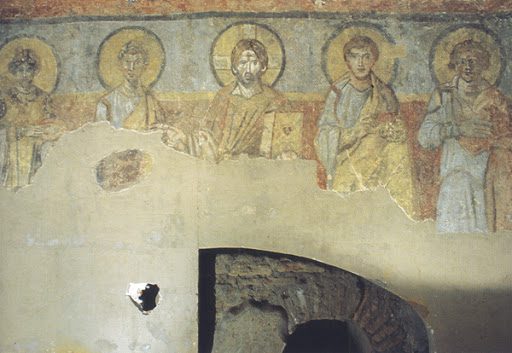
It's the showpiece, and it's also the most wounded piece. In the martyrs' crypt there was a fresco of Byzantine taste called Coronatio Martyrum, the crowning of the martyrs. At the center Christ the Savior seated on a throne, with a robe and pallium of purple color, blessing. At the sides the four saints with the crowns of victory. Simplicius receives the crown from the hands of Christ and is flanked by Beatrice. On the other side Faustinus, with the palm, and Rufinian.
How to Read the Scene
The composition reproduces a court ceremony transferred to Paradise, and it's the way late antique and early medieval art imagines the glory of the martyrs: the sovereign on the throne handing the golden crown to the deserving subject, with the other dignitaries lined up symmetrically. Anyone who has in mind the Roman apse mosaics of saints in a row with the veiled crown in their hands already has the code for reading this fresco. The difference is one of scale and means. Here we're in a country crypt, and the regal scene is painted in fresco on a consolidated tuff wall.
The Dating of the Coronatio Martyrum
There is no agreement on the date. The record of the Sovrintendenza Capitolina says it is certainly earlier than 682, the year of the relics' translation, and leans toward the first half of the sixth century. The general encyclopedia entry confirms the sixth century. The Catholic encyclopedia instead brings it to the middle of the seventh. A hundred years is not a detail when speaking of a work that documents the cult of four saints. The most solid argument remains the chronological and material one: a fresco celebrating the martyrs in their crypt makes sense as long as the bodies are there, and the bodies leave in 682. The prevailing indication is the sixth century, with the later dating as an alternative supported by serious sources.
The Nineteenth-Century Detachment and the Restorations
The story of its conservation hurts. In the nineteenth century an attempt was made to detach it from the wall and the operation caused serious damage. Other damage came with the transfer to canvas. A restoration was carried out in 1983. The lower part is particularly compromised, and to understand how it was originally you have to resort to the nineteenth-century engravings that document its appearance before the interventions. It's a harsh lesson in how the century that rediscovered the catacombs also mistreated them: detaching frescoes was current practice, the idea of conserving in situ was not yet a dogma, and we see the result today.
Another Well-Known Fact, Yet Rarely Mentioned
That the Catacombs of Generosa were plundered in very recent times, and that it wasn't the barbarians or the relic hunters of the 1600s who did it. At the time of discovery the great majority of the loculi were still intact, and so they remained until 1970, when unknown persons committed acts of vandalism that damaged them, in all likelihood in search of valuable finds. We're not talking about a medieval episode: we're talking about a Rome that already had its superintendencies, its protection laws, its archaeologists. Loculi that had gone through 16 centuries sealed were opened in one night, for nothing, because inside there was nothing precious and there couldn't be: it was a cemetery of the poor.
This fact, which is usually dismissed in a line, should be read as the real reason why the Roman catacombs are not all open to the public. The closure is not a clerical whim or a resource problem: it's the consequence of what happens when a fragile complex stays accessible without control. Anyone complaining that they can't get into Generosa whenever they want should think about that night in 1970.
The second rarely cited fact concerns economic geography, and explains why this place exists. Via Campana, whose route Via della Magliana follows, started from the Tiber ford near Tiber Island, followed the right bank and led to the Campus salinarum romanarum, the salt pans at the river mouth, today roughly under Fiumicino airport. Salt was a strategic commodity even before Rome was Rome, and the pairing of Via Campana and Via Salaria made up the system that carried salt from the Tyrrhenian to the Adriatic. Only from the first century AD, with the construction of the ports of Claudius and Trajan, did the Campana lose importance in favor of Via Portuense. The Arvals' sacred grove stood here because the oldest traffic in Lazio passed here. The pozzolana quarry served the building sites reachable from that road. The Christian cemetery was born at the margins of that system. Whoever ignores salt doesn't understand Generosa.
The Rediscovery of the Catacombs of Generosa in 1868
The year that changes everything is 1868, and to understand it you have to hold together two digs and two disciplines.
Wilhelm Henzen and the Arval Sanctuary
Wilhelm Henzen, born in Bremen in 1816 and died in Rome in 1887, was an epigraphist, not an archaeologist, and this distinction matters. First secretary of the German Archaeological Institute in Rome, collaborator of Theodor Mommsen on the Corpus Inscriptionum Latinarum undertaking, Henzen devoted years to the sanctuary of the goddess Dia and to the slabs of the Arvals, and his edition of the Acta fratrum Arvalium quae supersunt remains a reference of the discipline. It was his dig on the plateau that set everything else in motion. Anyone who wants to get a sense of the man should look at the scale of the work: reconstructing a fragmentary epigraphic corpus, restoring and commenting on it, in the nineteenth century, without digital photography and without databases.
Giovanni Battista de Rossi and the Basilica
Giovanni Battista de Rossi is the founder of Christian archaeology as a scientific discipline, the man of the Roma sotterranea cristiana and of the Crypt of the Popes at San Callisto. Here he identified the remains of the basilica in what was then the vineyard of the Ceccarelli brothers. Along the northern slope of the hill, 45 meters above sea level, he recognized some entrances corresponding to the openings of the ancient pozzolana quarries, and from there he traced back to the catacomb. The basilica was found by chance and only partly uncovered.
De Rossi deserves the other half of the portrait too, however. He is the same man under whose responsibility the detachment of the Coronatio Martyrum was attempted, with the damage we know about. The two things must be held together: the founder of the discipline worked with the criteria of his time, and the criteria of his time ruined the most important fresco in this complex. Writing hagiography of archaeologists serves no one.
Enrico Josi and the Twentieth-Century Excavations
In the 1930s Enrico Josi, one of the great names of Italian Christian archaeology, carried out restorations and new investigations, putting back in order what the nineteenth century had dug in haste. The concluding campaigns, conducted by the French archaeological school, completed the excavation of the basilica and clarified the three-nave layout. The dates given by the sources differ, one speaks of 1980-1986 and another of 1975-1986, and they are in any case the years in which the site was read with modern stratigraphic method. It's to those campaigns that we owe our knowledge of the tombs in the church floor and the reliable reconstruction of the plan.
The Right Photo to Take at the Catacombs of Generosa
It's not the photo underground, and I say it against everyone's instinct. In the galleries there's little light, filming in the Pontifical Commission's complexes is subject to regulation and has to be agreed upon, and in any case a narrow gallery lit with flash gives back a gray tube without depth and without emotion. The underground photos you see published are made with professional lighting, tripod and long exposures, that is, with equipment and permits that a group visit doesn't include.
The right photo is taken on the surface, on the remains of the Damasan basilica. Wait for the low light of late afternoon, stand on the west side, that is, the side from which the pilgrims entered, and frame the three naves in foreshortening with the apse in the background and the hill behind. The raking light brings out the courses of masonry and the limits of the naves, which at noon vanish into a uniform flatness. The image that results tells exactly what the building was: a church leaning against the side of a hill full of the dead. If you have a moderate wide-angle lens, 24 or 28 millimeters equivalent, it's the right focal length. With a phone, use the main lens and not the digital zoom.
The second photograph I recommend is of the reused marbles. If the route takes you where inscribed slabs reused as material for the basilica are visible, photograph them close up, with the light coming from the side, so the carvings can be read: it's the most telling detail on the site, Latin letters cut for a pagan cult and ending up under the feet of a Christian liturgy. The third, if you get there, is the arcosolium with the shepherd between the two sheep and the inscription PASTOR. Frame it head-on, without direct flash if you can, because flash flattens the already exhausted color.
One last thing, and it's not a formality. Always ask permission before shooting and respect the staff's directions. Here you're not in a museum, you're in a cemetery, and the difference should be enough by itself.
Some Important Events That Happened Here in History
Republican and imperial age. The plateau above the hill hosts the sacred grove of the goddess Dia and the seat of the college of the Arval Brothers. Every May, for centuries, 12 priests celebrate here a three-day festival with sacrifices, banquet and the singing of the Carmen Arvale, and every year they inscribe on marble slabs the account of what they have done. In the imperial age the emperors belong to the college.
Until the third century. The side of the hill is exploited as a pozzolana quarry. The horizontal galleries that result will serve for something else entirely.
Between the end of the third century and the beginning of the fourth. The galleries of the now-abandoned quarry are chosen by a small rural Christian community as a burial place. This is the birth of the Catacombs of Generosa.
302 or 303, under Diocletian. According to the hagiographic tradition, the martyrdom of the brothers Simplicius and Faustinus, the bodies thrown into the Tiber, the recovery by their sister Beatrice and the burial in the quarry of the matron Generosa. Shortly afterward, the martyrdom of Beatrice. Around those tombs the cemetery develops rapidly.
Second half of the fourth century, with 382 often indicated. Pope Damasus has the semi-underground basilica of 20 meters by 14 built above the tomb of the martyrs, organizes the pilgrims' route with the introitus ad martyres and the fenestella confessionis, and transforms a rural burial ground into a sanctuary. The Arval slabs end up in the construction.
Until the first decades of the sixth century. The basilica keeps its funerary purpose: burial continues in the floor of the church, in trench graves dug in the clay and covered with roof tiles.
First half of the sixth century, according to the prevailing hypothesis. The Coronatio Martyrum is painted in the martyrial crypt, with Christ enthroned crowning the four Portuense saints.
Between the end of the sixth and the beginning of the seventh century. The abandonment of the complex begins. Use of the galleries slowly dies out.
682. Pope Leo II has the relics of the martyrs transferred to the church of Santa Bibiana on the Esquiline. It is the date that closes the ancient history of Generosa: without the holy bodies there is no pilgrimage, and without pilgrimage the site closes up again. 11 centuries of silence follow.
1868. Wilhelm Henzen excavates the sanctuary of the goddess Dia. Giovanni Battista de Rossi identifies the remains of the basilica in the vineyard of the Ceccarelli brothers, recognizes along the northern slope the entrances of the ancient quarries and works his way back to the catacomb. It is the year that changes everything.
Nineteenth century, after the discovery. The attempt to detach the Coronatio Martyrum, which badly damages the fresco, and the later transfer onto canvas, which adds more damage.
The 1930s. Enrico Josi carries out restorations and new investigations.
1970. Unknown persons enter the complex and commit acts of vandalism that damage the loculi that had remained intact since the discovery, presumably looking for valuable finds. It is the worst damage the site has suffered in the contemporary era.
The 1980s. The excavation campaigns of the French school complete the investigation of the basilica, confirm the three-aisle layout and document the floor burials.
1983. Restoration of the Coronatio Martyrum.
Who passed through the Catacombs of Generosa
The Roman emperors, as priests. The college of the Arval Brothers had 12 members, and in the imperial age the emperors were part of it. This means that on the plateau above these galleries, during the May festivals, the princes of Rome passed, not as visiting sovereigns but as fellow brethren of an archaic agrarian cult. The Acta preserve the names of those present year by year, and it is one of the few documentary series that lets us know who was there, on a precise day, in a precise place.
Pope Damasus I. Pontiff from 366 to 384, he is the man who made this rural cemetery a sanctuary. That he came in person is more than plausible for a pope who made the search for the martyrs' tombs the program of his pontificate, but the certain fact is another and is worth more: his architecture is here, and the building bends around the tomb of the martyrs according to the logic that Damasus applied throughout underground Rome.
Pope Leo II. In 682 he orders the transfer of the relics to Santa Bibiana. He is the pope who, in effect, closes Generosa: an administrative and devotional act that ends a centuries-old pilgrimage.
The early medieval pilgrims. We don't know their names, but we know that they came, because the fenestella confessionis and the introitus ad martyres exist to manage them. They were people who came from far away with itineraries in hand, and in the itineraries this place still appeared as ad sextum Philippi.
Wilhelm Henzen. The epigraphist from Bremen, from 1856 first secretary of the German Archaeological Institute, collaborator of Mommsen, came here for the Arval slabs and ended up reopening the door of a catacomb. His 1868 dig is the reason this place can be talked about today.
Giovanni Battista de Rossi. The founder of scientific Christian archaeology, the man who had already brought the Crypt of the Popes back to light. In 1868 he recognized the basilica in the Ceccarelli vineyard and from there the catacomb. And he is the same man under whose management the fresco of the crypt was ruined in the attempt to detach it. The merit and the damage belong to the same person.
Enrico Josi. In the 1930s he put the site back in order with more mature criteria. His is a name that recurs in half of Roman Christian archaeology of the twentieth century.
The archaeologists of the French school. In the 1980s they carried out the modern excavation of the basilica, the one with stratigraphy, graphic documentation and field notebooks. Without their work the plan that can be read on the ground today would be a hypothesis.
The farmers, boatmen and salt workers of the Portuense suburb. They are the real protagonists, and they left their name nowhere, except on a tile sealed with lime and on a few modest inscriptions. They are the ones who dug the loculi, carried the dead underground, lit the lamps in the niches and had a shepherd between two sheep painted. The Catacombs of Generosa are theirs, much more than the four martyrs'.
The Catacombs of Generosa with Children
Let's be clear: it's not a place for strollers. The galleries are narrow and irregular, you go down about eight meters, the surface route is on packed earth and the access path has no signs. Under six or seven years old it's better to let it go, not out of pickiness but because the child gets nothing out of it and complicates the visit for everyone.
From seven years up, instead, it works well, and it works for a precise narrative reason: the story of the two brothers thrown into the river and the sister who recovers them at night is a story that holds up, and the logic of the cemetery dug in an exhausted quarry can be explained in 30 seconds with a drawing in the sand. With kids it's best to prepare the story beforehand, on the bus or in the parking area: underground there's little talking, the voice gets lost and attention lasts less. Those who arrive already knowing the story look at things instead of listening to an explanation.
Accessibility and What to Wear for the Catacombs of Generosa
On accessibility for people with mobility disabilities the Pontifical Commission does not publish specific statements for this complex. The objective picture is one of narrow galleries, a difference in level of about eight meters, an outdoor route on natural ground and access through a service door. Anyone with particular needs should put the question expressly in the request email, describing the situation precisely, and act on the Commission's answer. Anyone looking for a catacomb with an easier route and published information should look at the catacombs of Priscilla or San Sebastiano.
On clothing it's best to be categorical, because too many people suffer for nothing. Closed shoes with a sole that grips, never sandals and never heels: the ground is uneven and in some places damp. A sweatshirt or light jacket even in August, because underground the temperature stays low and constant all year and the contrast with the heat outside is brutal. Long pants. A headlamp. No bulky bag, because in the narrow galleries a swinging shoulder strap rubs against the walls and the loculi. And your phone battery charged before going down.
The Catacombs of Generosa and Rome's Other Catacombs
Rome has more than 60 catalogued catacomb complexes, and only a handful can be visited with a ticket and set hours. The most useful comparison is with the giant on the Appia: the catacombs of San Callisto occupy an area of 15 hectares, with a network of galleries almost 20 kilometers long spread over several levels, and reach depths of more than 20 meters. The published ticket is €10 full price and €7 reduced, with free admission for children up to six years old, for people with a disability above 74 percent, for tour guides and for authorized scholars.
Compared to that scale, Generosa is another category and another story: 2,800 square meters, a single level, eight meters deep, a country cemetery that grew around three tombs. Neither model is superior to the other, but demanding from one what the other offers brings only disappointment.
Rome's Other Catacombs Open on Request
In the same condition as Generosa are the catacomb of Novatian, the catacombs of Santa Tecla, the Museo di Domitilla with the Region of the Bakers, the Museo della Torretta with the Crypts of Lucina, the Museo e catacomba di Pretestato, the Hypogeum of the Aurelii on Viale Manzoni, the anonymous catacomb on Via Anapo, the catacombs of Commodilla and the catacomb of Vigna Chiaraviglio. Commodilla is the closest to Generosa in size and in visiting regime, and the two pair well in a day devoted to the southern and western suburbs. Anyone interested in private hypogea and fourth-century funerary painting should also keep an eye on the hypogeum of Via Dino Compagni, which belongs to another category of monuments but follows the same logic of controlled access.
Catacombs Open to the Public
For completeness: in Rome the Pontifical Commission lists among the catacombs open to the public San Pancrazio, Priscilla, San Sebastiano, Domitilla, Sant'Agnese, San Callisto and Santi Marcellino e Pietro. These are the seven that can be visited with a ticket and without prior paperwork. All the others, Generosa included, go through the written procedure.
What's Around the Catacombs of Generosa
The area is Magliana and Portuense, and it doesn't belong to any standard tourist itinerary. That is exactly why it lends itself to a well-built day, provided you have a car or accept the pace of surface transport.
A few minutes away, along the same axis of Via della Magliana that follows the ancient Via Campana, is the church of Santa Passera, one of the most curious small buildings on the right bank, with a hypogeum below ground level. It's the natural stop before or after Generosa, and it completes the story of early Christianity in this stretch of the river. Continuing toward the city you meet the necropolis of Via Portuense, which tells the pagan funerary world of the same area and allows a direct comparison between two ways of burying the dead.
Farther on, in Trastevere, the basilica of Santa Cecilia in Trastevere closes the circle with the Roman martyr par excellence, whose body was brought into the city precisely from a catacomb on the Appia. It's the most famous example of the translation mechanism that emptied Generosa in 682. On the other bank, the basilica of San Paolo fuori le Mura and the Museo della Via Ostiense inside Porta San Paolo tell the story of the other great road to the sea, the one on the left bank.
Anyone with half a day and a car can finish at EUR, which is a quarter of an hour away, for a violent and instructive contrast between the fourth century and the twentieth. If instead the catacomb theme has taken over, the right area is the Appia Antica Park, where the major complexes are and where in the same day you can add the Villa of the Quintilii and the great roadside tombs. For the modern chapter of Roman burial, the reference remains the Verano cemetery.
When to Go to the Catacombs of Generosa
The best season is the in-between one, April and May or October. The reason has nothing to do with the catacomb, where the temperature stays low and constant all year, but with the surface: the plateau of the basilica and the sanctuary area are walked on natural ground, and with winter mud or the 40 degrees of July the outdoor part becomes tiring and you end up dispatching it in five minutes. That would be a pity, since it's the better half.
The recommended time is late afternoon, for the raking light on the basilica remains mentioned in connection with photographs. If you have to choose between a morning and an afternoon, choose the afternoon. One last calendar consideration, for those who like historical coincidences: the Arval festival fell in May, and in May the plateau is at its best. It's not an archaeological argument, it's an argument about the pleasure of the visit, and as such I offer it.
Quick Questions About the Catacombs of Generosa
Can you visit the Catacombs of Generosa?
Not freely. The Pontifical Commission for Sacred Archaeology classifies them among the Roman catacombs open only on request. A prior written request is needed and there is no ticketed entrance.
How much does a visit to the Catacombs of Generosa cost?
The contribution indicated for Roman catacombs open on request is €250.00 per group, with groups of no more than 15 people. There is no individual ticket. The body's pages don't all report the same amount, so it's best to have the figure confirmed in writing when you make the request.
What does the contribution include?
The presence of a fossor for custody and assistance and an archaeologist to illustrate the monument. It's not a visit you do on your own with a flashlight.
How do you book a visit to the Catacombs of Generosa?
By email to protocollo@arcsacra.va containing the full personal details of the applicant or written on the institution's letterhead, and stating the reason, day, time, number of participants and any need for an archaeological guide in a foreign language. The phone numbers given on the catacomb's page are 06 4465610 and 06 4467601.
How far in advance do you need to write?
Weeks, not days. The Commission has to arrange a fossor and an archaeologist for your group, and this takes time. Give several alternative dates in the first email.
What is the exact address of the Catacombs of Generosa?
Via delle Catacombe di Generosa, 00148 Rome, in Municipio XI Arvalia Portuense, on the right bank of the Tiber in the Portuense suburb.
How do you get there by public transport?
Surface lines 128, 719 and 228 run along Via della Magliana and Via del Tempio degli Arvali. The 228 has among its stops the Magliana station of the FL1 line. The last stretch is on foot along a dead-end road and a dirt path. It's best to check the route the same day on the Roman public transport app, because in this area detours are frequent.
Can you come by car and park?
Yes. You arrive from Via della Magliana and there is a wide spot to leave the car at the start of the dead-end road. The last stretch toward the site is on packed earth.
Is there a museum of the Catacombs of Generosa?
No. The phrase "museum of the Catacombs of Generosa" circulates online for historical reasons, but on the Pontifical Commission's site the place is simply "Catacomb of Generosa" and has no museum section. The Commission's underground museums in Rome are those of Domitilla, of the Torretta with the Crypts of Lucina, and of Pretestato.
How long does a visit to the Catacombs of Generosa last?
There is no published official duration. The special openings organized in the area have usually taken a couple of hours, including the surface area. Plan around that order of magnitude and ask for confirmation when you book.
Can you take photos inside the Catacombs of Generosa?
Filming in the Pontifical Commission's complexes is subject to regulation and has to be agreed upon. Ask permission when you submit the request and follow the staff's directions on site.
Are bones visible?
The loculi are largely empty. The martyrs' relics were translated in 682, and the complex was excavated and cleaned in modern times. In 1970 acts of vandalism opened many loculi that had remained intact until then. Don't expect an ossuary like the one in the Capuchin crypt.
Is it cold inside the Catacombs of Generosa?
Underground the temperature stays low and constant all year, even in the height of the Roman summer. Bring a sweatshirt or light jacket, and put it on before going down.
Are the Catacombs of Generosa accessible to people with mobility difficulties?
The Commission does not publish specific accessibility statements for this complex. The galleries are narrow, you go down about eight meters and the outdoor route is on natural ground. Put the question expressly in the request email.
Are they suitable for children?
From six or seven years old and up, and with an attentive adult, yes. The story of the Portuense martyrs works very well with kids. With the youngest and with strollers, no.
Why are they called the Catacombs of Generosa?
From the name of the Roman matron who owned the land, an exhausted pozzolana quarry, where according to tradition the martyrs were buried. It's the general rule of Roman catacombs: the cemetery carries the name of whoever made the land available.
What does "ad sextum Philippi" mean?
"At the sixth of Philip," that is, at the sixth mile, in a stretch of countryside identified by the name of a local landowner. It also appears in the form "super Philippi." It's the ancient name of the cemetery, preceding the use of the name Generosa.
Who are the martyrs buried at the Catacombs of Generosa?
Simplicius, Faustinus, Beatrice and Rufinian, known as the holy Portuense martyrs. Simplicius and Faustinus were brothers, Beatrice their sister. Rufinian is attested only by the fresco of the Coronatio Martyrum.
Are Beatrice and Viatrice two different saints?
No, they are the same person. The Latin name is Viatrix, Italianized as Beatrice, and the sources use the two forms interchangeably.
What is the Coronatio Martyrum?
A fresco in the martyrial crypt with Christ enthroned, in a purple robe and pallium, crowning the four martyrs. It was damaged in the nineteenth-century detachment attempt, further compromised by the transfer to canvas, and restored in 1983. The prevailing dating is the sixth century, with an alternative proposal at the middle of the seventh. In any case it is earlier than 682.
How big is the catacomb?
About 2,800 square meters on a single level, at a depth of about eight meters inside the hill. The galleries are narrow and irregular because they follow the course of the old quarry galleries.
What is the difference between Generosa and the large catacombs open to visitors?
Size and access regime. San Callisto occupies 15 hectares with almost 20 kilometers of galleries on several levels and opens with a ticket and guides. Generosa has 2,800 square meters on one level and opens only on written request.
Which other Roman catacombs are open on request?
Novatian, Santa Tecla, the Museo di Domitilla with the Region of the Bakers, the Museo della Torretta with the Crypts of Lucina, the Museo e catacomba di Pretestato, the Hypogeum of the Aurelii on Viale Manzoni, the anonymous catacomb on Via Anapo, Commodilla, Vigna Chiaraviglio and Generosa.
Which Roman catacombs open with a ticket instead?
San Pancrazio, Priscilla, San Sebastiano, Domitilla, Sant'Agnese, San Callisto and Santi Marcellino e Pietro.
Can you visit alone without a guide?
No. The visit includes accompaniment by the Commission's staff, and in any case the gate is closed.
Is there anything to see on the surface?
Yes, and it's worth the trip: the remains of the semi-subterranean basilica of Pope Damasus, about 20 meters by 14, with three naves and an apse, and the area of the sanctuary of the goddess Dia with the seat of the college of the Arval Brothers. Ask expressly that they be included in the visit.
When were the Catacombs of Generosa discovered?
In 1868, during Wilhelm Henzen's excavations in the sacred grove of the Arvals. Giovanni Battista de Rossi identified the remains of the basilica in what was then the vineyard of the Ceccarelli brothers and from there traced back to the catacomb.
Who runs the Catacombs of Generosa today?
The Pontifical Commission for Sacred Archaeology, which depends on the Holy See and has jurisdiction over ancient Christian cemeteries. The number to call for a visit is the Commission's.
Are there free or special openings?
The Comitato Catacombe di Generosa organizes guided tours and lectures together with Municipio XI and the Pontifical Commission. The contact given on the institutional pages is 349 7930661. The calendar is not fixed and must be asked about directly.
Is it worth combining the visit with other places?
Yes. The church of Santa Passera on the same road axis and the necropolis of Via Portuense work well on the same day. With a car, EUR can be added without effort.
What is the best time of year?
April, May and October. Underground the temperature never changes, but the surface part, which is half the value of the visit, is enjoyed much better with dry ground and mild temperatures.
What should you bring?
Closed shoes with a sole that grips, a sweatshirt or light jacket even in summer, long pants, a headlamp, a charged phone and no bulky bag.
Why aren't the Catacombs of Generosa open every day?
Because they are a fragile complex, with narrow galleries already reinforced in antiquity, and because the experience of the 1970 vandalism showed what happens when a site like this stays accessible without control. The visit accompanied by a fossor and an archaeologist is a protective measure, before it is a service.
We close with our opinion, to keep in mind as you climb back up to the wide spot. The Catacombs of Generosa are the least spectacular and most instructive place in Rome's underground. There's no Crypt of the Popes, no line, no souvenir shop. There's a hill above a bend in the Tiber where for centuries 12 priests sang in a Latin that not even they understood anymore. Where Christian farmers then buried their dead inside an exhausted quarry. And where finally a pope built a church 20 meters long using as material the marble slabs of the gods before. Three cast-off religions stacked in 20 meters of hill. If you can put together a group and write that email, do it: it stays with you more than many places that have a ticket office and a line.
Article written by the TourLeaderPro editorial team, contact them for Private/Corporate/V.I.P. Tours and Experiences.
Planning a trip to Rome? The English-language guides to visiting the city are on ItalyPlanner.com.