Hypogeum of Via Dino Compagni
In short. The Hypogeum of Via Dino Compagni, which archaeologists call the catacomb of Via Latina, opens under the sidewalk at Via Latina 258, in the Appio-Latino district, and the first thing to know is also the most inconvenient: the Pontifical…

The Hypogeum of Via Dino Compagni, which archaeologists call the catacomb of Via Latina, opens under the sidewalk at Via Latina 258, in the Appio-Latino district, and the first thing to know is also the most inconvenient: the Pontifical Commission for Sacred Archaeology, the owner and operator, lists it among the underground cemeteries closed to the public. No ticket office, no hours, no entrance price, no ordinary reservation. The body's contact details are the phone numbers +39 06 4465610 and +39 06 4467601 and the email address protocollo@arcsacra.va. On the official sacred archaeology portal the page dedicated to this hypogeum offers a virtual tour of the painted galleries, which today remains the most realistic way to see them. The few physical descents that happen each year are extraordinary openings with limited numbers, authorized case by case for cultural associations: you go down through a manhole in the sidewalk, by a staircase, and the places run out in a few hours. Anyone coming to Rome with a free afternoon and a wish for an underground site open every day has to aim elsewhere.
To get your bearings among the city's underground cemeteries and understand which ones you can really visit, the starting point is the guide to the catacombs of Rome, where you find the complexes with regular entry, the addresses and the closing days.
Where it is and how you get into the Hypogeum of Via Dino Compagni
The street address is Via Latina 258, Appio-Latino, but the monument's name comes from the street that runs over it, Via Dino Compagni, the one where in the postwar years the foundations were dug for the building that almost killed the catacomb. The ancient entrance, the one that in the 4th century opened toward the countryside of Via Latina, has been wiped out by the modern construction: today the opening is a manhole on the sidewalk, and this is already half the character of the place. There's no portal, no courtyard, no gate with a sign. There's a cast-iron manhole cover in the middle of a residential neighborhood, with cars parked a step away.
The area is the one between Via Appia Nuova and the Caffarella valley, a short distance from the Furio Camillo station on metro line A. Anyone who wants to build a day in this part of the city has plenty to fill it with even without going underground: the Caffarella Park begins a few hundred meters farther on, with the church of Sant'Urbano alla Caffarella and its medieval frescoes, and the Appian Way Park can be reached in barely a quarter of an hour.
The depth and elevation of the Hypogeum of Via Dino Compagni
The cemetery extends between 12.92 and 16.20 meters below the current street level. These are figures from a topographic survey, not a brochure, and they say one precise thing: the tuff bed in which the fossores dug is deep enough to have protected the paintings from surface humidity for 16 centuries, but not deep enough to save them from the foundation piles of a 1950s building. The difference of three meters in elevation, here, decided which rooms have reached us intact and which were broken through by concrete.
Why the Hypogeum of Via Dino Compagni is closed to the public
The reason is not bureaucratic, it's physical. About 100 scenes painted on 4th-century plaster, in an underground environment of very high humidity, react to human presence like a photographic plate to light: the breath of 20 people raises the carbon dioxide, the heat shifts the dew point, water condenses on the cold walls and puts the salts of the tuff into solution, which then recrystallize on the paint film. In the catacombs with regular entry the routes are designed to keep the public away from the important frescoes. Here the frescoes are everywhere, from floor to vault, and there is no route that avoids them.
On top of this there is a safety problem: access is through a street manhole cover, the staircase is steep, the rooms are narrow and the escape routes are what they were. None of the conditions that make San Callisto or Priscilla visitable exist on Via Latina. The Commission therefore grants exceptional openings, with very small groups and with a guide who answers for everything. In our judgment it's the right choice, and anyone who protests the closure has never seen what happens to a painted plaster when 30,000 people a year walk past it.
The discovery of the Hypogeum of Via Dino Compagni
The story of the find is one of the ugliest and most instructive in Roman archaeology of the 20th century, and it's worth telling in full.
The building site that found the Hypogeum of Via Dino Compagni
The mid-1950s, a neighborhood in expansion, a construction company digs the foundations of a new building between Via Dino Compagni and Via Latina. The excavator buckets break through the vault of an underground room. The people working on the site understand perfectly well what they have in front of them: painted walls, columns, arcosolia, marble sarcophagi. And they decide not to tell anyone until the end of the works, because reporting a find means a stopped site, inspections, restrictions and months lost.
The silence lasts long enough to do irreparable damage. Some rooms are crossed by the reinforced concrete pours of the foundation piles, which cut through frescoed walls. In the months when the catacomb stays open and unguarded, illegal diggers get in and carry off what gets carried off: inscribed slabs, objects, grave goods. The original burials of the richest cubicula are emptied. When the engineer Mario Santa Maria finally reports the find to the Pontifical Commission for Sacred Archaeology, part of the monument is gone.
Antonio Ferrua and the excavation of the Hypogeum of Via Dino Compagni
The Commission sends to the spot Father Antonio Ferrua, a Jesuit, born in Trinità in 1901 and ordained a priest in 1930, an epigrapher of standing and future secretary of the Commission itself, already engaged since 1940 in the excavations under St. Peter's Basilica ordered by Pius XII. Ferrua has a record few can claim: the edition of the epigrams of Pope Damasus, begun in 1933, and then the monumental collection of the Christian inscriptions of Rome earlier than the 7th century. He goes down into the new hypogeum lowering himself on a rope from a hole opened in the vault of one of the rooms, and understands within a few minutes that he is in front of something without precedent.
The recovery and clearing campaign runs from November 2, 1955 to June 15, 1956. Ferrua publishes the results in 1960 in a volume that has remained a classic of the discipline, Le pitture della nuova catacomba di via Latina, issued in Vatican City by the Pontifical Institute of Christian Archaeology. He returns to the subject 30 years later with a book for the general reader whose title says it all, Catacombe sconosciute. Una pinacoteca del IV secolo sotto la via Latina. Ferrua dies in Rome in 2003, at 102: he lived long enough to see his catacomb become a required chapter in every manual of early Christian art.
A curiosity about the Hypogeum of Via Dino Compagni
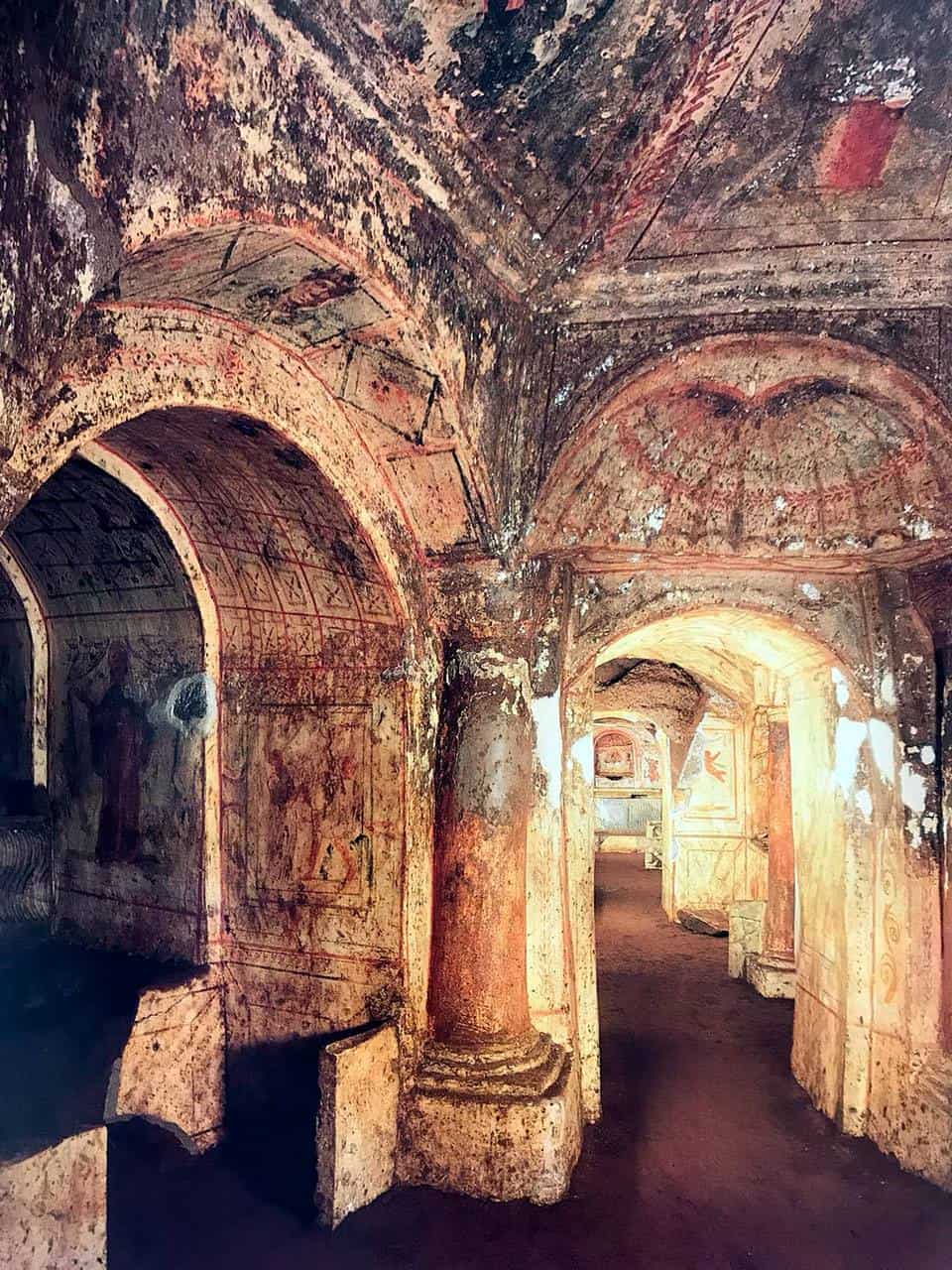
The real curiosity of this place is not that there are pagan paintings next to Christian ones. It's that they were painted, in all probability, by the same workshop. In the cubiculum the scholars call E there dominates a semi-reclining female figure on a field of wheat and poppies, with a snake coiled around her left arm: it's Tellus, Mother Earth, a deity of the traditional Roman religion. In the neighboring cubiculum, labeled F, there are Samson routing the Philistines with the jawbone of an ass and Christ speaking with the Samaritan woman at Jacob's well. Those who have studied the two rooms observe that the hand, the application of color, the way of building the shadows and even the surrounding decorative repertoire are the same. A single group of painters, hired by the same patrons, worked for two different faiths in the same underground site.
This changes the meaning of the whole monument. We are not in front of two communities fighting over a space, but in front of one extended family, a wealthy one, that buys a hypogeum for its dead and lets each branch have the room decorated according to its own devotion. The pagan patron and the Christian patron called the same fresco painters and probably paid the same price. In the 4th century, while at the imperial level battles of religious legitimation were being fought, under a field in Appio-Latino coexistence was a matter of family and of contract with the workshop. Anyone looking in the Roman catacombs for proof of a society sharply divided in two finds here exactly the opposite, and for this reason the Hypogeum of Via Dino Compagni has forced scholars to rewrite a few pages.
How the Hypogeum of Via Dino Compagni is laid out: plan and galleries
The plan is simple and legible, a rare thing in the Roman catacombs, which usually grow by disorderly additions over two or three centuries. Here the design is unified because the time of use was short.
The two parallel galleries
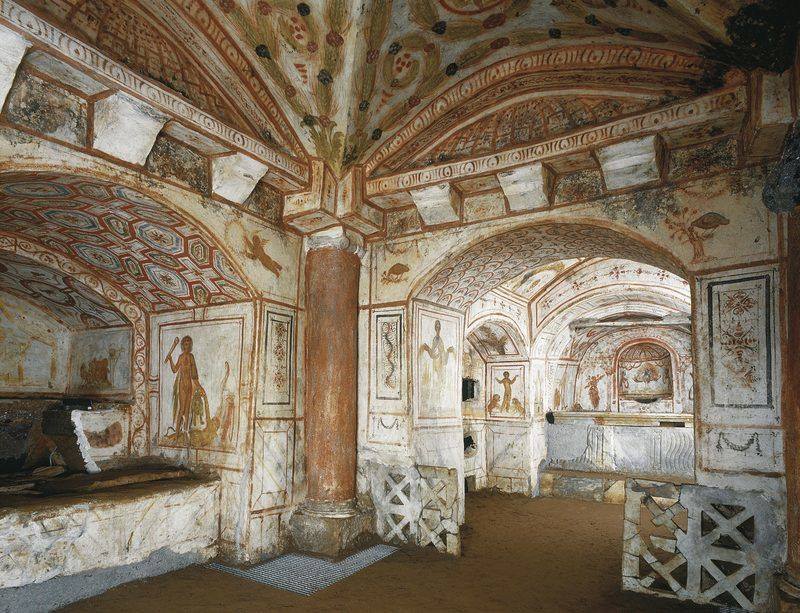
The complex develops on a single level. Two parallel galleries, about 30 meters long, run about 18 meters apart. A third gallery, over 40 meters long, crosses them perpendicularly and ends in a succession of vestibules, cubicula and crypts. It's in this end zone that everything that makes the monument famous is concentrated: the stuccoes, the columns set against the corners, the moldings, the cross vaults and sail vaults, the monumental arcosolia.
The 14 cubicula of the Hypogeum of Via Dino Compagni
The closed rooms number 14, spacious, with loculi in the walls and arcosolium tombs. The recorded burials are about 400: a number that, set against the kilometers of galleries of a community cemetery, clearly says that here we are not in a community cemetery but on private property. Ferrua labeled the rooms with letters of the alphabet, from A to O, and the corridors with the numbers from 1 to 6: those labels are still today the way the scholarly literature cites the individual scenes.
The four phases of excavation
The cemetery grows in four successive phases, all within a very short span. The first opens the entrance gallery with the first two cubicula. The second pushes deeper and adds the rooms painted with Old Testament themes. The third opens a gallery halfway along the previous one, with a vestibule onto which the pagan cubiculum and the elongated Christian one open. The fourth, toward the west, produces the ambulatory that leads to the hexagonal vestibule and to the final sequence of rooms. The dating of the paintings proposed by Ferrua, around 320-350, still holds after 60 years of discussion. The use of the cemetery runs out around 350-360: some 50 years in all, then silence.
The cubiculum-by-cubiculum route through the Hypogeum of Via Dino Compagni
What follows is the itinerary as you walk it going down, with the main subjects room by room. Anyone looking at the virtual tour on the sacred archaeology site can use it as a reading map.
Cubiculum A: the opening biblical repertory
A large square room, entirely frescoed on a white ground marked by red bands. Three wide arcosolia tell the Old and New Testaments with a density rarely seen in the catacombs. On the entrance wall the original sin of Adam and Eve, Daniel in the lions' den, Noah drunk. In the left arcosolium Isaac blessing Jacob in the tympanum, surrounded by the cycle of Jonah. At the back Susanna among the elders, and on the surrounding wall Christ among the apostles. On the right a pastoral composition with Moses and the people of Israel and the three youths in the furnace. At the center of the vault the Good Shepherd. Three later loculi and intrusive burials have ruined part of the paintings, and illegal diggers emptied the original tombs.
Cubicula B and C: the second painting campaign
A double room, square, with columns set against the corners that hold up the vault. Here appear Old Testament subjects that had never been painted before in Roman catacomb painting. In the left arcosolium Jacob entering Egypt with his family, the carts marching toward the pharaoh's city and the Nile with fish in the lower register. In the vault Adam and Eve in despair, dressed in spotted skins, the sacrifices of Cain and Abel with the lamb and the sheaf, Lot fleeing Sodom with his daughters. Then Samson, Moses, the cycle of Joseph with the dream that changes his life. In the right arcosolium the ascension of Elijah on the chariot of fire, and again Abraham, Isaac, Jacob. In the vault Noah in the ark, Samson facing the lion bare-handed, Absalom caught by his hair in the oak, Jacob's ladder.
Cubiculum C closes the axis at the far end and is a privileged room, with a single arcosolium burial and a small rectangular niche above the tomb, probably made for a statuette of the deceased. On the deep left arch the resurrection of Lazarus, the sacrifice of Abraham, above Moses receiving the Law and the pillar of fire. On the right arch the crossing of the Red Sea, one of the most spectacular scenes of the whole complex. Around the arcosolium peacocks, the expulsion from the earthly paradise, episodes of Moses, Job and Jonah.
Cubiculum D: the hall of funeral banquets
It's a rectangular room that holds not tombs but living people. It was used for the refrigeria, the ritual meals that family members ate beside their dead on anniversaries and on the day of burial. It has pairs of columns set against the corners near the entrance and a small stair of four steps that leaves from the back wall. From here, going down two steps, you enter cubicula E and F. Anyone who imagines the catacombs as places of burial alone struggles to place a dining room 15 meters underground: yet the banquet next to the tomb was normal practice, shared by pagans and Christians, and the Church would take decades to limit it.
Cubiculum E: Tellus and the pagan themes of the Hypogeum of Via Dino Compagni
The first entirely pagan room, with a single arcosolium. In the tympanum the semi-reclining female figure already mentioned, identified as Tellus, the Earth: the wheat, the poppies, the snake on her arm. Ferrua at first had read in it the death of Cleopatra, misled by the snake itself, and the correction of the identification is one of the most honest episodes in the historiography of this monument. Around it, winged Victories, animals, flowers, dancers, and above the arcosolium two peacocks pecking from a stemmed cup. The Gorgon and the zoomorphic elements complete a repertory that any Roman of the 4th century would have recognized as his own.
Cubiculum F: Samson and the Samaritan woman
An unusual plan, like a flattened pear, with a narrow entrance. Three arcosolia flanked by columns painted in imitation of pavonazzetto. In the back arcosolium Samson routing the Philistines with the jawbone of an ass, a subject with no comparison in Roman catacomb painting. On the left Christ and the Samaritan woman at Jacob's well: Christ young and beardless, in sandals, the woman in laced ankle boots that are a small document of late antique fashion. On the right Balaam's ass, with the prophet blocked by the angel who holds a drawn sword.
Vestibule G and room H: the well and the fossor
Vestibule G is a small square room from which two passages lead off. The one on the left, corridor 6, runs straight to a blind end occupied by loculi thought to be meant for slaves and freedmen of the family. The one on the right, corridor 5, descends with long steps cut into the tuff to a well that still contains water: it served the refrigeria and the mortars of the building site. Above the entrance of room H a fossor is painted, that is, one of the diggers who pulled all this out with pickaxes. Room H is a widening of the passage, with walls plastered and painted in imitation of ashlar, a function not clarified, perhaps also tied to the banquets.
Cubiculum I: the hexagon and the anatomy lesson
It's the most architecturally ambitious room of the complex: hexagonal, slightly elongated on the major axis, with pairs of columns set against the corners and at the sides of the entrance and exit, holding up a sail vault divided into six segments. Two very deep arcosolia on the diagonal back sides contain three tombs each, and in the upper tombs marble sarcophagi with strigilated decoration have been inserted. Two side passages lead to two smaller rooms, seriously compromised by the concrete of the modern construction.
In the left tympanum Christ in majesty between Saints Peter and Paul, with figures of Moses and Job at the sides. In the right tympanum the scene that has made more ink flow than any other, discussed further on. At the center of the vault a roundel with a man holding a scroll. In the segments, portraits with scrolls and codices separated by book boxes for volumes. The general tone of the room is philosophical and cultural before devotional: it's the room of someone who wanted to be remembered as a man of study.
Cubicula L and M: between Abraham and the soldiers at the tunic
The small square room L works as an antechamber to the three final cubicula. On one wall the sacrifice of Abraham, on the opposite one Samson killing the lion. Cubiculum M has a wide entrance flanked by paired columns and two arcosolia that occupy the side walls entirely. In the right arcosolium the original sin among scenes of Jonah. In the left one two soldiers throwing dice for Jesus's tunic, another very rare subject, and Jonah again. In the vault a roundel with the Good Shepherd surrounded by birds.
Cubiculum N: the cubiculum of Hercules
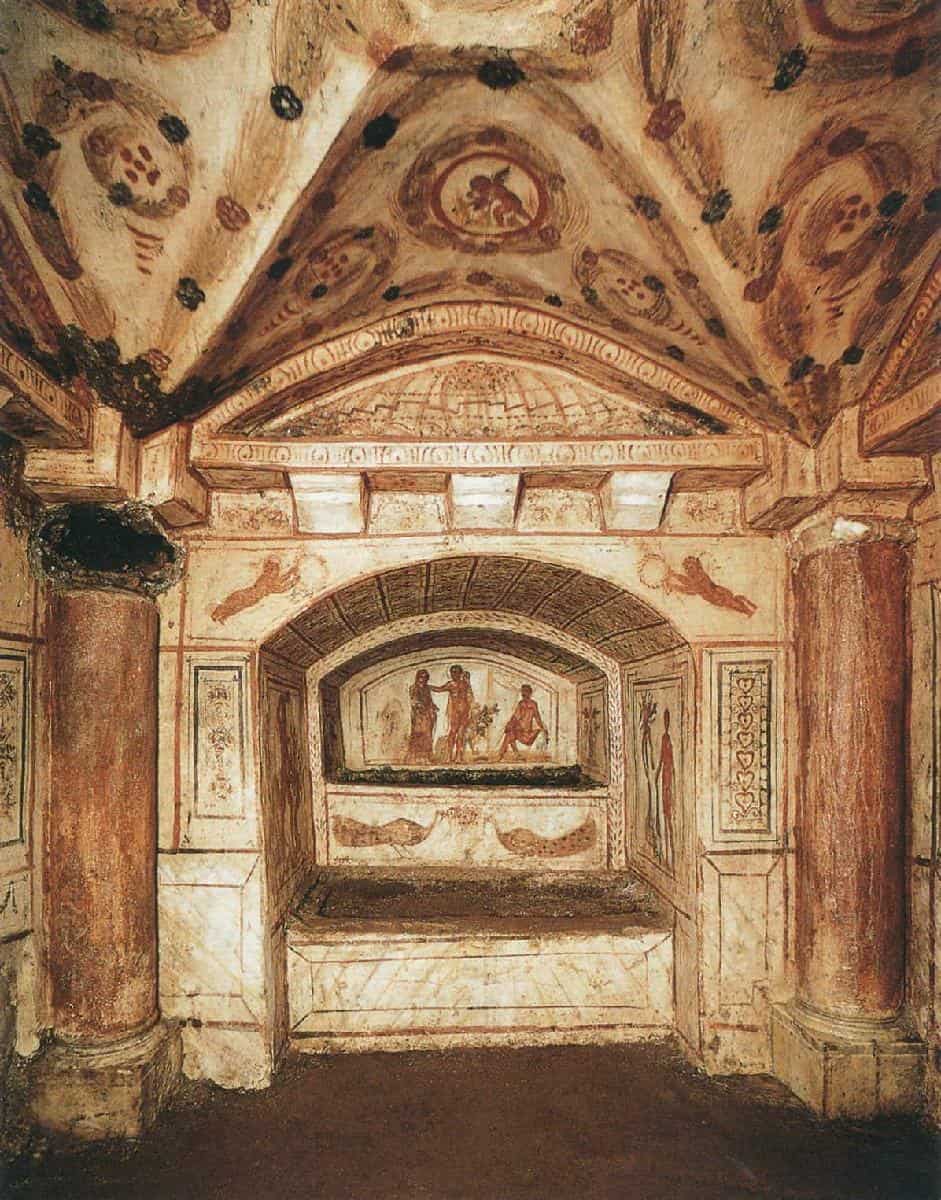
The second entirely pagan room, and the most famous. Four corner columns cut into the tuff, with real marble Ionic capitals and bases set into the rock, and triangular pediments as a crown. On the walls the cycle of Hercules, discussed in the chapter that follows. In the vault garlands of wheat ears among cupids reaping the grain.
Cubiculum O: the woman with the nimbus
The last room, with a single arcosolium and an apsed niche for a statuette occupied by a frontal peacock with its tail raised. The decoration is more carefully done than average. At the springings of the arcosolium vault the multiplication of the loaves and fishes and the three youths in the furnace. On the front Noah in the ark and a praying figure. On the left wall the resurrection of Lazarus and episodes from the life of Moses. On the right wall the flight into Egypt and the crossing of the Red Sea. At the center of the arcosolium vault the roundel with the portrait of a young woman, the only depiction of a deceased person in the whole complex, with her head surrounded by a nimbus. At the entrance two screens of perforated marble: in community catacombs a similar apparatus would have suggested the tomb of a martyr, and for decades people tried to read a saint here. Current research is more cautious, because the nimbus in the 4th century was not yet an exclusive attribute of saints.

One thing nobody tells you about the Hypogeum of Via Dino Compagni
Everyone talks about the frescoes. Nobody talks about the plumbing. At the end of corridor 5, after a long staircase cut into the tuff, there's a well that still contains water. It's not a colorful detail: it's the proof that this underground site was a place where people lived, not only where they buried. The water served to mix the mortars during the digging, to wash hands before and after the rites, and above all it served the refrigeria, the funeral banquets that the family members ate in room D, seated 15 meters underground beside their dead, on the anniversary of the burial. Bringing wine, bread and water all the way down there for about a dozen people meant organization, servants and money.
The second detail, rarely cited, is social. Corridor 6 ends in a blind end full of anonymous loculi, without paintings, without marbles, without niches: the current reading assigns them to slaves and freedmen of the same property. The same cubic meters of tuff, the same air, the same well water, but a world of distance from the hexagonal room with the strigilated sarcophagi. The third detail is that fossor painted above the entrance of room H: a worker shown with his tools inside the work he dug himself. In the Roman catacombs it happens, and it's one of the few occasions when ancient art shows us who physically did the work. In a monument built entirely to celebrate wealthy patrons, the Hypogeum of Via Dino Compagni also keeps the face of the man who held the pickaxe.
The cycle of Hercules in the Hypogeum of Via Dino Compagni
Cubiculum N is the reason this hypogeum appears in all the manuals. On the walls of the two arcosolia runs a cycle dedicated to Hercules that has no parallels in any other Roman underground cemetery. On one side Hercules with the dying Admetus and the body of the slain Cacus, and Hercules together with Athena. On the other the central episode: Hercules handing Alcestis back to Admetus, bringing her back from Hades, with Cerberus crouching in the background. Next to it, Hercules against the Hydra and the garden of the Hesperides with the golden apples.
The choice is not random and not decorative. Alcestis is the wife who agrees to die in her husband's place and whom a hero snatches from death: in late antique funerary repertory she is one of the most powerful images of salvation paganism produced, exactly as the resurrection of Lazarus is for Christians. The two promises run in parallel, a few meters apart, inside the same family hypogeum. Whoever commissioned cubiculum N knew perfectly well what he was asking of the painter.
There's then a detail worth the trip for anyone interested in iconography: in some of these scenes Hercules appears with the nimbus around his head. The same halo that we automatically associate with Christian saints, in the 4th century, moves freely on a pagan hero. It's the quickest way to understand that in the visual culture of that century the codes were still shared and in motion, and that reading the nimbus as a mark of sainthood is an error of perspective we inherited from later centuries.
The anatomy lesson: the most debated scene
In the right tympanum of hexagonal cubiculum I a group of men in tunic and pallium surrounds a reclining figure. At the center a figure with the air of a teacher, seated or bent over, points to the body. The interpretation prevailing today is that it's an anatomy lesson on a corpse, which would make it one of the very rare ancient depictions of medical teaching, and would suggest that the owner of the room was a doctor or a teacher.
Alternative readings are not lacking. Some have seen in it a philosophy lesson, with the teacher commenting on a theme before his disciples, consistent with the roundel of the scroll at the center of the vault and with the codices painted in the segments. It must be said clearly that no inscription helps us: the hypogeum has yielded no epigraphs naming the owners, and every identification remains a hypothesis based on the image. Caution here is mandatory. What is certain, and what nobody disputes, is the overall tone of the room: a man who wanted to be remembered for what he knew, and who spent a fortune so that his funeral chamber would say so to anyone who came down to eat beside his tomb.
My advice for visiting the Hypogeum of Via Dino Compagni
The advice starts from an observation: in the vast majority of cases you won't get in. So the plan is built in three moves, in order of realism.
First: watch the virtual tour that the Pontifical Commission for Sacred Archaeology puts on the hypogeum's official page. Do it on a big screen, not on a phone, and with the plan of the cubicula beside you. 30 minutes well spent are worth more than a descent made without knowing what you're looking at, and in the Red Sea scene or in the tympanum of Tellus the detail that matters is tiny.
Second: if you want to try the physical descent, the only way is to follow the Roman cultural associations that obtain, year by year, the Commission's authorization for extraordinary openings with limited numbers. There are few dates, the groups count a handful of people, the lists close in very short order and the waiting lists are long. Sign up for the newsletters, pencil in the low-season months and don't count on a last minute stroke of luck: it doesn't work that way.
Third, and it's the most useful advice: build the day around an underground site that you can visit and use the Hypogeum of Via Dino Compagni as a story. The catacombs of Santa Tecla open only on request and have frescoes of the highest quality. San Sebastiano and San Callisto are a quarter of an hour away by car and can be visited every day except the weekly closing day. Commodilla and the Generosa complex complete the picture for anyone who wants to understand the funerary geography of the city. If instead you're after pure staging effect, the Capuchin Friars Museum with the ossuary crypt on Via Veneto is a different genre altogether, but it works. One last practical recommendation for any catacomb: closed shoes with a sole that holds on wet ground, a sweatshirt even in August because below it's a constant 15 or 16 degrees Celsius, and no big backpacks.
Another well-known fact, yet rarely cited
The well-known fact is that the Roman catacombs were never hiding places of persecuted Christians. You read it everywhere, and yet the legend holds up very well and every year I hear it repeated in front of the gates of the Appia. The underground cemeteries were regular funerary properties, declared, protected by Roman law on tombs, often reachable by anyone. They were the last place in the world to hide, given that the authorities knew perfectly well where they were and who owned them.
What is cited much less is the corollary that concerns this very monument. The Hypogeum of Via Dino Compagni is not even a community cemetery: it's a private hypogeum, bought and dug by a family group for its dead, and this explains the orderly plan, the constant depth, the richness of the stuccoes and the limited number of burials, about 400 in all. It also explains the coexistence of cults, which in a cemetery run by the Church of Rome would have been unthinkable.
There's a second corollary, entirely 20th-century and much less noble: the foundation piles of the modern building crossed and destroyed two minor rooms opening on the sides of the hexagonal cubiculum, and the removal of the archaeological layers at the surface wiped out forever every trace of the ancient entrance. We will never know how one entered this hypogeum in the 4th century, or if it had a structure above ground. The damage was not done by time: it was done by a building-site decision.
The right photo to take at the Hypogeum of Via Dino Compagni
The right photo, for almost all visitors, is the one at the surface, and it's much more interesting than it seems. Stand on Via Latina at number 258, on an afternoon of low sun, and frame the manhole on the sidewalk with the building behind it and the parked cars on both sides. There's no plaque, no sign, nothing that declares what is underneath. That banal image of a Roman residential periphery, with a cast-iron manhole cover at the center, is the most honest portrait of the relationship between this city and its subsoil: 15 meters lower there is a 4th-century picture gallery, and on the surface someone is parking.
Technical advice: frontal framing at a meter and a half off the ground, lens around 35 millimeters, the manhole cover in the lower third and the building taking up the rest. If you have a wide-angle lens, crouch down and put the manhole in the extreme foreground with the perspective of the street running away: it works better than any vertical shot.
For those who instead obtain authorization to go down, the framing worth the descent is the six-segment vault of the hexagonal cubiculum, shot from below at the center of the room, with the two deep arcosolia coming in at the sides. But the first rule is that the paintings come before the photograph: in the painted rooms you shoot only within the terms the authorization allows, without flash and without tripods that clutter a passage little more than a meter wide. A photographer who holds up the group in front of a 4th-century plaster to adjust the light is a problem, not an artist.
Some important events that happened here in history
The first event is the foundation itself. In the early 4th century, at a moment when Christianity emerges from legal clandestinity and the great Roman families are divided between the old religion and the new, a family group buys a plot along Via Latina and has a luxury hypogeum dug there. It's an investment, and it's a declaration of rank.
The second is the painting campaign of the years around 320-350: over 100 painted scenes, stuccoes, columns, marble capitals set into the tuff, strigilated sarcophagi lowered 15 meters deep through shafts and stairs. A job that kept a workshop busy for months and produced what scholars have dubbed the 4th-century picture gallery: warm colors, reds, browns, violets, with yellow and ochre brushstrokes and touches of blue and green that bounce from one wall to the other.
The third is the abandonment, around 350-360, after barely some 50 years of use. Then the centuries of plundering: intrusive burials in the most beautiful cubicula, emptied tombs, marbles carried off. It must be said that the traditional hypothesis according to which the pagan rooms would be tied to the restoration of paganism promoted by Julian, emperor between 361 and 363, does not hold up against the chronology of the paintings: if the cycle of Hercules and the Tellus date from the years around 320-350, they precede that brief official return, and testify to an ordinary coexistence, not a political reaction.
The fourth event is the most recent and the bitterest: the discovery of the mid-1950s, kept hidden while work continued, with the damage from the concrete pours and the raids of illegal diggers, and then the report by the engineer Mario Santa Maria to the Pontifical Commission for Sacred Archaeology. The fifth is the clearing campaign led by Antonio Ferrua from November 2, 1955 to June 15, 1956, with the first descent made by lowering himself on a rope from the hole opened in the vault. The sixth is the 1960 publication, which put this hypogeum into the international circuit of studies and forced the history of early Christian art to revise its certainties on the separation between pagan and Christian iconography.
Who has passed through the Hypogeum of Via Dino Compagni
Let's begin with those who passed through first and whose names we don't know. The owners are unknown: no epigraph yields a name, a family name, an office. We know they were rich, that they were related to each other, that they had slaves and freedmen buried in corridor 6, that some of them were Christian and others were not, and that at least one cared enormously about being remembered as a man of culture. Of the only person whose face we have, the young woman in the roundel in cubiculum O, we don't know the name.
Then the fossores passed through, the professional diggers who cut the tuff with pickaxe blows and carried the earth out on their shoulders. One of them is painted above the entrance of room H, with his tools, and in this cemetery without names he is the most concrete portrait we have.
In the 20th century the big name is Antonio Ferrua (1901-2003), a Jesuit, epigrapher, secretary of the Pontifical Commission for Sacred Archaeology, already engaged since 1940 in the campaign under the Vatican basilica started by Pius XII and editor of the collection of the Christian inscriptions of Rome earlier than the 7th century. It was he who lowered himself on the rope, directed the clearing between 1955 and 1956 and published in 1960 the volume that made the monument famous. Alongside him the engineer Mario Santa Maria, who made the report. And after them generations of specialists in late antique art, who have debated the anatomy lesson, the Tellus mistaken for Cleopatra, the nimbus of Hercules and the screens of cubiculum O.
The general Italian public, finally, entered it through television: the catacomb was featured in the historical popularization program Ulisse, il piacere della scoperta, hosted by Alberto Angela on Rai 3. It's probably the reason why many Romans today know that under Via Latina there is something exceptional, though having not the slightest chance of seeing it in person.

What to see around the Hypogeum of Via Dino Compagni
The neighborhood isn't touristy and this, for anyone who has already seen the center, is an advantage. In 10 minutes on foot you enter the Caffarella valley, which is real Roman countryside inside the Grande Raccordo, with flocks, nymphaea and farmhouses. Another quarter of an hour and you're on the Appia Antica, where the original paving stones, the family tombs and the columbaria tell the same funerary story as the hypogeum, but in the open air and in the light of the sun.
A half-day itinerary around the Hypogeum of Via Dino Compagni
The recommended route is this: start from Via Latina, go down into the Caffarella, stop at Sant'Urbano, come out on the Appia at the level of the catacomb of San Callisto, and then, at leisure, San Sebastiano fuori le mura and its basilica. Anyone with energy left continues to the Villa of the Quintilii or detours to the Aqueducts Park, which in the light of late afternoon is one of the best places in Rome. Returning toward the center, Porta San Sebastiano closes the circle with the walkway on the Aurelian Walls, and the Mausoleum of the Fosse Ardeatine adds the memory of the 20th century to an itinerary that would otherwise stop at antiquity.
The catacombs of Rome you can really visit
Rome has dozens of recorded underground complexes and only a small part is open regularly. The official sacred archaeology portal distinguishes three categories: catacombs open to the public, those visitable on request and those closed, the category Via Latina hypogeum falls into. Among the first are San Callisto at Via Appia Antica 110, San Sebastiano at Via Appia Antica 136, Domitilla at Via delle Sette Chiese 282, Priscilla at Via Salaria 430, Sant'Agnese at Via Nomentana 349, Santi Marcellino e Pietro at Via Casilina 641 and San Pancrazio in Piazza San Pancrazio. The most extensive are the catacombs of San Callisto, with about 20 kilometers of galleries spread over about 30 hectares.
Among those on request are the catacombs of Santa Tecla, and in the same condition of limited access there are quite a few minor hypogea, including those that pop up under neighborhood venues: in the Pigneto, for instance, an ancient burial chamber opens under a historic bar, and every year Roman building sites turn up new ones. For anyone who wants an orderly overview, Priscilla, Commodilla and the Generosa catacombs museum cover different eras and contexts. On the side of urban stratification, instead, the Crypta Balbi and the Basilica of San Clemente show how Rome built itself on top of itself, level after level.

Quick questions about the Hypogeum of Via Dino Compagni
Can you visit the Hypogeum of Via Dino Compagni?
The official portal of the Pontifical Commission for Sacred Archaeology lists it as closed to the public. There are no ordinary visits: you go down only on the occasion of authorized extraordinary openings, in very small groups.
How much is a ticket for the Hypogeum of Via Dino Compagni?
There is no ticket, because there is no ticket office: the site has no ordinary entry. For the exceptional openings the conditions are set case by case by whoever obtains the authorization.
Where exactly is the Hypogeum of Via Dino Compagni?
At Via Latina 258, in the Appio-Latino district, Rome. The name comes from Via Dino Compagni, the street above it along which the building that led to its discovery was dug.
How do you get into the Hypogeum of Via Dino Compagni?
Through a manhole opened in the sidewalk of Via Latina, with a staircase. The ancient entrance was destroyed by the modern construction.
What is the phone number for information?
The Pontifical Commission for Sacred Archaeology answers at +39 06 4465610 and +39 06 4467601. The email address given on the official portal is protocollo@arcsacra.va.
Why is it also called the catacomb of Via Latina?
Because the funerary complex lies along the route of the ancient Via Latina, one of the oldest consular roads leaving Rome toward the southeast.
What era are the paintings of the Hypogeum of Via Dino Compagni from?
The dating proposed by the excavator and still accepted by scholars places the painted cycle around 320-350. The cemetery was used for about 50 years, until 350-360.
How many painted scenes are there?
Over 100, spread across walls, vaults, arcosolia and architectural elements. For this reason the complex is called the 4th-century picture gallery.
Why are there pagan subjects in a catacomb?
Because it was not a community cemetery but a private hypogeum of one or more related family groups, whose members did not all share the same faith. The pagan cubicula and the Christian ones coexist in the same complex.
What is the cycle of Hercules in the Hypogeum of Via Dino Compagni?
It's the decoration of cubiculum N: Hercules against the Hydra, the garden of the Hesperides, Hercules with Athena, and above all Hercules bringing Alcestis back to Admetus from the underworld, with Cerberus in the background. In some scenes the hero appears with the nimbus.
What is the anatomy lesson?
A scene in the hexagonal cubiculum in which a group of men in tunic and pallium surrounds a reclining figure, with a central figure pointing to it. The reading prevailing today is that of a medical lesson. The philosophical interpretation has also been proposed. No inscription allows a decision.
How deep is the Hypogeum of Via Dino Compagni?
Between 12.92 and 16.20 meters below the current street level.
How many burials does it contain?
About 400 burials, distributed among loculi, arcosolia and sarcophagi, in 14 cubicula.
Who discovered the Hypogeum of Via Dino Compagni?
The find happened by chance during the foundation excavations of a building, in the mid-1950s. The report to the Pontifical Commission for Sacred Archaeology was made by the engineer Mario Santa Maria. The scientific excavation was directed by Father Antonio Ferrua.
Why did the discovery cause so much damage?
Because it was kept hidden until the end of the building work: in the meantime the reinforced concrete pours crossed some rooms and illegal diggers emptied the tombs.
Were the catacombs refuges from persecutors?
No. They were regular cemeteries, protected by Roman law on tombs and perfectly known to the authorities. The legend of the refuge was born in the modern age.
Is there a virtual tour of the Hypogeum of Via Dino Compagni?
Yes, the hypogeum's official page on the sacred archaeology portal offers a virtual visit of the painted galleries. It's the most realistic way to see them.
Can you take photographs inside?
In the painted rooms photography depends on the terms of the authorization granted for the extraordinary opening. Flash and tripods are in any case incompatible with the conservation of the plasters and with the width of the passages.
Is it wheelchair accessible?
No. Access is through a street manhole cover by a steep staircase, in narrow rooms at a deep level: there are no accessibility conditions.
Is it suitable for children?
In the rare extraordinary openings the places are few and the route is demanding, with stairs and cramped spaces. For a first underground experience with kids the catacombs with an equipped route on the Appia Antica work much better.
What is the difference between this hypogeum and the catacombs of San Callisto?
San Callisto is an immense community cemetery, about 20 kilometers of galleries over about 30 hectares, run and visitable every day with a guide. The Hypogeum of Via Dino Compagni is a private burial ground of a few hundred tombs, closed, and it matters for the quality of the painting, not for its extent.
How long does the visit last when it is granted?
The extraordinary openings generally last the time of a complete guided route through the painted cubicula, with very small groups. The precise conditions must be asked of whoever organizes the authorized opening.
What is the temperature down there?
As in all Roman underground cemeteries, the temperature stays stable around 15 or 16 degrees Celsius all year, with very high humidity. You need a sweatshirt even in the height of summer.
Is it worth going all the way there if you can't get in?
If you're in Rome for three days, no. If you're going through the neighborhood anyway on your way to the Caffarella or the Appia Antica, yes: five minutes in front of that manhole, knowing what's underneath, changes the way you'll look at the whole city.
The verdict on the Hypogeum of Via Dino Compagni
In the Roman catacombs it's common to see the disappointment of those who find that the most interesting place is precisely the one you can't enter. On this, though, there's no doubt: better a 4th-century picture gallery closed and intact than open and worn away. We've already paid the bill once, when a building site decided to keep quiet so as not to stop the work and let the concrete and the thieves do in a few months the damage that 16 centuries of darkness had avoided. If one day the Commission finds the technical way to let the public down without ruining the plasters, I'll be the first in line. Until then, respect for Hercules bringing Alcestis back from Hades is shown by staying on the surface.
Article written by the editorial team of TourLeaderPro, contact them for Private/Corporate/V.I.P. Tours and Experiences.
Planning a trip to Rome? The English guides to visiting the city are on ItalyPlanner.com.