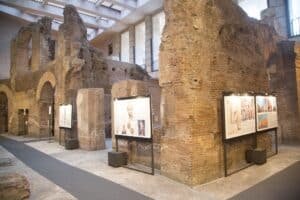
Catacombs of Santa Tecla
In short. The Catacombs of Santa Tecla are at via Silvio D'Amico 42, in Rome, Ostiense neighborhood, and the entrance opens on the ground floor of a modern apartment building a little over half a kilometer from the Basilica of San Paolo fuori le Mura.
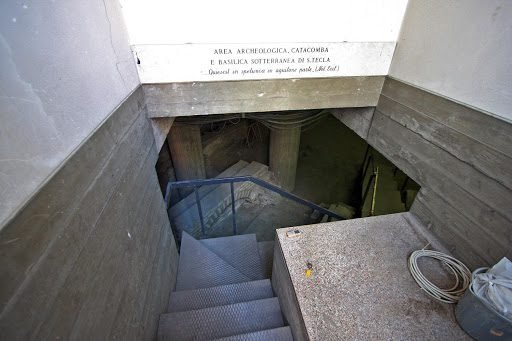
The Catacombs of Santa Tecla are at via Silvio D'Amico 42, in Rome, Ostiense neighborhood, and the entrance opens on the ground floor of a modern apartment building a little over half a kilometer from the Basilica of San Paolo fuori le Mura. They are not open to the public: they have no ticket office, no hours, no visiting slot to show up for. You get in only with a special visit authorized by the Pontificia Commissione di Archeologia Sacra, which has custody of the monument. The request is sent by email to protocollo@arcsacra.va and must contain the full personal details of the applicant, or arrive on the institution's letterhead, with the reason for the visit, the desired day and time, the number of participants and any need for a foreign-language guide. The Commission's phone numbers are 06 4465610 and 06 4467601. The group cannot exceed 15 people. The fee indicated for catacombs open on request is 250.00 euros per group, not per person, and includes the fossor who opens and assists during the descent and the archaeologist who explains the monument. The exact amount must be confirmed with the Commission when authorization is granted, because for special visits the regulations provide a quote case by case. You get there by metro B, Basilica San Paolo stop, and then seven minutes on foot south along via Ostiense. Bus 23, which connects piazzale Clodio to largo San Leonardo Murialdo in the Valco San Paolo area, runs along the same route and drops you a couple of steps away. Inside it's 14 degrees all year, the staircase is steep and there are no restrooms for visitors. If you want the overall picture of the city's Christian underground, the main guide is the one on the Catacombs of Rome.

How to get to the Catacombs of Santa Tecla
The geography is deceptive here. On paper the monument is in a semi-central neighborhood, served by the metro, a quarter of an hour from the historic center. On the reality of the sidewalk it's a residential address among postwar buildings, with no sign, no line, none of the signals the tourist associates with an archaeological site. Whoever arrives for the first time walks past the door twice before recognizing it. The reference point is not the street number, it's the basilica. Take San Paolo as your beacon, put it behind you and walk south, and in seven minutes you're in front of the right place.
Where to buy tickets. Santa Tecla has no ticket office: it's one of the catacombs that can be visited only on request through the Pontificia Commissione di Archeologia Sacra, catacombeditalia.va, with opening reserved for groups of up to 15 people and a fixed cost per group. There is no product on sale online for this site: you write to the Commission and wait for the date. Checked on September 28, 2026.
To the Catacombs of Santa Tecla by metro and train
Metro line B stops at Basilica San Paolo, and it's the simplest way: from the center, from Termini, from the Colosseum, from Piramide you get there without changes. From the station exit the basilica is in front of you, and from there you continue along via Ostiense toward EUR. The regional train that runs on the old Roma-Lido line also stops at the same station, the line that goes to Ostia and that archaeologists have used for a century to reach the excavations of Ostia Antica: if you're coming from Ostia or Acilia you can reach the Catacombs of Santa Tecla without ever passing through the center. A practical warning that applies to both: closures for works on the southern section are frequent on weekends, and the replacement bus adds as much as 20 minutes. If you have an appointment with the Commission, and the appointment is at a fixed time because the fossor is waiting for you, allow a wide margin.
By bus and by car
Bus 23 is the reference line of via Ostiense: it connects piazzale Clodio, so the Prati and Foro Italico area, to largo San Leonardo Murialdo, in the Valco San Paolo neighborhood, passing through piazzale Ostiense, the Cestius Pyramid and the whole basilica corridor. It's one of the longest routes on the network and takes about 50 minutes from one terminus to the other, so don't take it from Prati thinking you'll be quick. Take it if you're already in the Testaccio or Ostiense area. By car it's the worst solution. Via Silvio D'Amico is a neighborhood street with residential parking, the blue-line spaces are few and taken, and the stretch of via Ostiense you have to drive is one of the most congested in the city at peak hours. If you really have to drive, arrive before 9:30 or after 15:00, and expect to circle. By scooter or bicycle, on the other hand, you get there very well: the Ostiense bike path runs along the Tiber and takes you almost to the door.
How to get permission to visit the Catacombs of Santa Tecla
This is the part that discourages 90 percent of people, and it's worth explaining well because it's not complicated: it's only slow. Roman catacombs are divided into two administrative categories. Some are open to the public with a ticket office and guided visit slots, and they're the five or six everyone knows, from San Callisto to San Sebastiano, from Priscilla onward. The others, which are the majority, stay closed and are visited on written request, with a reserved escort. Santa Tecla belongs to the second group, and belongs to it for technical reasons: the spaces are narrow, access is wedged into a private building, the freshly restored paintings are fragile and a continuous flow of visitors would ruin them in a few years. The closure is not a whim, it's conservation.
The request to visit the Catacombs of Santa Tecla, point by point
The request must be addressed to the Pontificia Commissione di Archeologia Sacra at protocollo@arcsacra.va. The text needs, without exception: the full personal details of the applicant, or the institution's letterhead if a school, a university, a parish or an association is writing. The reason for the visit, and here you don't need to be a professor, it's enough to state a serious interest. The desired day and time, better with two or three alternatives. The number of participants. Any need for a foreign-language guide. The group cannot exceed 15 people, and the limit is strict because it is imposed by the capacity of the spaces. The advice I give to organizers: write a good month ahead, indicate a weekday morning, and if you get no answer within 10 days call the Commission's numbers. The machine works, but it works at the pace of an office that manages dozens of monuments across five Italian regions.
How much the visit to the Catacombs of Santa Tecla costs and what it includes
The figure indicated for catacombs open on request is 250.00 euros per group. It's not an individual ticket, it's a flat fee: 15 people pay the same amount as four, which means a visit alone is a luxury while a visit with a full group costs less than 17 euros a head, that is, what an ordinary entry to a state museum costs. The price includes two professionals, and both are necessary. The fossor, who is the technical custodian of the monument, with a trade that in Rome has the name it had in the fourth century, opens, lights, checks the paths and closes. The archaeologist accompanies and explains. The Commission's general regulations provide for a case-by-case quote for special visits, so the exact figure must be confirmed when the authorization arrives. One last unintuitive thing: a special visit can also be requested for sectors excluded from the ordinary route of catacombs that are normally open, and this is the route scholars use to see spaces no tourist will ever see.
Extraordinary openings and the Giornata delle Catacombe
There is a second route, cheaper and much less certain: extraordinary openings. Every year the Pontificia Commissione promotes the Giornata delle Catacombe, which in the autumn edition of October 12, 2024 had as its theme the passage from remembrance to prayer and opened to the public precisely the monuments normally closed, Santa Tecla included, together with San Lorenzo, Pretestato, Museo della Torretta in the Callixtus complex, the Fornai region at Domitilla and Generosa. The dates of later editions are published on the website dedicated to the Giornata delle Catacombe a few weeks in advance, and places sell out in a few hours. FAI delegations have also brought their members here: on September 28, 2018 the Rome delegation organized a special visit reserved for members with a contribution of 30 euros. If you don't have a group of 15 people to put together, keeping an eye on these occasions is the right strategy. It costs patience, not money.
A curiosity about the Catacombs of Santa Tecla
In June 2009, in a cubiculum two meters by two buried under an apartment building in Ostiense, a laser brought back to light the face of a bald man with a pointed beard and the look of someone thinking. It's Saint Paul, and it's considered the oldest portrait of him known. The news came out in the Osservatore Romano and went around the world in 24 hours, because it touched a raw nerve: the Christianity of the first centuries is a religion of texts, and the faces of its founders we have inherited from centuries of later painting. Here instead was a face painted when the memory of the apostle was still a matter of direct transmission, barely three and a half centuries after the events, and what's more a few hundred meters from the place where tradition puts his burial.
The real curiosity, though, is another, and it's technical. That face was not discovered by digging. It was there, on the wall, under a thick, opaque crust of calcium carbonate that seepage water had deposited over 16 centuries. Anyone who had entered that cubiculum in the last 300 years had it before their eyes without seeing it. In 1720 Marcantonio Boldetti published the plan of the cemetery. In the 19th century Mariano Armellini studied it and dismissed its paintings as the ugliest of underground Rome. None of them could know that the dirty white was not degraded plaster: it was a blanket. The laser, calibrated to selectively attack the calcareous white and stop in front of the pigments, simply removed the blanket.
Our opinion is that this is the most underrated Roman archaeological discovery of the current century. It produced no new monument, opened no visitable site, generated no tourist flow: it produced four faces 50 centimeters in diameter in a room nobody sees. Yet it changed the chronology of Christian iconography. It's worth more than 10 exhibitions.
Something nobody tells you about the Catacombs of Santa Tecla
Above the cubiculum of the apostles there are eight floors of inhabited apartments. People hanging out laundry, arguing in the elevator, taking the dog down. The building is from the 1950s and was built when Ostiense was expanding south at a frantic pace, and the cemetery complex ended up literally under the foundations. Access to the monument is wedged into private property: you enter through a space that belongs to the logic of the building, not to that of the archaeological site. This detail explains almost everything else, and no tourist guide puts it on the first page. It explains why there can't be a ticket office. It explains why there are no restrooms. It explains why the maximum number of visitors is 15 and not 50. It explains why visits are arranged one by one with an office, instead of being bought with a click.
The second thing nobody tells you concerns the historical judgment on this place. For 150 years Santa Tecla was considered a second-rank catacomb, interesting for specialists and negligible for everyone else, and the reason is that line of Armellini's about the ugliest paintings of the Roman underground. In 1961 an emergency excavation brought the whole complex to light and Umberto Maria Fasola devoted two fundamental studies to it in the Rivista di Archeologia Cristiana, in 1964 and 1970, but the aesthetic prejudice held. It took two restoration campaigns and a new technology to understand that the problem was not the painters: it was the limestone. Fabrizio Bisconti, who directed the archaeological superintendency of the catacombs when the icons came back to light, commented that the author of those paintings was not a refined artist, indeed was extremely slapdash. He's right. And this, for the historian, is a merit: slapdash painting is working painting, it repeats what the community took for granted. A masterpiece would be the vision of a genius. Here we have the face that the Christians of Rome took as given.
Third thing, in all honesty: don't expect the emotion of a dramatic twist. The images are small, the room is cramped, the light is artificial and the time spent in that room is limited for conservation reasons. Whoever arrives here looking for the spectacle of the Colosseum leaves disappointed. Whoever arrives knowing what they're looking at leaves different.
My advice for visiting the Catacombs of Santa Tecla
First piece of advice, and it's the one that counts: don't come here first. The Catacombs of Santa Tecla are a monument for advanced readers. If you've never set foot in a Roman catacomb, the first time go to San Callisto or Priscilla, where the route is organized, the guide explains from scratch and the distances make you understand physically what an underground necropolis of 20 kilometers of galleries is. Then come back here. You'll see things they didn't tell you at San Callisto, and you'll understand them in 10 seconds instead of 10 minutes.
Second piece of advice: organize the group before writing to the Commission. The 250.00 euro flat fee rewards those who arrive as 15 and punishes those who arrive as three. Putting together 15 people interested in a closed catacomb takes time, so the right schedule is this: first find the participants, then propose three alternative dates to the Commission, then confirm. The other way around you end up giving up.
Third: dress for a cellar, not for a church. Inside it's a constant 14 degrees and high humidity even in August, when outside it's 38. The temperature difference of 20 degrees in 30 seconds of descent is felt in your bones, and the sweatshirt is not a whim. Closed shoes with a non-smooth sole: the floor is packed earth and in some places it's slippery. No bulky bags, because the passages are narrow and it's hard to turn around.
Fourth, and it concerns the head more than the body: read something before going down. 10 minutes on the structure of the complex is enough, the three ambulacra, the underground basilica, the cubiculum with the icons. The visit lasts less than an hour and there's no time to reconstruct everything from scratch on the spot. If you arrive prepared, the archaeologist who accompanies you notices in the first five minutes and the explanation changes level. It's the simplest and most effective trick I know for turning a visit into an experience.
Fifth and last: ask to stop in silence for two minutes in the chamber with the intensive burials. Not in the cubiculum of the icons, which is the famous room. In the other one, where the dead are packed from floor to ceiling over five meters of height. The cubiculum of the apostles tells the faith of a rich family. That chamber tells the death of everyone else. Leaving without having looked at it is a mistake.
The cubiculum of the apostles in the Catacombs of Santa Tecla, painting by painting
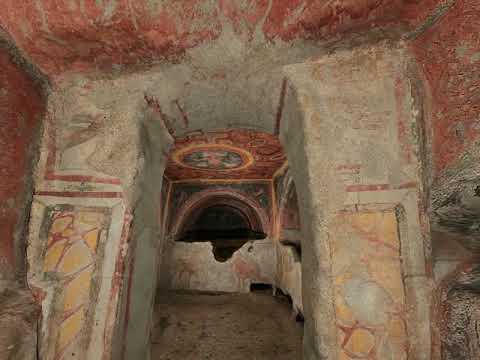
The cubiculum that made the Catacombs of Santa Tecla famous is a square room about two meters on a side, dug into the tufa and plastered, with a painted vault and walls marked by arcosolia. It was commissioned, according to the interpretation of the scholars who restored it, by a woman of the late imperial Roman aristocracy converted to Christianity, who had herself represented in the lunette of an arcosolium in an orant pose together with her daughter, with a scroll in her hand, a sign of culture and wisdom. She is buried in there. The dating swings between the mid and the late fourth century depending on the scholar, and this margin of about 50 years is normal in catacomb archaeology: you date the painting style, the types of burial and the materials, not a document. The four icons are each about 50 centimeters in diameter and are arranged in clipei, that is, circular medallions, on the vault.
The face of Saint Paul
It's the highlight of the whole complex and the image that gave the Catacombs of Santa Tecla worldwide fame. Paul is bald on his high forehead, has a dark, pointed beard, a narrow nose, large fixed eyes. It's the face that Christian iconography will repeat for 1,600 years, from apse mosaics to Baroque canvases, and seeing it here, in its first known formulation, produces a strange effect: it seems like a quotation, and instead it's the original. The topographical context adds weight. Via Ostiense is the road along which tradition places the apostle's martyrdom, and his venerated tomb is in the basilica you see when you come out of the metro. That the oldest portrait of Paul came out in a catacomb on this road is not a geographical detail: it is the sign that the Christian community of the area cultivated a precise, local Pauline memory.
Peter, Andrew and John
The following year, in June 2010, the restoration completed the picture. On the vault of the same cubiculum three other figures emerged: Peter, recognizable by his white, short beard and hair, Andrew, and John, the youngest of the four, beardless. For Peter and Paul these were the first isolated and properly iconic images, that is, autonomous portraits and not figures inside a narrative scene. For Andrew and John they were the oldest images known at all. This is where the cubiculum becomes a first-rate document for art history: it shows that in the second half of the fourth century the apostolic college was no longer an anonymous crowd of 12 men in tunics, but a group of individuals with recognizable and stable physiognomic features. The face becomes an attribute, as the keys or the sword would later.
The vault with the Good Shepherd and the lunette with the apostolic college
The four medallions don't float in a void: they surround a central scene with the Good Shepherd and his flock, the most frequent theme of Roman catacomb painting, which here works as the pivot of the composition. In the entrance lunette, instead, Christ appears among the apostolic college. The rest of the complex's repertoire is the classic one of the Christian underground of Rome: the three Hebrew youths in the furnace, the resurrection of Lazarus, Jonah swallowed and spat out by the sea monster, the sacrifice of Abraham and Isaac. They are all images of last-minute salvation, chosen deliberately by those who had to bury their dead, and their repetition from one catacomb to another shows that a shared figurative canon existed, almost a handbook. Whoever has already seen the catacomb of via Dino Compagni finds the same subjects treated with superior painterly quality: the comparison between the two monuments is one of the most instructive exercises you can do in Rome.
The patron and her daughter
This detail deserves attention, because it's usually dismissed in one line and yet says a great deal. The woman who paid for the cubiculum had herself portrayed with a scroll in her hand. In the fourth century the scroll, the volumen, is the attribute of learning and status, and on a woman it counts double. It's not an image of humble devotion: it's the portrait of a cultured patron who wants to be remembered as such, in a space she had paid for out of her own pocket and in which she had the four apostles dear to her painted. Around 350, the Roman aristocracy was converting en masse and bringing its own habits of representation into the new religion. This cubiculum is a photograph of that social passage, taken underground.
The laser restoration: how to remove a crust without removing the color
The technical part deserves respect, because without it there would be no discovery to talk about. The problem was this: over the paintings there was a layer of calcium carbonate deposited by percolating water, white, hard and optically covering. Traditional mechanical and chemical methods, with that layer, also take away the pigment underneath, and on a fourth-century fresco a mistake can't be corrected. The solution adopted by the Pontificia Commissione's site was a specially modified laser, used for the first time on catacomb paintings: calibrated for chromatic selection, it struck and vaporized only the white of the calcification and stopped in front of the colors underneath. Barbara Mazzei, who directed the restorations for the Commission, described the system's operation in just this way. The work lasted about two years. The volume that collects the results, edited by Mazzei herself and titled after the cubiculum of the apostles in the Roman catacombs of Santa Tecla, came out in the Vatican in 2010 and is still the scientific reference for anyone who wants to study this space seriously.

What you see going down into the Catacombs of Santa Tecla
The complex is not as large as the giants of the Appia, and that's an advantage: you can read all of it in an hour and the mind doesn't get lost. The sequence of spaces tells a precise urban story, from the productive area to the pagan necropolis, from the pagan necropolis to the Christian cemetery, from the Christian cemetery to the sanctuary. Whoever goes down knowing this sequence sees one thing. Whoever goes down without knowing it sees corridors.
Before the Catacombs of Santa Tecla: the quarry, the dyeworks, the open-air necropolis
The land on which the Catacombs of Santa Tecla stand was, between the first and the third century, a piece of productive periphery of imperial Rome, what we would today call a craft zone. Pozzolana was extracted there, the material that makes Roman concrete what it is, and a dyeworks operated there. When the activity ran out, the area changed use according to a logic that repeats everywhere in Rome: where you stop producing, you start burying. An open-air, subdial necropolis was born in this way, with its family mausoleums, which stayed in use while below, in the same years, the Christian cemetery was being dug. Pagans above and Christians below, at the same time, with no apparent conflict. It's one of the most useful corrections archaeology has made to the popular story of the catacombs, and you touch it with your hand right here.
The underground basilica of the Catacombs of Santa Tecla
The monumental core is a small underground basilica, built in the early fourth century, that is, at the moment when Christianity emerged from legal clandestinity and began to build. It's not a church in the sense we give the word today: it's a dug-out sanctuary, divided into three spaces separated by double arcades, designed to receive the faithful around the venerated tomb. At the western end opens the monumental arcosolium attributed to the martyr, with its own skylight that brought natural light from above onto the burial. Toward the middle of the century the complex was enlarged with a retrosanctos, the space behind the venerated sepulcher where anyone who could afford it had themselves buried as close as possible to the saint. The logic of the retrosanctos is the same that in Rome would produce a thousand years of prestige burials inside basilicas: physical closeness to the martyr as a guarantee for the day of judgment.
The three ambulacra and the 22 burial chambers
Around the basilica, and later than it, three wide corridors develop arranged in an isosceles triangle. It's not a labyrinth: it's a regular, almost geometric layout, revealing planning at the drawing table and not growth by accumulation. 22 burial chambers open onto these ambulacra. The visit doesn't go through all of them, for reasons of safety and conservation, but the layout can be read clearly. Compared with the endless galleries of San Callisto or Domitilla, where the visitor loses orientation after five minutes, here the human scale of the complex lets you understand how a community cemetery really worked: how much space was needed, how burials were distributed, where people passed during the celebrations.
The skylights made from pagan mausoleums
Here's the detail I like best, and it usually goes unnoticed. The skylights, that is, the vertical shafts that brought air and light from the surface into the galleries, were in some cases made by breaking through the floor of pagan mausoleums that stood on the surface. The funerary monument of a non-Christian Roman family, abandoned, was punctured to light the tombs of the Christians below. There's no polemical intent: there's a work site using what it finds. But the result is a powerful image of third- and fourth-century Rome, a city rewriting itself on top of itself without demolishing, reusing its own structures as building material. The same logic that fills the Aurelian Walls with absorbed tombs and turns a temple into a church.
The intensive burials of the Catacombs of Santa Tecla: 12 chambers filled to the ceiling
This is the phenomenon that makes the Catacombs of Santa Tecla an almost unique case study in the Roman panorama. In 12 of the 22 chambers the fossores adopted a procedure not found elsewhere with this systematic quality. First they dug the normal loculi in the side walls, as in any catacomb. Then they lowered the floor of the chamber by about three meters below the level of the gallery, obtaining a pit. Finally they began to fill that pit with alla cappuccina burials, that is, with the body protected by tiles arranged in a double pitch, stacking the layers and separating them with lime, until reaching the ceiling. The result is a column of dead about five meters high overall, with a density of burials that has few parallels.
Why they did it here and not elsewhere is not established with certainty. The explanations proposed range from the demographic pressure of a rapidly growing community to the cost of land, from the nature of the tufa bank to the presence of specialized labor and abundant brick material. None of these hypotheses has so far prevailed over the others. What interests me is the effect it has: in front of a wall of cappuccine stacked over five meters you understand, without needing statistics, what mortality was in an ancient city.
The brick stamps and the Baths of Caracalla site
A detail for archaeologists, but worth telling because it opens a window on the Roman economy. The brick material used in the alla cappuccina burials is abundant and of good quality, and the stamps place it in the Severan age, between the end of the second and the beginning of the third century, that is, between Septimius Severus and Caracalla. A material like that, in that quantity, doesn't arrive by chance in a suburban cemetery 50 years later: the scholars' hypothesis is that it came from a deposit left unused, perhaps linked to the great site of the Baths of Caracalla. If the hypothesis holds, those bricks tell two stories in one: imperial luxury that doesn't use up everything it orders, and Christian fossores who a few decades later use the leftovers to protect the bodies of the poor. Rome is this, from day one.
Another well-known fact, yet rarely mentioned
The catacombs were not hiding places. Every archaeologist knows it, every manual writes it, and despite this a great many visitors go underground convinced that persecuted Christians took refuge in the galleries to escape soldiers and celebrate Mass in secret. It's a 19th-century legend, fed by devotional literature and a couple of hugely successful novels, and it collapses as soon as you look it in the face.
First argument, the simplest: a catacomb is not secret. The entrance is on a consular road, well visible, often monumentalized. The cemeteries were registered, Roman law protected burials as loca religiosa and the Christian community was their owner or usufructuary in a recognized way. A Roman magistrate who had wanted to arrest Christians knew perfectly well where to look. Second argument, technical: you can't live underground. There's no air for hundreds of people, no water, no way to cook, and with oil lamps the oxygen runs out fast. Third argument, chronological, and it's the decisive one: most of the galleries visited today, those of the Catacombs of Santa Tecla included, were dug in the fourth century, that is, after 313, when the persecutions were over and Christianity was a lawful religion. They dug more precisely because there was nothing left to fear.
What were they for, then? For burying, and doing it all together. The Christian community rejected cremation, which was the dominant Roman practice, and needed space for the burial of thousands of bodies on expensive land. Digging vertically into the tufa was the economical solution. In addition, burial near a martyr had enormous spiritual value, and the underground sanctuary of Santa Tecla with its retrosanctos shows it physically. I add a lexical note that always throws people: the word catacomb is not an ancient technical term. It was born as a place name, ad catacumbas, and indicated a single precise place on the Appia, the depression near the present San Sebastiano. Only in the Middle Ages did the name of that place become the generic name of all the underground cemeteries of Rome. Calling this Ostiense complex a catacomb is, literally, an abuse of language a thousand years old.
Who Tecla was, and why the answer is not simple
The name of the monument poses a problem that archaeology has not solved and that is worth telling in full, because it is a good example of how you work with sources when the sources are missing.
The first hypothesis: Thecla of Iconium, the disciple of Paul
Paul Styger and other scholars proposed identifying the holder of the cemetery with Thecla of Iconium, the figure who appears in the Acta Pauli et Theclae, an apocryphal text widely circulated in ancient Christianity. According to that story Thecla, a young woman of Iconium, in Asia Minor, hears Paul's preaching, breaks off her engagement, follows the apostle, is condemned to torture several times and each time survives through miraculous intervention, and ends her days at Seleucia. Her cult in the East was enormous, and Tertullian, in De baptismo, recalls that the text was the work of a presbyter of Asia who had composed it out of love for Paul and who for that reason was removed from his office: an ancient and precious testimony, which serves to date the success of the story but not to prove the historical existence of its protagonist. The hypothesis has an obvious advantage in this context: we are on via Ostiense, Paul's road, and a martyr tied to his name would fit very well. It also has a weakness: the link remains literary, not documentary.
The second hypothesis: a Roman martyr of the time of Diocletian
Umberto Maria Fasola, who excavated and studied the complex after 1961, argued instead that it was a Roman woman, martyred in the city during the persecutions of Diocletian, in the early fourth century, and buried here. The only monumental support for a Roman Thecla is an inscription from the nearby cemetery of Commodilla, which records the dies natalis of a Thecla, that is, the day of her death understood as birth into heaven. It's little, and whoever works with sources knows it: a widespread female name and a date can belong to anyone. But the presence of an underground sanctuary with a monumental arcosolium and retrosanctos shows that someone specific was venerated here in the fourth century, and that the cult was strong enough to justify a building investment.
The traditional name of the monument came down through Mariano Armellini in the 19th century and is to be kept by convention, not by certainty. Distinguishing between what is documented, what is tradition and what is modern hypothesis does not take away from the charm of the place: it adds to it, because it shows how the memory of a city is built.
The right photo to take at the Catacombs of Santa Tecla
Let's start from the constraint, which here is severe. The possibility of photographing inside must be agreed in advance with the Pontificia Commissione di Archeologia Sacra at the time of the visit request, and it's not a given permission: the freshly restored paintings are the most delicate object in the complex. Flash is to be excluded in any case, both out of respect for conservation and because it flattens any painted surface. Whoever gets authorization should work with high ISO, a fast lens and a steady hand, or with a compact tripod if the spaces allow, and be content with the light of the lighting system.
The best photograph, though, is not the one everybody looks for. The first instinct is to point the camera at Paul's face, and the result is almost always disappointing: the medallion is small, it's up high, a frontal shot is almost impossible and the official reproduction of the restoration will be better than yours anyway. The photo that's really worth taking is another: a chamber with stacked alla cappuccina burials, shot from below looking up, so that the lens takes in all five meters of layers. There's no famous subject in that shot, and that's exactly why it works: whoever looks at it sees a wall of bodies and understands in a second what 10 lines of text don't explain. If the light allows, keep an element of human scale in the frame, a shoulder, a hand, a flashlight. Without a reference of scale that wall looks like any wall.
The third shot is outside, and requires no permission: the building. A residential apartment block of the 1950s, with windows, balconies, air conditioners and scooters parked in front, and under those foundations the oldest portrait of Saint Paul. It's the photograph that sums up Rome better than any postcard of the Colosseum, and in a caption it explains itself. Take it from the opposite sidewalk, with a moderate wide-angle, in late afternoon, when the raking light carves the facade. Then take a couple of steps toward the basilica and photograph the bell tower of San Paolo fuori le Mura from the same street: the two images together tell the whole story of the neighborhood, the sanctuary on the surface and the cemetery underground.

Some important events that took place here in history
The chronicle of this place is made of very long silences interrupted by a few decisive days. It's worth putting them in order, because each one changed what we know.
Third century, the conversion of the area. The zone stops being a piece of productive periphery, with its pozzolana quarry and its dyeworks, and becomes burial ground. Above, an open-air necropolis is born. Below, the digging of the Christian cemetery begins. It's the moment when the landscape of via Ostiense changes trade.
Early fourth century, the underground basilica. Shortly after the end of the persecutions the community builds underground a three-room sanctuary with the monumental arcosolium of the martyr. It's no longer a cemetery: it's a place of worship. Toward the middle of the century the retrosanctos is added, and privileged burials crowd around the venerated tomb.
Second half of the fourth century, the cubiculum of the apostles. A converted Roman matron has the room dug and decorated that 16 centuries later will make the complex famous, and has herself portrayed with her daughter on the wall.
1703, the first documented entry. Giovanni Marangoni enters the cemetery, which had remained unknown for centuries. It's the beginning of the monument's modern life.
1720, Boldetti's plan. Marcantonio Boldetti publishes the survey of the complex, calling it the cemetery at the ponticello of Saint Paul, with a name that describes the topography and not the titleholder. For a century and a half the place will be called that.
Second half of the 19th century, Armellini's identification. Mariano Armellini studies the cemetery and identifies it as the burial ground of the martyr Thecla, giving it the name it still bears today. It's the same Armellini who dismisses its paintings as the ugliest of underground Rome, a judgment that will weigh for 150 years.
1961, the building site and the excavation. During construction work on the surface, the engineer Pietro Monaco reports the discovery of ancient structures. The report triggers the archaeological investigation, and under the building under construction the whole cemetery complex re-emerges with the funerary area on the surface. Without that report, today we would have nothing.
1964 and 1970, Fasola's studies. Umberto Maria Fasola publishes in the Rivista di Archeologia Cristiana the two fundamental works on the complex and on the underground basilica, which remain the basis of all later research. In 1985 Valnea Santa Maria Scrinari returns to the cemetery complex in the Rendiconti of the Pontificia Accademia.
June 2009, the face of Paul. During the laser restoration the portrait of the apostle re-emerges from the calcareous crust. The Osservatore Romano reports the news and the case becomes international.
2010, the other three apostles and the book. The completion of the restoration brings back Peter, Andrew and John, and the discovery is presented publicly during the year by Fabrizio Bisconti. The volume edited by Barbara Mazzei devoted to the cubiculum of the apostles comes out in the Vatican, collecting the data of the site.
2018, the FAI opening. On September 28 the Rome delegation of FAI brings its members into the complex with a special visit for a contribution, one of the rare occasions of non-institutional access.
October 12, 2024, the Giornata delle Catacombe. In the autumn edition devoted to the passage from remembrance to prayer, in preparation for the Jubilee, Santa Tecla is among the normally closed monuments opened to the public for a day.
Who has passed through the Catacombs of Santa Tecla
Don't expect emperors and popes on state visits: this is a monument of scholars, and the names that count are those of the people who searched for it, dug it, read it and restored it. The first, chronologically, is Antonio Bosio, the Fleming from Malta who between the end of the 16th century and the beginning of the 17th explored dozens of Roman underground cemeteries by candlelight and founded with his Roma sotterranea the discipline we now call Christian archaeology: he is probably credited with the first recognition of the site. In 1703 Giovanni Marangoni, scholar and antiquarian, enters it and leaves a record of it. In 1720 Marcantonio Boldetti, custodian of the sacred relics and cemeteries, publishes its plan with the name cemetery at the ponticello of Saint Paul. Boldetti is a debated figure, because his method of removing relics irreparably damaged many contexts, but without his plans we would have lost the memory of entire monuments.
In the 19th century comes Mariano Armellini, the great topographer of the churches of Rome, who gives the cemetery the name of Thecla and its paintings the most famous panning in their history. In 1961 the protagonist is a technician, not an archaeologist: the engineer Pietro Monaco, who in front of the ancient structures that surfaced at the apartment building site did the right thing and gave notice. Anyone involved in protection knows how rare that is.
Then the real scientific season begins. Umberto Maria Fasola, a Barnabite, one of the greatest catacomb scholars of the 20th century, leads the excavation and signs in 1964 and 1970 the studies that reconstruct the complex and the underground basilica. To him is also due the hypothesis of Thecla as a Roman martyr of the Diocletian age. Valnea Santa Maria Scrinari, a long-standing archaeologist, returns to the cemetery complex in the mid-1980s. In recent times the two names to remember are Fabrizio Bisconti, archaeological superintendent of the catacombs and university professor, who presented the icons of the apostles to the world and gave their critical reading, and Barbara Mazzei, director of restorations for the Pontificia Commissione, who led the laser site and edited the scientific volume on the cubiculum.
What remains is the oldest and most uncertain passage of all, which is tradition and not document: via Ostiense is the road along which Christian memory places the last stretch of the walk of Paul of Tarsus toward the place of martyrdom, and the basilica that holds his venerated tomb is a few hundred meters from here. That his oldest portrait re-emerged in this very cemetery, after 16 centuries of limestone, is one of those coincidences that in Rome no longer surprise anyone.
What to see around the Catacombs of Santa Tecla
You leave through the door and find yourself in a neighborhood that has nothing touristy and a great deal to tell. I usually organize the day like this, and it works.
The first stop is 500 meters away: the Basilica of San Paolo fuori le Mura, the second largest in Rome after St. Peter's, rebuilt after the fire of 1823 and for that reason often snubbed by those looking only for the ancient. They're wrong: the Cosmatesque cloister escaped the fire and is one of the most beautiful places in the city, and the series of portraits of the popes running along the nave remains a grand idea. It's here that the tomb of the apostle is venerated, and after seeing his face painted in the fourth century the visit takes on a different weight.
Going back up north along via Ostiense you meet the Museo della Via Ostiense, housed inside Porta San Paolo, which explains the ancient topography of the road, of Ostia and of the port. Check whether it's open before going, because the museum has gone through long periods of closure. Next to it are the Pyramid of Gaius Cestius, the most eccentric funerary monument of Augustan Rome, and the stretch of the Aurelian Walls that is joined to it. A little farther on the Centrale Montemartini holds the most intelligent museum juxtaposition in the city, ancient statues among the diesel turbines of a 1912 power plant.
If you still have breath, on the other side is the Garbatella neighborhood with its 1920s public housing, and under Garbatella run the Catacombs of Commodilla, the cemetery from which comes the inscription that brings a Roman Thecla into play and that holds one of the oldest written attestations of the Roman vernacular. To the south, a couple of metro stops away, are EUR and, among the eucalyptus trees, the Abbey of Tre Fontane, the place where tradition puts the beheading of Paul. If you want to close the Pauline circle in a single day, that is the last link.
The Catacombs of Santa Tecla with children and with people with mobility problems
Here I have to be blunt, because honesty on this point avoids unpleasant surprises. The complex is not accessible to people with mobility difficulties and it is not wheelchair accessible: you go down a steep staircase, the passages are narrow, the floor is uneven and there are no alternative routes. It's not a matter of the staff's goodwill, it's the physical shape of a cemetery dug into the tufa 17 centuries ago. People with walking problems, people with vertigo or people who suffer from serious claustrophobia would do well to give up from the start and choose a different monument: San Callisto and San Sebastiano have easier routes and wider spaces, while still being underground.
With children the discussion is different and depends on age. Under 10 I advise against it, and not because of the theme of death, which children handle better than adults, but for practical reasons: the cramped spaces, the partial darkness, the length of the explanation and the fact that here there is nothing to touch or to do. From age 10 up, if the kid has already seen something archaeological and arrives prepared, the visit works very well, and the alla cappuccina burials impress far more than any documentary. Bring a lightweight headlamp, which gives the kid a role, and make sure he or she asks the archaeologist the first question. It changes the whole following hour.
Two final warnings that apply to everyone. There are no restrooms for visitors inside, so take care of that beforehand, in the basilica or in a bar on via Ostiense. And the constant temperature of 14 degrees with high humidity, which in winter is almost comfortable, in August is a thermal shock: whoever arrives sweaty and in a tank top leaves with a stiff neck.
When to go and how long the visit to the Catacombs of Santa Tecla lasts
The actual length of the visit is a little under an hour. It's not negotiable and depends on the size of the complex and the conservation rules: the painted spaces don't tolerate long stays by large groups, because the heat and humidity of bodies alter the microclimate that has protected those surfaces for 16 centuries. Whoever asks to stay longer is asking for something that can't be given.
The best time of year, if you can choose, is autumn or spring, for the simple reason that the temperature difference with the outside is minimal and the body doesn't suffer it. The worst time is the Roman August, when you go from 38 degrees to 14 in half a minute. As for time of day, ask for the morning: the Commission works better in the morning, the fossores too, and the neighborhood's logistics are simpler. Add to the count the time it takes to get here, which from the center is about half an hour, and consider that a well-built half day in this area is worth more than a rush. A suggested route: visit the Catacombs of Santa Tecla early in the morning, then the basilica of San Paolo at an easy pace, lunch at a place in Ostiense, afternoon at Centrale Montemartini. Leave home at 8:30 and come back at 18:00 with the feeling of having understood a piece of the city.
The Catacombs of Santa Tecla and the other catacombs of Rome
A frequent question is whether it's better to come here rather than go to one of the open catacombs. The short answer is that they're different things and that the right order is the open ones first, then this one. The long answer requires a comparison.
The Catacombs of San Callisto, on the Appia Antica, are the official cemetery of the Church of Rome in the third century and contain the crypt of the popes: they're the institutional monument, the one that best explains the organization of the Christian community. The Catacombs of San Sebastiano, a little farther along the same road, preserve the apostolic memory with the graffiti of pilgrims invoking Peter and Paul, and are the place that gave its name to all the others. The Catacombs of Priscilla, on the Salaria, are the museum of the oldest Christian painting, with the so-called Greek chapel. The Catacombs of Commodilla, in Garbatella, have the oldest known inscription in Roman vernacular. The hypogeum of via Dino Compagni, on the Latina, is the richest and strangest private painted cycle of the Roman underground, with pagan scenes next to biblical scenes. The Generosa complex, on the Portuense, is the small cemetery of the martyrs of the Tiber bend.
In this panorama Santa Tecla occupies a precise and irreplaceable slot: it's the place of the portraits. It doesn't have the monumentality of San Callisto or the painterly richness of Priscilla, but it holds the oldest known faces of the four apostles, and no one else has that. If I had to order the visits for an enthusiast who has a week, I'd say San Callisto, then Priscilla, then San Sebastiano, then via Dino Compagni, and finally Santa Tecla as the close: when you get here you have the tools to understand why four 50-centimeter medallions are worth a trip. To get your bearings in the whole, the complete map of the Christian underground is in the guide to the Catacombs of Rome, and anyone who wants to tie it all to the landscape of the consular roads will find the surface context in the Appian Way Park and the church of Domine Quo Vadis.
Quick questions about the Catacombs of Santa Tecla
Where exactly are the Catacombs of Santa Tecla?
At via Silvio D'Amico 42, Ostiense neighborhood, in Rome, under a modern apartment building, a little over half a kilometer from the basilica of San Paolo fuori le Mura.
Are the Catacombs of Santa Tecla open to the public?
No. They are a normally closed monument, and access is only by special visit authorized by the Pontificia Commissione di Archeologia Sacra. There is no ticket office, opening hours or slots to show up for.
How do you book the visit to the Catacombs of Santa Tecla?
You write to protocollo@arcsacra.va giving the full personal details of the applicant or writing on the institution's letterhead, the reason for the visit, the desired day and time, the number of participants and any need for a foreign-language guide. The Commission's phone numbers are 06 4465610 and 06 4467601.
How much does it cost to visit the Catacombs of Santa Tecla?
The fee indicated for catacombs open on request is 250.00 euros per group, not per person, and includes the fossor and the archaeologist. For special visits the regulations provide a quote, so the final amount must be confirmed with the Commission.
How many people can enter the Catacombs of Santa Tecla together?
The group cannot exceed 15 people. The limit is imposed by the size of the spaces and cannot be waived.
How far ahead do you need to write?
A good month is the right measure. Requests are handled by an office that manages monuments in several Italian regions, and proposing two or three alternative dates greatly raises the chances of getting authorization.
How long does the visit to the Catacombs of Santa Tecla last?
A little under an hour. The length is kept short also for reasons of conserving the restored paintings.
Can you take photographs inside the Catacombs of Santa Tecla?
Only if authorized by the Pontificia Commissione, and the permission must be requested together with the visit. Flash is excluded in any case.
What exactly do you see?
The underground basilica of the early fourth century with the arcosolium of the martyr, the three ambulacra arranged in an isosceles triangle, some of the 22 burial chambers, the chambers with intensive alla cappuccina burials and the cubiculum with the icons of the apostles.
Why are the Catacombs of Santa Tecla famous?
For the cubiculum painted in the second half of the fourth century in which the laser restoration brought back to light the faces of Peter, Paul, Andrew and John, considered the oldest known iconic images of the four apostles. Paul's is held to be his oldest portrait.
When was the face of Saint Paul discovered?
In June 2009, during the laser restoration of the cubiculum vault. The other three apostles re-emerged with the completion of the work in 2010.
What technique was used for the restoration?
A specially modified laser, used for the first time on catacomb paintings, calibrated to selectively attack the white layer of calcium carbonate and stop in front of the pigments underneath. The site lasted about two years.
Who was Saint Thecla?
There's no certainty. Some scholars identify her with Thecla of Iconium, the disciple of Paul in the Acta Pauli et Theclae. Others, with Umberto Maria Fasola, hold that she was a Roman martyr of the time of Diocletian. The only monumental clue is an inscription from the nearby cemetery of Commodilla that records the dies natalis of a Thecla.
Is it cold inside the Catacombs of Santa Tecla?
It's a constant 14 degrees all year, with high humidity. In winter it's tolerable, in summer the difference with the outside reaches 20 degrees: the sweatshirt is necessary even in August.
Are they wheelchair accessible?
No. Steep staircase, narrow passages, uneven floor and no alternative route.
Are they suitable for children?
From age 10 up, and better if they've already seen something archaeological. Under that age the cramped spaces and the length of the explanation make the visit tiring.
Are there restrooms or a bookshop?
No. Not being a monument open to the public, it has no ticket office, coat check, bookshop or services for visitors. It's best to take care of that beforehand, in the basilica or in a bar on via Ostiense.
How do you get to the Catacombs of Santa Tecla by public transport?
Metro B, Basilica San Paolo stop, and then about seven minutes on foot south. The train of the line to Ostia stops at the same station. Bus 23, between piazzale Clodio and largo San Leonardo Murialdo, runs along via Ostiense.
Can you park in the area?
Poorly. Via Silvio D'Amico is a residential street with few free spaces and via Ostiense is congested at peak hours. The metro is better.
Is there a way in without organizing a group?
Yes, but you have to be patient: the extraordinary openings. The Giornata delle Catacombe, promoted by the Pontificia Commissione, opens for a day even the normally closed monuments, and Santa Tecla was among them in the edition of October 12, 2024. Later dates are announced on the website dedicated to the Giornata delle Catacombe with a few weeks' notice.
Did Christians really hide here during the persecutions?
No, it's a 19th-century legend. The catacombs were legal and known cemeteries, protected by Roman law, and you couldn't live underground. Most of the galleries visited today were dug after 313, when the persecutions were over.
What's the difference between the Catacombs of Santa Tecla and those of San Callisto?
San Callisto is the great official cemetery of the Church of Rome, open to the public, with the crypt of the popes and kilometers of galleries. Santa Tecla is a small, closed complex, visited on request, and its distinction concerns the portraits of the apostles. They are complementary, not alternatives.
What are the alla cappuccina burials of the Catacombs of Santa Tecla?
Burials in which the body, laid in the earth, is protected by tiles arranged in a double pitch like a small roof. At Santa Tecla they were piled in layers separated by lime until they filled 12 burial chambers from floor to ceiling, for an overall height of about five meters.
Why had the paintings stayed invisible for centuries?
Because seepage water had deposited over them a white, covering crust of calcium carbonate. In the 19th century Mariano Armellini judged those paintings the ugliest of underground Rome: he was looking at the limestone, not the fresco.
Can the Catacombs of Santa Tecla be visited in the evening?
No. Visits are arranged with the Commission during office hours, and the morning is the time slot in which it's easiest to get a date.
Is it worth visiting the Catacombs of Santa Tecla if I've already seen other catacombs?
Yes, and it's in fact the correct order. Whoever has already seen a great open cemetery understands in a few seconds what makes this place special. Whoever starts here risks leaving without having understood what they saw.
To close, an opinion. Rome has a unique ability to hold the sublime and the ordinary together without making noise: above, an apartment building with scooters parked in front, below, the painted face of a man dead 2,000 years that millions of people still call by name today. Neither of the two is ashamed of the other. If you manage to organize the group and get the date, go down those steps, stay quiet for 30 seconds in front of the wall of cappuccine and then lift your eyes to the four medallions. You'll notice that the faces don't look at you: they look to the center, toward the Good Shepherd. That detail, which no photograph conveys, is the reason a room two meters by two deserves a month of waiting and a well-written letter.
Article written by the editorial team of TourLeaderPro, contact them for Private/Corporate/V.I.P. Tours and Experiences.
Planning a trip to Rome? The English guides for visiting the city are on ItalyPlanner.com.
Contact Information
Nearby
 Street Art in Rome: Neighborhoods and Walls to See700 m
- Street Art in Ostiense700 m
- Ostiense700 m
- Basilica of Saint Paul Outside the Walls800 m
- Cycling in Rome: The Bike Routes That Really Work1.1 km
- LOA Acrobax, social center in Marconi1.1 km
Upcoming events nearby
- Teatro Marconi 2026-2027 Season, September 28 to December 31, 2026600 m
- Hammerklavier, performance in memory of Dante Cappelletti at Spazio Rossellini, Nov 26, 20261.0 km
- Sfinge Dunlop. Animali del futuro in via di estinzione (Animals of the Future in Danger of Extinction), exhibition at Spazio Rossellini, Nov 27 to 29, 20261.0 km
- Corpi in ascolto by Orbita at the Teatro Biblioteca Quarticciolo and Spazio Rossellini, through December 20, 20261.0 km