Ostiense
In short. You go to Ostiense for industrial archaeology, and the main piece is the Centrale Montemartini at Via Ostiense 106, open Tuesday to Sunday from 9:00 to 19:00, closed on Monday, full ticket €11 and reduced €6.50, free for residents of…
You go to Ostiense for industrial archaeology, and the main piece is the Centrale Montemartini at Via Ostiense 106, open Tuesday to Sunday from 9:00 to 19:00, closed on Monday, full ticket €11 and reduced €6.50, free for residents of Rome and the Metropolitan City since February 2026. Data checked on September 28, 2026 on the museum's official website.
The rest of the neighborhood is seen from the street. The Gasometer cannot be visited, the Mercati Generali are a closed construction site, the former Porto Fluviale has gone back to being a public housing building and Blu's mural is gone. This is an area you cross on foot looking up, not a row of museums to tick off in sequence.
The most frequent confusion concerns the boundaries. For Romans, Ostiense begins after Porta San Paolo and ends toward the Basilica of San Paolo, with the Tiber to the west and the hill of Garbatella to the east. Testaccio is something else, it lies on the other side of Piazzale Ostiense, and anyone who mixes them up ends up walking twice as much.
Where Ostiense is and how to get there
The neighborhood runs along Via Ostiense, the consular road that from Porta San Paolo descends toward the river and continues to Ostia. The route is the ancient one, the elevations have changed little, and walking it you follow a Roman axis with 1900s sheds on either side. The interesting stretch goes from the piazzale to the basilica, about two and a half kilometers.
Metro line B has two useful stops: Piramide and Garbatella. Piramide serves the north entrance of the neighborhood, where the Pyramid of Cestius, Porta San Paolo and the Museo della Via Ostiense are. Garbatella is the right stop for the Centrale Montemartini and for the residential hill above the road.
From the Garbatella stop to the museum it is a walk of less than 10 minutes downhill. Anyone arriving from Piramide who wants to do it all on foot should allow 25 minutes of industrial sidewalk, with no shade, with traffic alongside. In the warm months it's best to take one more metro stop and spare yourself the least pleasant part of the route.
The station and the trains
Roma Ostiense is the neighborhood's railway station, connected on foot to the Piramide metro stop through Piazzale dei Partigiani. Regional trains and connections to Fiumicino airport stop there. Those arriving from southern Lazio or from the coast get off conveniently here, because it avoids the Termini hub and its crowds altogether.
Next to the Piramide metro is also the terminus of the railway to Ostia, inside the Porta San Paolo building. It is a 1920s structure, with a waiting room and platform shelters that deserve a look even if you don't take the train. Many pass through in a hurry without looking up.
The Centrale Montemartini: the thing to see first
The Centrale Montemartini is the first public power plant of Rome, converted into an exhibition venue and today the second site of the Capitoline Museums. Inside are ancient statues, portraits, funerary reliefs and mosaics, arranged among boilers, turbines and diesel engines left in place. The address is Via Ostiense 106, the call center is 060608.
The hours checked on September 28, 2026 are these: Tuesday to Sunday from 9:00 to 19:00, last entry one hour before closing. Closed on Monday, May 1 and December 25. On December 24 and 31 you can enter from 9:00 to 14:00. Before leaving it's best to check the notices page, because changes pile up.
The published fares are €11 full and €6.50 reduced, with a €1 presale fee if you buy online or at the call center. Since February 2026 entry is free for those who reside in Rome and the Metropolitan City, showing an ID card at the desk. Holders of the MIC card go in without paying.
There is also the Capitolini Card, valid seven days for the Capitoline Museums and the Centrale Montemartini, at €15.50 full and €11.50 reduced. It makes sense only if you really plan the double visit, otherwise the single ticket costs less. Temporary exhibitions are paid separately, with a supplement that can be bought online or directly at the ticket office.
In the period between June 26 and November 15, 2026 the exhibition Moda in luce 1955-1975 is on at the venue, with an integrated fare compared to the ordinary ticket. Those who arrive without knowing find two prices at the desk and waste time deciding. Better to arrive with the idea already clear.
What you see inside, in concrete terms
The machine room with the two diesel engines is the room that stays in your head. The sculptures are placed in front of masses of painted metal as tall as a house, and the contrast works because nobody tried to hide it. The route is linear, you follow it without a map, and in an hour and a half you see everything at ease.
The boiler room hosts the materials from the excavations of the Horti romani and a series of portraits. Those who have already done the archaeological museums of the center find here pieces of the same Capitoline collection, placed however in a completely different light. The captions are dry, in Italian and English, without digital reconstructions.
The real flaw is the line at the desk on rainy weekends, when the area fills with groups. Buying in advance online solves it, but it is not refundable or changeable, so it suits only those with a certain date. On weekday mornings the museum is almost empty and you wander as you like.
The Gasometer: you look, you don't visit
The Gasometer is not open to the public and no visiting hours are published. The lattice structure you see from half the neighborhood is part of a private industrial area, fenced, with controlled access. Anyone looking for a ticket looks in vain. There is no monument open to the public here, but a disused industrial plant inside a fenced property.
This needs saying first, because every year people arrive convinced they can climb it. You don't climb it. The only occasions when the public enters that area are events organized by the owner, announced case by case and without any regularity. Outside those dates, the perimeter is closed and so are the gates.
From the outside, though, it can be seen very well, and from several points. The best view comes from Via del Commercio and from the Lungotevere, with the metal carcass rising above the low sheds. Up close the structure loses force, because the fences and signs cut the view and there is no way to step back far enough.
The Gasometer works much better from a distance. The right place to look at it is the bridge, not the sidewalk below. Anyone who walks around it hoping for a close-up shot wastes half an hour and comes back disappointed.
Why it's there
The plant was born to store city gas when the neighborhood became Rome's zone of heavy services: workshops, warehouses, power plant, slaughterhouse a little further on. The whole sector between the river and the consular road was conceived as the operational back of the city, far from the palaces and close to the freight yard.
The logic was simple: goods arriving from the Tiber and the railway, processing on site, distribution toward the center. That is why a power plant, a river port, a freight yard and the wholesale markets are found together here. None of these plants was meant to be looked at, and that is why today they work as an image.
A curiosity about Ostiense
The name of the neighborhood comes from the road, not the other way around. Via Ostiense is a Republican consular road built to connect Rome to the port at the mouth of the Tiber, and the gate in the Aurelian Walls that lets it out is called precisely Porta San Paolo, but in antiquity it was the Porta Ostiensis. The modern place name follows the road's.
The curious thing is that the route has never changed direction in 2,000 years. The levels have risen, the road beds have been redone, but the axis has remained the same. Walking toward the basilica you follow exactly the line that the carts took with the grain unloaded at Ostia.
A second detail concerns the basalt paving stones. In some stretches, under the asphalt, the ancient paving still exists, and in a couple of places it has been brought to light and made visible. The Museo della Via Ostiense, inside Porta San Paolo, gathers the materials and the models that explain the route.
The Mercati Generali and the construction site that never ends
The Mercati Generali of Via Ostiense are the big 1920s complex where for decades the fruit and vegetables of half of Rome passed. Activity moved elsewhere many years ago, the area was designated for commercial and cultural redevelopment, and since then it has been a construction site closed to the public.
Today it cannot be visited and no opening date is published. You see fences, idle cranes, the facades of the pavilions above the sheet metal. Anyone who arrives with the idea of finding an open market is left empty-handed, and this is one of the reasons it's best to get informed first and not trust old guides.
The original complex is nonetheless readable from the outside along the street: the buildings in line, the end walls with their large openings, the repeated rhythm of the bays. It is service architecture of the 1920s, designed for loading and unloading, and its strength lies precisely in the repetition.
An unpopular position: this stalled construction site tells more about the city than many open attractions. A Rome that accumulates big containers and cannot manage to fill them is a real fact, not an accident. In front of the fence the explanation becomes clear.
What to look at while passing by
On the opposite side of the street workshops, depots and old converted sheds line up. Some have become spaces for university teaching, others remain warehouses. Looking at the hand-painted signs left on the walls you reconstruct the trade that was done inside, which often disappeared 30 years ago.
The facades of the Mercati have reliefs and lettering in typefaces of the time. They must be looked for high up, because below the view is cut by parked cars. Those who walk with a phone in hand don't see them, and indeed in the photos circulating online this piece of the neighborhood is almost absent.
The former Porto Fluviale and the Blu mural that is no more
For 10 years the most photographed street art work in the neighborhood was Blu's mural on the former military warehouse at the corner of Via del Porto Fluviale and Via delle Conce, with the windows turned into the eyes of gigantic faces. In the summer of 2025, during the building's redevelopment works, the two main facades were repainted with the artist's consent, after documentation requested by the Soprintendenza.
The building, occupied for housing from 2003 to 2024, was transformed by Roma Capitale with PNRR funds into 54 public housing units, handed over to families in September 2026. Today it is a building where people live with a lease: you look from the street, you photograph from the street, you don't go in and you don't ring the doorbells. The whole story, with dates and figures, is in the entry on the Ex Porto Fluviale.
On any portions of the mural left on the blind walls the sources do not agree, and anyone going on purpose must allow for not finding the work anymore. The photographs circulating online and on collaborative maps almost all predate the summer of 2025. It is a good example of how street art lives and dies together with the buildings it is painted on.
In plain terms: I don't take it for granted that a painted wall stays there forever, nor that it is intact tomorrow. Anyone going to see a specific work should make a recent check before leaving. It is a caution that applies to almost all of the street art of Ostiense, made on private walls and without any protection.
The other walls of the neighborhood
Around the road there are dozens of mural works of very different eras and quality, some commissioned, many not. The reasoned survey is in the entry on street art in Rome, which lines up the neighborhoods and distinguishes authorized works from spontaneous ones.
The greatest density is in the triangle between Via del Porto Fluviale, Via del Gazometro and Via dei Magazzini Generali. You can cover it in a good hour, without hurry, and the good light is that of early afternoon because the sun hits the facades head-on. In the morning many walls stay in shadow.
Here comes the contrarian position: Ostiense as a street art neighborhood is overrated. Many walls are repetitive, some are already faded, and the mural tour takes time that would pay off more inside the Centrale Montemartini. If you have half a day, the museum comes before the walls. Always.
Something nobody tells you about Ostiense
The neighborhood has two speeds and changes face depending on the hour. On a weekday it is an area of offices, university classrooms and warehouses, with wide sidewalks and few people. In the evening and on weekends it fills with young adults and the same street becomes almost impassable, with lines at the stops and noise until late.
This means that sightseeing and nightlife don't coexist well. Those who want to look at the walls at ease come early in the morning or in early afternoon. Those who come in the evening find a completely different neighborhood, made of bars and lines, where the painted facades are hard to see and the photos don't turn out.
The second thing nobody says concerns perceived distances. On the map Ostiense looks compact, but the industrial front has very long blocks without crossings, and to get from one side of the road to the other you sometimes walk 300 meters more. With a group of 20 people this weighs quite a lot.
Third thing: shade does not exist. Trees are few, the streets are wide and the low sheds don't shelter from the sun. From June to September the stretch between Piazzale Ostiense and the Centrale Montemartini at two in the afternoon is an ordeal. The right time to come here is nine in the morning.
Roma Tre and the neighborhood that filled up with students
A substantial part of Roma Tre University occupies buildings along Via Ostiense, largely carved out of converted industrial structures. This has changed the neighborhood more than any urban planning project: it has brought thousands of young people every day, and with them copy shops, libraries, study rooms and a demand for space that did not exist before.
The visible effect is that many sheds were saved precisely because they were converted into classrooms. A warehouse with metal trusses becomes a reading room without losing the original structure, and whoever enters sees the framework overhead. It is the model that has worked best in these parts.
On the contemporary art side the neighborhood is less central than people think: the main site of the MACRO is elsewhere, and anyone looking for it here is in the wrong area. In Ostiense contemporary production passes mainly through temporary spaces, painted walls and university initiatives, which open and close without a stable calendar.
The less visible effect is seasonality. From mid-July to mid-September the neighborhood empties, many businesses close or cut their hours, and the area becomes quiet in a way that surprises. Those who come in August find almost deserted streets and this, for looking at the walls, is a clear advantage.
The Pyramid and the Non-Catholic Cemetery, at the edge of the neighborhood
The Pyramid of Cestius stands at Piazzale Ostiense, incorporated into the Aurelian Walls next to Porta San Paolo. It is the tomb of a Roman magistrate, built of brick faced with marble, and from the outside it can be seen free from any side of the piazzale. It is the monument that marks the start of the neighborhood for those arriving from the center.
The inside is another matter. The burial chamber can be visited only with guided visits on scheduled dates, run by the Soprintendenza Speciale di Roma and only by reservation. With a notice of September 1, 2026 the Soprintendenza announced that the spots for the dates on the calendar were sold out and that new openings were being evaluated.
In practical terms: don't count on it. Interior visits come out in batches, sell out in a few hours and there is no ticket office on site. Those who really care must follow the Soprintendenza's website and book on the very day the dates are published. Everyone else should settle for the exterior, which is the best part anyway.
Right next to the Pyramid is the Non-Catholic Cemetery, where non-Catholic foreigners who died in Rome are buried, among them much-visited English poets. It is the quietest place in the whole area, with tall cypresses and cats everywhere. The hours and the donation requested at the entrance must be checked on the cemetery's website before going.
Climbing from the piazzale toward the west you reach in a few minutes the Aventine Hill, with the Basilica of San Saba and, higher up, Santa Sabina. It is the green and quiet counterweight to the industrial front, and for those disappointed by Ostiense this half-hour detour is worthwhile.
Why these two are technically outside
The Pyramid and the Non-Catholic Cemetery belong administratively to the area of Testaccio and to the strip of the walls, not to Ostiense strictly speaking. I put them here because anyone visiting the neighborhood passes through them anyway, being the entry point, and because the metro that serves both is the same.
Those with time can go back up toward the Monte dei Cocci and the former Slaughterhouse, which are the Testaccio version of the same industrial story. The Nuovo Mercato Testaccio and the district's diffuse museum complete the picture from the other side of the piazzale. It is a 20-minute walk on a gentle slope, and the passage from one district to the other is felt right away in the facades and in the noise.
Ostiense station and Piazzale dei Partigiani
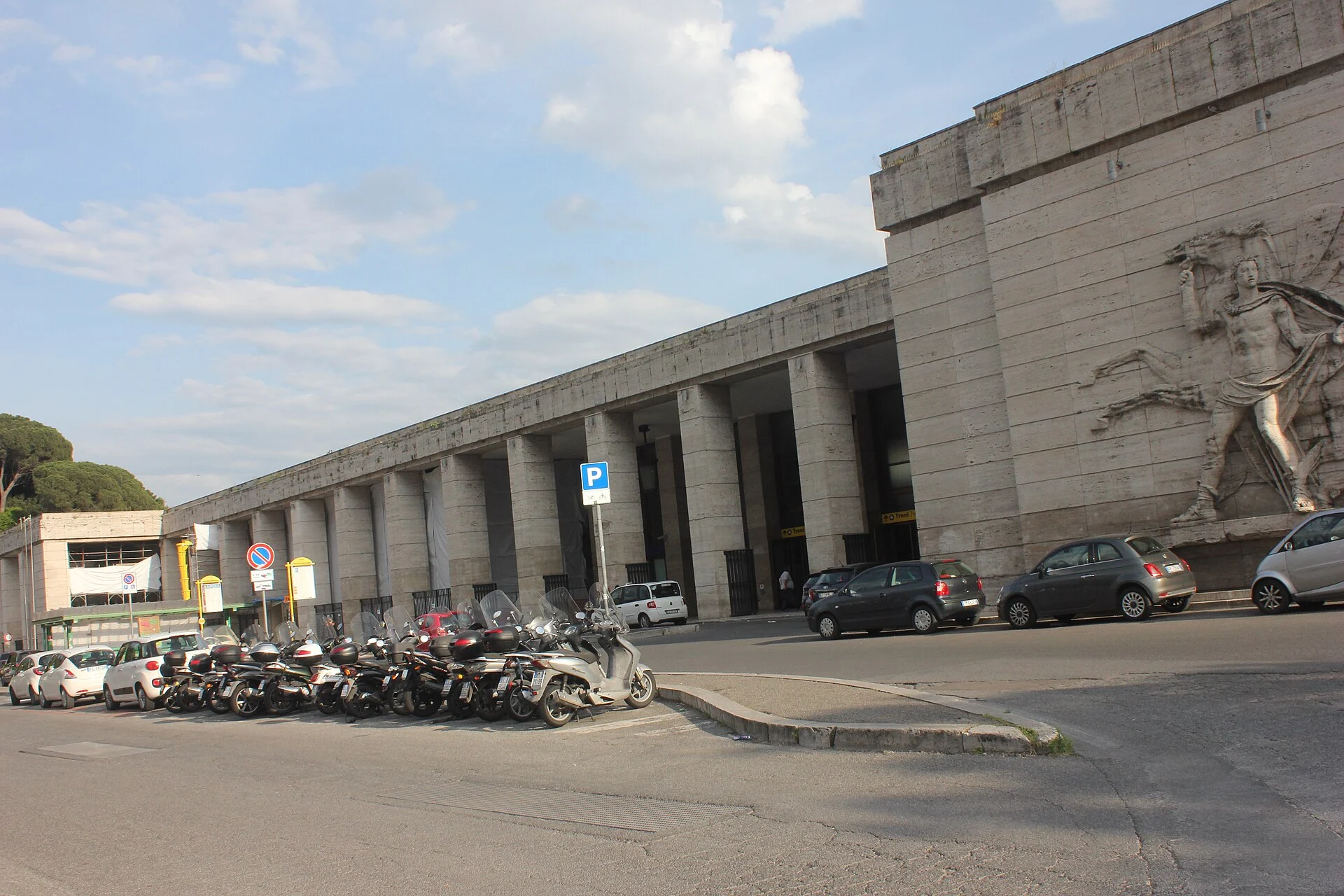
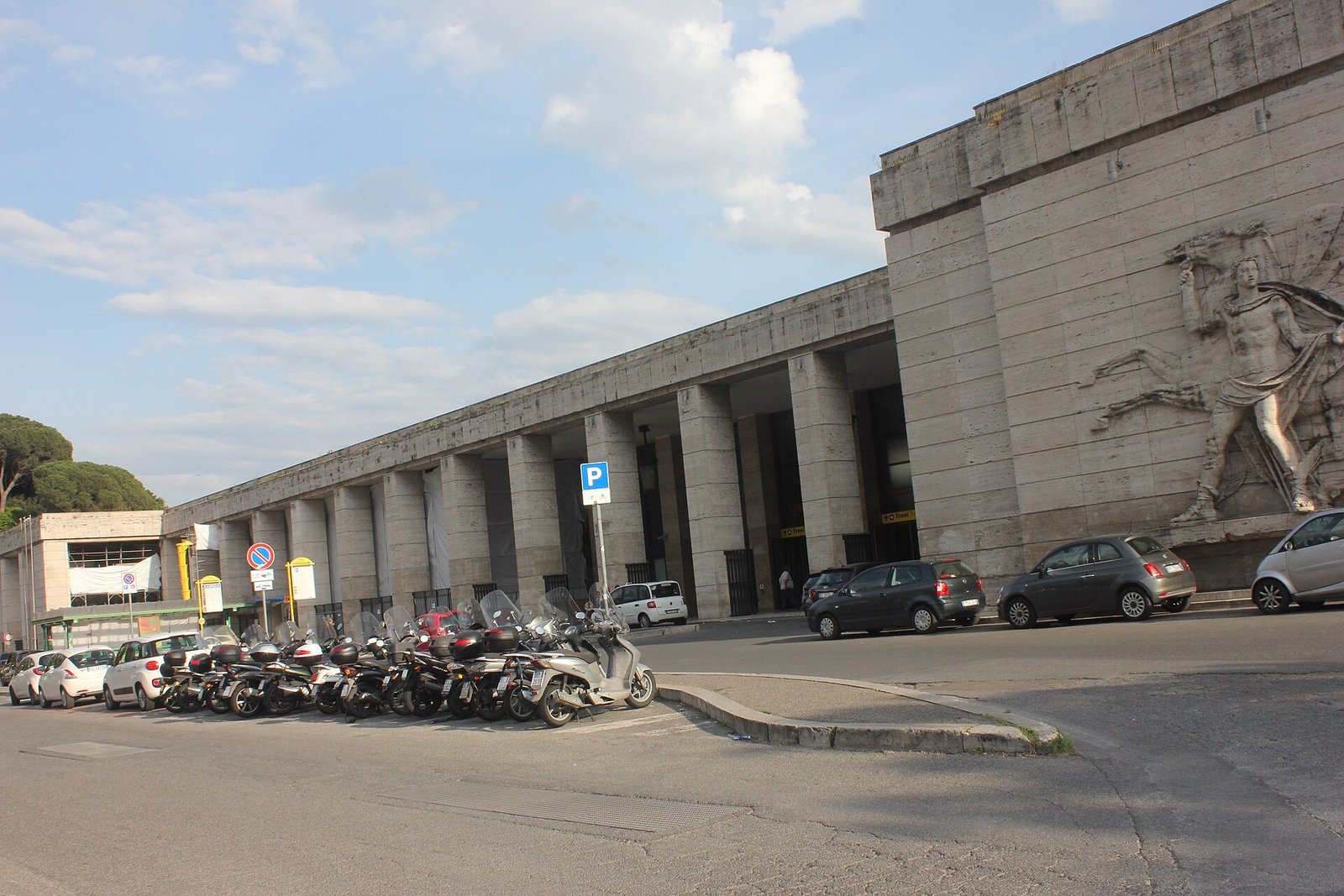
Roma Ostiense station was built in the 1930s and still serves regional trains and airport connections. The building has a clear rationalist stamp, with marbles, porticoes and a long hall worth a stop even for those who don't need to leave. On the side toward the piazzale the original rhythm of the openings is preserved.
Piazzale dei Partigiani, in front of the station, is the hinge between the railway station, the Piramide metro and the neighborhood. It is a transit area, often busy, with the Pyramid in the background. It is not a nice place to stop, but it is the point where almost all Ostiense itineraries really begin.
Inside the station is a portion of ancient mosaic from an excavation in the area, displayed in a passage area. The signage is scarce and a thousand people walk past it without noticing. It is one of those details that works very well with a group, precisely because nobody expects it in a station.
My advice for visiting Ostiense
Start with the Centrale Montemartini and do it first, right when it opens, at nine in the morning. It is the piece that holds up the rest of the day, and seeing it with empty rooms completely changes the experience. Then you step out, walk north along the road and look at the walls with the rising light.
Take metro line B to Garbatella and not to Piramide. From Garbatella you reach the museum downhill and in a few minutes, while from Piramide you get 25 minutes of sidewalk with no shade. The walk is nicer done in reverse, from the museum toward the piazzale, with the sun at your back.
Closed-toe, comfortable shoes, always. Here you walk on asphalt and on uneven sidewalks, with construction stretches and narrow passages between parked cars. It is not a historic-center stroll and those who arrive with the wrong shoes notice after the first kilometer.
Don't come on Monday. The Centrale Montemartini is closed, and without the museum Ostiense is reduced to an industrial walk that says little to many. If you only have Monday, move the day to Trastevere or to the Monti district and keep Ostiense for another day.
Last piece of advice, which is also an opinion: two and a half hours are enough. Anyone planning a whole day here ends up padding it, because the neighborhood has three or four strong things and a lot of filler in between. Better to pair it with Saint Paul Outside the Walls, which is one metro stop away.
Another well-known fact, yet rarely cited
Everyone knows Ostiense was the industrial zone of Rome. Almost nobody says it was also the zone of the railway freight yards, and that the network of tracks serving warehouses and markets was very dense. Some stretches of rail are still embedded in the asphalt on Via del Porto Fluviale and in the side streets.
You see them by walking and looking at the ground, which nobody does. The rails surface in pieces, cut by road repairs, and draw the curves with which the wagons entered the courtyards of the sheds. With enthusiasts this detail works better than any mural.
The second fact rarely cited concerns the river. Ostiense was a real port, with quays and cranes, and the place name Via del Porto Fluviale is not decorative. River port activity ceased a long time ago, the quays have been altered and today the river from here is almost invisible behind the fences.
Those who want to see the Tiber in an accessible stretch must move toward the bridges, where ramps go down to water level. In summer the event Lungo il Tevere occupies a stretch of quay farther upstream, between Tiber Island and Ponte Sublicio.
The right photo to take in Ostiense
The photo that holds up is the one inside the machine room of the Centrale Montemartini, with a white statue in the foreground and the black diesel engine behind. You need the wide-angle lens or you lose the scale. Flash is forbidden and the light is low, so it's best to lean on a wall and use long exposures.
Outside, at the former Porto Fluviale the photo that holds up today is from the corner, from the opposite sidewalk at the intersection with Via delle Conce, with the row of big windows of the old military warehouse. Without Blu's faces what remains is the architecture, sober and recently restored. No people at the windows and no zooming into the homes: it is an inhabited building.
For the Gasometer the spot is the bridge over the Tiber, with the lattice structure standing out against the sky and the low sheds in front. At sunset the backlight works, in the morning the design of the pylons shows better. From below, against the fences, nothing decent ever comes out.
A fourth image that few look for: the Pyramid framed from the sidewalk of Via Marmorata with the Aurelian Walls pressing it on both sides. It shows in a single shot the tomb and the wall that incorporated it. It takes patience with the traffic, because buses pass continuously and cover the base.
Some important events that happened here in history
The defense of Porta San Paolo in September 1943 is the heaviest episode that took place on the edge of the neighborhood. Units of the Italian army and Roman civilians tried to stop the German troops coming up from the south along Via Ostiense. The plaques on site recall the fallen and the date is still a city commemoration.
The memory of those days is a living thing in these parts, not a closed chapter. Every year the festival L'Aperossa works between Garbatella and Ostiense precisely on cinema, memory and rights. It is a good thermometer of how the neighborhood tells its own story.
Much further back in time, the body of Paul passed along this road after the execution, and the burial gave rise to the basilica that bears his name. The cult turned the road into a pilgrimage route, and for centuries the main traffic was that, not commercial.
In the 1900s the neighborhood was the laboratory of Roman industrialization: the power plant went into operation, the wholesale markets concentrated food supply, gas was stored here. Then all this stopped within a few decades, leaving the empty containers that people go to see today.
The season of conversions begins with the transformation of the power plant into an exhibition venue, which was initially a temporary arrangement for the Capitoline collections and then became permanent. From there on the idea of reusing the sheds instead of demolishing them became the prevailing line, with the uneven results you see.
Who has passed through Ostiense
Paul of Tarsus is the figure who marked the road most lastingly, because his burial along this road generated the basilica and the pilgrimage. The route between the gate and the basilica was for centuries one of the most traveled religious axes of Rome, even before the neighborhood existed.
Gaius Cestius, a Roman magistrate, left here the most conspicuous tomb of the area, the Pyramid, built in an Egyptianizing fashion then widespread. Little is known of him beyond the inscription on the monument, and this is one of the cases where the work is far more famous than the person who commissioned it.
Blu, an artist from Bologna who works without showing his face, painted here one of his biggest facades. His presence shifted international attention onto the neighborhood, so much so that today many foreign visitors arrive in Ostiense knowing that wall and completely ignoring the Centrale Montemartini.
Pier Paolo Pasolini filmed and set part of his work in the Roman outskirts along this axis, among the public housing and the industrial front toward the river. Those looking for Pasolini places often start here and then move south, along the same road.
Foreign poets and artists who died in Rome rest a few hundred meters away, in the Non-Catholic Cemetery, and this makes the area around Porta San Paolo one of the densest concentrations of foreign memory in the city. The contrast with the sheds 200 meters away is one of the things that make the neighborhood interesting.
Garbatella, above the road
Garbatella begins a little above Via Ostiense and is reached from the stop of the same name on metro line B. It is a neighborhood of 1920s public housing, built in lots with courtyards, outdoor staircases and gardens, and has a completely different character from the industrial strip below. It deserves a separate walk, not a hasty appendix.
If you have an extra half day, combine it with Ostiense, because they are the productive face and the residential face of the same piece of city. The Orti Urbani show how the green spaces of the lots have been reclaimed by the residents. The stairs and courtyards are crossed on foot, with respect, because people live there.
Going south you reach the EUR area, which is the third chapter of the same axis: after the industrial city and the working-class one, the monumental city of the 1900s. The Square Colosseum and the little lake are a few metro stops away.
San Paolo fuori le Mura, the natural terminus
The Basilica of San Paolo fuori le Mura closes the road to the south and is the logical conclusion of any route in Ostiense. It is reached by metro line B, stop of the same name, or on foot from Garbatella with a long and unpleasant walk along fast-traffic roads.
The interior is enormous and largely from the 1800s, rebuilt after the fire that destroyed the ancient basilica. The cloister with its twisted columns is the surviving medieval part and is visited for a fee. Those who arrive after the industrial sheds find a very strong break, and that is exactly what makes the pairing good.
A little further, toward the south, the Tre Fontane Abbey marks the traditional site of the martyrdom, inside a wooded little valley that nobody expects in that area. The Santi Pietro e Paolo church at EUR completes the theme in a 1900s key, inside the district of the Universal Exposition that was never inaugurated.
Those who want to understand how the Roman consular roads worked leaving the city can compare this axis with the Appia Antica park, where the burial ground along the road has remained readable. On the opposite side of the river the necropolis of Via Portuense tells the same logic on the road to the other port.
Eating in the area
For eating, Ostiense is a double zone: many places geared to university students, with low prices and variable quality, and a few serious kitchens hidden among the sheds. The risk here is not the classic tourist trap of the center, because there are few tourists at lunch, but cheap mediocrity.
The signs to recognize stay the same all over Rome. The menu with photographs of the dishes printed next to the prices is the first alarm bell: whoever really cooks doesn't need to show you what the dish will look like. It holds everywhere, even outside the tourist circuit, and here it holds above all for fixed-price menus.
The second sign is the scene in the window. The lady rolling out the pasta sheet behind the glass or on the sidewalk is a theatrical lure set up to make you slow down, not a clue about the kitchen. In the neighborhood this staging is rarely seen, but it is arriving along with the new places on the road.
Third: the person at the door inviting you to sit down. A place that works with regular customers doesn't need to recruit you from the sidewalk. If someone stops you in the street with the menu in hand, keep walking. This rule alone spares you most mistakes in any neighborhood of Rome.
Fourth: the kitchen open without a break from morning to late at night. A kitchen that never closes is a kitchen that reheats, because no brigade works 15 straight hours on made-to-order dishes. Split hours, with the afternoon closure, are a good sign even when they seem inconvenient.
Fifth: the places set in front of famous monuments that adjust the price to the customer's face. Here the monument is the Pyramid, and on the piazzale the mechanism exists. The symptoms are items without a written price, the cover charge that appears only on the bill and different price lists between the indoor room and the outside tables.
On the repeated chains seen on every street of the center the point is simple and without snobbery: they work as a tourist attraction, with the same product everywhere and fast service. They are not a scam, they are something else. Romans don't go there, and in Ostiense you still see few of them.
The only criterion is to look at who is sitting and in what language they order. If the tables hold employees, professors and students speaking Italian and the place is full at half past one, you are in the right place. If the tables hold only people with backpacks and cameras, change street.
For those who want a selection already made and checked on the spot, Daniele's list on Google Maps gathers the Roman addresses, neighborhood by neighborhood: the complete list can be consulted here. It is updated by hand and contains no places he hasn't tried.
Last practical note on timing. Around here people lunch early, because the rhythm is that of offices and classrooms: at 13:00 the tables are already taken and at 14:30 many kitchens close. Those who arrive at 15:00 hoping for a late lunch find few options, almost all questionable.
When to come and when to avoid
The good months are April, May, October and November, with side light and manageable temperatures. In summer the stretch between 11:00 and 17:00 is unbearable for lack of shade, and the asphalt sidewalks give back heat until evening. August has the advantage of empty streets and the disadvantage of many closures.
The worst day is Monday, with the Centrale Montemartini closed. On Saturday afternoon the area gets crowded, Sunday morning is excellent for walking and photographing because traffic drops a lot. On Friday and Saturday evening the neighborhood changes function and becomes a nightlife zone, with all that this entails.
If it rains, Ostiense loses almost everything, because it is an outdoor route with a single important interior. In that case plan B is the museum for an hour and a half and then a metro ride toward something indoors, for example the Museo di Roma in Trastevere or the Planetarium at EUR.
In summer the north part of the neighborhood links well with the outdoor events of the archaeological strip: the Circus Maximus and the Baths of Caracalla are a few stops away, and the Casa del Jazz with its park lies halfway. In Testaccio, on the other side of the piazzale, the district's summer program is in motion.
A half-day itinerary
9:00, metro B stop Garbatella, walk down to Via Ostiense. 9:15, entry to the Centrale Montemartini right at opening, an hour and a half inside at ease, exit around 10:45. This is the fixed block on which everything else is built, and moving it earlier really changes the quality of the visit.
11:00, walk back up Via Ostiense toward the north, stopping in front of the Mercati Generali and the industrial facades. 11:30, detour into the triangle of Via del Porto Fluviale for the painted walls, including the new ones of 2025, and a short, discreet stop in front of the former Porto Fluviale. 40 minutes are enough, and the light starts to be the right one.
12:15, arrival at Piazzale Ostiense, Pyramid from the outside and Porta San Paolo with the Museo della Via Ostiense if it is open. 12:45, Non-Catholic Cemetery if the hours allow, or back up toward Testaccio for lunch. At this point the half day is full and ends without forcing.
Those with extra time add in the afternoon San Paolo fuori le Mura, one metro stop to the south, or Garbatella climbing up in elevation. Both options work better than prolonging the stay on the industrial front, which after three hours has already said what it had to say.
Frequently asked questions about Ostiense
Can the Gasometer of Rome be visited?
No. The structure is inside a private, fenced industrial area, and there are no published visiting hours or ticket office. It is observed only from the outside, and the best points are the bridge over the Tiber and the side streets toward the river. Extraordinary openings happen only on the occasion of events organized by the owner.
How much does the Centrale Montemartini cost and when is it open?
The full ticket costs €11 and the reduced €6.50, with a €1 presale fee for online purchase. Since February 2026 entry is free for residents of Rome and the Metropolitan City with ID. Open Tuesday to Sunday from 9:00 to 19:00, closed on Monday. Data checked on September 28, 2026.
Can you go inside the Pyramid of Cestius?
Only with guided visits on scheduled dates, run by the Soprintendenza Speciale di Roma and with reservation required. With a notice of September 1, 2026 the Soprintendenza announced that the spots for the dates on the calendar were sold out and that any new openings would be announced on the institutional website. The exterior can be seen free from the piazzale.
Is Blu's mural at the former Porto Fluviale still there?
On the main facades, no. In the summer of 2025, during the construction that turned the former barracks into 54 public housing units, the walls on Via del Porto Fluviale and Via delle Conce were repainted with the artist's consent. On any parts preserved on the blind walls the sources do not agree. The building is inhabited and is looked at only from the street.
Are the Mercati Generali open?
No, the area is a construction site closed to the public and no opening date is published. The complex is observed only from the outside, walking along Via Ostiense, where the 1920s buildings and some original lettering high on the end walls of the pavilions can be read.
Which metro stop is best for Ostiense?
Garbatella for the Centrale Montemartini, because the museum is reached in less than 10 minutes downhill. Piramide for the north part of the neighborhood, meaning the Pyramid of Cestius, Porta San Paolo, the Museo della Via Ostiense and the Non-Catholic Cemetery. Both are on line B, and between the two it is about 25 minutes on foot.
How much time do you need to see Ostiense?
Two and a half or three hours cover the museum, the painted walls and the industrial front up to Piazzale Ostiense well. A whole day is too much for the neighborhood alone and it's best spent pairing San Paolo fuori le Mura, Garbatella or Testaccio, all reachable in a few minutes by metro.
Is Ostiense safe in the evening?
In the evening the neighborhood fills with young people and bars, so the main streets are busy. The side streets toward the river and the areas around the disused sheds stay dark and little traveled, and it is not advisable to walk them alone. By day there are no particular problems along the road.
Can you see the Tiber from Ostiense?
Little, and badly, because the old port quays are largely inaccessible and the river front is taken up by fences and plants. To be near the water you have to move toward the bridges, where ramps go down to river level. In summer the events on the quays are held farther upstream, toward the center.
Who wrote this page
The entry is edited by the editorial team of Tour Leader Pro, the Rome-based outfit that designs itineraries, visits and cultural events in Rome and Lazio. Hours, fares and access conditions given here are checked at the date stated in the text against the official sources cited: they change often, so a check before leaving is always a good idea.
Those who have to fit into one day civic museums with different closing days, monuments that open only by reservation in batches, construction sites that shift the routes and distances that look short on the map and are not on the asphalt, for themselves or for a group, find working tools at Tour Leader Pro, designed both for those who guide and for those who organize on their own.
For the general picture on trains, airports, rentals and destinations in Lazio outside the center of Rome, from the coast to the lakes to the Castelli, a useful resource is Italy Planner, which puts together connections, real travel times and the seasonality of openings, with detail on which destinations hold up as a day trip and which require an overnight stay.
Official sources consulted on September 28, 2026: the pages hours and addresses and tickets of the Centrale Montemartini website, and the notice of the Soprintendenza Speciale di Roma on visits to the Pyramid of Cestius of September 1, 2026. On the Gasometer and the Mercati Generali no body publishes hours or visiting arrangements, and for this reason the page treats them as places to be observed only from the outside.