Street Art in Rome: Neighborhoods and Walls to See
In short. Rome has at least seven neighborhoods where mural painting is not an episode but a fabric: Ostiense, Garbatella, Tor Marancia, Quadraro, Tor Pignattara, Pigneto and San Basilio.
Rome has at least seven neighborhoods where mural painting is not an episode but a fabric: Ostiense, Garbatella, Tor Marancia, Quadraro, Tor Pignattara, Pigneto and San Basilio. They were born between 2010 and 2015, some from festivals funded by foundations and the city government, others from private galleries that paid for a wall to promote an exhibition, others still from public art projects agreed with ATER and with the tenants of the public housing. But there is a premise that almost no guide puts at the top and that instead has to be put at the top: a large part of the works cited in the texts circulating online no longer exists. The most famous mural in the city, the one Blu had painted on the former occupied barracks on Via del Porto Fluviale, was removed during the redevelopment work on the building. The pages that follow tell how street art was born in each neighborhood, what you see today and how to get there.
First rule: walls change, and they change fast
Street art is art with an uncertain expiration date: a mural painted on a private building can be covered in one morning, without notice and without anyone committing an offense. This is not a side note, it is the defining characteristic of the medium, and it changes how any guide has to be read, this one included.
How many works really disappear
It's enough to scroll the public catalog of the MURo, the urban art museum of Quadraro, to find the wording "now covered" next to the two founding interventions of the project, on Via dei Lentuli, and next to other works of the early years, including a piece by Alice Pasquini from March 2012. In Ostiense, works by Momo and Derek Bruno on Via del Commercio have ceased to exist, along with a mural by Axel Void and the underpass of Via delle Conce, which for years had been one of the neighborhood's two open-air poster galleries. In Pigneto the mural by Omino71 dedicated to Pasolini as a journalist is recorded as removed. These are not isolated cases: they are the statistical norm.
Why they disappear
There are four reasons and they almost never have to do with vandalism. Routine maintenance: a condominium redoes the facade and the mural goes away with the plaster. Building work, as in the case of the former barracks on Via del Porto Fluviale. Natural decay: many techniques used on the street, from pasted stencils to posters, last a few months, and some artists choose them precisely for that. And the decision of the author: in Italy there are known cases of artists who erased their own works with their own hands in protest against the commercial use of street works.
How to use this page without being disappointed
The practical rule is simple: you go out for a neighborhood, not for a single work. Anyone who sets out with the idea of photographing a specific mural found in a guide from a few years ago has a real chance of finding a white wall. Anyone who sets out to walk an hour and a half inside old Quadraro or inside lot 1 of Tor Marancia comes home with 20 works seen, some not listed anywhere. Before a targeted outing it's best to check the collaborative maps and the channels of artists and curators, who document coverings and new interventions. In the paragraphs that follow, when a reliable source reports that a work is no longer visible, it says so.

Commissioned street art, spontaneous writing: the distinction you need to understand
The big murals of Tor Marancia, Quadraro and San Basilio are commissioned works, paid for, authorized by the owners of the buildings and mapped: they have a curator, a contract and often public funding. It's a different category from spontaneous writing, which is signed at night and asks no permission. Confusing the two makes half of what you see while walking incomprehensible.
What "public art project" means
Big City Life in Tor Marancia was conceived by 999Contemporary, curated by Stefano S. Antonelli and Gianluca Marziani, organized by Francesca Mezzano, supported by Roma Capitale and the Fondazione Roma Arte Musei, and shared with ATER, the territorial housing authority, which owns the painted buildings. SanBa in San Basilio was born from an idea of the creative team of WALLS, had Simone Pallotta as curator and drew on the support of the Fondazione Roma Arte Musei with the backing of Zètema, ATER and Municipio Roma IV. The MURo of Quadraro is an association founded by the artist David Diavù Vecchiato, who since 2010 has invited Italian and foreign artists and publishes the catalog online with address, date and title. In all three cases there were condominium meetings, meetings with residents, workshops in the schools: the authorization is not a stamp, it is a process.
Writing, which is something else
Writing, that is writing your own name with spray paint, is born as an unauthorized practice and keeps rules and a vocabulary of its own, foreign to the world of funded public art. In Rome you see a great deal of it, particularly along the railway lines and on the trains: from Ponte Settimia Spizzichino, which connects Via Ostiense to the new Garbatella, you watch metro B trains covered in pieces pass underneath. Many artists who are established today come from there, and several of the more abstract walls you meet around, for example those by Sten Lex, are the outcome of an evolution that starts from letters and arrives at pure geometry. When you observe a tag on top of a commissioned mural you are looking at a conflict internal to a scene, not an act against art in general.
The neighborhoods' dissent
It has to be said, because it is part of the picture: not all residents welcome the projects with enthusiasm. In Tor Pignattara, where a good part of the big walls was paid for by the galleries Varsi and Wunderkammern to launch their own exhibitions, protest writing has appeared against the transformation of the neighborhood into a tourist attraction. In Tor Marancia, on the day of the official inauguration of the murals, some inhabitants asked the institutions to take care of the condition of the housing as well. Street art in the outskirts is almost always also a discussion about gentrification and about who decides what is beautiful.
Photographing murals: what you can do and what you can't
In Italy there is no general "freedom of panorama": the copyright law, number 633 of 1941, does not contain an exception that automatically authorizes the publication of photographs of works of art located in a public place. This directly concerns anyone who photographs a mural, because a mural is a protected work of authorship and its authors are in the overwhelming majority living.
The difference between looking, photographing and publishing
Walking around Quadraro and taking photos for yourself poses no problems. The point arises when the photograph is published, and even more when it is used for commercial purposes: covers, postcards, T-shirts, promotional material, image banks. Article 70 of the Italian law allows quotation and reproduction for purposes of criticism or discussion, provided it does not constitute competition with the economic exploitation of the work. Paragraph 1-bis, introduced in 2008, added the free online publication of low-resolution images for educational or scientific use and without profit, but it does not cover commercial use. The prudent rule, for anyone who has to publish, is to ask the author or whoever curated the project.
Why it's worth asking
The street artists active in Rome almost all have a public presence and a reachable contact, and the associations that curated the projects, from the MURo to 999Contemporary to WALLS, manage the communication of the works they produced. Asking costs an email and settles in advance a problem that otherwise stays open. It applies all the more to works made on public housing, where besides the author's right there is also the position of the owning body.
And respect for the people who live there
Lot 1 of Tor Marancia and the small apartment blocks of San Basilio are homes, not exhibition halls: inside the courtyards laundry is hung, people park, children are brought downstairs. Photographing windows, balconies and people without asking is, even before being a legal question, a discourtesy that residents have been pointing out for years. The right way to visit these places is that of someone entering another person's courtyard: in a low voice, without drones, without tripods planted in front of a doorway.
Ostiense: the first district, and the proof that nothing lasts forever
Ostiense is the neighborhood where Roman street art became a public fact, between 2010 and 2013, thanks to the first editions of the Outdoor festival, a project of the agency NUfactory born in 2010. In a few years the former industrial area between the Pyramid of Cestius, the gasometer and Via Ostiense filled up with big mural paintings to the point of being renamed the street art district.
How the phenomenon was born here
The first edition of Outdoor, in 2010, was curated by Christian Omodeo and in fact took place in Garbatella, with four large works all made with the same medium, the poster, and all in black and white: the Italians Sten Lex and JB Rock, the French C215 and L'Atlas. In parallel, JB Rock and Sten Lex painted two walls commissioned by communications agencies on Via dei Magazzini Generali, in Ostiense, a street nicknamed since then "via della Comunicazione". JB Rock's Wall of Fame and Sten Lex's portraits of imaginary inhabitants on the opposite side open the history of the neighborhood. The 2011 edition, directed by Gregorio Pampinelli, concentrated on Ostiense and brought here Kid Acne, the Dutchman Zedz, Agostino Iacurci and the Brazilian Herbert Baglione. In 2012, curated by Simone Pallotta, Momo and the Spaniards Sam3 and Borondo arrived. The festival then left the neighborhood, until the eighth edition, in 2018, at the former Testaccio Slaughterhouse.
The Blu mural that is no longer there
The best-known work of the neighborhood was the one Blu painted on the former Air Force warehouse on Via del Porto Fluviale, occupied since 2003 by dozens of families: 27 faces built by playing with the windows of the building, each with a story of social injustice, environmental exploitation or inequality. In 2014 the artist returned to the same building to paint its side with a construction site hoisted onto a ship attacked by pirates. Today the mural is no longer there: the removal happened as part of the redevelopment of the building, financed with over €13 million of PNRR funds, which provides for 54 public housing units and the end of the building work by 2026. According to the reconstruction published by Artribune in December 2025 the removal happened by agreement with the artist, the work having achieved its purpose, that is the actual assignment of the housing units to the community that lived in the building.
What you see today
What remains, and can be seen from afar, is Hunting Pollution by Iena Cruz: a thousand square meters on the facade of the residential building at the corner of Via del Porto Fluviale and Via del Commercio, painted in 2018 with Airlite paint, which captures pollutants, on the initiative of the association Yourban2030 and presented as the biggest ecological mural in Europe. On Via del Porto Fluviale there is also Fish 'n Kids by Agostino Iacurci, from 2011. On Via del Commercio Paint Over the Cracks by Kid Acne survives, 65 meters of lettering inspired by the Roman saying "mettice 'na pezza". On Via delle Conce you find a Sten Lex of the figurative phase, the portrait of a student taken from a university yearbook with the stencil poster technique: the matrix is pasted on the wall, painted and then destroyed, letting time complete the work.
DOTS, the neighborhood's new map
The newest thing in recent times is called DOTS. Connecting Ostiense, a set of interventions carried out between the Pyramid of Cestius and Via del Porto Fluviale, passing through Viale del Campo Boario, Piazza Bottego and Via delle Conce, sponsored by Municipio VIII, curated by Industrie Fluviali with the coordination of LifeGate and Polimera and financed by the company Brightstar. Geometric Bang, the artist name of Mattia Botta, painted the wall along Via del Porto Fluviale with a geometric landscape in which the memory of the women workers of the Lavatoio Lanario and the women workers of the Saccheria Sonnino resurfaces. Moneyless, that is Teo Pirisi, dedicated to the telegraph operators a walkable work of asphalt art under the railway bridge of Via delle Conce. Alice Lotti worked on the asphalt of Viale del Campo Boario and Piazza Vittorio Bottego, putting at the center the women of the Resistance, among them Marisa Musu, and telling the neighborhood from the cypresses of the Non-Catholic Cemetery to Monte dei Cocci.
A walking route from Piramide, about two hours
You start from the Piramide station of metro B, which is also Roma Ostiense for regional trains. You take Via Ostiense toward the south, turn onto Via del Porto Fluviale and arrive at the corner with Via del Commercio, where the Iena Cruz facade rises. On the opposite side you see the former barracks, turned into public housing since September 2026. You walk along Via del Commercio for Kid Acne, go back to Via delle Conce for Sten Lex and for Moneyless's asphalt art under the railway bridge, and go up Via dei Magazzini Generali for the Wall of Fame. From here you close toward the Pyramid or toward the south, along Via Ostiense, as far as the Centrale Montemartini, the old thermoelectric power plant where ancient statues live side by side with turbines. At Porta San Paolo there is the Museo della Via Ostiense.
How to get to Ostiense
The Piramide station of metro line B is the most convenient access point and coincides with the Roma Ostiense railway station, served by regional trains and by the connection with Fiumicino airport. The Roma Lido railway also passes through the same hub. The Garbatella stop, also on the B, serves the southern part of the neighborhood and the gasometer better. For those arriving by car the area is dense and parking is hard at peak hours and on weekend evenings, when the nightlife of Via Libetta and surroundings fills the streets. Surface lines and schedules change often: it's best to check them on the app or on the website of the transport company before moving.
Garbatella: little authorized street art, a great deal to see
Garbatella was born on February 18, 1920, when King Victor Emmanuel III inaugurated the first buildings of the neighborhood in Piazza Benedetto Brin, and the official name, Concordia, never took hold. It's a particular case: one of the most photographed neighborhoods of Rome, but with a much slimmer authorized mural heritage than its neighbors.
The wall on Via Caffaro, three times
The history of street art in Garbatella is concentrated almost entirely on one wall, at the intersection with Via Caffaro. In 2010, for the first edition of Outdoor, Sten Lex pasted there an enormous poster with the face of Francesco Totti set beside a she-wolf: it lasted a few months, erased by rain and wind, as the project intended. In 2013 the same authors returned to the same building with Passaggio, a geometric, almost monochrome work: it was the first mural in Rome produced through crowdfunding, and the fundraising exceeded the threshold of €10,000. According to those who have mapped the neighborhood, it is the only intervention from those years still present in Garbatella. In 2021 it was joined by a second monochrome mural by Greg Jager, made with Giampiero Quaini, Paola Manfroni and Federica Micale, which translates into 12 symbols the first 12 articles of the Constitution.
The small, scattered and unauthorized works
The rest is made of tiny interventions, many of them not commissioned, that you meet while walking: the stencils of the Frenchman C215, Christian Guémy, who in Garbatella left cats, women, homeless people and a portrait of his daughter Nina, with a piece unusually large by his standards on Via Badoero, the works of Alice Pasquini, a few Space Invader mosaics, the posters between the sacred and the profane by Ex Voto Fecit, present at the neighborhood market and at the Casetta Rossa. Around the social center La Strada, on Via Passino, walls and roof are covered with politically themed paintings, with interventions attributed among others to Detshorore and Francesco Pogliaghi. Since these are largely spontaneous works, their presence is the least guaranteed of all.
The 2020 cycle, between centenary and memory
In the first months of 2020, with the fourth edition of the Muri Sicuri festival interrupted by the lockdown, two murals arrived that are little known even to Romans. On Via Passino, Flavio Solo and Diamond painted Oh my darling Clementine, an Art Nouveau-style portrait of Clementina Eusebi, the woman to whom the nickname of the neighborhood is traced back. On Via Fincati, the Italian-Venezuelan artist Luis Gomez de Teran made Preghiera al Tramonto, with a sculpted nail applied to the wall and white buds, in reference to the L'Aquila earthquake of 2009. For the centenary, in Piazza Bartolomeo Romano, Francesco Pogliaghi portrayed the partisan Enrico Mancini, killed at the Ardeatine Caves on March 24, 1944. Near the Viletta Social Lab there is Supernova by Jerico, an artist born in the Philippines and raised right in Garbatella, who later also worked on lot 1 of Tor Marancia.
A one-hour walking route from the Garbatella metro
From the Garbatella station of metro B you take Via Giacinto Pullino as far as Piazza Augusto Albini, where the first lots appear, turn onto Via Domenico Munari and arrive at the intersection with Via Caffaro, at the foot of Sten Lex's big mural. You then enter old Garbatella by Via Vettor Fausto, with the lot numbers painted on the buildings, and reach Piazza Ricoldo da Montecroce with the Scala degli Innamorati. From Viale Guglielmo Massaia you reach the Alberghi Suburbani, built between 1928 and 1929 for those displaced by the demolitions of Borgo and the Suburra. From Via Passino, in front of the social center and its walls, you reach the Teatro Palladium and finally Piazza Benedetto Brin. Whoever wants to close toward the river goes down to Via Ostiense, in front of Parco Schuster and the Basilica of St. Paul Outside the Walls. In the neighborhood you also find the Garbatella Urban Gardens, and in summer Garbatella and Ostiense share programs such as L'Aperossa.
How to get to Garbatella
The Garbatella station of metro line B is the natural access. Alternatively the neighborhood is served by bus lines 670, 673 and 715. Whoever arrives by car finds a spot more easily on Circonvallazione Ostiense and in the neighboring streets than inside the lots, where the roadways are very narrow. The whole neighborhood can be covered on foot, but it has staircases and slopes that must be considered by anyone moving with wheelchairs or strollers.
Tor Marancia: Big City Life, the museum inside a condominium courtyard
Big City Life is the project that between January 8 and February 27, 2015 transformed the facades of 11 public housing blocks of lot 1 of Tor Marancia, at number 63 of Viale di Tor Marancia, into a route of 22 mural paintings made by artists from 10 countries. It's the most radical case of participatory public art ever made in Rome, because the works are not on an enclosure wall but on the homes of about 500 families.
How it was born
The project was conceived by 999Contemporary, organized by Francesca Mezzano and curated by Stefano S. Antonelli and Gianluca Marziani, with the financial support of Roma Capitale and the Fondazione Roma Arte Musei, the sharing of ATER, owner of the buildings, and the patronage of Municipio Roma VIII. The students of the neighborhood schools took part in workshops with the artists, while the local kids set up an association, Rude, for the promotion and maintenance of the works. The declared idea was that the museum would stay open seven days a week, with no ticket and no hours. The sources diverge on a detail: the promoter's press release speaks of 20 artists and 20 monumental mural paintings, while the list of invitees and the most widespread guides count 22 names and 22 works, because two of the participants are duos and because at least one intervention is not monumental.
Why they call it Shanghai
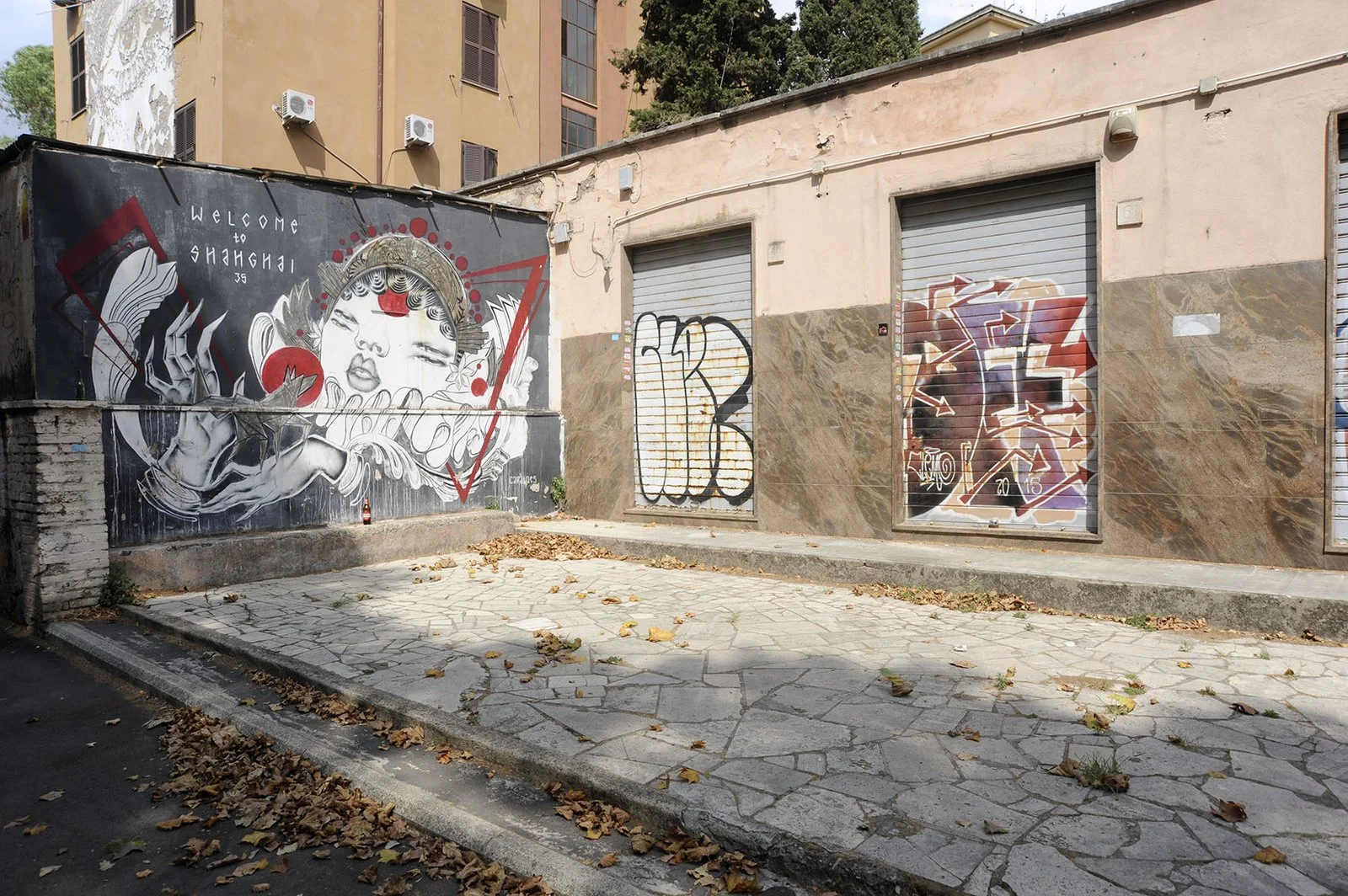
The lot is known to Romans as Shanghai, and the first mural you meet, just outside the entrance, is precisely Welcome to Shanghai by Caratoes: a traditional Chinese mask holding a Capitoline she-wolf folded into origami. Beside the entrance there is also the pilot work of the project, Il peso della Storia by the Argentine Franco Fasoli, with two masked wrestlers, an Italian on the shoulders of an Argentine, in a pose ambiguous between a wrestling hold and a gesture of help.
The works inside the complex
Past the opening in the wall you enter a courtyard from the 1950s, with paths, stone benches and hanging laundry, and from there you see the facades. Mr Klevra painted Nostra Signora di Shanghai, a Byzantine-style Madonna in which Rome is the Virgin and Tor Marancia the Child. Diamond signed Hic sunt Adamantes, a sleeping woman in Art Nouveau style holding a diamond. Lek and Sowat titled their work Veni Vidi Vinci, a pun built around the story of a boy of the complex, Andrea Vinci, who as a child lost the mobility of his lower limbs. Gaia, that is Andrew Pisacane, made a De Chirico-style mural with a suspended orange fruit, and its title, Spettacolo Rinnovamento Maturità, was given to him by the inhabitants. Jerico painted Distanza Uomo Natura, inspired by Michelangelo's Creation. Then there are Still Life by Reka, Il Vento by Moneyless, Ponentino by Pantonio, Io sarò by Guido Van Helten and Humanity Constellation by Philippe Baudelocque, which reproduces the hand of a tenant. Brad Downey chose not to paint: he spent the available budget to solve some practical needs of the residents, leaving the wall empty.
The redeeming child
The work that became the manifesto of the project is Seth's Il bambino redentore: a boy who has built himself a colorful ladder to look beyond the gray of the building. The boy is Luca, who lived in the complex and died in an accident during a game. It's the clearest example of the method with which the project was built: the stories collected in the homes ended up inside the walls.
What might no longer be there
A detailed guide published after the realization reports having been unable to locate on site Ordine Disordine by Matteo Basilé, a work dedicated to the Chinese artist and dissident Ai Weiwei, leaving open the hypothesis that the facade was repainted, without confirmation either way. Even paintings made with museum-quality materials, like those of Big City Life, age: 10 years of sun and rain on the south-facing facades show. Expect less vivid colors than those in the photographs of 2015.
Route and how to get to Tor Marancia
The visit takes a good hour: you enter from number 63 of Viale di Tor Marancia, go around the courtyard looking up, go out and check the two external works. The simplest way to arrive is the Garbatella station of metro B, followed by a quarter of an hour of walking that goes up Viale Guglielmo Massaia, crosses Via Cristoforo Colombo and comes down Viale di Tor Marancia. Alternatively bus lines 670, 673 and 715 serve the Garbatella area from which the same walk starts, and they should be checked before leaving. You are entering an inhabited private courtyard: visit in silence, without ringing doorbells and without photographing windows. In summer the neighborhood also hosts free open-air screenings, such as those of the program Vivi il Cinema!.
Image: courtyard of a lot of 1950s public housing with paths and stone benches, and the facades of the blocks entirely painted.
Quadraro: the MURo, a museum born from the memory of the roundup
The MURo, Museo di Urban Art di Roma, is an association founded by the artist David Diavù Vecchiato that since December 2010 has invited artists to paint in old Quadraro and keeps the public catalog, work by work, with address and date. It's the Roman project in which the link between mural painting and the history of the neighborhood is most explicit, because almost everything revolves around a fact of 1944.
The wasps' nest
Around four in the morning on April 17, 1944 German troops surrounded Quadraro and launched Operation Whale, Unternehmen Walfisch, directed personally by Major Kappler, with the participation of the Gestapo, the SS and the Koch gang. The neighborhood was considered by the Nazis an inaccessible den, a "wasps' nest", and the expression with which they wanted to insult it has become the name by which Quadraro tells its own story. The figures for the deported do not agree: the only list considered reliable, compiled at the time by the parish priest don Gioacchino Rey, counts at least 683 deported out of about 2000 people rounded up, while other reconstructions speak of 740, 744, at least 800, about 750, and the testimony of a deportee reaches 947. The citation of the gold medal awarded on April 17, 2004 speaks of about a thousand men between 18 and 60 years old. Only half came back.
Nido di Vespe by Lucamaleonte
In April 2014, exactly 70 years after the roundup, the MURo invited the Roman Lucamaleonte to paint on Via del Monte del Grano a colossal nest with seven giant wasps, one for each decade elapsed since the date. The choice of the wall was explained by the curator: that street represents, in an urban and historical sense, a gateway to old Quadraro, the point where until the 1970s you passed from the shacks and dirt roads to the new Quadraro of multistory buildings. The technique is acrylic on wall, and Lucamaleonte's style, made of insects and plant elements rendered with a line reminiscent of old engravings, makes the image almost naturalistic until you know its meaning.
The museum's other interventions
The MURo catalog covers about 10 years. In April 2012 Gary Baseman painted The Buckingham Warrior at Largo dei Quintili, a work that the museum itself ties to the memory of the roundup. In October 2013 Ron English and Beau Stanton arrived on Via dei Pisoni. Between 2012 and 2015 artists such as Gio Pistone, Mr Thoms, Jim Avignon, Fin Dac, Mauro Pallotta and Omino71 worked on Via dei Lentuli, Via dei Quintili and around the Quadraro tunnel. Diavù himself signed on Via Decio Mure, between December 2017 and April 2018, a work titled SQ947, with the number that refers to the highest of the figures attributed to the deported. The last intervention recorded in the catalog is from June 2021. Several works from the early years are instead covered, and the catalog says so.
Walking route in old Quadraro
The useful loop is short and takes about an hour and a half without hurrying. You start from the Porta Furba Quadraro stop of metro A, go down toward the old neighborhood and take Via del Monte del Grano for the Nido di Vespe. From there you wander among Via dei Lentuli, Via dei Quintili, Largo dei Quintili and Via dei Pisoni, the streets where the MURo concentrated its interventions, keeping in mind that some walls have changed. Whoever still has legs can continue toward the Tor Fiscale Park and from there reach the Aqueducts Park. Toward Via Appia you reach Villa of the Quintilii and the Appia Antica Park, while the Caffarella Park remains within bus reach.
How to get to Quadraro
The reference stops are Porta Furba Quadraro and Numidio Quadrato, both on metro line A, which runs under Via Tuscolana. Old Quadraro, the one with the murals, extends uphill from Via Tuscolana relative to the Porta Furba Quadraro stop. The area is also served by surface lines that run along Via Tuscolana and by connections toward Tuscolano and Casilino, which should be checked because they change. By car parking on the inner streets is difficult and the streets are narrow: it's best to arrive by metro.
Tor Pignattara: the galleries pay for the walls, the neighborhood argues
In Tor Pignattara almost all the big murals have a precise client: the Roman galleries Varsi and Wunderkammern, the latter based right in the neighborhood, paid for entire facades to launch the exhibitions of their artists between 2013 and 2017. It's the opposite model from the participatory one of Tor Marancia, and it has produced a density of international names that is hard to match.
Hostia, the so-called Sistine Chapel of Torpigna
The most talked-about work is Hostia by Nicola Verlato, painted between April and May 2015 on the facade of a small apartment building at Via Galeazzo Alessi 215: 10 meters high and almost 6 wide, acrylic and tempera on masonry, produced by Sky Arte with Level 33 and curated by Diavù. It depicts the fall of Pasolini's body at the moment of his death: at the top Giuseppe Pelosi with two journalists interviewing him, in the center the poet plunging toward an allegorical island where he finds himself again as a child on his mother's lap and addresses Petrarch, at the bottom right the naked figure of Ezra Pound. The neighborhood has nicknamed it the Sistine Chapel of Tor Pignattara. The choice of place is no accident: Tor Pignattara, together with Quadraro, San Basilio, Ostiense and Tor Marancia, was among the neighborhoods Pasolini frequented most.
The gallery walls
The rest is concentrated around Via Alessi and the nearby streets. Also on Via Alessi are a piece by the Indian artist Aakash Nihalani, who uses the wall as a surface for perspective tricks, and one by the French artist L'Atlas, from 2015. On Via Gabrio Serbelloni you'll find a large stencil by Jef Aérosol portraying Tom Sawyer and L'Orecchio Destro by the Spanish artist Escif. On Via Francesco Baracca there is Blu Landscape by Sten Lex, from 2015, abstract and adding blue to their usual black and white palette. Some C215 stencils from 2013 remain on Via Ciro da Urbino. On Via Capua a mural by the German duo Herakut portrays a Palestinian refugee woman holding her loved ones, and on Via Oddi there is Clear sky on the pink house by Agostino Iacurci, very different from the long mural the same artist had painted on Via Nicolò Forteguerri in 2009, during a writing convention organized by WALLS.
The Impero cinema and the faces of the neighborhood
In March 2014 Diavù painted a cycle titled 5 Melting Icons on the former Impero cinema, at Via dell'Acqua Bullicante 121, with the faces of Mario Monicelli, Anna Magnani, the brothers Sergio and Franco Citti and Pier Paolo Pasolini, all born or professionally raised in this part of Rome. Since the portraits appeared, the abandoned cinema has started hosting cultural activities again. Not far away, under the Alessandrino aqueduct, Alexey Luka painted Straniera in 2015, a geometric composition with a woman drinking a coffee.
Works no longer visible
Here too the map has thinned out. The mural by the Polish duo Etam Cru on Via Lodovico Pavoni, 32 meters high and for years described as the largest in Rome, with a homeless man drinking coffee as he climbs out of a dumpster, is reported as no longer there by the most detailed guide available, while other pages from the same source still mention it: this is a point on which the information doesn't agree and which needs to be checked on site. The piece by the French duo Ella e Pitr on Largo Bartolomeo Perestrello is also no longer visible, and part of the C215 stencils has disappeared.
Walking route and how to get there
A good loop starts from the former Impero cinema on Via dell'Acqua Bullicante, goes down toward Via Alessi for Hostia, Nihalani and L'Atlas, cuts across Via Gabrio Serbelloni for Jef Aérosol and Escif, stops at Via Ciro da Urbino and Via Francesco Baracca and ends under the Alessandrino aqueduct: about two hours with stops. You reach the area with the Malatesta and Teano stations on metro line C, as well as the surface lines of Via Casilina and Via Prenestina. In the neighborhood you'll also find the Mausoleum of Saint Helena with the catacombs of Saints Marcellinus and Peter, and in summer the area hosts events such as the Casilino Urban Fest and Cinema sul Tetto at Casilino Sky Park.
Pigneto: the artists' studios are here, and it shows
Pigneto is the neighborhood where several Roman street artists have their studios, and that is the reason for the number of small pieces you come across in its narrow streets. Born from 1870 out of the merging of spontaneous settlements, it was the set of Rome, Open City and Accattone, and the memory of those films is a recurring theme on the walls.
The reference works
On Via Fanfulla da Lodi, the street of Accattone and Bar Necci, is the neighborhood's best-loved mural: two lovers on a bench, by Alice Pasquini, inspired by a photograph taken in Paris when kissing in public was still forbidden in Italy. On the same street, for the 40th anniversary of Pasolini's death, three murals were painted that tell three of his faces. The one by Omino71, which portrayed Pasolini the journalist as a superhero and was titled Io so i nomi, has been removed. What remains is L'occhio di Pasolini by Maupal and a Madonna by Mr Klevra painted according to the canons of 13th-century religious art, whose face is that of the actress Margherita Caruso in The Gospel According to Matthew. On Via Antonio Tempesta you can see a geometric Etnik and a dreamlike animal by the Spanish artist Dulk, both commissioned by the Varsi gallery in 2015.
The political walls and the former Snia
Pigneto keeps a strong anti-fascist identity: on Via Giovanni Brancaleone, the artist of Yemeni origin Aladin painted a triptych that links the 70th anniversary of the Liberation to contemporary social struggles. At the entrance of the former Snia Viscosa, the former factory turned social center, is one of the best Blus in Rome, a mass of exploited workers from which two yellow figures manage to break free. Inside, there is a mural by Jorit dedicated to Luana D'Orazio, who died at work in 2021. Next to the factory is the Lago Ex SNIA. Further south, along Via del Mandrione, you reach Snodo Mandrione.
Walking route and how to get there
Get off at the Pigneto station on metro line C, opened on June 29, 2015 under Via del Pigneto, walk the pedestrian zone with its market and bars, go down Via Fanfulla da Lodi for Alice Pasquini and the Pasolini murals, cut toward Via Antonio Tempesta for Etnik and Dulk, head back up toward Via Fortebraccio and finish at the former Snia: an hour and a half, two with a stop. The neighborhood is also served by the tram and bus lines that run along Via Prenestina and Via Casilina, and by the Roma Pigneto railway station. The surface lines should be checked anyway. It is the area of Rome where it pays most to wander without an itinerary, looking at the side walls and the building entrances.
San Basilio: SanBa, public art where it was needed
San Basilio is a borgata built between the 1930s and 1940s to house the people expelled from the center by the regime's demolitions, and it is the Roman neighborhood where the struggle for housing has left the deepest mark: between September 5 and 9, 1974, the eviction from occupied apartments turned into a riot, and on September 8 the 19-year-old Fabrizio Ceruso was killed by a gunshot during the clashes. The street art project that changed the look of some buildings arrived 40 years later, and the context matters.
The SanBa project
SanBa was born from an idea of the WALLS creative team, curated by Simone Pallotta, with the backing of the Fondazione Roma Arte Musei and the support of Zètema, ATER and Municipio Roma IV. The first phase, in the spring of 2014, involved the Spanish artist Liqen, for the first time in Rome, and the Italian Agostino Iacurci, called on to paint the facades of four ATER buildings on Via Fabriano and Via Recanati, after a round of residents' meetings and encounters with the inhabitants. Liqen created El Renacer, an enormous rake plowing the city and uprooting the remains of the industrial era, and a window onto an imaginary paradise populated by exotic flowers and insects. Iacurci worked with his graphic line and flat colors. In the second phase, presented to the neighborhood on February 28, 2015, the Roman artist Hitnes painted six facades overlooking a disused small square, with a fantastical fauna.
What to expect from a visit
San Basilio doesn't have the density of Tor Pignattara or the concentration of Tor Marancia: the works are few, large and far from each other, and you see them in a walk of three quarters of an hour between Via Fabriano, Via Recanati and the surrounding streets. It is also the neighborhood where the presence of murals is most directly tied to a political debate: over the years a piece that appeared on Via Recanati has sparked public controversy, and the walls of the neighborhood regularly host unauthorized writing and pieces that enter into dialogue, or conflict, with the commissioned ones. Anyone who comes here looking only for images to photograph has understood half of it.
How to get to San Basilio
There are no metro stops inside the neighborhood: you get there with the surface lines that leave from the Ponte Mammolo and Rebibbia terminals, on line B, or from the Tiburtina area. Because routes change fairly often, the line and the stop should be checked on the spot on the ATAC app or an up-to-date route planner. By car you arrive from Via Tiburtina or the Grande Raccordo Anulare and park without too much trouble.
How to put the neighborhoods together in one or two days
The 7 neighborhoods aren't on the same side of the city: Ostiense, Garbatella and Tor Marancia form a block to the south, Quadraro, Tor Pignattara and Pigneto a block to the east, and San Basilio stays isolated in the northeast. Trying to do everything in one day means spending the day on the metro.
The south day
Morning in Ostiense starting from Piramide, lunch toward Garbatella, afternoon with a tour of old Garbatella and a finish at Tor Marancia, which is a quarter of an hour's walk from the neighborhood. It takes about 6 hours with stops, almost all on foot. If you want an indoor alternative in case of rain, on the same axis you'll find the Centrale Montemartini, the Museo diffuso del rione Testaccio and the Nuovo Mercato Testaccio.
The east day
Morning in Quadraro starting from Porta Furba Quadraro, a transfer toward Casilino, afternoon between Tor Pignattara and Pigneto, which border each other and can be walked in sequence. Here too it's a good 6 hours. In the evening Pigneto is the right place to stop and eat. San Basilio is best done separately, in a half day, perhaps combined with the Tiburtina area and Container San Lorenzo.
The indoor stops
If you want to understand how urban art dialogues with museum art, Rome has 3 useful institutions: the MACRO, the MAXXI in Flaminio and the Galleria d'Arte Moderna di Roma. Among the spaces that hosted the Outdoor festival, the former Testaccio slaughterhouse and the Teatro India remain, where a large portrait of Pasolini was painted. In summer Testaccio hosts open-air events such as Testaccio Estate.
Frequently asked questions about street art in Rome
Which is the best neighborhood to see street art in Rome?
Tor Marancia is the neighborhood with the highest concentration of street art in Rome: 22 murals made in 2015 on the facades of 11 buildings of lot 1, at number 63 of Viale di Tor Marancia, all visible in an hour by walking into the residential courtyard. If you want a variety of international artists instead, you'll find more material in Tor Pignattara, where the Varsi and Wunderkammern galleries have commissioned dozens of large walls.
How much does it cost to see the murals of Rome?
Seeing the murals of Rome costs nothing: all the neighborhoods mentioned are open streets and courtyards, with no ticket, no opening hours and no reservation. The only expense is public transport and any guided tours organized by associations and licensed guides, who have their own rates. The urban art museum of Quadraro and the Tor Marancia project were explicitly born as public museums that are always accessible.
Does Blu's mural on Via del Porto Fluviale still exist?
No, Blu's mural on the former barracks on Via del Porto Fluviale in Ostiense is no longer visible: it was removed as part of the renovation of the building, funded with over 13 million euros of PNRR funds to turn it into 54 public housing apartments, with the end of construction announced by the end of 2026. According to the account published by Artribune in December 2025, the removal took place by mutual agreement with the artist.
Can you photograph the murals and publish the photos?
Photographing the murals of Rome for personal use poses no problems, but publishing those photos, and above all using them for commercial purposes, is not automatically free: in Italy the copyright law does not provide for a general freedom of panorama, and the murals are protected works by authors who are largely still living. For editorial or commercial use it is best to ask the artist or the association that curated the project.
How do you get to the Tor Marancia murals by public transport?
You get to the Tor Marancia murals by getting off at the Garbatella station on metro line B and walking about a quarter of an hour, going up Viale Guglielmo Massaia, crossing Via Cristoforo Colombo and going down Viale di Tor Marancia to number 63. The part of Garbatella where the walk starts is also served by bus lines 670, 673 and 715, which should be checked before you leave because routes change.
How much time do you need to visit a street art neighborhood?
Visiting a street art neighborhood in Rome takes from one to two and a half hours on foot: Tor Marancia is done in about an hour because everything is inside a courtyard, old Quadraro takes about an hour and a half, and Ostiense and Tor Pignattara reach two and a half hours with stops. Putting two nearby neighborhoods together comfortably fills a whole day.
What is the difference between street art and graffiti?
The street art that Roman guides talk about is largely commissioned art: projects such as Big City Life in Tor Marancia, SanBa in San Basilio and the MURo in Quadraro have a curator, funding, the permission of the building owners and a public catalog. Writing, meaning writing your own name with spray paint, was instead born as an unauthorized practice and has its own rules and codes: they are two worlds that coexist in Rome and sometimes overlap on the same wall.
Are the murals of Rome suitable for a visit with children?
Walks among the murals of Rome work well with children because they take place outdoors, with no tickets and no lines, and the images are large and recognizable: Tor Marancia is the most suitable of all, because everything is in a courtyard closed to traffic. You should consider the distances, from 6 to 10 kilometers for a full day, and the fact that some routes, like the Garbatella one, have staircases and slopes.
One last recommendation before you head out
Roman street art is not a list of works but a city that rewrites itself: in the same year a mural disappears under a construction site and 3 new pieces appear on sidewalks and traffic islands. The right way to visit it is that of someone who accepts that part of what they have read is already out of date, and that the best piece of the day will almost always be something that didn't appear on any list.
If you are building a multi-day itinerary in Rome and want to combine these neighborhoods with the archaeological and museum routes of the center, you'll find planning tools on Tour Leader Pro, while Italy Planner is a good resource for getting your bearings on transport, regional connections and destinations in Lazio.