Ex Snia
In short. There are places in Rome that explain themselves: a temple, an obelisk, a staircase.
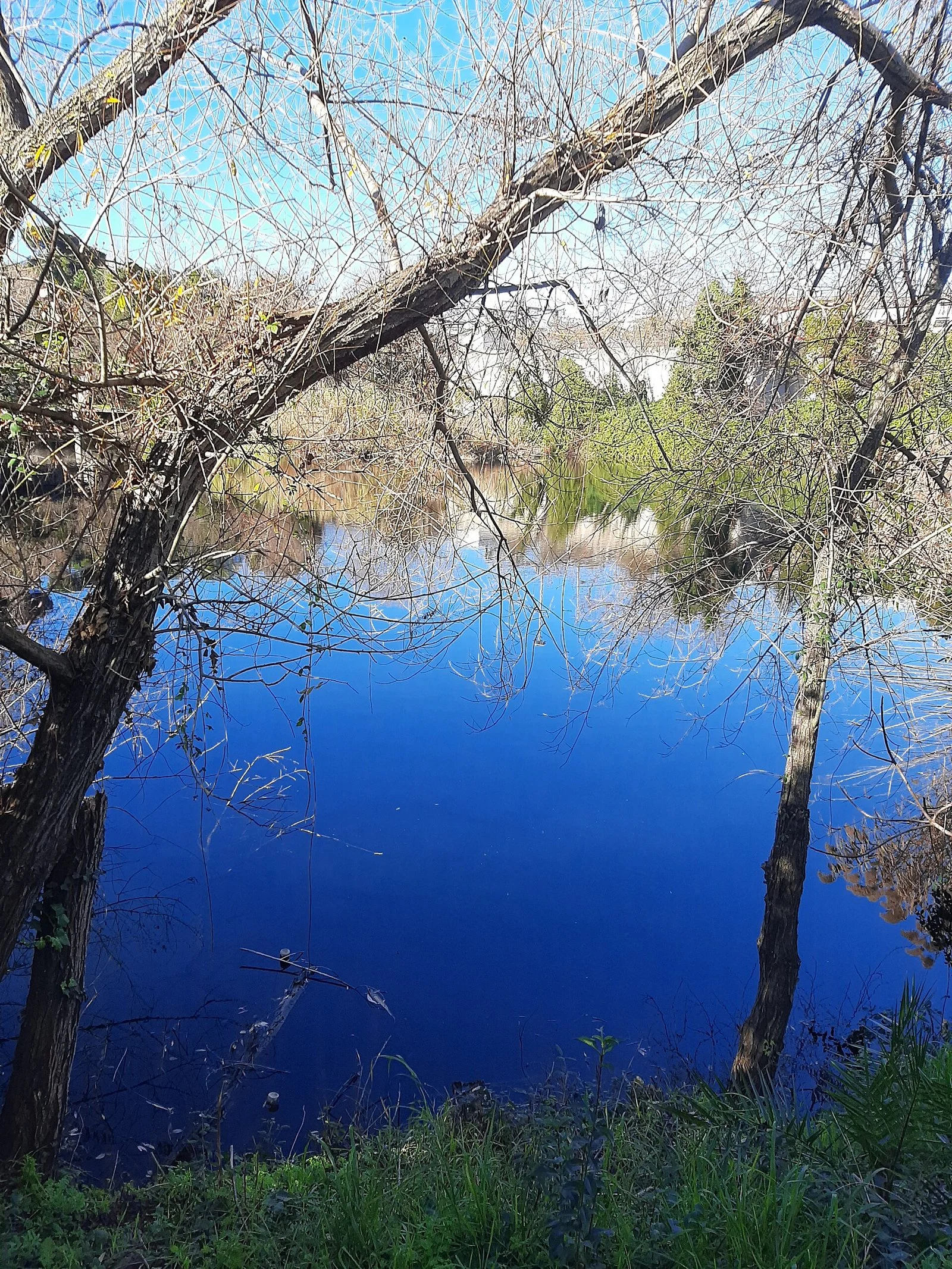
There are places in Rome that explain themselves: a temple, an obelisk, a staircase. And then there's Ex Snia, which doesn't explain itself at all and for that very reason deserves to be told slowly. Here, a couple of kilometers from Porta Maggiore, inside a quadrilateral of small buildings, workshops and sheds, there's a lake. Not an ornamental pond dug by an architect to please a prince, not a pool in a noble villa: a real lake, deep, fed by an aquifer, with reed beds, herons, fish and the muffled sound that water makes when the city goes around it without noticing. A lake that nobody wanted, that nobody designed and that nobody, for at least 20 years, really knew how to classify.
I'll say it right away, because it's the thing that strikes first-time visitors most: the lake of Ex Snia was born from a mistake. From a construction-site excavation, in the 1990s, that went too deep and punctured an aquifer. The water rose and never left. From there on the story becomes an urban novel with everything in it: an artificial silk factory of the 1920s, thousands of women workers, carbon disulfide, 40 years of ruins, a building project, a very long legal dispute, a neighborhood that stands in the way, a public park, a social center, a decree of the Lazio Region and finally, because life is stranger than fiction, a twinning with a Belgian lake.
Because Ex Snia is also, inevitably, a political place, and pretending it isn't would be an elegant way of not understanding it.
Ex Snia: what you see and why it's worth it
Imagine walking along via Prenestina at the height of largo Preneste. Traffic, trams, rolling shutters, the ordinary fabric of a working Rome. Then you enter a gap, pass a few dozen meters of untidy greenery, and find yourself in front of a wide, greenish, strangely silent sheet of water, closed in by a belt of marsh reeds, with the broken silhouette of brick industrial buildings behind it. The windows no longer have glass. Birds of prey sit on the cornices. Someone, on the shore, is looking through binoculars.
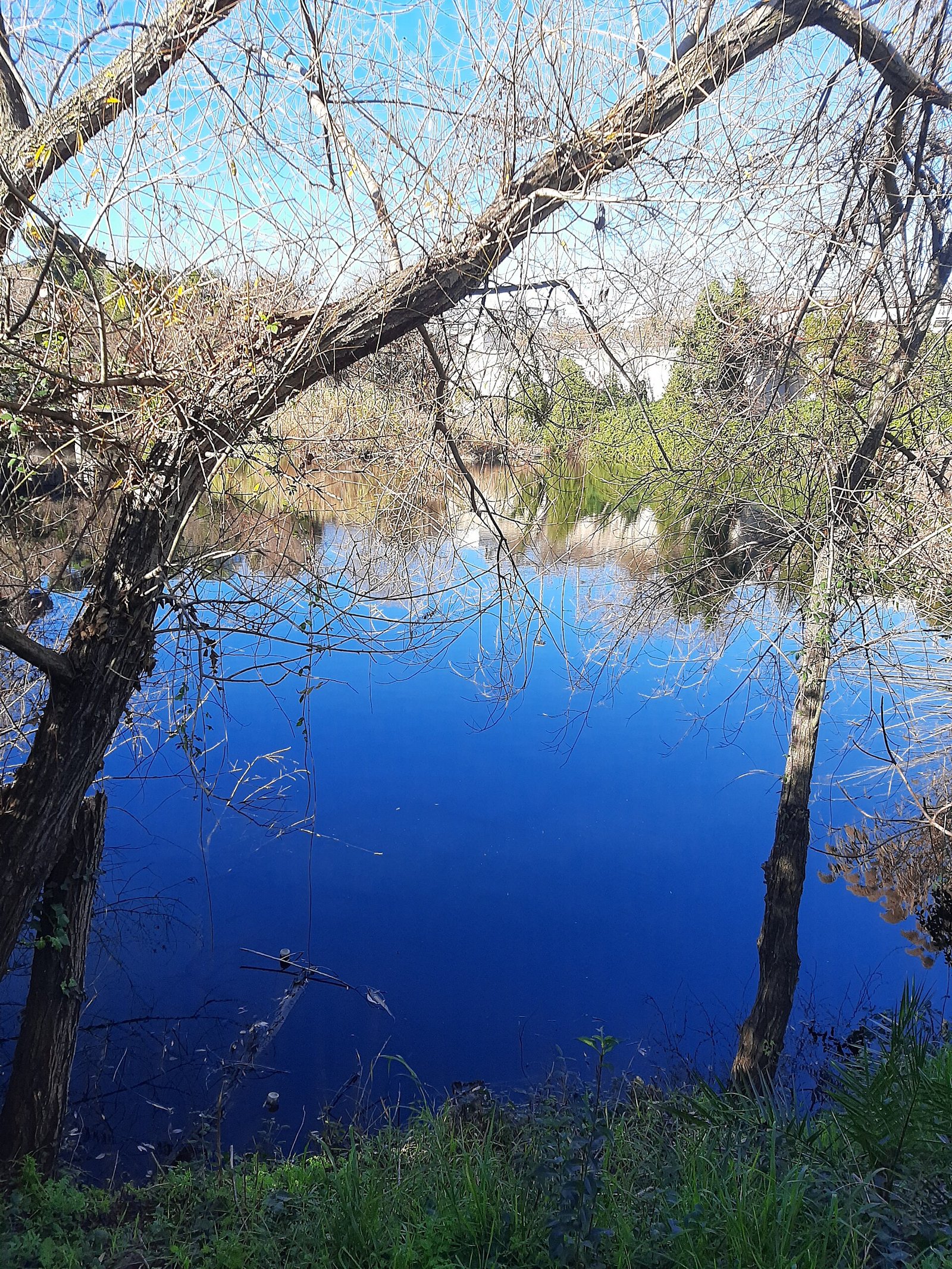
This dissonance is the heart of the experience. Ex Snia isn't beautiful in the way Villa Borghese is beautiful: it's beautiful in the way a thing is that wasn't supposed to happen and instead imposed itself. The aesthetic quality of the place comes from the friction between three overlapping layers: the industrial archaeology of the early 1900s, the interrupted construction site of the 1990s with its pillars and reinforced concrete walls, and the spontaneous nature that took everything back without asking permission.
A landscape in three beats
The first beat is the factory: bricks, trusses, chimneys, the architectural vocabulary of Italian industry when Italian industry was optimistic. The second beat is the halted construction site: concrete pours that end in nothing, rusted reinforcing bars, excavation levels that are now lake bottoms. The third beat is the water and what the water has called in: reed beds, willows, poplars, and a number of birds that in a city like Rome, at this distance from the center, you don't expect.
I assure you the effect is stronger than any description. Even someone who has seen the Forums, the Sistine Chapel and Castel Sant'Angelo in the same week goes quiet for a good minute in front of this basin of green water. Not out of scenic emotion: out of disorientation. It's a Rome that doesn't appear on postcards and yet tells the city's 1900s better than many official monuments.
Why I recommend it even to those short on time
If you have three days in Rome, I understand that Ex Snia isn't at the top of the list, and I won't pretend otherwise. But if you've already seen ancient and Baroque Rome, or if you're coming back to the city for the second or third time, this place gives you something the classic itineraries don't have: the sense of a living, contested city that argues with itself. And besides, it can be visited in an hour, it's free, and it's in a quadrant, Prenestino, Pigneto, Portonaccio, that is worth an afternoon on its own.
Where Ex Snia is and how to get there
We are in the eastern quadrant of Rome, in Municipio V, in the strip between via Prenestina and via Tiburtina that in the 1900s was the city's real productive engine. The area of the former plant occupies a large block facing largo Preneste and via di Portonaccio, a few hundred meters from the Roma Prenestina rail yard and from the bundle of tracks that snakes toward Tiburtina.
By public transport
The simplest way to get to Ex Snia is the tram that runs along the Prenestina: you get off at largo Preneste and you've practically arrived. Alternatively there are the surface lines connecting Porta Maggiore and Termini station with the Prenestino, and the urban belt railway stations. Coming from the historic center you can take the tram at Porta Maggiore and enjoy 10 minutes of authentic city: tracks wedging between buildings, shops, neighborhood markets.
A practical warning: Roman surface lines change route more often than tourists expect, because of construction and detours. Before leaving, check the updated route on the transport company's app or on the panels at the stop, instead of trusting a map printed last year. This goes for Ex Snia as for any other destination outside the central circuit.
On foot, by bike, by car
On foot from Pigneto it's just under 20 minutes, and they're interesting 20 minutes: you cross the bridge over the tracks, skirt workshops and depots, pass a sequence of public housing buildings that tell of the neighborhood's growth between the two wars. By bicycle it's even more convenient, although the Prenestina is not a bike lane and must be approached with care: better the inner streets.
By car, the advice is simple: don't come by car. Parking in the area is an exercise in patience, street parking is almost all taken by residents, and the area is well served by public transport. If you really must, consider leaving the car at one of the metro stations with park-and-ride and completing the trip by public transport.
Access to the area
Public access to the natural monument area is from the via di Portonaccio side, at number 230, while the Parco delle Energie, the large public green space bordering the lake, has its entrances on the largo Preneste and via Prenestina side. Not all of the former factory area is public and freely accessible: some portions are still private or off limits, and I'll come back to this later because it's exactly the point where the story gets complicated. Opening hours vary over the year and with the scheduled activities: check them before leaving on the official channels of the managing body or the park, instead of assuming everything is always open.
The name: why it's called Lago Bullicante ex Snia
The full name by which this place is known in the city is "Lago Bullicante ex Snia," and every part of the name has a precise reason. It's worth taking apart, because it's a small exercise in Roman toponymy that explains a lot.
"Snia" comes from the factory
Snia is the acronym by which the Società Nazionale Industria Applicazioni Viscosa was known, one of the great Italian chemical-textile groups of the 1900s, specialized in the production of artificial fibers derived from cellulose: what at the time was called rayon or, in advertising language, "artificial silk." The Roman plant was not born directly under that brand, however: the mill belonged to Cisa Viscosa, and only later, with the group's corporate mergers, did the land formally pass into the assets of Snia Viscosa. In the language of the neighborhood, though, the factory was always "la Snia," and from there "l'ex Snia" when the factory was no longer there.
"Bullicante" comes from much earlier
The term "bullicante" was not invented by the activists of the 2000s: it's an ancient place name of this part of Rome. There is a via dell'Acqua Bullicante running through the neighborhood, and the name derives from the waters that in this area surfaced bubbling, "boiling," hence bullicante, because of the underground water circulation linked to the volcanism of the Colli Albani. It's one of those coincidences that seem written by a lazy novelist: the neighborhood was called that for the water that boiled underground, and right there, centuries later, a bulldozer punctured the aquifer and the water came back to the surface.
In signage and official documents you'll also find the wording "Lago ex Snia, Viscosa," which is the one adopted by the regional protection measure. In Roman speech all the variants stay in circulation: the lake of the ex Snia, the Bullicante, the laghetto della Snia. If you ask a passerby in Prenestino for directions, any of these formulas will work.
Before the factory: the Prenestino that wasn't there
To understand Ex Snia you have to take a step back and imagine this part of the city when it wasn't a city. Until the early 1900s, outside the Aurelian walls and beyond Porta Maggiore, via Prenestina ran through open countryside: vineyards, farmhouses, marrane, a few inns at the edge of the consular road that led toward Palestrina, the ancient Praeneste. The fabric was agricultural, dotted with ancient remains, aqueducts, tombs, substructures, that the farmers used as stables or storerooms without much archaeological reverence.
The industrial push of the early 1900s
Things change rapidly between the end of the 1800s and the first decades of the following century. Rome, which became the capital in 1871, grows at a pace that its productive apparatus can't keep up with. The city is administrative, ecclesiastical, building-oriented, but industrially weak compared with the Northern triangle. When industry arrives, it settles where there are three things: space, water and railway. The eastern quadrant, between Prenestina, Casilina and Tiburtina, had all three.
In a few years the plants that would give this Rome its face were born: machine shops, glassworks, railway depots, chemical plants. Around the factories grow the workers' houses, often built without a plan, sometimes with the illegal borgate that in the 1930s and 1940s would become an identifying trait of Roman urban planning. Prenestino, Pigneto, Quadraro, Tiburtino: the working-class geography of the capital is drawn here.
The water underfoot
There is, however, a fact worth keeping in mind from now on, because it will become decisive. The subsoil of this part of Rome is not dry. The lava flows and pyroclastic deposits of the Colli Albani volcanic complex created a complex hydrogeological structure, with aquifers that circulate at shallow depth and that in several places give springs, pools and outcrops. The Acqua Bullicante is one of these. The Acqua Santa, the Acqua Sacra, the Acqua Acetosa are place names of the same family, scattered across different quadrants of the city.
Put another way: anyone who digs deep in this area is playing with water. In 1992 someone found that out in the most spectacular way possible.
1923: the Cisa Viscosa plant is born
The largo Preneste plant opens its doors in the early 1920s, the date that recurs in the neighborhood's memory and in local publications is 1923, as a mill for the production of artificial textile fiber. It wasn't a small factory: it was a large industrial complex, with production sheds, warehouses, offices, services, housing for staff, a thermal plant, a water treatment facility. It occupied an entire block, and that block is still today the perimeter of the area we are talking about.
Why Rome
The choice of Rome wasn't obvious. The viscose industry was concentrated mainly in the North, close to sources of hydroelectric power and to the textile districts. But the capital offered other advantages: abundant, low-cost labor, a growing domestic market, closeness to political power in a season when the large Italian chemical companies were very careful to cultivate the relationship with the state, and, this is the technical point, the availability of water. Viscose production is water-hungry in an almost obsessive way: water is needed for preparing the solutions, for the spinning baths, for washing, for cooling.
The subsoil of Prenestino, with its generous aquifer, was exactly what was needed. There is an almost perfect symmetry in this story: the factory came here for the water, and when the factory was no longer there, it was the water that took the place back.
A piece of city inside the city
The plants of that generation were not just workplaces: they were urban organisms. They had canteens, infirmaries, company stores, often housing. The rhythm of the sirens marked the neighborhood's day. The houses built around were inhabited in very large part by those who worked inside. Whoever has family memories of Prenestino tells of grandparents and great-grandparents who measured time in shifts, and of a relationship with the factory that was at once economic dependence and collective identity.
It must be said honestly: the factory was not loved for itself. It was tiring, often harmful, and as we will see the chemistry of viscose had heavy health costs. But it gave work in a city that had little of it, and it gave work above all to women, in an era when salaried female employment was still a socially complicated matter.
How rayon was made: the chemistry that built Ex Snia
It's worth spending a few lines on what was actually produced in here, because without understanding it you can understand neither the factory's success nor the reasons the neighborhood remembers it with mixed feelings.
From cellulose to thread
Viscose rayon is an artificial fiber: not synthetic, that is, not built from scratch from petroleum, but obtained from a natural raw material, cellulose, chemically transformed. You start from wood pulp or cotton linters. The cellulose is treated with caustic soda, obtaining the so-called alkali cellulose. This is left to mature, then reacted with carbon disulfide, which generates cellulose xanthate, a yellow-orange compound that dissolves in alkaline solution giving a dense, viscous liquid, the "viscose," precisely, from which the process takes its name.
The solution is then filtered, matured, and finally extruded through spinnerets: perforated plates with hundreds of micro-orifices, immersed in an acid regeneration bath based on sulfuric acid and salts. On contact with the bath, the filament regenerates into pure cellulose and becomes thread. From there it goes to stretching, washing, bleaching, drying, twisting and spooling.
Why it was a commercial revolution
Rayon was born as a substitute for silk, and for decades it was sold exactly that way: the luster and softness of silk at a fraction of the price. In an Italy that wanted to dress better than it could afford, the success was enormous. Stockings, linings, shirts, underwear, curtains, and then technical uses: the reinforced fiber for tires, the cord for industrial applications. In the 1930s the autarky policy of the Fascist regime gave a further push to the national fiber, presented as the Italian alternative to imports.
There is a detail that usually amuses: rayon was the first mass-market artificial fiber, and it anticipated nylon by two decades. When today people talk about "sustainable fashion" and cellulose-based fibers, they are rediscovering, with much cleaner chemistry, a family of materials that was produced industrially in Rome 100 years ago, in a shed that now has hawks on the roof.
The women workers of Ex Snia
If I had to name the main reason this factory deserves a place in Rome's social history, I wouldn't say rayon: I'd say the women. Viscose processing, like much of textiles, employed female labor in overwhelming proportion. The tasks of spinning, twisting, thread control, knotting and winding required quick hands, continuous attention and tolerance of monotony, and they were paid less than the men's, which in the industrial logic of the era was the truly decisive argument.
Mass female employment
The figures circulating on the workforce of the Roman plant vary greatly depending on the source and the period considered, and must be taken with the caution due to numbers reconstructed after the fact: we speak of the order of thousands of employees at moments of peak activity, with a clear female majority. Beyond the exact figure, the sociological point is clear: for a generation of Roman women of the eastern quadrant, the Snia was the first experience of their own wage, of schedules, of a contract, of a union.
It meant getting up before dawn, clocking in, working shifts even at night, going home and finding a second day of housework waiting. But it also meant holding a pay envelope, and this, in a society that considered women's economic dependence normal, was a revolutionary fact that nobody at the time called by that name.
Oral memory
Much of what we know about daily life inside the plant comes from testimonies gathered late, from children and grandchildren, and from research carried out in recent decades by neighborhood associations and by scholars of labor history. It's precious material and must be treated for what it is: memory, with its emotional charge and its inevitable slippages. When they tell you that "2,000 women worked here," accept the number as an order of magnitude, not as an archive datum.
One thing, though, memory returns with surprising consistency: the smell. Whoever lived here in the production years remembers a smell both acrid and sweetish, which on windless days spread over the whole district. It was the smell of viscose chemistry, and it's the point from which we must start to speak of the dark side of this story.
Carbon disulfide: the hidden price of artificial silk
You can't tell the story of a viscose factory without addressing the health question, and I do it not out of a taste for denunciation but because it's documented history of occupational medicine, independent of any political position.
What carbon disulfide does
Carbon disulfide, also called carbon bisulfide, formula CS2, is the key reagent of the viscose process. It's a volatile liquid, highly flammable and neurotoxic. Chronic exposure to its vapors is associated in the scientific literature with a clinical picture that includes peripheral and central neurological disorders, psychic alterations, vascular damage, effects on reproduction. The hydrogen sulfide that develops in the spinning baths has its own toxicity, and the work environments of the time were hot, humid and poorly ventilated.
In European industrial history, viscose factories are a classic chapter of the occupational disease literature. It's not an Italian peculiarity, still less a Roman one: it's the signature of a production process that, with the technologies and rules of the time, systematically exposed workers to dangerous substances. What has changed in recent decades is not the chemistry, but the way of containing it: closed cycles, solvent recovery, extraction, exposure limits, health surveillance.
How to take this into account when visiting
This part is a necessary antidote to industrial nostalgia. It's easy, in front of a ruined shed, to feel that romantic sentiment the Germans would happily name with a long word: the melancholy for work that is no more. The work that existed here was hard and, by today's standards, dangerous. Remembering it takes nothing away from the dignity of those who did it: it gives it back, because it places it in a story of hard-won gains instead of a sepia postcard image.
There is also a concrete, current consequence, which I'll discuss later: an area that hosted heavy chemical production for decades is an area where the environmental questions of the subsoil are never trivial, and this is one of the technical knots that have accompanied the Ex Snia story for years.
Snia Viscosa, Gualino and Marinotti: the empire of fiber
The brand that gave this place its popular name belongs to one of the most adventurous business stories of 1900s Italy, and it's worth summarizing because it explains why the acronym "Snia" has stayed stuck to a block of Prenestino for a century.
From a shipping company to a chemical giant
The acronym Snia was born as Società di Navigazione Italo-Americana, the creature of the Piedmontese financier and industrialist Riccardo Gualino, one of those characters who seem to come out of a novel: art collector, patron, unscrupulous builder of cross-shareholdings. In the years right after the First World War, with the collapse of maritime freight rates, the company was converted to the new industrial frontier of artificial fiber, and became Snia Viscosa. Within a few years the group took a dominant position in the sector in Italy and an international standing.
Gualino's arc was abruptly cut off in 1930, when his financial empire collapsed and the Fascist regime struck him hard, going as far as internal exile in Lipari. It's a lesson in economic history that comments on itself: in the Italy of the 1930s, the fortune of a captain of industry depended on his relationship with political power as much as on his balance sheets.
The Marinotti era
The name that dominates the following phase is that of Franco Marinotti, at the head of the group from the end of the 1930s and for decades the absolute protagonist of Italian textile chemistry. Under his direction Snia Viscosa passed through autarky, the war, reconstruction and the boom, diversifying from viscose toward synthetic fibers and chemicals. It's an era in which the group is one of the largest private companies in the country.
It must be said clearly, to avoid misunderstandings: when Snia Viscosa formally became owner of the Roman land, as a result of the group's corporate mergers, the largo Preneste factory had already ceased production years earlier. The transfer dates to 1969, and concerns a real estate asset, not an active plant. The matter has its own bitter irony: the name everybody uses for this place is that of the company that produced the least here.
The war, the postwar and the closing of 1954
The eastern quadrant of Rome did not come out of the Second World War unscathed. The rail yards and industrial areas were military targets, and the bombings of 1943 and 1944 hit the sector between San Lorenzo, Tiburtino, Prenestino and Casilino hard. The bombing of San Lorenzo on July 19, 1943 is the best known and the most tragic, but it was not the only episode affecting this part of the city.
A factory inside the urban Resistance
The working-class districts of eastern Rome had a role in the city's Resistance that historiography has amply documented: Quadraro with the roundup of April 17, 1944, Pigneto and Prenestino with their support networks, the strikes and the demonstrations for bread. This is the context in which the factory must be placed, without attributing to it merits that don't belong to it: factories don't make the Resistance, the people who work inside them and live around them do.
1954: production stops
The plant closes in 1954. The reasons are the classic ones of industrial decommissioning: aging equipment, costs, reorganization of the group's production at other sites, changes in the fiber market. Rayon, which had been a revolution, began to face competition from synthetic fibers derived from petroleum, and the Italian industrial geography was being redrawn.
From that moment, the block of largo Preneste enters a long limbo. It's not demolished, not converted, not returned to the city. It stays there, closed, while around it the neighborhood keeps growing and filling up. It's a condition that anyone familiar with European industrial peripheries will recognize at once: the fenced void in the middle of the full, the area that everyone crosses with their eyes and nobody can cross on foot.
40 years of abandonment: Ex Snia as an industrial ruin
Between 1954 and the early 1990s almost half a century passes. These are the years when the area becomes what urban planners call, in technical language, an "urban void," and what the residents simply called "the factory."
What happens to a disused area
Three things happen, always the same, in all the cities of the world. The first is physical decay: roofs give way, glass breaks, structures oxidize, invasive vegetation colonizes the courtyards. The second is informal occupation: unauthorized storage, makeshift shelters, improvised dumps, and in some cases activities that have an elastic relationship with legality. The third is the speculation of waiting: whoever owns the area has no interest in doing anything until the land value rises enough to justify a real estate operation.
All three occurred here. And it's important to say so because the affectionate story told today about the ex Snia risks forgetting how much that area was, for decades, a problem and not a resource for those living next to it.
The chain of ownership transfers
The documentary reconstruction of the property transfers is less boring than it seems, because it's the backbone of the whole story that follows. In 1969 the land enters the assets of Snia Viscosa as a result of a merger. In 1982 ownership passes to a real estate company linked to the group. In March 1990 the area is sold to another company, and in November of the same year it ends up in the hands of the building contractor Antonio Pulcini, through one of his companies.
In April 1990 a building permit had been issued for a project with a productive designation. This is where the most controversial chapter of the story starts, the one on which papers, orders, appeals and rulings have been written for 30 years.
1990: the building project that was to change the area
We come to the knot. At the beginning of the 1990s the area of the former factory is the subject of a real estate operation that, in the owners' intentions, was to turn it into a commercial complex with attached underground parking. It's the model that in those years was applied everywhere in Europe to disused industrial areas inside cities: you demolish, you dig, you build a shopping center, you sell.
The building permit and the controversy over land use
Here begins the part where you have to be precise and not pull the blanket toward either side. The building permit issued in April 1990 concerned a project with a productive designation. According to the reconstruction made over the years by the municipal offices and the committees, the works actually started went beyond that permit, in effect amounting to the construction of a commercial structure with underground parking, which the productive designation did not allow.
This is the substance of the contested violation: not so much "they built without a permit" as "they built something different from what the permit had been granted for." It's a technical distinction that seems subtle and is instead central, because the litigation spiraled around it.
The regulatory context of the time
It must also be said, for balance, that the early 1990s are a particular moment for Roman urban planning: the master plan in force dated from 1962, the city was discussing the regeneration of disused areas, and administrative practice on variances and changes of use was, to put it euphemistically, elastic. I'm not justifying anything: I'm saying that this story was not an isolated anomaly in an immaculate landscape, but an episode within a season in which the relationship between private initiative and public control over building was structurally unbalanced.
1992: the excavation, the aquifer, the flooding
In 1992 the bulldozers dig to build the underground parking. About 10 meters below ground level they intercept the aquifer. The water enters the excavation and starts to rise. It's not a trickle: it's a substantial flow, continuously fed by the underground water circulation.
The attempt to drain the water and the flooding of largo Preneste
The construction site's reaction was the one anyone would have predicted: pump the water out and send it into the sewer. The problem is that the urban sewer network is not sized to receive the continuous flow of an aquifer. The pipes were overloaded and gave way, with consequent flooding of the largo Preneste area. It's the episode that in the neighborhood's memory marks the beginning of everything: water that instead of disappearing into the subsoil pours into the street, in front of everyone's eyes.
From that moment the situation becomes unmanageable for the construction site. There is no economically sustainable way to keep dry an excavation fed by an aquifer: it would have been necessary to build a permanent waterproofing and drainage system of enormous cost, with authorized disposal and lifelong management. The works stop. The water rises. And stays.
How a lake forms
The basin that forms occupies the cavity of the excavation and stabilizes at a level determined by the piezometric level of the aquifer: in practice, the lake is the visible part of an underground water surface that someone has uncovered. The dimensions are considerable for an urban setting: a sheet of water on the order of a few thousand square meters, with depths that in the central parts reach several meters. It's the largest lake basin inside Rome's railway ring, larger than the little lake of Villa Borghese.
The level oscillates seasonally, as is normal for a water body fed by groundwater: it rises in rainy months, drops in summer. Those who have frequented the place for years have learned to read these oscillations on the banks, where the reed bed advances and retreats following the water.
The water that comes from the Colli Albani
One of the aspects that makes Ex Snia interesting even for those with no interest in urban planning matters is the nature of the water that fills the basin. It's not stagnant rainwater, it's not wastewater: it's groundwater, coming from the great hydrogeological reservoir linked to the Colli Albani volcanic complex, what geologists call the Vulcano Laziale.
A bit of geology, without being scared
The Vulcano Laziale built, over hundreds of thousands of years, a volcanic edifice whose products, tuffs, pozzolanas, lava flows, extend right into the urban territory of Rome. These materials have very different permeabilities: some let water through, others retain it. The result is a system of overlapping aquifers, which in the eastern part of the city circulate at modest depths and which emerge naturally at several points.
The mineral springs of the Castelli, the acidulous and ferruginous waters of different places in the eastern quadrant, the very place name of the Acqua Bullicante: all are manifestations of the same phenomenon. The water that fills the lake of Ex Snia belongs to this family, and that is why site descriptions speak of good-quality water, fed by deep circulation and not by polluted surface runoff.
A surprisingly clean water
It's one of the facts that most surprises visitors: in the middle of a disused industrial area, inside a metropolis of almost 3 million residents, there is a basin whose water is described as clear and of good quality, so much so that its potential swimmability has been discussed, at the level of public debate and proposals, not regulations. People have canoed on the lake during organized initiatives.
The counterpoint must be added immediately, though: the lake is not a public pool and you don't go there to swim. The banks are largely made up of unsecured construction-site structures, the depth increases quickly, and access to the water is regulated by the provisions of the managing body of the protected area. Admiring it from the shore is already a lot.
The demolition order and the endless litigation
In 1993 the municipal administration steps in: with order number 155 of the then Sixth Circoscrizione of the Comune di Roma, the demolition of the works carried out is ordered. On paper, the story could have ended there. In reality, that order is the beginning of a judicial and administrative path that drags on for decades.
The appeal and administrative inertia
The owners challenge the measure. The appeal is partially upheld in 2010, and, this is the point that fueled the public controversy, a relevant element in the decision was the failure of the municipal administration to defend itself in court. Put another way: it was not so much the merit of the owners' arguments that weighed, as the fact that the Comune did not show up to support its own.
In the following years further elements of irregularity in the works carried out emerge, including objections concerning the floor-plan documentation submitted. These are steps that the neighborhood committees have constantly relaunched in public debate, and that it is right to report while indicating their nature: they are elements that emerged in administrative and judicial proceedings, not insinuations.
Why it's an exemplary Italian story
For foreign visitors it's the moment when you understand something about Italy that no history book explains well. A demolition order from 1993 that in 2020 has still not produced the removal of the structures. A dispute that outlives six or seven mayors. An administration that loses a case for not having appeared. It's not movie-style corruption: it's administrative entropy, which over the long run produces equally substantial effects.
It must also be said, for completeness and balance, that from the owners' point of view the story looks different: a real estate operation started with a building permit issued by the administration, blocked by an unforeseen event, and then subjected to a 30-year regime of uncertainty that prevented any development of the area. This too is, from their point of view, a story of public malfunction. That the final result, a lake and an urban oasis, is now considered a precious collective asset is one of those paradoxes that history produces without asking anyone's permission.
The neighborhood discovers Ex Snia
For a few years the lake remains a rumor, something you know and don't see: behind the boundary walls there was water, but nobody could verify it. Then, gradually, the area begins to be frequented. These are the neighborhood kids who enter through the gaps, the residents who look in, the organized groups who start taking care of patches of greenery.
The 1990s and the season of the social centers
Mid-1990s: Rome lives one of the most intense seasons of occupying disused spaces for social and cultural purposes. All over the city, abandoned buildings become social centers, gathering spaces, rehearsal rooms, people's gyms, after-school programs. It's a phenomenon that has had and continues to have opposing readings, some consider it civic reappropriation of abandoned property, some consider it illegitimate occupation of others' property, and that in any case has profoundly affected the cultural geography of the capital.
At Ex Snia too a portion of the complex is occupied and becomes a social center. From that nucleus, over the years, take shape the activities that have accompanied the story of the lake: assemblies, public initiatives, concerts, popular sports activities, historical research on the neighborhood, environmental monitoring.
The Forum Territoriale Permanente Parco delle Energie
The body that appears most often in the news of this story is the Forum Territoriale Permanente Parco delle Energie, a neighborhood organization born to follow the fate of the area and the adjacent public park. Over the years it has performed a function worth describing precisely, because it's more articulated than the stereotype of street activism: collection and organization of administrative documentation, promotion of naturalistic studies, environmental education activities, dialogue with the Comune and the Region, organization of public initiatives.
You may or may not share the political approach of this type of experience, but one fact is hard to dispute: without organized and continuous pressure from below, a lake born by mistake inside a private area subject to litigation would in all likelihood have met the fate of many other urban anomalies, that is, it would have been filled in, covered over or forgotten. The fact that today it is a regional natural monument is the result of a process in which local mobilization had a decisive weight, recognized in public documents as well.
The Parco delle Energie and the Casa del Parco
Next to the lake, and partly around it, extends the Parco delle Energie, a public green space that represents the "normalized" part of this story: lawns, trees, paths, play areas, spaces for sports. This is where the neighborhood lives its own piece of everyday greenery, the one where you walk the dog, jog, bring the kids.
A park born from a battle
The park didn't fall from the sky. It comes from the public acquisition of a portion of the former industrial area, and it is the first tangible result of the long dispute over the ex Snia. In urban planning terms it's a textbook case of what is called a "recovered urban standard": a very high-density neighborhood, with historically insufficient green provision, that regains open surface through the transformation of a disused area.
The name is programmatic and needs explaining, because at first sight it sounds vaguely New Age. "Delle Energie" refers to the energy and production history of the site and to an idea of the park as a place of environmental and social experimentation: water saving, naturalistic management of greenery, ecological education. It's a dedication that bears the mark of the period when it was chosen, with its faith in sustainability as a collective project.
The Casa del Parco
Inside the area is the Casa del Parco, a recovered building that works as a reference point for the activities: information, cultural initiatives, workshops, meetings, hospitality for groups and school classes, an archive of the neighborhood's memory. It's the kind of presence that makes the difference between a green area and a lived place: without someone to open a door, turn on a light and organize something, a park is just grass.
The activities and hours vary over the year and depend on the programming: if you plan to take part in a guided visit, an environmental education initiative or an event, find out beforehand through the official channels. You'll save yourself the disappointment of finding everything closed on a weekday afternoon in August.
The wall, the gap and "the lake that fights"
In the chronology of the dispute there is a moment that has become almost iconographic in the local telling: that of the wall. The physical separation between the public part and the part where the lake is located was for years a central issue, because it determined who could see the water and who could not.
Opening a passage
In the 2010s neighborhood mobilization led to the opening of a passage that made the lake actually reachable for those using the park. It's an episode that the protagonists tell as an act of collective reappropriation and that, from the point of view of the private property involved, has been read in an evidently opposite way. I report both readings because it's honest to do so: a gap opened in a wall is, depending on the point of view, a right exercised or a violation committed, and the judicial and administrative story that followed reflects this ambivalence.
What is certain, and verifiable by anyone who visits the place today, is that the accessibility of the lake radically changed its symbolic status. A lake that can't be seen is a cadastral curiosity. A lake that can be seen becomes a perceived common good, and from there the road to institutional protection gets much shorter.
The lake in music
In 2014 the Roman group Assalti Frontali, together with Il Muro del Canto, dedicated the song "Il lago che combatte" to the site. It's a fact of cultural news worth recording, because it marks the moment when the story leaves the neighborhood's perimeter and enters the wider city imagination. In 2017 the cartoonist Zerocalcare dedicated a calendar to the lake, contributing further to its fame among a young public that isn't necessarily militant.
These steps are not decorations: in the history of urban conflicts, the moment when a place acquires a shared cultural representation, a song, a drawing, a documentary, is often the moment when its defense stops being a matter for a few and becomes a city issue. That is exactly what happened here.
2020: the decree and the Natural Monument
The institutional end point of the story carries a date and a protocol number, and it's good to cite them precisely because they are the most solid fact of this whole story. On June 30, 2020 the President of the Lazio Region issued decree number T00108, which established the natural monument called "Lago Ex SNIA, Viscosa."
What "natural monument" means
In the Italian system of protected areas, the natural monument is a specific category, provided for by the framework law on protected areas and elaborated by regional regulations. It serves to protect natural elements of particular value, a geological formation, a monumental tree, a spring, a single ecosystem, which by extent or characteristics would not justify establishing a park or a reserve but which deserve protection all the same.
It's the right instrument for a case like this: an area of small size, within the urban fabric, with a recognized ecological and landscape value. The establishment entails a protection regime with restrictions on transformations, the identification of a managing body, and the definition of safeguard rules.
Who manages it
The management of the natural monument is entrusted to RomaNatura, the regional body that administers the system of protected natural areas within the territory of the Comune di Roma. RomaNatura manages a set of reserves and monuments that includes, among others, the Valle dell'Aniene, the Marcigliana, the Valle dei Casali, Monte Mario, the Tenuta dei Massimi: a network that makes Rome, in terms of the extent of protected areas inside the municipal boundaries, an almost unique case among the great European capitals.
In the official description of the site a precise function is underlined: the lake represents a piece of ecological corridor that helps connect the Valle dell'Aniene Nature Reserve with the Appia Antica Park. In a strongly fragmented urban landscape, this connecting function is anything but symbolic: it determines the concrete possibility for many species to move, feed and reproduce.
What the decree did not resolve
A clarification is needed, though, and I make it plainly because it is the part most often left out of enthusiastic accounts. The establishment of the natural monument did not entail the removal of the structures built during the construction site of the 1990s, which are still present in the area. And it did not resolve in one stroke the question of ownership and designation of all the portions of the block. The restriction protects. It does not automatically turn private into public, and it does not demolish what has been built.
The spontaneous flora of the lake of Ex Snia
Let's move on to the part that, for a naturalist, is the most surprising. Surveys conducted on the area have counted a number of plant species that in an urban context of this kind is unbelievable: we speak of 358 spontaneous species, to which are added 133 cultivated species present in the area, for a total of almost 500 floristic entities. The plant communities identified are 11.
The reed bed and the riparian strip
The dominant feature of the lakeshore is the reed bed of common reed, Phragmites australis, the same one that forms the reed beds of lakes and coastal marshes. It's an extraordinarily efficient plant: it stabilizes the banks, filters nutrients, offers shelter and nesting sites to a large number of birds, and produces that continuous, dry, papery sound that is the soundtrack of the place when there's wind.
Next to the reed bed, white willow, white poplar and black poplar have settled on their own: the classic triad of riparian vegetation in central Italy. The fact that they settled on their own, without planting, is the detail that makes the place a laboratory of succession ecology: here you can observe what happens when nature recolonizes an urban area without a plan.
The Other Presences
In the rest of the area there are Mediterranean species such as Aleppo pine and Mediterranean buckthorn, together with an assemblage of spontaneous herbaceous plants that includes species like rough clover and annual costolina. Elements of the Mediterranean maquis live side by side with ruderal elements typical of disturbed soils and hygrophilous elements tied to water: a layering that reflects exactly the history of the place, made of reworked soils, construction fill and a water table that changed everything.
I recommend, if you're interested in the botanical side, visiting the area between April and June: it's the time when the herbaceous component is at its best, the reed bed is at the peak of its growth and the willows have a full canopy. In the middle of August the herbaceous vegetation is largely dry and the view is less generous.
The Birds of Ex Snia: Herons, Kingfishers, Peregrine Falcons
If there's one fact that alone justifies the protected status, it's the ornithological one. Almost 90 species of birds have been recorded in the area. 90. Inside an urban block of Municipio V, a stone's throw from Via Prenestina.
The Species of Community Interest
Among the species observed there are nine of community interest, meaning included in the lists of the European legislation on the conservation of wild birds: the glossy ibis, the little bittern, the night heron, the squacco heron, the purple heron, the little egret, the marsh harrier, the kingfisher and the peregrine falcon. For those not familiar with these names, I'll try to translate the impression they make on an ornithologist: it's the list you'd expect from a protected coastal wetland, not from a construction crater in the middle of Rome.
The night heron and the squacco heron are nocturnal and crepuscular herons, elusive, tied to wetlands with dense riparian vegetation. The little bittern is the smallest European heron, a bird that can make itself practically invisible by freezing upright among the reeds. The glossy ibis, with its dark plumage with a metallic sheen and its curved bill, is a presence that makes news in central Italy every time. The kingfisher is the turquoise arrow that anyone who has spent half an hour in silence on the bank of still water hopes to see.
The Peregrine Falcons in the Ruins
The most cinematic detail, though, concerns the peregrine falcon, which has found in the ruins of the factory the conditions to nest. It's a phenomenon documented in many European cities: the peregrine, which in nature nests on vertical rock walls, has learned that skyscrapers, bell towers, silos and industrial sheds are rock walls built by humans, with the added advantage of a stable pigeon population at its disposal.
Watching the fastest raptor in the world (in a dive it comfortably exceeds 300 kilometers per hour) use as a cliff the remains of a rayon plant from the 1920s is the kind of image that condenses everything there is to say about Ex Snia. Little owls have also been reported in the area, which find ideal conditions in the cavities of the walls.
How and When to Watch Them
The early morning hours are by far the best time: the water birds are active, the light is low and raking, the urban noise is at its minimum. Late afternoon works for the crepuscular herons. Bring binoculars (even modest ones, an 8x42 is perfectly fine) and above all bring patience: wildlife doesn't perform on command, and whoever arrives noisy and in a hurry sees nothing and concludes there's nothing.
Non-negotiable rule: you don't enter the reed bed, you don't approach nesting sites, you don't use playback calls. Disturbance in an area of this size has immediate effects, and a bird that abandons its nest for your photograph is a cost that no shot is worth.
Dragonflies, Bats and the Other Minor Presences
The wildlife of Ex Snia doesn't end with the birds, and in fact the most surprising figure concerns the insects.
30 Species of Dragonflies
In the area, 30 species of odonates have been recorded, meaning dragonflies and damselflies: almost a third of all those known for Italy. It's a number that deserves an explanation, because it's not a detail for entomologists only. Odonates are first-rate ecological indicators: they have aquatic larvae that live in the water for months or years, they are sensitive to pollution and to the structure of the riparian vegetation, and their diversity says a great deal about the health of a body of water.
30 species in an urban basin mean good-quality water, vegetated banks, no significant chemical pressures. They mean, in a word, that this lake works as an ecosystem and not as an ornamental pond.
The Bats
Four species of bats are observed regularly: the soprano pipistrelle, Savi's pipistrelle, Kuhl's pipistrelle and the common pipistrelle. This too is a quality indicator: bats need roosts (and the ruins offer them in quantity) and an abundance of flying insects, which a body of water guarantees on summer evenings. At sunset, in June, you can watch the hunting over the surface of the lake: a quick, silent ballet, very hard to photograph and beautiful to watch.
Mammals and Other Presences
Foxes have been reported sporadically in the area, and pheasants nest in the surrounding meadows. The urban fox is by now an established phenomenon across Europe and Rome is no exception: the animal has a behavioral plasticity that lets it adapt to human-altered settings, as long as it has shelter and food resources. The pheasant, of non-native origin but naturalized for centuries, finds favorable conditions in the uncultivated meadows.
There are fish in the waters of the lake, but their makeup is the result of uncontrolled introductions and not of natural colonization. An isolated lake has no way of populating itself with fish on its own. It's one of the aspects on which the nature management of an ecosystem born by chance poses genuinely new problems: what do you conserve, when what you conserve is itself an unintended artifact?
The Lake as an Ecological Corridor
I'd like to insist on a concept that is central in urban ecology today and that Ex Snia illustrates better than any textbook: connectivity.
Why Protecting the Islands Isn't Enough
For decades nature conservation reasoned in terms of islands: you mark off an area of value, you protect it, you hope it's enough. Then it became clear that animal and plant populations confined to islands that are too small and too far from each other become genetically impoverished and go locally extinct. Connections are needed: corridors along which individuals can move, disperse, recolonize.
In the urban context the corridors are watercourses, railway strips, tree rows, parks in sequence. Rome, because of its shape, has exceptional ones: the Aniene valley, the Tiber valley, the green wedge of the Appia Antica, the arc of the peri-urban parks. The lake of Ex Snia sits as a connecting piece between the Aniene system, to the north, and the Appia system, to the south.
A Wetland for Stopovers
For migrating water birds, an urban wetland works as a stopover and feeding area along routes that cross the Mediterranean. A heron moving up the peninsula in spring needs to stop, eat, rest. Every additional body of water along the route increases the chances that the journey succeeds. That's why wetlands, even small ones, even artificial ones, even accidental ones, have a conservation value out of proportion to their surface area.
Put bluntly: this lake, born from a construction error, today performs a real ecological function for species that are protected at the European level. It's the kind of irony that makes natural history more interesting than any ideological narrative.
Ex Snia, Pigneto and Prenestino
You can't talk about this place without talking about its context, because Ex Snia can be understood only within the social geography of the eastern quadrant of Rome.
Pigneto, from Borgata to Trendy Neighborhood
A few hundred meters away, on the other side of the tracks, is Pigneto: the working-class borgata that Pier Paolo Pasolini chose as the setting for "Accattone" in 1961 and that in the 2000s went through a radical transformation, becoming one of the busiest neighborhoods of Roman nightlife and culture. The pedestrian stretch of Via del Pigneto with its market, bars, live music venues, bookshops: the complete sample of what urban planners call gentrification and what residents call, depending on age and income, rebirth or expulsion.
Historic places survive in the neighborhood, first of all the old bar under the railway bridge that appears in Pasolini's images and that has become a reference point of Roman cinematic memory. Going there for a coffee after visiting the lake is a smart way to end the afternoon.
Prenestino and Portonaccio
On the opposite side, Prenestino and Portonaccio keep a more frankly working-class and productive character: workshops, warehouses, small apartment buildings from the 1950s and 1960s, neighborhood markets. It's the Rome that works and doesn't pose, the one that tourists usually cross only by train, looking out the window between Tiburtina and Termini.
These are neighborhoods with an intense political history, and that helps explain why the dispute over the lake found here the ground to last 30 years. The associative fabric, the committees, the party branches, the parishes, the schools: there was a social infrastructure capable of sustaining a long fight. In a neighborhood without that infrastructure, the lake would have been filled in in 1994 and nobody would have noticed.
The Tension That Remains
It would be unfair to paint an idyllic picture. These neighborhoods live with serious problems: real estate pressure, drug dealing, decay in some areas, lack of services, conflicts over the use of public spaces. Ex Snia too, like all semi-abandoned spaces, has known improper uses and situations of insecurity. Anyone who tells you about this place as a utopia realized is selling you an image. Anyone who tells you about it as an area to avoid is selling you the opposite image. The reality, as almost always, lies in the middle and changes from hour to hour.
The Twinning with the Marais Wiels of Brussels
In September 2022 something happened that, if it weren't documented, would seem invented: the lake of Ex Snia was twinned with another lake, the Marais Wiels, located in the municipality of Forest, in the Brussels-Capital Region, in Belgium.
Two Parallel Stories
The reason for the twinning is that the two stories are almost identical. The Marais Wiels too (the "Wiels marsh") is a body of water of unintentional human origin, formed in a construction site after the water table surfaced, in a dense urban setting, and there too the spontaneous formation of a wetland gave rise to a valuable ecosystem and to a neighborhood mobilization for its conservation.
The twinning ceremony held in Rome was a gesture both symbolic and strategic: it networks similar experiences, allows exchanges of technical knowledge on managing these anomalous ecosystems, and, not least, gives both disputes an additional argument in dealing with the institutions, showing that this isn't a local oddity but a European urban phenomenon.
A New Category of Landscape
I say this as someone passionate about the subject: we are witnessing the birth of a category of landscape that didn't exist 100 years ago. It's not nature, it's not artifice, it's not ruin, it's not park. It's the unplanned ecological outcome of industrial abandonment, and European cities are full of them: the lagoons of disused quarries, the spontaneous woods of railway yards, the grasslands of abandoned port areas. English-language literature calls them by an effective term, "novel ecosystems", that is, new ecosystems. Ex Snia is perhaps the most readable Italian example.
What Remains Open: Expropriation, Ownership, the Future
If you come here thinking you're visiting a concluded story, you're mistaken. Ex Snia is a political work site that is still open, and I think it's right to tell you precisely where the point of friction lies, without rooting for a side.
What Is Public and What Isn't
The block of the former factory isn't a homogeneous whole. One part has been acquired into the public estate and hosts the Parco delle Energie. One part is now protected as a natural monument, which restricts transformations but doesn't automatically coincide with public ownership. Other portions have remained private and not expropriated. This leopard-spot map is the real unresolved problem.
In November 2023 the citizens' committees turned again to the city administration asking for the complete expropriation of the area, justifying the request with the risk that high-density building projects on the portions not yet acquired would compromise the ecosystem of the lake. It's a clear and legitimate position, and it should be reported for what it is: a claim, not an accomplished fact.
The Other Side's Reasons
For balance, the opposite position should be stated too, which in the Roman public debate is often neglected. From the standpoint of a private owner, an area bought regularly, with a building permit issued by the administration, made unusable by an unforeseen event and then progressively restricted by public measures, poses a real problem of property protection and compensation. Expropriation isn't free: it involves paying an indemnity, and determining that indemnity for an area with such a convoluted planning history is anything but simple.
Then there's the question, not at all theoretical, of public resources: acquiring the entire block means committing money that has alternative uses. Those who oppose full expropriation use arguments of this kind, and dismissing them as pretextual doesn't help to understand why the matter is still there after 30 years.
The Technical Knot of the Structures and the Subsoil
Finally there's a technical aspect that rarely enters the debate but is decisive. The structures from the construction site of the 1990s are still in the area. Removing them, ordered on paper by a 1993 ordinance, isn't a trivial operation: these are partly submerged reinforced-concrete structures, whose demolition in the presence of a body of water and a protected ecosystem would require a serious impact study. Paradoxically, today demolishing might do more harm than leaving them.
Likewise, the subsoil of an area that for 30 years hosted heavy chemical production raises questions of environmental characterization that any future intervention will have to face. I'm not saying there's a proven problem. I'm saying it's one of the technical variables that make every hypothesis of transformation more complicated and more expensive than it looks from afar.
How to Tell It
Here it makes sense to do three things. First: distinguish what is documented (the ordinance, the decree, the dates, the wildlife censuses) from what is interpretation. Second: give voice to the positions in play without granting any of them a monopoly on being right. Third: remember that the result we all admire today, namely the lake, was nobody's project. The developer didn't want it, the City hadn't foreseen it, the residents didn't imagine it. It happened. What was chosen, and what can legitimately be debated, is what to do with it afterward.
How to Visit Ex Snia Today
Let's get practical, because a guide that tells the story and then leaves you in front of a closed gate hasn't done its job.
Entrances and Accessibility
Public access to the natural monument area is possible from number 230 of Via di Portonaccio. The Parco delle Energie, on the other hand, has its entrances facing Largo Preneste. The two parts are adjoining but not identical, and the opening of the lake area may follow specific rules and hours, tied also to the presence of staff and to the scheduling of activities.
The practical advice is always the same: check first. The channels of the managing body and those of the park publish updated information, and in periods of maintenance or adverse weather access may be suspended. Also consider that, being a natural area with banks that aren't fully equipped, the walkability isn't everywhere that of a city garden: closed-toe shoes, always.
How Much Time You Need
For the loop around the lake and a look at the ruins, 40 minutes is enough. If you want to combine the Parco delle Energie, make it an hour and a half. If you come to watch birds, allow at least two hours and bring something to drink. If you add a walk in Pigneto, you have a whole afternoon well spent.
Guided Visits and Activities
Over the course of the year there are guided visits, environmental education activities, cultural initiatives and environmental volunteering days organized by the managing body, by schools and by the associations of the neighborhood. If you have the chance to join one of these occasions, do it: the difference between looking at a body of water and understanding it is all in the person who explains it to you while you're looking at it.
Rules of Conduct
The rules of any protected area apply, with a few specific emphases. Don't leave waste, not even organic. Don't light fires. Don't pick plants. Don't disturb the animals and don't enter the reed bed. No swimming and no putting boats on the water outside authorized initiatives. Dogs must be kept on a leash, both out of respect for wildlife and for their own safety, since the area has construction structures and steep banks. And don't release animals into the lake: the aquatic fauna of an isolated ecosystem is extremely fragile and every introduction produces imbalances.
Ex Snia Season by Season
The character of the place changes enormously over the year, and whoever returns in different seasons has the impression of visiting different places.
Spring
It's the best season by far. From March to June the vegetation explodes, the reed bed rises again, the birds are in full breeding activity and the migratory passage brings unexpected presences. Dragonflies begin to emerge from April. The temperatures let you stand still and observe without suffering. If you have to choose a single time of the year, choose the second half of April.
Summer
The Roman summer is severe and this place is no exception: from 11:00 to 17:00 shade is scarce and the sultriness considerable. But the early morning hours are splendid, with the mist on the water and the silence, and in the evening at sunset you get to see the bats hunt. It's also the season when the neighborhood organizes the most outdoor initiatives, and when the Parco delle Energie becomes an evening refuge for the families of the district.
Autumn
October and November are underrated. The light turns golden and low, the poplars turn yellow, the water regains level after the summer and the autumn migratory passage brings movement again. It's also the period when photographs come out best, because the contrast between the warm vegetation and the gray of the ruins is at its maximum.
Winter
In winter the reed bed is dry and straw-colored, the vegetation thins out and the industrial landscape re-emerges in all its harshness. It's the season when the place is at its most severe and most legible: you see the structure, you see the geometries of the construction site, you see what was there before nature covered everything. For those who come for the industrial history, and not for the herons, it's the right time.
Ex Snia with Kids, by Bike, with the Dog
With Kids
It works very well, provided you set it up the right way. To kids the story "there was a factory, then they dug and by mistake water came out and now herons live there" gets across immediately and wins them over: it's a story with a surprise inside. Bring binoculars and turn the visit into a sighting hunt. The Parco delle Energie has equipped play areas, so you can combine the contemplative part with the liberating one.
Be careful though: the banks of the lake are not a playground. There are construction structures, drops, areas where the bottom falls away quickly. Keep an eye on the kids and don't let them run free toward the water.
By Bicycle
The area is flat and lends itself to it. The eastern quadrant has an incomplete but growing bike network, and the inner streets of Prenestino and Pigneto can be ridden with relative peace of mind. Avoid taking the major through roads by bike at rush hour. Inside the green areas stay on the paths and moderate your speed: you share the space with pedestrians, children and dogs.
With the Dog
Dogs are welcome in the spaces where they're allowed, always on a leash. Remember that this is an area of natural interest with wildlife nesting on the ground and among the reeds: a loose dog that enters the reed bed in spring can do very serious damage, entirely unintentionally. It's one of those rules that seem like nitpicking and instead have a precise ecological basis.
Eating and Drinking Around Ex Snia
There's no food service inside the natural area, so it pays to plan ahead. The good news is that we're in one of the most gastronomically lively quadrants of non-touristy Rome.
Pigneto
A quarter of an hour on foot away, Pigneto offers the highest concentration of venues in the area: cafés, bakeries, neighborhood trattorias, traditional Roman cuisine and contemporary cuisine, beer bars, wine bars, and a nightlife that gets intense on weekends. The pedestrian stretch of Via del Pigneto with the market is the right place for a mid-afternoon stop.
A historic landmark worth mentioning because it belongs to the cultural memory of the city: the old place under the railway overpass, active for almost a century, tied to the filming of "Accattone" and over the years become a symbol of the neighborhood. It's the kind of place where the coffee costs what it should and the history is included in the price.
Prenestino and Portonaccio
On the opposite side the offer is more working-class and less on display: bakeries, pizza by the slice, delis, neighborhood bars where you have breakfast at six in the morning alongside people on their way to work. If you're looking for the authentic experience of a Rome that doesn't play itself, this is where you find it. Don't expect elaborate wine lists: expect well-made supplì.
A Tip on Method
Avoid booking in advance based on rankings seen online: in these neighborhoods quality changes quickly and local word of mouth beats any ranking. Take a few steps, look at where Romans are sitting at lunch on a weekday, and go in there. It works almost every time.
A Walking Itinerary Starting from Ex Snia
I suggest a half-day route that uses the lake as a starting point and turns a single-spot visit into a reading of the eastern quadrant. It's an itinerary I do often and it works well even with people who already know Rome.
First Stop: Porta Maggiore
If you're coming from the center, start from Porta Maggiore, one of the most extraordinary and least visited nodes of ancient Rome. Here the Claudia and Anio Novus aqueducts converge, incorporated into a monumental gate of the 1st century, and next to it is the tomb of the baker Marcus Vergilius Eurysaces, with its frieze that recounts Roman bread-making in every detail. It's a monument that speaks of labor, and it's the perfect prelude to a day that speaks of labor.
Second Stop: Pigneto
From there, taking the Casilina or the Prenestina, you enter Pigneto. Cross it on foot, pass under the railway overpass, look at the low villas of the 1920s and 1930s that alternate with the apartment buildings, look for the murals. It's a neighborhood you read by walking and that, told in the abstract, means nothing.
Third Stop: the Ex Snia Lake
The bridge over the tracks takes you to the other side, toward Largo Preneste. Here our place comes on stage: the park, the ruins, the water. Take the time you need, walk around, sit for 10 minutes in silence on the bank. It's the heart of the itinerary and should be experienced without hurry.
Fourth Stop: Toward the Aniene
Anyone with energy left can continue north, toward Portonaccio and the Aniene valley, to complete the picture of the ecological corridor the lake is part of. The Aniene Valley Nature Reserve offers paths along the river and a completely different perspective on Roman urban nature: no longer an anomaly inside a block, but a continuous river system.
Variants
If you prefer to stay on the industrial theme, you can combine the visit with a survey of the other testimonies of Rome's 20th-century industry in the quadrant: the railway yards, the depots, the manufacturing buildings. If instead you want to finish in style, move at sunset toward Verano or San Lorenzo, another neighborhood where working-class history, university and nightlife intertwine.
Ex Snia and Rome's Industrial Archaeology
It's worth placing this site in the broader panorama of the capital's industrial remains, because Rome has a heritage of industrial archaeology that almost nobody associates with the city of the Caesars and the popes.
The Ostiense Model
The best-known case is Ostiense: the Centrale Montemartini, a former thermoelectric power plant from 1912, now a museum where ancient sculptures dialogue with turbines and diesel engines, is probably the most successful industrial reuse operation in Italy. Not far away are the Mercati Generali, the Gazometro with its lattice structure over 80 meters high, the former Slaughterhouses of Testaccio converted into cultural and university spaces.
It's the classic model of recovery: you keep the container, change the content, give it back to the city. It works when there's public or private investment, a project and a use that is sustainable over time.
Why Ex Snia Is a Different Case
None of this happened at Ex Snia, and that is precisely the point. There was no reuse project here: there was a project failure followed by a natural colonization. The value of the site doesn't lie in restoring the buildings (which are unconsolidated ruins and largely not visitable) but in the ecosystem that formed among them.
It's a lesson that contemporary urban planning is learning with difficulty: not all abandoned areas have to be transformed. In some cases the best choice, ecologically and even economically, is to let natural succession run its course and limit yourself to managing accessibility and safety. The English term is urban "wilding". In Italian, more prosaically, it's rinaturalizzazione spontanea.
What Is Really Being Preserved
A fascinating, unresolved question remains, which I hand over to the visitor. In a place like this, is the object of protection the walls of the factory or the water around them? The memory of labor or the biodiversity? These are values that can conflict: consolidating the ruins to make them visitable means turning the area into a construction site and disturbing wildlife. Leaving everything as it is means accepting that industrial memory crumbles. There is no right answer, and anyone who tells you otherwise is oversimplifying.
Ex Snia in the Debate on the Commons
Over the years this place has become one of the reference points of the Italian debate on so-called urban commons, and it's worth spending a few lines explaining what that's about, because it's a vocabulary you hear often and rarely understand.
The Concept
The category of the commons indicates resources whose use value is collective and whose management cannot be reduced either to private property or to traditional public administration: water, air, urban spaces, cultural heritage. In the Italian debate of the last 20 years the theme has had remarkable success, fueled by legal reflection and by a series of citizen disputes over theaters, disused spaces, green areas.
Applying It to This Case
Those who support reading the former Snia as a commons argue like this: that an ecosystem of recognized value, born spontaneously, whose existence depends on a collective resource such as the aquifer, can't be treated as a mere building lot, that its management must involve the residents who have cared for it for decades, and that the neighborhood mobilization has played a substitute role with respect to an inert administration.
Those who contest this reading object that the concept of the commons, applied extensively, risks eroding constitutional guarantees on property and replacing formal democratic procedures with the legitimacy of organized groups that are not elected. It's a serious objection, which deserves to be reported without caricature.
The Possible Synthesis
One fact remains: the concrete outcome of this affair was a regional measure, that is, an act of a democratically legitimated institution, which took up a demand for protection that emerged from below and translated it into an existing legal category. From the standpoint of how institutions function, this is exactly how the system is supposed to work, whatever each person's sympathies for the parties involved. The fact that it took almost 30 years is another matter, and not a cheerful one.
Mistakes Not to Make at Ex Snia
The practical part closes with a list of frequent slip-ups, to avoid.
Arriving Without Checking on Access
It's mistake number one. It's not a city park open 24 hours: it's a protected area with its own access rules and a setting in which some portions aren't visitable. A phone call or an online check before leaving avoids a wasted trip.
Expecting a Postcard Lake
Whoever arrives imagining Bracciano is disappointed. This is an urban basin surrounded by ruins, with construction structures in plain view, in an industrial setting. Its beauty is of another kind and has to be met with the right expectations. If you come for the glossy photograph, you've got the wrong place. If you come to understand a city, you're in the right place.
Treating It as an Attraction to Get Through in 10 Minutes
A place like this needs time and silence to give something back. A 10-minute stop is enough for a photograph and for understanding nothing. Sit down, look at the water, listen: within a quarter of an hour you'll start to distinguish the movements in the reed bed and the calls of the birds, and your perception of the place will change completely.
Buying Into One Version of the Facts Before Knowing Them
It's the subtlest mistake. This place is loaded with political meanings, and both those who tell it as a symbol of resistance and those who tell it as an example of tolerated illegality tend to select the facts that suit them. Have them tell you the dates, the protocol numbers, the censuses. The documents exist and are public: the 1993 ordinance, the 2020 decree, the nature studies. Verifiable reporting is more interesting than any militant narrative, whichever side it comes from.
Assuming the Story Is Over
It isn't. The unexpropriated portions, the fate of the structures, the management arrangements: they are all open games. Whoever visits this place is looking at a process under way, not a concluded monument. And it's perhaps the main reason it's worth coming.
A Curiosity About Ex Snia
The funniest curiosity concerns the name, and more precisely that place-name coincidence already hinted at, the kind that makes even the most distracted visitors smile. The neighborhood where Ex Snia stands has carried for centuries the place-name Acqua Bullicante: there's a street with that name, and the reason is that in this area waters surfaced that gurgled, "boiled", because of underground circulation tied to the volcanism of the Alban Hills. The name passed through the centuries unscathed, through the transformation of countryside into borgata and of borgata into neighborhood, surviving as a mere street sign, a linguistic fossil that no longer meant anything to anyone.
Then, in 1992, a bulldozer digs for an underground parking garage, punctures the water table at a depth of about 10 meters, and the water comes back to the surface. The place-name suddenly becomes descriptive again. The street was called Acqua Bullicante because the water boiled there, and now the water is there again, in a quantity large enough to form the largest lake surface inside Rome's railway ring. It's as if the city had preserved for centuries, in a name, the geological information that the designers of the construction site had not considered.
I'll add a second layer to the curiosity, which is even nicer. The factory had come here, in the 1920s, precisely for the water: viscose production requires enormous quantities of process water, and the Prenestino water table was a precious resource. So the water called the factory. The factory closed and left a void. The void attracted a construction site. The construction site found the water again. The cycle closes, and what closes it is the element that was there before everyone and remained after everyone. Told this way, the story of Ex Snia looks like a parable written by someone with a considerable sense of geological humor.
One Thing Nobody Tells You About Ex Snia
In the accounts that circulate about Ex Snia there is an element that is systematically glossed over, and not out of bad faith: because it's inconvenient for everyone. It is this: the demolition order for the unauthorized works, issued in 1993, was never carried out, and the owner's appeal was partially upheld in 2010 also because of the inertia of the city administration, which did not properly appear in court to defend its own measure.
Think about it for a moment. The City issues an act, the owner challenges it, and the City doesn't go to defend it. It's not a defeat on the merits: it's a forfeit. In an affair in which the public body is often portrayed as a victim or as an impartial arbiter, this detail tells a different and murkier reality, made of understaffed offices, priorities that change with each administration, files lost in the succession of managers. It's not a conspiracy: it's ordinary Italian administration, which over the long term produces effects that no political will could have produced so effectively.
The second thing that is rarely said, and that completes the picture, is that the structures built during that construction site were not removed even after the natural monument was established in 2020. They're still there, partly submerged, partly emerging, and by now they structurally form part of the landscape that everyone comes to admire. Some of them offer perches and shelter to wildlife. It's a paradoxical situation that none of the parties has an interest in highlighting: for those who defend the lake, admitting that the building abuse has become part of the ecosystem is embarrassing. For those who claim the right to build, remembering that those structures are formally subject to a demolition order never carried out is just as embarrassing.
This is exactly the level of complexity that makes the place interesting. A place where the unlawful act has turned into protected habitat forces you to revise any simple moral scheme. I don't tell the story of Ex Snia to teach a lesson: I tell it because it's a case in which reality has outrun all the categories we had prepared to interpret it.
My Advice for Visiting Ex Snia
The most useful advice I can give you is to come early in the morning, on a weekday, and to spend the first 20 minutes doing nothing but standing still. I know it sounds like advice from a monk, but it has a precise technical reason: the wildlife of an urban area of this size is used to a constant but predictable human presence, and reacts to movement more than to presence. If you arrive, walk slowly to a spot on the bank, sit down and don't move anymore, within a quarter of an hour the ecosystem goes back to behaving as if you weren't there. The herons return to the edge, the kingfisher flies across, the moorhens come out of the reed bed.
If instead you walk around the lake walking and talking, you'll see a lake with some reeds around it and you'll leave convinced there's not much at Ex Snia. It's exactly the difference between looking and observing, and it's the reason birdwatchers spend hours motionless with the air of the possessed.
The Accessories That Make the Difference
Bring binoculars, even cheap ones. Bring closed-toe shoes, because the paths aren't paved everywhere and the construction structures make the ground uneven. Bring water, because there are no refreshment points inside. In summer bring a hat and in spring a mosquito repellent, since mosquitoes near a reed bed are guaranteed. And bring, if possible, a local: the oral memory of the neighborhood adds to this place a dimension that no information panel can give.
The Advice on Method
The second piece of advice concerns how to have it told to you. Before coming, read two or three sources with different orientations: the documentation of the managing body for the natural side, journalistic reporting for the planning and judicial side, and the materials produced by neighborhood groups for the social memory side. Then compare them. The discrepancies you'll find aren't a nuisance: they're the most instructive part. A contested place is understood by reading the points where the accounts diverge, not those where they coincide.
And Finally, Go Back
Ex Snia is not a place to visit once. It's a place to see in two different seasons, preferably one in spring and one in winter, because the transformation of the landscape is such that the second visit seems to be about another place. In April it's a Mediterranean wetland. In January it's an industrial ruin with water inside. Both are true.
Another Well-Known Fact, Yet Rarely Mentioned
The well-known fact is that the Ex Snia factory closed in 1954. All the reconstructions say so, it appears on every panel, the guides repeat it. What almost no one follows through to the end is the consequence of that date: it means that the area remained abandoned for almost 40 years before the construction site of the 1990s opened, and that the entire generation that grew up in the neighborhood between the 1960s and the 1980s lived alongside an enormous fenced-off void without it being a public issue for anyone.
40 years is a very long time. It's the time that separates postwar reconstruction from the fall of the Berlin Wall. In those decades Rome grew out of all proportion, built entire neighborhoods, hosted an Olympics, lived through the boom and the crisis, and for all that time an industrial block of considerable size in Municipio V stayed there, unused, waiting for the real estate market to make it worthwhile to do something with it. It's not a detail: it's the fundamental economic mechanism that explains the affair. Land capital is in no hurry. Waiting costs little and pays a lot, when the value of land grows.
The second little-cited consequence concerns memory. After 40 years of abandonment, when in the 1990s the neighborhood began to mobilize, the men and women workers of the factory were by then elderly or gone. The fight for the lake was not conducted by those who had worked inside: it was conducted by people who had inherited a place, not an experience. This explains why the industrial memory of the site was reconstructed after the fact, through research, testimony collected belatedly and archival work, instead of being passed down in continuity.
Finally, there's a third aspect, the most concrete. In a context of disused chemical production, 40 years of abandonment are also 40 years during which nobody cleaned up anything. This makes any hypothesis of transforming the area more complex today, and paradoxically strengthens the conservative option: letting the ecosystem keep functioning as it is costs far less than intervening, and carries fewer environmental risks. Time, in this story, has been a leading actor, and nobody had invited it.
The Right Photo to Take at Ex Snia
The most effective photograph of Ex Snia isn't the one of the lake alone, and it isn't the one of the ruins alone: it's the one that puts water and concrete in the same frame. It's the only shot that tells the story with no need for a caption. Look for an accessible point on the bank from which you can see, in the foreground, the surface of the water with the reed bed, and in the background the broken silhouette of the industrial buildings or a pillar from the construction site emerging. That contrast is the subject.
The Light
The two hours after dawn are the best by far: the raking light lights up the reed bed, the water is still and acts as a mirror, and the morning mists of spring and autumn give that soft quality that midday destroys. Late afternoon works well in winter, when the low sun warms the bricks of the buildings. Avoid summer noon: flat light, impossible contrasts, washed-out colors.
The Technical Mistakes to Avoid
The first mistake is overexposing the water: if you meter on the reed bed, the reflective surface gets blown out. Meter on the highlights and recover the shadows in post-processing, or use a polarizing filter, which works miracles here because it eliminates reflections and restores the real color of the water and of the submerged vegetation along the edge.
The second mistake is going at all costs for the close-up of a heron with a lens that isn't up to it. With a modest telephoto you'll get a gray blotch in the middle of a green rectangle. Better to give up the wildlife portrait and focus on the landscape, which is much stronger here. If instead you have the right equipment, remember the non-negotiable rule: no photograph is worth approaching a nest or entering the reed bed.
A Contrarian Suggestion
Try black and white. It sounds like advice for aesthetes, but it has a logic: stripped of green, the landscape of Ex Snia reveals its geometric structure, the relationship between the building masses and the surface of the water, the texture of the bricks against that of the reeds. In black and white this place looks like a photograph of Central European industrial archaeology, and the resemblance is no accident: it belongs to the same family of landscapes.
And finally, the photograph nobody takes and that is worth taking: the one facing outward. Stand with your back to the lake and photograph the buildings of the neighborhood that overlook the area. It's the image that explains where we really are, and without which the lake looks like any place in the countryside rather than an anomaly in the heart of a metropolis.
Some Important Events That Happened Here in History
I'll try to line up, with verifiable dates, the events that made this block what it is today. It's a dense chronology, and it's worth keeping in mind while walking along the bank, because every element of the landscape corresponds to a step in this sequence.
The 1920s: The Opening of the Plant
The first event is the industrial settlement itself. In the early 1920s (the date that recurs in local reconstructions is 1923) the Cisa Viscosa factory opens, intended for the production of artificial fiber. It's the founding event: from that moment the block is a factory, and the neighborhood that grows around it is a factory neighborhood. Thousands of people, overwhelmingly women, would work there in the following decades.
1954: The Closure
The second event is the end of production, in 1954. It's the date that opens the very long abandonment. From then on the area enters a purely real estate dimension: in 1969 the land flows into the assets of Snia Viscosa following a corporate merger, in 1982 it passes to a related real estate company, in March 1990 it's sold to another company and in November of the same year it reaches the building contractor Antonio Pulcini through a company of his.
1990: The Building Permit
In April 1990 a building permit is issued for a development with a productive use. It's the act from which all the later litigation descends, because the works that were started amounted in fact to the construction of a commercial complex with underground parking, a use that permit did not allow.
1992: The Water Table and the Flooding
It's the central event, the one that changes the nature of the place. During the excavations for the underground parking, the aquifer is intercepted at a depth of about 10 meters. The attempt to discharge the water into the sewer causes overload and collapse of the pipes, flooding the area around Largo Preneste. Work stops, the excavation fills up, the lake is born. Nobody designed it, nobody wanted it, and for 30 years it hasn't gone away.
1993: The Demolition Order
Ordinance number 155 of the Sixth District of the City of Rome orders the demolition of the works carried out. The owner appeals. In 2010 the appeal is partially upheld, also because of the city administration's failure to defend itself in court. The works, to date, have not been removed.
The 1990s and 2000s: The Neighborhood Enters the Scene
A portion of the complex is occupied and becomes a social center. The Forum Territoriale Permanente Parco delle Energie is born and takes shape. The public acquisition of part of the area allows the creation of the Parco delle Energie, with the Casa del Parco as the base for its activities. It's the phase in which a real estate dispute turns into a neighborhood issue and then a city one.
2014 and 2017: The Lake Enters the Collective Imagination
In 2014 Assalti Frontali together with Il Muro del Canto dedicate to the site the song "Il lago che combatte". In 2017 Zerocalcare dedicates a calendar to the lake. These are the years in which the mobilization obtains the opening of a passage that makes the lake actually reachable from the park, a passage read as reappropriation on the part of the neighborhood and in the opposite way by the owner.
June 30, 2020: The Decree
The President of the Lazio Region issues decree number T00108 establishing the natural monument "Lago Ex SNIA - Viscosa". It's the definitive institutional recognition of the natural value of the area, entrusted to the management of RomaNatura. The restriction protects, but doesn't remove the structures and doesn't resolve the question of the still-private portions.
September 2022: The Twinning
In Rome the twinning ceremony takes place with the Marais Wiels, a lake of similar unintentional human origin located in the municipality of Forest, in the Brussels-Capital Region. Two construction accidents turned ecosystems recognize each other: it's, in its way, a diplomatic event.
November 2023: The Request for Full Expropriation
The citizens' committees turn again to the city administration asking for the complete expropriation of the area, justifying the request with the fear that high-density building projects on the portions not yet acquired would compromise the ecosystem. The matter, to date, remains open.
Who Passed Through Ex Snia
The question of who has passed through Ex Snia has a less glamorous and more interesting answer than the one you'd give for a monument in the center. No emperors, popes or Grand Tour travelers passed through here. The Rome that works passed through here, then the Rome that argues, and finally the Rome that watches birds.
The Women Workers, Before Anyone Else
The absolute protagonists of this place are the workers of the plant, thousands of women who between the 1920s and the early 1950s passed every day through the gates of Largo Preneste. We know almost none of their names, and that's exactly the point: they are the part of Italian history that left no plaques. The research carried out in recent decades by scholars and neighborhood associations has recovered testimony, photographs and fragments of family memory, but most of those biographies are lost. Walking here, you walk over a vanished archive.
The Names of Industry
On the entrepreneurial side, the story intertwines with that of Snia Viscosa and of the figures who marked its trajectory: Riccardo Gualino, the Piedmontese financier who turned a shipping company into Italy's largest artificial fiber group, and Franco Marinotti, who led its fortunes from the late 1930s through autarky, the war and reconstruction. It's worth specifying, for fairness, that the link between these names and the Roman block is corporate rather than biographical: the plant operated as Cisa Viscosa and the land entered the assets of Snia Viscosa only in 1969, when production had ceased a decade and a half earlier.
The Construction Site Entrepreneur
The name that appears in all the acts of the modern phase is that of Antonio Pulcini, the building contractor who acquired the area in November 1990 through a company of his and who started the construction site from which, unintentionally, the lake was born. He is a figure who in the neighborhood's telling plays the antagonist, and it's right to remember that behind that role there is a legal and economic position that had its venues of representation and its trial outcomes, some of them favorable. Telling a dispute means reporting that there were two parties.
The Artists
The lake attracted the attention of part of Rome's cultural scene. In 2014 Assalti Frontali, the city's historic rap group, together with the folk-music group Il Muro del Canto, dedicated "Il lago che combatte" to it. In 2017 the cartoonist Zerocalcare, one of the most recognizable voices in the telling of Rome's peripheries, dedicated a calendar to it. These are steps that took this place beyond the borders of Municipio V and into the cultural conversation of the city.
The Illustrious Neighbors
A clarification, because sooner or later someone asks: Pier Paolo Pasolini isn't linked to this block, but he shot "Accattone" in 1961 a few hundred meters from here, in the streets of Pigneto, and his work remains the most penetrating portrait that exists of this quadrant of Rome at the moment of the passage from borgata to neighborhood. Whoever comes to Ex Snia is walking in the same human landscape that Pasolini described, simply 60 years later and on the other side of the tracks. I don't attribute to the place a presence it didn't have: I point out a contiguity that helps understand where you are.
Who Passes Through Today
Today those who pass through Ex Snia are the technicians and naturalists who run the wildlife and plant censuses, the staff of the managing body, teachers with classes on environmental education visits, photographers, birdwatchers with their binoculars, residents crossing the park on their way to work, runners, dogs, kids. And in September 2022 a Belgian delegation passed through too, come to celebrate the twinning with the Marais Wiels of Brussels: two lakes born by mistake taking turns playing host. If you're looking for a list of famous visitors, this isn't the right page. If you're looking for a place that keeps being crossed by real people who determine its fate, you're exactly where you should be.
Quick Questions About Ex Snia
Where Is Ex Snia and Where Do You Enter
You're in the eastern quadrant of Rome, in Municipio V, in a large block facing Largo Preneste and Via di Portonaccio. The natural monument area, that is, the lake, is accessed from Via di Portonaccio, at number 230. The Parco delle Energie, the public green space that borders the lake, has its entrances on the side of Largo Preneste and Via Prenestina. Some portions of the former factory remain private or off limits.
How to Get to Ex Snia by Public Transit
The simplest way is the tram that runs along the Prenestina: get off at Largo Preneste and you've practically arrived. From the center you can take it at Porta Maggiore, about 10 minutes. On foot from Pigneto it takes you just under 20 minutes. Driving is not recommended, because the parking in the area is almost all taken by residents. The surface lines often change routes, so check the updated one before leaving.
Do You Pay to Visit Ex Snia
No, the visit is free. It's not, however, a city park that's always open: it's a protected area, managed by RomaNatura, with its own access rules. Hours vary over the year and with the scheduled activities, and access may be suspended for maintenance or bad weather. Check them first on the official channels of the managing body or of the park.
How Long the Visit Takes
For the loop around the lake and a look at the ruins of the factory, 40 minutes is enough. If you add the Parco delle Energie you get to an hour and a half. If you come to watch birds, allow at least two hours and bring something to drink, because there are no refreshment points inside the area. With a walk to Pigneto, a quarter of an hour away on foot, you fill a whole afternoon.
When Is the Best Time to Go to Ex Snia
The best season is spring, from March to June, and if you have to choose a single time, aim for the second half of April. As for the time of day, early morning suits you best, when the water birds are active and the noise of the city is at its minimum. In summer avoid the window from 11:00 to 17:00, with little shade and a lot of sultriness. For the industrial history, winter is good, when the vegetation thins out.
Can You Swim in the Lake
No, you don't swim in the lake and you don't enter it with boats outside authorized initiatives. The banks are largely construction structures that haven't been made safe and the depth increases quickly. The rules of a protected area apply: no waste, no fires, you don't enter the reed bed and dogs stay on a leash. Bring closed-toe shoes and keep an eye on kids near the water.
Article written by the editorial team of TourLeaderPro, contact them for Private/Corporate/V.I.P. Tours and Experiences.
Planning a trip to Rome? The English-language guides for visiting the city are on ItalyPlanner.com.
Contact Information
Via Prenestina, 173
Roma Roma Città, Roma Città