Lago Ex SNIA
In short. Lago Ex SNIA is in Rome's V Municipio, between Via Prenestina, Via di Portonaccio and Via di Casal Bertone, a few steps from Largo Preneste.
Lago Ex SNIA is in Rome's V Municipio, between Via Prenestina, Via di Portonaccio and Via di Casal Bertone, a few steps from Largo Preneste. The pedestrian entrance Romans use every day is at Via di Portonaccio 230, while the Casa del Parco delle Energie, the base that coordinates the care of the area, is at Via Prenestina 175. There is no ticket to pay and no ticket booth. The gate on the lake opens every day from 10:00 until sunset, with hours guaranteed by the volunteers of the Forum Territoriale Permanente del Parco delle Energie, which holds its assembly on the first Wednesday of every month at 19:00. By public transport, the useful Metro C stops are Gardenie and Malatesta, both about 10 minutes away on foot. Along Via Prenestina, from Porta Maggiore to Tor de' Schiavi, run trams 5, 14 and 19, which are replaced by buses when there is work on the network. The reference stop is Largo Preneste. There are no guided tours at set times and no mandatory reservations. Special openings, nature walks and public events are announced by the collective that manages the space. If you are looking for other places in Rome to string together in the same day, you can start from the page on Rome's tourist attractions.
Lago Ex SNIA, also called Lago Bullicante and Lago Sandro Pertini, has been a natural monument of the Lazio Region since June 30, 2020, entrusted to the management of RomaNatura, with a protected area of about 7.5 hectares. It is the only lake in Rome born by mistake, inside a construction site, against the will of the people who unintentionally created it. And it is the reason it's worth the trip out to the eastern outskirts.

What Lago Ex SNIA Really Is
Rome has lakes of every origin. It has volcanic craters to the north, artificial basins drawn by architects, ornamental pools born together with the noble villas. Lago Ex SNIA belongs to none of these families. It is a body of spring water that appeared in a building site on the eastern outskirts, fed by the water table that runs under the neighborhood and by the hydraulic memory of a stream, the Marranella, which Romans had known for centuries under the name Acqua Bullicante.
The paradox is that this lake is larger than the lake at Villa Borghese, the basin that every tourist guide names as the quintessential Roman body of water, and by surface area it turns out to be the largest among those inside the railway ring that encircles the city. The comparison with the EUR lake, designed on paper in the 1950s, is even more instructive: one is the product of a master plan, the other the product of a miscalculation.
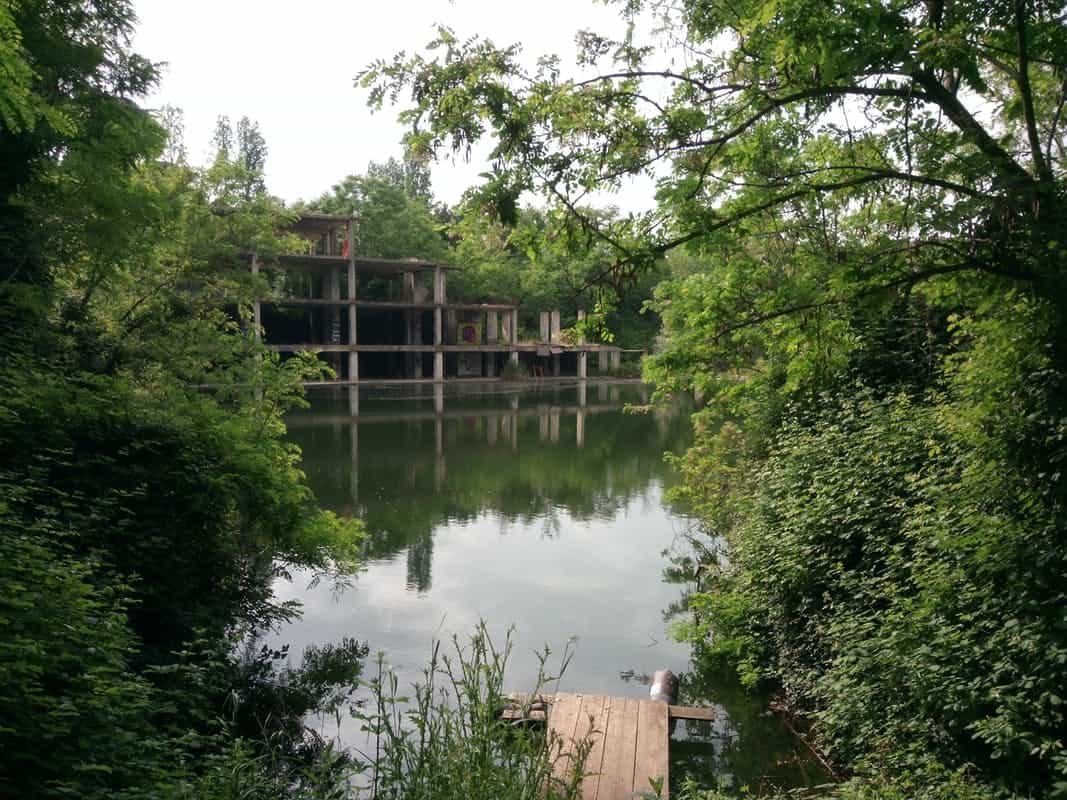
Anyone who arrives at Lago Ex SNIA expecting a tidy urban park is thrown off for the first five minutes. The banks are wild, the sheds of the old factory emerge among the pines, and the reinforced concrete skeleton of an unfinished commercial building rises out of the water. Then the eye adjusts and you realize that this is the most interesting thing: a piece of the industrial city that nature has taken back in 30 years, in plain sight, in the middle of an inhabited neighborhood.
Why Lago Ex SNIA Has Three Names
The official name of the natural monument is Lago ex SNIA - Viscosa, from the corporate name of the company that owned the land. Lago Bullicante comes from the historic place name of the area, Acqua Bullicante, which a street in the neighborhood still carries. It refers to the waters that bubbled up from the subsoil, an unmistakable sign of a water table close to the surface. Lago Sandro Pertini is the name the neighborhood gave it from below, and it can be read on the signs painted by the residents. Three names for the same body of water tell three different stories: the industrial one, the geological one, the political one.
How to Get to Lago Ex SNIA
The ordinary access is from the gate at Via di Portonaccio 230. If you arrive on foot from Largo Preneste, you follow the perimeter wall of the former plant and find the opening in the wall, which is not an architectural detail but the result of a dispute that lasted years.
By Metro C
The most convenient stations on Line C are Gardenie, in Piazzale delle Gardenie, opened on June 29, 2015 together with the section between Alessandrino and Lodi, and Malatesta. From both it's about a 10-minute walk through the Prenestino, which is also the best way to understand the context: 1950s apartment buildings, workshops, old-time shops, murals. If you're coming from the center, you can take Line C at San Giovanni, where the interchange with Line A is direct.
By Tram Along Via Prenestina
Lines 5, 14 and 19 run along Via Prenestina from Porta Maggiore to Tor de' Schiavi and stop at Largo Preneste, a few minutes from the park entrance. It's the route I recommend to anyone who wants to read the neighborhood from the window. You pass the buildings of the old industrial zone, you skirt the Verano behind you and you enter the Prenestino through the main door. When the tram network is affected by roadwork, the same lines run with replacement buses. It's best to check the route on the same day on the transit company's website.
By Car, by Bike, on Foot from the Pigneto
Arriving by car is possible but not very smart. The parking around Largo Preneste is that of a dense neighborhood, with residents who fight over it from seven in the morning. The bicycle works better, because the stretch between the Pigneto and Via di Portonaccio is flat. On foot from the Pigneto it takes about 20 minutes, and the route goes through one of the most photographed parts of Rome, photographed by Romans themselves.
The Factory Before Lago Ex SNIA: CISA Viscosa
Before the water there was rayon. In 1923 the CISA Viscosa plant opened in this area, intended for the production of so-called artificial silk: a fiber obtained with a mixed chemical and textile cycle, starting from cellulose treated with soda and carbon disulfide until a viscous solution is produced which, extruded through very fine spinnerets, solidifies into filament. The name of the factory is not a commercial fancy: viscose is the name of the process.
The plant came to employ about 2,500 workers, half of them women. It's a figure that is read distractedly today and that instead says everything about how the Roman periphery worked between the two wars: a neighborhood built around a gate, hours marked by the siren, a whole generation of textile workers who entered the factory as girls. Viscose processing involved exposure to carbon disulfide, a substance whose neurological toxicity occupational medicine would later document. The collective disputes that run through the history of the plant also arise from there, not only from wages.
The Factory and the Roman Resistance
During the German occupation of Rome the plant was a point of reference for the Resistance in the eastern part of the city. The factories of Via Prenestina and Via Tiburtina formed a working-class belt that fed the partisan formations, hid wanted people and organized strikes in conditions where striking meant risking deportation. It's a page that the neighborhood has never forgotten and that returns, every year, in the public events held inside the park.
The 1954 Closure and the Industrial Legacy
Production stopped in 1954. The first-generation artificial fibers lost ground to synthetic fibers derived from petroleum, the viscose cycle became expensive and environmentally unsustainable, and a plant wedged inside the city that had grown up around it no longer had room to expand. What remains are the sheds, the smokestack, the boundary walls and a pine grove planted in the 1920s, protected by a ministerial decree of 1968. That pine grove is today the most mature part of the park's greenery: trees a century old, grown when the factory was running all around.
SNIA Viscosa: Who Owned Lago Ex SNIA
The acronym that gives the lake its name comes from far away. SNIA was born in Turin in 1917 on the initiative of Riccardo Gualino, entrepreneur and collector, under the name Società di Navigazione Italo Americana: a maritime transport company between Italy and the United States. From 1920 the company changed trade and focused on artificial textile fibers, becoming SNIA Viscosa. Under the presidency of Franco Marinotti the group grew until it was, in 1925, the largest Italian company by capital, with a daily production of artificial yarns that represented the largely predominant share of the national total.
In 1937 SNIA introduced Lanital, a fiber made from milk casein, a flagship product of autarky. After the war the group diversified into mechanics, fine chemicals and biomedical, until the spin-off of the medical activities in 2003 and the insolvency declared in 2008. The brand still exists, in different hands and with another industrial scope.
For our story one precise corporate step matters: in 1969 SNIA Viscosa absorbed CISA by merger, and the Roman land entered its assets. From then on the fate of the area became a real estate affair.
From Industrial Assets to the Market: 1982, 1990, 1992
In 1982 the owner sold land and buildings to Società Immobiliare Snia s.r.l. In March 1990 the latter resold the property to Società Pinciana 188 s.r.l. In April 1990 the new owner obtained a building permit for a property for productive use. In November 1990 the real estate company passed to Ponente 1978 s.r.l., traceable to the builder Antonio Pulcini.
Anyone who reads this sequence of deeds with a Roman eye recognizes a familiar pattern: a disused industrial area, a formally productive designation, building substance. The project that takes shape on the land is a shopping center with an underground parking garage. In 1992 the excavations begin.
1992: How Lago Ex SNIA Was Born
The construction site digs. And meets water.
Under ground level, a few meters deep, runs a water table fed by the volcanic deposits of the Colli Albani: mineral water of excellent quality, which the place name Acqua Bullicante had been signaling for centuries to anyone willing to read the toponymy before signing a project. Closer to the surface flowed the Marranella stream, a historic watercourse of the area, buried and forgotten like so many other Roman streams.
Once the water table was intercepted, water began to gush into the excavation. The company's reaction was the typical one of someone who wants to avoid a work stoppage: divert the flow and channel it into the sewer system. The remedy turned out worse than the problem. The pipes couldn't handle the flow, went into overload and burst, and Largo Preneste ended up underwater. An urban flood, in the middle of the neighborhood, with Romans leaning out of their windows to watch the street turned into a torrent.
Once the bypass was closed and the network repaired, the water kept doing the only thing it knows how to do: fill the void. The basin dug for the parking garage turned into a lake, the level stabilized at the water balance imposed by the spring vein, and the site became unworkable. In that same year, 1992, the city administration annulled the building permit. The court dispute that followed dragged on until 2007.
The concrete structure of the commercial building begun that year and never completed still emerges from the water. It is the most eloquent unintentional monument of the whole affair: a speculation stopped by water, left where it sank.

The Water of Lago Ex SNIA: Geology of a Mistake
To understand Lago Ex SNIA you have to look below, not above. The eastern sector of Rome rests on volcanic deposits tied to the activity of the Colli Albani district, permeable materials that store and release good-quality water. Above these deposits ran the streams, the minor watercourses that Romans call marrane, and one of them, the Marranella, drained precisely this area.
The practical consequence is that the water table lies at a modest depth, on the order of a few meters below ground level. No geological surprise: a known condition, written into the street names. Acqua Bullicante means water that boils, that bubbles as it rises. A designer who had read a hydrogeological map before designing an underground floor would have known.
Why the Water Doesn't Go Away
The lake is not an accumulation of rain. It is continuously fed by the spring vein, and this explains three things the visitor notices right away: the level stays stable even in summer, the water is clear and the temperature stays low. A stagnant basin of that size, in a city like Rome, would become a green pool in August. Here it doesn't happen, because there is a turnover.
Can You Swim in Lago Ex SNIA
The question always comes, and the practical answer is blunt: no. The official descriptions of the monument speak of clean waters that are in theory suitable for swimming, and it is true that over the years water sports such as canoeing have been discussed. But on site there is no equipped beach, no lifeguard service, no safe access to the water. The banks are steep, the vegetation is dense and concrete structures from an abandoned construction site emerge from the bottom. The water of Lago Ex SNIA is for looking at, photographing and studying. You don't swim in it.
The Lago Ex SNIA - Viscosa Natural Monument
The recognition came on June 30, 2020, by decree of the President of the Lazio Region number T00108, published in the Official Bulletin of the Lazio Region of July 2, 2020 number 83, pursuant to article 6 of regional law number 29 of October 6, 1997 on protected natural areas. The measure establishes the natural monument named Lago ex SNIA - Viscosa and entrusts its management to RomaNatura, the regional body that administers the system of protected areas within the municipal territory of Rome.
The protected area is about 7.5 hectares. It's not a huge number, and in fact the neighborhood's historic request was always broader: protection of the entire complex, industrial sheds included. The decree protected the wet heart of the area, leaving out portions that remain the subject of litigation.
The Ecological Corridor Between the Aniene and the Appia Antica
The technical reason for the restriction is not only the rarity of the basin. Lago Ex SNIA works as an ecological corridor between the Valle dell'Aniene Nature Reserve to the north and the Appia Antica Park to the south. In a city that has fragmented its green space into islands separated by built-up fabric, a wetland in an intermediate position works as a stopover for migratory birds and as a genetic reservoir for the animal populations that move between the two large protected areas. Anyone who knows the network of Roman green areas, from the Cervelletta Park to the Parco di Aguzzano, knows that these intermediate links are worth more, ecologically, than their surface area.
What the Restriction Forbids and What It Allows
A natural monument is not a fenced park with a guard: it is a protection regime that prevents building transformations and alterations of natural balances, subjecting any intervention to the managing body. In practice it means that at Lago Ex SNIA you cannot build, you cannot modify the banks, you cannot alter the water regime. Public use, scientific research and nature maintenance remain compatible. The restriction, however, does not resolve the question of ownership: part of the area, the part from which the wreck of the shopping center emerges, has remained in private hands, and this is the reason the dispute did not close in 2020.
The Biodiversity of Lago Ex SNIA
The fact that most strikes naturalists is the speed. In a little over 30 years, without any renaturalization project, a flooded construction site has become one of the richest wetland environments in the city.
The Plants Around Lago Ex SNIA
The botanical surveys of the area count about 300 spontaneous plant species and 11 plant communities, including three habitats considered priority by the European Union under the criteria of the Natura 2000 network. Along the banks the common reed dominates, Phragmites australis, the symbol plant of wetlands and the true biological filter of the basin: its roots hold nutrients and oxygenate the sediment. Next to it grow the white willow, Salix alba, the white poplar, Populus alba, and the black poplar, Populus nigra: the classic succession of Lazio's riparian woods, appeared here spontaneously.
In the drier sectors, the vegetation instead tells the industrial story. On the walls of the disused factory a population of Aleppo pine, Pinus halepensis, has settled, a Mediterranean species able to colonize poor and rocky substrates. Here the rocky substrate is concrete. On the western bank a cooler community prevails, dominated by the bay laurel, Laurus nobilis. East of the lake and in the western part of the former factory there is a ruderal herbaceous vegetation, the kind botanists associate with disturbed ground. Among the exotic species is the black locust, Robinia pseudoacacia, which arrived in Europe from North America in the 1600s and is now present in half of Italy.
In the open meadow areas appear species typical of the pastures of the Roman countryside, such as Scabiosa maritima, Dasypyrum villosum, Securigera cretica and Securigera securidaca: a strip of countryside that survived on the outskirts, as happens in the Caffarella Park or along the Aqueducts Park.
The Birds of Lago Ex SNIA
The birdlife is the reason it's worth bringing binoculars. The official records of the natural monument document 62 bird species, three of them of Community interest. The surveys carried out in the following years by the naturalists who frequent the area indicate noticeably higher numbers, a sign that the list grows with every observation season.
Among the regular presences are the mallard, which nests on the lake, the common moorhen and the kingfisher, which is the encounter everyone hopes for: a blue and orange arrow that flies low over the water and dives from a fixed perch. There is the common pheasant in the open areas. Passing through you can see the peregrine falcon, which in Rome nests on tall buildings and hunts in flight, and the woodcock. In the reed beds herons appear, and among the species cited as significant are the purple heron and the squacco heron, ardeids tied precisely to dense reed beds.
Insects, Bats, Mammals
Dragonflies are the most sensitive indicator of the quality of still water, because their larvae live submerged for months. At Lago Ex SNIA several dozen species have been counted, a significant share of Italy's dragonfly fauna. There are beetles and butterflies in quantity.
Among the mammals, the most plentiful are the bats: Savi's pipistrelle, Hypsugo savii, and Kuhl's pipistrelle, Pipistrellus kuhlii, hunt at dusk above the water, where the density of insects is highest. A Kuhl's pipistrelle eats every night a quantity of mosquitoes that no chemical treatment matches. And then there is the fox, an occasional but documented presence, which frequents the area as it frequents half of the Roman outskirts.
The Parco delle Energie, the Casa del Parco and the CSOA eXSnia
Lago Ex SNIA is not an isolated area: it is the wet part of a larger organism, the Parco delle Energie, inaugurated in 1997 on the site of the former factory. The name comes from the declared vocation of the place, which from the beginning has combined public green space, environmental experimentation and neighborhood social activities.
The Casa del Parco
The main base is the Casa del Parco delle Energie, at Via Prenestina 175, completed in 2012 with green building criteria. It is the place where assemblies are held, where the documentary memory of the area is kept and where you go if you're looking for information on the activities. The Forum Territoriale Permanente del Parco delle Energie, the body that coordinates management from below, meets here on the first Wednesday of every month at 19:00, and the meetings are open.
The Social Center and the Workers' Archive
In 1995 the spaces of the former factory were occupied and the self-managed social center eXSnia was born. Beyond whatever political judgment anyone may have about the occupation of a building, one fact must be acknowledged: inside those sheds, archive material from the factory was recovered and saved, documents that tell of the productive and union life of the plant and that would otherwise have ended up in a landfill along with the machinery. The industrial memory of the eastern quadrant of Rome, the kind that museums present in display cases as at the Centrale Montemartini, was preserved here by the people who lived around it.
Who Opens and Closes the Gate
The daily management of access to the lake is entrusted to volunteers. The gate at Via di Portonaccio 230 opens every day from 10:00 to sunset thanks to shifts organized by the Forum and by the groups that animate the space, which self-finance with public events. It's a fragile formula, dependent on people's availability, and it's worth knowing before you plan the visit on a day of pouring rain or during the mid-August holidays.
30 Years of Dispute Over Lago Ex SNIA
The story of Lago Ex SNIA is, in its entirety, a story of urban conflict. Summarizing it in three lines would betray it. It's worth going through it stage by stage.
1992-2007: The Permit, the Annulment, the Legal Paperwork
Already in 1992, as soon as the excavations started, citizens filed a formal complaint about the building permit issued to the real estate company. The city administration annulled the permit that same year, but the owner appealed, and the administrative litigation continued until 2007. Meanwhile the water rose and the site stopped by itself.
2003-2004: The Park Project and the Expropriation
In 2003 the City of Rome approved the Progetto del Parco Prenestino ex Snia Viscosa, which envisages a park extending beyond Via di Portonaccio as far as the Prenestina station and the present Parco Pasolini. On the basis of that project, in 2004, the area between the lake and Via di Portonaccio was expropriated, with funds allocated to the capital. The overall project, however, had no follow-up, and the expropriated area remained abandoned for years: an expropriation without a park.
2008-2009: The Swimming World Championships Pool
With the approach of the Rome 2009 Swimming World Championships, the idea of building a swimming facility on the area came up. The neighborhood responded with a mobilization that culminated in a demonstration on April 1, 2009, built with the irony typical of successful Roman disputes. The idea was withdrawn.
2013: The Bando Ricognitivo and the Citizens' Entry
This is the decisive year. The Bando Ricognitivo of the city administration led by Gianni Alemanno opened to the proposal of the same Ponente 1978: 55,000 cubic meters of construction, four towers and the covering of the lake. Covering a lake to build on top of it, in a city that spent centuries looking for water. The Prenestino's answer was a mass entry: thousands of people entered the area claiming access to an environmental asset that formally was not yet public.
2014-2016: The Opening in the Wall and the Taking Charge
After about a year of initiatives the City completed the expropriation of the lake area and in 2014 opened a gap in the wall on Via di Portonaccio, making the park physically accessible. The formal act, however, was not followed by a real management takeover, and from spring 2016 the Forum Territoriale took on responsibility informally: fixed opening hours, maintenance, minimal equipment, mowing, paths.
2020-2023: The Decree and What Remains Outside
The establishment of the natural monument in 2020 closed the main game and opened a new one, because the protected perimeter only partly meets the requests put forward by the Forum. In November 2023 the committees once again filed a complaint to ask for the protection and expropriation of the entire area, including the private portion from which the wreck of the shopping center emerges. The dispute, which began with a complaint in 1992, has passed 30 years.
The complete chronicle of the affair, with the documents and dates, is published by the committee on the site lagoexsnia.wordpress.com.
Lago Ex SNIA in Popular Culture
Few Roman places on the outskirts have produced so much iconography. In 2014 Assalti Frontali, a Roman rap group of long militancy, dedicated to the basin the song Il lago che combatte, which gives the place its most widespread nickname. In 2017 the cartoonist Michele Rech, Zerocalcare, who grew up in this very area between Rebibbia and the Prenestino, made a calendar dedicated to the lake. In September 2022 the twinning with the Marais Wiels was celebrated, an anthropogenic wetland in the municipality of Forest in Brussels, also born from an interrupted building excavation: two different cities, the same hydraulic story, the same conflict over land.

How to Visit Lago Ex SNIA
The visit takes no more than an hour and a half if you limit yourself to the loop around the basin and the pine grove. It becomes a whole afternoon if you add reading the panels, a stop in the clearings and a walk in the Prenestino.
The Route Around Lago Ex SNIA
From the gate on Via di Portonaccio you go down toward the hollow. The main path follows the edge of the basin counterclockwise and alternates stretches of reed bed, where the water disappears behind the vegetation, with open windows onto the water. The western bank, the one dominated by laurel, is the coolest and shadiest. The east side, with the ruderal herbaceous vegetation, is more open and sunnier. The historic 1920s pine grove is crossed in the upper part, and it's worth stopping to look at the trunks: they are the only trees that saw the factory in operation.
What Shoes You Need
This is not a paved garden. The paths are packed earth, with exposed roots and muddy stretches after rain. A few passages are steep. Sneakers are enough, sandals are not. In summer it's best to bring water, because there are no kiosks inside the area.
Lago Ex SNIA with Children
It works well, on two conditions. The first is supervision: the banks are not protected by continuous railings and the water is deep a few steps from the edge. The second is the choice of time: in the early morning or late afternoon the birds really can be seen, and a child who manages to watch a kingfisher or a brood of mallards remembers that day for years. The Parco delle Energie offers open spaces better suited to play than the banks of the basin.
Accessibility
The initial stretch from the entrance can be walked without particular difficulty, while the full loop around the lake has slopes and a natural surface that make the use of wheelchairs and rigid strollers problematic. If you have specific needs, you do well to contact the Casa del Parco in advance to find out which stretches are passable in the current season.
When to Go to Lago Ex SNIA
The best season is late winter and spring, between February and May: the water is at its maximum level, the reed bed has not yet closed off all the views, and the migratory passage brings species that are not seen in summer. Autumn is the second choice, with the advantage of low light. In the middle of August the park is still beautiful but the central hours are tough, and animal activity is concentrated at dawn and sunset. Recent rain doesn't spoil the visit. I advise against it only because of the state of the paths.
Frequently Asked Questions About Lago Ex SNIA
How much does it cost to enter Lago Ex SNIA?
Entrance to Lago Ex SNIA is free: there is no ticket or ticket booth, and access to the park and the lake is open. It is one of the few natural areas in Rome born spontaneously inside the city, and the volunteer management of the site keeps it accessible at no cost.
What are the opening hours of Lago Ex SNIA?
The gate at Lago Ex SNIA opens every day from 10:00 until sunset, with hours guaranteed by volunteers. Since the management is volunteer-run, in extreme weather or during holiday periods the opening can vary, so it's best to allow for some flexibility.
Where is the entrance to Lago Ex SNIA and how do you get there?
The ordinary access to Lago Ex SNIA is from the gate at Via di Portonaccio 230, on the eastern outskirts of Rome. By Metro Line C, the most convenient stations are Gardenie, in Piazzale delle Gardenie, opened on June 29, 2015 on the section between Alessandrino and the neighboring areas.
How was Lago Ex SNIA born?
Lago Ex SNIA was born in 1992, when a construction site intercepted a water table fed by the volcanic deposits of the Colli Albani, flooding the excavation intended for a shopping center that was never completed. The company tried to divert the water into the neighborhood's sewer system, but the flow of the water table overcame every attempt at draining.
How long does it take to visit Lago Ex SNIA?
The visit to Lago Ex SNIA takes no more than an hour and a half if you limit yourself to the loop around the basin and the pine grove. It becomes a whole afternoon if you add reading the information panels, a stop in the clearings and a walk in the nearby Prenestino neighborhood.
Is Lago Ex SNIA a protected natural area?
Yes. Since June 30, 2020 Lago Ex SNIA has been recognized as a regional natural monument, by decree of the President of the Lazio Region, and its management is entrusted to RomaNatura. The natural monument protects about seven and a half hectares, although the portion from which the skeleton of the never-completed shopping center emerges has remained private.
What was there before Lago Ex SNIA?
In place of Lago Ex SNIA stood the CISA Viscosa plant, opened in 1923 to produce rayon, an artificial textile fiber obtained from cellulose treated with soda and carbon disulfide. The production cycle employed about 2,500 people, half of them women, until the factory closed in 1954.
What to See Around Lago Ex SNIA
The area rewards those who stay. To the west, beyond the railway, begins the Pigneto, with the pedestrian stretch of the market, the historic trattorias and the low houses that served as the backdrop of neorealist cinema. To the north you reach the Verano monumental cemetery, which is to all effects an open-air museum of 19th-century sculpture. To the east, along Via Prenestina, you find the Castagneto Prenestino, another example of green space reclaimed by the neighborhood. If you want to stay on the theme of industrial archaeology, a short distance away you find the Snodo Mandrione, under the arches of the aqueducts.
The rest of the former industrial area is told on the page dedicated to the ex SNIA, which completes the picture on the sheds and the spaces of the complex. For a day devoted entirely to Rome's less-trodden green spaces, the Parco del Pineto and the Monte Mario Reserve are the natural complements on the opposite side of the city.
If you are organizing a day like this for a group, a school class or a company delegation, in the services of TourLeaderPro in Rome you find the operational support of guides who know the eastern outskirts, and not only the historic center.
A Curiosity About Lago Ex SNIA
The curiosity that few people know is about the sewer. When the construction site intercepted the water table in 1992, the company's reaction was not to stop: it was to divert the water into the neighborhood's sewer system, hoping to empty the excavation faster than the spring filled it. The calculation was wrong for an elementary reason of hydraulics: a water table fed by a volcanic aquifer has a flow that does not depend on the will of those who dig, and an urban sewer network is sized for domestic discharges and rainwater, not for a permanent spring. The pipes went under pressure and burst. Largo Preneste flooded.
The detail that makes the affair memorable is that the neighborhood had the answer written on its street signs for generations: Acqua Bullicante. The name indicates water that boils at the surface, that is, an outcropping water table. Roman toponymy is a free hydrogeological archive, and in this case it was ignored by those who were designing an underground floor.
Then there is the geographical detail that overturns the city's tourist hierarchies. Lago Ex SNIA exceeds in size the lake at Villa Borghese, the basin that appears in half a million photographs a year, and it turns out to be the largest body of water inside the railway ring that encircles Rome. The biggest lake in the consolidated city is not the one where you rent rowboats: it is the one born by mistake behind an industrial boundary wall, in the eastern outskirts, and for 20 years no tourist guide ever mentioned it.
Something Nobody Tells You About Lago Ex SNIA
Nobody says that the lake, legally, is divided in two. The natural monument established in 2020 protects about seven and a half hectares, but it did not resolve the question of who owns the land: the portion from which the concrete skeleton of the never-completed shopping center emerges has remained private. It means that the visitor walking the bank looks at a protected environmental asset and, at the same time, at someone else's property. This asymmetry explains why the dispute did not close with the regional decree and why in November 2023 the committees went back to asking for the expropriation of the entire area.
The second thing nobody says concerns who opens the gate. There is no municipal custodian, no permanent staff: the daily opening from 10:00 to sunset is guaranteed by volunteers, with shifts organized by the Forum Territoriale Permanente del Parco delle Energie and financed with self-produced public events. A protected natural area of the Lazio Region is physically accessible because a group of residents took on a task that no body was performing. If you arrive on a weekday in the middle of August or during a downpour, you may find the gate closed, and not out of whim.
The third concerns the archive. Inside the sheds occupied in 1995, documentation from the factory was recovered: production papers, union materials, the memory of Roman working-class labor. A part of the capital's industrial history was saved in there, not in an institute.
The Advice I Give You for Visiting Lago Ex SNIA
Go early in the morning, on a spring weekday, and bring binoculars, even small ones. This is the advice I have repeated for years to anyone who asks me, and it has three technical reasons.
The first is light. The basin is sunken and surrounded by tall vegetation. In the central hours the water reflects the white sky and flattens everything, while in early morning the raking light separates the planes, brings out the green of the reed bed and makes the concrete wreck in the middle of the water legible.
The second is wildlife. Water birds are active at dawn and in the late afternoon, and the kingfisher, the encounter everyone hopes for, hunts from fixed perches in the cool hours. The binoculars are needed because the distances across the reed bed are greater than they seem and with the naked eye you miss half of what happens.
The third is solitude. On weekends the area is used by the neighborhood, and rightly so: it was born for that. But to understand the place you have to hear it in silence, with the background noise of Via Prenestina arriving muffled and the gurgle of the water.
I'll add one unromantic practical note: check the status of the tram lines on the same day, because roadwork on the Roman surface network often changes the routes. And dress as for a country walk, not as for a visit downtown: here the ground is natural, and after rain you feel it under your shoes. If you are preparing a broader Roman itinerary around this stop, you can lean on the advice in ItalyPlanner on three days in Rome to fit the travel times together.
Another Well-Known Fact, Yet Rarely Cited
Everyone knows there was a factory here. Almost nobody remembers what was produced here and at what human cost. The CISA Viscosa plant, opened in 1923, produced rayon, the artificial silk obtained by treating cellulose with caustic soda and carbon disulfide until a viscous mass was produced which, pushed through spinnerets, became continuous filament. The cycle employed about 2,500 people, half of them women, in an era when women's factory work was the norm in textiles and the exception elsewhere.
Carbon disulfide is a neurotoxic solvent, and the history of viscose across Europe coincides with the history of occupational medicine applied to workplace poisoning. The collective disputes that ran through the factory were not only about wages: they were about the air breathed inside the departments.
Then there is the chapter that the neighborhood kept alive longer than official historiography: during the German occupation the plant was a point of reference for the Roman Resistance. The belt of factories on Via Prenestina and Via Tiburtina fed the partisan formations in a city where striking meant risking deportation.
Production ceased in 1954, overwhelmed by competition from synthetic fibers derived from petroleum and by the impossibility of expanding in an urban fabric that in the meantime had surrounded the sheds. What remained were the walls, the pine grove planted in the 1920s and protected by a ministerial decree of 1968, and a community that kept living around a closed gate.
The Right Photo to Take at Lago Ex SNIA
The photograph that tells Lago Ex SNIA better than any other is the one that holds the water and the concrete in the same frame: the reed bed in the foreground, the water in the center, and in the background the wreck of the concrete structure of the never-finished shopping center, with the pillars coming out of the water. It is the exact image of the affair: the speculation stopped and submerged, nature slowly taking it back.
Technically it's best to work in the first hour after the gate opens or in the last one before sunset. The raking light does two favors: it separates the green of the reed bed from the gray of the concrete and gives long reflections on the water, which in the central hours becomes a white slab. A polarizing filter helps you choose whether to see the reflection or the bottom.
The second shot I recommend is vertical, inside the historic pine grove: the trunks from the 1920s backlit, with the basin glimpsed between the stems. It tells of the layering of the place, which is both industrial and wooded.
The third is a detail shot: the roots of the common reed at the edge, or the factory's boundary wall with the Aleppo pine growing on the concrete. This last image, a Mediterranean tree rooted on an industrial structure, is the biological portrait of the place.
A rule of good manners that counts for more than any camera setting: you don't enter the reed bed to get closer to the birds. It is the nesting habitat, and one more photograph isn't worth an abandoned brood. The telephoto lens exists for this.
Some Important Events That Happened Here in History
The first event is from 1923: the opening of the CISA Viscosa plant, which turns a portion of suburban countryside into an industrial hub with thousands of employees and redraws the neighborhood around it.
The second belongs to the war years, when the factory becomes a point of reference for the Roman Resistance in the eastern part of the city.
The third is the closure of 1954, which opens the long period of abandonment and, with the 1969 merger into SNIA Viscosa, starts the passage of the land from industrial assets to the real estate market, with the sales of 1982 and 1990.
The fourth is the accident of 1992: the excavation for the parking garage intercepts the water table, the attempt to dump the water into the sewer sends the pipes under pressure, Largo Preneste floods and the lake is born. In the same year the City annuls the building permit and citizens file the first formal complaint. The litigation will drag on until 2007.
The fifth is 2013, the year of the Bando Ricognitivo with the project of 55,000 cubic meters, four towers and the covering of the water, and also the year of the first mass entry of citizens into the area.
The sixth is 2014, with the completion of the expropriation of the lake area and the opening of the gap in the wall on Via di Portonaccio: the moment when the basin stops being a forbidden place.
The seventh is June 30, 2020, with the decree of the President of the Lazio Region number T00108 that establishes the Lago ex SNIA - Viscosa natural monument and entrusts its management to RomaNatura.
The eighth is September 2022, with the twinning between this basin and the Marais Wiels in Forest, Brussels, another wetland born from an interrupted building excavation: two European outskirts that recognize they have the same story.
Who Passed Through Lago Ex SNIA
The people who left a documented mark on this place are not emperors or cardinals, and that should be said clearly rather than masked with lofty names.
First of all passed thousands of women and men workers: about 2,500 people at a time in the decades the plant was active, half of them women, who went through that gate every morning between 1923 and 1954. The partisans passed through, who found support in the factory during the German occupation.
On the industrial side, the name that weighs most is that of Riccardo Gualino, founder of SNIA in Turin in 1917, entrepreneur and art collector, and that of Franco Marinotti, president under whose leadership the company became in 1925 the largest Italian firm by capital. They are figures tied to the ownership of the group more than to the daily life of the Roman plant, and they should be cited for what they are: the men of the holding company.
On the opposite side, the one that prevented cementification, passed the thousands of citizens of the Prenestino and the Pigneto who in 2013 entered the area claiming public access to it, and the volunteers who since 2016 open the gate every day.
Among those who gave the place its public image are Assalti Frontali, who in 2014 dedicated the song Il lago che combatte to it, and Zerocalcare, who grew up in this area and in 2017 made a calendar dedicated to the basin. In 2022 the Belgian delegations of the Marais Wiels arrived for the twinning.
The founding decree of the natural monument instead bears the signature of Nicola Zingaretti, then president of the Lazio Region: an institutional step that closes, on paper, a dispute that lasted almost 30 years.
Quick Questions About Lago Ex SNIA
How much does it cost to enter Lago Ex SNIA
Nothing. There is no ticket or ticket booth: access to the park and the lake is open and free.
What are the opening hours of Lago Ex SNIA
The gate on the lake opens every day from 10:00 until sunset, with hours guaranteed by volunteers. Since the management is volunteer-run, in extreme weather or during holiday periods the opening can vary.
Where is the entrance to Lago Ex SNIA
The pedestrian entrance is at Via di Portonaccio 230, in the V Municipio. The Casa del Parco delle Energie is instead at Via Prenestina 175.
How do you get to Lago Ex SNIA by metro
With Line C, getting off at Gardenie or Malatesta. From both stations it's roughly a 10-minute walk.
Which tram goes to Lago Ex SNIA
Lines 5, 14 and 19 run along Via Prenestina between Porta Maggiore and Tor de' Schiavi and stop at Largo Preneste. During roadwork on the tram network the same lines run with replacement buses.
Do you need to book to visit Lago Ex SNIA
No. No reservation is required for a self-guided visit. The public events and organized nature walks instead follow the calendars announced by those who manage the space.
Can you swim in Lago Ex SNIA
No. There are no equipped access points, supervision or swimming services, the banks are steep and concrete structures from the old construction site emerge from the bottom.
Can you bring dogs to Lago Ex SNIA
The park is used daily by the people who live around it, dogs included, but since it is a natural monument with nesting in the reed bed, the leash is not optional. The detailed rules should be asked at the Casa del Parco.
How long does it take to visit Lago Ex SNIA
An hour and a half is enough for the loop around the basin and the pine grove. With birdwatching, stops and a walk in the neighborhood you easily reach half a day.
Is Lago Ex SNIA suitable for children
Yes, with constant supervision: the banks have no continuous railings and the water becomes deep a short distance from the edge. The open spaces of the Parco delle Energie are better suited to free play.
Is Lago Ex SNIA wheelchair accessible
The initial stretch from the entrance is easy, the full loop is not: natural surface, exposed roots and slopes. It's best to ask in advance at the Casa del Parco about the seasonal condition of the paths.
Can you take photographs at Lago Ex SNIA
Yes, without limitations for personal use. The rule applies of not entering the reed bed to get close to the nesting birds.
Why is the lake called Bullicante
From the historic place name of the area, Acqua Bullicante, which indicated the surfacing, bubbling waters of the water table below. A street in the neighborhood still carries that name.
Who manages Lago Ex SNIA
The natural monument is entrusted to RomaNatura, the regional body for the protected areas of Rome. The daily management of access and the ordinary maintenance are ensured by the Forum Territoriale Permanente del Parco delle Energie and by the groups that animate the area.
When was the natural monument established
On June 30, 2020, by decree of the President of the Lazio Region number T00108, published in the Official Bulletin of the Lazio Region of July 2, 2020 number 83.
How big is the protected area of Lago Ex SNIA
The protected perimeter covers about 7.5 hectares. The body of water exceeds in size the lake at Villa Borghese and is the largest of those inside the Roman railway ring.
How many birds can you see at Lago Ex SNIA
The official records of the monument list 62 species, three of them of Community interest. The later field surveys noticeably raise the count. Among the most sought-after presences are the kingfisher, the mallard and, passing through, the peregrine falcon.
What is the difference between Lago Ex SNIA and the EUR lake
The EUR lake is a designed artificial basin, set in a planned neighborhood. Lago Ex SNIA is a spring-fed basin born by mistake in a construction site and protected as a natural monument. The first is architecture, the second is hydrogeology.
Can you visit Lago Ex SNIA with a guide
There are no guided tours at set times. If you want professional accompaniment, for a school or company group, you can turn to industry operators such as TourLeaderPro, who also work outside the historic center circuit.
Is it worth coming all the way here if you have only a few days in Rome
If it's your first visit to the city and you have two days, no: the Colosseum, the Pantheon and the Vatican Museums come first. On a second or third visit, instead, Lago Ex SNIA is worth more than many famous destinations. If you are planning a stay in English, you'll find an overview of the priorities in the ItalyPlanner guide to things to do in Rome.
Is there a bar or kiosk inside the park
Inside the area there are no continuous refreshment services: it's best to bring water. The neighborhood bars, along Via Prenestina and toward the Pigneto, are a few minutes' walk away.
The Verdict on Lago Ex SNIA
It's wise to distrust places that tell their own story. Lago Ex SNIA is one of them, and it passes the test anyway: here industrial history, hydrogeology, urban conflict and biology hold together within a radius of 300 meters, and explain each other without need for rhetoric.
It's not a place for those seeking comfort. There are no services, the ground is natural, the gate depends on people who get up in the morning to open it. But if you're looking for a piece of Rome that no postcard has yet worn out, and you want to understand how a city really works when water decides to have its say, this is the address. Bring binoculars, arrive early, and leave the reed bed to the birds.
Article written by the editorial team of TourLeaderPro, contact them for Private/Corporate/V.I.P. Tours and Experiences.
Planning a trip to Rome? The English guides for visiting the city are on ItalyPlanner.com.