San Sisto Vecchio
In short. San Sisto Vecchio stands at Piazzale Numa Pompilio, at the point where Viale delle Terme di Caracalla ends and the road continues toward Porta San Sebastiano, becoming the urban stretch of the Appian Way.
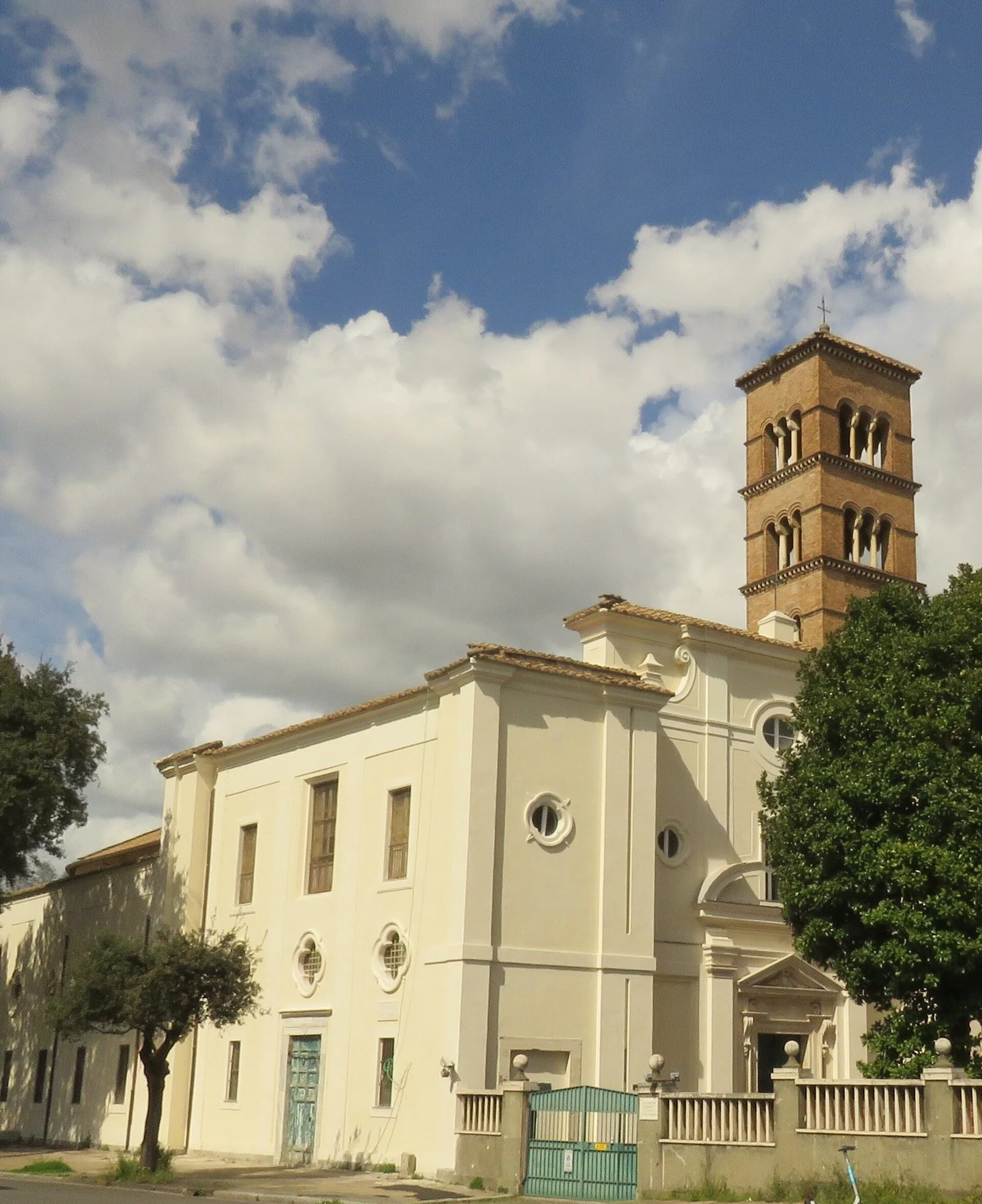
San Sisto Vecchio stands at Piazzale Numa Pompilio, at the point where Viale delle Terme di Caracalla ends and the road continues toward Porta San Sebastiano, becoming the urban stretch of the Appian Way. It is a very ancient title, the titulus Crescentianae, and it is the place where in 1221 Saint Dominic of Guzmán set up the first Dominican convent of nuns in Rome. Anyone who comes here after visiting the Baths of Caracalla finds an 18th-century facade in muted colors, a medieval bell tower sticking out at the side and a door that is almost always closed. The part that justifies the trip, a cycle of medieval frescoes among the least visited in Rome, can't be seen by passing at random: the convent rooms open only on request and by arrangement made in advance with the religious community that still lives in the complex. This page explains what is really inside, what the sources say and where the sources diverge from one another, how to get there and what to realistically expect from an unplanned visit.
Where San Sisto Vecchio is and how to get there
The basilica's address is Piazzale Numa Pompilio 8, while the entrance to the monastery and the generalate faces Via Druso, the street that runs down the right side of the complex. Both indications appear in the institutional listings and do not contradict each other: the piazzale is the facade, Via Druso is the side with the service doors and the access to the community. Anyone who sets the navigator to Via Druso arrives behind the church and then has to go around the block.
By metro
The useful stop is Circo Massimo, on line B. From there you walk along Viale delle Terme di Caracalla for about one kilometer, slightly uphill in the final part, with a real time of 12 or 15 minutes at a normal pace. The route is all on a wide, tree-lined sidewalk, on the left side of the roadway looking south, and passes in front of the entrance of the Baths of Caracalla. If you arrive from Termini, take metro B toward Laurentina and get off at the third stop after Colosseo.
There is also the Piramide option, also line B, with a longer and less pleasant walk along Viale Giotto and Viale Guido Baccelli. It only makes sense for those coming from the Roma Lido railway or from the Porta San Paolo and Pyramid of Cestius quadrant.
By bus
Piazzale Numa Pompilio is served by the surface lines that run along Viale delle Terme di Caracalla and continue toward the Appian Way. The most recognizable is the 118, which links the area with the Catacombs of San Callisto, the Catacombs of San Sebastiano and the Appian Way Regional Park: it's the line Romans use to get down to the Appian Way without a car. Surface routes in Rome change often because of work sites and detours, so check on the day itself on the transport company's app and not on a printed guide. For the general picture of Roman transport we have a dedicated page on how to get around Rome.
On foot, and why it's worth it
San Sisto Vecchio gives far more as a stop on a walk than as an isolated destination. From the Circus Maximus you go down along the Baths of Caracalla, arrive at the piazzale, go into the church, and then continue along Via di Porta San Sebastiano to Porta San Sebastiano, which is the point where the Appian Way leaves the Aurelian Walls. It's a little over two kilometers in all, largely on a narrow, lightly trafficked road, with villa walls and cypresses on either side. This is the beautiful part of the route, and almost nobody does it.
By car and by bike
Parking around the piazzale is paid, with blue lines, during weekday daytime slots, and free spaces are few in the middle hours of the morning, when the coaches headed for Caracalla arrive. Anyone coming from outside Rome does better to leave the car at a line B park-and-ride and finish by metro. By bicycle the stretch from Circo Massimo is doable but has to be shared with the fast traffic of the avenue. If you want to understand which Roman cycling routes really work, you'll find an honest assessment on our page on Rome by bike.
What you really see, and what you don't
This is the most important practical point of the page, and it has to be said before the history: going in through the church door you see the 18th-century hall, not the medieval convent. The frescoes that make San Sisto Vecchio a place of interest for art history are in rooms that belong to the monastery, and access depends on the availability of the religious community. There is no ticket office, there is no marked route, there is no custodian who accompanies visitors.
The 18th-century hall
The interior, redone in the 18th century, has a single nave, light, sober, with plastered walls and unshowy side altars. Anyone who arrives expecting the theatrical baroque of the churches of the center will be disappointed, and it's better to know that. The interest of the hall is of a different kind: it is a reorganization that swallowed an early Christian basilica and a medieval church, leaving in view only two fragments, the bell tower and the apse area. Looking at that hall knowing what lies beneath completely changes the experience. Looking at it without knowing means walking out in four minutes thinking there was nothing.
The apse area
The surviving part of the medieval building is the apse, spared by the 18th-century work site. The available descriptions speak of more than one apse superimposed over time, with a 13th-century layout and a second intervention attributed to the 15th century, and place the painted cycle precisely in the gap between the two. This is one of the pieces of information we were unable to verify in person and that we report as we find it in the sources, noting that the description is technical and hard to reconstruct without the monument in front of you.
The bell tower
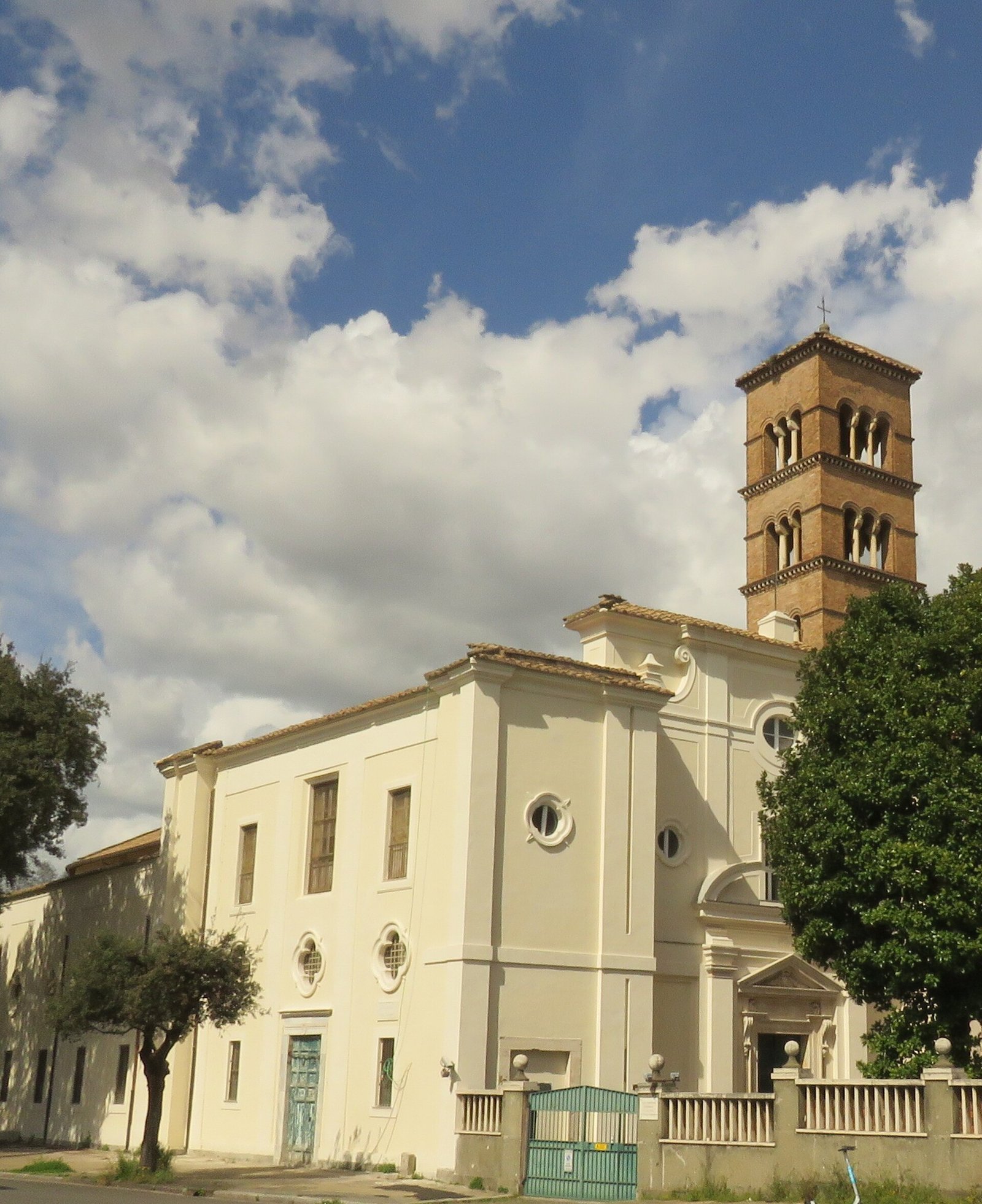
The bell tower is visible from the outside without going in, and by itself justifies a five-minute stop on the piazzale. It has a square plan and three orders of triple-arched windows, with white marble colonnettes supporting the little arches. At the base a sundial is still legible. The sources describe it as about 13 meters tall and restored in 1938, and report a single bell, cast by the Lucenti foundry in 1817.
The convent rooms
Cloister, chapter house and refectory belong to the monastery and are seen only by arrangement made beforehand. The cloister is square, with six round arches on each side, and in the lunettes it preserves an 18th-century cycle with Stories of the Life of Saint Dominic attributed to Andrea Casale. The chapter house has mullioned windows. The refectory is of notable size, indicated as about 33 meters in its first stretch. Anyone who wants to see these spaces has to write or phone in advance and accept the idea that the answer may be no.
The titulus Crescentianae: the origins of the place
The founding of the title dates to the end of the 4th century and tradition ties it to Pope Anastasius I, whose pontificate is placed between 399 and 401. The original name, titulus Crescentianae, points in all likelihood to a matron named Crescentiana who would have financed the building. It is the standard mechanism by which Roman titles arise, that is private houses of well-off Christian families turned into places of worship and then into proper churches.
Why right here
Some reconstructions place the founding on the site of a private bath complex, the balneum Mamertini, attributed to a Roman prefect. The fact appears in local popular literature and we are not able to confirm it from direct archaeological sources, so we report it as a current hypothesis and not as an established finding. What is certain is that the area, in the late empire, was a semi-peripheral belt of large estates and public facilities, dominated by the mass of the imperial baths.
From Crescentiana to Sixtus
The dedication to Saint Sixtus appears in a document of 595. The saint is Pope Sixtus II, martyred in 258 under Valerian, killed in the cemetery of Callixtus together with some deacons. His most famous deacon, Lawrence, was executed a few days later. The relics of Sixtus II were brought here from the catacombs during the early Middle Ages, and the transfer is generally referred to the 6th century and the pontificate of Gregory the Great. The link between this church and the Catacombs of San Callisto, which lie a little farther on along the same Appian Way, is therefore not only geographical.
The early Christian basilica
The measures that circulate for the original building are precise: about 47.4 meters by 17.8, three aisles divided by arcades on 24 columns. Six granite columns with acanthus-leaf capitals would still be in place. These numbers appear in only one line of sources and should be compared with the specialist archaeological literature before being taken as definitive. We report them because they are the only ones available, noting the limit.
The work site of Innocent III
Between 1198 and 1216, during the pontificate of Innocent III, the church was rebuilt. The work is said to have raised the floor level by more than two meters and reduced the hall to a single nave, keeping the apse. The bell tower is also attributed to this season, and here arises one of the divergences we deal with further on: some institutional listings date it to the 12th century, others to the first quarter of the 13th.
Saint Dominic at San Sisto: the chronology, and where it doesn't add up
The sequence of Dominican events at San Sisto is known in its general lines, and is told badly almost everywhere. The crux is that in a few years, between 1219 and 1221, two different communities succeed one another in the same complex, a male one and a female one, and that the female community is not born here from scratch but arrives from another monastery in the area. Whoever skips a step gets a version that seems plausible and is wrong.
1219: Honorius III hands San Sisto to Dominic
Between the end of 1219 and the first months of 1220 Pope Honorius III entrusts Dominic of Guzmán with the task of reforming the women's monasteries of Rome and hands him the church of San Sisto. The first concrete effect is male: Dominic gathers here a community of preaching friars. San Sisto is therefore the first Roman seat of the Order of Preachers, and it is so for a very short time.
1220: the friars move to Santa Sabina
Shortly after, the friars leave San Sisto and settle on the Aventine, at Santa Sabina, which will become and remain the Roman home of the Dominicans. The sources place the move between 1220 and 1221 and do not agree on the exact year. The reason for the transfer is functional: San Sisto was needed for the women's project wanted by the pope, and the friars had to free the spaces. Dominic nevertheless continued to follow the San Sisto community in person, going down from the Aventine, according to tradition, every day. The walking distance between Santa Sabina and Piazzale Numa Pompilio is about two and a half kilometers, and anyone who walks it today understands what it meant to do it twice a day.
February 24, 1221: the nuns enter
The date that the Dominican sources give for the nuns' entry into the new monastery is February 24, 1221, Ash Wednesday. The group is composite. Almost all the nuns of the monastery of Santa Maria in Tempulo arrive, which was a short distance away, along the same line of the Appian Way. Four or five nuns arrive from Santa Bibiana. A few isolated vocations arrive. And from Prouille, in Languedoc, arrives a nucleus of eight nuns with a prioress destined to lead the Roman community, accompanied by the Bishop of Toulouse, Fulk. This is the first Dominican convent of nuns in Italy.
Where the version that circulates doesn't add up
The reconstruction that circulates in guides and online summaries often reverses the direction of the movement and has the nuns move from San Sisto to Santa Maria in Tempulo. It is the opposite. Santa Maria in Tempulo is the monastery of departure, San Sisto is the one of arrival. Whoever reads the reversed sentence builds a chronology in which Dominic founds at San Sisto and then moves elsewhere, while Honorius III's project was exactly to centralize at San Sisto scattered and poorly governed Roman women's communities.
A second confused point concerns the formula "first Dominican community of Rome". It holds for the friars, who were at San Sisto first, and it holds for the nuns, who at San Sisto made up the Order's first women's monastery. They are two distinct firsts, separated by a year or a little more, and they are regularly merged into one. When in doubt, the criterion to keep is chronological: first the friars, then the move to Santa Sabina, then the nuns.
A third point deserves caution. Some listings date the establishment of the women's monastery to 1222, others to 1221. The date of February 24, 1221 comes from the Order's tradition and is the most detailed, because it is given with the liturgical day. The year 1222 appears in reconstructions that probably combine the nuns' entry with the monastery's legal settlement, which came later. We report both dates because both are found in serious sources, and we distrust anyone who gives only one without saying the other exists.
The icon that moved four times
The nuns of Santa Maria in Tempulo did not arrive empty-handed. They brought with them a very ancient Marian icon, known as the Madonna of San Sisto or Maria Advocata, a painted panel that tradition has coming from Constantinople and that scholars place in the eastern Mediterranean, with proposed datings running from the 6th century onward and a very wide margin of uncertainty. The examinations carried out in 1960 recorded a panel of 70.2 by 40.5 centimeters, half a centimeter thick, perhaps of linden wood, in very poor condition.
The icon's path is a summary of the history of this monastery: from Santa Maria in Tempulo to San Sisto in 1221, from San Sisto to Santi Domenico e Sisto in 1575, and finally, in 1931, to the monastery of Santa Maria del Rosario on Monte Mario, where it is still kept by a cloistered community. At San Sisto Vecchio the icon hasn't been there for 450 years: whoever comes to see it has the wrong address, and it's a mistake that happens.
A curiosity about San Sisto Vecchio
The "Vecchio" (old) in the name is an administrative consequence with a precise date, far from an antiquarian whim. On February 8, 1575 the Dominican nuns left the monastery on the Appian Way and moved to the new complex of Santi Domenico e Sisto, at the top of the Magnanapoli rise, on the Quirinal side. From then on a way to tell the two houses apart was needed, and the old seat took the adjective that has stuck to it for four and a half centuries.
The reason for the move was health
The stated reason was the unhealthiness of the site and malaria. It is not a convenient formula. The belt between the imperial baths, the Caffarella valley and the Appian Way was marshy, crossed by the Marrana, the artificial watercourse also called Aqua Mariana, and for centuries was considered unhealthy in summer. Rome lost inhabitants precisely in these low, damp belts, and religious complexes moved toward the heights. The choice of the Quirinal, airy and high, has to be read in this light.
The Dominican sequel at Magnanapoli
Anyone who wants to close the circle can climb to Magnanapoli, where the Roman Dominican women's fabric was reconstituted. A short distance from Santi Domenico e Sisto is Santa Caterina da Siena a Magnanapoli, another Dominican women's foundation, whose monastery was largely demolished in the 1920s to free up the Torre delle Milizie. They are two different churches, close to each other, and they are constantly mixed up.
A heraldic detail on the portal
On the main portal there is a triangular pediment with dragons. The dragon is the emblem of the Boncompagni, and the reference is to Cardinal Filippo Boncompagni, nephew of Gregory XIII, who worked on the church in the 16th century. An earlier portal, from the 15th century, attributed to Cardinal Pietro Ferrici, was moved and now serves as a side entrance. They are two clues about patronage readable from outside, free, in 30 seconds, and nobody looks at them.
One thing nobody tells you about San Sisto Vecchio
Pages that talk about this church almost always present it with the same formula: "preserves 13th-century frescoes". The formula is convenient and doesn't hold up to the first check. Among the scenes described in the complex there are some dedicated to the life of Saint Catherine of Siena, and Catherine was born in 1347, died in 1380, was canonized in 1461. None of those scenes can be from the 13th century. Any text that puts the whole pictorial set under the label "13th century" is compressing into a single entry at least two distinct decorative campaigns, separated by a good century.
What the sources really say
The general encyclopedia entries and the city's tourist listing speak of 13th-century frescoes with scenes drawn from the New Testament and the apocryphal gospels. A more analytical reconstruction instead places the main cycle in the 14th century and brings it close to the workshop of Pietro Cavallini, with a proposed dating around 1320. Yet another speaks of frescoes from the late 13th century. And the same analytical description attributes the Catherine scenes to a master active between the late 14th and the early 15th century. In the apse, 16th-century paintings with the Trinity, Saint Sixtus II and Saint Lawrence are also noted.
Why the confusion is understandable
A complex that has been an early Christian basilica, a work site of Innocent III, a Dominican monastery for three and a half centuries, then abandoned, then rebuilt in the 18th century, then taken over by the State and used as a warehouse, accumulates layers that no short label can contain. The problem is not that the sources are wrong: it is that each describes a different portion and then the summary overlaps them. Whoever writes a 300-word listing picks the most evocative century and moves on.
How we handle it here
We are not able to settle the question, and we don't. We report that the complex contains medieval wall paintings of great interest for the history of Roman painting, that the proposed dates range from the late 13th century to the full 14th, that there are later 14th- and 15th-century campaigns and a 16th-century intervention in the apse, and that closeness to the circle of Pietro Cavallini is an attributive proposal, not an established fact. Anyone who needs a usable dating for academic work has to go to the Corpus of medieval painting in Rome and to the specialist bibliography, not to a popular page, this one included.
My advice for visiting San Sisto Vecchio
The practical advice is just one and it is worth more than everything else: phone first. San Sisto Vecchio does not work like a museum and does not even work like a church of the center that is always open. It is the seat of an active religious community, with a generalate, a guesthouse and an inner life that doesn't revolve around visitors. The only opening hours published by an institutional source, the city tourist portal's listing, give 9:00 to 12:00 in the morning and 16:00 to 18:00 in the afternoon, and the same listing warns that hours may vary and that it's best to contact the facility before showing up. The published contacts are the numbers 06 77205177 and 06 77205174 and a secretariat email address.
The verdict, without beating around the bush
Showing up at San Sisto Vecchio without having called is, in most cases, a wasted trip. Not because the church is always closed, but because the part worth the trip, that is the frescoes in the convent rooms, is not included in the ordinary opening of the hall. Whoever walks in through the door sees a decent, rather characterless 18th-century church, leaves after five minutes and concludes the place was overrated. The place is not overrated: it is badly told by those who don't explain that you need permission.
How to ask for access
The request should be made with real advance notice, not the day before, explaining who you are, how many of you there are and what you want to see. Roman religious communities respond more willingly to precise requests than to generic messages. An organized group with a study motive has better odds than a single passing tourist. The answer may be no, and it has to be accepted: the convent rooms are not public space.
When to go
Early morning, on weekdays, is the slot in which the area is most workable and the light on the bell tower comes from the east, so it lights it well. In the middle hours the piazzale is congested by tourist coaches headed for the baths. In summer the walk from the Circus Maximus becomes tiring after 10:00, because the shade of the avenue's trees is patchy. In August many religious communities cut back activities and availability: if your trip falls in that month, call with even more margin.
How much time to allow
For the 18th-century hall alone and the bell tower seen from outside, 20 minutes are enough. With access to the cloister and the chapter house you easily reach an hour and a half, because the paintings take time, light and explanation. Included in a walk that starts from the Circus Maximus and arrives at Porta San Sebastiano, the whole thing takes an honest half day.
Another well-known fact, yet rarely cited
After 1873 the monastery was taken over by the Italian State under the suppression laws and put to uses with nothing religious about them: a warehouse, and according to local reconstructions also a depot for the maintenance of funeral carriages. It is a 20-year parenthesis that almost no listing tells, and that explains the state the complex was in at the end of the 19th century.
The return in 1893
On January 17, 1893 Maria Antonia Lalia, born in 1839 and died in 1914, formerly prioress of the Dominican monastery of Misilmeri in Sicily, started with two companions a new religious institute. The seat was San Sisto Vecchio itself, obtained from the Irish Dominicans who run San Clemente. The congregation was born with a missionary project aimed at Eastern Europe and Russia, and then expanded to schools, hospitals, shelters and missions. The decree of praise came on February 10, 1936 from Pius XI, the final approval of the constitutions on June 28, 1943. As of 2008 the congregation counted a little over 400 sisters in about 50 communities, across Italy, Russia, Guatemala, Honduras, Mexico and Peru.
The right photo to take at San Sisto Vecchio
The photograph that works here is the Romanesque bell tower shot from Via Druso side, with the 18th-century facade at an angle, in the morning between 8:00 and 10:00 when the sun comes in low from the east and sets the white colonnettes of the triple windows off from the brick. It's a vertical subject, and should be treated as such: portrait framing, a lens around 35 millimeters equivalent so as not to distort the lines, the camera held parallel to the facade to avoid converging verticals.
The rules inside
In the hall of the church, photography without flash and without a tripod is generally tolerated when no services are under way, as in most Roman churches, but it remains at the discretion of whoever looks after the place and has to stop at the first request. In the convent rooms the rule changes: there you photograph only if whoever accompanies you explicitly authorizes it, and photographing the frescoes may be banned altogether for conservation reasons. Ask before shooting, not after.
Some important events that took place here in history
The chronology of San Sisto Vecchio reads as a sequence of changes of use, each of which erased or covered something of the one before. What follows is the essential backbone, with the dates we were able to check against several sources and an explicit note of those on which the sources do not agree.
End of the 4th century: the founding of the title
The titulus Crescentianae is founded at the end of the 4th century and traced by tradition to the pontificate of Anastasius I, between 399 and 401. It appears in the Liber Pontificalis. The cardinal title connected to it is among the oldest of the Roman Church and is still assigned today: the current titular holder is Cardinal Antoine Kambanda.
595: the first mention as San Sisto
A document of 595 records the new dedication. The transfer of the relics of Pope Sixtus II from the catacombs is placed in the 6th century and referred to the season of Gregory the Great. In the 8th century a restoration is attributed to Pope Adrian I.
1198 to 1216: the rebuilding by Innocent III
The church is rebuilt, the floor raised, the hall reduced to a single nave, the apse kept. The bell tower is tied to this phase, with the reservation on dating already noted.
1219 to 1221: the Dominican season
Honorius III hands San Sisto to Dominic of Guzmán, the friars settle in and then move to Santa Sabina, and on February 24, 1221 the nuns enter. It is the moment that gives this place a significance that goes beyond Rome, because here is born the first Dominican convent of nuns in Italy.
February 8, 1575: the departure of the nuns
The women's community leaves the Appian Way for the new monastery of Santi Domenico e Sisto on the Quirinal, taking the icon with it. From here on the complex is "old" and a long phase of marginality begins.
1725 to 1727: Raguzzini's work site
Benedict XIII, a Dominican pope, entrusts Filippo Raguzzini with the rebuilding of the complex. The present facade and a new cloister in place of the medieval one are born. The bell tower and the apse area survive.
1873 to 1893: the confiscation and the return
The monastery passes to the State and is used as a warehouse. In 1893 Maria Antonia Lalia founds the Dominican Missionaries of San Sisto here and the complex returns to a continuous religious function, which lasts to this day.
Who has passed through San Sisto Vecchio
The list of people who had to do with this place is short and weighty. It is a monument tied to a few decisive figures, almost all from the early 1200s, rather than to a long procession of famous visitors.
Dominic of Guzmán
The founder of the Order of Preachers didn't just pass through here: he lived and worked here. He gathered the first Roman friars, guided them, moved them to Santa Sabina, built the women's community and followed it in person by coming down from the Aventine. He died in Bologna on August 6, 1221, a few months after the nuns' entry. San Sisto is therefore one of the last work sites of his life.
Honorius III
The pope who handed him the church and entrusted him with the reform of the Roman women's monasteries is the real director of the operation. Without his decision the complex would have remained one ancient title among many.
Benedict XIII and Filippo Raguzzini
The Dominican pope Pietro Francesco Orsini, Benedict XIII, and his architect from Benevento Filippo Raguzzini are the pair that gave the complex the form seen today. Raguzzini is the designer of Piazza Sant'Ignazio, one of the most original results of the early 18th century in Rome, and this helps frame his work here, much more restrained.
Maria Antonia Lalia
The Sicilian sister who in 1893 brought religious life back into a complex reduced to a warehouse is the last decisive figure of this story. The congregation she founded is still here and this explains, more than any other reason, why the frescoes can't be visited freely: the monastery is a lived-in home.
The nuns of Santa Maria in Tempulo
They remain nameless in most accounts, and are the true protagonists of 1221. They were moved from one monastery to another by papal decision, brought with them the most precious object they had and gave substance to the first Dominican women's monastery in Italy. The sources record that almost all of them accepted the transfer. Almost.
Filippo Raguzzini's work site and what it swallowed
The 18th-century rebuilding is documented between 1725 and 1727, commissioned by Benedict XIII, and bears the signature of Filippo Raguzzini. The result is the present facade and a new cloister that replaces the medieval one. Raguzzini worked within a complex in poor condition, with a women's community that had left a century and a half before, and carried out a work of consolidation and reorganization more than of invention.
Why the Dominican pope put money into it
Benedict XIII, born Pietro Francesco Orsini, was a Dominican. Recovering the house where Dominic had founded the Order's first women's monastery had a precise identity value for him, and it is the simplest reason why a complex on the edge of the city, in an area considered unhealthy, received a work site of that kind in those years.
What survived
The sources agree on one point: the work site left the bell tower and the apse standing, that is the two medieval elements that can still be recognized. All the rest of the visible shell is 18th-century. The wall paintings survived because they were in rooms not touched by the rebuilding of the hall, and this fortunate circumstance is the reason there is something to see today.
The comparison that helps understand Raguzzini
Whoever knows Piazza Sant'Ignazio, the small urban theater that Raguzzini designed up against the Jesuit church, is surprised by how restrained what he did at San Sisto is. Here there is no scenographic invention: there is a job of putting things back in order. The comparison is useful because it shows that the architect adapted his register to the client and the budget, and that his rococo fame covers a much more varied professional practice. Anyone who wants to see how 18th-century Roman architects behaved when they had a free hand can compare with the Basilica of Santa Maria degli Angeli or with the interiors of Sant'Ignazio di Loyola.
The complex today: a lived-in home, not a museum
San Sisto Vecchio is today the seat of the Dominican Missionary Sisters of San Sisto, who have their generalate here, and it hosts a reception facility for pilgrims and guests. The basilica is also listed as a subsidiary place of worship of the parish of Santa Maria in Domnica alla Navicella, on the Celio, which means it has no parish life of its own and that hours depend on internal arrangements and not on a museum calendar.
What this means for those arriving
It means that the logic of the place is that of a religious house. The people who open the door have other duties. There is no staff dedicated to welcoming visitors, no bookshop, no explanatory panels. Anyone who arrives expecting a managed site is thrown off. Anyone who arrives knowing they are entering someone else's home behaves accordingly and is generally welcomed well.
Accessibility
The church entrance is preceded by a few steps and the complex is arranged on different levels, with the medieval floor level raised in the age of Innocent III and the later 18th-century arrangement. We found no declared accessible route nor equipped restrooms for visitors. Anyone in a wheelchair or with mobility difficulties must ask, when making contact, which rooms are actually reachable, and it's best to do so explicitly. A general picture of the city can be found on our page on accessible Rome.
What to see around: the most underrated area of the historic center
The quadrant between the Baths of Caracalla, the southern Celio and the start of the Appian Way holds a very high density of monuments and a very low density of tourists. It's the only place in Rome where you can chain together five or six first-rate sights on foot without ever standing in a line.
The churches 100 meters away
On the other side of the piazzale, practically opposite, are Santi Nereo e Achilleo, with the fresco cycle commissioned by Cardinal Baronio in the late 16th century and the Carolingian-era mosaic of the triumphal arch. A little farther up, toward the Little Aventine, Santa Balbina stands on a silent rise and preserves an early Christian hall and medieval burials of quality. The two churches also have limited hours: whoever wants to see all three in the same morning has to phone all three.
Toward the Appian Way
Taking Via di Porta San Sebastiano you meet San Giovanni a Porta Latina, with its portico and Romanesque bell tower, and farther on Porta San Sebastiano, the most monumental gate of the Aurelian Walls. From there the Appian Way begins in earnest and you enter the Appian Way Regional Park, with the Catacombs of San Sebastiano, San Sebastiano fuori le Mura and, much farther on, the Villa of the Quintilii.
Toward the Celio
Going back up toward the north you reach in a few minutes a rare concentration: Santo Stefano Rotondo, Santa Maria in Domnica alla Navicella, the Basilica of Santi Giovanni e Paolo with the Roman houses of the Celio beneath it, San Gregorio al Celio and the greenery of Villa Celimontana. Farther still are Santi Quattro Coronati and San Clemente.
Toward the Aventine
On the other side, crossing Viale delle Terme di Caracalla, you climb the Aventine: San Saba, Santa Prisca with the Mithraeum, Santa Sabina, the churches of Sant'Anselmo and of Santi Bonifacio e Alessio. Our page on what to see on the Aventine lines up the stops with real times.
The big neighbor
The Baths of Caracalla are five minutes on foot and are the reason most people come to this area. In summer the area hosts the opera and concert season: the program has its own pages, from the Caracalla Festival to the Jazz & Image evenings, which tell the calendar and not the monument. For the overall picture of the Roman summer season there is our page on Estate Romana.
Where to eat nearby: the honest warning
Around Piazzale Numa Pompilio the dining offer is almost absent, and that has to be said before anyone sets out counting on stopping. It's an area of avenues, boundary walls, institutional seats and green: there is no commercial fabric, there are no shops, and the few businesses present serve mostly the flow of coaches headed for the baths. Anyone who needs to eat must plan to walk as far as Testaccio, the Aventine or toward the Celio, or organize otherwise.
The practical way to solve it
For a morning visit the simplest solution is to have breakfast beforehand, in one of the served neighborhoods, and have lunch afterward, once you've come back up. Whoever walks to Porta San Paolo enters an area with a much higher density of places. Whoever goes back up toward the Celio and San Clemente approaches the San Giovanni area. Neither detour exceeds 20 minutes on foot.
The signs that tell you not to go here
In the belts near big monuments, and the Baths of Caracalla are one, the usual signs apply. The menu with photographs of the dishes. The lady rolling out fresh pasta in the window or on the sidewalk, which is a staged lure and not a sign of cooking. The person at the entrance inviting you to sit. The place open nonstop from morning to night, with no kitchen break, that is without a kitchen crew working to defined services. The places set up in front of famous monuments, which often adjust the price to the customer in front of them, with items unpriced on the menu and different price lists inside and outside.
The chains of the center
In the center of Rome a dining model with a repeated sign has grown, with the same menu at several points in the city and the line with a number ticket at the entrance. It works very well as a tourist attraction and Romans don't go there. It isn't a matter of snobbery: that model sells a standardized experience, and people who live in the city look for something else. The same rule holds for the area around the Appian Way, where few businesses cover a huge catchment and competition doesn't do its job.
The criterion, just one
Look at who is sitting there and in what language they order. If at the tables there are people ordering in Italian without looking at the menu, the place holds up. If there are only customers with a backpack and a map, move on. Anyone who wants an already filtered reference can consult Daniele Dezi's personal list on Google Maps, a curated and unsponsored collection. For the full reasoning on how to choose in Rome we have a dedicated page on where to eat in Rome, and for historic venues the one on historic cafes and shops.
Frequently asked questions about San Sisto Vecchio
How much does it cost to enter San Sisto Vecchio?
Entry to the basilica of San Sisto Vecchio is free, as in all Roman churches open for worship, and there is no ticket office. For the monastery rooms, cloister, chapter house and refectory, no fee appears to be published: access is arranged directly with the religious community and is not guaranteed. If you find a price online referring to the frescoes, it is a package from a third-party operator.
What are the opening hours of San Sisto Vecchio?
The only San Sisto Vecchio schedule published by an institutional source, the city tourist portal's listing, gives 9:00 to 12:00 and 16:00 to 18:00, with the explicit warning that hours may vary. We couldn't confirm it on site and the facility is a religious house with its own needs: before leaving it's best to phone the published numbers, 06 77205177 and 06 77205174.
Can you see the medieval frescoes of San Sisto Vecchio?
The medieval frescoes of San Sisto Vecchio are in rooms that belong to the monastery and are not included in the church's ordinary opening. They have to be requested in advance from the religious community, explaining how many of you there are and what interests you, and the request may be refused. Whoever shows up without an arrangement sees only the 18th-century hall, which is something else.
How do you get to San Sisto Vecchio by public transport?
To get to San Sisto Vecchio the most reliable option is metro B to Circo Massimo and then 12 or 15 minutes on foot along Viale delle Terme di Caracalla. Alternatively, the surface lines that run along the avenue serve it, and the 118, which goes down from Piazzale Numa Pompilio toward the catacombs and the Appian Way. Routes change often: check on the day itself.
Is San Sisto Vecchio the church of Saint Dominic in Rome?
San Sisto Vecchio is the place where Saint Dominic of Guzmán settled the first Roman community of preaching friars around 1219 and where on February 24, 1221 he founded the first Dominican convent of nuns in Italy. The friars, however, moved almost immediately to Santa Sabina on the Aventine, which has remained the Order's Roman home. The two churches should be kept distinct.
Are the frescoes of San Sisto Vecchio from the 1200s?
The datings of the San Sisto Vecchio frescoes do not agree: some sources speak of the 13th century, others of the 14th with a link to the workshop of Pietro Cavallini around 1320, and the scenes dedicated to Saint Catherine of Siena, who died in 1380, are necessarily later. In the complex several decorative campaigns coexist, up to a 16th-century intervention in the apse.
How much time do you need to visit San Sisto Vecchio?
To visit San Sisto Vecchio limiting yourself to the 18th-century church and the bell tower seen from outside, 20 minutes are enough. With the arranged access to the cloister and the chapter house you need an hour and a half, because the paintings take time and explanation. Including the stop in a walk from the Circus Maximus to Porta San Sebastiano takes a comfortable half day.
Is San Sisto Vecchio suitable for children?
San Sisto Vecchio offers little to small children: there are no educational routes, panels or activities, and the 18th-century hall is bare. It works better as a short stop within an outdoor day that includes the Baths of Caracalla and the Appian Way, where there is no lack of room to walk. The piazzale in front of the church is a node of heavy traffic: hold the children by the hand.
Is San Sisto Vecchio accessible to people with mobility difficulties?
Access to San Sisto Vecchio has a few steps at the church entrance and the complex is arranged on different levels, a legacy of the medieval raising of the floor and of the 18th-century arrangement. No accessible route or equipped facilities for visitors appear to be declared. Anyone in a wheelchair must ask, when making contact, which rooms are reachable, because the answer isn't a given.
Who wrote this page
This page is edited by the editorial team of Tour Leader Pro, the Rome-based project office that designs and coordinates visits, itineraries and cultural events in Rome and Lazio. Hours, fees and access conditions reported here were checked at the date of publication against the official sources indicated in the text. Before leaving it's best to check them again, because they change often. If you find outdated information, let us know.
Anyone building a Roman itinerary who has to make work discretionary openings, churches run by religious communities and not by tourist bodies, access to be arranged weeks in advance and walking distances that look short on paper and are not once they go uphill, for yourself or for a group, will find planning tools on Tour Leader Pro, which collects materials designed for those who accompany visits and for those who organize on their own.
For the overall picture of rail connections, rentals, airports and destinations in Lazio beyond central Rome, from the Castelli to the lakes to the coast, Italy Planner is a good resource.