Santa Balbina all’Aventino
In short. Santa Balbina all’Aventino is an early Christian basilica in Piazza di Santa Balbina, in the San Saba rione, built inside a large late antique hall on the rise that divides the Baths of Caracalla from Viale Guido Baccelli.
Santa Balbina all’Aventino is an early Christian basilica in Piazza di Santa Balbina, in the San Saba rione, built inside a large late antique hall on the rise that divides the Baths of Caracalla from Viale Guido Baccelli. It is one of the oldest churches in Rome and one of the least visited, for a simple reason: it opens little and tells almost no one. Those who arrive without checking first find a gate, a lawn, a bare facade and nothing else. Those who do get in find something rare in the city, a single nave without columns, as wide and tall as a thermal hall, with large semicircular niches cut into the side walls and a medieval floor running toward the apse. Inside there are a Cosmatesque funerary monument from the late 13th century, fragments of medieval frescoes, marbles that survived two building campaigns and a 20th-century restoration that decided to erase the 17th century to give back the fourth. The lines that follow explain what this building was before it was a church, what you see today, what was lost forever in 1930 and how to plan to find it open.
Where Santa Balbina all’Aventino is and how to get there
The church occupies the top of the so-called Little Aventine, the minor rise separated from the Greater Aventine by the valley of Viale Aventino, and faces a closed square that leads nowhere. The address is Piazza di Santa Balbina 8, a few minutes' walk from the entrance of the Baths of Caracalla and from the tree-lined promenade of Viale Guido Baccelli. It is a corner that Romans drive through without looking at and that visitors almost never reach, because it lies outside the line that connects the Colosseum to the Circus Maximus and the Orange Garden.
The Little Aventine, which is not the postcard Aventine
A place-name misunderstanding is best cleared up right away, because it wastes many people's time. When people say Aventine, almost everyone thinks of Piazza dei Cavalieri di Malta, the keyhole of the Priory, the basilica of Santa Sabina and the churches of Sant’Anselmo and of Santi Bonifacio e Alessio. That is the Greater Aventine. Santa Balbina is on the rise opposite, beyond Viale Aventino, the hill that topographers call the Lesser Aventine and that today largely coincides with the San Saba rione. The distance between the two hills is short as the crow flies and longer on foot, because in between there is a valley and a through road. Those who plan the day thinking of going from the Orange Garden to Santa Balbina in five minutes miscalculate: it takes a good 20, with a descent and a climb back up.
How to get there by public transport
The useful stop is Circo Massimo on subway line B, from which you walk up in 10 or 12 minutes along Viale Guido Baccelli or by Largo delle Terme di Caracalla. Alternatively, get off at Piramide, also on line B, next to Porta San Paolo and the Pyramid of Cestius, and climb back up through the San Saba rione, with a steeper ascent but a more interesting route. Several surface lines run along Viale delle Terme di Caracalla, among them the 118 headed toward the Appia Antica park, and others pass on nearby Viale Aventino. Atac routes change fairly often, so it's best to check the line the same day instead of trusting a list written months earlier. We have a dedicated page on getting around the city, useful for understanding tickets and connections: how to get around Rome.
On foot from the Baths of Caracalla
The best connection remains the one on foot from the Baths. Leaving the archaeological area you take Viale Guido Baccelli, follow the boundary wall and climb to the right toward the square: it is under 10 minutes, in shade for a good part of the year thanks to the pines. It is the stretch we recommend to those who already have the Caracalla ticket and want to add a short stop without taking transport. In the concert season, when the Baths host the summer opera program and the evenings of Jazz & Image, the area fills up at aperitivo time and the traffic on Viale Baccelli gets noticeably worse: if the goal is the church, morning is better.
Hours, admission and the problem of finding it open
Admission to Santa Balbina all’Aventino is free, as in all parish and rectorial churches of Rome, but the opening hours are very limited and do not follow the wide schedule of the major basilicas. This is the most important operational fact on the page, and we put it up high on purpose.
Why we don't publish a schedule
For little-visited churches, hours copied from guides that are years old circulate online, and Santa Balbina is a textbook case: you find contradictory indications, often referring to a period when custody worked differently. We do not report an hour we cannot confirm at the date of publication. The criterion we give is a different one and holds up better over time: opening is tied to the celebration and to the presence of whoever holds the keys, so the most likely access windows are those around Masses, Sunday in particular, and on request for accompanied groups.
Where to check before leaving
There are three channels to consult, in this order. The first is the website of the Diocese of Rome, which keeps a page for each church in the city with the updated contacts of the office that manages it. The second is the phone contact of the rectory or the reference parish, which is the fastest way to know if on a given morning the church is open or occupied. The third is the notice posted on the door, which remains the most reliable source of all and also the most useless, because you read it only when you have already arrived. For organized groups the right channel is a written request a few days in advance, and in that case availability is generally good.
What happens if you find it closed
It happens often. We say it plainly, because it is the main reason for the disappointed reviews of this church. Santa Balbina is a place of worship with light management, with no ticket office and no hall staff. Being closed is the normal condition for a good part of the week. Those who care must treat it as an appointment to make, not a stop to improvise. Those who instead pass by chance and find it closed still have two things to look at: the outer portico and the side of the ancient hall, where the masonry tells half the story by itself. And they can fall back on a nearby church that opens regularly, for example the basilica of San Saba, 10 minutes away on foot.
The late antique hall: what this building was before becoming a church
Santa Balbina is a Roman hall of the late antique period adapted for Christian worship, not a basilica built from scratch. The conversion kept the original shell almost entirely. This explains the anomalous shape of the interior, and also why the outer perimeter looks more like a thermal pavilion than a church.
The hypothesis of the house of Lucius Fabius Cilo
The most widespread reading in the literature identifies the hall with a reception room of the domus of Lucius Fabius Cilo, a leading senator in the Severan age, consul for the second time in 204 and prefect of the city under Septimius Severus. Ancient sources record that Severus gave him a house on the Aventine, and the position of the hall, on the Little Aventine and right next to the building site of the imperial baths, has made the association almost automatic since the 19th century.
It must be said clearly: this is a hypothesis, not an established fact. There is no inscription found in place that ties the building to Cilo, and the identification rests on a combination of literary reports, topography and the dating of the masonry. Some scholars consider it solid, others treat it as a conjecture suggested by proximity and leave it open, observing that several senatorial properties stood in the area and that Cilo's domus could have been elsewhere on the hill. Anyone writing a guide who presents the identification as certain is oversimplifying.
What the masonry says
The dating of the hall oscillates, in scholars' proposals, between the first half of the third century and the late fourth century, and the range has never fully closed. The reason is that the building has undergone reworking and that the facing visible today is in part the result of modern restoration, which makes comparison with other building sites less clean than one would like. The point on which there is agreement is the nature of the building: a single hall of great light, originally covered with a vault or with a truss according to the reconstructions, designed to receive and to represent, not to pray.
How it reads from the outside
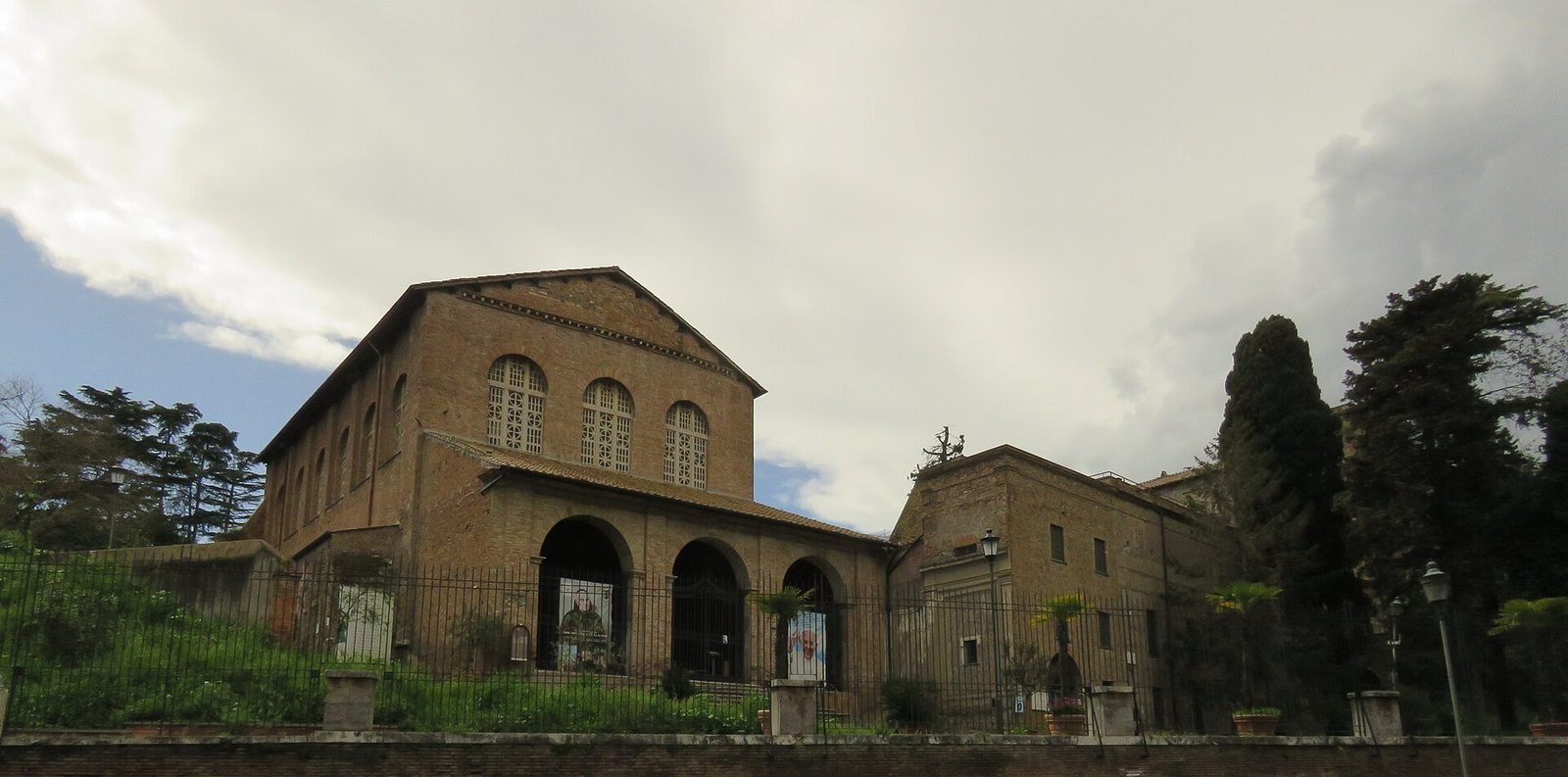
Walking around the complex you see the most honest part of the monument. The side walls show the ancient brickwork, the traces of the original large windows, the repairs of the medieval age and the 20th-century patches, recognizable because they are too regular. The interior niches project outside as semicircular volumes, and this is the fastest way to understand, even before going in, that you are looking at Roman civil architecture and not a church born as such. The useful comparison is with the halls of the Baths of Caracalla, 200 meters away, or with the late antique halls reused elsewhere in the city, like those you can guess at beneath the Roman houses of the Caelian.
The single nave without columns, and why it is the first thing you notice
Santa Balbina all’Aventino is among the very few churches in Rome with a single nave without columns or pillars, and those who enter notice it within two seconds without knowing why. The vertical rhythm the eye is used to in a Roman basilica is missing: no rows of ancient reused shafts, no arches, no delimited central aisle. There is just one very large room.
The effect it has
The feeling is of being inside a single continuous volume, closer to a public hall than to a church. The space is wide, the ceiling high, the light comes in from the large windows above and meets no obstacles. In a three-aisle basilica the gaze is channeled toward the altar by the columns. Here there is no guide, and the apse at the back does all the work alone. It is a condition found in Rome in few cases, almost always linked to the reuse of ancient buildings, and it makes the visit different from that of Santa Sabina or of Santa Prassede, where the colonnade is the protagonist.
The large side niches
The long walls are cut by large semicircular niches, three per side according to the current count, as tall as a bay and deep enough to hold an altar or a monument. They are the most evident trace of the original civil function: niches of that size housed statues, seating or apparatus of display, and in the Roman hall they marked the wall like an architectural backdrop. Christianity reused them as chapels, and in some of them ended up the furnishings seen today, including sarcophagi and reused slabs.
This is the detail we recommend looking at first, even before the marbles. Go in, stop halfway down the nave and count the niches: from there you understand the building better than from any panel.
From the early Christian titulus to the basilica: the origins
Santa Balbina is one of the historic tituli of Rome, the titular churches that make up the oldest structure of the city's ecclesiastical organization, and it is still today the seat of a cardinalatial title. The most cited documentary attestation is the signature at the Roman synod of 595, held under Gregory the Great, where the titulus sanctae Balbinae appears.
Saint Balbina the martyr and Balbina the owner
Hagiographic tradition makes Balbina the daughter of the tribune Quirinus, healed and baptized by Pope Alexander I in the early second century, and counts her among the martyrs of the early Christian age. The passio that tells the story is a late text of debated historical value, so we present it for what it is: devotional tradition, not chronicle.
Alongside this reading there is a second, more prosaic one and, for many scholars, more probable. Roman tituli often take the name of the owner of the property that hosted the community, and a Balbina who owned the building would explain the name without need of the martyr. The two explanations do not exclude each other, because devotion may have grafted itself onto the place name, but it is honest to point out that the first is hagiography and the second is a hypothesis in the history of property. An identical mechanism is discussed for other Roman churches, among them Santa Prisca on the Aventine.
The funerary monument of Cardinal Stefano Surdi
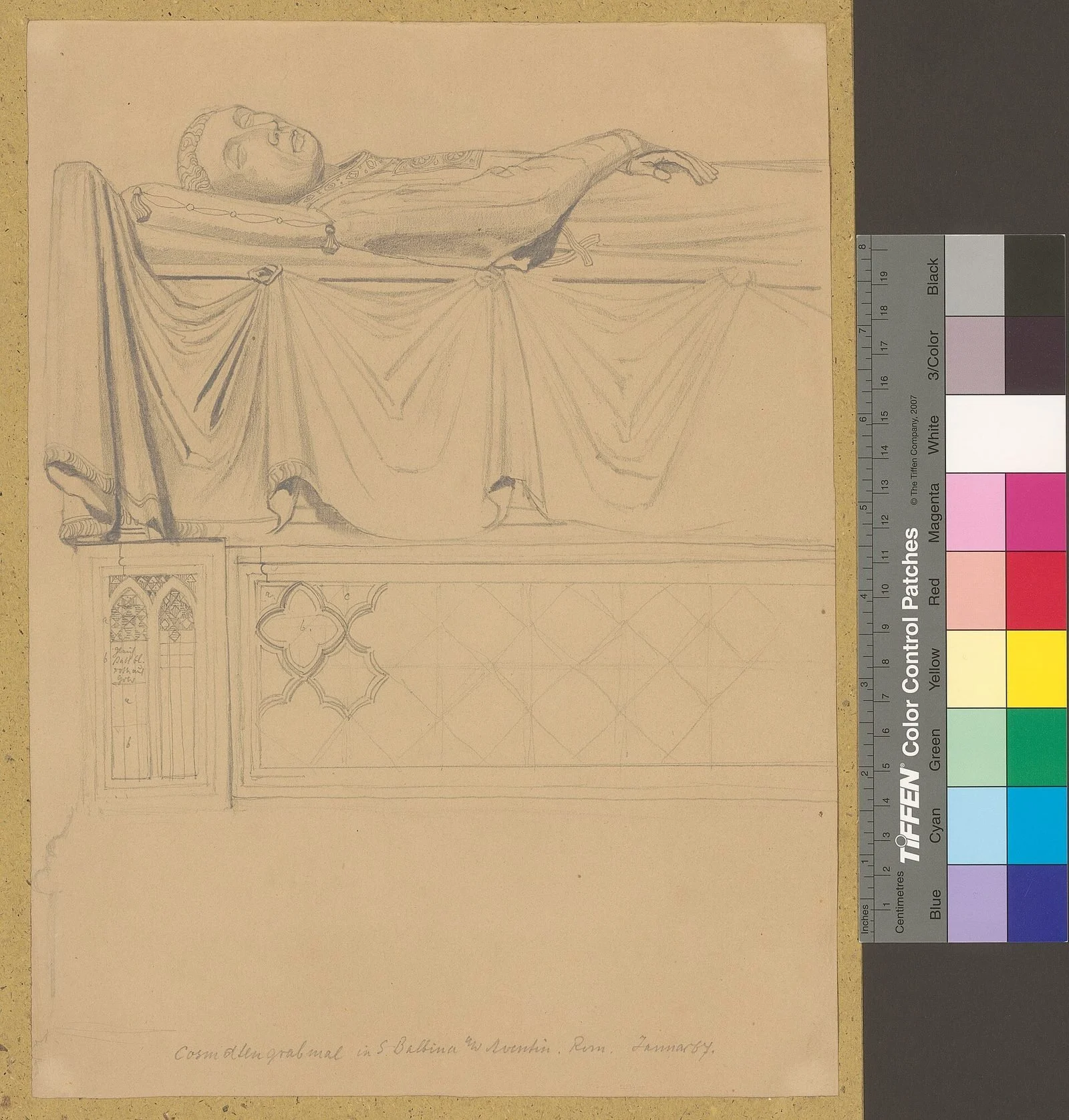
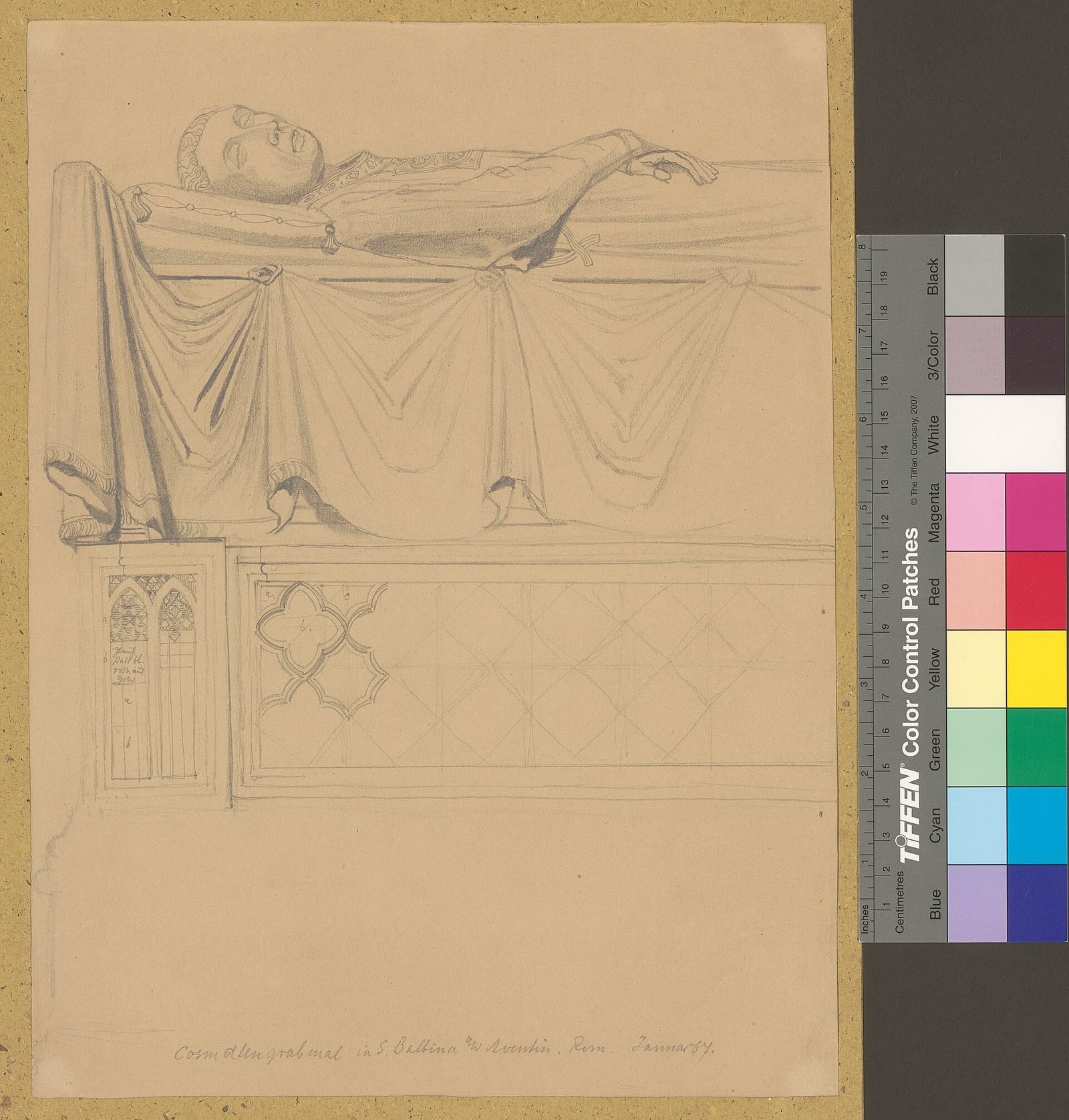
The most important piece kept inside Santa Balbina all’Aventino is the funerary monument of Cardinal Stefano Surdi, a Cosmatesque wall tomb of the late 13th century with mosaic, canopy and figure of the deceased lying down. It is the reason art historians come all the way here, and it is also the piece on which the disagreements over attribution concentrate.
What you see
The monument is laid out according to the scheme of the mature Cosmatesque tomb: a sarcophagus supported by brackets, the figure of the deceased stretched on the lid, an arch or a tympanum above, and a decoration of marble and glass-paste inlays that runs over the jambs and the cornices. The mosaic uses the geometric modules typical of the Cosmati workshop, with reused porphyry and serpentine discs set in a fabric of light tesserae. In the lunette there is a sacred scene with the deceased presented to the Virgin, according to a formula that repeats in those years in high-ranking Roman tombs.
The attribution to Giovanni di Cosma and what makes it debated
The current attribution is to Giovanni di Cosma, the last great exponent of the Cosmati dynasty, active between the late 13th century and the first years of the 14th and author of some of the best-known tombs of the Rome of that moment: the monument of Bishop Guillaume Durand in Santa Maria sopra Minerva and that of Cardinal Consalvo Rodríguez in Santa Maria Maggiore. The stylistic comparison with these two pieces is the basis of the attribution of the Surdi monument.
Here, however, the sources do not agree on one concrete point, and we report it. Some descriptions speak of a signed work and cite the signature formula that Giovanni di Cosma uses elsewhere. Others present the attribution as stylistic, therefore founded on comparison and not on an inscription legible in place. The difference is not academic: it changes the degree of certainty. Visitors should do the simplest thing, that is, look with their own eyes for a signature carved on the cornices, and take note that, if they don't find it, the attribution remains a judgment of specialists that is shared but not proven by a document.
Stefano Surdi's dates are also uncertain in popular sources: his death is placed between 1295 and the first years of the 14th century depending on the reconstructions, and the same ecclesiastical rank sometimes appears as cardinal, at other times with different specifications. We report the range instead of choosing one end.
The other marbles
In the niches and along the walls are distributed other pieces of varied provenance, which arrived here with the movements of furnishings that affected many Roman churches between the Renaissance and the modern age. The most cited is a marble relief with the Crucifixion, generally referred to 15th-century Roman sculpture and associated in guides with Mino da Fiesole, with the warning that the name of Mino in Rome actually covers an open philological question, because criticism has long distinguished between Mino da Fiesole and a second sculptor called Mino del Reame, and the division of works between the two is not settled. There are also sarcophagi and reused fragments, and medieval slabs that the restoration reassembled in a position not necessarily original.
The medieval frescoes and the floor
Inside Santa Balbina fragments of medieval wall painting survive, distributed mostly in the side niches and in some stretches of wall: they are fragments, not legible cycles, and those who expect a continuous decoration will come away empty-handed.
What remains of the painting
The surviving passages date between the 13th and the 15th century depending on the panels, and include figures of saints, fragments of sacred scenes and traces of false curtains in the lower band. Preservation is uneven: in some niches the surface is legible, elsewhere only shadows remain. Lighting conditions matter enormously, because without artificial lighting on many fragments are simply not visible. This is one of the reasons why an accompanied visit pays off more here than elsewhere.
The floor
The floor preserves portions of marble inlay in the Cosmatesque tradition, with porphyry discs and bands of tesserae that compose the typical pattern of medieval Roman floors. As almost everywhere in the city, what you walk on is the result of remakings and recompositions: original parts, reassembled parts, modern additions. It is not an intact floor and nobody serious presents it as such. For a comparison with a better-preserved and more extensive Cosmatesque floor, San Clemente is best, 20 minutes away on the other side of the Caelian.
The 20th-century restoration: what was gained and what was lost
The current look of Santa Balbina all’Aventino is the result of a restoration campaign carried out between the late 1920s and the early 1930s, which removed almost entirely the church's Baroque garb to bring the late antique structure back into view. It is the decision that defines the building as we see it, and it deserves a judgment, not a neutral description.
Antonio Muñoz and the restoration by reinstatement
The direction is attributed to Antonio Muñoz, the scholar and official who in those years signed in Rome a series of interventions of the same family, among them those on Santa Sabina and on San Giorgio in Velabro, and who was the main Roman interpreter of the so-called restoration by reinstatement. The precise dates of the Santa Balbina campaign appear with small variations in the different sources, generally between 1927 and 1930, so we give the range.
The method was declared and consistent: identify the historical phase considered most significant, eliminate the later overlays judged spurious, fill the gaps with recognizable materials. Applied to Rome in the years between the wars, that method also had a political function, because it gave the city back an ancient and medieval image that served the regime's official narrative. Ignoring this context means not understanding why those building sites were so many and so rapid.
What was gained
The gain is real and can be measured as soon as you step in. Without the Baroque cladding you read the original volume of the hall, you see the niches in their full size, you understand the height of the large windows and the relationship between wall and light. The church has recovered a character that belongs to it and that no description could have given back, and it has also recovered its own intelligibility: today anyone entering understands they are inside a Roman hall. Before the building campaign that evidence was covered by stuccoes, frames and altars.
What was lost
The loss is just as real, and guides tend to gloss over it. The Baroque remaking of Santa Balbina was an authentic stratification, produced by patrons and artists who had worked on the building with the same legitimacy as those who came before. Removing it meant erasing forever a chapter of the church's biography: altars, decorative apparatus, lighting solutions, furnishings. No site notebook gives back what was taken down. Moreover, the reinstatement introduced new elements presented as ancient, and the borderline between reintegration and invention is hard to read in some places.
Our judgment
The balance, almost a century later, is in the black for the visitor and in the red for the historian. Those who enter today see something rare and see it well, and that counts. Those who study the building work on a mutilated source, because a whole phase has been removed from direct observation. The practical lesson for visitors is simple and holds for half of Rome: in front of a church that looks very ancient, it's always worth asking how much of that antiquity survived and how much was decided in the 1930s. At Santa Balbina the answer is that the shell is real and the setting is a proposal.
A curiosity about Santa Balbina all’Aventino
The most solid curiosity concerns the name, and overturns the order everyone takes for granted: in all likelihood the church is not named after the martyr but after an owner. In the system of Roman tituli the name indicated who owned the property made available to the Christian community, and only later did devotion turn that name into a saint with a biography, a martyrdom and a feast day. Santa Balbina is one of the cases where the mechanism is best seen, because the martyr's passio is a late text and its historicity has long been debated.
A name that generates a saint
The process is documented for several Roman tituli, and it is one of the most interesting contributions of modern hagiographic research to the history of the city: part of the calendar of Roman saints is born from a land registry. It takes nothing away from devotion, which is a historical fact in its own right, but it changes how the building is read. This is not the house of a martyr: it is a reception hall that belonged to a Roman family, became a church, and whose property name was reread as a saint's name.
Something nobody tells you about Santa Balbina all’Aventino
What nobody says is that the silence of this area is not natural: it is the result of a 20th-century urban planning choice that emptied the area instead of filling it. The Little Aventine and the Caracalla belt were treated between the 1920s and the 1930s as a monumental protection zone, with demolitions, clearances and the creation of through avenues that cut the fabric. The result is a part of the center with very few residents, almost no shops and a density of greenery that does not exist elsewhere in the city.
Why there is no one in the street
Around Santa Balbina there are no commercial businesses, no market, no offices open to the public in significant numbers. The streets are for passing through, not for staying. This produces the feeling of emptiness that many visitors register as charm and that in reality is a lack of city: a central area without functions is an area that lives only on passing trade. Anyone looking for a bar after four in the afternoon notices.
The other side of the coin
The flip side is that this is today one of the least crowded walks inside the Aurelian Walls. The stretch between the church, Viale Guido Baccelli, the Park of the Scipios and the Tomb of the Scipios is covered on foot without meeting almost anyone, with the wall of the Baths on one side and the pines on the other. For those who come to Rome in high season and look for an hour of breathing room not far from the center, it is the most concrete answer we can give.
My advice for visiting Santa Balbina all’Aventino
The operational advice is just one and is worth more than all the others put together: call first and build the visit around the church, not the other way around. Santa Balbina is the only stop in the quadrant with an access problem, so it is the one to fix first in the morning's program. Everything else, Baths included, adapts.
The right order for the morning
This is how we build it. You arrive at Circo Massimo on subway line B around 9:00, climb to Santa Balbina in the agreed window, and spend 40 minutes inside, which is the right time for the hall, the Surdi monument, the frescoes and the floor without rushing. Then you go down to the Baths of Caracalla, which take a good hour and a half and which at 11:00 still have raking light on the mosaics of the underground rooms. From there, on foot, you wrap up toward San Saba and go down to eat in Testaccio.
The blunt verdict
Santa Balbina is worth the detour if you are already in the area for Caracalla, and worth a trip of its own only for those with a specific interest in late antique architecture or Cosmatesque sculpture. We don't recommend it as a first stop to those with three days in Rome. We recommend it without reservation to those coming back to the city for the fourth time who have already seen everything else, and to those with older kids who are starting to tire of the crowds.
Another well-known fact, yet rarely cited
The fact is that Santa Balbina is a cardinalatial title, that is, one of the Roman churches assigned to cardinals as a sign of their tie to the clergy of the city, and this explains why a church that is almost always closed is nevertheless maintained, restored and present in official documents. The system of titles is one of the oldest and most continuous structures of Rome, and runs without interruption from the third century to today.
How the system of titles works
Every cardinal who is not an Eastern patriarch receives a church of Rome, presbyteral title or diaconia, and becomes its symbolic reference. The tie is formal and does not involve pastoral care, but it produces concrete effects: attention, funding for works, plaques, coats of arms. In the less-visited titular churches this mechanism is often the only reason the building has not been abandoned. It holds for Santa Balbina as for Santa Maria in Domnica on the Caelian or for San Giovanni a Porta Latina.
The Little Aventine and the San Saba rione around the church
Santa Balbina is on the edge of the San Saba rione, the 21st rione of Rome, established in the 20th century and built largely between 1907 and the 1920s on the garden city model, with row villas, interior courtyards and narrow streets. It is one of the most recognizable residential neighborhoods of the city and one of the least traveled by visitors.
The border with Testaccio
Going down toward the west you reach Testaccio, which is the exact opposite: a dense, working-class neighborhood, with its market, Monte dei Cocci, the former Slaughterhouse and the widespread museum of the rione. For those planning a whole day, the combination of the silence of Santa Balbina in the morning and Testaccio from noon onward is the one that works best.
The right photo to take at Santa Balbina all’Aventino
The right photo at Santa Balbina is the interior of the hall shot from the back, on the central axis, with the side niches opening symmetrically and the apse at the end: it is the only framing that conveys the absence of columns, that is, the reason this church earns its place in Rome's roll of honor.
The framing and the settings
You need a moderate wide angle, around 24 millimeters on full frame, held level so the verticals don't fall. The camera should be held low, at chest height, so the floor enters the frame and gives depth. Without a tripod you have to raise the sensitivity, because the interior is dark: the usable handheld shutter speeds fall below 1/30 of a second only with stabilization. A tripod, where churches allow it, is here almost always poorly tolerated for reasons of safety and bulk, so it's best to ask and not take it for granted.
The light and the hour
Good light comes in through the high windows in the middle of the morning, between 10:00 and noon, and cuts across the nave at a slant. It is the moment when the niches take on volume and the walls stop being flat. In the afternoon the interior goes dark and only the artificial light remains, which is cold and uneven. The Surdi monument, instead, should be photographed in diffuse light, because the mosaic reflects and slashes of sun burn out the light tesserae.
Some important events that happened here in history
The history of Santa Balbina is not made of great political events but of changes of function, and each of these changes left a physical mark still legible on site.
The Roman synod of 595
The titulus sanctae Balbinae appears among the signatures of the Roman synod convened by Gregory the Great in 595, and it is the documentary attestation that fixes the existence of the titular community at that date. From then on the church enters the official lists of the Roman clergy for good. It is the moment when a private hall becomes an institution.
The insertion into the medieval monastic complex
Between the early and late Middle Ages the church was flanked by monastic structures, and the building underwent the adaptations that function required. It is the phase that produced the bell tower, the reworking of the presbytery and most of the apparatus of which the painted fragments remain today. It is also the phase when the Cosmatesque marbles arrive.
The building campaign between 1927 and 1930
The restoration carried out under the direction of Antonio Muñoz, placed by the sources between 1927 and 1930 with small variations in date, stripped the church of modern additions and rebuilt the early Christian layout of the presbytery. It is the event that determines everything seen today, including the exposed truss roof. The same decade sees the urban redefinition of the whole quadrant, with the opening of the avenues and the clearing of the belt around the Baths.
Who has passed through Santa Balbina all’Aventino
The list of people tied to Santa Balbina is short and almost entirely documentary: the protagonists of great Roman history did not pass through here in droves, but a few names matter and it is worth separating the certain ones from the hypothetical ones.
Lucius Fabius Cilo, with reservations
The Severan senator is the name most cited in connection with this building, and remains a hypothetical attribution. Cilo was consul for the second time in 204 and prefect of the city under Septimius Severus, and ancient sources record the house on the Aventine that the emperor gave him. That this house is the hall of Santa Balbina is a topographical conjecture, supported by many and demonstrated by no one.
Gregory the Great and the Roman clergy
The link with Gregory the Great is indirect but documented: it is under his pontificate that the title appears in the acts of 595. After him the church enters the chain of titleholders, a list of cardinals that runs through the centuries and reaches today, and that produced the later maintenance and interventions.
Giovanni di Cosma and the Cosmati workshop
The presence of the Surdi monument ties Santa Balbina to the last generation of Roman marble workers, the Cosmati family, who between the 13th and 14th centuries produced floors, ciboria and tombs across half of central Italy. Giovanni di Cosma, to whom the monument is attributed, is the same author of the tombs of the Minerva and of Santa Maria Maggiore.
Where to eat around Santa Balbina all’Aventino
Around Santa Balbina the food offer is practically absent, and that is not a polite way of saying there's little: within a five-minute walk of the church there are no trattorias, no market, and the bars can be counted on one hand. Anyone counting on eating here has the plan wrong. The solution is to go down, toward Testaccio to the west or toward the San Saba neighborhood just to the south, where a few neighborhood addresses exist.
We don't name names, and we explain why
On estateromana.com we don't point to signs. A list of places goes stale in a few months, the management changes, the cooking changes and it ends up becoming a source of disappointment. What we can give is the method for choosing, which does not expire. For those who still want a personal, unsponsored starting point, there is Daniele Dezi's personal list on Google Maps, kept updated by hand and without commercial agreements of any kind.
The signs that point to a trap
There are five and you can recognize them from the street, without going in. The lady rolling fresh pasta in the window or on the sidewalk is an advertising lure, not an index of the cooking. The menu with photographs of the dishes says the place addresses people who don't read Italian and will never come back. The tout inviting you to sit works on commission on the passing trade. The place open from morning to late night with no kitchen break serves preparations that are not made in that kitchen. And the seats placed in front of famous monuments, with items not priced on the list or with a different list inside and outside, raise the bill according to who is in front of them.
The chains of the center
In the center of Rome, places with a repeated sign have multiplied, the same menu in several points of the city, often with the line managed by numbered tickets. We point them out for what they are, a marketing phenomenon built on social media word of mouth, and we observe only one thing: Romans don't go there. We don't name them and we don't recommend them.
The simplest criterion of all
Look at who is sitting at the tables and in what language they order. If at two in the afternoon in a neighborhood spot people order in Italian and there are people alone with the newspaper, the bill will be honest and so will the cooking. If the place fills up only with customers carrying backpacks and maps, the price was built for them. For a broader discussion of Roman habits and meal times we have a dedicated page: where to eat in Rome. In Testaccio the choice is wide and prices are still below the historic center's average, and the covered market is the fastest solution for those who want to eat at midday without sitting down.
What to see nearby
Santa Balbina sits in the middle of one of the most archaeologically dense quadrants of Rome, and its usefulness in an itinerary is almost all here: it is the short stop that gives meaning to a day built on something else.
Five minutes away
The Baths of Caracalla are the bulky neighbor, and they are also the reason almost everyone arrives in the area. The Park of the Scipios and the Tomb of the Scipios are a little farther, toward Porta Latina, and are worth a detour for those interested in Republican archaeology. The basilica of San Saba closes the group to the south.
15 minutes away
To the north you climb to the Circus Maximus, the Palatine and the whole front of the Forums, and from there to the Colosseum. Toward the Greater Aventine you reach the Orange Garden, Santa Sabina, the villa of the Priory of Malta and the other churches of the Aventine, with an overview on our page about what to see on the Aventine, which covers the greater hill and not this side. Going down toward the Tiber there are Santa Maria in Cosmedin with the Mouth of Truth, San Giorgio in Velabro and San Nicola in Carcere.
Toward the Caelian and toward the Appian Way
The Caelian is the other quiet hill of the area, with the Roman houses under the basilica of Santi Giovanni e Paolo, Santo Stefano Rotondo, Santa Maria in Domnica, Villa Celimontana and San Gregorio al Celio, as well as the basilica of San Clemente and the Santi Quattro Coronati. To the south the route leads to San Giovanni a Porta Latina, the Appia Antica park, the Caffarella and the catacombs of Domitilla.
Toward Ostiense
On the opposite side you go down to Porta San Paolo, the Pyramid of Cestius, the Non-Catholic Cemetery and the Museum of Via Ostiense, and continuing you reach the Centrale Montemartini, the former Slaughterhouse, Monte dei Cocci and the basilica of St. Paul Outside the Walls. These are all stops connected by subway line B, so the day wraps up without effort.
Frequently asked questions about Santa Balbina all’Aventino
How much does it cost to enter Santa Balbina all’Aventino?
Admission to Santa Balbina all’Aventino is free and there is no ticket: it is a church open for worship, not a museum with a ticket office. The problem is not the cost but access, because the opening hours are very reduced and variable. For accompanied groups the visit is arranged in advance with the rectory, and in that case an offering for maintenance may be requested, which remains voluntary.
What are the hours of Santa Balbina all’Aventino?
The hours of Santa Balbina all’Aventino are limited and we don't publish them because we cannot confirm them at the date of publication. Contradictory indications circulate online, often copied from old guides. The most likely access windows remain those tied to celebrations, Sunday in particular, and arranged visits. Before leaving it's best to check the website of the Diocese of Rome or phone the office that manages it.
How do you get to Santa Balbina all’Aventino by public transport?
To get to Santa Balbina all’Aventino the most convenient stop is Circo Massimo on subway line B, from which you walk up in 10 or 12 minutes along Viale Guido Baccelli. Alternatively, get off at Piramide, also on line B, and climb back up through the San Saba rione. Several surface lines run along Viale delle Terme di Caracalla, but the routes change often and should be checked the same day.
How long does it take to visit Santa Balbina all’Aventino?
40 minutes are enough to visit Santa Balbina all’Aventino, enough time for the hall, the funerary monument of Cardinal Surdi, the fresco fragments in the niches and the floor. Those interested in late antique architecture can stay a good hour, especially if they also walk around the outside to read the masonry. Included in a morning with the Baths of Caracalla, the visit comfortably wraps up by noon.
Why does Santa Balbina all’Aventino have no columns?
Santa Balbina all’Aventino has no columns because it was not born as a church: the basilica occupies a large Roman hall of the late antique period, adapted for Christian worship while keeping its shell. The room had a single span marked by large semicircular niches on the long sides, and that structure remained. It is one of the very few Roman churches with a single nave without internal supports.
Is it true that Santa Balbina all’Aventino was the house of Fabius Cilo?
The identification of the hall of Santa Balbina all’Aventino with the domus of Lucius Fabius Cilo is a widespread hypothesis, not an established fact. Ancient sources record that Septimius Severus gave the senator a house on the Aventine, and the position of the building has made the association natural. But there is no inscription found in place to prove it, and part of the scholars leave the question open.
What is the monument of Stefano Surdi at Santa Balbina all’Aventino?
The monument of Stefano Surdi at Santa Balbina all’Aventino is a Cosmatesque wall tomb of the late 13th century, with sarcophagus, figure of the deceased lying down and a decoration of marble and glass-paste inlays. The current attribution is to Giovanni di Cosma, also the author of the tombs in Santa Maria sopra Minerva and in Santa Maria Maggiore. Some sources speak of a signed work, others of a stylistic attribution: the divergence exists and must be pointed out.
Is Santa Balbina all’Aventino accessible to people with mobility disabilities?
Access to Santa Balbina all’Aventino is through a portico raised above the square, so the presence of steps must be taken into account and no permanent barrier-free solutions are reported. The interior, once you are in, is a single continuous level and is walked without changes in height. Those traveling with a wheelchair should make a call beforehand anyway, because the access conditions depend on the staff present.
Can you take photographs inside Santa Balbina all’Aventino?
Inside Santa Balbina all’Aventino photography without flash is normally tolerated as in most Roman churches, while a tripod requires permission and is often denied for reasons of bulk. No photographs during celebrations. The interior is dark, so it's best to raise the sensitivity and take advantage of the light from the high windows in the middle of the morning.
Who wrote this page
This page is edited by the team of Tour Leader Pro, the Roman project office that designs and coordinates visits, itineraries and cultural events in Rome and Lazio. Hours, fees and access conditions reported here are verified at the date of publication on the official sources indicated in the text: it's best to recheck them before leaving, because they change often. If you find outdated information, let us know.
Those building a multi-day Roman itinerary, combining this stop with the Baths of Caracalla, the Aventine, the Caelian and the descent toward Testaccio, will find planning tools and operational support on Tour Leader Pro, which works on building cultural routes in Rome and Lazio.
For the wider picture, that is, trains, travel between regions and Italian destinations to combine with a Roman stop, a useful resource at the planning stage is Italy Planner, which covers Italy as a whole and not just the city of Rome.