Jazz & Image 2026 free concerts under the Baths of Caracalla
In short. Jazz & Image 2026 took place in the park of the Baths of Caracalla, on Viale delle Terme di Caracalla, from June 21 to August 16, 2026, with free-admission concerts almost every evening and the Severan ruins lit up behind the stage.

Jazz & Image 2026 took place in the park of the Baths of Caracalla, on Viale delle Terme di Caracalla, from June 21 to August 16, 2026, with free-admission concerts almost every evening and the Severan ruins lit up behind the stage. The edition closed on August 16: today, in September, the lawn where the chairs were set out is a lawn again and the park has resumed its daytime hours as an archaeological area. I'm writing about it all the same, and at length, because the festival returns with a regularity that in Rome is almost a rarity, and because anyone who discovers it now has 10 months ahead to get organized properly instead of the barely three days with which people usually notice that a free festival has already started.
The formula, for those who have never seen it, is simple to the bone. You enter from the park along the avenue, without a ticket and without a reservation, you find a stage set up on the lawn inside the archaeological enclosure, you listen to Italian and international jazz, jam sessions, crossovers with funk, with Brazilian music, with singer-songwriter music, and you stay until late with the brick wall dozens of meters high that becomes a screen of warm light. It's not a festival of barriers and accreditations: it's something you do after dinner, bringing a bottle of water and a light sweatshirt, because at midnight along that avenue a breath of air always comes down that you don't find in the rest of the city.
On Fridays, once the festival was over for the evening, the same park changed skin and passed the baton to the nights of Muccassassina, which held its summer season at Caracalla. It's a detail that says a lot about how this piece of summer Rome works: the same square of grass, within two hours, goes from the double bass to the dance floor without anyone finding anything strange in it. Those who wanted jazz and nothing else left around midnight. Those who wanted to continue stayed, and around 01:00 the music was something else.
Admission was free. I repeat it because it is the thing people have the most trouble believing: a festival that lasts almost two months, inside one of the most imposing monuments of preserved antiquity, without paying anything. The flip side is that seating is limited and that those who arrive late listen standing or sitting on the ground, which, with Rome's July weather, is not exactly a punishment. If you're reading after the season has ended and want to understand how to plan for next year, the pages that matter are that of the monument itself, the Baths of Caracalla, and that of the Rome Opera House, which holds its summer opera season in the same enclosure for almost 90 years and which shares with jazz much more than an address.
How the 2026 edition went
From June 21 to August 16 is a little under two full months. The calendar covered the whole heart of the Roman summer, the one in which the city empties of residents and fills with everyone else, and worked on the logic that holds up long festivals: not the single hit of 5,000 people, but continuity. One evening after another, with an audience that partly returns, recognizes the faces, always takes its place in the same spot, and partly changes every evening because it is made of people who ended up there by chance after a walk at the Circus Maximus.
Anyone who has gone more than once knows: the difference between an evening in late June and one in mid-August is enormous, and it doesn't concern the music. At the end of June the park is still full of Romans, the evenings are long, darkness comes very late, around 21:30, and the first sets are played in a blue light that has an effect on the ruins that no lighting rig can replicate. In mid-August darkness falls earlier, the audience is half foreigners, the air is heavier and the ruins can be seen only for what the floodlights decide to show. If I had to choose a moment for 2027, I would choose without hesitation the second half of June or the first week of July.
Another thing the 2026 edition confirmed is that the park holds up well to numbers that on paper would seem unmanageable. The enclosure of the baths, at its maximum extent, measures roughly 337 meters by 328, and counting the exedrae you reach over 400 meters in width: inside a perimeter like this you can put a stage, an informal audience area, the food stalls and the bathroom lines without anyone feeling squeezed. That's the reason why at Caracalla you never get the crowded-concert feeling you have, say, in a square of the historic center. Severan gigantism works in favor of the organizers.
On the practical side the edition ran like the previous ones: gates opening in the late afternoon, first set in early evening, second set later, closing around 00:30 except on Fridays. Bars and refreshment points inside the perimeter, festival prices, lines that grow long at the intermission. There was no reservation, no seat numbering, no priority mechanism: order of arrival counted, which is the most democratic criterion and also the most ruthless. Those who arrived at 21:30 for a 21:00 set found the lawn occupied and settled to the side, where the audio is still decent but the view of the stage becomes a matter of luck.
It's worth adding a note on the relationship between the festival and the monument, because it is the thing that makes Caracalla different from any other Roman summer stage. The structures are not touched. The stage is a temporary installation, the cables run on walkways, the chairs rest on a protected surface and nobody climbs the walls. After the restoration of the 1990s, which removed from the site all the fixed structures accumulated in previous decades, the rule has become this and is not up for debate: the show is the guest, the monument is the host. Anyone who has seen the photos of the opera stagings of the 1950s, with real horses and sets that climbed the ancient masonry, understands why the rule changed.
The park, what you see on arriving
It's worth describing the arrival, because the first impact with Caracalla conditions the whole evening. You walk along Viale delle Terme di Caracalla, a wide street lined with pines, with traffic flowing fast and a bike path on one side. On the right, for those coming from the Circus Maximus, the wall begins. It's not just any wall: it's the one that supported the embankment on which the baths were built, a row of communicating cells on two levels that in antiquity housed shops open to the street. Today you see the rooms, the bricks, the marks of vanished floors. From outside it looks like a fortification. From inside, when you enter and the lawn opens up, you understand that it was the back of the shops.
The park gate lets you onto an avenue that rises gently. You arrive at the level of the ancient garden and at that point the central body appears all at once: a rectangular block of high, broken masonry, with arches that no longer support anything and large windows open to the sky. It measures roughly 114 meters by 220, and counting the projection of the calidarium you reach 140 meters of depth. These are numbers that say nothing when you read them. In person they say everything, because the point is not the absolute size but the fact that a building of that scale has remained standing by half and completely free of modern construction around it. In Europe there is almost nothing similar.
The concert stage is set up in this space, oriented so that the audience has its back to the entrance and faces the masonry. It's an obvious but highly effective scenographic choice: the performer has the wall behind, the listener has in front the wall and the musician together. In the hours when the light changes, between 20:00 and 21:00 on a July evening, the bricks go from pink to orange to brown and then the floodlights come on. Anyone who has done photography as a hobby knows that quarter of an hour is the right moment, and I'll say it better further on.
Around it, the garden. The space between the outer enclosure and the central body was green even in antiquity: there was a xystus, a long walkway probably covered by a pergola, and flowerbeds laid out according to the taste of the time. Today's green doesn't reproduce the ancient one but the idea is the same, and on summer evenings it produces a perceptible microclimate: between the busy avenue and the center of the park there are easily two or three degrees of difference. In 2024, after 1,800 years, water returned to flow in a pool placed at the entrance of the monument, an intervention that put back in the site the element that defined it.
A curiosity about Jazz & Image 2026: free concerts under the Baths of Caracalla
The curiosity to tell concerns the name. It's not a festival called simply Jazz: it's called Jazz and Image, and that second word is not decorative. The festival was born with a double idea, music and images together, in a period when pairing the live concert with projection was a much less trivial choice than it seems today. The result is that at Caracalla, for years, jazz was not only sound: it was sound inside a visual frame built on purpose, with the lit ruins as a permanent backdrop and, in some editions, projections and visual materials integrated into the evening.
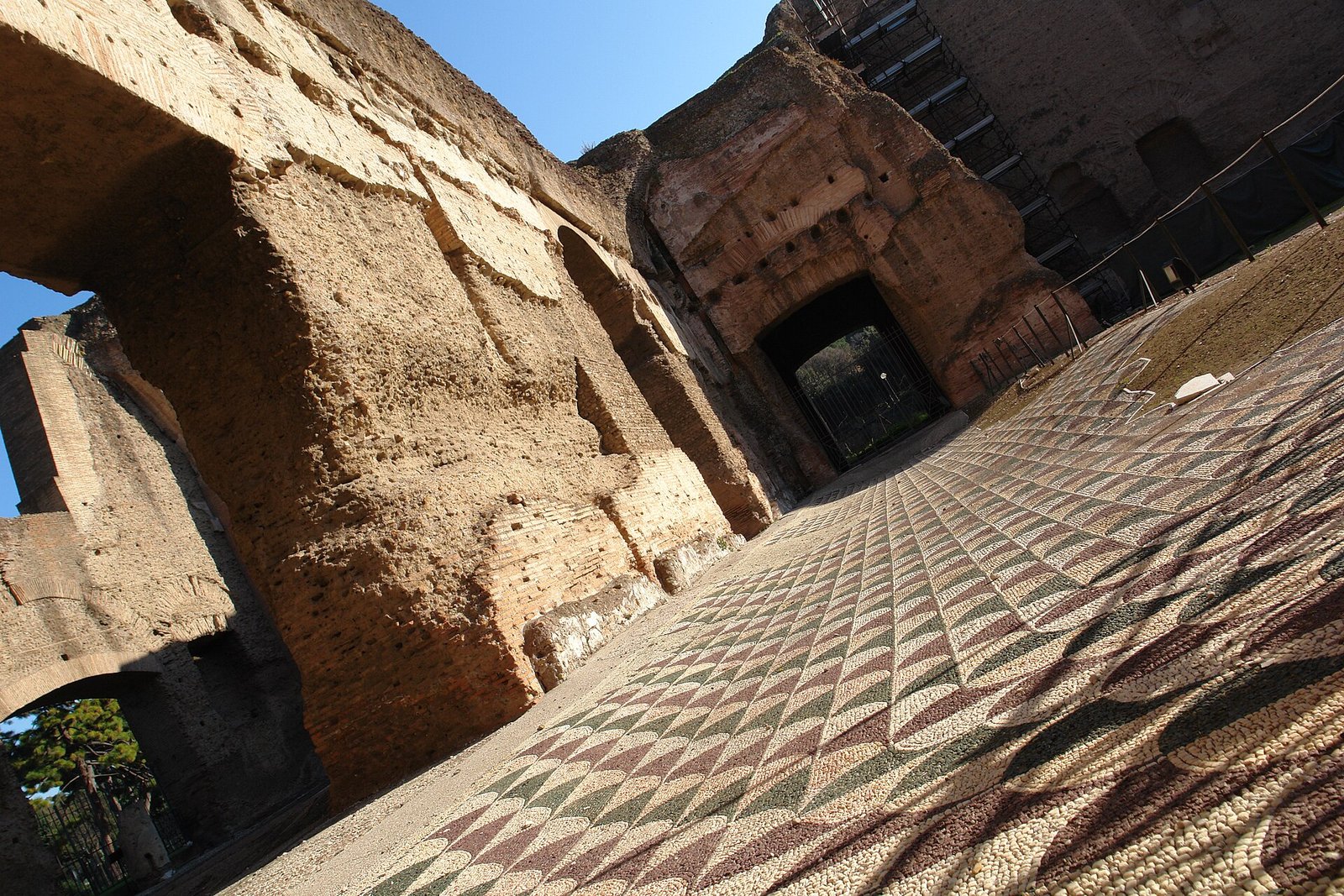
Now, if you think about it for a moment, that choice is of an almost embarrassing coherence with the place. Roman baths were, among other things, visual machines. The calidarium, the circular hot room 34 meters in diameter, was covered by a dome on eight enormous piers and projected from the body of the building toward the south precisely to catch the sun from the large windows: it was designed so that light would enter and put on a show on the water and the marbles. The floor mosaics of the changing rooms, which can still be seen, were made to be looked at while walking on them. The walls were clad in colored marbles that changed tone with the hour of the day. Calling the festival Jazz and Image, inside a building like this, was a gesture far more appropriate than whoever did it probably imagined.
There is then a second level of curiosity, more prosaic and more Roman. The free festival coexists in the same enclosure with the opera season of the Teatro dell'Opera, which has been at home at Caracalla since 1937 and which is anything but free. In the same park, in the same month, two very different audiences exist: the one that buys a ticket for an Aida and the one that walks in with an ice cream in hand to hear a quartet. Sometimes, on the evenings when the two touch, you see the crossing traffic of people dressed in completely different ways walking along the same avenue. It's one of the most exact images of how this city works, and is worth the trip by itself.
I add a third thing, less known. When people talk about Caracalla as a concert venue, many think that the musical use of the site is a trick of recent decades. It isn't: the spectacular vocation of that precise piece of ground is ancient. On the far side of the enclosure, toward the present Viale Guido Baccelli, there opens a rectangular exedra fitted with tiered seating, a kind of half stadium, at whose base athletic contests and theatrical competitions took place. An audience seated on steps watching someone perform is, at that point, a practice documented for 1,800 years. Jazz is the latest form taken by a very old habit.
The Baths of Caracalla before becoming a stage
To understand why a free festival works so well in this place you have to know what this place was. The Antonine Baths, the ancient name, were built on the Little Aventine between 212 and 216 AD, as shown by the stamps on the bricks, in an area adjacent to the initial stretch of Via Appia, about 400 meters outside the ancient Porta Capena and a little south of the sacred grove of the Camenae. Caracalla, of the Severan dynasty, had them built, and they were inaugurated in 216 without the works being entirely finished: his successors Elagabalus and Alexander Severus still dealt with the decoration and the outer enclosure in the following years.
A clarification worth making, because the wrong version often circulates: one sometimes reads that the site was started in 206 by Septimius Severus, Caracalla's father. Scholars consider this reconstruction poorly founded, and the dating that holds is that of the brick stamps. It's not pedantry: 10 years' difference, on a building of this scale, completely changes the political meaning of the operation. An emperor who inherits his father's building site is one thing. An emperor who opens his own, of that size, just after taking the throne, is another.
To bring water there, a branch of the Aqua Marcia was created in 212, called the aqua Antoniniana, which crossed Via Appia resting on a pre-existing structure, the Arch of Drusus. To make room for the complex, buildings were torn down, a large sector of the hill was leveled and the opposite side, the one facing the Appia, was filled with the excavated earth. Access was ensured by Via Nova, a wide and probably tree-lined street. It was one of the most violent operations of urban remodeling Rome has known, and the fact that today all of it looks like natural landscape is the result of 1,800 years of forgetting.
At the far end of the enclosure, toward Viale Guido Baccelli, the ground was supported by 64 communicating cells on two levels that formed the great cistern of the complex, placed at the terminal point of the aqua Antoniniana. At the sides of the half stadium I mentioned there were two apsed halls, in all likelihood the libraries, and only the right one survives. Why do I say it: because a library inside a bathing establishment says that those baths were not a place where people washed. They were a complete civic center, with sport, culture, socialization and commerce, and bathing was just one of the things you did there. Today's music festival, seen in this light, is not a modern intrusion: it is the same function, with a different technology.
The central body was organized according to the scheme that the Baths of Trajan had fixed on the Esquiline. Four doors on the northeast side: two led into the porticoes flanking the natatio, the large open-air pool, decorated with four enormous monolithic granite columns. The other two, in all likelihood the main entrances, led into the great vestibules and from there into the changing rooms. The changing rooms, the apodyteria, still preserve the mosaics, and were on two levels connected by a staircase. The two palaestrae, symmetrical on the short sides, had a central courtyard of 50 by 20 meters closed on three sides by a portico with columns of giallo antico.
From the opposite side of the palaestrae you entered a sequence of heated rooms, among them the laconicum, the sauna, with concave walls and a southern exposure. At the end of the sequence was the calidarium, circular, with many pools, covered by a dome held up by eight powerful piers. At the center of the building the frigidarium, a basilical hall of 58 by 24 meters, covered by three large cross vaults on eight piers fronted by granite columns. The two granite basins that today serve as fountains in Piazza Farnese come from here. The tepidarium, an intermediate and smaller room, closed the hot route.
The orientation was not casual. As at the Baths of Trajan, the axis made the best use of solar exposure, with the calidarium on the south side lit by the large windows and projecting from the rest of the building to catch as much light as possible. Whoever designed this building reasoned about the path of the sun with the same precision with which a lighting technician today reasons about the angle of the floodlights. It's a thought I recommend keeping in mind when you're sitting on the lawn at 21:00 and the wall in front changes color: that change of color is the design, not a side effect.
Something nobody tells you about Jazz & Image 2026: free concerts under the Baths of Caracalla
The thing nobody tells you concerns acoustics, and more precisely the fact that at Caracalla the acoustics aren't one: they are at least three, and they change depending on where you sit. This is true for jazz as for opera, and those who go regularly have learned it at their own expense.
The point is that the audience is arranged on an open lawn, with free space behind and in front an enormous and irregular mass of masonry. The amplified sound arrives direct from the speakers, but a part comes back reflected by the walls of the central body, and depending on the distance that reflection can arrive in phase or out of phase. In the central zone, about 15 meters from the stage, the sound is clean and the reverb adds body. Farther back, around 40 meters, a slight tail begins that on piano and double bass is pleasant and on a fast drum kit muddies things. On the sides, near the lateral masonry, the reverb takes over: you hear everything, but the transients are lost.
The practical consequence is counterintuitive. The best position is not the front row. In the front row you are too close to the speakers and you lose the contribution of the space, which at Caracalla is half the experience. The best position is the intermediate band, slightly off-center, where the direct and the reflected add up well. If you arrive early and can choose, it's worth counting about 20 steps from the stage and settling there, not on the axis but a little to the side: you lose something in view and gain a lot in sound.
The second thing you almost never read is that the park, in the evening, has a temperature all its own and a particular humidity regime. The ground is packed earth and lawn, not asphalt, and gives back less accumulated heat. The brick masonry, on the other hand, accumulates heat all day and releases it slowly after sunset: sitting near a wall exposed to the west, at 22:00 on a July evening, means having a stove behind you. It seems a detail. After two hours of concert it is not anymore.
Third thing, and it concerns mosquitoes. The park is green, irrigated, with tall trees, and on the humid evenings of late July the tiger mosquitoes are there and they are insistent. Nobody writes it in the programs, obviously, because it's not good communication. Those who go regularly put on repellent before entering, not after. It's the difference between remembering the music and remembering your ankles.
Fourth, and this is almost philosophical. A free festival changes the behavior of the audience. When you haven't paid, you feel free to arrive late, to talk, to get up in the middle of a set. At Caracalla you accept the pact: high-level music without spending a euro, in exchange for an audience noisier and more mobile than that of a club. Those who aren't willing to accept it would do better to spend the ticket money at the Alexanderplatz or at Gregory's, where silence is part of the service.
The advice I give you for visiting Jazz & Image 2026: free concerts under the Baths of Caracalla
The main advice, the one I'd give if I could give only one, is: arrive at least an hour and a half early and use that hour and a half to visit the monument instead of standing in line. It's less obvious than it sounds.
The Baths of Caracalla are an archaeological site that can be visited for a fee during the day, with a ticket and hours, and they are anything but a side dish to the concert: they are one of the three or four Roman monuments that truly leave a mark, and most of those who come for the music have never seen them in daylight. The daytime visit and the evening concert are two different experiences of the same place, and doing them on the same day multiplies them instead of adding them. In the afternoon you see the mosaics, the structure, the calidarium, the real proportions. In the evening you see the scenography. If you limit yourself to the evening, you take home half of it.
Second advice: eat beforehand, and eat well, outside the park. The surrounding neighborhood isn't famous for its restaurants but not far away is Testaccio, which has plenty to eat at any price level. Going into the concert already full means not standing in line at the refreshment point at intermission, which is exactly the moment when the line is longest and the next set is about to begin. Those who want an idea of the neighborhood before going can start from the Testaccio District Open Museum.
Third: the sweatshirt. I know that said in June it seems absurd, with 35 degrees at 19:00. But the park is large, there's vegetation, in the evening the air moves, and from 23:00 on you sit still on a lawn that has cooled down. Anyone who stays until 01:00 with nothing on their shoulders feels it. A light sweatshirt, rolled up, also serves as a cushion during the concert, which solves the second classic problem: the chairs, when there are any, are rigid, and the lawn, after an hour, is hard.
Fourth: shoes. The ground is mixed, there are stretches of gravel, roots, differences in level. Flip-flops are a terrible idea, especially at the exit, when the park is dark and people all move together. Those with mobility difficulties should know that the access route has stretches that aren't perfectly flat: it's not prohibitive, but it should be tackled calmly and outside the exit flow.
Fifth, and it concerns the exit. At the end of the concert a few hundred people pour out all together onto Viale delle Terme di Caracalla, which at 00:30 has a reduced surface service. Metro line B, Circo Massimo stop, in that time slot runs less frequently, and on Friday and Saturday it observes extended hours that however are worth checking the same evening because they change. The solution: instead of going toward the Circus Maximus with everyone else, walk in the opposite direction, toward Porta San Sebastiano and then up, or toward the Pyramid of Cestius, where there is more choice of transport and many fewer people in line. It's a 20-minute walk through a silent nighttime Rome that, by itself, is worth the detour.
Sixth and last: don't bring folding chairs, small tables, parasols. It seems obvious but every year someone tries. It's a protected archaeological site, the checks at the entrance exist and are reasonably strict on glass, alcohol brought from outside and bulky equipment. A thin blanket to sit on is almost always allowed, and is the most useful thing you can put in a backpack.
How to get to the park and how to get back
The reference stop is Circo Massimo, metro line B. From there it's about a 10-minute walk, flat, along a route that passes beside the Circus Maximus itself and then turns onto Viale delle Terme di Caracalla. It's a pleasant walk in the evening, well lit in the first part, a bit less in the second, but always busy on concert nights: you follow the crowd, practically.
On the surface, the lines that serve Viale delle Terme di Caracalla and Viale Guido Baccelli drop you very close to the entrance. Evening schedules are however the weak point of the whole Roman system, and on this there is no miracle advice: if the concert ends at 00:30, a bus may keep you waiting. Taxis can be found, but on evenings of heavy turnout it's worth booking one before the end instead of after.
By bicycle or scooter is the solution I prefer. Viale delle Terme di Caracalla has a bike path, the route from the center is mostly flat up to the Circus Maximus, and the only demanding stretch is the climb toward the Aventine if you arrive from that side. Parking a light vehicle near the entrance is easy. Parking a car is not. The blue-line spaces along the avenue free up in the evening but not enough, and the residential neighborhood behind, toward San Saba, is entirely occupied by residents. If you arrive by car, allow a quarter of an hour of circling.
Another well-known fact, yet rarely cited
The well-known fact is that the Baths of Caracalla were a quarry. Everyone knows it in the abstract, nobody thinks about it while listening to a sax solo. And yet half of what makes that place scenic today depends exactly on this: the baths are skeletal because for a thousand years they were taken apart piece by piece.
The chronology is clear. After the cutting of the aqueducts by the Goths of Vitiges during the Gothic War, from 537 the baths stopped functioning. From then on the complex was abandoned and reused several times: the central part became a xenodochium, that is, a shelter for pilgrims and the needy, while the surrounding area served as a cemetery for burials. Then came agriculture: vineyards, above all, belonging to owners of nearby villas or to ecclesiastical bodies and associations. A cultivated field inside the largest bathing complex ever built up to that time.
But the real transformation was the extractive one. From the abandonment of the 6th century onward, the exploitation of the ruins as a quarry of fine materials never ceased: marbles, metals, and also entire architectural structures, architraves, columns, capitals, carried away and reinstalled elsewhere. The cathedral of Pisa and the basilica of Santa Maria in Trastevere contain architectural elements taken from the baths area. Nearby a limekiln remained active for a long time, that is, a furnace where fine marbles were burned to make lime. This is the detail I find most impressive: statues and cladding of Greek marble reduced to building material, because lime was needed and the marble was there.
The last intact granite column was removed from the natatio in 1563 to be given by Pope Pius IV to Cosimo I de' Medici, first grand duke of Tuscany, who had it placed in the center of Piazza Santa Trinita in Florence: it is the Column of Justice, and anyone who passes by sees it without knowing it comes from Caracalla's pool. The two granite basins that serve as fountains in Piazza Farnese have the same origin, from the frigidarium, although on this the debate among scholars is not closed. Other basins recovered from the complex ended up in the Belvedere courtyard, at the Vatican Museums.
Why does this well-known fact deserve to be cited more often? Because it overturns the way we look at the monument. We are not looking at a ruin produced by time: we are looking at the negative of a thousand years of urban recycling. Every empty niche corresponds to a statue that is elsewhere, every rough wall to a marble cladding that became the floor of a church or the lime of a wall. The bare beauty that serves as backdrop to the concerts is the result of a systematic plundering, and this makes it, if possible, more interesting and not less.
There is a corollary that directly concerns the festival. The masonry we see today is the load-bearing structure, the brick and concrete core, that is exactly the part that the despoilers were not interested in. That structure survived because it was worth nothing. And it is precisely that structure, brutal, rough, without ornaments, that in the evening under the floodlights becomes spectacular. The contemporary taste for bare brick, for exposed concrete, for the stripped monumental, finds here its involuntary ancestor. If Caracalla had kept all its colored marbles, it would probably seem to us much less modern.
Under the lawn: the underground, the Mithraeum, the mosaics
While you listen to a concert on the lawn, there is a world beneath your feet. The baths were equipped with a complex network of underground rooms where the service rooms, the furnaces, the wood stores and the staff routes were: the whole operating machine of the complex, completely hidden from the eyes of those who came to bathe. It's one of the most modern features of Roman bath architecture, this clear separation between front and back, between the scene and the backstage.
The underground was cleared in excavation campaigns in 1901 and 1912, and the work continued in 1938, when the discovery that made Caracalla famous among scholars of ancient religions was reached: the Mithraeum. It is the largest Mithraeum known in Rome, carved out of one of the underground corridors near the northwest exedra, with access from outside the enclosure. Because it is near the basilica of Santa Balbina, it is sometimes also called the Mithraeum of Santa Balbina.
The description of the space says a lot. It's a centrally planned hall, covered by a series of cross vaults held up by piers, with two large side benches on which the faithful lay down during the ritual banquet. The floor still preserves a pattern of white and black bands. The hall is preceded by a vestibule from which two smaller rooms are accessed, and one of these must have served as a stable for the bulls destined for sacrifice. Keeping live bulls in the basement of a public bathing establishment, to kill them in a rite reserved to initiates, while upstairs people swam, is one of the most alienating images ancient Rome can offer. The Mithraeum has been restored but as a rule remains closed to the public and is visited only on particular occasions: if you find it accessible, don't let it slip.
Above, in the light, there are the mosaics. The changing rooms preserve elegant mosaic floorings, and above the porticoes of the palaestrae ran large corridors also paved in mosaic. The most famous piece, however, is no longer here. In the 19th century the Vicentine nobleman Girolamo Egidio di Velo, a passionate archaeology enthusiast, undertook an excavation that allowed him to recognize the rooms of the central body and discover two important mosaic floors. A dispute arose with the Papal State, holder of the excavation concession, and it ended with the transfer of the mosaics in exchange for some minor sculptures. Those sculptures are today in the Naturalistic Archaeological Museum of Vicenza, and the great mosaic with athletes is in the Vatican Museums.
It's worth describing it, because it is one of the most surprising things in Roman art. It comes from one of the two large semicircular exedrae of the side courtyards, and was discovered in 1824. The polychrome tesserae drew alternating panels, rectangular with full figures and square with busts, framed by a braid and dentil pattern. The subjects are victorious athletes and referees: the referees togate, holding the prizes or the small rods that indicate their role, the athletes nude, with the attributes of their specialty, the discus, the instruments of the pancratium, or the prizes won, palms and crowns. Above the head of some figures the name is written.
But the point is not the subject, it's the style. The figures are rendered realistically, with powerful musculature, and the heads are true portraits, built with effective physiognomic features, angular, almost brutal, large eyes, intense expressiveness, shaved or tufted hair. The prevailing colors are browns and reddish browns, with violent contrasts. The school of mosaicists that produced them was active in Rome between 210 and 230 and also made the mosaics found near Porta Maggiore with analogous subjects. They are the faces of professional athletes of the 3rd century, portrayed without any idealization. Looking at them is uncomfortable, because they look like photographs.
Among the works that came out of here there are also the three great Farnese sculptures, found in the 16th-century excavations under the pontificate of Paul III: the Bull, the Flora and the Hercules. The Farnese Bull, a Roman copy of a famous Hellenistic group and more correctly the Punishment of Dirce, is the largest single sculpture ever recovered from antiquity. The Farnese Hercules, or Heracles at rest, is over three meters tall and bears the signature of Glykon of Athens. Both are today in the National Archaeological Museum of Naples, where they ended up through the hereditary and dynastic affairs of the Farnese family. To the major pieces are added busts of the Antonines, statues of Minerva and Venus, a vestal, a bacchante and other minor works.
Keeping all this in mind while you listen to music on the lawn changes the evening. The niches you see on the inner facade of the natatio, groups of three superimposed on two levels, contained statues. Those niches are empty because their contents are scattered between Naples, the Vatican and storage. The stage, with its lights, occupies the space left free by a sculptural collection that today would alone fill a museum of the first rank.
The right photo to take at Jazz & Image 2026: free concerts under the Baths of Caracalla
The right photo is not the one of the stage. I say it right away because it's the mistake everyone makes: you point the phone at the musician, you get a bright blotch on a black background, and at home nothing is left. The stage is lit to be seen live, not to be photographed with a small sensor from 100 meters away.
The right photo is the one of the wall with people in front of it, taken in the hour that precedes full darkness. It works like this: between sunset and full night, in July in Rome, there are about 40 minutes in which the sky is still dark blue but the floodlights on the monument are already on. In those 40 minutes the warm artificial light on the bricks and the cold natural light of the sky have comparable intensity, and a phone manages to hold both without blowing out either. After that moment, the sky turns black, the contrast explodes and the photograph is reduced to an orange wall on nothing.
How to set up the shot. You position yourself at the edge of the lawn, not in the center, and frame horizontally putting the wall in the upper half and the heads of the audience on the lower strip. The black silhouettes of the seated people serve to give scale: without them the wall is a wall and could be three meters high or 30. With them you suddenly understand that we are inside something gigantic. If the phone has a mode that lets you lower the exposure, take off a third or half a stop: the lights on the bricks blow out easily and a blown-out white can't be recovered.
The second photo I recommend is taken outside the enclosure, before entering. Along Viale delle Terme di Caracalla, from the opposite sidewalk, you frame the row of vaulted chambers, the cells on two levels of the northeast front, with the pines as a frame above. In the evening the street lighting cuts across them at an angle and the black rooms become a grid of blind windows. It's the image that best conveys the nature of the place: an infrastructure, not a temple.
The third, for those who come by day to visit the site before the concert, is the mosaics. They should be photographed from above, perpendicular to the floor, with the phone held parallel to the ground, and without your own shadow in the frame, which means standing with the sun at your side and not behind you. What comes out is a graphic, geometric image, which holds up in print and which nobody expects when you tell them you're coming from a jazz concert.
What doesn't work, I say it to save you attempts: the video of the concert shot with the phone at arm's length. The speaker audio saturates the microphone, the image wobbles, and on top of that you block the view of the people seated in the back rows, which on crowded evenings is the thing that makes people angriest. A minute of video recorded holding the phone low, resting on your knee, with the frame fixed on the wall and the sound arriving as it arrives, is worth more than 10 minutes of shaky footage. And you stay on good terms with your neighbors.
Some important events that happened here in history
I'll try to line up the moments that marked this place, because the list is longer and more varied than you'd expect from an archaeological site.
216 AD, the inauguration. The emperor Caracalla opens to the public a complex that the works have not yet completed. Until the opening of the Baths of Diocletian, in 306, these will be the most imposing public baths ever built in the Roman Empire. They served above all the residents of the first, second and 12th Augustan regions, that is, the whole area between the Celio, the Aventine and the Circus Maximus: an enormous catchment area, which explains the size.
The following centuries see restoration work by Aurelian, Diocletian, Theodosius and finally the Gothic king Theodoric, between 493 and 526. In the 5th century Polemius Silvius cites them as one of the seven wonders of Rome, famous for the richness of the decoration. Then, in 537, during the Gothic War, the cutting of the aqueducts ordered by Vitiges interrupts the water supply and the baths cease to function. Three and a half centuries of continuous activity end in one season of siege.
The 16th century brings the Farnese excavations, under Pope Paul III, which bring back the statues that survived the medieval destruction and send them toward the family collection and then toward Naples. 1563 is the year of the natatio column taken to Florence. The 19th century brings new excavation campaigns and the discovery of the mosaic with athletes in 1824.
1901 and 1912 are the years of the clearing of the underground, completed in 1938 with the discovery of the Mithraeum. In between, 1937, which is the date that changed the modern destiny of the monument: the Governor of Rome Piero Colonna decides that the Teatro dell'Opera should have an open-air summer season, on the model of the opera festival of the Arena di Verona and the Puccini Festival of Torre del Lago, and identifies as its venue the archaeological complex of the Baths of Caracalla. The stage, designed and set up by Pericle Ansaldo, is placed in one of the halls next to the tepidarium, and with its 1,500 square meters of surface and a proscenium opening of 22 meters it becomes the largest stage in the world, with a single audience area divided into six sectors holding 8,000 seats. The first season, in 1937, counts five performances in all, three of Lucia di Lammermoor and two of Tosca.
1938 is the year of expansion. The operas become six, the Gioconda, Mefistofele, Aida, Lohengrin, Isabeau conducted by its composer and Turandot, for a total of 28 performances between June 30 and August 15. The stage is moved inside the exedra of the calidarium, where it still is today, and the audience area is enlarged to 20,000 seats. These are stadium numbers, and in fact the comparison with a stadium, in those years, was intended.
The Second World War interrupts everything. Performances resume in 1945 and for half a century Caracalla becomes one of the symbolic places of the Italian summer. In 1960, during the Rome Olympic Games, the Baths of Caracalla host the gymnastics competitions: one of the few cases in the world in which an Olympic competition took place inside an ancient monument, and an involuntary return to the original sports function of the complex, which had two palaestrae.
On July 7, 1990, on the eve of the World Cup final, the concert that would become the most watched in the history of classical music takes place here: Luciano Pavarotti, Plácido Domingo and José Carreras together for the first time, with Zubin Mehta on the podium, before a television audience estimated at around 800 million people. The recording of that evening became the best-selling classical music album of all time. The idea was born as a fundraiser for Carreras's foundation against leukemia and as a way, for Domingo and Pavarotti, of welcoming their friend back after his illness. That all this happened inside the enclosure of a bathing establishment of the 3rd century remains, decades later, an almost unreal fact.
From 1993 the performances stop again, and for about 10 years: major restoration of the Roman walls is needed, along with the removal of all the fixed structures that the stagings had accumulated on the site. During those years the Opera's summer season moves, at times, to the Olympic Stadium. When it returns to Caracalla, in the early 2000s, it does so with a completely different approach: modern systems, a space less critical from the archaeological point of view, and an audience area reduced to about 3,500 seats compared with the traditional 8,000. Less audience, less impact, more respect.
On April 6, 2009 the L'Aquila earthquake causes slight damage to the building. In 2020 and 2021, because of the pandemic, the Opera's summer season moves to the Circus Maximus, where it is possible to set up a larger audience area and orchestra pit and to keep social distancing. Then it goes back. In 2024 something happens that is worth more than many restorations: after 1,800 years water flows again on the site, through the new reflecting pool placed at the entrance to the monument.
In the middle of all this, the jazz festival. It doesn't appear in the official chronicles with the emphasis of the three tenors, but it is the thing that made the park familiar to tens of thousands of Romans who would never have gone to the opera. A monument that people frequent is a monument that people defend, and it's worth remembering that when people discuss if holding concerts inside archaeological areas is appropriate.
Who Has Passed Through Jazz & Image 2026, Free Concerts Under the Baths of Caracalla
Here I have to be honest about method. I don't list names of musicians from the 2026 lineup, because the programs of free festivals change until the last minute, substitutions are frequent, and reporting a wrong name is worse than reporting none. What is of most interest is who has passed through this enclosure in the broad sense of the term: the catalog of people who, in 18 centuries, have crossed this piece of land.
Ordinary Romans came through, to begin with. Thousands a day, for three and a half centuries. They came from the Caelian Hill, the Aventine Hill, the Circus Maximus area, and used a free or nearly free facility, financed by the emperor, with an open-air pool, hot rooms, gyms, libraries and shops. It is the largest audience this place has ever had, and it left no name. When in the evening you sit on the lawn among a few hundred other people who haven't paid for a ticket, the continuity is more literal than it seems.
The professional athletes of the third century came through, the ones portrayed in the great mosaic: hard faces, shaved heads, names written above the figures. They were recognizable champions, with specialties and trophies, and the mosaicist portrayed them the way celebrities are portrayed. The initiates of the cult of Mithras came through, who went down into the underground rooms for rites we know little about, and the bulls that never came out of there came through.
Medieval pilgrims housed in the xenodochium came through, and the farmers who grew vines inside the frigidarium. Marble quarriers came through, generation after generation, and the kiln workers who reduced Greek sculptures to lime. The 16th-century diggers who pulled out the Bull and the Hercules came through, and the Farnese agents who had them loaded for Naples.
Grand Tour travelers came through, for whom Caracalla was an obligatory stop on the romantic pilgrimage among the ruins. Percy Bysshe Shelley, in particular, tied his name to this place: in the preface to Prometheus Unbound he declared that he had written the drama among the ruins of the Baths of Caracalla, amid the flowery platforms and airy labyrinths of those walls. Prometheus Unbound was completed in Italy in 1819 and published in 1820. Whatever one thinks of romantic poetry, the fact that one of the key texts of English Romanticism was born sitting on these walls gives a certain vertigo.
The Olympic gymnasts of 1960 came through. Pavarotti, Domingo and Carreras came through on the evening of July 7, 1990, with Zubin Mehta conducting. Dozens of opera seasons came through, with the singers and conductors who made the history of 20th-century Italian opera, from 1937 on, with the interruption of the war and that of the restorations. The generations of Romans who saw their first Aida there as kids came through, because at Caracalla the ticket cost less than at the Costanzi and the summer was long.
And every summer, for many years, a jazz audience has come through, one that in Rome has a precise history of its own, made of historic clubs and festivals in parks. Those who go to Caracalla in summer are largely the same people who in winter are found at Alexanderplatz, at Elegance Cafè, at the Casa del Jazz, and who in summer split their time between this park, Summertime in the park of the Casa del Jazz and Village Celimontana at Villa Celimontana. They are three or four places, all within a few kilometers of each other, that together make Rome a city with a summer jazz offering that few European capitals can match.
What to See Nearby, Before or After the Concert
The area is among the densest in Rome and lends itself to building a whole day that ends with music. I'll start with the closest things.
The Circus Maximus is a 10-minute walk away and is the obligatory passage point for those arriving by subway. In the evening, with the Palatine Hill lit up at the far end of the valley, it is one of the finest views in the city and it costs nothing. Above, on the Aventine, are the Basilica of Santa Sabina, with its fifth-century wooden doors, and the Rome Rose Garden, which however has a blooming season concentrated between May and June and should be visited in that window.
Down toward the Tiber is the Mouth of Truth with its surroundings of Republican temples in the Forum Boarium, one of the pieces of ancient Rome least visited relative to what it is worth. On the other side, following the avenue past the baths, you get to Porta San Sebastiano and the start of the Appian Way: from there begins the Appia Antica Park, which deserves a day of its own and is very easy to do by bike. Farther on, along the same line, are the Catacombs of San Sebastiano, the basilica of San Sebastiano fuori le mura and the Villa of the Quintilii, which shares the state museum circuit with Caracalla.
Those who want to stay on the baths theme have two obligatory stops, and both are in the center. The Baths of Diocletian, inaugurated in 306, are the only Roman complex that surpassed Caracalla in size and today house a section of the National Roman Museum. Next to it is Palazzo Massimo, with the finest collection of ancient sculpture and painting in Italy after Naples. The third piece is the Museum of the Baths of Trajan on the Oppian Hill, which gives back the architectural model from which Caracalla derives its layout. Seeing the three sites in chronological order, Trajan, Caracalla, Diocletian, is a lesson in architecture that no book can give.
For the rest of the evening, if the music isn't enough, the Testaccio neighborhood is a quarter of an hour away and in summer has its own festival, Testaccio Estate, at the Città dell'Altra Economia. Those who instead want to stay on the thread of free concerts in the ruins can look at Santa Cecilia a Massenzio, and those looking for outdoor cinema at Celio Stellato. The Caracalla Festival of the Teatro dell'Opera, on the other hand, is the paid sibling of the same summer and in 2026 brought part of its programming to the Circus Maximus.
Where to Eat and Drink Before Going In
The stretch of avenue in front of the baths is a through road and has few real restaurants. What there is, on event nights, is calibrated to passing tourism and the prices that follow. Better not to eat there.
The two sensible directions are Testaccio and San Saba. Testaccio is the neighborhood of popular Roman cooking par excellence, with the Nuovo Mercato that works very well by day for a quick lunch and in the evening gives way to the area's trattorias and pizzerias by the slice. From there to the baths it is 15 or 20 minutes on foot, on the flat, a route that passes next to the Pyramid of Cestius and is quiet in the evening.
San Saba, the residential district behind the baths, is the less obvious choice and often the best. It is a small neighborhood, built in the early 1900s as a garden suburb, with low villas, quiet streets and a handful of neighborhood places where you eat at normal prices and get served at a human pace. It has the enormous advantage of being five minutes from the entrance: you have dinner without hurry, pay, walk downhill and go in. On nights of big crowds it is the difference between arriving relaxed and arriving in a rush.
Frequently Asked Questions
Does it really cost nothing? Yes. Admission to the festival was free, with no ticket and no reservation. The daytime visit to the archaeological site and the opera season performances are still paid, which is another matter and is bought separately.
Can you reserve a seat? No, and it's not even worth asking. It's first come, first served. Anyone who wants to sit decently should arrive at least 40 minutes before the start, and anyone who wants the center, an hour.
Is it suitable for children? Up to a certain hour yes, and it is in fact one of the best ways to show a child an ancient monument without the boredom of a guided tour. The problem is the hour: the main sets end late and tiredness arrives. With small children, the first set and then home.
Is it accessible to people with mobility difficulties? In part. The route from the entrance to the stage area is passable but not all flat and has stretches of uneven ground. It's best to arrive early, when there's no flow, and to find out about the specific night.
Does it ever rain? In Rome between the end of June and mid-August it rains very little, but the heat thunderstorms of late July exist and are violent. There is no cover on the lawn. A thin rain jacket in your backpack, on nights with an unstable forecast, is a two-minute investment.
Will it return in 2027? The festival has decades of continuity and there is no reason to think it will stop. The dates are usually known between spring and early summer, and the typical period remains the one between the second half of June and mid-August. Those who want to arrive prepared should keep an eye on the page of the Baths of Caracalla and that of the Teatro dell'Opera, because the park's overall calendar is built around the opera season.
Frequently Asked Questions About Jazz & Image 2026, Free Concerts Under the Baths of Caracalla
When was Jazz & Image 2026 held?
Jazz & Image 2026 was held from June 21 to August 16, 2026, a little under two full months that covered the heart of the Roman summer. The calendar worked on the logic of long festivals, with one evening after another instead of a single big event concentrated in a few dates.
Where is Jazz & Image held?
Jazz & Image is held in the park adjacent to the Baths of Caracalla, along Viale delle Terme di Caracalla in Rome, at the foot of the wall that supported the embankment on which the ancient baths were built. The audience is arranged on an open lawn, with the imposing monument as a backdrop.
How much is a ticket for Jazz & Image?
Admission to the Jazz & Image festival is free, with no ticket and no reservation. The daytime visit to the archaeological site of the Baths of Caracalla and the opera season performances, on the other hand, are paid, being separate events that are bought separately.
Do I need to reserve a seat for Jazz & Image?
No, you can't reserve a seat for Jazz & Image, and it's not even worth asking: it's first come, first served. Anyone who wants to sit comfortably should arrive at least 40 minutes before the start of the concert, according to the experience of those who regularly attend the festival.
How do you get to Jazz & Image, at the Baths of Caracalla?
The reference stop for Jazz & Image is Circo Massimo, on subway Line B. From there it is about 10 minutes on foot, on the flat, along a route that passes next to the Circus Maximus and then turns onto Viale delle Terme di Caracalla, well frequented on concert nights.
Is the ticket to visit the Baths of Caracalla included in Jazz & Image?
No, the ticket for the daytime visit to the Baths of Caracalla is not included in Jazz & Image, which remains a separate, free evening event. Anyone who wants to visit the monument during the day has to buy a ticket separately, with its own hours and access arrangements.
If You Want to Plan the Evening, or the Whole Trip
Let's close with two useful addresses, which do two different and complementary things. If you need someone to build the day to your measure, with a real guide who takes you inside the baths in the afternoon and leaves you at the park in time for the concert, or if you are organizing a group and need serious logistics, the reference is Tour Leader Pro, which in Rome works with licensed guides and with small groups.
If instead the problem is wider, meaning you are putting together a trip to Italy and Rome is one of the stops, then it's best to start from the overall planning: how many days to give each city, how to fit the trains together, what to book in advance and what to leave open. For that the right place is Italy Planner, which thinks in terms of whole itineraries rather than the single visit. A free festival like this is exactly the kind of thing that fits well in a planned trip: it costs nothing, requires no reservation and gives an evening that you couldn't have anywhere else in the world.
The rest, frankly, is done by the place. All you need is to arrive a little early, sit on the lawn while the sky is still light, and wait for the floodlights to come on over the wall. The first chord arrives when the sky has turned dark blue, and at that point you understand for yourself why in Rome they have been repeating this for decades.