San Cesareo de Appia
In short. San Cesareo de Appia is at Via di Porta San Sebastiano 2, about 30 meters past the point where Piazzale Numa Pompilio narrows and the road becomes the first urban stretch of the ancient Appian Way.
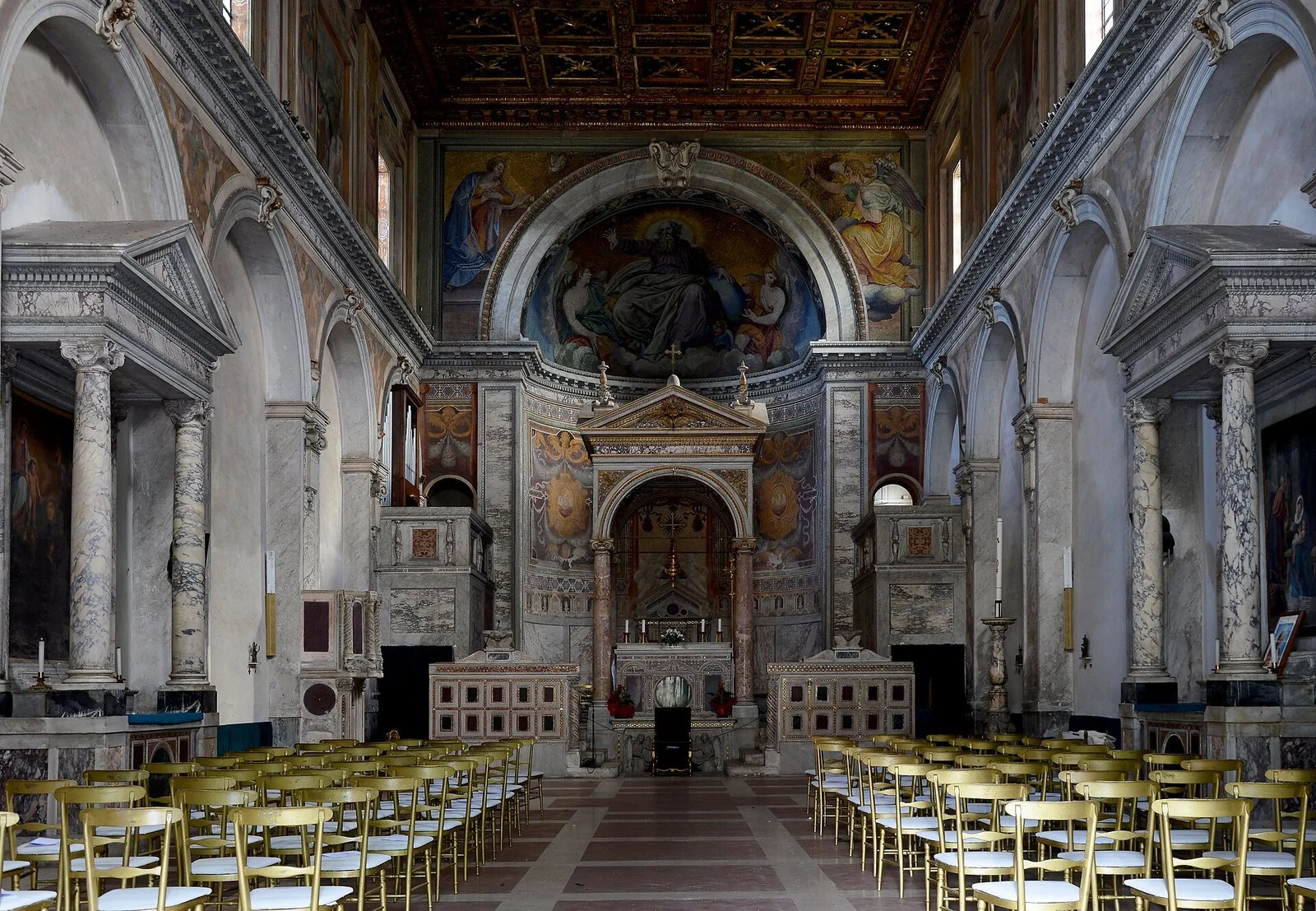
San Cesareo de Appia is at Via di Porta San Sebastiano 2, about 30 meters past the point where Piazzale Numa Pompilio narrows and the road becomes the first urban stretch of the ancient Appian Way. It's a small church, raised on a staircase, with a sober facade that stops nobody. Inside are an ambo, a bishop's throne, a presbytery enclosure and an altar frontal in 13th-century Cosmatesque work, and they are among the best pieces left in Rome. Under the floor are two large rooms of a 2nd-century bath complex with a black-and-white sea mosaic. There is only one problem: the door is closed almost all the time. Anyone passing by on a weekday finds a barred door and no sign explaining when it will reopen. This page says what is inside, where the sources disagree with each other, on which day you can really get in, and what you can't see instead.
Where San Cesareo de Appia is and how to get there
The address is Via di Porta San Sebastiano 2, on the first stretch of the road that leads to the walls. The Appia Antica Archaeological Park, which has had the church in its care since 2021, gives the postal code 00153. The Ministry of Culture listing gives 00179. They are two postal codes for different zones, and the discrepancy is worth pointing out, even though it changes nothing for getting there: the spot is always the same, a few steps from the intersection with Viale delle Terme di Caracalla.
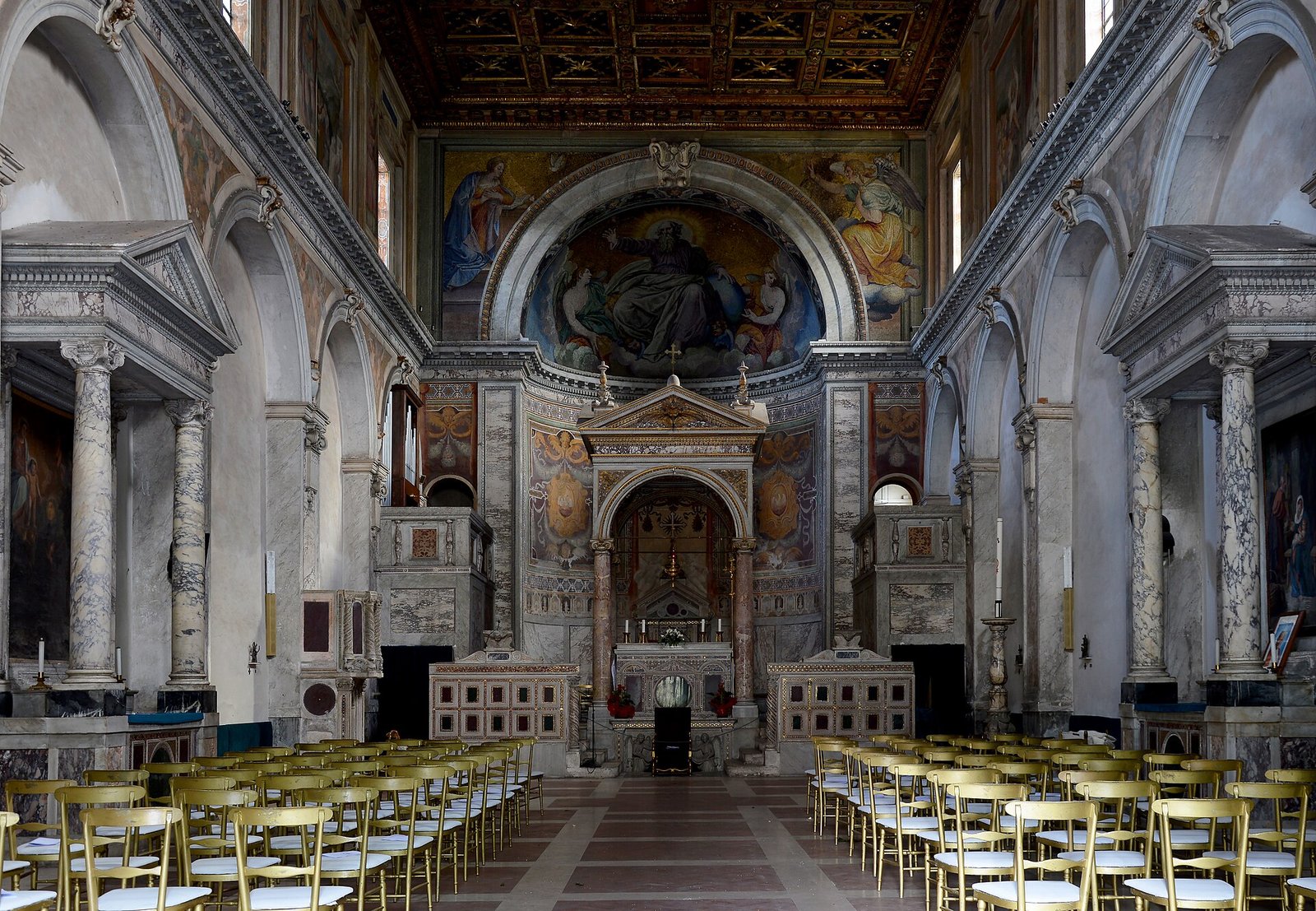
The best visual reference is the piazzale. If you arrive from Viale delle Terme di Caracalla, you see the obelisk of Piazzale Numa Pompilio, take the narrow road that goes down toward the south, and on the left, after a few dozen meters, you find a short staircase and a side wall of light-colored masonry. That's the church. Without looking for it you won't notice it, because the road is narrow, traffic moves fast and the sidewalk on that side is tight.
By metro
The stop the Archaeological Park indicates is Circo Massimo, on line B. From there you walk along Viale delle Terme di Caracalla for about a kilometer, real time 12 or 14 minutes, wide tree-lined sidewalk, a slight climb at the end. It's the route that passes the entrance of the Baths of Caracalla and San Sisto Vecchio, so it counts as a walk and not just as a transfer.
The other option is San Giovanni, which is served by line A and line C. From there you go down Via dell'Amba Aradam and cut across toward Piazzale Numa Pompilio: it's about 20 minutes on foot, busier and less pleasant than the route from Circo Massimo. It only makes sense for people coming from the St. John Lateran area who want to end the day on the Appian Way instead of going back to the center.
By bus
The lines the Archaeological Park indicates are three: the 118, which stops at Porta San Sebastiano and Numa Pompilio, and the 714 and the 671, which stop at the Baths of Caracalla. The 118 is the one that really serves, because it's the line that goes down the Appian Way toward the Catacombs of San Callisto and the Catacombs of San Sebastiano. Other surface lines also appear to pass at the same stop.
One recommendation: the routes of Roman surface lines change because of construction, demonstrations and detours, and they change on short notice. Check the same day on the transit company's app, not on a printed guide and not even on this page. For the general picture of getting around the city we have a dedicated page on how to get around Rome.
On foot, which is the right way
San Cesareo works as a stop on a walk, not as a single destination. The recommended route starts from the Circus Maximus, goes down along the Baths of Caracalla, touches Santa Balbina on the rise to the right, passes San Sisto Vecchio, arrives at San Cesareo and continues on Via di Porta San Sebastiano to Porta San Sebastiano, that is, the point where the Appian Way leaves the Aurelian Walls.
It's a little over two and a half kilometers. The second half is the best part: a narrow road between villa walls, cypresses, the Tomb of the Scipios and the Arch of Drusus just before the walls. Almost nobody walks it, and that alone is a reason.
By car, bike, taxi
Parking around the piazzale is blue-line paid parking, and in the middle hours of the morning there are few free spots, because the tour buses headed for Caracalla arrive. Via di Porta San Sebastiano is narrow with limited parking: if you come from outside Rome, you're better off leaving the car at a line B park-and-ride. By bike the stretch from Circo Massimo is doable, but you share it with the fast traffic of the avenue. An honest assessment of Rome's bike routes is on our page on Rome by bike.
When it's open, and why you find it closed
This is the most important practical point on the page and I'm putting it before the history. San Cesareo de Appia opens on Sunday morning, for the religious service. On the other days of the week the door stays closed and there is no custodian who opens on request for the first person who rings. If you pass by on a Tuesday afternoon, you don't get in, period.
The official sources don't say the same thing, and it's right to report that. The Ministry of Culture listing says open Sunday from 10:00 to 12:30, closed Monday to Saturday, no reservation needed. The Appia Antica Archaeological Park writes that the basilica, excluding the hypogeum, is for the moment open on Sunday morning for the service. The Rome city tourism portal, under opening hours, reports instead that at the moment the church is not open to the public.
A fourth indication, different again, circulates on popular listings: Sunday from 10:00, other days by reservation, free admission. The reservation for the other days isn't confirmed by any institutional source, so I'd treat it as not guaranteed. Free admission, on the other hand, is consistent with the nature of the place, which remains a church in active use and not a museum with a ticket office.
The practical summary is this: the realistic window is Sunday morning, roughly between 10:00 and noon, and it's best to arrive close to the end of Mass, when the church stays open a little longer and you can look around without disturbing anyone. If you want certainty, write beforehand to the Appia Antica Archaeological Park, which has managed the church since 2021 and answers the institutional addresses published on its official website. Data verified in September 2026.
Masses and weddings
San Cesareo is in great demand for weddings, and this is a variable that no guide mentions. On Saturday mornings and on spring afternoons you may find the church open but occupied by a private ceremony, with flowers, extra chairs and photographers. Going in at that moment is possible but inappropriate, and in any case you see nothing: the presbytery, the part that matters, is exactly where the group is.
What happens if you find it closed
Finding it closed here is the norm, not the exception, and it's best to build the plan so that the closure doesn't ruin the day. The church sits on a stretch of road where, within a 10-minute walk, there are Porta San Sebastiano with the walkway on the walls, the Tomb of the Scipios, the Scipios' Park and San Giovanni a Porta Latina. None of these depends on San Cesareo to work.
What you really see when you go in
The interior is a single nave, not very large, with walls marked by a continuous series of blind arches and a coffered wooden ceiling in blue and gold. The first impression is not that of a medieval church: it's that of an early 1600s building site that absorbed medieval pieces. Anyone who walks in expecting an intact Romanesque basilica is thrown off, and does well to know it beforehand.
The part that justifies the trip is the presbytery. On the right is the ambo, with twisted columns covered in porphyry and serpentine tesserae and the symbols of the evangelists. In front of the altar run the screens of the presbytery enclosure, also with spiral columns. At the back, against the wall of the apse, stands the bishop's throne. And under the altar table you see the frontal, which is the most beautiful piece of all.
The floor in front of the presbytery steps preserves a stretch of Cosmatesque work around a serpentine disc. It's a fragment, not a complete floor in the manner of the great ones of Rome, and it should be looked at for what it is: what survived of a larger setting.
The rest of the furnishings are 1600s. The ciborium above the altar, with columns of brecciatelone, belongs to that building campaign and has nothing medieval about it, even though at a glance it fits in. The pipe organ you see in the church is very recent, built by Francesco Saverio Colamarino between 1997 and 1999.
What you don't see instead
The hypogeum with the Roman baths and the sea mosaic is not part of the visit. The Archaeological Park says so explicitly when it describes the opening schedule: the church opens on Sunday, the hypogeum does not. Anyone who arrives counting on going down under the floor is left empty-handed, and since almost all the online guides talk about the Neptune mosaic without adding that it's inaccessible, the disappointment is frequent.
You also don't see the two small apses of the early medieval hall, which the excavations documented but which the 1600s rebuilding erased from the standing structure. Of the 8th-century church, inside, nothing is left that is legible to the naked eye. What remains is in the excavation reports and drawings, not in front of the visitor's eyes.
Origins and name: where the sources diverge
The founding dates you read around don't agree, and the divergence is sharp. It's better to line them up than to pick one and pass it off as certain, because each rests on a different kind of evidence and the three don't entirely exclude each other.
The 4th-century tradition
One line of tradition ties the church to the 4th century and to the transfer to Rome of the relics of Saint Caesarius, a deacon martyred at Terracina, under the emperor Valentinian I, who reigned from 364 to 375. It's the account found in English-language encyclopedia entries. It should be taken for what it is: a hagiographic tradition, not archaeological proof on the spot.
The 8th-century hall
The reconstruction that institutions now accept describes a single-nave place of worship with two small apses, built in the 8th century over preexisting Roman structures. Both the listing of the Appia Antica Archaeological Park and that of the Ministry of Culture indicate it. If only one has to be named, this is the soundest dating, because it's the one that rests on structures and not on stories.
The first written records
The first certain written mention dates to 1192, in the catalog of Roman churches compiled by Cencio Camerario, where the church appears with the qualifier de Appia. In 1320 the so-called Turin Catalog records it as San Cesareo in Turrim and notes the presence of four friars, a sign of an already reduced community. Some scholars also link to the church the passages of the Liber Pontificalis relating to Leo III and Leo IV, between the 9th and 10th centuries, which mention a monastery with an oratory dedicated to Saint Caesarius. The identification, however, remains disputed.
Why it's called in Palatio
The double name is the most tangled thing about this church, and it's a historical error fossilized in a cardinal's title. On the Palatine there was a church of San Cesareo tied to the imperial palace, now lost. When Cesare Baronio promoted the restoration around 1600, he took the church on the Appian Way to be the Palatine one. The title was therefore restored under the name San Cesareo in Palatio and assigned to this church, which has never had anything to do with the Palatine.
The cardinal's title had been established by Leo X on July 6, 1517, suppressed by Sixtus V in 1587 and readmitted by Clement VIII in 1600. Since then the church's official name in Holy See documents has remained the wrong one, while in everyday use and on the Park's signage the other has prevailed, de Appia, which says where the church really is.
The Middle Ages, the Crosier Fathers and the long abandonment
Between the 1200s and the 1300s the church had a period of works and then a long decline. Under Boniface VIII, pope from 1294 to 1303, the nave was enlarged and a narthex was added. According to the account found in Roman scholarly listings, in 1302 the same pontiff entrusted the church, already in poor condition, to the Order of the Crosiers, who built next to it a hospital for pilgrims traveling the Appian Way.
Then Benedictine nuns, and finally the transfer of 1439 under Eugene IV, when the administration was moved to San Sisto. This information comes from local popular history sources and isn't confirmed on institutional listings: the degree of certainty is therefore lower than for the dates of 1192 and 1600.
The fact that no source contradicts is the decline. In the 1300s the church was already run-down, with four friars running it, and in the following two centuries it got worse still. When Baronio took it on, the building was in ruins. Everything you see today, apart from the medieval marbles, comes from that early 1600s rescue.
Cesare Baronio's building campaign under Clement VIII
Cesare Baronio, an Oratorian cardinal and author of the Annales Ecclesiastici, is the figure who made this church exist as we see it. Under the pontificate of Clement VIII, pope from 1592 to 1605, Baronio promoted a radical restoration ahead of the Jubilee of 1600. The actual works fall in 1602 and 1603, and involved raising the structure and rebuilding the facade.
Baronio was not just any patron. He was a historian of the Church, and his program for San Cesareo was consistent with the method of his Annales: recover the memory of Rome's ancient churches, put them back into service, give them a decoration that told the story of the titular saint. Baronio himself worked on Santi Nereo e Achilleo a little further up, along the same route: anyone who wants to understand his way of proceeding should look at the two churches one after the other, because they explain each other.
The artistic commission went to Giuseppe Cesari, the Cavalier d'Arpino, who was the leading painter for Roman patrons in those years. On the walls of the nave, scenes from the life of Saint Caesarius were made, and he was also given the design of the apse mosaic. The overall result is late Mannerist, orderly, cold: it doesn't please everyone, and I understand why.
In 1603, with the works finished, the church passed to the Somaschi fathers. The coffered ceiling carries the coat of arms of the Aldobrandini family, that is, of Clement VIII, with a central panel dedicated to Saint Caesarius: it's the patron's signature, placed where everyone sees it when they look up.
The Cosmatesque furnishings: what is original and what is reassembled
A clear premise is needed here, because it's the point on which guides are most hasty. The Cosmatesque furnishings of San Cesareo were not made for San Cesareo. They are 13th-century pieces that came from another church and were reassembled here in the 1602 and 1603 building campaign. They are authentic as material, they are recomposed as objects. The two things have to be kept distinct, otherwise you tell a false story.
Where they come from
The provenance given by most sources, including institutional ones, is San Giovanni in Laterano, and in particular the transept of the basilica, which had just been refitted in those very years. The Ministry of Culture listing speaks of 13th-century architectural elements from the Lateran transept. The English-language specialist literature is more cautious and admits that the pieces may come from more than one source, because the group is not uniform.
Anyone who looks carefully notices it on their own. The marbles don't all have the same thickness, the designs of the inlays don't match, some frames are cut to fit a space other than the one they were made for. This is the sign of reassembly, and in a Cosmatesque church that has stayed in its place you don't see it.
The ambo
The ambo is the first thing you notice to the right of the presbytery. It has twisted columns in serpentine and porphyry, a parapet with paneled fields and the symbols of the evangelists. The overall structure is a recomposition: the original 13th-century parts are the panels and the little columns, the assembly is 1600s. Well photographed, it stands up to comparison with far more famous ambos, and nobody photographs it.
The bishop's throne
The episcopal throne at the back of the apse is the piece that surprises anyone who knows the Cosmati. The tesserae have a dominant pale blue, which is rare in Roman Cosmatesque work: the norm is the red of porphyry and the green of serpentine on a light ground. The specialist literature records exactly this color anomaly. If you only have time to look at one thing in this church, look at that.
The altar frontal
Under the table of the high altar is a portion of a Cosmatesque frontal from the mid-1200s, with a central disc in which phoenix figures appear. It's a fragment, not a whole frontal, and you can tell: the decorative field breaks off where the piece was cut to fit the new altar table. The phoenix, a bird that is reborn from its own ashes, is a symbol of resurrection and has a precise meaning above an altar.
The screens and the floor
The screens of the presbytery enclosure close off the space in front of the altar with pairs of spiral columns and inlaid panels. The surviving Cosmatesque floor is reduced to a stretch in front of the steps, organized around a large serpentine disc. Anyone who comes here after seeing Santa Maria in Cosmedin or the Santi Quattro Coronati understands right away the difference between a floor in place and a relocated scrap.
What is not Cosmatesque
The ciborium above the altar is 1600s, with Ionic columns in brecciatelone, and it blends with the ancient marbles without being one. A large part of the frames and joining pieces that hold the presbytery together is also from that building campaign. Telling the two hands apart is the most interesting exercise to do in here, and you do it with the naked eye, looking at how the joints behave.
The apse mosaic, which isn't medieval
In the apse basin there is a mosaic of God the Father among the angels. Many visitors take it for medieval, because it's in a church full of 13th-century marbles and because mosaic technique in Rome immediately calls to mind early Christian and medieval apses. It isn't. It's early 1600s, from Baronio's building campaign.
The design is by the Cavalier d'Arpino. The physical execution of the mosaic is attributed to Francesco Zucchi, a mosaicist active in Rome in those years. It's a very conscious patron's choice: using mosaic, an archaic and costly technique, to declare continuity between the ancient church and the restored one. Baronio made history with materials too.
The precise dating of the work isn't given unambiguously by the sources: it falls within the works of 1602 and 1603 or in the years immediately after, but an exact year isn't published on the official listings. If someone gives you a date to the single year, ask what it's based on.
The Roman baths and the sea mosaic under the floor
Under the church are two large rectangular rooms of the imperial age, with brick walls, marble facings and black-and-white mosaic floors. The discovery happened in 1936, during work on the church floor done to eliminate damp seepage. The excavations continued in the following years, with investigations that went as far as the 1950s.
The mosaic is marine: Nereids, Tritons, fish, black figures on a white ground. In one of the two rooms Neptune appears on a chariot. The overall surface is given at around 300 square meters by a specialist source and around 400 by an English-language reference work: the order of magnitude is that, the exact figure changes depending on what is counted.
The most precise dating available places the mosaic between the late Antonine age and the early Severan age, so straddling the end of the 2nd century and the start of the 3rd. The institutional listings limit themselves to saying 2nd century AD. The function of the rooms is almost certainly as baths, and some propose identifying the complex with the Thermae Commodianae mentioned in the Regionary Catalogs. It's a proposal, not an established fact.
Can you visit them? No, and it's best to say so clearly
The hypogeum can't be visited. The Appia Antica Archaeological Park, when it describes the opening schedule, expressly excludes the hypogeum from Sunday morning. The mosaic has suffered from damp, which is the same problem that caused its discovery in 1936, and it has not been accessible to the public for years.
Since 2021, with the ministerial decree of October 22 of that year, the basilica has been among the properties of the Appia Antica Archaeological Park, directed by Simone Quilici. The Park has announced extraordinary maintenance and restoration work with a view to broader public use. A restoration site for the mosaics has been started on the hypogeum, directed by the archaeologist Santino Alessandro Cugno, with three-dimensional surveys, georadar investigations and diagnostic analyses, with the end of the works announced for late 2025.
As of September 2026 no opening calendar for the hypogeum has been published. Translated: the restoration has been done or is under way, but regular access to the mosaic is not yet something you can put in a plan. If they open it one day, it will become one of the most interesting underground sites in the city, because a sea mosaic of that extent isn't a common thing in Rome.
A curiosity about San Cesareo de Appia
Karol Wojtyła was the cardinal titular of this church. Paul VI gave him the title of San Cesareo in Palatio on June 29, 1967, and he held it until October 16, 1978, the day of his election to the papacy. 11 years. A church that today opens on Sunday morning for a Mass was for 11 years the Roman title of the Archbishop of Kraków.
There's a practical side to this that always amuses Polish groups: many pilgrims look for John Paul II's title and end up at San Giovanni in Laterano or at St. Peter's, because nobody imagines it's a little church on the urban Appian Way closed six days out of seven. After him the title passed to other cardinals. The current titleholder is Antonio Maria Vegliò.
The name of the title, on top of that, is the wrong one: in Palatio, that is, referring to a church on the Palatine that no longer exists. A future pope bore for 11 years the title of a church mistaken for another because of an attribution error of the early 1600s, never corrected.
One thing nobody tells you about San Cesareo de Appia
The apse mosaic, the one everybody photographs thinking they're taking home a medieval image, is early 1600s. Design by the Cavalier d'Arpino, execution attributed to Francesco Zucchi. So not the restoration of an ancient mosaic. A new mosaic, made in the 1600s with a medieval technique to make a freshly rebuilt church look ancient.
The same logic applies to the whole presbytery. The Cosmatesque marbles are real and are from the 1200s, but they have been here for 400 years and not 800, and they were cut and refitted to go into spaces different from the original ones. San Cesareo is, to all intents and purposes, a historiographic staging built by a historian. Baronio knew perfectly well what he was doing.
This takes nothing away from the quality of the pieces. It does remove the romantic misunderstanding of the medieval church surviving intact, which is the reading the average visitor carries inside without anyone taking it apart. Knowing it completely changes the way you look at the presbytery, and in our judgment it makes it more interesting, not less.
My advice for visiting San Cesareo de Appia
Don't build a day around this church. Build a walk on the urban Appian Way and put San Cesareo in it as a possible Sunday-morning bonus. If it opens, you've seen one of the best things in the area. If it doesn't, the day holds up anyway because the route between Circo Massimo and Porta San Sebastiano works on its own.
On Sunday morning leave the house early and do the circuit in this order: Baths of Caracalla at opening, then Santi Nereo e Achilleo and San Sisto Vecchio from the outside, then San Cesareo around 11:00, when Mass is under way and you can go in at the back without disturbing anyone, and finally Porta San Sebastiano with the walkway on the walls. Five full hours, no lines, no ticket apart from Caracalla.
Inside, go straight to the presbytery and give yourself a good 10 minutes. The rest of the church can be seen in three. Do you need a flashlight? No, but you need full daylight: the artificial lighting is poor and the inlays of the marbles are hard to read in low light. Overcast winter mornings are the worst.
What to avoid
Avoid arriving during a wedding, as I said above, and avoid the afternoon in general, because it doesn't open. Also avoid putting the underground areas in the plan: you can't go down, and anyone who promises you otherwise hasn't checked. If you want to see Roman floor mosaics that are really accessible, the right place isn't this one but the Centrale Montemartini, two stops away.
Another well-known fact, yet rarely cited
The church doesn't belong to a tourist circuit, it belongs to an archaeological park. Since the ministerial decree of October 22, 2021, San Cesareo de Appia has been a property of the Appia Antica Archaeological Park, the same body that manages the Villa of the Quintilii, the mausoleum of Cecilia Metella and the other sites along the regina viarum.
The reason for that choice is topographical, and it's stated in the records: the church sits exactly on the first mile of the Appian Way, inside the walls. Administratively it makes more sense to keep it with the monuments of the road than with the churches of the center. For the visitor the practical consequence is that the correct information is found on the Park's website and not on the general portals, which in fact contradict each other.
This passage also explains why the opening schedule could change in the coming years. The Park has announced extraordinary maintenance and restoration with a view to broader public use. If and when that happens, San Cesareo will stop being a church you find closed nine times out of 10. For now it isn't so.
The right photo to take at San Cesareo de Appia
The photograph to take home is the detail of the disc with the phoenixes on the altar frontal. You stand facing the altar table, crouch to the height of the piece, and leave everything else out of the frame. The porphyry and serpentine tesserae in the raking morning light give back the red and the green with no need for correction.
The second photograph is the bishop's throne, because of that pale blue you don't expect in Cosmatesque work. It should be framed from a three-quarter angle, not head-on, because from three-quarters you can see the thickness of the marbles and the fact that the piece is reassembled. No flash: it flattens the tesserae and burns out the whites of the ground.
The wrong photograph, the one everybody takes, is the panorama of the nave from the back. It always comes out the same, always dark, always with the ceiling crooked from the wide-angle lens, and it says nothing about this church. The 1600s nave is the least interesting part of what is in front of you.
Outside
From the outside, the framing that works is from the opposite sidewalk, with the staircase in the foreground and the road curving toward the walls. You understand the position: a church that faces the urban Appian Way and not a piazza. If you want the beautiful photograph of the area, though, take it 200 meters further on, under the Arch of Drusus, or directly at the gate with its two towers.
Some important events that happened here in history
The first event documented with certainty is administrative and has a date: 1192, when the church appears in the catalog of Cencio Camerario with the qualifier de Appia. From that moment San Cesareo exists in writing. Everything that is told about before rests on hagiographic traditions or on disputed identifications of passages of the Liber Pontificalis.
The second is the passage under Boniface VIII, between 1294 and 1303, with the enlargement of the nave and the addition of the narthex, and with the church being entrusted to the Crosiers and the building of a hospital for pilgrims. These are the years of the first Jubilee, in 1300, and a church on the urban Appian Way meant assistance for those entering the city from the southern road.
The third, and the weightiest of all, is the building campaign of 1602 and 1603. Baronio rebuilds the structure, the Cavalier d'Arpino decorates it, the Cosmatesque furnishings arrive from the Lateran, Clement VIII restores the cardinal's title in 1600 with the wrong name, and in 1603 the church passes to the Somaschi fathers. In two years San Cesareo changes its face, furnishings, official name and management.
The fourth is 1936: during work on the floor against damp, the Roman bath rooms and the sea mosaic are discovered. The church suddenly gains an archaeological depth that nobody attributed to it, and with it a conservation problem that still lasts. The last step is the decree of October 22, 2021, which transfers it to the Appia Antica Archaeological Park.
Who passed through San Cesareo de Appia
Cesare Baronio is the name that weighs the most. An Oratorian, a historian of the Church, author of the Annales Ecclesiastici, a cardinal under Clement VIII: he is the one who wanted the restoration, the one who decided the iconographic program, the one who got the identification with the Palatine church wrong, handing the church an improper official name that has lasted for over 400 years.
Giuseppe Cesari, the Cavalier d'Arpino, is the second. The dominant painter of the Rome of that turn of the century, the one in whose workshop a young Caravaggio passed, he signs here the scenes from the life of Saint Caesarius and the design of the apse mosaic. Anyone who wants to understand the Rome of those years should compare with the churches of the itinerary on Baroque Rome: San Cesareo stands one step earlier, still within late Mannerism.
Francesco Zucchi, mosaicist, is the third and the least known: the physical execution of the apse mosaic is his. Then there are the holders of the cardinal's title, from Silvestro Aldobrandini, nephew of Clement VIII and first titleholder after the restoration, to Karol Wojtyła, titleholder from 1967 to 1978 and then Pope John Paul II. The current titleholder is Antonio Maria Vegliò.
Finally, the pilgrims. For centuries anyone entering Rome through the Appian Gate passed in front of this church before anything else, and under Boniface VIII there was a hospital for them right next door. Today that flow no longer exists, and the first mile of the Appian Way inside the walls is one of the least walked stretches in the whole city.
What to see around it, without going far
The area around San Cesareo is one of the least visited in the historic center, and it's dense. Walking south, in 10 minutes you reach Porta San Sebastiano, the monumental gate of the Aurelian Walls with the walkable wall walk and the two towers. Before the gate, on the left, are the Tomb of the Scipios and the Scipios' Park, and a little further the Arch of Drusus.
Past the gate the Appia Antica Park proper begins, with the Domine Quo Vadis church a few hundred meters away, the Catacombs of Domitilla and the Ardeatine Caves Mausoleum on the Ardeatine side. To find your way among the different underground complexes of the area we have a general page on the Catacombs of Rome.
Heading back north, the Caelian fans out: Santo Stefano Rotondo, Santa Maria in Domnica alla Navicella, Villa Celimontana, San Gregorio al Celio, the Roman Houses of the Caelian under the Basilica of Saints John and Paul. It's the least trodden of the seven hills, and it shares with San Cesareo the vice of tight opening hours.
To the west, beyond Viale delle Terme di Caracalla, you climb the Aventine: San Saba, Santa Sabina and everything our page on what to see on the Aventine describes. Going down toward Ostiense instead you reach the Pyramid of Cestius, Monte dei Cocci and Testaccio.
If you have only one day and want to fit San Cesareo into a wider plan, you'll find two ready-made schemes in our pages on Rome in one day and three days in Rome. The advice, if time is short, is to sacrifice San Cesareo and keep Caracalla, the Colosseum and the Roman Forum: a church that opens two hours a week can't compete with the priorities of someone coming to Rome for the first time.
Eating nearby: around the church there's nothing
Let's start with the uncomfortable fact. Within 300 meters of San Cesareo de Appia there is no food offering worth the name. Via di Porta San Sebastiano is a road of boundary walls, private villas and gates, and Piazzale Numa Pompilio is a traffic knot. Anyone who plans to come out of the church and sit down to eat right in front makes a planning mistake, and finds out with an empty stomach.
The real offering begins in two opposite directions. Going back up toward San Giovanni, along Via dell'Amba Aradam and in the inner streets between Via Magna Grecia and Piazza Epiro, you enter a neighborhood fabric with trattorias and bakeries frequented by the people who live and work there. Going down instead toward Garbatella and Ostiense, beyond the railway, you find the second area, younger and cheaper, with the Garbatella urban gardens as the reference point for the zone.
How to recognize a trap, here as elsewhere
The first sign is the menu with photographs of the dishes. No place that really cooks needs to show the picture of a carbonara: it's shown by those selling to people who will never come back and who order by pointing. If the photographs are laminated and in four languages, the bill will be high and the dish will be frozen.
The second sign is the lady rolling out the pasta sheet in the window or even on the sidewalk. It's a staged act, not a clue to the cooking. It serves to stop passersby, and it works very well, but the pasta that reaches the plate is almost never that one, and you pay for that little theater. In neighborhood trattorias the pasta is made in the kitchen, out of sight.
The third is the person at the entrance who invites you to sit down. A place that has to go and get customers in the street has a customer problem. In the areas where Romans really eat, nobody stops you: at most they tell you there's no room.
The fourth is the all-day schedule from morning to late at night, with no kitchen break. A working kitchen has its shifts, it opens, closes, reopens. Whoever serves nonstop from 11:00 to 23:00 is heating up ready-made preparations, and you can tell by how fast the first course arrives.
The fifth concerns the places in front of famous monuments. There the price adjusts to the customer: items without prices on the menu, fish or meat by weight with no indication, different price lists between the indoor room and the outside tables, cover charges and service fees that appear only on the bill. Around San Cesareo the problem doesn't exist because there's nothing, but as soon as you head back up toward the busy zones it comes back intact.
The chains with a repeated sign
In the center there are restaurant chains with the same sign repeated at 10 or 15 addresses, often in the spots with the most foot traffic. They work as a tourist attraction to all intents and purposes: recognizable decor, identical menu everywhere, fast service, predictable prices. There is nothing scandalous about it, and anyone traveling with tired children understands them very well.
The point is another one: Romans don't go there. Not out of snobbery, but because that formula is made for people who stay in the city three days and won't be back, not for those who eat there on a Tuesday evening. If you want to eat the way people who live here eat, those signs should simply be skipped, without making it a moral issue.
The only criterion
One criterion only, and it applies everywhere in this city: look at who is sitting at the tables and what language they order in. If at 2 p.m. inside there are people speaking Italian with a Roman accent, workers, office employees, local families, you're in the right place. If there are only foreigners with backpacks and the menu in hand, no. 30 seconds from the window, and you have your answer.
A list of places to eat, kept up to date by hand and with no exchange of favors, can be consulted here: Daniele's Google Maps list. For the San Cesareo area the logic remains the one stated above: move away from the church, choose one of the two directions, and eat where people eat for a living.
A note on the market
If you want to sort out lunch quickly and well, without sitting down, shop at a neighborhood market and eat outdoors. Within reasonable distance are the Nuovo Mercato Testaccio and the area of the former Slaughterhouse. A sandwich, fruit, a bottle of water, and you're back walking the Appian Way without having lost an hour and a half at the table.
Frequently asked questions about San Cesareo de Appia
When is San Cesareo de Appia open?
San Cesareo de Appia opens on Sunday morning, for the religious service. The Ministry of Culture listing gives Sunday from 10:00 to 12:30 and closure Monday to Saturday. The Appia Antica Archaeological Park confirms Sunday morning only and excludes the hypogeum. The city tourism portal instead reports that the church is not open to the public. The official indications diverge, so Sunday morning remains the only window to count on. Checked in September 2026.
How much does it cost to enter San Cesareo de Appia?
Entry to San Cesareo de Appia has no ticket: it's a church in active use and not a museum site with a ticket office. No institutional source publishes a fee. The Ministry of Culture listing also notes that a reservation is not necessary for the Sunday opening.
Can you visit the Roman baths under the church?
No. The hypogeum with the bath rooms of the 2nd century and the black-and-white sea mosaic is not part of the visit. The Appia Antica Archaeological Park expressly excludes the hypogeum from the Sunday opening. A mosaic restoration site has been started, with the end of the works announced for late 2025, but as of September 2026 no visiting calendar has been published.
Are the Cosmatesque furnishings original to the church?
The marbles are authentic 13th-century, but they were not made for this church. The ambo, throne, presbytery screens and altar frontal are heterogeneous elements that came from another building, according to most sources from the transept of San Giovanni in Laterano, and were reassembled at San Cesareo during the building campaign of 1602 and 1603. The specialist literature doesn't rule out that they come from more than one church.
Is the apse mosaic medieval?
No, the mosaic of the apse basin with God the Father among the angels is early 1600s. The design is by the Cavalier d'Arpino, the execution is attributed to the mosaicist Francesco Zucchi. The mosaic technique, archaic and costly, was a choice made by Cesare Baronio to tie the restored church visually to the ancient Roman tradition.
How do you get to San Cesareo de Appia by public transportation?
The metro stop indicated by the Archaeological Park is Circo Massimo, on line B, followed by about a kilometer on foot along Viale delle Terme di Caracalla. The bus lines indicated are the 118, which stops at Porta San Sebastiano and Numa Pompilio, and the 714 and the 671, which stop at the Baths of Caracalla. Surface routes in Rome change often: check the same day on the transit company's app.
Why is it also called San Cesareo in Palatio?
The name in Palatio comes from an identification error. On the Palatine there was a church dedicated to Saint Caesarius, now lost. When Cesare Baronio promoted the restoration around 1600 he believed it was this one. Clement VIII then restored the cardinal's title with that name, which has remained in the official documents of the Holy See, while current usage prefers de Appia.
How long does it take to visit San Cesareo de Appia?
Half an hour is enough, and 10 minutes of that half hour should be spent in front of the presbytery. The church has a single nave and the rest is seen quickly. Included in a walk from the Circus Maximus to Porta San Sebastiano, with a stop at the Baths of Caracalla, the visit comfortably takes a whole morning.
Is San Cesareo de Appia accessible to people with mobility difficulties?
The entrance is preceded by a staircase and no accessible route or equipped facilities are declared. Wheelchair users need to ask the Appia Antica Archaeological Park in advance which solutions are practicable, because the answer isn't published anywhere. The sidewalk of Via di Porta San Sebastiano in front of the church is also narrow and uneven.
Who wrote this page
The editorial team behind this page is that of Tour Leader Pro, a Roman project office that designs and coordinates visits, itineraries and cultural events in Rome and Lazio. The hours, access conditions and practical information reported here come from the official sources cited in the text as of the publication date: check them again before leaving, because for this church they change and the sources contradict each other. Let us know about any data that doesn't match.
Anyone putting together a Roman itinerary soon runs into the same wall: churches open two hours a week, hypogea closed for restoration with no reopening date, different bodies publishing different hours for the same building, walking distances that look short on paper and aren't uphill. Planning tools designed for those who lead groups and for those who organize on their own can be found on Tour Leader Pro.
For the wider picture, that is rail connections, rentals, airports and destinations in Lazio outside the center of Rome, from the Castelli to the lakes to the coast, a useful resource is Italy Planner.