Grand Mosque of Rome
In short. The Grand Mosque of Rome is at viale della Moschea 85, in the north of the city, at the foot of the Parioli and Monte Antenne hills, behind Villa Ada and a short walk from the Acqua Acetosa sports facilities.
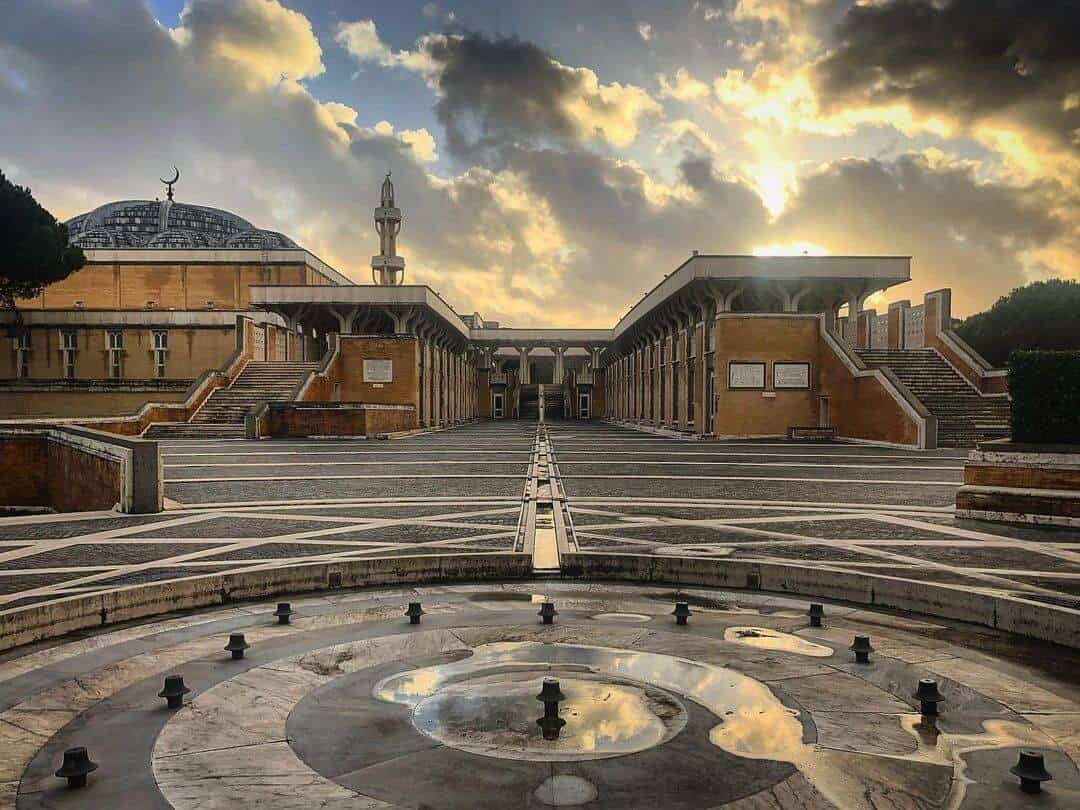
The Grand Mosque of Rome is at viale della Moschea 85, in the north of the city, at the foot of the Parioli and Monte Antenne hills, behind Villa Ada and a short walk from the Acqua Acetosa sports facilities. It is the largest place of worship for Muslims in Italy and the largest in Western Europe, and it is home to the Centro Islamico Culturale d'Italia, the body that owns and runs the entire complex. You can get there conveniently by the Roma-Viterbo regional railway, the old Roma Nord, getting off at the stations that serve the sports fields and the Acqua Acetosa area, and by the surface lines that climb up to Parioli and run alongside Villa Ada. Those who come by car will find parking along the district's avenues, but on visiting mornings it's best to arrive early. Entry to the mosque for non-Muslim visitors is free and happens through visits organized by the Islamic Center, usually concentrated on the mornings of two weekdays a week. Since the calendar changes with Ramadan, with the main Islamic holidays, with civil holidays and with the August break, it's best to arrange the day, the time and any reservation with the Centro Islamico Culturale d'Italia before showing up at the gate. To enter the prayer hall, you take off your shoes, and women cover their heads with a scarf. These are the only two requirements, and the rest is freedom to look around.
To get your bearings in the rest of the area and find the other sights within walking distance, it's best to start from the tourist attractions page for Rome, where the Parioli district and Villa Ada appear with their main points of interest.

What Is the Grand Mosque of Rome and Why It Matters
The Grand Mosque of Rome is, first of all, a record that surprises anyone who doesn't know the recent history of the city. The largest mosque in Western Europe does not stand in Istanbul or in a Gulf capital. It stands a few hundred meters from Villa Ada, in a green bend of northern Rome where the noise of traffic fades among the pines. The complex covers an area of about 30,000 square meters of land and includes the prayer hall, a large arcaded courtyard, the minaret, the library, offices, classrooms for cultural activities and service areas. The prayer hall can hold thousands of people. On major holidays, when attendance far exceeds the usual capacity and tens of thousands of worshippers arrive, prayer spills out into the courtyard and onto the surrounding forecourts.
The mosque's role is not only religious. The Centro Islamico Culturale d'Italia, which commissioned and runs the Grand Mosque of Rome, is a point of reference for the capital's Muslim community and, at the same time, a partner for Italian institutions. Weddings are celebrated here, funerals are accompanied, language and religion classes are taught, and there are conferences and interfaith dialogue meetings. Anyone who visits the building as a tourist or as someone curious about architecture therefore enters a living place, not a frozen monument. You feel this difference as soon as you pass the gate, and it changes the way you look at every detail.
There is also the reason that brings contemporary architecture enthusiasts here from all over the world. The Grand Mosque of Rome is considered one of the most important works built in Italy in the second half of the twentieth century, a building that tried to reconcile two very distant traditions, that of Islamic art and that of Roman architecture, without either prevailing over the other. The result divides opinion, fascinates, and sparks debate, and that is exactly why it deserves to be looked at closely, not walked through in a hurry.
The History of the Grand Mosque of Rome
The Idea of a Mosque in the Capital of Christendom
The idea of giving Rome a major Islamic place of worship is older than many people think, and it spanned a large part of the twentieth century before finding land and money. Rome is the seat of the papacy and the center of Catholic Christianity, and building the largest mosque in the West here carried a symbolic weight that none of the players involved could ignore. The decisive push came from the Arab world and, in particular, from Saudi Arabia. Tradition ties the project's concrete start to King Faysal's visit to Rome, when in 1966 he raised the question of a worthy temple for the Muslims present in Italy and for the many faithful passing through the capital. The Saudi sovereign, custodian of the two holy mosques of Mecca and Medina and head of the ruling dynasty, gave his financial backing to the project. The king was assassinated later, in 1975, but the project was already underway and continued with the support of several Muslim-majority states.
The institutional step that made everything else possible was the decision by the Comune di Roma to grant the land. The resolution that assigned the area to the construction of the mosque dates to the mid-1970s, and it was not a foregone conclusion. A long debate arose around the location, the height of the minaret and the very advisability of the project, with objections of every kind. In the end the chosen site was the current one, on the edge of Villa Ada, in an area that combined the availability of green space with proximity to the center.
The Competition, the Designers, the Construction Site
The design of the Grand Mosque of Rome came out of an international competition and was entrusted to a team led by the Roman architect Paolo Portoghesi, one of the protagonists of the Italian architectural debate of the second half of the twentieth century, a theorist and historian as well as a designer. Working with him were the engineer Vittorio Gigliotti, responsible for the structural part and Portoghesi's classmate on many projects, and the Iraqi architect Sami Mousawi, who brought to the group a direct knowledge of the Islamic building tradition. The name of Nino Tozzo appears among the collaborators on the project. Mousawi left the group around 1980, and the management of the project remained with Portoghesi and Gigliotti.
The construction site was a long one, as the inscription placed on the outside of the building tells: more than 20 years passed from the granting of the land to the inauguration. The first stone was laid in 1984, the year 1362 of the Hijra according to the Islamic calendar, in the presence of the then President of the Republic Sandro Pertini, a detail that shows how much the work was felt to be a matter of national importance and not only a religious one. The construction then took a decade, amid technical difficulties, revisions and settling. The inauguration took place on June 21, 1995, the day of the summer solstice: a date that, in a building designed entirely around the theme of light, was certainly not a coincidence.

The Architecture of the Grand Mosque of Rome
A Meeting Between Rome and Islam
The core of Portoghesi's thinking is simple to state and extremely difficult to carry out: Islamic architecture, in its spread from the Atlantic to Asia, did not produce a single language but many different languages, each born from an encounter with a local tradition. The Mosque of Cordoba does not resemble the one in Isfahan, and neither of them resembles Hagia Sophia, converted into a mosque in Istanbul. If this is true, then a mosque built in Rome could and should seek a dialogue with the history and materials of the place, instead of transplanting a foreign model. This is the reason the building speaks Roman while remaining fully Islamic.
The dialogue passes first of all through materials. Portoghesi chose travertine, the Roman stone par excellence, the one of the great ancient and Baroque monuments, used in several shades. He used peperino for the frames, cortina brick and pink terracotta for the surfaces, all materials that give the Grand Mosque of Rome the warm colors the eye associates with the city. The load-bearing structure is in reinforced concrete, but the cladding and the treatment of the surfaces work so that the building does not appear as a foreign body dropped into the greenery, but rather as something that rises out of the landscape without friction.
The Palm-Shaped Columns of the Prayer Hall
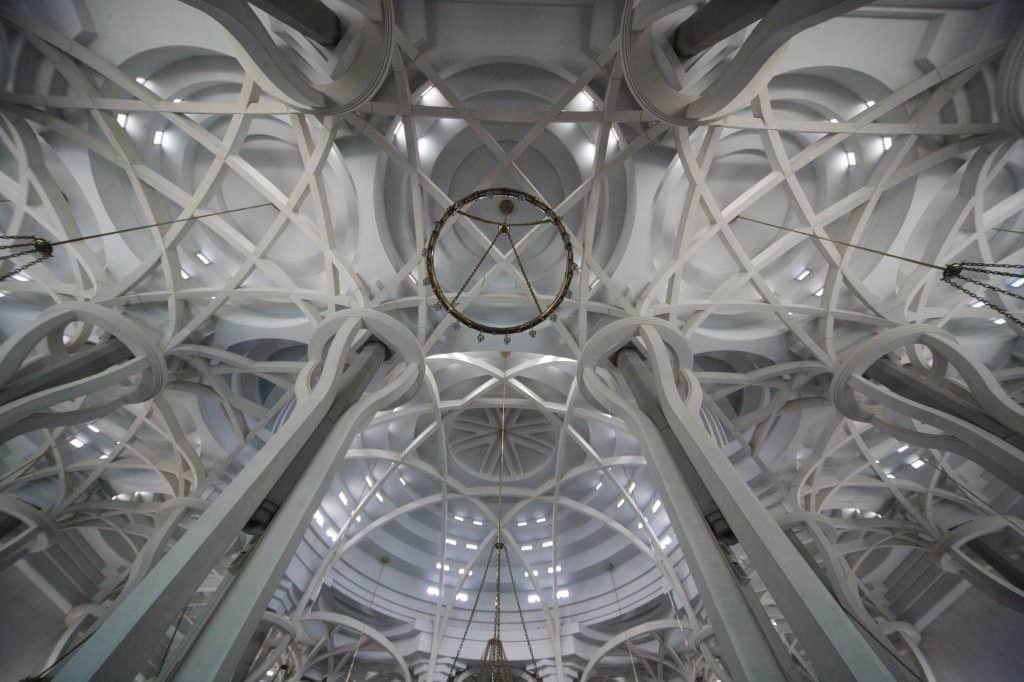
The element that strikes most, and that alone is worth the visit to the Grand Mosque of Rome, is the system of pillars in the prayer hall. There are 32 polystyle supports, that is, bundles of elements that rise vertically and then open at the top, branching out and intertwining until they connect to the vaults and domes. The reading of this forest of stone is deliberately ambiguous, and each person finds a different image in it: some see the trunk and crown of a palm tree, some a branching tree, some two hands placed together in the gesture of prayer, with the fingers touching at the top. Portoghesi worked deliberately so that the column would lose the rigidity of the classical support and become a living organism that grows, a reference to nature and to the Quranic idea of the oasis.
Walking among these pillars produces the effect of crossing an orderly wood, or the naves of a large hall that has nothing rigid about it. Curved lines dominate everywhere, and the geometry, however rigorous in the plan, appears to the eye as a continuous flow. It is here that the Grand Mosque of Rome reaches its highest point, and it is worth stopping for a long time, looking up and following the way each support turns into a roof.
The Dome, the Vaults and the Light
Above the prayer hall rises a large central dome, surrounded by a series of smaller domes that converge toward the main vault through a system of bays. The interplay between the multiplicity of the small coverings and the unity of the large dome is one of the theoretical themes of the building: many points converging on one center, periphery and centrality coming together. The reference is twofold. On one side are the great Ottoman mosques of the architect Sinān and Persian domes. On the other is the Roman tradition, the Pantheon and the dome of Saint Peter's, with which the Grand Mosque of Rome openly engages. The central dome was deliberately designed lower than that of Saint Peter's, a gesture of restraint and respect toward the urban landscape and its symbols.
Light is the true protagonist of the interior, and it is a theological theme before it is an architectural one. The Quranic verse that governs the design is taken from the 24th Sura, the Sura of Light, which says that Allah is the light of the heavens and the earth. Portoghesi translated this idea into lighting studied to the millimeter: glass panels placed at human height along the wall facing Mecca, calibrated openings, and hidden artificial sources that produce soft chiaroscuro. The result is a space where light does not fall evenly but is distributed in patches, creating a sense of indeterminacy and recollection. The hall's vault is painted blue, and at certain morning hours the combination of blue and golden reflections produces a climate of stillness that photographs only partly capture.

The Decorations, the Mihrab and the Arabesques
The decoration of the Grand Mosque of Rome is restrained, and this surprises those who expect the opulence of certain Gulf mosques. Islamic tradition does not allow the depiction of human figures or animals in places of worship, so ornament is entrusted to geometry, calligraphy and color. The walls feature glazed ceramics in delicate tones, made with traditional techniques with the contribution of Moroccan craftsmen, and the surfaces hold Quranic verses written in calligraphy, arabesques, and motifs that repeat and multiply according to mathematical rules. Encaustic stucco, of Greco-Roman origin, also appears, along with majolica cladding.
The wall facing Mecca contains the mihrab, the niche that indicates to the faithful the direction of prayer. It is not an altar, because in Islam there is no sacrifice or priesthood in the Christian sense. It is an orientation, a sign that gathers attention and directs it toward the east, toward the Kaaba. Beside it is the minbar, the pulpit from which the imam delivers the Friday sermon. When looking at these elements, it is worth remembering that the entire Grand Mosque of Rome is organized around that direction. The building, although immersed in the greenery of the Parioli, ideally points toward Mecca, and all its geometry obeys that axis.
The Courtyard, the Minaret and the Relationship with Greenery
Before the prayer hall you come to the large arcaded courtyard, a space of transition and recollection that revives an ancient model of Islamic architecture, the alternation between open courts and covered spaces typical of Persian mosques. The outer portico continues the system of interior reinforced concrete pillars with square sections, designed to be crossed by light, and connects the spaces in a gradual path that prepares the entrance to the prayer space. The minaret rises beside the complex as a vertical element that marks the mosque in the landscape. It does not house loudspeakers that broadcast the call to prayer over the neighborhood, a choice agreed upon at the time of construction to respect the surrounding urban context.
The relationship with greenery is an integral part of the project. The Grand Mosque of Rome does not impose itself as an isolated block but emerges from the trees, and the vegetation of the Parioli and Villa Ada accompanies it on every side. Portoghesi sought this effect: a building that belongs to its garden, that is seen through the foliage and gradually revealed, without the ostentation of a monumental facade.
The Islamic Cultural Center of Italy
The Grand Mosque of Rome cannot be fully understood if it is separated from the Islamic Cultural Center of Italy, the body that commissioned and built it and that today runs it. The Center owns the complex and manages every activity, from daily prayer to cultural programming. The role of imam of the mosque is held by the religious leader designated by the Center. Over the years, several spiritual leaders have followed one another, and the current religious leadership is in the hands of Sheikh Salah Ramadan. The presidency and direction of the body have seen changes and also moments of internal tension, as happens in any institution that represents a broad and varied community. In recent years the presidency has changed hands more than once, with resignations and new appointments that have sparked debate.
The Center's activities go well beyond the rite. Here are held Arabic language and religion courses, training meetings, conferences, opportunities for dialogue with other faiths. The mosque hosts moments of openness to the city, like the days when the complex shows itself to the public as part of events dedicated to contemporary architecture. For the visitor, knowing that behind the building there is this daily life changes the quality of the visit: you are not looking at an empty shell, but at the home of a community.

How to Visit the Great Mosque of Rome
Days, Hours and Booking
Visits by the non-Muslim public to the Great Mosque of Rome go through the openings organized by the Islamic Cultural Center of Italy. In general the complex welcomes visitors on the mornings of two weekdays, with free admission. Groups should announce themselves in advance. The calendar, however, is not fixed all year: openings are suspended during the month of Ramadan, on the main Islamic holidays, on Italian civil holidays and during the August summer break. Anyone planning the visit should therefore do one simple thing: verify the day and time by contacting the Islamic Cultural Center before setting out, because arriving at the gate on a closing day is the easiest disappointment to avoid.
Access Rules and Dress
Entering a place of worship in use requires some care, and at the Great Mosque of Rome the rules are few and reasonable. Dress should be kept sober, covering shoulders and legs. Women should bring a scarf or a light head covering to wear inside. To enter the prayer hall you take off your shoes, as Islamic custom requires: the hall is the floor on which the faithful prostrate themselves, and you walk on it barefoot or in socks. During the visit you keep your voice low, turn off ringtones, and ask before photographing people. These are minimal gestures of respect, the same ones you would observe in a church during a service, and they are repaid with a welcome that those who have visited the mosque remember with pleasure.
How Long the Visit Takes and What to Expect
A complete visit to the Great Mosque of Rome, courtyard included, takes about an hour, a bit more if accompanied by an explanation of the architecture and the liturgy. Don't expect crowds: the place, outside the big tourist circuits, is almost always enjoyed in peace, and that is one of its merits. Anyone arriving expecting a spectacular monument full of gold will be thrown off, because the strength of the building lies entirely in its proportion, its light and the design of its structures. Anyone who instead arrives ready to look at the architecture for what it is will find one of the most intense experiences that north Rome can offer.
Paolo Portoghesi and the Language of the Great Mosque of Rome
To really understand the Great Mosque of Rome you have to know who the man who designed it was. Paolo Portoghesi, born in Rome in 1931 and died in 2023, was one of the most complete figures of Italian architecture: a designer, but also an art historian, theorist, professor, author of fundamental studies on the Roman Baroque, on Francesco Borromini and on Guarino Guarini. He was among the protagonists of the movement that in the 1970s and 1980s called into question the rigor of modern rationalism, the so-called postmodern in architecture, and in 1980 he directed the first Venice Architecture Biennale with the famous Strada Novissima. Portoghesi believed that architecture should not deny the history and memory of places, but dialogue with them. And there was no terrain better suited to testing this idea than a mosque to be built in Rome.
His approach to the Great Mosque of Rome was that of the scholar even before the designer. Portoghesi set about studying Islamic architecture as he had studied the Baroque, seeking not a model to copy but the generating principle, the hidden rule that unites buildings very distant from one another. Hence the choice not to reproduce a mosque of Cairo or Istanbul, but to reinvent that language starting from the materials and light of Rome. The result earned him a rare recognition: being accepted, as a designer Christian by formation, by the Muslim client and by the international Islamic world, which saw in the building an act of respect and not an appropriation. It's a balance few architects in the world have managed to reach, and the Great Mosque of Rome remains the most visible proof of that ability.
The Geometry and Models of the Great Mosque of Rome
The plan of the Grand Mosque of Rome combines three major historical models of Islamic architecture, which Portoghesi cites and fuses. The first is the so-called forest mosque, typical of the Maghreb and embodied by the Great Mosque of Córdoba, in southern Spain, where rows of columns and arches create a hypostyle space that extends like a forest. It is the model that explains the forest of pillars in the Roman prayer hall. The second is the Ottoman mosque, the large hall covered by a system of domes perfected by the Turkish architect Sinan in the 16th century, to which the central dome and the roofs refer. The third is the Persian mosque, based on alternating large open courtyards and enclosed spaces, which returns in the relationship between the arcaded courtyard and the hall.
On these models, Portoghesi grafts a compositional method entirely his own, based on repeating a spatial cell that multiplies and aggregates. The many smaller domes that converge on the large central vault translate a philosophical idea into architecture: multiplicity gathered into unity, the many points on the periphery converging on a center. It is the same principle that governs Islamic geometric decoration, where an elementary motif, repeated according to mathematical rules, generates patterns of endless complexity without ever losing its connection to its starting unit. In this sense, the Grand Mosque of Rome is a building that can be read as a line of reasoning: each part points to the whole, and the whole is explained through the parts.
Islam in Rome and the Role of the Grand Mosque of Rome
The Grand Mosque of Rome is not the only place where Muslims in the capital pray, but it is the main and most visible one. Many smaller prayer rooms exist across the city, often set up in neighborhood premises, serving the communities of different districts. The Parioli mosque, however, is the only one built as such, with a minaret, a dome and spaces designed from the outset for Islamic worship, and it is the institutional seat that represents the community in its dealings with the Italian state. It hosts the large collective Friday prayer, and it hosts the two major feasts of the Islamic calendar, the end of Ramadan and the Festival of Sacrifice.
The fact that the largest Islamic place of worship in Western Europe stands in Rome, the city of the papacy, has a meaning that goes beyond the news. It tells the story of a capital that over the course of the 20th century became increasingly plural, a destination for immigration and a crossroads of faiths, and that chose to give that plurality a dignified and visible home rather than hide it. The Grand Mosque of Rome is the built sign of that choice, and for this reason its history matters to Muslim believers as much as to anyone who wants to understand how Rome has changed over the last 50 years. Visiting it means reading a recent and little-told chapter of the city's life, the one about the meeting of its religious communities.
The Grand Mosque of Rome and Its Neighborhood
The location of the Grand Mosque of Rome is a bonus for anyone who wants to build a full day around the area. A short walk away is Villa Ada, one of the city's largest parks, with its ponds, paths and the Antenne fort hidden among the trees. It is the ideal place for a stroll before or after the visit. Not far away, underground, are the Catacombs of Priscilla, one of Rome's most important early Christian cemeteries, with very ancient frescoes. The contrast between Portoghesi's contemporary Islam and the Christianity of the origins, just a short walk apart, says a lot about the layering of this city.
Toward the river you reach the Foro Italico, with its mosaics and the Stadium of Marbles, and the historic Milvian Bridge, the site of the battle that in 312 changed the course of the Empire. On the contemporary culture side, the Auditorium Parco della Musica by Renzo Piano and the MAXXI museum by Zaha Hadid complete an itinerary that strings together some of the most debated architecture of Rome in recent decades. Those who love the ancient world can head to the Museo Etrusco di Villa Giulia or go down toward Villa Borghese and the Bioparco di Roma (Rome Zoo). For those who want instead to read Rome through its religious communities, the Jewish Museum of Rome in the Ghetto offers a natural counterpoint to the visit to the mosque.

The Roman Materials of the Grand Mosque of Rome
It is worth taking a closer look at what the Grand Mosque of Rome is made of, because much of its dialogue with the city plays out there. Travertine, the pale, porous stone from the quarries of Tivoli, is the material Rome used to build the Colosseum, the colonnade of St. Peter's, and a thousand Baroque facades. Using it for a mosque places the building in the same family as those monuments, and gives it the same warm color that the afternoon sun brings out on the ancient stones. Portoghesi used it in several shades, alternating it with the gray peperino of the cornices, the volcanic stone of the Alban Hills, and cortina brickwork, which covers large surfaces with the rosy tone of terracotta. These are the materials of the Lazio landscape, not exotic imports, and they give the whole a texture that feels familiar to anyone who knows Rome.
To this Roman base are added the know-how of the Islamic world. The glazed majolica tiles and ceramic cladding, with their delicate tones, were made with the help of Moroccan craftsmen using techniques handed down over generations. The encaustic stucco work, by contrast, points to a technique of Greco-Roman origin, further proof that in the building, traditions intertwine rather than exclude each other. The roofing was also treated with care, using durable materials designed to withstand time. Looking closely at a wall of the Grand Mosque of Rome, you can therefore read a collaboration between two worlds: the stone of the Roman countryside and the craftsmanship of the Maghreb, joined in a surface that does not belong entirely to either one or the other.
Visiting the Grand Mosque of Rome with Children and Taking It Slowly
The Grand Mosque of Rome is a destination that works well with children too, as long as you prepare them. The spaces are large, bright, and laid out largely on a single level, and the forest of columns in the prayer hall captures the imagination of the youngest visitors, who often see an enchanted wood before they see a work of architecture. It's worth explaining to them in advance that it is a working place of worship, where people speak quietly and a few simple rules are observed, such as taking off your shoes before entering the prayer hall. Turning the visit into a small observation game, looking for the hidden shapes in the pillars and the patterns that repeat in the decorations, makes it memorable.
For visitors with accessibility needs, the building, which is recent and mostly on level ground, is an advantage, but the specific conditions of routes and services should be checked with the Centro Islamico Culturale before the visit. In general, the Grand Mosque of Rome rewards those who approach it slowly: it is not a place to pass through, it is a place to dwell in for an hour, sitting in a corner of the courtyard watching the light change, walking slowly among the supports, looking up at the blue vault. Those who give it this time leave with an image that resembles no other among those Rome offers its visitors.
A Curiosity About Grand Mosque of Rome
The curiosity that catches first-time visitors off guard concerns the date of the opening. The Grand Mosque of Rome was opened for worship on June 21, 1995, and the choice of the summer solstice, the longest day of the year, was not a chance occurrence but a gesture consistent with the building's entire concept. Everything here is built around light: the Quranic verse that governs the design comes from the Sura of Light, the windows are calibrated to bring light into the prayer hall at human height, and the blue vault reflects and distributes the light. Opening the mosque on the day the sun reaches its highest point on the horizon was a way of sealing that idea with an astronomical event.
There is a second curiosity that few people know, and it concerns precisely those columns everyone admires. Portoghesi, a theorist as well as a designer, has explained several times that the shape of the supports comes from observing nature and from geometric calculations, not from decorative whim: the way each pillar branches out at the top mirrors the structural behavior of certain natural forms, where branching distributes loads. The stone forest of the Grand Mosque of Rome is therefore also a lesson in statics disguised as poetry. Looking at it knowing this changes the experience: what seems like pure fantasy is the result of rigorous reasoning about how a structure can support a wide roof with the least amount of material.
One Thing Nobody Tells You About Grand Mosque of Rome
The thing almost nobody tells you is how harsh and long the political path was that led to the building's existence. Building the largest mosque in the West in the city of the pope was an extremely delicate matter, debated for decades before a single stone was laid. The issue of the minaret, for example, was the subject of negotiation: it was agreed that the call to prayer that marks the day in Muslim countries would not be broadcast from the tower through loudspeakers, so as not to layer that voice over Rome's soundscape. It is a compromise that says a lot about the nature of this building, born from the meeting of different sensitivities and built with the intention of not hurting anyone.
There is also a detail of scale that escapes most visitors: the dome of the Grand Mosque of Rome was deliberately designed lower than the dome of St. Peter's. It was not a technical constraint. It was a choice of respect for the symbolic profile of the city. In a capital where heights have always carried meaning, where for centuries no building could rise above the great dome, this voluntary self-limitation of Islamic architecture tells a whole season of relations between faiths and institutions. The mosque asserts its presence with force, but chooses not to compete in height with the symbol of Christianity: a gesture that is worth more than many speeches about dialogue.
The Advice I Give for Visiting Grand Mosque of Rome
The advice is just one, and it is worth more than all the others: call ahead. The Grand Mosque of Rome is not a museum with continuous hours. It is a place of worship that opens to the public in precise and variable windows, suspended during Ramadan, Islamic holidays, Italian public holidays and the entire month of August. It happens often that you arrive at the gate on Viale della Moschea and find it closed because you assumed the hours. Agree on a day and time with the Centro Islamico Culturale d'Italia, and if you come as a group, let them know in advance. You'll avoid the disappointment and get a better welcome.
The second piece of advice concerns the time of day. Go early in the morning, when the light is still low and cuts across the prayer hall diagonally through the windows. This is when the building looks its best, and the columns cast long shadows that bring out its design. Wear shoes that are easy to take off, since you enter the prayer hall barefoot, and women should bring a light scarf. One last thing, and I say this as a professional: don't treat this visit as a quick checkmark between one monument and the next. The Grand Mosque of Rome asks for time and attention, and it rewards those who stop to look instead of passing through. Give it a full hour, courtyard included, and you'll leave having understood something about Rome that the guides in the center don't tell.
Another Well-Known Fact, Yet Rarely Mentioned
The fact is this: the Grand Mosque of Rome was made possible by money from Saudi Arabia and other Muslim states, but the architectural design was signed by an Italian, a Roman, Catholic by cultural background, one of the major historians of twentieth-century architecture. Paolo Portoghesi was not an architect of the Islamic world. He was a Roman intellectual who had studied the Baroque, who had written fundamental books on Borromini and Guarini, and who found himself interpreting a religious tradition that was not his own with a respect and competence that were recognized throughout the Muslim world. This exchange, an Arab client and a Roman designer, is the deeper meaning of the building, and it is the reason the mosque speaks two languages at once.
The second aspect that is rarely mentioned concerns the craftsmen and the materials. The glazed ceramics and decorations were entrusted to artisans from the Arab world, in particular from Morocco, who carried techniques handed down for centuries. The travertine, peperino and cotto, by contrast, came from the quarries of Lazio, the same materials used to build the city's ancient monuments and Baroque churches. The building therefore brings together, side by side, the manual knowledge of the Maghreb and the stone of Rome. It is a collaboration that is rarely told, and it explains why the Grand Mosque of Rome, though a work of the twentieth century, has the substance and color of Roman things of always.
The Right Photo to Take at Grand Mosque of Rome
The photo that captures the soul of the place is the one taken from inside the prayer hall, looking up. Stand between the pillars, aim the lens at the point where the supports open and interweave into the vaults, and include the blue vault in the frame. That is where the idea of the stone forest reads, and it is the image no postcard conveys. The morning light, filtered through the windows, draws gradations on the pillars that change minute by minute, and it's worth waiting for the moment when a ray cuts through the hall. Remember that you photograph the architecture, not the worshippers. If people are praying, wait or change your frame.
Outside, the best photo is the one that captures the Grand Mosque of Rome among the trees, with the minaret rising behind the foliage and the dome emerging from the greenery of the Parioli. Look for a raised spot, or walk away along the avenues of Villa Ada, so the building is framed by vegetation. It is the image Portoghesi was looking for, the mosque that belongs to its garden and does not impose itself as an isolated block. On clear days, with Rome's clear sky, the contrast between the pale travertine, the rosy cotto and the green of the pines makes a photograph that is worth the trip out here.
Some Important Events That Happened Here in History
The first major event was the laying of the foundation stone in 1984, in the presence of the President of the Republic, Sandro Pertini. It was not a mere protocol detail: the head of state's attendance at an Islamic religious construction site, in the city of the pope, marked the public and institutional recognition of the Muslim presence in Italy. From that day on, the Grand Mosque of Rome stopped being a proposal debated for decades and became a concrete fact, destined to change the religious face of the capital.
The second major moment was the inauguration on June 21, 1995, which officially opened the largest Islamic place of worship in Western Europe. Since then the mosque has become the center of religious life for Rome's Muslims: the Friday prayer is held here, and the great feasts of the Islamic calendar are celebrated here. On the days of the Festival of Sacrifice and the end of Ramadan, the number of visitors far exceeds the capacity of the prayer hall, and tens of thousands of worshippers fill the courtyard and the surrounding spaces. These are the images that every year show how much the community has grown since the building was designed.
Over the years the Grand Mosque of Rome has also been the setting for moments of interreligious dialogue and initiatives to open up to the city, as well as internal institutional changes within the Centro Islamico Culturale, with changes in the presidency and religious leadership that reflected the complexity of representing a large and diverse community. Whenever the building opens its doors to the public, as part of events dedicated to contemporary architecture, another kind of event also takes place: the meeting of Romans and visitors with a work that many know only by name and that they discover, once inside, to be one of the most original buildings in their city.
Who has passed through the Grand Mosque of Rome
The figure who belongs more than anyone else to the history of this place is Paolo Portoghesi, the Roman architect and historian who signed the design and left here one of the most demanding works of his long career. Alongside him we should remember the engineer Vittorio Gigliotti, who solved the bold structural challenges of the branching columns and the domes, and the Iraqi architect Sami Mousawi, who in the first phase brought direct knowledge of Islamic building traditions to the team. These are the three names without which the Grand Mosque of Rome would not exist in the form we admire today.
Among the powerful, the story of the mosque is tied to King Faisal of Saudi Arabia, guardian of the holy mosques of Mecca and Medina, whose financial support launched the project and who never saw the work completed, having been assassinated in 1975. And then there is Sandro Pertini, the President of the Republic who chose to attend the laying of the foundation stone in 1984, linking his name to a gesture recognizing religious freedom. Over the years the Grand Mosque of Rome has hosted ambassadors, Muslim religious leaders from around the world, representatives of Italian institutions and of other faiths, and its leadership has passed through public figures, such as the former member of parliament Khalid Chaouki, who headed it in the second half of the 2010s. But the real passage that matters is the daily and anonymous one of the thousands of worshippers who pray here, and of the visitors who every week pass through the gate to understand a piece of Rome they thought they knew.
Quick questions about the Grand Mosque of Rome
Where is the Grand Mosque of Rome?
At viale della Moschea 85, in the northern part of the city, at the foot of the Parioli and Monte Antenne, behind Villa Ada and near the Acqua Acetosa sports facilities.
How much does it cost to enter the Grand Mosque of Rome?
Admission for the public is free and takes place through guided visits organized by the Centro Islamico Culturale d'Italia.
When is the Grand Mosque of Rome open to the public?
Visits for non-Muslim visitors are usually concentrated in two weekday mornings a week, but the schedule changes with Ramadan, Islamic holidays, Italian public holidays and the August break. It's best to check the day and time with the Islamic Center before you go.
Do I need to book a visit to the Grand Mosque of Rome?
Groups should announce themselves in advance to the Centro Islamico Culturale d'Italia. Individual visitors should also check that it's open on the day before showing up at the gate.
How do I get to the Grand Mosque of Rome by public transportation?
You can reach it by the Rome-Viterbo regional railway, getting off at the stations that serve the sports fields and Acqua Acetosa area, and by surface bus lines that climb the Parioli and run along Villa Ada. It's best to check which line is most convenient from your starting point.
How long does a visit to the Grand Mosque of Rome take?
About an hour, including the courtyard, a little longer if it's accompanied by an explanation of the architecture and liturgy.
What should I wear to visit the Grand Mosque of Rome?
Dress modestly, covering shoulders and legs. Women should bring a scarf or a light head covering to wear inside.
Do I have to take off my shoes at the Grand Mosque of Rome?
Yes, to enter the prayer hall you take off your shoes, as Islamic custom requires. People move about barefoot or in socks.
Can you take photographs at the Grand Mosque of Rome?
In general you can photograph the architecture, while being discreet. Don't photograph worshippers at prayer without their consent, and if you're unsure, it's best to ask the staff.
Who designed the Grand Mosque of Rome?
The architect Paolo Portoghesi with the engineer Vittorio Gigliotti for the structures, and, in the first phase, the Iraqi architect Sami Mousawi. Among the collaborators is Nino Tozzo.
When was the Grand Mosque of Rome built?
The land was granted by the municipality in the 1970s, the first stone was laid in 1984, and the inauguration took place on June 21, 1995, more than 20 years after the process began.
Who funded the Grand Mosque of Rome?
The project was backed by Saudi Arabia, with the support of King Faysal, and by other Muslim-majority states.
How many worshippers can the Grand Mosque of Rome hold?
The prayer hall holds thousands of people, and on the major feast days the entire complex can gather tens of thousands of worshippers, between the hall and the outdoor spaces.
Why is the Grand Mosque of Rome famous?
Because it is the largest Islamic place of worship in Western Europe and one of the most important works of contemporary architecture built in Italy, famous for the branching columns of the prayer hall and for the dialogue between Islamic art and Roman materials.
Is the Grand Mosque of Rome accessible to people with disabilities?
The complex is recent and laid out largely on a single level. For specific accessibility needs, it's best to ask the Centro Islamico Culturale for information before your visit.
Is the Grand Mosque of Rome suitable for children?
Yes, the visit is calm and the spaces are spacious. Younger children should be told that it is a working place of worship, where voices are kept low and access rules are followed.
What is there to see around the Grand Mosque of Rome?
Villa Ada and its park, the Catacombs of Priscilla, the Foro Italico, Ponte Milvio, the Auditorium Parco della Musica, the MAXXI and the Etruscan Museum of Villa Giulia, all within a short distance.
What is the best time to visit the Grand Mosque of Rome?
Early in the morning, when the low light comes through the windows and cuts diagonally across the prayer hall, bringing out the pattern of the columns.
A final thought on the Grand Mosque of Rome
Of all the architecture I take people to see when they're looking for the less obvious Rome, this is the one that provokes the strongest reactions. Those who arrive prejudiced leave changed, and those who arrive curious leave won over. The strength of the Grand Mosque of Rome doesn't lie in gold or in size. It lies in the intelligence with which a Roman architect managed to make a faith that is not Roman speak in Roman terms, using the travertine of his city and the geometry of Islam to build a space where light becomes prayer. Go slowly, in the morning, after calling to make sure it's open. Stop among the columns, look up, and let the building do its work. You'll leave knowing a little more about Rome, and about how cities, when they choose to, know how to welcome.
Article written by the editorial team of TourLeaderPro, contact them for Tours and Private/Corporate/V.I.P. Experiences.
Planning a trip to Rome? English-language guides for visiting the city are available at ItalyPlanner.com.