Waldensian Evangelical Church
In short. If you come toward Trajan's Forum going up from Piazza Venezia, on the left side of the street, the one below the Quirinal Hill, there's a doorway almost nobody looks at.
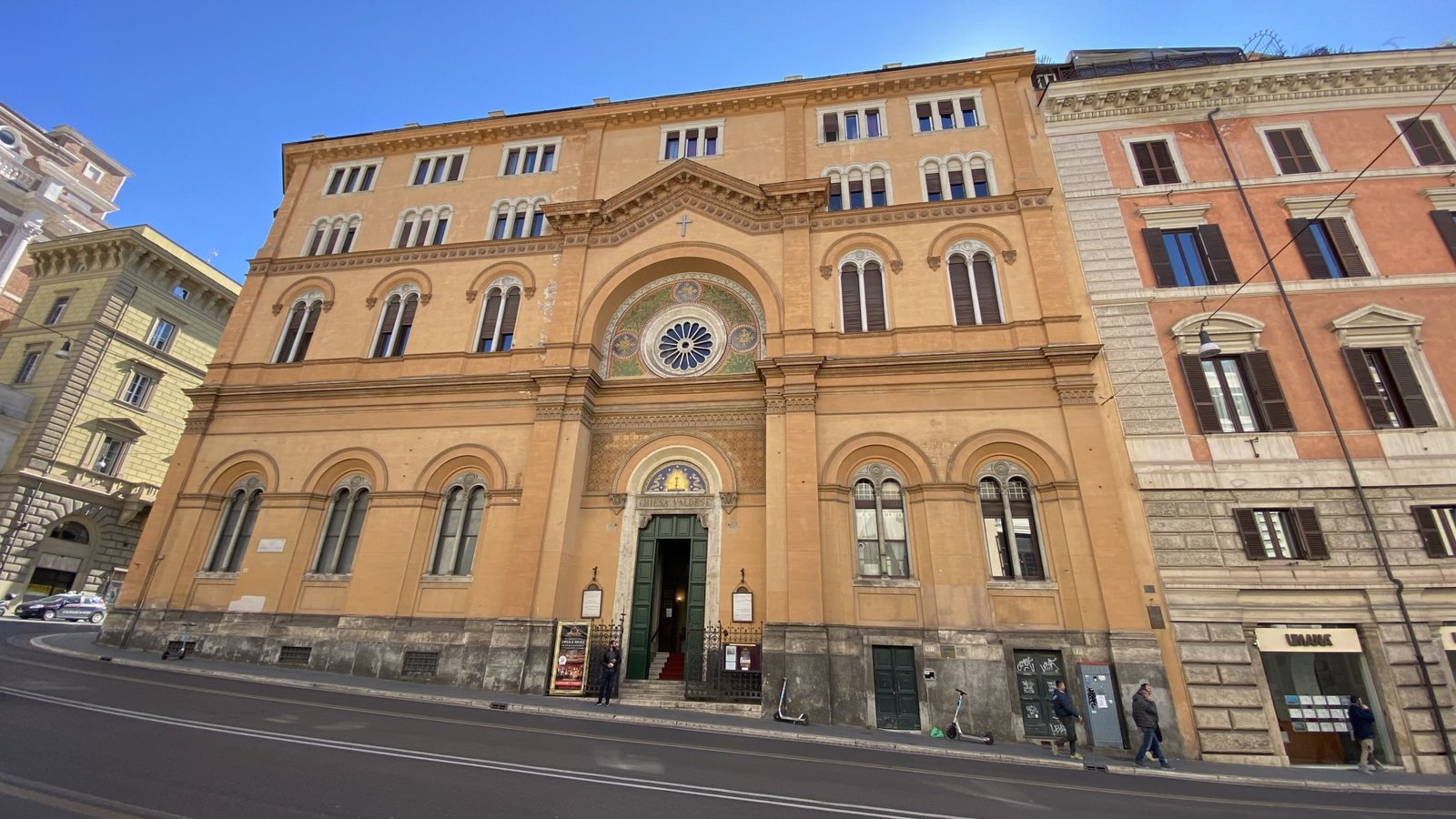
If you come toward Trajan's Forum going up from Piazza Venezia, on the left side of the street, the one below the Quirinal Hill, there's a doorway almost nobody looks at. Above it is a street number, 107 Via IV Novembre, and behind that doorway opens one of the most discreet and most history-laden places of worship Rome has: the Waldensian Evangelical Church of the rione Trevi. It has no bell tower, no dome, no flight of steps to announce it. It has a facade that blends into a late 19th-century building, and in that very blending lies the first chapter of its story: when it was built, Protestants in Rome could not afford to draw too much attention, and for a good part of a century their presence in this city had simply been forbidden.
Along the Forums this is one of the very few addresses you can describe by looking at two things at once: on the other side of the roadway, practically across the street, is the entrance to Trajan's Markets, at number 94, the great brick hemicycle of the 2nd century that today houses the Museum of the Imperial Forums. On one side imperial Rome, on the other the Rome of religious minorities who for centuries lived on the margins and who only after 1870 were able to open a place of worship in the center. 2,000 years of distance in 20 meters of asphalt. It doesn't happen often.
Where the Waldensian Evangelical Church Is and How to Get There
The exact address is Via IV Novembre 107, Rome, in the rione Trevi, on the stretch of road that connects Piazza Venezia and Piazza dei Santi Apostoli to Largo Magnanapoli and then to Via Nazionale. It's a spot in Rome that everybody passes through and almost nobody looks at: the roadway is wide, the traffic is constant, the sidewalk climbs at a slight slope toward the Quirinal and the eye is drawn to the Torre delle Milizie, the 13th-century tower that rises above Trajan's Markets and that Romans for centuries called, with a historical imagination all their own, Nero's tower. The Waldensian Evangelical Church is on the opposite side, set into the ground floor of a building, and you have to look for it with a minimum of attention.
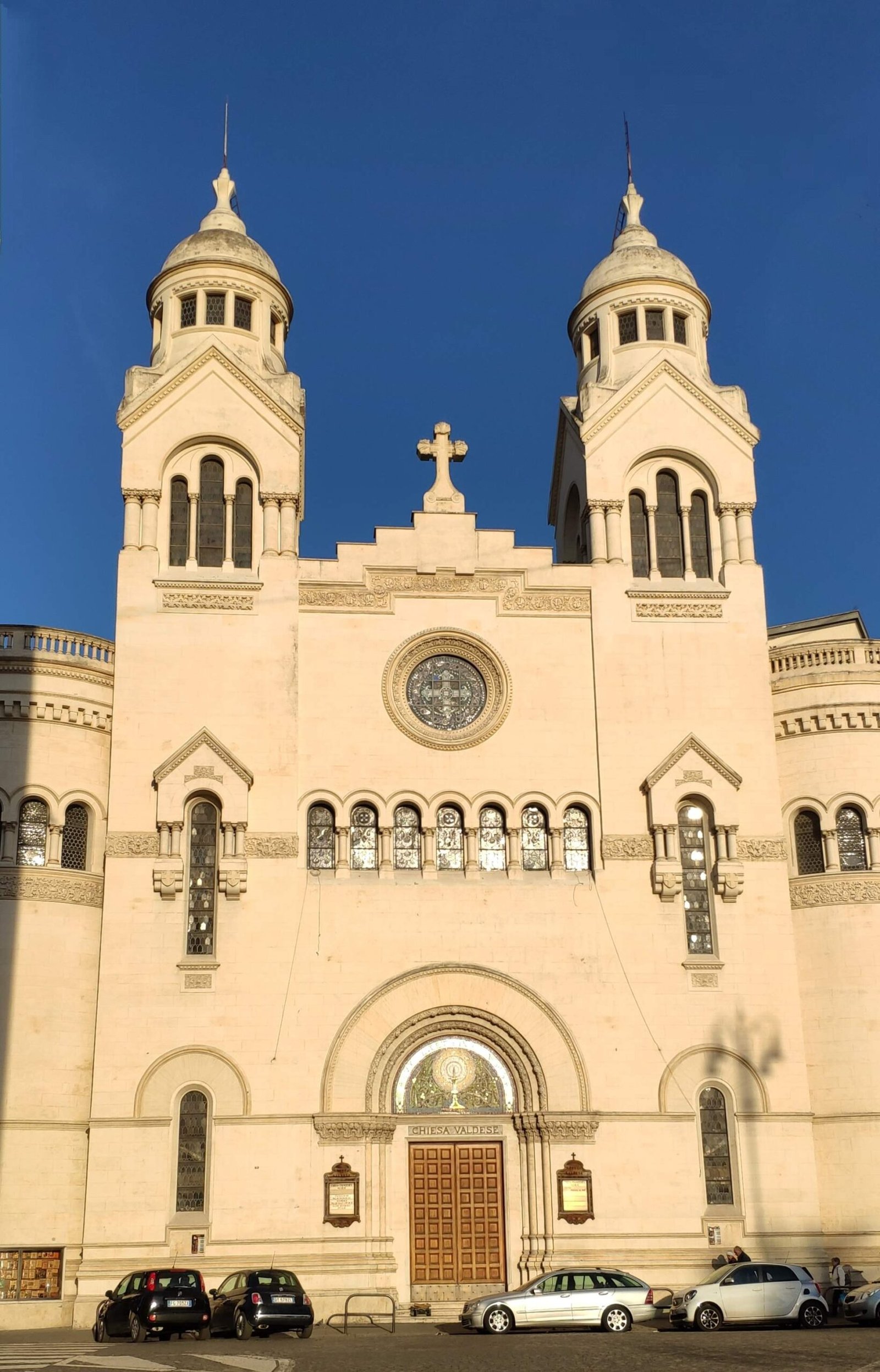
The best way to get there is on foot. From Piazza Venezia it's barely five minutes: you take Via IV Novembre with the Vittoriano behind you and walk uphill. From Largo Magnanapoli, where the Baroque church of Santa Caterina a Magnanapoli and the gardens of Villa Aldobrandini hanging above the street are, it's three minutes downhill. If you're arriving by metro you have two options, both reasonable: line B, Cavour stop, and from there you go down Via Cavour and the Imperial Forums, or line A, Repubblica stop, and from there you walk all of Via Nazionale downhill, which is one of the most underrated urban walks in the city. In both cases you walk between 10 and 15 minutes. Via IV Novembre is served by several surface lines that climb from Piazza Venezia toward Via Nazionale, and the useful stop is the one at Trajan's Markets.
The Name of the Street Is Younger Than the Waldensian Evangelical Church
Here's a curious detail that immediately puts the dates in perspective. The street is called Via IV Novembre in memory of November 4, 1918, the day of the Victory Bulletin, and the name dates precisely from the end of the First World War. The church, on the other hand, had already been there for over 30 years: it was built in 1883-1884. That means the building has seen its own address change, that its first churchgoers wrote a different street name on their letters from the one we read today on the plaque, and that this stretch of roadway was considered, originally, the natural extension of Via Nazionale toward Piazza Venezia. Rome is made of this too: stones that stay, names that move.
I'll add a detail for those who like recent urban changes: in 2019 the road surface of Via IV Novembre, historically in sampietrini, was replaced with asphalt, keeping the stone paving only along the edges of the roadway. Anyone who returns to Rome after a few years and remembers the noise the wheels made on this slope notices immediately that something has changed. The cars glide more quietly, and paradoxically you hear the organ better when a few notes filter out from inside.
What the Waldensian Evangelical Church Really Is: Not a Museum, a Community
Let me make the most important thing clear right away, because it's what makes a visit here different from a visit to San Pietro in Vincoli or the Gesù. The Waldensian Evangelical Church of Via IV Novembre is not a monument open to the public with hours, a ticket office and a visitor route. It is the place of worship of a living community, which meets every Sunday at 11:00, which has a pastor, a consistory, a choir, a Sunday school for children, midweek meetings, Bible study groups and solidarity activities. The door isn't open because there's something to exhibit, it's open because there's someone to welcome.
This radically changes the way you should approach it. You don't go in "to see" in the sense in which you enter a picture gallery. You go in to attend a service, a concert, a lecture, or, and it often happens, because you ring the bell, ask politely, and someone from the community opens up and takes you inside telling you a couple of things. In that case the thanks is not a ticket, it's good manners: silence, phone muted, no photographs unless you've been told explicitly that you can, and the willingness to leave an offering if you feel like it, without anyone asking you for it.
The community belongs to the Waldensian Evangelical Church - Union of Methodist and Waldensian Churches, the oldest Protestant denomination present in Italy. The published phone number is 06 6792617 and the email address is romaquattronovembre@chiesavaldese.org: if you plan to come as a group or want to know whether the church is accessible on a given day, writing first is the only sensible strategy. It's not a place where you show up with 20 people without warning.
Why the Waldensian Evangelical Church Is Called That
"Waldensian" doesn't come from a place, as with "Romans" or "Florentines," nor from a founder who gave himself that name. It comes from a man, Valdo of Lyon, a merchant of the second half of the 12th century, and the movement that took off from him was for a long time called the Poor of Lyon. "Evangelical" instead indicates belonging to the world of the Protestant Reformation, that is, to those churches that put the Gospel, Scripture and preaching at the center. Put together, the two words tell a story more than 800 years long: a movement born in the Middle Ages, condemned as heretical, survived in some Alpine valleys, entered the Reformation in the 1500s, persecuted until the 1800s, emancipated in 1848 and arrived in Rome only after 1870.
It should be said right away, as soon as you walk in: what you have in front of you is not a branch broken off from some northern European Protestant church and transplanted to Italy. It is an Italian reality, with Italian and French roots, older than Luther by about three and a half centuries. When in 1517 Martin Luther posted his theses at Wittenberg, the Waldensians had already been hunted for over 300 years. It's one of the few European religious minorities that can say something like that, and it's worth remembering, because it perfectly explains the sober and resilient tone of this building.
Valdo of Lyon and the Birth of the Movement Behind the Waldensian Evangelical Church
The story begins far from Rome, in Lyon, around 1173. A rich merchant, whose name has reached us in different forms (Valdo, Valdesio, and in the Italian tradition also Pietro Valdo), goes through what we would today call a crisis of meaning. Medieval sources tell that, struck by the sudden death of an acquaintance and by a minstrel's song about the life of Saint Alexis, he turns to a master of theology to ask what is the best way to go to God. He receives in reply the phrase from the Gospel of Matthew that orders the rich young man to sell everything and give it to the poor. Valdo takes it literally. He settles his wife, puts his daughters in a convent, distributes his wealth and begins to preach in the street, in voluntary poverty.
Up to here, nothing the Middle Ages didn't know: evangelical poverty was in the air and a few years later, on the other side of the Alps, Francis of Assisi would follow a path not entirely dissimilar. The decisive difference is another one and lies in two choices that cost the Waldensians eight centuries of trouble. The first: Valdo had portions of the Bible translated into the vernacular, so that people could hear and understand it. The second: he held that preaching belonged to anyone who had received the call, laypeople included, and, an even more startling point for the time, women too. Preaching without episcopal authorization, and from a translated text, meant challenging the clergy's monopoly on the Word.
The Condemnation and the Underground Years That Precede the Waldensian Evangelical Church
The reaction came quickly. In 1184, at Verona, the movement was condemned and the Poor of Lyon were classed among the heretics. From that moment begins a very long story of life underground, which is perhaps the most extraordinary thing in the whole Waldensian story: a movement with no state, no universities, no armies, transmitted through family and itinerant channels over three centuries. The medieval Waldensian preachers, whom the sources call barba (a word that in the Alpine dialects means "uncle," a term of respect), traveled in pairs, often disguised as peddlers, carrying their wares in one bag and the biblical texts in another. They entered homes, sold fabrics or pins and, when the house was safe, read the Gospel.
The movement spread in France, Germany, Bohemia, Piedmont, Calabria and Apulia. It was cut down by the Inquisition repeatedly, with burnings and trials documented all over Europe. It survived above all in one place, and not by chance: the western Alpine valleys, the Cottian Alps, that is the Val Pellice, the Val Chisone, the Val Germanasca, in that knot of mountains west of Pinerolo where the terrain is steep, communications are difficult and anyone who wants to repress has to work quite hard. Mountains don't work miracles, but they protect minorities better than plains.
Chanforan 1532: When the Waldensians Enter the Reformation, and the Waldensian Evangelical Church Becomes Protestant
The decisive step comes in 1532, in a clearing of the Val d'Angrogna called Chanforan. The Waldensian barba, who had made contact with the Swiss and French reformers, gather in assembly and resolve to join the Protestant Reformation. It's not a sudden twist: it's the end point of a dialogue begun years earlier, with the sending of emissaries to Switzerland and Germany to understand whether that new movement shaking Europe was saying the same things the Waldensians had been repeating for centuries in hiding. The answer was that yes, on many points there was convergence.
At Chanforan the Waldensians also decided on something very concrete and very costly: to finance a French translation of the Bible made from the original texts. Out of it came, in 1535, the so-called Olivétan Bible, named after the translator Pierre Robert known as Olivétan, cousin of John Calvin, who signed the Latin preface. The Waldensians of the valleys, mountain people who were not swimming in gold, put together a considerable sum to pay for it. There is no detail that sums up the character of this church better: when it has money, it spends it on books, schools and hospitals. It's a trait we will find intact four centuries later, when we get to talking about how this church manages its resources today.
The Price of Coming Out of Hiding
Coming out into the open had a very high and immediate price. Until then the Waldensians had been persecuted as heretics only sporadically identifiable, from 1532 on they became a recognizable religious minority, with temples, pastors, assemblies, and therefore a much easier target. The Waldensian communities of Calabria, at Guardia Piemontese and in the neighboring villages, where Piedmontese families had moved in the 1300s, were destroyed in 1561 with a violence that the chronicles of the time do not hide at all. In the Piedmontese valleys began a cycle of repressions and resistance that would last almost 300 years.
It's a part worth knowing in front of a Waldensian place of worship, because otherwise you don't understand the architecture. A community that for centuries prayed in farmhouses, barns, clearings and caves does not develop a taste for the monumental building. It develops a taste for the essential building, where what matters is that the voice of the reader be heard and that everyone can see each other's faces. The church of Via IV Novembre, with its single rectangular hall, is the translation into 19th-century masonry of a very long habit of sobriety.
The Piedmontese Easter of 1655 and the European Echo That Reaches the Waldensian Evangelical Church
In 1655 the Waldensian valleys went through the bloodiest season of their history. A ducal order forced the Waldensian families living outside the boundaries assigned to them to leave their homes in the depth of winter, and the protest was followed by a military repression that swept over the villages of the Val Pellice and the neighboring valleys. The memory of those days has gone down in history under the name of Piedmontese Easter, and the testimonies gathered then, though they must be read with the caution due to any partisan source, describe massacres of civilians.
The remarkable thing, and what helps to understand why a minority of a few thousand people left such a big mark, is what happened afterward. The news reached Protestant Europe and provoked an unprecedented diplomatic and cultural reaction. The England of Oliver Cromwell set its diplomacy in motion, public subscriptions were opened across half the continent and, above all, John Milton, the poet of Paradise Lost, then secretary for foreign languages of the English government, wrote a sonnet that begins with a line that has remained famous in English literature: Avenge, O Lord, thy slaughter'd saints. It is probably the only case in which an Italian Alpine community of a few thousand souls entered the British poetic canon for good.
Why That Memory Still Matters Inside the Waldensian Evangelical Church
If you attend a service here on Via IV Novembre you will not hear any vindictive or victimizing tone: it's not in the style of this church, which has an almost temperamental distrust of rhetoric. But if you chat with someone from the community after the service, and the conversation touches on history, you'll notice that those dates are present, precise, familiar. 1655 and 1689 are not for the Waldensians what a date in a school textbook is for us. They are family memory, often literally: many surnames you meet in the Italian Waldensian churches (Bertalot, Bounous, Coïsson, Geymonat, Peyrot, Pons, Rostan, Tourn) come from those valleys and those events.
The Glorious Return of 1689, Epic Chapter in the History of the Waldensian Evangelical Church
In 1686 the situation collapsed again: after the revocation of the Edict of Nantes in France, the Duke of Savoy too imposed abjuration or exile on the Waldensians. The valleys were emptied. Thousands of people ended up in prison, a great many died, the survivors were deported beyond the Alps and found refuge in Protestant Switzerland and southern Germany, where villages founded by Waldensian exiles still exist today with names that betray their origin.
Three years later, in August 1689, one of the most incredible feats of modern European history takes place. A group of about 900 men led by the pastor and commander Henri Arnaud sets out from the shores of Lake Geneva, crosses the Alps under arms, fights along the way and in a little over 10 days returns to the valleys of origin, retaking the land from which it had been driven. The march has gone down in history as the Glorious Return. The route, now turned into a hiking itinerary that can be walked in about 10 days, remains one of the founding stories of Waldensian identity: a minority that, instead of dissolving in the diaspora, returns home on foot crossing the Alpine passes.
It's an episode to be told with care, because it's the moment when the Waldensian story stops being only religious history and becomes European history in its own right. And because it serves to explain something that strikes anyone who enters Via IV Novembre for the first time: the tenacity. A church that has been through all this has no need of marble to feel legitimate.
February 17, 1848: Charles Albert's Letters Patent and the Freedom That Makes the Waldensian Evangelical Church Possible
Between 1689 and the middle of the 19th century the Waldensians lived in what historians have called, without too much beating around the bush, an Alpine ghetto: tolerated within precise geographic boundaries, excluded from professions, universities, land ownership outside the valleys, full civil rights. They could exist, as long as they stayed where they were and weren't seen too much.
The turning point comes on February 17, 1848, when Charles Albert of Savoy signs the Letters Patent granting the Waldensians civil and political rights: admission to schools and universities, to public office, to the professions, full citizenship. A point that is often told badly deserves precision: the Letters Patent do not grant freedom of worship as we understand it, they sanction civil emancipation. Full religious freedom will arrive by degrees, with the Albertine Statute and with the process of unification. But February 17, 1848 remains the date that breaks centuries of segregation, and in fact it is the holiday of the Waldensian Church even today.
The Bonfires of February 17, Which in Rome Are Lit in Another Way
In the Waldensian valleys on the evening of February 16 bonfires are lit on the heights: fires visible from one slope to the other, recalling the way the news of emancipation was passed along in 1848 from one village to the next. The next day there are parades, speeches, community lunches and plays. It's a civic and religious festival together, the kind that is hard to explain to someone who has never been, because they mix emotion and merriment in doses the rest of Italy reserves only for weddings.
In Rome there are no heights on which to light fires, but February 17 is nonetheless a date marked on the calendar of the city's communities: services, public meetings, lectures, moments shared with other Evangelical churches. If you happen to be in Rome in mid-February and want to see this church at its most identity-defining moment, that's the right period: it's worth finding out about the programs by writing to the community, because the calendar changes every year.
What Happens in 1848 From the Point of View of Someone Visiting the Waldensian Evangelical Church
The link with Via IV Novembre is direct and worth spelling out. Without 1848 there would be no season of expansion that takes the Waldensians out of the valleys and into Italian cities, without that season there would be no Evangelization Committee opening churches in Turin, Genoa, Florence, Livorno, Naples, and without that network of urban churches, when in 1870 Rome becomes the capital of Italy, there would have been nobody ready to open a place of worship below the Quirinal within a very few months. The stones of this building rest on a date, and the date is February 17, 1848.
From Porta Pia to Via IV Novembre: How the Waldensian Evangelical Church of Rome Is Born
On September 20, 1870 the bersaglieri open the breach at Porta Pia and Rome ceases to be the capital of the Papal State. For non-Catholic denominations it's an absolute watershed. Until then, inside the walls, a Protestant service was simply unthinkable: the few foreign communities tolerated in Rome had to meet outside the walls, in buildings tied to the embassies, with a series of precautions that seem surreal today. The Anglican chapel, to take the best-known example, stood outside Porta del Popolo, in an adapted granary: people prayed outside the city because inside they couldn't.
In a very short time after 1870 the Waldensian evangelists arrive in the city, together with Methodists, Baptists and other denominations. It's a feverish season, made of rented rooms, public lectures, distribution of Bibles and very lively polemics with the Catholic press. Rome becomes, for a handful of years, the laboratory of Italian Protestantism. Communities are born in temporary premises and look for a stable home as soon as means allow. The Roman Waldensian community follows exactly this path, and the end point is the building we are talking about.
Giulio Especo y Vera, the Pope's Officer Who Becomes Waldensian
The story of the construction has a protagonist who seems to have stepped out of a novel. His name is Giulio Especo y Vera, a marquis, and before the breach he had been an officer of the pontifical army, the sources give him the rank of lieutenant colonel. After 1870 he embraced the Evangelical faith and became a reference figure and deacon of the Roman Waldensian community. It is thanks to him, and to the support of the Reverend Robert Walter Stewart, that the community manages to get its hands on the land on which the church will rise.
This name deserves a moment of attention, because it says something precise about what Rome was in those years. An officer of the pope's army who, a few years after the end of temporal power, finds himself procuring the land for a Protestant temple 300 meters from the Quirinal: it's not a colorful detail, it's the photograph of a world that was changing its skin fast and, for many, painfully. Especo y Vera's conversion made a stir at the time, as you can imagine.
The 1883 Building Site and the Inauguration of the Waldensian Evangelical Church
The project is entrusted to the architect Benedetto Andolfi. Work begins in 1883 and ends the following year, in 1884: a quick building site, explained by the modest size of the work and by the practical urgency of giving the community a home. These are the years of the great building fever of Rome as capital, when entire neighborhoods spring up from nothing, the Tiber is enclosed between embankment walls and Via Nazionale is opened as a modern axis between the station and the center. The Waldensian church fits into that climate and adopts its language.
Anyone expecting a freestanding building, with its churchyard and a profile recognizable from afar, is thrown off: the church occupies the ground floor of a building, and its nature as a place of worship is barely declared by the facade. This choice has been debated at length, and there are two explanations in circulation, both plausible and probably both true. The first is economic: the community was small and its means limited, and integrating the hall into an income-producing building allowed it to save money and to obtain useful spaces on the upper floors. The second is one of political opportunity: in a Rome just wrested from the pope, a Protestant church presenting itself as a provocative monument would have attracted hostility that nobody wanted. Discretion, here, is also a form of intelligence.
The Architecture of the Waldensian Evangelical Church: Neo-Romanesque Outside, Neoclassical Inside
The facade is in Neo-Romanesque style, and it's the part you see from the street. It's a 19th-century Neo-Romanesque, of the kind that chooses the round arcading and the sober layout to declare antiquity and seriousness without pomp: no statues, no narrative decoration, no theatrical Baroque facade. To the distracted passerby it will simply look like a building front a little better cared for than the others, and that is precisely the effect that was wanted.
The surprise is inside. The interior is in Neoclassical style, and it's a measured Neoclassical, bright, almost domestic in its proportions. The contrast between a Romanesque shell and a classical interior is not a contradiction, it's a way of proceeding typical of late 19th-century eclecticism: outside you communicate with the city using the repertoire considered most suited to the context, inside you build the environment the liturgy needs. And Protestant liturgy needs one thing above all others: a hall in which the word reaches everyone clearly.
The Single Hall of the Waldensian Evangelical Church
The space is a single one, on a rectangular plan. No side aisles, no chapels, no transept, no processional routes. Whoever enters immediately sees the entire space and, not a minor thing, sees all the other people present. It's an assembly architecture: the community is gathered before the Word, not arranged along a procession advancing toward an altar.
The ceiling is coffered, and it holds up the classical tone of the whole, giving depth and rhythm to a room that would otherwise risk looking flat. Along the sides run wide mullioned windows with polychrome stained glass, alternating with smooth Corinthian pilasters: these are the two elements that make the personality of the hall. The pilasters mark the walls like a regular grid, the mullioned windows let in a colored, diffused light that changes quite a lot over the course of the day. On one side the windows are genuinely polychrome, on the other the solution adopted is that of painted glass: a detail you notice well if you stand at the back of the hall and compare the two sides.
At the rear opens the semicircular apse, and here the most important observation of the whole visit has to be made. In a Catholic church the apse is the place of the high altar, that is, of the Eucharistic sacrifice. Here, in the apse, stands the pulpit. It is not a rearrangement of furnishings, it's a theological declaration: the focal point of the building is the place from which Scripture is read and explained. Whoever understands this has understood 90 percent of what there is to understand in a Protestant place of worship.
The Choir Loft, the Columns and the Entrance
Above the entrance runs a choir loft supported by two Corinthian columns, and on that loft the organ is placed. It's a classic arrangement of Reformed worship: the music is behind the assembly, not in front. The organist and the choir are not a spectacle to watch, they are support for everyone's singing. When the assembly sings a hymn, and in the Waldensian churches there is a lot of singing, in full voice, the sound arrives from behind and above, and the acoustic effect in a hall of this size is notably more engaging than you would expect from such a contained space.
On the table in front of the pulpit lies, open, the Bible. It's neither a decorative object nor a relic: it's the book from which one reads. In the apse there's a cross, alone, without the body of Christ, following the Protestant custom that emphasizes the resurrection more than the agony. You won't find statues of saints, you won't find devotional images, you won't find reliquaries. The decoration is simple and elegant, and everything that is there has a function.
The Organ of the Waldensian Evangelical Church, an Instrument With a Precise History
The pipe organ is a Carlo Vegezzi-Bossi, opus 698, built in 1885, thus just a year after the end of work on the hall. The Vegezzi-Bossi family is one of the most important organ-building dynasties of 19th and 20th century Italy, with a workshop in Turin, and finding one of their instruments here is no accident: the link between the Waldensian world and Piedmont is structural, and when it came to equipping the new Roman church with an organ they turned to those who made the best organs in Piedmont.
The instrument has two keyboards of 61 notes and a pedalboard of 30 notes, with 13 stops. It was electrified in 1965 by the firm Buccolini and restored in 1999 by the same firm. These are numbers that will mean little to someone who doesn't frequent the organ world, but it's worth translating them: 13 stops are a sober palette, perfectly suited to accompanying congregational singing and to organ literature of medium size, not to symphonic effects for a big hall. An organ, in short, that does exactly what is needed in this building, without wanting to compete with anyone.
Why It's Worth Hearing It, If You Get the Chance
In Protestant halls the organ is not an ornament: it's the instrument that holds everyone's singing together. If you attend a service you'll notice that the introduction to the hymn serves to set the pitch and the tempo, and that then the instrument supports the voices without covering them. It also happens that the church hosts concerts and musical events, as occurs in several churches of central Rome with good acoustics: they are ideal occasions to walk in, sit down and look around calmly, without fear of disturbing a service in progress. The programs are announced from time to time and don't follow a fixed calendar, so the only reliable method is to check the community's announcements.
A Comparison That Helps: Two Vegezzi-Bossis in Rome
There's a detail Roman organ enthusiasts like quite a lot. The other Waldensian church in the city, the temple in Piazza Cavour, also houses a Vegezzi-Bossi, the opus 1349, from 1913, with 2,308 pipes and 32 stops. Between the two instruments there's almost 30 years of distance and an impressive jump in scale: the first is the instrument of a small community that is settling in, the second is that of a community that, three decades later, has consolidated and can afford a large concert organ. The story of the Waldensian presence in Rome can be told just by lining up these two sound machines.
What You Won't Find Inside the Waldensian Evangelical Church (and Why That's the Interesting Part)
It's the right place for someone who has visited 20 Roman churches in three days and walks in with eyes still full of stucco, polychrome marble, flying angels and fake skies breaking open. The reaction is almost always the same: a silence, then the question "is that it?" Yes, that's it. And the emptiness you perceive is not a lack of means: it's a precise, thought-out theological choice, with 800 years of arguments behind it.
There are no statues, because the Reformed tradition reads the second commandment as a prohibition on representing the divine for purposes of worship. There are no relics, because the mediation of the saints is not part of this theology: you pray to God directly, without intercessors. There is no altar in the sacrificial sense, because the Lord's Supper is commemoration and communion, not the repetition of a sacrifice. There are no confessionals, because auricular confession to the priest is not practiced. There are no devotional images in front of which to light candles. There is, above all, no physical separation between clergy and people: no balustrade, no reserved choir, no sacred space closed off to the laity.
The Pastor Is Not a Priest: A Difference That Explains the Building
In the Waldensian world the pastor does not belong to a sacred order distinct from the faithful. It is a ministry, that is, a service, entrusted to a person who has studied theology and whom the community recognizes, it does not confer a different ontological status. Women enter the pastoral ministry on equal terms, and in the Italian Methodist and Waldensian churches they are a sizable share of the pastoral body. If you come to a service here in Rome and in the neighboring communities, it's entirely normal for a woman pastor to be the one preaching.
Decisions don't come down from above but rise from below: every local church has an assembly that elects its own consistory and has a say on important choices, including the calling of the pastor. The absence of visible hierarchy in the space, no throne, no episcopal seat, no order of reserved seats, is not an aesthetic detail, it is the architectural translation of an ecclesiastical structure of the assembly type. Looking at a Waldensian hall and understanding how the Waldensian Church works are, literally, the same operation.
Sobriety Is Not Poverty of Taste
It's worth adding a clarification, because the commonplace "Protestant equals bare" is imprecise. The same Waldensian Church, when 30 years later it built the temple in Piazza Cavour, chose a very rich decorative language, with artist-made stained glass, mosaics and fine materials. So there is no prohibition on beauty. There is a criterion: nothing must become an object of worship, nothing must come between the believer and the Word. Within this criterion the freedom is wide, and the Waldensians have used it in different ways depending on the era and the possibilities. Via IV Novembre represents the season of the sobriety of the Roman origins, Piazza Cavour that of maturity.
How to Visit the Waldensian Evangelical Church: Practical Instructions and a Bit of Etiquette
This is the section I ask you to read carefully, because it's what makes the difference between a successful visit and a door closed in your face. The Waldensian Evangelical Church of Via IV Novembre has no museum hours. There is no custodian selling tickets, no signposted route, no information panels and no bookshop. There is a community that uses the space, and the space is open when the community opens it.
The Three Ways In
The first and simplest is to attend the Sunday service at 11:00. Anyone can come in, you don't need to belong to the Waldensian Church, you don't need to give notice, you don't need to have a defined faith. You sit at the back, you follow, you observe. It's the only moment when access is guaranteed without organizing anything.
The second is to come for a concert, a lecture or a public meeting. The Roman Protestant churches have a long tradition of cultural use of their spaces, and it happens that the hall hosts music or debates. In that case access is that of an event and you can look around with more freedom.
The third, for those with particular needs (groups, scholars, organ enthusiasts, architecture students), is to write or call ahead, using the contacts published by the community: telephone 06 6792617, email romaquattronovembre@chiesavaldese.org. It's the long way, but it's the only serious one if you want to be sure of getting in on a day and at a time you choose. You'll be answered by people who do this voluntarily, so it's best to write in advance and not demand immediate replies.
How to Behave Inside the Waldensian Evangelical Church
The rules are not written anywhere because they are simple common sense, but I list them because common sense often goes on vacation too when traveling. You enter in silence and turn off your phone's ringer. There is no formal dress code as in the Vatican (nobody will measure your shoulders or knees) but the criterion is respect: you are in a place that for someone is home and prayer. You don't eat and you don't drink. You don't take photos during the service: if you want images, ask before or after, and accept a possible no without arguing.
If you attend the service, know that nobody will embarrass you by asking you to introduce yourself or take part in anything. People stand and sit together at certain moments, and you can simply follow what the others do or stay seated. During the collection a plate or a bag will pass: you are not obliged to give anything, and it's entirely normal to let it pass. At the end, very likely, someone will speak to you. It's local good manners, not proselytizing: the Italian historic churches of the Reformation are among the least pushy religious realities you can meet.
What to Expect From a Sunday Service in the Waldensian Evangelical Church
Anyone who has a Catholic Mass in mind will find similarities of structure and differences of substance. The length is around an hour, the atmosphere is both focused and informal, and the center of gravity of the meeting is the preaching. It's not a short commentary inserted between two rites: it's the heart of the service, a constructed discourse that starts from the biblical texts read shortly before and explains them, relating them to current events and to the lives of those listening. It can last quite a while, and it's not rare for it to be the most demanding part of the whole meeting. Anyone coming from a different liturgical habit notices it right away.
Around the preaching the other elements are arranged: the opening invocation, the confession of sin and the announcement of forgiveness, the biblical readings, the prayers, the hymns sung by the assembly (usually from a hymnal you find in the pews or on the chairs), the community announcements, the collection, the final blessing. The singing deserves a separate note: in the churches of the Reformation the assembly sings, not a professional choir in its place. You're not expected to listen, you're expected to sing, if you feel like it. Nobody will look at you badly if you stay silent.
The Lord's Supper and Who Can Take Part
The Lord's Supper, that is the celebration of bread and wine, is not necessarily part of every Sunday service: in the Waldensian churches it recurs according to a calendar set by the community and tied to the major dates of the liturgical year. When it's celebrated, the manner is sober: bread and wine are shared, often with the assembly arranging itself in a circle or being served in the pews. If you don't belong to the community and find yourself there by chance, the simplest thing is to listen to the invitation extended from the pulpit, which clarifies to whom participation is addressed, and act accordingly. Staying seated is not discourteous and draws no one's glance.
The After-Service, Which Is Part of the Service
There's a moment that appears in no guide and that in a small community counts as much as the liturgy: what happens right when it ends. People linger, greet each other, chat, exchange news, organize. In many communities there's a coffee or a tea. If you're a visitor and have five minutes, stay: that's where you understand what a minority church is in a city with an overwhelming Catholic majority like Rome. It's not something you can deduce by looking at the Corinthian pilasters.
The Neighborhood Around the Waldensian Evangelical Church: The Rione Trevi at the Foot of the Quirinal
One of the reasons I recommend this address even to those with no interest in religious history is the location. You are at the point where Rome changes era every 100 meters, and you can build around it a half-day walk that looks like no standard itinerary.
What's Within a Stone's Throw
Across the street, as I said, Trajan's Markets with the Museum of the Imperial Forums, entrance at Via IV Novembre 94: the Trajanic complex laid out on several levels, with Via Biberatica and the rooms that climb up the flank of the Quirinal, now set up with the architectural fragments of the Forums. Above it, the Torre delle Milizie, a 13th-century tower, visibly tilted because of an ancient settlement. A little farther up, at Largo Magnanapoli, the church of Santa Caterina a Magnanapoli, Baroque, 17th century, and the gardens of Villa Aldobrandini, a small hanging park reached from Via Mazzarino that almost no tourist knows: benches in the shade, orange trees, and a view from above over Via Nazionale.
Going down toward Piazza Venezia you meet Palazzo Colonna, with its extraordinary Gallery open to the public on limited days, and the Salita del Grillo, one of the most photogenic alleys in the area, which climbs toward the Casa dei Cavalieri di Rodi passing under an arch. On the other side is the Forum of Trajan with Trajan's Column, the Vittoriano, and then the whole sequence of the Imperial Forums to the Colosseum. In the opposite direction, Via Nazionale leads to the Palazzo delle Esposizioni and, going up, to the Quirinal.
An Itinerary That Really Works
What I usually suggest is this: morning at Trajan's Markets, a break in the gardens of Villa Aldobrandini, a service or visit at the Waldensian Evangelical Church if the day allows, lunch around Via Panisperna or the rione Monti, which starts on the other side of the street and has the highest density of trattorias in the center, and the afternoon given to the Imperial Forums. It's a day that alternates archaeology, garden, modern history and neighborhood life, and that doesn't involve a single minute of bus.
The Other Roman Site: The Temple in Piazza Cavour and the Waldensian Evangelical Church of Via IV Novembre
In Rome there are two Waldensian churches, and confusing them is the most common mistake made when looking for information. The one we are talking about is the Waldensian Evangelical Church of Via IV Novembre 107, in the rione Trevi, the oldest, the one from 1883-1884. The other is the Waldensian temple in Piazza Cavour, in the rione Prati, and it's a completely different thing in date, size and architectural language. It's worth comparing them, because together they tell the entire arc of the Waldensian presence in the capital.
How the Temple in Piazza Cavour Came About
At the beginning of the 20th century the Roman Waldensian community had been working in the city for about 30 years and had grown to the point of needing a second place of worship, in a new area. The choice fell on Prati, a neighborhood then in full expansion, built on land that until shortly before had been agricultural and designed with a regular layout that deliberately turned its back on the Vatican. In 1910, thanks to the generosity of Mrs. Stewart Kennedy, the community bought a lot of about 1,500 square meters.
The project bears the signature of the architect Paolo Bonci and, for the engineering side and the supervision of the works, of the engineer Emanuele Rutelli. The building site ran from 1911 to 1913 and used a technique that was then cutting-edge: reinforced concrete, carried out by the Turin firm of Giovanni Antonio Porcheddu, the same one that in those years brought the Hennebique system to Italy. The style is eclectic, with Neo-Romanesque elements fused with Liberty solutions. The inauguration took place on February 8, 1914, with the moderator Bartolomeo Léger, the pastors Giovanni Luzzi and Arturo Muston, and the presence of foreign diplomatic delegations.
Why Piazza Cavour Is So Different
The temple in Piazza Cavour broke with Protestant austerity and did so consciously. The stained glass was designed by Paolo Paschetto, the Waldensian artist who in 1948 would design the emblem of the Italian Republic, the one with the star, the cogwheel, the olive branch and the oak, and made by Cesare Picchiarini, the most important Roman master glassmaker of the time. In the lunette above the entrance there is a polychrome mosaic by Evandro Monticelli depicting a candelabrum with a lit candle resting on the Bible, accompanied by the Latin motto Lux lucet in tenebris. Inside, in the apse, a large red Latin cross on a gold background and a starry-sky ceiling. The organ, as already mentioned, is a Vegezzi-Bossi from 1913 with over 2,300 pipes.
30 years separate Via IV Novembre from Piazza Cavour, and you can read every one of them. The first is the church of a minority just arrived, settling in cautiously on the ground floor of a building, the second is the temple of a rooted community, which builds a recognizable building on a monumental square and calls on artists to decorate it. If you have time for both, my advice is to visit them in this chronological order: first Trevi, then Prati. The sequence tells a story, the reverse order flattens it.
The Waldensian Faculty of Theology, the Brain of the Waldensian Evangelical Church, Is in Rome
A few steps from Piazza Cavour, at Via Pietro Cossa 42, is an institution that few people in Rome know and that is in fact one of the most significant centers of religious study in the country: the Waldensian Faculty of Theology. It is where the pastors of the Italian Methodist and Waldensian churches are trained, and where the most specialized Protestant theological library in Italy is housed.
The history of the Faculty is itself a map of the Waldensian journey toward a unified Italy. Founded in 1855 at Torre Pellice, in the heart of the valleys, with two professors and two students, it was moved in 1861 to Florence, the cultural and then political capital of the new Kingdom, and finally in 1922 to Rome, into the building constructed expressly to a design by the architect Giulio Magni. Three sites, three eras: the mountain of resistance, the city of Risorgimento culture, the capital.
The Library and the Journal
The Faculty's library holds over 100,000 volumes and about 300 periodicals: for those who deal with the history of the Reformation, biblical exegesis, ecumenism or Italian religious history it is a resource without equal in Italy. Since 1952 the Faculty has published the journal Protestantesimo. Among the figures who have marked its history are Paolo Geymonat (1827-1907), a professor in the Florentine season, Giovanni Luzzi (1856-1948), author of a celebrated Italian Bible translation, and in times closer to us the exegete Jan Alberto Soggin and the historian and ecumenist Paolo Ricca, the latter also known to the general public for his work as a writer.
I point out the Faculty even to those passing through Rome as tourists, because it organizes open lectures and meetings, and because the mere fact of knowing it exists changes the perception of this church. It's not a little devotional group: it's a denomination with an academic tradition of 170 years, a pastoral body trained at university and a continuous editorial output.
The Protestant Rome Around the Waldensian Evangelical Church
Once you start looking at the city through this lens, Rome turns out to be full of addresses you had always walked past without noticing. The central offices of the Waldensian Church (the Tavola Valdese, the administration, the office that manages the otto per mille funds, the Opera for the Methodist churches in Italy) are at Via Firenze 38, a stone's throw from Via Nazionale. The Methodist Church of Rome is at the corner of Via XX Settembre and Via Firenze, with Sunday service at 11:00. Then there's an English-language Methodist community that meets in Piazza di Ponte Sant'Angelo, at 10:30, in the Neo-Gothic building right in front of the bridge that leads to Castel Sant'Angelo, and a Korean Methodist community that holds services at Via Firenze 38 at 15:00.
Also in the center you'll find the American Episcopal church of St. Paul's Within the Walls, on Via Nazionale, the first Protestant place of worship built inside the walls of Rome after 1870, with mosaics by Edward Burne-Jones, the Lutheran church on Via Sicilia, and, in the Piramide area, the Non-Catholic Cemetery, where Keats, Shelley, Gramsci and Carlo Emilio Gadda rest. If you want a thematic itinerary that no tour group ever follows, this is yours: the Rome of religious minorities, which begins right in front of the doorway at Via IV Novembre 107.
Why All These Addresses Are in the Same Area
It's no accident. The band that runs from Via Nazionale to Via XX Settembre, passing through the Quirinal and Via Firenze, is the Rome built right after 1870: new neighborhoods, ministries, banks, hotels, the station. It was the part of the city freest from the urban and symbolic weight of the papacy, therefore the one where a Protestant presence could settle with less friction. The religious geography of Rome, if you look at it carefully, tells the political history of unified Italy better than many monuments built on purpose to tell it.
Synod, Tavola Valdese and Moderator: How the Waldensian Evangelical Church Is Organized
To understand who decides what in this church you have to abandon the pyramid model entirely. The supreme body is the Synod, an assembly of about 180 members made up of pastors and lay delegates elected by the local churches, which meets every year at Torre Pellice, in the Val Pellice, generally at the end of August. It lasts a week, discusses and votes on every relevant issue (theological, ethical, economic, organizational), and its decisions bind the whole church.
The executive body is the Tavola Valdese, made up of seven members and chaired by the moderator, elected by the Synod. Watch the title: "moderator" means exactly what it says, that is, someone who presides and coordinates. He or she is not a bishop, has no doctrinal powers, does not appoint pastors from above. The term is limited and the moderator answers to the Synod. The local churches, for their part, are run by an assembly of members and an elected consistory. It is a Presbyterian-synodal model of government, and anyone who has studied modern history will recognize in this institutional architecture one of the distant roots of European representative assemblies.
Methodists and Waldensians Together Since 1975
In 1975 the Waldensian Evangelical Church and the Evangelical Methodist Church of Italy signed an integration pact, creating the Union of Methodist and Waldensian Churches. The two denominations each keep their own historical identity and their own specific rules, but they share a Synod and common bodies. That is why, on the website and in the official documents, the heading you read is the double one, and why in Rome the Waldensian and Methodist churches belong to one and the same network.
The Agreement With the Italian State
The relationship with the State is governed by an agreement signed on February 21, 1984 and implemented by law 449 of 1984, later amended in 1993 by law 409. It was the first agreement concluded in application of Article 8 of the Constitution, the one that recognizes the right of denominations other than the Catholic one to regulate their relations with the State by law on the basis of agreements with their respective representatives. A fact that says a lot about the moral dimension of this church compared with its numerical weight: the Waldensians in Italy and Switzerland were just over 21,000 members according to figures released in 2017, with a pastoral body of just over 80 people, a significant share of them women. 21,000 people, and the Republic's first agreement.
The Waldensian Otto per Mille, the Choice That Sets the Waldensian Evangelical Church Apart
This is the chapter that causes the most astonishment of all, and not only among foreigners. The Waldensian Church takes part in the otto per mille mechanism of the IRPEF income tax and manages its funds through a dedicated office that has operated since 1994. The particular feature is in the destination: those funds do not finance the church's worship activities. They don't pay pastors' salaries, they don't pay the heating of the temples, they don't pay for the restoration of buildings used for liturgy. They go entirely to projects of social and health care, education and culture, integration, response to humanitarian and climate emergencies.
It works like a public call for proposals: church bodies but also associations and nonprofit organizations outside the church submit projects, which are evaluated and funded. It follows that a considerable part of the money collected through a signature on the tax return ends up with organizations that have no confessional link with the Waldensian Church. It's a model the church chose deliberately and which explains, much more than ancient history, why a denomination with 21,000 members is known and supported by hundreds of thousands of Italian taxpayers.
The Funding of Worship Comes From Elsewhere
The logical consequence is that everything concerning internal life, pastors, premises, activities, is supported by the voluntary contributions of members. Every church member contributes according to their means, and the budgets are discussed in the local assemblies and then in the Synod. It's a system of direct self-financing that has the flaw of being tiring and the merit of making every community responsible for itself. When you walk into Via IV Novembre and see a tidy, living hall, you are looking at the result of this mechanism, not of a public contribution.
The Humanitarian Corridors, a Work That Also Starts From Here
In December 2015 the Federation of Evangelical Churches in Italy, the Tavola Valdese and the Community of Sant'Egidio signed with the ministries of Foreign Affairs and the Interior a protocol that created a tool then unprecedented in Europe: the humanitarian corridors. The idea is simple and for that reason brilliant: to allow legal and safe entry into Italy, with a humanitarian visa, for vulnerable people who are in transit countries, sparing them the crossing of the Mediterranean on a rubber boat.
The first arrival took place on February 29, 2016: 97 people from Lebanon, mostly Syrian families fleeing the war. Since then the model has extended to other European countries (France, Belgium, Andorra) and has involved thousands of people of Syrian, Afghan, Eritrean, Sudanese, Somali, Yemeni and Palestinian nationality. In 2019 the initiative received the Nansen Refugee Award. The funding for the Protestant share comes, precisely, from the Waldensian otto per mille and from the Waldensian diaconate: they are the funds I was talking about a moment ago, translated into plane tickets, housing, Italian courses, school enrollments and job support.
It's the most concrete way to explain what a church like this is today. The doorway at Via IV Novembre 107 is modest, but what passes through the network this community belongs to is far less so.
Lux lucet in tenebris: the Symbol of the Waldensian Evangelical Church
The Waldensian motto is Lux lucet in tenebris, "the light shines in the darkness," taken from the prologue of the Gospel of John. The emblem that goes with it is a candelabrum with a lit candle, surrounded by seven stars, often resting on the open Bible. The candelabrum is the light of the Gospel, the seven stars refer to the seven churches of the Apocalypse, the Bible is the source. It's a symbol the Waldensians have used since at least the 1500s and that turns up everywhere in their world: on the facades of temples, on publications, on official documents, and in Rome in the entrance mosaic of the temple in Piazza Cavour.
I find it one of the best-chosen mottos in all of European religious history, because it describes with surgical precision the condition of a minority: not a light that eliminates the darkness, but a light that shines inside the darkness, that is, that keeps existing despite the context. Eight centuries of condemnations, exiles, burnings, Alpine marches, legal ghettos and finally citizenship all sit inside that present-tense verb, lucet. It shines. Not "it has shone," not "it will shine."
When to Come to the Waldensian Evangelical Church
The short answer is: Sunday morning, for the service at 11:00. The long answer requires a few seasonal distinctions, because Rome is not the same city in February and in August, and this address feels it more than others.
Winter and Spring
The best period by far is from January to May. In February there is the anniversary of the 17th, the festival of Waldensian freedom, which in Rome translates into services and public meetings: it's the moment when the community is most visible and most willing to tell its story. In spring the light that comes through the mullioned windows is just right, the hall has a pleasant temperature and the city is not yet saturated with visitors. If your interest is understanding, not just seeing, this is the window to choose.
Summer
July and August are the most uncertain season. Rome empties out, many communities reduce their activities, some combine services with other churches in the city, and at the end of August a part of the leaders are at Torre Pellice for the Synod. Add that Via IV Novembre, exposed at midday and without trees, is one of the hottest streets in the center between two and five in the afternoon. If you come in summer, come early in the morning or in the evening, and check first that someone will be there.
Autumn
From September to December community life resumes at full pace: regular services, activities, meetings, cultural initiatives. It's an excellent period, with the variable of rain, which in Rome in November is not a detail. The advantage is that the hall, closed and intimate, on a gray day has an atmosphere it will never have in summer.
Accessibility, Children, Visit Times
The hall is on the ground floor of the building, which simplifies things a lot compared with many Roman churches with entrance staircases. Anyone with specific accessibility needs still does well to flag them by writing beforehand, so as to receive precise directions about the entrance. For children the place works better than you might think, provided you prepare them: there's nothing spectacular to look at, but there's an excellent story to tell, and the tale of preachers disguised as merchants with Bibles in their bags has a notable hold on kids. Many communities offer a Sunday school during the service, with activities for the youngest.
How much time does it take? For the hall alone, 20 minutes are more than enough if someone accompanies you and tells you the story. For a service, allow a good hour plus the time afterward. For the complete version (Via IV Novembre, Piazza Cavour, Via Pietro Cossa and maybe a walk among the other Protestant addresses of the center) you need a whole day, and it's a day I recommend to anyone who has already seen Rome three or four times and is looking for something different from the fifth round of the Vatican Museums.
Frequently Asked Questions About the Waldensian Evangelical Church
Can You Go in Without Being Waldensian?
Yes, without any restriction. The Sunday service is public and anyone can take part, believer or not, of any denomination. You won't be asked anything, you won't have to sign anything, you won't be approached to be convinced of anything.
Do You Pay for a Ticket?
No. It's not a museum and there's no ticket office. During the service a free offering is collected, in which you are free not to take part.
Is the Waldensian Evangelical Church Catholic?
No. It's a Protestant church, a member of the Reformation since 1532 and with earlier medieval origins. It does not recognize the authority of the pope, does not venerate saints, does not have seven sacraments but two (baptism and the Lord's Supper), and has a synodal rather than hierarchical structure. It has, however, maintained ecumenical relations for decades with the Catholic Church and with the other Christian denominations, and in Italy it takes part in many joint initiatives.
Can Women Be Pastors?
Yes, on equal terms, and in the Italian Methodist and Waldensian churches women pastors have been an established presence for decades. In Rome several communities are led by women. It's good to know, because it's one of the points on which visitors' surprise is most frequent.
What Is the Difference Between the Waldensian Evangelical Church of Via IV Novembre and the One in Piazza Cavour?
They are two distinct communities of the same church, in two different neighborhoods. Via IV Novembre 107, rione Trevi, is the oldest site, built in 1883-1884, with a hall on the ground floor of a building, Sunday service at 11:00. Piazza Cavour 32, rione Prati, is the large temple of 1911-1914 with the candelabrum mosaic on the facade, Sunday service at 10:45. If you're looking for the monumental building, it's the second one. If you're looking for the Roman origins of the community, it's the first.
Can Weddings Be Held There?
The Waldensian Church celebrates weddings with civil effects by virtue of the agreement with the State, following the procedures provided by law. The conditions and arrangements, however, have to be discussed directly with the community and with the pastor: it's not a tourist service and it can't be organized remotely in a few days.
Are There Guided Tours?
There is no structured guided-tour service with fixed hours. Groups and school classes can ask the community, which evaluates case by case and according to the availability of volunteers. The simplest way for an individual visitor remains the Sunday service.
A Curiosity About the Waldensian Evangelical Church
The last curiosity concerns a man who never set foot in this church and yet appears every day, thousands of times, on each of our documents. His name was Paolo Paschetto, he was Waldensian, born in Torre Pellice in 1885, and he was the artist who designed the stained glass of the Waldensian temple in Piazza Cavour. In 1948 he won the competition for the emblem of the Italian Republic: the star, the cogwheel, the olive branch and the oak branch that you see on the identity card, on passports, on school facades and on uniforms. The image that represents republican Italy bears the signature of an artist belonging to a religious minority that until 100 years earlier had not had full civil rights.
The symmetry deserves to be noted. In 1848 a king grants the Waldensians the right to attend schools and to enter the professions. A century later, a Waldensian designs the symbol of the State that replaced that kingdom. Between the two dates lie the building of the church on Via IV Novembre, the arrival of the Protestants in Rome, the settling of the Faculty of Theology on Via Pietro Cossa and two world wars. It's a fully fledged Italian story, and nobody ever tells it.
I'll add a second curiosity, less solemn but just as instructive. The organ of this church, the Vegezzi-Bossi opus 698, carries an opus number that tells us how many instruments that Turin workshop had already built by 1885. When 30 years later the same firm supplied the organ in Piazza Cavour, the opus number had risen to 1349. 650 instruments in three decades: it's the snapshot of an Italy that, after unification, was building churches, theaters and concert halls at a frenzied pace. Organs, in this sense, are an excellent economic indicator. This too can be discussed, in front of a choir loft.
Something Nobody Tells You About the Waldensian Evangelical Church
What nobody will tell you is that this building is almost impossible to find if you don't already know it's there. I don't say it for color: I say it because it's operational information that will save you 20 minutes of walking back and forth on the wrong sidewalk. There's no bell tower, no churchyard, no dome, no brown tourist sign of the kind the city puts in front of monuments. There's a street number and a facade that blends in with the building. The Waldensian Evangelical Church of Via IV Novembre is, in every sense, a place you have to look for in order to find.
And this, which seems a flaw, is instead the key to reading the entire building. In the Rome of the late 1800s a religious minority just out of centuries of persecution did not build monuments of defiance 300 meters from the Quirinal Palace and a kilometer from the Vatican. It built a solid, functional, dignified hall inside a building, and put a good organ in it. Discretion was not shyness: it was the strategy of those who know that the goal is not to impress, it's to last. More than 140 years have passed and the community is still there, every Sunday at 11:00. I'd say the strategy worked.
Then there is a second thing nobody will tell you, and it's subtler. Many visitors walk into a Protestant church and feel a sensation they struggle to name: a kind of unease, as if something were missing. That's right: something is missing, and it's missing on purpose. The mediation is missing. There is no image to rest your eyes on so as not to look inside yourself, no saint to whom to delegate a request, no spectacular rite to fill the silence. What remains is a room, an open book, chairs arranged so that people can see each other's faces. For some it is arid. For others it is the first place in Rome where they manage to stay truly still. There's no way of knowing which of the two categories you belong to until you walk in.
My Advice for Visiting the Waldensian Evangelical Church
The advice is just one and I put it without beating around the bush: come on a Sunday morning, to the 11:00 service, and stay until the end. Don't have the door opened for five minutes to take a look and snap three photographs. This is not a building you use up with your eyes: the Corinthian pilasters are beautiful but they won't change your life, the coffers of the ceiling are elegant but you saw more sumptuous ones the day before. What is unique here is the use that is made of it, and the use is seen only when the hall is full.
Arrive 10 minutes early, sit toward the back, take the hymnal you find at your place and leaf through it while people come in. Observe something no guide will point out: how people arrange themselves in the space, who greets whom, how old they are, how many languages you hear. Then listen to the preaching to the end, even if it's long, even if you don't share a single word of what is said. It's the only way to understand what a church founded on the word instead of on the image means.
Second piece of advice, a practical one: write beforehand if you're not coming on a Sunday. At romaquattronovembre@chiesavaldese.org or on 06 6792617. A courteous message saying who you are, how many of you there are and why you're interested gets much more than 20 minutes spent ringing doorbells. And if they answer that that day isn't possible, take it as a fact of reality: behind that door there isn't a tourist service, there's a community of volunteers.
Third piece of advice, which holds as a general rule for Rome and here more than elsewhere: don't squeeze this visit between two timed monuments. If you have the Vatican Museums at 13:00 and the Colosseum at 16:00, skip Via IV Novembre and come back another year. This place gives something back only to those who have half an hour to lose. Whoever arrives watching the clock leaves saying "nice, but small," which is exactly the comment of someone who has understood nothing, through no fault of their own, just from hurry.
Another Well-Known Fact, Yet Rarely Cited
The well-known fact is that the Waldensians are older than the Protestant Reformation. You read it in every fact sheet, everyone says it, and it's true: Valdo of Lyon preaches around 1173, the condemnation comes in 1184, Luther posts his theses in 1517. A gap of 340 years. So far, nothing new.
What is cited much less often is the historical consequence of that primacy, namely that the Waldensians lived three and a half centuries underground without printed books, without universities, without protecting princes and without territories of their own. The German Reformation had movable-type printing, the princes of the Empire, the free cities, the universities. The medieval Waldensians had the barba, itinerant preachers who traveled in pairs disguised as merchants, memorized long biblical passages and passed on the doctrine from house to house. Their network was not a structure, it was a movement in the literal sense: people on the move.
The second little-cited aspect concerns women. Female preaching appears among the Poor of Lyon from the very beginning, and it was one of the charges their opponents used against them in 12th and 13th century documents: the Waldensians were reproached for letting even "little women" preach. Eight centuries later, the Waldensian Church is one of the Italian Christian denominations with the highest percentage of women in the pastoral ministry. It's not a recent fashion imported from outside: it's a line of continuity that starts in the Middle Ages, breaks off, resurfaces and becomes institutionalized in the 20th century. When you enter this hall and see a woman pastor climb into the pulpit, you are looking at the very long tail of a controversy that is 800 years old.
Third element, known and never fully told: the Waldensian Church was the first denomination to sign an agreement with the Italian Republic, in 1984, finally giving effect to Article 8 of the Constitution, which had remained a dead letter for 36 years. A community of a few tens of thousands of people opened the legal path along which all the other non-Catholic denominations of the country then passed. Anyone who deals with ecclesiastical law knows it very well. Anyone walking past the doorway at Via IV Novembre 107 almost never does.
The Right Photo to Take at the Waldensian Evangelical Church
Start with the rule, which here comes before aesthetics: no photography during the service. Period. No exceptions, no discreet shot from the back, no phone held low. If you want images of the interior, you ask before or after, you accept the answer and you behave accordingly. That said, the photographs worth taking away from this address are three, and none of the three is the usual wide shot of the hall.
The First: The Run of the Mullioned Windows
Stand at the back of the hall, in a corner, and frame the side wall in tight perspective, so that the mullioned windows with the polychrome stained glass and the Corinthian pilasters follow one another diagonally toward the apse. It's a geometric, almost abstract photograph, that conveys the rhythm of the architecture much better than a frontal one. Take it in mid-morning, when the light comes in from the sides and the stained glass colors the air instead of just coloring the glass. If you have patience, wait for a person to cross the frame: the human scale makes the dimensions readable.
The Second: The Apse With the Pulpit
The conceptually most interesting photograph is the one of the semicircular apse with the pulpit at the center. Frame it frontal, centered, symmetrical, including the open Bible and the cross. It is not a beautiful image in the decorative sense of the term, it's an image that explains: it shows in a single shot the theological difference between this building and the 100 Catholic churches you visited last week. If you have to show someone what a Protestant hall is without making a speech, this is the frame.
The Third: The Choir Loft and the Organ From Below
Turn toward the entrance and photograph the choir loft supported by the two Corinthian columns with the Vegezzi-Bossi organ above, backlit if the door is open. It's the shot nobody takes because it requires turning your back on the altar, an automatic reflex we carry with us from all the other churches, and it is instead the one that tells the sound side of the building. If you have a wide-angle lens, lean against the wall of the apse and take in the whole hall up to the choir loft: you'll have in one shot pulpit, pews and organ, that is word, assembly and song.
And Outside?
Outside, the best subject is not the facade alone, which says little in itself. It's the comparison: stand on the opposite sidewalk and frame the church doorway with, in the same image or in two twin shots, the hemicycle of Trajan's Markets and the Torre delle Milizie behind it. 800 years of religious persecution in front of 2,000 years of Empire, in 20 meters of roadway asphalted in 2019. It's the photograph that explains Rome better than almost any other.
Some Important Events That Happened Here in History
The first event is the construction itself. The building site opened in 1883 and closed in 1884 marks the moment when the Waldensian community of Rome stops being an evangelizing group hosted in rented rooms and becomes a church with a home of its own in the center of the capital. 13 years had passed since the breach of Porta Pia: 13 years to go from the legal impossibility of existing to a place of worship under the Quirinal. In terms of the history of European religious minorities, it's a remarkable acceleration.
The second event is the arrival of the Vegezzi-Bossi organ in 1885. It may seem a minor fact compared with the construction, and yet it says a lot: a community that, just after finishing the hall, invests in an instrument built by the best Piedmontese organ workshop is declaring that congregational singing is not an accessory. In the scale of priorities of this church, a good organ comes before any decoration.
The third event does not happen within these walls but concerns them directly: on February 8, 1914 the temple in Piazza Cavour is inaugurated. From that day the Roman Waldensian community has two sites, and Via IV Novembre ceases to be the only point of reference and becomes the historic church, the church of the origins. It's a change of status that in the life of a building counts as much as a restoration: the function changes, the public changes, the meaning changes.
The fourth is 1922, when the Waldensian Faculty of Theology leaves Florence and settles in Rome, at Via Pietro Cossa 42. From that moment the capital is no longer just a city in which the Waldensians have churches: it is the center of training and governance of their denomination. The two Roman churches, and this one in particular because of its very central position, become places where theology students, professors, pastors in training and foreign visitors cross paths.
The fifth group of events is the one that runs through the 20th century and that this building lived through like all of Rome: the two wars, the Fascist 20 years with their difficulties for minority denominations, the occupation of the city in 1943-1944 and the season of clandestine hospitality in which the Roman Evangelical churches, like several religious institutions in the city, found themselves involved in protecting the persecuted. These are pages to be told with caution, because historiography distinguishes case by case, but the general picture is documented: in an occupied city, a hall on the ground floor of a building in the center is a place whose usefulness is easy to understand.
The sixth is technical and concerns the instrument: the electrification of the organ in 1965 and its restoration in 1999, both by the firm Buccolini. 34 years between the two interventions, and in between the change of sensibility that swept the whole Italian organ world: from the season in which modernizing was an absolute value to the one in which conserving and restoring has become the prevailing criterion. The history of this instrument is, on a very small scale, the history of Italian musical restoration.
The seventh, finally, is collective and still continues: every Sunday at 11:00, for over 140 years, a service has been held in this hall. It's not an event in the journalistic sense of the term, but try thinking about it in terms of duration. Wars, regimes, changes of the street's address, the replacement of sampietrini with asphalt, the coming and going of whole generations: and the door still opens at 11.
Who Has Passed Through the Waldensian Evangelical Church
The first name is the one that made everything else possible: Giulio Especo y Vera, marquis and former officer of the pontifical army, converted to the Evangelical faith after 1870 and made a deacon of the Roman Waldensian community. It was thanks to him and to the Reverend Robert Walter Stewart that the community obtained the land on which the building was constructed. A man who had served the pope and who ended up providing a home for the Protestants of Rome: if the story of this church had a character out of a novel, it would be him.
The second is the architect Benedetto Andolfi, who in 1883 signed the project and in a little over a year delivered the work. It's not a name that appears in architecture history textbooks next to the greats of 19th-century Rome, and that is exactly what makes him interesting: he was one of the many professionals who in post-unification Rome worked on buildings of everyday use, without monumental pretensions, constructing the part of the city we take for granted today. His task was to carve out a functional place of worship inside a building, and he fulfilled it very well.
Third, the Vegezzi-Bossi workshop, and in particular Carlo Vegezzi-Bossi, whose instrument number 698 has stood on the choir loft since 1885. The Turin family was the main organ-building dynasty of 19th and 20th century Italy and its instruments are found all over the peninsula. In Rome, the Waldensians own two of them: this one and the great organ of Piazza Cavour from 1913.
Then there are the figures who orbit the Roman Waldensian world and whom this church crossed paths with several times over the 20th century. Giovanni Luzzi (1856-1948), pastor, professor and author of the Bible translation that bears his name, present at the inauguration of the temple in Piazza Cavour and a central figure of early 20th-century Italian Protestant culture. Paolo Geymonat (1827-1907), among the protagonists of the Florentine season of the Faculty and of the work of evangelization in unified Italy. In more recent times Jan Alberto Soggin, a biblical scholar of international fame, and Paolo Ricca, church historian and ecumenist, among the most listened-to Protestant voices in Italy: all names tied to the Waldensian Faculty of Theology, that is to an institution a quarter of an hour's walk from here whose professors and students regularly attend the Roman communities.
Paolo Paschetto (1885-1963) must also be remembered, the Waldensian artist of Piazza Cavour stained glass and of the emblem of the Italian Republic: his presence in the Waldensian Rome of the 20th century is a matter of fact, and his signature is, as I said, in the pockets of all Italians.
Finally, and it's not a rhetorical close, there are the names we will never know. The workers of the 1883 building site. The members of the first community, many of whom came from the Alpine valleys looking for work in the capital. The women who kept activities going when means were scarce. The organists who accompanied thousands of hymns. The foreign visitors who, walking in here, found the only place in Rome where they felt at home. And, in recent years, the people who arrived in Italy through the humanitarian corridors funded by this church's funds, who in the Roman Evangelical communities have often found their first network of relationships. For them there is no plaque. There are the chairs, and every Sunday they are occupied.
Let's close with an observation to be made on the sidewalk, before resuming the climb toward Largo Magnanapoli. Rome is the city that invented religious monumentality: domes, facades, colonnades, obelisks, staircases that force you to raise your eyes. Then there's a doorway at number 107 on Via IV Novembre, across from Trajan's Markets, that doesn't raise its voice to anyone and that opens onto a rectangular hall with an open book at the far end. Among the places of worship in this city, it's one of the very few in which the architecture doesn't try to convince you of anything. It leaves you alone with the space, with the silence and with your own head. And believe me, in Rome that is an absolute rarity.
Article written by the editorial team of TourLeaderPro, contact them for Private/Corporate/V.I.P. Tours and Experiences.
Planning a trip to Rome? The English guides to visiting the city are on ItalyPlanner.com.
Contact Information
Via IV Novembre, 107
Roma Roma Città, Roma Città