Evangelical Methodist Church
In short. The Evangelical Methodist Church of Rome occupies the block between Via XX Settembre and Via Firenze, in the Castro Pretorio district.
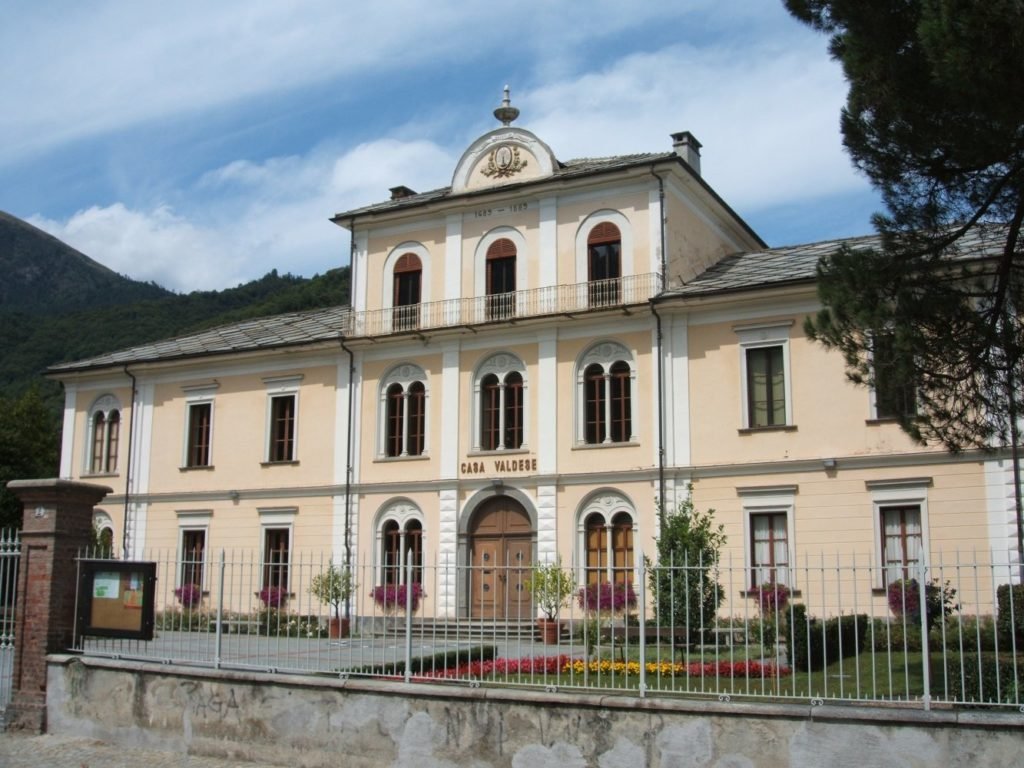
The Evangelical Methodist Church of Rome occupies the block between Via XX Settembre and Via Firenze, in the Castro Pretorio district. The main door of the building that houses the offices, the reception room and the social help desk is at Via Firenze 38, while the entrance to the church itself, the one that leads straight into the hall, opens onto Via XX Settembre at number 123 c. They are two doors of the same complex, and this double numbering is the first thing to clear up, because it sends one visitor in two off course. The Sunday service is held in the morning at 11 a.m. Admission is free, as in every Italian evangelical church, and there is no ticket office because there is no ticket. The useful metro stop is Repubblica on Line A, a little over 400 meters away on level ground. From Termini you get there on foot in a good 10 minutes by going up Via delle Terme di Diocleziano and turning into Via XX Settembre, or by the surface lines that run along Via Nazionale, including the 40 and the 64, getting off at the height of Via Firenze. Bus routes in Rome change with the roadworks, and a check of the public transport app before you leave home saves a quarter of an hour of confusion.
I have been a guide in Rome long enough to know that this address almost never appears in itineraries, and I find that a pity born of collective distraction. In a single hall you get the story of the breach of Porta Pia, the Umbertine architecture of Via XX Settembre, a cycle of stained glass signed by the artist who designed the emblem of the Italian Republic, a late 1800s Piedmontese organ and a community that today prays in Italian, Korean, English and Twi. It is not a museum, and I will come back to this more than once: it is an active church, with a congregation that meets here every Sunday. You visit it with the same courtesy with which you enter a parish church during Mass, that is, by asking, waiting, taking off your hat and lowering your voice.
Where the Evangelical Methodist Church is and how to get there
The postal address that circulates most often, and the one under which the community is registered across half of Rome, is Via Firenze 38. If you come from Via Nazionale, you turn into Via Firenze at the Teatro dell'Opera and within 50 meters you find yourself in front of a monumental doorway topped by rusticated pilasters. This is the Palazzo Metodista, the building that American Methodism built for itself in Rome at the end of the 1800s. If instead you come from Piazza San Bernardo or Largo Santa Susanna, you walk along Via XX Settembre and find the entrance to the church almost at the corner, recognizable by its portal with a pediment and columns.
The practical coordinates of the Evangelical Methodist Church
The complex is in the Castro Pretorio district, halfway between the Quirinale and Porta Pia, on the stretch of Via XX Settembre that Romans have learned to call the street of the ministries: the Ministry of Defense, the Ministry of Economy and Finance, and the Bank of Italy on Via Nazionale a short step away. The elevation is the high one of the Quirinal Hill, so the walk is level from Repubblica but slightly uphill if you climb from Termini. The postal code is 00184 for Via Firenze side. The telephone number and email addresses of the community are published on the official website of the Evangelical Methodist Church of Rome, and that is where you should start for any request: the opening hours of the church outside services depend on the week's activities and are not museum hours.
By public transport to the Evangelical Methodist Church
Metro Line A serves the area with two stops that are almost equidistant, Repubblica and Barberini. The first is more convenient because it avoids the climb up Via delle Quattro Fontane. From Termini station, which is the hub where the regional trains and the connection to Fiumicino arrive, the walk is about a kilometer. The surface lines that go up Via Nazionale leave you 200 meters away. Those that run along Via XX Settembre stop between Largo Santa Susanna and Via Firenze. If you arrive by car, you must bear in mind that the whole area lies inside the limited traffic zone of the historic center during daytime hours, that street parking is paid and almost always full, and that the nearest underground car park is the one under Piazza della Repubblica. My advice is blunt and sincere: here the car is a mistake.
Accessibility of the Evangelical Methodist Church
The worship hall is on the ground floor, and access from the street front requires climbing a few steps. If you use a wheelchair, it is best to contact the community's office in advance and agree on the easiest entrance to the complex, because the building has several wings and several doors, and a practical solution exists. The upper gallery, that is, the horseshoe-shaped balcony that runs along three sides of the hall, is instead reached by a staircase and is not accessible to everyone. The community answers courteously to requests made in good time: they are people used to receiving foreigners, migrants, ecumenical groups and lost tourists, and hospitality is part of their theological vocabulary even before it is part of their etiquette.
What the Evangelical Methodist Church on Via Firenze really is
Let's clear up the vocabulary, because in Italy "Protestant" is a word that many people use and few handle well. The Evangelical Methodist Church of Rome is a Protestant Christian community that descends from the English revival of the 1700s led by John Wesley. It does not depend on the Vatican, it has no bishops in the Catholic sense, it does not venerate saints or images, it celebrates only two sacraments, baptism and the Lord's Supper, and it entrusts the governance of the community to a church council elected by the assembly of members, which includes laymen and laywomen together with the pastor. Women's ministry is fully recognized: in Italian Methodism women preach, preside and lead, and in Rome this has been a fact for decades.
Since 1975 the Italian Methodist churches and the Waldensian churches have lived within a Pact of Integration that keeps them united in a single Synod while leaving each its own historical identity and its own bodies. For this reason the community on Via Firenze presents itself as Methodist and at the same time belongs to the Union of Methodist and Waldensian Churches. The Methodist arm of that union has a name that sounds bureaucratic but is in fact history: Opera per le Chiese Evangeliche Metodiste in Italia, abbreviated OPCEMI. Whoever enters from Via Firenze 38 therefore enters, at once, a local church and a piece of the national organization of Italian Protestantism.
One last point of vocabulary. In the evangelical world the building is called a temple, not a church: the church is the community of people, the temple is the place where it meets. You will hear members say "our temple" with the same naturalness with which a Roman says "my parish." It is not pedantry, it is theology: the building is not consecrated, it is not sacred in itself, it does not contain a presence to be adored. It is a hall for listening to the Word and singing. This explains the sobriety of what you will see inside, and also why nobody will genuflect as they enter.
Which Methodist church: the map of the Roman sites
In Rome there are two Methodist churches, and they are confused with embarrassing regularity, even by guides who ought to know better. The first is the one I am talking about here, the Italian-speaking community of Via Firenze 38 and Via XX Settembre, heir of the American Methodist Episcopal mission and home to the national offices. The second is the Ponte Sant'Angelo Methodist Church, the English-speaking congregation that meets in the building at the foot of the bridge, with its entrance at Via del Banco di Santo Spirito 3 and a front onto Piazza di Ponte Sant'Angelo. There the service is in English on Sunday morning at 10:30, with the Lord's Supper on the first Sunday of the month, and the community was born as an English-language congregation in the mid-1950s.
Why two Methodist churches in the same city
The reason is historical and worth telling, because it explains half of Italian Protestantism. In the 1800s Methodism came to Italy from two different directions and at two different times: first the English Wesleyans, sent by the Wesleyan Methodist Missionary Society of London, then the American Episcopalians of the Methodist Episcopal Church. The two missions divided the territory with a fairness that is surprising when you reread the documents, avoiding overlap city by city, but in Rome both ended up being present, because after 1870 Rome was the symbol that neither wanted to leave to the other. The complex on Via XX Settembre is the child of the American mission. The English-speaking presence near Castel Sant'Angelo descends instead from the English-language branch. Today both belong to the same Italian Methodist family and to the same Synod with the Waldensians, so the old division is institutional archaeology. But the double site has remained, and the double site creates misunderstandings.
The third name that confuses everyone
Then there is the Evangelical Waldensian Church of Piazza Cavour, the church with the tall bell tower that you can see from the Lungotevere, and there is the Waldensian community of Via IV Novembre. They are sister churches, integrated with the Methodists since 1975, but they are not the same thing. If you have an appointment and have only been told "evangelical church," ask for the full address. The difference between the Waldensian temple of Piazza Cavour and the Methodist temple of Via Firenze is two and a half kilometers and one Tiber. Anyone who wants to see both in one morning can do it, and the architectural comparison between the two buildings is one of the most instructive exercises I recommend to anyone who studies the religious architecture of Rome as a capital city. The page on the Evangelical Waldensian Church will help you prepare for the second stop.
Before the church: San Caio and the demolitions of Rome as capital
The ground on which the Evangelical Methodist Church stands was not empty. Until the 1880s the church of San Caio stood there. It was built in 1631 under Urban VIII at the request of a community of Dalmatian devotees who were looking for the memory of the ancient titulus Gai, the presbyteral title linked to Pope Caius, a pontiff of the 3rd century. The 17th-century project is attributed to Francesco Peparelli and Vincenzo della Greca. The church had a facade of good ambition and a bell tower with a small pavilion dome. Beneath its foundations, scholars have recognized late antique structures, attributed to the domus of the Nummii, with an underground mithraeum. It is one of those Roman knots in which the cult of Mithras, the ancient Christian title, the Baroque church and the Protestant church follow one another on the same handful of square meters.
The 1881 master plan and the disappearance of San Caio
Rome as capital was in a hurry. The master plan of 1881 rewrote the Quirinal plateau to turn it into the district of the ministries, and the church of San Caio fell to the pickax in the middle of the decade to make room for the large building of the Ministry of War, today the Ministry of Defense, which occupies the lower stretch of Via XX Settembre. It was not an isolated case: in the same season monasteries, gardens and convents that had marked out the Strada Pia in papal Rome disappeared, and the 17th-century fabric was replaced by compact blocks of four and five floors. The memory of the cardinal title of San Caio survived as a title, but the building did not.
What remains of San Caio under the Evangelical Methodist Church
On this point we have to be honest and cautious. That the Methodist church stands on the site of the demolished church is documented, and the memory of the Roman Methodist community has always repeated it. That the 19th-century foundations reuse 17th-century masonry is a claim that you read in historical reconstructions, but it is not something the visitor can verify with their own eyes, because under the hall there is today no archaeological route that can be visited. What you can do is look at the urban sequence: on your left the building of a ministry of the Kingdom of Italy, in front of you a Protestant church, behind you a street that bears the name of the date on which the bersaglieri entered Rome. In a few meters there is the whole Roman question.
William Burt, the man who wanted the Evangelical Methodist Church on Via XX Settembre
The protagonist of this story is a Methodist Episcopal pastor born in Padstow, in Cornwall, in 1852 and emigrated to the United States: William Burt, who died in 1936. He arrived in Italy in the second half of the 1880s to assist Leroy Monroe Vernon, the pioneer of the American mission in Italy, and to restore order to a mission shaken by tensions. After Vernon's resignation, at the end of that decade, Burt took over the whole Italian Methodist Episcopal work and began to behave as a builder of institutions more than as an itinerant preacher.
Burt's program: not a chapel, a citadel
The idea Burt had in mind was ambitious to the point of recklessness: to evangelize Italy by forming a new educated ruling class, secular in its methods and liberal in its ideas. For this reason a worship hall was not enough for him. He needed a building that would contain the theological school to train Italian pastors, a boarding house for students, the professors' apartments, the administrative offices of the mission and even a publishing house, La Speranza, with the periodicals that spread the evangelical message. Burt founded magazines, among them L'Evangelista. In 1899 he opened the Istituto Savonarola as a home for former Catholic priests who had passed to Protestantism. He promoted schools aimed at the children of the middle class, including a girls' school, and sought alliances with the anticlerical and Masonic circles of the capital, with whom he shared an aversion to temporal power.
The purchase of May 30, 1891
The decisive step was the purchase of the land, which Burt completed on May 30, 1891: the area left free by the demolitions, at the corner between the brand new Via XX Settembre and Via Firenze. Buying there, in 1891, meant planting a flag. American Methodism was settling a few hundred meters from the Quirinale, on the street named after the capture of Rome, with its facade turned toward the buildings of the new State. Nobody at the time considered the operation neutral, and the Catholic press did not take it well at all. Burt would be elected bishop in 1904 and would receive from King Victor Emmanuel III the cross of Saints Maurice and Lazarus, before returning to the United States in 1912 and retiring in 1924. At the entrance of the building at Via Firenze 38 a commemorative column recalls his name. Walk past it slowly, because it is the most discreet and most political monument of the block.
The construction of the Evangelical Methodist Church, 1893-1895
The chronology of the building site is documented with a precision that is not to be taken for granted for a 19th-century building. The building permit was requested on May 13, 1893. In September of the same year the first stone was laid, in a ceremony presided over by Bishop Vincent, and on May 9, 1894 the cornerstone was placed. In a little over two years the complex was finished. It is a construction time that today would make any Roman site management blush, and that was then made possible by the feverish pace of building in the capital, with abundant workers and materials within reach of the railway.
Who designed the Evangelical Methodist Church
On the authorship of the design the sources do not speak with one voice, and whoever tells you a single version is simplifying. The name that recurs in the studies is that of Rodolfo Buti, joined by Carlo Busiri Vici, a member of a dynasty of Roman architects very active between the 1800s and the 1900s. Part of the literature attributes the work to one, part to the other, part to both with distinct roles between design and direction of the site. The prudent and correct form is to say that the building was born from the collaboration between Buti and Busiri Vici under the close supervision of Burt as client, who had ideas of his own on the design and did not keep them to himself.
A building that contains a church
The choice of type is the smartest thing in the whole operation. Instead of building an isolated church, recognizable as a church from afar, the Methodists built a four-story income building, aligned with the street front of Via XX Settembre, and carved the church out of it on the ground floor. The result is that the building does not shout. A distracted passerby sees an Umbertine building like many others. Only whoever raises their eyes toward the inscription or stops in front of the portal with its pediment understands that behind those windows there is a worship hall. In a city where churches announce themselves with domes and bell towers, the Evangelical Methodist Church practices an understatement that is at once political prudence and theology: no building is sacred, so no building needs to look it.
September 20, 1895: the date of the inauguration was no accident
The church was solemnly inaugurated by Bishop Fitzgerald on September 20, 1895, the exact 25th anniversary of the breach of Porta Pia. Anyone who knows Italian history grasps the significance of the gesture at once. On September 20, 1870 the bersaglieri had entered Rome, ending the temporal power of the popes. September 20 had become a national holiday of the Kingdom of Italy and the banner of the anticlerical laity. Choosing that date to inaugurate a Protestant church 200 meters from the Quirinale meant declaring that religious freedom was a conquest of 1870 and that Italian Protestants were its most visible beneficiaries.
The context: a street that changes name and master
Via XX Settembre has not always been called that. In Roman times the axis was the Alta Semita, the high road that ran along the ridge of the Quirinal. In the 1500s Pius IV had it reopened and straightened, and for three centuries it was called Strada Pia, completed around 1565 and closed by Michelangelo's Porta Pia. After 1870 the name changed and with it the function: from a promenade of cardinals to the backbone of the State. The Methodist church fits into that story as a Protestant gloss on a chapter of the Risorgimento.
What it meant then to build here
We must remember that until 1870 Protestant worship in Rome was possible only outside the walls or inside diplomatic premises: foreigners of the Reformed faith met outside Porta del Popolo, under the protection of the embassies, and papal subjects were forbidden to take part. In 25 years Rome went from that tolerated clandestinity to a four-story building with its own theological school on the street of the ministries. I do not know many urban transformations that tell a constitutional change with as much clarity. It is worth looking at the building with the date in mind: without that date, this building would not exist.
The exterior architecture of the Evangelical Methodist Church
The front is in late Renaissance style, or "cinquecentesco" as it was called then, and uses rustication systematically. The design is organized by giant rusticated pilasters that embrace the ground floor and the first floor, imposing a vertical rhythm that holds the whole facade together. Above, the floors progressively reduce in height up to the fourth, closed by a triple motif of small arches that lightens the crown. On the ground floor there are 10 tall two-light windows with a round arch, and the portal is topped by a pediment supported by columns. The street front has no superfluous ornaments: no statue, no devotional relief, no monumental cross. The language is that of Roman palaces of the later 16th century as reread by Umbertine eclecticism.
How to read the facade of the Evangelical Methodist Church
If you want to understand the building in 30 seconds, stand on the opposite sidewalk of Via XX Settembre and count the registers. Rusticated base with the two-light windows: here is the church. First floor included in the giant pilasters: here were the collective functions, halls and offices. Second and third floors with lower, plainer windows: the residence, the boarding house, the professors' apartments. Top floor with the small arches: service. The facade is a functional section set upright, and this way of making the design coincide with the purpose is typical of post-unification Roman building, which had to build quickly, well and without waste.
The material: travertine, rustication, granite
The elements worth observing up close are the stone details: the granite columns that divide the two-light windows, with marble capitals and bases in white, and the base plinth in granite. The contrast between the gray of the granite and the white of the marbles is measured, almost shy, and holds up well against the dirt of the city. Notice also the quality of the workmanship of the rustication: it is not a rough rustication like that of a fortress, it is a designed rustication, with regular bedding lines, which serves to give weight to the base without turning the facade into a castle. It is a building that wants to appear solid and civil at once, which, considering who paid for it and why, is exactly the right message.
The interior of the Evangelical Methodist Church: the hall, the gallery, the ceiling
You walk in and the first surprise is the space: much larger than the facade leads you to expect, and above all much brighter. The hall has a rectangular plan, with no side aisles, no transept, no apse: a single room oriented toward the front of the preaching. Along three sides runs a horseshoe gallery, that is, an upper balcony supported by columns, which doubles the capacity and gives the finest viewpoint of the whole building. Superimposed Corinthian pilasters, resting on a high base, mark out the walls, taking up the theme of the facade: outside rustication and giant order, inside Corinthian order and regular repetition. It is the unity of language that was taught in the academies of the 1800s, applied with discipline.
The ceiling of the Evangelical Methodist Church
Look up as soon as you enter, even before looking at the stained glass. The ceiling is decorated with identical circular motifs, distributed in 15 panels. 15 compartments, 15 circles, no figure, no painted sky, no glory of angels. If you arrive from a Roman Baroque church you feel a kind of void, and the void is intended: the ornament here has a rhythmic function, not a narrative one. There is nothing to contemplate above because the center of worship is below and in the middle, where one reads and preaches. It is worth stopping for 30 seconds under the center of the hall and counting the panels. It is the quickest way to understand how a church of the Reformation works.
The two-light windows, the light, the color
The large round-arched two-light windows with granite columns, which on the facade we read as an element of rhythm, inside become machines of light. In the middle hours of the day the hall receives a diffuse illumination that the colored glass filters unevenly: pale where the glass is opalescent, saturated where the design calls for reds and blues. Do not expect the great Gothic cathedrals of northern Europe. The scale is domestic, the color is measured, and this very measure makes the symbols easier to read. There is no vertigo here, there is legibility.
The stained glass of Paolo Paschetto in the Evangelical Methodist Church
The showpiece of the hall, the one for which it would be worth coming even if there were nothing else, is the stained glass designed in 1924 by Paolo Paschetto and made by the glassworks of Cesare Picchiarini, the master glassmaker who in Rome trained half a generation of artists and worked with Duilio Cambellotti and Umberto Bottazzi. Paschetto, born in Torre Pellice in 1885 and died in 1963, was the son of a Waldensian pastor. He was a painter, engraver, decorator, teacher, author of stamps and posters, a man who went through the Italian 1900s working for the State and for the Protestant churches together.
The man who designed the emblem of the Republic
The fact that surprises most is this: the emblem of the Italian Republic, the star inside the cogwheel with the oak branch and the olive branch, adopted in 1948 at the end of two public competitions, carries the signature of Paolo Paschetto, a Waldensian from the Piedmontese valleys. On identity documents, on passports, on the facades of prefectures, on the letterheads of every Italian public office there is the design of a Protestant artist formed in the visual culture of the Reformation. It sounds like an exaggeration, but it is documented, and anyone who wants to go deeper will find material on the page of the exhibition Sotto una buona stella dedicated to Paolo Paschetto at the Musei di Villa Torlonia.
How the stained glass of the Evangelical Methodist Church is made
Compared with the stained glass that Paschetto made for the Waldensian church in Piazza Cavour, the Methodist ones have a more geometric character, less floral, less enveloping: clean lines, broad fields of color, an almost graphic sobriety. The repertoire is entirely biblical and very ancient, that of the first Christian centuries: the chi-rho, the dove, the lily, the lamb, the anchor, the lamp, the palm, the ark, the vine, the candelabrum. Along with the stained glass, Paschetto also worked on the decoration of the walls, with two large images that remain the focal points of the hall: the burning bush and a cross flowering with lilies.
The burning bush and the cross of lilies: what they mean
The bush that burns without being consumed comes from the third chapter of Exodus, the account of the calling of Moses, and it is one of the identity symbols of European Protestantism: you find it in the coat of arms of many Reformed churches as an image of the persecuted community that does not die out. Putting it in a church built by a religious minority in the capital of Catholicism was a declaration, not a decoration. The cross flowering with lilies, by contrast, joins the sign of the passion to the sign of purity and resurrection: death that sprouts. They are images that can be explained in a minute and are remembered forever, and that is exactly why Protestant visual culture prefers them to complex narrative cycles.
A tip on the stained glass
If you can choose the time, come when the sun is high: the stained glass gives its best in direct light and becomes opaque and dull on rainy days. And look at it twice: the first time from the floor of the hall, the second, if they let you go up, from the gallery, where the design is read at eye level and Paschetto's hand is better understood. The leap in quality between the view from below and the one from the balcony is what visitors appreciate most.
The organ of the Evangelical Methodist Church
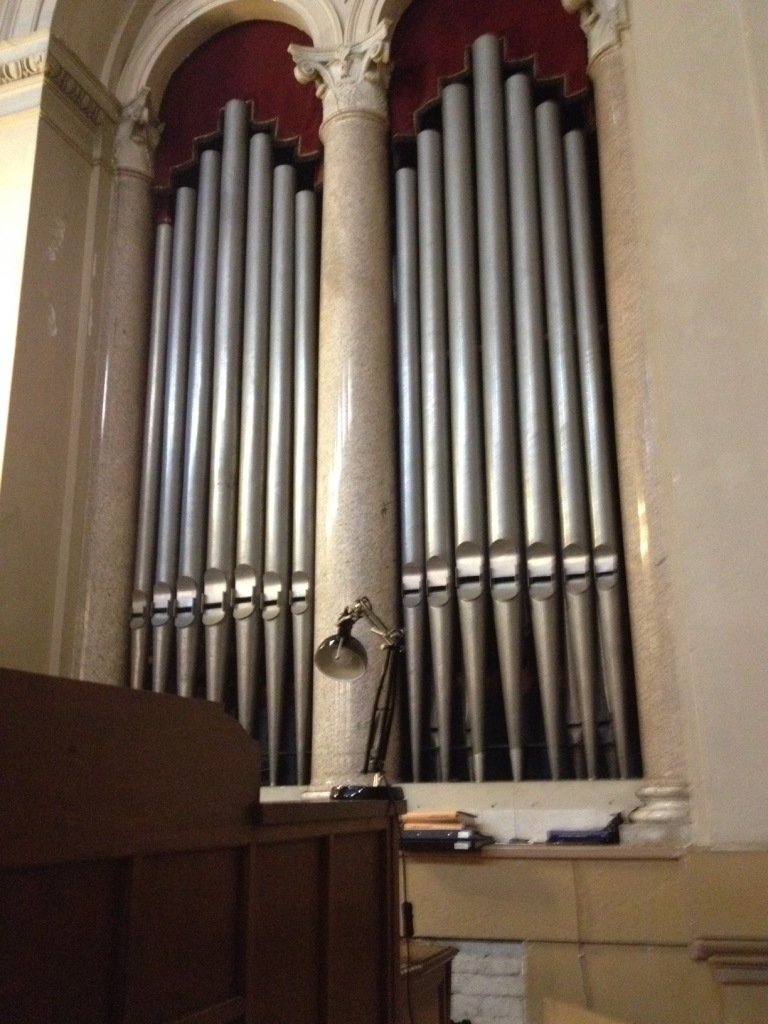
The instrument is a pipe organ built in 1895 by Carlo Vegezzi-Bossi, that is, by the most important Piedmontese organ-building dynasty of the 1800s, with 13 stops spread over two manuals and pedal. In 1980 the action was electrified, an intervention that made the instrument easier to play and that organ scholars have always argued over, because the original mechanical action gives a touch that electrification alters. 13 stops make a medium-sized organ, suited to supporting congregational singing and holding up a choral repertoire: in Methodism singing is not an ornament of worship, it is worship.
Why an Italian organ in a church founded by Americans
The detail is amusing. Roman Methodism was born from an American mission, the money came from overseas, and the organizational model did too. But for the organ they chose a top-level Italian builder from Turin, in the middle of the season in which Italian organ building was renewing itself on the French symphonic model. It is a choice of rootedness: you build in Italy, you play the Italian way, you sing in Italian. Italian Methodism has always insisted on this point and has always rejected the accusation of being an imported foreign religion. The choice of the organ, tiny in appearance, goes in the same direction.
Music and concerts in the Evangelical Methodist Church
The hall has generous acoustics and a cozy capacity, so for years it has also hosted concerts of classical and sacred music open to the public, with programs ranging from the Baroque to choral seasons. These are events announced from time to time: the community allows the use of its spaces for activities compatible with the life of the church and has a dedicated address for requests to use the rooms. Anyone who loves live music in unexpected places would do well to keep an eye on the schedules. Hearing an ensemble under the gallery on Via XX Settembre is a different experience from hearing it in a concert hall, and the difference lies entirely in the short reverberation and the absence of staging.
The furnishings of the Evangelical Methodist Church: pulpit, table, open Bible
A Catholic who comes in here for the first time instinctively looks for three things and finds none of them: the altar, the tabernacle, the images of the saints. In place of the altar there is a wooden table, that of the Lord's Supper, and on the table an open Bible facing the assembly. It is not a detail of furnishing, it is the synthesis of a theology: the book open toward the people means that the Word belongs to everyone and must be read by everyone, in an understandable language, without intermediaries. It is the same principle for which the Reformation translated the Bible into national languages and for which the English Methodists of the 1700s taught miners to read.
The pulpit of 1930
The wooden pulpit, made in 1930, is the visual focus of the hall. It is not hung on a column halfway down the nave like medieval pulpits, it does not serve to be heard from afar. It is placed frontally, slightly raised, because the preacher must be seen and heard by the whole assembly, including the gallery. Preaching in a Methodist service generally lasts between 20 and 30 minutes and is the central moment of the liturgy together with singing. If you attend for the first time, notice the amount of time devoted to listening and music compared with that devoted to ritual.
Sobriety as a choice and not as poverty
Some people leave here saying it is bare. It is not bare, it is disciplined. A Protestant church is not poor for lack of means, it is essential by conviction, because it holds that the devotional image risks replacing listening. The paradox of Via Firenze is that this essentiality coexists with an expensive building, with a brand-name organ and with a decorative cycle by an important artist: the sobriety concerns the content of the worship, not the quality of the construction. It is a fine distinction, and understanding it transforms the visit.
Who John and Charles Wesley were, the fathers of Methodism
To understand what happens on Sunday morning on Via XX Settembre you have to go back to 18th-century England. John Wesley, born in 1703 and died in 1791, was an Anglican priest, the son of a pastor and of Susanna Wesley, a woman of iron and culture who personally educated a dozen children. At Oxford, toward the end of the 1720s, John, his brother Charles and a small group of students founded a fellowship to pray, study the Bible, fast, visit prisoners and assist the poor according to a rigidly regulated program. Their companions called them Methodists in mockery, that is, those who do everything by method. The sarcastic nickname became the name of one of the most widespread Christian families in the world.
May 24, 1738 and the strangely warmed heart
The turning point in John Wesley's life is dated: on the evening of May 24, 1738, at a meeting on Aldersgate Street in London, while Luther's preface to the Letter to the Romans was being read, Wesley felt what he described, in his famous expression, as a strangely warmed heart, and the certainty of being accepted by God. His itinerant preaching was born from that experience. Over his lifetime Wesley covered tens of thousands of kilometers on horseback, preached in the open air when Anglican pulpits were closed to him, organized the converts into societies, classes and circuits, and invented a system of training laypeople that allowed preaching to continue without him.
Charles Wesley and sung theology
If John organized, Charles sang. Charles Wesley, born in 1707 and died in 1788, wrote a quantity of hymns that is counted in thousands, many of which are still sung today throughout the English-speaking world and beyond. Methodism learned its doctrine by singing it, and that is one of the reasons why in a Methodist church congregational singing has a role that in other traditions belongs only to the sermon. When people sing with the organ of 1895 on Via Firenze, what you hear is the long tail of a pastoral intuition of 18th-century England: people remember what they sing far more than what they hear.
Sanctification, method, social commitment
Wesleyan theology insists on a few key points: grace offered to all and not to a few predestined, personal conversion as a real experience, sanctification as a path of growth that lasts a whole lifetime, faith that is verified in works. From this derives the social vocation that has accompanied Methodism wherever it has arrived: schools, orphanages, dispensaries, battles against slavery, support for the labor movement, temperance, literacy. In England it was said for a century that the Labour movement owed more to Methodism than to Marx. It is a joke, but like all good jokes it contains a statistic. The link between faith and service also explains why the Roman community, today, is known in the city more for its diaconia than for its architecture.
Methodism arrives in Italy: Wesleyans and Episcopalians
Methodism enters Italy with Unification, and it is no coincidence. In 1859 William Arthur, secretary of the Wesleyan Methodist Missionary Society of London, lands on the peninsula with the task of understanding what could be done in a country that was unifying and that, for the first time, was writing rules on freedom of worship. Soon afterward arrive the missionaries destined to stay: Richard Green, who settles in Florence at the beginning of the 1860s, and above all Henry James Piggott, present from 1861, the man who would organize Italian Wesleyan Methodism and remain its reference figure for decades. The first communities arise in the center and the north, an organization with districts takes shape, and Italian preachers begin to be trained.
The American Episcopalians and Leroy Monroe Vernon
The second branch arrives from the west. The Methodist Episcopal Church of the United States sends to Italy Leroy Monroe Vernon, born in 1838 and died in 1896, who opens the American mission at the beginning of the 1870s and in 1874 gives shape to the Methodist Episcopal Church of Italy, with Bologna among the first centers and Rome immediately in its sights. The Episcopal presence in the capital consolidates in the years immediately after the breach, when the right to open non-Catholic places of worship inside the walls was an absolute novelty and every rented hall was newspaper news.
Two Methodisms, two sociologies
The two missions were not identical and not interchangeable either. The Wesleyans recruited mainly among peasants, miners and artisans, in the valleys and the villages. The Episcopalians turned to the cities, to professionals, teachers and merchants, and invested massively in education. In practice they divided the field to avoid competition, and the division held until the 1900s. Both branches produced social works of considerable size relative to the numbers of their base: orphanages, vocational schools, girls' institutes, publishing houses. Between 1903 and 1905 communities of the Chiesa Evangelica Italiana, another piece of Risorgimento evangelism, also merged into the two Methodist churches.
Methodism under Fascism
The Fascist era was hard. Religious minorities were suspected of being foreign agencies, the Concordat of 1929 consolidated Catholic primacy, many Methodist works closed or were scaled down, and the funding from abroad, which had sustained the system built by Burt, dried up after the crisis of 1929. The ambitious project of forming an evangelical ruling class in Italy faded, and Italian Methodism shrank to a network of small, tenacious communities. Anyone looking at the building on Via Firenze today must imagine it in those years too: half-empty offices, closed schools, a church that kept filling up on Sunday mornings because a congregation, that one, had remained.
From 1946 to 1975: unification, autonomy and the Pact of Integration
In 1946, just after the war, the two branches of Italian Methodism united in the Chiesa Evangelica Metodista d'Italia, closing a separation that had lasted 70 years. In 1961 legal recognition arrived by decree of the President of the Republic, and in 1962 Italian Methodism obtained full autonomy from the British mother church. In internal memory that date is worth as much as a national independence, because it meant that decisions about the Italian communities were taken in Italy.
The Pact of Integration of 1975
The decisive step came in 1975, when the Waldensian Synod and the Methodist Conference approved the Pact of Integration. It was not a merger that erases, it was an integration that preserves: the Methodist churches kept their name, their history, their Wesleyan spirituality and an organization of their own, and together they entered the single Synod that since 1979 has governed the Union of Methodist and Waldensian Churches. The Methodist arm took the name Opera per le Chiese Evangeliche Metodiste in Italia, OPCEMI, recognized by decree of the President of the Republic in 1979. Since then a pastor can serve either a Waldensian or a Methodist community indifferently, theological training is shared at the Waldensian Faculty of Rome, and decisions are taken together.
Why that pact still matters today
It matters for a practical reason even before a theological one: it allowed two small minorities to stop duplicating structures and to concentrate their forces on schools, hospitals, rest homes, projects for migrants and, since 1993, on the allocation of the eight per mille share that the Union receives and distributes entirely in social and cultural projects, without using a lira of it for worship or for pastors' salaries. If in Italy you hear about humanitarian corridors, about legal reception programs for refugees, know that a substantial part of that machinery was born in the Waldensian and Methodist world, and that the building at Via Firenze 38 is one of its addresses.
The building of the Evangelical Methodist Church as an evangelical citadel
Behind the facade on Via XX Settembre, for decades, there was much more than a worship hall. The complex housed the theological school started by Burt together with E. S. Stackpole to train Italian pastors, a men's boarding house for students, the professors' apartments, the administrative offices of the mission and the publishing house La Speranza, with its magazines. In the founder's idea the building was to be a complete cultural machine: the pastor was trained, housed, the periodical that would spread his preaching was printed, the communities of the peninsula were administered, and on the ground floor worship was celebrated.
The other Methodist works in Rome
Outside the block, the same enterprise produced a campus on Monte Mario and school institutes intended for middle-class families, among them a girls' school named after Crandon. They were explicit educational bets: to bring to Italy the Anglo-Saxon educational model, with attention to English, the sciences, sport, individual responsibility. The project did not survive the wars and the crisis, but it left traces in the history of private education in Rome and in the memory of generations of families who passed through. Today at Via Firenze 38 what remains are the offices of the national Methodist body, the community spaces and the social help desk.
The Methodist Documentation Center
The memory of this story is kept by a body born in 2009, the Centro di Documentazione Metodista, which collects sources and promotes research on Italian Methodism in collaboration with the university and with specialized publishers, publishing the proceedings of its own conferences. It is not a museum open to the public with visiting hours: it is a tool for scholars, and those with research interests contact it beforehand. I mention it because it is the right body to turn to if you are looking for documents on the construction of the church, on the Methodist schools or on the biographies of the pastors of the 1800s.
The Evangelical Methodist Church today: an intercultural community
If you come here expecting a congregation of elderly Italians you will be taken aback. The Methodist community of Rome has for years been one of the most international realities in the city. Alongside the Italian-speaking congregation live Korean-, Filipino- and Ghanaian-language groups, each with its own times of worship and its own musical traditions, inside the same building. The choir, the Bible studies, the Sunday school for children and the joint assemblies bring together origins that you would not expect in a district of ministries. On the Sundays when the communities celebrate together, the hall of 1895 hears the same hymn sung in three different languages, and I assure you that the result is like nothing you hear elsewhere in Rome.
The Sunday service in the Evangelical Methodist Church
The Italian service is held on Sunday morning at 11 a.m. and lasts about an hour and a quarter. The structure is simple: invocation, congregational singing, prayer, Bible readings, preaching, intercessions, offering, blessing. The Lord's Supper is celebrated on dates set by the community's calendar and is open to anyone who believes, without checks and without formal membership. In the Methodist world they say that the table is not the church's, it is the Lord's. Visitors from outside are welcomed, often greeted by name on the way out, and sometimes invited to the coffee that follows. There is no obligation to give and nobody will come around asking you for anything: the basket circulates, and you leave something if you want.
What to expect if you are not a believer
Many visitors ask if it is acceptable to attend as non-believers or as Catholics. The answer is yes, without pretense: you just have to behave with respect, turn off your phone, avoid photographing during the service, stand and sit when the assembly does or stay seated if you prefer. Nobody will ask you to declare your faith, nobody will embarrass you. If you want to understand Italian Protestantism from the inside, an hour in this hall teaches more than three books, because you will see how people pray without images, how they sing together, how they listen to a sermon and how a minority community holds together people from four continents.
The diaconia of the Evangelical Methodist Church
The everyday face of this community is its social work, which in evangelical vocabulary is called diaconia, from the Greek for "to serve." In the building at Via Firenze 38 there is a help desk dedicated to work and migration issues, open to the public on Wednesday mornings from 9:30 to 13:30, where people are helped to find their way through paperwork, documents and job searches. Alongside the help desk, the community carries on the distribution of food parcels to families in financial difficulty.
Breakfast Time and the Italian school
The best-known project in the neighborhood is called Breakfast Time and consists of handing out a hot breakfast to homeless people in the area, with clothing and blankets in the cold months. It is not anonymous charity: the stated approach is reciprocity, that is, serving with people and not simply for people, asking what is needed instead of deciding at a desk. The Italian school for foreigners, which also prepares people for the tests required for residence permits, is held in the premises of the Methodist community of Ponte Sant'Angelo with teachers from several associations. It is the best example of how the two Roman sites, the Italian-speaking one and the English-speaking one, work as a single organism.
Why diaconia explains the architecture
There is a direct thread between the burning bush on the wall and the breakfast handed out at seven in the morning on the sidewalk. Methodism is born among English miners and the prisoners of Oxford. It arrives in Italy with schools and orphanages. It builds in Rome a building that contains classrooms and offices as well as the church. In all three phases the same idea: faith is measured in service. To understand this church do not look only at the stained glass, look at who comes in through the main door on Wednesday morning.
How to visit the Evangelical Methodist Church
I repeat the premise because it is the thing most often misunderstood: the Evangelical Methodist Church is not a museum, it has no ticket office, no tourist visiting hours, no marked route and no custodial staff available to visitors. It is an active place of worship and at the same time the seat of offices that work. Everything else follows from this.
The three ways in
The first and simplest: attend the 11 a.m. Sunday service. It is open to anyone, it is free, and nobody will look at you askance if you stay at the back. The second: show up on the occasion of a concert or a public meeting hosted in the hall, when the building is open and the visit is natural. The third, for groups and for those with a specific interest: write to the community in advance, explain who you are and what interests you, and agree on a time compatible with the activities. The community handles requests to use and visit the spaces through the contacts published on its website, and that is the correct route. Showing up without notice hoping that someone will open is the best way to find the door closed.
Visitor etiquette in the Evangelical Methodist Church
A few rules, all common sense. Normal, neat clothing, no obligation to wear a veil or cover your shoulders as in certain basilicas, but no beachwear either. Phone on silent. No photographs during the service. Outside the service you ask first, and the answer is almost always yes. No flash toward the stained glass, which besides being rude is of no use from a photographic point of view. If you come in after the service has begun, sit in the last row without crossing the hall. If someone speaks to you, answer: here the handshake at the entrance is custom, not intrusion.
How much time you need
For a visit to the hall, reading the stained glass and glancing at the gallery, 20 minutes are enough. If you are interested in the history of the building and want to ask questions of someone from the community, allow an hour. The Sunday service lasts a little over an hour. A group that wants to include the Evangelical Methodist Church in an itinerary on Rome as a capital can count on 40 minutes, including the stop in the street to read the facade and the column dedicated to William Burt.
With children
The community has a Sunday school, so children are not a problem, they are normal. For the youngest visitors it is best to give a concrete task: count the 15 panels of the ceiling, find the dove, the anchor, the lamp and the lamb in the stained glass, work out why the book on the table is open toward them and not toward the pastor. These are observation games that work well between six and 12 years old and that, without sermons, explain a cultural difference that stays obscure to many adults.
When to go to the Evangelical Methodist Church
The best season is the one with high light and clear sky, so late spring and early autumn. In the middle of August many community activities stop and life in the building slows down, as all of Rome slows down. The time slot I recommend for the light on the stained glass is the central one, between 11:00 and 15:00. If your interest is the community and not only the building, the only right moment is Sunday morning.
The dates that change the tone of the visit
Some appointments in the year make the visit denser. September 20, anniversary of the breach and of the inauguration of the church, is the symbolic day par excellence of Roman Protestantism, and in the neighborhood meetings and commemorative moments are organized. February 17 is the Waldensian festival par excellence, the memory of the Letters Patent of 1848 that granted civil rights to the Waldensians of Piedmont, and in the churches of the Union it is celebrated with services and meetings. Reformation Sunday, the last Sunday of October, and the period of Advent bring concerts and choral liturgies. If you happen to be in Rome at one of these moments, it is worth checking the community's calendar.
When to avoid
Avoid showing up during church assemblies, funerals, weddings and meetings of the national bodies held in the building. These are moments when the presence of strangers with a camera is out of place. Avoid Wednesday morning too if you are looking for a quiet visit, because it is the day of the help desk and the main door is busy. Saturday afternoon, by contrast, is often the moment when the building is quietest, but also the one when it is most likely to be closed. Without a contact made in advance you risk a wasted trip.
What to see around the Evangelical Methodist Church
One of the strengths of this address is that it sits at the center of a 10-minute walking radius that contains an impressive quantity of a different Rome: water, baths, theaters, ministries, papal palaces, ancient art and 20th-century art.
Two minutes on foot
Leaving onto Via Firenze and turning right you arrive straight away at the Rome Opera House, the hall that was born as the Teatro Costanzi in 1880 and that today bears the name of the square dedicated to Beniamino Gigli. The back of the theater looks right onto Via Firenze. Going down Via Nazionale you meet the Palazzo delle Esposizioni by Pio Piacentini, inaugurated in 1883, which is the largest exhibition machine in the historic center. On the opposite side, toward Piazza San Bernardo, are the Acqua Felice fountain with the Moses of Prospero Antichi and the church of Santa Maria della Vittoria with the Cornaro Chapel by Gian Lorenzo Bernini, where the Ecstasy of Saint Teresa is found: 400 meters, no more.
10 minutes on foot
Toward Termini you reach the Baths of Diocletian with the basilica of Santa Maria degli Angeli carved by Michelangelo out of the tepidarium, and a few steps away the Octagonal Hall, one of the best-preserved bath rooms in the city. On the other side of Piazza dei Cinquecento is Palazzo Massimo alle Terme with the frescoes of the Villa of Livia, which I consider the most beautiful room in all of indoor archaeological Rome. Going up toward the hill you reach the Quirinale Palace and the Scuderie del Quirinale. Going down toward Via delle Quattro Fontane you meet Palazzo Barberini with the Galleria Nazionale d'Arte Antica. In 15 minutes you are at the Trevi Fountain or at the basilica of Santa Maria Maggiore.
A recommended detour
100 meters from Via Nazionale, on Via Marco Minghetti, is the Galleria Sciarra, a Liberty-style courtyard frescoed with the cycle of feminine virtue, free of charge and almost always deserted. The contrast between the Protestant sobriety of Via Firenze and the decorative exuberance of the Sciarra is an excellent way to understand two opposite ideas of image, 10 minutes from one another, in the same city and in the same decade of construction.
Protestant Rome: an itinerary that starts from the Evangelical Methodist Church
The city of religious minorities is a parallel Rome, little talked about and very rich. A half-day itinerary, entirely on foot or with one metro ride, can begin here and bring together four centuries of the history of freedom of worship.
The stops of the itinerary
First stop, the Evangelical Methodist Church between Via Firenze and Via XX Settembre, with a reading of the facade and of Paschetto's stained glass. Second stop, the church of the Evangelical Waldensian Church in Piazza Cavour, built in the early 1900s, where Paschetto worked with a richer and more floral decorative register. Third stop, the English-speaking Methodist community at the foot of Ponte Sant'Angelo, a short step from Castel Sant'Angelo. Fourth stop, for those who want to widen their view to non-Christian minorities, the Synagogue of Rome with the Jewish Museum, where the story is told of the oldest Jewish community in Europe and of the end of the ghetto, which dates to 1870 too.
The common thread to hold on to
The thread is the date. Before September 20, 1870, in Rome you could not build a Protestant church inside the walls, the Jewish community lived under centuries-old restrictions and religious freedom was a principle of other States. Afterward, within 30 years, the city fills with places of worship of the minorities: Methodists, Waldensians, Anglicans, Baptists, Lutherans, the new synagogue on the Lungotevere. Looking at them in sequence means seeing a constitution translated into architecture. And it also means understanding why the church on Via Firenze was inaugurated precisely on an anniversary: in those years, for the minorities, dates were arguments.
A curiosity about the Evangelical Methodist Church
The curiosity I like best concerns an object you have in your pocket. The emblem of the Italian Republic, the five-pointed star on the cogwheel between the oak branch and the olive branch, which appears on the identity card, on the passport, on the signs of the prefectures and on the letterheads of every ministry, was designed by Paolo Paschetto, a Waldensian artist born in Torre Pellice in 1885, the same man who in 1924 made the stained glass and the wall decorations of the Evangelical Methodist Church of Rome. It means that the hand that gave a graphic face to the Italian State born of the Constitution had already worked, 20 years earlier, inside a Protestant church 200 meters from the Quirinale. In the country with the highest concentration of Catholic symbols in the world, the symbol of the State bears the signature of a member of a minority that at the time of unification had just emerged from centuries of discrimination.
The second curiosity is in the date. The church was inaugurated on September 20, 1895, exactly 25 years after the breach of Porta Pia, and it stands on the street that bears the name of that breach. It was no accident, it was a manifesto: the Methodists were telling the city that their legal existence inside the walls of Rome was a child of 1870. Even today, when the calendar reaches September 20, in that hall a double anniversary is celebrated, civil and religious together, something that very few in Rome know how to do.
Third curiosity, for those who love stratification: under and around this block there have followed one another a late antique mithraeum attributed to the domus of the Nummii, an ancient Christian title linked to Pope Caius, a 17th-century church built for a community of Dalmatian devotees, a demolition site ordered by the master plan of 1881 and finally a Protestant church built with American money. Five different religions or denominations, or nearly, on the same handful of square meters, in 18 centuries. Rome does this: the cult changes and the place stays.
Something nobody tells you about the Evangelical Methodist Church
Nobody tells you that this address has two doors and two street numbers, and that choosing the wrong one means ringing an intercom that does not answer. Via Firenze 38 is the main door of the building, where the offices, the social help desk and the community spaces work. Via XX Settembre 123 c is the entrance to the church, the one that leads straight into the hall and the one that is open for the Sunday service. In guides, city directories and maps the address that appears is almost always the first, because it is the historic postal address of the body. But if on Sunday at 11 a.m. you show up at the door on Via Firenze and find it closed, it is not that the church does not exist: you are simply on the wrong side of the block. Turn the corner.
The second thing that is rarely said is that here there is no mass tourism and not even organized tourism. You will not find custodians, tickets, audio guides, explanatory signs, a souvenir shop. If you want to enter outside service hours you must write first and agree, and the community has a dedicated email address for requests to use the spaces. Many visitors read this absence of services as being closed. It is the opposite: it is a small community that has no tourist office and that, if notified, organizes itself to welcome you with a courtesy that no museum can afford.
Third thing, the most surprising for a Roman: on Wednesday morning, from 9:30 to 13:30, a help desk for work and migration issues operates in this building, and in the cold seasons the community hands out hot breakfasts, blankets and clothing to the homeless people of the neighborhood. Anyone who imagines Roman Protestantism as a matter of books and sermons would do well to pass by Via Firenze in those hours. The difference between a building and a church lies exactly in this: the building has a facade, the church has opening hours for those who have nothing.
The advice I give you for visiting the Evangelical Methodist Church
The advice is blunt: come on Sunday at 11 a.m. and take part in the service. There is no other way to see this place for what it is. Show up 10 minutes early at the entrance on Via XX Settembre, greet whoever is at the door, say it is your first time and ask where you can sit. They will show you a seat and give you the hymnal. You do not need to know the liturgical responses, you do not need to be Protestant, you do not need to do anything except listen. At the end, if you stay for coffee, you will have the chance to ask the questions that really interest you to people who answer willingly, and who see enough curious visitors not to be surprised.
The second piece of advice concerns light and is for those who come in as photographers or as lovers of the decorative arts. Paschetto's stained glass lives on direct sun: on a clear morning in April or September the geometry of the symbols stands out from the glass and the red of the lamb and the blue of the dove become legible even from the back of the hall. On a rainy day the same cycle looks gray and flat and you will take home a disappointment. Look at the sky before choosing the day.
The third piece of advice is about method, and I give it to those who organize itineraries. Do not put the Evangelical Methodist Church as an isolated stop, because on its own it lasts 20 minutes and risks seeming slight. Build a thematic route around it: Rome as a capital and the Roman question, with Via XX Settembre, the ministries, Porta Pia and 1870. Or Rome of the religious minorities, with the Waldensian church in Piazza Cavour and the synagogue on the Lungotevere. Or again Paschetto and the decorative arts of the early 1900s, putting together the Methodist and the Waldensian stained glass. Inside a story, this place becomes memorable. Outside a story, it remains a handsome door in a district of offices.
Another well-known fact, yet rarely cited
The fact is this: since 1975 Methodists and Waldensians in Italy have lived within a Pact of Integration, and this means that the community on Via Firenze belongs to a church that, among those receiving the eight per mille, has chosen by statute not to allocate a single euro of those funds to worship, pastors' salaries or church building, and uses them entirely in social, welfare, cultural and international cooperation projects, publicly accounted for. It is a fact that almost everyone has heard at least once and that almost nobody connects to the concrete buildings in which that choice was deliberated. One of those buildings is the one between Via Firenze and Via XX Settembre.
The second little-cited fact concerns women. In the Methodist and Waldensian churches the pastoral ministry of women has been fully recognized for decades, and in Rome the Methodist community has been led by women pastors without this being news. In an Italian religious landscape where the question remains open or closed depending on the denomination, this normality is a significant historical fact, and it has ancient roots: already in Wesley's England women preached in the Methodist societies, and the training of laymen and laywomen was an integral part of the system.
Third fact, the most disorienting: Italian Methodism is numerically small, a few thousand members in the whole country, and despite this it has a public visibility and a capacity for social initiative out of proportion to the numbers. The explanation is in the structure: organized communities, strong lay participation, a stable alliance with the Waldensians, shared theological training at the Waldensian Faculty of Rome, and a tradition of almost two centuries of work in schools and welfare. It is not a power, it is an organized minority. The difference is enormous and shows very clearly when you enter this building.
The right photo to take at the Evangelical Methodist Church
The best photograph of the exterior is taken from the opposite sidewalk of Via XX Settembre, stepping back until you include the corner with Via Firenze. From there you read the whole elevation, the rusticated base with the two-light windows, the giant pilasters, the progressive reduction of the floors and the crown of small arches. The good time is early morning, when the raking sun sculpts the rustication and the street is still clear. Toward noon the facade receives flat light and the relief disappears. A 24 or 28 millimeter lens is more than enough. With an extreme wide angle the vertical lines fall and the building seems to tip over.
Inside, the photograph worth the trip is the one from the gallery toward the hall: the horseshoe balcony lets you frame in a single image the 15-panel ceiling, the Corinthian pilasters, the wooden pulpit of 1930 and the table with the open Bible. You need a long exposure and a stable support, because the natural light is soft and the artificial lights are warm. Without support you take home blurred shots. Permission must be asked beforehand and is never guaranteed, because the gallery is not always accessible. If they grant it, be quick and discreet.
The third image, the one nobody takes and that is worth taking, is a detail: the commemorative column dedicated to William Burt at the entrance of Via Firenze 38. A close-up photograph, with the surface of the stone and the main door blurred behind, tells the whole story better than a panorama. And if you want the most effective summary of this piece of the city, position yourself so as to have in the same frame the front of the Protestant church and, at the end of the street, the bulk of the ministry: two brand-new powers that in 1895 looked each other in the face on the same street. A golden rule that always holds: no flash, never during the service, and if someone asks you to stop, you stop without argument.
Some important events that happened here in history
The first date is a demolition. In the 1880s, in application of the master plan of 1881, the church of San Caio, built in 1631 under Urban VIII, disappears, and with it a piece of the devotional memory of the Strada Pia. The area is reorganized to make room for the buildings of the new State, beginning with the Ministry of War. On May 30, 1891 the Methodist Episcopal pastor William Burt buys the land left free at the corner with Via Firenze. On May 13, 1893 the building permit is requested. In September of the same year Bishop Vincent lays the first stone, and on May 9, 1894 the cornerstone is placed.
On September 20, 1895 Bishop Fitzgerald solemnly inaugurates the church on the 25th anniversary of the breach of Porta Pia. In 1924 Paolo Paschetto designs the stained glass, made by the glassworks of Cesare Picchiarini, and paints the wall decorations with the burning bush and the cross flowering with lilies. In 1930 the wooden pulpit is completed. The organ, built by Carlo Vegezzi-Bossi in 1895 with 13 stops on two manuals and pedal, is electrified in 1980. In between come Fascism, the war, the unification of the two Methodist branches in 1946, the autonomy from the British mother church in 1962 and the Pact of Integration with the Waldensians in 1975: all facts that this hall has recorded in the minutes of its assemblies, because a Protestant church minutes everything and keeps it.
The most recent and most striking event took place on September 20, 2025, when the President of the Republic Sergio Mattarella took part in the church ceremony for the 130th anniversary of the inauguration: the first time that an Italian head of state officially crossed the threshold of the Methodist church of Rome. The coincidence of dates, the September 20 of the breach, the September 20 of 1895 and the September 20 of 2025, gave the occasion a symbolic weight that no ceremony built at a desk could have achieved. For a minority that in 1870 had just won the right to exist legally inside the walls of Rome, that red carpet in front of the door on Via XX Settembre was the recognition of a path a century and a half long.
Who passed through the Evangelical Methodist Church
The first name is that of the builder, William Burt, born in Padstow in Cornwall in 1852 and died in 1936: pastor, organizer, publisher, founder of schools, elected bishop in 1904 and awarded by Victor Emmanuel III the cross of Saints Maurice and Lazarus, returned to the United States in 1912. Alongside him we should remember Leroy Monroe Vernon, the first superintendent of the Methodist Episcopal mission in Italy, and the American bishops who presided over the two ceremonies of the building site, Vincent for the first stone in 1893 and Fitzgerald for the inauguration of 1895. They are figures who in Italian history left no monuments, but left buildings, magazines and generations of pastors trained in the theological school that occupied the upper floors of this building.
The second name is that of the artist, Paolo Paschetto, who worked here in 1924 leaving the stained glass and the wall decorations, and who would become the author of the emblem of the Republic adopted in 1948. With him the master glassmaker Cesare Picchiarini, the Roman who taught the craft of artistic glass to an entire generation of artists between Liberty and the 1900s. Then there is the signature of the organ builder Carlo Vegezzi-Bossi, heir of the most celebrated Piedmontese organ-building dynasty, who in 1895 built the instrument still in use today. Three top-level Italian professionals called to work for a community of a few hundred people: proof that this church, on its own instruments of worship, never skimped.
The third name is very recent and institutional: Sergio Mattarella, who on September 20, 2025 entered this hall for the 130th anniversary of the church. But the passages that best tell the place are those without a name in the books: the families of workers and clerks who here baptized children and held funerals for 130 years, the theology students who came from all over Italy to sleep in the boarding house on the upper floors, the refugees and migrants who found an office open on Wednesday morning, the Korean, Filipino and Ghanaian communities that today sing in this hall in their own languages. In a city that measures its importance in popes and emperors, this is a church that is measured in ordinary people, and that is precisely what makes it interesting.
Quick questions about the Evangelical Methodist Church
How much does it cost to enter the Evangelical Methodist Church
Nothing. There is no ticket, no ticket office, no compulsory offering. During the service a basket circulates for free offerings and nobody checks who leaves something and who does not. If you attend a concert hosted in the hall, the ticket is the concert organizer's and not the church's.
What is the exact address of the Evangelical Methodist Church
The building has its entrance at Via Firenze 38, while the church opens onto Via XX Settembre 123 c, in the Castro Pretorio district. They are the same complex, straddling the corner. For the Sunday service you use the entrance on Via XX Settembre. For the offices and the social help desk, the one on Via Firenze.
What time is the service at the Evangelical Methodist Church
The service in Italian is held on Sunday morning at 11 a.m. and lasts a little over an hour. The communities of other languages present in the building have their own times, which are published on the church's website. Before planning a visit in a holiday period, it is best to check the calendar, because in the weeks of Christmas, Easter and Pentecost the liturgies may change time.
Can you visit the Evangelical Methodist Church outside service times
Yes, but on request. There are no tourist opening hours and no staff dedicated to visits: you have to write to the community in advance, explain your interest and agree on a time compatible with the activities of the building. For groups it is the only practicable route.
Do you need to book for the Evangelical Methodist Church
For the Sunday service no, you just walk in. For a visit on other days yes, booking or at least a prior contact is indispensable. For concerts the organizer's rules apply.
Can you take photographs in the Evangelical Methodist Church
Outside the service and with the permission of whoever welcomes you, yes. During the service no, out of respect for those who are praying. In any case no flash, especially toward the stained glass: besides being invasive, it produces reflections that ruin the shot.
Is the Evangelical Methodist Church Catholic
No. It is a Protestant church of the Wesleyan tradition, with no dependence on the Holy See, with only two sacraments recognized, baptism and the Lord's Supper, without the cult of saints and without auricular confession. Since 1975 it has been part of the Union of Methodist and Waldensian Churches.
Can a Catholic take part in the service of the Evangelical Methodist Church
Certainly, and it often happens, especially during the Week of Prayer for Christian Unity in January. Nobody will ask you for a declaration of your denomination. The Lord's Supper in Methodist practice is open to anyone who believes, without checking formal membership.
What is the difference between the Evangelical Methodist Church and the Waldensian church
Different origins: the Waldensians are born in the Middle Ages from the movement of Waldo of Lyon and join the Reformation in the 16th century. The Methodists are born in 18th-century England from the revival led by John Wesley. Since 1975 the two bodies have been integrated in a single Synod while keeping their own name, history and organizations. In practice, today, a pastor can serve either community indifferently.
How many Methodist churches are there in Rome
Two: the Italian-speaking community between Via Firenze and Via XX Settembre and the English-speaking congregation of Ponte Sant'Angelo, with its entrance at Via del Banco di Santo Spirito 3. The second celebrates in English on Sunday at 10:30, with the Lord's Supper on the first Sunday of the month.
Is the Evangelical Methodist Church wheelchair accessible
The hall is on the ground floor and the entrance has a few steps. The complex has several accesses and the community helps to identify the best solution, provided you contact it in advance. The upper gallery can be reached only by stairs.
How long does a visit to the Evangelical Methodist Church take
20 minutes to see the hall and read the stained glass. An hour if you want to understand the history of the building and talk with someone from the community. A little over an hour if you attend the service. 40 minutes is the right length for a stop within a guided itinerary on Rome as a capital.
Is the Evangelical Methodist Church suitable for children
Yes. There is a Sunday school and children are part of the ordinary life of the community. For a visit, it works well to turn the stained glass into a hunt for symbols: dove, lamb, anchor, lamp, palm, vine, candelabrum.
Are there concerts in the Evangelical Methodist Church
Yes, the hall periodically hosts concerts of classical and sacred music, in addition to the community's own musical initiatives. There is no fixed season published years in advance: events are announced from time to time.
Who built the Evangelical Methodist Church
The commission came from the Methodist Episcopal pastor William Burt, who bought the land in 1891. The design is attributed to Rodolfo Buti with the collaboration of Carlo Busiri Vici. Building site between 1893 and 1895, inauguration on September 20, 1895.
Who made the stained glass of the Evangelical Methodist Church
Paolo Paschetto designed it in 1924 and the glassworks of Cesare Picchiarini made it. Paschetto is the author of the emblem of the Italian Republic adopted in 1948 and is also the author of the wall decorations of the hall, with the burning bush and the cross flowering with lilies.
What organ is in the Evangelical Methodist Church
A pipe organ by Carlo Vegezzi-Bossi from 1895, with 13 stops on two manuals and pedal, with action electrified in 1980. It is sized to support congregational singing, which has a central role in Methodist worship.
What was there before the Evangelical Methodist Church
The area was occupied by the church of San Caio, from 1631, demolished in the 1880s in application of the master plan of 1881. Under that church late antique structures attributed to the domus of the Nummii, with a mithraeum, had been recognized.
Why was the Evangelical Methodist Church inaugurated on September 20
Because September 20, 1895 was the 25th anniversary of the breach of Porta Pia, that is, of the end of the temporal power of the popes and the beginning of freedom of worship inside the walls of Rome. The choice of the date was a public declaration.
Has the Evangelical Methodist Church received official visits
Yes. On September 20, 2025 the President of the Republic Sergio Mattarella took part in the ceremony for the 130th anniversary of the inauguration of the church, the first official visit by an Italian head of state to this church.
How to get to the Evangelical Methodist Church from Termini station
On foot in about 10 or 12 minutes, going up toward the Baths of Diocletian and turning into Via XX Settembre. Alternatively, one stop of Metro Line A to Repubblica and then five minutes of walking. From Fiumicino airport the direct train to Termini is best.
Is there parking near the Evangelical Methodist Church
There is no dedicated one. The area is inside the limited traffic zone of the historic center during daytime hours, street spaces are paid and scarce, and the nearest garage is the one under Piazza della Repubblica. The practical advice is to arrive by metro.
Can the Evangelical Methodist Church be used for weddings or events
Celebrations are a matter for the community and must be agreed with the church council and the pastor. For the use of the spaces, including requests for concerts and meetings, there is a dedicated contact published on the official website. It is not a hall that is rented like any other.
What to see near the Evangelical Methodist Church
Within a few minutes on foot: the Teatro dell'Opera, the Palazzo delle Esposizioni, the Acqua Felice fountain with the Moses, Santa Maria della Vittoria with Bernini's Ecstasy of Saint Teresa, the Baths of Diocletian with Santa Maria degli Angeli, Palazzo Massimo alle Terme, the Quirinale with the Scuderie, Palazzo Barberini.
Is the Evangelical Methodist Church worth visiting
On one condition: that you are interested in understanding something and not just ticking a box. Anyone looking for marbles, domes and Baroque masterpieces will find better bread 200 meters farther on. Anyone who wants to see how Rome changed constitution between 1870 and 1895, and how a religious minority put its own history inside a building, will find here a lesson that no museum tells.
The verdict on the Evangelical Methodist Church
Without snobbery: this place pays back those who arrive prepared and disappoints those who pass by chance. It has no wow effect, no immediate marvel, nothing to put in a photo carousel. It has instead a quality that in Rome becomes rare as the center turns into a tourist stage: it is real. The community that meets there on Sunday is the same one that opens the help desk on Wednesday, the building that houses the church also houses the offices that manage social projects across half of Italy, and the stained glass of 1924 is looked at every week by people who have seen it a thousand times and keep singing beneath it.
If I had to give one piece of advice to whoever reads this, it would be this: go on an April Sunday morning, sit at the back, listen for an hour, watch the light coming in through the two-light windows while the assembly sings, and then step out onto Via XX Settembre and walk toward Porta Pia. In 15 minutes of walking you will have crossed the history of religious freedom in Italy, from the breach of the bersaglieri to the hot breakfast handed out at the door. I do not know many Roman addresses able to hold together so many things with so little noise.
Article written by the editorial team of TourLeaderPro, contact them for Private/Corporate/V.I.P. Tours and Experiences.
Planning a trip to Rome? The English-language guides to visiting the city are on ItalyPlanner.com.
Contact Information
Via Firenze, 38
Roma Roma Città, Roma Città