Piazza della Repubblica
In short. Piazza della Repubblica is the big semicircular square that opens at the crossing of Via Nazionale, Via Vittorio Emanuele Orlando and Viale Enrico De Nicola, five minutes on foot from Termini station, and its curved shape is not a…
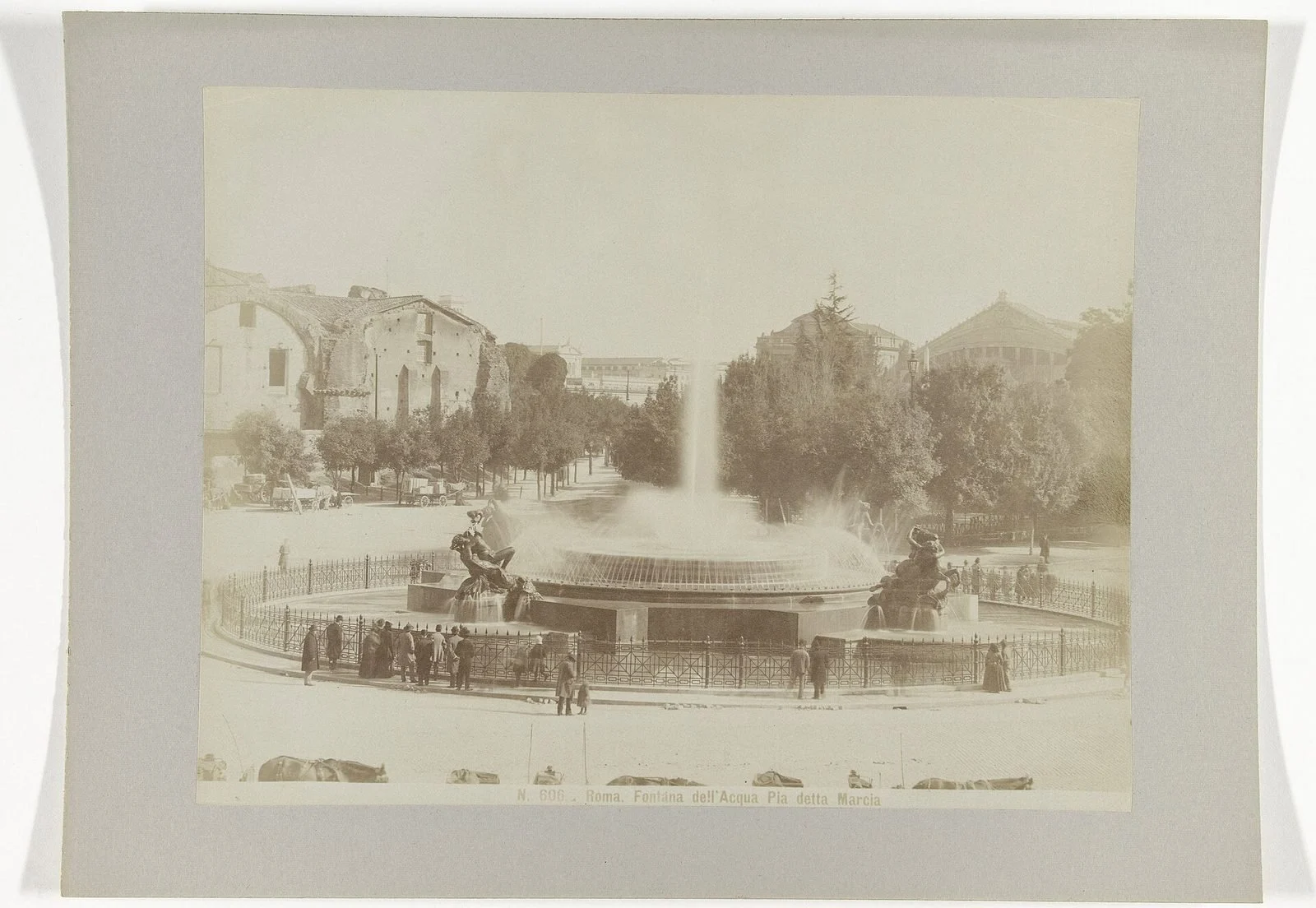
Piazza della Repubblica is the big semicircular square that opens at the crossing of Via Nazionale, Via Vittorio Emanuele Orlando and Viale Enrico De Nicola, five minutes on foot from Termini station, and its curved shape is not a 19th-century whim: the hemicycle of the two arcaded buildings designed by Gaetano Koch follows the perimeter of the exedra of the Baths of Diocletian, the largest bath complex of ancient Rome, built between 298 and 306 AD. That's why Romans, when they say they'll meet here, still say “a piazza Esedra,” a name the city officially changed in the mid-1900s and that spoken language never let go of. In the middle runs the Fountain of the Naiads, with four bronze nymphs stretched out on water animals and a man gripping a dolphin: the fountain that caused a scandal in 1901 and that the Romans, when the first central group was unveiled, christened with a nickname from a fried-food shop.
The square you cross today is something else from the postcard. It is a traffic junction in every sense, with a ring of lanes around the fountain, buses braking and starting again, large and mid-size hotels under the porticoes, agencies, offices and the Line A metro stop that opens right onto the sidewalk. Termini is a few hundred meters away, and being close to the station brings with it everything a station brings with it, day and night. In the lines that follow you'll find what was here before the square, how its curve came about, the real story of the fountain with its three construction phases, what to visit around it and what time is best to pass through to see it as it deserves.
Where Piazza della Repubblica Is and How to Get There
Piazza della Repubblica is in the Castro Pretorio district, on the edge of the Viminal Hill, about 400 meters from the main exit of Termini station and a little over 600 from Piazza Barberini. It's an obligatory crossing point for anyone heading down from Termini toward the historic center: Via Nazionale starts from here and in a kilometer and a half reaches Piazza Venezia and the Altar of the Fatherland, while on the opposite side the square opens toward Viale Enrico De Nicola and the walls of the baths.
On Foot from Termini Station
From Termini station it's five or six minutes of easy walking, with no stairs and no climbs. Leaving the main hall onto Piazza dei Cinquecento you keep to the right, follow the side of the station along Viale Enrico De Nicola and arrive directly at the side of the square where the basilica of Santa Maria degli Angeli faces. It's the route thousands of commuters take every day, and it's also the stretch where you should keep your eyes on your backpack: the area around the station, in the evening especially, is worked by pickpockets who target the flow of people dragging a suitcase.
By Metro
The Repubblica stop on Line A, also labeled Repubblica Teatro dell’Opera, opens onto the square itself: it's the fastest option by far. Line A has been running since 1980 and connects this point to Barberini in one stop, to Spagna in two, to Flaminio in three, and in the opposite direction to Termini in just one stop, where you change to Line B. Anyone arriving from the airports on the train to Termini therefore has a single change and a one-minute metro ride, or a six-minute walk. The station has elevators, but as on the whole Roman network it's best to check that day's operation on the transport company's website, because out-of-service stops are frequent.
By Bus
Many surface lines stop on the square and on the first stretch of Via Nazionale, among them the 40, 60, 64, 70, 170, 910 and H. The 40 and 64 are the two lines that go from Termini toward Largo Argentina and the Vatican, and they're also the two most crowded in the city: in the morning you ride squeezed in, with your wallet in front. The 170 goes down toward Testaccio, the 910 goes up toward Villa Borghese and Piazzale Clodio. Schedules and routes change often because of roadworks and detours, so check the updated route before boarding.
By Car: Why It's the Worst Choice
You can arrive in Piazza della Repubblica by car, because the square is outside the limited traffic zone of the historic center, but it's the least sensible option. The ring around the fountain is one of the most loaded intersections in Rome, on-street parking is paid during daytime hours and the garages in the area charge hourly rates of a central district. Anyone coming from outside Rome does far better to leave the car in a park-and-ride lot on the metro and finish the trip by rail: you save time and money, and you avoid circling for 20 minutes looking for a space that isn't there.
Getting Your Bearings Once You Arrive
The square has four reference points that can be seen from anywhere and that are enough not to lose your sense of direction. The first is the fountain, at the center of the ring. The second is the rough facade of the basilica of Santa Maria degli Angeli, which doesn't look like a church because it's a wall of Roman brick: it's the side of the baths. The third is the mouth of Via Nazionale, on the side opposite the basilica, recognizable by the straight run of Umbertine buildings. The fourth is the corner of Via Vittorio Emanuele Orlando, which climbs toward Via XX Settembre and toward Porta Pia. Keep these four points in mind and you'll know right away which way you're turning.
The Exedra of the Baths of Diocletian: The Shape That Still Rules the Square
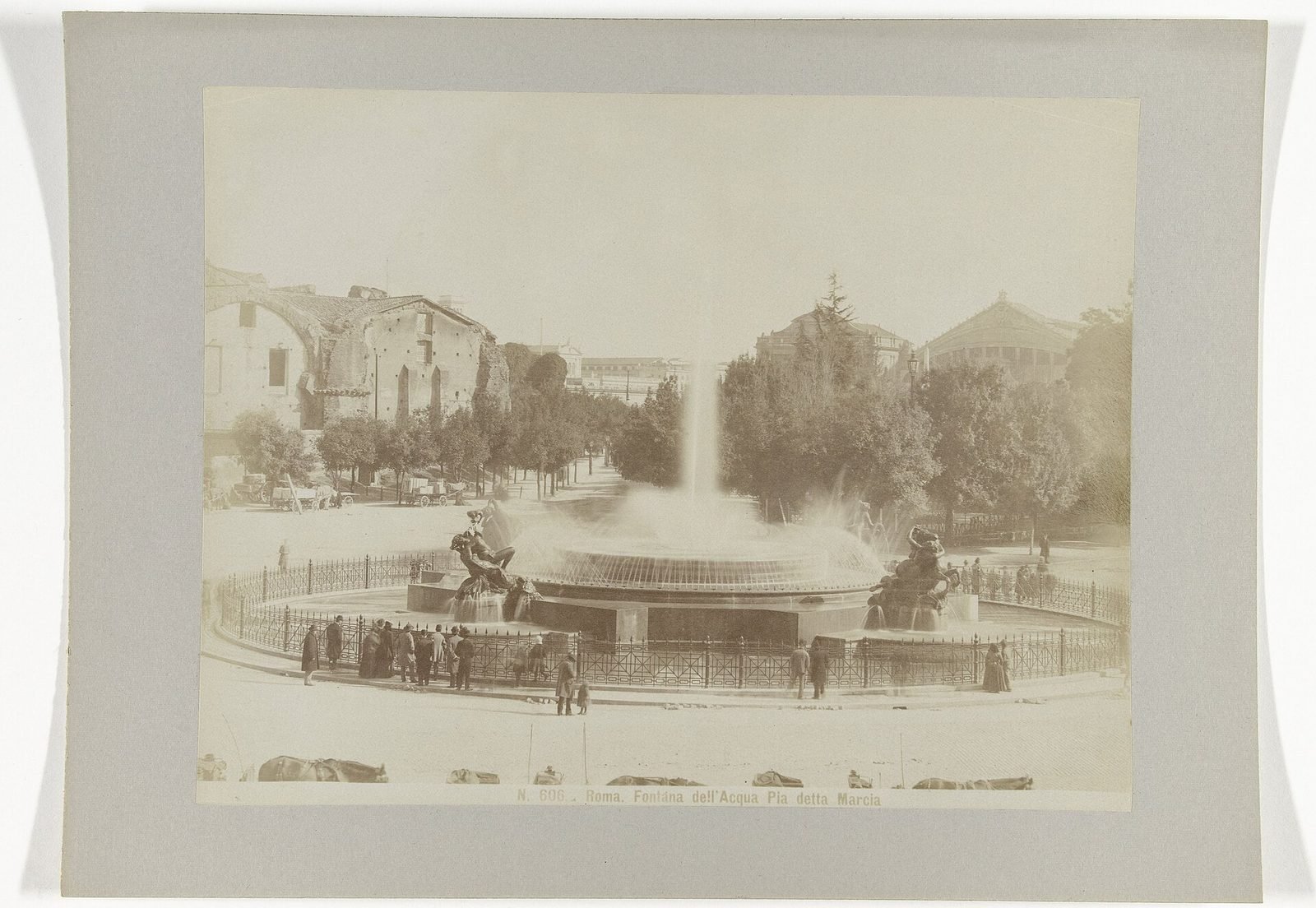
The curve of Piazza della Repubblica reproduces the perimeter of the exedra of the Baths of Diocletian, the great hemicycle that closed off the southwest side of the bath complex's enclosure. The ancient exedra was a semicircular structure with tiered seating, used as a place to rest and for shows inside the baths' enclosure, and the archaeological literature estimates its diameter at around 140 meters. When, at the end of the 1800s, it came time to give a shape to the monumental entrance of the capital Rome, urban engineering did not erase that trace: it followed it.
What the Baths of Diocletian Were
The Baths of Diocletian were built between 298 and 306 AD and dedicated in the name of the emperor Diocletian, although the building site was started and largely run under his colleague Maximian. They covered an area that modern reconstructions put at around 13 hectares, the largest of all the bath complexes of the ancient city. The enclosure occupied the slope between the Viminal and the Quirinal, an area the Aqua Marcia aqueduct had been supplying for centuries. The figures on capacity that circulate in guidebooks, the ones that speak of 3,000 people at the same time, come from modern estimates and not from an ancient source: we report them as such.
Where the Square Ends and Archaeology Begins
The complex has not disappeared: it has been reused. The tepidarium and the frigidarium became the basilica of Santa Maria degli Angeli e dei Martiri. One of the large circular halls at the corners of the enclosure is the Octagonal Hall, on Via Giuseppe Romita. Another sector houses the seat of the National Roman Museum at the Baths, with the cloister attributed by tradition to Michelangelo. Anyone walking from Piazza della Repubblica to Piazza dei Cinquecento is going around a single ancient building, broken up into four properties and four different ticket offices.
Why the Name “Piazza Esedra” Won't Die
The square has changed its name three times. Born as Piazza delle Terme, it became Piazza dell’Esedra precisely because of the shape of the hemicycle, and took its current name through a city council resolution in the postwar period. On the exact date the sources don't agree: some give 1953, others 1960, and we haven't found a single clear confirmation to settle the matter. The point that matters for anyone arriving today is another: in Roman speech, on the signs at the historic terminals and in the language of taxi drivers, “Esedra” is still the name in use. Asking to be taken to Piazza Esedra is not a mistake, it's the form that gets understood first.
Gaetano Koch's Hemicycle: Two Buildings, an Arc of 300 Meters
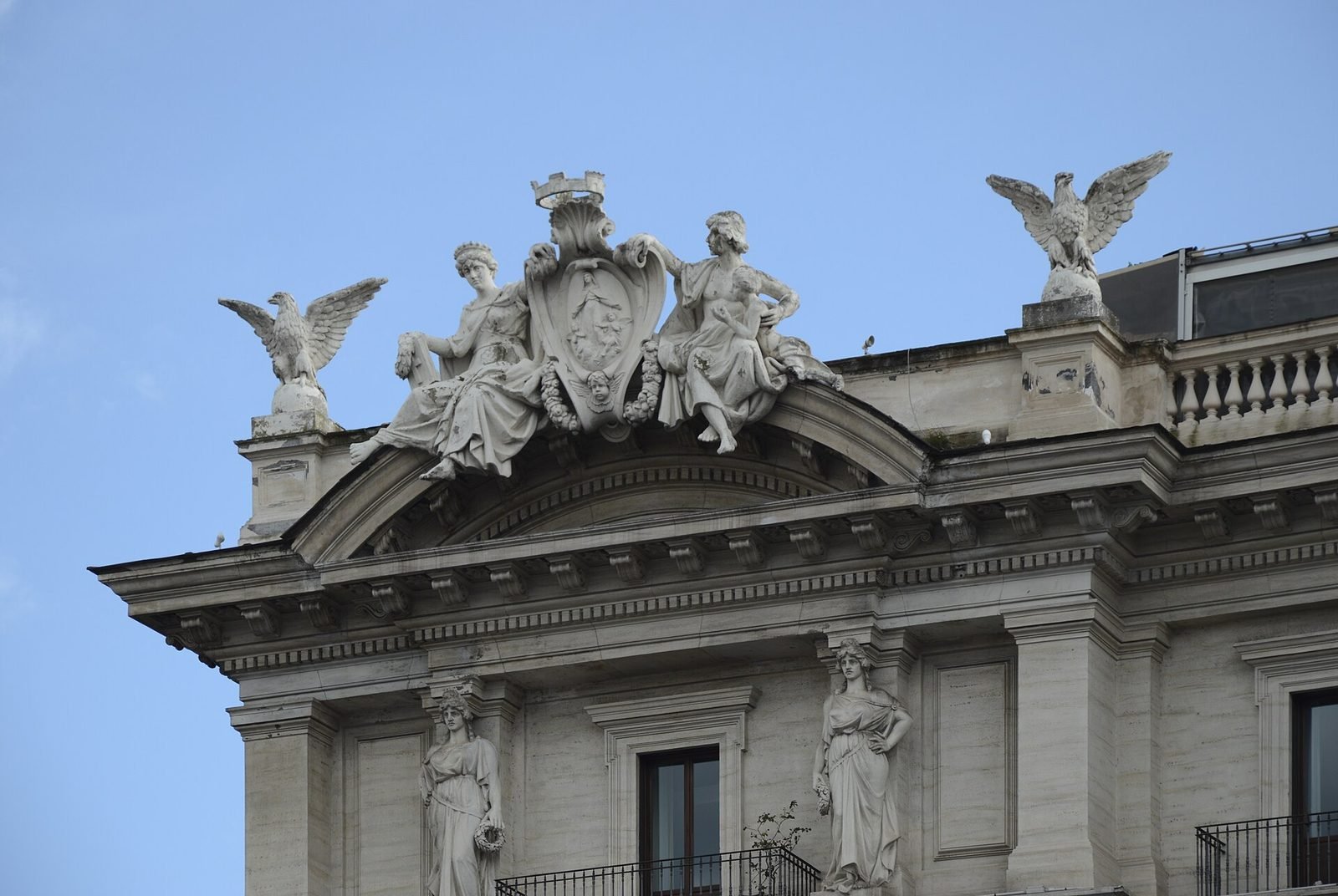
The two arcaded buildings that draw the curve of Piazza della Repubblica are the work of the architect Gaetano Koch and were built in the years between 1887 and 1898, in the season when the capital Rome was filling the land between Termini and the Quirinal with new neighborhoods. Here too the sources diverge by a few years: some reconstructions move the building site to the period between 1896 and 1902. The substance doesn't change: we're within a span of 15 years straddling the end of the 1800s, and the result is a continuous urban backdrop, with round-arched porticoes and coffered ceilings, that wraps the square along almost its entire curved length.
The Porticoes and What You Find Under Them
The porticoes run along both buildings and can be walked along the whole curve, sheltered from rain and sun. Under the arches there is an alternation of hotels, offices, travel agencies, shops. The commercial character of the portico has changed a lot in recent decades and today it is largely aimed at people passing through just once: anyone looking for a neighborhood shop must head up toward the Monti district or down toward the Esquilino and the Esquilino market. The porticoes remain, however, the best thing about the square in the middle hours of summer, because they are the only continuous shade in an area almost without trees.
The Verdict: The Square Seen from Outside and from Inside
The hemicycle reads well from only two positions. From the sidewalk in front of the basilica, where the eye takes in the whole curve at once. And from under the portico, walking, where you sense the rhythm of the arches and the depth of the coffers. From the center of the square, that is, from the fountain island, the curve gets lost: you see only cars and the backs of the buildings. If you have 10 minutes, spend them better on the outer sidewalk than on the central island, where the traffic noise even drowns out the jet of the fountain.
The Fountain of the Naiads: Three Building Sites, a Scandal and a Nickname
The Fountain of the Naiads at the center of Piazza della Repubblica was not born all at once. It is the result of three distinct phases, running from 1870 to 1914, and this explains why the basin, the nymphs and the central group seem to belong to three different worlds. It was born as the terminal display of the Acqua Pia Antica Marcia aqueduct, that is, as the point where the water of a new aqueduct shows itself to the city. It's the kind of monument that Rome has been building for 2,000 years, from the Acqua Vergine onward, and this is the last one conceived under the Papal State and the first one built in the capital Rome.
1870: The Water Arrives 10 Days Before Porta Pia
The Acqua Pia Antica Marcia aqueduct, commissioned by Pope Pius IX and built between 1865 and 1870, brought back to the city the water of the springs of the ancient Aqua Marcia. It was inaugurated provisionally on September 10, 1870, 10 days before the breach of Porta Pia that ended the Papal State. The first monumental arrangement was modest and provisional, a jet and little more. The historical paradox is all there: the fountain that celebrates the last hydraulic act of the pope-king becomes, within two weeks, the fountain of the new state.
1888: Alessandro Guerrieri's Basin
The architectural layout you see today is due to Alessandro Guerrieri, with the design approved in the mid-1880s and the basin built in 1888. It is a precise geometric machine: three concentric circular bowls at different heights, resting on an octagonal base with sides alternately straight and concave, and on the straight sides open four semicircular basins. The materials are granite and travertine. On this structure, which by itself was already a finished fountain, 13 years later the bronzes that gave it its name were added.
1901: Mario Rutelli's Four Naiads
The four nude female bronze figures are the work of the Palermo-born sculptor Mario Rutelli (1859-1941), modeled between 1897 and 1901 and placed on the four straight sides of the base. Each is recognizable by the animal she lies on and the water element she represents: the nymph of the lakes with the swan, the nymph of the rivers reclining on a water monster, the nymph of the underground waters on a dragon, the nymph of the oceans riding a sea horse. It is full-fledged Liberty-style sculpture, and the Capitoline Superintendency considers it the most significant example of that language in Rome.
The Scandal of the Unveiling
When the bronzes were put in place, the pose of the figures and their nudity provoked a very harsh reaction in the city's conservative circles. A wooden fence blocking the view of the monument was kept around the fountain, and the matter became a city case discussed in the newspapers and in the city council. On February 10, 1901 the city lifted its reservation in favor of the progressive arguments and the fence was torn down. The fact is documented and doesn't need to be inflated: the square gained a monument and the news gained a month-long controversy.
1911: The Central Group the Romans Called “Fritto Misto”
For the center of the basin Rutelli prepared a first sculptural group, made of cement conglomerate and unveiled in 1911: three tritons, a dolphin and a large octopus entwined together in what was meant to look like a struggle. The reaction was immediate sarcasm and the Romans renamed it “il fritto misto,” for the tangle of bodies and tentacles. Judged unsuited to the scenery of the square, the group was removed and in 1913 moved to the gardens of Piazza Vittorio Emanuele II, in the Esquilino, where it still stands and is still known by that nickname. Anyone who wants to see the discarded chapter of the fountain's history must therefore walk 20 minutes toward the Porta Alchemica in Piazza Vittorio, inside the same gardens.
1912-1914: The Glauco
In place of the removed group Rutelli modeled a nude male figure gripping a dolphin from whose mouth the central jet comes out: Glaucus, the sea deity of Greek mythology, as an image of man's dominion over the force of nature. The dates in circulation refer to different phases of the same work: 1912 for the model and the installation, 1914 for the re-inauguration of the whole. The Glauco too had its popular baptism, less cruel than the first: “l’omo co’ er pesce in mano” is the phrase found in the 20th-century collections of Romanesco sayings.
A Curiosity About Piazza della Repubblica
The most solid curiosity about Piazza della Repubblica concerns the way the ancient name won out over all the official ones: the square has been called this since the postwar period, but in speech and in everyday place names it remains “Esedra,” a Greek word that indicated a semicircular structure with seats, and that here continues to name a piece of the city. It's one of the few Roman cases where the name of an ancient building, vanished as a building, survives as an address.
A Square That Is the Cast of a Wall
The thing to bring into focus is that Koch's buildings don't imitate the exedra: they occupy it. The foundations and the alignment follow the line of the ancient wall, which in some points was incorporated into the modern structures. That's the reason the curve is so regular and so wide: no urban planner at the end of the 1800s would have spontaneously drawn a hemicycle of those dimensions in a spot like this, but the perimeter was already there and it made sense to use it.
The Nickname the Fountain Has Carried for a Century
The second curiosity is the fate of the first central group. The “fritto misto” was not destroyed, as is often told around town: it was moved. Since 1913 it has stood in the gardens of Piazza Vittorio Emanuele II, a quarter of an hour's walk from here, and the public that passes it today has no idea it is the discarded piece of the most photographed fountain of the Termini area. Anyone who wants to reconstruct the story in full must therefore see two squares, not one.
Something Nobody Tells You About Piazza della Repubblica
What is almost never said is that Piazza della Repubblica works badly as a square and very well as a hub: it is not a space where people stop, because the traffic ring separates the central island from the sidewalks and there is no continuous pedestrian side where you can sit. Anyone who arrives expecting a square for lingering, like Piazza Navona or Piazza del Popolo, is disappointed in three minutes. Anyone who arrives knowing it's a monumental intersection, and looks at it the way you look at an intersection, appreciates it much more.
Crossing: Where You Can and Where You Can't
To reach the central island of the fountain you use the signaled pedestrian crossings. Not every side has a convenient one, and the flow of cars leaving Via Nazionale is continuous at rush hour. The classic mistake is crossing diagonally counting on the courtesy of drivers: here it doesn't work. The practical advice is to enter the island from the basilica side, where the view is wider and the signal timing is more generous.
The Noise, and Why It Matters More Than You Think
The second fact nobody anticipates is acoustic. In Piazza della Repubblica the background noise is that of an expressway, and it covers the sound of the water almost entirely. Anyone imagining listening to the fountain the way you listen to the Acqua Paola on the Janiculum is badly mistaken. The moment when the water is truly audible is very early morning, before seven, or the dead of night on a weekday.
The Area Changes Face After Sunset
Third point, and it has to be said without beating around the bush because it's the question we get asked most often: the square is a few hundred meters from Termini and after sunset takes on the character of a station area, with people in difficulty, insistent begging and petty crime linked to pickpocketing. It's not an area we advise against crossing in the evening, and it is well lit and busy until late, but anyone walking with luggage, a camera around the neck and a phone in hand must be as alert as they would be in any large European station. It's context, not an alarm.
My Advice for Visiting Piazza della Repubblica
Our advice for Piazza della Repubblica is not to treat it as a destination but as the start of a walk of a couple of hours: you arrive here at eight in the morning, look at the fountain in raking light with the square half empty, go into Santa Maria degli Angeli as soon as it opens and continue on foot toward the Baths of Diocletian and Palazzo Massimo alle Terme, all within 300 meters. By 10 the square is already something else and the museums have lines.
The Right Time, in Concrete Terms
The square faces southwest, so it gets full sun in the afternoon and stays in shade early in the morning, when the light comes in low from behind the basilica and lights up the bronzes without flattening them. In summer, between 11:00 and 16:00, the central island is an oven with no shade: if you pass at those hours, it's best to stay under Koch's porticoes and step out only for the photo. In winter the opposite happens, and the afternoon is when the hemicycle gets its best light.
What You Book and What You Don't
The square is open public space: it has no ticket, no hours, no reservations. The museums around it do have tickets and hours, and the conditions change often, so check them on the official channels of the National Roman Museum for the archaeological sites and of the Teatro dell’Opera for performances. The Octagonal Hall in particular has had irregular openings and periods of closure over the years: before counting on it in your itinerary, ask for confirmation, because finding it closed has happened to many people.
How Much Time You Need
For the square itself 15 minutes is enough: the loop of the hemicycle under the portico, the crossing to the island, two or three shots of the fountain. With the basilica you get to 40 minutes. Adding the Baths of Diocletian and the cloister you're at around two and a half hours. With Palazzo Massimo included, which on its own deserves a full two hours, you fill a whole morning without ever taking a vehicle.
The Blunt Verdict
If your time in Rome is short, the fountain is worth the stop and the square isn't. That is: the 10 minutes spent in front of the naiads are well spent, while the quarter of an hour spent circling under the porticoes looking for atmosphere is time that should have gone to Santa Maria degli Angeli, which is 30 meters away and free. The real treasure of this corner of Rome is inside the buildings, not on the asphalt.
Another Well-Known Fact, Yet Rarely Cited
The well-known fact that almost nobody cites in full is that the basilica of Santa Maria degli Angeli e dei Martiri is the only church in Rome designed by Michelangelo Buonarroti and actually built: the commission came in 1561 from Pope Pius IV, the artist was 86 years old and he died in 1564, three years after the building site opened. The church was not built from scratch. Michelangelo took the halls of the frigidarium and the tepidarium of the baths and turned them into liturgical space while preserving them, with an attitude toward ruins that in the 1500s was anything but obvious.
What Remains of Michelangelo and What Is Vanvitelli's
What you see on entering today is largely 18th-century. Around 1750 Luigi Vanvitelli worked on the building, effectively rotating the axis of the church and dressing the interior according to the taste of the time, with stucco, marbles and altars. The great transverse hall with the red granite columns, tall and monolithic, is however the Roman one: those columns held up the vault of the bath hall and have stayed in place. Anyone who wants to follow the thread of Michelangelo's Roman work in the city will find an overview on our page on Michelangelo in Rome.
The Meridian Line on the Floor
On the floor of the basilica runs a meridian line in bronze and marble, commissioned by Pope Clement XI for the Jubilee of 1700 and built by the astronomer Francesco Bianchini in the early 1700s. A hole in the high wall lets in a ray of sunlight that at true noon falls on the line, at a different point depending on the season. It served to verify the length of the solar year and the date of Easter, and it still works: it's one of the few scientific instruments of that era still in use in the place for which it was built. You see it for free, because the basilica has no entrance ticket, and to catch the passage of the sun you have to be there around noon.
The Bronze Doors, and Why You Can't Photograph Them Freely
The basilica's bronze doors were made by the sculptor Igor Mitoraj and inaugurated in 2006. They are contemporary works, so still protected by copyright: shots for personal use are one thing, publication is another, and anyone who works with images must take it into account. It's a boring clarification that we make gladly, because it is exactly the kind of detail that trips up anyone preparing material for the web.
The Right Photo to Take at Piazza della Repubblica
The right photo at Piazza della Repubblica is taken from the outer sidewalk on Via Vittorio Emanuele Orlando side, with the fountain in the foreground on the left and the curve of Koch's porticoes running away to the right: it's the only framing that holds the hemicycle and the monument in the same image without distorting them. You need a moderate wide angle, around 24 millimeters on full frame, and a position slightly set back under the portico to avoid the cables of the surface line.
The Hour and the Light
The first hour after dawn is the best for three concrete reasons: traffic is still light and you can take exposures of a few seconds without a bus in the middle of the frame, the bronzes are in raking light and show their modeling, and the sky behind the hemicycle is clean. The second good moment is the blue hour in the evening, when the fountain lighting comes on and the lamps of the porticoes balance the sky. Midday in summer is the worst of all: sun in your face, impossible contrast, white reflections on the travertine.
The Three Framings That Work
The first is the wide shot with hemicycle and fountain described above. The second is the detail of a single naiad from below, taken from outside the basin with the jet in the background: dark bronze against white water is the contrast that holds up best. The third is the perspective of the portico, camera resting on a column and a run of arches and coffers, a photo almost nobody takes and that tells the architecture of the square better than any panorama. If you add a fourth, point the lens toward the mouth of Via Nazionale at sunset, when the street is in line with the light.
What to Avoid
Avoid the photo from the central island with the buildings in the background, which flattens everything and fills the frame with cars. Avoid the tight vertical on the Glauco, because the central jet covers half of it in most wind conditions. And watch out for the water: the spray reaches several meters and settles on the lens within a few minutes, especially on the downwind side. A lens cloth is really needed here.
Some Important Events That Happened Here in History
The events documented at this point of the city span almost 18 centuries, from the building of the Baths of Diocletian between 298 and 306 AD to the big contemporary demonstrations that use the square as the starting or arrival point of marches. It's a sequence that reads well because every era has left a piece still visible.
298-306: The Imperial Building Site
The construction of the baths occupied an enormous area on the Viminal for about eight years and required restructuring the water supply of the upper part of the city. The exedra that gives the current square its shape was part of the outer enclosure, the wall that enclosed gardens, gyms, libraries and resting halls around the actual bath block.
September 10, 1870: The Water of the Acqua Pia
The provisional inauguration of the display of the Acqua Pia Antica Marcia aqueduct took place 10 days before the breach of Porta Pia. It is the last public act of the Papal State on the subject of aqueducts and, by a coincidence worth telling for what it is, the first hydraulic monument that the capital Rome found already in its coffers.
February 10, 1901: The Fence Comes Down
The city decision that ended the protection of the naiads from prying eyes is a minor date in the history of Italy and a big date in the history of Roman manners. From that day the fountain has been visible as we see it now, and the controversy over the nudity of the figures died down within a few weeks.
The 1900s: The Square of Marches and Waiting
Over the course of the 1900s the hemicycle was repeatedly a gathering and transit point for union and political demonstrations headed toward Piazza San Giovanni or toward the center, because of its position and the capacity of the ring.
Who Has Passed Through Piazza della Repubblica
Through this point of the city have passed, in chronological order, the emperors who wanted the baths, the most famous architect of the Renaissance, a papal astronomer, a pope-king, the architect of Umbertine Rome and a Sicilian sculptor who staked his reputation here. They are documented passages, not legends: each left a piece of stone or bronze still in its place.
Diocletian and Maximian
The baths bear the name of Diocletian but were started and largely overseen by his colleague Maximian, under the four-emperor system of government that characterized those years. The official dedication of the complex, which epigraphic sources reconstruct, associates the names of the sovereigns of the tetrarchy. Neither of the two, it must be said, lived permanently in Rome.
Michelangelo Buonarroti
The last Michelangelo, the one of the 1560s, worked a few dozen meters from here while also overseeing the building of St. Peter's. The basilica of Santa Maria degli Angeli is his least showy Roman work and perhaps the most intelligent: a project that gives up building and chooses to reuse. Anyone who wants to see the other traces of his passage in the city can start from our page on the cloister that tradition attributes to him, inside the Baths of Diocletian.
Gaetano Koch
The architect of the hemicycle signed a quantity of buildings in the Rome of the late 1800s and gave shape to entire representative streets. He died in 1910, when the fountain of the square he had closed with his porticoes did not yet have its definitive central group. So he never saw the square completed as we see it.
Mario Rutelli
The Palermo-born sculptor who modeled the naiads and the Glauco found himself twice at the center of public controversy: first for the nudity of the figures, then for the rejected central group. His surname has stayed in Roman news also through his great-grandnephew Francesco Rutelli, mayor of the city in the 1990s. His most debated work and his most loved work are in the same basin.
And Then Everyone Else
Since 1950, the year the current Termini station building was inaugurated, anyone who arrived in Rome by train and walked toward the center has passed through here. Heads of state, Jubilee pilgrims, students, emigrants leaving and returning, groups looking for the first hotel. It's the function this square has truly performed for 140 years: the threshold between those who arrive and the city.
What to See Around Piazza della Repubblica
Within 500 meters of Piazza della Repubblica there are four state museum sites, two basilicas, an opera house and the largest railway station in Italy: it's the highest concentration of visitable things among all the arrival areas of the city. Here is how they line up, with real walking times.
Santa Maria degli Angeli e dei Martiri, 30 Meters
The basilica of Santa Maria degli Angeli opens onto the square itself, with its facade carved out of the curved wall of the ancient calidarium. Entry is free and the interior is worth a 20-minute stop even for those who don't go into churches: the transverse hall with the granite columns is the best-preserved ancient space in the area. Hours and liturgical closures are checked on the basilica's website.
Baths of Diocletian and Cloister, 200 Meters
The seat of the National Roman Museum at the Baths of Diocletian, with entrance on Viale Enrico De Nicola, gathers inscriptions, protohistoric materials and the surviving bath structures, and includes the large cloister attributed to Michelangelo. The National Roman Museum ticket is normally cumulative across several sites and valid for a few days: conditions change, so check them on the museum's website before buying.
Octagonal Hall, 150 Meters
The Octagonal Hall, on Via Giuseppe Romita, is one of the circular corner halls of the bath enclosure, with a dome covering of remarkable width. Over the years it has had a history of intermittent openings, temporary exhibition uses and long closures. Before putting it in your itinerary, check whether it's open, because it is by no means guaranteed.
Palazzo Massimo alle Terme, 300 Meters
At Palazzo Massimo, in Largo di Villa Peretti, are kept the frescoes of the Villa of Livia and some of the most important sculptures of Roman art. If you have to choose only one museum in this area, we recommend this one without hesitation: it's less crowded than the big names and the quality of the collection is beyond question. You need at least an hour and a half, better two.
Teatro dell’Opera, 250 Meters
The Rome Opera House is in Piazza Beniamino Gigli, around the corner from Via Nazionale. Born as the Teatro Costanzi and inaugurated on November 27, 1880 with Rossini's Semiramide, it hosted the world premieres of Mascagni's Cavalleria rusticana in 1890 and Puccini's Tosca in 1900. The building was renovated by Marcello Piacentini between 1926 and 1928 and again at the end of the 1950s, when it took its current facade. The program and prices are on the theater's website.
Via Nazionale and the Palazzo delle Esposizioni
From here Via Nazionale begins, the street the post-unification Rome opened to connect the station to the center. Halfway along you meet the Palazzo delle Esposizioni, inaugurated in 1883, which hosts temporary exhibitions and has a continuous program. A little farther, heading down toward the center, you reach the Galleria Sciarra, a frescoed Liberty-style courtyard that you cross for free and that almost nobody knows, and farther down the Galleria Alberto Sordi on Via del Corso.
The Quadrant of Fountains and Baroque Palaces
Going up Via Vittorio Emanuele Orlando you reach Santa Maria della Vittoria in five minutes, where Bernini's Ecstasy of Saint Teresa stands, and in 10 you arrive at Piazza Barberini with the Triton Fountain and Palazzo Barberini, home of the National Gallery of Ancient Art. Under the palace, visitable by reservation, is the Barberini Mithraeum. Continuing to the Quattro Fontane you meet Borromini's San Carlo alle Quattro Fontane and, farther on, Bernini's Sant’Andrea al Quirinale, with the Quirinal Palace, the square's obelisk and the Stables. It's the densest walk you can make starting from here.
Toward the Esquilino
On the other side, past Termini, you enter the Esquilino: Santa Maria Maggiore is 10 minutes away, with the Esquiline Obelisk behind the apse, and nearby the mosaics of Santa Prassede and Santa Pudenziana, two churches worth double the time they usually get. In Piazza dei Cinquecento, in front of the station, stands the Dogali Obelisk, which very few people notice.
The Other Stops Within Reach of the Metro
With one or two stops on Line A you reach Piazza di Spagna with the Barcaccia, the Trevi Fountain by getting off at Barberini, and Piazza del Popolo. With Line B you go down to the Colosseum and the Roman Forum, or to the Circus Maximus. On foot toward the center, beyond Via Nazionale, you meet Trajan's Markets, and farther on Piazza Navona with the Fountain of the Four Rivers, the Crypta Balbi and Palazzo Altemps, two more sites of the National Roman Museum included in the same cumulative ticket, and the Turtle Fountain in Piazza Mattei.
Eating Around Piazza della Repubblica: How to Choose and What to Avoid
Around Piazza della Repubblica and along the first stretch of Via Nazionale, dining is almost entirely geared to people passing through just once, because the catchment is that of a station and about 10 large hotels: it's the part of Rome where the ratio between price and quality worsens fastest the closer you get to the monument. We don't name places, by choice: a list of signs goes out of date in a few months and teaches nothing. We give instead the criteria for choosing, which hold here and in any other tourist quadrant of the city.
The Five Signs of a Trap
The first sign is the lady rolling out fresh pasta in the window or directly on the sidewalk: it's an advertising lure, not a kitchen, and in the vast majority of cases that pasta is not what arrives on the plate. The second is the menu with photographs of the dishes, often laminated and translated into six languages: it's for people who will never come back, and a place cooking for regulars doesn't need it. The third is the barker at the door inviting you to sit: a place that has to stop people in the street has a problem filling its seats, and that problem gets passed on to the bill or the ingredients.
The fourth sign is non-stop hours from morning to night with no kitchen break: a real kitchen has two services and stops in between, because it prepares. The fifth is the places set in front of famous monuments, which often adjust the price to the customer in front of them: items not priced on the list, cover charge and service that appear only at the end, different menus inside and outside. These five signs can be recognized from the street, in 30 seconds, without going in.
The Chains of the Center
In recent years the center of Rome has filled with places under repeated signs, with the same menu in several parts of the city, the line with a number ticket and all-identical communication. It's a phenomenon explained by rent costs and tourism volumes, and it should be seen for what it is. The fact that matters for the reader: Romans don't go to those places. We don't name them and we don't recommend them.
The Simplest Criterion of All
Look at who is seated and in what language they order. In an office and station neighborhood like this one, at 12:30 a place with employees inside speaking Italian and ordering without looking at the menu is a place that works on regulars. If the tables hold only suitcases, the place lives on passing trade. The second, complementary criterion is walking: five or six minutes uphill toward the Monti district or toward Via XX Settembre is enough to get out of the monument price band.
For anyone who wants an already selected starting point, without signs put there at random, we point to Daniele Dezi's personal list on Google Maps: it's a curated collection, not sponsored and not paid, built on places tried in person over time.
Accessibility, Children and Practical Matters
Piazza della Repubblica is entirely flat and the sidewalks under Koch's porticoes are wide and regular, so the square itself can be walked without difficulty with strollers and wheelchairs. The problem spots are elsewhere: the crossings of the traffic ring, the signal timings and the crowding of the sidewalks at rush hour.
With Children
For a child the fountain works, because the bronzes are big, recognizable and full of animals to look for: the swan, the dragon, the sea horse, the dolphin. Five minutes of play finding them is worth more than half an hour of explanations. There is only one warning and it should be taken seriously: the central island is surrounded by lanes on all sides, so children must be held by the hand from the crossing onward. There are no equipped play areas in the area: the nearest is in the gardens of Piazza Vittorio.
Services, Water and Shade
There are no public restrooms on the square: the nearest are inside Termini station, for a fee, and in the museums for those with a ticket. Free drinking water can be found at the cast-iron fountains in the area, which in Rome deliver mains water and are safe. Shade, in summer, exists only under the porticoes and in the basilica, which, being built into the Roman masonry, stays cool even on the worst days of July.
Frequently Asked Questions About Piazza della Repubblica
How much does it cost to visit Piazza della Repubblica?
Piazza della Repubblica is an open-air public space and has no entrance ticket: you cross it and photograph it freely at any hour. The museums around it do have a ticket, such as the Baths of Diocletian and Palazzo Massimo alle Terme, while the basilica of Santa Maria degli Angeli e dei Martiri can be visited without paying. Museum fares and discounts change over time and should be checked on the official websites.
Why is Piazza della Repubblica also called Piazza Esedra?
Piazza della Repubblica was officially called Piazza dell’Esedra before being renamed by a city council resolution in the postwar period, and the old name has stayed in the spoken usage of Romans. It comes from the exedra of the Baths of Diocletian, the great ancient hemicycle whose perimeter is followed by Gaetano Koch's arcaded buildings. On the precise date of the change the sources give 1953 or 1960.
How do you get to Piazza della Repubblica by public transport?
Piazza della Repubblica has its own metro stop, Repubblica on Line A, which opens directly onto the square, and it is only one stop from Termini. On the surface, many bus lines stop in the area, among them the 40, 60, 64, 70, 170, 910 and H. From Termini station you can walk there in five or six minutes on a flat route.
How much time do you need to visit Piazza della Repubblica?
For Piazza della Repubblica 15 minutes is enough if you limit yourself to the fountain and a loop under the porticoes. Adding the basilica of Santa Maria degli Angeli takes you to 40 minutes, with the Baths of Diocletian and the cloister you go past two hours, and including Palazzo Massimo alle Terme fills a whole morning without moving more than 300 meters.
Who made the Fountain of the Naiads in Piazza della Repubblica?
The Fountain of the Naiads in Piazza della Repubblica is the result of the work of two authors in different phases: the architectural layout with the basins is by Alessandro Guerrieri, built in 1888, while the four bronze nymphs and the central group of the Glauco are by the Palermo-born sculptor Mario Rutelli, placed respectively in 1901 and between 1912 and 1914.
Is it true that the Fountain of the Naiads caused a scandal?
Yes, the Fountain of the Naiads in Piazza della Repubblica provoked a documented public controversy at the time of its unveiling, because of the nudity and pose of the four female bronze figures. A wooden fence blocking the view was kept around the monument, and torn down after the city's favorable decision of February 10, 1901. The matter died down within a few weeks.
What is the “fritto misto” the Romans talk about?
The “fritto misto” is the popular nickname of the first central sculptural group of the fountain in Piazza della Repubblica, unveiled in 1911 and made up of three tritons, a dolphin and a large octopus entwined together. Judged unsuitable, it was removed and in 1913 moved to the gardens of Piazza Vittorio Emanuele II, where it still stands today under that same nickname.
Is Piazza della Repubblica safe in the evening?
Piazza della Repubblica is well lit and busy until late, but it is a few hundred meters from Termini station and shares its evening dynamics, including pickpocketing and insistent begging. We recommend the normal alertness of a large European station: bags in front, phone not in hand while walking, crossings only at the signals. During the day the problem doesn't arise.
Can you visit the basilica of Santa Maria degli Angeli for free?
The basilica of Santa Maria degli Angeli e dei Martiri, which faces Piazza della Repubblica, can be visited without an entrance ticket like all Roman parish churches. Inside are the meridian line drawn by Francesco Bianchini for the Jubilee of 1700 and the granite columns of the ancient bath hall. Hours follow the religious services and it's best to check them on the basilica's website before going.
Who Wrote This Page
This page is edited by the team at Tour Leader Pro, the Rome-based project office that designs and coordinates visits, itineraries and cultural events in Rome and Lazio. Hours, fares and access conditions given here were checked on the official sources named in the text as of the publication date: it's best to recheck them before leaving, because they change often. If you find an outdated piece of information, let us know.
How to Fit the Square into a Roman Itinerary
Piazza della Repubblica works best as the first or last stop of a day, because it's where you arrive and where you leave from. Anyone who has just dropped their suitcase at the hotel can step out and have in front of them, within a 10-minute walk, a Michelangelo basilica, two sites of the National Roman Museum and an opera house. Anyone who instead has a train to catch in the afternoon can close the morning here and walk to Termini with carry-on luggage. It's the way this square works best: as a hinge.
If you're organizing a broader itinerary in the center of Rome, combining this stop with the museum sites of the Termini area and with the climb toward the Quirinal, you can find useful planning tools at Tour Leader Pro, while for a broader picture on transport, travel between cities and destinations in Lazio, Italy Planner is a good resource.