Dogali Obelisk
In short. The Dogali Obelisk is a monolith of red Aswan granite 6.34 meters tall, inscribed for the pharaoh Ramesses II and raised more than 3,000 years ago at Heliopolis, which today stands in the gardens between Viale Luigi Einaudi and Viale…
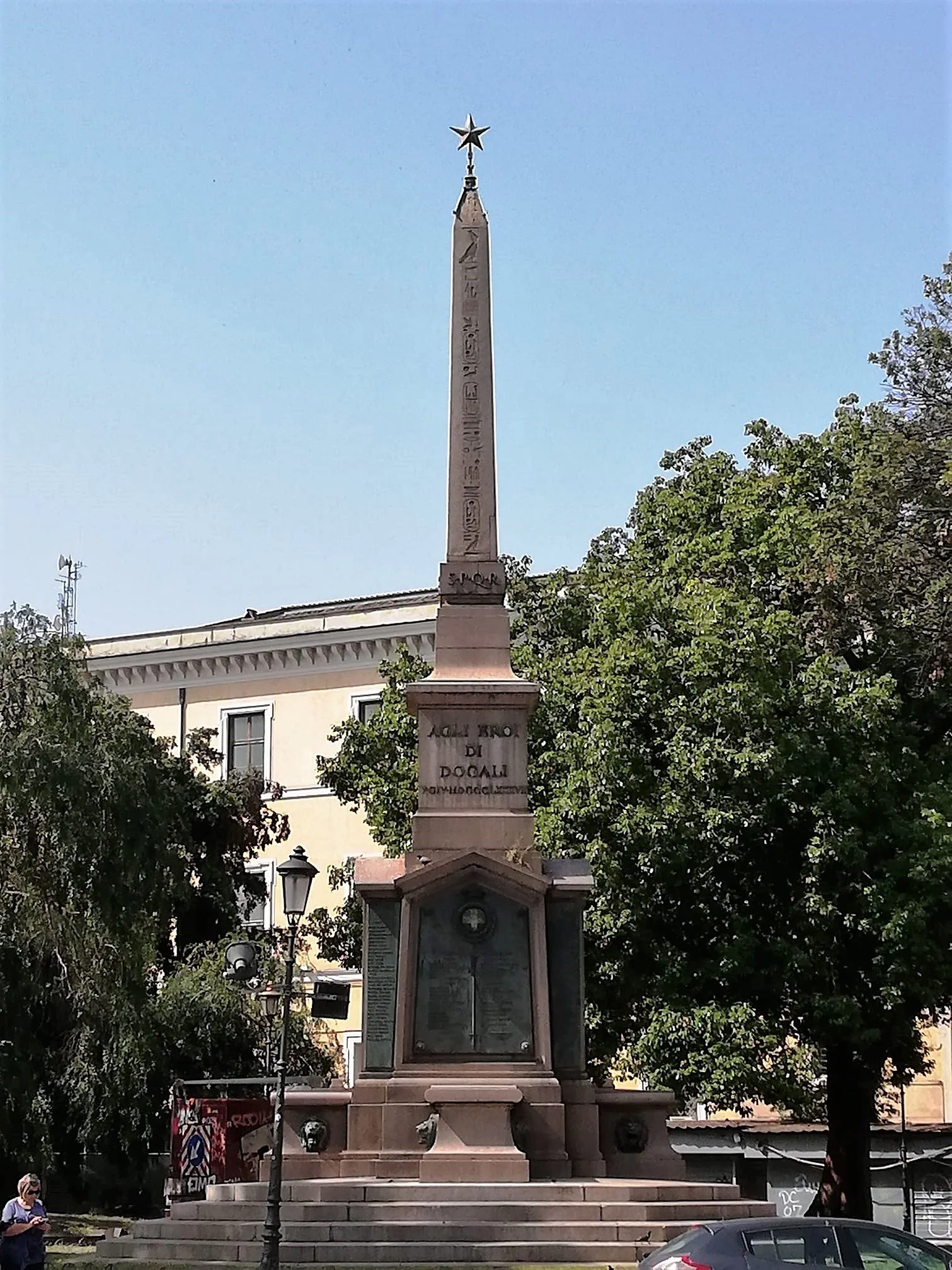
The Dogali Obelisk is a monolith of red Aswan granite 6.34 meters tall, inscribed for the pharaoh Ramesses II and raised more than 3,000 years ago at Heliopolis, which today stands in the gardens between Viale Luigi Einaudi and Viale delle Terme di Diocleziano, about 100 meters from the exit of Termini station. It is one of the 13 ancient obelisks of Rome, and it is also the least visited of them all: tens of thousands of people walk past it every day dragging a suitcase toward the train, and almost none stops to read what the bronze plates fixed on the base say. Those plates carry the names of the Italian soldiers who fell on January 26, 1887 at Dogali, in present-day Eritrea, in a clash with the Ethiopian troops of Ras Alula Engida. The monument was born this way: an Egyptian obelisk that re-emerged from a Roman excavation in 1883 and was adapted, four years later, as a memorial to a colonial defeat. The lines that follow tell the three stories that overlap in this block of granite, namely the Egypt of the pharaohs, the imperial Rome that imported cults and obelisks from the Nile, and the Umbertine Italy that was looking for an empire in East Africa. They are stories that must be told for what they are, without rhetoric and without discounts.
Where the Dogali Obelisk is and how to get there
The Dogali Obelisk stands in a tree-lined flower bed between Viale Luigi Einaudi and Viale delle Terme di Diocleziano, on the south side of Piazza dei Cinquecento, that is, the open space in front of the facade of Termini station. It is not inside the square proper, where buses and taxis stop, but a little farther on, in the direction of Piazza della Repubblica, in a green strip that separates the station forecourt from the complex of the Baths of Diocletian. Whoever leaves Termini by the main exit and looks to the right with the tracks behind them spots it as a dark spire sticking up among the pines and holm oaks, above a light granite base.
By metro and train
The stop is Termini, the terminus of line A and line B of the Rome metro, as well as an interchange with the regional railways and with the line to Fiumicino airport. From the station exit to the obelisk it's a three or four minute walk. Whoever arrives on metro A can also get off at the next stop, Repubblica, and walk back along Viale Luigi Einaudi: from that side the obelisk comes before the station, and it is the most convenient way to get there for those coming off regional trains from the Roma Tiburtina hub or other lines.
By bus and tram
Piazza dei Cinquecento is the city's main surface hub: dozens of urban bus lines terminate or pass through here, along with the airport connections and the intercity coaches for Lazio. After the reorganization of the square completed for the 2025 Jubilee the terminals have been rearranged, so it's best to check the exact stop for your line on the app or on the information totems on arrival, because the layout before those works no longer matches the current one. The nearest tram terminus is the one at Piazza di Porta Maggiore, reachable on foot in about 15 minutes crossing the Esquilino district.
On foot from the center
From the historic center the walk is long but pleasant: from Piazza della Repubblica you get there in five minutes along Viale Luigi Einaudi, from Via Nazionale in about 10, from Piazza Navona in a little over half an hour following Via del Corso and Via del Traforo. Whoever comes from the Monti district can go up Via Cavour to Santa Maria Maggiore and then down toward Termini by Via Giovanni Amendola. The richest route, though, is the one that starts from the Campus Martius, that is, from the place where this obelisk was physically extracted in 1883: from the Basilica of Santa Maria sopra Minerva to Piazza dei Cinquecento it's about two and a half kilometers, 40 minutes of walking, and you retrace exactly the road the monolith traveled on a cart in 1886.
What the Dogali Obelisk is: three monuments in one
The Dogali Obelisk is not a single monument. It is an Egyptian object of the second millennium BC, reused by the Romans as sacred furnishing in a sanctuary of Nile deities, and reused a second time by liberal Italy as a military memorial. Each of these three passages left a physical mark on the monument, and whoever stops to look at it can read all three in a single glance: the hieroglyphs on the shaft, the fracture between the blocks put back together after the discovery, the bronze plates with lists of names on the 19th-century base.
The ancient shaft
The monolith is in red granite from the quarries of Aswan, in Upper Egypt, the same ones from which came most of the obelisks the Romans brought to Italy. It measures 6.34 meters in height, a modest size compared with the colossi that dominate the Roman squares: the Lateran Obelisk exceeds 30 meters, the one in Piazza San Pietro 25. The four faces of the shaft are entirely covered with hieroglyphs celebrating the pharaoh Ramesses II and his devotion to the solar deities of Heliopolis. The whole monument, including the 19th-century base and the crowning, reaches instead 16.92 meters: the difference between the two figures explains why some guides speak of an obelisk of 6 meters and others of a monument that exceeds 9 or 16, without any being wrong. It's simply a matter of what is being measured.
The 19th-century base
Under the shaft is a modern construction, designed in 1887 by the architect Francesco Azzurri: a tall granite pedestal on a polygonal plan, with four corner elements in the shape of a tapered altar, bronze lion heads and, on the sides, the bronze tablets with the list of the fallen arranged in two columns and ordered by military rank. The crowning of the monument includes a star-shaped element, in a taste typical of the House of Savoy at that time. The text of the dedicatory inscription is attributed to Ruggero Bonghi, a man of letters and politician among the best known of Umbertine Rome, and it sums up the dedication to the heroes of Dogali with the date of the battle and that of the inauguration.
The Egyptian origin: Ramesses II and the city of the sun
The Dogali Obelisk was inscribed for Ramesses II, pharaoh of the 19th Dynasty whose reign is placed by Egyptologists in the 13th century BC, and it was raised at Heliopolis, the city sacred to the sun god north of present-day Cairo. The fact can be drawn from the hieroglyphic inscriptions that cover the four faces of the shaft, and it is the same that this monolith shares with other Roman obelisks of Heliopolitan origin.
What an obelisk was for the Egyptians
An obelisk, in the Egyptian conception, was not a commemorative monument in the sense we understand it. It was an object of solar cult: a petrified ray of sunlight, planted in front of the entrance of a temple, with the tip covered in precious metal so as to light up at the first morning light. Obelisks were normally raised in pairs, at the sides of the portal of the entrance pylon, and bore inscribed the name and titles of the ruler who had dedicated them, together with formulas affirming his devotion to the deity of the temple. The tapered shape on a square base and the pyramidal tip, called the pyramidion, echo the sacred benben stone kept at Heliopolis, the primordial hill on which, according to Heliopolitan theology, the sun had risen for the first time.
Heliopolis, the obelisk quarry of the ancient world
Heliopolis was, in the time of Ramesses II, one of the great religious centers of Egypt: the seat of the cult of Atum and Ra, the most prestigious priestly college in the country, a temple complex that the Greeks called by the name we still use and that means precisely city of the sun. It was also, as a result, the place where the largest number of obelisks was concentrated. It was from there that the Romans, in the centuries of the occupation of Egypt, took most of the monoliths they brought to Italy: from the Flaminian Obelisk in Piazza del Popolo, which is the oldest in Rome, to the Obelisk of Montecitorio, up to this one of Dogali. Today at Heliopolis, absorbed into the northern outskirts of Cairo, only one obelisk remains standing, that of Senusret I.
The Iseum Campense: Egypt inside the Campus Martius
Before becoming a monument to the fallen, the Dogali Obelisk stood in the middle of the Campus Martius, inside the sanctuary of Isis and Serapis that the ancients called the Iseum Campense: the largest complex of Egyptian cult ever built in Rome, extending according to reconstructions for about 240 meters in length and 60 in width, in the area that today corresponds roughly to the Pigna district, between the church of Santa Maria sopra Minerva and that of Santo Stefano del Cacco.
Domitian and the reconstruction
After the fire of AD 80 that devastated the Campus Martius, the emperor Domitian had the sanctuary rebuilt on a far more ambitious scale, and on that occasion had a group of red granite obelisks brought from Heliopolis, meant to give the complex an explicitly Egyptian character. It was not mere furnishing: the presence of authentic monoliths, coming from the sacred city of the sun, served to certify the authenticity of the sanctuary and legitimize its prestige. It is in this context that our obelisk arrives in Rome, together with those that today stand in front of the Pantheon and above Bernini's little elephant, that is, the Obelisk of the Minerva.
What remains of the Iseum today
Of the sanctuary itself practically nothing remains visible above ground: it is buried under the medieval and modern urban fabric of the Pigna district. What remains, though, is its furnishings, scattered across half a city and half of Europe. The obelisks remain. Some famous sculptures remain, among them the talking statue called Madama Lucrezia, set against Palazzetto Venezia, and the gigantic Marble Foot of Via del Piè di Marmo, a fragment of a colossal statue of a deity. The river personifications of the Nile and the Tiber remain, ended up respectively in the Vatican Museums and at the Louvre. And the place names remain: the church of Santa Maria sopra Minerva carries in its name the ancient temple on which it was built, and the nearby Largo Torre Argentina preserves in the open air, in the sacred area, a fragment of that same Republican temple district.
The four obelisks of the Iseum and where they ended up
Reconstructing the diaspora of the Isis obelisks is one of the most instructive exercises for understanding how the reuse of antiquity worked in Rome. One is today in front of the Pantheon, on a fountain in Piazza della Rotonda. One is on the back of Bernini's little elephant in Piazza della Minerva. One is this one of Dogali. One, the true twin of ours, is in Florence, in the amphitheater of the Boboli Garden. Some scholars trace the monolith kept at Urbino to the same group as well. It is the same logic of dispersal and reuse seen with the Obelisks of Villa Torlonia, which, however, are 19th-century and not ancient, and with the Agonal Obelisk of Piazza Navona, which is instead a Roman production of the Domitianic age with hieroglyphs carved in Rome.
The discovery: 1719, then 1883
The Dogali Obelisk was brought fully back to light in 1883 by Rodolfo Lanciani, during excavations carried out in the area of the convent of Santa Maria sopra Minerva, but its rediscovery had begun more than a century and a half earlier: the tip of the monolith had already surfaced in 1719, on Via di Sant'Ignazio, during works connected with the Biblioteca Casanatense, without the whole shaft being extracted at that time.
From storeroom to monument: four years of waiting
Between the discovery of 1883 and the erection of 1887 four years pass during which the monolith remains in effect a find without a destination. It was not a piece spectacular enough to impose itself as a standalone attraction and there was not, at the time, a museum ready to receive it: Palazzo Massimo alle Terme would become the seat of the Museo Nazionale Romano only a century later, and the first museum core of the Baths of Diocletian was just being born in those same years. The destination came from outside, and abruptly: the news of Dogali.
A curiosity about the Dogali Obelisk
The Dogali Obelisk has an almost perfect twin 700 kilometers away: the obelisk of the Boboli Garden in Florence, also 6.34 meters tall, also inscribed for Ramesses II, also coming from the Iseum Campense. The two monoliths shared the same Roman sanctuary for a few centuries and then took opposite paths.
Two diverging destinies from one temple
The future Boboli obelisk ended up in the 1500s in the hands of Cardinal Ferdinando de' Medici, who had it placed in the gardens of the family villa on the Pincian Hill, next to Trinità dei Monti. It stayed there for two centuries, in one of the most famous antiquities collections in Europe. In June 1788 the grand duke Peter Leopold of Lorraine ordered its transfer to Tuscany: the monolith traveled by sea as far as Livorno, then went up toward Florence, where it arrived in October, and it was raised in the Boboli amphitheater in 1790. Ours, in the same period, was still underground in the Campus Martius, ignored by everyone, and would stay there for almost another century.
The Battle of Dogali: what happened on January 26, 1887
The Battle of Dogali was a clash fought on January 26, 1887 in a place in present-day Eritrea, about 30 kilometers from Massawa, between an Italian column commanded by Lieutenant Colonel Tommaso De Cristoforis and the Ethiopian troops of Ras Alula Engida, and it ended with the almost total destruction of the Italian column. It is the engagement this monument commemorates, and it must be told with precision because around its numbers a fair amount of inaccuracy has accumulated in 139 years.
How Italy had arrived on the Red Sea
In February 1885 an Italian contingent of about 800 bersaglieri, under the command of Colonel Tancredi Saletta, landed at Massawa, a Red Sea port then formally under Egyptian administration, and took possession of it without fighting. The operation took place with British consent, at a moment when Egyptian control over the region was collapsing and London had an interest in a friendly garrison on the flank of the rebellious Sudan. In the following months the Italian garrison expanded inland and along the coast, and occupied among others the village of Saati, in an area that the Ethiopia of Emperor John IV considered its own. The Ethiopian protests were formal, repeated and ignored.
Saati, January 25, 1887
On January 25, 1887 Ras Alula Engida, governor of the Hamasien and a man trusted by the negus, attacked the Italian fort of Saati with imposing forces. The assault did not succeed, but it showed that the Ethiopians were determined and able to concentrate thousands of men close to the Italian positions. The garrison, isolated, asked for supplies and reinforcements.
The ambush at Dogali
The next day, January 26, a column set out from Monkullo toward Saati with supplies, under the command of Lieutenant Colonel Tommaso De Cristoforis. Its strength is reported by the sources at around 550 men, with 22 officers, largely Italian infantry flanked by a small contingent of Eritrean askari and by pack-train personnel. Informed of the movement by his own scouts, Ras Alula intercepted the column in the Dogali area with much superior forces, estimated by the sources at between 7,000 and 15,000 men.
The Italians dug in on a rise and held out for hours, until the ammunition ran out. The clash ended with the annihilation of the column: De Cristoforis fell on the field together with most of his men. The number of Italian dead is given by the historical sources at around 430, of whom 23 officers, while other reconstructions report 413 soldiers plus 22 officers. The survivors, many of them wounded, were a few dozen. The Ethiopian losses, almost never cited in the Italian publications of the time, are estimated by modern reconstructions at between 700 and over 1,000 dead: it was a victory paid for dearly.
The knot of the numbers: 548, 430, 500
One thing must be said clearly here, because the confusion is widespread even in authoritative sources. The figure of 548 that recurs very often online and on some tourist sheets is not the number of the fallen: it is, in the most reliable reconstructions, the overall strength of the column that set out for Saati. The dead were about 430. The name of the square, dei Cinquecento, comes from a rounding up of that figure, consistent with how the press of the time reported the event. Several guides and sites instead give 548 as the number of the dead: the discrepancy exists, is documentable, and whoever writes about this monument would do well to point it out rather than spread it.
The context, told in full
Dogali was an episode of Italian colonial penetration into East Africa, which began with the purchase of Assab Bay in the 1870s and continued with the occupation of Massawa. The men who fell on January 26, 1887 were conscripts and career soldiers sent to garrison a territorial expansion decided in Rome, in a territory none of them had chosen and that Ethiopia claimed. Ras Alula was not an aggressor who dropped in from nowhere: he was defending a frontier that his sovereign considered violated. Telling the battle without this context means telling half of it, and the half that is less explainable.
How the Italy of 1887 turned a defeat into a monument
The news of Dogali reached Italy in the first days of February 1887 and produced a wave of public emotion without precedent in the short history of the kingdom, with immediate political consequences and with a monumental response that was decided and carried out in four months.
The political crisis
The defeat overwhelmed the government. Foreign Minister Carlo Felice Nicolis di Robilant had to resign, the cabinet led by Agostino Depretis fell into crisis and emerged deeply reshuffled, and responsibility for administering the African possessions passed from the Foreign Ministry to the War Ministry: a change of ownership that says in itself in which direction the country had decided to move. Within a few months the political figure who came out strengthened was Francesco Crispi, destined to lead the government and to give Italian colonial policy a decisive acceleration.
The military response
The defeat was followed by an expedition of very different proportions: a corps of about 20,000 men under General Alessandro Asinari di San Marzano, sent to retake control of the area. In the following years the expansion continued: in 1889 the Treaty of Uccialli was signed, whose Amharic text and Italian text diverged on a decisive point and whose Italian reading made Ethiopia a protectorate, and in 1890 the possessions were unified in the Colony of Eritrea. Nine years after Dogali, in 1896, the defeat at Adwa would abruptly close this phase.
The symbolic response: an available obelisk
The Rome city council decided to dedicate a monument to the fallen and to name after them the square in front of the station, which from Piazza della Stazione became Piazza dei Cinquecento. For the monument the monolith unearthed four years earlier in the Campus Martius was chosen, which was available, free and loaded with that ancient auctoritas that Umbertine Italy was looking for everywhere to legitimize itself. The architect Francesco Azzurri designed the base, Ruggero Bonghi composed the inscription, and the monument was inaugurated on June 5, 1887, the day of the Festa dello Statuto, that is, the main civic holiday of the kingdom.
Why an Egyptian obelisk in particular
The choice was neither random nor merely opportunistic. In the political culture of post-unification Italy, ancient Rome was the reservoir of legitimacy to draw on to build a recent and fragile national identity. An Egyptian obelisk brought to Rome by the emperors and now stood up again by the new Italian State said, without needing words, that this new State considered itself the heir of an empire. Applying this message to a colonial enterprise under way in East Africa was, from the point of view of whoever conceived it, perfectly coherent. This is exactly the point that makes the monument hard to look at today, and to which we return further on.
One thing nobody tells you about the Dogali Obelisk
What almost no guide tells is that between 1937 and the end of the 1960s, at the foot of the Dogali Obelisk, there was a second monument: the bronze statue of the Lion of Judah, symbol of the Ethiopian monarchy, brought to Rome as a war trophy after the Italian occupation of Ethiopia and placed under the obelisk as a trophy. And that in front of that statue a man named Zerai Deres performed in 1938 a gesture that is remembered to this day in Ethiopia and Eritrea.
The Lion of Judah
The statue was the work of the French sculptor Georges Gardet, made in gilded bronze in 1930 for the coronation of Emperor Haile Selassie, and placed in Addis Ababa. In 1936, after the end of the Ethiopian war and the Italian entry into the capital, it was taken and transported to Rome. It was inaugurated at the base of the obelisk on May 8, 1937, coinciding with the celebrations for the proclamation of the empire. The logic of the operation was explicit and declared at the time: the symbol of the defeated dynasty laid at the foot of the memorial to the fallen of 1887, 50 years later, as the fulfillment of a revenge.
Zerai Deres, June 15, 1938
On June 15, 1938 a young Eritrean named Zerai Deres, who had arrived in Italy as an interpreter, found himself in front of the Lion of Judah placed under the obelisk and reacted with a loud and violent act of protest, in the course of which several people were injured. He was arrested, declared mentally ill and confined in a psychiatric hospital in Sicily, where he died in 1945. Ethiopian and Eritrean historiography considers him a patriot and a national hero. In Italy his name remained unknown to the general public until very recent times, when some grassroots initiatives began to map his memory. The detailed reconstruction of the events of that day varies considerably from source to source, and on some particulars there is no shared version.
The return of the statue
The Lion of Judah is today in Addis Ababa, in front of the railway station, at the end of Churchill Avenue. On the exact year of the return the sources do not agree: some indicate 1960, others 1969, others still 1970. The most detailed reconstruction places the return at the end of the 1960s, with a ceremony in the presence of Haile Selassie himself. Whoever looks for a certain date does not find it, and here it is not invented.
What the monument lacks today
Of the story of the Lion of Judah, on the monument, there is no trace. There is no panel, no explanatory plaque, no pointer. Whoever stops in front of the Dogali Obelisk reads the names of the Italian fallen and nothing else: not who was fighting on the other side, not why Italy was there, not what was added and then removed at the foot of that base. It is a gap that more than one scholar and more than one research project on Italian colonial memory has pointed out in recent years.
The advice I give you for visiting the Dogali Obelisk
The Dogali Obelisk can be visited free of charge and without a ticket, outdoors, in 10 minutes, and the most useful advice is not to treat it as a standalone stop but as the start or end of a two-hour or so route around Termini that includes the Baths of Diocletian and Palazzo Massimo, both less than five minutes on foot.
When to go
The best time is early morning, before nine, or the end of the afternoon. Not for reasons of crowding at the monument, which is never crowded, but for the context: Piazza dei Cinquecento is a transport hub, and in rush hours the noise and the comings and goings make any contemplative pause impossible. In the early morning hours the gardens are quiet and the raking light lights up the red granite of the shaft. In summer the shade of the trees makes stopping bearable even at midday, which in the rest of the area is not at all a given.
How much time you really need
For the monument itself 10 minutes are enough: the full circuit of the base, reading the plates, a few photographs. For a visit that makes sense, though, it's best to allow at least two hours for the area, because the immediate context is extraordinarily dense. A reasonable itinerary includes the obelisk, then the Basilica of Santa Maria degli Angeli e dei Martiri that occupies the central hall of the ancient baths, then the Baths of Diocletian proper with their cloisters, and finally Palazzo Massimo alle Terme with the frescoes of the villa of Livia. Whoever still has time can add the Octagonal Hall of the Baths of Diocletian.
Accessibility
The monument is outdoors, in a pedestrian area, and the approach route from the station is flat and free of significant barriers. The base, however, is raised on a few steps: whoever moves in a wheelchair can go around the monument and see it entirely, but cannot get close to the bronze plates at reading distance. The redevelopment of the area completed for the 2025 Jubilee has improved the pedestrian routes of the square. On the state of completion and on the opening of the green area around the obelisk it's best to check the updated situation, because the garden sector has been the object of works that also affected the fences and the accesses.
Another well-known fact, yet rarely cited
It is known that the Dogali Obelisk was moved, but almost nobody tells that the monument is not where it was inaugurated: the original 1887 placement was in the middle of the forecourt in front of the station, and the transfer to the gardens took place in the 1920s to make room for the reorganization of the Termini hub.
Why it was moved
In the 1920s Termini station was the bottleneck of Roman traffic. The increase in trains, the growth of the city toward the east and the need to reorganize the forecourt to accommodate public transport made unsustainable the presence of a monument almost 17 meters tall planted in the middle of the maneuvering space. The solution was to move it a few hundred meters, toward the green strip in the direction of Piazza della Repubblica, where it still stands.
When exactly
The sources give slightly different dates: some indicate 1924, others 1925, others still describe an operation begun in July 1924 and concluded only years later, with the definitive rearrangement of the area in the 1930s. The divergence probably reflects the difference between the date on which the monument was dismantled, that on which it was raised again and that on which the whole garden layout was completed. The name of the reference avenue also changed several times over the 1900s, which contributes to the confusion in period descriptions.
The least obvious consequence
The move produced an effect nobody had foreseen: the monument disappeared from collective view. As long as it stood in the middle of the forecourt, anyone arriving in Rome by train found it in front of them on leaving the station, and its presence was a public fact. Moved to a side flower bed, behind a row of trees, it became invisible to those who aren't looking for it. The square is still called dei Cinquecento, but the link between the name of the square and the monument that justifies it has been broken: the vast majority of the people who cross Piazza dei Cinquecento every day do not know what those 500 are, and have no element on the spot to find out.
A monument born elsewhere, moved, and then once more redesigned around
Between 2023 and 2025 the whole of Piazza dei Cinquecento was redesigned as part of the Jubilee works, with a work site started in October 2023 and a total declared investment of around 21 million euros, on a design by a group led by the TVK studio with the IT'S studio, winner of a 2021 competition. The design of the new paving takes up the theme of the tracks, the pedestrian and tree-planted surfaces were enlarged and the bus terminals reorganized. The green area around the obelisk, indicated in the documents as the Dogali garden, is among the sectors for completion of the project: whoever visits today would do well to check on the spot the state of accessibility of the area, which changed several times during the works.
The right photo to take of the Dogali Obelisk
The best photo of the Dogali Obelisk is taken from Viale Luigi Einaudi, about 20 meters from the monument, staying low and framing the shaft against the light with the facade of Termini station blurred in the background: it is the only point where the image tells by itself the overlap between pharaonic Egypt and the Rome of the 1900s.
The light
The red Aswan granite gives its best in warm, raking light, so in the first hour after dawn or the last before sunset. At midday the shaft looks flat and grayish, and the contrast with the sky burns out the highlights. On overcast days the monument renders surprisingly well: the diffused light brings out the hieroglyphs, which in full sun tend to disappear.
The detail worth more than the whole
The most effective photograph is not the one of the whole monument but the one of the bronze plates of the base: the columns of names in raised letters, with the green patina of the bronze and the afternoon shadows, tell the meaning of the monument better than any overall shot. It is a photo that requires getting very close and working on a plane parallel to the plate, to avoid distortion. The detail of the bronze lion heads at the corners is also worth it, which few visitors notice.
The photo almost nobody takes
There is one image that conveys better than any other the current condition of the monument: the one taken from far away, including in the foreground the flows of people crossing the square with their wheeled suitcases toward the trains and, in the background, the spire among the trees. It is a photograph that documents a fact, namely that this monument is today a peripheral object in the daily landscape of the city, and that none of those who walk past it looks at it. It requires patience and an exposure time that gives a little blur to the figures.
Some important events that happened here in history
The place where the Dogali Obelisk stands has a stratification that begins long before the monument: we are at the edge of the complex of the Baths of Diocletian, the largest bath complex ever built in Rome, and right up against the line of the Servian Wall, a stretch of which is still visible near the station.
The Viminal Hill and the imperial baths
The area between Termini and Piazza della Repubblica corresponds to the northeast sector of the ancient city, on the slopes of the Viminal and the Quirinal. Here, between AD 298 and 306, the complex of the baths wanted by Diocletian was built, which occupied an enormous surface and whose exedra is still legible in the hemicycle of Piazza della Repubblica. The very word Termini, contrary to what many think, does not derive from the idea of a railway terminus but from the ancient baths.
The Servian Wall under the station
During the 19th- and 20th-century works for the station, substantial stretches of the so-called Servian circuit emerged, the oldest monumental fortification of Rome, whose construction the sources attribute to King Servius Tullius but which archaeologists date largely to the 4th century BC, after the Gallic sack. A stretch is still visible outside the station, on the side of Via Giovanni Giolitti, and is one of the few points in Rome where the archaic circuit is met without having to enter a museum.
June 5, 1887: the inauguration
The monument was inaugurated on June 5, 1887, the Festa dello Statuto, in the station forecourt renamed at the same time Piazza dei Cinquecento. It was a public ceremony of great impact, at a moment when the African question was at the center of the national debate and the memory of the fallen was being used as political glue.
Who has passed by the Dogali Obelisk
Through this monument have passed, over three millennia, figures who have nothing in common except having laid hands on the same block of granite: an Egyptian pharaoh, a Roman emperor, a 19th-century archaeologist, an architect, a man of letters lent to politics and a young Eritrean whose name almost nobody in Italy knows.
Ramesses II
The pharaoh of the 19th Dynasty for whom the obelisk was inscribed reigned for about 67 years in the 13th century BC and is the Egyptian ruler of whom the most monuments remain in absolute terms. His name, inscribed on the four faces of the shaft, is the reason this piece of granite has come down to us: it was a sacred and royal object, and as such it was kept, transported, reused.
Domitian
The Flavian emperor who had the Iseum Campense rebuilt after the fire of AD 80 is responsible for the arrival of the monolith in Rome. Domitian was also the commissioner of the stadium on which Piazza Navona is modeled, whose remains can be visited in the Stadium of Domitian: his mark on the topography of the Campus Martius is still everywhere.
Rodolfo Lanciani
The archaeologist who brought the monolith back to light in 1883 is the figure who more than any other documented ancient Rome just as modern Rome was destroying it to build on top of it. His Forma Urbis Romae, the great archaeological map of the city, remains the reference tool for anyone studying Roman topography.
Francesco Azzurri
The architect who designed the base in 1887 was a prominent figure in Umbertine Rome, active in academia and in many public commissions of the capital. His design for the monument to the fallen of Dogali is one of the clearest examples of how the official architecture of the period approached the task of celebrating the new State through the reuse of ancient material.
Ruggero Bonghi
The text of the dedicatory inscription is attributed to Ruggero Bonghi, philologist, journalist, deputy and Minister of Public Education. Bonghi was one of the most authoritative intellectuals of liberal Italy, and his presence in this project bears witness to the political and symbolic weight attributed to the operation.
Tommaso De Cristoforis and his men
The lieutenant colonel who commanded the column of January 26, 1887 fell on the field with the great majority of his soldiers. The names of those men, inscribed on the bronze plates of the base, are the most concrete part of the whole monument: they were conscripts and career soldiers from all over Italy, many very young, sent to garrison a policy decided in Rome.
Ras Alula Engida
The Ethiopian commander who won at Dogali was one of the main generals of Emperor John IV and a leading figure in the Ethiopian history of the 19th century. In Ethiopia and Eritrea he is remembered as a defender of the country's independence. His name, on the Roman monument that commemorates that battle, appears nowhere.
Zerai Deres
The young Eritrean who in June 1938 protested in front of the Lion of Judah placed at the foot of the obelisk died in 1945 in a Sicilian psychiatric hospital after years of confinement. In Eritrea and Ethiopia he is considered a national hero. In Italy his name began to circulate outside the circle of specialists only in recent years, thanks to research and grassroots memory projects.
How to look today at a monument like this
The Dogali Obelisk is today one of the most studied cases of what historians call uncomfortable heritage: a public monument that commemorates an episode of Italian colonial history without any apparatus to help understand it, in a country that came to terms with that history very late and very partially.
What it says and what it keeps silent
The monument says only one thing: that 430 and more Italians died on January 26, 1887 and that the nation remembers them as heroes. It doesn't say where they were, it doesn't say why they were there, it doesn't say against whom they were fighting nor for what reason those were fighting them. It doesn't say how many Ethiopians fell the same day. It doesn't say that 50 years later another Italian government used that monument as a pedestal for a war trophy taken from Addis Ababa. It says nothing about Zerai Deres. A monument is not required to tell everything, but in this case the gap between what the place has seen and what the place declares is particularly wide.
The debate on contextualization
In recent years, in Italy as in other European countries, a discussion has opened on what to do with monuments tied to the colonial past. Positions range from removal to full preservation, but the most discussed solution, and the most practiced elsewhere, is a third one: leave the monument where it is and place beside it an informational apparatus that explains its origin, context and transformations. On this monument, at the moment, such an apparatus does not exist. Several university research projects and several civic initiatives have proposed interventions in this direction, but it does not appear that they have been carried out on site.
What to see around the Dogali Obelisk
Within a five-minute walk of the Dogali Obelisk there are two venues of the Museo Nazionale Romano, a basilica carved out of an ancient bath hall and one of the most extensive archaeological complexes in the city: it is probably the densest and least frequented concentration of antiquities in the center of Rome.
The Baths of Diocletian
The complex of the Baths of Diocletian occupies the area right next to the gardens where the obelisk stands. It is the venue of the Museo Nazionale Romano dedicated to epigraphy and to the protohistory of Lazio, and it includes the great cloister attributed to Michelangelo. The visit takes at least an hour and a half and pairs naturally with that of the Octagonal Hall.
Palazzo Massimo
Palazzo Massimo alle Terme preserves, on the second floor, the frescoes of the villa of Livia at Prima Porta and the mosaics of the suburban villas, that is, one of the most important cores of Roman painting in the world. If you have to choose a single indoor visit in the area, it's this one.
Santa Maria degli Angeli
The Basilica of Santa Maria degli Angeli e dei Martiri is the church carved by Michelangelo out of the frigidarium of the ancient baths, with the 18th-century addition of Francesco Bianchini's meridian line on the floor. It is free and takes half an hour to visit.
Frequently asked questions about the Dogali Obelisk
Where exactly is the Dogali Obelisk?
The Dogali Obelisk is in the gardens between Viale Luigi Einaudi and Viale delle Terme di Diocleziano, on the south side of Piazza dei Cinquecento, a few minutes' walk from the main exit of Termini station in Rome. It is not in the center of the square, where it was inaugurated in 1887, but in the side green area in the direction of Piazza della Repubblica, where it was moved in the 1920s.
How much does it cost to visit the Dogali Obelisk?
Visiting the Dogali Obelisk is free: it is an outdoor monument on public land, with no ticket, no reservation and no opening hours for the monument itself. The green area where it stands has, however, been affected by the redevelopment works of Piazza dei Cinquecento, so it's best to check on the spot the state of the accesses and any fences at the time of the visit.
How tall is the Dogali Obelisk?
The Dogali Obelisk has a red granite shaft 6.34 meters tall, while the complete monument, including the 19th-century base and the crowning, reaches 16.92 meters. The difference between the two measurements explains why some sources speak of an obelisk of a little over 6 meters and others of a monument that exceeds 9 or 16: it depends on what is included in the measurement.
Why is it called the Dogali Obelisk?
The Dogali Obelisk takes its name from the Battle of Dogali, fought on January 26, 1887 in present-day Eritrea, in which an Italian column commanded by Lieutenant Colonel Tommaso De Cristoforis was annihilated by the Ethiopian troops of Ras Alula Engida. In June of the same year the Municipality of Rome decided to dedicate to the fallen the Egyptian obelisk found four years earlier and to rename the station forecourt Piazza dei Cinquecento.
How many Italian soldiers died in the Battle of Dogali?
In the Battle of Dogali about 430 Italian soldiers died, of whom 23 officers, according to the most widespread historical reconstructions, while other sources report 413 soldiers and 22 officers. The figure of 548, often cited as the number of the fallen, actually corresponds to the overall strength of the column that set out for Saati. The Ethiopian losses, rarely mentioned, are estimated at between 700 and over 1,000 men.
Where does the Dogali Obelisk come from?
The Dogali Obelisk comes from Heliopolis, in Egypt, where it was inscribed for the pharaoh Ramesses II in the 13th century BC with granite extracted from the quarries of Aswan. It was brought to Rome in the imperial age to decorate the Iseum Campense, the sanctuary of Isis and Serapis in the Campus Martius rebuilt by Domitian after the fire of AD 80, and it stayed there until the collapse of the complex.
When was the Dogali Obelisk found?
The Dogali Obelisk was brought to light in 1883 by the archaeologist Rodolfo Lanciani during excavations carried out near the convent of Santa Maria sopra Minerva, in the Campus Martius. The tip of the monolith had, however, already surfaced in 1719 on Via di Sant'Ignazio, during works connected with the Biblioteca Casanatense, without the whole shaft being extracted at that time, and it was recovered in fragments and then reassembled.
Is the Dogali Obelisk accessible to people with mobility disabilities?
The Dogali Obelisk is reachable by a flat pedestrian route free of significant barriers starting from Termini station, and the monument can be observed in full by walking around it. The base, however, is raised on a few steps, so whoever moves in a wheelchair cannot get close to the bronze plates with the names of the fallen at the distance needed to read them.
How much time do you need to visit the Dogali Obelisk?
For the Dogali Obelisk 10 minutes are enough: the circuit of the base, reading the bronze plates and a few photographs. It makes sense, though, to put it in a route of two or three hours that includes the Baths of Diocletian, Palazzo Massimo alle Terme and the basilica of Santa Maria degli Angeli e dei Martiri, all reachable on foot in less than five minutes from the monument.
One last piece of advice for those planning the itinerary
The Dogali Obelisk works as an opening or closing stop of a half day around Termini, not as a destination in itself. Whoever arrives in Rome by train can give it the 10 minutes that separate the station exit from the first appointment of the day, and whoever is leaving can stop there before going back to the platforms: in both cases it is a way to begin or end the trip with something worth having understood, instead of with yet another line in front of an entrance.
Whoever is organizing a broader itinerary in the center of Rome, crossing this stop with the venues of the Museo Nazionale Romano and with the other destinations of the Termini area, can find useful planning tools on Tour Leader Pro, while for a wider picture of transport and destinations in Lazio a good resource is Italy Planner.