Fontana delle Naiadi
In short. The Fontana delle Naiadi is in the middle of Piazza della Repubblica, in the Castro Pretorio rione, in Rome, and you can see it at any hour without a ticket, without a reservation and without opening hours: it is an outdoor public monument.
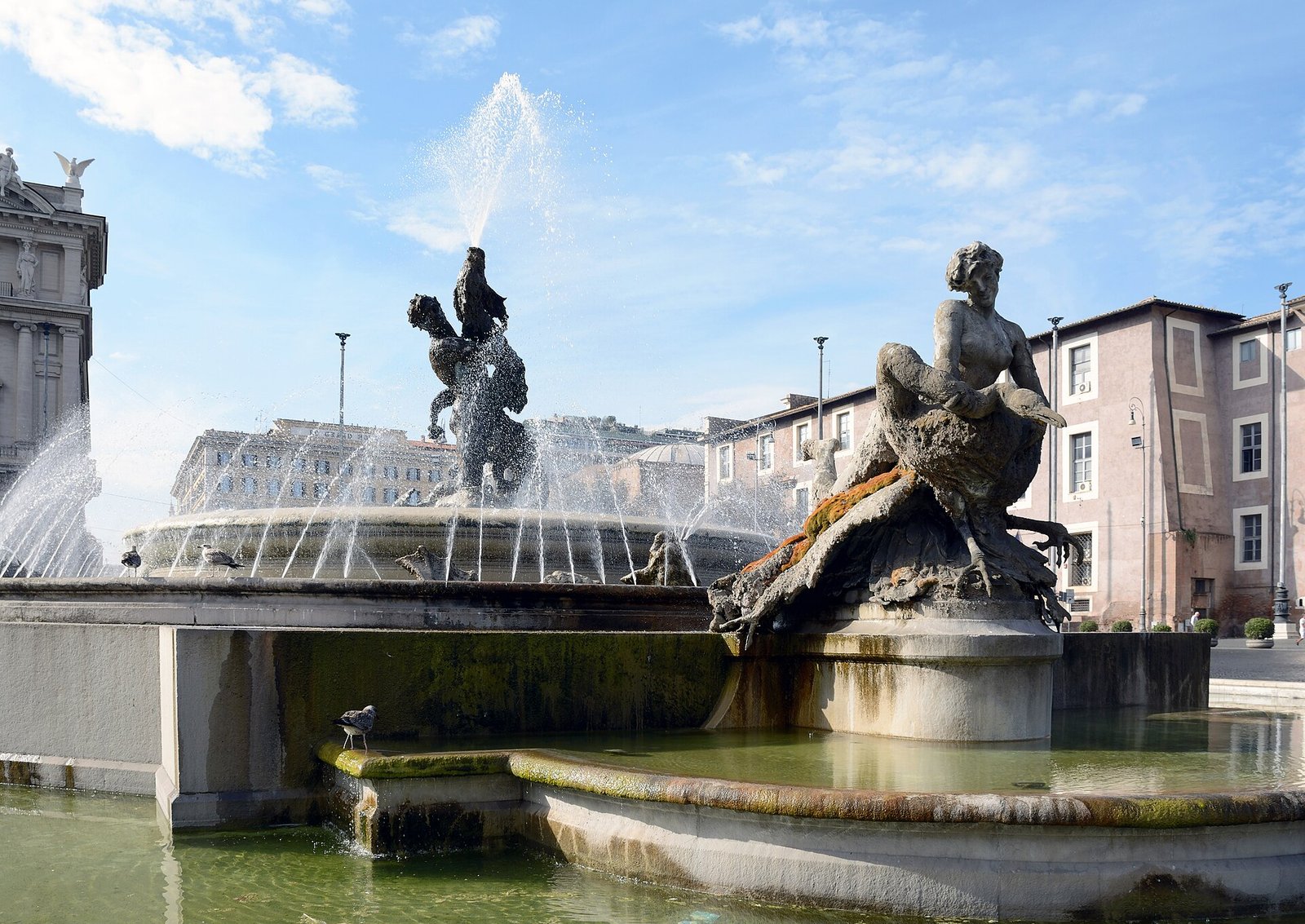
The Fontana delle Naiadi is in the middle of Piazza della Repubblica, in the Castro Pretorio rione, in Rome, and you can see it at any hour without a ticket, without a reservation and without opening hours: it is an outdoor public monument. It is protected by the Sovrintendenza Capitolina ai Beni Culturali di Roma Capitale, which in July 2025 closed a restoration that lasted from September 2024 and was financed with PNRR funds from the Caput Mundi program. Today the water flows again and the bronzes are clean.
It is the terminal mostra of the Acqua Pia Antica Marcia, the aqueduct rebuilt under Pius IX. The pope inaugurated it in provisional form on September 10, 1870, 10 days before the capture of Rome. In the 1880s the architect Alessandro Guerrieri redesigned it in its current position, and from 1897 the sculptor Mario Rutelli worked on the four bronze groups with the naiads, unveiled in 1901. The Glaucus at the center came later, and the definitive form is that of 1914.
Data checked on September 29, 2026 on the website of the Sovrintendenza Capitolina, on the official news of the restoration published by the same Sovrintendenza and on the tourism portal of Roma Capitale. None of the sources gives opening hours, because there are none. None publishes a maintenance calendar either: the fountain can be left without water for work on the systems without public notice, as happened in 2019 and during the latest construction site. Otherwise you look at it from the piazza, on foot, day and night.
At a glance: address, hours, ticket
- Address: Piazza della Repubblica, in the middle of the piazza that Romans still call Piazza Esedra, Castro Pretorio rione, Rome.
- Operator: Sovrintendenza Capitolina ai Beni Culturali di Roma Capitale, with Acea Ato 2 and Areti for the systems in the latest restoration.
- How to get in: there is no entrance, the fountain is viewed from the piazza and the surrounding sidewalks.
- Price: free, no ticket and no reservation.
- Hours: always visible, with artistic lighting renewed in 2025 for the evening.
- How to get there: Metro line A, Repubblica stop, under the piazza, or on foot from Termini station.
- Accessibility: Turismo Roma refers to the Roma accessibile section of its portal, the operator does not publish specific information.
Where it is and what you actually see
The fountain occupies the center of Piazza della Repubblica, the large semicircular piazza between Termini station and Via Nazionale. The popular name Piazza Esedra comes from the curve of the arcaded buildings, which follows the exedra of the Baths of Diocletian. Behind the basin, the brick walls of the baths house the basilica of Santa Maria degli Angeli e dei Martiri. In front, straight toward the west, Via Nazionale begins.
The structure is simple to read. An octagonal base supports three concentric circular basins at different heights, and the basins are of pink granite. On the edge of the largest basin are the four bronze groups by Mario Rutelli, each with a naiad stretched out on an aquatic animal. At the center rises the Glaucus, a nude man clasped to a dolphin, from whose mouth the highest jet starts. The Sovrintendenza lists granite, travertine, bronze and cement conglomerate as the materials.
What you really see depends on where you place yourself. The piazza works like a big roundabout, and the fountain stays in the middle of the traffic that circles it. From the sidewalk under the arcades the bronzes look small and the noise of the cars covers that of the water. The best spot is the mouth of Via Nazionale, from where the fountain presents itself head-on with the basilica behind, as the person who moved it here at the end of the 19th century intended.
The Sovrintendenza Capitolina defines the fountain as the most significant example of the Liberty style in Rome, and the city's tourism portal calls it the first fountain of Roma Capitale. The two labels explain why it does not resemble the Baroque fountains of the center. There are no sculpted rocks, obelisks, popes in the form of coats of arms. There are bodies in motion, almost fantastical animals and a very high vertical jet. It is a fountain of the bourgeois city, built for those who arrived by train.
Those who come down from Termini meet it after a few minutes' walk, and it is often the first monument in Rome they see. For this very reason it gets looked at in passing, from the window of a taxi or while crossing the crosswalk with a suitcase. It is worth a real stop, of at least 10 minutes, walking around it on the sidewalks to see all four groups. Each naiad differs from the others in pose and in animal, and from one side you can understand two at most.
The piazza around it is part of the design. The two arcaded buildings that draw the curve were built in the same years in which the fountain was being moved and redesigned, and their semicircular shape is not a whim: it follows the perimeter of the ancient exedra. Those who look at the fountain are therefore looking at three layers of Rome superimposed, the baths built between the 3rd and 4th centuries, the church carved out of their halls and the Umbertine city. Few places in the capital put them together in such a small space.
Coming out of Metro line A at the Repubblica stop, the fountain is the first thing you see, and it is worth pausing a moment before crossing. From that point you grasp the scale of the whole: the diameter of the basin, the height of the central jet, the distance between the four groups. The exact dimensions are not published by the operator, but the basin takes up a large part of the central space of the piazza, and the bronze groups, which the city's portal calls colossal, read well even from far away.
A curiosity about the Fontana delle Naiadi
The first central group was not the Glaucus. In 1911 Rutelli placed in the middle of the basin a set of three tritons, a dolphin and an octopus, which the Turismo Roma portal describes as renamed by Romans the fritto misto. The nickname spread quickly and the group was not liked. The Sovrintendenza adds that it was made of cement and was judged unsuitable. In 1913 it was dismantled and moved to the gardens of Piazza Vittorio Emanuele II, on the Esquiline.
The fritto misto still exists. It is in the gardens of Piazza Vittorio, the same green area as the Porta Alchemica and the remains of the Trophies of Marius, and many look at it there without knowing where it comes from. The most widespread encyclopedia entry describes it as in a poor state of preservation. Anyone who takes a walk through the neighborhood, following our guide to the Esquiline, can see the two halves of the same story in less than half an hour on foot.
It remains to understand who the Glaucus is. In Greek myth he is a fisherman who, after eating a miraculous herb, throws himself into the sea and becomes a sea god. Rutelli represents him as a muscular man clasping a dolphin, and from the animal's mouth comes the main jet. The subject ties in well with the theme of water arriving in the city, and the male figure at the center acts as a counterweight to the four nymphs reclining on the edge of the basin.
Why is it called the mostra of the Acqua Marcia?
In Rome the mostra is the monumental fountain that marks the arrival of an aqueduct in the city. The Trevi Fountain is the mostra of the Acqua Vergine, the Fontana del Mosè that of the Acqua Felice, the Fontanone del Gianicolo, that is, the Acqua Paola Fountain, that of the aqueduct of Paul V. The Naiads close the series: the Sovrintendenza calls it the last mostra of the Papal State and at the same time the first of Rome as capital.
The aqueduct is called Acqua Pia Antica Marcia because it joins two names. Antica Marcia recalls the Roman aqueduct that brought water into the city from the Aniene valley. Pia comes from Pius IX, who in the 1860s had the new conduit built, between 1865 and 1870 according to the Sovrintendenza. The arches of the ancient aqueducts can still be seen in the Aqueducts Park, along the line from which the water entered the city from the southeast.
The first installation of 1870 was a modest affair. According to the most widespread reconstruction, it was a wide circular basin with an edge made of rocks and a few spurts of water. It served to say that the water had arrived, with a public ceremony and a pope present. The rest, that is, the bronzes, the Liberty style, the perspective on Via Nazionale, came later, and was the work of another Rome, that of the governments of the Kingdom of Italy and of the great Umbertine neighborhoods.
Lined up, the mostre tell of four different eras of the city. The Mosè of the late 16th century, with its triumphal-arch architecture, speaks the language of the Counter-Reformation. The Fontanone of the early 17th century imitates a church facade. Trevi, completed in the 18th century, takes Baroque staging to the maximum. The Naiads give up architecture as a backdrop and put bodies at the center. Visiting them in sequence, all on foot, is one of the best ways to read three centuries of Rome through water.
The water that reaches the fountain today passes through the network managed by Acea Ato 2, the company that runs Rome's water service and that in the 2024-2025 restoration rebuilt the hydraulic systems together with Areti, responsible for the electrical part and the lighting. The Sovrintendenza Capitolina, on the other hand, is responsible for the sculptures and the basins. It is a division of tasks typical of Rome's monumental fountains, where the monument and the system that feeds it follow different administrative paths.
Something nobody tells you about the Fontana delle Naiadi
The fountain was not born where it stands. The Sovrintendenza Capitolina writes that on September 10, 1870 Pius IX inaugurated it provisionally in the Termini area, at the spot where the Obelisk of Dogali stands today. The move to the center of the exedra responded to a precise urban plan: the Turismo Roma portal explains that the new position served to give a monumental perspective to Via Nazionale, the new street that connected the station to the center.
The second detail concerns the date. 10 days after the papal inauguration, on September 20, 1870, Italian troops entered the city through the breach at Porta Pia, which you can reach on foot from here in about 20 minutes. Pius IX's fountain was thus the last water work inaugurated by a pope-king, and immediately became the fountain of the new capital. Few monuments in Rome have an origin so astride two regimes.
The Obelisk of Dogali today stands in the gardens of Viale Luigi Einaudi, along the walking route between Piazza della Repubblica and the station. Those who pass in front of it rarely know that this was the fountain's first site, and that Pius IX's mostra stood in an area then still open, before the Umbertine city redesigned the whole zone. It is worth a one-minute stop, to look at the distance between the two points and understand how much the neighborhood changed in a few decades.
Who are the four naiads and what do they represent?
The naiads are the nymphs of fresh waters in Greek mythology. Rutelli, a sculptor from Palermo who lived between 1859 and 1941, made them four nude female figures, each associated with a type of water. There is the nymph of the lakes, recognizable by the swan. There is the one of the rivers, stretched out on a freshwater animal. There is the one of the oceans, riding a sea horse. And finally the one of the underground waters, on a reptile creature.
On the animals the sources do not agree in the details. The Turismo Roma portal speaks of a sea horse, a water snake, a swan and a lizard. The encyclopedia entries instead describe an aquatic monster for the nymph of the rivers and a dragon for that of the underground waters. The difference depends on how the bronze is read: the creatures are deliberately hybrid, halfway between a real animal and a sea monster, and each description picks a different word.
The Sovrintendenza describes the naiads as lively and joyful figures, who seem to play with animals and monsters under the jets of water. This is the point that matters in front of the bronzes. Compared with the composed nymphs of the Baroque fountains, these twist, laugh, abandon themselves on the backs of the animals. For its time it was a bold choice, and the reactions at the inauguration show it. Look at the hands and feet: they are the details that the 2025 restoration made legible again.
The best way to look at them is to walk around the piazza clockwise, stopping in front of each group. Each naiad has a different direction of gaze and body, and the animal that supports her changes the rhythm of the composition: the swan is calm, the sea horse is in full stride, the two reptile creatures coil in on themselves. The full circuit takes a few minutes and gives back the fountain as Rutelli conceived it, a work to be seen from every side.
My advice for visiting the Fontana delle Naiadi
My advice is to arrive on foot from Via Nazionale, climbing from Largo Magnanapoli or coming down from the Palazzo delle Esposizioni, and to keep the fountain in front of your eyes for the whole last stretch. It is the axis for which it was moved here, and from that direction you understand the design: the straight street, the fountain as a backdrop, the basilica in the baths closing the view. Arriving from Termini, instead, you see it from the side and squeezed by traffic.
Then it is worth choosing the time. By day the direct light makes the bronzes dark and flat, especially at midday in summer. At sunset and after dark the artistic lighting renewed with the 2025 restoration does its work, and the figures take on relief. Keep the traffic in mind: cross only on the crosswalks, don't stop on the roadways to take photographs, and don't sit on the edge of the basin. The urban police regulation of Roma Capitale forbids entering the fountains.
The last piece of advice concerns expectations. In our judgment the fountain works better as a stop on a route than as a destination in itself. On its own it takes a quarter of an hour. Set among the Aula Ottagona, Palazzo Massimo alle Terme and Santa Maria degli Angeli it becomes the key to reading the whole area: the ancient baths, the Renaissance church, the late 19th-century city, all within a few minutes' walk.
One last practical note. On hot days the piazza offers no shade near the basin, and the stone reflects the sun. It is worth alternating the stop at the fountain with a break inside Santa Maria degli Angeli, where a long marble meridian line runs across the floor and the temperature stays cool even in summer. Remember that it is a place of worship: during services you enter in silence and avoid wandering the nave with a camera.
Do you need a ticket or a reservation?
No. The Fontana delle Naiadi is an outdoor monument in a public piazza, with no visiting enclosure, no ticket office and no hours. The Turismo Roma portal says so explicitly: there are no opening hours or fares, because it is a monument in a piazza. No reservations are needed, even for large groups, although with many people it is best to stop under the arcades and not on the traffic islands, for safety and out of respect for passersby.
The official channel for historical information and updates on the work is the fountain's page on the website of the Sovrintendenza Capitolina. The operator does not publish guided tours dedicated to the fountain alone and does not sell tickets. Be wary of anyone offering paid admission or a tour for the Naiads as if it were a closed site: it is a piazza. The nearby museums, on the other hand, have their own ticket offices and hours to check on their respective official websites.
For large groups, the only organizational concern is the meeting point. The piazza is big and noisy, and explaining the fountain to 30 people from a narrow sidewalk under the arcades becomes difficult. It is best to tell the story before arriving, for example on the steps of the basilica or in the gardens of Viale Einaudi, and then leave a few free minutes for photos. The fines for those who climb on the basin apply to everyone, even to those who take a group photo on the edge.
Another well-known fact, yet rarely mentioned
That the naiads caused a scandal is told by almost everyone. The Turismo Roma portal writes that the 1901 inauguration provoked many controversies over the sensuality of the female figures, so much so that the work remained hidden for a long time behind a wooden fence. The most widespread encyclopedia entry instead tells a shorter story: the protests from the conservative circles close to the Vatican, the fence, then a popular uprising and the Comune authorizing its removal after a short time.
The less-cited fact is another, and concerns the chronology. The naiads of 1901 remained for years without a stable central group: the fritto misto arrived in 1911, was removed in 1913, and the Glaucus completed the fountain only in 1914. 13 years of work in pieces, between scandalous bronzes, a mocked group and a replacement. Our opinion is that the story of the scandal is overrated: the offended modesty lasted a short time, while the search for a convincing center took more than a decade.
There is also a lesser-known precedent. Before the bronzes, the Sovrintendenza recalls that in 1888 the fountain was provisionally decorated with four stucco lions, on the occasion of the visit of the German emperor Wilhelm II. They were temporary decorations, meant to make a good impression in front of a state guest. Rutelli received the commission for the definitive sculptures only in 1897, nine years later. In the meantime the fountain remained an architectural basin with its jets and little else.
The right photo to take at the Fontana delle Naiadi
The photo that tells the story of the fountain is taken from the mouth of Via Nazionale, on the sidewalk, with the jet of the Glaucus in the center of the frame and the facade of the basilica in the baths in the background. You need a normal lens, not an extreme wide angle, which would distort the curve of the arcades. The best moment is the blue hour, shortly after sunset, when the sky still has color and the artistic lighting is already on over the bronzes.
The second photo is a detail. Approach from the inner sidewalk of the piazza, where you can get there on the pedestrian crossings, and choose a single naiad with her animal. The nymph of the lakes with the swan is the most legible, the one of the oceans on the horse is the most dynamic. With a light telephoto lens you isolate the figures from the traffic and the signs. Never climb over the edge, never climb onto the basin to get closer: besides being forbidden, the freshly restored bronze needs to be protected.
For those who love long perspectives there is a third possibility. From the top of Via Nazionale, at the height of the Palazzo delle Esposizioni, the central jet is visible at the end of the street like a white dot among the buildings. It is not a postcard photo, but it documents well the urban planning idea of the late 19th century: a new street, straight and wide, ending on a fountain. It is best taken early on a Sunday morning, when the traffic is lighter.
Rainy days offer an opportunity that few take advantage of. The wet asphalt of the piazza reflects the lit fountain, and the shiny bronzes pick up reflections they don't have in dry weather. You need an umbrella and a bit of patience with the traffic, but the result pays off. In winter darkness comes early, and already at five in the afternoon the artificial light is working on the figures. Avoid the flash: on wet bronzes it creates white spots and flattens the relief of the sculptures.
How do you get there from central Rome?
The simplest way is the metro. Line A has a stop under the piazza, called Repubblica, and you come out directly in view of the fountain. The presence of the station right underneath explains one of the fountain's latest technical problems: in 2019 it was shut down because of water leaks that caused seepage into the metro. From Termini, where lines A and B pass and national trains arrive, you walk a few minutes along Viale Luigi Einaudi.
From the historic center the best solution is on foot. From Piazza Venezia you go up Via Nazionale, about 20 minutes on a gentle uphill. From the Trevi area you pass by the Quirinale and the Quattro Fontane, then continue along Via XX Settembre to Largo di Santa Susanna. From Piazza Barberini, where Palazzo Barberini is, the route is even shorter, along Via Barberini and Largo di Santa Susanna.
For buses, Via Nazionale and Piazza dei Cinquecento are among the best-served hubs in the city, but the lines change with roadworks and detours. The up-to-date reference is the Atac website, with route calculation. By car it makes no sense to come: the piazza is crossed by heavy traffic, parking in the area is scarce and the nearby historic center is regulated by limited-traffic gates. Better to move on foot or by public transport.
Those arriving from the Colosseum can cross the Monti rione, climb its sloping streets and come out on Via Nazionale. It is the longest route, a good half hour on foot, but also the most pleasant, with shops, small churches and neighborhood piazzas along the way. From Via Nazionale it is a few hundred meters to the fountain, still on a slight uphill, with the view opening onto the exedra in the last steps.
Some important events that happened here in history
On September 10, 1870 Pius IX inaugurates the provisional mostra of the Acqua Pia Antica Marcia in the Termini area. On September 20 the Italian troops enter Rome. In the 1880s the fountain is moved and redesigned by Alessandro Guerrieri: the Sovrintendenza gives 1885 for the completion of the architectural part, the tourism portal gives 1888 for the move, and the sources do not agree on the exact moment. In 1888 the provisional lions arrive for Wilhelm II.
In 1897 Mario Rutelli receives the commission for the sculptures. In 1901 the fountain is inaugurated with the four groups of naiads, and controversy breaks out over their nudity. In 1911 the group of tritons appears at the center, immediately mocked, and in 1913 it is moved to Piazza Vittorio. Rutelli replaces it with the Glaucus grasping the dolphin. In 1914 the fountain is inaugurated in its definitive form, the one still seen today, without substantial changes.
In the 20th century routine maintenance follows and a complete restoration that the Sovrintendenza dates to 1998. In 2019 the fountain stays off for months because of the leaks that wetted the metro station, and reopens in August. From September 2024 to July 2025 comes the most recent construction site, 240 days of work for more than €580,000, with PNRR Caput Mundi funds and a contribution from the Infrastructure and Public Works Department of Roma Capitale.
The context helps read the dates. Between 1870 and 1914 Rome becomes the capital of the Kingdom of Italy, builds ministries, residential neighborhoods and a new station, opens straight streets like Via Nazionale and Via XX Settembre. The fountain grows together with this city: it is born papal, is moved for urban planning needs, receives modern bronzes and a controversial central group. It is the monument that best tells, in a single piazza, the passage from the Rome of the popes to that of the kings.
Who has passed through the Fontana delle Naiadi
The first name is that of Pius IX, who wanted the aqueduct and inaugurated its mostra a few days before losing temporal power. The second is Alessandro Guerrieri, the architect who designed the basins and base and whom the Sovrintendenza lists together with Rutelli as author of the work. Then there is Wilhelm II, emperor of Germany, for whose 1888 visit the fountain was decorated with the stucco lions. A state guest who never saw the naiads.
Mario Rutelli is the real protagonist. A Palermitan, he worked on the fountain for over 15 years, from the 1897 commission to the final Glaucus. His naiads brought him both fame and controversy. The fritto misto group was a misstep, and the fact that he himself replaced it with a new composition says a lot about the relationship between the sculptor and the city that judged him at every change.
More recently, the fountain has passed through the hands of the restorers coordinated by the Sovrintendenza Capitolina and of the technicians of Acea Ato 2 and Areti, who rebuilt the hydraulic systems and the lighting. And every day thousands of people who get off the trains at Termini pass by, often without stopping. The fountain was designed for them, for those who enter Rome from the station and must understand right away that they are in a capital.
There remains a collective protagonist, often forgotten: the Roman public of 1901. According to the most widespread reconstruction, it was the popular protests against the wooden fence that pushed the Comune to take it down and leave the naiads in view. 10 years later the same public rejected the group of tritons with a nickname, and that time too the work was changed. Few fountains in Rome owe their final form so directly to the judgment of the people who passed in front of them.
What do the documents say and what is the story told?
The documents, that is, the Sovrintendenza's entries and the official news of the restoration, say few certain things: the date of September 10, 1870, Guerrieri's design, the commission to Rutelli in 1897, the inauguration of the bronzes in 1901, the central cement group of 1911 moved in 1913, the Glaucus and the definitive form of 1914. They also give the materials and the list of the 2024-2025 work. On these points the institutional sources coincide, with the exception of the date of the first move.
Tradition adds the nicknames. Piazza Esedra for a piazza that officially is called Piazza della Repubblica. The fritto misto for the group of tritons with the octopus, which the Comune's portal reports as a popular nickname. Tradition also tells of the reactions to the scandal, in tones that change depending on who writes: for some it was a battle of civilization, for others a brief controversy, quickly closed with the removal of the fence.
Then there is the level of legend. About the women who supposedly posed for the naiads, stories of all sorts circulate, with names, family ties and anecdotes about their old age, which no institutional source reports. Better to treat them as piazza gossip, pleasant to hear but without a document behind them. The same goes for overly precise symbolic attributions: the Glaucus as man's dominion over nature is a widespread reading, not a statement by the author.
The date of the last restoration before the recent one is also not certain. The Sovrintendenza Capitolina gives 1998, while the encyclopedia entries speak of a work in 1988. The two figures are too similar to rule out a typo on one side or the other, and the available sources do not allow us to establish which is right. Until a documentary confirmation, the Sovrintendenza's figure remains the reference, because it comes from the body that has custody of the fountain.
A minor detail concerns the name itself. The Sovrintendenza Capitolina writes Najadi, with a j, following an old Italian spelling still found in many documents of the late 19th and early 20th centuries. The city's tourism portal and almost all guides use instead Naiadi, with an i. The two forms indicate the same work, and those looking for archive documents or historical images do well to try both, because the older catalogs often follow the spelling with the j.
What changed with the 2024-2025 restoration?
The construction site started in September 2024 and was closed in July 2025, after 240 days of work. The Sovrintendenza Capitolina directed and supervised the work, while Acea Ato 2 and Areti handled the systems. The cost exceeds €580,000, covered by the PNRR Caput Mundi program with a contribution from the Infrastructure and Public Works Department. The official news of completion is dated July 17, 2025, and with the closing of the construction site the water flowed again in the basins.
The list of work published by the Sovrintendenza is concrete. Cleaning and restoration of the bronze sculptures, that is, the four naiads and the Glaucus. Restoration of the pink granite basins. Disinfestation and treatments against biological organisms. Overhaul and replacement of the stucco work. Application of protective coatings on the surfaces. Rebuilding of the basins' waterproofing, which is the least visible part and the most important, given the problem of leaks toward the metro. Overhaul of the hydraulic systems and new artistic lighting.
For those looking, the difference is noticeable above all on the bronzes. The Sovrintendenza writes that with the cleaning and treatments the sculptural works have become legible again, along with the decorative details. In practice it is worth getting close from the sidewalk and looking for the small parts: the scales, the fins, the tails of the animals, the hair of the naiads. In the evening the new lighting separates the figures from the background. Our judgment is that it is worth going back even for those who remember it as it was before the construction site.
The restoration is part of the Caput Mundi program, the PNRR line devoted to Rome's cultural heritage, which in the same years financed work on many fountains and monuments of the city. For the Fontana delle Naiadi, Roma Capitale's commitment went beyond the European funds, with the additional contribution of the Infrastructure and Public Works Department. The result concerns above all conservation: the waterproofed basins and the renewed systems should reduce the leaks that in the past forced the fountain to be switched off.
When is it switched off and what shouldn't you expect?
The fountain never closes, because it has no entrance. It can, however, be left without water. This happens during maintenance of the systems, as in 2019, and during restorations, as between 2024 and 2025, when it stayed behind scaffolding for months. The operator does not publish a maintenance calendar, so the only way to know is to walk by. If you find the basin empty, the bronzes are still visible from the edge of the piazza.
Don't expect a quiet place. The fountain is in the middle of one of the most intense traffic hubs in Rome, a few minutes from Termini, and there are no benches around the basin. Don't expect to be able to bathe in it either: the urban police regulation of Roma Capitale forbids it in the city's fountains, and the news reports fines and removals with Daspo urbano precisely for bathing in the Naiads. The edge of the basin is not a seat.
Finally, don't expect an ancient fountain. The name of the piazza, the exedra of the baths and the basilica behind make you think of something thousands of years old, and you sometimes hear visitors convinced they are in front of a Roman or Baroque work. It is instead a work from between the 19th and 20th centuries, built with bronze, granite and cement for the capital of the Kingdom of Italy. Read that way, with its correct dates, it becomes much more interesting.
Another thing to know concerns the uses of the piazza. For decades Piazza della Repubblica has been one of the usual starting points of the marches and demonstrations that cross the center, and on days of mobilization the area fills with people, flags and barriers. The fountain remains visible, but the visit becomes noisy and the crossings may be closed. If your goal is photos of the bronzes, check the traffic news the day before you go.
Eating in the area
The area between Piazza della Repubblica and Termini is one of the hardest in Rome for eating well. The density of passing travelers favors places that count on the customer who won't come back: photo menus in four languages, barkers on the sidewalk, items written without a price, a kitchen open from morning to night without a break. Some windows stage handmade pasta in front of passersby, and often it is just scenery. Romans don't sit down here, and not out of snobbery.
The reason is practical. Where the price is not written, the bill adapts to the customer, and where the menu outside is different from the one inside the surprise comes at the end. It is worth moving a few streets away, toward the Monti rione or toward the residential streets behind Via Nazionale, where the places live off regular customers and prices are displayed. To find your way without risk, there is the list of addresses on Google Maps kept by the editorial team.
The same caution applies to a coffee. In the bars around the piazza and toward the station the price at the counter and at the table can be very different, and the price list is not always clearly visible. Ask before sitting down, or do as Romans do, who drink coffee standing at the counter in a few minutes. Those who need a longer break find shade and quiet in the cloisters and gardens of the museums in the area, with an admission ticket.
What to combine in a day
The first pairing is immediate. Behind the fountain, the basilica of Santa Maria degli Angeli occupies the great hall of the baths, turned into a church on a design linked to Michelangelo. A few steps away, the Baths of Diocletian house a branch of the Museo Nazionale Romano, and the Aula Ottagona is another part of the same complex. Overlooking Piazza dei Cinquecento is Palazzo Massimo, with the mosaics and frescoes of the Villa of Livia.
Those who prefer to stay on the theme of water can take a short tour of the nearby mostre and fountains. The Fontana del Mosè is a few minutes away in Largo di Santa Susanna. From there you go down to Piazza Barberini for Bernini's Triton Fountain, and climb to the Quirinale passing by the Quattro Fontane and San Carlo alle Quattro Fontane. It is a one-hour walk, among popes, Baroque and Rome as capital.
An alternative leads east, to the Esquiline. From the fountain you reach Termini, where in the forecourt the blocks of the Servian Walls remain, and then Piazza Vittorio with the fritto misto and the Porta Alchemica. In the area there are also Santa Bibiana and Sant'Eusebio all'Esquilino, and the Esquiline Obelisk on the apse side of Santa Maria Maggiore. For the afternoon, Palazzo Barberini and the Mithraeum of Barberini are a quarter of an hour away.
If you still have time, the Quirinale area is a quarter of an hour on foot. Piazza del Quirinale with the obelisk and the fountain of the Dioscuri closes the theme of monumental fountains, while the Quirinal Palace and the Scuderie del Quirinale have visits and exhibitions by reservation. Those looking for more ideas without spending will find suggestions in our guide to free Rome, where the Fontana delle Naiadi is fully at home.
Frequently asked questions
Do you pay to see the Fontana delle Naiadi?
No. The fountain is in the middle of Piazza della Repubblica, a public space, and can be viewed free at any hour of the day and night. There is no ticket office, there are no hours and no need to book. The tourism portal of Roma Capitale states this clearly. Anyone offering a ticket for the fountain is actually selling a guided visit of the area, not an admission. For updates on the work the reference is the website of the Sovrintendenza Capitolina.
Why is it also called Piazza Esedra fountain?
Because the piazza is built on the exedra of the Baths of Diocletian, that is, on the great curve that closed the baths' enclosure. The arcaded buildings of the late 19th century follow its shape, and for decades the piazza was called Piazza dell'Esedra. The official name of Piazza della Repubblica came later, but Romans keep using the old one. This is why many say the fountain of the Esedra, or simply the Naiads, and mean the same work.
Who made the fountain's sculptures?
The bronze sculptures are by Mario Rutelli, a sculptor from Palermo born in 1859 and died in 1941. He received the commission in 1897, delivered the four groups of naiads for the 1901 inauguration and completed the central group of the Glaucus after the failure of the first group of tritons. The architectural part, that is, the basins and the base, is instead by the architect Alessandro Guerrieri. The Sovrintendenza lists both as authors of the fountain in its present form.
Why did the naiads cause a scandal?
Because of their nudity and their poses, judged too sensual by part of the city at the 1901 inauguration. The city's tourism portal says the work stayed hidden for a long time behind a wooden fence. Other reconstructions speak of a fence removed after a short time, following popular protests and a decision by the Comune. The sources do not agree on the duration, but they agree that the controversy was strong and public.
What is the fritto misto of Piazza Vittorio?
It is the first central group of the fountain, placed in 1911: three tritons, a dolphin and an octopus, made of cement. Romans immediately renamed it the fritto misto, and the negative verdict was such that in 1913 it was removed and moved to the gardens of Piazza Vittorio Emanuele II, on the Esquiline, where it still is today. In its place Rutelli put the Glaucus with the dolphin, inaugurated in the fountain's definitive form in 1914.
Is the fountain always on?
Usually yes, but there is no published calendar of switch-ons or maintenance. In recent years it has been off twice for long periods: in 2019, because of water leaks that caused seepage into the metro station below, and between September 2024 and July 2025, for the restoration financed with PNRR funds. If you find the basin empty, the bronzes are still visible from the edge of the piazza, and in the evening the artistic lighting highlights them anyway.
Can you swim in the Fontana delle Naiadi?
No. The urban police regulation of Roma Capitale forbids bathing in and entering the city's fountains, and the news reports fines and Daspo urbano precisely for people caught in the basin of the Naiads. Besides the ban there is a reason of respect for the monument: the bronzes and basins have just been restored with public funds. On hot days it is better to look for shade under the arcades or inside the basilica of Santa Maria degli Angeli.
Is the fountain lit at night?
Yes. The restoration completed in July 2025 renewed the artistic lighting, which lights up the bronzes after sunset and separates them from the background of the buildings. Evening is the best time to see it, because the traffic drops and the artificial light gives relief to the figures of the naiads and the Glaucus. The operator does not publish switch-on times, but as a rule the lighting stays on during the hours of darkness, as for the city's other monumental fountains.
How much time do you need to see it?
For the fountain alone, 10 or 15 minutes are enough, the time to walk around it on the sidewalks and look at all four groups. It becomes much more, though, if you use it as a starting point. Santa Maria degli Angeli, the Baths of Diocletian, the Aula Ottagona and Palazzo Massimo are all within a few minutes' walk, and with the museums half a day fills up easily without ever taking a vehicle.
Who wrote this and from what sources
The text comes from the editorial team of Tour Leader Pro, the Rome-based outfit that designs itineraries, visits and cultural events across Rome and Lazio. The fares, hours and booking arrangements reported here come from the official sources cited in the text, as of the date given at the start: for the Fontana delle Naiadi the entries of the Sovrintendenza Capitolina, the official news on the 2025 restoration and the tourism portal of Roma Capitale apply. Tell us what you find changed.
Organizing a stop at the Naiads for a group seems easy, because there are no tickets or time slots. The real difficulty is the piazza: heavy traffic, narrow sidewalks under the arcades, crossings to be managed carefully. It is best to set the meeting point away from the roadway and tell the story of the fountain before getting there. For those who plan cultural outings in the city, a useful resource for those who organize group trips is Tour Leader Pro.
The Fontana delle Naiadi is also the urban terminus of an aqueduct that begins far from Rome, in the Aniene valley. Following the water up to the springs leads toward Tivoli, Subiaco and the Monti Simbruini, areas that deserve a multi-day trip with stops outside the capital. Putting together the city and the province takes a bit of planning, and a useful resource for putting together a multi-day itinerary is Italy Planner.