Piazza del Quirinale
In short. Piazza del Quirinale is the most beautiful free panoramic terrace in the center of Rome, and nobody sells it to you as such because you don't pay for a ticket.
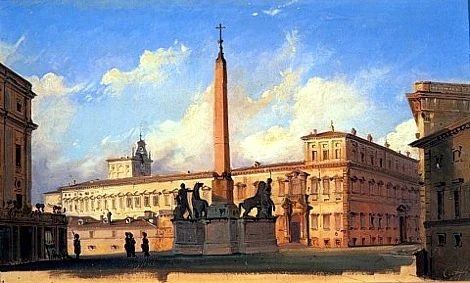
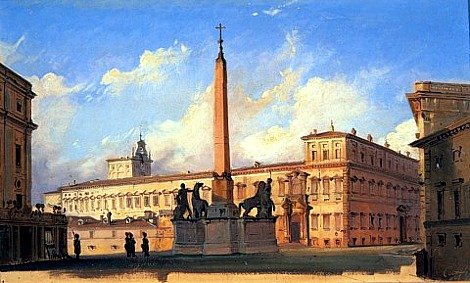
Piazza del Quirinale is the most beautiful free panoramic terrace in the center of Rome, and nobody sells it to you as such because you don't pay for a ticket. You get there on foot, rest your elbows on the balustrade and have half the city in front of you, all the way to the dome of St. Peter's. Overhead, two marble colossi holding two horses by the bridle, an Egyptian obelisk and a granite basin that has held three different jobs in its life. In the middle, every day, the changing of the honor guard.
The square occupies the top of the Quirinal Hill, which Roma Capitale lists as the highest of the seven hills. From here the ground drops toward the Tridente and toward the Forum. That is why the viewpoint works, and why the palace ended up where it did. The popes came here in summer for the air, the kings stayed, and the Republic has lived in it since 1946. The result is a ceremonial square that by day is a military post and by evening goes back to being a public overlook.
Where it is and how to really get there
The address is Piazza del Quirinale, 00187 Roma. It has no street numbers that matter to the visitor, except one: the Infopoint of the Presidency of the Republic is at Salita di Montecavallo 15, and it is only for tickets to the palace visit. The Scuderie have their own entrance at Via XXIV Maggio 16, on the same widening. The Palazzo della Consulta faces the east side and cannot be visited.
The most convenient metro is line A. Barberini and Repubblica are both around 600 meters away, and in both cases the last stretch is uphill. From Barberini you take Via delle Quattro Fontane, pass the intersection of the Quattro Fontane and go down Via del Quirinale. From Repubblica you cut through Via Nazionale and climb to the right. If you have trouble walking, keep in mind that this part of Rome is all slopes and sampietrini.
The useful buses run on Via Nazionale, not on the square. Lines 40, 60, 64, 70, 170 and H pass along that axis, with stops at the Palazzo delle Esposizioni. From there you climb Via della Consulta and in five minutes you are under the Dioscuri. No surface line drops you directly in the square: the street that crosses it is very tightly restricted to traffic and guarded.
From Termini on foot it's a little over a kilometer, almost all on Via Nazionale. If you arrive from the Trevi Fountain, you get the shortest and the most tiring climb: Via della Dataria and then the staircase of Salita di Montecavallo, which comes out exactly at the side of the palace. It's 120 meters of elevation gain compressed into a small space. In summer, at two in the afternoon, it's a questionable choice.
Transport data and addresses checked on September 28, 2026 on the official pages of the Presidency of the Republic and of the Scuderie del Quirinale. Roman surface lines change route with a frequency that has no equal in Europe: before leaving, it's worth rechecking on the transport company's app, especially on weekends and on ceremony days, when the area is closed.
A curiosity about Piazza del Quirinale
The monument in the middle of the square is a collage of three objects that had never been seen together before ending up here. The two marble groups of Castor and Pollux are from the imperial age and come from the Baths of Constantine, which stood a few dozen meters away, under the present Palazzo della Consulta and surroundings. The obelisk comes from the Mausoleum of Augustus, on the other side of the city. The granite basin comes from the Roman Forum.
Three pieces, three origins, three different centuries of reuse. The Dioscuri were already visible in the Middle Ages and gave the place its old name: Monte Cavallo. It wasn't a tour guide's nickname, it was the official place name, the one you find in documents and maps up to the nineteenth century. Salita di Montecavallo, which still carries that name, is the same road Romans took to come and see the horses.
Domenico Fontana, at the end of the sixteenth century, restored the groups and brought them to a central position in the square. They were side by side, almost forming a single block. The arrangement you see today comes two centuries later: in 1782 Pope Pius VI commissioned the architect Giovanni Antinori to take it in hand again, and Antinori separated the block by rotating the two groups so that they stood at a right angle to each other. It is a scenographic choice, not an archaeological one.
That rotation is the reason the fountain works from wherever you arrive. Stand on Via del Quirinale side and you see one horse in three-quarter view and the other almost in profile. Move toward the balustrade and the relationship reverses. Antinori didn't have an audience of archaeologists: he had a papal square to make readable for those crossing it in a carriage. He succeeded.
Why it's called Monte Cavallo
The name Monte Cavallo survives in minor place names and in the mouths of older Romans. It indicated the whole plateau, not just the square, and derived directly from the presence of the two marble horses, which for centuries were the only notable thing in an area otherwise made of vineyards, vegetable gardens and convents. The papal palace came after, not before. The monument christened the district, not the other way around.
Something nobody tells you about Piazza del Quirinale
On the plinths of the two groups you can read attributions to Phidias and to Praxiteles. They are false, and always have been. No serious scholar supports them: they are late or reused inscriptions, and the groups are Roman copies of the imperial age that rework much older Greek models. Whoever tells you that you're looking at a Phidias is telling you a medieval legend that stayed carved in the stone.
The interesting thing is not that the attribution is wrong. It's that it survived. Throughout the Middle Ages and a good part of the Renaissance, those two signatures made Monte Cavallo a place of artistic pilgrimage: people came to see the two most famous Greek sculptors of antiquity pitted against each other on the same subject. A contest that never existed, but that brought generations of draftsmen here.
The second point nobody mentions concerns the basin. That circular bowl of gray granite has nothing to do with the Dioscuri: it is an ancient basin that resurfaced in the area of the Campo Vaccino, that is the Roman Forum reduced to pasture, and it is recorded as found in 1587. It stayed around Rome for over two centuries before finding a placement. It was set up here only in 1818.
The one who put together the final piece was Raffaele Stern, and to him is owed in fact the authorship of the fountain as we see it. An error that circulates a lot needs correcting here: in 1818 Pius VI had been dead for 19 years. Pius VI's campaign with Antinori is the one of 1782 on the groups and of 1786 on the obelisk. The basin and the hydraulic layout belong to the following pontificate. Two distinct projects, more than 30 years apart.
What you can't see from here
From the square you can't see the palace gardens, which occupy four hectares just behind the facade. You can't see the cortile d'onore. You can't see almost anything of the institutional machine inside. The facade is long, low, deliberately sober, and declares nothing. It is a precise architectural choice: the palace of the popes had to impose itself by extension, not by decoration.
You can't even see the interior of the Quirinal Palace without a reservation, and the Palazzo della Consulta can't be visited in any case, since it has housed the Constitutional Court since 1955 and has no ordinary public openings. The building is by Ferdinando Fuga, built from 1732 for Clement XII: look at it from outside, because it's the only thing you can do.
The Dioscuri, the obelisk and the basin: three pieces put back together
The two groups represent Castor and Pollux, the twin sons of Leda, horse tamers and protectors of horsemen. In republican Rome they had a temple in the Roman Forum, of which three columns remain, among the most photographed in the city. Here on the hill they arrived from a baths context: the Baths of Constantine, the last great bath complex built in Rome, of which practically nothing is in view today.
They are colossal figures. Standing under the plinth, the horse's head is several meters above you, and the relationship of scale is the first thing that strikes whoever arrives. They are marble, not bronze, and that makes them vulnerable: the surfaces show the work of the seventeenth- and eighteenth-century restorations, and in several places you can tell the modern integration from the ancient piece. Look at the legs and the tails.
The obelisk in the middle is red Aswan granite. It measures 14.63 meters of shaft, which become 28.94 meters counting the base. It is smooth, without hieroglyphs: it was cut in Egypt and brought to Rome in the imperial age, probably under Domitian, to adorn, together with its twin, the entrance of the Mausoleum of Augustus. Two identical spires on either side of the door of the dynastic tomb.
The two obelisks are recorded as found in 1527 and stayed on the ground for over two and a half centuries. One ended up here in 1786, by the will of Pius VI and under the direction of Antinori, recovered at the base of the sixteenth-century Hospital of San Rocco at Ripetta. The other is the Esquiline Obelisk, which today stands behind Santa Maria Maggiore. The twins were separated and have never seen each other again.
If you want the entry on the monolith alone, you'll find it on the page for the Quirinal Obelisk. Here it's worth looking at how the shaft fits between the two groups: Antinori planted it in line with the facade of the palace, and the result is that from the balustrade the tip of the spire cuts the sky exactly between the two horses. It's not by chance.
The basin closes the composition at the bottom. It's a monolithic bowl of granite, circular, wide and shallow, of the type that served as a basin in ancient baths. It comes from the area of the Campo Vaccino, that is from the area of the Forum where cows grazed before the nineteenth-century excavations. The same area that gave back the Rostra of the Roman Forum and a quantity of material reused elsewhere.
Why the fountain throws so little water
Whoever expects a powerful jet is disappointed. The Quirinale fountain has a restrained flow, and the reason is hydraulic before it is aesthetic: here we are at the highest point, and the water arrives with little residual pressure. The spectacular fountains of Rome are almost all down low, where the water column still has drop left to spend. Compare with the Triton Fountain, 100 meters farther down.
The network that serves this part of the city is the historic one, fed by the Aqua Virgo aqueduct for the low areas and by later supplies for the high ones. Don't go into the technical detail: it's enough to know that elevation rules, and that on Monte Cavallo the jet has always been modest. Whoever was looking for hydraulic splendor went elsewhere.
My advice for visiting Piazza del Quirinale
Come twice, at two different times, and not on the same day. The first time in the afternoon, for the changing of the guard and to understand the square with full light on the marbles. The second 40 minutes after sunset, when the balustrade empties, the city lights come on beneath you and the dome of St. Peter's becomes a dark silhouette against the still-blue sky.
90 percent of groups arrive here at the wrong time: noon, sun straight overhead, no shade, balustrade full of people photographing against the light. The square is completely uncovered. There are no trees, no benches, and in summer the paving gives back heat until evening. Bring water, because there are no drinking fountains in the square.
The short loop I recommend takes an hour and a half and costs nothing. You go into Sant’Andrea al Quirinale, Bernini's oval church 100 meters away, then continue to Borromini's San Carlo alle Quattro Fontane, come back and finish at the balustrade. Two geniuses of the Baroque 300 meters apart, both free.
If you have more time, add San Silvestro al Quirinale, which opens little and badly but keeps paintings of great quality, and the Scuderie del Quirinale, if there is an exhibition at that moment that interests you. The Scuderie have wide hours, from 10:00 to 20:00 with last entry at 19:00, and a final glass ramp with a view over the rooftops that is worth the ticket by itself.
When to avoid the square
Avoid ceremony days if your aim is to look around calmly. On institutional occasions the square is fenced off, the balustrade closed, and you go through checks to get in. June 2 is the extreme case: the Festa della Repubblica turns the whole sector between here, Piazza Venezia and the Altar of the Fatherland into a controlled-traffic zone for the entire day.
Avoid pounding rain too, and not for the obvious annoyance. The sloping paving becomes seriously slippery, and the descent of Salita di Montecavallo toward Trevi in smooth soles is a real risk. On those steps bad falls are not rare. If it rains, go down by Via della Consulta and Via Nazionale, which are less steep and have decent sidewalks.
The changing of the guard: which one, when, and how long it lasts
There are two different ceremonies and they are constantly confused. The ordinary one takes place every day and is short, dry, military: a few men, no music, just the time to replace the honor guard in front of the main door. The solemn one is held on holidays, lasts much longer, fields a large unit and includes a military band concert at the end.
The reference times come from an official communiqué of the Presidency of the Republic of September 28, 2000, which set the changing on weekdays at 15:15 and on holidays at 16:00, moving the previous time two hours earlier. That arrangement has remained. In the warm months the holiday time moves later: recent communiqués give 18:00 in the summer period.
Two examples you can check on the Presidency's website. On Sunday, September 14, 2025 the changing was held at 18:00, with a concert by the Banda Musicale della Marina Militare. On Sunday, March 1, 2026 it was held at 16:00, again with the Marina Militare in tow. The practical rule is this: from October to May 16:00, from June to September 18:00. Check anyway.
You check on quirinale.it, where every solemn ceremony is announced with a dedicated communiqué a few days before, with date, time and musical program. There is no annual calendar published once and for all, and this is the reason online guides keep getting it wrong. If you can't find the communiqué for the Sunday you're interested in, don't take the time for granted.
The changing can be suspended or modified. It happens for bad weather, for the President's institutional commitments, for national mourning and during some phases of the year when the palace reduces public activity. The suspension is not always announced clearly in advance: it happens that you arrive and find only the fixed guard. Don't build your day around this ceremony.
The Corazzieri, who they are
The Reggimento Corazzieri is a unit of the Arma dei Carabinieri and provides the honor guard to the President of the Republic. The requirement everyone knows is the minimum height of 190 centimeters, but it is not the only one: the selection is strict on equestrian training and ceremonial service. The modern origin of the corps goes back to February 7, 1868, when 80 mounted carabinieri were chosen from the legions of Florence, Milan and Bologna.
That first formation was born to escort Prince Umberto to his wedding with Margherita of Savoy. After 1946 the unit changed its name several times: President Luigi Einaudi had the traditional uniforms of 1876 restored, and the current name of Reggimento Corazzieri dates to December 24, 1992. The cuirass and helmet you see in the square are therefore a nineteenth-century restoration wanted in the republican era.
On major occasions the unit also fields the horses and the Fanfara del 4 Reggimento Carabinieri a cavallo is added. It happened on June 1, 2026 at 15:30 for the eightieth anniversary of the Republic: parade and review in the square, with 10 pieces on the program and the national anthem performed twice. That mounted version is rare and should be looked for in the communiqués, not awaited at random.
Where to stand to see something
The best side is the one toward the balustrade, facing the main door of the palace, not pressed against the side barriers. Arrive 20 minutes early if you want the front row, 40 if you go on a spring Sunday. The solemn ceremony lasts around half an hour counting the final concert, the weekday one is over in a few minutes and most of those present don't even notice it.
How to book the visit to the Palazzo del Quirinale
Booking is mandatory and is done through three official channels, all run by the Presidency of the Republic. Online through the ticketing system visite.quirinale.it. By phone at 06 42012191, active Monday to Sunday from 9:00 to 17:00. In person at the Infopoint at Salita di Montecavallo 15, open Tuesday, Wednesday, Friday, Saturday and Sunday from 9:00 to 17:00.
The cost is the good news. The route is free, and you pay only the mandatory booking fee of €2.50 per person. For a palace of that quality it's a figure with no equal in the city. Online and at the call center you pay by credit card, at the Infopoint debit cards and cash are also accepted. Always consult the official page before you set out: the booking page on the Presidency's website.
The palace opens to the public Tuesday, Wednesday, Friday, Saturday and Sunday from 9:30 to 16:00, with last entry at 14:30. Monday and Thursday it is closed. There is also a long summer closure: from July 26 to September 11 the palace receives no visitors. Anyone arriving in Rome in August and counting on this visit is headed for a sure disappointment.
The ticket rules are strict and worth knowing beforehand. The ticket is named and tied to a precise date and time. The booking cannot be changed and the ticket is not refundable. You must show up 15 minutes before the start of the visit with a valid ID. Children under 12 must be accompanied by an adult.
How far ahead to book. No fixed opening window for sales to individual visitors appears to be published, and availability is loaded progressively. Weekend slots disappear weeks ahead in the high-season months, while a Tuesday in February can be found even a few days out. Practical rule: book as soon as you have your dates, as soon as you've decided.
The three routes
There are three routes available and they all last about an hour and 20 minutes. The first is the artistic and institutional one: Cortile d’Onore, ground floor, Piano Nobile and Imperial Apartments. It's the classic track, the one that shows the state rooms and the succession of papal spaces that became royal and then presidential. If you come only once, choose this one.
The second is thematic and is titled Vasella, Giardini e Carrozze. It takes you to the historic tableware, the gardens and the court carriages. It's the route that interests most those who have already seen the rooms and those with a curiosity about the material machinery of a state palace. It's also the only ordinary way to set foot in the gardens outside of June 2.
The third is called Quirinale Contemporaneo and is dedicated to the collection of works of art and contemporary design objects placed in the palace. It's a recent project and works well with those who have an interest in the Italian twentieth century. With groups it is not well suited, because it requires an already motivated audience, but whoever chooses it knowingly comes out happy.
Schools and groups
For school visits the procedure is different and goes through applications to be sent according to the calendar published by the Presidency: for the 2026 and 2027 school year applications can be sent starting July 1. Teachers who move in September almost always find the best dates already assigned. The conditions for organized groups should be checked directly on the official channel, not through intermediaries.
The Quirinale Gardens
The gardens occupy four hectares behind the palace, of which about 11,000 square meters are lawns. They have almost 500 years of history, which makes them older than those of Versailles. They count about three and a half kilometers of hedges, 34 fountains and trees of notable age, including a plane tree that is around 400 years old. From the square you can't guess any of it.
The special opening to the public is June 2 of every year, the day of the Festa della Repubblica, and it draws up to 20,000 visitors. The line is long, the route is limited by numbers and the heat is already starting to be felt. Whoever cares should show up early and count on a real wait. Outside that date, ordinary access goes through the thematic route Vasella, Giardini e Carrozze.
Don't expect a public park. The Quirinale gardens are a ceremonial space inside a presidential area, with mandatory paths and staff who check. Whoever wants green space to walk in without restrictions in Rome has better, free alternatives, from the Orange Garden on the Aventine to the Pincio, which moreover offers a first-rate viewpoint.
Another well-known fact, yet rarely cited
Everyone knows the Quirinale was the residence of the popes, then of the kings, then of the presidents. Almost nobody dwells on the fact that this handover left precise physical traces in the rooms, and that the palace is one of the few seats in the world where three different regimes have lived within the same walls without demolishing them. The rooms keep overlapping layers instead of erasures.
The hill was chosen in the sixteenth century for a banal reason that has never been contradicted: the air. The Vatican and the Lateran were low, damp, malarial in summer. Here you could breathe. The papal summer retreat became a permanent residence, the residence became a government palace, and the government palace progressively absorbed vineyards, convents and houses of the surroundings until reaching its present extent, which is enormous.
The tower that rises over the cortile d'onore, with the double-loggia facade, is known as the Torre dei Venti or torrino. The sources attribute to it a bell tower added at a later time, with hypotheses that bring in Carlo Maderno and Francesco Borromini: disputed attributions, not established. From the square you barely glimpse it, and most visitors don't notice it.
The conclave was held here several times, because the palace was a papal residence in every respect. When Italy took Rome in 1870, the Quirinale passed to the Savoys: a handover that the papacy contested for a long time. The palace became a royal palace until 1946, and since then it has been the seat of the Presidency of the Republic. The main door is the same, the walls are the same.
The square as a political space
Piazza del Quirinale has never been a neighborhood square. It was the open space in front of the residence of power, and it continues to be. This explains the absence of outdoor seating, of kiosks, of commercial businesses directly facing it. It also explains why maintenance is better than elsewhere in the center and why security is visible. It's a public square that works as an institutional antechamber.
The difference is clear when you compare it with Piazza Colonna and with nearby Piazza della Repubblica: the first is squeezed between government buildings and traffic, the second is a nineteenth-century hemicycle crossed by everything. Here instead the space is wide, open on one side and closed on the other three, with no significant vehicle crossing. That's why it feels different.
The right photo to take at Piazza del Quirinale
The photo that works is not the one of the fountain. It's the one from the balustrade toward the west, with the city below and the dome of St. Peter's on the line of the horizon, taken when the sun has already gone down and the sky still has color. You need a modest telephoto, around 70 millimeters equivalent, to compress the plane and give the dome weight. With a wide angle the dome becomes a dot.
The second shot I recommend is from below, at the foot of one of the two groups, with the horse cutting the frame diagonally and the obelisk rising behind. Get on your knees and use a 24 millimeter. The distortion of the verticals helps here, because it gives back the real scale of those marbles, which is completely lost when seen from afar.
The third is the changing of the guard, and here I spare you an illusion: nothing good comes out from the second row. If you want the ceremony in a photograph you have to arrive well in advance, take a position on the right side looking at the main door and stay still. Whoever moves during the lining up loses the spot and doesn't get it back. With a cell phone, forget the result.
The best light on the marbles is that of late afternoon, when the raking sun brings out the modeling of the manes and the musculature. At noon the marble goes pure white and all the details disappear. Whoever photographs the palace facade finds it in shade for much of the day: it is oriented so that it gets real sun only at certain hours.
What to avoid in photography
Avoid photographing the soldiers on duty from close range and insistently. Filming the square is not forbidden in absolute terms, but the staff may step in, and near entrances and checkpoints the attitude is understandably rigid. Keep your distance, don't use bulky tripods on the service paths and don't climb on the plinths: that is a violation that costs you dearly.
Some important events that took place here in history
The first block of events concerns the conclaves. With the stable papal residence on the hill, the election of the pontiff took place several times inside this palace instead of in the Vatican. It means that for long periods the decision-making center of the Church was here, not on the other bank of the Tiber. The square in front knew the waiting, the announcements and the crowds that today we associate only with St. Peter's Square.
The second block is 1870. With the taking of Rome and the transfer of the capital, the palace passed to the royal house and became a royal palace. The papacy refused for decades to recognize that handover. The Quirinale became the material symbol of the Roman question, and the square in front was the stage of the monarchist demonstrations and the protests that accompanied the process.
The third block is 1946. With the institutional referendum and the birth of the Republic, the palace changed purpose once again, without a day of gap. Since then the square has been the place where the ceremonies tied to the presidency take place: oaths, greetings to foreign heads of state, changings of the guard in solemn form for national anniversaries.
Among the anniversaries that have particular weight here are the Festa della Repubblica on June 2, the anniversary of the proclamation of the unity of Italy in March and the Festa del Tricolore in January. For all these dates the Presidency publishes specific communiqués with times and program. On June 1, 2026 the changing was held in solemn form for the eightieth anniversary of the Republic, with the Corazzieri on horseback.
An event of a different nature concerns the urban layout. Between 1782 and 1786 the square changed face with Antinori's works commissioned by Pius VI, and in 1818 with Stern's completion. In 36 years the central monument went from a sixteenth-century block to a modern scenographic composition. Few Roman squares have such a precise formal date of birth for their present layout.
The square in iconography
Monte Cavallo is one of the most drawn subjects of the Rome of travelers. The eighteenth- and nineteenth-century views show the square before and after the rotation of the groups, and let you follow the building site step by step. Whoever studies those prints discovers that the present balustrade and the layout of the viewpoint are late interventions: for centuries the edge of the hill was much less defined.
Who has passed through Piazza del Quirinale
The architects, first of all. Domenico Fontana for the first arrangement of the groups. Ferdinando Fuga for the Palazzo della Consulta starting in 1732. Giovanni Antinori for the rotation of the Dioscuri in 1782 and for the raising of the obelisk in 1786. Raffaele Stern for the basin and the final layout in 1818. Four names, four building sites, a single monument that adds them up.
The popes. The hill was a pontifical residence for almost three centuries, and each pontiff left something: rooms, chapels, garden arrangements. Pius VI is the one who changed the square most visibly. Clement XII is the one who wanted the Consulta. These are documented and verifiable steps, not anecdote: you find them in the official sources and in the historical bibliography.
The kings. From 1870 to 1946 the palace was the royal palace of the Savoys, with everything that implies in terms of court, ceremonial and daily life. It is the period that left the carriages visible on the thematic route and a good part of the ceremonial furnishings. Its material legacy is more substantial than public memory acknowledges.
The presidents of the Republic, from Enrico De Nicola onward. Luigi Einaudi is the one who left a mark on the visible image of the square, because he had the historic uniforms of the Corazzieri dating to 1876 restored. When you photograph a corazziere you are photographing a decision made in the republican era on a nineteenth-century model. It is a chain of choices, not a random leftover.
And then the artists passing through. Those who came to Rome for the Grand Tour climbed to Monte Cavallo because the two false signatures of Phidias and Praxiteles morally obliged them to. Draftsmen, engravers, painters: the square appears in hundreds of views kept in European museums. An audience that today concentrates on Piazza di Spagna and on Trinità dei Monti.
What I disagree with everyone on
The unpopular position is this: the solemn Sunday changing of the guard is overrated, and the weekday one at 15:15 is more interesting. The solemn version draws crowds, barriers, raised phones and a liturgy that is hard to follow from the ground. The weekday version is essential, brief and visible.
Whoever arrives in Rome for three days and organizes Sunday afternoon around the solemn ceremony loses three hours between waiting, positioning and dispersal, to take home 20 minutes of military band and a shaky video. Whoever passes by here on a Tuesday at three in the afternoon sees the same replacement of the guard, at close range, with nobody in front, and is free in 10 minutes.
The second unpopular position concerns sunset. Everyone recommends the balustrade at sunset, and everyone is off by 20 minutes. At the moment of sunset you look straight into the sun, the dome disappears in the backlight and the photographs are burned out. The good moment is 30 to 50 minutes later: the city lights up, the sky still holds the blue, and the profile of St. Peter's becomes readable again.
Third, and this one upsets colleagues. If you have few hours and must choose between visiting the interior of the palace and taking a calm turn around the square with Sant’Andrea, San Carlo and the balustrade, choose the second. The interior is remarkable and costs €2.50, but it is a rigid guided route of an hour and 20 minutes. Outside you have three masterpieces and a viewpoint, with no schedule.
Eating in the area
The zone between the Quirinale, Via Nazionale and Trevi is one of the most treacherous stretches of the center for anyone who wants to eat decently. The flow of visitors is continuous and almost nobody comes back twice: it is the economic condition that produces indifferent cooking at high prices. You need criteria, not luck. Here are the signs that work everywhere in Rome.
First sign: photographs of the dishes on the displayed menu. An illustrated menu serves those who don't read Italian and those who will never return. No kitchen that cares about its reputation photographs a carbonara and hangs it outside. Second sign: the woman rolling fresh pasta in the window or directly on the sidewalk. It's a scenic lure, set up to be filmed, and says absolutely nothing about what comes out of the kitchen.
Third sign: the person at the entrance who invites you to sit down, shows you the menu, tells you there is room. A place with customers doesn't need to recruit them on the street. Fourth sign: uninterrupted opening from morning to late at night with no kitchen break. A real kitchen stops between services, because it has to clean, tidy up and prepare. Whoever never stops works with reheated food.
Fifth sign, the most expensive: seats placed in front of famous monuments that adapt the price to the customer. You recognize them by the unpriced items on the menu, the vague cover charge, the different price list between the indoor room and the outside tables. Around the Trevi Fountain this mechanism is systematic. Always ask the price of what isn't written, before ordering it.
The chains with a repeated sign that you meet on Via Nazionale and along the way toward Via del Corso deserve an honest word. They work as tourist attractions: studied windows, standardized product, quick service, photographed queues. They are not scams and they won't hurt you. Simply, Romans don't go there, and if you have few dinners in Rome, those are not the dinners to spend there.
The single criterion you're left with, if you have nothing else, is to look at who is sitting and in what language they order. Go in, stop for three seconds on the threshold and listen. If Italian with a Roman accent is spoken at the tables and there are people eating alone with the dish of the day, you are in the right place. If you hear six languages and nobody has the same dish in front of them, leave.
The best area to eat within walking distance from here is not the square or Via Nazionale, but the Monti district, which begins just below, beyond Via Nazionale. 10 minutes downhill and everything changes: narrow streets, local clientele, more honest prices. The climb back at the end of dinner is tiring, but it's an acceptable price. The direction of Sant’Agata dei Goti also gives better results than the monumental center.
To orient yourself without relying on automatic rankings, Daniele keeps an updated personal list of Roman addresses tried in person: the list on Google Maps. It is not exhaustive and doesn't claim to be. It serves as a safety net when you find yourself in an area you don't know and you're hungry between seven and eight in the evening.
Coffee, and how not to get fleeced
On coffee there is only one rule and it has no exceptions: ask the price at the counter before sitting down. Table service in the monumental areas can multiply the cost by five, and in many cases it's perfectly legal because the price list is posted somewhere. An espresso at the counter in Rome remains a modest expense. The same espresso sitting in front of a monument does not.
What's around, within 10 minutes on foot
Going down toward Trevi you reach the fountain and the system of alleys around it in five minutes. In the same direction, a little farther, you meet San Marcello al Corso and the Galleria Colonna, which opens on very limited days and is one of the most sumptuous halls in Rome when you catch it open. Check the hours, because they are restrictive.
Toward the south the hill descends onto the Forums. In a quarter of an hour you reach the Trajan’s Markets and Trajan’s Column, and from there you are already at the Capitoline Hill. It's the right route to link the Quirinale to ancient Rome without transport: all downhill, all walkable, with the advantage of crossing three eras without getting on a bus.
Toward the east, beyond the Quattro Fontane, you enter the territory of Palazzo Barberini and of the Mithraeum of Barberini, the latter accessible only by reservation and with rare visits. Continuing, you come out on Via Veneto. The opposite direction leads to the Baths of Diocletian and the Basilica of Santa Maria degli Angeli, with Santa Maria Maggiore a little farther on.
Whoever wants to close the day with another overlook has two serious options. The Janiculum, which looks at the city from the opposite side and requires a transfer, and the Pincio obelisk with the terrace above Piazza del Popolo, reachable on foot in about 20 minutes passing through Piazza di Spagna.
On the institutional front, whoever is interested in the palaces of power can complete the tour with Montecitorio, its obelisk and Palazzo Madama, seat of the Senate. All three have public openings with their own rules and separate calendars, which must be checked on their respective official websites. The Pantheon and the Ara Pacis remain within a stroll's radius.
Frequently asked questions
Can you go up to Piazza del Quirinale for free?
Piazza del Quirinale is an open public space and you pay nothing to access it, nor to lean over the balustrade, nor to look at the fountain of the Dioscuri, nor to watch the changing of the guard. You pay only to enter the palace, and even then the route is free with a mandatory booking fee of €2.50.
What time is the changing of the guard at the Quirinale?
The ordinary changing takes place on weekdays at 15:15 according to the arrangement set by an official communiqué of the Presidency of the Republic. On holidays the solemn ceremony is held at 16:00 in the cold period and at 18:00 in the summer period, as documented by the communiqués of March 1, 2026 and September 14, 2025. Check quirinale.it before going.
Can the changing of the guard be suspended?
Yes, the ceremony can be suspended or moved for bad weather, institutional commitments, national mourning or security reasons. There is no fixed annual calendar published once and for all: the Presidency of the Republic issues a dedicated communiqué for each solemn ceremony, usually a few days before. Whoever organizes a day around this appointment risks finding it empty.
How do you book the visit to the Palazzo del Quirinale and how much does it cost?
Booking is done online on the visite.quirinale.it system, or at the call center 06 42012191 every day from 9:00 to 17:00, or in person at the Infopoint at Salita di Montecavallo 15, open Tuesday, Wednesday, Friday, Saturday and Sunday from 9:00 to 17:00. The route is free, with a mandatory booking fee of €2.50 per person.
What are the opening days and hours of the palace?
The palace opens Tuesday, Wednesday, Friday, Saturday and Sunday from 9:30 to 16:00, with last entry at 14:30. Monday and Thursday it is closed. A prolonged summer closure is planned from July 26 to September 11, during which no visits are held. The data are those published on the Presidency's official pages as of September 28, 2026.
Can you visit the Quirinale Gardens?
The gardens open to the public on June 2 of every year, on the occasion of the Festa della Repubblica, with attendance reaching 20,000 people and long lines. Outside that date, ordinary access goes through the thematic route Vasella, Giardini e Carrozze, which can be booked through the same channels as the palace visit. It is not a public park and you can't walk in freely.
Can the ticket be changed or refunded?
No. The ticket is named and tied to a precise date and time, the booking cannot be changed and the ticket is not refundable. You must show up 15 minutes before the start of the visit with a valid ID, and children under 12 must be accompanied by an adult. These are conditions published by the Presidency.
Where do the Dioscuri, the obelisk and the basin come from?
The two groups of Castor and Pollux are from the imperial age and come from the nearby Baths of Constantine. The obelisk, in red Aswan granite, adorned the entrance of the Mausoleum of Augustus together with its Esquiline twin and was erected here in 1786 by the will of Pius VI under the direction of Giovanni Antinori. The granite basin comes from the area of the Campo Vaccino, that is from the Roman Forum.
Is the fountain the work of Pius VI or of Raffaele Stern?
Of both, in two different moments that are often confused. Pius VI commissioned Antinori in 1782 to rotate the two groups at a right angle and in 1786 to raise the obelisk. The basin was placed only in 1818, under a later pontificate, and to Raffaele Stern is owed in fact the authorship of the fountain in its present form. Attributing everything to Pius VI is a widespread error.
Who wrote this page
The page is edited by the staff of Tour Leader Pro, a Rome-based organization that designs and coordinates visits, itineraries and cultural events in Rome and Lazio. The hours, fares, booking channels and access conditions listed here come from the official sources cited in the text as of the date indicated. Recheck them before leaving, because they change often and without notice. If you find an expired piece of information, let us know.
Whoever has to build a Roman itinerary holding together military ceremonies that can be canceled, institutional palaces with their own calendars, named non-refundable tickets and elevation changes that you don't see on paper, for themselves or for a group, finds planning tools and operational materials at Tour Leader Pro, designed both for those who guide and for those who organize on their own.
For the overall picture on rail connections, rentals, airports and destinations in Lazio beyond the center of Rome, from the Castelli to the lakes to the coast, a useful resource is Italy Planner, which reasons about real transfers and times instead of lists of things to see.