Pincio Obelisk
In short. The Pincio Obelisk rises in the middle of Viale dell'Obelisco, in the stretch of gardens that runs above Piazza del Popolo and links the panoramic terrace of the Pincio to the great park of Villa Borghese.
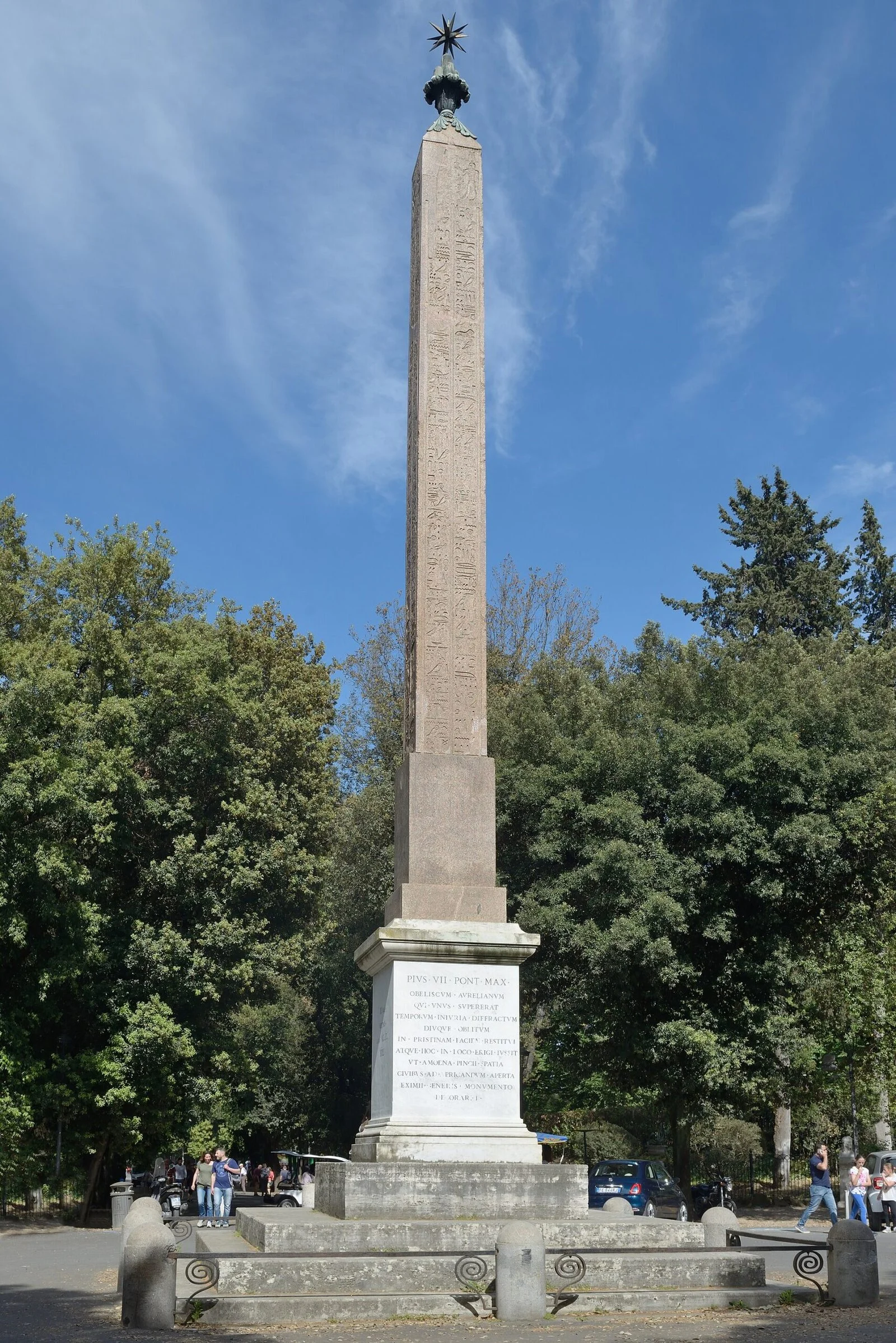
The Pincio Obelisk rises in the middle of Viale dell'Obelisco, in the stretch of gardens that runs above Piazza del Popolo and links the panoramic terrace of the Pincio to the great park of Villa Borghese. It is a pink granite monolith a little over nine meters tall, which with the modern base and the bronze star on top exceeds 17, and it goes almost unnoticed by people walking toward the viewpoint with the sunset on their mind. Yet it is one of the most extraordinary objects in the city: it is not a pharaonic obelisk carried off from Egypt as loot, but an obelisk of the Roman era, cut by order of the emperor Hadrian after AD 130 in memory of Antinous, the Bithynian youth who had been his favorite and who drowned in the Nile. The hieroglyphs covering its four faces are not an exotic ornament: they are a text, and they tell at length the boy's death, his deification, the founding of the city of Antinoopolis on the spot of the drowning and the establishment of his cult. That is why scholars consider it a first-hand historical document on that episode, the only surviving contemporary testimony of the funerary honors granted to Antinous. The lines that follow tell what that text really says, what it doesn't say, where the obelisk is debated to have originally stood, and how this block of granite got all the way up here by way of an imperial circus, a vineyard outside Porta Maggiore, the courtyard of a Baroque palace and a Vatican garden.
Where the Pincio Obelisk is and how to get there
The obelisk stands on the Pincio hill, at the center of the tree-lined clearing from which Viale dell'Obelisco takes its name, in the green area between the panoramic terrace overlooking Piazza del Popolo and the western edge of Villa Borghese. There is no ticket, no gate to go through and no dedicated opening hours: the monument occupies an open public area, along an avenue used every day by people walking, running or cycling. Its position, a few minutes on foot from the terrace, is the reason so many visitors walk past it without noticing: the view over the city grabs the attention, and the pink granite among the trees fades into the background.
On foot from Piazza del Popolo
The most scenic climb starts from the eastern side of Piazza del Popolo, where Giuseppe Valadier designed in the first decades of the 19th century a system of curving ramps and terraces that leads from the level of the square to that of the hill without steep steps. From the square to the viewpoint it takes five or six minutes of walking at a moderate incline, and from the viewpoint to the obelisk another three or four minutes along the tree-lined avenue. It's a route that also works well for those with strollers or light luggage, because the difference in height is spread over long ramps and not staircases.
On foot from Piazza di Spagna and Trinità dei Monti
Those coming from Piazza di Spagna climb the staircase to the church of Trinità dei Monti and continue along Viale della Trinità dei Monti, skirting the wall of Villa Medici until they enter the Pincio promenade. It's the route preferred by those who want to see two different obelisks in sequence, the Sallustian one in front of Trinità dei Monti and the one of Antinous a little farther on.
By public transportation
The most convenient metro stop is Flaminio, on Line A, which comes out a few steps from Porta del Popolo: from there you cross the square and take the climb to the Pincio. An alternative is the Spagna stop, also on Line A, which serves Piazza di Spagna area and allows the climb from Trinità dei Monti. Several surface bus lines run along the Lungotevere and Viale del Muro Torto, skirting the perimeter of the hill, while the tram lines serving Piazzale Flaminio make it possible to arrive from the Flaminio district and the northern part of the city. For those with reduced mobility, the climb from Piazzale Flaminio toward Viale delle Magnolie, inside Villa Borghese, is the route with the most regular slope. The interior avenues of the park are closed to private traffic, so driving up to the monument is not possible, and parking on the streets around Piazza del Popolo is almost everywhere paid and regulated by limited traffic zones.
Finding your way on the avenue: how not to pick the wrong obelisk
In Rome there are 13 ancient obelisks, and within a few minutes' walk of the Pincio you meet three different ones, which generates constant confusion. Below, in the middle of Piazza del Popolo, stands the Flaminian Obelisk, a pharaonic monolith brought to Rome by Augustus. A little farther south, in front of the facade of Trinità dei Monti, stands the Sallustian obelisk, also of Roman make. The Pincio Obelisk is the third: it stands amid greenery, not on a paved square, and it is recognizable because the base is clearly 19th-century and the tip carries a bronze star. If in front of you there is an oval square with two twin churches, you are at the wrong obelisk.
What the Pincio Obelisk really is: a Roman obelisk, not an Egyptian one
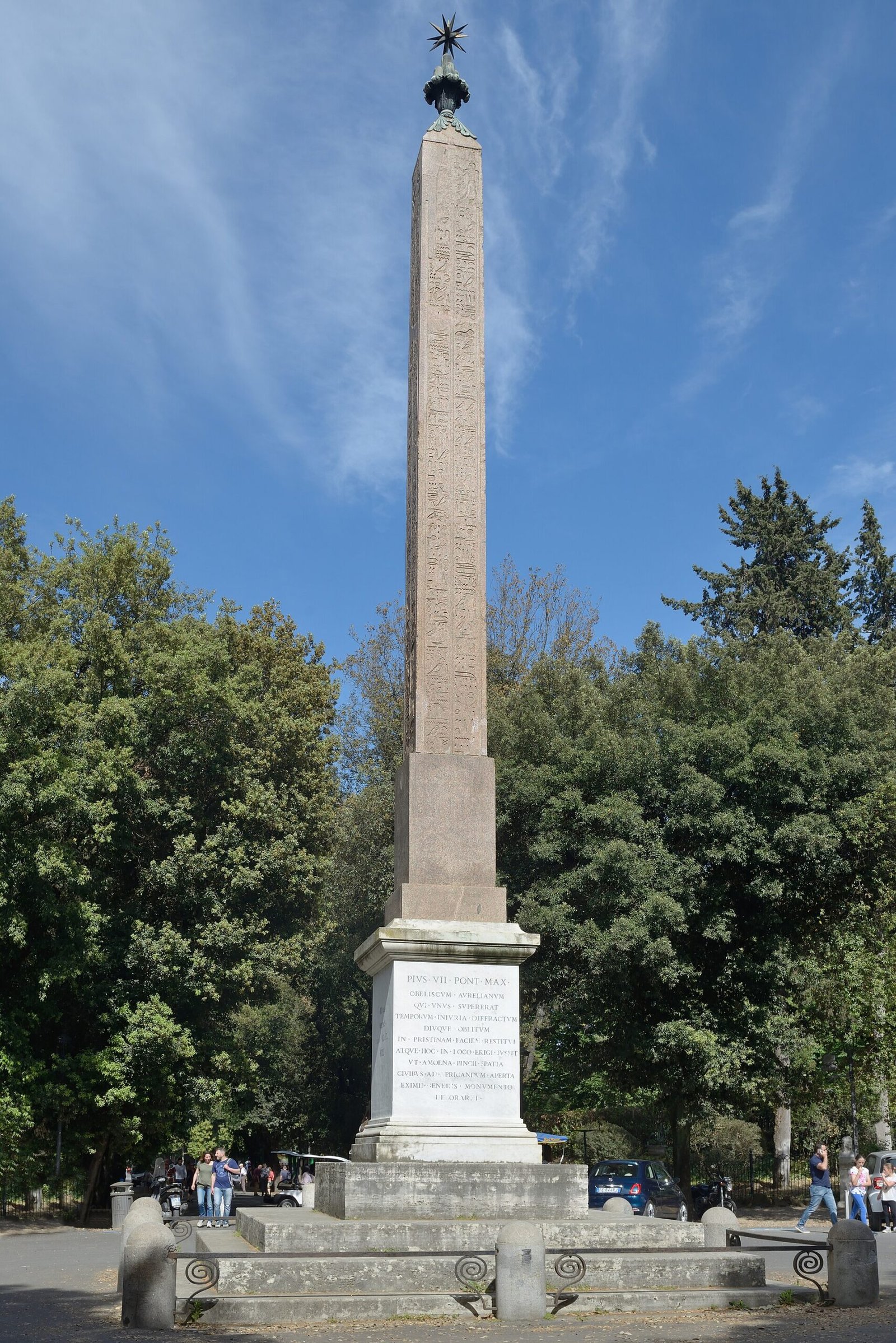
The Pincio Obelisk is an obelisk of the Roman era, made in the 2nd century AD at the wish of the emperor Hadrian, and not a pharaonic monolith transported to Rome as a trophy. It's a distinction that changes everything in how the monument is read, because it sets it sharply apart from most of the others you see in the city.
The difference between Egyptian and Roman obelisks
Of the 13 ancient obelisks of Rome, a considerable part was quarried in Egypt in the pharaonic age, inscribed there with the names of the rulers who had commissioned them, and then transported to Italy after the Roman conquest of Egypt: this is the case of the Flaminian Obelisk in Piazza del Popolo and of the Lateran Obelisk, the tallest of all. Another part, instead, was made in the Roman era: the granite was quarried in the same Egyptian quarries, but the monument was conceived, commissioned and in a number of cases inscribed for a Roman patron. The Agonal Obelisk of Piazza Navona belongs to this second category, and so does the Pincio Obelisk.
The measurements: nine meters of shaft, 17 with the base
The ancient shaft measures 9.24 meters in height, while the whole monument, including the modern base and the bronze star placed at the top, reaches 17.26 meters. 19th-century sources expressed the same measurements in the units of the time, speaking of 30 feet for the ancient shaft and 57 for the complete monument: they are the same values, translated into another system. In the ranking of Roman obelisks it is therefore a monument of medium size, very far from the good 32 meters of the Lateran one, but imposing compared with the minor monoliths of the imperial age.
The star on top and the 19th-century base
What you see today is not all ancient. The base on which the shaft rests and the bronze crowning element that finishes its tip belong to the 19th-century arrangement of the monument, carried out when the obelisk was raised on the Pincio in 1822 at the wish of Pope Pius VII. A Latin inscription recalling the papal intervention was carved on the base: it is the kind of signature that popes left on almost every obelisk re-erected in Rome between the 16th and 19th centuries, starting with the Vatican one. Telling the ancient shaft from the modern elements by eye is simple: the pink granite carved with hieroglyphs is Roman, everything else is not.
Who Antinous was and what happened to him on the Nile
Antinous was a young man from Bithynia, a region of Asia Minor on the Black Sea, born in all likelihood in Claudiopolis, today's Bolu in Turkey, around the second decade of the 2nd century AD. He became the favorite of the emperor Hadrian and accompanied him on his journeys through the eastern provinces of the empire, up to that trip to Egypt during which, toward the end of October AD 130, he drowned in the Nile.
What the ancient sources really say
The ancient sources on Antinous's death are few and brief. Cassius Dio, a Greek historian of the Severan age, reports the news of the drowning and gives a version according to which the youth voluntarily sacrificed himself in connection with religious or magical practices meant to prolong the emperor's life, specifying however that this was what was being told and not an established fact. The Life of Hadrian contained in the Historia Augusta, a late antique biographical collection of uneven reliability, reports the death in the Nile, records the emperor's boundless grief with an expression comparing it to the weeping of a woman, and recalls the extraordinary honors that followed. These are, in essence, the two main literary sources, and neither of them explains how the boy ended up in the water.
What the sources don't say
What the sources don't say is much more than what they say, and it's good to make that clear because the popular literature on Antinous is full of reconstructions presented as certain. We don't know under what material circumstances the fall into the river happened, we don't know if there were witnesses, we don't know exactly what the day-to-day relationship between the emperor and the boy was, beyond the fact, universally recognized in antiquity, that Antinous was his favorite and that Hadrian was deeply attached to him. The hypotheses you read everywhere, namely accident, suicide, political murder and voluntary ritual sacrifice, are precisely modern hypotheses built on a very thin documentary base, and none of them can be considered proven. The honest way to tell this story is to say that a young man died in the Nile in the autumn of AD 130, that the emperor was devastated by it, and that everything else is reconstruction.
The date and the place
The death is placed by most scholars toward the end of October AD 130, on a stretch of the Nile in Middle Egypt, in the area where an oracular sanctuary of the god Bes stood and not far from the city of Hermopolis. There is broad agreement on this geographic location, because it is there that Hadrian had the new city dedicated to the boy built: the foundation marked, by declaration, the point of the drowning. On the precise day the modern sources diverge, and those who indicate October 24 or 30 do so on the basis of calendar reconstructions that not all scholars accept in the same way.
The deification of Antinous and the birth of a cult
After his death in the Nile, Antinous was deified, that is, officially placed among the gods, and within a few years his cult spread to dozens of cities of the empire, above all in the Greek-speaking eastern provinces. It is a historical fact documented by an enormous quantity of material evidence: statues, coins, inscriptions, reliefs.
Antinoopolis, the city founded on the place of his death
Hadrian founded on the bank of the Nile, at the point linked to the young man's death, a new city called Antinoopolis, destined to become the center of the cult. The foundation is explicitly recalled in the hieroglyphic text of the obelisk, which speaks of a city bearing his name, built in good white stone, surrounded by statues of gods and by columns, home to a temple and to periodic games in honor of the new god. Modern sources place the foundation between the autumn of 130 and the spring of 131, and on this point there is no unanimous consensus: some indicate October 30, 130, others the following spring, and the obelisk itself provides no date.
The disappearance of the cult and the paradox of the hieroglyphs
With the rise of Christianity the cult of Antinous was one of the most exposed targets of anti-pagan polemic: Christian authors cite it repeatedly as an example of the arbitrariness of imperial deification, and its sanctuaries disappeared. Here lies a paradox worth noting: while the temples were being dismantled and the dedications erased, the text carved on the obelisk survived precisely because it was written in hieroglyphs, that is, in a script that in late antique and then medieval Rome practically nobody could read anymore. An unreadable document is a document nobody bothers to destroy.
A curiosity about the Pincio Obelisk
The hieroglyphs covering the four faces of the obelisk were not carved in Egypt: they were carved in Rome, or in any case in Italy, by workers who were working from a text composed by someone who really did know sacred Egyptian, but who were not themselves used to writing in that language. It's a circumstance that scholars deduce from the irregular quality of the signs, from their layout and from a series of graphic uncertainties that a professional Egyptian engraver would not have made.
A block that arrived smooth and was carved at its destination
The granite was quarried in Egypt, as always, and shipped toward Italy. The carving, however, took place at the destination, which means the text was conceived for a Roman audience and place, not for an Egyptian sanctuary. It's a practice documented for other obelisks of the imperial age as well, and it explains why the monument, though Egyptian in form and language, is a product entirely Roman in thought and in commission.
Who wrote the text
Precise proposals exist on the author of the text. Some Egyptologists, among them Philippe Derchain and Jean-Claude Grenier, have recognized in the formulas of the obelisk the hand of an Egyptian priest active in Italy, identified with a certain Pétarbeschenis from Akhmim, on the basis of the similarity between the titles carved on the obelisk and those of a funerary stele referring to that same person. It's an attribution based on a formal comparison between two documents, not on an explicit signature: it must therefore be presented for what it is, that is, an argued hypothesis and not a documentary certainty.
Why this matters more than it seems
That the text was composed by an Egyptian priest working in Italy changes the way it is read. It is not a document produced by the Egyptian temple bureaucracy and then imported: it is a text written for the emperor, within Egyptian religious culture but for a Roman patron, with the declared aim of inscribing Antinous in the Egyptian pantheon and of asking the gods for the emperor's well-being in exchange. It is also the reason the text is so rich in concrete information: whoever wrote it had to explain a very recent affair, not evoke an ancient myth.
What the hieroglyphs say, face by face
The four faces of the obelisk each carry an autonomous text, and together they make up a continuous narrative of the story of Antinous: the death, the funerary honors, the deification, the founding of the city and the establishment of the cult, plus a request addressed to the gods for Hadrian's benefit. The translations published by different scholars agree on the general sense and diverge on individual passages, in particular those concerning the burial place.
The side with the founding of the city
Another face contains the most informative passage from the historical point of view: the description of the city founded in honor of the young man, defined as a city bearing his name, built in good white stone, equipped with temples, statues of gods and columns. It is the most explicit contemporary testimony we have on the founding of Antinoopolis, and one of the reasons the obelisk is cited as a source in any serious study on the subject. A further face concentrates on the celebrations established in the Egyptian city, with periodic games, prizes and crowns for the winners: the typical apparatus of Greek athletic festivals transferred into an Egyptian religious context.
The side with the funerary rites
A third face describes the death and the rites performed for the young man, with the formula according to which all the customs provided for Osiris were repeated for him: in Egyptian theology this means that Antinous was treated exactly like the dead and risen god, with the whole apparatus of funerary practices that accompanied that model. It is here that the disputed passages on the place where the god rests appear.
A formula that also names Sabina
The text names, besides Hadrian and Antinous, also Sabina, the emperor's wife, and names her as living. It is a valuable technical detail, because it allows a chronological limit to be set: the carving must predate the empress's death, which occurred around the mid-130s of the 2nd century, and postdate Antinous's death in 130. The resulting window is a few years, and it is the reason why 19th-century scholars, even before modern archaeological investigations, considered this obelisk the most securely datable of those in Rome.
Something nobody tells you about the Pincio Obelisk
This obelisk is not a monument that tells a story already known from other sources: it is the source. The text carved on its faces is the only surviving contemporary account of the funerary honors granted to Antinous and of his deification, and no other ancient document that has come down to us says as much about that episode with the same chronological closeness to the events.
Why it is worth more than Cassius Dio and the Historia Augusta
The two main literary sources on Antinous's death were written a long time after the events: Cassius Dio worked between the end of the 2nd and the beginning of the 3rd century, and the Historia Augusta is a late antique compilation, written at least two centuries later, notoriously casual in mixing reliable information and inventions. The obelisk, on the other hand, was carved within a very few years of the young man's death, at the direct wish of the person most involved in the affair. It is not a neutral text, indeed it is declaredly celebratory and religious, but it is contemporary: it says what was officially meant to be said about Antinous while those who had known him were still alive.
A document saved by its own unreadability
Then there is the paradox already mentioned, which deserves repeating because it is the heart of the matter: this text has come down to us precisely because nobody, for over a millennium, was able to read it. The key to the hieroglyphs was lost in antiquity and recovered only in the 19th century, after the decipherment started by Jean-François Champollion from the Rosetta Stone. For all the centuries in between, the obelisk of Antinous was a block of granite covered in mysterious signs, moved, broken, abandoned in a vineyard and then re-erected, without anyone knowing they were handling a first-hand document on one of the most debated episodes of Roman imperial history. The first systematic readings of the text date to the second half of the 19th century and to the last years of the century, and in the 20th century and in the early 2000s more refined critical editions followed that clarified the reading of individual passages.
A practical consequence for visitors
All this changes how you look at the monument in person. Whoever stops in front of the obelisk is not looking at an exotic decoration but at a written page, and the vertical columns of signs running along each face are lines of text with a beginning and an end. Even without being able to read a single hieroglyph, recognizing this structure, that is, understanding that the signs are arranged in columns and that the figures at the top form an introductory scene, completely changes the perception of the object.
The advice I give you for visiting the Pincio Obelisk
The most useful advice concerns the order of the visit: go to the obelisk before the terrace, not after. Whoever arrives at the Pincio instinctively heads for the viewpoint over Piazza del Popolo, and once they've seen the panorama they hardly ever go back to the inner avenue: the obelisk thus remains a footnote or, more often, a thing glimpsed in passing. Reversing the order costs five minutes and completely changes the quality of the visit.
No ticket needed, but you need light
The area is public, open and free, and the monument is visible at any hour. The problem is not access but lighting: the hieroglyphs are carved on a dark, compact stone, and with the sun directly overhead the signs flatten until they are almost invisible. The raking light of early morning or late afternoon, striking the cut edges, gives back to the carvings a relief that is entirely lost at noon. If the aim is to make out the signs, the time of day matters more than anything else.
Walk around all four faces
It seems obvious and almost nobody does it: the monument has four different texts and should be walked around in full. Each face receives light at a different time of day, so even at the same hour there will always be one more legible than the others. Doing the full circle takes less than two minutes and lets you notice the differences in preservation among the sides, which are not equal: the surface suffered unevenly over the centuries of abandonment, breakage and exposure to the open air.
The fractures: where the monument broke
The shaft was found broken into several fragments and was put back together in the 19th century. Looking at the monolith from bottom to top you can spot the joint lines between the sections, more or less evident depending on the light, and with them the portions of text lost at the breaks. Looking for them is an exercise in reading the monument far more instructive than any frontal photograph, and it should be kept in mind also when reading the translations: some of the restorations proposed by scholars concern precisely damaged passages.
How much time to allow
For the obelisk itself 10 or 15 minutes are enough, full circle and pause included. The point is that nobody climbs to the Pincio just for the obelisk: the stop makes sense within a broader stroll that includes the panoramic terrace, the avenue of busts, the water clock and perhaps the descent toward Piazza del Popolo or the entrance into Villa Borghese. For a route like this you need at least an hour and a half, two if you add the Galleria Borghese, which however requires mandatory reservation with an assigned time slot and has to be planned separately. The avenue is flat, tree-lined and closed to traffic, so it is suitable for strollers and for children who walk.
Another well-known fact, yet rarely mentioned
Nobody knows for certain where Antinous's tomb was, and nobody knows for certain where this obelisk was originally placed. They are two separate but intertwined questions, because if the obelisk marked the tomb, answering the second would also mean answering the first. On the point scholars do not agree, and the positions in the field are at least three.
The Hadrian's Villa hypothesis
The excavation campaigns carried out at Hadrian's Villa in Tivoli between the late 1990s and the early 2000s brought to light, in the area near the entrance of the villa, a complex interpreted as an Antinoeion, that is, as a sanctuary dedicated to the deified youth: two small temples facing each other, an exedra, architectural elements and sculptural fragments of Egyptian taste, and between the two temples a square masonry foundation compatible with the housing of an obelisk. The authors of the reference archaeological study, Zaccaria Mari and Sergio Sgalambro, have argued that the complex was not a simple cenotaph but the actual tomb of the youth, and that the obelisk now on the Pincio stood at its center. It is the hypothesis that in the last 20 years has received the most attention and is today the most cited in popular writing.
The Roman hypothesis of the imperial horti
The Egyptologist Jean-Claude Grenier, who devoted a monographic study to the text of the obelisk, has proposed a different reading. According to his interpretation of a passage of the hieroglyphic text, the god would rest in a consecrated place inside an estate belonging to the lord of Rome, that is, in an imperial property, and Grenier has indicated as possible candidates the suburban horti of the capital, in particular those that Hadrian would have inherited through his family. In this reconstruction the burial, and with it the obelisk, would be in Rome and not in Tivoli. Other proposals have involved different areas of the city, including the area of the horti on the Palatine linked to oriental cults.
The Egyptian hypothesis
Finally there is the Egyptian lead. Some late antique sources report that Antinous was buried in Antinoopolis itself, the city founded in his honor, and the idea has a coherence of its own: the place of death, that of the cult and that of the burial would coincide. The problem is that, unlike the case of Hadrian's Villa, in the excavations of the Egyptian city neither a funerary sanctuary nor a tomb attributable to the youth has so far been securely identified, and the late antique testimony is chronologically distant from the events.
Why the text of the obelisk doesn't settle the question
The reason the debate continues is linguistic even before it is archaeological. The passage that should indicate the burial place is worded ambiguously, and its translation depends on the reconstruction of grammatical elements that are not expressed unambiguously in the carved text: depending on how that point is restored, the god rests in a place that can be identified in Egypt, in Tivoli or in Rome. It's an exemplary case of how a single philological uncertainty can keep a historical question open for decades. The correct way to report the situation is to say that there are three competing reconstructions, that the one of Hadrian's Villa has in its favor a concrete archaeological finding in the square foundation discovered between the two temples, and that none of the three can be called proven.
The Varian Circus, that is, where the obelisk certainly stood
On the one documented ancient location, instead, the doubts are far fewer. In the 3rd century the obelisk was in the Varian Circus, the racetrack attached to the suburban imperial residence in the eastern sector of the city, in the area between the present-day Aurelian Walls, Porta Maggiore and the basilica of Holy Cross in Jerusalem. There the monolith was planted on the spina, that is, on the central low wall around which the chariots turned, according to an established practice: the obelisk on the spina was an almost obligatory element of Roman circuses, as the Circus Maximus and the Circus of Maxentius on the Appian Way show. The move is traditionally attributed to Elagabalus, the adolescent emperor of Syrian origin who reigned between 218 and 222 and who made that residence his headquarters.
The right photo to take at the Pincio Obelisk
The photograph that does this monument the most justice is not the one of the whole obelisk seen from afar, which gives back only a dark spire among the trees, but the close-up detail of a face lit from the side, in which the hieroglyphs emerge from the granite with their relief. It's the only shot that tells what the object really is: a written text, not a decoration.
The detail of the hieroglyphs in raking light
You need low light, so early morning or the last hour of the afternoon, and you need to choose the face that at that moment gets the sun from the side. It's best to get as close as possible, frame a limited portion of the column of signs and let the granite fill the whole frame: the contrast between the smooth surface and the groove of the carvings does the rest. With the sun high, the same shot gives a flat, unreadable surface.
The obelisk from below, among the leaves
A second effective shot is obtained by getting almost to the base and pointing upward, so as to make the lines of the shaft converge and set the tip with the bronze star against the sky and the tree crowns. It's a shot that works particularly well on clear-sky days and at hours when the light filters through the branches, and that conveys the height of the monolith much better than any frontal shot.
The obelisk in its avenue
Those who want a context photograph, not a detail, should step back along the avenue and frame the obelisk at the end of the tree-lined perspective. It is the image that explains the 19th-century logic of the arrangement, where the ancient monument works as the perspective focus of a public promenade: exactly what the papal urban planning of the early 19th century wanted to achieve.
Some important events that happened here in history
The history of this obelisk is above all a history of moves: in 19 centuries the monolith has changed location at least four times, going from an imperial sanctuary to a circus, from a vineyard to a noble courtyard, from a Vatican garden to the hill where it stands today. Each move corresponds to a different moment in the relationship between Rome and its own ruins.
The 2nd century: the original location, unknown
The first stage is also the least documented. The obelisk was cut on Hadrian's order after AD 130 and carved in Italy within a few years, but where it was originally erected remains a matter of discussion among the three hypotheses already seen. What is certain is that the monument was born as an element of a religious complex dedicated to the deified youth, not as a generic urban ornament.
The 3rd century: the spina of the Varian Circus
During the 3rd century the obelisk was placed on the spina of the Varian Circus, the track attached to the suburban imperial residence in the south-eastern sector of the city, not far from the stretch of the Aurelian Walls between Porta Maggiore and Porta San Giovanni. Tradition attributes the initiative to Elagabalus, who made that complex the center of his court. With the end of the empire and the abandonment of the circus, the obelisk fell and broke, remaining however always in view, above ground, without ever being completely buried.
The 16th century: the fragments in the vineyard
At the beginning of the 16th century the antiquarian Andrea Fulvio noted that he had seen the fragments of the obelisk outside Porta Maggiore, behind the basilica of Santa Croce in Gerusalemme, among the vineyards. In 1570 two brothers, Curzio and Marcello Saccoccia, had the pieces brought back into view and placed on an arch of the Acqua Felice aqueduct, which passed nearby, a commemorative inscription dated to that year. Some reconstructions indicate instead 1589 as the year of the finding: the discrepancy depends on the fact that the monument was never truly discovered, having remained visible for centuries, and that the sources record different moments of its re-emergence. From the proximity to the Aurelian Walls derives the name by which it was long called, the Aurelian Obelisk, which still appears today in some official designations.
The 17th century: the Barberini courtyard
Under the pontificate of Urban VIII, a pope of the Barberini family, the fragments were transported into the city and placed in 1633 in the garden of Palazzo Barberini, with the declared intention of re-erecting the obelisk near the palace. The project was never carried out, and the monolith stayed lying on the ground for almost a century and a half, so that the name Barberini Obelisk stuck to the monument and is still found today in the specialist literature, especially in English.
The 18th century: the move to the Vatican
In 1773 Cornelia Barberini donated the obelisk to Pope Clement XIV, who had it transported to the Vatican gardens, in the area of the Cortile della Pigna. In the Vatican too the monument stayed on the ground: his successor Pius VI toyed with the idea of raising it in the Belvedere Courtyard, above a fountain, mounting it on an ancient pedestal, but the project ran aground and the obelisk stayed where it had been deposited. Whoever today visits the Vatican Museums and crosses the Cortile della Pigna walks in an area where this monolith lay for almost half a century.
1822: the Pincio, Pius VII and the hill's building site
The last move took place in 1822, in the final years of the pontificate of Pius VII, when the obelisk was restored, put back together and finally raised on the level area of the Pincio public promenade, where it stands to this day. It is the last ancient obelisk to have been raised in Rome, and its placement must be read within the great project of urban arrangement that in those very years was transforming Piazza del Popolo and the hill above it into a single scenic complex. On the architect who physically oversaw the operation the sources do not agree: the general arrangement of the area is unanimously attributed to Giuseppe Valadier, and many sources attribute to him also the raising of the obelisk, whereas the 19th-century source closest to the events, namely Antonio Nibby in his description of Rome of 1838, names the architect Marini for the restoration and transport. Both attributions should be reported, because both circulate in the literature.
Why precisely in 1822
The choice to re-erect the obelisk at that moment was not random. After the Napoleonic interlude, during which Rome had been a departmental capital of the French empire and the Pincio had been the object of projects for a monumental public garden, the return of papal power came with the desire to complete those building projects under a papal banner. Raising an obelisk was the most traditional and most readable gesture with which a pope could sign an urban work: Sixtus V had done it at the end of the 16th century with a systematic campaign, and the popes of the 18th century had done it with the minor monoliths. Pius VII closed that tradition, which had lasted over two centuries, with the last obelisk available.
The 20th century and the reopening of the file
In the 20th century the obelisk was the object of increasingly precise Egyptological and archaeological studies, which clarified the content of the text and placed the monument within the history of the cult of Antinous. The investigations carried out at Hadrian's Villa between the late 1990s and the early 2000s then reopened in a resounding way the problem of the original location, shifting scholars' attention from the philological reading of the text to the stratigraphic reading of the terrain: it is a good example of how an archaeological discovery can put back in question a file that seemed closed.
Who has passed by the Pincio Obelisk
Few stones in Rome have seen pass by, in order, the emperor who wanted them, the audience of an imperial circus, the farmers of a suburban vineyard, a papal family, two pontiffs and finally, for two centuries, anyone who climbs the Pincio for a stroll. The list of those who have passed by this obelisk is, in fact, a summary of the social history of the city.
Hadrian and the imperial court
The first name is that of the patron. Hadrian wanted the monument, established its religious meaning and, if the Hadrian's Villa hypothesis is correct, saw it rise at the center of a sanctuary he had designed for the dead boy. With him should be recalled the people of the court who frequented that monument: the empress Sabina, named in the hieroglyphic text as living, and the circle of officials, priests and artists that gravitated around the emperor in his last years.
The Egyptian priest who wrote the text
A little-known but central figure is that of the man who composed the text: an Egyptian priest active in Italy, identified by some scholars with a certain Pétarbeschenis of Akhmim. The identification may or may not be correct, but the existence of such a figure is certain, because someone had to formulate those titles according to the rules of Egyptian theology. It's a character who tells well of imperial Rome as a cosmopolitan city, where a priest who had come from Upper Egypt could find himself drafting for the emperor the text of a funerary monument.
Elagabalus and the circus audience
In the 3rd century the monolith ended up in the middle of the track of a circus, and this means that for years it passed before the eyes of thousands of spectators who came to watch the chariot races in the suburban imperial residence. Elagabalus, the very young Syrian emperor who lived in that residence, remains the name associated with the move, but the real frequenters of the monument were the anonymous spectators of the races.
Antiquarians, Barberini and popes
Between the 15th and 16th centuries the systematic rediscovery of Roman antiquities led antiquarians to catalog every visible ruin, and the fragments of the obelisk entered those repertories thanks to Andrea Fulvio. In the 17th century the Barberini came on stage, bringing the monolith to the garden of their palace without ever raising it. In the 18th century the donation to Clement XIV handed it over to the Vatican. In the 19th century Pius VII finally had it raised on the Pincio. Three passages that tell three different ways of understanding the possession of the ancient: Baroque aristocratic collecting, papal museum accumulation, 19th-century urban enhancement.
The Romans, for two centuries
From 1822 on, the audience of the obelisk is simply the city. The Pincio promenade was throughout the 19th and 20th centuries one of the quintessential gathering places of the Roman bourgeoisie, a destination for carriages first and for Sunday strolls later, and it has remained to this day a fixture of outdoor life in the city. Generations of Romans have learned to call it simply the obelisk, knowing nothing of Antinous: which, considering the story, has a certain irony.
The Pincio around the obelisk: what to see a few steps away
The obelisk is not a destination in itself but a point inside a historic park, and the visit only makes sense if you place it in context. The Pincio hill is not one of the seven canonical hills of Rome and in antiquity was occupied by the horti, that is, the great villas with gardens of the Roman aristocracy: the arrangement as a public promenade that we see today is 19th-century, and the page dedicated to the Pincio tells at length the history of the hill and its terrace, while these lines limit themselves to what is found a few dozen steps from the obelisk.
The terrace, the busts and the water clock
The viewpoint overlooking Piazza del Popolo is the reason most visitors climb up here: from there the gaze takes in the oval square with the Flaminian Obelisk at its center, the rooftops of the historic center and the dome of St. Peter's in the background. Along the avenues hundreds of marble herms with portraits of illustrious figures of Italian history are lined up, an open-air gallery put together starting in the 19th century, while in a wooded corner there is the hydrochronometer, the water-driven clock installed in the second half of the 19th century on an artificial rock in the middle of a basin.
Villa Borghese, just beyond
To the east the Pincio promenade merges with the park of Villa Borghese, the great green space that holds the little lake with the Temple of Aesculapius and the Galleria Borghese with its collection of sculpture and painting. Those who have half a day can build a single route that starts from Piazza del Popolo, climbs to the Pincio, touches the obelisk and continues in the park to the lake: it is one of the most restful urban walks Rome offers.
Preservation and current state
The monument is exposed outdoors without protection, in a public park area, and shows the typical conservation problems of stone outdoors in an urban environment: deposits of particulate matter, dark crusts in the areas sheltered from rain wash, biological colonization in the shaded portions. The area around the obelisk is subject to the ordinary maintenance of public greenery and may be temporarily affected by pruning work or path resurfacing: those who want absolute certainty of finding the area clear can check the notices of the Capitoline Superintendency of Cultural Heritage, which has jurisdiction over the monument and the park.
Frequently asked questions about the Pincio Obelisk
What is the Pincio Obelisk?
The Pincio Obelisk is a pink granite obelisk of the Roman era, commissioned by the emperor Hadrian after AD 130 in memory of Antinous, the young man drowned in the Nile and then deified. It stands in the gardens of the Pincio, along Viale dell'Obelisco, above Piazza del Popolo, and the hieroglyphs carved on its four faces tell of the young man's death, deification and cult.
How tall is the Pincio Obelisk?
The Pincio Obelisk has an ancient shaft 9.24 meters tall, which with the 19th-century base and the bronze star at the top brings the overall height of the monument to 17.26 meters. 19th-century sources give the same measurements in the units of the time, 30 feet for the shaft alone and 57 for the complete monument.
Do you pay to see the Pincio Obelisk?
No, seeing the Pincio Obelisk is completely free: the monument is in a public green area, outdoors, with no fences or ticket office. There are no dedicated opening hours and no need to book. The only possible limitation concerns any park maintenance work, which may temporarily divert foot traffic in the immediate vicinity.
How do you get to the Pincio Obelisk by public transportation?
The most convenient way to reach the Pincio Obelisk is the Line A metro, Flaminio stop, then walking up from the ramps of Piazza del Popolo in five or six minutes. Alternatively, get off at the Spagna stop and climb from Trinità dei Monti. Several surface lines serve Piazzale Flaminio and the perimeter of the hill, while the park avenues are closed to private traffic.
Why is the Pincio Obelisk also called the Obelisk of Antinous?
The Pincio Obelisk is also called the Obelisk of Antinous because it was erected by Hadrian in memory of Antinous, the Bithynian youth who died drowned in the Nile in AD 130 and was then deified. The monument is also known as the Aurelian Obelisk, from the place of its finding near the Aurelian Walls, and as the Barberini Obelisk, from the family that kept it in the 17th century.
What is written on the Pincio Obelisk?
On the Pincio Obelisk is carved a text in Egyptian hieroglyphs that tells of the death of Antinous, the funerary rites and his assimilation to Osiris, the founding of the city of Antinoopolis on the place of the drowning and the establishment of temples and games in his honor, with requests to the gods for Hadrian's benefit. It is the only surviving contemporary account of that episode.
Where did the Pincio Obelisk originally stand?
The original location of the Pincio Obelisk is not known with certainty and scholars do not agree: the main hypotheses are the sanctuary of Antinous excavated at Hadrian's Villa in Tivoli, an imperial property in Rome and the Egyptian city of Antinoopolis. The only documented ancient location is the spina of the Varian Circus, where the monolith stood in the 3rd century.
When was the obelisk placed on the Pincio?
The Pincio Obelisk was raised in its present position in 1822 at the wish of Pope Pius VII, after being restored and put back together: it is the last ancient obelisk raised in Rome. The arrangement of the area is tied to Giuseppe Valadier's project for the Pincio and Piazza del Popolo, while a 19th-century source close to the events attributes the transport and restoration to the architect Marini.
Is it worth going to the Pincio Obelisk with children?
Yes, the Pincio Obelisk is reached by a flat walk along tree-lined avenues closed to traffic, suitable for strollers and for children who walk. The stop in front of the monument takes 10 or 15 minutes, and combines well with the panoramic terrace, the water clock and the nearby park of Villa Borghese, where there are the lake, play areas and bike rentals.
One last piece of advice for those planning the itinerary
The Pincio Obelisk works very well as an intermediate stop on a day built around the northern quadrant of the historic center: Piazza del Popolo, climb to the Pincio, obelisk, terrace, and then, your choice, entering Villa Borghese toward the lake and the Galleria or going down toward Trinità dei Monti and Piazza di Spagna. Dedicating a separate trip to it would make no sense, while including it in this route does, because it adds 10 minutes and a story that almost none of the other passersby know.
Anyone lining up several stops in one day, cross-checking parks, panoramic terraces and museums with different hours and reservations, can find useful planning tools on Tour Leader Pro, while for a broader picture of transport and destinations in Lazio, Italy Planner is a good resource.