Caffè Sant’Eustachio
In short. Caffè Sant'Eustachio, official name Sant'Eustachio Il Caffè, is at Piazza di Sant'Eustachio 82, between the Pantheon and Palazzo Madama.
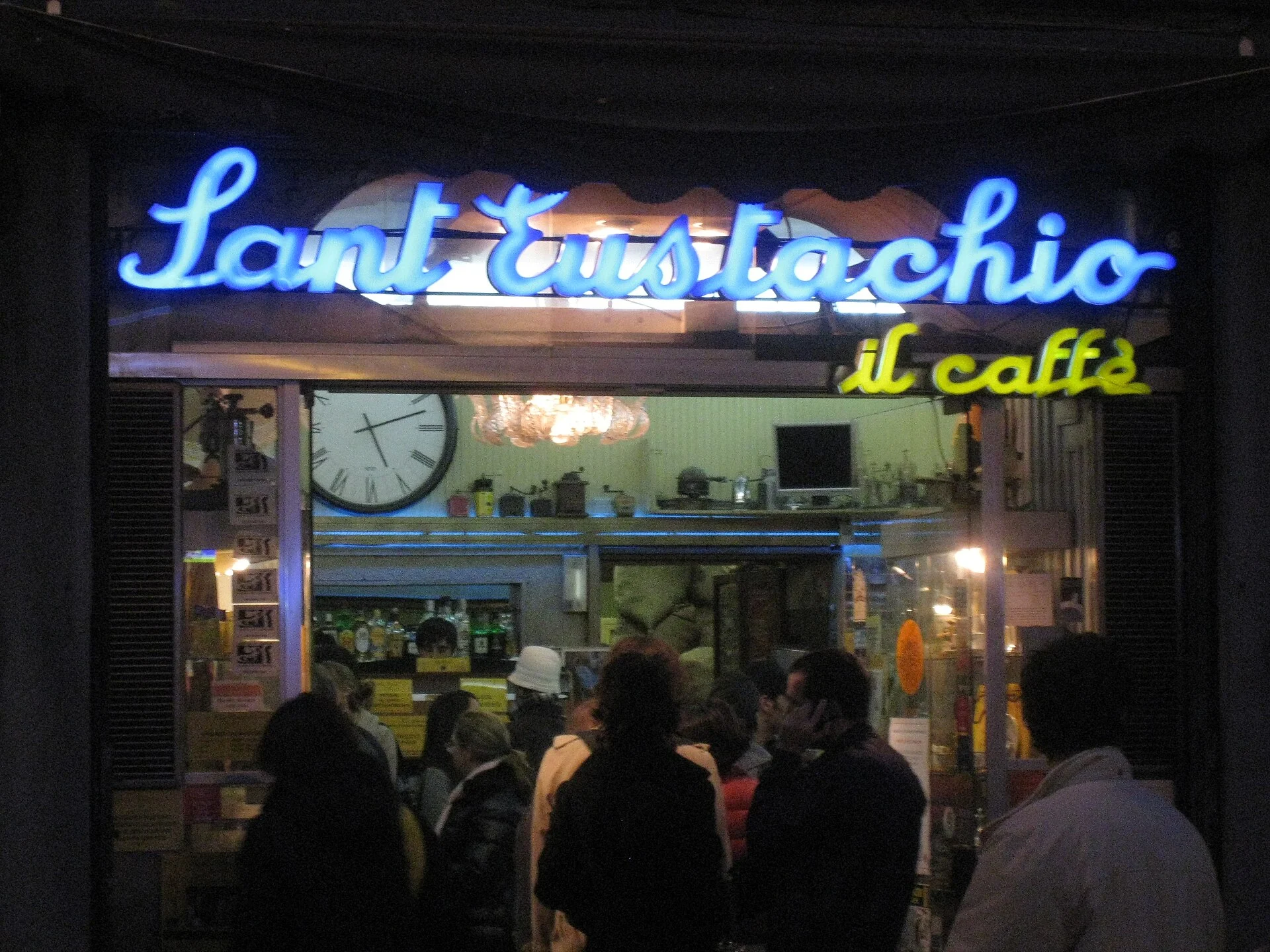
Caffè Sant'Eustachio, official name Sant'Eustachio Il Caffè, is at Piazza di Sant'Eustachio 82, between the Pantheon and Palazzo Madama. It's a bar with a roastery, privately owned by the Ricci brothers since 1999. You don't pay an entrance fee and you don't book anything: you walk in, pay at the cash register, drink at the counter. The bar's price list isn't published online, the official phone is 06 68802048.
People come here for three reasons, and it's best to line them up right away. The gran caffè, that is the sugared espresso with that dense foam that made the place famous. The wood-fired roasting, which the place says is still in use. And the 1938 furnishings, with the mosaics, the curved counter and the stag with the cross at the entrance. Everything else, including the stories about the secret blend, should be taken with a grain of salt.
Hours, contacts and practical data correspond to the check of September 28, 2026 on the place's official website and on the other sources mentioned later in the text. Historic bars change their hours with the seasons and with the owners' decisions, and the website doesn't give a calendar of extraordinary closures. If you come specially on a particular date, on Ferragosto or at Christmas for example, a phone call to the place's number removes any doubt.
Where it is and what you see
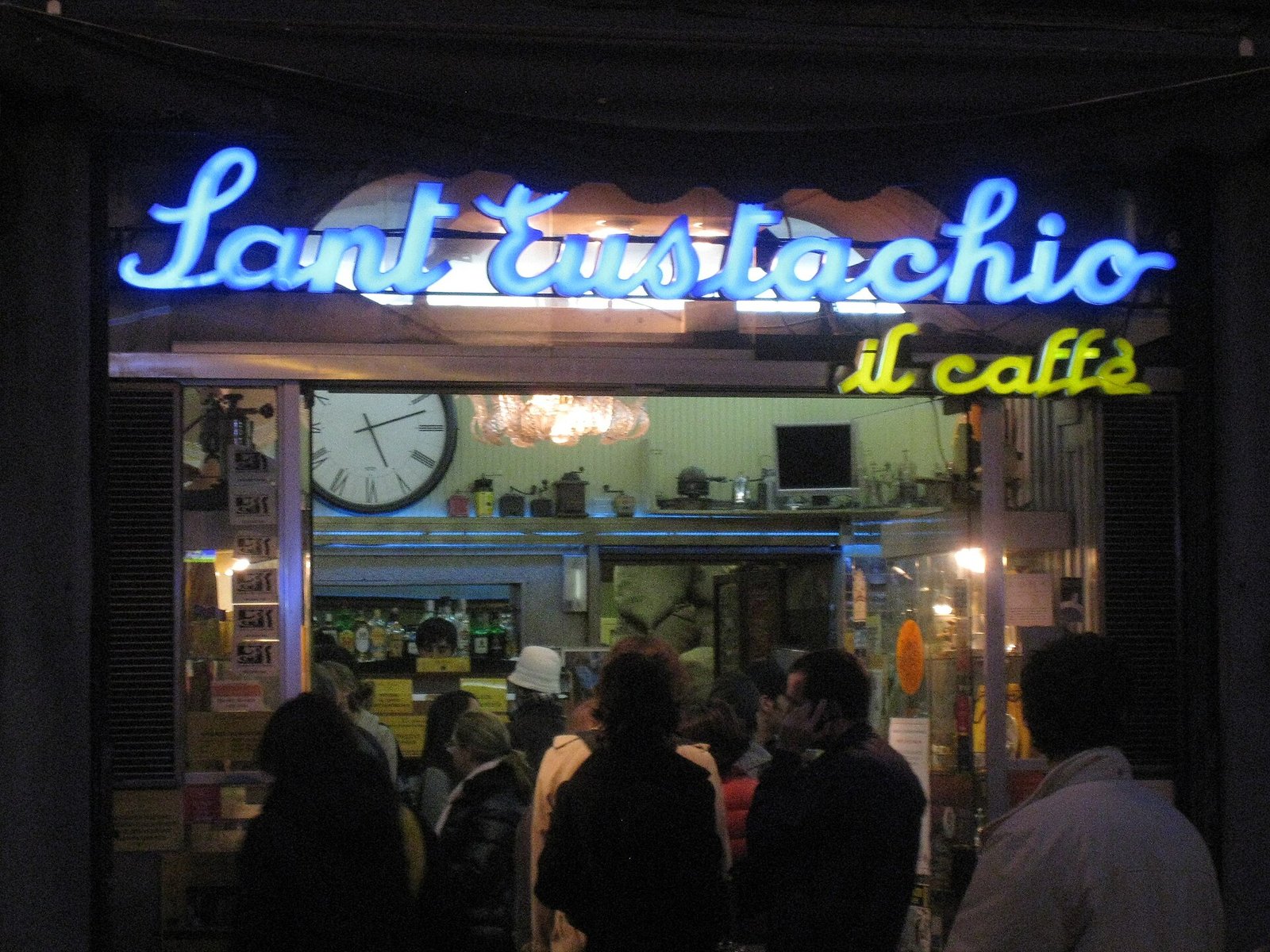
Piazza di Sant'Eustachio is a small, irregular square in the district that bears the same name, behind the Pantheon and on the side of Palazzo Madama, seat of the Senate. On one side is the Basilica of Sant'Eustachio, with the stag's head on top of the facade, on the other the 16th-century buildings. The bar occupies a corner of the square, with the entrance on the street and a few outdoor tables.
Inside the space is narrow and always moving. As soon as you enter, on the right, is the cash register. Opposite is the counter, curved in shape, behind which the baristas work. The mosaic floor and the furnishings are those of the 1938 opening, according to what the art guides and the trade press report. The light walls and the absence of wood, which the place describes as a modern choice for the time, can still be read today.
The detail almost everyone steps on without looking is the mosaic stag on the threshold. It's the place's emblem and recalls the legend of Saint Eustace, the Roman general who according to tradition saw a luminous cross between the antlers of a stag during a hunt. The same symbol appears on the basilica's facade, on the cups, on the yellow moka pots sold at the counter and on the bags of coffee beans.
What you don't see: the roastery. The wood-fired roaster that the place says is in operation isn't part of a visit route, there are no windows onto the workshop and no organized tours. Those who arrive expecting a small coffee museum find a crowded bar, with customers standing, tourists with phones in hand and baristas who have no time for explanations. It's a workplace, and it should be experienced that way.
Hours, prices and how to order at the counter
The place's official website publishes these hours: Sunday to Thursday from 7:30 to 1 at night, Friday from 7:30 to 1:30, Saturday from 7:30 to 2. The place lists two closing days, December 25 and August 15. They are long hours, those of a historic-center bar that works with the evening crowd of Piazza Navona and the Pantheon. In the early morning the square still belongs to Romans.
The price list at the counter and at the table isn't published on the place's website, so I don't report it. You read it on site, at the cash register, before ordering. Press reviews agree on two points: the gran caffè costs more than a normal espresso and table service costs more than the counter, as in almost all bars in the center. The online shop, on the other hand, publishes the prices of packaged products.
At the check of September 28, 2026 the place's online shop listed the 250-gram coffee beans at €8.90, and the chocolate-covered coffee beans in packages from €5.50 to €18.50. The catalog also includes cups, moka pots and gift boxes. There is no ticket office, there are no paid guided visits and there is no booking channel: anyone selling you priority entry to the bar is selling you hot air.
The ordering system is the classic one of Roman bars, and tourists get it wrong every day. You enter, go to the cash register on the right, say what you want and pay. With the receipt you go to the counter, put it down and repeat the order to the barista. Only then does the cup arrive. Anyone who plants themselves at the counter without a receipt waits in vain, and meanwhile blocks those who have already paid.
A curiosity about Caffè Sant'Eustachio
The stag with the cross wasn't invented by the bar. You find it on top of the basilica's facade across the square, a stag's head with the cross between its antlers, placed when the church was rebuilt at the beginning of the 18th century. The 1938 bar took its name from the square and the church, as an interview with Raimondo Ricci published in 2021 also recounts, and with the name it carried the symbol along.
The result is a square where the same animal appears twice, 30 meters apart, once in stone on the sacred pediment and once in mosaic on the threshold of a bar. The basilica's stag looks at the square from above and almost nobody notices it, the bar's lies under the shoes of thousands of people a day. Look up before going in: the comparison says a lot about how Rome recycles its symbols.
The stag also appears far from Rome. Tradition places Eustace's vision on a mountain in the Aniene valley, where the Sanctuary of the Mentorella stands today, with a chapel dedicated to the saint built on the rock. The bar's website also recalls that Saint Eustace is patron of Matera and that his feast falls on September 20. From here to Guadagnolo it's 60 kilometers or so of road.
A detail customers rarely notice: the place's logo with the stylized stag has over time become more recognizable than the saint himself. Ask a tourist with a yellow moka pot in hand who Eustace was and most likely they don't know. The bar absorbed the legend and turned it into a brand. It's not a fault, it's what happens to place names when they become commercial names.
The square itself gave its name to the whole district. Sant'Eustachio is one of Rome's historic districts, the one stretching between the Pantheon, Piazza Navona and Largo Argentina, and its coat of arms is precisely the stag's head with the cross. Look at the marble plaques at street corners: on those of the district you find the same animal. The bar, in practice, carries in a cup the coat of arms of a piece of the city.
The stag legend, on three levels
What the documents say. A church dedicated to Saint Eustace at this point of the Campus Martius is already mentioned at the end of the 8th century, was reconsecrated in 1196, had its Romanesque bell tower in those years and was rebuilt between 1701 and 1703. The canopy of the high altar bears the name of Ferdinando Fuga, 1749. These are archive and building-site facts. On the saint as a historical person, however, the papers say nothing verifiable.
What tradition says. Placidus, a Roman general under Trajan, during a hunt chases a stag and sees a luminous cross between its antlers. He converts, is baptized with his wife and children and takes the name Eustace. The most widespread hagiographic account then has him martyred under Hadrian, shut with his family inside a red-hot bronze bull. It's the version you read in the medieval collections of lives of the saints.
What is legend, and where the versions diverge. The bar's website tells that the emperor condemned Eustace and his family to die in the Colosseum, and that the lions stopped in front of them without touching them. The oldest lives of the saints put the wild beasts and the bronze bull in sequence, and the place of the torment doesn't always coincide with the Colosseum. The sources do not agree, and the tale grew richer passing from mouth to mouth.
The place's website also quotes a line by Gabriele D'Annunzio, in which the poet compares himself to the stag carrying the arrow lodged in its flank. It's an elegant way to tie a bar to a literary tradition, and you find it written on the page devoted to the legend. Keep the levels distinct, though. The mosaic stag is a commercial emblem of 1938, the one on the facade is a devotional symbol of the 18th century. Neither proves anything about the saint.
Something nobody tells you about Caffè Sant'Eustachio
The coffee comes already sugared. It's not an opinion and not an anecdote: the national tourist portal, international guides and trade press reviews all say so. If you order a coffee or a gran caffè without saying anything, the barista prepares it with the sugar already in, whipped together with the crema. Those who want it unsweetened must say so at the cash register and repeat it at the counter: amaro, or little sugar.
This changes the whole judgment of the place. A large part of that dense, compact crema that visitors photograph comes from the sugar worked with the first drops of coffee, a technique many Romans know from the moka at home. When you taste the sugared gran caffè you're tasting a preparation, not the blend. If you want to understand what the coffee they roast here is really like, the only serious test is the unsweetened espresso.
The second point nobody mentions concerns the date. The bar opens in 1938, and the University of Rome had left the Sapienza palace, the one with the spiral dome of Sant'Ivo alla Sapienza, across the street, only three years earlier, to move to the new University City. The district was losing students and professors just as the bar was getting its new look. Curious timing.
Those who arrive convinced that Sant'Eustachio is the coffee of the Sapienza students are therefore off by a few years. The place grew with the public of institutional buildings, offices and archives, and then with tourism. The neighborhood-bar counter stayed, the public changed. Keeping it in mind helps to understand why in the early morning and late at night the bar has two completely different faces.
The gran caffè: documents, tradition, legend
What is documented. The place states an arabica blend, with fair-trade coffee and coffee from Slow Food presidia, imported directly from small cooperatives in the Dominican Republic, Guatemala, Ethiopia, Brazil, Galápagos and the island of Saint Helena. It states wood-fired, slow roasting, by separate origins. The national tourist portal describes the gran caffè as an espresso from a blend in reserved doses, served in a cup a little larger than normal, already sugared.
What the bar's tradition says. The preparation happens out of the customers' sight: the trade press has written that the counter was built higher than normal precisely to prevent spying on the baristas' work, other guides describe a wall shielding the machine. The baristas work turned away, whip the crema and serve the cup ready made. All of this is real and you see it with your own eyes, at the counter.
What is legend. For decades there have been theories about the hidden ingredient of the foam: a pinch of baking soda, according to a rumor reported by TimeOut in 2018, or egg white, according to other foreign guides. None of these theories is confirmed by the place, and no serious source gives them as certain. The simplest explanation, sugar whipped with the first coffee and a blend roasted in a certain way, needs no mysteries.
In our judgment the secret works mainly as a story. A bar that covers the machine creates curiosity, and curiosity brings the line out the door. There is nothing improper in it: it's theater, and counter theater in Rome is an ancient tradition. Just don't mistake it for a technical fact, and don't tell it to your guests as an established fact.
Besides the gran caffè the counter offers other preparations the place and the press often mention: coffee granita with cream in summer, coffee mousse, the monachella with chocolate and cream. They are indulgent variants, suited to those who don't drink espresso. If you have to choose just one thing, though, order two espressos one after the other, one sugared and one unsweetened, and compare them. You learn more that way than from any explanation.
My advice for visiting Caffè Sant'Eustachio
Go before nine in the morning, on a weekday. At that hour the bar works for the neighborhood: office workers, shop clerks, people from the area's offices who drink coffee standing in two minutes and leave. The rhythm is the real one, the line at the register is short and you can look at the counter, the mosaics and the stag on the threshold without being pushed. After 10 the tourist flow arrives and everything changes.
Order at the counter, not at a table. The outdoor tables are few, half a dozen according to the guides, and exist mainly for tourists: service costs more and you lose the only thing that matters, which is watching the baristas at work. Coffee at Sant'Eustachio is drunk standing, with the cup resting on the marble, among the people. Seated outside, it's a coffee like any other in a nice square.
Decide on sugar before you get to the register. If you say nothing the coffee comes sweet, and if you want it unsweetened you have to say so clearly. A practical tip for those leading groups: place the order all at once, with a single receipt, and specify how many unsweetened and how many sugared. At the counter confusion over who asked for what is the main cause of waiting, and the barista has no time to repeat.
If you want to take something home, buy the coffee beans or ground coffee at the sales counter, not the gadgets. The yellow moka pots are beautiful but they are a gift item, the coffee is the product. Ask for the grind suited to your machine, moka or espresso, and use it within a few weeks. Those flying should remember that vacuum-packed coffee beans travel well in a suitcase too, unlike opened packages.
Don't come on Saturday night after dinner expecting calm. The bar stays open until 2, but at that hour the square fills with people leaving the nearby venues, the line goes past the door and the tables are taken. That's an experience too, but a different one. If your goal is to understand the place, early morning always wins. If you only want the gran caffè to tell about, any hour will do.
The wood-fired roastery and the blend
The place presents itself as an old wood-fired roastery born in 1938, and on the page about the raw material it writes that it roasts coffee over wood as it used to be done, gently. According to a 2021 interview with Raimondo Ricci, the roaster arrived after the Second World War, when the bar also became a roastery. Art and tourist guides mention a wood-fired machine from 1948 still working. The website doesn't specify the exact place of the roasting.
Wood-fired roasting is slower and less regular than gas or electric, and requires an expert roaster who controls the heat by eye and by nose. Its defenders claim it gives a softer, less bitter coffee, its critics consider it an image choice. The practical truth is that the difference is felt mostly in the unsweetened espresso and almost not at all in the sugared gran caffè.
On the supply chain the place publishes precise data. Since 1998 it has looked for coffee varieties in South America, since 2008 it has devoted a share of revenue to a producers' cooperative in Minas Gerais, Brazil, and uses coffee certified by the international fair-trade circuit. These are statements by the operator, reported on its website, and should be read as such: the certification mark can be verified on the packages, the rest is company storytelling.
Since 1999 the ownership has been the Ricci brothers. According to the same 2021 interview, Raimondo follows roasting and the coffee bar, Roberto the search for coffee in the countries of origin. Over time the brand has opened other points of sale and an online shop, and the coffee beans can also be found at retailers in Italy and abroad. The bar in Piazza di Sant'Eustachio remains the historic seat and the only Roman address given on the contacts page.
Another well-known fact, yet rarely cited
The 1938 bar doesn't come out of nowhere. The place tells that on the same spot there already existed in the 19th century an establishment called Caffè e Latte, and that in 1938 it was renovated and renamed with the name of the square. It's a step almost everyone knows and almost nobody mentions, because the date 1938 works better on the brand. In reality in Rome many historic bars carry the date of the renovation, not that of the first license.
The second fact concerns the building. The place and the national tourist portal give as the seat the Palazzo Stati Cenci Maccarani, built between 1519 and 1524 to a design by Giulio Romano, a pupil of Raphael, for Cristoforo Stati, conservator of Rome, with the money of his wife Faustina Cenci's dowry. The rusticated ground floor with the carriage doors is the one that still opens onto the square today. A bar inside a Giulio Romano palace.
The third fact is institutional. In 1972 the palace passed to the State Property Office and was assigned to the Senate of the Republic, which has its main seat in the nearby Palazzo Madama. The palace's interiors, with mid-16th-century painted decorations attributed to Perin del Vaga and other painters of his circle, can't be visited like a museum. They can be seen only on the Senate's extraordinary openings, when announced.
The right photo to take at Caffè Sant'Eustachio
The photo is the one from above on the threshold, with the mosaic stag framed in full and the tips of your shoes at the edge of the frame. Take it early in the morning, when nobody is coming in or out, because after 10 it's impossible to find half a second of free floor. Keep the phone parallel to the floor, without tilting it, otherwise the stag gets distorted. Don't block the entrance: shoot and move aside.
The second shot is from the square toward the sign, with the basilica's facade in the upper part of the frame. Stand on the opposite side, near the church, and try to keep in the same image the stone stag on the pediment and the bar's entrance. It's the only point from which you understand the relation between the two symbols. It works better with afternoon light, when the sun comes down from the west over the square.
Inside, the right photo is the cup on the marble of the counter with the crema intact, taken from the side. Ask for the gran caffè, set it down, shoot in three seconds and drink it. Those who spend five minutes composing the image block the counter, get dirty looks from the baristas and drink a cold coffee with a collapsed crema. Flash is useless and annoying: the place's light is enough for any modern phone.
Avoid the frontal photo of the baristas at work without asking. They are people working at a very high pace, not extras, and behind the counter you don't photograph out of respect and because the machine is shielded on purpose. Avoid too the classic photo of the outdoor table with the cup and the blurred square: everybody takes it, it tells nothing about the place and it costs you the table-service surcharge.
One last idea for those who love details: the bag of coffee beans or the yellow moka pot photographed on the marble of the sales counter, with the brand's stag in the foreground. It's an image that tells the place better than a thousand panoramas, and it's done without disturbing anyone. If instead you're looking for the empty square, come back early on Sunday morning, when the center is still asleep and the tables haven't been set up.
Sant'Eustachio and Tazza d'Oro, the rivalry of the two cafés
A few hundred meters away, on the other side of the Pantheon, is the other big name of roasted coffee in the center, the Tazza d'Oro. Foreign guides love to tell the two bars as rivals, and those visiting the center often end up asking which of the two is better. The honest answer is that they are two different schools. Here the sugared coffee with whipped crema, there the coffee granita with cream, which the guides cite as the house specialty.
The rivalry is largely a tale for travelers. The neighborhood's Romans go to one or the other out of habit, because of the street, because of the barista they know. Neither needs the other to exist. If you have half an hour, though, the comparison is worth it: take an unsweetened espresso at both and decide for yourself. It's a far more useful exercise than the rankings of Rome's best coffees that circulate online.
Those who want to widen their view to bars and shops with a long history behind them will find an overview on the page about Rome's historic cafés and shops. There you also find the Antico Caffè Greco on Via Condotti, which plays in a completely different league: 19th-century rooms, paintings on the walls, table service. Sant'Eustachio remains a counter bar, and should be judged as such.
Some important events that took place here in history
Between 1519 and 1524 Giulio Romano builds for Cristoforo Stati the palace that today, according to the place, houses the bar. It's one of the buildings of early 16th-century Rome, inspired by the model of Bramante's Palazzo Caprini, with a rusticated ground floor meant for shops and carriage houses. The idea of a commercial ground floor under a family's noble floor is the same that, four centuries later, allows a bar to open here.
In 1701-1703 the church of Sant'Eustachio is rebuilt in its present forms, and the facade receives the stag's head with the cross. In 1749 Ferdinando Fuga signs the canopy of the high altar. The square takes the look we see today. In the 19th century, according to the place's account, an establishment called Caffè e Latte is already working in the corner of the square, destined to transform a century later.
In 1938 Caffè e Latte is renovated and takes the name Sant'Eustachio. The place describes it as very modern for the time, with no wood, white walls, mosaics and a curved counter. After the war the bar acquires a roaster and also becomes a roastery: the guides mention a wood-fired machine from 1948. It's the step that turns a square bar into a coffee brand.
In 1972 the palace passes to the State Property Office and is assigned to the Senate, which expands into the buildings around Palazzo Madama. In 1998 the bar starts looking for coffee varieties in South America, and in 1999 ownership passes to the Ricci brothers. In 2008 the project with the Brazilian producers' cooperative begins. These are dates published by the place and by interviews with the owners, and press sources repeat them without variation.
In 2023 Roma Capitale launched a census of the city's historic shops to access regional funds, with precise requirements: for historic venues at least 70 years of continuous activity and a historical and architectural value. Sant'Eustachio, with the date 1938, has the age to qualify. The place's inclusion in a municipal list, however, doesn't appear in the public sources consulted, and the information isn't published on the bar's website.
The name of the bar ties its story to that of the district and the church, which have much older dates. A church dedicated to the saint in this spot is mentioned at the end of the 8th century and was reconsecrated in 1196, the year the Romanesque bell tower still visible today also dates from, partly hidden by the buildings around it. Anyone having coffee at the counter is standing inside an urban fabric with more than a thousand years of continuity.
Who has passed through Caffè Sant’Eustachio
Sant’Eustachio, to begin with, even if only as a name and a symbol. The Roman general of the legend never saw this bar, but the bar wouldn't exist as it is without him: the name, the deer at the door, the logo, even the feast day of September 20 mentioned on the website. He's the most loyal customer, in a way, and the only one who doesn't pay the receipt at the register.
Cristoforo Stati and Faustina Cenci, who commissioned the palazzo. He was a conservator of Rome, she the daughter of a family whose name, at the end of that same century, would become sadly famous. The building that today, according to the bar, houses the café was built with her dowry money. Two names that no customer at the counter knows, and that nevertheless explain why that facade has the architectural quality it has.
The brothers Raimondo and Roberto Ricci, owners since 1999, are the people who turned the bar into a brand known outside Rome, with the online shop, the resellers and the points of sale opened in recent years. They chose to leave the 1938 furnishings untouched and to bet on fair-trade coffee and wood-fired roasting. The strategy can be debated, the consistency can't.
Among the famous customers there are no documented names that can be cited with a source. TimeOut wrote in 2018 that the walls were covered with testimonials from famous people, without naming them. Quotes from enthusiastic foreign food critics recur in articles, often reported with no date or verifiable source. I leave them out for the same reason: praise without a checkable signature is not a fact.
Because of its location, the bar has served the public of the institutional buildings for decades: senators, officials, parliamentary journalists, archive clerks. Precise names of politicians who were regulars, however, don't appear in sources that can be cited, and the talk about who had coffee here and with whom remains talk. Anyone who tells of a certain minister at the counter every morning is telling a story, not reporting a fact.
Coffee at the counter, instructions for outsiders
The Roman bar has rules that nobody writes down, and at Sant’Eustachio they all apply. Coffee is drunk standing up, quickly, and you give up your spot at the counter to whoever comes next. Don't ask for a big coffee thinking of the American kind: the long coffee exists, but it's something else. If you want water you can ask for it, in many bars the glass comes with the espresso, but don't take for granted that it will arrive on its own.
There are legends about cappuccino after lunch that make Romans smile. Nobody will refuse you a cappuccino at 3 in the afternoon, and no barista will look at you badly. Simply, Italians almost always drink it at breakfast. If you want to do as they do, at Sant’Eustachio after lunch order an espresso, bitter or sweetened, or in summer a coffee granita with whipped cream. The rest is a matter of personal taste.
The rest of the choreography is simple. You say hello when you come in, you say clearly what you want, you say thank you when you leave. The baristas in the historic center work with hundreds of people an hour and appreciate whoever is quick and precise. You don't need to speak Italian: pointing, smiling and having your receipt ready is enough. What doesn't work is the long discussion at the counter about plant milk, temperature and cup size.
A note for those who bring children or teenagers. The counter is high, the space is narrow and people push, so the youngest do better outside in the piazza, with an adult who goes in to order. For those who don't drink coffee, the bar offers granita, mousse and coffee desserts, and the chocolate-covered beans are the souvenir kids like most. A real coffee, though, leave to the adults.
What is overrated
The contrarian position, with no beating around the bush: the gran caffè is overrated. It's a sweetened espresso with whipped cream, good, indulgent, but its fame comes more from the story of the secret than from the taste. Anyone drinking it for the first time mostly tastes sugar. The best product at Sant’Eustachio is the bitter espresso, which almost no tourist orders because nobody suggests it to them.
Also overrated is the idea that this is the best coffee in Rome. There is no best coffee in Rome as an objective fact, there are tastes, habits, different roasts. Sant’Eustachio is a historic bar with a serious roastery and a precise identity, and that is enough. The rankings that put it in first place talk about the brand, the piazza and the history, respectable things but different from the little cup you drink.
Finally, the line. At peak hours people wait 10 or 15 minutes outside the door for a coffee that is drunk in 30 seconds. If you see the queue spilling out onto the piazza, walk around the Pantheon and come back. No coffee is worth a quarter of an hour in line under the July sun, not even this one. In Rome you go to a bar in passing, you don't book it by waiting.
How to get there
The bar can be reached on foot from anywhere in the historic center. From the Pantheon it's a few minutes: you go around the west side of the temple, take one of the little streets heading west and come out in piazza di Sant’Eustachio. From Piazza Navona you leave from the east side, cross corso del Rinascimento next to the Senate and you've arrived.
From Largo di Torre Argentina, where many surface lines stop, you head north through the inner streets of the district and arrive in less than 10 minutes, passing next to the Teatro Valle. The bus and tram lines in the center often change route because of works and construction sites: always check the website of Rome's transport company before leaving.
It makes no sense to come by car. The piazza is inside the limited traffic zone of the historic center, parking is scarce and expensive, and the bar has no agreements. You can arrive by bicycle or scooter, but the streets around are cobbled and full of pedestrians, so you get off and continue on foot. Those with mobility difficulties should keep in mind that the interior space is narrow and almost always crowded, and should ask by phone about access conditions.
From the Trevi Fountain it takes a quarter of an hour on foot, going through via delle Muratte, piazza di Pietra and the streets behind Santa Maria in Aquiro. It's a flat walk, entirely in the historic center, that lends itself to a morning stroll with two coffee stops. From Campo de’ Fiori the time is similar, crossing corso Vittorio Emanuele at Sant’Andrea della Valle.
What to pair it with in the district
The natural stop is the Basilica of Sant’Eustachio on the other side of the piazza, where the deer of the legend looks at you from the facade, and right after it the courtyard of Palazzo della Sapienza with Borromini's Sant’Ivo. Then the Pantheon, which after a coffee at the counter you look at in a different spirit. Three stops in 10 minutes of walking.
If you love painting, there are two churches with Caravaggio within walking distance. San Luigi dei Francesi with the canvases of Saint Matthew and the Basilica of Sant’Agostino with the Madonna of the Pilgrims. Then the Minerva with the little elephant obelisk in front. It's a classic circuit for anyone with a couple of hours in the center, and the coffee at Sant’Eustachio closes it well.
If you want books, nearby you'll find the Biblioteca Angelica next to Sant’Agostino and the Biblioteca Casanatense behind the Minerva. If you prefer archaeology, head down to the sacred area of Largo Argentina, with the cat sanctuary, or to the Crypta Balbi. Under Piazza Navona are the remains of the Stadium of Domitian, which can be visited with a ticket.
For a day of museums: Palazzo Altemps with its ancient sculptures, the Museo di Roma at Palazzo Braschi on the history of the city and Palazzo Doria Pamphilj on the Corso. If you're curious about the places of politics, you can stop by Montecitorio and Piazza Colonna, 10 minutes on foot. If you prefer markets, there's a guide to the markets of Rome.
To stay on the subject of coffee, after Sant’Eustachio and Tazza d’Oro it's worth seeing a neighborhood market in the morning, when the fruit and vegetable stalls work for the residents. The Mercato Trionfale near the Vatican Museums and the Mercato di San Cosimato in Trastevere are the easiest to combine. There you see the daily rhythm of the neighborhoods, the same one you only catch in a bar before 9.
If you have your coffee in the afternoon, end the walk in Piazza Navona with Bernini's Fountain of the Four Rivers and Borromini's church of Sant’Agnese in Agone, facing each other. On the other side of the piazza, past the cloister of Santa Maria della Pace, you reach Pasquino, the talking statue. It's a half-hour route that touches the best of the Roman 17th century.
Eating in the area
The area between the Pantheon, Piazza Navona and the Senate is one of the hardest in Rome to eat well in without getting ripped off. The density of tourists is very high, rents are expensive, and many places work on the passing customer who will never come back. It isn't a general condemnation: there are serious kitchens here too. But the signs for recognizing the traps have to be learned, and they apply throughout the center.
First sign, the menu with photographs of the dishes, often laminated and translated into five languages. A place that has to show you the picture of a carbonara is addressing people who don't know what it is, and cooks accordingly. Second sign, the person at the door inviting you in. A place that has to stop passersby in the street has no regular customers, and regular customers are the only guarantee there is.
Third sign, the lady rolling out pasta dough in the window or on the sidewalk. It's a scene staged to stop you, not a sign of quality: well-made fresh pasta is prepared in the kitchen in the morning, away from the dust of the street. Fourth sign, places that stay open continuously from morning to night, with no break between lunch and dinner. A real kitchen has a crew that has to rest and prep, and it stops.
Fifth sign, typical of monumental piazzas like the Pantheon's: the price that adjusts to the customer. Items with no price on the menu, fish by weight without stating the weight, vague labels like dish of the day. Sometimes the menu displayed outside is different from the one they give you at the table. Always ask the price before ordering and check the bill line by line, without embarrassment.
Why don't Romans go there? Not out of snobbery. Simply, those who live or work in the center know the places where they've been eating for years, know how much they'll spend and have no reason to take risks. If at 2 p.m. on a Tuesday you see office workers, shop assistants and local families speaking Romanesco in a place, you've found it. If there are only tables of tourists with backpacks and the waiter switches to English at first glance, act accordingly.
So you don't have to go by trial and error, I keep an up-to-date public list of addresses I really go to, in the center and beyond: our list of the places where we eat. It isn't sponsored and it changes when the places change. A practical tip: after your coffee at the counter, move a few streets away from the main piazzas before sitting down. Already 300 meters from the Pantheon, prices and cooking change.
Frequently asked questions
Where is Caffè Sant’Eustachio and what are its hours?
The bar is at piazza di Sant’Eustachio 82, between the Pantheon and Palazzo Madama. The official website gives these hours: Sunday to Thursday from 7:30 to 01:00, Friday until 01:30, Saturday until 02:00. The bar is closed on December 25 and August 15. For confirmation the official number is 06 68802048.
How much does a coffee cost at Sant’Eustachio?
The price list for the counter and the tables isn't published on the bar's website and can be read at the register. Reviews agree that the gran caffè costs more than a regular espresso and that table service costs more than the counter. The online shop, on the other hand, publishes the prices of the packaged products, such as the 250-gram bag of coffee beans.
What is the gran caffè?
It's the bar's specialty: an espresso from a blend in doses the bar doesn't disclose, served in a cup slightly bigger than usual, already sweetened, with a layer of thick whipped cream. It's prepared out of the customers' sight. The rumors about hidden ingredients like baking soda are not confirmed by the bar.
Does the coffee come already sweetened?
Yes, if you say nothing the coffee and the gran caffè arrive sweetened, with the sugar whipped together with the cream. If you want it without sugar you have to ask for a bitter coffee, and it's best to say so both at the register and to the barista. You can also ask for little sugar. The bitter espresso is the best way to really taste the wood-roasted blend.
How do you order at the counter?
You go in, head to the register on the right, order and pay. With the receipt in hand you go to the counter, put it down and repeat the order to the barista, who prepares and serves. It's the traditional system of Roman bars. If you stand at the counter without having paid, you wait for nothing. The outdoor tables have different service and prices.
Is the coffee really wood-roasted?
The bar states on its website that it roasts the coffee with wood, slowly and by separate origins, and guides mention a wood-fired roaster from 1948 still in operation. The roastery can't be visited and the website doesn't specify where the roasting takes place. Beans and ground coffee can be bought at the sales counter or in the online shop.
What does the deer at the entrance represent?
The deer with the cross in mosaic on the threshold is the bar's emblem and recalls the legend of Saint Eustace, the Roman general who according to tradition saw a luminous cross between the antlers of a deer during a hunt and converted. The same symbol is at the top of the facade of the basilica on the other side of the piazza.
Since when has the bar existed?
The bar gives 1938 as the birth date of Sant’Eustachio, when an establishment already active in the 19th century under the name Caffè e Latte was renovated and renamed. The mosaics and furnishings are from that year. After the war the bar also became a roastery, and since 1999 it has been owned by the Ricci brothers.
Can you buy coffee to take home?
Yes, at the bar's sales counter you can buy coffee beans and ground coffee, chocolate-covered beans, little cups and the yellow moka pots with the deer brand. The same products are sold in the bar's online shop, which publishes current prices. It's a good idea to ask for the grind suited to your machine, moka or espresso, at the time of purchase.
Who wrote this page
The page comes from the editorial team of Tour Leader Pro, the Rome-based outfit that designs itineraries, visits and cultural events across Rome and Lazio. Hours, contacts and product prices reported here come from the official sources cited in the text, as of the date given at the top. Since it's a private business, hours and price lists may change without notice. Tell us what you find changed.
Putting together a morning in the historic center means fitting together churches that close at lunchtime, museums with mandatory booking, historic bars crowded at the wrong hours and pedestrian routes that look shorter on the map than they are, for yourself or for a group of 40 people. Anyone facing this kind of puzzle will find on Tour Leader Pro working materials designed for those who guide and for those who organize on their own.
For the wider picture, meaning regional trains and seasonal schedules, rentals, airports, transfers between one province and another and destinations in Lazio outside the center of Rome, from the Castelli to the volcanic lakes of the north, down to the Tyrrhenian coast and the villages of the hinterland, a useful resource for putting together a multi-day itinerary is Italy Planner.