Caffè Tazza d’Oro
In short. The Casa del Caffè Tazza d'Oro is at Via degli Orfani 84, on the first stretch of the street that climbs from Piazza della Rotonda, with the Pantheon in view as soon as you step out the door.
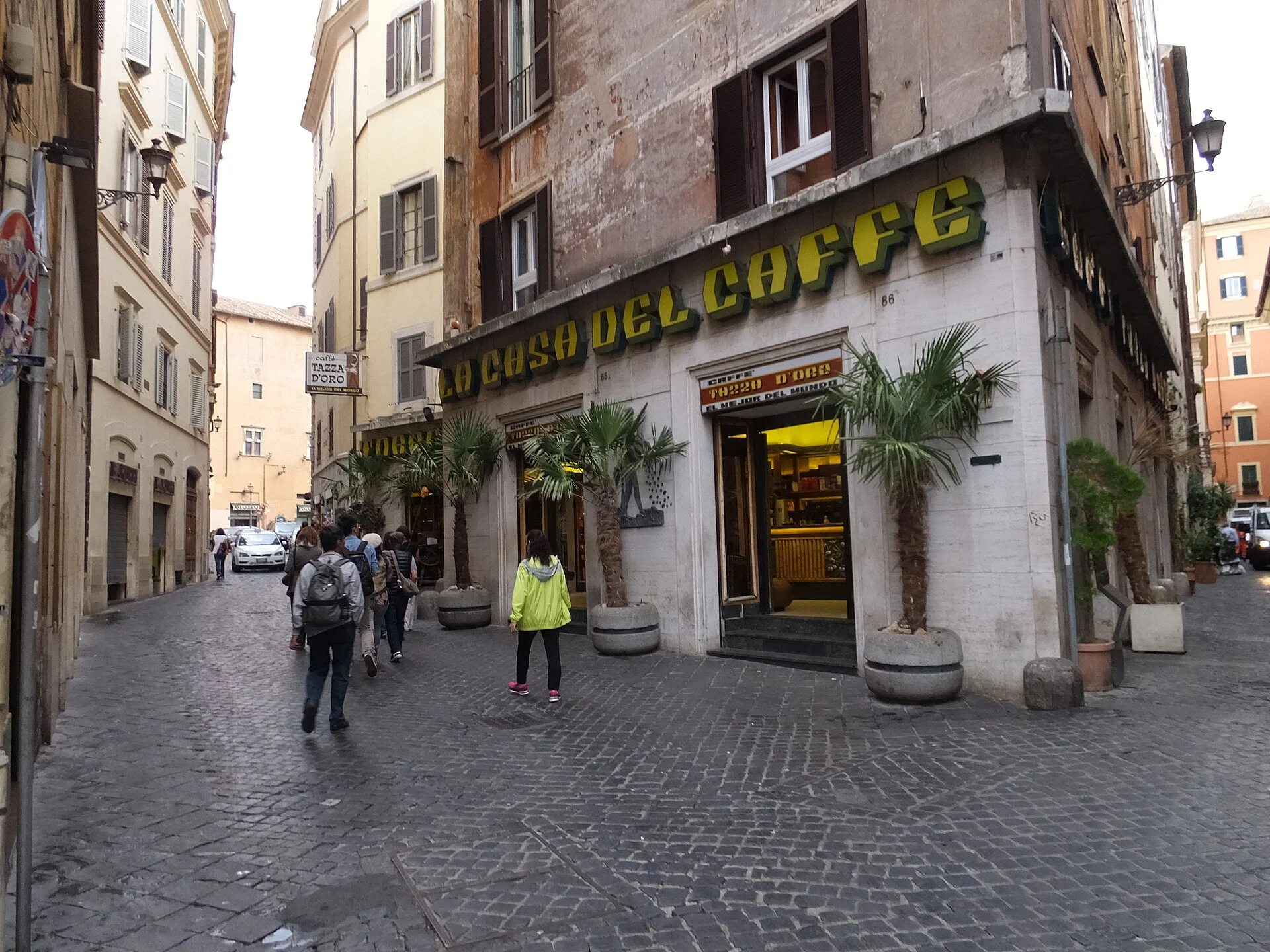
The Casa del Caffè Tazza d'Oro is at Via degli Orfani 84, on the first stretch of the street that climbs from Piazza della Rotonda, with the Pantheon in view as soon as you step out the door. It is run by the company Antigua Tazzadoro, of the family that founded it. You walk in freely, there is nothing to book and you pay only for what you consume. The counter price list is not published on the operator's website, which gives the numbers 06 6789792 and 06 6792768.
It's a roastery before it's a bar. The official website places the founding of the company in 1944 as a roastery and the opening of the tasting bar in 1946, with four generations of the same family at the helm. Today you find a long counter, shelves of coffee beans and ground coffee, the register at the entrance and, in summer, a line that spills onto the sidewalk for the coffee granita with cream.
The practical information in these lines corresponds to the check made on September 28, 2026 on the operator's website, on the tourist portal of Roma Capitale and on the trade press cited further on. The venue doesn't publish its hours on its own website, and the ones circulating on travel blogs don't match each other. If you arrive early in the morning or late in the evening, a phone call to the official numbers saves you from a closed shutter.
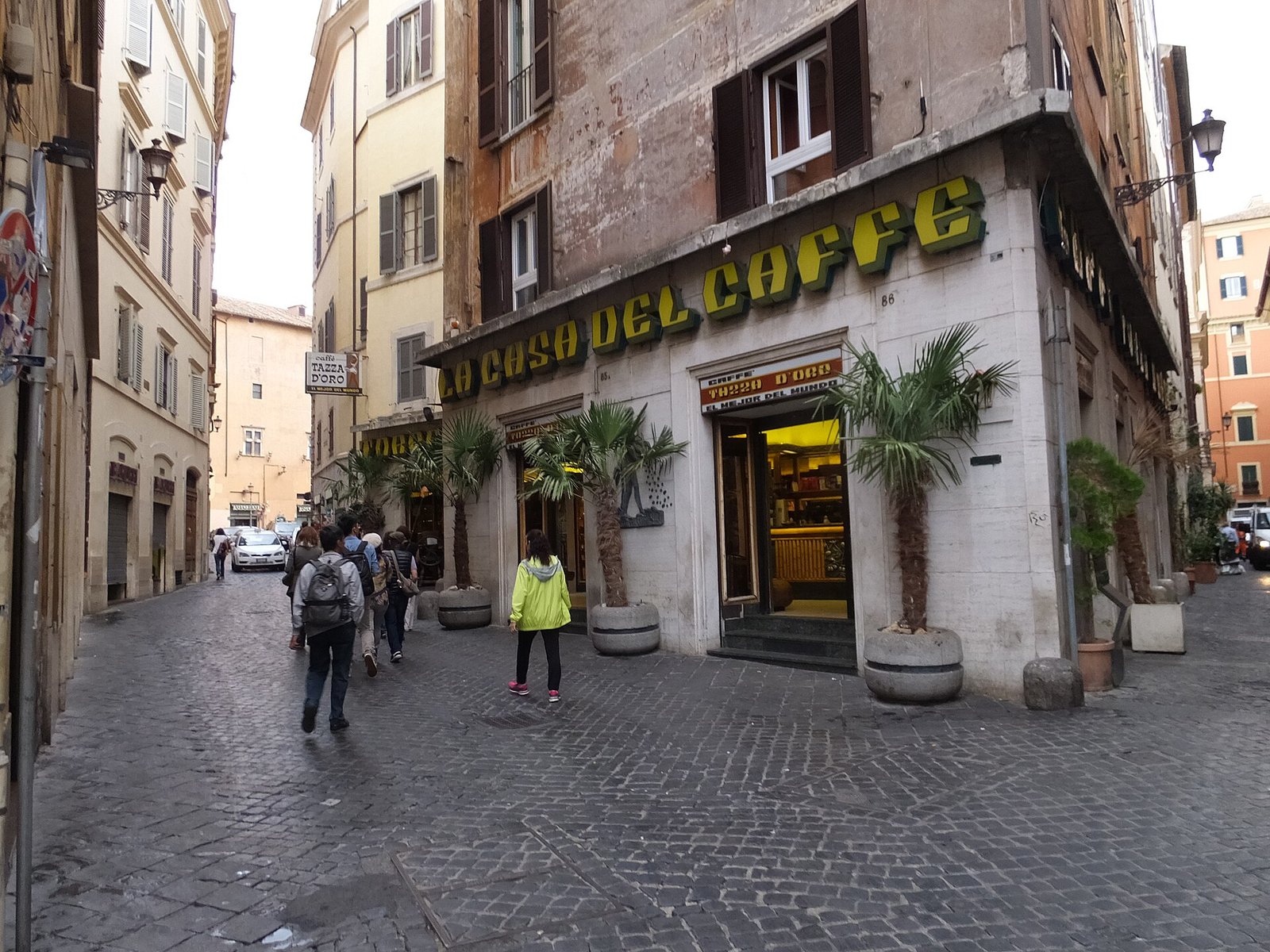
Where It Is and What You Find Inside
Via degli Orfani starts from the northeast corner of Piazza della Rotonda and climbs toward Piazza Capranica. Tazza d'Oro is just outside the square, a few steps into the street, and from the threshold you can see the portico of the Pantheon with its granite columns. The city's tourist portal gives Via dei Pastini 6 as the address, while the operator states Via degli Orfani 84: go with the second, that's the door.
Inside, the layout is that of a roasting shop expanded into a bar. On the right and at the back run the shelves with packages, jars and bags, in front is the counter where you drink standing up, and at the entrance the register. Sources describing the furnishings speak of a 1950s fit-out maintained over time, with the roastery's machines and shelves in plain view. The smell of roasted coffee reaches you already from the square.
On the facade and on all the packages appears the sower, a young woman scattering coffee beans over the outlines of Rome's monuments. The operator presents her as the symbol of its artisanal tradition. It's the image you'll find again on the cups sold on the shelves, on the bags, on the signs, and many visitors photograph it without knowing what it represents. Keep it in mind, because it comes back several times below.
The venue also has a few outdoor tables, noted by the Gambero Rosso guide to bars, but the heart of the shop remains the counter. Coffee standing up, Roman style, is how the place is meant to be, and those who sit outside are looking for the view of the square more than the service. The interior spaces are narrow compared with the flow of people passing through, especially from late morning to the afternoon in the warm months.
What you won't find: an elegant tearoom with waiters in jackets, a lunch menu, a kitchen. Tazza d'Oro is a counter bar that sells coffee, not a literary café or a restaurant. Whoever arrives with the idea of sitting a long time is disappointed, whoever arrives for a cup, a granita or half a kilo of blend to take home finds exactly what they are looking for.
A Curiosity About Caffè Tazza d'Oro
The name doesn't come from the family. According to the account published by the Roman portal Sai che a Roma, the founder Mario Fiocchetto de Saint Arnaud decided not to use his own surname and chose Tazza d'Oro, a name that was meant to speak for the quality of the product on its own. For a roaster of that era it was an unusual choice, because coffee firms were almost always named after whoever founded them.
The choice had a consequence that Romans know little about. Tazza d'Oro is a common name, and in Italy it is used by venues that have nothing to do with the Pantheon bar. In Rimini, for example, a café of the same name, born in the 1950s as a roastery, was recognized as a historic shop by its own municipality in 2023, with no connection to the Pantheon firm.
To stand apart, the Roman firm has relied on two elements: the wording La Casa del Caffè, which appears in the official name, and the sower as a graphic trademark. When you buy a package outside Rome, those two marks tell you if you are getting Via degli Orfani blend or a namesake. The name alone is not enough, and the operator knows it well.
The second curious detail concerns the flagship blend, La Regina dei Caffè. The operator describes it as a recipe kept secret for over 50 years, made of five different qualities of coffee dosed against each other, medium roast, with notes of toasted bread, hazelnut and cocoa. The secret is declared by the producer and belongs to the commercial storytelling: the precise origins of the beans and the percentages are not published.
Something Nobody Tells You About Caffè Tazza d'Oro
The founding dates don't match, and the difference is not a small one. The operator's website says the roastery was born in 1944 and the bar in 1946. The trade magazine Comunicaffè, in an article of December 11, 2024, writes that the coffee shop was inaugurated at Via degli Orfani 84 in 1944. Sai che a Roma instead dates the founding of the roastery to 1946. Three sources, two years, two different businesses.
The most reasonable reading is the operator's, which separates the two things: first the roasting and the selling, then the counter where you taste. It is also the one that fits with the rest of the story, because a roastery needs customers who buy coffee to take home before it needs customers who drink it standing up. The sources don't agree, and this has to be said to anyone who cites 1944 as the date of the bar.
And 1944 is not an ordinary year for Rome. The Allied troops enter the city on June 4, and the months before and after are those of rationing, the black market, real coffee impossible to find and replaced by barley and chicory substitutes. Opening a roastery at that moment, a few meters from the Pantheon, meant betting on the return of imported coffee, which in 1944 was anything but certain.
The operator doesn't publish the exact month of the opening, so there's no telling if the roastery started before or after the Liberation. Whoever tells the scene of the first coffee served to American soldiers is building an anecdote, not reporting a document. In the public records you can consult there is the year and nothing more, and we have to make do with the year until the family makes something more public.
I'll add something that nobody tells visitors: the daily roasting no longer takes place on Via degli Orfani. The operator lists a production plant in Formello, at Via degli Olmetti 5, and Comunicaffè specifies that the original 1940s roaster still operates in the historic venue, used for small lots of fine coffees. The smell you catch in the square is real, but the actual production is outside Rome.
The Coffee Granita With Cream
The granita is the reason the line spills onto the sidewalk. The operator lists it among its specialties under the wording coffee granitas, without publishing a recipe, a history or a selling period. Descriptions in the press and on blogs agree on the form: iced coffee scraped into crystals, served in a layered glass with whipped cream, underneath and on top. You can also ask for it without cream.
On seasonality the operator says nothing. Several sources describe it as available all year, but this is not official data and should be asked at the counter or by phone. In practice demand is concentrated between May and September, when the square turns into an oven and the granita in a glass becomes the simplest way to survive midday. In winter the line gets much shorter.
The history of the granita at the Pantheon is not documented in any of the open sources you can consult. The documentary level says that today the venue sells it and lists it among its specialties. The level of Roman tradition has considered it for decades a summer ritual of the center. The legend has it invented here, and this claim has no verifiable support: coffee granitas have existed all over Italy for much longer.
On price the venue does not publish a dated price list on its website. Figures reported by blogs and articles from different years circulate, but none is a source from the operator and prices in the center change often. The practical advice is to look at the sign at the register before you get in line for the receipt. As in many historic Roman bars, you pay first and hand the receipt to the counter afterward.
The editorial team's position, against the grain of what you'll read everywhere: the granita is good, but the ritual built around it is overrated. Half an hour in line under the July sun for a plastic cup to eat standing on the step of the fountain is not an experience, it's a queue. If you want to understand Tazza d'Oro, come at eight in the morning and have a coffee at the counter with the neighborhood's Romans.
My Advice for Visiting Caffè Tazza d'Oro
Go early. In the morning, before the organized groups start their tour of the Pantheon, the counter is filled by people who work in the buildings of the area, among offices, shops and institutions, and the rhythm is that of a neighborhood bar: coffee, receipt, a couple of words with the barista, out. It's the only moment of the day when the shop resembles what it used to be, that is, a place for Romans.
Pay at the register before going to the counter, saying exactly what you want. The advance-receipt system applies in many historic bars in the center and puts in difficulty those who arrive from abroad, who line up at the counter and get sent back. Once you have the receipt in hand, put it on the counter and repeat the order. The barista tears it and prepares. It's a quick procedure, if you know it.
If you're more interested in coffee than in granita, turn your eyes to the shelves. La Regina dei Caffè is the historic blend, the Miscela Americana is the light-roast variant, and the operator offers fine single origins, among them a Jamaica Blue Mountain cited by Gambero Rosso in 2023. Ask for the grind suited to your machine at home: moka, espresso or filter change the result a lot.
Avoid the middle hours of summer days if you have little time. Between 11 and 6 in the afternoon Piazza della Rotonda gathers those leaving the Pantheon, those waiting to enter and those stopping at the fountain, and a considerable part of that flow ends up in line in front of Tazza d'Oro. Service remains quick, but the space is what it is and the experience becomes a funnel.
One last pointer: if you're traveling with a group, don't go in all together. Send one or two people to the register with everyone's order and have the others wait outside, on the side of the square. A group of 30 people filling the venue at noon blocks those who just need to grab a coffee and go back to work.
Hours, Contacts and How to Get In
Entry is free, as in any bar, and there is no ticket. There is no booking for the counter or for the outdoor tables, and there are no organized visits of the roastery published by the operator. The venue doesn't sell access to the bar through third-party platforms, so any offer of a tour with granita included is a product of an outside operator, not of Tazza d'Oro.
Opening hours are not published on the operator's website, neither on the contacts page nor in the company presentation. The tourist portal of Roma Capitale, in the listing updated on March 1, 2025, refers to direct contact with the venue for current hours. Travel blogs give hours that differ from each other and from different years, and they shouldn't be taken as certain data.
The official contacts given by the operator are two landline numbers for the Rome bar, 06 6789792 and 06 6792768, and the email address info@tazzadorocoffeeshop.com. For the Formello plant the published number is 06 90405289, useful only for commercial inquiries. The company name that appears on the website is Antigua Tazzadoro, the family company that runs production, bar and online sales.
To buy coffee remotely the operator has an online store on its website, with blends, single origins, capsules, pods, teas, sweets and the cups with the sower. It is the official channel. No affiliates or authorized resellers are listed here, and it's best to buy directly from the producer if you want to be sure you're holding Via degli Orfani blend and not a namesake.
On accessibility the operator doesn't publish any information. The entrance is at street level, but the interior space is narrow and crowded at peak hours, and anyone in a wheelchair or with a stroller struggles to reach the counter. People with specific needs can ask a companion to pay at the register and order, and wait outside in the square, which is pedestrian and flat.
The Roastery and La Regina dei Caffè
The word torrefazione, in Rome, has a precise meaning: a shop that roasts raw coffee and sells it by weight, with or without a tasting counter. In the postwar period the center had many, and almost all have closed or become ordinary bars. The operator of Tazza d'Oro claims to be the only historic artisanal company of its kind left in the center of the city. It is a statement by the producer, not an official census.
The 1940s roaster still running in the venue, for small lots, is the detail that sets the shop apart from a simple bar with a brand. The bulk of production takes place in Formello, where the company has its plant, and from there the packages leave for the shop, for online sales and for the franchised venues. The operator describes its own production as artisanal within the industry, oriented to quality.
La Regina dei Caffè is the blend that built the name. The operator presents it as the firm's first bar blend, handed down for four generations and updated over time with the selection of the beans. According to the account of Sai che a Roma, the founder traveled to South America to choose the raw coffee personally. It is a family tale, plausible for a roaster of that era, but not documented by published records.
Alongside the historic blend there are the light-roast American version, the organic blends, a selection of gourmet single origins and products for home machines. The range is that of a firm that sells well beyond the square, and the operator states that it exports worldwide through the online store and its own franchises. The Pantheon bar remains the showcase, however, and the only place where everything is tasted at the counter.
A practical tip, given how many bags full of packages leave the shop: buy beans if you have a grinder, and in small quantities. Ground coffee loses aroma within a few days once opened, and half a kilo of fine blend left in the pantry for two months becomes an ordinary coffee. Better two small packages bought on two visits than one big one you struggle to finish. Ask at the counter for the roasting date, if it isn't printed on the package.
Another Well-Known Fact, Yet Rarely Cited
Tazza d'Oro is a historic shop recognized by Roma Capitale. The city's tourist portal reports the recognition with management decision number 786 of July 23, 2003. The register of Rome's historic shops collects long-standing businesses that have kept their sector and identity over time. Many visitors take for granted that a bar this old is protected in some way, few know that behind it there is a precise administrative act, with a number and a date that anyone can cite.
The second fact known to everyone and rarely written down is the name of the street. Via degli Orfani takes its name from the orphanage tied to the church of Santa Maria in Aquiro, which stands at the end of the street, on Piazza Capranica. According to historical accounts, in the 16th century the church was entrusted to the confraternity of the orphans, and Cardinal Anton Maria Salviati around 1590 rebuilt it and founded next to it the college that bears his name.
So the coffee shop most frequented by visitors to this part of Rome carries in its address the memory of an institution caring for children without families. Nobody thinks about it while waiting for the granita, but it is enough to raise your eyes to the facade of Santa Maria in Aquiro to understand where the name comes from. The street is short, less than 200 meters, and is worth walking to the end.
The third fact is that the family has stayed the same. Comunicaffè lists as owner the architect Natalia Fiocchetto, granddaughter of the founder and daughter of the engineer Carlo Fiocchetto, and speaks of over 80 years of family management. In a historic center where historic businesses change hands constantly and often end up with restaurant groups, the continuity of one family across four generations is the real rarity, even more than the furnishings.
The Right Photo to Take at Caffè Tazza d'Oro
The photo is the one of the sign with the Pantheon in the same frame. Stand in Piazza della Rotonda, level with the fountain, and look for a spot where the mouth of Via degli Orfani with the sign and the mass of the portico fit in the same vertical shot, the shop in the foreground and the monument in the background. It's the only photo that tells where the venue really is. Hold the phone vertically: horizontally the portico gets cut off or the shop becomes a dot at the edge.
The light on the square changes a lot over the day, and the corner of the shop goes from full sun to shade in a few hours, with contrasts that phone cameras handle poorly. Try at two different times and keep the version in which sign and columns are lit in a similar way. If you want the square empty, the time is before eight: after 10 the frame fills up with people, umbrellas and carts.
The second photo is a detail: the sower. Look for her on the facade or on the packages displayed in the window and shoot her up close, filling the frame. It is an illustration designed for print, with the stylized Roman monuments under the rain of beans, and it works better than the whole venue when it has to be published at a small size. Avoid flash on the window glass, which reflects everything.
Inside, if the counter is free, the right photo is the barista's gesture: the cup set down, the receipt torn, the granita glass with the cream rising. Ask permission before photographing the staff, because they are working and not posing. A quick shot, from the side, without stopping the service, is worth far more than a session with the phone held up in the middle of the line.
The photo I advise against is the selfie with the granita glass in front of the Pantheon's columns. Everyone takes it, the result is always the same and the midday light flattens the granite of the columns. If you want the Pantheon, photograph it from the side of Via della Rotonda, where the brick wall of the drum shows its structure, and leave the granita for later.
The Relationship With the Pantheon
Tazza d'Oro exists where it exists because of the Pantheon. Piazza della Rotonda takes its name from the popular nickname of the monument, the Rotonda, and for centuries it has been one of the places of obligatory passage in the center. The operator has built its identity on this proximity, to the point of putting it in the official name: La Casa del Caffè al Pantheon. The monument sells the coffee, and the coffee sells the monument.
The Pantheon you see from the bar's door bears on its frieze the inscription M AGRIPPA L F COS TERTIUM FECIT, that is, Marcus Agrippa, son of Lucius, consul for the third time, made it. The present temple, however, is the Hadrianic-era reconstruction, and the inscription repeats that of the first building. In 609 Pope Boniface IV consecrated it as the church of Santa Maria ad Martyres, and it is thanks to this that it has come down to us intact.
In the center of the square is the fountain designed by Giacomo Della Porta at the end of the 16th century, on which at the beginning of the 18th century the Macuteo obelisk was mounted, one of the Egyptian obelisks that Romans reused in the Campo Marzio. It is the space where the granita line mixes with people sitting on the fountain steps. From here the streets lead to all the squares of the center.
Inside the Pantheon are buried Raphael and the first two kings of Italy, and the monument remains one of the most visited places in the city, with regulated entry and flow time slots to know in advance. For hours, tickets and access rules I refer you to the page on the Pantheon on our site, which covers that chapter in detail. Coffee comes before or after, not during.
The practical rule is simple: Pantheon first, then coffee. Whoever enters the Pantheon after drinking a granita standing up has sticky hands, an open backpack and a head elsewhere. Whoever goes in at first opening, with the square still empty, sees the light of the oculus fall on the floor without a crowd, and then sits on a step at the bar with something to tell.
Some Important Events That Happened Here in History
1944 is the birth year of the roastery according to the operator. Rome comes out of the German occupation in June and for months lives on rationing, ration cards, substitutes. Opening a firm that roasts imported raw coffee in that season meant counting on the reopening of maritime traffic, and the Fiocchetto family did it on a street that faced the most visited monument in the center.
1946 is the year of the bar, again according to the operator: the counter is born as a place to taste the roasted coffee and then buy it. In the same year Italy votes in the institutional referendum and becomes a republic, and Rome begins to fill up with visitors again. The dates coincide with the recovery of tourism in the center, and the position on Piazza della Rotonda proves to be the family's winning choice.
On July 23, 2003 Roma Capitale recognizes Tazza d'Oro as a historic shop, with management decision number 786 reported by the municipal tourist portal. The municipal register was created to list the city's historic commercial businesses and support them against replacement by chains and souvenir shops, which in the center is the concrete risk. For a tourist-traffic bar like this one, the listing is also an argument of identity that the operator can spend with customers.
On a date the operator doesn't publish, production moves to Formello, to the plant on Via degli Olmetti, while the historic roaster stays in Via degli Orfani venue for small lots. It is the step that turns a shop into a company with online sales, and that allows the family to keep the Pantheon bar without sacrificing counter space to the warehouse.
In December 2024 Comunicaffè reports two new franchised venues abroad, one in Nidri on the Greek island of Lefkada and one in Seoul, South Korea. The operator confirms on its website that it exports through franchises, without publishing a list of locations. The Roman venue also appears in the Gambero Rosso guide to bars.
Who Has Passed Through Caffè Tazza d'Oro
Mario Fiocchetto de Saint Arnaud, the founder. According to Sai che a Roma he already owned three cafés on Via Nazionale from the early 1900s, before opening the roastery near the Pantheon. The double surname, Italian and French, doesn't appear on the sign by his own choice. The same source attributes to him the creation of the Regina dei Caffè blend and the choice of the firm's name, and the current operator claims the recipe as a family inheritance.
Carlo Fiocchetto, an engineer, whom Comunicaffè lists as the father of the current owner, and then Natalia Fiocchetto, an architect, granddaughter of the founder, who runs the company today. Four generations, says the operator. It is one of the few families in the historic commerce of the center that have remained in charge of their own shop without handing it over to outside groups, and this shows in the consistency of the furnishings and the brand.
Famous customers are the point where you have to stop. The bar sits between Montecitorio and Palazzo Madama, and neighborhood tradition tells of it being frequented by members of parliament, journalists and officials. It's plausible given the geography. No open source, however, documents specific names with dates and circumstances, and the names circulating online are repeated without proof.
So, the three levels, plainly. Documented: the venue has been frequented by the center's public and by Pantheon visitors for 80 years. Tradition: politicians and reporters from the nearby Parliament have coffee there between sessions. Legend: the movie star or the famous writer who supposedly ordered the granita at the counter, a story found in many different versions and never with a document behind it.
And then there are the baristas, whom nobody mentions and who make the place. Those who work the Tazza d'Oro counter serve hundreds of people an hour in the summer months, in four or five languages, with a receipt system that has to be kept in order at every order. Watch them work for five minutes before ordering: you'll understand the place better than any story about famous customers can explain.
Tazza d'Oro and Sant'Eustachio, the Rivalry You Don't Need
Every guide to Rome lines up the two names: Tazza d'Oro at the Pantheon and the Caffè Sant'Eustachio in the square of the same name, a few hundred meters away, in front of the Basilica di Sant'Eustachio. Visitors ask which is the best, as if it were a championship final. The position is clear: the question is wrong, because the two venues do different things and are visited for different reasons.
Tazza d'Oro is a roastery that sells coffee beans and ground coffee, with a tasting counter and a granita that has become famous. The sensible comparison is not between two cups drunk in a hurry, but between two ways of understanding Roman coffee. Whoever wants to understand the difference should drink both the same morning, a quarter of an hour apart, and then decide for themselves without being guided by rankings.
No scores, then, and no best in Rome. The rankings change every year, depend on who makes them and on what they measure, and none has official value. What can be said is that both venues are close, both historic, both stormed in the middle hours. The tour of the two cafés is done on foot in 10 minutes, passing by Sant'Ivo alla Sapienza.
For those who want to widen the comparison, Rome has a network of historic cafés and shops that deserves an itinerary of its own, from the Antico Caffè Greco on Via Condotti to the neighborhood roasteries. Our guide to historic cafés and shops of Rome lines them up with practical information, and helps you choose without being swept up by the fame of a name.
How to Get There
Piazza della Rotonda is pedestrian and you can't get there by car. The Campo Marzio sits inside the limited traffic zone of the historic center, and parking nearby is impossible for those without permits. The solution is to arrive on foot, starting from one of the public transport stops on the large through streets, such as Via del Corso, Corso Rinascimento or Largo di Torre Argentina.
The metro doesn't reach the Campo Marzio. The closest stations on Line A are Spagna and Barberini, both about 20 minutes' walk away, passing through the streets of the Tridente or through the Trevi Fountain area. For the buses and trams that stop on Via del Corso and at Largo Argentina, consult the route calculation service of Rome's transit company on the same day.
On foot from the nearby squares, times are short. From Piazza Navona it is five minutes passing by Sant'Eustachio, from Piazza Colonna and the Column of Marcus Aurelius the same, through Piazza di Pietra or Via dei Pastini, from Largo Argentina less than 10, going north via Via di Torre Argentina and skirting the side of the monument.
Whoever arrives from Fontana di Trevi can follow Via delle Muratte, cross Via del Corso and continue along Via di Pietra to Piazza della Rotonda: a quarter of an hour at an easy pace. It is the route most used by groups, and at peak hours the alleys fill up. If you prefer the quieter alternative, go by Piazza Capranica and come down Via degli Orfani, entering the square from the bar's side.
When It's Crowded and What Not to Expect
Tazza d'Oro is crowded almost always, but with different intensity. The peak runs from late morning through the afternoon, especially in the months between April and October and on weekends, when the Pantheon gets its highest flow. The first hour after opening and the last are the quietest. In winter, on weekdays, even the midday slot is bearable without problems.
Don't expect table service in the Viennese café style. Don't expect to find a seat inside at peak hours, or a restroom always available: the operator doesn't publish information on services, and in very crowded bars in the center restroom access can be limited. Ask at the register if you need it. Don't expect a lunch menu, because here you drink and buy coffee.
Don't expect a coffee museum either. There are no panels, historic display cases with captions or organized visits to the roaster published by the operator. The history is read in the furnishings, the sign and the packages, and has to be told by whoever accompanies you or read beforehand. Whoever walks in expecting an explanation finds a bar working at full speed that has no time for lessons.
Finally, watch out for the outdoor tables if you're in a hurry. Sitting outside, with Piazza della Rotonda in front of you, is pleasant, but table service, where available, follows rules and prices different from the counter, as in almost all the bars in the center. The operator doesn't publish the price list on the website, so ask before sitting down if there is a difference. It's a normal question, and no Roman barista takes offense.
Eating in the Area
The Pantheon area is one of the hardest in Rome to eat well in without paying for the view. Around Piazza della Rotonda and in the alleys toward the Minerva the venues work almost only with passing visitors, and the business model is that of someone who will never see the customer again. It's not a moral judgment, it's a matter of incentives, and the signs to recognize it are always the same.
First sign: menus with photographs of the dishes, laminated and translated into five languages. A place that has to show you the picture of the carbonara is talking to someone who doesn't know what it is, and cooks accordingly. Second sign: the person at the door who stops you to invite you in. Places with regular customers don't need one, and regular customers are the only guarantee there is.
Third sign: the lady rolling out pasta dough in the window or on the sidewalk. It is a scene staged to stop the passerby, not a hint of quality. Well-made fresh pasta is prepared in the kitchen, in the morning, away from the street. Fourth sign: a kitchen open without a break from morning to late at night. A real kitchen has a pause, because the crew has to rest and prepare the next service.
Fifth sign, the most expensive: tables in front of monuments with menu items without a price, fish of the day by weight with no indication, and sometimes a different price list inside and outside. Always ask the price before ordering, and have them show you the full menu, not the reduced one posted at the door. It's the rule that holds across the whole historic center, and at the Pantheon more than anywhere.
Romans don't eat in Piazza della Rotonda, and not out of snobbery. They pass through, have a coffee at the counter, and to sit at a table they go a few streets farther, where the venues work with the neighborhood and the offices. The simplest criterion is to look at who is seated at lunch on a weekday: if you hear Romanesco spoken and see office workers on their break, you're in the right place.
We have collected the criteria in a guide to where to eat in Rome without falling into the traps, and so you don't have to proceed by trial and error we keep updated a public map with the addresses we really go to, in Rome and beyond, without sponsorships: our list of the places where we eat. The list changes when the places change.
What to Pair It With During the Day
Tazza d'Oro is a 10-minute stop, and fits into any tour of the Campo Marzio. The first pairing is obvious: the Pantheon across the way. The second is the Basilica of Santa Maria sopra Minerva, behind the monument, with the only major Gothic church in Rome and Michelangelo's Christ. In front, on the square, Bernini's little elephant holds up the Minerva Obelisk.
Anyone who loves the 17th century has a hard-to-beat concentration within reach. San Luigi dei Francesi holds three Caravaggio canvases in the Contarelli Chapel, the Basilica di Sant'Agostino has another one, and Sant'Ignazio offers the fake dome painted by Andrea Pozzo. For the full picture there is the guide to Caravaggio in Rome.
If you prefer small, less-visited churches, you can go up Via degli Orfani to Santa Maria in Aquiro and then detour toward Santa Maria Maddalena, with its Rococo facade, and Santa Maria in Campo Marzio. That's 10 minutes of walking in all, and in these churches you'll find more silence than anywhere else in the area.
To build a full day, the Pantheon tour pairs well with Piazza Navona and its Fountain of the Four Rivers, with Palazzo Doria Pamphilj on Via del Corso and with the Church of the Gesù. Our itineraries on Baroque Rome and on Rome in One Day put these stops in sequence with travel times.
If your interest is food and neighborhood commerce more than monuments, pair the cup at the Pantheon with a neighborhood market the next morning. The Mercato Trionfale near the Vatican Museums and the Mercato di San Cosimato in Trastevere show the Rome that shops and cooks every day. For the evening, our guide to Rome at Night brings you the lit-up square.
Frequently Asked Questions
Where exactly is Caffè Tazza d'Oro?
The operator gives Via degli Orfani 84, 00186 Rome as the address. The venue is on the first stretch of the street, just outside Piazza della Rotonda, with the Pantheon in view. The tourist portal of Roma Capitale instead gives Via dei Pastini 6: the sources don't agree on the street number, but there is only one door and it's the one with the sign facing the square.
What are the opening hours?
The operator doesn't publish hours on its website, and the city's tourist portal refers you to direct contact. Blogs give hours that differ from each other and from different years. For the current hours call the bar's official numbers, 06 6789792 or 06 6792768, or write to info@tazzadorocoffeeshop.com, especially if you want to go very early in the morning or on holidays.
How much does the coffee granita with cream cost?
The venue doesn't publish a dated counter price list on its website, so the price can't be given as official data. The figures circulating online come from blogs and articles from different years. The price list is posted at the register, where you pay before ordering at the counter. Also ask if the price changes between the counter and the outdoor tables, as happens in many bars in the center.
Is the granita available all year?
The operator lists coffee granitas among its specialties but doesn't give a selling period. Several sources describe it as available in winter too, but this is not official data. Anyone traveling between November and March who wants the granita at all costs does well to ask by phone before crossing the city on purpose. In summer availability is not a problem, the line is.
In what year was the venue opened?
The operator's website places the birth of the roastery in 1944 and the opening of the tasting bar in 1946. Comunicaffè, in December 2024, writes that the coffee shop was inaugurated in 1944, while the portal Sai che a Roma dates the founding to 1946. The sources don't agree, and the most coherent version remains the operator's, which distinguishes the two businesses.
Is the coffee still roasted at the venue?
The main production takes place at the company's plant in Formello, at Via degli Olmetti 5, as the operator states. According to Comunicaffè, the original 1940s roaster still operates in Via degli Orfani venue, used for small lots of fine coffees. The coffee for sale on the shelves therefore comes largely from Formello, with the same blend and the same brand.
Are there other Tazza d'Oro venues in Italy and abroad?
The operator states that it exports through the online store and its own franchises, and Comunicaffè in December 2024 reported venues in Nidri, on the Greek island of Lefkada, and in Seoul. Beware of namesakes: in Italy there are bars called Tazza d'Oro with no connection to the Roman firm, such as the historic café in Rimini recognized by its municipality.
Tazza d'Oro or Sant'Eustachio, which to choose?
There is no official answer and the rankings change every year. The two venues are a few minutes' walk from each other and do different things: Tazza d'Oro is first of all a roastery with a counter and sales of coffee beans, Caffè Sant'Eustachio has its own history and its own style. The advice is to try both the same morning and decide for yourself.
Who Wrote the Page
The page comes from the editorial team of Tour Leader Pro, the Rome-based organization that designs itineraries, visits and cultural events across Rome and Lazio. Addresses, contacts, dates and management information given here come from the sources cited in the text, as of the date indicated at the beginning. Since this is a commercial business, hours and price lists change without notice: check them again before you go. Let us know what you find changed.
Lining up a day in the Campo Marzio means fitting together the opening times of churches, which often close in the middle of the day, the Pantheon's entry slots, the lines at historic bars in the hot hours and the walking times between squares that on the map look attached and on foot, in the middle of the crowd, are not. Anyone preparing this kind of tour will find at Tour Leader Pro materials designed for those who guide groups and for those who organize on their own.
For the wider picture, meaning regional trains and seasonal schedules, airports, travel between one city and another and multi-day itineraries in Italy, from Lazio to the other regions, a useful resource for putting together a complete trip is Italy Planner. It helps place Rome inside a broader route without losing sight of the real travel times.