Santuario della Mentorella
In short. The Santuario della Mentorella is at Via della Mentorella 1, in Capranica Prenestina, on the flank of Monte Guadagnolo, and it is run by the fathers of the Congregation of the Resurrection, the Polish religious order that locals simply…
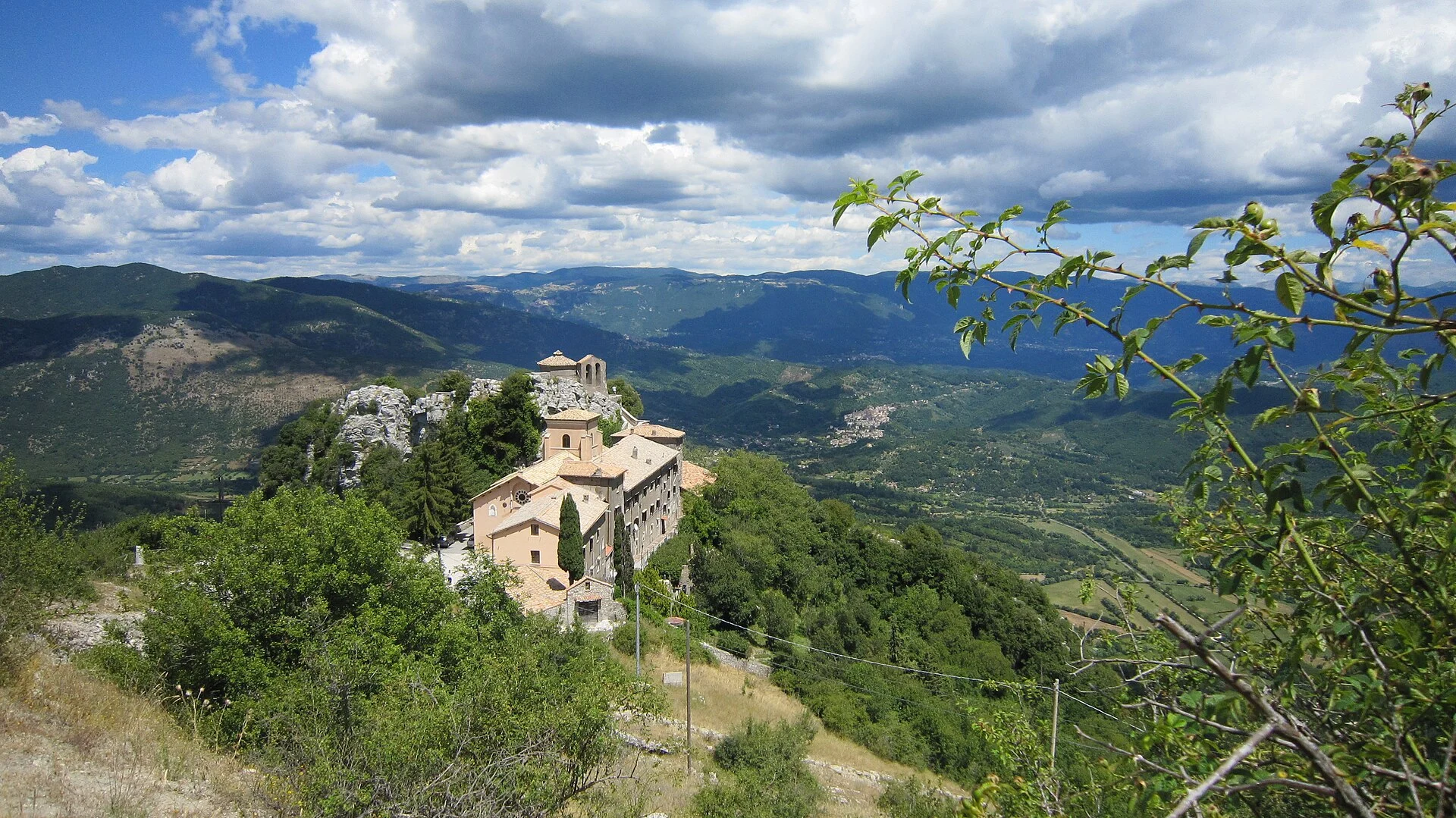
The Santuario della Mentorella is at Via della Mentorella 1, in Capranica Prenestina, on the flank of Monte Guadagnolo, and it is run by the fathers of the Congregation of the Resurrection, the Polish religious order that locals simply call the Resurrectionists. Entry is free, nothing needs to be booked for an individual visit, and information is requested by phone at 06 95471899 or by email at mentorella@tiscali.it, given in the entry of the Episcopal Conference.
The draw that brings most people up here is Karol Wojtyła. On October 29, 1978, two weeks after his election, the new pope left Rome for the first time and came here, to pray before a wooden Madonna carved around the 12th century. The second draw, older, is the crag where tradition places the conversion of Sant’Eustachio, the Roman general of the stag with the cross between its antlers.
The hours, Masses, contacts and road directions given here come from the check of September 28, 2026 on the sanctuary's website, on the portal of the Diocese of Tivoli and Palestrina and on the other institutional sources cited later in the text. In the mountains the hours change with the season and with the snow, and public transport is down to the bone: before leaving, phone the sanctuary and check the runs on the Cotral search engine.
Where it is and what you really see
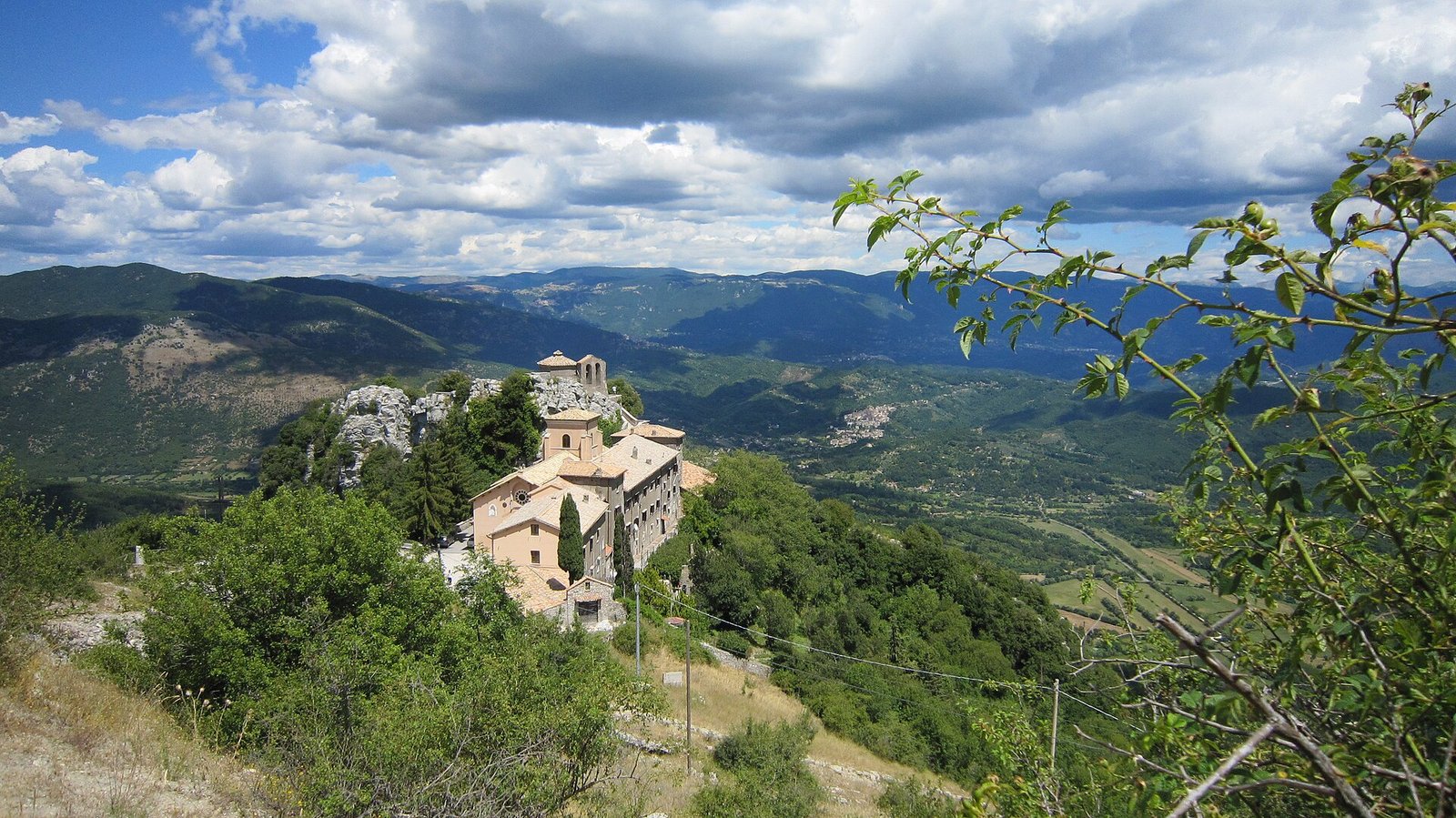
The sanctuary occupies a spur of rock in the Prenestini Mountains, between Tivoli and Palestrina, and looks almost sheer down on the Giovenzano valley. Administratively it belongs to Capranica Prenestina, but the inhabited center of reference is Guadagnolo, the only hamlet of the municipality, about two kilometers away by road. The municipal seat is almost 10 kilometers of hairpin bends from Guadagnolo.
On the altitude the sources do not agree. The entry of the Episcopal Conference and the free encyclopedia give 1,018 meters, Vatican News in 2025 wrote 1,218, the regional tourist portal speaks of 1,200 meters and another guide of 1,050. The difference depends on where it is measured, the church or the nearby summit. The practical fact is this: you are above 1,000 meters, and the temperature reminds you even in August.
The complex is not a single building. The regional portal describes it as five small blocks of masonry crowded onto adjoining rocky peaks, and it is the most honest definition. There is the church with three naves and a rose-window facade, the convent of the religious with the guesthouse, the 17th-century Scala Santa that climbs to the chapel of Sant’Eustachio, built on the rock, and under the chapel the natural cave that bears the name of San Benedetto.
Inside the church you see the wooden statue of the Madonna and Child, seated on a throne, in oak, which the sanctuary's sources date between the 11th and 12th centuries. Above the altar is a ciborium of 1305 enriched in the 19th century with Cosmatesque-style decoration. Under the altar a fragment of medieval pavement of the same school is preserved, and along the walls run frescoes from the 15th to the 19th century.
In front of the church entrance there is a bronze sculpture of John Paul II, and it is the point where almost all the groups stop. All around, the mountain is pasture, woods and limestone rock. There are no shops, there is no town attached to the sanctuary, and whoever arrives expecting a square of stalls as at certain lowland sanctuaries finds instead wind, silence and a few cows grazing along the road.
A curiosity about the Santuario della Mentorella
The name has nothing to do with a mentor. Medieval documents call the place Vultuilla, Bulturella, Vulturella, and the most widespread explanation links it to the Latin mons vulturum, the mountain of vultures or birds of prey. Through a corruption of pronunciation Vulturella would have become Mentorella. The municipality of Capranica also reports two other hypotheses, an early medieval tower or a Goth named Wult converted to Christianity.
The second curiosity is read on the bell tower of the chapel of Sant’Eustachio, a small bell tower with three bells rung by rope. Above it is an inscription worth the trip by itself: do not act as bell ringer if your heart does not beat like a Christian's. It is a warning addressed to whoever pulls the rope, and in a place where the sound of the bells is heard throughout the valley it has a very concrete sense.
The third concerns hearts. Under the high altar, by his express wish, the heart of the Jesuit Athanasius Kircher has been laid, the man who in the 17th century set the sanctuary back on its feet. In a marble case on the right column of the altar is instead preserved the heart of Pope Innocent XIII, Michelangelo Conti, who died in 1724. In the church also rest the remains of Cardinal Bernardo Maria Conti.
Documents, tradition and legend: three different things
I start from the legend, because it is the one always told first. Placidus, a Roman general in the time of Trajan, during a hunt on this mountain chases a stag and sees between its antlers the face of Christ, or a luminous cross depending on the version. He converts, takes the name Eustace, and later under Hadrian is martyred with his wife and children inside a red-hot bronze bull.
The same story is told in other places in Europe, and the stag with the cross between its antlers is the same one that accompanies Saint Hubert in the northern countries. Whoever wants to see the symbol in Rome finds it at the top of the facade of the Basilica of Sant’Eustachio, near the Pantheon, with the stag's head and the cross. The Mentorella claims the place of the vision, not exclusive rights to the story.
Then there is tradition, which is a step above legend because it rests on a continuous devotion. According to tradition, the emperor Constantine had the first chapel built on the site of the vision and Pope Sylvester I consecrated it. Also according to tradition, the young Benedict of Nursia lived two years in the cave under the crag before moving to Subiaco, and around the 6th century the Virgin supposedly appeared to some peasants of the area.
Finally the documents, which are few but solid. The Regesto Sublacense, the register of the abbey of Subiaco, reports a donation of the mountain to the monks attributed to Gregory the Great in 594. In 984 a Roman noblewoman named Rosa leaves the mountain by will to the monastery of San Gregorio al Clivo Scauro. In 1005 a bull of Pope John XVIII confirms Vultuilla among the properties of the abbey of Subiaco. Here history begins to walk on paper.
From that moment the news becomes more precise. Between 1219 and 1248 Bishop Claro of Tivoli laments the poor condition of the sanctuary. In 1390 church and convent are recorded as abandoned, and the decay lasts almost two centuries. The rest, that is Kircher's restoration and the arrival of the Polish religious, is documented in detail. Keeping the three levels separate takes nothing away from devotion, it only helps to understand what you are looking at.
One thing nobody tells you about the Santuario della Mentorella
The slogan you find in almost every guide is that the Mentorella is supposedly the oldest Marian sanctuary in Italy. I say it with respect for those who believe it: it is a catchphrase, not a historical fact. It rests on the Constantinian tradition, which no document confirms, and what's more the chapel attributed to Constantine was dedicated to Sant’Eustachio, not to the Virgin. The documented Marian cult comes later.
This does not make the place less serious, on the contrary. The remarkable thing is that a sanctuary on an isolated crag, abandoned in 1390, left in ruins for almost two centuries, confiscated by the State after 1870 and put up for auction in 1880, is still open every day with regular Masses. This continuity, which can be documented year by year, is a stronger argument than any record of age.
The second thing that is not said is that the statue of the Madonna was stolen. In 1972 someone carried it off from the church, and the Carabinieri found it after about a year. The Madonna you see on the throne today is therefore the recovered original, and in the throne was also placed the silver rose that Benedict XVI sent in 2007 for the 150 years of the Resurrectionists' presence.
The third concerns a work that almost everyone looks at distractedly, a medieval relief of the 12th century that the entries describe differently. One presents it as the work of Guglielmo da Chieti with the consecration of an altar by a pope, another as an oak panel with the apparition of the stag to Eustace. The sources do not agree on the subject: ask the fathers to show it to you and look at it with your own eyes.
My advice for visiting the Santuario della Mentorella
Come on a weekday, in the morning. The sanctuary's website indicates opening from 8:00 to 19:00 every day, and on weekdays the only Mass is at 16:00. This means that between 9:00 and noon on a Tuesday you have the church, the Scala Santa and the cave almost to yourself. On Sunday, with four Masses between 10:00 and 17:00, the parking lot fills with buses and the place changes nature.
Bring a jacket even in high summer and shoes with a real sole. The Scala Santa has worn steps, the path to the chapel of Sant’Eustachio and the cave runs over rock, and above 1,000 meters the wind can be biting. The regional tourist portal expressly warns to be careful during periods of snow, and in winter the road from Guadagnolo can become a serious problem.
Make the climb in silence at least for a stretch. The Mentorella is a place where people come to pray, not a museum with a custodian watching you. During the hours of Masses and confessions avoid wandering around the church, respect the signs in the convent areas and ask the religious before entering reserved spaces.
If you want to understand the place, phone ahead and ask if one of the fathers can accompany you for a few minutes. The entry of the Episcopal Conference lists among the services guided visits to the sanctuary, as well as spiritual retreats and spiritual direction. There is no published fee and no fixed calendar, so it depends on the community's availability. A free offering is the normal gesture, nobody will ask you for one.
Allow the right amount of time. The church can be seen in half an hour, but the Scala Santa, the chapel on the crag, the cave and the viewpoint bring the visit to a good hour. If you add the climb on foot to the summit cross or a stretch of trail, half a day is gone. Whoever arrives from Rome and leaves after 40 minutes has seen the parking lot and the bronze statue, little else.
Hours, Masses and how to get in
The sanctuary, according to the site run by the community, is open every day from 8:00 to 19:00, weekdays and holidays. Masses are at 16:00 from Monday to Saturday, and on Sundays and holidays at 10:00, 11:00, 12:30 and 17:00. On the first Saturday of the month at 17:00 there is the Mass for the sick. The rosary is recited half an hour before every Mass. Other sources indicate closing at 20:00: the operator's hours prevail.
Entry is free and there is no ticket office and no sales channel, official or third-party, for entering the church. Whoever offers you a ticket for the Mentorella is selling you transport or an escort, not access. The reference for any information is the sanctuary's website, with the phone number 06 95471899 also published by the diocese.
The portal of the Diocese of Tivoli and Palestrina adds other fixed appointments: Lauds at 8:30, Vespers at 16:00, the evening rosary at 18:00, Eucharistic adoration on Thursday at 16:30, and confessions between 10:00 and 12:00 and between 15:30 and 19:00. The hours of the two sources do not coincide in every detail, for example on the rosary, and it's best to have them confirmed by phone.
The main feasts listed by the entry of the Episcopal Conference are four: Mary Mother of Graces on the last Sunday of August, which in 2026 fell on August 30, Sant’Eustachio on September 20, San Benedetto on July 11 and Saint John Paul II on October 22. On feast days the Masses multiply, organized pilgrimages arrive and the parking lot fills early. Whoever seeks recollection chooses other dates.
For groups there is a possibility few know about. The convent has a guesthouse with 25 beds for organized groups and eight double rooms for priests, religious and lay groups, in particular scouts. People come for retreats and spiritual exercises, not for a vacation. The financial terms are not published and must be asked of the community directly, by phone or by email.
Inside the church: frescoes, coats of arms and altar
The church has three naves, and the sources date it in its current form to the 12th century, with many later alterations. The high altar preserves two small stone columns that the sanctuary's tradition attributes to the 4th century and to the first church of Sant’Eustachio. Above rises the ciborium of 1305, and at the top of the altar there is a wooden cross of the 19th century. The statue of the Madonna stands at the center of everything.
The frescoes should be read in layers. To the 15th century belong a Madonna and Child, Saint Dominic, Saint Michael the Archangel and Saint Anthony Abbot. To the 17th century, that is the Kircher period, the baptism of the emperor Constantine, the consecration of the church of Sant’Eustachio by Pope Sylvester, Saint Athanasius, the dream of Saint Joseph, Saint Ignatius of Loyola and Saint Francis Xavier. The two Jesuit saints are the signature of the man who directed the work.
Then there are the saints tied to the place and the mountain: Saint Benedict, Saint Scholastica, Saint Mary Magdalene, Saint Lucy, Saint Agapitus, who is the patron of Palestrina. To the 19th century belongs Saint Casimir, patron of Poland and Lithuania, the sign of the new masters of the house. Above the arches of the central nave you see the coats of arms of Innocent XIII, Gregory XVI, Pius IX and Leo XIII, and you have to look for them by raising your head.
The practical advice is to walk around the walls before sitting down, with the morning light coming in through the windows. The oldest frescoes are fragmentary and not all legible, and on foggy days the church is dark. No panel will tell you who is who, so keep the list of subjects at hand. If a father is free, ask him to point out Kircher in the iconography of the chapel of San Silvestro.
Guadagnolo and the monument to the Redeemer
Guadagnolo, according to the free encyclopedia, is the highest non-municipal inhabited center in Lazio, built on a limestone mountain above the sanctuary. It is a small town, with the square where the bus stops and a few stone houses. Whoever arrives by car passes through anyway, because the road to the Mentorella branches off just before the town. It is worth going up to the town even just to see the view from the other side.
On the mountain there is also the monument to the Redeemer, which Vatican News recalls as erected in 1889 at the wish of Leo XIII, the same pope whose coat of arms appears in the nave of the Mentorella. The sanctuary's website gives no directions for reaching it, so ask in town or the religious before setting out. It is a natural destination for those who add a short walk to the visit of the sanctuary and still have legs after the Scala Santa.
Who runs the sanctuary today
The Congregation of the Resurrection of Our Lord Jesus Christ was born in Paris on February 17, 1836, founded by Bogdan Jański with Piotr Semenenko and Hieronim Kajsiewicz, to assist the Polish exiles who fled after the failed uprising of 1830 and 1831. The first religious pronounced their vows in Rome in the catacombs of San Sebastiano during Easter of 1842. The sources give different dates, March 27 or April 3.
In 1857 Pius IX entrusted the sanctuary to them, and according to the diocese in 1864 the same pope granted ownership in perpetuity. Then came united Italy: after 1870 the State confiscated the properties, in 1880 it put the complex up for auction, and in 1883 the fathers bought back the church and convent for 8,500 lire, with Father Luigi Oldoini as first rector. Paying to get back a house that was already yours is a very Italian story.
Today the sanctuary is the main seat of the Resurrectionists in Italy and the spiritual center of the congregation, which also works in Rome, Pescara, Montecelio and Sant’Angelo Romano. The rector who welcomed Leo XIV in August 2025, according to Vatican News, is Father Adam Dźwigoń. The community's website has versions in Polish, English and Spanish, and this says a lot about who comes up here: Italian pilgrims from the nearby towns, Polish groups, foreign visitors.
Another well-known fact, yet rarely cited
Everyone knows Kircher restored the Mentorella, few ask what one of the most famous minds of Baroque Europe was doing up here. Athanasius Kircher, a German Jesuit born in 1602 and died in 1680, taught at the Roman College and dealt with everything: hieroglyphs, volcanoes, magnetism, music, Oriental languages, machines. His museum at the Roman College was one of the obligatory stops of cultured travelers of the 17th century.
According to the diocese and the municipality, Kircher began the work in 1660, with funding from the emperor Leopold I of Habsburg, other sources give 1661. In 1664 the annual feast of September 29 was established, and in 1665 Kircher published the Historia Eustachio-Mariana, the book that gathered documents and traditions on the origins of the sanctuary. Rebuilding the building and writing its history at the same time also meant giving shape to the tradition.
Kircher restored church and convent, built the chapel of Sant’Eustachio on the crag of the vision and the Scala Santa that climbs to it, and decorated the chapel of San Silvestro. Whoever wants to see the world he came from should look at the Church of Sant’Ignazio, built next to the Roman College. Part of the collections of his museum ended up in the state collections, among them the Pigorini Museum at the Museum of Civilizations.
The right photo to take at the Santuario della Mentorella
The photo is the one from the chapel of Sant’Eustachio looking down. Climb the Scala Santa, stand next to the small bell tower and frame vertically the drop of the crag with the Giovenzano valley below. The bell tower with the three ropes in the foreground gives the scale, the void below does the rest. It is the image that explains why someone chose to build right here.
The second framing is made from the access road, a few hundred meters before the parking lot, when the complex appears on the crag with its crowded blocks. It works better in the morning, with the sun coming from the east and lighting the stone. In the afternoon the sanctuary goes against the light and becomes a dark silhouette. Stop only where there is room to pull over, because the roadway is narrow.
Inside the church the right photo is the Madonna under the ciborium, but ask first if photography is allowed, and never during services. Avoid the flash, which flattens the wood and disturbs those praying. Outside, the bronze statue of John Paul II in front of the entrance is the shot everyone takes: if you really want it, take it from three quarters with the rose-window facade behind, not head-on.
How to get there from Rome by car
The sanctuary's website indicates about 53 kilometers from the center of Rome and an hour and a quarter of travel. The recommended route goes by the A1 highway: you exit at San Cesareo, head toward Palestrina, then toward Castel San Pietro Romano and Capranica Prenestina. In the square at Capranica you take provincial road 58a, Via di Guadagnolo, and before reaching Guadagnolo you turn left following the signs for the sanctuary.
Those coming from the A24, the Rome-L’Aquila, exit at Castel Madama, take provincial road 33 toward San Vito Romano, pass the Passo della Fortuna, continue on provincial road 50a and after Pisoniano take 59a to Capranica Prenestina. From there the directions are the same. This route is longer but crosses the most beautiful valley, and pairs well with a stop at Tivoli on the way out.
The last stretch is a mountain road. The connection of about two kilometers between Guadagnolo and the sanctuary was completed in 1961 and paved and inaugurated on October 22, 1967. Before then people climbed on foot or by mule. Today it can be driven without problems in a normal car, but with tight curves, livestock on the roadway and frequent fog in autumn. At night and with snow it's another matter.
The parking lot exists and is large. The Jubilee page of the Metropolitan City describes it as spacious and with access for buses, and indeed pilgrimages arrive by coach all the way to the top. No parking fee appears to be published. On weekdays you find a spot without difficulty, on Sunday morning and on the feast days at the end of August it's best to arrive before 10:00, when the festive Masses begin.
By public transport: possible, but it's an expedition
No bus reaches the sanctuary. There is a Cotral suburban line that connects Palestrina with Castel San Pietro Romano, Capranica Prenestina and Guadagnolo, but the runs are very few, designed for students and residents, and appear only on weekdays. At Guadagnolo the terminal is in Piazza Dante Alighieri. From there to the sanctuary there remain about 2.3 kilometers of paved road, downhill on the way out and uphill on the way back.
To get to Palestrina from Rome you take the Cotral runs that leave from the Anagnina terminal, on metro line A, or from Ponte Mammolo, on metro line B, bound for Genazzano, San Vito Romano or Olevano Romano. At Palestrina you change, and at the stop it's best to ask the driver where the run for the mountain passes. Times are searched with the Cotral timetable search engine, entering departure and arrival.
The verdict is blunt: by public transport you get there, but you risk being stuck at the top. With so few runs a day, getting it wrong by 10 minutes means missing the last useful chance to go down to Palestrina, and on weekends there is no service. Those who don't drive will do better to organize as a group, take a taxi from Palestrina or join a parish pilgrimage.
On foot: the trails that climb to the sanctuary
Walkers have many more options than those waiting for the bus. The sources on the sanctuary list several trails: the Pilgrims' trail from the Passo della Fortuna, at Ciciliano, in about three and a half hours, the Karol Wojtyła trail from Pisoniano in two and a half hours, the Creste trail from Capranica Prenestina passing through Monte Calo and Guadagnolo in four hours, and the one of Pope Gregory the Great from San Gregorio da Sassola.
The trail dedicated to Wojtyła, marked by the Italian Alpine Club, starts from Pisoniano, the town of the Hemp Museum. There is also an equipped trail named after Kircher, short, about half an hour, but reserved for expert hikers. There is also a nature loop of about three hours that starts and returns to the parking lot, suitable for those who arrive by car and want to walk without organizing the return.
A local association that organizes the climb from Ciciliano indicates about 14 kilometers round trip, 500 meters of elevation gain and four hours to go up. These are not walks for city shoes. You need enough water, you need a jacket, and you need to start early. In summer the sun on the ridge meadows beats down hard, in autumn the fog rises in a few minutes.
Some important events that happened here in history
The first documented event is the series of acts that tie the mountain to the Benedictines. The donation attributed to Gregory the Great in 594, the will of the noblewoman Rosa in 984 in favor of the monastery of San Gregorio al Celio, the bull of John XVIII in 1005 confirming the possession of Subiaco. For almost 1,000 years the Mentorella depends on the great abbey of the Aniene valley, until the passage to the Jesuits in the late 16th century.
The second is the 17th-century restoration. After the abandonment of 1390 and two centuries of ruin, Kircher begins the work in 1660, in 1664 Pope Alexander VII proclaims an extraordinary celebration and the feast of September 29 is fixed, and in 1665 the Historia Eustachio-Mariana comes out. From this moment the sanctuary resumes functioning as a pilgrimage destination, with the chapels, the Scala Santa and the 17th-century frescoes that can still be seen.
The third is the arrival of the Poles. In 1857 Pius IX entrusts the sanctuary to the Congregation of the Resurrection, after 1870 the State confiscates the properties, in 1880 puts them up for auction, in 1883 the fathers buy them back. On September 29, 1901 the Vatican Chapter solemnly crowns the statue of the Madonna. In 1947 the Scala Santa is renewed, between 1961 and 1967 the road from Guadagnolo is completed and paved.
The fourth is the season of the popes. On October 29, 1978 John Paul II chooses the Mentorella for his first outing from Rome after the election. The sources list seven other official visits up to 2000, besides many private climbs. Benedict XVI comes in a private capacity on October 29, 2005. On August 19, 2025 Leo XIV goes up from Castel Gandolfo, prays, visits the cave and has lunch with the religious.
In between are the less celebrated but decisive events for those who visit today. In 1972 the theft of the statue and its recovery by the Carabinieri about a year later. In 2000 the complete renovation of the complex for the Great Jubilee. In 2007 the 150th anniversary of the Resurrectionists' presence, celebrated on August 26 with Cardinal Zenon Grocholewski and the silver rose sent by Benedict XVI.
Who has passed through the Santuario della Mentorella
Sant’Eustachio, if you follow tradition, is first on the list, even though the documents say nothing about his story. His name remains tied to a crag, a chapel and a feast, September 20. Stronger is the link with San Benedetto, whom tradition has in prayer in the cave for two years before Subiaco, where the Sacro Speco and the Monastery of Santa Scolastica would later rise.
Athanasius Kircher passed through here more than anyone else in the 17th century, to the point of wanting to leave his heart here. The Jesuit who dealt with princes and emperors and received travelers from half of Europe in his Roman museum had himself buried, at least in part, in a mountain church. It is a detail that says far more than many biographies about the relationship between this man and the place he had rebuilt.
Innocent XIII, Michelangelo Conti, pope from 1721 to 1724, belonged to the family of the counts of Poli, whose fief was just below these mountains. Vatican News recalls his visit to the sanctuary, and his heart is preserved here. His coat of arms appears above the arches of the central nave together with those of Gregory XVI, Pius IX and Leo XIII, the popes who protected the sanctuary between the 18th and 19th centuries.
The Polish Resurrectionists have been here for almost 170 years, and have brought with them a part of their national history. Among the 19th-century frescoes appears Saint Casimir, prince and patron of Poland and Lithuania. The names of the rectors of recent decades are almost all Polish. This continuous presence explains why, when a cardinal of Kraków came to Rome, this mountain felt to him like a piece of home.
Karol Wojtyła is the name that brings the crowds up here. In the speech of October 29, 1978, published by the Holy See, the pope recalled having often visited the sanctuary during his Roman stays as bishop and cardinal, and explained that he had returned to pray. After him came Benedict XVI, in a private capacity, and Leo XIV, who in 2025 visited the so-called Pope's room, where an armchair used by his predecessors is kept.
John Paul II and the Mentorella: what is documented
The main document is the speech delivered here on October 29, 1978, which can be read on the website of the Holy See. The pope explains that he climbed the mountain following the example of Mary going to visit Elizabeth, and says that prayer is the first task of his service. It is a short text, and worth reading before you go up.
Then there are the later visits, listed by the free encyclopedia on the basis of the sanctuary's reports: March 31, 1979, December 28, 1987, April 17, 1990, December 27, 1991, December 30, 1996, October 28, 1997 and February 3, 2000. The frequency of dates between Christmas and New Year's is striking, when the pope's official calendar eased. Alongside these are the incognito climbs, which remain in local memory but not in the public records.
Here runs the thin line between document and story. That Wojtyła loved this place is certain, he said so himself. The incognito climbs, on the other hand, are reported by the free encyclopedia and the sanctuary's sources as visits that remained in local memory, without dates. Every detail added to those climbs, who was there, what he said, where he stopped, belongs to oral storytelling. It may be true, but it has neither a date nor a written source, and should be listened to as such.
On this point it is worth going against the current. The Mentorella is sold almost only as Wojtyła's sanctuary, and this does the place a disservice. Whoever goes up only for the bronze statue and the pope's room misses the crag of Sant’Eustachio, the cave, Kircher's frescoes and 1,000 years of Benedictine records. The Polish pope is the last chapter of a very long story, not the first.
Here is a practical point. You get off the coach, take the photo in front of the bronze, go into the church for five minutes and leave for the restaurant. On the way back nobody can say what was under the chapel or who painted Saint Casimir. Give the pope the time he deserves, but give the mountain at least an hour, because it is the real reason for the trip.
When it's closed and what not to expect
According to the operator, the sanctuary is open all year, every day. No closing days are published. The real problem is not the hours but the road: with snow and ice, between December and March, the climb from Capranica and the stretch from Guadagnolo can become impassable without chains or winter tires. In those months phone the same morning to find out the situation at the top.
Don't expect tourist services. There is no bookshop, no café inside open to the public, no audio guides or explanatory panels in foreign languages. The entry of an association that organizes visits indicates the presence of restrooms. Everything else, that is water, food and gas, has to be organized before going up, because Guadagnolo is a small town and the sanctuary is a place of prayer, not an equipped area.
On accessibility the situation is difficult by nature. The church is reached from the parking lot, but the Scala Santa, the chapel of Sant’Eustachio and the cave of San Benedetto are routes over rock and historic steps. An accessibility statement for the complex does not appear to be published. Whoever moves in a wheelchair or with mobility difficulties must ask by phone which spaces are reachable before setting out.
Eating in the area
Up here there are none of the traps of central Rome, and this should be said right away. The real risk is down in the valley, at the points where buses unload groups and on the busiest scenic terraces, as happens at any organized-trip destination. There the signs I know well appear, and they apply to any crowded destination in Lazio.
The first are menus with photographs of the dishes, laminated and translated into five languages. The second is the person at the door who stops you and invites you in: a place that has to look for customers on the street has no regular customers. The third is the lady rolling out pasta in the window, who is theater for the passerby, not a guarantee. Serious fresh pasta is made in the kitchen, in the morning.
Then there are places open continuously from morning to night with no kitchen break, menu items with no price, and a different price list between the outside tables and the dining room inside. Romans don't go there, and not out of snobbery: they know those places live off customers who won't come back. In the towns of the Prenestini Mountains good cooking exists, but it opens on tight hours and often only on weekends.
The criterion is simple: look at who is sitting. If at lunch on a weekday there are workers, town hall employees and local families, the place works. To avoid trial and error you can start from our list of the places where we eat ourselves, which is not sponsored and changes when the places change. In the mountains always phone before going up.
What to combine in a day
The most natural pairing is Palestrina. Going down toward the highway you pass below the Sanctuary of Fortuna Primigenia, one of the great terraced complexes of ancient Lazio, and the National Archaeological Museum with the Nile mosaic. Lower down, outside the historic center, the ruins of Hadrian's villa in Palestrina remain. Two sanctuaries 1,000 years apart, on the same mountain.
Those coming from the A24 can do the day in reverse, starting from Tivoli in the morning with Villa d’Este or Hadrian's Villa and going up to the Mentorella in the afternoon. The Villa Gregoriana Park is the alternative for those who prefer walking. All three require at least two hours, so they cannot be combined with the Mentorella on the same day.
For those who love small towns, Castel San Pietro Romano is on the way and has an enormous view over the plain. A little farther south are Genazzano, with its Selva, and Olevano Romano. At Rocca di Cave there is the fossil coral reef with the geopaleontological museum, a surprise for those traveling with kids.
Whoever does an itinerary of the sanctuaries of Lazio has a complete network. Toward the upper Aniene valley there are the Simbruini Mountains and the Sanctuary of the Most Holy Trinity at Vallepietra. In Ciociaria you go down toward the Trisulti Charterhouse and the Casamari Abbey, toward the Lepini there is the Valvisciolo Abbey, toward Viterbo the Sanctuary of Santa Maria della Quercia.
Those who instead want to stay on the Marian and Roman theme can close the circle in the city with the Sanctuary of Divino Amore and with Santa Maria Maggiore, the oldest Marian basilica in Rome. For the Benedictine theme, besides Subiaco, there is the Farfa Abbey in the Sabina. For the Wojtyła theme, St. Peter's Basilica, where he is buried.
Frequently asked questions
Do you pay to enter the Santuario della Mentorella?
No, entry is free. The sanctuary is a church run by the fathers of the Congregation of the Resurrection and has no ticket office. The parking lot too, described as spacious and with access for buses, has no published fee. For information you call 06 95471899 or write to mentorella@tiscali.it. A free offering in the church is welcome but nobody asks for it.
What are the Mass times?
According to the sanctuary's website the weekday Mass is at 16:00, Monday through Saturday, while on Sundays and holidays the Masses are at 10:00, 11:00, 12:30 and 17:00. On the first Saturday of the month at 17:00 the Mass for the sick is celebrated, and the rosary precedes every Mass by half an hour. The sanctuary stays open from 8:00 to 19:00 every day of the year.
Can you get there by public transport?
Only in part. No bus reaches the sanctuary. A Cotral line connects Palestrina to Capranica Prenestina and Guadagnolo, with very few runs and only on weekdays, and from the Guadagnolo terminal about 2.3 kilometers remain on foot. You reach Palestrina with the Cotral runs from Anagnina or Ponte Mammolo. Times must be checked on the Cotral search engine before leaving.
How long is the drive from Rome?
The sanctuary indicates about 53 kilometers from the center and an hour and a quarter of travel. You exit the A1 at San Cesareo and go up through Palestrina, Castel San Pietro Romano and Capranica Prenestina, then take Via di Guadagnolo and turn left for the sanctuary. Alternatively you exit the A24 at Castel Madama and go through San Vito Romano and Pisoniano.
Why was John Paul II so attached to this sanctuary?
In the speech of October 29, 1978, published by the Holy See, the pope tells of having often visited the sanctuary during his stays in Rome, before the election, when he was archbishop of Kraków and cardinal, in a sanctuary run by religious from his own country. It was his first outing from Rome after the election, and the sources list seven other official visits up to 2000, besides several private climbs.
Is it true that Sant’Eustachio converted here?
Tradition says so, not a document. According to the legend the Roman general Placidus saw on this mountain a stag with the face of Christ between its antlers, converted and took the name Eustace. According to tradition Constantine had the first chapel built and Pope Sylvester consecrated it. The documents on the mountain begin with the register of the abbey of Subiaco, at the end of the 6th century.
Can you sleep at the sanctuary?
The convent has a guesthouse with 25 beds for organized groups and eight double rooms for priests, religious and lay groups, in particular scouts, according to the entry of the Italian Episcopal Conference. It is hospitality designed for retreats and spiritual exercises. Rates are not published and availability is asked of the community directly, by phone or by email.
Is the sanctuary open in winter too?
Yes, the operator indicates opening all year, from 8:00 to 19:00. The winter problem is the road: above 1,000 meters snow and ice can make the last kilometers from Capranica and from Guadagnolo difficult, and the regional tourist portal expressly urges care during periods of snow. In the cold months it's best to phone the same morning and travel with winter equipment.
Who wrote this page
This page comes from the editorial team of Tour Leader Pro, the Rome-based outfit that designs itineraries, visits and cultural events between Rome and Lazio. The hours, Masses, contacts and connections given here come from the official sources cited in the text at the date indicated at the opening: in a mountain sanctuary they change with the season, so recheck them before leaving. Tell us what you find changed.
Going up to the Mentorella with a group means fitting together Sunday Masses, coaches on the hairpin bends, Cotral runs that vanish on weekends, snow in winter and lunches to book in towns that open on tight hours, for yourself or for 40 pilgrims. Whoever faces this kind of puzzle will find on Tour Leader Pro working materials designed for those who lead groups and for those who organize on their own.
For the wider picture, that is regional trains and seasonal timetables, rentals, airports, moving between one province and another and destinations in Lazio outside central Rome, from the Prenestini Mountains to the Aniene valley and on to the volcanic lakes of the north and the Tyrrhenian coast, a useful resource for putting together a multi-day itinerary is Italy Planner.