Sacro Speco of Subiaco, Monastery of St. Benedict
In short. The Sacro Speco is the Monastery of St. Benedict in Subiaco, and it hangs on the face of Monte Taleo at 626 meters, above the Aniene valley, held up by nine arches that keep it suspended over the void.
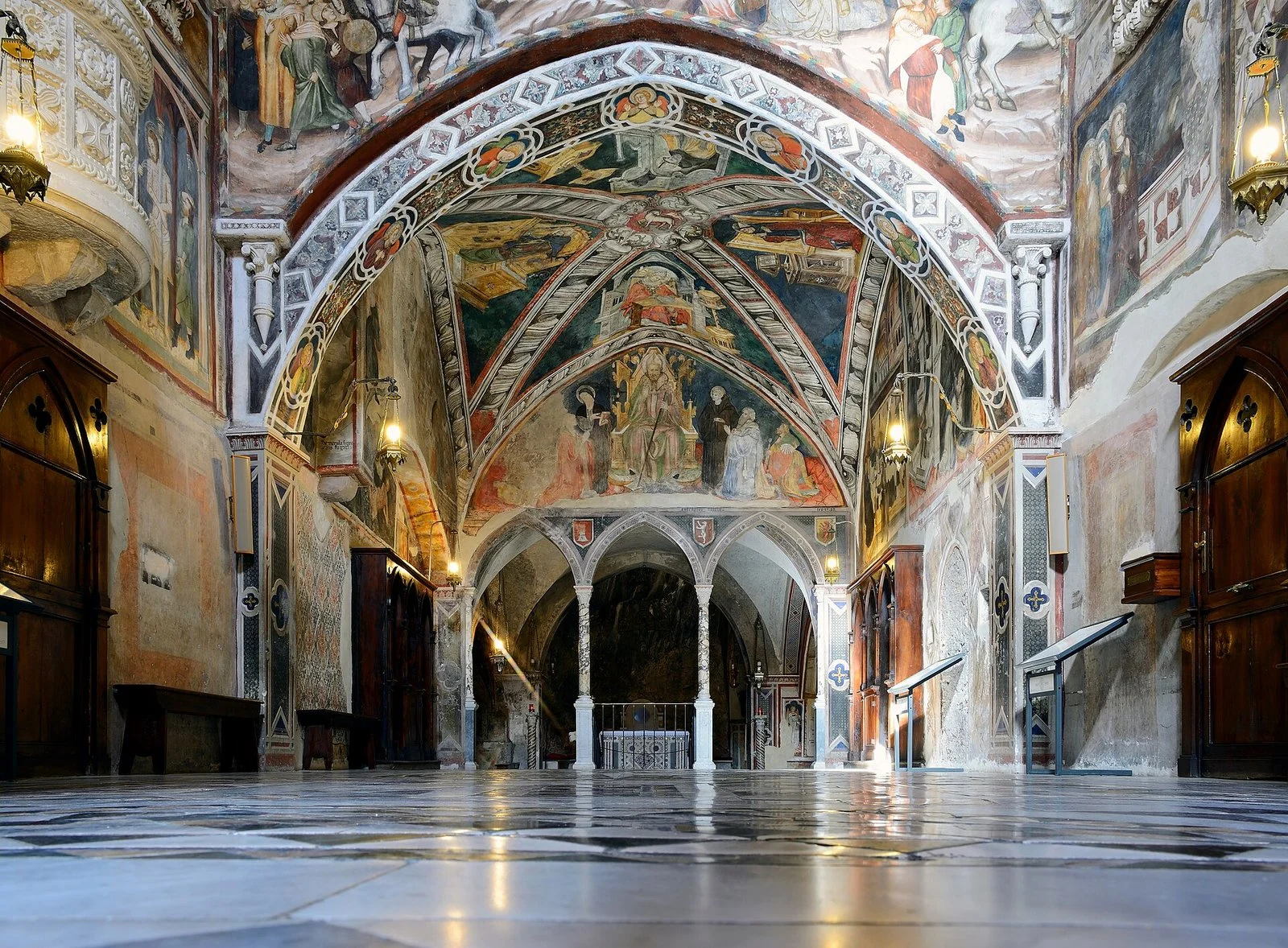
The Sacro Speco is the Monastery of St. Benedict in Subiaco, and it hangs on the face of Monte Taleo at 626 meters, above the Aniene valley, held up by nine arches that keep it suspended over the void. Pope Pius II, who saw it in 1461, compared it to a swallow’s nest, and it's still the most exact description of it there is. Inside there isn't one church: there are two, one above the other, plus a series of chapels and caves cut into the rock, and on almost every available surface there are frescoes ranging from the 8th to the 15th century. The page on Subiaco covers the town, not the monastery: here we talk about the monastery and how things really stand, including the things the guides tell badly.
Anyone who climbs up here finds a living place of worship, with a monastic community that lives in it, not a museum. Visits are limited, you enter accompanied and at certain hours you don't enter at all. On this page you'll find the hours verified on the official website, the divergences between sources when there are any, how you really get here from Rome without a car, what Book II of the Dialogues of Gregory the Great says and where the hagiographic account ends and the little that history can say begins, the open question of the portrait of St. Francis, and the second monastery, that of Santa Scolastica, with the story of the first Italian printing press.
Where the Monastery Is and What It Is
The address is Piazzale San Benedetto, in Subiaco, province of Rome, on the slope of Monte Taleo inside the regional natural park of the Simbruini Mountains. Subiaco is a municipality of just over 8,000 inhabitants at 408 meters of elevation, and the monastery sits quite a bit higher than the town, on a road that climbs in hairpin bends along the flank of the mountain. The current name, Sacro Speco, indicates the cave around which the whole complex grew: speco is the Latin specus, cave.
The official name remains the Monastery of St. Benedict, and it's worth keeping the two apart because in Subiaco there are two Benedictine monasteries, distinct and far from each other. The other is the Monastery of Santa Scolastica, lower down, at 530 meters, and it's the one with the three cloisters and the library. Anyone who says they went to Subiaco and saw the monastery has often seen only one and doesn't know which.
How You Get There From Rome, for Real
Subiaco is about 70 kilometers from Rome toward the east, and the first fact to make clear is that there is no railway. The line that linked Rome to Subiaco was dismantled decades ago, so anyone looking for a train wastes time. Two roads remain: the car and the intercity bus.
By Car
The normal route is the A24 motorway toward L’Aquila, exit Vicovaro Mandela, then the road that goes up the Aniene valley to Subiaco and from there the climb to the monasteries. The real time, without traffic and without stops, is a little over an hour from the Grande Raccordo Anulare. The final part is all curves: anyone prone to carsickness finds out in the last kilometers. The exits toward Arsoli and Anticoli Corrado serve other valleys and shorten nothing.
By Cotral From Ponte Mammolo
The regional bus leaves from the Ponte Mammolo terminus, on Metro Line B, and arrives in Subiaco at Piazza Falcone. The travel time given by the schedule comparison sites is around an hour and a quarter, with frequent runs on weekdays and noticeably sparser service on Sundays and holidays, which is exactly the day most people would want to go. Schedules change with the school calendar and should be checked on the carrier’s website the day before, not in the guidebooks. For the general picture of Roman transport, including Metro B that takes you to the terminus, there's our page on getting around Rome.
The serious problem comes after. The bus drops passengers in the center of Subiaco, not at the monasteries, and between the town square and the Sacro Speco there are kilometers of climbing. The local connection exists but is designed for residents, with few runs: anyone counting on arriving by bus at 11:00 and leaving at 13:00 risks spending the useful time walking along the provincial road. The honest solution for anyone without a car is to budget for a local taxi for the last stretch, or two and a half hours of walking round trip.
Walking Up, and the Path Nobody Uses
There is a pedestrian route linking the two monasteries, and it's called Via Benedicti. It starts at Santa Scolastica, at 530 meters, and arrives at San Benedetto, at 626 meters: less than 100 meters of elevation gain, about half an hour of walking, among stone staircases, stretches of mule track and two crossings of the provincial road. The path is marked, passes votive shrines and a jubilee monument with the statue of the saint, and comes out just below the monastery entrance. It's the best way to get there, and a minority of visitors do it.
Anyone who drives all the way up finds a parking area in front of the portal leading into the monastery area, on a slight slope, isolated and quiet, from which you continue on foot anyway along an uphill lane for a few minutes. There is no shuttle, no elevator, no way to get to the church door by car. On high-season Sundays and on Benedictine feast days the parking area fills early: anyone arriving at noon on a March 20 may end up parking quite a bit lower down and doing the whole climb.
Hours, Closures, Reservations and Visit Rules
The hours published by the website dedicated to the monastery indicate morning opening from 09:00 to 12:30, with last entry at 12:00, and afternoon opening that varies by season: from November 2 to March 31 from 15:00 to 17:00 with last entry at 16:30, from April 1 to November 1 from 15:00 to 18:00 with last entry at 17:30. On Sunday morning part of the sanctuary stays closed to the public for the celebrations, set for 08:30 and 10:00.
Where the Sources Don’t Agree
The sources differ on the hours, and the difference isn't a matter of a few minutes. The general portal of the Sublacense Benedictine monasteries gives 09:30 to 12:15 and 15:30 to 18:15 for the summer season, and the same range appears on several regional tourist portals. The specific website of the Monastery of St. Benedict gives instead the wider ranges indicated above. We can't say which of the two is in force on the day you read this: a phone call to 0774 85039 remains the only serious way to know before leaving, and it costs less than a wasted trip.
You Enter Accompanied, and It’s Not Optional
Being accompanied by a monastery guide is mandatory for safety reasons. The route runs through steep stairs, passages cut into the rock, low thresholds and tight spaces where a person who wanders from the group is really at risk. Anyone who imagines wandering on their own to photograph at leisure needs to change their mind before going up: you go forward with the group and at the group’s pace. Entry to the sanctuary has no ticket, and offerings remain offerings.
Dress and Small Rules
Shoulders must be covered and trousers or skirts must reach the knee. It isn't a formality: in front of the entrance you sometimes see people sent back on hot July days. Photographs are allowed without flash, for obvious reasons of fresco conservation. Dogs are admitted only if small and carried in arms or in a carrier. The complex also includes a shop with honey, liqueurs and books produced or edited by the community.
Benedict in the Cave: The Account and the History
The story everyone knows comes from a single book, and it's best to say so right away. Book II of the Dialogues of Gregory the Great, written toward the end of the 6th century, that is about 50 years after the death of its protagonist, is the source from which everything we know about Benedict of Nursia descends. Treccani, in its entry on him, is explicit: the reliable facts about the saint’s life are rather scarce, and all reliable information derives from that text. The later medieval biographies add nothing well founded.
What a Hagiographic Text Is
Gregory the Great wasn't writing a biography in the sense we understand today. He was writing an edifying work, built to show that holiness was still at work in Italy in the years of the Gothic wars, and organized by exemplary episodes and miracles. Inside a text of this kind the material fact and the spiritual meaning aren't separate and aren't meant to be. Anyone who reads the Dialogues as a chronicle gets the literary genre wrong, and anyone who throws them out as a fable loses the only testimony we have.
Romanus and the Basket Lowered From the Cliff
The most famous episode is also the one that makes sense of the architecture of the place. According to the Dialogues, the very young Benedict leaves Rome and his studies, goes up the valley and hides in a cave in the rock face. A monk named Romanus, who belonged to a nearby community, discovers the retreat, gives him the monastic habit and for three years provides for feeding him by taking part of his own ration and lowering it along the wall in a basket tied to a rope. A little bell was attached to the rope, which served to warn the recluse that food was arriving.
The detail worth keeping in mind, while standing in the monastery, is that that wall is the wall in front of you. The account also says that the devil, annoyed, broke the bell with a stone. None of these elements is verifiable, and none of them is irrelevant: they are the narrative framework on which the whole sanctuary was designed and built centuries later, chapel after chapel. When the guide points out the Grotta dei Pastori and the Speco, they are showing you the topography of a text.
The Three Years, and Then What
Again according to Gregory, after the period of seclusion Benedict is discovered by some shepherds of the area and his fame spreads. The monks of a cenobium in the valley, which the sources place at Vicovaro, call him to lead them and then, impatient with the discipline he demands, try to poison him. Benedict returns to Subiaco and organizes 12 small monasteries of 12 monks each, keeping the direction of them. Around 529, because of the hostility of a priest named Florentius, he leaves the valley and goes south, where he will found Montecassino.
The Montecassino abbey is therefore the second chapter, not the first, and this is the point they rightly like to recall in Subiaco. The current dates for the saint’s life, birth at Norcia in 480 and death on March 21, 547, are the dates of tradition and should be taken as such: there is no document that fixes them. Anyone who wants to do the route in full will find the Briganti Way and the network of Apennine itineraries crossing the same territory.
Of the 12 Monasteries, What Remains
Of the 12 monasteries of the valley practically nothing recognizable remains. The Saracen raids of the 9th century devastated the Subiaco complex, and what you see today is the result of later reconstructions promoted by the popes between the 11th and 14th centuries. The Sacro Speco in its current form is a medieval sanctuary built around a memory of the 6th century, and not a building of that century. Confusing the two is the mistake you hear repeated most often in the corridors.
The Building Set Against the Wall
The complex is set into the rock overhanging the valley and rests on nine tall arches, some of them pointed, which form the base visible from below. Inside there is no readable plan: there is a succession of rooms at different levels, churches, chapels and caves, many of them carved directly into the stone. The visitor loses orientation in the first five minutes, and that's normal.
The Entrance Corridor
You enter from a vaulted corridor that looks out over the Aniene valley, decorated with early 1500s frescoes attributed to the circle of Perugino. It's the point where it's worth stopping 30 seconds longer than the group allows, because it's the only moment when you understand the height at which you are walking.
The Upper Church
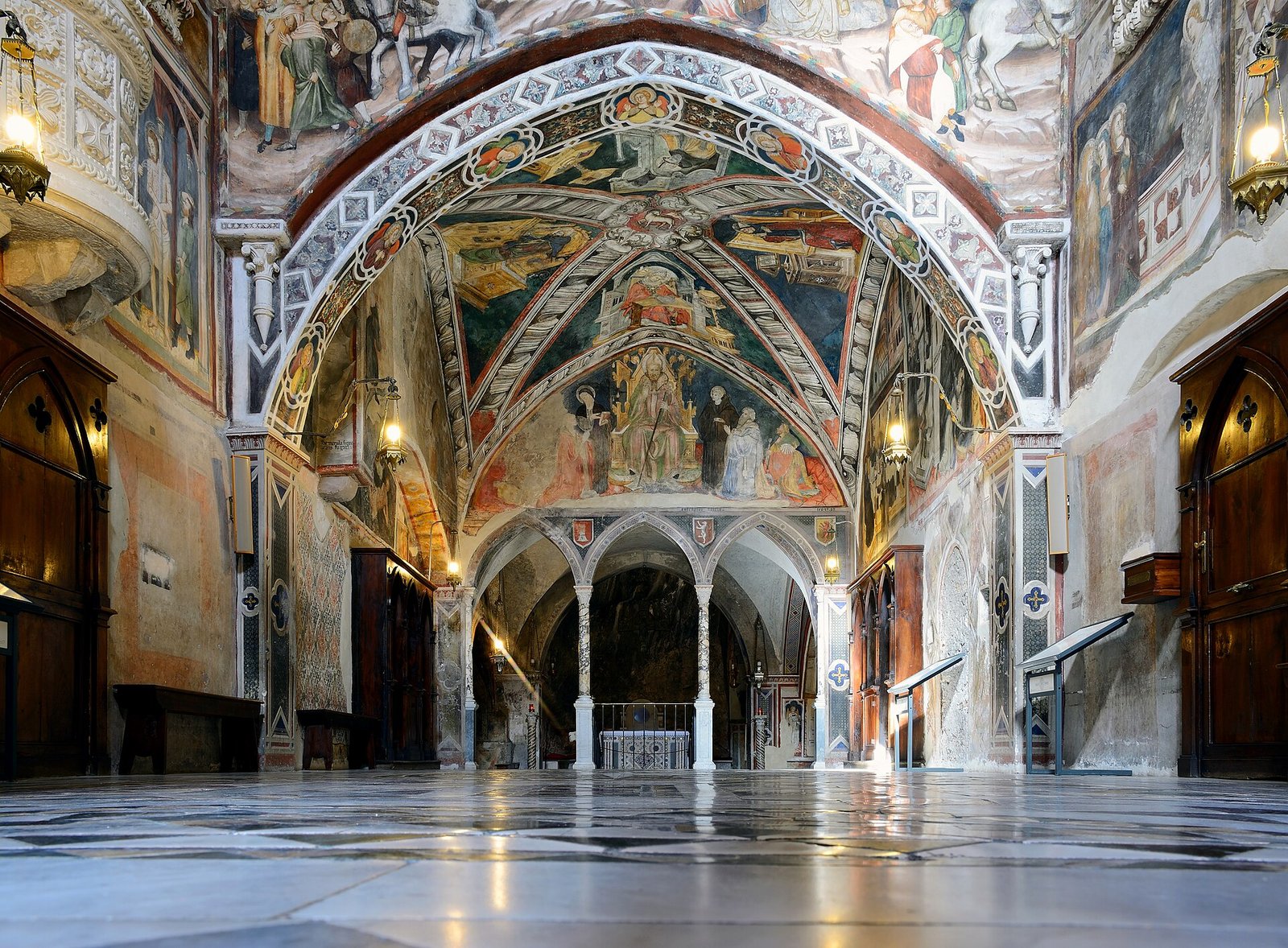
The upper church dates to the 14th century and is divided into two bays. The first has a ribbed cross vault and keeps Sienese-school frescoes with stories from the life of Christ, including a Crucifixion facing the entrance. The second bay is decorated with paintings from the Umbrian-Marchigian circle of the first decades of the 1400s, dedicated to the life of St. Benedict. The two hands can be told apart with the naked eye even without specific expertise: the colors change, the drawing of the figures changes, the rhythm of the scenes changes.
The Lower Church
From the upper church you go down to the lower church by a staircase that starts next to the altar. The lower church is entirely frescoed by painters linked to the Roman Benedictine school, and includes a Madonna and Child among angels attributed to the painter who signs as Magister Conxolus. The side walls unfold narrative cycles with episodes from the saint’s life. Below, incorporated in the building, is the cave.
The Speco
The cave is small, irregular, cold even in August, and contains a statue of St. Benedict made by Antonio Raggi in 1657. It's the point around which everything else was built, and it produces two opposite reactions in visitors: those who expected something monumental are thrown by the size, those who understand what they are looking at would spend half an hour there. The Baroque statue inside the cavern is a violent and intentional break.
The Scala Santa and the Chapels
The Scala Santa is the medieval route that originally linked the Grotta dei Pastori to the Speco, and today it's one of the most interesting stretches of the visit. On its walls there are 14th-century frescoes with the Encounter of the Three Living and the Three Dead and a Triumph of Death, that is two of the most widespread macabre themes in 14th-century Europe. Seeing them here, in a narrow and dim space, is a different experience from seeing them reproduced in a textbook.
The minor chapels complete the route. The chapel of San Gregorio is cut into the rock and houses the portrait we discuss in the next chapter. The chapel of the Madonna, near the Scala Santa, keeps scenes of the Annunciation. The Grotta dei Pastori, which was the original entrance to the sanctuary, holds a Madonna and Child dated between the 9th and 10th century, that is one of the oldest pieces in the complex.
The Frescoes: Schools, Masters and Dates
The painted decoration of the Sacro Speco covers a very long span, from the first Byzantine-circle testimonies attributed to the 8th century to well into the 1400s. The most important cycles are concentrated in the 13th and 14th centuries and revolve around three thematic cores: the Passion of Christ, the life of the Madonna and the life of St. Benedict. There is no unified program, because there was no single building campaign.
Magister Conxolus
The name that appears most often is that of Magister Conxolus, a painter active in the second half of the 1200s in the Rome and Lazio area, to whom works in other churches of the region are also attributed. His signature in the monastery has notable documentary value, because in Italian painting of that period signatures are rare. Almost nothing is known of his biography, and the attributions given to him vary from scholar to scholar.
The Umbrian-Sienese School and Its Problems
The formula Umbrian-Sienese school, which you read everywhere about the Sacro Speco, is a descriptive convenience more than a rigorous category. The sources we consulted actually distinguish at least three different things: a 14th-century master of Sienese culture who paints the scenes of the Passion in the upper church, a group from the Umbrian-Marchigian circle that works in the early 1400s on the Benedictine stories, and the Roman-Benedictine workshop of the lower church. Saying just Sienese flattens distinctions that you can see by eye.
The Portrait of St. Francis, and Why the Question Remains Open
In the chapel of San Gregorio there is the figure of a standing friar, in a tunic tied with a cord, with a tall hood and a scroll in his left hand. At his feet appears a smaller monk, probably the patron. Next to the figure is the inscription FRATER FRANCISCUS. The figure has no halo and no stigmata. On this image one of the most repeated claims of Italian cultural tourism has been built: that it is the oldest known portrait of Francis of Assisi.
The Argument of Those Who Support the Early Date
Those who propose the earlier date reason like this. Francis received the stigmata in 1224 and was canonized in July of 1228: an image lacking both signs, stigmata and halo, must necessarily precede those events, otherwise the painter would have had no reason to omit them. Local tradition places a visit by Francis to Subiaco in 1223, under the abbacy of John VI, who ran the monastery between 1217 and 1227, and makes the fresco a portrait from life, or at least an immediate memory of that passage. In this reading the inscription calls him simply friar, not saint, and it is the strongest proof in favor.
The Argument of Those Who Support the Late Date
The entry in the General Catalogue of Cultural Heritage of the Ministry of Culture says something else. It records the work under the conventional name of Master of Brother Francis, a 13th-century painter of Roman culture, and dates it between 1228 and 1229, explicitly writing that the traditional dating to 1224 must be corrected. The argument rests on an inscription in the chapel recalling the consecration by Cardinal Ugolino, that is the future Gregory IX: if the chapel was consecrated on that occasion, the decoration can’t be earlier. The same entry recalls that Pietro Toesca placed this hand alongside the Third Master of the crypt of Anagni cathedral.
What Still Stands
The two positions can’t be reconciled, and we are not in a position to choose between them. Some points remain firm. The portrait is in any case among the oldest in existence, even accepting 1228 or 1229, because Franciscan figurative production begins practically in those years. The absence of halo and stigmata is a real and notable iconographic fact, which some scholars explain not by chronology but by context: this is a Benedictine monastery, and Franciscan iconography arrives here in a form still uncertain and set apart. A recurring comparison is with the oratory of San Pellegrino at Bominaco, in Abruzzo, where a Francis appears with a halo but without stigmata.
Anyone who wants the title of oldest known portrait, in short, has to accept that it's a contested title and not a measurement. The datable Franciscan works of the immediately following decades, starting with the painted Tuscan panels of the 1230s, enter the same competition. Anyone passing by the church of San Francesco a Ripa in Rome, where the saint stayed according to tradition, meets another Roman Franciscan memory with verification problems of the same kind. The sanctuary of Greccio, in the Rieti area, keeps another Franciscan memory with the same documentation problems.
A Curiosity About the Sacro Speco di Subiaco
The phrase with which the monastery is presented in half the world is not by an art critic but by a pope on the road. Enea Silvio Piccolomini, Pope Pius II, climbed up here in 1461 and in his writings compared the complex to a swallow’s nest stuck to the wall. The image has been enormously successful and has been repeated for five and a half centuries, often by people who don't know whom they owe it to.
The interesting thing is that the description is technically exact. Swallows build by resting the nest on a vertical surface and leaving it suspended over the void, which is exactly the static principle of the nine arches on which the monastery stands. Pius II had excellent Latin prose and the eye of a real traveler: he spent a good part of his pontificate going around Italy and described the places he saw with a precision rare in the literature of his time.
Something Nobody Tells You About the Sacro Speco di Subiaco
Very few monks live here. The community that inhabits the Sacro Speco is reduced to a handful of people, and every year the sanctuary receives tens of thousands of visitors. The ratio between the two numbers explains almost everything a visitor finds strange: the split hours, the afternoon closing window, the limited access, the partly closed Sunday morning, the fact that nobody lets you wander alone.
The practical consequence is that the Sacro Speco doesn't work like a state museum and doesn't behave like one. There's no reservations office with a 24/7 switchboard, no audio guides in 12 languages, no shift staff. There is a religious community that opens its home at certain hours and closes it again at others, and that now and then closes it again for reasons that won't be explained to you. Taking this as a lack of service means you misunderstood where you went.
The second consequence concerns silence. At peak hours, between 10 and noon on a spring Sunday, the sanctuary is full of groups crossing paths in the narrow corridors and the noise booms against the rock. Anyone looking for the atmosphere they expected has to arrive at opening or at the last afternoon entry, and on a weekday.
My Advice for Visiting the Sacro Speco di Subiaco
Do the two monasteries on the same day, but in this order: first Santa Scolastica, then San Benedetto, and the stretch in between on foot along Via Benedicti. There are three reasons. The first is that Santa Scolastica, with its three cloisters and its library, explains the historical context that the Sacro Speco takes for granted. The second is that the half hour of uphill walking puts you in the right physical condition to understand where you are going. The third is that this way you avoid peak parking.
The Timing That Works
The morning opening, arriving at 9 sharp, is the best slot by far. The light enters the entrance corridor, the organized groups haven't come up yet and the interior temperature is bearable even in summer. The second choice is the last hour of the afternoon, but you have to watch the last entry time, which in winter falls at 16:30. Showing up at 16:45 on a Tuesday in January means finding the door closed.
What to Bring
Closed shoes with a sole that grips, because the stone steps are smooth and in places damp. A sweatshirt even in July, because in the caves the temperature difference is several degrees. Clothing that respects the rule of covered shoulders and knees, without having to resort to improvised fixes in front of the entrance. Cash, because in the monastic shops the terminal doesn't always work and the phone signal up there is what it is.
Another Well-Known Fact, Yet Rarely Cited
Subiaco is the place where printing was born in Italy, and almost nobody connects it with the monastery while visiting it. In 1465, in the monastery of Santa Scolastica, two German clerics put into operation the first printing press active on Italian soil. The fact is known to specialists and appears on all the ministry entries, but in the current tourist narrative it is squashed by the story of Benedict, which is older and easier to tell.
The link between the two things is not accidental. Benedictine monasteries were, in 15th-century Europe, the places where books were copied and kept, and Subiaco already had a substantial library: at the end of the 1300s the sources speak of a holding on the order of 10,000 volumes. A printing press that arrives in a monastery doesn't arrive just anywhere: it arrives where the book trade already existed in another form. We devote a chapter to this story further on.
The recognition came recently. Subiaco was proclaimed Italian Book Capital 2025, announced by the Ministry of Culture in December 2024, and the citation explicitly mentions the 1465 press and the typographic style that bears the town’s name.
The Right Photo to Take at the Sacro Speco di Subiaco
The photograph that tells this place isn't taken inside, it's taken from outside and from below. You have to go down to the road, move a few hundred meters down toward the valley and turn around: from there you see the entire white block glued to the gray wall, with the nine arches lifting it off the void and the woods climbing around it. It's the only frame in which you grasp the building madness of the operation, and almost nobody looks for it because they drive up to the parking area and don't look back.
The Light
The wall faces in such a way that in the early morning hours the complex stays in shadow and the rock above is already lit, which produces a contrast that is hard to handle. The best moment is late afternoon in the warm season, when the light comes in raking and separates the arches from the background. In winter the useful window is very narrow and almost coincides with closing time.
Some Important Events That Happened Here in History
The chronology of this place rests on a few fixed points and many traditions. We separate them, because the distinction matters.
Before the 6th Century
Nero has an imperial residence built in the valley, arranged in at least five nuclei on the two banks of the Aniene, damming the river with monumental dams and creating three artificial basins. Tacitus, in the Annals, recalls the emperor at a banquet near the Simbruina stagna, in the villa called Sublaqueum. Pliny the Elder speaks of three lakes famous for their beauty. This is the ancient literary evidence, and it is confirmed by the remains on the ground.
Around 500
Benedict retreats into the cave. The date is traditional and has no documentary support. In the same period, again according to Gregory the Great, the 12 monasteries of the valley are born.
9th Century
Saracen raids devastate the Subiaco complex. It's the moment of rupture that separates the ancient phase from everything you see today.
11th, 12th and 14th Centuries
Popes and abbots promote the reconstruction and decoration of the sanctuary. The lower church receives the cycles of the workshop of Magister Conxolus in the second half of the 1200s, the upper church is built and frescoed in the 1300s, the Scala Santa is decorated with the macabre themes of the 14th century.
1223 or 1228
The figure of Brother Francis is painted in the chapel of San Gregorio. The date is contested, as we explained above.
1461
Pius II visits the monastery and coins the definition destined to last.
1465
At Santa Scolastica the first Italian printing press goes into operation.
1657
Antonio Raggi sculpts the statue of St. Benedict placed inside the Speco.
Who Passed Through the Sacro Speco di Subiaco
The most debated passage remains that of Francis of Assisi, which local tradition places in 1223 and which is far from established. The early Franciscan sources do not record it explicitly, and those who support it rely mainly on the fresco and on the monastery’s memory. We report the tradition and point out that it is tradition.
Popes
Pius II in 1461 is documented. Before and after him the Subiaco valley received continual papal interventions, because the territorial abbey of Subiaco was for centuries an entity of importance in the ecclesiastical geography of Lazio, with jurisdiction over a wide territory. The Spanish cardinal Juan de Torquemada, Giovanni Turrecremata in Italian, was commendatory abbot and it was he who called the two German printers to Subiaco.
Travelers and Painters
From the late 1700s and throughout the 1800s the upper Aniene valley was a fixed destination for the northern European landscape painters working in Rome. The phenomenon concerns the entire area: Olevano Romano and Anticoli Corrado have a documented and continuous history of artists’ colonies, and Cervara di Roma owes its 19th-century fame to the same movement. The Sacro Speco appears in dozens of views and engravings of that period, often with exaggerated proportions of the rock wall.
The Rose Garden and the Tradition of the Brambles
In the outer area of the monastery there is a rose garden, and it's the place tied to one of the most told stories of the sanctuary. According to the Dialogues, Benedict, to overcome a violent temptation, threw himself naked into a thornbush. The current rose garden is said to mark that place. The later tradition adds the second act: Francis of Assisi, during the visit of 1223, supposedly grafted thornless roses onto those brambles, which have bloomed ever since.
What Can Be Said and What Can’t
The episode of the thornbush already appears in the oldest source, that is Gregory the Great, and as such belongs to the original hagiographic framework. The Franciscan graft, on the other hand, is later local tradition, with no match in the early Franciscan sources, and it overlaps with an analogous legend documented at the Porziuncola of Assisi, where thornless roses are tied to an episode in the life of Francis. That the same story appears in two different places is in itself a significant fact: it points to a circulating narrative motif, not a localized fact.
What You See in Practice
Out of season, the rose garden is a patch of ground with pruned shrubs and nothing visually notable. Anyone arriving in February expecting a flowering garden is disappointed. The bloom, on the old roses, is concentrated between late spring and early summer, and has to be looked at knowing what it represents, otherwise they are just roses. The point of this stop is the story, not the botany.
The Other Monastery: Santa Scolastica and Its Three Cloisters
The Monastery of Santa Scolastica, lower down on the same road, is the only one of the 12 Benedictine monasteries of the valley to have survived continuously, and this makes it one of the oldest monastic complexes in Italy still functioning. Over the entrance is the motto Ora et labora. Inside, the sequence of the three cloisters is a manual of Italian architecture in three lessons.
The Cosmatesque Cloister
The oldest of the three is the Cosmatesque cloister, built in phases over the course of the 13th century. The name comes from the Roman craftsmen specialized in marble inlay who worked for generations in Rome and Lazio, and who left twisted colonnettes and mosaic decoration here. Anyone who has seen the Roman cloisters of the Cosmatesque circle recognizes the hand at once.
The Gothic Cloister
The Gothic cloister is from the 14th century and has a completely different character: pointed arches, pillars, an austerity that clashes with the richness of the previous one. On the north side of this cloister the library opens.
The Renaissance Cloister
The third cloister is 16th-century, with the regular proportions and round arches of its era. The bell tower of the complex, on the other hand, is Romanesque, from the 12th century, and the church was entirely rebuilt at the end of the 1700s, which produces the stylistic break that visitors find most disconcerting.
Practical Information
The hours of Santa Scolastica are different from those of the Sacro Speco and must be checked separately, at 0774 85525. The library, which is a state library, has yet another schedule: Thursday, Friday and Saturday from 08:30 to 15:00, reservation required. Anyone who arrives hoping to enter the library on a Sunday doesn't get in. The complex also hosts a guesthouse with dining service, which is the reason why the subject of eating in the area has to be approached in a particular way, as we do further on.
1465: The First Books Printed in Italy
In 1464 two German clerics arrive in Subiaco, Corrado Sweynheym, from Eltville near Mainz, and Arnoldo Pannartz, probably from Prague. Cardinal Giovanni Turrecremata, commendatory abbot, calls them. They come from the area where movable-type printing had been born only a few years earlier and they bring the craft with them. In 1465 the press is running inside the monastery of Santa Scolastica.
What They Printed, in Order
The first product was an elementary Latin grammar, the Donatus pro puerulis, of which no copy survives: we know it from indirect sources. The first printed book in Italy that survives is therefore Cicero’s De oratore, finished before September 30, 1465. Next comes the Lactantius, which came off the press on October 29, 1465, and collects three works: De divinis institutionibus, De ira Dei, De opificio hominis. The last Subiaco edition is St. Augustine’s De civitate Dei, dated June 12, 1467.
Then the Two Leave
Sweynheym and Pannartz left Subiaco for Rome, where they continued their activity on a much larger scale. On the date of the move the sources differ: some give 1467, right after the Augustine, others 1468. The estimated print runs of the Subiaco editions are between 275 and 300 copies per title, which for the era is an enormous quantity of identical books and for us is very few. The typeface they used, halfway between German Gothic and humanist roman, went down in history as the Subiaco style.
What Remains in Subiaco Today
This is the part the guides get wrong most often. The State Library of the National Monument of Santa Scolastica holds 192 incunabula editions in 206 copies. Of the Subiaco production it has the Lactantius of October 29, 1465 and two copies of the De civitate Dei of June 12, 1467, for which the manuscript used in the print shop is also preserved, which is as rare a piece as the book. Cicero’s De oratore, that is the first surviving Italian book, is not in Subiaco. Anyone who reads around that Santa Scolastica keeps the first book printed in Italy is reading a wrong simplification.
In 2026, on the occasion of the Italian Book Capital title, the library hosted an exhibition with loaned volumes, including a Gutenberg Bible and a copy of the De oratore. Temporary exhibitions are temporary exhibitions: check what is actually on view during the period when you go, instead of trusting a newspaper article found online.
Nero’s Lakes and the Villa in the Valley
The place name Subiaco comes from the Latin Sublaqueum, which means below the lakes. The lakes are gone, and they were artificial. Nero had the Aniene dammed with monumental dams, creating three basins in series, and built an imperial residence around them, distributed in at least five nuclei on the two banks, connected by bridges, cryptoporticoes, gardens and panoramic paths.
What It Has to Do With Benedict
The connection is more direct than it seems. When Benedict goes up this valley, the villa has already been in ruins for centuries: an enormous architecture, abandoned, in a landscape of water and rock. For a young man looking for solitude, a place like that offers material refuge and, for a man of his time, a meaning as well. The imperial marble ends up in the floors of the sanctuary built centuries later, and the circle closes without anyone having planned it.
What You See Today
The Soprintendenza for archaeology, fine arts and landscape responsible for the area has carried out and continues to carry out excavations and restorations on the nuclei of the villa, and over the years the remains of the bridge over the upper lake have also come back to light. Access to the remains is, however, discontinuous and tied to opening campaigns and to guided tours organized periodically. Anyone who wants to see them must inquire beforehand with the offices responsible, because this is not an archaeological area with a ticket office and fixed hours.
What to See Around, in the Valley
Anyone who climbs all the way up here does wrong to limit themselves to the monastery, because the upper Aniene valley has a remarkable density of things and low tourist traffic. The historic center of Subiaco has an abbatial fortress in a dominant position and a medieval bridge over the Aniene worth the detour, plus an urban fabric rebuilt after the damage of the war.
Mountains
The park of the Simbruini Mountains is the largest regional park in Lazio and begins exactly here. On its slopes lie Canterano, Cervara di Roma, which is the highest municipality in the province of Rome, and farther south Filettino, already in the province of Frosinone. Toward the interior you reach the Portella of Trevi nel Lazio and the karst caves of the Pietrasecca reserve, already in Abruzzo. On the opposite side of the valley stretch the Lucretili Mountains and the Monte Catillo reserve above Tivoli.
Villages and Towns
On the way back toward Rome, with a reasonable detour, there are Arsoli, Anticoli Corrado and Olevano Romano. Farther away, toward the Prenestini, are Genazzano and Palestrina with its ancient sanctuary. Toward Ciociaria you go down to Fiuggi. Anyone continuing instead toward the Sabina and the Rieti area meets Farfa, Casperia, the Turano lake and Rieti.
The Rest of the Classic Day
The most common combination among Romans is Subiaco plus Tivoli, which is on the same route. In Tivoli there are Hadrian's Villa, Villa d’Este and the Villa Gregoriana park, and it's a full day on its own. Putting Subiaco and Tivoli in the same day means doing both badly.
Other Benedictine Places
Anyone who wants to build a Benedictine itinerary, in Rome and Lazio, has plenty of material. The Montecassino abbey is the final landing point of Benedict’s story, the Farfa abbey in the Sabina is the other great Benedictine complex in Lazio, and in Rome there are the church of San Benedetto in Piscinula in Trastevere, tied according to tradition to the saint’s stay in Rome, the basilica of Santa Sabina on the Aventine and the Tre Fontane abbey.
Eating in Subiaco and the Upper Aniene Valley
You have to start from a fact that changes everything: around the monastery there is nothing. The Sacro Speco sits on a wooded slope at 600 meters of elevation, and within a walk there are a monastic shop and the guesthouse of the neighboring monastery. Anyone counting on finding a place to sit down on leaving the visit, at 13:30 on a Saturday, has to get back in the car and go down. This is the first practical piece of advice and it's also the most useful.
Mountain Town, Short Season
Subiaco works the way Apennine towns work: the offering concentrates in the warm months and on weekends, and on winter weekdays many kitchens stay closed. The kitchen shift is tight, generally from 12:30 to 14:30, and anyone arriving at 15:00 finds chairs on the tables. Monday is a widespread closing day. Anyone who wants to eat sitting down in Subiaco out of season does well to phone that same morning instead of just showing up.
The Signs That Something Is Off
The warning bells are the same everywhere in Italy and they apply up here too, adapted to the scale of the place. The menu with photographs of the dishes is the first: no kitchen that knows what it's doing needs to show the picture of a fettuccina. The lady rolling out pasta dough behind the glass or on the sidewalk in front of the entrance is a scenic lure built for passersby, not a clue to the quality of what comes out of the kitchen, and in towns with heavy tourist traffic this staging reaches even where local tradition didn't call for it.
The second sign is the person standing on the threshold inviting you to come in and sit down. A place that works with its regular customers doesn't need to recruit passersby. The third is the continuous schedule: a kitchen open from morning to night with no break isn't cooking, it's reheating. The fourth is the location: places planted in front of the entrance of a heavily visited monument adjust the price to the customer in front of them, and the mechanism can be recognized by the unpriced items on the board, the cover charge that appears only on the bill, and the difference between the price list displayed outside and the one brought to the table.
The Chains of Central Rome, and Why the Point Applies Here Too
In central Rome there are groups with several places under an identical sign, repeated from square to square, that intercept the tourist flow with a standardized offering. They are for all intents and purposes tourist attractions, with the logic of a tourist attraction: location, visibility, table turnover. There's nothing scandalous in it, and it's fair to say without superiority that Romans don't go and that those who do are buying a different service from the one they think. In the valley towns the phenomenon is less visible, but the underlying mechanism arrives here too in the form of places built around the tour bus.
The Criterion, Just One
The criterion that always works is to look at who is sitting inside and in what language they order. If at 12:30 on a Tuesday the tables are occupied by locals who speak the valley dialect and don't consult the menu, you're in the right place. If at 19:30 in the evening the room is full and outside it's the hour when residents don't eat yet, you're entering a place calibrated for another audience. This criterion costs zero and almost never errs.
The Cooking of the Upper Valley
The tradition here is poor mountain food: homemade pasta from durum wheat flours, slow-cooked meat sauces, legumes, mushrooms and chestnuts in the right season, local pecorino cheeses, lamb and pork. It's not Roman cooking from a Testaccio trattoria and it doesn't have to be. Anyone who comes up to Subiaco looking for carbonara is asking the wrong place for something the place has no reason to do well.
Where to Look
Daniele’s Google Maps list collects addresses checked in the field, in Rome and beyond, and is updated when needed: the list of the places where we eat. For the overall Roman picture, with the extended reasoning on the traps, there's our page on where to eat in Rome, and for the historic places the one on cafés and historic shops. Anyone staying overnight outside Rome will find the reasoning on areas on the page about where to stay in Rome.
Frequently Asked Questions About the Sacro Speco di Subiaco
How Much Does It Cost to Enter the Sacro Speco di Subiaco?
Entry to the Sacro Speco sanctuary has no ticket, as in open places of worship. Offerings are voluntary and do not replace a fare. Guided tours in a foreign language have to be arranged and require a minimum number of participants given as 10 people. Anyone who finds a price online referring to entry is looking at the package of a third-party tour operator, not a fare of the monastery.
What Are the Hours of the Monastery of St. Benedict in Subiaco?
The website dedicated to the monastery indicates opening from 09:00 to 12:30 with last entry at 12:00, and in the afternoon from 15:00 to 17:00 between November 2 and March 31, from 15:00 to 18:00 between April 1 and November 1. The general portal of the Subiaco monasteries gives slightly different ranges, from 09:30 to 12:15 and from 15:30 to 18:15. Call 0774 85039 before leaving.
Do You Need to Book a Visit to the Sacro Speco?
Reservations aren't needed for individual visitors and for groups of up to five or seven people, who are accompanied on arrival. Organized groups of over 10 people must instead write to the monastery in advance, because access is limited for safety reasons. In any case you don't enter alone: being accompanied by a monastery guide is mandatory along the entire route.
How Do You Get to the Sacro Speco From Rome Without a Car?
The public connection from Rome is the Cotral regional bus that leaves from the Ponte Mammolo terminus, on Metro B, and arrives in the center of Subiaco in about an hour and a quarter. The monastery, however, is not in town: between the bus square and the sanctuary there are kilometers of climbing, with a local service of few runs designed for residents. Budget for a local taxi or a long walk.
Is the Fresco of St. Francis at the Sacro Speco Really the Oldest?
The question is open and should not be closed. Tradition dates the fresco to 1223 or 1224, when Francis was still alive and had not received the stigmata, and the claim to primacy rests on this. The entry in the General Catalogue of Cultural Heritage assigns it instead to the Master of Brother Francis and dates it between 1228 and 1229, explicitly correcting the traditional dating. It remains in any case among the oldest portraits in existence.
What’s the Difference Between the Sacro Speco and Santa Scolastica?
They are two distinct Benedictine monasteries, about half an hour’s walk from each other. The Sacro Speco, or Monastery of St. Benedict, is higher up and is built around the hermitage cave, with two superimposed churches and the fresco cycles. Santa Scolastica is lower down, has three cloisters from different eras and the library, and is the place of the first Italian printing press of 1465. They have different hours and phone numbers.
How Much Time Do You Need to Visit the Sacro Speco?
The accompanied visit of the sanctuary alone generally lasts between 40 minutes and an hour, depending on the group and the rooms actually open that day. Adding Santa Scolastica, the walk between the two monasteries along Via Benedicti and a stop to eat, you fill a whole day leaving Rome in the morning. Anyone who also wants the little lake of San Benedetto has to choose or come back.
Is the Sacro Speco Accessible to People With Mobility Difficulties?
The visiting route runs over steep stone stairs, passages cut into the rock, continuous level changes and low thresholds, and even the arrival from the parking area requires an uphill stretch on foot. No accessible route or elevator is published. Anyone in a wheelchair or with difficulty walking must phone beforehand and ask what is actually reachable, because the answer is not a given and depends on the rooms.
Who Wrote This Page
The editorial team that curates these entries is that of Tour Leader Pro, the Rome-based project office that designs and coordinates visits, itineraries and cultural events in Rome and Lazio. The hours, contacts and access conditions reported here are checked against the official sources cited in the text as of the date the page was put online. They change often, especially when they depend on a religious community: a check before leaving avoids a wasted trip, and reports of data that are no longer valid are useful to us.
Anyone who has to build an itinerary outside Rome with real constraints, split hours, early last entries, limited access, places that close on Sunday morning for services, public connections that reach the town but not the destination and climbs that look short on paper, for themselves or for a group, will find planning tools on Tour Leader Pro, where we collect materials designed both for those who lead visits as a profession and for those who organize on their own.
For the big picture on trains, regional buses, rentals, airports and destinations in Lazio and central Italy outside the center of Rome, from the lakes to the Sabina to the Apennines, a useful resource is Italy Planner.