Arsoli (RM)
In short. Arsoli sits 470 meters above sea level on the last rocky spur of the Aniene Valley before the Abruzzo border, in the Metropolitan City of Rome Capital, with a little over 1,300 inhabitants and a private castle that overlooks the town from a cliff.
Arsoli sits 470 meters above sea level on the last rocky spur of the Aniene Valley before the Abruzzo border, in the Metropolitan City of Rome Capital, with a little over 1,300 inhabitants and a private castle that overlooks the town from a cliff. From Rome it is just under an hour: the A24 Rome-Teramo motorway to the Carsoli-Oricola exit and then five kilometers of provincial road, or the old State Road 5 Tiburtina Valeria, which enters the town passing under the castle. The regional train on the Rome-Pescara line stops at Arsoli station, opened on July 28, 1888 and located about a kilometer from the town, with direct connections to Roma Tiburtina and Avezzano. The station has been unstaffed since June 9, 2001, so you have to buy your ticket before boarding. The historic center can be walked in an hour and visited for free: the only thing you pay for is the Museum of Musical Traditions of the Aniene Valley, at Corso Borgo San Bartolomeo 63, open Monday to Friday 9.30-12.30, Saturday and Sunday 9.30-12.30 and 15.30-18.30, closed Tuesday, phone 0774 920290. Castello Massimo, which remains the property of the Massimo family, opens on request through the Pro Loco of Arsoli, at the same number: guided visits have been suspended for restoration work, so it's best to call before getting in the car. Entry to the village is free, parking in the lots below the walls.
The town is part of the territory of the Simbruini Mountains, the range that closes off the province of Rome to the east and that here joins the Lucretili Mountains: those who come to Arsoli for the village almost always end up staying for the trails too.

Where Arsoli (RM) is and why its position matters
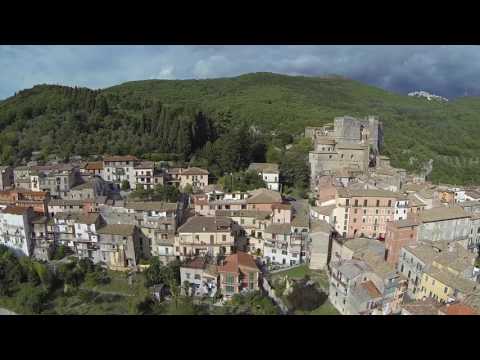
Look at a map of the Aniene Valley and you'll understand Arsoli in 30 seconds. The river comes down from Filettino, cuts through Subiaco, widens toward Agosta and Marano Equo, then the valley narrows. At that bottleneck, where Lazio ends and the Marsica begins, the rock raises a spur: the town is on top, the road passes below. Everything has gone through here: the flocks of the transhumance, the legions, the pilgrims bound for Abruzzo, the hordes coming down from the north toward Rome, today's trucks on the A24. Arsoli is not an isolated mountain town, it is a threshold town, and you can feel the difference in the architecture: walls, gates, a castle that looks in two directions.
The name says it better than any description. Medieval documents call the place mons qui vocatur saxa seu Arsula, the mountain called of the rocks, that is Arsula: even before the village there was the boulder. In the local dialect the people of Arsoli say Àrzuli, and the dialect form survives on signs, in the band's songs and in the names of the dishes you'll hear about at the food festivals.
The real distances from Rome and the nearby villages
From central Rome it is about 65 kilometers, an hour if the Grande Raccordo Anulare leaves you in peace, an hour and 20 minutes on an August Friday. From Tivoli it is 40 minutes going up the valley, from Subiaco 20 minutes, from Anticoli Corrado a quarter of an hour, from Cervara di Roma half an hour of hairpin bends that are worth the trip all by themselves. Abruzzo begins after a few kilometers: Oricola and Carsoli are already in the province of L'Aquila, and this closeness explains half of the village's military history.
How to get to Arsoli (RM) by train
The Rome-Pescara railway, opened in 1888, is the most civilized way to come here. From Tiburtina station the regional trains bound for Avezzano stop at Arsoli. The service has about 15 runs a day, and the station, a kilometer below the town, has no staff: no ticket office, no luggage storage, no information. The kilometer between the station and the village is uphill and has no continuous sidewalk, so with suitcases it's best to call a taxi or get picked up. A century ago this station handled freight and workers for the factories of the valley. The closing of the local industries reduced it to a regional stop, and you can see it from the shelters.
How to get to Arsoli (RM) by car
The A24 Rome-Teramo is the fast way: exit Carsoli-Oricola, then you go down toward the valley floor and back up on provincial road 39/b. State Road 5 Tiburtina Valeria is the slow way and I recommend it to anyone with time, because it follows the route of the ancient Via Valeria and runs through the towns of the middle Aniene one after the other. In winter the provincial road can be icy early in the morning: here you go above 400 meters and the climate zone is E, with 2199 degree days, which in plain language means it gets seriously cold from November to March.
A two-hour tour of Arsoli (RM): the recommended itinerary
If you have only one morning, this is the order that works. You leave the car below the walls and walk up toward Piazza Valeria, the square of the cafes and little tables, which is the town's living room and the place where you can tell if it's market day. From there you take Corso Borgo San Bartolomeo, the spine of the old village, and arrive at the Museum of Musical Traditions: half an hour inside, no more, but to be done with the headphones on and the totems switched on. You come out, take Salita al Campo and in three minutes you are in front of Castello Massimo, which occupies the whole head of the spur. From the castle esplanade you look out over the Fosso del Diavolo, the gorge that cuts the rock under the walls. Return through the lower alleys, stopping at the church of the Santissimo Salvatore and the little church of San Rocco. If you've had a good lunch, add the short Are trail and it takes you another hour.
The verdict is blunt: Arsoli should be seen early in the morning or in the late afternoon. At noon the gray stone of the spur flattens everything and the photos come out flat. With raking light, instead, the castle and the village stand out from the valley floor in a way that no other town of the middle Aniene manages.
Castello Massimo, the very reason for Arsoli (RM)
Castello Massimo is not a tourist castle. It is a private, lived-in residence, which has belonged to the same family since 1574 and which opens on request: when you see it, you're entering someone's home, and this changes the way it is visited and told. From outside it is a compact block of wall, squared towers and 19th-century windows, resting on a cliff that drops into the gully. From inside it is a layering of a thousand years: Benedictine monastery, feudal fortress, Renaissance noble palace, neo-Gothic residence.
From the monks' fortress to the Massimo palace
The original core dates to around the year 1000, when there was a monastic settlement here tied to Subiaco. The transformation into a true castle came in the 13th century with the Passamonti, who made it the pivot of their dominion over the valley. The turning point was 1574: the Massimo, one of the great baronial families of Rome, bought the fief and the castle and began three centuries of works. They became marquises of Arsoli in 1686 and princes in 1826, and the 19th century in particular brought the neo-Gothic revision of the facades and the crenellations, following the European taste of the time: what looks medieval today, in many places, is 19th-century.
The underground levels of Castello Massimo: oil room, cheese room, prison
The lower level of the castle is the part that strikes visitors most, and not for its beauty. Here are the service rooms of a self-sufficient lordly economy: the ogliara, the oil room with its jars, the caciara, where the cheeses of the local sheep farming were aged, the oven, the kitchen with a fireplace big enough to stand up in. And, at the back, the prison, with the instruments of torture kept in place. A feudal lord administered justice in person: the prison under the house was not an eccentricity, it was an office. Seeing the statutes written on the noble floor and the chains on the floor below, in the same building, is the most effective history lesson this village offers.
The noble floor and the Throne Room
The second level houses the noble apartments, those reserved for guests of standing, with furnishings, tapestries, paintings and rugs accumulated by the family over the centuries. The highlight is the Throne Room, whose ceiling is frescoed by the Zuccari brothers, Taddeo and Federico, natives of the Marche who in the second half of the 16th century worked for the Farnese at Caprarola and in the Vatican. It is not a convenient attribution: the presence of the Zuccari at Arsoli is explained very well by the patron, that Fabrizio Massimo who had just bought the fief and who in Rome moved in the same artistic circle. In front of a Zuccari ceiling it's worth raising your eyes and looking for the perspective construction of the quadrature: they are the ones who invent a large part of the decorative language that Rome's 1600s would later take to excess.
The great hall frescoed by Marco Benefial in 1749
The main hall has walls and ceiling entirely painted in 1749 by Marco Benefial, with mostly mythological subjects. Benefial is a painter worth knowing: a Roman, born in 1684, trained on 17th-century naturalism, he was an odd voice out in late Baroque Rome, so polemical that he got himself expelled from the Accademia di San Luca. His painting is dry, full-blooded, with little taste for the decorative game of his time. Finding a whole cycle by him, dated, in a private castle in the Aniene Valley, is the main reason art historians climb up to Arsoli.
The chapel of San Filippo Neri and the Cosmatesque marbles
The inner chapel is dedicated to San Filippo Neri, and the dedication is no accident: it was he who advised the Massimo to buy Arsoli. The floor and the wall coverings have marble inlays in the Cosmatesque taste, comparable to the 13th-century works of the Benedictine monasteries of Subiaco. The Cosmati were families of Roman marble workers who for two centuries recycled ancient marbles into geometric inlays of porphyry and serpentine: when you see one, you are looking at pieces of imperial Rome cut into little discs in the 13th century.
The armories of Castello Massimo
The two armories hold armor, ancient weapons, family coats of arms, portraits of the Massimo and a collection of antique musical instruments. The coexistence of breastplates and instruments in the same room says a lot about the culture of this house, which at Arsoli kept musical ensembles and bands for generations. Along the route you also pass through corridors dug into the rocky spur on which the castle rests: the rock is not the foundation of the castle, it is part of it.
The Italian garden and the terraces over the gully
Next to the castle opens the Italian garden of late Renaissance layout: regular geometries, trimmed hedges, ornamental trees, water features and terraces looking out over the valley. It is not a big park, it is a hanging garden, and its meaning is all in the view: from there you dominate the floor of the Aniene Valley and the eye follows the line of the old Via Valeria. Italian gardens of this size, left in private hands and never turned into a public park, can be counted on the fingers in Lazio.
How to visit Castello Massimo in Arsoli (RM)
Guided visits are currently suspended for restoration and consolidation work. When they resume, access is by reservation through the Pro Loco of Arsoli, phone 0774 920290, with paid admission and opening on request, typically for groups. The address the castle gives for correspondence is on Piazzale Massimo, at the top of the village. Before planning a trip solely for the castle, call: since it is a private home, the calendar changes.

The churches of Arsoli (RM), one by one
The village preserves five historic places of worship, all reachable on foot within a radius of 400 meters. They are village churches, not basilicas: you look at them with the right eye, the one that looks for the building phases and the signs of baronial patronage.
The church of San Bartolomeo, patron saint of Arsoli (RM)
The origins of the church dedicated to San Bartolomeo go back to the 13th century, and the saint also gives his name to the main street of the old village, Corso Borgo San Bartolomeo. Bartholomew is the patron saint of Arsoli and is celebrated on August 24, with the patronal feast followed by the fair. The saint's iconography is one of the harshest in the Christian calendar: flayed alive, he is portrayed with the knife and his own skin in his hand. In village churches his image is often on a 17th-century altar canvas, and the comparison with the famous Michelangelesque Bartholomew of the Sistine is the key to explaining to visitors how the circulation of models between Rome and the provinces worked.
The church of the Santissimo Salvatore
The church of the Santissimo Salvatore is from the 16th century and its design is attributed to Giacomo della Porta, the architect who in Rome completed the dome of St. Peter's and designed the façade of the Gesù. The attribution should be taken as established tradition more than as ironclad archival fact, but the chronological coincidence works: these are the same years in which the Massimo, just installed, rebuild the church of the fief and reorganize the ecclesiastical benefices. Fabrizio Massimo personally took charge of the rebuilding, in all probability at the urging of San Filippo Neri, who was his confessor and adviser also in financial matters.
The church of San Lorenzo
From the 15th century, the church of San Lorenzo has a role that goes beyond architecture: in 1579 it hosted the assembly in which the community of Arsoli delegated Carlo Belli to collaborate on the drafting of the Statute. The town hall of the 16th century met in church, because the church was the only covered space big enough to hold the heads of household of an entire village. One of the devotional traditions of Arsoli is still tied to the pilgrimage of San Lorenzo, in August.
The little church of San Rocco
Small, from the 16th century, with frescoes from 15th- and 16th-century circles: the little church of San Rocco is the most intimate place in the village. Rocco is the saint invoked against the plague, and at Arsoli the plague was not an abstract concept: the village was depopulated twice, by the pestilence brought by the Landsknechts in the early 1500s and by the one of 1656. A church dedicated to Rocco, in a town like this, is a collective votive offering. His feast falls on August 16 and is today the day when the town organizes the blood donation with AVIS: the continuity between the ancient vow and the modern civic gesture is one of the most beautiful things this calendar tells.
The church of the Santissima Trinità
The church of the Santissima Trinità is recent, from 1956, and serves the modern part of the town. Its interest is liturgical and social more than artistic, but devotion to the Trinity at Arsoli is very ancient and is tied to the pilgrimage on foot to the sanctuary of the Santissima Trinità on Monte Autore, above Vallepietra, which the people of Arsoli undertake in May. It is a real walk, the kind that used to be done barefoot, and those who do it today get a hands-on sense of what mountain devotions were before cars.
The Museum of Musical Traditions of the Aniene Valley in Arsoli (RM)
This museum is the surprise of Arsoli and the reason it's worth a detour even with the castle closed. It is housed on the ground floor of the former Massimo Granary, the building the family used as a storehouse for the fief's grain, and it is reached from Salita al Campo, the stairway that leads toward the castle. A single barrel-vaulted room, four thematic sections, interactive multimedia stations with consultable archives.
The four sections of the museum
The first section is devoted to the pastoral musical tradition: here appear the ciufalitti, the shepherds' reed flutes, the zampogne, the gnaccare and the tambourines, the instruments that accompanied the transhumance and the Christmas novenas. The second collects the instruments of the artisans, the urban music of the village, that of the trades. The third is sacred and devotional music, with liturgical objects, handwritten scores and the repertoires of the confraternities. The fourth is the band tradition, and here the Massimo family enters the scene, which at Arsoli supported instrumental ensembles for generations and later donated their collection. Alongside the instruments the museum keeps scores, historical documents, photographs and audio and video recordings: it is to all intents and purposes an ethnomusicological archive, cataloged in the DEMOS thematic system of the Lazio Region and in the MedAniene territorial network.
Hours, ticket and contacts of the museum of Arsoli (RM)
Address: Corso Borgo San Bartolomeo 63, 00023 Arsoli. Open Monday to Friday from 9.30 to 12.30, Saturday and Sunday from 9.30 to 12.30 and from 15.30 to 18.30, closed Tuesday. Phone 0774 920290, email ecomuseoarsoli@gmail.com. For the ticket price and for group visits it's best to contact the museum directly, which also organizes workshops, seminars and music events. Practical tip: ask them to start the recordings of full-throated singing and of door-to-door begging repertoires. Hearing the real voices of the valley's elders, inside a room full of silent instruments, is a completely different experience from reading the captions.
The other cultural sites in Arsoli (RM)
The museum of rural life
Next to the music museum, Arsoli keeps a collection devoted to peasant life: farm tools, household objects, reconstructions of the work environments of a mountain economy based on wheat, corn, legumes, chestnuts and sheep farming. It is the natural complement to the visit to the music museum, because the musical instruments of this valley are born exactly inside that material world: the reed of the ciufalitto is the same reed used to beat the pods of the fagiolina.
The La Fenice Theater
The municipal theater La Fenice has been active since 1999 and has been recognized as an artistic residency since 2015. For a town of a little over 1,300 inhabitants, having a theater with a stable program and hosting companies in residence is an almost anomalous fact in the landscape of small Lazio towns. If you happen to be in Arsoli in season, check the schedule: it costs less than a Roman movie theater and you watch in a real hall.
Arsoli (RM) as a film set
The village and the castle have been used as locations for films and TV miniseries. No surprise: the castle offers authentic, furnished period interiors, the village has alleys with no visible cables and the valley supplies mountain backdrops an hour from the Roman studios. If during your visit you feel you've already seen a stairway, it's probably true.
The history of Arsoli (RM): from the Aequi to the Massimo princes
The Aequi, the Romans and Via Valeria
Before Rome this was the land of the Aequi, the Italic people who from the Aniene Valley held their own against the Republic for more than a century. Their territory was definitively subdued at the beginning of the 3rd century BC, and Romanization brought here the road, the rustic villas and above all hydraulic engineering. From Roman times diffuse traces remain in the territory: stretches of road, remains of substructures, and the channels of the great aqueducts that drew water right here for the capital.
The Benedictines and the monastery of Sant'Andrea
In the 9th century the valley is the domain of the monks of Subiaco, direct heirs of the foundation of St. Benedict. At Arsoli the Benedictines built one of the 13 monasteries of Subiaco, that of Sant'Andrea, whose existence is confirmed by a bull of Pope Gregory IV of 864. It is the document that gives Arsoli its first certain date. The monastery, as happened everywhere in central Italy threatened by raids, was progressively fortified: the church becomes a fortress, the cloister becomes a courtyard of arms, and the castle is born.
The Passamonti, lords for three centuries
In the 13th century the lordship of Arsoli passes to the Passamonti family, probably by right of conquest, and stays with them until 1536 with a single interruption: between 1495 and 1502 the castle was held by force of arms by the Colonna, the baronial house that in those years controlled half of Lazio. The Passamonti transform the fortified monastery into a true castle and tie their name to the figure the people of Arsoli still celebrate every June: Amico Passamonti.
The end of the Passamonti and the sale to the Zambeccari
The early 1500s are the dark period of the village. The house is hit by a serious financial collapse, the plague brought by the passing Landsknechts almost completely depopulates the town, and Amico Passamonti, lord of Arsoli, is slaughtered by Marzio Colonna. Three blows in a few years. The family decides to sell: on September 21, 1536, by notarial deed, the castle of Arsoli passes to the Zambeccari, a Bolognese family. Arsoli reaches that change of hands in terrible condition, with houses in ruins, fields uncultivated or turned to marsh and very few activities still alive.
The war of the Roman Campagna and the Zambeccari's lack of interest
The Zambeccari do not invest in the fief. To their lack of interest is added, from 1557, the war of the Roman Campagna fought under the pontificate of Paul IV: Arsoli lies a short distance from Oricola, a stronghold occupied by Germans and Spaniards, and a border town in wartime is always a plundered town. Within 40 years Arsoli goes from being an ancient lordship to being a property problem to be liquidated.
San Filippo Neri, Fabrizio Massimo and the purchase of 1574
The turning point comes from Rome and has a name that surprises: Filippo Neri. The founder of the Oratory was confessor, spiritual director and adviser also in financial matters to Prince Fabrizio Massimo, and it was he who suggested he buy Arsoli. The contract with Flaminio Zambeccari was signed on October 30, 1574 in the records of the notary Prospero Campano. The Massimo, a noble Roman family that claimed very ancient origins, thus received as a dowry a town depopulated by plagues, and endured another one in 1656. They never abandoned the castle, and the community flourished again each time: when in 1744 the castle was besieged by Spanish troops, and when in 1798 it was partly plundered by the French, the family stayed.
What the Massimo did for the village
Under the Massimo, to whom the castle still belongs today, Arsoli begins to breathe again. Fabrizio takes charge of the rebuilding of the church and the reorganization of the ecclesiastical benefices, in all probability at the urging of Neri himself. As feudal lord he issues a statute and a series of decrees for the administration of justice. And he has a new aqueduct built to bring water to the village and the fortress: in a town perched on a spur of rock, water is the first political problem. In the following centuries come the embellishments: the rooms frescoed by the Zuccari in the 16th century, Benefial's hall in the 18th century, the two armories, the Italian gardens, and finally the 19th-century neo-Gothic revision.

The Statute of Arsoli (RM) of 1584, the document worth the trip
Among the stories of Arsoli, this is the one that stays in your head. In 1579 the feudal lord commissioned the drafting of the fief's statute from the Roman jurist Luca Peto, a man of standing in the Rome of the time: he held administrative offices and devoted years to the revision of the Statuta Urbis, the city's body of law. Alongside the jurist was placed a man from Arsoli, Carlo Belli, delegated by the community in the assembly held that year in the church of San Lorenzo.
A feudal lord who calls on the people to write the laws
The whole point is here. At the time a lord imposed his own statute and that was it. At Arsoli the feudal lord instead calls on the community to collaborate on the drafting, delegating a local representative alongside the city jurist. It must be said honestly that one can reasonably suppose the result was the agreed revision of norms of Roman or Lombard derivation already in force, not an invention from nothing. But the method remains remarkable for 1579.
How the Statute is made
The Statute was published on June 28, 1584 by deed of the notary Benedetto De Amicis, with the consent of the Lord and of the Massari who had already signed it on the 8th of the same month. It is divided into three books. The first collects in 42 chapters the norms of a general character, of public law and civil procedure, with the rules on trades, weights and measures. The second, titled Delli statuti criminali, sets the penal norms in 45 chapters. The third, Delli danni dati, contains in 27 chapters the provisions of administrative policing, that is the law on damage to livestock, fields and woods.
Why it is a text ahead of its time
Comparison with the statutes of neighboring fiefs shows that the one of Arsoli goes beyond the typical contents of rural statutes, which limited themselves to regulating agrarian life and civil law: here all aspects of living together are regulated. Already from the religious invocations of the introductory pages the stamp of the Counter-Reformation can be read, with the moral framing of legal problems. For the period, the treatment of the crimes of adultery and of rape of a woman stands out, as does the introduction of very severe penalties for the gravest crimes, conceived as a deterrent. The copy taken from the original in 1606 by Giovanni Pistoniense is kept in the State Archive of Rome.
The Roman aqueducts around Arsoli (RM)
If ancient Rome was able to be a city of a million inhabitants, part of the credit belongs to this valley. Within a radius of a few kilometers from Arsoli, the Romans drew the water of three of the four most important aqueducts of the capital.
The Aqua Marcia, the best water in Rome
The Aqua Marcia was built in 144 BC and drew from the springs of the upper Aniene basin near Marano Equo, between Arsoli and Agosta. It ran for 91 kilometers with a daily flow of 4,690 quinariae, equal to about 194,635 cubic meters. The ancients considered it the best water that reached the city, and the sources describe it as a gift of the gods to the City. The springs of that stretch of the valley still feed Rome's modern aqueduct today: drink a glass from a Roman nasone and you are drinking water that is born a few kilometers from here.
The Aqua Claudia and the Anio Novus
The two twin aqueducts were begun in AD 38 under Caligula and completed in 52 under Claudius, who gave his name to the first. They were in operation already from 47, five years before the official end of the works. The Aqua Claudia drew its water from two springs called Curzia and Cerulea, in the Aniene Valley between the municipalities of Arsoli and Marano Equo, at the present-day Santa Lucia pond. It measured 46.406 Roman miles, about 68.681 kilometers, of which some 16 on surface arches, with a flow of 4,607 quinariae, equal to 191,190 cubic meters a day and about 2,211 liters per second. At the terminal reservoir at Porta Maggiore, however, only 2,855 of them arrived. The Anio Novus, at 87 kilometers, is the longest aqueduct of antiquity and took its water directly from the river further upstream, which also made it the muddiest. If you want to see the end point of this story you have to go to the Aqueducts Park, where the arches of the Claudia cross the Roman countryside.
The Anio Vetus, the first of them all
The oldest of the Aniene aqueducts is the Anio Vetus, of 270 BC, which drew directly from the river at the 29th mile of Via Valeria, between present-day Vicovaro and Mandela: 63.5 kilometers, almost entirely underground, with a flow of 4,398 quinariae. It is the second aqueduct in the history of Rome after the Appia, and it was already born in this valley.
The nature around Arsoli (RM): trails, gorges and pastures
From the town start two easy routes that can also be done with children: the one of the Are and the one of the Pozzo del Diavolo. They are walks of an hour or a little more, on dirt tracks and mule paths, where you happen to cross herds at pasture and, with a bit of luck, see a buzzard in flight over the valley floor.
The Pozzo del Diavolo and the Fosso del Diavolo
The gorge that cuts the rock under the castle is called Fosso del Diavolo, and the route of the same name leads toward the little waterfalls and natural pools carved by the water in the limestone. It is a damp, shady environment even in August, so the rocky floor can be slippery: shoes with treaded soles, always. In summer the pools attract the town's kids. In autumn, with the first rains, the flow grows and the show is better but the access more delicate.
The Are trail
The Are route is the one I recommend to anyone with a free afternoon and no mountaineering ambitions: modest elevation gain, a clean trail, open views over the valley. The name refers to the are, the stone floors used for threshing and for common farm uses: mountain place names almost always describe the work, not the landscape.
Toward Cervara, Riofreddo and the woods
On the road that goes from Arsoli to Cervara di Roma one pine grove and wood of mixed species follows another, extending to the borders of Riofreddo, where the forest opens into a broad clearing. The landscape you cross is beautiful in itself, but the real sweep of the eye is the one toward the Aniene Valley and toward the far outer ridges of the Sabine Mountains, which close the horizon to the north. Those who want to push higher have the Park of the Simbruini Mountains within reach, and further south the Abruzzo, Lazio and Molise National Park.
The cuisine of Arsoli (RM): the fagiolina and everything else
Arsoli cooking is cooking with few ingredients and great manual technique. Wheat flour, corn flour, spelt, water, oil, garlic, tomato, lard, legumes, wild greens. No dish on this list was born to be good: they were born to be enough. That they then became good is a credit to the women who repeated them for centuries.
The fagiolina of Arsoli, a Slow Food Presidium
The Arsoli fagiolina is the symbol product of the town and is now a Slow Food Presidium. Beans arrived in Italy in the first half of the 16th century by way of Charles V of Spain, and at Arsoli cultivation is documented already in 1552: they were so precious that Pope Julius III sent magistrates to prevent thefts in the fields. The plant is a climber and reaches three and a half meters in height. It has white flowers and pods that contain white seeds, small, kidney-shaped. Hence the diminutive. The skin is very thin, the flesh buttery, the digestibility high, and the trait cooks appreciate most is that it needs no soaking and holds its texture in cooking. The harvest is by hand and staggered, from August to November, and the dried pods are beaten with cane flails. Brought close to extinction in recent decades, the variety was recovered thanks to elderly growers who had kept the seed and to an association of producers that today grows and promotes it. It is eaten very simply, with celery and extra virgin olive oil.
Soups and handmade pasta
The ciciarchiole are bean soup with homemade wheat flour pasta, cut into small squares: the dish to try at the festival of the ciciarchiole and of the Arsoli fagiolina, held between the third week of August and the first of September. The sagne are pasta of wheat or spelt flour mixed with water alone, cut a finger wide, usually dressed with a sauce of garlic, oil and tomato and served in the scifa or directly on the pastry board. The sagnozzi have wheat flour, water and a little egg white, a narrow cut, cooked in broth dressed with small pieces of lard. The cillitti co’ j’agliu are the thinnest version: a very narrow cut, width and thickness equal, a sauce of oil, garlic and tomato, served on the pastry board or in the scifette, rectangular wooden plates. The gnucchitti are small flour dumplings dressed with the same sauce of oil, garlic and tomato.
Polenta, frascaregli and corn breads
The pullenta is corn flour polenta, served on the pastry board and dressed with a simple sauce or with pork ribs, small game or snails. What was left over was portioned and reheated at the fire as frittegli. The frascaregli are made by cooking in water wheat flour reduced to grains, are served on the pastry board like polenta and are dressed with garlic, oil and tomato. The maritigliu is prepared by adding corn flour and anise seeds to leavened wheat flour dough.
Beans and vegetables
The fasoli co lle coteche are beans stewed with plenty of pork rinds. The fasoli allissi are cooked over the fireplace fire inside a typical terracotta pigna and are dressed only with olive oil. The erbe mmischie are a mix of wild greens, chicory and other spontaneous herbs, boiled and then sauteed in a pan with oil and garlic. The broccoli o cicci soffocati are cabbages or turnip greens cooked from raw: vegetable, oil, garlic and a little vinegar are put all at once in a pot and left to cook with the lid always closed.
Pizzas and wood-fired breads
The pizzigliu a furnu ardente is a pizza of bread dough cooked at the mouth of the wood-fired oven while the oven is heated with dry brushwood: a masterpiece of household economy, because it uses the heat that would otherwise be lost. The pizza 'nfrasca is wheat and corn flour bread baked in the wood-fired oven. The pizzigliu alla rostera is corn flour bread mixed with water and cooked in a perforated pan. The pizza summa is made with bread dough not yet leavened and cooked under the clay tile. The pizza pe tterra is the bread of Easter Sunday: eggs, anise seeds and oil are added to the wheat flour, it is shaped into loaves and baked in the wood-fired oven.
The sweets of Arsoli (RM)
The pizza leveta is the Easter sweet: flour, eggs, raisins, candied fruit and sugar, the dough put into deep pans, left to rise at home and baked in the wood-fired oven. The frittegli de patane come from a dough of flour, mashed potatoes, raisins, sugar and rum, cut into diamonds and fried in boiling oil. The handed-down quantities speak of 500 grams of mashed potatoes, 400 grams of flour, two tablespoons of sugar and 100 grams of soaked raisins. They were made for Christmas Eve together with the frittegli cogli broccoli and the frittegli cogliu baccalà. The pangiallu is the Christmas dried-fruit sweet: walnuts, hazelnuts, almonds, figs, chocolate and candied fruit blended with honey and baked. The pizzafritta is a fritter of leavened pizza dough cooked in a pan in plenty of boiling oil, eaten savory with tomato sauce or sweet with sugar, and it has its own festival at the beginning of spring. The tisichelle are delicate little sweets made by beating eggs, sugar, a few anise seeds and very little flour: the batter is taken by the spoonful, set on a baking tray and baked, where it takes on a round, flattened shape. The ciammellette de magru are small ring cakes of flour, anise seeds, sugar, pieces of walnut, oil and wine.
The ciambella of brotherhood
It deserves a paragraph of its own. The ciammella della fratellanza is a big ring cake of flour, eggs, milk, olive oil and anise seeds, leavened, scalded in boiling water and then baked in the wood-fired oven. It is the sweet that each religious confraternity gives to its brothers on the feast day of the Saint, and its weight and its size are set by the ancient statutes: giving it and receiving it is a sign of brotherhood and friendship. A sweet regulated by a confraternity statute is something rarely found in Italian cooking, and by itself it tells how the society of a village worked before the modern State.
Cheeses, meats and the rest
To these dishes were added, sporadically, omelets and meats of wether and sheep, reserved for the few who could afford them, while the consumption of fresh or aged cheeses, ricotta, caciotte and pecorino, made from the local sheep farming, was in common use. Poor cooking out of necessity, wholesome by constitution: the modern reappraisal has made it an attraction, celebrated in the town's festivals and anniversaries.

The festivals and food fairs of Arsoli (RM), month by month
Few communities of this size have such a full calendar. The practical advice: the exact dates change every year and must be confirmed with the Pro Loco of Arsoli or with the town hall before leaving, because many festivals move to the nearest weekend.
The Palio dell'Amico, the medieval festival of late June
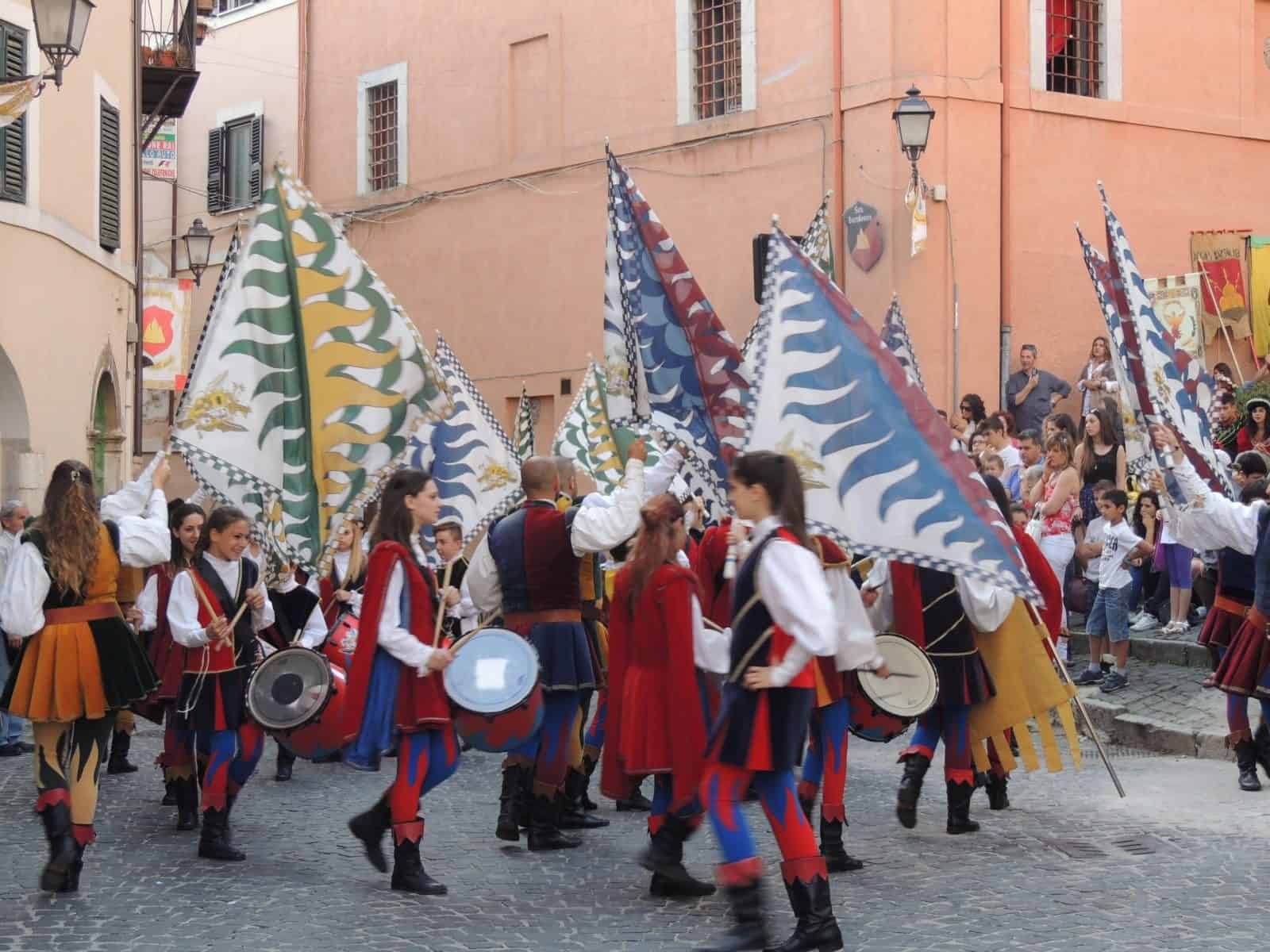
It is the most beautiful festival of Arsoli and the one most tied to its identity. The Palio dell'Amico was established on June 28, 1997 and is repeated every year around that date. The name honors Amico Passamonti, the 16th-century lord of Arsoli and man of arms who fought against the mercenaries of Charles V during the Sack of Rome and defended the Florentine Republic, before being killed by Marzio Colonna. The day is structured around a historical procession with nobles, knights, jesters, flag throwers and archers that crosses the town in the late afternoon. In the Disputa del Palio the teams of the four historic districts face each other in historical archery. In Piazza Grande the Convivio dei Borghi is held, with dinners in the street and traditional dishes, fagiolina included. The evening closes with fire shows, swords and flaming arrows. If you have to choose a single day of the year to come to Arsoli, choose this one.
The Sagra della Fagiolina Arsolana
The town's best-known food event is held on the first weekend of September, organized by the Pro Loco of Arsoli, and has a history that goes back decades: the editions have been counted since the 1960s. The fagiolina is tasted in its simplest form, dressed with good oil and accompanied by celery, and in soups with the ciciarchiole. Go early: around nine in the evening the lines at the stands get long.
Spring: the Festa della Primavera and the Sagra della Pizzafritta
In April the town comes alive with the Festa della Primavera and the Sagra della Pizzafritta, devoted to showcasing local gastronomy and in particular pizzas, pizzigli and pizzafritte in all their variants, with musical entertainment of a popular and folkloric character and re-enactments of the trades and farm work of the spring season.
May: San Filippo, the Trinity and Corpus Domini
In May the Fiera di San Filippo takes place, a market of livestock, goods and craft products that preserves the structure of the ancient feudal fairs. Also in May falls the Feast of the Santissima Trinità, with the pilgrimage on foot to the sanctuary of Monte Autore, and the Feast of Corpus Domini, with the typical flower carpets along the village streets: the carpets of petals are prepared during the night and last the length of a procession.
August: the sacred and profane month of Arsoli (RM)
August is the densest month. It begins with the traditional pilgrimage of San Lorenzo. On the 14th and 15th the procession of the Inchinata is held for the Feast of the Assumption of Mary, one of the oldest Marian rites in Lazio, in which two sacred images are made to bow to one another. The 16th is the Feast of San Rocco, today a day of blood donation with AVIS. It continues with the Week of Art and Folklore until August 24, the day of the Feast of San Bartolomeo, patron saint of Arsoli, followed by the Fiera di San Bartolomeo and the Feast of Our Lady of Guadalupe, co-patron of the town. In August the Street Artists Festival is also held.
Autumn and winter
In October the Fiera di Santa Incoronata returns. For Christmas, for the Befana and for Easter the town comes out into the square anyway with initiatives of different kinds: nativity scenes, bingo nights, processions, band concerts. Arsoli is a very active village from the social and spiritual point of view, and in winter community life simply moves from the squares to the parish halls and the theater.
A curiosity about Arsoli (RM)
The curiosity I like best concerns a nickname. Luigi Pirandello called Arsoli la piccola Parigi, little Paris. The Nobel laureate in literature frequented this village for several years, mostly in the summer and vacation periods, arriving by gig from nearby Anticoli Corrado, where his son Fausto, a painter, lived. And the comparison, however affectionate, had a concrete basis: Arsoli was at the time the district seat, and so home to judicial and administrative offices, and the presence of the Massimo family had attracted a cultured bourgeoisie with a social life crowded with salons, music and conversation. A town of a few thousand souls that hosted a magistrate's court, notaries, a brass band, a theater and Roman nobility on holiday: in the middle of the mountains of the middle Aniene, it really did look like a capital in miniature.
There is a detail that makes the label even more interesting. Pirandello wrote about the Italian provinces with remarkable harshness, and his short stories are full of stifling towns from which the characters can't escape. That he of all people chose for Arsoli a Parisian nickname, and not one of his bitter formulas, says how well he felt here. Over the centuries the village had been visited by popes, sovereigns, condottieri, artists, writers and saints, and of this continuous passage traces remain in the castle's papers and in the memory of the families. Whoever visits Arsoli today walks in a town that, for a brief stretch of its history, had a cultural weight out of proportion to its size. Pirandello's Casa Museo, for those who want to dig deeper, is in Rome: you'll find it on the page for the Casa Museo Pirandello.
Something nobody tells you about Arsoli (RM)
No guide will tell you that Arsoli's first hydraulic infrastructure was not built for Arsoli. The Romans drew the water of the Marcia, the Claudia and the Anio Novus here to carry it to Rome, but the medieval village that arose on the rocky spur, centuries later, was left without water of its own. A town perched on a limestone boulder has no convenient wells, and to draw water you had to go down to the valley floor and climb back up with the containers on your shoulders. That is the reason the new aqueduct built by the Massimo in the 16th century, to supply the village and the fortress, was not a lordly embellishment but an intervention that materially changed the daily life of the families: it meant the women no longer had to make the climb twice a day with the water basin on their heads.
The second thing nobody tells concerns the springs. The Santa Lucia pond, between Arsoli and Marano Equo, is the point where the Curzia and Cerulea springs that fed the Aqua Claudia surfaced. Looking at that modest sheet of water it's hard to imagine that 191,190 cubic meters of water a day left from there bound for Porta Maggiore, and that of that flow only a little more than half actually reached the terminal reservoir in the city: the rest was lost along the almost 70 kilometers of channel, through evaporation, seepage and illegal diversions. The ancients knew the problem of clandestine taps very well and legislated at length to counter them. Basically, water theft in the Aniene Valley has been documented for 2,000 years: long before Pope Julius III sent the magistrates to protect the fagiolina fields from thieves, in 1552.
The advice I give you for visiting Arsoli (RM)
The main advice is to call first. Castello Massimo is an inhabited private property, the guided visits are currently suspended for restoration and in any case work on request: whoever arrives at Arsoli hoping to buy a ticket at a window goes away empty-handed. The Pro Loco number is 0774 920290, the same as the music museum, and a call settles in two minutes the question that would otherwise ruin the day.
The second piece of advice concerns the day of the week. The museum is closed on Tuesday: avoid it. On Saturday and Sunday the museum also opens in the afternoon, from 15.30 to 18.30, so the weekend allows the full tour at a relaxed pace. If you come on Monday, Wednesday, Thursday or Friday, the opening is morning only, from 9.30 to 12.30, and must be planned for the morning.
Third: combine Arsoli with another town. By itself the village is exhausted in half a day, and it would be a waste to travel an hour only to turn straight back. The combinations that work are Arsoli with Subiaco for those who want the Benedictine monasteries, Arsoli with Cervara di Roma for those who want the landscape, Arsoli with Anticoli Corrado for those who follow the trail of the painters and of Pirandello. If you have two days, add Tivoli with Hadrian's Villa and Villa d'Este on the way back.
Frequently asked questions about Arsoli (RM)
Where is Arsoli and how far is it from Rome?
Arsoli is in the Metropolitan City of Rome Capital, in the upper Aniene Valley, on the border with Marsican Abruzzo, surrounded by the Simbruini Mountains. The town is about 65 kilometers from Rome and is perched on a rocky spur at the point where the valley narrows.
How do you get to Arsoli without a car?
You can reach Arsoli from Rome by the regional train on the Rome-Pescara line, which stops in the municipality. It is a convenient alternative for those who don't want to drive along the Aniene Valley up to the spur on which the town stands.
Can you visit Castello Massimo in Arsoli?
Castello Massimo in Arsoli is not a tourist castle but an inhabited private residence, belonging to the same family since 1574, which opens only on request. At the moment guided visits are suspended for restoration, so it's best to call the Pro Loco first, at 0774 920290, instead of showing up hoping to buy a ticket at a window.
What can you see at the Museum of Musical Traditions in Arsoli?
The Museum of Musical Traditions of the Aniene Valley, in Arsoli, is housed on the ground floor of the former Massimo Granary, the building the Massimo family used as a storehouse for the fief's grain, reached from Salita al Campo. It is organized in a single barrel-vaulted room with four thematic sections and interactive multimedia stations.
How many inhabitants does Arsoli have?
Arsoli has a little over 1,300 residents, according to the most recent registry data available. It is a small town but with a historical and cultural heritage out of proportion to its size, which includes a castle, five historic churches and two museums.
How long does it take to visit Arsoli?
To visit Arsoli at a relaxed pace one morning is enough: you start from Piazza Valeria, walk along Corso Borgo San Bartolomeo, the spine of the old village, and arrive at the Museum of Musical Traditions, which takes about half an hour to visit. The five historic churches of the town are all reachable on foot within a radius of 400 meters.
What do you eat in Arsoli?
The cooking of Arsoli is cooking with few ingredients and great manual technique, made of wheat flour, corn flour, spelt, legumes and wild greens. The signature product is the Arsoli fagiolina, a Slow Food Presidium legume grown in this part of the Aniene Valley.
What is the main festival of Arsoli?
The most identity-defining festival of Arsoli is the Palio dell'Amico, a medieval event held in late June and considered the most beautiful of the town. It draws visitors from the whole Aniene Valley and stages the historical reconstruction of life in the fief.
Fourth and last: eat here. There is no reason to come to Arsoli and have lunch on the motorway. Piazza Valeria has cafes and restaurants, and the fagiolina is on the table all year round because the dried product is available in every season. Ask if they have the ciciarchiole: if they make them for you, you've won the day. Anyone organizing groups and needing an authorized tour escort for the Aniene Valley can turn to the professionals of TourLeaderPro, who work in Rome and its province.
Another well-known fact, yet rarely cited
Everybody knows the Massimo bought Arsoli. Almost nobody dwells on who advised them and on what that means. The adviser was Filippo Neri, the Florentine priest who invented the Oratory in Rome and whom the city called the saint of joy. Neri was confessor and spiritual director to Fabrizio Massimo, and his influence on the family extended to financial choices: it was he who suggested buying a ruined fief, depopulated by plague, with marshy fields and crumbling houses. The contract with Flaminio Zambeccari was signed on October 30, 1574.
The sense of that advice is understood only by putting it inside the Counter-Reformation. Neri and his circle promoted a nobility that would consider the fief a pastoral responsibility and not an income: buying a destroyed town meant committing to rebuild it. And indeed the Massimo, as soon as they were installed, rebuild the church, reorganize the ecclesiastical benefices, write a statute calling on the community to collaborate, build the aqueduct. The castle chapel is dedicated precisely to San Filippo Neri, and the dedication works like a signature on the moral contract.
Then there is the tail of the story, the one that is always forgotten. The Massimo never left. They endured the plague of 1656, the siege by Spanish troops in 1744, the partial plundering of 1798, the passage from the Papal State to the Kingdom of Italy, and they are still owners of the castle. Four and a half centuries of family continuity on the same property are a European rarity, and explain why the interiors have come down to us with furnishings, tapestries, paintings, rugs, weapons and musical instruments in place instead of dispersed on the antiques market.
The right photo to take at Arsoli (RM)
The photograph that does justice to this town isn't taken inside the village. It is taken from the valley floor, on the road that climbs toward the center, at the point where the rocky spur, the castle and the houses line up in a single vertical block. It is the framing that gives back the geographic reason for Arsoli: first the rock, then the walls, then the town, and above everything the mass of Castello Massimo. With a moderate telephoto, around 70 or 100 millimeters, the scene is compressed and the castle looks even more overhanging.
The right light is that of late afternoon, when the sun comes from the west and cuts across the facade of the castle from the side: the 19th-century crenellations cast sharp shadows and the stone takes on a warm color that doesn't exist at noon. In winter the good moment comes early, around four. In June around seven 30. If you're lucky enough to find haze on the valley floor after a night of rain, the village emerges from the gray and the photo takes itself.
The second framing to look for is the gorge of the Fosso del Diavolo seen from the garden terraces, with the void below and the valley opening in the distance: here you need a wide-angle lens and you need to be careful, because the parapet is low and the rock drops sheer. The third is a detail shot and I recommend it to those who love particulars: the Cosmatesque marble inlays of the chapel, photographed from above and in natural light, with the geometry of the porphyry discs filling the frame. The fourth is on the day of the Palio dell'Amico, when the flag throwers hurl the flags in Piazza Grande: fast shutter speeds, at least a thousandth of a second, and patience to wait for the good throw. A necessary caution: inside the castle, being a private home, photographs must be agreed with whoever is accompanying you.
Some important events that happened here in history
The first event is documentary and unspectacular, but it is the one that founds everything: the bull of Pope Gregory IV of 864 confirming to the monks of Subiaco the possession of the monastery of Sant'Andrea in Arsoli. From that sheet begins the written history of the town, and from that monastery the castle is born.
The second is the military conquest of 1495. In that year the Colonna, the most powerful baronial house in Lazio, take Arsoli from the Passamonti by force of arms and hold it until 1502. Seven years of military occupation in a border fief, in the thick of the Italian Wars, while Cesare Borgia was reorganizing the Papal State by force.
The third is the murder of Amico Passamonti, lord of Arsoli, killed by Marzio Colonna. The deed comes in an already disastrous period, with the house in financial collapse and the village depopulated by the plague brought by the Landsknechts. Amico had fought against the mercenaries of Charles V during the Sack of Rome in 1527 and had defended the Florentine Republic: he was a man of arms of some weight, and his death is still today the memory around which the town builds its most important festival.
The fourth is the sale of September 21, 1536 to the Zambeccari, and the fifth is the purchase by the Massimo on October 30, 1574. Between the two transfers there are almost 40 years of neglect, with the war of the Roman Campagna raging from 1557 a few kilometers away, around the stronghold of Oricola held by Germans and Spaniards.
The sixth event is the publication of the Statute, on June 28, 1584, by deed of the notary Benedetto De Amicis. The seventh is the plague of 1656, the one that struck all of central and southern Italy and that at Arsoli paired with the one of the previous century. The eighth is the siege of the castle by Spanish troops in 1744, during the War of the Austrian Succession, and the ninth is the partial plundering of 1798, in the years of the Jacobin Roman Republic and the French armies.
The 10th belongs to the Risorgimento and can still be seen: on the third level of the castle the rooms where Garibaldi and his officers stayed are preserved. The 11th is the inauguration of the railway, on July 28, 1888, which took Arsoli out of isolation and for decades made it a hub of goods and workers. The 12th, 20th-century and peaceful, is the establishment of the Palio dell'Amico on June 28, 1997, and the 13th the opening of Teatro La Fenice in 1999, which became an artistic residency in 2015.
Who has passed through Arsoli (RM)
The list is long for a town of this size. The first name is Saint Benedict of Norcia, in an indirect sense: it was his monks, from nearby Subiaco, who founded the monastery of Sant'Andrea here in the 9th century, one of the 13 monasteries of Subiaco. The second is Pope Gregory IV, who in 864 issued the bull confirming that possession.
The third name is San Filippo Neri. The founder of the Oratory not only advised Fabrizio Massimo to buy Arsoli, but probably also oversaw the rebuilding of the church and the reorganization of the ecclesiastical benefices. The castle dedicates the chapel to him. The fourth and fifth are Taddeo and Federico Zuccari, the painters from the Marche who frescoed the ceiling of the Throne Room in the second half of the 16th century, the same ones who worked at Caprarola for the Farnese and in the Vatican for the popes.
The sixth is Luca Peto, a leading Roman jurist, reviser of the Statuta Urbis, called in 1579 to draft the Statute of Arsoli. Alongside him we should remember Carlo Belli of Arsoli, delegated by the community. The seventh is Marco Benefial, the Roman painter who in 1749 frescoed the walls and ceiling of the great hall with mythological subjects: one of the most independent characters of 18th-century Roman painting.
The eighth is Giuseppe Garibaldi, who with his officers stayed on the third level of the castle: the rooms are still shown. The ninth is Giacomo della Porta, to whom local tradition attributes the design of the church of the Santissimo Salvatore. The 10th is Luigi Pirandello, who frequented Arsoli for years, arrived by gig from Anticoli Corrado and christened it la piccola Parigi.
We should then remember, without individual names because the castle's papers record them in bulk, the popes, sovereigns, condottieri, artists and saints who over the centuries passed through Arsoli taking advantage of its position on the road to Abruzzo. And we should remember, in recent times, the directors and crews who have used the village and the castle as a set for films and TV miniseries. A town of 1,300 inhabitants with a guest list like that is a case that deserves respect.
What to see around Arsoli (RM)
Whoever gets this far has in front of them one of the densest areas of Lazio. Subiaco, 20 minutes away, offers the Benedictine monasteries and the abbatial fortress. Cervara di Roma, the highest town in the province of Rome, is an open-air sculpture museum. Anticoli Corrado was the town of models and painters, and keeps a surprising museum of modern art. On the nature side, the park of the Simbruini Mountains and the Aniene Valley Nature Reserve cover the whole range, from high-altitude beech forests to gorges. Toward Abruzzo, just past the border, are the Pietrasecca Caves near Carsoli, with their underground route. On the way back to Rome, Villa Gregoriana Park in Tivoli closes the circle of the water that this valley has been telling from the start. Those who prefer lakes have the Percile Lakes on the Lucretili Mountains, just under half an hour away.
Quick questions about Arsoli (RM)
Where is Arsoli (RM)?
Arsoli is in the Metropolitan City of Rome Capital, in the upper Aniene Valley, on the border with Marsican Abruzzo, surrounded by the Simbruini Mountains. It is about 65 kilometers from Rome.
How many inhabitants does Arsoli (RM) have?
A little over 1,300 residents, according to the most recent registry data available.
How do you get to Arsoli (RM) without a car?
By the regional train on the Rome-Pescara line, toward Avezzano, from Roma Tiburtina. Arsoli station is about a kilometer from the center, uphill, and is unstaffed: the ticket must be bought before departure.
Can you visit Castello Massimo in Arsoli (RM)?
The castle is a private property of the Massimo family and opens on request with paid admission, through the Pro Loco of Arsoli, phone 0774 920290. Guided visits appear to be suspended for restoration work: it's best to call first.
How much does it cost to visit Arsoli (RM)?
The village can be toured for free. You pay for the ticket to the Museum of Musical Traditions, whose price must be asked of the museum directly, and for the castle visit when it is active.
How much time do you need to visit Arsoli (RM)?
Two hours are enough for the village and the museum. Half a day if you add the castle, a full day if you also fit in a trail and lunch.
What are the opening hours of the museum of Arsoli (RM)?
Monday to Friday 9.30-12.30, Saturday and Sunday 9.30-12.30 and 15.30-18.30, closed Tuesday. Address: Corso Borgo San Bartolomeo 63.
Is Arsoli (RM) suitable for children?
Yes. The music museum has interactive stations that work very well with kids, the Are and Pozzo del Diavolo trails are short, and the Palio dell'Amico with archers and flag throwers is a show children remember.
Is Arsoli (RM) accessible for people with mobility difficulties?
The village is built on a rocky spur, with climbs, stairways and cobbles: mobility is objectively difficult. The museum occupies a ground floor, so it is the most manageable part. For the castle and the interior routes it's best to ask the Pro Loco in advance.
What is the typical dish of Arsoli (RM)?
The Arsoli fagiolina, a Slow Food Presidium, served with celery and extra virgin olive oil or in the soup with the ciciarchiole.
When is the Sagra della Fagiolina Arsolana held?
On the first weekend of September, organized by the Pro Loco. The exact dates change every year and must be confirmed.
When is the Palio dell'Amico held in Arsoli (RM)?
Around June 28, the date of the first edition in 1997. Historical procession in the late afternoon, archery contest and banquet in the evening, closing with fire shows.
Who was Amico Passamonti?
A lord of Arsoli of the 16th century, a man of arms, who fought against the mercenaries of Charles V in the Sack of Rome and defended the Florentine Republic, killed by Marzio Colonna. The Palio bears his name.
Why did Pirandello call Arsoli la piccola Parigi?
For the intense social life the town had at the turn of the 19th and 20th centuries, when it was the district seat and hosted the Massimo family and a cultured bourgeoisie. Pirandello arrived by gig from Anticoli Corrado, where his son Fausto lived.
Who frescoed Castello Massimo?
The ceiling of the Throne Room is by the brothers Taddeo and Federico Zuccari, in the 16th century. The main hall, walls and ceiling, is by Marco Benefial, who painted it in 1749 with mostly mythological subjects.
What is Arsoli's (RM) connection to the Roman aqueducts?
The springs of the Aqua Marcia, of 144 BC, are in the upper Aniene basin near Marano Equo, between Arsoli and Agosta. The Aqua Claudia drew the Curzia and Cerulea springs between Arsoli and Marano Equo, at the present-day Santa Lucia pond. The Anio Novus took its water directly from the river further upstream.
Are there easy trails starting from Arsoli (RM)?
Yes, two: the Are route and the Pozzo del Diavolo route. Both about an hour, with modest elevation gain. You need shoes with treaded soles, especially in the gorge, where the rock is wet.
When is the best time to go to Arsoli (RM)?
Late June for the Palio, early September for the food festival, May and October for walking in the best weather. In winter it is seriously cold: the climate zone is E, with 2199 degree days.
Can you stay overnight in Arsoli (RM)?
The town and the neighboring municipalities offer small accommodations, farm stays and holiday homes. For up-to-date availability it's best to ask the Pro Loco of Arsoli or the town hall.
What is the difference between Arsoli (RM) and the other villages of the Aniene Valley?
Arsoli has a private castle still lived in by the same family since 1574, a regional-level ethnomusicological museum and a 16th-century Statute written with the participation of the community. Subiaco has the monasteries, Anticoli has the painters, Cervara has the altitude and the stone: every village in this valley has its specialty, and Arsoli's is lordly continuity.
Can Arsoli (RM) be visited as a day trip from Rome?
Without problems. Leave in the morning, an hour of travel, village and museum by lunchtime, lunch in town, a trail or a second village in the afternoon, back for dinner. For those organizing the day in English, the guides of the ItalyPlanner network collect the day trips from Rome.
Do you need to book to visit Arsoli (RM)?
For the village no. For the castle yes, always. For the museum it is not mandatory, but with a group it's best to give notice.
The verdict on Arsoli (RM)
A blunt verdict: Arsoli is the village of the middle Aniene that best withstands a second visit. The first time you go for the castle and go home with the feeling of having seen a pretty town. The second time you start to understand the rest, that is a serious ethnomusicological museum, a statute of 1584 written with the participation of the citizens, a cuisine with 20 proper names that no other municipality uses, and three imperial aqueducts that begin a stone's throw away. Fast tourism measures places in photographs. Arsoli is measured in layers.
That said, don't come here expecting a village equipped for mass tourism. There are no ticket offices, no audio guides in five languages, the castle opens when the family and the Pro Loco manage to get it open, and the museum closes on Tuesday. Those who accept these rules find a real town, still lived in, with the band rehearsing in the evening and old men speaking arzulanu at the bar. Those who don't would do better to stop at Tivoli. For those who want to visit the Aniene Valley with a professional, or build a multi-day itinerary between Rome and the Simbruini, the reference is the TourLeaderPro network in Rome. For those preparing the trip in English, the 30 things to do in Rome are collected in the ItalyPlanner guide. And if you are organizing a group outing or a corporate experience in Lazio, the TourLeaderPro group trips start from here.
Article written by the editorial team of TourLeaderPro, contact them for Private/Corporate/V.I.P. Tours and Experiences.
Planning a trip to Rome? The English-language guides to visiting the city are on ItalyPlanner.com.