Grotte di Pietrasecca Nature Reserve (Carsoli)
In short. The Grotte di Pietrasecca Nature Reserve (Carsoli) covers about 110 hectares in the municipal territory of Carsoli, in the province of L'Aquila, behind the hamlet of Pietrasecca.
The Grotte di Pietrasecca Nature Reserve (Carsoli) covers about 110 hectares in the municipal territory of Carsoli, in the province of L'Aquila, behind the hamlet of Pietrasecca. The reference point for the visit is the reserve's visitor center in the village, while the offices of the managing body are at the Carsoli town hall, Piazza della Libertà 1, 67061 Carsoli (AQ), phone 0863 908329. You enter the caves only accompanied by a caving guide and only by phone booking at the reserve's number, 320 1715968, or by writing to info@grottedipietrasecca.it. Email is for groups and school classes, the phone for weekend descents. The departure times given by the managers are 10:00, 11:30, 15:00 and 16:30, with the warning to show up at least 15 minutes early for the first level and 20 minutes early for the second. The ordinary calendar covers weekends throughout the year, while in August you can go down every day except Monday. The ticket price does not appear in a public price list and is agreed at the time of booking, together with the level of visit. Ask on the phone before getting in the car, because it changes between the first and second level and because groups have fixed numbers, 25 people at most for the first level and 10 for the second.
By car from Rome you take the A24 and exit at Carsoli or at Tagliacozzo, depending on traffic and direction, and from Avezzano or Pescara you arrive on the A25 exiting at Carsoli-Oricola. In every case the last stretch is on the Tiburtina Valeria, the old consular road that climbs from Tivoli toward the Marsica, and then on the road that goes up toward the village of Pietrasecca. From Piazza Venezia it is a little over 80 kilometers and about an hour and 10 minutes of driving without traffic. The managers provide the helmet. You bring your own hiking shoes with lugged soles, and in the second level high boots and gloves are handed out. Inside the cave there is no fixed lighting, no walkways and no railings. The Grotta del Cervo has stayed exactly as the cavers found it, and that is the reason you go down only with someone qualified to accompany you, in application of Abruzzo regional law 25 of 2004. Anyone looking for other caves within an hour will find the Grotta di Luppa on the Lazio side of the Carseolani Mountains, and farther south the Falvaterra Caves and Rio Obaco.

What the Grotte di Pietrasecca Nature Reserve (Carsoli) Really Is
Protected areas almost always arise to defend something you can see: a forest, a peak, a wetland, a bird colony. Here the opposite happened. The Grotte di Pietrasecca Nature Reserve (Carsoli) was established by Abruzzo regional law of March 10, 1992, number 19, and it protected first of all an emptiness: two karst cavities carved by water inside the limestone of the Carseolani Mountains, with what they contain of mineral, animal and archaeological material. The managers present it as the first Italian and European case of a reserve established to protect an underground environment, and the claim holds up: in 1992 in Italy caves were almost always either a private tourist business or a matter internal to the caving world, rarely the protected asset of a natural area.
The area is about 110 hectares and includes the valley floor around the village of Pietrasecca, the wooded slopes that close it in and the karst belt at altitude. Management belongs to the Comune of Carsoli, with the scientific support of the University of L'Aquila and the collaboration of caving groups, among them the Società Speleologica Italiana. The caves also fall within the network of sites of Community importance of Abruzzo, which binds management to criteria of habitat conservation and not only of public use.
The Piana del Cavaliere, the Threshold Between Lazio and Abruzzo
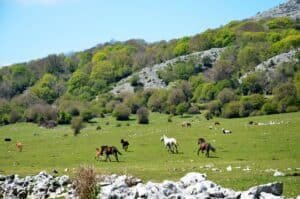
Whoever arrives from Rome doesn't notice having entered Abruzzo, and that's a mistake. The Piana del Cavaliere is an upland plain with a karst floor straddling the regional border, closed between the Carseolani Mountains and the reliefs that descend toward the Turano valley: waters that vanish into the ground, sinkholes, a high and cold farming landscape that Ovid described in two words that remained famous, a cold land, poorly suited to the olive but generous with grain. The Grotte di Pietrasecca Nature Reserve (Carsoli) guards the northern edge of this system. The limestone here behaves like a sponge: it takes surface water, swallows it, carries it for hundreds of meters in the dark and gives it back lower down as a spring. The two caves of the reserve are the two chapters of this hydraulic story, one still active and one now fossil.
Why the Grotte di Pietrasecca Nature Reserve (Carsoli) Matters Beyond Abruzzo
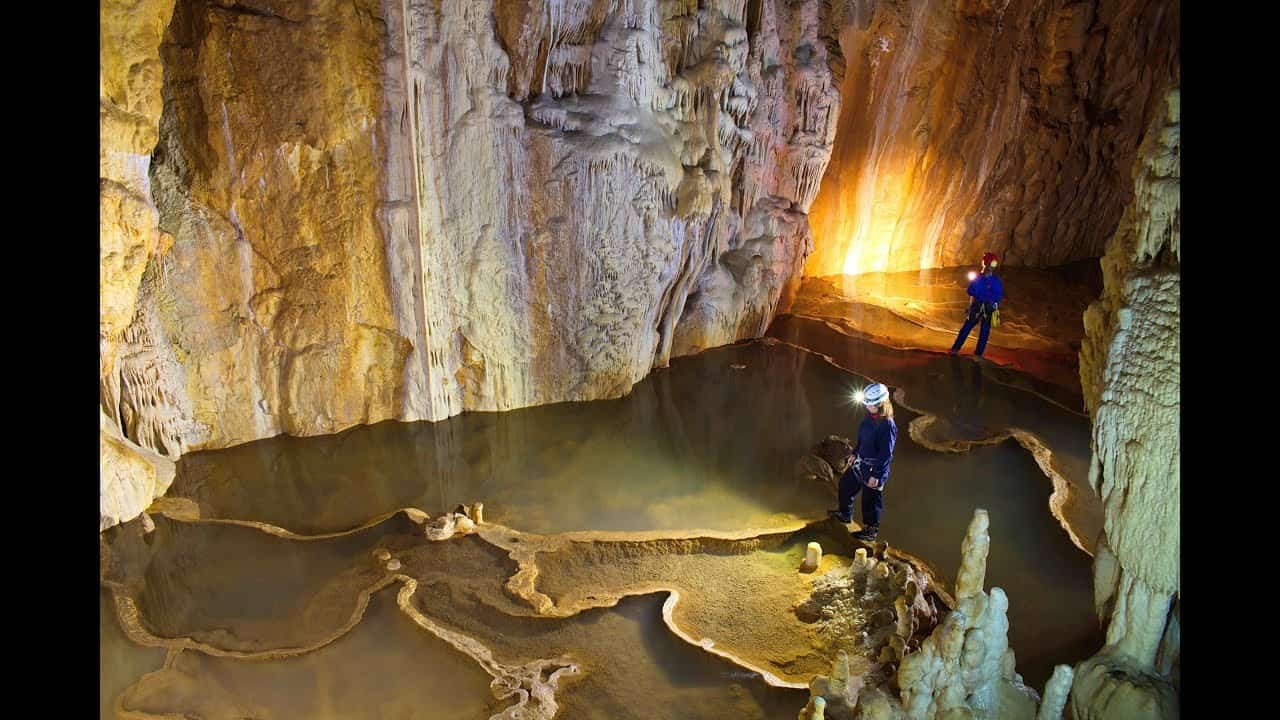
Among the caves open to the public in central Italy, Pietrasecca is the opposite of what the public expects. No scenic lighting system, no metal walkway, no piped audio: the Grotta del Cervo is walked with the light each person carries on the helmet, and this changes the perception of space radically. The formations come out of the dark two meters from you and not an instant before. Our opinion is firm: anyone who has already seen a fitted-out cave and came out with the feeling of having visited a corridor lit in colors should come here, because it's the experience that corrects that memory.
The Grotta del Cervo, the Heart of the Grotte di Pietrasecca Nature Reserve (Carsoli)
The Grotta del Cervo, also called Grotta Grande del Cervo, opens at 858 meters above sea level and develops about 2,500 meters of galleries with an internal elevation difference of 70 meters. From the village of Pietrasecca you reach it on foot in about 20 minutes, along a paved path that crosses a Turkey oak wood and climbs with a gentle slope. The entrance is closed by a gate and opens only for guided visits: the approach is free, the cave is not.
The Discovery of the Grotta del Cervo in 1984
The cavity was identified in 1984 by the Gruppo Speleologico Romano in the course of explorations carried out in the karst area of Pietrasecca, which revolved around the Ovito swallow hole and its blocked branches. The important fact is not the date, it's the state in which the cave was found: intact. No earlier passage, no smoke-written signature on the walls, no broken formation, no trash. A cave sealed for centuries and reopened at a time when caving culture had already matured the concept of conservation, which is the reason it can be walked today as it is.
The Hall of the Ancestors
It's the end point of the first level of the visit and the real theater of the cave. The name alludes to the ancient animal remains found in the complex and to the very long history of animal use of the cavity. Here the guides stop, turn off the lights for a few seconds when the group is calm and explain the mechanism of concretion: infiltration water loaded with calcium carbonate, loss of carbon dioxide on contact with the cave air, deposition of a film of calcite a fraction of a millimeter thick per year. The columns in front of you are the sum of hundreds of thousands of those films.
The Branch of Wonders
The name, for once, is not advertising. It's the sector where the concretion reaches its greatest density: very thin soda-straw stalactites, large-diameter columns, white wall flows that reflect the headlamp light like fresh plaster. It's also the most delicate sector of the whole Grotte di Pietrasecca Nature Reserve (Carsoli): an involuntary contact with a greasy hand leaves a mark that calcite does not cover for decades. The guides repeat it insistently, and they are right.
The Hall of the Little Pools
The little pools are gours, calcite basins formed by the precipitation of carbonate along the edge of a film of water flowing over an inclined surface. The edge grows, holds the water back, and a staircase of small stacked pools is born. At Pietrasecca they are small in size and very crisp in make, and they remain one of the best photographic subjects in the cave, if you have a side light and a bit of patience.
The Medusa Branch
It takes its name from a formation of unmistakable shape, with a dome and a fringe of hanging appendages. In caves place names arise like this, by resemblance, and the catalog of names of a cavity is always a small anthropological document: it says what the explorers who first walked it saw, with what images they had in mind.
The Mud River
Here the cave changes register. Clay deposits occupy the floor of the passage for long stretches and tell of a phase when the cavity was crossed by water loaded with fine sediment. These muds are not dirt. They are archives. Layering, grain sizes and minerals have allowed scholars to reconstruct the phases of flooding and emptying of the system. On the second level of the visit you really walk inside this environment, and you come out covered.
The Bypass Hall
A connecting space, as the name says, that joins two main branches by going around a blocked stretch. In caves of this kind the bypass is almost always the result of an ancient collapse: the original route closes, the water looks for another way through the fractures, and a new corridor opens. The internal geometry of a cavity is the sum of these adjustments.
The River of Silence
The most beautiful name in the catalog. It's one of the deep sectors, reserved for the advanced levels of visit, where water flows without noise over a regular floor. In a cave silence is never absolute: there is always the dripping, there is the breathing of the group, there is the rustle of air in the narrow points. A stretch where you hear nothing is an acoustic rarity, and the guides make a point of noting it.
The Pleistocene Bones and the Roman Coins
The Grotta del Cervo owes its scientific fame to two finds of very different nature. The first is paleontological: bone remains attributed to four mammal species of the Middle and Upper Pleistocene, bear, lynx, cave lion and deer. The cave lion, Panthera leo spelaea, is the great extinct predator of glacial Europe, and its presence here is the fact that strikes the public most. The second find is archaeological and numismatic: 18 bronze coins of the Roman era datable between the fourth and fifth centuries AD, plus one specimen from the 15th century. The name of the cave comes from the deer, and it is one of the rare cases in which a caving place name derives from an excavation datum and not from a formal resemblance.
The 1456 Earthquake Written in Calcite
This is the chapter that makes the Grotta del Cervo a case study cited well beyond Abruzzo. The formations of the cavity began to form, according to published reconstructions, around 850,000 years ago, and their growth was interrupted several times by datable collapses: one around 100,000 years ago, one around 35,000, and finally the event associated with the earthquake of 1456, the seismic catastrophe that devastated the central-southern Apennines and that the chronicles remember as one of the most violent in Italian history. After that collapse the concretion started again, slowly, on top of the rubble. Reading a 15th century shock inside a stalagmite is not a narrative device: it's paleoseismology, and in studies carried out on the Pietrasecca system, traces of local seismic events have been recognized over a span of time reaching into hundreds of thousands of years. If you are looking for a learned reason to come all the way here, this is one.

The Grotta dell'Ovito, the Swallow Hole of the Grotte di Pietrasecca Nature Reserve (Carsoli)
The Grotta dell'Ovito, also called the Pietrasecca Swallow Hole, opens at 806 meters above sea level just outside the village, along the road that runs parallel to the A24 highway. It is the other half of the reserve and represents its living part: while the Grotta del Cervo is a system largely fossil, the Ovito is still at work, collecting the waters of the basin of the same name and carrying them underground for about 1,300 meters before giving them back downstream as a spring. On the surface, just before the mouth, the stream has cut a small canyon in the limestone that passes under the bridge of the Tiburtina Valeria state road: a landscape detail that almost nobody notices when driving.
The Numbers of the Ovito
The total surveyed development exceeds 1,370 meters, with an elevation difference of 41 meters. The initial gallery is the most spectacular part and also the easiest to imagine for someone who is not a caver: 270 meters long with vaults that range between 15 and 20 meters in height, a cathedral carved by water that gradually narrows into a gorge and leads to a hall occupied by a lake. From there on begins the network of inner branches.
The Inner Spaces of the Ovito
The names given by the explorers make up a recognizable topography, worth listing in full because it's the mental map with which cavers talk about this cavity.
- Two-arch portal
- Old fossil branch
- Hall of the three arches
- Contact elbow
- Lake Styx
- Cavern of the giants
- Branch of the lakes
- Gallery of the Marsi
- The fork
- Branch of the Eccentrics
- Gallery with little pools
- Concretion-covered hall
- Aquilan branches
Two names deserve a note. The Branch of the Eccentrics takes its title from eccentric formations, or helictites, calcite crystals that grow in directions contrary to gravity following capillarity and air circulation: they are among the most fragile and rarest formations a cave can produce. The Gallery of the Marsi instead recalls the Italic people who lived in this part of the Apennines before the Roman conquest, and reminds us that the Carsoli area was border land between the Aequi and the Marsi.
The Nine Bats of the Ovito
A bat community of exceptional richness has been recorded in the Grotta dell'Ovito, with nine different species identified, among them the lesser horseshoe bat. For a single cavity of the central Apennines it's a high number, and it explains by itself why the reserve entered the network of sites of Community importance. The bats use the cave for wintering and for daytime rest, and they are animals that pay dearly for disturbance: an out-of-season awakening costs a hibernating bat a significant share of the fat reserves accumulated for winter. Hence the rule, rigidly applied, that forbids independent entry and limits access in critical periods. In the Ovito also live the cave cricket, a harvestman, an isopod and several troglophile spiders, among them Meta menardi, Nesticus eremita and Porrhomma convexum.
The Aquilan Branches, a 2015 Discovery
Caves are never finished being explored. In 2015 the Grotte e Forre Francesco De Marchi group of the CAI of L'Aquila identified and surveyed a new sector in the Ovito, christened the Aquilan branches, which added about 200 meters to the known development of the cavity. 30 years after the first systematic explorations, in a cave studied and frequented by specialists, there was still a piece of the underground world that nobody had seen.
The Grotta dell'Ovito Is Not a Tourist Cave
On this point we must be clear, because confusion between the two cavities of the Grotte di Pietrasecca Nature Reserve (Carsoli) is the most frequent mistake of those planning the trip. The visit you normally book concerns the Grotta del Cervo. The Ovito is an active swallow hole: water is always there, it's not an occasional obstacle, and the traverse requires a neoprene wetsuit, very small groups of four or five people at most and a whole day of effort, from four to six hours, up to the terminal siphon lake. The managers classify it as a third-level difficulty excursion and reserve it for people with caving experience, assessed case by case. Put directly: nobody enters the Ovito alone, and nobody enters it on a Sunday morning after parking the car. Independent entry into an active cavity, without equipment and without knowing the water regime, is the fastest way to turn a trip into a rescue operation.
The Three Levels of Visit of the Grotte di Pietrasecca Nature Reserve (Carsoli)
Accompaniment by a caving guide is mandatory and derives from Abruzzo regional law 25 of 2004. The managers have organized the offer into three levels of increasing commitment, all in the Grotta del Cervo, plus the traverse of the Ovito reserved for experts.
First Level, the One for Everyone
It is the visit done by 90 percent of the public. Total duration within an hour and a quarter, of which about an hour actually underground, on a route that reaches the Hall of the Ancestors. No experience needed: independent motor ability and the capacity to walk an easy hiking path are enough. The minimum age indicated by the managers is around five, and it's worth confirming on the phone when you book, because the requirement is the child's motor self-sufficiency more than the year of birth. Helmet provided, shoes with lugged soles mandatory, group of up to 25 people, meeting 15 minutes before the chosen time.
Second Level, Where You Really Get Wet
You access it only after having done the first level and having understood how to move in a cave. Duration up to two and a half hours, of which almost two underground, maximum group of 10 people, departure indicated at 11:30. The route includes progression by opposition on rock, the wading of a small lake with water reaching the leg and a short squeeze. High boots, helmet and gloves are provided. A complete change of clothes you bring yourself, and you will need it. It's the visit I recommend to someone who is 20 and wants to understand what real caving is, not the idea you get of it by looking at photographs.
Third Level, the Full Exploration
Up to eight hours, of which about seven inside the cave, with vertical drops on rope and long stretches in water. It's not a visit, it's a caving outing: the managers grant it to people already known and assessed, with full equipment. Anyone who gets to this level does not need explanations about what awaits them.
Booking and Showing Up at the Grotte di Pietrasecca Nature Reserve (Carsoli)
Phone booking at 320 1715968 is the mandatory step: there is no queue at a ticket office, and the places per turn are counted. The descent times communicated by the managers are 10:00, 11:30, 15:00 and 16:30, and the calendar covers the weekends of the whole year plus daily opening in August, Monday excluded. If you arrive late you lose the turn, because the guide goes in with the group and does not come back. For schools, groups and educational outings write to info@grottedipietrasecca.it: the reserve's environmental education programs cover geology, paleontology, botany, fauna and archaeology, are run by specialized staff and issue a certificate usable for educational credits.
What to Wear on Your Feet and Body
Inside the caves the temperature stays low and constant all year, and humidity is close to saturation: in July you go in sweaty and come out chilled. Hiking shoes with lugged soles, a sweatshirt or fleece even in August, long pants that can get dirty. Leave at home clothes you would hate to ruin, because the mud of the Grotta del Cervo is real clay and doesn't always come out in the first wash. A personal headlamp is useful as a backup, but the helmet with the light is provided by the reserve.
The Woods and Flora of the Grotte di Pietrasecca Nature Reserve (Carsoli)
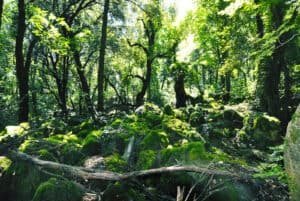
Above the caves there is a plant world that deserves the time of a walk, and in spring it is worth the visit as much as the underground. The slopes are covered by Turkey oak woods, which at these altitudes are the dominant formation, with hop hornbeam, manna ash and beech on the cooler exposures and higher up. Along the watercourses appear the hornbeam, the hazel, willows and poplars, the typical riparian vegetation that accompanies the stream to the mouth of the swallow hole. On the ground you find brittle bladder fern in the damp rock cracks, elecampane, bellflowers, buttercup, watercress and butterbur in the wettest stretches, and the Apennine anemone, which between April and May fills the clearings with white.
The beech wood that closes the scene behind the waterfall is the picture the Grotte di Pietrasecca Nature Reserve (Carsoli) offers in the right week of April, when the new leaves have that acid green that lasts a few days and the water is at maximum flow. Anyone who comes in August finds a darker, cooler wood and much less water. They are two different visits and the difference is made by the calendar, not luck.
The Underground Fauna of the Grotte di Pietrasecca Nature Reserve (Carsoli)
The animals living in caves belong to three categories worth distinguishing, because the guides use them and the public often confuses them. Trogloxenes enter by chance and do not survive there. Troglophiles live there well but can also manage outside. Troglobites are bound to the cave exclusively and show the classic adaptations: depigmentation, reduction or loss of eyes, lengthening of antennae and legs as sensory compensation.
The Cave Cricket
Dolichopoda is the animal you'll see first, just past the entrance. It's a wingless orthopteran, with very long antennae and disproportionate legs, concentrated in the zones near the mouth because it goes out at night to feed outside and comes back into the dark during the day. The colonies cling to the vaults in dense groups. They don't sting, they don't bite and they're completely harmless: the instinctive reaction of those seeing them for the first time is nonetheless a step back.
The Beetles and Other Invertebrates
In the Pietrasecca complex very small beetles have been reported, among them Choleva sturmi and Laemostenus latialis, almost invisible to the naked eye and for that very reason interesting: hypogean fauna is measured in millimeters. To these are added harvestmen, isopods and the web-weaving spiders of the twilight zones, with Meta menardi as the emblem species of Italian caves, the same one you meet at the entrance of almost all Apennine cavities.
The Bats and the Rules That Protect Them
The bat community of the Grotta dell'Ovito, with its nine recorded species, is the most important biological heritage of the reserve. Whoever visits the first level of the Grotta del Cervo will almost certainly not see any: that's normal, and it's not a flaw of the visit. The colonies occupy reserved sectors and management does what it can to keep them undisturbed. If during the descent the guide asks you to lower your voice or to turn off a light pointed upward, this is the reason.
The Trails and Geosites of the Grotte di Pietrasecca Nature Reserve (Carsoli)
The network of internal trails can be walked freely and requires neither guide nor booking: the restriction concerns the cavities, not the surface. Paper maps are picked up at the Carsoli town hall and at the reserve's visitor center, and it's worth doing so, because the signage on the ground is basic. Three geosites have been identified and enhanced within the protected perimeter and are visited with geologists and researchers on dedicated days: they are the points where the karst structure can be read in the open air, among swallow holes, surface forms and stratigraphic contacts.
The Trail to the Grotta del Cervo
It starts from the village of Pietrasecca and climbs through the Turkey oak wood with a paved surface for a large part of the route. Barely 20 minutes of walking, modest elevation gain, almost continuous shade. It's the approach that all visiting groups make and it can also be walked without entering the cave, going as far as the square in front of the gate.
The Loop of the Village of Pietrasecca and the Swallow Hole
The low loop touches the mouth of the Ovito, the stretch of gorge carved in the limestone and the bridge of the Tiburtina Valeria. It's the best route to understand the hydraulic workings of the Grotte di Pietrasecca Nature Reserve (Carsoli) without going in anywhere: you see the water arrive, you see the water disappear, and that is enough to explain karst better than any panel.
When the Pietrasecca Waterfall Runs
The waterfall is at its best between March and May, with the thaw and spring rains. In summer it can shrink to a trickle or dry up entirely, and in autumn and winter it returns to an average flow. Anyone arriving at Ferragosto hoping for the jump of water photographed online risks a disappointment: the practical advice is to ask on the phone, along with the booking, how the flow is in those days.
A Curiosity About the Grotte di Pietrasecca Nature Reserve (Carsoli)
The real curiosity of this place is not a stalactite, it's a date read inside the rock. In the Grotta del Cervo the formations have recorded, like a very slow seismograph, the seismic history of the Piana del Cavaliere. The deposition of calcite begins, according to reconstructions, around 850,000 years ago and proceeds in very thin layers. When an earthquake shakes the massif, the columns break, the blocks fall, sedimentation stops and then resumes on top of the chaos. Scholars have recognized in this sequence at least three major interruptions, placed around 100,000 years ago, 35,000 years ago and finally in 1456, the year of the great earthquake of the southern Apennines that razed dozens of centers in Molise, Campania and Abruzzo.
The consequence is that the Grotta del Cervo is one of the few Italian cavities in which a historic event documented by the chronicles finds a direct, measurable physical confirmation, in the form of sheared and re-covered formations. The paleoseismicity research carried out in the Pietrasecca system has pushed the reading much further back, to the point of recognizing traces of local shocks over a scale of hundreds of thousands of years. This, for a 110-hectare reserve born in 1992, is a scientific contribution out of proportion to its size. And it changes the way you look at the hall: what looks like a heap of fallen debris is actually the signature of a precise day in the 15th century.
I'll add the minor curiosity that always amuses groups: the name of the cave does not derive from the shape of a formation, as happens almost always in caving, but from a bone. The deer remains found in the inner deposits, together with those of bear, lynx and cave lion, gave the cavity its name. A paleontological place name is a rarity, and an excellent first topic of the visit.
One Thing Nobody Tells You About the Grotte di Pietrasecca Nature Reserve (Carsoli)
What nobody tells you is that here the absence of facilities is not a delay, it's a management choice, and that this choice conditions your whole day. In the Grotta del Cervo there are no walkways, handrails, concrete steps or fixed lighting. The only light is that of the helmets. Anyone arriving with the imagery of the fitted-out caves of the Carso or the tourist cavities of Central Italy, with metal paths and colored spotlights, has to recalibrate expectations before leaving: you walk on rock and mud, you duck, you use your hands.
The second element that doesn't appear in the summaries is the fixed number. 25 people per turn in the first level, 10 in the second, four or five in the Ovito traverse. It's not a marketing formula: it's the limit beyond which a group, in a cave with no fixed lighting, stops being manageable and starts damaging the formations through simple friction. The practical corollary is that a spring weekend with good weather can sell out, and that phoning on Saturday morning to go down on Saturday afternoon is a gamble.
The third point concerns the difference between the two cavities, which the Grotte di Pietrasecca Nature Reserve (Carsoli) carries in its name in the plural and which creates constant misunderstandings. There are two caves, but the ordinary visit concerns only the Grotta del Cervo. The Grotta dell'Ovito has no tourist route: it's an active swallow hole, tackled in a wetsuit, in tiny groups and with caving experience, and its main interest is the bat colony, which must be protected from disturbance. Anyone who books thinking of seeing both in the same afternoon has misunderstood the place.
The last thing, the most banal and the most ignored: you come out dirty. The second level passes through the Mud River and the clay of the Grotta del Cervo sticks to fabrics. A complete change in the trunk and a plastic bag for the wet clothes are worth more than any other equipment advice.
The Advice I Give You for Visiting the Grotte di Pietrasecca Nature Reserve (Carsoli)
The advice is one and concerns the calendar: aim for a weekend in late April or early May, book the 10:00 turn and dedicate the whole day to it, not just the morning. The reason is hydraulic before aesthetic. In those weeks the waterfall has its maximum flow, the swallow hole works at full capacity and you truly understand what water does in a karst system. The beech wood has its new leaves. And the outside temperature makes pleasant the trail that in August you face sweating. The 10:00 turn avoids the afternoon crowding and leaves you time to do the Ovito loop after lunch.
The second piece of advice is about the type of visit. If you have already done a show cave and you are in normal physical condition, book the first level and ask, at the end, what the second involves: almost everyone comes back to do it. If instead you bring children, stay at the first level and don't push, because total darkness with a headlamp is a strong experience even for an adult and at six can be frightening. The guides handle it well, but it's up to you to know your child.
Third: phone a few days ahead and ask three things together, the price of the level you're interested in, the availability of places in the turn and the water flow in those days. These are three questions that solve 90 percent of surprises. And a fourth, if you come from Rome: ask if that week's calendar has variations, because the ordinary weekend calendar admits exceptions communicated by the managers.
Frequently Asked Questions About the Grotte di Pietrasecca Nature Reserve (Carsoli)
Where is the Grotte di Pietrasecca Nature Reserve?
The Grotte di Pietrasecca Nature Reserve is in the municipality of Carsoli, in the province of L'Aquila, near the hamlet of Pietrasecca, on the northern edge of the Piana del Cavaliere. The manager's offices are at the Carsoli town hall, Piazza della Libertà 1.
How far is the Grotte di Pietrasecca Nature Reserve from Rome?
The Grotte di Pietrasecca Nature Reserve is a little over 80 kilometers from Rome, about an hour and 10 minutes by car, exiting the A24 highway at Carsoli.
Can you enter the Grotta del Cervo at Pietrasecca alone?
No, accompaniment by a caving guide is mandatory in the Grotta del Cervo, of the Grotte di Pietrasecca Nature Reserve, by Abruzzo regional law. The offer is organized in three levels of increasing commitment: the first, the one for everyone, has a total duration within an hour and a quarter.
Is the Grotte di Pietrasecca Nature Reserve good for children?
The first level of the Grotta del Cervo, in the Grotte di Pietrasecca Nature Reserve, works well with kids from age seven and up and is formally accessible around five, as long as the requirement is motor independence and not chronological age. The approach trail is easy and shaded, and the actual time underground is around an hour.
Is the Grotta del Cervo accessible to people with mobility difficulties?
No, the Grotta del Cervo of the Grotte di Pietrasecca Nature Reserve is not accessible to people with reduced mobility: the inside route requires balance, footholds on uneven rock, low stretches and slippery ground, and there are no walkways or handrails. The outside path to the gate is paved for a large part, but it remains a mountain path with a slope.
What is the best time to visit the Grotte di Pietrasecca Nature Reserve?
The best time for the Grotte di Pietrasecca Nature Reserve is a weekend in late April or early May: in those weeks the Ovito waterfall has its maximum flow, the swallow hole works at full capacity and the beech wood above the caves has new leaves.
Can you visit the outdoor trails of the Grotte di Pietrasecca Nature Reserve without a guide?
Yes, the network of internal trails of the Grotte di Pietrasecca Nature Reserve can be walked freely and requires neither guide nor booking: the requirement of a mandatory guide concerns only the cavities, not the surface. Paper maps are picked up at the Carsoli town hall and at the reserve's visitor center.
One last recommendation, the one that is worth the trip. Don't treat Pietrasecca as an isolated stop. From the Piana del Cavaliere you reach in half an hour Lake Turano and Castel di Tora, in 40 minutes the reserve of Monte Navegna and Monte Cervia, and to the south the ridge of the Simbruini Mountains with Subiaco and Cervara di Roma. A one-hour cave inside a mountain day is worth much more than a one-hour cave inside a round trip on the highway. If you want someone to build the day for you, the licensed tour escorts who work in this Apennine quadrant are organized through the TourLeaderPro tour escort service.
Another Well-Known Fact, Yet Rarely Cited
Everyone repeats that the reserve was born in 1992 to protect the caves. Almost nobody adds the interesting part: that that law, Abruzzo regional law number 19 of March 10, 1992, represents the first case in Italy and in Europe of a protected area established to specifically protect a hypogean environment. Until then caves were protected by reflection, as contained inside parks born for other reasons, or managed as commercial attractions. Here the protected asset is the void, with its air, its water, its fauna and its silence.
The regulatory consequence is more concrete than it seems. An area protected for the subsurface imposes constraints that a surface reserve does not know: control of water inflows into the feeding basin, because what enters the swallow hole ends up in the aquifer and the spring, regulation of the number of visitors, because the amount of carbon dioxide exhaled by a group alters the chemical balance of calcite deposition, and access calendars built on the biological cycle of the bats, with the phases of hibernation and reproduction to respect. Environmental monitoring is entrusted by the Carsoli town hall to associations and specialized institutes, with the support of the University of L'Aquila.
The second rarely cited fact concerns the history of the discovery. The Grotta del Cervo was not found by chance by a shepherd, as the traditional tale that accompanies half of Italy's caves would have it. It was the result of systematic work by the Gruppo Speleologico Romano in 1984, inside an area already known and already trodden because of the Ovito swallow hole. The difference is not a detail: it means that the conservation of the cavity was thought out from day one, because whoever went in first knew exactly what they were touching.

The Right Photo to Take at the Grotte di Pietrasecca Nature Reserve (Carsoli)
The right photograph in this cave is not the panorama of the hall. It's the detail of the calcite little pools lit from the side. I'll explain why, and how to get it. In a cavity without fixed lighting the light source is the headlamp on your head, that is a point light, frontal and flat: the worst possible condition for rendering the volume of a formation, because it cancels the shadows and flattens everything into a white blotch. The solution doesn't require professional gear: ask a companion in the group to light the formation from the side, at 45 degrees, while you shoot with your headlamp lowered or off. The relief of the gours, the thin edges, the transparency of the water held in the basins come out suddenly.
The second subject that works is the Hall of the Ancestors with a person in it, small, from behind, with the headlamp on pointed at the walls. Without a human figure the scale of the space can't be read and the photo becomes an indecipherable texture. With a figure, the hall tells its size. Be careful never to point the headlamp into the lens of the person shooting and not to shoot with the flash aimed directly at the dark walls, which gives back only the dust in suspension.
Outside the cave, the best subject of the Grotte di Pietrasecca Nature Reserve (Carsoli) is the waterfall with the beech wood behind it in the second half of April: abundant water, new green, morning light until 11 o'clock before the sun enters the gully and burns out the contrasts. The third subject, the most overlooked, is the small canyon cut by the stream in the limestone just before the swallow hole, under the bridge of the Tiburtina Valeria: people pass over that bridge every day without knowing they have a gorge under their wheels.
A rule of good manners that counts as technical advice: no tripods planted in the middle of the route when the group has to pass, and never rest the camera or your hand on the formations to steady yourself. The grease from fingers locally blocks the deposition of calcite and leaves a mark that nobody will ever be able to remove.
A Few Important Events That Happened Here in History
The first event is geological and has a zero hour that can be placed around 850,000 years ago, when in the cavity that would become the Grotta del Cervo the deposition of calcite begins. From that moment the cave records, layer upon layer, the climatic and seismic history of the massif. The major interruptions recognized in the sequence fall around 100,000 and 35,000 years ago: collapses that break columns and seal off entire branches.
The second event belongs to the Middle and Upper Pleistocene and is the animal use of the cavity. Inside the deposits remains of bear, lynx, cave lion and deer have been recognized: a faunal community from glacial Europe, with large predators now vanished from the continent. How their remains ended up in there, through an accidental fall, a den or water transport, is the question specialists ask at every deposit of this kind.
The third event is Roman and late antique. The 18 bronze coins from the fourth and fifth centuries AD found in the Grotta del Cervo tell of human use of the cavity in a time of crisis, when the Tiburtina Valeria continued to link Rome to the Marsica and the Carsoli territory remained a corridor of passage. Small-denomination coins in a cave almost always mean repeated presence, not an isolated episode.
The fourth event is the earthquake of December 5, 1456, the shock that upended the central-southern Apennines and left deep marks in Abruzzo. In the Grotta del Cervo it is read as a collapse horizon above which the concretion slowly starts again. According to the current reading the event contributed to sealing the cavity, which remained closed until the explorations of the 20th century: it is the physical reason cavers found it pristine.
The fifth event is from 1984, when the Gruppo Speleologico Romano identifies the Grotta del Cervo while working in the karst area of Pietrasecca. The sixth is from March 10, 1992, with the regional law that establishes the reserve, the first in Italy and in Europe to be born to protect an underground environment. The seventh, less solemn but not minor, is from 2015: the Grotte e Forre Francesco De Marchi group of the CAI of L'Aquila identifies in the Ovito the Aquilan branches, adding a previously unknown sector to a cavity thought to be known. The exploration history of the Grotte di Pietrasecca Nature Reserve (Carsoli), put differently, is not closed.
Who Passed Through the Grotte di Pietrasecca Nature Reserve (Carsoli)
The most illustrious name linked to this territory is Ovid's, and the document is his own. In the fourth book of the Fasti, at verses 683 and following, the poet tells of having stopped at Carseoli while going up toward the Paeligni, his native land, and describes the place with a formula that became proverbial in the area: cold land, not suited to olives, but fertile in grain. In the house of an old host he listens to the story of the boy who caught a fox, wrapped it in straw and hay and set it on fire, causing the burning of the fields: from that episode, according to Ovid's aetiological account, would derive the rite of the burning foxes during the Cerialia. The passage closes with the news that at Carseoli a law forbade raising foxes. It's first-rate Latin literature set a few kilometers from these caves, and very few people know it.
From here, in fact, Roman history has passed in its entirety. Carsioli was founded as a Latin colony in the territory of the Aequiculi, on the border with the Marsi, on an initiative that the sources place in 304 BC and with the settlement of 4,000 colonists in 298 BC by the dictator Marcus Valerius Maximus, the same man to whom the start of Via Valeria is owed, the road that climbed from Tivoli toward Carsioli and Alba Fucens. During the Social War of 91 BC the colony was a Roman stronghold and paid dearly for the clash with the Marsi. The remains of the ancient city are today found near Civita di Oricola, a few minutes from the reserve: city walls, ruins, traces of an aqueduct, mosaic floors.
Turning to contemporaries, the figures who really matter for the Grotte di Pietrasecca Nature Reserve (Carsoli) are the cavers. The Gruppo Speleologico Romano, which in 1984 identified the Grotta del Cervo, and the researchers of the University of L'Aquila who in the 1990s and 2000s published the multidisciplinary studies on the karst system, starting from the work of Ezio Burri, the geologist who more than anyone has tied his name to Pietrasecca and its caves. To them are owed the surveys, the datings and the paleoseismic reading that make this cavity a case cited in the scientific literature. The Grotte e Forre Francesco De Marchi group of the CAI of L'Aquila added the chapter of the Aquilan branches in 2015.
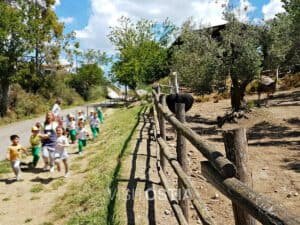
Finally, every weekend, school classes pass through. The reserve's environmental education programs bring primary and secondary school classes underground with specialized teachers, on geological, paleontological, botanical, faunal and archaeological themes. If I had to name the category of visitors who leave here more changed than when they came in, I would name them without hesitation.
The Grotte di Pietrasecca Nature Reserve (Carsoli) with Children
The first level of the Grotta del Cervo works well with kids from age seven and up and is formally accessible around five, with the warning that the requirement is motor independence and not chronological age. The youngest stay under the constant supervision of an accompanying adult. The approach trail is easy and shaded, the actual time underground is around an hour, and the critical factor is only one: the dark. With the headlamp on, the child sees what they look at and nothing around, and this condition can be demanding. The guides know it and handle it calmly, but a child who is afraid of the dark should be prepared at home, not at the cave entrance.
The strong point, on the educational side, is that there is no spectacle here: it's explained how a stalactite forms, how a wingless cave cricket lives, why a bat shouldn't be woken in winter. These are concepts that at nine stick forever. More family-sized day ideas in Lazio and Abruzzo can be found among the proposals for families and children.
Accessibility of the Grotte di Pietrasecca Nature Reserve (Carsoli)
We have to be honest about the limits. The Grotta del Cervo is not accessible to people with reduced mobility: the inside route requires balance, footholds on uneven rock, low stretches and slippery ground, and there are no walkways or handrails. The outside path to the gate is paved for a large part but remains a mountain path with a slope. Anyone with walking problems, marked claustrophobia or cardiac limitations should discuss it with the managers at the time of booking and, in many cases, stop at the outside part of the reserve, which still offers the village, the wood, the mouth of the swallow hole and the waterfall in season.
What to See Around the Grotte di Pietrasecca Nature Reserve (Carsoli)
Pietrasecca is a hamlet of Carsoli and Carsoli is the largest center of the Piana del Cavaliere, with its services, its restaurants and a food tradition that revolves around potatoes, truffle and arrosticini. A few minutes away, near Civita di Oricola, the remains of ancient Carsioli emerge. Toward the north the road drops quickly into the Turano basin, one of the most beautiful lake settings of central Italy.
Toward the Turano and the Sabina
Lake Turano with the village of Castel di Tora overlooking the water, the reserve of Monte Navegna and Monte Cervia, the castle of Collalto Sabino that dominates the valley from above, and then, descending toward the Tiber, Orvinio, Fara in Sabina with Farfa Abbey and Poggio Mirteto. It's the quadrant I recommend for the next day, if you sleep in the area.
Toward the Lucretili Mountains and the Aniene Valley
On the Lazio side of the Carseolani open up Percile with its small karst lakes, another chapter of the same geological phenomenon that produced the caves, and not far away the Grotta di Luppa. Going down along the Aniene you meet Arsoli with its Massimo castle and Anticoli Corrado, the town of the models and painters.
Toward the Simbruini and the Upper Valley
Barely half an hour away begins the park of the Simbruini Mountains, with Subiaco and its Benedictine monasteries, Cervara di Roma perched on the rock and the plateaus of Monte Livata. For those who want to continue into Abruzzo, the natural direction is that of the Abruzzo, Lazio and Molise National Park and the Camosciara.
A Weekend Built Around the Grotte di Pietrasecca Nature Reserve (Carsoli)
Saturday morning departure from Rome around eight, A24, Carsoli exit, arrival at Pietrasecca in time for the 10:00 turn in the Grotta del Cervo. Lunch in Carsoli, afternoon on the swallow hole loop and on the reserve's trails, dinner and overnight between Carsoli and the Turano basin. Sunday morning the lake, Castel di Tora, possibly the castle of Collalto Sabino, return in the afternoon by the Tiburtina or the highway. Two full days, less than 200 kilometers in total, a landscape that in Rome nobody expects to find an hour's drive away. Anyone traveling with foreign guests who wants a custom-built day, with reserved access and slow rhythms, finds the reference in the private experiences for small groups by TourLeaderPro. For those planning the trip in English, the regional overview is in the ItalyPlanner guide to Abruzzo, while ideas for day trips are collected on the day trips in Italy page.
Quick Questions About the Grotte di Pietrasecca Nature Reserve (Carsoli)
Where is the Grotte di Pietrasecca Nature Reserve (Carsoli)?
In the municipality of Carsoli, in the province of L'Aquila, near the hamlet of Pietrasecca, on the northern edge of the Piana del Cavaliere. The manager's offices are at the Carsoli town hall, Piazza della Libertà 1.
How far is the Grotte di Pietrasecca Nature Reserve (Carsoli) from Rome?
A little over 80 kilometers, about an hour and 10 minutes by car on the A24 exiting at Carsoli or at Tagliacozzo, and the last stretch on the Tiburtina Valeria.
Can you enter the caves of Pietrasecca without a guide?
No. Entry is allowed only with a caving guide and by booking, in application of Abruzzo regional law 25 of 2004. The entrance of the Grotta del Cervo is closed by a gate.
Do you need to book to visit the Grotte di Pietrasecca Nature Reserve (Carsoli)?
Yes, always, at 320 1715968. Groups have fixed numbers and the turns sell out on good-season weekends.
What are the visiting hours of the caves of Pietrasecca?
The descent times communicated by the managers are 10:00, 11:30, 15:00 and 16:30. You show up 15 minutes early for the first level and 20 minutes early for the second.
When is the Pietrasecca reserve open?
Visits take place on weekends throughout the year, barring notices from the managers, and in August every day except Monday.
How much does a ticket to the Grotte di Pietrasecca Nature Reserve (Carsoli) cost?
The price list is not published in a stable form: the price of the chosen level is agreed by phone at the time of booking. It's best to ask for it along with the availability of places.
How long does the visit to the caves of Pietrasecca take?
The first level stays within an hour and a quarter in total, with about an hour underground. The second level reaches two and a half hours. The third level takes up to eight hours.
Which cave is normally visited?
The Grotta del Cervo. The Grotta dell'Ovito has no tourist route and is reserved for third-level caving excursions with a neoprene wetsuit and groups of four or five people.
Are the caves of Pietrasecca lit?
No. There is no fixed lighting and there are no walkways: you proceed with the light of the helmet, provided by the managers.
What shoes do you need for the Grotte di Pietrasecca Nature Reserve (Carsoli)?
Hiking or sports shoes with lugged soles. For the second level the managers provide high boots, helmet and gloves.
What is the temperature inside the caves of Pietrasecca?
Low and constant all year, with very high humidity. Even in August you need a sweatshirt or fleece.
Do you get dirty in the caves of Pietrasecca?
On the first level a little, on the second a lot: you cross the Mud River and wade a small lake. Bring a complete change and a bag for wet clothes.
From what age can you go down into the Grotta del Cervo?
The minimum age indicated for the first level is around five, with the requirement of motor independence. Younger children require the constant supervision of an adult. It's best to confirm at the time of booking.
Is the visit suitable for people with claustrophobia?
The first level takes place in wide spaces, but total darkness and the lack of reference points can be demanding. Anyone with marked claustrophobia would do well to talk to the guide before entering.
Is it accessible by wheelchair?
No. The inside route requires balance and footholds on uneven rock and the outside path is a mountain trail. The outside part of the reserve can still be visited.
Can you take photographs in the caves of Pietrasecca?
Yes, with common sense: no flash pointed into other people's eyes, no tripods in the middle of the passage, and in no case do you rest hands or equipment on the formations.
How many visitors are there per turn?
Up to 25 people on the first level, 10 on the second, four or five in the Ovito traverse.
What animals can you see in the caves of Pietrasecca?
Near the entrance the Dolichopoda cave cricket, wingless and with very long antennae. In the Ovito live nine bat species, among them the lesser horseshoe bat, plus spiders, harvestmen and isopods.
What was found in the Grotta del Cervo?
Bone remains of bear, lynx, cave lion and deer from the Middle and Upper Pleistocene, 18 bronze Roman coins from the fourth and fifth centuries AD and one coin from the 15th century.
When was the Grotte di Pietrasecca Nature Reserve (Carsoli) established?
By Abruzzo regional law number 19 of March 10, 1992, over about 110 hectares: it is considered the first Italian and European protected area born to protect a hypogean environment.
Who manages the Grotte di Pietrasecca Nature Reserve (Carsoli)?
The Carsoli town hall, with the scientific support of the University of L'Aquila and the collaboration of caving groups.
Can you visit the reserve without going into the cave?
Yes. The trails can be walked freely and the maps are picked up at the Carsoli town hall and at the visitor center. You reach the square in front of the cave, the mouth of the swallow hole and the waterfall.
When is there the most water in the Pietrasecca waterfall?
Between March and May. In summer the flow drops a lot and can go to zero. In autumn and winter it holds at average values.
Are school visits organized at Pietrasecca?
Yes, with environmental education programs on geology, paleontology, botany, fauna and archaeology, run by specialized staff and with a certificate issued. They are booked by writing to info@grottedipietrasecca.it.
What's the difference between the Grotta del Cervo and the Grotta dell'Ovito?
The first is at 858 meters of elevation, develops 2,500 meters with 70 meters of elevation difference and is largely fossil and full of concretions. The second is at 806 meters, develops over 1,370 meters with 41 meters of elevation difference and is an active swallow hole traversed by water.
Is it worth combining the caves of Pietrasecca with other destinations?
Yes. In half an hour you reach Lake Turano and Castel di Tora, in 40 minutes the reserve of Monte Navegna and Monte Cervia, and to the south the Simbruini Mountains with Subiaco.
The Last Recommendation
If you have time for only one cave in central Italy, and you want to understand what a karst cavity really is, come here and not to a fitted-out cave. You will come out with dirty shoes, with some scratches on your pants and with something that lighting systems hand to nobody: the real measure of the dark, and the precise sensation of how much time water needs to build a column of calcite. Book the morning turn on a Sunday in late April, bring a change of clothes, and leave an extra hour for the wood. The Grotte di Pietrasecca Nature Reserve (Carsoli) rewards those who give it a whole day, and disappoints those who treat it as a stop between two highway toll booths.
Article written by the editorial team of TourLeaderPro, contact them for Private/Corporate/V.I.P. Tours and Experiences.
Planning a trip to Rome? The English guides for visiting the city are on ItalyPlanner.com.