Abruzzo, Lazio and Molise National Park
In short. The Abruzzo, Lazio and Molise National Park has its seat in Pescasseroli (AQ), where the Authority's administration is located.
The Abruzzo, Lazio and Molise National Park has its seat in Pescasseroli (AQ), where the Authority's administration is located. The Visitor Center with the Natural History Museum, the Wildlife Park and the Apennine Garden is on Viale Colli dell'Oro, also in Pescasseroli: it opens every day, in the 10:00-17:30 range barring seasonal changes, and admission is paid, with the fee published on the Authority's official website. The park's territory, by contrast, has no ticket: you enter freely into the valleys, villages and trails, with two exceptions. The first is parking in the busiest valleys: at the Camosciara and in Val Fondillo parking is paid by the day (a few euros for a car, rates posted at the entrance and to be confirmed on site) and at the Camosciara a paid little train shortens the climb to the upper parking area. The second is the summer regime of the three trails most sensitive for the chamois: the I1 of the Val di Rose (from Civitella Alfedena to the Forca Resuni hut), the F1 of Monte Amaro di Opi from Val Fondillo and the L1 of Monte Meta from the Pianoro Campitelli, which between late July and mid-September can be walked only on a paid guided hike with the guides appointed by the park, booking at the Authority's offices. By car from Rome you take the A24 and then the A25 as far as the Pescina exit, continue on State Road 83 Marsicana through Gioia dei Marsi and the Passo del Diavolo and descend to Pescasseroli: count a good two and a half hours for about 170 kilometers, three if the Passo del Diavolo is snowy. Alternatively, from Lazio, you go up the A1 to Frosinone or Ferentino, cross Sora and the Valle di Comino and enter the park from the Forca d'Acero pass (State Road 509), which descends straight to Opi. Without a car the most reliable solution is the regional train from Roma Tiburtina to Avezzano (about two hours) and, from Piazza Kennedy, next to the station, the TUA bus to Castel di Sangro that stops at Pescasseroli, Opi, Villetta Barrea, Civitella Alfedena and Barrea. In summer a direct Rome-Alto Sangro connection is also activated, whose schedules must be checked every year on the carrier's website. For a serious visit you need three days with a base at Pescasseroli, Civitella Alfedena or Villetta Barrea.
The Abruzzo, Lazio and Molise National Park is the progenitor of the Apennine protected areas and its Lazio portion, with the Camosciara as symbol and the Valle di Comino as entrance, makes it a weekend destination for those leaving from Rome. Anyone who wants to tackle the valleys with a professional escort will find at TourLeaderPro the organization of group trips throughout Italy. For English-language readers ItalyPlanner publishes a guide dedicated to Pescasseroli and an overview of Abruzzo.

What the Abruzzo, Lazio and Molise National Park really is
Established by royal decree-law of January 11, 1923, a few weeks after the Gran Paradiso, the Abruzzo, Lazio and Molise National Park lies for the most part in the province of L'Aquila and for the remainder in those of Frosinone and Isernia: three regions, three provinces, 25 municipalities. Its international fame does not come from the landscape, which is nonetheless of a severe beauty, but from a zoological fact: here survived some of the most important animal populations in Italy, the Apennine wolf, the Abruzzo chamois and above all the Marsican brown bear, which elsewhere in the Apennines had died out. To this is added a cultural primacy: in the Abruzzo, Lazio and Molise National Park the first Italian initiatives of modern environmentalism were born, from the campaigns of Erminio Sipari in the 1920s to the development model of Civitella Alfedena in the 1970s. The reader arriving from Rome must factor in one thing: it is not a park to look at through the car window. Its valleys are won on foot and its animals are seen only with patience, at dawn or dusk, and never where you expect to find them.
The physical heart of the Abruzzo, Lazio and Molise National Park is the upper Sangro valley, a valley-floor furrow at 1,100 meters elevation closed between the Marsicani Mountains to the north and the Meta Mountains to the south, with Monte Petroso (2,247 meters) and Monte Meta (2,242 meters) as the highest peaks. Toward the west the park crosses the Apennine watershed and descends into the Valle di Comino, that is, in the province of Frosinone. Toward the south it extends over the Molise Mainarde, between Pizzone and Castel San Vincenzo, where the Volturno rises. The rivers are the Sangro, the Giovenco, the Melfa and the Volturno. The lakes are the artificial Lake Barrea, Lago Vivo below the Petroso and the tiny Pantaniello, at altitude, one of the few peat bogs of the central Apennines.
How to get to the Abruzzo, Lazio and Molise National Park and where you enter
There are four entrances to the Abruzzo, Lazio and Molise National Park and it's best to choose them according to where you want to sleep. The main access is from the eastern Marsica: from the Pescina exit of the A25 motorway, State Road 83 Marsicana crosses the park from north to southeast and touches one after another the tourist centers of Pescasseroli, Opi, Villetta Barrea, Civitella Alfedena, Barrea and Alfedena. It is the road suited to those leaving from Rome and from L'Aquila. The second access comes from the Cocullo toll gate, also on the A25, with State Road 479 Sannite going up the Sagittario valley, passing through the gorges, Scanno and the Passo Godi and descending to Villetta Barrea: it is the most scenic road and, in winter, the most exposed to snow. The third access is in Lazio: from the Valle di Comino State Road 509 climbs to the Forca d'Acero pass and plunges onto Opi, and it is the natural route for those coming from Frosinone, Sora and Cassino. The fourth is in Molise, from Isernia going up the Volturno to Castelnuovo al Volturno and the Mainarde. In kilometers: the park's territory is about 30 kilometers from Isernia, 60 from Frosinone (Opi entrance), 74 from L'Aquila and 133 from Rome counting to the Ortona dei Marsi entrance, the closest to the capital but also the least served. The tourist centers of the upper Sangro are reached from Rome in a good two and a half hours.
A candid piece of advice on public transport: it works, but only if you accept the rhythm of the coach. The regional train Roma Tiburtina-Avezzano takes about two hours. The connection with the TUA bus to Castel di Sangro leaves from Piazza Kennedy, next to the station, and reaches Villetta Barrea in a little under two hours. Anyone taking the 8:10 train arrives at Villetta a little before 13:00. On the return the first morning coach leaves Villetta Barrea around 7 and gets to Rome in mid-morning. The railway station nearest the upper Sangro is Castel di Sangro, on the Sulmona-Carpinone line, a masterpiece of 19th-century engineering with very few runs: pleasant for the tourist with time, useless for anyone with a booking.
A curiosity about the Abruzzo, Lazio and Molise National Park
The Abruzzo, Lazio and Molise National Park was born from a lease. On November 25, 1921, 13 months before the Gran Paradiso obtained its founding decree, the deputy Erminio Sipari and the Pro Montibus et Sylvis Federation leased from the municipality of Opi a patch of about 100 hectares between Val Fondillo and the Camosciara and started a de facto protected management there, with no law, no ministry, not a cent of public money. The official inauguration was held in Pescasseroli on September 9, 1922. The royal decree-law arrived on January 11, 1923. This is why one often reads that the Gran Paradiso is the first Italian national park (by decree, December 3, 1922) and just as often that the first is the Abruzzo one (by de facto foundation, November 1921): both are right, and it is the only case in which a national park was first practiced and then legislated.
The lesser-known curiosity concerns the model. Sipari, who was a cousin of Benedetto Croce and a landowner in Pescasseroli and Alvito, did not look to the Piedmontese royal hunting reserves but to Yellowstone Park, and wrote so explicitly: a state-owned area open to the public, with refuges, trails and a museum, run by an autonomous body and not by a royal house. By 1926 the Abruzzo, Lazio and Molise National Park already had a museum and a zoo at Pescasseroli, the first refuges and a first trail network: things no other Italian protected area could claim. In our view this organizational primacy, more than the date, explains why the Abruzzo park is still today the best known abroad among the Italian parks.
The flora of the Abruzzo, Lazio and Molise National Park
The roughly central position in the peninsula and the repeated enlargements into territories of different landscapes have made the Abruzzo, Lazio and Molise National Park a reservoir of rare and endemic plant species and the place where the most typical environments of the Apennines have been best preserved. The park is read by altitude bands, and it's best to read it that way while walking too: below 1,000 meters the agricultural landscape and the river banks, between 1,000 and 1,800 the beech wood, above 1,800 the grasslands, the scree and the few high-altitude shrubs.
Synanthropic and riparian vegetation in the Abruzzo, Lazio and Molise National Park
The distance from the sea means the plant associations are mostly those of the continental area. Remaining, however, in the outer protection zone, are some relict holm oak woods on the hills that slope down toward the plateau of the former Lake Fucino, in particular at Casali d'Aschi, a hamlet of Gioia dei Marsi: a Mediterranean remnant in a mountain world. Other extrazonal Mediterranean elements brush the park for short stretches in the Valle di Comino and at Rocchetta a Volturno. Between 600 and 800-1,000 meters the level of the old crops, today left fallow or pasture, was originally that of the downy oak wood, widespread on the valley floors that fall within the watersheds of the Giovenco and the Liri and on the clayey plain, once cultivated, then submerged by the artificial reservoir of Lake Barrea. Oak woods remain abundant on the Mainarde side, with the Turkey oak woods around the artificial basin of Lake Cardito, where the very southern and, for Lazio, very rare presence of Lomelosia crenata has been reported, a species rare in Abruzzo and Molise too. Manna ash, maples, wild apple trees and cherry trees abound in the transition band with the montane level, which intensive grazing has heavily degraded.
The richest wetlands are the banks of the Sangro downstream of Pescasseroli. The river crosses the Opi plain, where the spontaneous plants are relegated to the floodplains with Apennine willow (Salix appennina), purple willow (Salix purpurea) and white poplar (Populus alba). Farther downstream, where the Sangro collects the waters of the Scerto stream and the Rio Fondillo, vegetation has reconquered old fields: the dominant shrubs are hazel (Corylus avellana) and large-leaved linden (Tilia platyphyllos), frequent but localized. In the understory on acid substrate the orchid Dactylorhiza maculata subsp. fuchsii is common. The artificial banks of Lake Barrea, subject to the continuous level swings of the reservoir, do not allow a floristic diversification worth noting. Important instead are the high-altitude spring bogs, which host the rare Dactylorhiza incarnata and the bogbean (Menyanthes trifoliata), a peat-bog plant that in the Apennines you can count on the fingers of one hand.

The montane and submontane level: the beech woods of the Abruzzo, Lazio and Molise National Park
From 800-1,000 to 1,800 meters the montane area is almost everywhere covered by a dense forest canopy dominated by beech, subject to civic uses and therefore cut periodically. Only the old-growth beech woods between Pescasseroli and Villavallelonga escaped cutting and host a plant and animal variety that in the so-called even-aged wood, the one that grew all together after a cut, simply does not exist: standing dead trees, cavities, wood-dwelling fungi, woodpeckers and beetles that live only on rotting wood. At the same altitudes grow the woods of the Camosciara and of Cacciagrande in Val Fondillo, in the municipalities of Villetta Barrea and Opi, whose floristic variety is the most important and most studied of the entire park.
Alongside the beeches live the sycamore maple, the Lobel's maple, the mountain whitebeam and the laburnum, widespread in the rest of the protected area too, and the most famous endemism of the zone: the black pine of Villetta Barrea. The stand is a relict of the glacial epoch. The species also appears sporadically around Monte Greco, Monte Godi and on the Mainarde, bearing witness to the ancient pine forests now replaced by pastures and grasslands. Those who want to see it find it on the slopes above Villetta Barrea and at the Camosciara, where the pines cling to the rock slabs. This strip of territory is also precious for typically Alpine presences such as the lady's slipper orchid (Cypripedium calceolus), the largest and most protected orchid in Europe, and Corallorhiza trifida, and for the many species of the dry or dripping limestone cliffs: the carnivorous plants of the genera Pinguicula and Drosera and the endemic Aquilegia magellensis. Polygala chamaebuxus at San Biagio Saracinisco reaches the southern limit of its Italian range. The yew (Taxus baccata) is not widespread, concentrated in the highest and wildest areas of the beech woods of the Meta Mountains and the mountains between Pescasseroli and Villavallelonga. Another relict is the stands of birch (Betula pendula), present in only two high-altitude stations on the Meta Mountains. In the park have been studied and described the Marsican iris (Iris marsica), the most beautiful and showy endemism of the central Apennines, which flowers violet between May and June in the clearings above Pescasseroli, and the Valais fescue (Festuca valesiaca).

The high-altitude vegetation and pastures of the Abruzzo, Lazio and Molise National Park
Above 1,800 meters the subalpine and alpine level is equally interesting and hosts the mountain pine, rare elsewhere in central-southern Italy. Geographic isolation has meant that many Alpine species, left as relicts in Abruzzo after the glaciations, have evolved into a series of endemisms, while others live here at the edge of their range. The list that follows is not a list for botanists: it is the reason why in June the grassland of Monte Marsicano or Meta is worth the climb.
- Androsace maxima: annual primrose-family plant typical of the eastern Alpine valleys. On the peninsula it is reported only in the Abruzzo, Lazio and Molise National Park and in the Sirente-Velino regional park.
- Gentiana nivalis: small gentian with blue corolla, rare throughout the national territory, here at the southern limit of its Italian range.
- Campanula tanfanii: present in the outer protection zone, a glacial relict differentiated by post-glacial isolation, widespread from the Furlo in the Marche to the park. It is the species closest to the Alpine endemic Campanula carnica.
- Campanula apennina: another peninsular endemism at the southern limit of its range.
- Viola hymettia and Viola eugeniae: the first, at the northern limit of its Italian range, is a form of the more frequent Viola arvensis. The second is very frequent in the central Apennines, where it replaces the similar Viola calcarata, a genetically close Alpine species.
- Festuca bosniaca: amphi-Adriatic, on the stony slopes of the reserve, at the northern limit of its Italian range. Inconspicuous, it is important because it is associated with the distribution of the Bosnian pine (Pinus leucodermis), which in Italy survives only in Calabria and Basilicata.
- Leontopodium nivale and Aster alpinus: the Apennine edelweiss and the alpine aster, showy elements of the high elevations, reach in the park the southern tip of their Italian range.
- Nigritella widderi: another localized wild orchid endemic to the central Apennines, reported on the summit plateau in the municipality of Opi.
Very rare, and mostly the result of reforestation, are the woods of the Peligna side of the park, the one that falls in the municipality of Scanno, where from the town to the peaks stretches uninterrupted the surface given over to grazing and livestock raising. Despite the unfavorable conditions this zone too preserves niches of biodiversity: in these valleys is found the only station in the park of Paeonia officinalis, the wild peony, and a large concentration of aromatic and medicinal plants, from hyssop (Hyssopus officinalis) to great yellow gentian (Gentiana lutea), from feverfew (Tanacetum parthenium) to Good King Henry (Chenopodium bonus-henricus), the herb that shepherds ate instead of spinach.
The UNESCO ancient beech forests of the Abruzzo, Lazio and Molise National Park
In 2017 five core areas of old-growth beech forests of the Abruzzo, Lazio and Molise National Park, with a total area of over 1,000 hectares, entered the world heritage as part of the transnational serial site of the ancient and primeval beech forests of the Carpathians and other regions of Europe. The five cores fall in the municipalities of Lecce nei Marsi (Selva Moricento), Opi (Cacciagrande and Valle Jancino, in Val Fondillo), Pescasseroli (Coppo del Principe and Coppo del Morto) and Villavallelonga (Val Cervara), and include trees that in part exceed 500 years. It was the first UNESCO recognition for the entire Abruzzo region. Val Cervara, above Villavallelonga, hosts some of the oldest beeches in Europe, and it was the age of the trees, not their size, that convinced the commission: a five-century-old beech is an organism as rare as a bear.
A professional's warning: the old-growth beech forests are not equipped for tourism and must not be. Coppo del Morto and Val Cervara have no panels or walkways. They are reached on normal trails and recognized because the forest changes face, with enormous trunks, fallen trees left on the ground and a different light. The right way to see them is with a park guide, in autumn, when the beech turns copper and the forest is silent. Anyone arriving in August in the Val Fondillo crosses a patch of one, Cacciagrande, without noticing.
Something nobody tells you about the Abruzzo, Lazio and Molise National Park
In the Abruzzo, Lazio and Molise National Park you can no longer climb wherever you like in August. Since 2025 the three trails most frequented by the chamois, the I1 of the Val di Rose that from Civitella Alfedena leads to the Forca Resuni hut, the F1 that from Val Fondillo climbs to Monte Amaro di Opi and the L1 that from the Pianoro Campitelli climbs to Monte Meta, have limited numbers between the end of July and mid-September: they can be walked only on a paid guided hike, with qualified guides appointed by the Authority, booking in advance. The reason is simple: the chamois with their young graze precisely on the summit grasslands crossed by those trails, and hundreds of hikers a day push them onto the cliffs, where the young don't eat enough to face the winter. Anyone arriving at Civitella Alfedena on Ferragosto convinced they'll climb the Val di Rose alone, as was done 20 years ago, turns back. The rest of the year the trail is free, and between late September and October, with the males in rut and the red beeches, it is enormously more beautiful.
The second thing not said concerns the lynx. The Abruzzo, Lazio and Molise National Park has for decades continued to list the lynx (Lynx lynx) among its inhabitants, present “in the wildest and most impervious areas”, and the panels still repeat it. The zoologists who worked in the park, Luigi Boitani first, maintain that there is no documented proof of a viable population and that the animal should be considered extinct in the Apennines, with the exception of the captive individuals of the Civitella Alfedena wildlife area. What remain are the testimonies of an animal called locally lupo cervino or lupo cerviero, in dialect jattepàrde, sighted between Pescasseroli, Opi and Villavallelonga between 1940 and 1970: oral tradition, not document. That is why the lynx is seen in the enclosure, while the bear roams free.
The fauna of the Abruzzo, Lazio and Molise National Park
The large mammals are the main reason the Abruzzo, Lazio and Molise National Park exists. Once all the animals now protected were widespread along the entire central-southern Apennines and constituted genetically autonomous populations with respect to European species, often true endemisms, very important from the zoological point of view and not yet fully studied in their genetic identity. Nineteenth-century rarefaction confined them here, and here the park found them in 1923.

The Marsican brown bear, symbol of the Abruzzo, Lazio and Molise National Park
The Marsican brown bear (Ursus arctos marsicanus, described by Giuseppe Altobello in 1921) is the symbol of the Abruzzo, Lazio and Molise National Park and has always ranged over all the mountains of southern Abruzzo, Lazio and Molise, with sightings at lower elevations too. The last formal estimate of the population, conducted in 2014 with genetic methods, indicated between 45 and 69 individuals in the park and its contiguous area: from the 80 animals recorded in the 1980s the presence had fallen to about 50, repeating the danger of extinction already touched in the 1950s, when the bears counted were about 30. The most recent data are encouraging, however: in 2024 the monitoring coordinated by the park counted seven females with 14 cubs, of which at least 12 survived the winter, and in 2025 again seven females with at least 16 newborns, the highest number in the series. Between 2014 and 2024 the average was about 11 cubs a year. On the opposite side, between 2003 and 2024 52 dead bears were recorded, an average of 2.4 a year, and over half from human-related causes: road collisions, poisoned bait, poaching. A 2018 study calculated a 17 percent probability that the population goes extinct within a century. In 2025 alone the park counted an adult male found dead at Ortona dei Marsi in April, probably killed by another bear, two young drowned in May in an artificial basin at Colle Rotondo after climbing over the fence, and an orphaned female cub recovered at Pizzone.
The bear's presence is attested most frequently in the wooded valleys of the Meta Mountains and in the Feudo Intramonti reserve. The planting of wild fruit trees and the regulation of tourist access have built over the years an environment better suited to its needs, while the real game is played outside the park, in the villages of the Marsica and the Valle di Comino where the bears come down to eat chickens and plums. Anyone who wants to see it free should know three things. It is seen from afar, with binoculars, in the high clearings at sunset in May and June. It is never chased. And anyone who finds it in a village must not feed it, because a confident bear is a dead bear. The judgment here is clear-cut: watching a bear with a guide, from the right spot and at the right hour, is the strongest nature experience you can have in peninsular Italy, and the fact that it is not guaranteed is exactly its value.
The Apennine wolf in the Abruzzo, Lazio and Molise National Park
The Apennine wolf (Canis lupus italicus), estimated at 40-50 individuals, is the most important predator of the park and of the entire Apennines. In 1970 about 10 remained. Thanks to the extension of the strict reserve, the growth of the Abruzzo chamois and the reintroduction of red deer and roe deer, the species has grown without pause until colonizing the Lazio and Tuscan Apennines. Other individuals, going up the Apennine ridge, have reached the Alps, southern France and eastern Spain, crossing the historical boundaries of the subspecies' range: the wolves of the western Alps descend, genetically, from these. The wolf is heard more than seen. To anyone who wants to understand it I recommend the wildlife area and the Apennine Wolf Museum of Civitella Alfedena, on Via Santa Lucia, where a pack lives in semi-freedom in a large enclosure above the village and observation from the viewpoint is free.
The lynx, between tradition and captivity
As said, the lynx (Lynx lynx) appears in the park's materials but not in the zoologists' evidence, who consider it extinct in the Apennines: the only specimens visible in the Abruzzo, Lazio and Molise National Park are those housed in the Civitella Alfedena wildlife area. The dialect name jattepàrde, cat-leopard, remains in the memory of the old people of Opi and Villavallelonga as the last sign of an animal that their grandfathers really saw.
The Abruzzo chamois in the Abruzzo, Lazio and Molise National Park
The Abruzzo chamois (Rupicapra pyrenaica ornata, formerly classified as Rupicapra rupicapra ornata), estimated at 600-700 individuals, is together with the bear the other great endemism of the park and was saved from extinction on the slopes of the Camosciara, whose place name bears witness to its relict presence. Genetically close to the Pyrenean chamois, it is visibly distinguished from the Alpine one by the darker fur collar on the neck, while the Alpine chamois has a light coat, white in winter. It also has longer and more open horns, and anyone who has seen both recognizes it at a glance. The animal has recovered territory and lives on the heights of Monte Amaro di Opi and Monte Meta above Picinisco, as well as, occasionally, on all the steepest slopes no longer subject to intensive grazing. From the Abruzzo park departed the specimens reintroduced on the Majella and in the Gran Sasso and Monti della Laga National Park, and then on the Sibillini and on the Sirente-Velino: every Apennine chamois alive today descends from the survivors of the Camosciara. The summer rules of the Val di Rose are there to serve it.
The red deer and the roe deer, reintroduced in the 1970s
The red deer (Cervus elaphus hippelaphus), today 700-800 individuals, had gone extinct in the park already at the time of its first establishment, in 1921. Its absence had affected the food chain and put predators in difficulty. In 1971 the first specimens were reintroduced from the eastern Alps, and settled in the woods on the slopes of Monte Marsicano. The number is expanding strongly, and in September, in the Val Fondillo and on the Opi plain, the bellowing of the males can be heard from the road. The roe deer (Capreolus capreolus), 300-400 individuals, was also reintroduced with the same aims: from about 60 head the population grew so much as to become the easiest species to spot, often at the edge of villages, at dawn.
The smaller mammals of the Abruzzo, Lazio and Molise National Park
Encounters are elusive with the wildcat, the pine marten, the stone marten, the badger and the polecat, species widespread throughout the national territory but here in notable densities. In 2018, after more than 40 years from the last report, the presence of the otter was confirmed in the clear waters of the Sangro, at the confluence of the streams rich in fish that descend from the side valleys and at the mouth in Lake Barrea. The Italian hare, distinct from the more common European hare, has also been confirmed on the Abruzzo and Molise slopes. The fox, the mole, the hedgehog and the weasel are frequent, the edible dormouse and the southern squirrel, with its dark coat, fairly common. Wild boars are a keenly felt problem, for the damage to crops and to people and for the disruption that rooting causes to the grass cover of the clearings, threatening rare plant presences. The bat species number 13.

The birds of the Abruzzo, Lazio and Molise National Park
Among the roughly 230 bird species the white-backed woodpecker is noted, tied to the old-growth beech woods with standing dead trees, in the woods of Monte Tranquillo above Pescasseroli and on the Meta Mountains. The reintroduction of the black woodpecker has been proposed. The white stork has been reported without nesting, sightings of the bearded vulture (Gypaetus barbatus) are rare, the presence of the griffon vulture (Gyps fulvus) from the colonies reintroduced on the Velino is occasional. The raptors are well distributed as in the whole Apennines: peregrine falcon, goshawk, buzzard, golden eagle, eagle owl and tawny owl. Along the clean watercourses live the dipper and the more common gray wagtail. The golden eagle has found many nesting sites in the park and, thanks to continuity with the neighboring protected areas, uses the Abruzzo, Lazio and Molise National Park as a corridor to reconquer the zones where it had gone extinct.
Reptiles, amphibians, fish and invertebrates
Among the reptiles, only in the harshest places and at altitude, lives the very rare Orsini's viper, besides the common viper. The western whip snake, the slow worm and the grass snake (Natrix natrix lanzai) are fairly frequent. The valleys rich in spring waters, marshes and peat bogs have preserved small rare and shy amphibians: the spectacled salamander, endemic to Italy, the Italian newt and the fire salamander. In the coldest watercourses live the native trout Salmo cettii and Salmo trutta, in the artificial basins the introduced rainbow trout (Oncorhynchus mykiss). The white-clawed crayfish (Austropotamobius pallipes italicus), an indicator of pristine waters, and the lake amphipod Gammarus lacustris have been reported. Insects number about 3,800 species, of which up to 2,000 beetles, many rare and localized: the butterfly Parnassius apollo, Carabus cavernosus violatus, the moth Triaxomera marsica and the Rosalia longicorn (Rosalia alpina), the blue longhorn beetle that lives only in old beeches and that for me is the most beautiful insect in Europe. Beekeeping is widely practiced and the park's honey, mountain and often organic, is bought in the villages.
The advice I give you for visiting the Abruzzo, Lazio and Molise National Park
The advice is one: don't make the Abruzzo, Lazio and Molise National Park a day trip from Rome. Five hours on the road for three hours in the valley repays no one, and the Camosciara at midday in August is a parking lot with waterfalls. You need at least two nights, and the base must be chosen with care. Pescasseroli is the capital, it has the Visitor Center, the shops, the restaurants and the ski lifts, and it is the comfortable choice for families and for those traveling by coach. Civitella Alfedena is the stone village above Lake Barrea, with the wolf and the Val di Rose behind it, and it is the choice of those who walk. Villetta Barrea is the middle way, with the Camosciara five minutes away and the black pines on the rocks above the houses. Opi, perched on its spur, is the most beautiful to look at and the most awkward to live in. A three-day program I've proposed for years: first day the Camosciara with the waterfalls and the afternoon at Civitella for the wolves. Second day Val Fondillo up to the Passaggio dell'Orso or, with a guide in summer, Val di Rose. Third day Scanno and the Sagittario gorges, or Forca d'Acero and the Valle di Comino with the bear wildlife area of Campoli Appennino and the lake of Posta Fibreno.
On the seasons the judgment is clear-cut. The best moment runs from the second half of September to mid-October: the bellowing of the red deer, the beeches turning, the chamois coming back down, no queues. May and June are the season of flowers and bears in the clearings, with snow still on the ridges and the high trails often impassable. July and August are crowded in the three main valleys and quiet everywhere else: anyone going in those weeks must set out at 7 in the morning and choose the Giovenco valley, the Mainarde or the Val Cervara instead of the Camosciara. Winter is for skiing at Pescasseroli and snowshoes in Val Fondillo, with the Passo del Diavolo and the Passo Godi that can close because of snow. Anyone who wants an escort for a corporate group or a tailor-made day can turn to TourLeaderPro, which organizes corporate experiences and team building starting from Rome.
Place by place: the valleys and lakes of the Abruzzo, Lazio and Molise National Park
The Camosciara, the strict reserve of the Abruzzo, Lazio and Molise National Park
The Camosciara is the rocky amphitheater between Villetta Barrea and Civitella Alfedena where the Abruzzo chamois was saved and where, in 1921, the park was born. You reach it from State Road 83 by turning at the sign: a paved road leads to the paid parking lot (daily rate posted at the entrance, to be confirmed on site), where trail G1 starts, 2.4 flat kilometers to the upper clearing, or the paid little rubber-wheeled train that saves three quarters of an hour of walking. From the clearing, trail G5, 300 meters, leads to the Ninfe waterfall and, a little further, to the Tre Cannelle waterfall, on the Rio Torto. The G7 climbs in 10 minutes to Rocca Tre Monti, the lookout over the medieval ruins of Rocca Intramonti. The reserve opens in the morning and closes in the evening on summer hours, dogs are allowed on a leash, and the steeper trails toward Monte Sterpi d'Alto and the Valle Jannanghera are left to people with legs and boots. The walls of the amphitheater are dolomite, a rare stone in the limestone Apennines, and that is why the Camosciara looks like a piece of the Dolomites that fell into Abruzzo.

The Val Fondillo of Opi
The Val Fondillo opens south of Opi, with an entrance from State Road 83 and paid parking with different rates for motorcycles, cars, campers and buses. It is the most complete valley of the Abruzzo, Lazio and Molise National Park: from the Centro Foresta, the Tornareccia spring trail is a half-hour walk that can also be done with a stroller. Trail F2 follows the Fondillo stream up to the Grotta delle Fate, where the stream begins, and then in about three hours to the Passaggio dell'Orso, the pass that marks the border with Lazio. From the Grotta Fondillo, the F1 climbs in two and a half hours to Monte Amaro di Opi, the balcony over the chamois, closed in summer except with a guide. The valley crosses the Cacciagrande beech forest, one of the five UNESCO cores, and on its plain holds the protohistoric necropolises that yielded the grave goods displayed in Pescasseroli. Dogs have free access to the whole valley. In September the bellowing of the stags booms between the walls: it is the most impressive sound show in the park.
The Val di Rose and Forca Resuni
From Civitella Alfedena, trail I1 climbs through the Val di Rose to the Forca Resuni hut, at 1,952 meters, with 845 meters of elevation gain: six to eight hours round trip, with the option of coming down through the Valle Jannanghera and closing the loop at the Camosciara. Above the tree line the meadows are the kingdom of the Abruzzo chamois, which lets you get as close as a few meters. From the end of July to mid-September access is allowed only on a guided hike, booked and paid, with the guides appointed by the park. The rest of the year it is free. Bring at least two liters of water each, because above the forest there is none, and start by 8.
Lake Barrea
Lake Barrea is an artificial reservoir created after the war by damming the Sangro, and it submerged the clay plain that used to be farmed. The shores are subject to swings in water level and for that reason are of little interest for the flora, but the lake is the only place in the park where you can swim, canoe and camp, with beaches at Villetta Barrea and at the mouth of the Sangro, where the otter came back in 2018. Barrea, on the eastern shore, is one of the Most Beautiful Villages in Italy, with its 11th-century castle. Civitella Alfedena, at 1,123 meters on the southern shore, is the other. In autumn, when the lake is low, the low walls of the submerged fields come back into view.
Forca d'Acero, the Valle di Comino and the Lazio side of the Abruzzo, Lazio and Molise National Park
The Lazio side of the park is that of the towns of the Valle di Comino: Alvito, Campoli Appennino, Pescosolido, Picinisco, San Biagio Saracinisco, San Donato Val di Comino, Settefrati and Vallerotonda. From the Forca d'Acero pass, with the beech forest around it, you look over the whole valley as far as the Ernici Mountains. At Campoli Appennino, the Marsican brown bear wildlife area lets you see up close the bears that cannot be released into the wild, in a large wooded enclosure. At Picinisco they make the pecorino that is a Slow Food Presidium, and from Prati di Mezzo the trail to Monte Meta on the Lazio side begins. Below Alvito, the sanctuary of Canneto, in Settefrati, closes the Melfa valley. For anyone coming from Rome it is the quickest way into the Abruzzo, Lazio and Molise National Park, and the least traveled.
The Molise Mainarde
The Mainarde sector, which joined the park in 1990, is the wildest and least visited: Pizzone, Castel San Vincenzo, Rocchetta a Volturno, Filignano and Scapoli. The artificial lake of Castel San Vincenzo mirrors the Mainarde. At Rocchetta a Volturno, the abbey of San Vincenzo al Volturno with the crypt of Epifanio is the cultural reason to come this far. At Scapoli they still make zampogne, the Italian bagpipes, and at the end of July an international festival of the instrument is held. The springs of the Volturno, under the Mainarde, are among the most abundant in southern Italy.
The Giovenco valley: Bisegna, San Sebastiano dei Marsi and Ortona dei Marsi
The latest enlargement of the Abruzzo, Lazio and Molise National Park, in 1999, brought 4,200 hectares of the Giovenco valley inside the boundaries, in the municipalities of Ortona dei Marsi and Bisegna. This is the Marsica side, the one you meet coming down from the Passo del Diavolo: Bisegna and its hamlet San Sebastiano dei Marsi have intact historic centers despite the 1915 earthquake, and Ortona dei Marsi is dominated by the remains of the castle and has the collegiate church of San Giovanni Battista. Here you see bears more than anywhere else, and tourists almost never.

Scanno, the lake and the Passo Godi
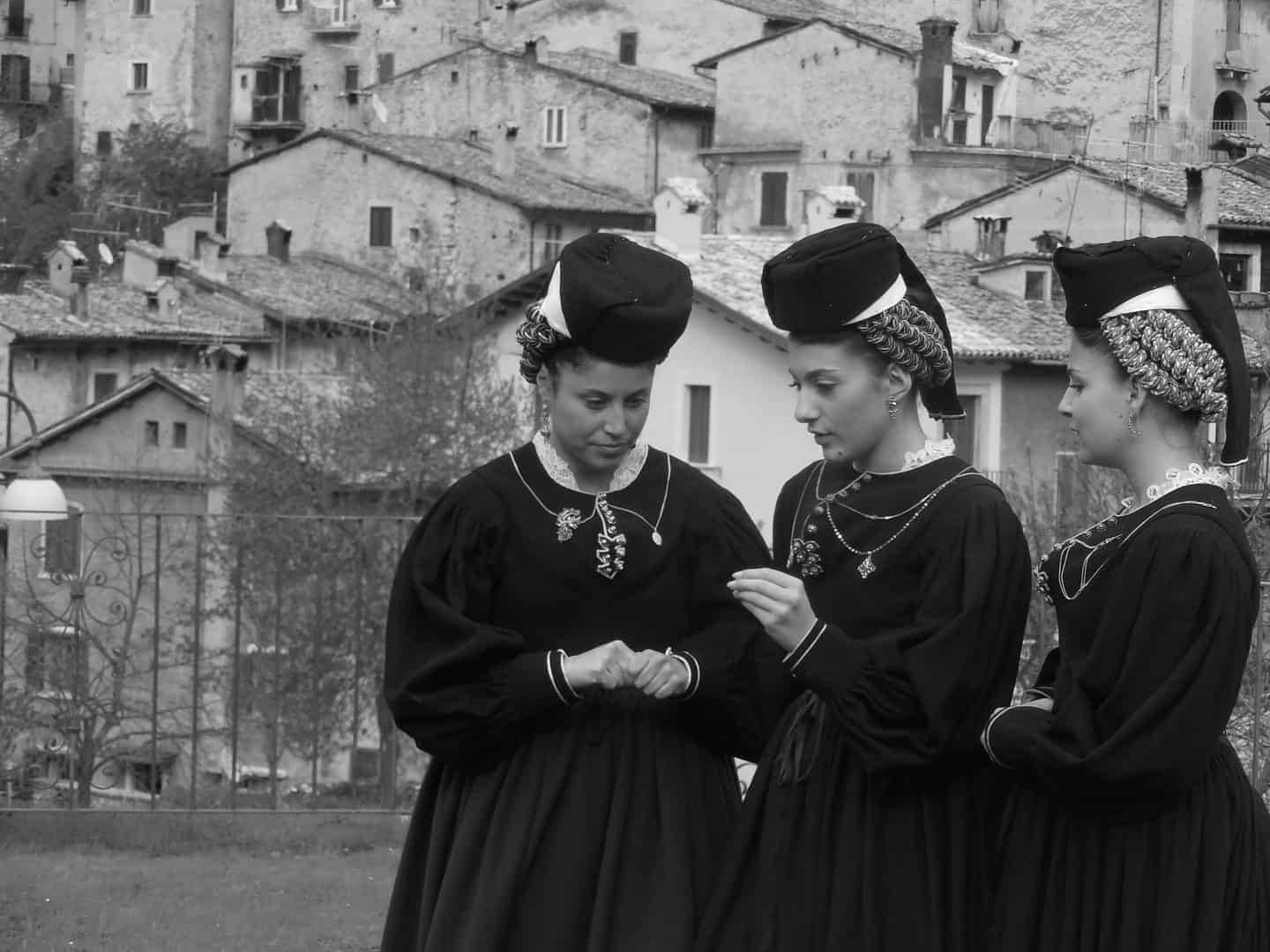
Scanno is a park municipality on the Peligna side, the one of pastures without woods, and with its lake, about one square kilometer in surface area and 32 meters deep, closed in by the Sagittario gorges, it is the most photographed destination of the whole area. From the Path of the Heart, above the western shore, the lake takes the shape that gave it its name. The town has kept the traditional women's costumes, bobbin lace and goldsmithing, and for the whole 20th century it was the city of photographers: Hilde Lotz-Bauer, Henri Cartier-Bresson, Mario Giacomelli, Renzo Tortelli, Gianni Berengo Gardin, Ferdinando Scianna and Mario Cresci portrayed it, and in 1964 Giacomelli's Scanno Boy entered the collection of the MoMA in New York. On August 14, Ju Catenacce reenacts the Scanno wedding in costume. From Scanno the state road climbs to the Passo Godi, between pastures and cross-country ski trails, and descends toward Villetta Barrea.
Another well-known fact, yet rarely cited
Benedetto Croce was born in Pescasseroli, in the Abruzzo, Lazio and Molise National Park, and not in Naples as many believe. He came into the world on February 25, 1866, on the second floor of Palazzo Sipari, the home of his mother Luisa Sipari, in a family of large owners of herds and pastures, and from Pescasseroli he carried with him all his life a concrete idea of what the economic history of a pastoral community was. In 1922 he put it in writing in an essay titled simply Pescasseroli, added as an appendix to his History of the Kingdom of Naples, where he told of the massari, the transhumance, the quarrels over pastures and the Sipari: it is still today the most intelligent reading you can do before coming here. In August 1910 he came back to the town and delivered from the palace balcony the speech that the inhabitants remember as the Pescasseroli Speech. To the municipality he donated the manuscript of the 1909 Logic. His cousin Erminio Sipari, a deputy and the founder of the park, was close to his liberal and national positions, and it is easy to see why the park was conceived in the Sipari house: an environmentalism of educated landowners, not of revolutionaries.
Today Palazzo Sipari houses the Museo di Palazzo Sipari with the Croce and Sipari archives, and you visit it in the center of Pescasseroli next to the church of Santi Pietro e Paolo. The fact that the greatest Italian philosopher of the 20th century was born at 1,167 meters above sea level, in a town of shepherds, and that the first Italian national park was invented in the same house, is a coincidence worth the museum ticket. Many visitors to the Abruzzo, Lazio and Molise National Park don't know it, and leave thinking Pescasseroli is just a town of skiing and bears.
Human geography and archaeology of the Abruzzo, Lazio and Molise National Park
The people of the upper Sangro had to adapt their customs to a harsh landscape, isolated for centuries and without infrastructure or communication routes. Some villages of the Abruzzo, Lazio and Molise National Park experienced the first real form of urbanization only after the Avezzano earthquake of January 13, 1915: given the damage to the historic cores, temporary homes were built, on which the modern buildings and new services were later developed. Before 1915 the strictly pastoral economy of the area had shaped the mountains and the rural landscape and also the layout and form of the inhabited centers: these did not develop around medieval castles, on defensive spurs or on Roman ruins as in the neighboring districts, because the remoteness of the place kept invaders and conquerors away. So the villages grew without a plan, around the 18th-century noble palaces of the great owners of land and livestock, the political and economic leaders of the pastoral communities, born on the model of the mountain masseria: a social order that followed the system of the Roman municipia and of the ethnic sanctuaries tied to transhumant herding. The massaro soon became the main owner of the herds he tended, until he was the only one with the capital needed to continue breeding and trading livestock, in ways that in part echo the development of modern capitalism in northern Europe. It is exactly the world described by Croce.
The first settlements and the Roman age in the Abruzzo, Lazio and Molise National Park
Archaeological investigations have brought to light the first traces of stable settlements dating to the Iron Age (10th-7th century BC), documented by the remains of rudimentary fortifications in polygonal masonry under the historic center of Opi and around Lake Barrea, in the Japagana valley. With herding practiced on a permanent basis, society organized itself into kinship groups: the necropolises of the Val Fondillo, Barrea and Alfedena testify to the first forms of social organization of the territory, and the grave goods with disc-shaped breastplates, brooches and amber necklaces are partly displayed in the museum of Pescasseroli. With the diversification of the Sabellic tribes settled in central Italy, in the 5th century BC, the mountains of the park came to mark the limit between the territories of the Marsi, the Volsci and the Samnite Pentri. The boundaries seem roughly those later set by the Roman administration, which divided the territory among the municipalities of:
- Aufidena, between present-day Alfedena and Castel di Sangro, which administered the upper Sangro as far as Opi. Its walls remain in the pine grove below the fortress of Alfedena.
- Atina, on which present-day Pescasseroli and Opi depended, formerly a possession of Cominium.
- Angizia, an ancient Marsic sacred area on the Fucino, later a Roman municipality that controlled the Fucine area up to the upper Giovenco valley.
- Betifulus, near the hermitage of Sant'Egidio at Scanno, formerly in the municipality of Corfinium, in Peligni territory.
Remains of the Italic and Roman presence are scattered along the Sangro valley: sanctuaries, villas, tombstones, and above all the archaeological area of Aufidena, with the Samnite necropolis excavated in the late 19th century that yielded hundreds of tombs.
Christianity and the Middle Ages
With the fall of the Western Roman Empire, the few social and administrative structures of the upper Sangro were lost. The arrival of the Lombards marked the first step toward political reconstruction after the end of the municipia, and the territory of today's Abruzzo, Lazio and Molise National Park found itself on the border between the duchy of Spoleto and the duchy of Benevento. To find a structured territorial organization again, you had to wait for the great abbeys of Montecassino and San Vincenzo al Volturno, which for centuries contended over hermitages, churches and pastures in the Apennines between Balsorano, the Mainarde and the Valle di Comino, straddling the Lombard borders. The abbey of Farfa too, for a short time around the 11th century, held a fief in Pescasseroli. The monks of the Volturno strengthened some early fortified settlements, Pescasseroli, Rocca Intramonti (whose ruins survive at the Camosciara, in the municipality of Civitella Alfedena) and Barrea, while the Valle di Comino was fortified with military structures at Alvito, Vicalvi and Picinisco to defend what was called the Land of Saint Benedict. From 1017 the Vallis Regia too, that is Barrea, and the monastery of Sant'Angelo in Barreggio at Villetta Barrea belonged to Montecassino. In the 12th century the Borrello family, followed by the d'Aquino of Alvito and the d'Avalos, became lords of Pescasseroli, and with the decline of the Volturno monastery after the earthquake of 1349 the lay lords gained more and more weight. From 1273 the territory of the park fell entirely within the Kingdom of Naples, divided among the provinces of Abruzzo Citra, Terra di Lavoro (Valle di Comino) and the Contado di Molise (Barrea, Pizzone).

The modern age and Italian unification
In 1669 Montecassino definitively acquired the last Volturno holdings. The feudal system, in the innermost areas of Abruzzo, never had great authority, and the political and economic pivots of the upper Sangro soon became, already from the 15th century, the massari and the livestock owners, entrepreneurs before capitalism. The administrative consolidation of the transhumance, attested throughout Italy since the early Middle Ages, was helped in Abruzzo by the political unity of the Kingdom of Naples: the Aragonese fought the feudal privileges that hindered the large-scale migration of herds from the upper Sangro to Puglia, combated banditry and built the vast system of the tratturi, with the Customs House of the Sheep of Foggia established by Alfonso of Aragon in 1447. A slow modernization then came through the wool industry in the district of Sora and, after Unification, through the paper mills along the Melfa at Picinisco and along the Volturno at Pizzone. Bauxite mining was also attempted, with poor results. Emigration to the Americas, between the 19th and 20th centuries, emptied the towns more than any earthquake.
The 25 municipalities of the Abruzzo, Lazio and Molise National Park
The Abruzzo, Lazio and Molise National Park includes 25 municipalities spread across three provinces. In the province of L'Aquila: Alfedena, Barrea, Bisegna, Civitella Alfedena, Gioia dei Marsi, Lecce nei Marsi, Opi, Ortona dei Marsi, Pescasseroli, Scanno, Villavallelonga and Villetta Barrea. In the province of Frosinone: Alvito, Campoli Appennino, Pescosolido, Picinisco, San Biagio Saracinisco, San Donato Val di Comino, Settefrati and Vallerotonda. In the province of Isernia: Castel San Vincenzo, Filignano, Pizzone, Rocchetta a Volturno and Scapoli. The municipal territory does not coincide with the protected perimeter: many of these municipalities enter the park only in part, and the rest falls in the external protection zone established in 1970.
The right photo to take at the Abruzzo, Lazio and Molise National Park
The right photo in the Abruzzo, Lazio and Molise National Park is not the one of the bear, which you take once in a lifetime and almost always badly, with a telephoto lens you don't have. It is the one of Opi from State Road 83 arriving from Pescasseroli, at dawn, when the town perched on its spur floats on the fog of the Sangro plain and behind it rise Monte Amaro and the Val Fondillo. You shoot from the pullout on the right just before the turnoff for Forca d'Acero, with the sun still behind the Meta. By 8 the fog is gone. The second photo is Lake Scanno from the Path of the Heart: you climb for 20 minutes from the western shore, from the little church of the Madonna del Lago, and from the right spot the lake shows its shape. In the late afternoon light the water turns bottle green. The third, harder one, is the chamois in the Val di Rose above the tree line, in September, with the male in profile and the dark collar in evidence: you take it with a 300 millimeter lens from 20 meters, sitting, without moving, and never with a drone, which is banned in the park.
A technical warning: the beech forests are dark and phone sensors turn them into a green mush. At the Camosciara the Ninfe waterfall is photographed in the side light of late morning. The black pines on the dolomite walls, on the other hand, in the evening, when the rock turns pink. And whoever wants the sweeping view of the whole Abruzzo, Lazio and Molise National Park goes up to Forca d'Acero and looks east: the upper Sangro with Opi, the Marsicano and the Camosciara all fit in a single frame.
Monuments and places of interest in the Abruzzo, Lazio and Molise National Park
The churches and abbeys of the Abruzzo, Lazio and Molise National Park
The church of San Tommaso at Barrea was consecrated in 1300 by the bishop of Trivento, remodeled in Baroque forms, damaged by the 1706 earthquake and then restored: the result is a hybrid building between Baroque and Renaissance, with a facade divided into an irregular rectangle and a Baroque portal of classical layout. Inside are frescoes by Paolo Gamba, the 18th-century Molise painter, a pupil of Solimena. The church of Santi Pietro e Paolo in Alfedena, a national monument since 1902, dates to the 13th century and was badly damaged in the Second World War, when the town found itself on the Gustav Line: the facade has been reassembled with a rose window and a portal of Gothic character and with the mosaic lunette by Fausto Conti from 1954, and the three-nave interior, heavily remodeled, keeps the frescoes by the same artist.
The abbey of San Vincenzo al Volturno, between Rocchetta a Volturno and Castel San Vincenzo, is one of the oldest monasteries on the border between Abruzzo and Molise. According to the Chronicon Vulturnense it was founded in 703 by three Beneventan nobles, Paldo, Tato and Taso, and became famous in the following century, when tradition makes it one of the largest abbeys in Europe, before the Saracen destruction of 881. The revival came in the 12th century with the Normans. The complex included the basilica of San Vincenzo Maggiore and the oratory with the crypt of Abbot Epifanio, frescoed between 824 and 842 with a cycle that is among the highest testimonies of early medieval painting in Italy: the Crucifixion, the Annunciation, the virgin martyrs, and Abbot Epifanio prostrate at the foot of the cross. The abbey had its own diocese, linked to Benevento, and holdings that reached as far as the Aterno, in the L'Aquila area, and to the slopes of the upper Sangro. Today you visit the rebuilt abbey church, where a community of Benedictine nuns lives, and the archaeological site of the basilica on the other bank of the Volturno. The crypt of Epifanio is visited by reservation and remains, for me, the most important work of art in the whole territory of the park.
The sanctuary of Canneto, in Settefrati, has very ancient origins: it stands on a Roman temple of the goddess Mefite, the Italic deity of sulfurous waters, at the end of the Melfa valley. Built in the 13th century, it depended on San Vincenzo al Volturno and then on Montecassino. For centuries it was the destination of pilgrimages by transhumant shepherds and it still is, in mid-August, when the Black Madonna of Canneto draws thousands of the faithful from the Valle di Comino and from Molise. The convent of San Nicola at Alvito was built in 1516 with the income of the church of Santa Maria del Campo, a Benedictine provostship in the Valle di Comino that has since returned to town administration. It was built outside the walls, on the slopes of the hill on which the town stands, on an outcrop that pushes into the plain, and the sumptuousness of the building testifies to its wealth. The church of Santi Pietro e Paolo in Pescasseroli, the mother church of the town founded around 1100, was remodeled in the Baroque age and brought back to Gothic forms in the 1960s: the facade has a pointed-arch portal, the interior three naves with ribbed cross vaults, the bell tower is incorporated into the sturdy side tower, and inside is venerated the wooden statue of the Black Madonna, crowned in 1752. The collegiate church of San Giovanni Battista at Ortona dei Marsi, the main place of worship of the town, was begun in the 12th century and completed in the 17th in Gothic-Baroque forms. At the end of the 16th century the bishop of the Marsi, Matteo Colli, raised it to a collegiate church, and inside it keeps an organ by Domenico Fedeli from 1752.

The medieval villages and castles of the Abruzzo, Lazio and Molise National Park
Among the medieval villages, first of all comes Civitella Alfedena, listed among the Most Beautiful Villages in Italy and a Touring Club Orange Flag. Close to the Camosciara, it is made of stone-walled houses, with the parish church of San Nicola di Bari, 17th-century, Baroque, with three naves, and the remains of the castle with its little tower incorporated into the noble palaces of the 16th century. The village is regularly visited by the Marsican bear and the chamois, and in the 1970s it was the laboratory of the park's ecological tourism: a cooperative of young people, a wolf wildlife area, a museum, houses restored instead of abandoned. Alfedena is overlooked by the fortress with its octagonal tower, surrounded by a pine grove where stretches of the walls of the Roman city of Aufidena are preserved. Among the Most Beautiful Villages in Italy in Abruzzo are also Barrea, fortified, with the 11th-century castle and the watchtower on the lake, and Opi, the Marsican village on its spur, with the church of Santa Maria Assunta and the Chamois Museum.
Not far away stands Pescasseroli, whose center has a 19th-century look because it was built largely with the stones of Castel Mancino, the 10th-11th-century fortress whose ruins remain on the hill above the town, between 1,275 and 1,332 meters. Besides being the main town of the Abruzzo, Lazio and Molise National Park, the legal seat of the Ente and of a busy ski resort on Monte delle Vitelle (1,966 meters, with chairlifts and ski lifts), Pescasseroli stands out for the church of Santi Pietro e Paolo and for Palazzo Sipari with its museum, the birthplace of Benedetto Croce. In the Marsica there is also the abandoned village of Sperone, in the municipality of Gioia dei Marsi: the original core was ruined by the Avezzano earthquake and almost only the cylindrical watchtower was left standing. The center rebuilt lower down was inhabited until the 1960s. In the surroundings are the medieval village of Ortona dei Marsi, dominated by the remains of the castle, and the villages of Bisegna and San Sebastiano dei Marsi, notable for the integrity of their historic centers despite the 1915 earthquake.
In Molise and Lazio the centers of historical interest are Castel San Vincenzo, Alvito, Settefrati and Vicalvi. Castel San Vincenzo, close to the abbey, is gathered in the form of a fortified center on a spur, with town gates and medieval palaces. Alvito is overlooked by the Cantelmo castle, built in the 11th century for defensive purposes and rebuilt by the Cantelmo family in the 1400s, and the village alternates the medieval with the 17th-century Baroque of the ducal palaces. Vicalvi is characterized by the 11th-century medieval castle on a rocky spur at about 600 meters above sea level, with two polygonal curtain walls that give it an unmistakable profile from the plain of the Valle di Comino. Among the abandoned villages of the Molise area is Rocchetta Alta, the old part of Rocchetta a Volturno, with its medieval stone-walled houses, the castle and the mother church: the town was partly abandoned after the construction of the new center, which followed the severe damage of the 1944 bombings, when the Gustav Line ran exactly through these mountains.

Some important events that happened here in history
In 1873 Victor Emmanuel II established the Royal Hunting Reserve of the Alta Val di Sangro in the municipalities of Opi, Pescasseroli, Villavallelonga, Collelongo, Lecce nei Marsi, Gioia dei Marsi, Balsorano and Castellafiume, at the urging of the Sipari: a hunting reserve, not a protection one, but it is the first act that recognizes a value in these mountains. Abolished in 1878, it was re-established in 1900 and lasted until 1912. On November 25, 1921, Erminio Sipari and the Pro Montibus et Sylvis leased from the municipality of Opi the 100 hectares between the Val Fondillo and the Camosciara. On September 9, 1922, the park was inaugurated in Pescasseroli, and on January 11, 1923, the royal decree-law established it. In 1925-1926 the boundaries widened to the Monti della Meta, and in the same year the board earmarked part of the Val Fondillo for logging, a measure that made the botanist Romualdo Pirotta, one of the founders, resign in protest. In 1933 the Fascist regime abolished the autonomous body and entrusted the Abruzzo, Lazio and Molise National Park to the Forestry Militia. In 1951 the Republic re-established the body. In 1967 came the European Diploma for Protected Areas of the Council of Europe. In 1969 Franco Tassi was appointed director and in 1970 he established the external protection zone. In 1971 the deer returned from the eastern Alps. In 1976 the third enlargement, to the Marsicano massif, averted a ski area between Pescasseroli and Bisegna. On January 10, 1990, the decree of President Cossiga added the Mainarde sector with the five Molise municipalities, 4,000 hectares, and in 1999 the last enlargement brought in 4,200 hectares of the Giovenco valley. In 2002 the Tassi administration ended amid judicial controversy and debts. In 2017 the ancient beech forests entered the UNESCO heritage. In 2018 the otter returned to the Sangro after 40 years. In 2025 came the first limited-access trails to protect the chamois and the record of 16 bear cubs counted.
Among the events that are not found in the official chronologies I put the war. Between the autumn of 1943 and the spring of 1944 the Gustav Line cut through the park from Alfedena to the Mainarde: Alfedena, Barrea, Pizzone and Rocchetta a Volturno were bombed or blown up by the retreating Germans, the church of Santi Pietro e Paolo in Alfedena was almost destroyed, and on the Mainarde the Italian Liberation Corps fought. Anyone who walks the Monti della Meta still finds the emplacements. It is the chapter that the Abruzzo, Lazio and Molise National Park tells least, and that explains why Rocchetta Alta is empty.
The history of the Ente: a century of the Abruzzo, Lazio and Molise National Park
The origins: from the royal reserve to the idea of a park
The strong isolation in which the upper Sangro had remained for centuries had allowed the survival of a significant number of animal and plant species worthy of conservation: not everything had been turned into pasture. To the timid local initiatives to establish a hunting reserve on the model of the Piedmontese ones came the Sipari family of Pescasseroli and Alvito, related to Benedetto Croce and close to his positions, who worked for the creation, in the municipalities of Opi, Pescasseroli, Villavallelonga, Collelongo, Lecce nei Marsi, Gioia dei Marsi, Balsorano and Castellafiume, of the Alta Val di Sangro Royal Reserve, officially established in 1873 by Victor Emmanuel II. This form of protection lasted until 1878, the year of its abolition. Re-established in 1900, it remained in force until the end of 1912. In the meantime Erminio Sipari began to give voice to the first Italian proposal for a national park on the model of Yellowstone, and not on that of hunting reserves: the difference, for the time, was enormous.
The first initiatives and the Pro Montibus et Sylvis
Together with Erminio Sipari, the first to propose a national park in Italy were the botanist Pietro Romualdo Pirotta, the zoologist Alessandro Ghigi, the writer Luigi Parpagliolo and the federated naturalist association Pro Montibus et Sylvis. The scholars of the Pro Montibus had noticed the concentration of Apennine species and the variety of habitats of the Marsica and in 1914 put forward the first protection plan: a large park extending from the former bed of the Fucino and the Peligna basin to Castel di Sangro, and from the Liri and the Valle di Comino to the slopes of the Majella. The excessive costs made the initiative fail, but it was followed by a second and more concrete involvement of associations and intellectuals. On November 25, 1921, a year before the decree for the Gran Paradiso, Sipari and the Federazione Pro Montibus began the protected management of the 100 hectares between the Val Fondillo and the Camosciara leased from the municipality of Opi: the Abruzzo, Lazio and Molise National Park existed before it had a law.
The legal establishment and the enlargements of the Abruzzo, Lazio and Molise National Park
In 1923 the park administration was officially established and the boundaries extended to other municipalities, which only later granted their territory to the autonomous body, forming the foundations of the present park. The first boundaries included part of the territory of Civitella Alfedena and Villetta Barrea (Monte Petroso and Camosciara), of Opi (Forca d'Acero, Val Fondillo, Valle Fredda), of Pescasseroli (La Difesa), of Bisegna (Terratta), of Villavallelonga and Collelongo (Prati d'Angro, Aceretta), of Lecce nei Marsi and Gioia dei Marsi (Cicerana, Passo del Diavolo), of Campoli Appennino and Alvito (Capo d'Acqua, Val Lattara) and of Settefrati. In 1925-1926 the protected area expanded to the Monti della Meta between Alfedena, Picinisco, San Biagio Saracinisco, Vallerotonda and part of the territory of Pizzone and of the Sangro valley, now in the province of Isernia. In the same period the administrative commission earmarked part of the Val Fondillo for logging, and Romualdo Pirotta, who opposed it, resigned from the board. In 1926 the park museum and zoo were established in Pescasseroli and the first huts and trail network were built: among the first political goals of the body was the choice to favor tourist presence and sports stays in an economic system compatible with protection, able to stand alongside the pastoral economy. In 1933 the Fascist regime abolished the autonomous body, probably because of its ties with Catholic associations, in particular with the scouts, and to strengthen in the parks the presence of the Forestry Militia, which also obtained the management of the Gran Paradiso and of the new parks of Circeo and Stelvio. Anyone who knows the Circeo National Park will find the same stamp in that season.
The postwar period and the Saltarelli administration
In 1951 the government re-established the autonomous body. The new management recovered the original goals and, besides many hires of surveillance staff, the promotion of scientific research and the extension of hunting bans, favored the construction of the first infrastructure for tourist hospitality. At the end of the 1950s harsh criticism flared up over building policy, over hotel speculation and over the ski runs and lifts built in several municipalities. The administration of Francesco Saltarelli, begun in 1952, tried to oppose the wave of illegal building but was ousted. The years of urban expansion of Pescasseroli and of the assault of concrete followed, according to a plan that wanted a large tourist and hotel district from Roccaraso to the municipalities of the Valle di Comino. In 1967 the park obtained the European Diploma for Protected Areas. A long period of receivership and hard environmental battles ended in 1969, when Franco Tassi was appointed director.
The Tassi administration and the great success of the Abruzzo, Lazio and Molise National Park
Franco Tassi, appointed in 1969, showed himself from the start opposed to the wave of land subdivisions that was reappearing in the most important municipalities. In 1970 he established the external protection zone, which largely follows the boundaries of the first great park proposed by Sipari and the Pro Montibus. In 1976 the third great enlargement, to the Monte Marsicano massif, averted a system of ski runs between Pescasseroli and Bisegna on the model of Roccaraso. These are the years of great success: the rethinking of development plans took concrete form in the selective welcome of an ecological tourism, in contrast with mass inflows, and for the first time in Italy an environmental economic model was launched that has its reference in Civitella Alfedena. On January 10, 1990, with a decree of the President of the Republic Francesco Cossiga, the municipalities of Pizzone, Castel San Vincenzo, Rocchetta a Volturno, Filignano and Scapoli granted part of their territory to the park's restrictions, for a total of 4,000 hectares: the Mainarde sector was born, the fourth great enlargement. The popularity of the reserve grew until it became the reference point of Italian environmentalism and the hotbed of the new great protection projects, in Abruzzo and, through the WWF, throughout the country. Between 1990 and 1999 the body collaborated in the establishment of the Gran Sasso and Monti della Laga National Park and of the Majella one and in the creation of a capillary system of regional reserves that make Abruzzo one of the European regions with the highest percentage of protected territory. Environmental associations gathered around the park staff and the first scientific research began, able to bring out the importance of the regional ecological system. In 1999 the last great enlargement added 4,200 hectares in the municipalities of Ortona dei Marsi and Bisegna, in the Giovenco valley.
The financial crisis, the end of the Tassi administration and the receivership
The great results did not take economic administration into account. The growth of the organizational system and the entry of elements foreign to the environmentalist tradition and to financial management, from national and regional bureaucratic constraints to the growing interest of local politicians in taking part in decisions, conditioned the work of the body. The trend continued until 2002, when a series of political and judicial events put an end to the Tassi administration: the former director, later found innocent, was reported and removed by the governing board, which accused him of having ordered unauthorized wiretaps during meetings. The debt incurred and an alleged false accounting led to his removal by the president of the body Fulco Pratesi, in those years president of WWF Italy, just as the direction of national and regional environmental policies was changing. The original plan, which envisaged the coordination of the reserves to be established around the park, was set aside. Instead of intervening in collaboration with the indebted reserve, a sequence of autonomous mirror parks was financed, for years fragmented and scattered, and to this was added the distrust of the populations and of environmentalists in the face of the controversies. A period of uncertainty followed until the no-confidence motion of the Comunità del parco, the advisory body established by framework law no. 394 of December 6, 1991, against Pratesi, who was removed in 2005 from the presidency by the Ministry of the Environment. From 2002 to 2008 Aldo Di Benedetto, formerly vice president of Pro Natura, heir of the Pro Montibus et Sylvis, was acting director, and from August 8, 2007, with the ministerial decree reconstituting the governing board, Giuseppe Rossi was appointed president, ending the receivership.
The new management of the Abruzzo, Lazio and Molise National Park
From January 22, 2008 to February 2011 the general director was Vittorio Ducoli, formerly director of the Adamello regional park, replaced first as acting director and then, from November 8, 2011, by Dario Febbo of Pescara, formerly director of the Gran Sasso and Monti della Laga National Park. On March 18, 2014, Antonio Carrara was appointed president. With a decree of October 8, 2019, after a period of prorogatio, the Minister of the Environment Sergio Costa appointed Giovanni Cannata president, and since August 13, 2019, the general director has been Luciano Sammarone, formerly commander of the Carabinieri biodiversity unit of Castel di Sangro. The most recent managements appear more and more oriented toward protection and toward restoring the relationship with local communities and institutions, and the bear monitoring coordinated by the park, with the annual counts of females with cubs, is today their most credible calling card. For the updated organization chart, the official website of the Ente is the place to look.

Culture, food and crafts in the Abruzzo, Lazio and Molise National Park
What to eat in the Abruzzo, Lazio and Molise National Park
Because of the distance from trade routes and the absence of olive oil and vines, in a mountain climate, the traditional products are those of the central Apennines: cured meats and sausages, humble first courses based on legumes and soft pasta, with vegetables that can be grown even at altitude like the Scanno bean or the cicerchia, and the mutton and lamb meats that the transhumance made the signature dish, from arrosticini to the pecora alla cottora. In the Valle di Comino some products are protected by Slow Food Presidia and by ministerial decrees: the pecorino of Picinisco, the truffle of Campoli Appennino, which has a festival and a market in autumn, and organic honey, as in other municipalities of the park. Sweets and liqueurs are promoted by small local firms, especially in Alvito (the marzipan torroni), in Scanno (the mostaccioli and the pan dell'orso, an almond and honey sweet covered in chocolate) and in Pescasseroli (the fragolino red wine, the sour cherry ratafià and the centerba). My advice is to buy the pecorino of Picinisco directly from the producers, the long-aged one, and not to look for lake fish: the trout in restaurants almost always comes from farms.
Crafts and traditions
In Scanno they still make bobbin lace, and the town has a rich goldsmithing tradition with the presentosa, the star-shaped jewel of Abruzzo women. Stone and wood working survives sporadically throughout the territory. At Scapoli, in Molise, they make zampogne, with a museum and an international festival, and in some municipalities they still make the costumes used in traditional festivals like Ju Catenacce of Scanno, on August 14. The Scanno costume, with the black pleated skirt and the turban-like headdress, is the one portrayed by Cartier-Bresson and Giacomelli, and some elderly women still wear it every day.

How to really visit the Abruzzo, Lazio and Molise National Park
Sports, skiing and activities in the Abruzzo, Lazio and Molise National Park
In the Abruzzo, Lazio and Molise National Park you can do hiking, guided trekking, horseback trekking, road and mountain biking, canoeing and birdwatching, cross-country skiing on the loops of Pescasseroli, Opi and Passo Godi, and downhill skiing at the lifts of Pescasseroli on Monte delle Vitelle, of Opi and of Scanno. For tourism, camping and swimming in the lakes of Barrea, Scanno and Villalago also count. The official trails are marked with a letter and a number, with the letter identifying the sector (G for the Camosciara, F for Val Fondillo, I for Civitella, L for the Monti della Meta): the park map is bought at the Visitor Centers and is indispensable, because phone coverage in the side valleys is nonexistent.
The Abruzzo, Lazio and Molise National Park with children
With small children the three things that work are the Visitor Center of Pescasseroli, with the museum, the wildlife park where you see bears, wolves, deer and chamois, and the Apennine garden. The wolf wildlife area of Civitella Alfedena, free, where the pack is observed from the lookout. And the Camosciara with the little train and the Ninfe waterfall, which is 300 meters from the clearing. In the Val Fondillo the Tornareccia trail can be done with a stroller. The Val di Rose is fine above 10 years old. If you prefer a private, tailor-made day, with driver and guide, on TourLeaderPro you will find the small-group experiences departing from Rome. On the Lazio side the bear wildlife area of Campoli Appennino and Lake Posta Fibreno round off a perfect day for a family leaving from Rome.

Accessibility, costs and how to save
The wildlife park of Pescasseroli has a barrier-free route marked by the Abruzzo Region, trail G1 of the Camosciara is flat and with the little train is accessible even to those who can't walk, the Tornareccia in the Val Fondillo is suitable for wheelchairs and strollers. The villages, on the other hand, are made of stairs. As for costs, the Abruzzo, Lazio and Molise National Park is one of the cheapest destinations in protected Italy: the territory is free, and you pay only for the Visitor Center of Pescasseroli (rates on the website of the Ente), the parking lots of the valleys, the little train of the Camosciara and the guided hikes required in summer on the three regulated trails. You save by sleeping in Villetta Barrea or in the towns of the Valle di Comino instead of Pescasseroli, going off season and bringing a packed lunch into the valleys, where there are no cafes.
What is around the Abruzzo, Lazio and Molise National Park
For anyone with one more day I suggest three directions. Toward Lazio, the Valle di Comino with Atina, San Donato Val di Comino, the lake of Posta Fibreno and, further down, the abbey of Montecassino. Toward the north, the Marsica with the Montagne della Duchessa Reserve and, beyond, the Monti Simbruini, on the road back to Rome. Toward the east, Scanno, the Sagittario gorges and Sulmona. For planning a nature trip to Italy in English, with the Marsican bear among the protagonists, I refer you to the ItalyPlanner guide to Italian wildlife.
Who has passed through the Abruzzo, Lazio and Molise National Park
The first name is Benedetto Croce, born in Pescasseroli on February 25, 1866, who came back in August 1910 for the speech from the balcony of Palazzo Sipari. The second is his cousin Erminio Sipari, a deputy, founder of the Abruzzo, Lazio and Molise National Park and first president of the body, to whom the Sentiero Sipari has been dedicated since 2018. Victor Emmanuel II is not documented in person on the upper Sangro, but in 1873 he established by his own act the royal hunting reserve from which everything began. Between 1914 and 1926 the founders of Italian scientific environmentalism passed through here: the botanist Pietro Romualdo Pirotta, director of the Botanical Garden of Rome, who resigned over the logging of the Val Fondillo, the zoologist Alessandro Ghigi, and the writer Luigi Parpagliolo. In the second half of the 20th century the park was the training ground of Franco Tassi, director from 1969 to 2002, of Fulco Pratesi, founder of WWF Italy and president of the body until 2005, and of Luigi Boitani, the zoologist who here in the 1970s carried out the first radiotelemetry studies of the wolf in Italy, changing the image of the animal from enemy to protected species.
Through Scanno, a park municipality, passed the great names of 20th-century photography: Hilde Lotz-Bauer in the 1930s, Henri Cartier-Bresson in the postwar years, Mario Giacomelli, whose image of the boy of Scanno entered the MoMA collection in 1964, and then Renzo Tortelli, Gianni Berengo Gardin, Ferdinando Scianna and Mario Cresci. In Pescasseroli, directors such as Ettore Scola and Riccardo Milani have shot films, according to local news reports. And then there are the passages that nobody records: the shepherds of the transhumance who every September came down from these valleys toward the Tavoliere along the Pescasseroli-Candela tratturo, 211 kilometers, for centuries, until the middle of the 20th century. The park is theirs before anyone else's.
Quick questions about the Abruzzo, Lazio and Molise National Park
How much does it cost to enter the Abruzzo, Lazio and Molise National Park?
Nothing: the territory has free access. You pay for the Visitor Center of Pescasseroli, the parking lots of the Camosciara and the Val Fondillo, the little train of the Camosciara and, in summer, the mandatory guided hikes on the three regulated trails.
How far is the Abruzzo, Lazio and Molise National Park from Rome?
About 170 kilometers to Pescasseroli via the A24-A25 and State Road 83, a good two and a half hours. 133 kilometers to the entrance at Ortona dei Marsi, the closest but the least served.
Can you get to the Abruzzo, Lazio and Molise National Park without a car?
Yes: the regional train Roma Tiburtina-Avezzano and the TUA bus from Piazza Kennedy to Pescasseroli, Opi, Villetta Barrea, Civitella Alfedena and Barrea. In summer there is a direct connection from the upper Sangro to Rome, to be checked every year.
How long does it take to visit the Abruzzo, Lazio and Molise National Park?
Three days for the three main valleys and the villages. A long weekend is the sensible minimum. In one day from Rome you see only the Camosciara or the Val Fondillo.
Where can you see bears in the Abruzzo, Lazio and Molise National Park?
Safely in the wildlife park of Pescasseroli and in the wildlife area of Campoli Appennino. In the wild, with luck and binoculars, in the high clearings at sunset between May and June, better with a park guide, or in the Giovenco valley.
How many Marsican bears are there?
The latest formal estimate, from 2014, indicates between 45 and 69 individuals in the park and the adjacent area. In 2025 seven females with at least 16 cubs were counted, the highest figure in the historical series.
Can you do the Val di Rose freely?
From mid-September to the end of July, yes. Between the end of July and mid-September, trail I1 is walked only on a paid guided hike, booked with the Ente. The same goes for Monte Amaro di Opi (F1) and for Monte Meta (L1).
Is the Camosciara suitable for children and wheelchairs?
Yes: trail G1 from the parking lot to the clearing is flat and there is the paid little train. From the clearing the Ninfe waterfall is 300 meters away. In the Val Fondillo the Tornareccia can be done with a stroller and a baby carriage.
Can you bring dogs into the Abruzzo, Lazio and Molise National Park?
At the Camosciara on a leash, in the Val Fondillo with free access to the whole valley. On the high trails it's best to avoid them, for the chamois and for the wolves. In the Visitor Centers and the wildlife areas they are normally not allowed in.
Is the Abruzzo, Lazio and Molise National Park free on the first Sunday of the month?
The territory is always free. For the Natural History Museum of Pescasseroli there is no monthly free admission like that of the state museums, and the rates should be checked on the website of the Ente.
Where do you park in the Abruzzo, Lazio and Molise National Park?
In the paid parking lots at the entrance of the Camosciara and the Val Fondillo, with daily rates. At Civitella Alfedena and Opi in the parking lots below the villages. At Pescasseroli along the avenue of the Visitor Center.
When is the best time to go to the Abruzzo, Lazio and Molise National Park?
From mid-September to mid-October for the bellowing of the stags, the colors and the chamois. May and June for flowers and bears. July and August only by starting at dawn and choosing the lesser-known valleys.
Can you ski in the Abruzzo, Lazio and Molise National Park?
Yes, at Pescasseroli on Monte delle Vitelle, with chairlifts and ski lifts up to 1,966 meters, besides the smaller lifts of Opi and Scanno and the cross-country loops of Passo Godi and Pescasseroli.
What is the difference between the Abruzzo, Lazio and Molise National Park and the Camosciara?
The Camosciara is a strict reserve inside the park, the dolomite amphitheater between Villetta Barrea and Civitella Alfedena where the chamois was saved. It is the most visited piece of the park, not a protected area in its own right.
Where can you swim in the Abruzzo, Lazio and Molise National Park?
In Lake Barrea, with beaches at Villetta Barrea and Barrea and canoes for rent, and in Lake Scanno. The rivers are cold and, in the strict reserves, not open for swimming.
What is there to see if it rains?
The Natural History Museum of Pescasseroli, Palazzo Sipari, the Apennine Wolf Museum of Civitella Alfedena, the Chamois Museum of Opi and, toward Molise, the abbey of San Vincenzo al Volturno with the crypt of Epifanio.
Do you need a guide to visit the Abruzzo, Lazio and Molise National Park?
For the valley floors, no. For the high trails in summer it is mandatory on the three regulated routes, and to see a bear in the wild it is the only serious way. The guides are those licensed and appointed by the Ente.
What is the highest peak of the Abruzzo, Lazio and Molise National Park?
Monte Petroso, 2,247 meters, followed by Monte Meta, 2,242 meters, both on the Meta range between Abruzzo, Lazio and Molise. Monte Marsicano, above Pescasseroli, also tops 2,000 meters.
Can you visit the UNESCO beech forests of the Abruzzo, Lazio and Molise National Park?
Yes, but without tourist facilities: Cacciagrande is crossed in the Val Fondillo, and Val Cervara above Villavallelonga and Coppo del Morto above Pescasseroli are reached on normal trails, better with a guide in autumn.
What do you eat in the Abruzzo, Lazio and Molise National Park?
Pecorino of Picinisco, truffle of Campoli Appennino, Scanno beans, arrosticini and mutton, mountain honey. In Scanno mostaccioli and pan dell'orso, in Pescasseroli ratafià and centerba.
The conclusion is this: the Abruzzo, Lazio and Molise National Park does not reward whoever crosses it, it rewards whoever stays. Sleep at Civitella or at Villetta, get up before the sun, climb into the Val di Rose at the end of September and leave the bear to luck. If you see one, you will have a story to tell for the rest of your life. If you don't, you will still have seen the truest Italian mountain there is.
Article written by the editorial team of TourLeaderPro, contact them for Private/Corporate/V.I.P. Tours and Experiences.
Planning a trip to Rome? The English guides to visiting the city are on ItalyPlanner.com.