Vicalvi (FR)
In short. Vicalvi is a scattered comune in the province of Frosinone, in the Valle di Comino, on the Lazio side of the Abruzzo, Lazio and Molise National Park: just over 700 residents spread across 10 nuclei, the town hall in Piazza Giovanni…
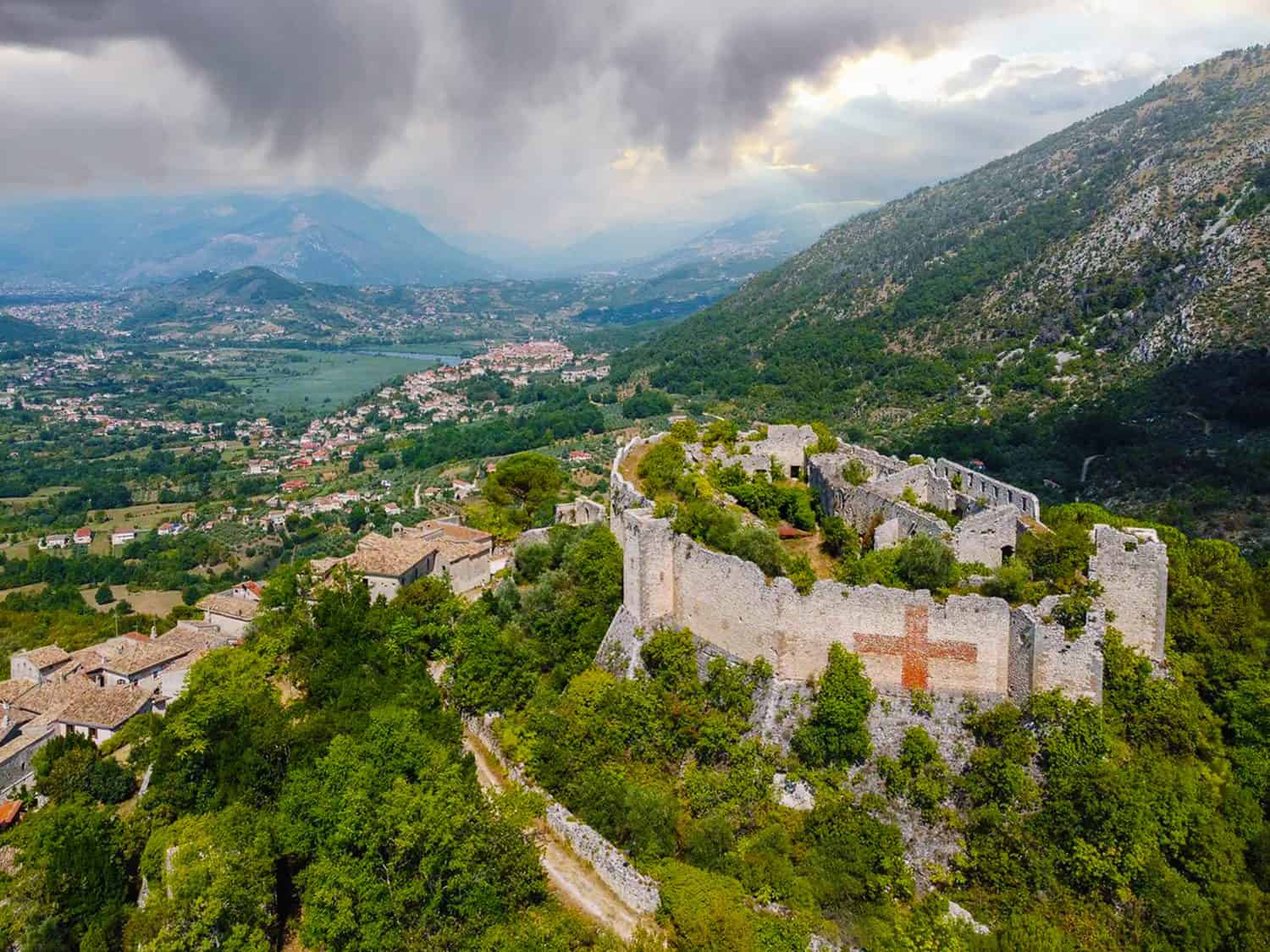
Vicalvi is a scattered comune in the province of Frosinone, in the Valle di Comino, on the Lazio side of the Abruzzo, Lazio and Molise National Park: just over 700 residents spread across 10 nuclei, the town hall in Piazza Giovanni Paolo II in the Delicata hamlet, the historic center perched on a hill and, at the top, at about 590 meters above sea level, the castle that you recognize from kilometers away by the big red cross painted on the facade. The village and its streets can be walked freely and for free on any day of the year, with no ticket and no hours. The castle, instead, no: it is municipal property and can be visited only with a guide, or in the guided openings organized by the Pro Loco Vicalvi departing at 10:30 and with mandatory booking by WhatsApp message to the number 380 4750704 (the Pro Loco asks for messages, not calls, and places are limited), or on request to the municipal offices at the number 0776 506512. From Rome you get there in a little under an hour and a half by car: A1 heading south, exit toward Frosinone or Ferentino, then the expressway to Sora, and from Sora about 10 kilometers of provincial road toward the Valle di Comino. Opening calendar, rates and contacts must be confirmed on the website of the Comune di Vicalvi or on the Pro Loco's channels before setting out: here seasonality matters, and in winter the openings thin out.
Where Vicalvi (FR) is and how to get there from Rome
Geography explains Vicalvi better than any preamble. The town occupies an isolated hill that closes to the west the basin of the Valle di Comino, an almost circular basin of about 244 square kilometers ringed by mountains, whose highest point is Monte Petroso at 2,247 meters and whose valley floor drops to a little over 300 meters. From the hill of Vicalvi you control two worlds: to the east the Valcomino with its towns arranged in a circle, to the west the Liri valley that descends toward Sora and Isola del Liri. Whoever built a fortress up there was not looking for a panorama: they were looking to see who was coming, from both sides, a day in advance.
By car from Rome to Vicalvi (FR)
The fastest route is the A1 motorway toward Naples to the Ferentino or Frosinone exit, then the Ferentino-Frosinone-Sora expressway, which is the road backbone of the whole inland Ciociaria. Once in Sora you take the direction of the Valle di Comino and in a little over 10 kilometers you are under the hill. The overall count, Roman traffic permitting, is a little under an hour and a half from the Colombo or from the Grande Raccordo Anulare south. An alternative exists from the south: whoever comes from Cassino takes the Cassino-Sora state road and goes up the Rapido and Liri valley, with the chance of stopping at the Abbey of Montecassino along the way. From the north, whoever comes down from Abruzzo on the A25 exits at Avezzano and takes the Avezzano-Sora, which crosses the Marsica and passes over into southern Lazio.
Practical advice: the last kilometers toward the historic center of Vicalvi are uphill, narrow and with short hairpin bends. A normal-size car gets through without problems, a camper doesn't. Whoever arrives with a long vehicle leaves it in the lower part of the village, in the Delicata area, and goes up on foot: it is a 20-minute uphill walk, which is worth more than any close-by parking.
By train and bus to Vicalvi (FR)
The reference railway station is Sora, on the Avezzano-Roccasecca railway, a single-track non-electrified line run by diesel railcars. From Roma Termini you reach Roccasecca on the line for Cassino and Naples, and at Roccasecca you change for Sora. It is a trip that requires patience and a careful reading of the timetables, because connections are not frequent and the line has known over the years suspensions and modernization works. From Sora the road links to the towns of the Valle di Comino are provided by the regional Cotral bus lines, with runs calibrated to school schedules: whoever counts on the bus for a Sunday outing risks being left on foot. The truth, said without beating around the bush, is that Vicalvi is visited by car or with a rental vehicle. Public transport works for residents and students, not for day tourism.
Where to leave the car in Vicalvi (FR)
Parking spaces are in the lower part, around Piazza Giovanni Paolo II and along Viale Roma, and in some widenings along the climb to the historic center. On the days of the guided visits to the castle and during the patron saint festivals the hill fills up fast: arriving half an hour early is the only strategy that works. The final stretch to the castle door is covered on foot in any case, on uneven ground.
Vicalvi (FR) in brief: the numbers of the village
Vicalvi counts just over 700 inhabitants, a figure that over the 20th century was severely reduced by emigration and by the shift of the population from the historic center to the lower districts, more comfortable and better served. The municipal territory is organized in 10 nuclei: Delicata, Centro Storico, Colle D'Agnese, Mortale, Maschiuna, Castellana, Palombo, Borgo, San Francesco and Colle Flonio. This scattered structure is not an administrative accident, it is the very form of Apennine settlement: the castle and the walled village for defense, the farming districts around, and in the 20th century the shift of the center of gravity toward the valley floor where the road passes.
On the economic side, the 2015 statistical surveys counted 52 active businesses with 132 employees, an average of a little over two employees per business: widespread micro-entrepreneurship, construction, crafts, neighborhood retail, agriculture. The vine falls within the Atina DOC regulations, the denomination that gave back dignity to the reds of the Valle di Comino, historically built on cabernet and on local grape varieties. These are small numbers, and they should be read for what they are: the snapshot of a town that has stopped growing in inhabitants and has begun to play the card of its heritage.
An administrative detail that explains many things: until 1927 Vicalvi belonged to the province of Caserta, and passed to that of Frosinone with the reorganization of that year. Even before, and for centuries, the Valle di Comino was Kingdom of Naples, not the Papal State. Whoever arrives from Rome thinking of finding the papal Ciociaria instead finds a southern border land, with another administrative history, another dialect and other food traditions.
A curiosity about Vicalvi (FR)
The big red cross painted on the southeast side of the castle is the sign with which Vicalvi presents itself to the world: it can be seen from Alvito, from Posta Fibreno, from the road that climbs from Sora, and it has become the town's trademark. The explanation everyone repeats is that during the Second World War the Germans turned the fortress into a field hospital and marked it with the emblem of the Red Cross, as the law of war requires. The cross was traced in 1943, at the height of the occupation, when the Gustav line made the Liri valley and the Cassino area one of the bloodiest fronts in Europe.
The point is that, according to the reconstruction of the architect Diego Mammone, a scholar of these places, a hospital was never set up in the castle. His words are clear-cut: the Germans' choice to paint the cross was purely dictated by cunning, and this was confirmed by the testimonies of the citizens who lived through that period. The troops used the castle as shelter and as a weapons depot, and with the cross they made sure it would not be bombed. Thanks to that expedient the castle was not destroyed and can be admired still today.
It is a curiosity that is worth more than an anecdote, because it tells two things at once. The first is military history: the illicit use of the protective emblem was a widespread practice of war, and in this case it worked. The second is the history of conservation: the most important medieval monument of the Valle di Comino has reached us intact thanks to a wartime deception. Few fortresses in southern Lazio can say as much. Alvito lost its castle to tremors and abandonment, Cassino was razed to the ground together with the abbey, Vicalvi remained standing because someone took a brush and some red paint. If you have to tell someone about Vicalvi in a single sentence, tell about the cross. Then go up, and show that under the paint there is a fortress of the year 1000.
One thing nobody tells you about Vicalvi (FR)
Almost all visitors look at the castle and think they are looking at the Middle Ages. In part it is true, but the oldest part of Vicalvi is at least 1,500 years older, and lies under and around the medieval fortress: they are the remains of polygonal walls, the ones popular tradition calls Cyclopean, built with large limestone blocks shaped to fit together by interlocking, laid dry, without mortar. It is not rubble material: it is a defensive system of a pre-Roman fortified center, in all probability Samnite, and the polygonal walls of central-southern Italy are dated overall between the 7th and the 2nd century BC. For Vicalvi the oldest phases are traced back to the 5th or 4th century BC.
The term Cyclopean comes from the ancient belief that only the Cyclopes could move boulders of that size, and it survives out of habit. Giuseppe Lugli, who devoted the classic study to these walls, distinguished four building manners, from the first with barely roughed-out, stacked blocks to the third with perfectly geometric polygons and matching faces, up to a more cursive fourth. The discussion on attribution is still open: Lugli tended to see the Roman hand in them, Filippo Coarelli considers them a technique used indifferently by the Italic peoples before Romanization and by the Romans themselves, and Giulio Magli observes that the Romans never left written testimony of having built in polygonal work. Whoever visits Vicalvi has before them, in a few square meters, a piece of this debate.
The second thing nobody says concerns the medieval defensive structure: the castle does not have one curtain wall, it has three, concentric, a rare solution among Apennine fortifications, where as a rule people make do with a single ring clinging to the rock. Local historical sources recall that originally the town was surrounded by a double circuit, later reinforced. If you look at the plan from above, the fortress draws an elongated almond shape: the towers are not at the corners of a quadrilateral but at the vertices of an irregular polygon that follows the ridge. It is not laziness on the builders' part, it is the correct reading of the terrain.
The advice I give you for visiting Vicalvi (FR)
Advice number one is banal and nobody follows it: book before you leave. The castle of Vicalvi is not a museum with a ticket office, it is a municipal monument that opens on dates set by the Pro Loco or on request. Whoever arrives without warning finds a gate and a panorama, which is not little but is not the visit. The WhatsApp message to the Pro Loco's number should be sent days in advance, because the groups are limited.
Advice number two concerns time. Vicalvi can be dispatched in 40 minutes if you limit yourself to the castle, and it would be a waste. The right day includes three hours on the hill, including the church of Saints John the Baptist and the Evangelist, the walk along the serpentine little road of the historic center and the stop at the viewpoint, then the convent of San Francesco in the San Francesco locality, then the descent toward the lake of Posta Fibreno for the afternoon. With this scheme you get back to Rome in the evening having seen a castle, a Franciscan convent with relics and a nature reserve with a floating island, which for a day trip is a serious haul.
Advice number three concerns shoes and season. On the hill you walk on cobbles, packed earth and bare rock: leave smooth soles at home, and this goes for the elegant ladies of organized groups too. As for the season, the opinion is clear-cut and unpopular: spring is the best window, between late March and May, when the green is bright, the guided openings are on the calendar and the heat has not yet bleached the valley. July and August bring the festivals and the sagre, but also the sultriness of the valley floor and the flat midday light. October is the second choice, with the woods turning and the Ciclostorica enlivening the valley. January and February, for a visitor coming from far away, are to be avoided: you risk the closed gate, fog in the basin and ice on the last hairpin bend.
Advice number four is the most concrete of all: in Vicalvi there are no structured tourist services, and this has to be factored in. Bring water, don't count on an open bar in the historic center on a midweek November afternoon, and arrange lunch in Sora, Atina or Alvito, where the trattorias exist and are working.

The Castle of Vicalvi (FR): the visit room by room
The fortress we call today the Lombard Castle of Vicalvi is the monument that justifies the trip. It stands on the top of the hill, at about 590 meters above sea level, and the visible building dates essentially to the 11th century, set on the ruins of an older Lombard garrison. The first documents attesting the presence of a fortification here are from 937. The Comune has owned it since 1986, and since then work of securing and recovery has followed that has made the accompanied visits possible.
The plan and the three circuits of the Castle of Vicalvi (FR)
The first thing that strikes whoever arrives at the door is the succession of barriers. The castle is protected by three concentric curtain walls, an unusual arrangement for an Apennine fortification of this size. The perimeter is not regular: it follows the rocky ridge and draws an elongated almond shape, with the towers placed at the vertices of the irregular polygon. The walls are very high on the exposed side, and in the 16th century, when gunpowder made vertical defenses obsolete, battered bases were added at the foot and square-plan towers on the northern side. It is the same evolution you read in dozens of Italian fortresses between the 15th and 16th centuries: the castle that is born to resist ladders and catapults has to learn to take iron balls.
The towers and the mullioned windows
Of the towers, two are preserved in their entirety and remain the most photographed element of the complex. On the inner walls open mullioned windows, a detail that often surprises: a fortress is not only a blind block, the noble rooms needed light and the mullioned windows bring it in with a design that already belongs to the language of medieval civil architecture. When you look at them from the inside, try to imagine the glass absent and the wooden shutters: that was the comfort of the year 1000.
The chapter hall of the Castle of Vicalvi (FR)
The most solemn room is the chapter hall, covered by cross vaults and marked by round arches. On the walls remain the traces of the fireplaces, whose travertine elements were carried off over the decades of abandonment. It is the hall where the fief was administered, where justice was rendered, where those who mattered met. Even emptied, it communicates its function: the proportions are those of a hall of state, not of a military storeroom.
The chapel and the Black Madonna
In the castle chapel survives a fresco that is worth the climb on its own: a Black Madonna with the Child in her arms, a 17th-century work, flanked by the young Saint John, Saint Sebastian and Saint Roch. The pairing is not accidental and should be read: Sebastian and Roch are the two saints invoked against the plague throughout modern Italy, and their presence dates the fresco to a season of epidemics, when even a garrison painted its own insurance on the wall. Black Madonnas are a widespread and debated phenomenon, between pigments altered by candle smoke and long-lasting devotions: here the image is modest in size and intense in effect, and should be looked at in raking light.
The fresco with the lake of Posta Fibreno
Also inside the fortress is preserved a fresco depicting the surrounding landscape and showing the lake of Posta Fibreno as it looked in past centuries. It is a rare document, because landscape painting with topographic value, in a rural and castle context, is not frequent. Whoever plans to go down to the lake in the afternoon should do this exercise: look at the fresco in the morning, then look at the body of water in real life. The comparison between the painted shape and the present one is the most effective way to understand how much a landscape moves over time.
The sentry walk and the sundial
The walkway on the perimeter walls is the moment when the visit changes register. From up there you take in the Valle di Comino to the east, the woods, the mountains of the Park, the towns arranged in a circle on their hills, and to the west the Liri valley. Below you, the old village of Vicalvi with its roofs. On the paving of the walkway a sundial is engraved, a detail that escapes those who walk looking at the horizon: look down. A solar clock engraved in the stone of a fortress tells that up there, besides the sentries, people lived.
The ruined village around the castle
The fortress is surrounded by the old medieval village, a fabric of houses largely in ruins that in recent years has been the object of urban recovery projects. Among the buildings involved is the church of San Pietro, which belongs to this upper nucleus. Walking among these ruins is an experience to be handled with caution and respect: they are private properties and fragile structures. The value for the visitor is one of urban reading: here you understand, better than in any handbook, what incastellamento means, that is, the migration of the population from the countryside toward the protective shadow of a fortress, the phenomenon that between the 10th and 11th centuries redrew the settlement map of half of Italy.

Another well-known fact, yet rarely cited
That Vicalvi borders Posta Fibreno everyone knows. That Posta Fibreno was part of the territory of Vicalvi until very recent times few know: the separation and the constitution as an autonomous comune date to 1957. That is less than 70 years ago. It means that the most famous karst lake of southern Lazio, with its floating island and its endemic trout, for centuries was Vicalvi water, and that the two towns share registries, surnames, kinships and memories to an extent that no street sign tells.
The fact has practical consequences for the visitor. The first is that the landscape painted on the castle fresco, with the lake in the foreground, was not an exotic view but the portrait of one's own territory. The second is that the pairing of Vicalvi and the lake of Posta Fibreno should be treated as a single outing, not as two distinct stops: 12 minutes by car separate the castle door from the shore. The third is one of method, and it is the most important: in Apennine towns the administrative boundaries are recent and mobile, while the communities are ancient. If you read the history of a village through today's boundaries, you read it crooked.
There is a second fact of the same family, and it concerns cultural orientation. Before 1927 Vicalvi was in the province of Caserta and, going back, was in the Kingdom of Naples. The Valle di Comino looked south, not to Rome. You can still hear it in the speech, which scholars place in the northern Campanian dialect area, you can see it in the festivals, you can taste it in the cured meats: the sweet spianata romana and the pressed, aromatic soppressata are the products that have always been prepared here, together with legume soups. Whoever arrives from Rome and expects the Ciociaria cuisine of the papal side finds something partly different, and does well to notice it.
The historic center of Vicalvi (FR), street by street
The historic center of Vicalvi has been preserved better than depopulation would have led one to expect. Its structure is of an elementary simplicity: a single little road winding in a serpentine on the flanks of the hill, with two rows of houses on the sides, and along the route the civil and religious buildings that count. There are no monumental squares or perspective axes: there is an obligatory path that climbs, and every bend gives back a different piece of valley.
Piazza Municipio and the municipal library of Vicalvi (FR)
In the lower part of the historic center opens Piazza Municipio, small and well proportioned. It is overlooked by the former seat of the Town Hall of Vicalvi, which today houses the municipal library: an intelligent reuse, of the kind that keeps a building alive instead of walling it up. The actual town hall, seat of the administration, is instead lower down, in Piazza Giovanni Paolo II, in the Delicata hamlet.
The church of Saints John the Baptist and the Evangelist
On the same square stands the parish church of Saints John the Baptist and the Evangelist, the main religious building of the old village. The plan dates to the mid-16th century, but a 17th-century intervention gave it the Baroque character that can be read today. The interior preserves painted decorations, in particular frescoes in the vault, and a Baroque wooden pulpit that is the most valuable furnishing: a carved wooden pulpit, in a village church, is almost always the fruit of a specific commission and of a good-level local workshop. On a modern altar is placed a 20th-century relief panel, testimony of the liturgical adjustments of the last century. The double dedication to the two Johns, the Baptist and the Evangelist, is typical of southern Italy and worth pointing out to visitors: it is not a casual devotional doubling, it is a choice that often accompanies Benedictine foundations and their parish reflections.
The small palace with the Renaissance portal
In the immediate vicinity of the castle you meet a small palace with a Renaissance portal, the only sign of cultivated architecture in the fabric of the upper houses. It is a detail that deserves a two-minute stop: the stone frame of a 16th-century portal, in a village of this scale, points to a family that had means and ambitions, and wanted to sign its own house with an urban language. Around it, several old houses make up a building fabric of different centuries, some still inhabited.
The old village and the two horizons
Adjoining the medieval village extends the old village, made of houses a few centuries old, partly still inhabited, which also includes the church of Saints John the Baptist and the Evangelist. From the streets and little squares of this nucleus you glimpse the two horizons that define Vicalvi: the Valcomino to the east and the Liri valley to the west. It is the privilege of ridge towns, and here it is enjoyed without effort.
The little church of San Rocco on the road to Alvito
Along the road leading to Alvito you meet the small church of San Rocco. Churches of San Rocco along connecting roads are never accidental: the pilgrim saint, protector against the plague, was placed near the entrances to the town, where wayfarers could stop without entering the settlement. A reading of this kind turns a minor chapel into a document of health history.
The church of San Nicandro
Among the religious buildings of the territory, mention must be made of the church of San Nicandro, described as a typical monastic cell of Greek-Byzantine plan and today privately owned. It is a clue to a little-told season of this Apennine: the presence of Greek-rite monasticism in central-southern Italy, in an era when the frontier between Latins and Byzantines physically ran through these valleys. It cannot be freely visited, but knowing it is there changes the way you look at the landscape.
Piazza Belvedere, the war memorial, the sacred shrine
Completing the repertoire of the historic center are Piazza Belvedere, a panoramic overlook from which you take in the basin, the war memorial and, on Viale Roma, a sacred shrine known as the cippo della croce. In Piazza Giovanni Paolo II, in the Delicata locality, a funerary lion is also kept: a sculptural find of ancient tradition, of the type that guarded sepulchral monuments. A funerary lion in a village square is almost always the sign of a reuse, that is, of a piece recovered from a nearby archaeological context and carried down to the valley at a later time. Stop and look at it: it is the oldest piece you meet without asking anyone's permission.
The convent of San Francesco in Vicalvi (FR)
A short distance from the village, in an isolated position, with a dense wood behind it, stands the ancient convent of San Francesco, founded according to tradition by Francis of Assisi in 1222, in the place where the story goes that the saint made water gush from the rock, creating a miraculous spring. The date and the direct attribution to the founder belong to the local Franciscan tradition, as happens for very many minorite convents of central Italy, and should be kept distinct from archive documentation: that the saint passed through these valleys on his travels between the Marsica and the Terra di Lavoro is consistent with the geography of his journeys, that every single foundation is of his hand is a matter of tradition.
The relics kept in the convent
The convent keeps a small treasure of memories tied to the saint of Assisi, and it is worth listing them one by one because they are the real reason for this stop. There is a wooden crucifix of the 10th century before which, according to tradition, Francis used to pray. There is a piece of board that is said to have served him as a pillow, a poor object that says more than a thousand hagiographies about the lifestyle the saint preached. There is a marble vessel called the Botticino of San Francesco, used to hold the Mass wine. And there is part of the hood of coarse gray wool that he is said to have worn. They are contact relics, not body relics: the category the Franciscans have always preferred, because it tells of the daily relationship with the founder.
The chapel of the Angel and the apparition of the ampulla
The fame of the convent is also tied to the episode of the apparition to the saint of an angel with the ampulla, portrayed in a painting kept in the chapel of the Angel. It is the image around which the local devotion was built, and its placement in a dedicated chapel says that the episode was considered foundational for the religious community of the place.
The sanctuary of Saint Pio of Pietrelcina
In the same San Francesco locality is the sanctuary dedicated to Saint Pio of Pietrelcina, which testifies to the vitality of contemporary devotion alongside the medieval one. Whoever arrives thinking of finding only 13th-century stones comes to terms with a living religiosity, which fills the churches on the right dates and which is an integral part of what there is to understand here.

The hamlets and districts of Vicalvi (FR)
To understand Vicalvi is to understand that the town is not just one. The 10 nuclei have different functions and should be visited with different expectations.
Delicata, the center of services
The Delicata locality is today the main nucleus of the town: here are the Town Hall, the buildings of the preschool and the primary school, the social center, the multipurpose sports facility, the carabinieri station and the main public and commercial establishments. It is the working Vicalvi, the one you go to for bread, for documents and for the sports field, and where it makes sense to leave the car. For tourists it offers no monuments except the funerary lion of Piazza Giovanni Paolo II, but it is the practical base of the day.
Borgo, the old post station and the productive area
The Borgo locality preserves an old nucleus of dwellings where a post station was once located, an element that says a lot about the historic road network: a post station is placed where couriers and travelers pass, and it is proof that this was not a closed valley. Today the same locality hosts industrial and craft settlements, the only stretch of contemporary productive landscape in the comune. The Fiera di San Nicandro is also held here.
San Francesco and the upper districts
The San Francesco locality is characterized by the presence of the convent and the sanctuary dedicated to Saint Pio, and it is the devotional destination of the territory. The other districts, Colle D'Agnese, Mortale, Maschiuna, Castellana, Palombo and Colle Flonio, make up the scattered agricultural fabric: houses, vegetable gardens, olive groves, vineyards, dry-stone walls. They have no monuments to visit, they have landscape to cross, and for those who love walking they are worth more than a church.
The right photo to take in Vicalvi (FR)
The photograph everyone attempts is the castle shot from below, from the road, with the red cross prominent. It works, and it is the identity portrait of the town, but it must be done with judgment: the cross is painted on the southeast flank, so the sun lights it head-on in the first part of the day. From 9 to 11 in the morning the red paint is saturated, the masonry is modeled by the raking light and the sky behind is still clean. In the early afternoon the same wall goes into shadow and the cross goes out in a gray without character. If you have only one chance, use the morning.
The second photograph, the one nobody thinks of taking, is shot from inside the sentry walk, framing a mullioned window as a frame and the Valle di Comino as the subject. The window gives depth and scale to the image, the valley fills the rectangle with light: it is the classic scheme of the framed view, and in a castle it always works. If the day is windy and clear, after a rain front, you can make out the towns on the opposite side of the basin.
The third photograph is the long one, and requires moving away. The hill of Vicalvi shot from one of the roads that climb toward Alvito or toward Posta Fibreno, with the fortress on top and the village sliding down the flank, gives the only honest portrait of the settlement: you understand at one glance why the castle is there and not elsewhere. Look for a spot free of electric cables, which in these valleys are the real ruin of every photograph, and use a medium-long focal length to compress the hill against the mountains of the Park.
The golden hour at the end of the day, on the castle, is less interesting than people think, because the light comes from the west and the facade with the cross stays backlit. But it is the right hour for the landscape toward the Liri valley, and for the black silhouette of the fortress against the glowing sky. A serious recommendation: during the guided visits you walk in a group on uneven surfaces, and the phone in front of your eyes is the quickest way to fall. Photograph standing still.

The history of Vicalvi (FR), from prehistory to the unification of Italy
The name itself is a lesson in historical geography. Vicalvi derives from Vicus Albus, where the Indo-European term alb means mountain: village of the mountain, mountain village. There is nothing poetic in the origin of the toponym, there is a description.
Prehistory and Italic settlement
The archaeological material recovered on the territory attests human presence since the Paleolithic. Later the hill hosted a fortified settlement, of which stretches of the massive circuit in polygonal work remain visible. Local sources speak of a Volscian settlement, while the walls are traced back to a Samnite center: the Valle di Comino is a border land between the two cultural areas, and the attribution dispute is normal in this belt of the Apennines. The first phases of fortification are placed in the 5th or 4th century BC. It is the time when the valley existed as an autonomous political entity, with its main city, that Cominium which gives the valley its name and which was destroyed in 293 BC during the Samnite wars.
Lombards, Saracens and Hungarians
The medieval fortification was born in the Lombard age: local tradition ties it to the Lombards of Capua, and the castle that is seen today was built on the ruins of that garrison. The oldest document attesting the presence of the castle is from 937. The 10th century was a very harsh season for the whole valley: Vicalvi suffered invasions, raids and plundering, first by Saracen bands and then by the Hungarians, exactly like the neighboring areas. In this context falls the intervention of Abbot Aligernus of Montecassino, who favored the reconstruction and strengthening of the defenses, in a systematic policy of reorganizing the Cassinese possessions after the devastation.
The castle under the abbot of Montecassino
In 1017 the castle of Vicalvi formally entered the possessions of the abbot of Montecassino. The monks held it until the beginning of the 13th century. It is a step worth more than one line in a list: it means that Vicalvi was for two centuries part of the Terra Sancti Benedicti, the vast territorial domain of the abbey, one of the main political and landed powers of the medieval Mezzogiorno. Whoever visits the abbey of Cassino and then goes up to Vicalvi sees the two extremes of the same system: the mother house and one of its frontier castles.
D'Aquino, Étendard, Cantelmo, Borgia, Gallio, Celli
At the beginning of the 13th century the castle passed to the d'Aquino family, the same that gave birth to Thomas Aquinas and that dominated the territory between Aquino and Roccasecca. They were the ones who strengthened the fortification, girding it with a double ring of walls. The Étendard followed, then again the counts d'Aquino, then the Cantelmo. The first truly documentable renovation on the architectural level is placed in the 14th century, during the Étendard possession: it is deduced from the set of horizontal and vertical structural elements that recall the Gothic language, including the peculiar single-pitch roof sloping inward, a solution anything but common.
The Cantelmo were, paradoxically, the cause of the decline: by choosing as their own residence the castle of Alvito, they decreed the abandonment of Vicalvi and its slow ruin. In the course of the late 15th century the fief passed to the Borgia, then to the Gallio family. At the beginning of the 19th century the duke of Alvito ceded it to the Celli family, related to the Marsella. After the abolition of feudal rights the territory became part of the Bourbon Kingdom, whose fortunes it followed until the unification of Italy. In 1986 the castle became property of the Comune of Vicalvi, closing a cycle of almost 1,000 years of private hands.
The 16th century and the adaptation to firearms
In the 16th century the spread of gunpowder made vulnerable the high, thin walls conceived for another kind of siege. At Vicalvi the response was the one you read all over Europe: battered bases to increase the thickness and deflect the shots, square-plan towers added on the northern side, a rethinking of the access points. It was not a reconstruction, it was defensive maintenance: the castle had already lost strategic importance, and the lords were investing elsewhere.
Some important events that took place here in history
The first event is the oldest and the hardest to date: the destruction of Cominium in 293 BC, during the third Samnite war, which wiped out the main center of the valley and redrew its layout. Vicalvi, with its polygonal walls, belongs to that vanished world. We do not have the birth certificate of its settlement, we have its stones.
The second event is the cycle of raids of the 10th century. The Saracen hordes first and the Hungarians then repeatedly crossed this Apennine, plundering, burning and forcing the populations to take refuge on high ground. It is from those devastations that the landscape we see today was born, with the towns on top of the hills and the valleys left to agricultural work. The reconstruction promoted by Abbot Aligernus and the passage of 1017 under Montecassino are the institutional response to that crisis.
The third event is military and has a precise date: 1435. Located in a strategic position between the Valle di Comino and the Sora area, the castle was assaulted several times over the centuries, but rarely fell. In that year Riccio di Montechiaro succeeded, a condottiero active in the wars that pitted Angevins and Aragonese against each other for the Kingdom of Naples. A fortress that in 500 years is taken only once is a well-designed fortress: the fact says more than any adjective about the quality of the three circuits.
The fourth event is the long agony of the castle after the Cantelmo moved to Alvito. There is no battle, there is a property decision: the lord chooses a more comfortable residence and the old fortress stops being maintained. In the following three centuries the roofs give way, the travertines of the fireplaces are carried off, the upper village empties. The degradation of monuments rarely takes the form of a catastrophe: almost always it takes the form of slow abandonment.
The fifth event is the Second World War, and it is the one that left the most visible mark. The Valle di Comino and the Liri valley were rear area and then front of the Gustav line. The German occupation used the castle as shelter and weapons depot, and in 1943 painted the red cross on the southeast flank. The Allied bombings hit the territory hard, and the old story according to which the castle was used as a field hospital clashes with the documented reconstruction of the defensive cunning. What is certain is the result: while a few kilometers away Cassino and its abbey were being reduced to dust, the fortress of Vicalvi remained standing.
The sixth event is administrative but it weighs: in 1927 the comune passes from the province of Caserta to that of Frosinone, in 1957 Posta Fibreno detaches and becomes an autonomous comune. In 30 years Vicalvi changes province and loses the lake. In 1986, finally, the Comune buys the castle, an act that makes possible everything that can be visited today.
Who passed through Vicalvi (FR)
The most famous name tied to these places is that of Francis of Assisi. The local Franciscan tradition attributes to him the foundation of the convent in 1222 and the miracle of the spring made to gush from the rock. The convent keeps the wooden crucifix before which he is said to have prayed, the fragment of board that served him as a pillow, the Botticino for the Mass wine and a piece of his gray wool hood. One must be honest about the degree of certainty: it is devotional tradition, very solid in the memory of the community and not verifiable with the tools of documentary criticism. That said, the passage of the first Friars Minor in these valleys, along the routes that linked Umbria to the Terra di Lavoro, is a historical fact of which the convent of Vicalvi is one of the traces.
The second name is that of Abbot Aligernus of Montecassino, protagonist of the Cassinese rebirth after the Saracen devastation, whose reconstruction work also touched this fortress. With him enters the power that will govern the castle from 1017 for two centuries.
Then there are the families that lived and commanded here, and that on their own are worth a review of the history of the Mezzogiorno. The counts d'Aquino, the house from which Thomas Aquinas comes, born in Roccasecca, and who strengthened the walls of Vicalvi with a second ring. The Étendard, of Norman and French origin, to whom the 14th-century renovation in Gothic language is owed. The Cantelmo, dukes of Alvito, who had the fief here and the residence elsewhere. The Borgia, who at the end of the 15th century came into possession: the same family as Alexander VI and Cesare, whose feudal network in the Kingdom of Naples expanded in those years with impressive speed. The Gallio, and finally the Celli, related to the Marsella, last private owners.
The fourth passage is the armed one: Riccio di Montechiaro, who in 1435 succeeded where others had failed and took the castle. And the Spanish castellans of the Aragonese age, around whom the most famous legend of the place coalesced.
The fifth is collective and nameless: the German soldiers who in 1943 occupied the fortress and painted the cross on it, and the civilians of Vicalvi who lived through that period and whose testimonies made it possible to reconstruct how things really went. They, after all, have the last word on this story.
A final note on the context: the Valle di Comino has an ancient literary nobility, because Atina already appears in Virgil's Aeneid, and a few kilometers away, in Arpino, Marcus Tullius Cicero and Gaius Marius were born. Whoever climbs onto the walkway of Vicalvi looks at a valley that Latin literature knew by name.
The ghost of Aleandra and the legends of the Castle of Vicalvi (FR)
No visit to Vicalvi ends without the tale of Aleandra Maddaloni. The legend has it that the ghost of a noblewoman haunts the castle, wife of a Spanish castellan of the period when the fortress was under Aragonese rule. While her husband was busy in the war against the Angevins, Aleandra received her lovers at night and then killed them. When the bodies were discovered and the secrets revealed, the man was ruthless: he had his wife shut in one of the towers, in chains, and then walled up alive. Since then, it is told, the husband had to live with the woman's tormented soul, and over the centuries testimonies have accumulated of wailing, noises of chains and apparitions around the fortress, together with the memory of a series of sinister accidents that supposedly befell some young men. The local inhabitants, still today, advise against wandering the area after sunset.
Historical criticism is less romantic. The name of Aleandra Maddaloni is foreign to the documented succession of the castle's feudatories, and the most accredited dating would place her, if anything, in the 18th century, not in the Aragonese 15th: a discrepancy that does not dismantle the popular tale, because legends do not work like archives, but that has to be told to the listener. In our judgment the legend of Aleandra is precious exactly because it is clearly layered, with a walled-up-alive core that belongs to a very widespread European narrative heritage and a local coating that gives it a tower, a husband and a war. Tell it for what it is, a good story, and don't pass it off as chronicle.
Festivals, sagre and traditions in Vicalvi (FR)
The calendar of celebrations is the most direct way to meet the community. The patron is Saint Bernardino of Siena, celebrated on May 20 with a procession and festivities: the choice of the Sienese saint, itinerant preacher of the Franciscan observance, is well explained in a town with a minorite convent. Saint Francis of Assisi is celebrated here on an anomalous date, August 1 and 2, tied to the anniversary of the Porziuncola more than to the liturgical feast of October. The Estate Vicalvese brings sagre and events both in the historic center and in the districts, and is the period in which the town fills up again thanks to the return of the emigrants. The Madonna dell'Immacolata and the Madonna del Rosario are celebrated on the first Saturday and the first Sunday of October, with a procession. The Fiera di San Nicandro is held in the Borgo locality, and keeps the character of a village fair, with its function of exchange even before devotion.
To this repertoire has been added in recent times the Ciclostorica, a cycling event in October with routes ranging from 37 to 80 kilometers through the valleys of the area, dedicated to the historical figures of the territory. It is an intelligent way to make the Valle di Comino known: whoever crosses it by bicycle sees it at a speed that lets you understand it.
Always check the dates on the channels of the Comune di Vicalvi and the Pro Loco before planning the trip: in towns of this size the calendar can slip by a week and information circulates mostly locally.
The nature around Vicalvi (FR)
Monte Morrone and the sinkhole of Fossa Licia
The hill on which the historic center stands is dominated by Monte Morrone, 970 meters above sea level, on whose slope Fossa Licia is clearly visible, a sinkhole of karst origin. Sinkholes are closed basins produced by the dissolution of limestone: here the phenomenon is readable with the naked eye, about a kilometer from the town, and it is the simplest way to explain to a layperson why in this valley there exist a lake with no visible inflows and springs that come out of the rock. The mountain works like a sponge, and gives the water back where the limestone ends.
The Bosseto of Vicalvi
On the northern slope of a hill extends the Bosseto di Vicalvi, a protected area of great botanical interest, entirely covered by boxwood bushes, Buxus sempervirens, together with other species in an environmental situation that scholars consider unique. Boxwood is a plant of great longevity and very slow growth, and a spontaneous stand so extensive, in a cool exposure, is a vegetational rarity that is worth the detour for anyone with even a minimal interest in nature. Visitors should remember that this is a protected area: you walk on the trails, you collect nothing.
The Lazio side of the National Park
Vicalvi falls within the Lazio side of the Abruzzo, Lazio and Molise National Park, which means that half an hour by car you enter one of the best-preserved forest environments of the Apennines, with ancient beech forests and the fauna that made the area famous, starting with the Marsican brown bear. Sightings cannot be planned and correct behavior is a serious matter: garbage closed in the car, no food left in the open, respect for signs and trails. The access rules, routes and any seasonal closures should be checked on the official website of the Park Authority before leaving. The nearby town of Campoli Appennino, known for the Fiera del Tartufo Bianco in November, is one of the places where coexistence with the bear is part of daily news.
The lake of Posta Fibreno
A few minutes from the hill is the Nature Reserve of the lake of Posta Fibreno, in the municipal territory of Posta Fibreno. It is a karst lake of contained size, just under 30 hectares of surface, about 1,096 meters long and on average 261 wide, with an average depth of 2.5 meters and a maximum around 15. The water stays between 10 and 11 degrees all year, a direct effect of spring feeding: it is icy in August and relatively warm in January.
Two elements make it a case study. The first is the floating island called the Rota, a natural raft of rhizomes, peat and roots roughly four meters thick and about 30 wide, which moves and rotates inside the flooded sinkhole like the tip of a spirograph. Pliny the Elder already spoke of it in the Naturalis Historia, and it does not often happen that you can see with your own eyes a phenomenon described by a Latin source. The second is the endemic trout Salmo fibreni, the carpione del Fibreno, which lives in no other watercourse in the world. An endemism of this scope in a body of water of 30 hectares is a very fragile heritage.

What to eat in Vicalvi (FR) and in the Valle di Comino
The cuisine of this valley is mountain and pork, with a strong southern imprint. The local cured meats include the sweet spianata romana, a pressed and aromatic sausage, and the soppressata, also flattened in shape: they are the products found in the shops of the area and that make up the typical cutting board. Bean and legume soups are the other mainstay, poor cooking that here has never been fashionable because it has never stopped being daily. On the dairy side the pastoral tradition has left ricottas and cheeses of good reputation, although production has contracted.
The wine is that of the Atina DOC, a denomination that covers the territory of the Valle di Comino and whose characteristic is an important presence of Bordeaux grape varieties, cabernet first, planted here in the 19th century and naturalized. It is a curious case in the Lazio panorama, where red is almost everywhere based on native grape varieties: whoever loves wine finds here a small interesting anomaly.
On the practical side, Vicalvi has no dining structured for tourism. Lunch is arranged in the nearby centers: Sora, Atina, San Donato Val di Comino and Alvito have trattorias and agriturismi that work all year. Check opening times and closing days by phone: in the low season, in the Apennines, Sunday evening and Monday are often closed.
What to see around Vicalvi (FR): the Valle di Comino and the Ciociaria
The position of Vicalvi makes it an excellent starting point. Within a radius of 20 minutes you reach Alvito, with its ducal castle and the Gallio palace, San Donato Val di Comino, the Lazio gateway of the Park, Atina, the main historic center of the valley and a name that appears in the Aeneid, and the reserve of the lake of Posta Fibreno.
Widening the circle to half an hour you reach Sora, the reference city for services and transport, Isola del Liri with its waterfall that plunges inside the town, one of the most singular urban spectacles in Italy, and Arpino, homeland of Cicero and Gaius Marius, where the polygonal walls of the Civitavecchia of Arpino keep a pointed arch that is a unicum in this type of masonry. Whoever is interested in the theme of Cyclopean walls finds in Arpino the comparison that Vicalvi lacks, for state of conservation and extent.
At 40 minutes to the south are Aquino and Roccasecca, the places of the d'Aquino family and the birth of Thomas, and Cassino with the Abbey of Montecassino, rebuilt after the destruction of 1944 and open to visitors: it is the stop that closes the historical circle opened by the passage of the castle of Vicalvi to the Cassinese abbot in 1017.
Heading west instead, in an hour you reach Veroli, where the Abbey of Casamari stands, one of the masterpieces of Cistercian Gothic in Italy, with a monastic settlement attested from 1005, the church consecrated in 1217 and raised to minor basilica by Pius XII in 1957, and Collepardo, where at 825 meters of altitude is the Certosa di Trisulti, founded by Pope Innocent III in 1204, a national monument since 1879 and today entrusted to the Ministry of Culture through the regional museums directorate of Lazio. At the Certosa don't skip the 18th-century pharmacy, with its rooms decorated in Pompeian taste and the trompe l'oeil, the vault designed by Giacomo Manco and the realistic portrait of the apothecary Benedetto Ricciardi painted by Filippo Balbi, and the botanical garden with boxwood hedges shaped like animals. In the church are kept two wooden choirs, from 1564 and 1688, and the vault frescoes by Giuseppe Caci.
Whoever wants to stretch further, toward the Pontine plain, finds Sermoneta with its Caetani castle and, at its foot, the Gardens of Ninfa, one of the most photographed gardens in Europe, which can be visited only on set dates and with a reservation.
Vicalvi (FR) with children, accessibility and practical information
Vicalvi (FR) with children
A real castle, with towers, walkways and a ghost legend, works with children better than any interactive museum. The Pro Loco's guided visit has a length compatible with the attention threshold of the little ones, and the tale of Aleandra is first-rate narrative material, to be dosed with common sense according to age. Watch out for safety, though: you walk on uneven surfaces, there are differences in level and parapets that are not always continuous, and children should be held by the hand in exposed stretches. Strollers are impractical: whoever has small children should use a baby carrier. The afternoon at the lake of Posta Fibreno rounds out the day well, with open spaces and water to look at.
Accessibility
Let's be clear: the historic center of Vicalvi and the castle are not accessible to those with serious mobility difficulties. The road climbs on a slope, the surface is cobbled or rocky, the rooms of the fortress are reached by steps and narrow passages. Whoever uses a wheelchair can enjoy the lower part of the town, in the Delicata area, and above all the panoramic views from the roads that go around the hill, which in any case give the best portrait of the castle. For specific needs it is best to contact the municipal offices in advance.
How much it costs and how long it takes
Entrance to the village is free and open. For the guided visits to the castle, conditions and any contribution are communicated by the Pro Loco at the time of booking: ask when you send the message. The visit to the fortress takes about an hour. The complete round of village, church and castle takes half a day. Adding the convent of San Francesco and the lake of Posta Fibreno fills the whole day.
Tourist services in Vicalvi (FR)
Frequently asked questions about Vicalvi (FR)
Where is Vicalvi?
Vicalvi is in the province of Frosinone, in the Valle di Comino, on the Lazio side of the Abruzzo, Lazio and Molise National Park. The castle stands at about 590 meters above sea level and the town hall is in Piazza Giovanni Paolo II, in the Delicata locality.
How far is Vicalvi from Rome?
Vicalvi is about an hour and a half by car from Rome, taking the A1 to Ferentino or Frosinone, then the expressway to Sora and finally about 10 kilometers of provincial road toward the Valle di Comino.
How do you visit the castle of Vicalvi?
The Lombard Castle of Vicalvi is not a museum with a ticket office but a municipal monument that opens on dates set by the Pro Loco or on request: it's best to book days in advance through the Pro Loco's WhatsApp number, otherwise you find only a closed gate.
Since when has the castle of Vicalvi existed?
The visible building of the castle of Vicalvi dates essentially to the 11th century, set on the ruins of an older Lombard garrison. The first documents attesting a fortification at this point are from 937.
Why does the castle of Vicalvi have a red cross painted on its facade?
The big red cross on the southeast flank of the castle of Vicalvi can be seen from Alvito, from Posta Fibreno and from the road that climbs from Sora, and it has become the town's distinctive trademark. The most repeated explanation ties it to the use of the fortress as a field hospital during the Second World War.
Is Vicalvi suitable for a trip with children?
Yes, a real castle, with towers, walkways and a ghost legend, works with children better than any interactive museum. The Pro Loco's guided visit has a length compatible with the attention of the little ones, but you walk on surfaces that require attention to safety.
What is there to see near Vicalvi?
Within 20 minutes of Vicalvi you reach Alvito with its ducal castle and the Gallio palace, San Donato Val di Comino, Atina, the main historic center of the valley, and the reserve of the lake of Posta Fibreno, which until 1957 was part of the territory of Vicalvi.
What do you eat in Vicalvi and in the Valle di Comino?
The cuisine of Vicalvi and the Valle di Comino is mountain and pork, with a strong southern imprint: among the local cured meats the sweet spianata romana and the soppressata, alongside bean and legume soups typical of the poor cooking of the area.
There is no permanent ticket office, bookshop, coat check or luggage storage: Vicalvi is a town, not an equipped museum site. Restrooms are in the public establishments of the Delicata area. Phone coverage on the hill is generally good but not uniform inside the walled rooms. Whoever organizes a group visit should reckon with this reality and prepare the logistics beforehand: it is exactly the kind of work handled by the professional tour guides of the TourLeaderPro network, who on these minor itineraries of southern Lazio manage transfers, permits and timing.
Quick questions about Vicalvi (FR)
Where is Vicalvi (FR)?
In the province of Frosinone, in the Valle di Comino, on the Lazio side of the Abruzzo, Lazio and Molise National Park. The castle stands at about 590 meters above sea level, the town hall is in Piazza Giovanni Paolo II, in the Delicata locality.
How far is Vicalvi (FR) from Rome?
About an hour and a half by car: A1 to Ferentino or Frosinone, expressway to Sora, then about 10 kilometers toward the Valle di Comino.
Can you visit the Castle of Vicalvi (FR)?
Yes, but not freely. The castle is municipally owned and is visited in the guided openings organized by the Pro Loco Vicalvi, with mandatory booking, or on request to the offices of the Comune.
How do you book the visit to the castle?
The Pro Loco Vicalvi takes bookings by WhatsApp message to the number 380 4750704 and expressly asks for messages rather than calls. The municipal offices answer at the number 0776 506512. Places are limited.
How much does it cost to visit Vicalvi (FR)?
Wandering the village costs nothing. The conditions of the guided visits to the castle should be asked of the Pro Loco at the time of booking.
What time do the guided visits to the castle start?
The guided openings have been scheduled with a morning departure, at 10:30. The calendar changes from season to season and must be confirmed before leaving.
How long does the visit to Vicalvi (FR) take?
About an hour for the castle alone, half a day for village, church and fortress, a whole day adding the convent of San Francesco and the lake of Posta Fibreno.
Why is there a red cross on the castle of Vicalvi (FR)?
It was painted in 1943 by German troops on the southeast flank. The traditional version speaks of a field hospital. The reconstruction by the architect Diego Mammone, based on the testimonies of the citizens, indicates instead a device to avoid the bombings, while the castle served as shelter and weapons depot.
Is the castle of Vicalvi (FR) really Lombard?
The visible building dates essentially to the 11th century and is set on the ruins of an older Lombard garrison. The current name of Lombard Castle keeps the memory of that first phase. The documents attesting the fortification start from 937.
What are the Cyclopean walls of Vicalvi (FR)?
Remains of pre-Roman polygonal walls in limestone blocks fitted dry, traced back to a fortified settlement of the Samnite sphere and dated in their oldest phases to the 5th or 4th century BC.
How many inhabitants does Vicalvi (FR) have?
Just over 700, spread across 10 residential nuclei: it is a scattered comune, with no single compact urban center.
Can you take photographs in Vicalvi (FR)?
Yes, the village and the viewpoints can be freely photographed. For filming inside the castle during the guided visits, and in particular for the use of drones or professional equipment, ask the guides first.
Is Vicalvi (FR) suitable for children?
Yes, with the appropriate precautions: differences in level, uneven surface and discontinuous parapets require supervision. The stroller is unusable on the hill.
Is Vicalvi (FR) wheelchair accessible?
The historic center and the castle are not, because of slopes and paving. The lower area of Delicata and the viewpoints reachable by car remain usable.
What is the difference between the castle of Vicalvi (FR) and the one in Alvito?
The castle of Vicalvi is a military ridge fortress with three concentric circuits, preserved in elevation. The one in Alvito, chosen by the Cantelmo as their residence in place of Vicalvi, belongs to a later phase and to a more lordly function. It was precisely the Cantelmo, by moving to Alvito, who decreed the abandonment of Vicalvi.
What is the floating island of the lake of Posta Fibreno?
The Rota, a natural raft of rhizomes, peat and roots about four meters thick and about 30 wide, which slowly rotates inside the flooded sinkhole. Pliny the Elder already spoke of it in Roman times.
Can you swim in the lake of Posta Fibreno?
It is a nature reserve, with specific access rules, and the water stays between 10 and 11 degrees all year. The ways of using it should be checked with the reserve's managing body.
What do you eat in Vicalvi (FR)?
Local cured meats such as the sweet spianata romana and the soppressata, legume soups, cheeses and ricottas of the pastoral tradition. The reference wine is the Atina DOC.
Where do you eat near Vicalvi (FR)?
In the town the offer is minimal: trattorias and agriturismi are in Sora, Atina, San Donato Val di Comino and Alvito. It's best to phone and book, especially in the off-season.
When is the best time to visit Vicalvi (FR)?
Spring, between late March and May, and as a second choice October. Winter exposes you to the risk of finding everything closed and the final road difficult.
Can you get to Vicalvi (FR) by public transport?
With difficulty. The useful station is Sora, on the Avezzano-Roccasecca line, reachable from Rome by changing at Roccasecca. From Sora the road links are Cotral, with timetables calibrated to school needs. For a day trip the car is the reasonable choice.
What festivals are celebrated in Vicalvi (FR)?
Saint Bernardino of Siena, patron, on May 20. Saint Francis of Assisi on August 1 and 2. The Estate Vicalvese with the sagre. The Madonna dell'Immacolata and the Madonna del Rosario on the first Saturday and the first Sunday of October. The Fiera di San Nicandro in the Borgo locality. In October the Ciclostorica is run.
Does Aleandra's ghost really exist?
It is a legend. The name of Aleandra Maddaloni does not appear in the documented succession of the feudatories, and the tradition that places her in the castle is referred, if anything, to the 18th century.
What can you see in a single day starting from Rome?
Morning in Vicalvi among village, church and castle, a stop at the convent of San Francesco, lunch in Sora or Atina, afternoon at the lake of Posta Fibreno and return. Whoever prefers the historical itinerary replaces the lake with Montecassino.
Is Vicalvi (FR) in the Abruzzo, Lazio and Molise National Park?
The territory lies on the Lazio side of the Park, in the Valle di Comino. Access rules, trails and seasonal closures should be consulted on the official website of the Park Authority.
Do you need a guide to visit Vicalvi (FR)?
For the village, no. For the castle, yes, because access is only accompanied. For those arriving from outside the region or organizing a group, a qualified tour guide takes care of bookings, timing and transfers.
The verdict on Vicalvi (FR)
Vicalvi is not a postcard village and does not pretend to be. It has an authentic castle, little restored and for that reason eloquent, which you visit only if you deserve it, that is, if you pick up the phone and book. It has a Franciscan convent with contact relics that are worth a silent stop. It has 2,500-year-old walls that nobody points out. And it has, below, a lake with an island that has been turning on itself since Pliny described it. If I had to point a Roman to a day trip that looks like no other, I would point to this one. Provided you leave early, have booked, and accept that here nobody sells you an experience: there is a town, there are volunteers who open a gate and there is you. Go in spring, with serious shoes, and take your time on the walkway: that round of walls, with the Valle di Comino on one side and the Liri valley on the other, is one of the most underrated panoramas in Lazio.
Whoever is organizing a longer trip in Italy finds the English-language guides, with day trips and itineraries of nature and mountains, on ItalyPlanner and in the section dedicated to Italian mountains and parks. For organized groups and corporate trips the reference is the group travel organization service and the customized experiences for small groups.
Article written by the editorial team of TourLeaderPro, contact them for Private/Corporate/V.I.P. Tours and Experiences.
Planning a trip to Rome? The English guides for visiting the city are on ItalyPlanner.com.