Roccasecca (FR)
In short. Roccasecca is in the province of Frosinone, in Ciociaria, about 130 km from Rome, which can be covered in an hour and a half on the A1 motorway (Cassino exit) or on Via Casilina.
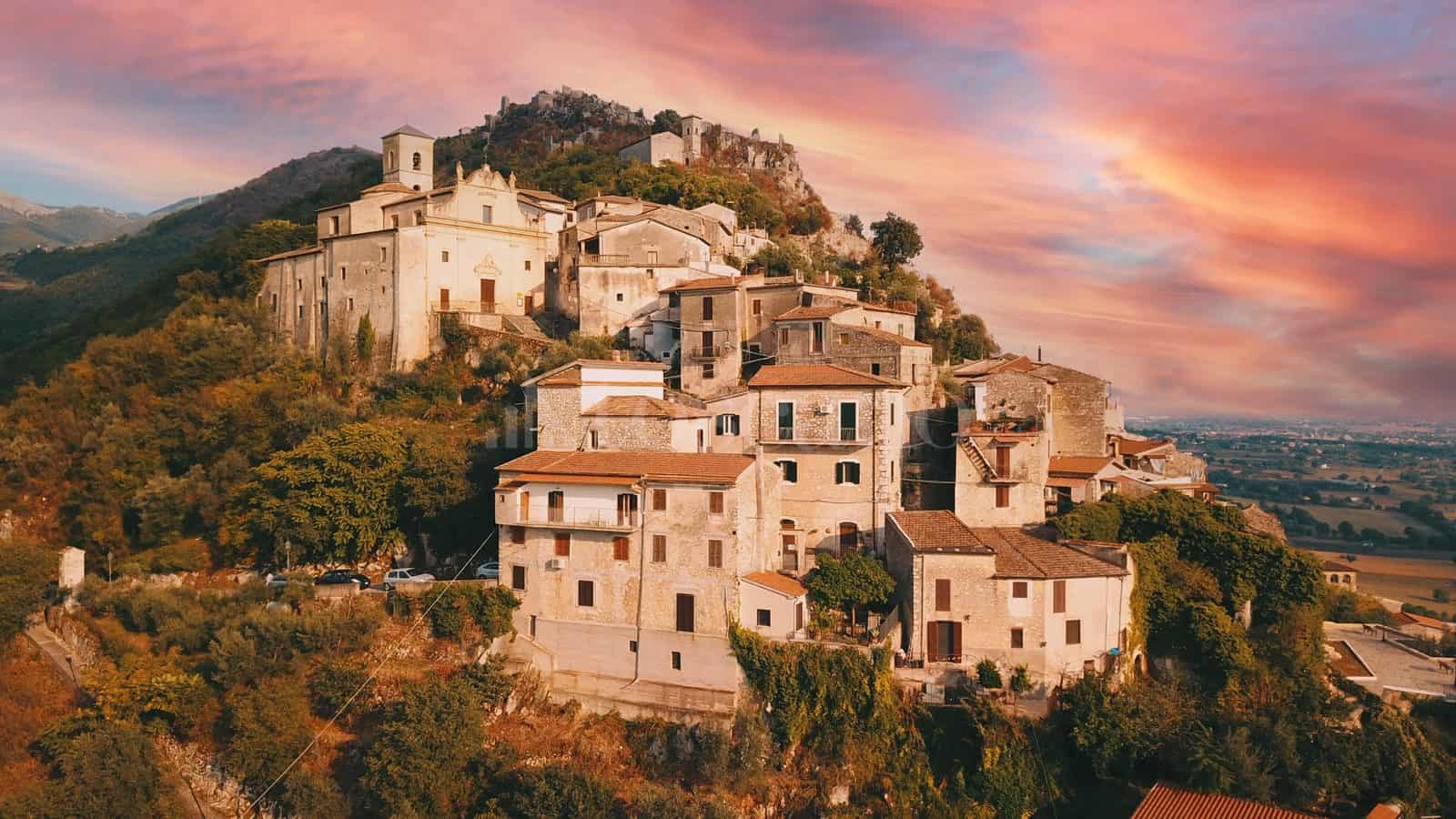
Roccasecca is in the province of Frosinone, in Ciociaria, about 130 km from Rome, which can be covered in an hour and a half on the A1 motorway (Cassino exit) or on Via Casilina. The municipality includes several hamlets: Castello, Caprile, Colle San Magno and Roccasecca Scalo, where the railway station on the Rome-Naples line (via Cassino) is located. Regional trains from Roma Termini stop at Roccasecca in about 1 hour and 45 minutes. By car from the Cassino motorway exit you drive about 12 km north on the SS6 Via Casilina. The medieval historic center occupies the slopes of Monte Asprano (553 meters), dominating the Liri Valley from a panoramic position of rare effectiveness. There is no entrance ticket for the village: visiting the medieval streets, the churches and the castle remains on foot is free. For the Monte Asprano Archaeological Park, check directly with the municipality or on the site www.visitroccasecca.it for any guided opening. Shops and workshops keep small-town hours: closed in the middle hours of the afternoon. The weekly market is held on Wednesday.
Anyone planning an itinerary in Ciociaria often starts from Aquino, where the cathedral of San Tommaso holds a relic of the Saint's heart, and reaches Roccasecca as the next stop, natural and logically consequent. From here the route widens toward Cassino and the Abbey of Montecassino, toward Arpino, the home town of Cicero, or toward Ferentino and Alatri with their mighty polygonal walls.
Roccasecca (FR): Ciociaria and the Liri Valley
Few Italian villages can claim to have given birth to a thinker able to redefine Western philosophy and theology for the centuries that followed. Roccasecca, with its just under 7,000 inhabitants spread between the hill hamlets and the industrial valley floor, carries this distinction with a composure that doesn't shout and doesn't show off. Those who arrive expecting an open-air museum devoted to Saint Thomas Aquinas are surprised: the town lives its history with the usual reserve of the Ciociaria villages, where the medieval stones of the castle and the sharp profile of the Torre del Cannone mix with daily life with the naturalness of places that are truly lived in.
The geographic position explains much of the history of the place. Roccasecca controls the mouth of two river gorges: the Melfa Gorges, which open the access to the Comino Valley, and the corridor toward the Liri. Whoever held Monte Asprano in fact held a communication hub between southern Lazio, Campania and the inner Apennine areas. This geographic centrality drew, over the centuries, the attention of different powers: Montecassino, the Normans, the Swabians of Frederick II, the Angevins, the Aragonese, the Boncompagni. Each left traces in the architecture, in the profile of the village, in local memory.
The surrounding landscape belongs to the harshest and most beautiful Apennine type: Monte Cairo acting as a scenic backdrop toward the northeast (1,669 meters), the Liri Valley stretching toward the west with its cultivated fields and ribbons of water, the Melfa Gorges cutting the limestone rock with the precision of a blade. Those coming from Campania or Rome won't find here the softness of the Sabina or the gentle panoramas of the Tuscia: Ciociaria has a harder, more tightly drawn character, with that beauty you earn by climbing and that doesn't offer itself to the first distracted glance.
To plan a trip in this area of Lazio with a professional guide, the services of TourLeaderPro for personalized experiences include itineraries off the most beaten tracks, with dedicated accompaniment also for corporate groups and small private parties.
The Castle of the Counts of Aquino and the Monte Asprano Archaeological Park in Roccasecca (FR)
The castle that dominates Roccasecca from the summit of Monte Asprano was born in 994 at the will of Abbot Mansone of Montecassino, who intended to give the abbey a defensive outpost toward the plain. The choice of the site was dictated by a pressing military logic: whoever controlled that promontory could watch over the valleys of the Liri and the Sacco and intercept movements along Via Latina. The initial construction was entrusted in part to the Aquino family, already present as vassals of Montecassino in the area between Pontecorvo and Aquino.
In the first years after the construction the castle was at the center of local struggles: Count Adenolfo III partially destroyed it in 996, but the structure was rebuilt with the addition of a cylindrical tower that would characterize the profile of the fortress for the centuries that followed. Landolfo and Rinaldo II of Aquino led the reconstruction works, establishing a very close link between their house and this mountain stronghold.
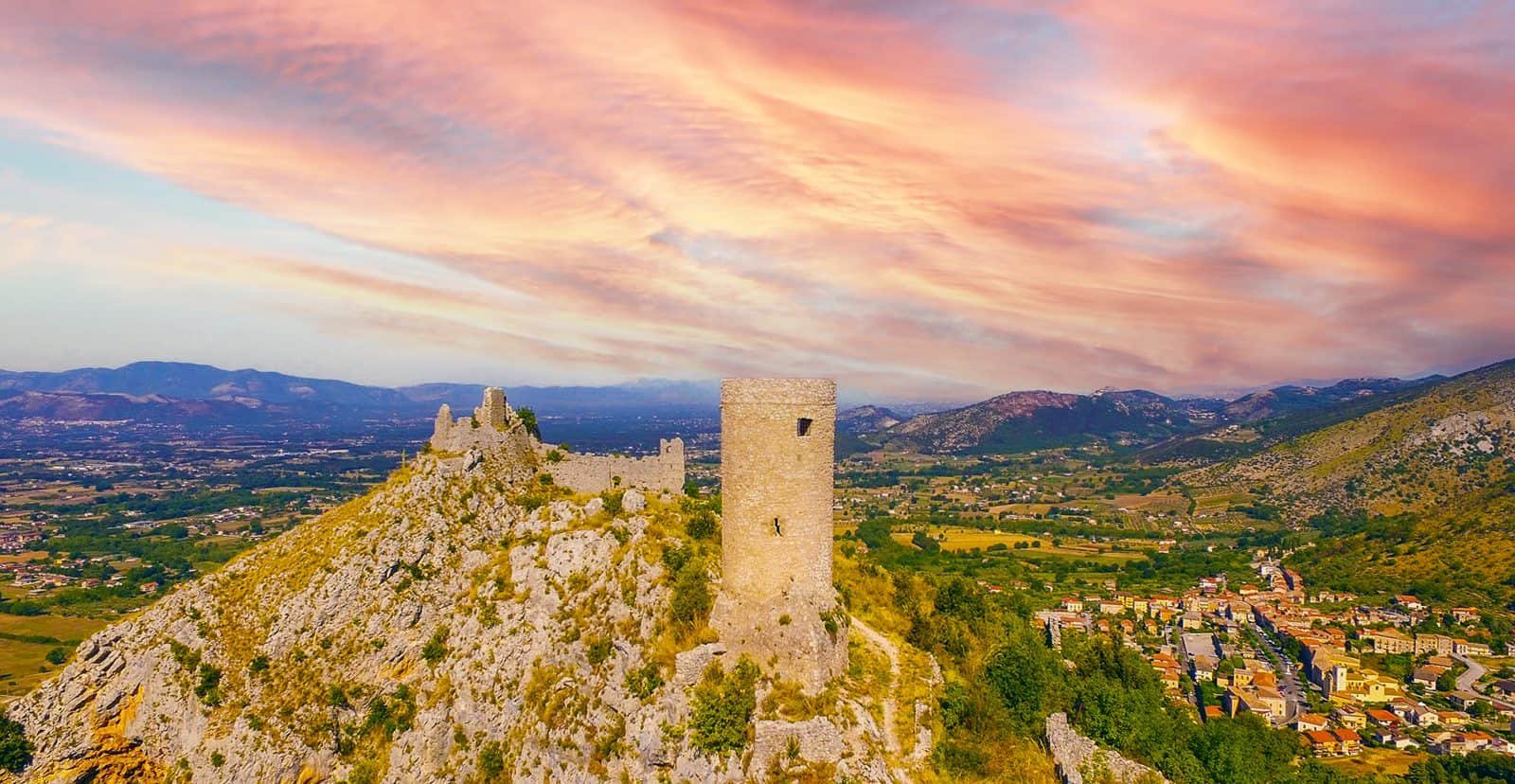
The complex visited today includes the remains of the quadrangular curtain wall with corner towers, the central keep, an internal cistern and the external Torre del Cannone. Despite the centuries of abandonment and the damage suffered during the Second World War, the structure keeps a remarkable legibility of its plan: you can still grasp the defensive logic, the arrangement of the buildings, the relationship between the keep and the corner towers. The area has been named the Monte Asprano Archaeological Park and included among the sites of greatest historical and archaeological interest in southern Lazio.
The climb to the castle through the streets of the medieval village is a visit in itself: the limestone alleys, the open-air stairs lined with ancient walls, the facades of houses that in many places incorporate medieval blocks give the sense of how the town lived in symbiosis with its fortress for centuries. It is not a reconstructed set: it is an urban fabric that time has compressed and deposited on itself, layer after layer.
The Torre del Cannone and the Imprisonment of the Young Thomas
The Torre del Cannone, tall and slender, dates from the 13th century and served as an external lookout tower relative to the castle's wall. Its current name comes from the popular tradition that has it as the seat of a medieval cannon, but the structure is much older than firearm artillery: it is a watchtower built for the visual control of the surrounding territory.
The story that local tradition associates with this tower is that of the imprisonment of the young Thomas Aquinas. In the summer of 1244, after Thomas had joined the Order of Preachers against the will of the family, his brothers captured him on Via Francigena while he was traveling to Paris with the superior of the order. Taken to Roccasecca, he was locked up, according to tradition, in this very tower, where he stayed for about a year and a half in the family's attempt to make him give up his Dominican vocation. The historical sources, in particular the Life written by William of Tocco about 50 years after the Saint's death, place the imprisonment in the family castle, without specifying which particular room. The Torre del Cannone is the location most commonly accepted by local tradition, although historians prefer caution in the precise identification.
During the period of imprisonment, according to hagiographic accounts, the family tried to convince Thomas to give up the Dominican habit even by resorting to a prostitute, whom the young man reportedly drove away with a burning brand. Thomas resisted every pressure and, freed around 1245, resumed the journey toward Paris and toward his intellectual destination.
Saint Thomas Aquinas: The Ciociaro Who Redefined Western Thought
To understand Roccasecca without understanding who Thomas Aquinas was and how he grew up in this area means grasping its geography but missing its deep meaning. The philosopher and theologian born here between 1224 and 1226 is one of the most influential thinkers in history: his Summa Theologiae has structured Catholic theology for 700 years, and his synthesis between Aristotelian philosophy and Christian theology continues to be debated in universities around half the world.
The Origins of the Aquino Family
The Aquino were a Norman family of comital rank that dominated a vast territory between southern Lazio and northern Campania, with the title of counts of Aquino. Thomas's father, Landolfo, was lord of Loreto and Belcastro, and his mother, Teodora Galluccio, belonged to a noble family of the Teano branch of the Caracciolo. Thomas was the seventh child of this couple, a position that in the family hierarchy left more room for vocational choices compared to the older brothers destined to succeed to the fiefs.
The family had deep relations with Montecassino: it owned lands in the area belonging to the abbey and had every interest in maintaining good relations with the most powerful monastic institution in the region. It was in this perspective that Landolfo decided to entrust the youngest son to the Benedictine monks of Montecassino as an oblate, around 1230, when Thomas was five or six years old.
The Years at Montecassino and Thomas's Training
The abbey of Montecassino, about 20 kilometers from Roccasecca, was then one of the most important intellectual centers of southern Italy. The Benedictine monks preserved and copied manuscripts, taught grammar, rhetoric and logic to novices and oblates, and kept relations with the great European abbeys. For the young Thomas, raised in a frontier castle, the move to Montecassino was an immersion in an intellectually stimulating environment, where books were treated with the same respect with which a feudal lord treated his weapons.
The stay at Montecassino lasted until 1239, when the tensions between Pope Gregory IX and Emperor Frederick II forced the monks to suspend teaching activities. Thomas then moved to Naples, to the university founded by Frederick II, where he studied liberal arts, philosophy and natural sciences. It was in Naples that he came into contact with the Dominicans, the mendicant order founded by Saint Dominic of Guzman in 1216, and decided to embrace its rule, a choice that would change his life and the history of philosophy.
The Imprisonment at Roccasecca and the Resistance to the Family
Thomas's decision to enter the Order of Preachers was in sharp contrast with the family plans. The Aquino had imagined for him the role of abbot of Montecassino, a position that would have guaranteed the family influence and resources without requiring the renunciation of material goods. The Dominican friars, on the contrary, were poor by choice, went on foot through the cities to preach and beg for alms, and had nothing to offer a noble family in terms of power or wealth.
When Thomas, in 1244, left with the Dominican superior toward Paris, his brothers Rinaldo and Aimo intercepted him on the road, captured him and brought him back to Roccasecca. His mother Teodora, arriving in haste from Naples, tried for a long time to convince him. According to the hagiographic sources, the imprisonment lasted between 12 and 18 months, during which Thomas devoted himself to the study of Scripture and to the Sentences of Peter Lombard, continuing to train intellectually even in physical confinement.
The release came around 1245, probably favored by the fact that Pope Innocent IV had established his seat in Avignon, making a prolonged family resistance to a religious choice approved by the Church inappropriate. Thomas resumed the journey toward Paris, where he would study under Albert the Great, the master who was the first to grasp the extraordinary intellectual capacity of his student.
Paris, Cologne and the Building of the Summa Theologiae
Thomas's intellectual biography after Roccasecca is a story of academic migrations among the most important European universities of the 13th century: Paris, Cologne, Paris again, then Orvieto, Rome, Viterbo, Naples. To Albert the Great goes the credit of having convinced his colleagues, skeptical of the stature of the young Ciociaro, nicknamed "the dumb ox" for his reluctance to speak in public. Albert reportedly said, according to tradition: "You call him a dumb ox, but one day his bellowing will fill the world."
The Summa Theologiae, his most ambitious work, remained unfinished: Thomas stopped writing in December 1273, after a mystical experience during Mass that left him unable to resume the work. Asked by a confrere why he had stopped writing, he reportedly answered: "I can't anymore. Everything I have written seems like straw to me compared to what I have seen." He died on March 7, 1274 in the abbey of Fossanova, not far from Priverno, while being transported to the Council of Lyon on commission of the Pope.
The Cult and the Intellectual Legacy of Thomas Aquinas
Canonized in 1323 by John XXII and proclaimed a Doctor of the Church in 1567 by Pius V, Thomas Aquinas is the patron of universities, students and scholars. His feast falls on January 28 (with a local celebration that in Roccasecca is organized on March 7, the date of his death). The Thomistic synthesis between reason and faith, between Aristotelian philosophy and Christian dogma, formed the backbone of medieval scholasticism and continues to be the main reference of Catholic thought toward modern philosophy.
His presence in Roccasecca is not only a historical fact: it is an identity the town carries with measured pride. The statue by Giuliano Vangi in the center of town, the annual celebrations, the name of the main church and that of many streets and squares attest how deeply rooted the figure of the Saint is in the collective memory, even among those who have nothing to do with medieval philosophy.
The Churches of Roccasecca (FR) to Visit
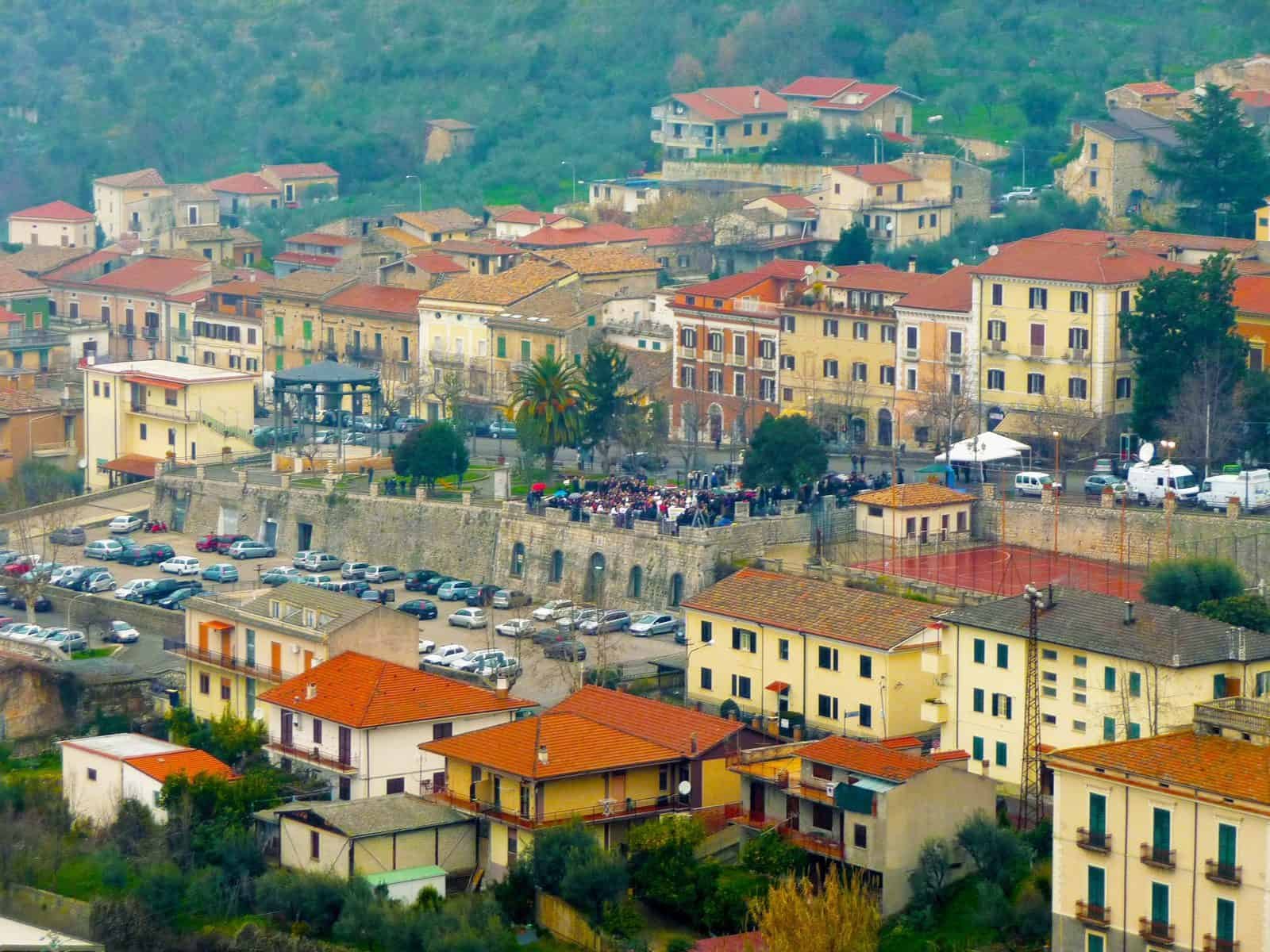
Roccasecca has an articulated and diverse religious heritage, the result of successive sedimentations running from the medieval age to the full 18th century. The churches are not concentrated in a single point of the village but spread between the historic center, the hamlets and the remains of the ancient castle layout: visiting them requires a walk that crosses the chronological levels of the town like pages of a book in stone.
The Church of San Tommaso d'Aquino in Roccasecca (FR)
Erected in 1325, in Gothic forms with a Latin cross plan, this church is the main monument of the Thomistic cult in town. The interior keeps 15th-century frescoes that document local devotion to the Saint with images of remarkable quality, set within the framework of late Gothic Ciociaria painting. The construction dates to a few decades after the canonization of Thomas (1323), a sign of how quickly the village reacted to the new glory of its illustrious son. The facade is sober and austere, following the custom of mendicant churches and their architectural heirs, without the elaborate decorations of urban cathedrals.
The Church of SS. Annunziata in Roccasecca (FR)
Built in the middle of the 15th century, the church of SS. Annunziata was raised to the rank of collegiate church in the 17th century, a recognition that reflected the demographic and social weight of the village in that period. The current facade is the result of a Baroque-style reconstruction completed around 1750: the contrast between the 15th-century origin of the church and its Baroque dress is more legible inside, where some older structures surface among the 18th-century decorations. The collegiate church is the main liturgical reference of the historic center and hosts the most important religious celebrations of the local calendar.
The Church of Santa Maria delle Grazie in the Hamlet of Caprile
Fifteenth century and located in the hamlet of Caprile, this church keeps frescoes relocated from the nearby rock church, which for conservation reasons could not keep them in situ. The transfer of frescoes from the rock setting to the walled church is a frequent case in the religious archaeology of southern Lazio, where natural cavities used as places of worship often cannot withstand the climatic conditions needed to preserve painting. The frescoes of Santa Maria delle Grazie therefore offer a window onto the medieval devotion of the area, despite the discontinuity of the original context.
The Convent and Church of San Francesco in Roccasecca (FR)
The Franciscan complex of Roccasecca is one of the most interesting architectural episodes of the town for the quality of its interior decoration. The late Baroque architecture comes with good-quality stucco work and a lighting system designed to enhance the scenographic effect of the interior. The Franciscan convents of Ciociaria often functioned as centers of cultural and charitable activity in the centuries of feudal rule: local historical research documents their role in the periods of greatest economic hardship for the rural populations.
The Hermitage and Grotto of San Michele in Caprile
The rock church dedicated to the Archangel Michael in the hamlet of Caprile belongs to the type of hermitages carved into limestone rock, widespread throughout southern Lazio and Campania as an expression of a devotion that favors isolation and withdrawal from society. The Byzantine-style frescoes kept in the hermitage include the scene of the Ascension of Christ, of notable iconographic interest for the persistence of Eastern figurative canons in an area geographically peripheral to the great centers of medieval painting. The grotto can be reached on foot from the hamlet of Caprile by a short path that crosses the vegetation of the limestone slope.

The Church of Santa Croce Fuori le Mura in Roccasecca (FR)
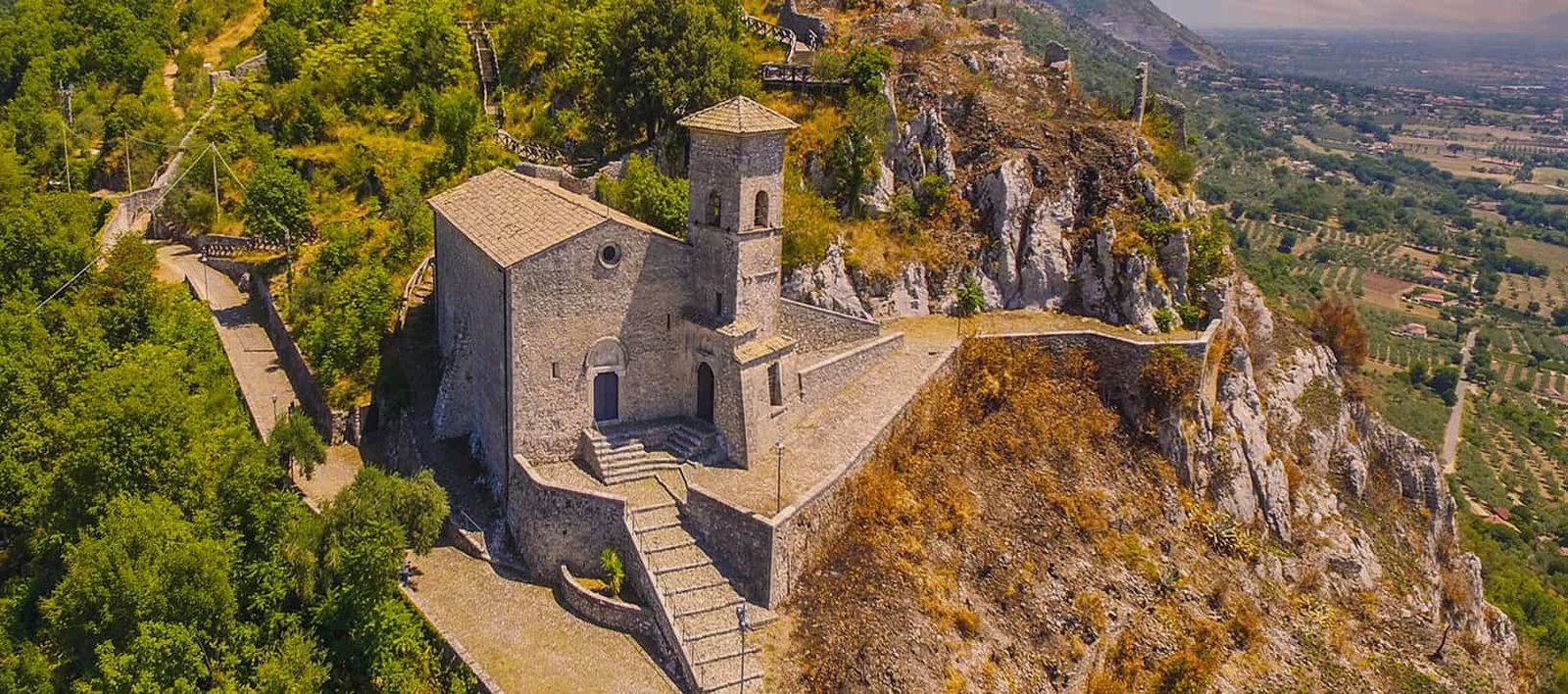
Built by the counts of Aquino as the castle church, Santa Croce Fuori le Mura occupies an isolated position relative to the compact urban fabric of the historic center. The name "fuori le mura" (outside the walls) recalls the Christian topographic tradition of cemetery churches and castle chapels built outside the residential enclosure but inside the defensive orbit of the castle. It is a building of modest size, sober in appearance, which the contact with the ruins of the surrounding castle charges with a historical evocation that written sources alone could not convey.
The Statue of Saint Thomas Aquinas by Giuliano Vangi in Roccasecca (FR)
On May 28, 2005, on the occasion of the visit of John Paul II to the diocese of Sora-Cassino-Aquino-Pontecorvo, a monumental statue dedicated to Saint Thomas Aquinas was unveiled in the center of Roccasecca, the work of the Florentine sculptor Giuliano Vangi. The work in Coreno marble (a marble quarried in the nearby Coreno Ausonio, in the province of Frosinone) reaches about 10 meters in height and offers an absolutely unconventional interpretation of Thomistic iconography.
Instead of the doctor at his lectern with pen and book, figures that dominate centuries of representation of the Saint, Vangi sculpted a Thomas "like a nimble angel," according to the artist's own description: a figure that soars upward with a dynamism almost sculptural in the most modern sense of the term, far from the solemn stillness of ecclesiastical portraiture. The choice of Coreno Ausonio as material is symbolically appropriate: a local marble, from the same land that saw the philosopher grow up, used by a contemporary artist of international fame.
Giuliano Vangi, born in 1931 in Barberino di Mugello and trained at the Academy of Fine Arts in Florence, is one of the most significant Italian sculptors of the second half of the 20th century, with works in museums and public spaces in Europe, America and Japan. The choice to entrust the Roccasecca monument to him attests the will of the local institutions not to limit themselves to devotional commemoration but to open a dialogue between the historical tradition of the place and contemporary sculpture.
The Statue of Totò and the Railway Station of Roccasecca (FR)
Near the railway station of Roccasecca Scalo is a monument dedicated to the Neapolitan comedian Totò (Antonio de Curtis, 1898-1967), unveiled in the presence of his daughter Liliana De Curtis. The presence of this monument in a Ciociaria town might seem unexpected, but it answers to logics of local identity that often cross regional borders: Totò is a heritage of southern Italy as a whole, and Roccasecca Scalo, with its station on the Rome-Naples line, was for decades a transit hub for those traveling that route.
The Melfa Gorges and the Natural Landscape Around Roccasecca (FR)
The Gorges of the Melfa River are the main natural heritage of the territory of Roccasecca and the neighboring municipalities. The Melfa rises in the Lazio Apennines and flows toward the Liri through a limestone canyon of notable depth and beauty, recognized as a Site of Community Importance (SCI) within the Natura 2000 network for the richness of the flora and fauna it hosts. The vegetation of the gorges combines woods of oak, hornbeam and maple with the rock-dwelling communities of the limestone walls, where raptors nest and botanical species of conservation interest grow.
A historic pedestrian path called "il Tracciolino" crosses the gorges linking the Liri Valley with the Comino Valley: it is a route used for centuries as a way of communication between the two valleys, before modern roads made these paths secondary. The Tracciolino is frequented today by hikers and trekking enthusiasts, who appreciate the combination of natural interest and historical value of the route. The spring and autumn months offer the best conditions for the visit: in summer the heat can be intense in the lower sections of the gorges, while in winter the path becomes slippery from humidity.
The limestone walls of Roccasecca and Caprile are also frequented by sport climbing enthusiasts, who find in this area a series of routes of varying difficulty on compact and well-structured rock. The proximity to paved roads and the presence of equipped rest stops have made these crag sectors progressively better known in the Lazio climbing scene.
The Way of Saint Benedict and the Southern Via Francigena in Roccasecca (FR)
Roccasecca holds a relevant position on two long-distance pilgrimage routes that cross central and southern Italy. It is the 15th stage of the Way of Saint Benedict, the walking route linking Norcia (home town of the founder of the Benedictine order) with Montecassino, and the 8th stage of the Southern Via Francigena, the route that leads from Rome to Santa Maria di Leuca through Campania, Basilicata and Puglia.

The Way of Saint Benedict is a route of about 600 kilometers linking two of the most important places of Benedictine spirituality. Passing through Roccasecca adds a further dimension to the walk: the pilgrim who covers this stage moves through a landscape that saw Thomas Aquinas grow up and that served as backdrop to the Norman and Swabian history of southern Lazio. The approach to Montecassino, which can already be glimpsed from the heights of Roccasecca, prepares you for the destination with a scenic progression hard to forget.
The Southern Via Francigena, less known than its northern namesake but no less interesting from the historical and scenic point of view, crosses the Liri Valley touching centers of notable interest such as Arpino, Cassino and, of course, Roccasecca. The stretch between Arpino and Roccasecca is among the most beautiful of the southern Lazio Via Francigena, with panoramas over the Liri Valley and the mountains of the Molise-Campania Apennines that in the colder months show the snowy peaks of the Meta massif.
For those who intend to walk these routes with professional accompaniment providing logistical and cultural support, TourLeaderPro offers professional tourist services also for walking itineraries in the Lazio and Campania region.
The History of Roccasecca (FR): From Prehistoric Origins to Postwar Reconstruction
The Origins and the Roman Period
The territory of Roccasecca preserves traces of settlement since prehistoric times. The geographic conditions of the site, with visual control of the valleys and the availability of water from the Melfa River, were favorable to human settlement even before the arrival of the Romans. In the Roman age the area was crossed by Via Latina, one of the main arteries linking Rome and southern Italy, which ran deeper in the valley than the present Via Casilina. The territory was called "Pagus" of the ancient Volsci, an Italic people that the Romans had progressively integrated into their system of alliances and conquests.
The medieval settlement was born from the movement of the inhabitants of the valley-floor localities toward the heights, a trend common throughout southern Italy between the 6th and the 10th century: the presence of Lombard and then Saracen raiders made the plains unsafe and pushed the rural populations to seek shelter in elevated positions more easily defended.
The Normans, the County of Aquino and the Founding of the Castle
The arrival of the Normans in southern Italy during the 11th century brought a deep reorganization of the feudal system of the area. The Battle of Civitate (1053), in which the Normans defeated the papal forces, and the later conquest of southern Italy by Robert Guiscard laid the foundations of a kingdom that would radically transform the political structure of the region. The counts of Aquino, already vassals of Montecassino, slotted into the new system of alliances while keeping control of the castle of Roccasecca and the surrounding territories.
In 1139 the Peace of San Germano sanctioned the Norman victory of Roger II and accelerated the decline of the autonomy of the county of Aquino, which nonetheless remained an important feudal structure until the second half of the 13th century. The Aquino navigated skillfully among the different factions in conflict: Swabian emperors, Roman popes, Norman kings, finding from time to time the balances necessary for the survival of their territorial patrimony.
Frederick II and the Swabian Age in Roccasecca (FR)
Frederick II of Swabia, the emperor who had founded the University of Naples where the young Thomas would study, was a figure well known in the lands of Ciociaria. His campaigns in southern Lazio and Campania led him several times to cross the Liri Valley, and local tradition recalls his presence in the Roccasecca area during the military operations of the 13th century. The siege of 1197, by Henry VI of Swabia, father of Frederick, had already tested the defenses of the castle, which had held out thanks to the natural strength of the position.
Frederick II was a sovereign of encyclopedic culture, protector of philosophers and scientists, and it is significant that the young Thomas spent part of his training (in Naples, in the imperial university) in the same cultural context that the Great Frederick had helped to create. The link between the Aquino family and the Swabian emperor was, moreover, also political: the Aquino were faithful vassals of the imperial crown in a territory contested between papal power and lay power.
The D'Avalos and the Boncompagni: The Long 16th and 17th Centuries
With the marriage between Antonella d'Aquino, last heir of the male line of the family, and Inico d'Avalos, the castle and the fiefs of Roccasecca passed in the second half of the 15th century to the d'Avalos family, of Catalan origin and protagonists of the Aragonese season in the Italian South. The d'Avalos were patrons and soldiers of rank: Captain Alfonso d'Avalos, marquis of Vasto, was one of the commanders of Charles V in the Italian wars of the 16th century.
In 1583 Roccasecca was sold to Duke Giacomo Boncompagni, illegitimate son of Pope Gregory XIII. The Boncompagni had extensive landholdings in Lazio and central Italy, and the purchase of Roccasecca fit into a strategy of consolidating the family's territorial patrimony. The town lived under Boncompagni control until the end of the feudal system, enjoying a relative stability compared to the previous centuries, although 18th-century accounts document the harshness of living conditions for peasant families: illness, drought and excessive taxes marked many periods of that century.
The 19th Century: The Risorgimento, the Brigands and Emigration from Roccasecca (FR)
The 19th century was for Roccasecca a period of intense and not always linear transformations. Napoleonic and then Carbonari ideas circulated in Ciociaria too, producing episodes of rebellion and repression that local chronicles document in some detail. Italian unification in 1860 produced contradictory effects: the end of the feudal system and of the Papal States opened new spaces of autonomy, but the question of post-unification brigandage heavily involved the whole area between southern Lazio and Campania, with bands of rebels using the Ciociaria mountains as an operating base.
Emigration became progressively the prevailing answer to the lack of economic prospects: first toward the industrial North, then toward North and South America. The remittances of emigrants helped change the economic face of Roccasecca over the course of the 20th century, in parallel with the industrial development of the Liri Valley.
The Second World War in Roccasecca (FR)
The geographic position of Roccasecca, with its railway station on the Rome-Naples line and the bridge over the Melfa, made it a military target of primary importance during the Italian campaign of 1943-1944. The German XIV Panzer Corps, commanded by General Frido von Senger und Etterlin, set up its headquarters in the area during the defense of the Gustav Line, the German defensive system that crossed the Italian peninsula at the height of Cassino.
The Allied bombings were continuous and devastating. On October 23, 1943 the station of Roccasecca Scalo was hit by an air raid of particular intensity that caused civilian casualties and enormous damage to the infrastructure. The postwar reconstruction occupied the town for all the 1950s, with recovery work that did not always favor the conservation of the historic heritage over immediate housing needs.
On September 14, 1974, on the seventh centenary of the death of Saint Thomas Aquinas, Pope Paul VI visited Roccasecca, an event that stayed imprinted in the town's collective memory as a moment of international recognition of the bond between the village and its illustrious fellow citizen.
Ciociaria Gastronomy in Roccasecca (FR) and the Surroundings
The cooking of Roccasecca belongs fully to the Ciociaria gastronomic tradition, one of the most genuine in Lazio: poor out of historical necessity, rich in the quality of its ingredients, anchored to local products that modern markets have struggled to homogenize. The territory of the Liri Valley produces good-quality raw materials: grains, legumes, garden vegetables, locally raised meats, pecorino cheeses.
Among the most representative dishes of the local gastronomy we find trippa alla ciociara, cooked with tomato, pecorino and marjoram in proportions that vary from one town to another in the area. Turnip soup, a winter dish of great simplicity and flavor, based on the brassica rapunifolia grown in the fields of the valley. Fried broccoli, served as an appetizer or side dish with vinegar and garlic. The roasted "gliù iammonceglie," a Ciociaria dialect term for a cut of pork prepared according to traditional recipes. Fresh pasta, in particular potato gnocchi, is the protagonist of the Sagra degli Gnocchi held in August, which draws visitors from all over Ciociaria.
The dairy products of the area deserve attention: the Ciociaria pecorino, made with milk from sheep raised on the Apennine pastures, has an aging and a flavor that vary depending on the production area. The chestnuts of the mountain areas and the extra virgin olive oil of the hills are other characteristic elements of the Ciociaria pantry. The local wine production doesn't have the reputation of the Castelli Romani, but the red wines of the area, made mainly from native Lazio varieties, have a character and an identity of their own.
For those who want to explore the gastronomy of southern Lazio and Ciociaria in a cultural and tourist key, the guides of ItalyPlanner.com offer a reference point for international travelers who want to discover this region beyond the standardized routes.
Festivals, Sagre and Traditions in Roccasecca (FR)
The festive calendar of Roccasecca mixes religious devotion, agricultural memory and popular culture with the naturalness typical of small Italian towns where these spheres were never completely separate. Each season has its own occasions, and the community lives them with an intensity that the festivals of larger centers, organized for an outside audience, hardly reach.
On March 7, the date of the death of Saint Thomas Aquinas (the liturgical feast, after the reform of the Roman calendar, falls on January 28), the town celebrates its patron saint with religious ceremonies and cultural events. The anniversary is an occasion for lectures, book presentations and initiatives that keep alive the dialogue between the local historical tradition and contemporary philosophical and theological thought.
On April 29 Saint Peter Martyr, the main patron saint of the municipality, is celebrated with the traditional procession that winds through the streets of the historic center. Easter brings the Canoe Rally della Malfa (or Melfa), a sports event on the river that has gained a certain reputation in river canoeing. Summer brings the Sagra degli Gnocchi (August), followed by the evenings of the Festival Musicale "Severino Gazzelloni" of classical music, dedicated to the famous flutist from Roccasecca who reached international fame. The Gazzelloni Festival, held between late August and early September, attracts musicians and enthusiasts of national level and helps put Roccasecca on the map of Italian chamber music.
Reenactments of peasant traditions form another strand of the festive calendar: "Comme 'na vota" is a celebration of reaping and threshing with traditional methods, while "Le cantine de 'na vota" (first Saturday of September) reopens the historic cellars of the village for tastings and informal gatherings. The Sagra del Broccolo in December closes the year with a tribute to the garden product most representative of the winter Ciociaria tradition. The weekly Wednesday market keeps alive the function of exchange and meeting that has characterized the villages of this valley for centuries.
How to Get to Roccasecca (FR) from Rome and from the Rest of Italy
By car from Rome: take the A1 motorway (Autostrada del Sole) toward Naples to the Cassino exit, then take the SS6 Via Casilina north for about 12 kilometers. Alternatively you can take Via Casilina for the whole stretch without the motorway, with a longer travel time but no toll. The historic center of Roccasecca Castello can be reached by car as far as the parking areas at the foot of the medieval village. The inner streets are narrow and in many stretches pedestrian.
By train: the Roccasecca station is on the Rome-Naples railway line via Cassino (not the high-speed one, but the historic line). Trenitalia runs regional trains from Roma Termini with a frequency of about two runs an hour at peak times and travel times of about 1 hour and 45 minutes. From the Roccasecca Scalo station the historic center of Roccasecca Castello is reached by local transport or on foot (about 3 kilometers with an elevation gain of a few hundred meters: the walk is pleasant but demanding).
For those coming from Naples, the Cassino station (reachable in about 45 minutes) is a convenient starting point for getting to Roccasecca. From Fiumicino airport you can take the direct train to Roma Termini and then the regional to Roccasecca, with a total time of about 2 hours and 30 minutes.
What to See Near Roccasecca (FR): An Itinerary in Ciociaria
Roccasecca fits naturally into a wider itinerary exploring Ciociaria and the Liri Valley. A few kilometers away are Aquino, with the cathedral where a relic of the heart of Saint Thomas is kept. Cassino, with its Archaeological Park and the Mausoleum of Ummidia Quadratilla. And of course the Abbey of Montecassino, the Benedictine monastery founded by Saint Benedict in 529 and rebuilt after the wartime destruction of 1944.
Moving north you reach Arpino, the town that gave birth to Marcus Tullius Cicero and that keeps one of the most imposing polygonal-work circuits of walls in Lazio, with the pointed gate dominating the medieval village. Farther on, Ferentino and Alatri offer equally spectacular examples of pre-Roman defensive architecture, with acropolises and cyclopean walls in extraordinary condition. Anagni, finally, with its cathedral and the frescoed crypt of Bishop Boniface VIII, is one of the jewels of Lazio Romanesque.
Those who want to widen their range of exploration can reach Isola del Liri, where the Liri waterfalls drop in the middle of the town with a spectacular effect. San Donato Val di Comino, a medieval village among the best preserved in Ciociaria. And Collepardo, with the Grotte dei Bambocci and the Certosa di Trisulti. Toward central Lazio, Fumone offers a papal castle of great historical interest, while Fiuggi and its thermal waters are a stop for wellness and relaxation.
For a longer itinerary extending toward coastal Lazio, Priverno with the Abbey of Fossanova (where Saint Thomas Aquinas died in 1274) and Sermoneta with its Caetani castle complete a route that crosses southern Lazio in all its historical depth. Those looking for the silence of monasteries find in Subiaco the sacred Benedictine hermitages where Saint Benedict began his ascetic experience before founding Montecassino.
A Curiosity About Roccasecca (FR)
The curiosity that very few people know concerns the very name of the municipality. "Roccasecca" does not derive, as one might think, from the presence of a particularly arid rock or from the dry climate of the area. The name is almost certainly of medieval origin and describes a specific feature of the promontory on which the castle stands: the limestone rock of Monte Asprano has a stratification that makes it "dry" in the sense of draining, that is, unable to hold rainwater, which filters quickly into the cracks of the limestone and feeds the springs farther downstream. A rock that forms no mud and holds no moisture on the surface was, in the Middle Ages, a synonym of solid and reliable ground for building a fortress.
The same toponymic root recurs in dozens of places in central-southern Italy where limestone geology dominates the landscape: Roccasecca is one of the best-known cases, but the family of place names is much wider. The locals, obviously, don't think of these etymologies when they use the name of their own town. But knowing where a name comes from changes the way you look at the rock on which that town is built.
Another lesser-known curiosity: the musician Severino Gazzelloni (1919-1992), considered the greatest Italian flutist of the 20th century and one of the leading exponents of contemporary flute music internationally, was born right in Roccasecca. Gazzelloni was the dedicatee of works by composers such as Luciano Berio, Bruno Maderna and Karlheinz Stockhausen, and collaborated with the most important European orchestras. The festival named after him, held every year in Roccasecca at the end of summer, is the main tribute of this community to an illustrious son perhaps less celebrated than Thomas Aquinas, but just as significant for Italian culture of the 20th century.
Something Nobody Tells You About Roccasecca (FR)
The hagiographic tradition tells that during the imprisonment in the family castle, Thomas's brothers tried to make him give up his Dominican vocation by bringing into his room a young woman of doubtful reputation, intending to make him yield to the temptation of the flesh. Thomas, according to the Life written by William of Tocco, took a burning brand from the fireplace and drove her away. So far the story is known, at least in ecclesiastical and philosophical circles.
What is never mentioned is that, after this episode, Thomas fell into a deep sleep and dreamed of two angels who girded his loins with a cord, as a sign of chastity conferred by God. He woke up crying out and, from that moment, never felt carnal temptations again, according to the hagiographic sources. The cord of the angels became a recurring symbol in the medieval iconography of the Saint, and the term "angelic girdle" appears in several hagiographic texts as a reference to this episode. Very few guides and very few popular texts on Roccasecca mention this detail, which however is fundamental to understanding the construction of the Saint's public image in the Middle Ages.
There is also a practical fact that almost no visitor knows: the Roccasecca Scalo railway station is on the valley floor, several kilometers and several hundred meters of elevation below the historic center of Roccasecca Castello. Those who arrive by train expecting to be a step from the medieval village find themselves instead in the industrial plain of the Liri Valley, with a demanding climb ahead of them. Whoever plans the visit should take this into account and arrange either local transport or about an hour on foot along an asphalt road.
The Advice I Give You for Visiting Roccasecca (FR)
The main advice is this: don't limit yourselves to a quick visit of the historic center and the Vangi statue. These two things can be seen in under an hour and risk leaving the feeling of a place of local color but not essential. Roccasecca becomes a truly interesting place when you approach it with the time needed to climb to the castle, to grasp the defensive logic of the fortress, to stop in the churches and really look at the frescoes, to walk the Tracciolino along the Melfa Gorges.
The best time to visit the historic center is early morning, before the heat becomes excessive in the summer months and before local traffic monopolizes the narrow streets of the village. The castle and the Torre del Cannone are reached on foot from the historic center with a climb of about 20 minutes on a cobbled path: bring comfortable shoes and water, especially in summer. The castle remains can be visited, but the structures are partly in ruins and call for the normal caution required at any archaeological site that is not fully set up.
For those who want to combine the visit to Roccasecca with a wider cultural experience, I recommend pairing the town with Aquino (the cathedral with the relic of Thomas's heart) and Montecassino (the abbey where the Saint studied as a child): the Aquino-Roccasecca-Montecassino triangle makes a half-day itinerary with an extraordinarily coherent narrative thread, that of the formation and thought of the greatest Italian medieval philosopher. If you have time, add Arpino in the afternoon: the pointed gate of the pre-Roman wall circuit deserves the time to see it in the right light.
For those traveling with children, the Melfa Gorges and the Tracciolino route are suited to older kids (from 10 years up) who can walk on uneven ground. Smaller children are more comfortable in the historic center and in the square with the Vangi statue, which usually catches their attention for its size and for the unusual representation of the Saint.
Another Well-Known Fact, Yet Rarely Mentioned
Everyone knows that Thomas Aquinas was born in Roccasecca. Very few dwell on the fact that the town where the greatest synthesizer of Aristotle and Christian theology was born is only about 20 kilometers from the town where Aristotle was taught in southern Italy before the European scholastic tradition absorbed him definitively: the University of Naples founded by Frederick II (1224), where Thomas studied between 1239 and 1244, was in that period one of the few centers in Italy where the Latin translation of Aristotle from the Arabic translation was read and taught systematically.
The fact that Thomas studied Aristotle in Naples, that he then applied Aristotelian tools to Christian theology under the guidance of Albert the Great in Paris and Cologne, and that this synthesis came about through a man raised in the mountains of Ciociaria, not far from the abbey of Montecassino and from the Benedictine monasteries that had preserved ancient wisdom for centuries, is one of those historical chains that is hard to believe is accidental. The intellectual geography of 13th-century Italy passes through Roccasecca more directly than most manuals of the history of philosophy let on.
Another well-known fact but rarely valued: Severino Gazzelloni, the world-famous flutist born in Roccasecca, was the first to perform publicly many of the postwar masterpieces written for flute, including Luciano Berio's Sequenza I (1958), a work that redefined solo flute technique in the 20th century. The link between Gazzelloni and the composers of the European avant-garde is documented by many writings and recordings, but in Roccasecca this aspect is often overshadowed by the cumbersome presence of Saint Thomas. The two illustrious fellow citizens are not comparable in historical weight, but both represent a tendency of the Ciociaria area to produce intellectually significant figures in very different fields.
The Right Photo to Take in Roccasecca (FR)
The photo you won't find in traditional guides, the one that is worth the climb, is taken from the base of the Torre del Cannone looking west in the light of late afternoon: the Liri Valley stretches out beneath you like an animated map, with cultivated fields that change color with the season, the ribbons of road cutting the valley floor and, on clear days of autumn or spring, the profiles of the Lazio and Campania mountains overlapping on the horizon in successive gradations of blue and gray.
The statue by Giuliano Vangi is best photographed in morning light, when the sun lights the Coreno marble from the right side and the contrast between the pale stone and the blue sky is sharper. In the afternoon the statue is often backlit by the sun sinking toward the west, which produces a different effect but a less legible one in standard photography. If you want a photo with the statue and the landscape in the background, move to the north side of the square and look for the angle that includes both the figure and the roofs of the medieval village.
For medieval villages, the classic advice holds here too: cobbled streets are best photographed in the middle hours of the morning, when the oblique light creates shadow and contrast between the stones and the facades. The entrance to the Church of San Tommaso d'Aquino offers an interesting vertical perspective if photographed from bottom to top, bringing out the Gothic sobriety of the facade.

Some Important Events That Happened Here in History
The history of Roccasecca is marked by episodes that, in the small space of a mountain village, reflect the great dynamics of medieval and modern power.
In 994, the year of the founding of the castle at the will of Abbot Mansone of Montecassino, Roccasecca entered documented history as a military border outpost. Already in 996, two years later, the castle was destroyed and partly rebuilt: a stormy beginning that announced the centuries of conflicts that would characterize the site.
In 1197 Emperor Henry VI of Swabia besieged the castle without managing to take it: the position of Monte Asprano was evidently stronger than medieval means of assault. The episode is documented in the chronicles of the time and illustrates the strategic relevance of the site in a period of intense conflicts between the papacy and the empire.
In 1244 came the capture of the young Thomas Aquinas by his brothers, an event that, as we have seen, would have incalculable consequences for the history of Western philosophy. It is no exaggeration to say that the period of imprisonment at Roccasecca was, paradoxically, one of the most formative periods of the Saint's intellectual life: forced into physical immobility, Thomas devoted himself to study with an intensity he could not have kept up during the frenetic travels of the Dominican novice.
In 1414 the castle and the fief of Roccasecca were at the center of the disputes between Queen Joanna II of Naples and her opponents, a period of political instability that cost Ciociaria decades of looting, requisitions and famines. Roccasecca changed hands several times in those years, passing between Angevin, Aragonese and papal forces without ever finding a lasting balance.
On September 14, 1974 Pope Paul VI visited Roccasecca to commemorate the seventh centenary of the death of Saint Thomas Aquinas. The papal visit was an event of national scope that drew to the small Ciociaria village pilgrims and authorities from all over Italy, confirming Roccasecca's place in the religious and cultural geography of Italian Catholicism.
The Gazzelloni Festival, in its first edition, brought to Roccasecca musicians and composers who had collaborated with the flutist during his international career: a cultural event that fit into the groove of the town's intellectual tradition with a modern look and open to dialogue with the European musical avant-garde.
Who Passed Through Roccasecca (FR)
By far the most important figure among those who passed through Roccasecca is, obviously, Thomas Aquinas himself, who was born here around 1224-1226 and spent his first years of life here before being sent as an oblate to Montecassino. He returned, as a prisoner, in 1244, and stayed for about a year and a half. Two very brief stays compared to a life spent between Naples, Paris, Cologne, Orvieto, Rome and Viterbo. And yet decisive in determining the character and vocation of one of the greatest European thinkers.
Emperor Frederick II of Swabia crossed the Liri Valley several times during his campaigns in southern Italy. Medieval chronicles document his presence in the Cassino area and in the border zone between Lazio and Campania, although it cannot be stated with certainty that Frederick entered Roccasecca in person. His predecessor Henry VI, instead, brought his army here in 1197 for the documented siege of the castle.
Pope Paul VI, Giovanni Battista Montini, visited Roccasecca on September 14, 1974. He was the second pontiff to visit Ciociaria for reasons tied to the cult of Saint Thomas, after Pius XII who in 1943 had gone to Aquino. Paul VI's visit was warm and followed by an enormous crowd: the pope stayed a long time in the main square and celebrated an open-air Mass.
Severino Gazzelloni (1919-1992) did not "pass through" Roccasecca: he was born here and spent his childhood before leaving for Rome and then for the stages of Europe. His figure belongs to the history of the town as much as that of Thomas Aquinas, although on a very different chronological and geographic scale. Gazzelloni was known and esteemed by Leonard Bernstein, Pierre Boulez, Igor Stravinsky and all the main composers of the European postwar period.
The pilgrims of the Way of Saint Benedict and of the Southern Via Francigena pass through Roccasecca today in growing numbers: a form of modern pilgrimage that adds to the history of the village a contemporary chapter made of backpacks, boots and travel notebooks. Those who walk these routes bring with them a curiosity and an openness to encounter that combine well with the dense and layered history of this corner of Ciociaria.
Quick Questions About Roccasecca (FR)
Where exactly is Roccasecca?
Roccasecca is in the province of Frosinone, in southern Lazio, in the Ciociaria area, about 130 km from Rome and 30 km from Cassino. The medieval historic center (Roccasecca Castello) occupies the slopes of Monte Asprano at an altitude of about 370 meters, while the railway station (Roccasecca Scalo) is on the valley floor a few kilometers away.
Is Roccasecca really the birthplace of Saint Thomas Aquinas?
Yes, Thomas Aquinas was born in Roccasecca around 1224-1226, according to the most credited medieval historical sources. There is an alternative tradition that places his birth at Belcastro in Calabria, but modern historiography is largely oriented toward Roccasecca, consistent with the fact that the Saint's father, Landolfo d'Aquino, was lord of this area of Ciociaria.
How do you get to Roccasecca from Rome?
By car you take the A1 motorway to the Cassino exit, then the SS6 Via Casilina north for about 12 km: the travel time is about 1 hour and 30 minutes. By train from Roma Termini you take the regional to Cassino (historic line, not high speed): the trip takes about 1 hour and 45 minutes. From the Roccasecca Scalo station to the historic center of Roccasecca Castello it takes about 30-40 minutes on foot or a local transport service.
How much time does it take to visit Roccasecca?
For a quick visit to the historic center and the Vangi statue, a couple of hours are enough. For a complete visit including the castle, the main churches, the Melfa Gorges and the hamlet of Caprile with the hermitage, count on at least half a day, better a full day.
Is there an entrance ticket to visit Roccasecca?
The walk in the historic center and the outside visit of the castle and the churches is free and without charge. For any guided visits to the Monte Asprano Archaeological Park, check the terms and costs on the website of the municipality or the local tourist office, since access conditions may vary.
What do you eat in Roccasecca and in Ciociaria?
Ciociaria gastronomy is based on good-quality local products: fresh pasta (gnocchi, sagne), soups of legumes and vegetables, trippa alla ciociara, lamb and pork with traditional recipes, pecorino cheeses, fried broccoli and garden products. The restaurants of the town and the surroundings offer this cooking with a generally favorable quality-to-price ratio.
When is the feast of Saint Thomas Aquinas held in Roccasecca?
The main celebrations are held on March 7, the date of the Saint's death, although the liturgical feast in the reformed Roman calendar is January 28. The initiatives include religious ceremonies, cultural lectures and public events that vary from year to year: check the program on the municipality's website.
Is the Gazzelloni Festival still held in Roccasecca?
The Festival Musicale "Severino Gazzelloni" is traditionally held between late August and early September. For updated programs and the dates of the current edition, consult the municipality's website or the pages of the local cultural associations.
Can the Melfa Gorges be visited all year round?
The Melfa Gorges can be walked for most of the year, but the best conditions are found in spring (May-June) and autumn (September-October). In summer the heat in the lower sections can be intense. In winter the damp limestone walls make the path slippery. Check the weather conditions before setting out on the Tracciolino.
Is Roccasecca suitable for visitors with children?
Older children (from 10 years up) find engaging experiences in the castle and on the Tracciolino. For smaller children the historic center and the square with the Vangi statue are accessible and interesting. The morphology of the village, with steep climbs and cobbled paving, calls for comfortable footwear and attention for strollers.
Is there parking in Roccasecca for those arriving by car?
There are parking areas at the foot of the historic center of Roccasecca Castello. The inner streets of the medieval village are narrow and in many points pedestrian, so you need to leave the car in the indicated areas before climbing on foot.
Which other villages of Ciociaria are worth visiting together with Roccasecca?
Among the most interesting in the area: Aquino (cathedral with relic of Saint Thomas), Arpino (pre-Roman polygonal walls and home town of Cicero), Ferentino and Alatri (megalithic acropolises), Anagni (Romanesque cathedral with frescoed crypt), Isola del Liri (waterfalls in the town center), San Donato Val di Comino (well-preserved medieval village), Collepardo (caves and the Trisulti charterhouse). For those who want to combine Ciociaria and the Lazio coast, Priverno with the Abbey of Fossanova and Sermoneta complete an itinerary of great historical density.
What is the link between Roccasecca and Montecassino?
The link is historical and direct. The castle of Roccasecca was founded in 994 by the abbot of Montecassino as a defensive outpost. The Aquino family was a vassal of Montecassino. The young Thomas was sent as an oblate to Montecassino around 1230. Today Roccasecca is the second-to-last stage of the Way of Saint Benedict, which ends precisely at Montecassino. The distance between the two places is about 20 km, which can be covered by car in under half an hour or on foot in a half-day trek.
Are there places to stay in Roccasecca?
The accommodation offer in Roccasecca is limited compared to the large tourist centers: there are a few bed and breakfasts and agriturismi in the area. For a wider choice of lodging it is better to turn toward Cassino or the better-equipped places of the Liri Valley. Check availability on the main booking portals with enough advance, especially in summer and in the periods of the local festivals.
Where can I find updated information on visiting Roccasecca?
The main reference point is the official website of the municipality. For itineraries in Ciociaria and southern Lazio in English, the guides of ItalyPlanner.com offer a useful perspective for international visitors. For private tours with a professional guide in the southern Lazio area, TourLeaderPro organizes tailor-made experiences for groups and individuals.
Is Saint Thomas Aquinas still venerated in Roccasecca today?
Yes, devotion to Saint Thomas is alive in the religious and cultural fabric of the town. The main church bears his name, the annual cultural festival of March 7 commemorates him, and the statue by Giuliano Vangi in the central square is a visual and symbolic reference point for the whole community. The Saint is the patron of universities and students, and in Roccasecca this identity is celebrated with a pride that goes beyond simple religious devotion.
Is it possible to visit Roccasecca in a day from Rome?
Yes, one day is enough for a satisfying visit, especially if you arrive early in the morning. Those who use the train have the advantage of not having to worry about parking, but must allow for the transfer from the station to the historic center. A combination of a visit to the medieval village, the castle, the main churches and a local gastronomic stop is comfortably done within a single day, with return to Rome in the late afternoon.
What is the Monte Asprano Archaeological Park in Roccasecca?
It is the official name given to the area of the castle of the Counts of Aquino and its surroundings, recognizing the historical and archaeological value of the medieval complex. The park includes the remains of the quadrangular curtain wall, the corner towers, the keep, the internal cistern and the external Torre del Cannone. It is one of the historical-archaeological sites of greatest interest in southern Lazio for the documentation of medieval feudal life in the Norman and Swabian area.
When is the best time to visit Roccasecca?
Spring (April-June) and autumn (September-October) are the best periods for the climate, for the quality of the photographic light and for the condition of the trails in the Melfa Gorges. August brings the sagre and the music festival, but the heat is intense and the village can be more crowded than usual. Winter has its charm on sunny days, when the landscape with snowy mountains in the background is particularly scenographic.
How do you organize a guided visit in Roccasecca and in Ciociaria?
For professional guided visits in the area, with an expert guide who knows the history of the territory and the Thomistic philosophical heritage, the services of TourLeaderPro include personalized itineraries for groups, companies and VIPs who want to explore southern Lazio with a culturally prepared guide.
Roccasecca deserves the time of those willing to look deeper than ordinary guides push you to do. It is a village that has history in its bones and restraint in its character, and that rewards curiosity without sitting on its laurels waiting for it. The coincidence of having given birth to the greatest synthesizer of medieval theology and to the greatest Italian flutist of the 20th century, in a village of 7,000 souls among the Ciociaria mountains, says something hard to explain about the relationship between place and human genius. It is not a postcard formula: it is a fact that invites thought.
Article written by the editorial team of TourLeaderPro, contact them for Private/Corporate/V.I.P. Tours and Experiences.
Planning a trip to Rome? The English-language guides to visiting the city are on ItalyPlanner.com.